January 7-8, 2009
Air Temperatures – The following maximum temperatures were recorded across the state of Hawaii Wednesday afternoon:
Lihue, Kauai – 76
Honolulu, Oahu – 81
Kaneohe, Oahu – 77
Kahului, Maui – 80
Hilo, Hawaii – 77
Kailua-kona – 80
Air Temperatures ranged between these warmest and coolest spots near sea level, and on the highest mountains…at 4 p.m. Wednesday afternoon:
Honolulu, Oahu – 79F
Molokai airport – 74
Haleakala Crater – 52 (near 10,000 feet on Maui)
Mauna Kea summit – 36 (near 14,000 feet on the Big Island)
Precipitation Totals – The following numbers represent the largest precipitation totals (inches) during the last 24 hours on each of the major islands, as of Wednesday afternoon:
0.69 Mount Waialaele, Kauai
0.93 Oahu Forest NWR, Oahu
0.04 Molokai
0.00 Lanai
0.05 Kahoolawe
0.72 Puu Kukui, Maui
0.49 Pahoa, Big Island
Weather Chart – Here’s the latest (automatically updated) weather map showing high pressure systems to the northeast of the Hawaiian Islands…keeping the trade winds blowing one more day. Winds will shift to the southeast on Friday, and become lighter.
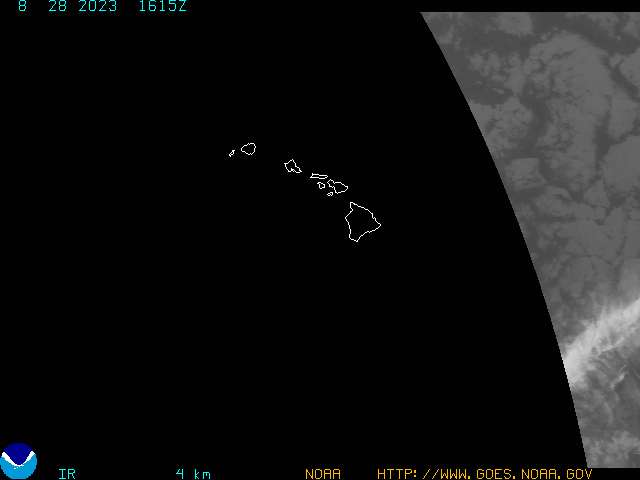
Satellite and Radar Images: To view the cloud conditions we have here in Hawaii, please use the following satellite links, starting off with the Infrared Satellite Image of the islands to see all the clouds around the state during the day and night. This next image is one that gives close images of the islands only during the daytime hours, and is referred to as a Close-up visible image. This next image shows a larger view of the Pacific…giving perspective to the wider ranging cloud patterns in the
Aloha Paragraphs
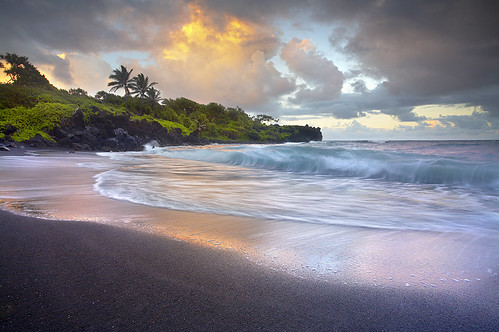
The windward side of east Maui…Waianapanapa
Photo Credit: flickr.com
Trade wind weather pattern will hold up through Thursday…giving way to lighter southeast breezes Friday, with volcanic haze spreading across parts of the Aloha state. These trade winds will blow generally in the light to moderately strong range…although locally quite gusty. We’ll see lighter breezes, along with volcanic haze, as the winds come up from the southeast direction Friday. As we get into the weekend, our winds will veer around to the south and southwest, ahead of a wet cold front, becoming locally strong and gusty then…especially around Kauai and Oahu.
Besides a few windward showers, our weather will remain just fine through Thursday…other than locally hazy skies, and af few interior afternoon showers through Friday. As the trade winds remain active, we’ll see a few light showers arriving along our windward sides into Thursday. We may find a few afternoon interior showers Friday. As we move into the weekend, south to southwest gusty Kona winds will begin carrying pre-frontal showers onto the leeward sides of some of the islands…especially Kauai and
It’s early Wednesday evening here in Kihei, Maui, as I start writing this last section of today’s narrative. Wednesday was a generally sunny day, with the usual popcorn kernel clouds, associated with the moderately strong trade winds…crossing our skies. The beaches, especially on the leeward sides, were near perfect, with lots of folks throwing down a towel, and soaking-up the warm sun rays. I don’t really see any troublesome weather conditions through Friday, although it will be hazier and locally quite muggy on our last day of the work week. This weekend will be quite a different story, as gusty south to southwest Kona winds begin blowing Saturday, leading to rainy weather later Saturday through Sunday. This cold front will arrive over Kauai first, working its way down across Oahu and the islands of Maui County Sunday…before exiting the Big Island Sunday night. ~~~ The winds will calm down in the wake of the cold front, with improved weather Monday. A new cold front, although probably not as dynamic as the first, will arrive towards the middle of next week, with yet another by perhaps next weekend. It’s winter here in the islands afterall, so this isn’t all that unusual for the month of January. ~~~ It’s sunny here in Kihei, before I take the drive upcountry to Kula. I can’t wait to get home, change clothes, put on my walking shoes, and get out for my evening walk. It feels so good to get out of the office, and then to listen to the news on HPR (Hawaii Public Radio) as I cruise home…finally getting outside for that brisk walk! I’ll be back here early Thursday morning with your next new narrative, I hope you have a great Wednesday night until then! Aloha for now…Glenn.
Interesting: Human-made light sources can alter natural light cycles, causing animals that rely on light cues to make mistakes when moving through their environment. In the journal Frontiers in Ecology and the Environment, a collaboration of ecologists, biologists and biophysicists has now shown that in addition to direct light, cues from polarized light can trigger animal behaviors leading to injury and often death. Artificial light that occurs at unnatural times or places – often called light pollution – can attract or repulse animals, resulting in increased predation, migrating in the wrong direction, choosing bad nest sites or mates, collisions with artificial structures and reduced time available to spend looking for food, just to name a few.
In a classic example, baby sea turtles use the direction of star- and moonlight reflected off the water surface to help them find the ocean when they emerge from their beach nests; in urbanized areas, many turtles turn the wrong way and migrate toward the brighter lights of buildings or streetlamps. "Environmental cues, such as the intensity of light, that animals use to make decisions occur at different levels of severity in the natural world," explains Bruce Robertson, an ecologist at Michigan State University. "When cues become unnaturally intense, animals can respond unnaturally strongly to them." That heightened response, he says, happens because of the way humans have changed the environment.
Interesting2: With 30 million drivers in the US aged 65 and over, we count on older Americans to recognize when they can no longer drive safely and decide that it’s time to stay off the road. A new study finds that a decrease in vision function is a key factor in bringing about this decision. The Salisbury Eye Evaluation and Driving Study (SEEDS), conducted by researchers affiliated with Johns Hopkins University, looked at changes in vision, cognition and the general health status of more than 1,200 licensed drivers aged 67-87 in Salisbury, MD, a community with limited public transportation. SEEDS is unique, in that the researchers performed comprehensive tests of both vision and cognitive function.
The results, recently published in Investigative Ophthalmology & Visual Science, reveal that after a year, 1.5 percent of the drivers had given up driving, and another 3.4 percent had restricted their driving. The most common predictors of stopping or decreasing driving were slow visual scanning, psychomotor speed and poor visuo-constructional skills, as well as reduced contrast sensitivity. (These skills are necessary to help drivers be aware of and respond to other cars, road conditions and road signs. Contrast sensitivity is the ability to detect detail in shades of gray; it is necessary for driving in poor weather and low lighting.) “These skills are important for safe and confident driving where objects are moving at rapid speeds in relation to each other, and timely and accurate judgments are required,” the researchers stated.
Interesting3: Remember the cool girls, huddled together in high school restrooms, puffing their cigarettes? Well, here’s consolation for the nerds in the crowd: Those teen smokers are more likely to experience obesity as adults, according to a new study from Finland. Girls who smoke 10 cigarettes per day or more are at greatest risk, particularly for abdominal obesity. Their waist sizes are 1.34 inches larger than nonsmokers’ waists are as young adults, according to the study in the February 2009 issue of the American Journal of Public Health. But smoking in adolescence did not necessarily predict weight problems for men, according to the study. Scientists know a correlation exists between women’s weight and smoking, said lead study author Suoma Saarni, a researcher with the Department of Public Health in Helsinki. However, she added, “we do not know why smoking did not affect men’s weight, as we do not know why smoking affected women’s weight.”
The study followed twins born between 1975 and 1979 with questionnaires mailed shortly after their 16th birthdays. Researchers collected more data on the 2,278 women and 2,018 men when the twins were in their 20s. Scientists looked at twins to take into account familial or genetic factors affecting smoking and weight gain, Saarni said. Half of the participants had never smoked, and 12 percent were former smokers in adolescence. About 15.5 percent of men and 9.4 percent of women smoked at least 10 cigarettes daily. By the time participants reached their 20s, weight problems became evident. By age 24, roughly 24 percent of men and 11 percent of women were overweight. However, male smokers were not necessarily more prone to become overweight than nonsmokers. The young women who smoked more than 10 cigarettes per day were 2.32 times more likely to become overweight than nonsmokers, according to the study.
Interesting4: The remarkable journey of a green turtle from Indonesia into Australian waters is helping conservationists to track the migratory route of this species to the Kimberley-Pilbara coast – one of the few relatively pristine coastal areas left on Earth. Artificial light that occurs at unnatural times or places – often called light pollution – can attract or repulse animals, resulting in increased predation, migrating in the wrong direction, choosing bad nest sites or mates, collisions with artificial structures and reduced time available to spend looking for food, just to name a few. In a classic example, baby sea turtles use the direction of star- and moonlight reflected off the water surface to help them find the ocean when they emerge from their beach nests; in urbanized areas, many turtles turn the wrong way and migrate toward the brighter lights of buildings or streetlamps. "Environmental cues, such as the intensity of light, that animals use to make decisions occur at different levels of severity in the natural world," explains Bruce Robertson, an ecologist at Michigan State University. "When cues become unnaturally intense, animals can respond unnaturally strongly to them." That heightened response, he says, happens because of the way humans have changed the environment.
Interesting5: Space missions are highly complex operations, not only because the satellites or space probes are unique pieces of top-notch intricate high-tech, but also because it is so challenging to get them to their assigned position in space without damage. The technology used is now being transferred to the car industry to increase comfort. During its launch into orbit, a satellite is exposed to a number of extreme stresses. At takeoff the extremely strong engine vibrations are transmitted via the launcher structure to the satellite, which is also exposed to a high-intensity sound level. The increasing speed of the rocket also leads to aerodynamic strains that turn into a shockwave when the launch vehicle’s velocity jumps from subsonic to supersonic. That is not all. When the burned out rocket stages are blasted off and the next stage is fired up, the satellite is exposed to temporary impulsive vibrations.
So how does the satellite survive earthquake-like vibrations, the forces of supersonic shock waves and the pressures of explosive blasts? French company ARTEC Aerospace has developed a vibration and acoustic attenuation technology based on a damping mechanism within the structures, called Smart Passive Damping Device. The principle of the technology is to increase the natural damping of a structure by fixing a light energy-dissipating device to it, without modifying the structure’s static behavior. SPADD’s damping system is so much superior to traditional dissipation devices that it is considered to be a technological breakthrough in the investigation and research of vibro-acoustics, the area of tackling noise and vibration problems such as those induced by powerful jets or rockets. The SPADD technology is used on the Ariane launchers and also mounted on board a number of satellites such as Intelsat, Inmarsat, Integral and MetOp.
Interesting6: Monitoring the speeds of migrating dunes and the volumes of sand transported over time is important to understanding how arid landscapes respond to wind-driven changes. Traditionally, scientists have monitored such changes through detailed field surveys or long-term surveillance of stakes planted in dune fields. Vermeesch and Drake have developed a new and more convenient approach to monitoring the speed and sand flux of migrating dunes. By using pairs of high-resolution optical satellite images taken at differing times, the authors monitored dune migration in the Bodélé depression of northern Chad over time intervals of 1 month to 6.5 years. The displacement maps generated from each pair of satellite images were then used to automatically distinguish dunes from interdunes. By interpolating a surface between the interdune areas and subtracting it from the surface observed by the satellite images, the authors obtain dune heights and volumes over fine spatial and temporal scales. From this, pixel-by-pixel estimates of sand flux were generated, allowing the authors to confirm that the Bodélé contains some of the world’s fastest moving dunes.
Interesting7: Mars is kind of like Texas: things are just bigger there. In addition to the biggest canyon and biggest volcano in the solar system, Mars has now been found to have sand ripples twice as tall as they would be on Earth. Initial measurements of some of the Red Planet’s dunes and ripples using stereo-images from the Mars Orbiter Camera onboard the Mars Global Surveyor have revealed ripple features reaching almost 20 feet high and dunes towering at 300 feet. One way to imagine the taller dimension of ripples on Mars is to visualize sand ripples on Earth, then stretch out the vertical dimension to double height, without changing the horizontal dimension. "They do seem higher in relation to ripples on Earth," said Kevin Williams of the Smithsonian National Air and Space Museum. Williams will be presenting this latest insight into the otherworldly scale of Marscapes on Monday, Nov. 3 at the annual meeting of the Geological Society of America in Seattle, WA. Ripples are common on Mars, and usually found in low-lying areas and inside craters, says Williams.
On Earth they tend to form in long parallel lines from sand grains being pushed by water or air at right angles to the ripple lines. Dunes, on the other hand, are formed when grains of sand actually get airborne and "saltate" (a word based on the Latin verb "to jump"). That leads to cusp-shaped, star-shaped, and other dune arrangements that allow materials to pile sand much higher. How exactly Martian dunes and ripples form is still unknown, says Williams, since the images from space give us no clues to the grain sizes or whether they are migrating or moving in any way. Though there are Viking spacecraft images from almost 30 years ago to compare with, the images do not have the resolution to confirm whether ripples have moved much in that time. For now, the dimensions of ripple-forms on Mars are the only indications of whether they are large ripples or small dunes. Williams’ results came about from the advantageous combination of image parameters to get the first height measurements of these ripple-like features at the limit of image resolution.
 Email Glenn James: