January 6-7, 2009
Air Temperatures – The following maximum temperatures were recorded across the state of Hawaii Tuesday afternoon:
Lihue, Kauai – 76
Honolulu, Oahu – 79
Kaneohe, Oahu – 77
Kahului, Maui – 83
Hilo, Hawaii – 78
Kailua-kona – 80
Air Temperatures ranged between these warmest and coolest spots near sea level, and on the highest mountains…at 4 p.m. Tuesday afternoon:
Port Allen, Kauai – 81F
Kaneohe, Oahu – 73F
Haleakala Crater – 50 (near 10,000 feet on Maui)
Mauna Kea summit – 37 (near 14,000 feet on the Big Island)
Precipitation Totals – The following numbers represent the largest precipitation totals (inches) during the last 24 hours on each of the major islands, as of Tuesday afternoon:
0.45 Wailua, Kauai
0.75 Poamoho 2, Oahu
0.10 Molokai
0.00 Lanai
0.02 Kahoolawe
0.28 Oheo Gulch, Maui
0.23 Mountain View, Big Island
Weather Chart – Here’s the latest (automatically updated) weather map showing high pressure systems to the north and northeast of the Hawaiian Islands. Our local trade winds will regain some strength later Wednesday, and then get lighter again later Thursday.
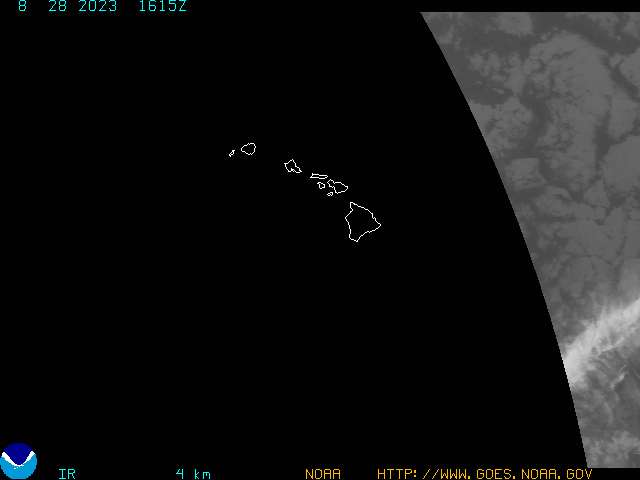
Satellite and Radar Images: To view the cloud conditions we have here in Hawaii, please use the following satellite links, starting off with the Infrared Satellite Image of the islands to see all the clouds around the state during the day and night. This next image is one that gives close images of the islands only during the daytime hours, and is referred to as a Close-up visible image. This next image shows a larger view of the Pacific…giving perspective to the wider ranging cloud patterns in the
Aloha Paragraphs

An inviting opportunity!
Photo Credit: flickr.com
The trade winds, after losing some strength Tuesday, will gain some of it back later Wednesday into Thursday. Our local trade winds will stick around into early Thursday, at which point they will shift to the southeast Thursday night into Friday. We will begin to see volcanic hazy, and perhaps muggy conditions developing as our wind speeds drop during that time frame. As we get into the weekend, our winds will veer around to the south and southwest, ahead of an approaching cold front, with our winds becomeing stronger and gusty then…especially around Kauai and Oahu.
Generally fair conditions will prevail, although a few showers will fall along the lush windward sides of the islands. As the trade winds remain active, we’ll see those few light showers arriving along our windward sides through Wednesday into Thursday. Later this week, by later Thursday and Friday, we’ll see afternoon interior clouds and a few scattered showers developing. As we move into the weekend, south to southwest Kona winds will begin carrying pre-frontal showers onto the leeward sides of some of the islands…especially on Kauai and
It’s early Tuesday evening here in Kihei, Maui, as I start writing this last section of today’s narrative. As noted above, our weather will remain quite nice, with trade winds blowing into early Thursday. Our atmosphere will turn more hazy and muggy later Thursday into Friday, before things get much more interesting this weekend, especially starting Sunday. ~~~ Just about the time that this cold front arrives on Kauai Saturday evening, or a little before, I will be flying out to Phoenix, Arizona, to attend the Annual American Meteorological Society Conference. I will be there for five days, at which point I will fly to Long Beach, to visit with my family for another five days. So there will be a 10 day break in my daily filings of this website. There will however be weather forecasts available throughout that period. I’ll have more to say about this later this week. ~~~ Tuesday was a nice day, a really nice day especially down on the beaches! It’s a little cloudy out the window here in Kihei, with more clouds having attached themselves over and around the mountains during the afternoon hours. Wednesday should be just fine, which is nice having two or three days continuing this pleasant early winter period. I would be thinking about getting things done on Saturday, looking ahead…as Sunday will be turning wet and wild…at least that’s how it looks from here. ~~~ I will be giving a friend a ride into Kahului on the way home to Kula this evening, as she left her automobile at the dealership for service. It will put me into traffic, but that’s alright. It looks rather cloudy up in Kula, but that won’t stop me from taking my walk, which I look forward to! I’ll meet you back here early Wednesday morning with your next new weather narrative from paradise. Aloha for now…Glenn.
Interesting: Polar bears in the western Arctic are finding it increasingly difficult to find food during the critical spring period, a recent study suggests. Seth Cherry, a PhD candidate working with University of Alberta scientist Andrew Derocher, came to the conclusion after comparing blood samples taken from polar bears in 1985-86 and comparing them to samples taken two decades later when sea ice cover was near or at record lows. By measuring the ratio of urea to creatinine — waste materials found in bears that are byproducts of metabolism — scientists can tell whether an animal is fasting. Mature males will often fast in the spring when they are spending almost all their energy searching for females. So it was not surprising to find that some of these animals were not eating for considerable periods of time. The blood samples, however, showed a sharp increase 20 years later in the number of bears that were fasting. What’s more, they were doing it for longer periods of time.
It didn’t matter how old the bear was or whether it was male or female — nearly a third of the bears sampled were going without food longer than they normally would. The study was done by University of Alberta and Environment Canada scientists. Sea ice in the Arctic has been thinning. Records for low ice cover were set in 2005 — and again in 2007, when the Northwest Passage was ice-free for the first time in recorded human history. In the Beaufort Sea, the spring meltdown in the Arctic began an average 13 days earlier between 2000 and 2005 than it did throughout the 1980s. Canadian Wildlife Service scientist Ian Stirling was the one who collected the blood samples back in 1985-86. He and other scientists have suggested that this early thaw and rapid meltdown in the Arctic will make polar bears, narwhal and hooded seals particularly vulnerable because their life cycles are so closely tied to the ice. Without ice as a platform to hunt seals, polar bears are deprived of ringed seals, the mainstay of their diet. Ringed seals could also be vulnerable because they need stable ice cover to nurse their pups in spring.
Interesting2: With the possible exception of the ice that covers Greenland, the West Antarctic ice shelf is the most important body of water in the world. If it thaws, the results will be disastrous for millions, raising sea levels and flooding coastal cities such as London, New York, Tokyo and Calcutta. So it is understandable that scientists are alarmed as to why one particular section of it – Pine Island Glacier – is melting so much faster than the rest. Pine Island, which contains around 30 trillion liters of water, is slipping into the sea at an ever accelerating rate, a development that alone could raise sea levels by as much as 10cm over the next century. Starting at an altitude of 2,500m, the glacier is 95 miles long and 18 miles wide, reaching the sea as an ice wall 750m high. Even before it began to speed up, it was one of the fastest-flowing glaciers in the world, at nine yards a day.
Scientists believe that the thinning of the glacier, and its acceleration, are due to unusual melting under the base as it enters the ocean. This is caused by either global warming or a hitherto unknown factor, such as an underwater volcano. Finding proof of either, however, has been problematic. The mountain glaciers in the west of the Antarctic have the worst blizzards and some of the harshest temperatures on the planet. The zone is too hostile for any research station, so scientists have to base information on satellite studies and aerial surveys. Now, though, a team of British scientists plans to attack the continent’s "weak underbelly" — the watery realms below the massive glaciers. Using a robot submarine nicknamed "Autosub", researchers from the British Antarctic Survey (BAS) hope to explore this previously inaccessible part of the glacier, to discover what is happening.
Interesting3: Remember the cool girls, huddled together in high school restrooms, puffing their cigarettes? Well, here’s consolation for the nerds in the crowd: Those teen smokers are more likely to experience obesity as adults, according to a new study from Finland. Girls who smoke 10 cigarettes per day or more are at greatest risk, particularly for abdominal obesity. Their waist sizes are 1.34 inches larger than nonsmokers’ waists are as young adults, according to the study in the February 2009 issue of the American Journal of Public Health. But smoking in adolescence did not necessarily predict weight problems for men, according to the study. Scientists know a correlation exists between women’s weight and smoking, said lead study author Suoma Saarni, a researcher with the Department of Public Health in Helsinki. However, she added, “we do not know why smoking did not affect men’s weight, as we do not know why smoking affected women’s weight.”
The study followed twins born between 1975 and 1979 with questionnaires mailed shortly after their 16th birthdays. Researchers collected more data on the 2,278 women and 2,018 men when the twins were in their 20s. Scientists looked at twins to take into account familial or genetic factors affecting smoking and weight gain, Saarni said. Half of the participants had never smoked, and 12 percent were former smokers in adolescence. About 15.5 percent of men and 9.4 percent of women smoked at least 10 cigarettes daily. By the time participants reached their 20s, weight problems became evident. By age 24, roughly 24 percent of men and 11 percent of women were overweight. However, male smokers were not necessarily more prone to become overweight than nonsmokers. The young women who smoked more than 10 cigarettes per day were 2.32 times more likely to become overweight than nonsmokers, according to the study.
Interesting4: The recent earthquake swarm underneath Yellowstone National Park appears to be slowing down considerably. It’s good news for the people at the Yellowstone Volcano Observatory who monitored close to 500 small earthquakes in the area during a six-day stretch. It had been the most intense swarm of earthquakes in Yellowstone since 1985. Yellowstone National Park normally sees at least 1,000 earthquakes every year. "We saw half of a year’s earthquakes in less than a week," Lowenstern added. The vast majority of the earthquakes were small and never felt by people within the park, but a few were strong enough to be felt by visitors and park staff. The strongest earthquake was a magnitude 3.9 on the Richter scale. Yellowstone National Park sits on top of a geologic "hot spot" and has historically been a very active area for earthquakes and the occasional volcanic eruption. The last massive eruption took place 640,000 years ago. Lowenstern said that the Volcano Observatory staff does continually assess the risk for another volcanic eruption, but it’s his belief this latest swarm was not indicative of anything more than just a series of relatively normal earthquakes. "We didn’t see any other indicators that told us we needed to be overly concerned," he said.
Interesting5: Climate researchers have shown that big volcanic eruptions over the past 450 years have temporarily cooled weather in the tropics—but suggest that such effects may have been masked in the 20th century by rising global temperatures. Their paper, which shows that higher latitudes can be even more sensitive to volcanism, appears in the current issue of Nature Geoscience. Scientists already agree that large eruptions have lowered temperatures at higher latitudes in recent centuries, because volcanic particles reflect sunlight back into space. For instance, 1816, the year following the massive Tambora eruption in Indonesia, became known as "The Year Without a Summer," after low temperatures caused crop failures in northern Europe and eastern North America. More extensive evidence comes in part from tree rings, which tend to grow thinner in years when temperatures go down. This is one of the first such studies to show how the tropics have responded, said lead author Rosanne D’Arrigo, a scientist at the Tree Ring Lab at Columbia University’s Lamont-Doherty Earth Observatory. "This is significant because it gives us more information about how tropical climate responds to forces that alter the effects solar radiation," said D’Arrigo. The other authors were Rob Wilson of Lamont and the University of St. Andrews, Scotland; and Alexander Tudhope of the University of Edinburgh, Scotland.
Along with tree rings, the researchers analyzed ice cores from alpine glaciers, and corals, taken from a wide area of the tropics. When things cool, not only do trees tend to grow less, but isotopes of oxygen in corals and glacial ice may shift. All showed that low-latitude temperatures declined for several years after major tropical eruptions. The samples, spanning 1546 to 1998, were taken from Nepal down through Indonesia and across the Indian and Pacific oceans; the ice cores came from the Peruvian Andes. The researchers used materials they collected themselves, as well as samples from the archives of other scientists. The data show that the most sustained cooling followed two events: an 1809 eruption that probably took place in the tropics, but whose exact location remains unknown; and the 1815 Tambora eruption, one of the most powerful recorded in human history. Following Tambora, between 1815 and 1818, tropical temperatures dropped as much as 1.5 degrees F below the mean. A slightly bigger one-year drop came in 1731–1.6 degrees F. The researchers say this may be connected to eruptions at the Canary Islands’ Lanzarote volcano, and Ecuador’s Sangay around this time. D’Arrigo says that the study shows also that higher latitudes may generally be even more sensitive than the tropics. Some corresponding drops in northern regions following volcanism were up to three times greater.
D’Arrigo said higher latitudes’ greater sensitivity appears to come from complex feedback mechanisms that make them vulnerable to temperature shifts. This goes along with growing evidence from other researchers that, as the globe warms, the most dramatic effects are being seen with rapid melting of glaciers, sea ice and tundra at high latitudes. The authors say that, overall, eruptions in the 20th century have exerted fewer obvious effects in the tropics. They said this could be because there were fewer major events in that century–but they noted it could also be "because of the damping effect of large-scale 20th-century warming." "Particularly warm decades may have partially overridden the cooling effect of some volcanic events," said D’Arrigo. Noting that few reliable instrumental records exist from before this time, she said, "This study provides some of the first comprehensive information about how the tropical climate system responded to volcanism prior to the instrumental period.
Interesting6: Researchers in Texas are making car parts out of coconuts. A team at Baylor University there has made trunk liners, floorboards and car-door interior covers using fibers from the outer husks of coconuts, replacing the synthetic polyester fibers typically used in composite materials. The approach has potential because coconuts are an abundant, renewable resource in all countries near the equator, including the Philippines, Indonesia and India. The husks are burned or thrown away, generating garbage. This is the first time that coconut fibers have been used to make these automotive products, said Walter Bradley, an engineering professor who is leading the project. In Ghana, as one of Bradley’s students told him, the discarded husks pile up in mounds, creating a health hazard because they collect water where malaria-causing mosquitoes can breed. "We are trying to turn trash into cash to help poor coconut farmers," Bradley said, adding that the long-term goal is to increase demand for coconuts to millions of pounds, and thereby raise their market price. Currently, there are about 11 million coconut farmers in the world making an average annual income of $500, he said.
 Email Glenn James: