January 27-28, 2009
Air Temperatures – The following maximum temperatures were recorded across the state of Hawaii Tuesday afternoon:
Lihue, Kauai – 72
Honolulu, Oahu – 71
Kaneohe, Oahu – 68
Kahului, Maui – 69
Hilo, Hawaii – 79
Kailua-kona – 82
Air Temperatures ranged between these warmest and coolest spots near sea level, and on the highest mountains…at 4 p.m. Tuesday afternoon:
Kailua-kona – 79F
Molokai airport – 64
Haleakala Crater – 41 (near 10,000 feet on Maui)
Mauna Kea summit – 36 (near 14,000 feet on the Big Island)
Precipitation Totals – The following numbers represent the largest precipitation totals (inches) during the last 24 hours on each of the major islands, as of Tuesday afternoon
5.60 Mount Waialaele, Kauai
2.06 Poamoho, Oahu
2.89 Molokai
1.91 Lanai
2.00 Kahoolawe
2.92 Puu Kukui, Maui
0.13 South Point, Big Island
Weather Chart – Here’s the latest (automatically updated) weather map showing a strong 1039 millibar high pressure system far to the northeast of the Hawaiian Islands. Our winds will generally be from the north to northeast…gradually becoming trade winds.
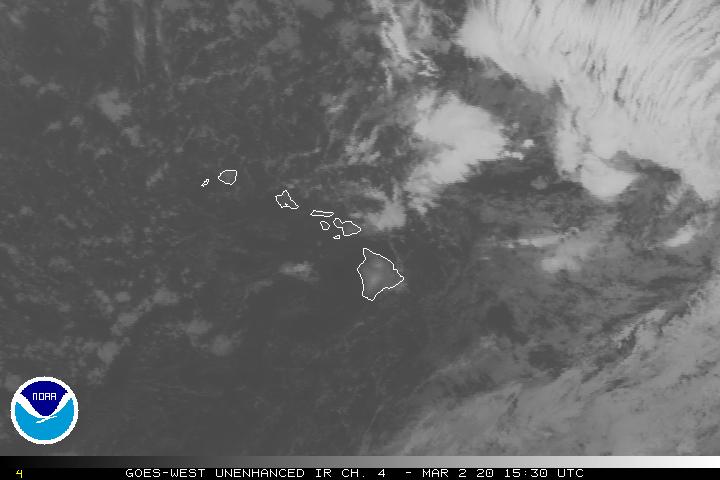
Satellite and Radar Images: To view the cloud conditions we have here in Hawaii, please use the following satellite links, starting off with the Infrared Satellite Image of the islands to see all the clouds around the state during the day and night. This next image is one that gives close images of the islands only during the daytime hours, and is referred to as a Close-up visible image. This next image shows a larger view of the Pacific…giving perspective to the wider ranging cloud patterns in the Pacific Ocean. To help you keep track of where any showers may be around the islands, here’s the latest animated radar image.
Hawaii’s Mountains – Here’s a link to the live webcam on the summit of near 14,000 foot Mauna Kea on the Big Island of Hawaii. The tallest peak on the island of Maui is the Haleakala Crater, which is near 10,000 feet in elevation. These two webcams are available during the daylight hours here in the islands…and when there’s a big moon rising just after sunset for an hour or two! Plus, during the nights and early mornings you will be able to see stars, and the sunrise too…depending upon weather conditions.
Aloha Paragraphs

Variably cloudy, some showers…cool
Photo Credit: flickr.com
Winds are cool from the north to northeast, keeping air temperatures lower than normal into Wednesday. The frontal cloud band that brought these chilly conditions to the state, stalled over Maui County Tuesday…and is now shifting back over Oahu. These cooler winds and clouds didn’t arrive over the Big Island, so that island warmed up more than the others. As the cloud band crawls back westward, the trade winds will fill into the state from the east Thursday…for a day or two. We may see a second cold front arriving later this coming weekend, shifting our winds back to the southeast Sunday, with possible volcanic haze returning then.
The cold front brought generous showers to all the islands, that is except the Big Island…where most rain gauges remained dry. The largest precipitation total was a very generous 5.60" over the mountains of Kauai, with generally 1-3" rainfall totals from Oahu down to Maui County. Here’s a looping radar image, so we can keep track of any precipitation that’s falling over the Hawaiian islands Tuesday night into Wednesday. Our local weather conditions will improve some Wednesday, with a fairly normal trade wind weather pattern taking over Thursday…although the windward biased showers will likely continue at times. The latest model runs suggest that we may see another cold front approaching later this weekend, which may bring more precipitation early next week.
The cold front, which we may more rightly call just a cloud band now…is stretched-out between Oahu and Maui. Speaking of the retired cold front, this satellite image shows what’s left of the frontal cloud band. At the time of this writing it was quite wide, covering most of the central islands. Here’s a looping satellite image of the front that arrived later Monday into Tuesday. As this old front, over the next 24 hours or so, edges back westward, rather than pushing through the entire state, showers will remain in the forecast generally around Oahu, and perhaps back to Kauai…and a little bit over Maui County perhaps too.
~~~ I’m about ready to leave Kihei, Maui, where it’s still cloudy, but the morning rains have ended. As mentioned above, it was chilly here in the islands Tuesday, definitely qualifying as a cool winter day just about everywhere. Air temperatures had a difficult time reaching 70F to 72 degrees, even at sea level in many areas. The Big Island, where the cold front didn’t reach, did manage to climb into the lower 80F’s in Kona! Temperatures will be on the cool side tonight and into Wednesday. I really enjoyed the rainfall, and because it fell in the light to moderately heavy realms, it was very helpful in soaking our dry soils…especially in the leeward areas. By the way, the Hana region of east Maui went without a drop of water today…as did several areas on the Big Island.
~~~ I’ll be back again early Wednesday morning, with more weather news, and a new narrative for you. We will likely see more clouds Wednesday, although in general, it won’t be a repeat preformance of Tuesday…with less clouds and rain in general. I trust that you will stop back by on Wednesday, for weather information, and of course another set of interesting news stories, such as you find below. I hope you enjoy your Tuesday night! Aloha for now…Glenn.
Interesting:
Many people who worry about global warming hope that once emissions of heat-trapping gases decline, the problems they cause will quickly begin to abate. Now researchers are saying that such hope is ill-founded, at least with regard to carbon dioxide. Because of the way carbon dioxide persists in the atmosphere and in the oceans, and the way the atmosphere and the oceans interact, patterns that are established at peak levels will produce problems like “inexorable sea level rise” and Dust-Bowl-like droughts for at least a thousand years, the researchers are reporting in the Proceedings of the National Academy of Sciences. “That peak would be the minimum you would be locking yourself into,” said Susan Solomon, a senior scientist at the National Oceanic and Atmospheric Administration, who led the work. The researchers describe what will happen if the atmospheric concentration of carbon dioxide — the principal heat-trapping gas emission — reaches 450 to 600 parts per million, up from about 385 p.p.m. today. Most climate researchers consider 450 p.p.m. virtually inevitable and 600 p.p.m. difficult to avoid by mid-century, if the use of fossil fuels continues at anything like its present rate.
Interesting2: New research into language evolution suggests most Pacific populations originated in Taiwan around 5,200 years ago. Scientists at The University of Auckland have used sophisticated computer analyses on vocabulary from 400 Austronesian languages to uncover how the Pacific was settled. "The Austronesian language family is one of the largest in the world, with 1200 languages spread across the Pacific," says Professor Russell Gray of the Department of Psychology. "The settlement of the Pacific is one of the most remarkable prehistoric human population expansions. By studying the basic vocabulary from these languages, such as words for animals, simple verbs, colours and numbers, we can trace how these languages evolved. The relationships between these languages give us a detailed history of Pacific settlement."
"Our results use cutting-edge computational methods derived from evolutionary biology on a large database of language data," says Dr Alexei Drummond of the Department of Computer Science. "By combining biological methods and linguistic data we are able to investigate big-picture questions about human origins". The results, published in the latest issue of the journal Science, show how the settlement of the Pacific proceeded in a series of expansion pulses and settlement pauses. The Austronesians arose in Taiwan around 5,200 years ago. Before entering the Philippines, they paused for around a thousand years, and then spread rapidly across the 7,000km from the Philippines to Polynesia in less than one thousand years. After settling Fiji, Samoa and Tonga, the Austronesians paused again for another thousand years, before finally spreading further into Polynesia eventually reaching as far as New Zealand, Hawaii and Easter Island.
Interesting3: Researchers at the Institute for Psychology of the Hungarian Academy of Sciences and the Institute for Logic, Language and Computation of the University of Amsterdam demonstrated that two to three day old babies can detect the beat in music. This phenomenon – termed ‘beat induction’ – is likely to have contributed to music’s origin. It enables such actions as clapping, making music together and dancing to a rhythm. Beat induction is also considered to be uniquely human. Even our closest evolutionary relatives, such as the chimpanzee, do not synchronize their behavior to rhythmic sounds. The findings, which have just been published in Proceedings of the National Academy of Sciences, challenge some earlier assumptions that beat induction is learned in the first few months of life, for example by parents rocking the infant.
Instead, the results of this collaborative European study demonstrate that beat perception is either innate or learned in the womb, as the auditory system is at least partly functional as of approximately three month before birth. It should be noted that the auditory capabilities underlying beat induction are also necessary for bootstrapping communication by sounds, allowing infants to adapt to the rhythm of the caretaker’s speech and to find out when to respond to it or to interject their own vocalization. Therefore, although these results are compatible with the notion of the genetic origin of music in humans, they do not provide the final answer in this longstanding debate.
Interesting4: Two ships, one of them carrying hundreds of passengers were stuck in the ice in the Saint Lawrence Seaway off Matane in eastern Canada, news reports said. Ice breakers had failed to clear a path for the two stricken ships, the CTMA Vacancier ferry with 300 people on board, and the Georges-Alexandre-Lebel, a cargo ship owned by Canada’s COGEMA shipping company, Canadian television CTV reported Tuesday. A third ship was freed on Monday. Passengers on the cruise ship were on their way to a one-week cross country ski tour on Monday when the ship became enmeshed in the ice, but the detour has dampened their holiday mood.
"It’s a 24 hour party on board," passenger James Gray told the broadcaster by telephone. "It’s an absolutely incredible experience. I think it’s a historic moment to be on a passenger ship stuck in the ice on the St Lawrence in the middle of winter. It’s about -40 Celsious outside right now," he added. COGEMA general director Andre Landry told the French-language newspaper Le Soleil that ice of that thickness has not been observed in the seaway that early in the year for many years. "That is usually expected in February and March," Landry said. Initial attempts to help the ship by the ice breaker Terry Fox failed. A 5-square-kilometre-large ice blanket has been blocking access to the port at Matane since the weekend, Le Soleil wrote. The Saint Lawrence Seaway connected North America’s Great Lakes with the Atlantic.
Interesting5: The Taipei City Zoo is considering reducing the daily quota for the number of visitors to allow each visitor more time to see two Chinese pandas, a newspaper reported Tuesday. The zoo is mulling cutting the daily quota of visitors to the Panda House from 22,000 to 10,000 after receiving complaints that people were being rushed through the Panda House, giving each person less than a minute to see the pandas, the Taipei Times said. "We will consider making changes after the Chinese New Year holidays, depending on the circumstances," the paper quoted Taipei Zoo Director Jason Yeh as saying. The two pandas, named as Tuan Tuan and Yuan Yuan (Tuanyuan means Reunion in Chinese), were given by Chinese President Hu Jintao to Taiwan on December 23, 2008. Following month-long quarantine, they made their debut on Monday – the first day of the Chinese New Year holidays.
Currently the Taipei Zoo allows only 22,000 people to see the pandas each day, hoping each visitor can stay inside the Panda House for 10 minutes. But because of the long lines, the visitors are rushed through the Panda House and some have even failed to see the pandas, as they often walks around and hide behind the bamboo or wooden structures. Some visitors said they felt cheated as they had driven several hours from south Taiwan to Taipei in order to see the pandas. But they either failed to see the pandas or were pushed out of the viewing area by security guards before they could take a photo of the charismatic megafauna. Pandas are among the most-endangered species in the world. There are about 1,680 pandas in the world, and most of them live in the mountains in southwest China.
Interesting6: Many damaging effects of climate change are already basically irreversible, a team of international researchers declared Monday, warning that even if carbon emissions can somehow be halted temperatures around the globe will remain high until at least the year 3000. "People have imagined that if we stopped emitting carbon dioxide the climate would go back to normal in 100 years, 200 years; that’s not true," climate researcher Susan Solomon said in a teleconference. Solomon, of the National Oceanic and Atmospheric Administration’s Earth System Research Laboratory, is lead author of an international team’s paper reporting irreversible damage from climate change, being published in Tuesday’s edition of Proceedings of the National Academy of Sciences. She defines "irreversible" as change that would remain for 1,000 years even if humans stopped adding carbon to the atmosphere immediately. The findings were announced as President Barack Obama ordered reviews that could lead to greater fuel efficiency and cleaner air, saying the Earth’s future depends on cutting air pollution. Said Solomon, "Climate change is slow, but it is unstoppable" — all the more reason to act quickly, so the long-term situation does not get even worse.
 Email Glenn James: