January 2-3, 2009
Air Temperatures – The following maximum temperatures were recorded across the state of Hawaii Friday afternoon:
Lihue, Kauai – 74
Honolulu, Oahu – 79
Kaneohe, Oahu – 77
Kahului, Maui – 80
Hilo, Hawaii – 77
Kailua-kona – 81
Air Temperatures ranged between these warmest and coolest spots near sea level, and on the highest mountains…at 4 p.m. Friday afternoon:
Kailua-kona – 79F
Princeville, Kauai – 72F
Haleakala Crater – 43 (near 10,000 feet on Maui)
Mauna Kea summit – 30 (near 14,000 feet on the Big Island)
Precipitation Totals – The following numbers represent the largest precipitation totals (inches) during the last 24 hours on each of the major islands, as of Friday afternoon:
1.73 Mount Waialaele, Kauai
3.57 Poamoho 2, Oahu
0.15 Molokai
0.21 Lanai
0.00 Kahoolawe
2.95 Kaupo Gap, Maui
5.19 Hilo airport, Big Island
Weather Chart – Here’s the latest (automatically updated) weather map showing a 1029 millibar high pressure system far to the northeast of the Hawaiian Islands. This trade wind producing high pressure system, along with its associated ridge, will keep locally strong and gusty trade winds blowing Saturday and Sunday.
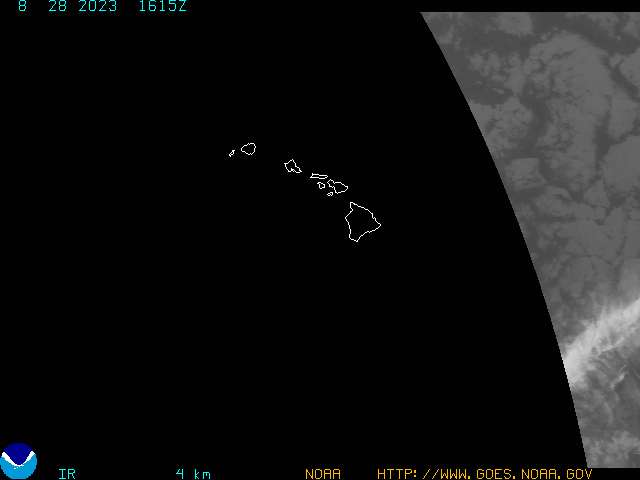
Satellite and Radar Images: To view the cloud conditions we have here in Hawaii, please use the following satellite links, starting off with the Infrared Satellite Image of the islands to see all the clouds around the state during the day and night. This next image is one that gives close images of the islands only during the daytime hours, and is referred to as a Close-up visible image. This next image shows a larger view of the Pacific…giving perspective to the wider ranging cloud patterns in the
Aloha Paragraphs

Catching the new trade wind breezes
Photo Credit: flickr.com
The trade winds will become stronger now, lasting through the weekend. The departing upper level trough to our southwest, and the high pressure system located to the northeast of the islands, will bring back the trade winds. We now small craft wind advisories active across all Hawaiian waters. The computer models show our local winds becoming lighter, and perhaps from the southeast later in the new week ahead…as a low pressure system, with its associated cold front, approaches the islands then.
Our weather will be less showery, and more sunny…as we move into the weekend. As the trade winds increase now, we’ll find drier air moving in…although with the usual windward biased showers falling at times. The weekend will be generally fine however, grading into the early part of the new week ahead. We may see more showers towards next weekend, as a cold front approaches. The main thing now, is that the leeward sides will be looking good again, with lots of sunshine back around now.
It’s early Friday evening here in Kihei, Maui, as I start writing this last section of today’s narrative. Skies finally began to clear, at least some Friday afternoon. The high clouds are starting to thin, as the upper level trough moves away to the west. This all is good news for those folks who like their sunshine, and have been putting-up with too many clouds the last week. The windward sides will still some some showers, but even there, will have less around in general. ~~~ Looking out the window here in Kihei, before I head over to Kahului for a new film this evening, I’m actually seeing a fair amount of blue skies for a change! I’m anticipating more sunshine Saturday…which I’m sure almost everyone will be enjoying! ~~~ As for this new film, its called The Reader (2008), starring Kate Winslet and Ralph Fiennes, among many others. A short synopsis is – a decade after his affair with an older woman, a law student re-encounters his former lover as she defends herself in a war-crime trial. This film looks good to me, and it isn’t one of my regular action flicks for a change. Here’s a trailer for this film, and of course I’ll be back early Saturday morning with my own response to what I thought. It looks like quite a deep and touching film, which I’m in the mood for. ~~~ I hope you have a great Friday night, and I look forward to catching up with you again on Saturday! Aloha for now…Glenn.
Mr. Dan Page, our Kihei weather reporter, just let me know that the 2008 rainfall total was only 10.52". The official designation for a desert climate type is 10.00" or less. So, despite the wet end of the year rainfall, the year as a whole was drier than normal. The normal yearly total for both Kihei and Lahaina, Maui, is 14-16 inches.
Interesting: A sustainable global food system in the 21st Century needs to be built on a series of "new fundamentals", according to a leading food expert. Tim Lang warned that the current system, designed in the 1940s, was showing "structural failures", such as "astronomic" environmental costs. The new approach needed to address key fundamentals like biodiversity, energy, water and urbanization, he added. Professor Lang is a member of the UK government’s newly formed Food Council. "Essentially, what we are dealing with at the moment is a food system that was laid down in the 1940s," he told BBC News. "It followed on from the dust bowl in the US, the collapse of food production in Europe and starvation in Asia. "At the time, there was clear evidence showing that there was a mismatch between producers and the need of consumers." Professor Lang, from City University, London, added that during the post-war period, food scientists and policymakers also thought increasing production would reduce the cost of food, while improving people’s diets and public health.
Interesting2: The Interior Department announced a controversial decision late Wednesday to double the rate of logging on 2.6 million acres of federally owned forests in southwestern Oregon. In doing so, it brushed aside the objections of the governor and two federal agencies charged with guarding the quality of the area’s water and the health of the fish that depend on it. The decision, which was posted on the Web sites of the Bureau of Land Management’s Oregon offices, has revived the battle lines formed during the fight over the extensive logging of old-growth timber in the 1980s, a practice blamed for the rapid decline in populations of the northern spotted owl. The economies of the timber industry and Oregon’s rural southwestern counties took a major hit when logging on federal lands in the area was cut back by 80 percent under the terms of the Northwest Forest Plan, which took effect about 15 years ago.
Representatives of both groups applauded Wednesday’s decision, saying it would revive local mills and timber companies. But environmental groups condemned the decision and gave notice that they would challenge the plan in federal court. The group Earthjustice called the decision a “massive giveaway at the expense of salmon spawning streams, healthy old-growth forests and habitat for rare birds such as the northern spotted owl and marbled murrelet.” Michael Campbell, a spokesman for the Bureau of Land Management’s office in Portland, Ore., said Wednesday that the plan was a blueprint and that there would be additional chance for environmental review and public comment as various tracts of land are prepared for sale.
Interesting3: More than 2 trillion tons of land ice in Greenland, Antarctica and Alaska have melted since 2003, according to new NASA satellite data that show the latest signs of what scientists say is global warming. More than half of the loss of landlocked ice in the past five years has occurred in Greenland, based on measurements of ice weight by NASA’s GRACE satellite, said NASA geophysicist Scott Luthcke. The water melting from Greenland in the past five years would fill up about 11 Chesapeake Bays, he said, and the Greenland melt seems to be accelerating. NASA scientists planned to present their findings Thursday at the American Geophysical Union conference in San Francisco. Luthcke said Greenland figures for the summer of 2008 aren’t complete yet, but this year’s ice loss, while still significant, won’t be as severe as 2007. The news was better for Alaska. After a precipitous drop in 2005, land ice increased slightly in 2008 because of large winter snowfalls, Luthcke said. Since 2003, when the NASA satellite started taking measurements, Alaska has lost 400 billion tons of land ice. In assessing climate change, scientists generally look at several years to determine the overall trend.
Interesting4: Scientists fear the already declining growth rate of the Great Barrier Reef’s corals will stop completely by 2050, killing off the reef and making way for algae. A new report shows the most robust corals on the reef have slowed in growth by more than 14 per cent since the "tipping point" in 1990. The paper, published in the international journal Science, and written by scientists Dr Glenn De’ath, Dr Janice Lough, and Dr Katharina Fabricius, shows evidence of a decline in the calcification rates in the Great Barrier Reef corals. The Australian Institute of Science paper claims the decline has been caused by a combination of rising sea surface temperatures and ocean acidification. Calcification refers to how much skeleton the coral forms each year. When large amounts of carbon dioxide enter the seawater, the resulting chemical change reduces a marine organism’s ability to form skeletons and protect itself against the environment. Dr Lough said the evidence was alarming.
"It is cause for extreme concern that such changes are already evident, with the relatively modest climate changes observed to date," she said. Dr De’ath said according to the trends, coral would stop growing altogether by 2050 and be replaced by algae, to the detriment of biodiversity in the area. "The data suggest that this severe and sudden decline in calcification is unprecedented in at least 400 years," he said. The situation would create a devastating chain reaction for species in the area, Dr De’ath said. "Algae will take over the area, small fish will lose their habitat, then the larger fish that eat the small fish will starve," he said. Queensland Premier Anna Bligh said she was worried by increasing scientific evidence of the state of the reef. The government has announced it will this year begin regulating chemical run-off from farming or agricultural activities into the reef for the first time. "I know there is not a lot of farmers who are happy with my decision … but we have a special responsibility to look after it, and 2009 will see new laws that will further protect the Great Barrier Reef," Ms Bligh said.
Interesting5: A pair of Washington lawyers is hoping to brand a new kind of corporate executive: the CCO, or chief climate officer. A small but growing number of companies have been jumping on the climate bandwagon in recent years, trying to figure out how to make their products and processes greener. The trend has caught on in various industries, from apparel to technology to foodstuffs, and many companies have turned their strategies over to an in-house climate czar. But as environmental attorneys Peter Gillon and Peter Gray see it, these czars have come in so many flavors that no one knows exactly what a company’s climate boss is supposed to do. In January, they’re inviting corporations to the Association of Corporate Climate Change Officers’ first meeting, where that question and others will be on the agenda.
"What are the resumes of a climate change officer? What are the core skill sets required to do their jobs, and what should their responsibilities be?" said Daniel Kreeger, a businessman who co-founded the organization, posing the questions that will be raised. Companies have handled the climate issue in vastly different ways, Kreeger said. While some have chosen to address it through their environmental and health offices, others have assigned it to their government affairs staff — or even their finance experts. Some companies consider climate part of a larger "sustainability" effort that includes water conservation, recycling and even social goals like fair wages and better working conditions. Others just hand it off to marketing. Similarly, climate czars have come from a kaleidoscope of backgrounds: Some are scientists, others are regulatory experts and some are businessmen above all.
Interesting6: Aquaculture production of seafood will probably remain the most rapidly increasing food production system worldwide through 2025, according to an assessment published in the January 2009 issue of BioScience. The assessment, by James S. Diana of the University of Michigan at Ann Arbor, notes that despite well-publicized concerns about some harmful effects of aquaculture, the technique may, when practiced well, be no more damaging to biodiversity than other food production systems. Moreover, it may be the only way to supply growing demand for seafood as the human population increases. Diana notes that total production from capture fisheries has remained approximately constant for the past 20 years and may decline. Aquaculture, in contrast, has increased by 8.8 percent per year since 1985 and now accounts for about one-third of all aquatic harvest by weight. Finfish, mollusks, and crustaceans dominate aquaculture production; seafood exports generate more money for developing countries than meat, coffee, tea, bananas, and rice combined.
Among the most potentially harmful effects of aquaculture, according to Diana, are the escape of farmed species that then become invasive, pollution of local waters by effluent, especially from freshwater systems, and land-use change associated with shrimp aquaculture in particular. Increased demand for fish products for use in feed and transmission of disease from captive to wild stocks are also hazards. Nonetheless, when carefully implemented, aquaculture can reduce pressure on overexploited wild stocks, enhance depleted stocks, and boost natural production of fishes as well as species diversity, according to Diana. Some harmful effects have diminished as management techniques have improved, and aquaculture has the potential to provide much-needed employment in developing countries. Diana points to the need for thorough life-cycle analyses to compare aquaculture with other food production systems. Such analyses are, however, only now being undertaken, and more comprehensive information is needed to guide the growth of this technique in sustainable ways.
Interesting7: Tiny diamonds sprinkled across North America suggest a "swarm" of comets hit the Earth around 13,000 years ago, kicking up enough disruption to send the planet into a cold spell and drive mammoths and other creatures into extinction, scientists reported on Friday. They suggest an event that would transcend anything Biblical — a series of blinding explosions in the atmosphere equivalent to thousands of atomic bombs, the researchers said. The so-called nanodiamonds are made under high-temperature, high-pressure conditions created by cosmic impacts, similar to an explosion over Tunguska in Siberia that flattened trees for miles in 1908. Doug Kennett of the University of Oregon and colleagues found the little diamonds at sites from Arizona to South Carolina and into Alberta and Manitoba in Canada.
They are buried at a level that corresponds to the beginning 12,900 years ago of the Younger Dryas, a 1,300-year-long cold spell during which North American mammoths, saber-toothed cats, camels and giant sloths became extinct. The Clovis culture of American Indians also appears to have fallen apart during this time. Bones of these animals, and Clovis artifacts, are abundant before this time. Excavations show a dark "mat" of carbon-rich material separates the bones and artifacts from emptier and younger layers. Writing in the journal Science, Kennett and colleagues report they have evidence of the nanodiamonds from six sites across North America, fitting in with the hypothesis that a giant explosion, or multiple explosions, above the Earth’s surface cause widespread fire and pressure. There is evidence these minerals can be found in other sediments, too, they said, and help explain the "black mat".
 Email Glenn James: