Weather Details and Aloha Paragraphs
Posted by GlennJuly 31-August 1 2006
Air Temperatures – The following maximum temperatures were recorded across Hawaii Monday:
Lihue, Kauai – 82F
Honolulu, Oahu – 85
Kaneohe, Oahu – 86
Kahului, Maui – 91
Hilo, Hawaii – 85
Kailua-Kona, Hawaii – 86
Temperatures early Tuesday morning ranged between these warmest and coolest spots near sea level at the 4 a.m. hour:
HONOLULU, OAHU – 77
HILO AIRPORT – 69
Precipitation Totals – The following numbers represent the largest precipitation totals (inches) during the last 24 hours (as of Tuesday morning) on each of the major islands:
2.74 LIHUE AIRPORT, KAUAI
1.66 PUNALUU PUMP, OAHU
0.00 MOLOKAI
0.02 LANAI
0.00 KAHOOLAWE
0.19 OHEO GULCH, MAUI
0.46 WAIKII, BIG ISLAND
Weather Chart – Here’s the latest (automatically updated) weather map…showing a moderately strong 1034 millibar high pressure system located far to the NW of our islands. Meanwhile, a trough of low pressure will pass close to the state Tuesday…keeping our local winds light east to SE. This trough will move away to the north Wednsday, allowing the trade winds to return then. Here’s a Weather Map Symbol page for clarification about what all those weather symbols mean on the map.
Hawaii’s Mountains – Here’s a link to the live webcam on the summit of near 14,000 foot Mauna Kea on the Big Island of Hawaii. The tallest peak on the island of Maui is the Haleakala Crater, which is near 10,000 feet in elevation. These two webcams are available during the daylight hours here in the islands…and when there’s a big moon rising just after sunset for an hour or two! Plus, during the nights and early mornings you will be able to see stars, and the sunrise too…depending upon cloud conditions.
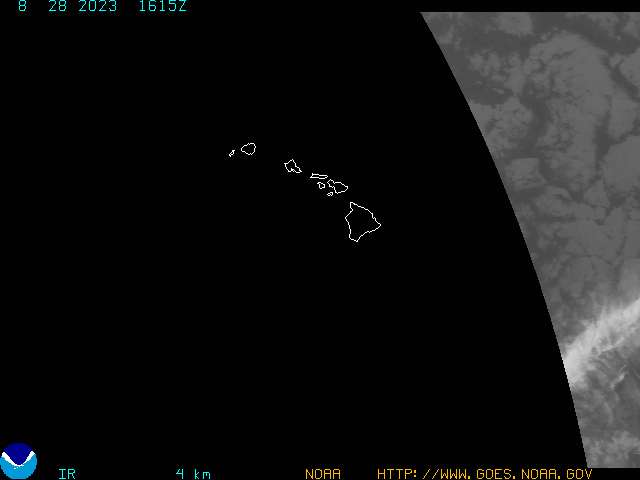
Satellite Images – To view the cloud conditions we have here in Hawaii, please use the following satellite links, starting off with the Infrared Satellite Image of the islands to see all the clouds around the state during the day and night. This next image is one that gives close images of the islands only during the daytime hours, and is referred to as a Close-up visible image. This next image shows a larger view of the Pacific…giving perspective to the wider ranging cloud patterns in the Pacific Ocean…out from the islands. To help you keep track of where any showers may be around the islands, here’s the latest animated radar image.
Aloha Paragraphs

Large summer waves in Hawaii now…
A low pressure system aloft will at least partially block our regular summer trade winds through Tuesday. This will have several influences in our
All that sunshine, combined with the humid air, will be the ingredients for shower prone conditions. The presence of the cold air aloft, in association the low pressure around now, will make for an unstable air mass. All of this will add up to an increased chance of afternoon cumulus cloud buildups over the interior sections of all the islands now. Those towering clouds will drop showers locally, some of which will be locally heavy. As the sun goes down, the islands will stop being “heating pads”, and the clouds will evaporate in most areas.
We call these types of meteorological conditions a convective weather pattern. Often we start off with slightly cooler than normal temperatures early on, then as the day progresses, we see that afternoon cloudiness described above. There’s a chance that we could some of those showers become localized flooders, although that would be only here and there at most. The expectation is that this rainfall inducing trough of low pressure will move away to the NW by Wednesday. This in turn will make way for the return of a regular trade wind weather pattern…putting an end to the sultry conditions, and returning the bias for showers to the windward sides.
The big news in
It’s early Monday evening here in Kula,
By the way, you may notice that the activity pages on this website look much better now, thanks to Bumpnetworks, who are both my friends, and also my valued website host! The team at Bump Networks provides custom software solutions, web solutions and hardware interfaces for a variety of clients. They’ve built software and web solutions for clients in many industries including high-tech, entertainment, travel, tour operator, GPS, disaster prevention and management, and government/DOD.
 Email Glenn James: