Weather Details and Aloha Paragraphs
Posted by GlennJuly 25-26 2006
Air Temperatures – The following maximum temperatures were recorded across Hawaii Tuesday:
Lihue, Kauai – 86F
Honolulu, Oahu – 86
Kaneohe, Oahu – 83
Kahului, Maui – 87
Hilo, Hawaii – 84
Kailua-Kona, Hawaii – 87
Temperatures early Wednesday morning ranged between these warmest and coolest spots near sea level at the 4 a.m. hour:
KAILUA-KONA – 78
HILO AIRPORT – 68
Precipitation Totals – The following numbers represent the largest precipitation totals (inches) during the last 24 hours (as of Wednesday morning) on each of the major islands:
0.45 MOUNT WAIALEALE, KAUAI
0.21 WILSON TUNNEL, OAHU
0.04 MOLOKAI
0.00 LANAI
0.00 KAHOOLAWE
0.04 WEST WAILUAIKI, MAUI
0.10 KAMUELA, BIG ISLAND
Weather Chart – Here’s the latest (automatically updated) weather map…showing a 1029 millibar high pressure system located to the NNE of our islands. This high pressure cell will keep light to moderately strong trade winds blowing…locally quite strong and gusty during the afternoons. Here’s a Weather Map Symbol page for clarification about what all those weather symbols mean on the map.
Hawaii’s Mountains – Here’s a link to the live webcam on the summit of near 14,000 foot Mauna Kea on the Big Island of Hawaii. The tallest peak on the island of Maui is the Haleakala Crater, which is near 10,000 feet in elevation. These two webcams are available during the daylight hours here in the islands…and when there’s a big moon rising just after sunset for an hour or two! Plus, during the nights and early mornings you will be able to see stars, and the sunrise too…depending upon cloud conditions.
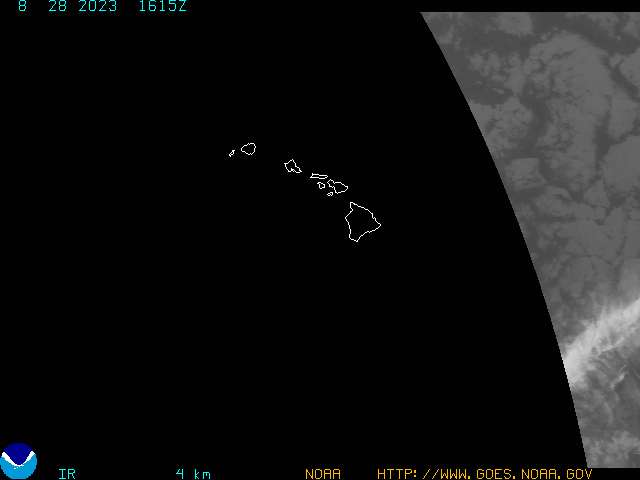
Satellite Images – To view the cloud conditions we have here in Hawaii, please use the following satellite links, starting off with the Infrared Satellite Image of the islands to see all the clouds around the state during the day and night. This next image is one that gives close images of the islands only during the daytime hours, and is referred to as a Close-up visible image. This next image shows a larger view of the Pacific…giving perspective to the wider ranging cloud patterns in the Pacific Ocean…out from the islands. To help you keep track of where any showers may be around the islands, here’s the latest animated radar image.
Tropical Cyclone Activity – The eastern Pacific hurricane season runs from May 15 through November 30…while the central Pacific (where Hawaii is) runs from June 1 through November 30. The latest storm information for the eastern Pacific can be found by clicking here. A storm tracking map for both the central and eastern areas can be found by clicking here . For the central Pacific, the latest storm information can be found by clicking here.

Wouldn’t you like to take a little nappypo here…would it be tropical enough?
Photo Credit: flikr.com
Pleasant trade wind weather will continue across the Hawaiian Islands through Thursday. Skies will be quite clear during the days, with fair nights prevailing. Most rain gauges around the state have remained quite dry during the last 24 hours, with little change expected. There will however be a few showers splashing down here and there.
Tropical depression Daniel remains modestly active some 800+ miles to the ESE of Hilo, Hawaii early Wednesday morning. Looking at what’s left of this storm, using this lastest satellite image, we can see that there is one spot of deep convection. Winds at 5am (Hawaii Standard Time) were sustained at 35+ mph around the center of this weakening tropical cyclone. The latest forecasts show that we’ll see just a swirl of low clouds moving by just south of the Big Island, then to the south of the other islands late Thursday night into Saturday morning. At this point, it looks like we would see an increase in showers when the northern fringe of these clouds arrive, especially over the Big Island, with locally strong and gusty trade winds blowing. This tropical system should be watched closely by interests in Hawaii, for any changes in the forecast track or wind speeds. Here’s a tracking map for your convenience, to keep you updated on Daniel’s progress westward.
It’s early Tuesday evening here in Kula, Maui, as I start this sunset commentary. I was astonished at how clear the Haleakala Crater was while driving home from Kihei to Kula! There was literally not a cloud in sight, which left every detail of the mountain clearly visible. Those slopes are often so cloud shrouded during the afternoons, reluctantly showing themselves only during the morning hours. We find ourselves on the outer fringe of tropical depression Daniel, with the subsiding air flow aloft creating pristine weather conditions. There are still NE trade winds blowing some patchy moisture into the islands, but there will probably be less and less, that is until the actual cloud field associated with Dannyboy arrives late Thursday into Friday morning. I’m straddling the fence at the moment, not sure to come down on the drier side, or the wetter side of how much precipitation will fall Friday into Saturday. To be truthful, I’m not altogether certain how strong the winds will become then either. I am quite sure though that whatever conditions do develop, they will look a lot like wet trade winds, coming into the state from the east and then the NE. I need another day or so before I’ll step down on one side or the other. Please excuse my uncertainty, it comes from seeing so many last minute changes that can occur with these retiring tropical systems. I hope you have a simply perfect Tuesday night, and that you will meet me here again Wednesday, at which point I’ll have waiting all the latest and greatest weather details that you have come to expect from this website. Aloha for now…Glenn.
 Email Glenn James: