Weather Details and Aloha Paragraphs
Posted by GlennJuly 6-7 2006
Air Temperatures – The following maximum temperatures were recorded across Hawaii Thursday:
Lihue, Kauai – 84F
Honolulu, Oahu – 87
Kaneohe, Oahu – 83
Kahului, Maui – 87
Hilo, Hawaii – 83
Kailua-Kona, Hawaii – 87
Temperatures early Friday morning ranged between these warmest and coolest spots near sea level at the 4 a.m. hour:
Kaneohe, Oahu – 77
Hilo airport – 71
Precipitation Totals – The following numbers represent the largest precipitation totals (inches) during the last 24 hours (as of Friday morning) on each of the major islands:
0.13 MOUNT WAIALEALE, KAUAI
0.16 MOANALUA, OAHU
0.00 MOLOKAI
0.00 LANAI
0.00 KAHOOLAWE
0.16 WEST WAILUAIKI, MAUI
0.66 KEALAKEKUA, BIG ISLAND
Weather Chart – Here’s the latest (automatically updated) weather map…showing high pressure systems located far to the WNW and NE of our islands. Low pressure systems traveling along in the middle latitudes will help to keep the ridge between these two anticyclones a little further south than it has been, but with only slightly lighter winds the result today into Saturday. Here’s a Weather Map Symbol page for clarification about what all those funny weather symbols mean.
Hawaii’s Mountains – Here’s a link to the live webcam on the summit of near 14,000 foot Mauna Kea on the Big Island of Hawaii. The tallest peak on the island of Maui is the Haleakala Crater, which is near 10,000 feet in elevation. These two webcams are available during the daylight hours here in the islands…and when there’s a big moon rising just after sunset for an hour or two! Plus, during the nights and early mornings you will be able to see stars, and the sunrise too…depending upon cloud conditions.
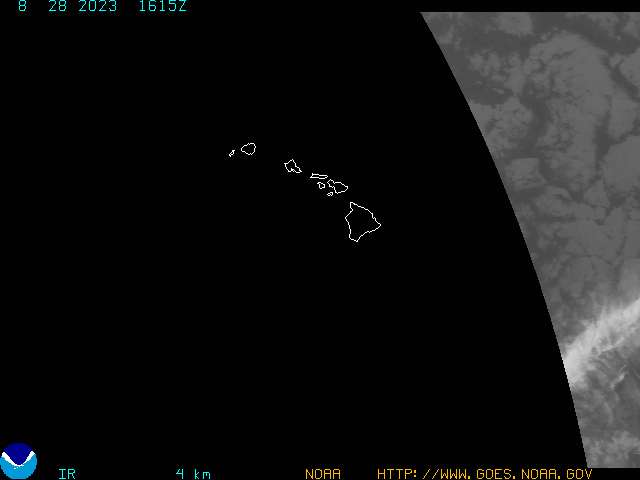
Satellite Images – To view the cloud conditions we have here in Hawaii, please use the following satellite links, starting off with the Infrared Satellite Image of the islands to see all the clouds around the state during the day and night. This next image is one that gives close images of the islands only during the daytime hours, and is referred to as a Close-up visible image. This next image shows a larger view of the Pacific…giving perspective to the wider ranging cloud patterns in the Pacific Ocean…out from the islands. To help you keep track of where any showers may be around the islands, here’s the latest animated radar image.
Tropical Cyclone Activity – The eastern Pacific hurricane season runs from May 15 through November 30…while the central Pacific runs from June 1 through November 30. The latest storm information for eastern Pacific can be found by clicking here. A storm tracking map can be found by clicking here. For the central Pacific, the latest information can be found by clicking here.

Photo credit: flikr.com
Our local trade winds will continue, although will become a little lighter now through Saturday. They certainly won’t be going away altogether, although as mentioned, may get slightly lighter for several days. This simply means that rather than being moderate to fresh, they will be moderately strong. We’ve seen wind gusts well into the 30 mph range the last several days, with at least one spot having 40+ mph gusts! These modestly reduced trade wind speeds will keep our trade winds blowing generally in the 10-25 mph range, with still a few of the windier spots having gusts topping the 30 mph mark. The trade winds are expected to recover their strength again by Sunday, remaining quite strong through most of next week.
As the trade winds get a little softer now, we will likely find just a few windward biased showers falling. Often when the trades mellow out a touch, we start to find an increase in clouds stacking-up over and around the mountains, especially during the afternoon hours. So we will see some minor showers falling in both places through Saturday. The expected increase in trade wind speeds later this weekend will probably then bring the focus for showers mostly back to the windward sides. The freshening trade winds will help to force incoming clouds off the ocean, up the sides of the volcanic slopes. We call this influence orographic precipitation, or mountain induced shower activity. The leeward sides will remain mostly dry throughout this subtle transition.
It’s early Thursday evening here in Kula, Maui, as I sit here typing out this sunset commentary. It was yet another warm, grading into hot day here in the islands. At the moment, right around 645pm, it’s still 70F degrees just outside my weather tower, and a very warm 82F degrees inside. My wind chimes are singing gently every once in a while, otherwise, it’s very peaceful and quiet. I don’t really have anything for dinner, so I’ll settle for an avocado from one of the trees on this property, plated with a couple of scoops of organic cottage cheese, and some fresh garden greens. I’m so delighted that tomorrow is Friday already, and then the weekend is right around the corner after that. I love these abbreviated work weeks! I have a luncheon meeting at the Sea Watch Restaurant in Wailea, which should be fun. All in all, things are going quite well for this Maui weatherman, and I hope you are in the same boat as well! I’ll be sure to meet you here super early in the morning with your next new narrative Friday. Aloha for now…Glenn.
I’d like to highlight the next advertising link on the left hand margin of all the pages on this website. 16 single family homesites in Spreckelsville, near Paia on the north shore of east Maui. Owning one of these 16 homesites will provide the rare opportunity to have a private access to one of the great beaches in the world. Ownership includes a private park for the residents, a private subdivision road, a private access to the beach (30 ft. wide), direct access to the bike path that will eventually run from Kahului to Paia and a 22 acre conservation area that will remain under the ownership of the residents association.
 Email Glenn James: