Weather Details and Aloha Paragraphs
Posted by GlennJune 24-25 2006
Air Temperatures – The following maximum temperatures were recorded across Hawaii Saturday:
Lihue, Kauai – 82F
Honolulu, Oahu – 88
Kaneohe, Oahu – 83
Kahului, Maui – 85
Hilo, Hawaii – 82
Kailua-Kona, Hawaii – 85
Temperatures early Sunday morning ranged between these warmest and coolest spots near sea level at the 5 a.m. hour:
Kailua-kona, Oahu – 76
Kahului, Maui – 66
Precipitation Totals – The following numbers represent the largest precipitation totals (inches) during the last 24 hours (as of Sunday morning) on each of the major islands:
0.25 LIHUE, KAUAI
0.14 WAIHEE PUMP, OAHU
0.01 MOLOKAI
0.00 LANAI
0.00 KAHOOLAWE
1.61 ULUPALAKUA, MAUI
0.34 MOUNTAIN VIEW, BIG ISLAND
Weather Chart – Here’s the latest (automatically updated) weather map…showing high pressure systems located far to the NE and NW of our islands. These high pressure cells have lost their connecting ridge now, as low pressure to Hawaii’s north breaks through, sending a trough of low pressure down over the islands…with light wind speeds today into Monday. Here’s a Weather Map Symbol page for clarification about what all those funny weather symbols mean.
Hawaii’s Mountains – Here’s a link to the live webcam on the summit of near 14,000 foot Mauna Kea on the Big Island of Hawaii. The tallest peak on the island of Maui is the Haleakala Crater, which is near 10,000 feet in elevation. These two webcams are available during the daylight hours here in the islands…and when there’s a big moon rising just after sunset for an hour or two! Plus, during the nights and early mornings you will be able to see stars, and the sunrise too…depending upon cloud conditions.
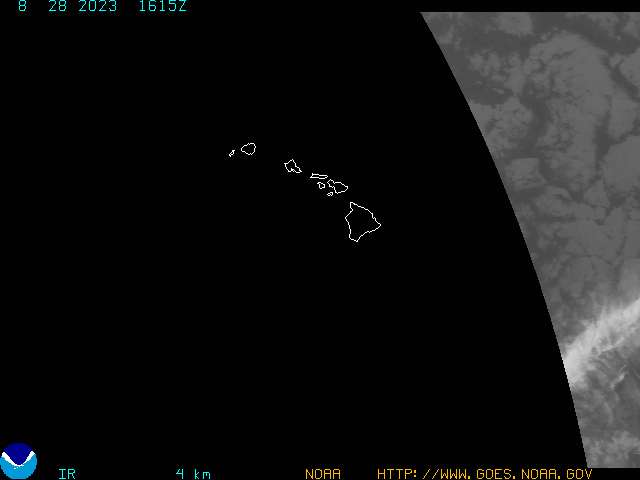
Satellite Images – To view the cloud conditions we have here in Hawaii, please use the following satellite links, starting off with the Infrared Satellite Image of the islands to see all the clouds around the state during the day and night. This next image is one that gives close images of the islands only during the daytime hours, and is referred to as a Close-up visible image. This next image shows a larger view of the Pacific…giving perspective to the wider ranging cloud patterns in the Pacific Ocean…out from the islands. To help you keep track of where any showers may be around the islands, here’s the latest animated radar image.
Tropical Cyclone Activity – The eastern Pacific hurricane season runs from May 15 through November 30…while the central Pacific runs from June 1 through November 30. The latest storm information for eastern Pacific can be found by clicking here. A storm tracking map can be found by clicking here. For the central Pacific, the latest information can be found by clicking here.


We’ve been having what could be considered fairly normal weather for this time of year here in the Hawaiian Islands for the last couple of weeks.The month of June is known for its breezy trade winds, very warm temperatures near sea level, and relatively dry conditions. 2006 has not been a normal year in terms of weather though, with fairly large swings away from what we would consider our climatological averages. The computer forecast models, for about the last week, have been hinting that we would be entering into another of those shifts back towards unusual this weekend…which seems to be manifesting as predicted.
Those weather models have forecast a low pressure system developing to the north of the state, which we now see on the current weather charts and satellite imagery. This area of low pressure has broken through our trade wind generating ridge of high pressure, which has been the connecting point between two high pressure cells to our NW and NE all week. This in turn will cause a softening of our local trade wind speeds through the next several days. The forecast keeps our trade winds lighter than normal through Monday, which will cause our local atmosphere to feel rather muggy, especially down near the beaches. The point here is that it’s unusual to have the trade winds falter like this during this early summer period.
All of this will have some influence in terms of precipitation as well. Recently we’ve seen just the usual few passing showers falling along our windward sides, which is common. As this low pressure system to our north has developed, the trade wind inversion has weakened and lifted in height. This simply means that whatever clouds that around, will be able to grow vertically in a more pronounced manner. Some of the models are suggesting, with unseasonably cold air aloft now, that we could see a few thunderstorms forming. This would be very unusual, in fact what I would call rare for late June! This may or may not happen, although it looks like we could see at least some briefly heavy showers around here and there, mostly over and around the mountains during the afternoon hours.
It’s early Saturday evening here in Kula, Maui, as I begin writing a few words, well before sunset. I’m listening to a Moody Blues CD, the one called Seventh Sojourn. When I used to live in Sonoma County, California some 31 years ago, I used to listen to these songs over and over…and over. This morning when I went back to bed after producing the Saturday narrative, I watched a Mockingbird from inside my weather tower, with binoculars, as it sang its heart out, while flittering around the upper branches of a Norfolk Pine. This kept me interested for quite a long time, as his beak kept putting out a near constant series of songs, each so unique. I’m sipping on a nice glass of rich Lake County Zinfandel, adding to the pleasure of being here in paradise. It really is nice to be living here on Maui, truly! I hope you have a great Saturday night here on Maui, or wherever you are in the world. I’ll be back early Sunday with an abbrievated narrative, freshened-up with the latest weather detail and a few words of this and that. Aloha for now…Glenn.
 Email Glenn James: