Weather Details & Aloha Paragraphs
Posted by GlennMay 4 – 5 2006
Air Temperatures – The following maximum temperatures were recorded across Hawaii Wednesday:
Lihue, Kauai – 79F
Honolulu, Oahu – 78
Kaneohe, Oahu – 79
Kahului, Maui – 82
Hilo, Hawaii – 80
Kailua-Kona, Hawaii – 86
Temperatures early Thursday morning ranged between these warmest and coolest spots near sea level at the 4 a.m. hour:
Kailua-kona – 72
Hilo – 62
Precipitation Totals – The following numbers represent the largest precipitation totals during the last 24 hours (as of Thursday morning) on each of the major islands, including:
0.47 MOUNT WAIALEALE, KAUAI
0.20 KAWAILOA, OAHU
0.08 MOLOKAI
0.00 LANAI
0.00 KAHOOLAWE
0.18 ULUPALAKUA, MAUI
0.12 HAKALAU, BIG ISLAND
Weather Chart – Here’s the latest (automatically updated) weather map…showing a low pressure trough to the NE and east of the islands…moving westward. At the same time, we have high pressure systems far to the north and NE. This pressure configuration will keep our winds light-moderately strong from the NE…gradually coming out of the true trade wind direction by Friday. Here’s a Weather Map Symbol page for clarification about what all those funny weather symbols mean.
Hawaii’s Mountains – Here’s a link to the live webcam on the summit of near 14,000 foot Mauna Kea on the Big Island of Hawaii. The tallest peak on the island of Maui is the Haleakala Crater, which is near 10,000 feet in elevation. These two webcams are available during the daylight hours here in the islands…and when there’s a big moon rising just after sunset for an hour or two! Plus, during the nights and early mornings you will be able to see stars, and the sunrise too…depending upon cloud conditions.
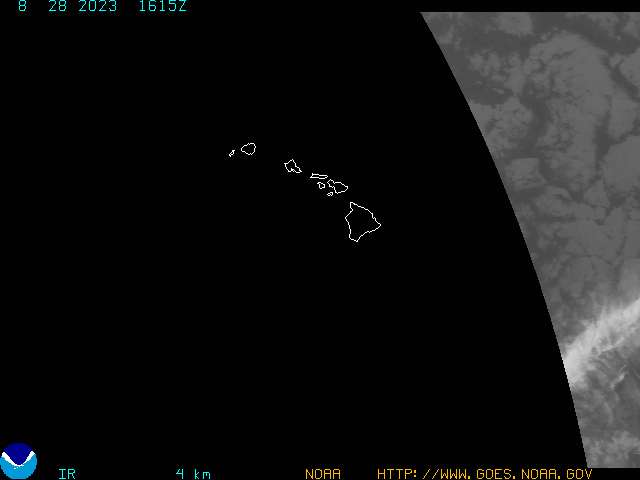
Satellite Images – To view the cloud conditions we have here in Hawaii, please use the following satellite links, starting off with the Infrared Satellite Image of the islands to see all the clouds around the state during the day and night. This next image is one that gives close images of the islands only during the daytime hours, and is referred to as a Close-up visible image. This next image shows a larger view of the Pacific…giving perspective to the wider ranging cloud patterns in the Pacific Ocean…out from the islands. To help you keep track of where any showers may be around the islands, here’s the latest animated radar image.

Sunset on a Kauai Beach
The low pressure system to our east has pretty much dissipated and the remnants of it in the form of an inverted trough in the surface easterlies is slowly drifting westward across the state. That will mean that the trade winds will bounce back on Thursday and Friday and we will likely not even see the SE winds on the back side of this trough. The temperatures will likely increase a bit especially at night as the winds will prevent the surface based inversion from forming. The humidity will also increase a tad for making it more comfortable when wet at the beach. A few more showers will be around with the return of the trades, and since there is apt to be a weak cyclonic circulation left behind at upper levels, some of these showers could be a little heavier than the run of the mill trade showers. Raymond asks if the weather will be fine when he gets here from the mainland in a couple of weeks. I would guarantee almost 100 percent that fine sunny trade wind weather will prevail by then. This is probably the best possible time climatologically to visit if you want sun and pleasant weather. Besides Maui has such a variety of microclimates that if you dont like one particular place, you will certainly be able to drive a few miles to find a more suitable location.
We had a strong earth quake of 7.8 moment magnitude in the Tonga trench 3000 miles away this morning near sunrise. There briefly was a tsunami watch out for the Hawaiian Islands which was cancelled in short order. Mary asks if we were in danger. There is always some danger of a tsunami during an undersea earth quake due to a possible landslide being involved. Thus a watch was the proper action while checking out nearby tide gages and buoy data connected with sea bottom pressure measurements. The tsunami waves travel at roughly 500 mph so if it had been an even more powerful quake, the wave would have arrived around noon Hawaiian time. Waves from that direction have not in the past been as dangerous it seems to me as from the SE and NE and N.
Much Aloha to you all from Hans substituting for Glenn. Glenn should be back for tomorrow’s summary.
 Email Glenn James: