Weather Details & Aloha Paragraphs
Posted by GlennApril 30 2006
Air Temperatures – The following maximum temperatures were recorded across Hawaii Saturday:
Lihue, Kauai – 80F
Honolulu, Oahu – 80
Kaneohe, Oahu – 80
Kahului, Maui – 85
Hilo, Hawaii – 80
Kailua-Kona, Hawaii – 84
Temperatures early Saturday morning ranged between these warmest and coolest spots near sea level at the 5 a.m. hour:
Kailua-kona – 74
Hilo airport – 66
Precipitation Totals – The following numbers represent the largest precipitation totals during the last 24 hours (as of Saturday afternoon) on each of the major islands, including:
0.80 HANALEI RIVER, KAUAI
1.38 NUUANU UPPER, OAHU
0.00 MOLOKAI
0.00 LANAI
0.00 KAHOOLAWE
0.97 WEST WAILUAIKI, MAUI
0.79 PIIHONUA, BIG ISLAND
Weather Chart – Here’s the latest (automatically updated) weather map…showing high pressure systems far to the north of Hawaii. At the same time we find a weak cold front south of these highs. At the same time, we have a new low pressure system which is forming to the NW of Hawaii. This pressure configuration will cause lighter winds Saturday and Sunday. Here’s a Weather Map Symbol page for clarification about what all those funny weather symbols mean.
Hawaii’s Mountains – Here’s a link to the live webcam on the summit of near 14,000 foot Mauna Kea on the Big Island of Hawaii. The tallest peak on the island of Maui is the Haleakala Crater, which is near 10,000 feet in elevation. These two webcams are available during the daylight hours here in the islands…and when there’s a big moon rising just after sunset for an hour or two! Plus, during the nights and early mornings you will be able to see stars, and the sunrise too…depending upon cloud conditions.
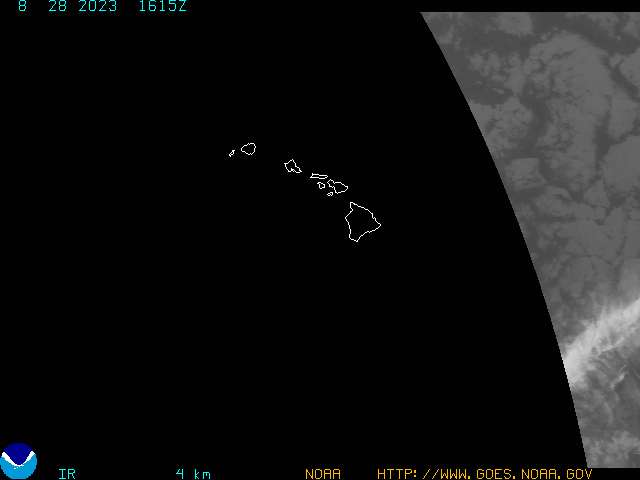
Satellite Images – To view the cloud conditions we have here in Hawaii, please use the following satellite links, starting off with the Infrared Satellite Image of the islands to see all the clouds around the state during the day and night. This next image is one that gives close images of the islands only during the daytime hours, and is referred to as a Close-up visible image. This next image shows a larger view of the Pacific…giving perspective to the wider ranging cloud patterns in the Pacific Ocean…out from the islands. To help you keep track of where any showers may be around the islands, here’s the latest animated radar image.

Lighter winds in Hawaii now
A low pressure system is developing about 500 miles north of the Islands where normally high pressure resides. This is weakening the trades and causing land and sea breezes to take over in most areas. The type of weather conditions that occur when the trades quit this time of the year is what we often refer to as a convective regime. This manifests itself in mostly clear and cool nights and sunny and warm days but with afternoon interior cloudiness with isolated showers lasting into the early evening hours. This regime will likely last through much of the upcoming week though the trades may return lightly after midweek and from slightly more northerly directions.
The low to the north of the Islands will be centered initially near 30N 155W. It is a cutoff low not tied in directly with the upper westerly jet stream. It will therefore be slow moving, but not act like the similar cutoff low that sat NW of the Islands in late February and all of March. Besides we will be on the dry side of the low underneath the northwesterly flow aloft. Not that we cannot be on the receiving end of a few locally heavy showers during the next few days.
We are now getting into the month of May and the sun is very powerful. Be sure to protect yourself against the harmful rays of the sun. At our latitudes near 20N, the sun is already almost vertical overhead at local noon which is about 12:30 pm standard time. The sun beating down on the ocean warms the upper layers of the water from a seasonal low value of about 22C (72F) in February to 27C (80F) in August. The water vapor content of the air goes up exponentially with this modest increase in temperature, and this is what supplies fuel for tropical cyclones which fortunately are a rarity around here but still a force to be reconned with. Our hurricane season here in the central North Pacific starts June 1, but we usually don’t have to worry much till about July 15th. Elsewhere, we just had a severe hurricane move inland from the Bay of Bengal into western portions of Myanmar between Rangoon and Chittagon. Otherwise, it is the quiet time of the year…the transition months between the southern hemisphere season and the upcoming northern…though the western Pacific is never totally quiet.
 Email Glenn James: