Weather Details & Aloha Paragraphs
Posted by GlennMarch 6-7 2006
Air Temperatures — The following maximum temperatures were recorded across Hawaii Monday:
Lihue, Kauai – 77F
Honolulu, Oahu – 80
Kaneohe, Oahu – 77
Kahului, Maui – 83
Hilo, Hawaii – 78
Kailua-Kona, Hawaii – 82
Temperatures early Tuesday morning ranged between these warmest and coolest spots near sea level at the 4 a.m. hour:
Kaneohe, Oahu – 73
Molokai airport – 62
Precipitation Totals — The following numbers represent the largest precipitation totals during the last 24 hours (as of Tuesday morning) on each of the major islands, including:
0.33 MOUNT WAIALEALE, KAUAI
0.56 MANOA LYON ARBORETUM, OAHU
0.00 MOLOKAI
0.00 LANAI
0.00 KAHOOLAWE
0.39 WEST WAILUAIKI, MAUI
0.15 HONAUNAU, BIG ISLAND
Weather Chart — Here’s the latest (automatically updated) weather map…showing a 1031 millibar high pressure system to the NE of the islands. This high pressure cell will keep the trade winds blowing today…gradually swinging around to the SE into Wednesday. Here’s a Weather Map Symbol page for clarification about what all those funny weather symbols mean.
Hawaii’s Mountains — Here’s a link to the live webcam on the summit of near 14,000 foot Mauna Kea on the Big Island of Hawaii. The tallest peak on the island of Maui is the Haleakala Crater, which is near 10,000 feet in elevation. These two webcams are only available during the daylight hours here in the islands…that is unless there’s a big moon rising just after sunset for an hour or two!
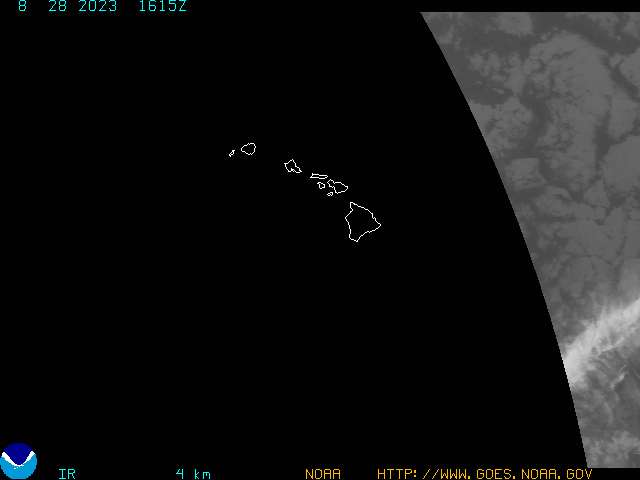
Satellite Images — To view the cloud conditions we have here in Hawaii, please use the following satellite links, starting off with the Infrared Satellite Imageof the islands to see all the clouds around the state. This next satellite image is one that gives close images of the islands only during the daytime hours, and is referred to as a Close-up visible satellite image. The next satellite image shows a larger view of the Pacific…giving perspective to the wider ranging cloud patterns in the Pacific Ocean…out from the islands. To help you keep track of where any showers may be around the islands, here’s the latest animated radar image.
Aloha Paragraphs

Pueo….the Hawaiian Owl
The weather here in the islands will be quite pleasant, with a late winter trade wind pattern in place for the time being. The windward sides of the islands will continue to see off and on showers arriving, which are common when the trades are blowing. The leeward sides will find partly sunny weather during the days, along with warm temperatures for beach excursions. A high pressure system to our north will keep the trade winds blowing through Tuesday.
The computer forecast models continue to show some changes occurring by mid-week. As a matter of fact, there seems to be some similarities between what’s coming up…and what happened last week on Kauai and Oahu. Last week’s weather was wet on those two islands, and we may very well see another round of showers arriving there by Thursday. This locally wet weather could conceivably remain in place into the weekend time frame. It’s still a little too early for exact details, although it looks like the second half of the week could be showery.
As was the case last week, the eastern islands of Maui and the Big Island may remain on the dry side of this deep moisture to the west. The models show a trough of low pressure setting up to the west of kauai. As this trough edges closer after Wednesday, the chances of rain will increase first for Kauai, and then for Oahu by Friday. As I mentioned in the above paragraph, the particulars with this forecast will have to be fine tuned as we move through the next couple of days. It isn’t certain yet whether the shower line will stop before reaching the entire state, so stay tuned for more on this unfolding sitation.
As far as the winds go, the trade winds will prevail through Tuesday. As the trough of low pressure moves closer to Hawaii, our winds will gradually swing around to the SE or even south in places. This will likely bring more volcanic haze to some parts of the state, and in particular around Kona, and then on up to the islands of Maui County. At the same time, SE and south winds bring moisture from the deeper tropics, which help to feed the showery clouds that will be around then. SE and south winds bring warmer air into the state as well, so we could see another record high temperature at the Kahului airport, like last week’s 88F degree readings for two straight days!
I had a good weekend, starting off with the sci-fi film Ultrviolet Friday night. Saturday’s surfing trip to the Lahaina side was fun. Sunday a friend and I went kayaking below the Pali on the way to Lahaina out of Maalaea Bay. Then it was the ping pong tournament with my neighbors last evening, while watching the nice sunset. There was a lot of physical exercise involved, which I enjoy a lot. My health is good, and my body serves me well, which I feel very fortunate about! Speaking of health, my Father is feeling pretty good, and will take the next test this Wednesday, and our hopes are that they will finally determine where the internal bleeding is happening…and then be able to fix the problem.
I asked our friend Hans Rosendal, recently retired NWS lead forecaster at the Honolulu office, to comment upon the recent very heavy, flooding rainfall event on Oahu. By the way, I’m honored that he would grace us with his amazingly deep understanding of the weather not only here in the islands, but worldwide! Here’s what he has to say about it:
Glenn asked me to comment and help explain the cause of the recent wet weather along the windward slopes of the Koolau mountain range of Oahu here in late February and early March. The wet weather occurred over several days as more than 2 feet of rainfall fell in spots from Kaneohe northward to Kahuku. We may ask what kind of atmospheric conditions are needed to produce such heavy rainfall?Â
On the larger scale we likely have a troughy region of light winds to the lee of the chain with say 20 kt southeast winds some distance offshore along the windward side. We are thus located along the western edge of the High centered between here and California.  Winds may thus be nearly calm along the shoreline itself. We therefore have cyclonic shear vorticity in the surface layers along this strip of shoreline from Waimanalo to Kahuku in spite of the flow at large being slightly anticyclonically curved. The property of vorticity is very conservative and thus do not quickly form or dissipate. There are however ready exchanges taking place between cyclonic shear and cyclonic curvature vorticity. Thus small low pressure centers do develop in these terrain favored spots out of the cyclonic shear and cause the convergence and anchoring mechanism.
Â
Â
Â
Â
It’s early Monday evening here in Kula, Maui. I just came in off the weather deck, watching the gorgeous sunset…all the while listening to the resident Mockingbird singing its heart out atop the Norfolk Pine next door. The sunset lit up all the high cirrus clouds around now, and in the process turning the waters of Maalaea Bay pink in color. As I was driving up through the pasturelands on the way home from work, I happened to see two Hawaiian Owls, also called Pueo here in the islands. I always think of this as a special occasion, and without fail put my palms together in acknowledgement of their presence. Just now as I was sitting outside, I saw a third one in the pastures just down the hill from my weather tower! I hit the beach again today, with the sunshine so deliciously warm on my bare back. The ocean was just the right temperature, and with no waves breaking, my swim was great. I hope you have a great Monday night! I’m pleased to see quite a few local businesses taking advantage of the link advertisement offer (details just below), as I think of it as a win-win-win situation: it helps businesses with a web presence, its helps the folks who are looking for special deals, or good things to buy or do here in the islands, and it helps me too! I’ll be back early Tuesday morning with the next completely updated weather narrative from paradise. Aloha for now…Glenn.
New Advertising Feature: This website receives between 6,000 and 12,000+ page impressions per day. Sunday, March 5th’s total visitor count to this website was 8,504. If one does a google search for Hawaii Weather or Maui Weather, this site comes up number one on the list. I’ve created a way that I can have a link from this popular website, directly to yours. It may be a great way to increase traffic to your own webpages. This offer is available for $50 per month, with a three month minimum. That makes three months of exposure to your business for just $150…which is a great way to highlight your website to folks who may already be interested in almost anything Hawaiian. Please email me, or leave a message in the reply box below, if you have some interest in this proposal. A link to your site will be displayed along the left hand margin of all the pages on this website, in alphabetical order. Check out the businesses that signed up recently…interesting and valuable information.
 Email Glenn James: