Air Temperatures ranged between these warmest and coolest spots near sea level around the state – and on the highest mountains…at 5pm Monday evening:
Port Allen, Kauai – 81F
Lihue, Kauai – 73
Haleakala Crater – 55 (near 10,000 feet on Maui)
Mauna Kea summit – 45 (near 14,000 feet on the Big Island)
Precipitation Totals–The following numbers represent the largest precipitation totals (inches) during the last 24 hours on each of the major islands, as of Monday afternoon:
0.02 Anahola, Kauai 0.30 Waimanalo, Oahu
0.02 Molokai
0.00 Lanai
0.00 Kahoolawe 0.52 West Wailuaiki, Maui 0.16 Honokaa, Big Island
Marine Winds – Here’s the latest (automatically updated)weather mapshowing a dissipating cold front near the Big Island. At the same time we have a high pressure center to our east-northeast. Our winds will be light and variable with a tendency to southeast later Tuesday…then back to the north and northeast Wednesday.
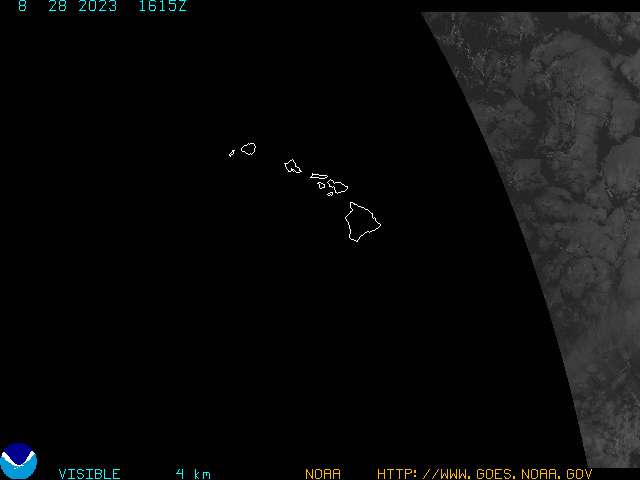
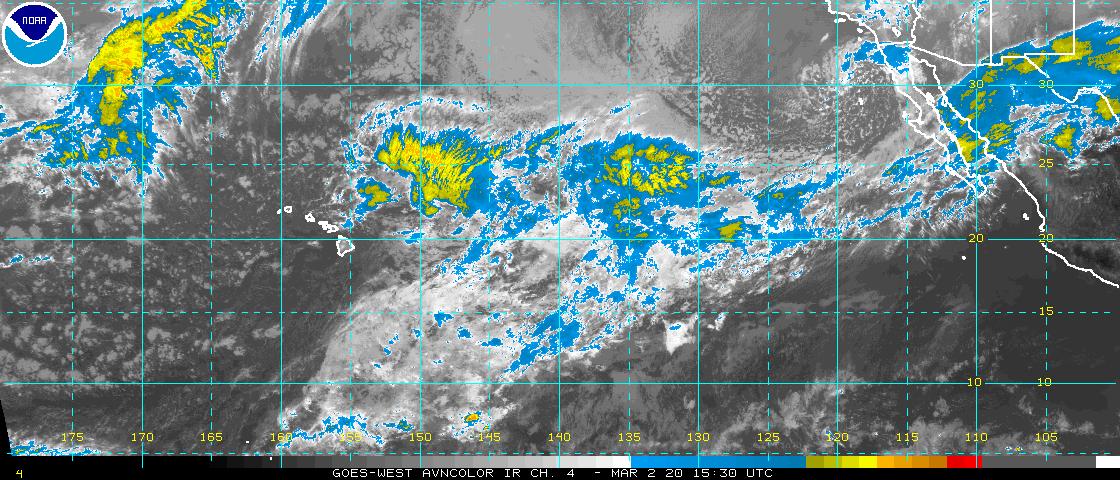
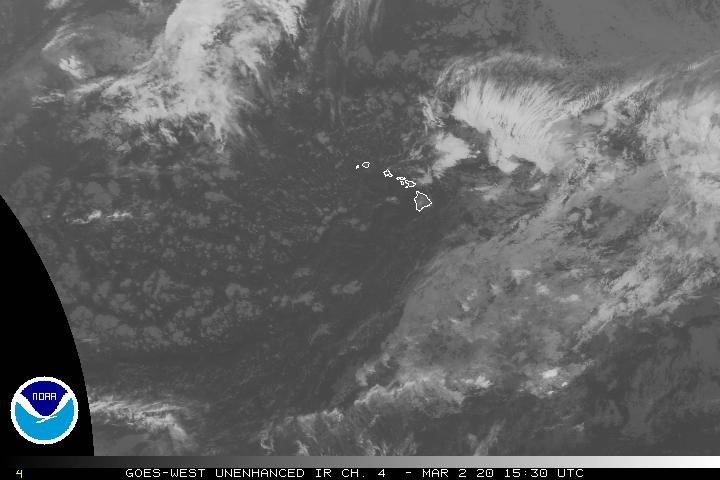
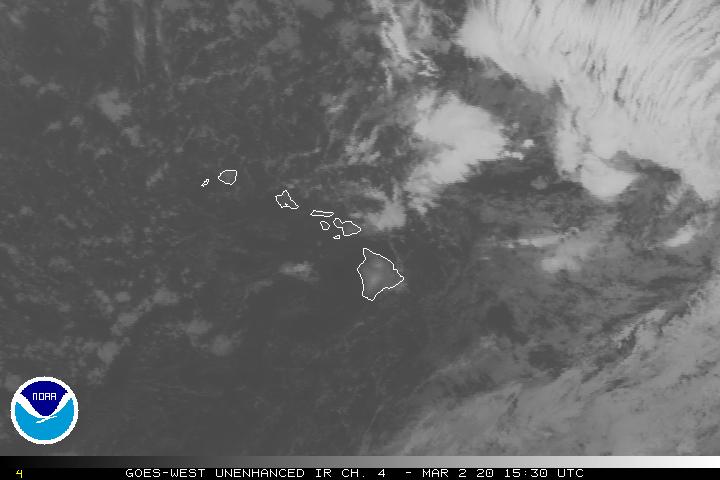
Satellite and Radar Images:To view the cloud conditions we have here in Hawaii, please use the following satellite links, starting off with thisInfrared Satellite Imageof the islands to see all the clouds around the state during the day and night. This next image is one that gives close images of the islands only during the daytime hours, and is referred to as aClose-up visible image. This next image showsa larger view of the Pacific…giving perspective to the wider ranging cloud patterns in the Pacific Ocean. Finally, here’s aLooping IR satellite image, making viewable the clouds around the islands 24 hours a day. To help you keep track of where any showers may be around the islands, here’s the latest animatedradar image.
Hawaii’s Mountains – Here’s a link to the live webcam on the summit of near 14,000 foot Mauna Kea on the Big Island of Hawaii. The tallest peak on the island of Maui is the Haleakala Crater, which is near 10,000 feet in elevation. These two webcams are available during the daylight hours here in the islands…and when there’s a big moon rising just after sunset for an hour or two! Plus, during the nights and early mornings you will be able to see stars, and the sunrise too…depending upon weather conditions. Tropical Cyclone activity in the eastern and central Pacific– Here’s the latest weather information coming out of theNational Hurricane Center, covering the eastern north Pacific. You can find the latest tropical cyclone information for the central north Pacific (where Hawaii is located) by clicking on this link to the Central Pacific Hurricane Center. Here’s atracking mapcovering both the eastern and central Pacific Ocean. A satellite image, which shows the entire ocean area between Hawaii and the Mexican coast…can be found here.
Aloha Paragraphs
Very large breaking waves along the north shores now!
A cold front brought some rather modest showers to the islands…which is dissipating over the Big Island Monday night.This front wasn’t a big rainfall producer, but at least brought some limited precipitation locally. The Big Island windward sides have the best chance for a few showers tonight, with some of the remnant moisture spreading back to the windward sides of Maui at times too. The islands of Kauai and Oahu will see generally fair weather into Tuesday. The next cold front forecast to approach our area, will move in our direction at mid-week. Just exactly what influence this front will have, besides bringing cooler winds our way…is still a bit uncertain as far as rainfall goes. The best opportunity for showers would be over the island of Kauai, closest to the weakening cold front.
As far as winds go, they are slightly cooler from the northeast now…and will be losing strength Tuesday.This air will be relatively dry, especially over Kauai and Oahu…outside the leftover moisture from the retiring cold front further south in the chain. The northeast direction will help to keep those clouds around Maui and the Big Island, hugging the windward coasts and slopes. As the next cold front approaches, our winds will take on a more east and southeast orientation Tuesday. This may once again bring a short period of hazy weather our way, as the volcanic emissions get carried towards the islands of Maui County. As the cold front gets closer, our winds will swing all the way around to south and southwest, and perhaps get locally gusty…especially over the taller mountains on the Big Island. The airflow in the wake of the Wednesday cold front will be brisk, and carry slightly cooler air into our area briefly, before warmer trade winds return.
We saw extra large to giant swells breaking along our north and west facing beaches Monday.This swell will be one of the largest swells of the winter season…although had peaked early Monday morning, and will be slowly diminishing into Tuesday. This winter will have more than the ordinary amount of these larger than normal swells arriving…as we’ve seen since winter started back in December! Looking further ahead, another very large swell will build late in the day Wednesday, remaining large for a couple of days thereafter. Then, during the second half of this coming weekend, yet another very large NW swell arrive. In between these extra large swell days, we’ll have just plain old large swells breaking along our north and west facing shores. This is the time of year when we often see these frequent high surf episodes, with the current swell being large enough…to keep high surf warning level waves breaking at the time of this writing.
It’s Monday evening, as I begin writing the last section of today’s narrative. As noted above, we have slightly cooler northeast breezes coming into the state now, along with a dissipating cold front over the Big Island.Thissatellite image, shows the cold front having moved over our southernmost island. Despite the presence of this dissipating cloud band, it has basically run out of water, or at least for the most part. Thislooping radar imagedemonstrates this fact quite well, although if you look closely, there are a few showers along the Hamakua coast of the Big Island, stretching across the Alenuihaha Channel onto the east Maui windward slopes as well. This dry weather pattern has become the norm this winter, and will very likely hold true for the next cold front, arriving around Wednesday. This of course isn’t good news for the islands of Maui and the Big Island, or for the other islands as well, which are all drier than normal now. As I’ve mentioned many times lately, this reality goes hand in hand with the El Nino condition, which is keeping us in drought conditions currently. ~~~
I’m getting a late start on my evening weather narrative update, but at least it’s still light enough here in Kihei, for me to see what’s happening out the window. There’s actually quite a few clouds out there, with what looks like some showers falling along the windward sides here on Maui. The winds are still coming a bit more out of the north than normal, so that there is still a slight chill to the air, in a tropical sense. I’d best be getting on the road, as even leaving now, it will likely be dark, or just before that by the time I get home to Kula. I’ll be back early Tuesday morning with your next new weather narrative from paradise. I hope you have a great Monday night until then! Aloha for now…Glenn.
Interesting:Scientists at NASA and the National Snow and Ice Data Center published research last week in the Journal of Geophysical Research based on satellite microwave data of seasonal Arctic ice thaw from 1970 to 2009. The study indicates the seasonal Arctic sea ice melt season is now about 20 days longer than it was 30 years ago.
The growing season of thaw is most pronounced in Arctic waters off the coasts of Alaska and Canada, including the Chukchi and Beaufort seas, where the season is 30 days longer now than in 1979. East Greenland and the Hudson Bay also share nearly a month longer of seasonal melt. The Hudson Bay exhibits one of the fastest increases in seasonal melt on the globe.
On average, seasonal melt has increased about 2.5 days per decade and lasts 3.7 days longer — an average of just under 20 days since 1979. "With the exception of the Sea of Okhotsk, all areas in the Arctic show a trend toward earlier melt onset and also a trend toward later freeze up," researchers said in their published report.
Scientists suggest that the longer melt season creates a feedback loop further accelerating warming in the region. When the ice melts, darker ocean water absorbs more heat from the sun. With a longer melt season there is more time for these dark waters to absorb more heat, adding further to ice loss.
The delayed fall freeze also means thinner ice reforms every season, leading to increased ice loss in the coming thaw next season. NASA has recently published research showing that average thickness of Arctic sea ice shrank 2.2 feet between the winters of 2004 and 2008, with the surface area covered by multi-year ice shrinking by more than 42 percent.
Interesting2:It is very cold in most of the US this winter.It brings to mind is it so cold that you can freeze to death as well as what happened to global warming? Cooling as well as warming trends have happened before and will happen again. Back in the 1970’s for example winters turned significantly colder for awhile.
Meteorologists are quick to point out that reliable U.S. weather data goes back only to the late 1800s, so it’s normal for records of various types to be broken every year, somewhere, when dealing with such a relatively brief data set. Any given day or year may set a record. For global warming it is the long term trend that is important. When cold air hits your body, blood will move away from your skin, fingers and toes and towards the inner core.
This process is called vasoconstriction, and it helps limit the amount of heat you lose to the environment. The opposite effect is called vasco-dilation where blood goes to the skin and heat is lost to the cold air (though you feel warm). This is what happens when one drinks too much alcohol. Shivering also occurs when you get cold. Major shivering also occurs when your body core temperature drops very low.
This is called hypothermia. This normally will not happen except under severe and prolonged exposure. If you’re wet and cold, your body loses heat up to 25 times faster. So being in wet clothing may cause more damage than just being in cold weather. Even sweat may do this.
The wind will also cool a person. In summer it a a cool refreshing breeze. In winter it is called wind chill. Normal core body temperature is 98.6 degrees Fahrenheit (F). Mild hypothermia sets in at about 95 degrees F. Below 70 degrees F, you are said to have profound hypothermia and death can occur.
A person in hypothermia may be unconscious and may appear dopey or intoxicated. The record for the lowest body temperature at which an adult has been known to survive is 56.7 degrees F, which occurred after the person was submersed in cold, icy water, according to Castellani of the U.S. Army Research Institute of Environmental Medicine.
Frostbite, an injury caused by freezing, is more common in everyday scenarios. This is because fingers and toes are more easily isolated from the body higher temperatures. Since frostbite is brought on by freezing, you can’t get frostbite if the air temperature is above 32 degrees F. "It takes a wind chill temperature of around minus 15 degrees [F] where you start to see an increase in the incident of frostbite," Castellani said.
Interesting3:A strip of paper infused with carbon nanotubes can quickly and inexpensively detect a toxin produced by algae in drinking water. Engineers at the University of Michigan led the development of the new biosensor. The paper strips perform 28 times faster than the complicated method most commonly used today to detect microcystin-LR, a chemical compound produced by cyanobacteria, or blue-green algae. Cyanobacteria is commonly found on nutrient-rich waters.
Microcystin-LR (MC-LR), even in very small quantities, is suspected to cause liver damage and possibly liver cancer. The substance and others like it are among the leading causes of biological water pollution. It is believed to be a culprit of mass poisonings going back to early human history, said Nicholas Kotov, a professor in the departments of Chemical Engineering, Biomedical Engineering and Materials Science and Engineering who led the project.
Water treatment plants — even in developed countries — can’t always remove MC-LR completely, nor can they test for it often enough, Kotov said. The biosensor he and his colleagues developed provides a quick, cheap, portable and sensitive test that could allow water treatment plants and individuals to verify the safety of water on a more regular basis.
"The safety of drinking water is a vital issue in many developing countries and in many parts of the United States," Kotov said. "We’ve developed a simple and inexpensive technology to detect multiple toxins." The technology could easily be adapted to detect a variety harmful chemicals or toxins in water or food.
Interesting4:The US Geological Survey reports that earthquake related deaths numbered 1783 worldwide, a big decrease from 2008 when more than 88,000 died, with more than 87,000 of the deaths occurring in the Eastern Sichuan, China earthquake in May 2008. In 2009, the worst earthquake was the September 30th earthquake in Southern Sumatra, Indonesia in which 1,117 people were killed.
Overall, earthquakes took the lives of people in 15 countries on four continents during 2009, including Afghanistan, Bhutan, China, Costa Rica, Greece, Indonesia, Italy, Kazakhstan, Honduras, Japan, Malawi, Samoa, South Africa and Tonga, as well as the U.S. territory of American Samoa. Earthquakes injured people in 11 additional countries, including the mainland United States, where a magnitude 4.4 earthquake on May 2 injured one person in the Los Angeles area.
The biggest 2009 earthquake in the 50 United States was, once again, in the Aleutian Islands of Alaska. The magnitude 6.5 earthquake occurred in the Fox Islands on Oct. 13. It was felt at the towns of Akutan and Unalaska, but caused no casualties or damage. The largest earthquake for the year in the contiguous United States was a magnitude 5.2 event on Oct. 2 in the Owens Valley southeast of Lone Pine, Calif.
Because of the sparse population in the epicentral area, this quake caused no damage although it was felt as far away as Merced and Los Angeles, Calif. and Las Vegas, Nev. The past year also marked the five-year anniversary of the magnitude 9.1 Sumatra-Andaman Island earthquake and subsequent tsunami on Dec. 26, 2004. That quake and tsunami killed 227,898 people, which is the fourth largest casualty toll for earthquakes and the largest toll for a tsunami in recorded history.
As a consequence of that earthquake, the USGS has significantly improved its earthquake notification and response capabilities. Improvements include the addition of nine real-time seismic stations across the Caribbean basin, a seismic and tsunami prone region near the U.S. southern border, implementation of a 24×7 earthquake operations center at the USGS National Earthquake Information Center (NEIC), and development of innovative tools for rapid evaluation of population exposure and damage to potentially damaging earthquakes.
The USGS estimates that several million earthquakes occur throughout the world each year, although most go undetected because they hit remote areas or have very small magnitudes. The USGS NEIC publishes the locations for about 40 earthquakes per day, or about 14,500 annually, using a publication threshold of magnitude 4.5 or greater worldwide or 2.5 or greater within the United States. On average, only 18 of these earthquakes occur at a magnitude of 7.0 or higher each year.
Interesting5:Smog in urban areas often makes the news. But truth be told, air quality is often much worse inside our homes than outside. That’s because tens of thousands of chemicals, some synthetic and some found in nature, are used to make products commonly found in buildings. Many of these chemicals are benign, some are highly toxic, and most fall in that wide gray area in between.
When it comes to indoor air contamination, the biggest culprit in our homes is VOCs, a large class of chemicals that can evaporate, or off gas, from stuff that’s all around us, like particle board, carpet, paint, cleaning products, and materials treated with stain-resistant and wrinkle-resistant chemicals.
VOCs can aggravate respiratory ailments like asthma, and have been linked to cancer and damage to nervous and reproductive systems. Will exposure to VOCs and other indoor air pollutants, such as mold or wood smoke, make you sick? This may sound like a cop-out, but the answer is—it depends.
It depends on the nature of the pollutant, your general health, the level of exposure and length of time you’re exposed, whether that pollutant might combine with other pollutants in your home or in your body to create a more dangerous compound, and other environmental and genetic factors.
Without clear answers, health experts say it’s prudent to take commonsense steps to limit your exposure to polluting chemicals. You might want to take extra precautions if there are people in your household who are at higher risk of being harmed by indoor air pollutants. These include infants and children and people with asthma, other respiratory conditions, compromised immune systems, or chemical sensitivities.
Interesting6:A new study by a researcher at Ben-Gurion University of the Negev (BGU) reveals that physicians’ moods impact the number of prescriptions, referrals and lab tests ordered, as well as the amount of time they spend talking with their patients. The findings of the study "Communicating with Patients, Prescribing Medications and Referring to Tests and Specialists: Associations with Physician Burnout and Moods" were recently presented at the 14th International Conference of the Israel National Institute for Health Policy by Prof. Talma Kushnir, Department of the Sociology of Health, BGU Faculty of Health Sciences.
Prof. Kushnir surveyed 188 primary physicians in Israel to determine whether doctors changed their professional behavior on good mood days, as well as days when they felt stressed, tired or anxious. Physicians’ burnout levels were also assessed. The study asked doctors to rank how their mood affected the extent they talked to patients, prescribed medications, sent them to lab or diagnostic tests and referred patients to a specialist.
Her findings show that a good or bad mood affected all five physician behaviors. On days the doctors felt positive moods, they spoke more to patients, wrote fewer prescriptions, ordered fewer tests and issued fewer referrals. However, when doctors were in a bad mood, they did the opposite. Additionally, if the physicians’ burnout level was higher, their moods more strongly impacted their behaviors.
"The finding that on bad mood days physicians tend to talk less, and may needlessly prescribe and refer more than on good mood days, implies that negative moods may be detrimental to quality and costly to healthcare systems," says Prof. Kushnir. Conversely, positive moods that have the opposite effects may help contain costs."
Air Temperatures ranged between these warmest and coolest spots near sea level around the state – and on the highest mountains…at 5pm Sunday evening:
Kailua-kona – 80F
Molokai airport – 70
Haleakala Crater – 54 (near 10,000 feet on Maui)
Mauna Kea summit – 46 (near 14,000 feet on the Big Island)
Precipitation Totals–The following numbers represent the largest precipitation totals (inches) during the last 24 hours on each of the major islands, as of Sunday afternoon:
0.68 Kokee, Kauai 0.40 Schofield South, Oahu
0.00 Molokai
0.00 Lanai
0.00 Kahoolawe
0.02 Puu Kukui, Maui 0.01 Saddle Quarry, Big Island
Marine Winds – Here’s the latest (automatically updated)weather mapshowing a high pressure ridge near the Big Island. At the same time, we see a cold front moving down through the state. Our winds will be light SW ahead of the front. Winds behind the cold front will be northwest…finally turning north to northeast through Monday.
Satellite and Radar Images:To view the cloud conditions we have here in Hawaii, please use the following satellite links, starting off with thisInfrared Satellite Imageof the islands to see all the clouds around the state during the day and night. This next image is one that gives close images of the islands only during the daytime hours, and is referred to as aClose-up visible image. This next image showsa larger view of the Pacific…giving perspective to the wider ranging cloud patterns in the Pacific Ocean. Finally, here’s aLooping IR satellite image, making viewable the clouds around the islands 24 hours a day. To help you keep track of where any showers may be around the islands, here’s the latest animatedradar image.
Hawaii’s Mountains – Here’s a link to the live webcam on the summit of near 14,000 foot Mauna Kea on the Big Island of Hawaii. The tallest peak on the island of Maui is the Haleakala Crater, which is near 10,000 feet in elevation. These two webcams are available during the daylight hours here in the islands…and when there’s a big moon rising just after sunset for an hour or two! Plus, during the nights and early mornings you will be able to see stars, and the sunrise too…depending upon weather conditions. Tropical Cyclone activity in the eastern and central Pacific– Here’s the latest weather information coming out of theNational Hurricane Center, covering the eastern north Pacific. You can find the latest tropical cyclone information for the central north Pacific (where Hawaii is located) by clicking on this link to the Central Pacific Hurricane Center. Here’s atracking mapcovering both the eastern and central Pacific Ocean. A satellite image, which shows the entire ocean area between Hawaii and the Mexican coast…can be found here.
Aloha Paragraphs
Cold front moving through the state
An active Pacific cold front is moving down through the Hawaiian Islands, which is expected to stall somewhere near Maui or perhaps as far south as the Big Island…bringing cooler air out way.Glancing at thissatellite image, we see the leading edge of the frontal cloud band having entered Maui County, with the island of Kauai already starting to clear…on the other end of the frontal boundary.
There’s still a question as to how far this next cold front will push into the state, although it looks like a good chance of it reaching the Big Island with at least some showers over the next couple of days. The next cold front, destined to get close to the state, will be in our vicinity by mid-week. Just exactly what influence this front will have, besides bringing cooler winds our way…is still up in the air.
We continue to see large to extra large swells breaking along our north and west facing beaches. Sunday saw a new very large, to near giant NW swell arriving, which will remain around into Monday and Tuesday. Looking even further ahead, yet another very large swell will build late in the day Wednesday, remaining large for several days thereafter. This is the time of year when we often see these frequent high surf events, with the current swell being large enough, to keep high surf warning level waves breaking.
It’s Sunday evening, as I begin writing the last section of today’s narrative. This satellite image, showing a larger area than the one above, displays the cold front progressing down over the southern part of the island chain. Here’s the latest looping radar image, showing a thin line of light showers along the leading edge of this cold front…although they seem to be diminishing with time.. What’s liable to happen is that the front will stall out someplace between Maui and the Big Island. This will leave the remnant moisture over those islands, which is a good thing. This is true, at least in providing some showers. The winds are already turning north and northeast behind the cold front, and even out ahead of it here on Maui early Sunday evening…which are cool. These winds will help to keep the clouds and some showers falling along the windward sides of these islands for a couple of days. The leeward sides likely won’t see much of this precipitation. This reality will stay in place through Monday, and perhaps into Tuesday, at least until the Kona winds start blowing ahead of the next cold front, forecast to arrive sometime around mid-week. ~~~ Looking out the windows of my Kula weather tower early Sunday evening, it’s become quite cloudy, after a lovely day of sunshine. At the same time, we have quite a bit of haze in our local skies too. As the north to northeast winds have a chance to blow a while longer, most areas will become less hazy on Monday. ~~~ I’m kind of excited about this rainfall just on our doorstep here on Maui, as the radar image above shows. It will likely be dark already before the rains arrive in upcountry Maui, but I’ll still look forward to hearing it fall in the dark. I love to see the rains falling during the daylight hours, as I consider it a treat to behold. I’ll be back early Monday morning with your next new weather narrative. I’m hoping that this cold front will make it across the Alenuihaha Channel to the Big Island, we’ll talk more about that in the morning. I hope you have a great Sunday night until then! Aloha for now…Glenn.
Interesting: Antarctica is warming, but not melting anything like as much as expected. In fact, during the continent’s summer this time last year, there was less melting than at any time in the 30 years that we have had reliable satellite measurements of the region.
The apparent contradiction is explained by the seasonal pattern of warming, say two glaciologists writing in Eos, the weekly newspaper of the American Geophysical Union. The continent’s winters and springs have warmed most, but it is still too cold in these seasons for anything to melt.
Melting in Antarctica happens almost entirely in the summers, which have warmed very little, say Andrew Monaghan of the National Center for Atmospheric Research in Boulder, Colorado, and Marco Tedesco of the City College of New York. John King of the British Antarctic Survey, based in Cambridge, warned against misinterpreting the lack of summer warming.
"Climate change denialists will use this work as evidence that Antarctica is not warming, despite the authors saying their works show no such thing," he said. Every year is different, says Tedesco. "In 2005, we had summer melting occurring inland as well as over the coastal ice shelves, and over areas up to 2500 meters above sea level."
And even during the exceptionally low melt of last summer, ice on the Antarctic Peninsula, which stretches out towards South America, continued to melt. The Wilkins ice shelf, which is attached to the peninsula, has been collapsing rapidly since February 2008.
The continent’s huge ice sheets contain enough frozen water to raise sea levels globally by around 60 meters. Tedesco and Monaghan say the main factor in how much they warm each summer is the strength of the winds that circle the continent. Circumpolar winds act as a barrier to warm air.
They have become stronger over the past four decades, effectively sealing off most of the continent each summer from the effects of global warming. The circumpolar winds appear to have strengthened because the ozone layer in the stratosphere has thinned.
This has made the lower stratosphere cooler and generated stronger winds beneath. But Tedesco warns that as the ozone hole heals in the coming decades, the winds will weaken, the continent will become much warmer in summer – and melting will increase.
Interesting2:The cold spell blanketing the Deep South was good news for some fruit growers, though the latest round of extreme weather has created worries for other farmers after the drought and drenching rains of 2009. "Right now, we’re letting nature take care of itself," said Joe Mitcham Jr., whose 100 acres of peaches are the largest orchard in Louisiana.
His peaches need 850 to 1,000 hours of temperatures below 45 degrees, and he expected to be well into 700 hours by next week. The effects of the latest weather swing may be more ominous for growers of citrus, strawberries and other specialties — depending on how long the cold snap lasts and, particularly for fish farmers, how abruptly it warms back up.
Alabama catfish producers, for example, could see greater-than-normal winter kill. Crawfish become lethargic and don’t eat, so farmers can’t catch them because they won’t go after the bait in traps until the waters warm up. It’s been almost 14 years since the area has had such a long and biting cold snap, said National Weather Service meteorologist Robert Ricks.
He expected temperatures to trend back toward more normal, above-freezing temperatures next week. Because most non-citrus fruits require an extended season of chilling to produce a good crop, they’re not big in warmer parts of the Deep South: fewer than 400 acres of peaches in Louisiana, and 1,000 acres of peaches and 250 acres of apples in Mississippi.
Even for peaches, it may be too cold for the best results, said Gary D. Gray, a regional extension agent based in Chilton County, Ala., where about 2,500 acres — 80 percent of the state’s crop — are grown. He said the best chilling occurs between 32 degrees and 50 degrees.
In Georgia, temperatures dipping into the 20s and 30s were helping the state’s 10,000 acres of peaches rack up the chilling hours needed to mature, said Charles Hall, executive director of the Georgia Fruit and Vegetable Growers Association. Apples need about the same amount of cold or a bit more, said Mike Reeves, regional agent for northeast Alabama.
The state has about 250 acres of apples, a state extension service spokeswoman said. The unusual cold also could kill off insects that might otherwise wreak havoc on blueberries or already hard-hit row crops later this season.
"It has been a wacky year," Mississippi State University agricultural economist John Michael Riley said. There was a slow start for some crops in 2009, with rains delaying spring planting.
Then came a dramatic dry-out, and high hopes for decent yields for crops like soybeans, cotton and sweet potatoes virtually washed away for many producers by near-constant rains at the peak of the traditional harvest. "The probability of something like this happening was always there," Riley said.
"It just happened to go down this year." Economists have estimated revenue losses for major row crops in Louisiana and Mississippi at more than $800 million, and Riley believes a federal emergency aid package will be needed to help some producers stay in business in 2010.
In many cases, 2009’s losses compounded those felt in 2008. That year was hit by hurricanes Gustav and Ike, high fuel and production costs, and wildly fluctuating prices on the commodities market.
Congress has yet to act on a bailout. At least half of Louisiana’s citrus crop is already picked, but farmers will have problems if temperatures drop to 22 degrees or below, said Alan Vaughn of the Louisiana State University AgCenter.
Growers with at least 4,000 trees will be able to get the labor to pick the rest and the coolers to hold the fruit for months, he said — but smaller growers, with a few hundred trees, don’t have the labor or storage capacity. The fruit, un-cooled, is good for about 10 days, Vaughn said.
"The small guy, if it gets too cold, he’s just lost the rest of his crop," he said. The cold comes at a bit of a lull in the production year. While there are some major crops at risk — Florida farmers have been scrambling to protect their citrus — much of the concern across the Southeast now settles on niche crops.
Farmer Eddie Faust was nervous about what he’d find when he peeled the insulated blanket off his strawberries once it warmed up again in southeast Louisiana. He figured some of the green berries he’d hoped to have picked and ready for sale for Valentine’s Day would have freeze burn.
He just hoped there wouldn’t be many. "It’s going to be a wait-and-see thing," he said days into a deep freeze that had sent lows into the 20s, about 15-20 degrees below normal for parts of the region. "This is the first in many years it’s dropped like this."
Interesting3:Viruses love plane travel. They get to fly around the world inside a closed container while their infected carrier breathes and coughs, spreading pathogens to other passengers, either by direct contact or through the air. And once people deplane, the virus can spread to other geographical areas. Scientists already know that smallpox, measles, tuberculosis, seasonal influenza and severe acute respiratory syndrome (SARS) can be transmitted during commercial flights.
Now, in the first study to predict the number of H1N1 flu infections that could occur during a flight, UCLA researchers found that transmission during transatlantic travel could be fairly high. Reporting in the current online edition of the journal BMC Medicine, Sally Blower, director of the Center for Biomedical Modeling at the Semel Institute for Neuroscience and Human Behavior at UCLA, along with Bradley Wagner and Brian Coburn, postdoctoral fellows in Blower’s research group, used novel mathematical modeling techniques to predict in-flight transmission of the H1N1 virus.
They found that transmission could be rather significant, particularly during long flights, if the infected individual travels in economy class. Specifically, two to five infections could occur during a five-hour flight, five to 10 during an 11-hour flight, and seven to 17 during a 17-hour flight. "Clearly, it was air travel, by transporting infectious individuals from the epicenter in Mexico to other geographic locations, that significantly affected the spread of H1N1 during the outbreak last spring," Coburn said.
"However, until our study, it hadn’t been determined how important in-flight transmission could be. Therefore, we decided to make a mathematical model and predict what could be expected to occur during a flight." Using methods from the field of quantitative microbial risk assessment, the researchers determined the number of potential infections in one transatlantic flight, assuming there was just a single infected passenger on board.
Specifically, they used the long-established Wells-Riley equation, which was developed more than 30 years ago and is now standard for predicting the size of outbreaks within buildings and other enclosed environments for infectious pathogens transmitted through the air.
The equation is based on the number of exposed individuals, the respiratory rate of the infected person, the length of exposure to the infectious droplets and the concentration of infectious viral particles over time.
Amid concerns regarding terrorists targeting airliners using weapons less detectable by traditional means, the Transportation Security Administration (TSA) is ramping up deployment of whole body scanners at security checkpoints in U.S. airports. These systems produce anatomically accurate images of the body and can detect objects and substances concealed by clothing.
Interesting4:Contrary to conventional belief, as the climate warms and growing seasons lengthen subalpine forests are likely to soak up less carbon dioxide, according to a new University of Colorado at Boulder study. As a result, more of the greenhouse gas will be left to concentrate in the atmosphere. "Our findings contradict studies of other ecosystems that conclude longer growing seasons actually increase plant carbon uptake," said Jia Hu, who conducted the research as a graduate student in CU-Boulder’s ecology and evolutionary biology department in conjunction with the university’s Cooperative Institute for Research in Environmental Sciences, or CIRES.
The study will be published in the February edition of the journal Global Change Biology. Working with ecology and evolutionary biology professor and CIRES Fellow Russell Monson, Hu found that while smaller spring snowpack tended to advance the onset of spring and extend the growing season, it also reduced the amount of water available to forests later in the summer and fall.
The water-stressed trees were then less effective in converting CO2 into biomass. Summer rains were unable to make up the difference, Hu said. "Snow is much more effective than rain in delivering water to these forests," said Monson. "If a warmer climate brings more rain, this won’t offset the carbon uptake potential being lost due to declining snow packs." Drier trees also are more susceptible to beetle infestations and wildfires, Monson said.
Air Temperatures ranged between these warmest and coolest spots near sea level around the state – and on the highest mountains…at 5pm Saturday evening:
Princeville, Kauai – 81F
Kahului, Maui – 77
Haleakala Crater – 59 (near 10,000 feet on Maui)
Mauna Kea summit – 46 (near 14,000 feet on the Big Island)
Precipitation Totals–The following numbers represent the largest precipitation totals (inches) during the last 24 hours on each of the major islands, as of Saturday afternoon:
0.01 Port Allen, Kauai 0.05 Waimanalo, Oahu
0.00 Molokai
0.00 Lanai
0.00 Kahoolawe 0.68 Kahakuloa, Maui 0.01 Kamuela, Big Island
Marine Winds – Here’s the latest (automatically updated)weather mapshowing a high pressure ridge near the Big Island. At the same time, we see a cold front approaching from the northwest. Our winds will be light southeasterly, then south and SW ahead of the front. Winds behind the cold front will be northwest…finally turning north to northeast. e cold front will be west, then northwest…finally turning north later Sunday into Monday.
Satellite and Radar Images:To view the cloud conditions we have here in Hawaii, please use the following satellite links, starting off with thisInfrared Satellite Imageof the islands to see all the clouds around the state during the day and night. This next image is one that gives close images of the islands only during the daytime hours, and is referred to as aClose-up visible image. This next image showsa larger view of the Pacific…giving perspective to the wider ranging cloud patterns in the Pacific Ocean. Finally, here’s aLooping IR satellite image, making viewable the clouds around the islands 24 hours a day. To help you keep track of where any showers may be around the islands, here’s the latest animatedradar image.
Hawaii’s Mountains – Here’s a link to the live webcam on the summit of near 14,000 foot Mauna Kea on the Big Island of Hawaii. The tallest peak on the island of Maui is the Haleakala Crater, which is near 10,000 feet in elevation. These two webcams are available during the daylight hours here in the islands…and when there’s a big moon rising just after sunset for an hour or two! Plus, during the nights and early mornings you will be able to see stars, and the sunrise too…depending upon weather conditions. Tropical Cyclone activity in the eastern and central Pacific– Here’s the latest weather information coming out of theNational Hurricane Center, covering the eastern north Pacific. You can find the latest tropical cyclone information for the central north Pacific (where Hawaii is located) by clicking on this link to the Central Pacific Hurricane Center. Here’s atracking mapcovering both the eastern and central Pacific Ocean. A satellite image, which shows the entire ocean area between Hawaii and the Mexican coast…can be found here.
Aloha Paragraphs
Saturday will be a nice day…although hazy
An active Pacific cold front is bearing down on the Hawaiian Islands, arriving first on Kauai Sunday…then pushing down into the state later Sunday into Monday.Glancing at thissatellite image, we see the an area of stable looking flat clouds to the southeast of the Big Island. These clouds aren’t a threat in terms of rainfall, although as dry as the Big Island is now…it could certainly use rain. As the breezes swing around from the south and southwest now…some parts of the state will see some thick volcanic haze, along with smoke from a wild fire in Kealakekua, on the Big Island Sunday.
Kona winds are blowing, with the approach of this new cold front.There’s still a question as to how far this next cold front will push into the state, although it looks like a good chance of it reaching the Big Island for a change! Winds will swing around to the north and northeast in the wake of this cold front, before veering around to the south and southwest again ahead of the next front, forecast for around Wednesday. This new frontal cloud band will bring showers into the state, which is a good thing. The mid-week front, slated for the middle of the new week, has the chance of bringing even more generous showers to us.
We continue to see near back to back large to extra large swells pounding our north and west facing beaches.These shores have been on the receiving end of these waves, with even some south facing beaches, with a western exposure, getting into the act lately. This latest swell kept the surf up Saturday. Although, by later Sunday, we’ll see another very large, to near giant NW swell arriving into Monday and Tuesday. The major word to the citizens of Hawaii now, should be to remain careful if they get near the ocean, where the current large swells are breaking. Looking even further ahead, yet another very large swell will build late in the day Wednesday, remaining large for several days thereafter.
It’s Saturday evening, as I begin writing the last section of today’s narrative. As noted above, we have more weather changes ahead. Saturday was good day, with a relatively dry and stable atmosphere overhead…although locally very hazy! This satellite image, showing a larger area than the one above, indicates that we will see some clouds arriving on the south and southwest Kona breezes ahead of the cold front. This satellite picture also shows the approaching cold front to the northwest of the islands…pushing in our direction. ~~~ the main thing Saturday, at least here on Maui, was the thick vog that blew in on the southeast and south winds. The satellite image above shows that large area of stable clouds to the southeast and south of the Big Island. It looks rather impressive, but I don’t expect much, if any showers from it. Just to make sure though, let’s check out this looping radar image. There are only a few very minor showers falling early Saturday evening, although we’ll leave this radar image up, as by Sunday, and especially later in the day, we’ll likely need it. ~~~ I had a great Saturday, hanging out with my neighbor next door, the female part of that couple. We talked a lot, and went down together to get propane for several of our tanks around the property. I then went down to Baldwin Beach, where it was crowded, with such great weather. The surf was big offshore, breaking on the outer reefs. I got into the ocean and swam around, and out to interact a little with some breaking waves. Everyone was really enjoying themselves, and especially the dogs and little kids. I then went to the health food store, and happened to see a poster on a telephone pole, advertising a good dance in Makawao tonight. I looked this group up on the internet, and they are well known over on the mainland. So, I’ve put my feelers out to a couple of friends to join me, although I’ll go alone if need be. I love to dance, and this promises to be another night of great dance music! ~~~ I’ll be out late again, probably well past midnight again, so I might be again later in getting up Sunday morning, to prepare your next new weather narrative from paradise. I will be back though, no doubt about it. I hope you have a great Saturday night until then! Aloha for now…Glenn.
Interesting: Antarctica is warming, but not melting anything like as much as expected. In fact, during the continent’s summer this time last year, there was less melting than at any time in the 30 years that we have had reliable satellite measurements of the region.
The apparent contradiction is explained by the seasonal pattern of warming, say two glaciologists writing in Eos, the weekly newspaper of the American Geophysical Union. The continent’s winters and springs have warmed most, but it is still too cold in these seasons for anything to melt.
Melting in Antarctica happens almost entirely in the summers, which have warmed very little, say Andrew Monaghan of the National Center for Atmospheric Research in Boulder, Colorado, and Marco Tedesco of the City College of New York. John King of the British Antarctic Survey, based in Cambridge, warned against misinterpreting the lack of summer warming.
"Climate change denialists will use this work as evidence that Antarctica is not warming, despite the authors saying their works show no such thing," he said. Every year is different, says Tedesco. "In 2005, we had summer melting occurring inland as well as over the coastal ice shelves, and over areas up to 2500 meters above sea level."
And even during the exceptionally low melt of last summer, ice on the Antarctic Peninsula, which stretches out towards South America, continued to melt. The Wilkins ice shelf, which is attached to the peninsula, has been collapsing rapidly since February 2008.
The continent’s huge ice sheets contain enough frozen water to raise sea levels globally by around 60 meters. Tedesco and Monaghan say the main factor in how much they warm each summer is the strength of the winds that circle the continent. Circumpolar winds act as a barrier to warm air.
They have become stronger over the past four decades, effectively sealing off most of the continent each summer from the effects of global warming. The circumpolar winds appear to have strengthened because the ozone layer in the stratosphere has thinned.
This has made the lower stratosphere cooler and generated stronger winds beneath. But Tedesco warns that as the ozone hole heals in the coming decades, the winds will weaken, the continent will become much warmer in summer – and melting will increase.
Interesting2:The cold spell blanketing the Deep South was good news for some fruit growers, though the latest round of extreme weather has created worries for other farmers after the drought and drenching rains of 2009. "Right now, we’re letting nature take care of itself," said Joe Mitcham Jr., whose 100 acres of peaches are the largest orchard in Louisiana.
His peaches need 850 to 1,000 hours of temperatures below 45 degrees, and he expected to be well into 700 hours by next week. The effects of the latest weather swing may be more ominous for growers of citrus, strawberries and other specialties — depending on how long the cold snap lasts and, particularly for fish farmers, how abruptly it warms back up.
Alabama catfish producers, for example, could see greater-than-normal winter kill. Crawfish become lethargic and don’t eat, so farmers can’t catch them because they won’t go after the bait in traps until the waters warm up. It’s been almost 14 years since the area has had such a long and biting cold snap, said National Weather Service meteorologist Robert Ricks.
He expected temperatures to trend back toward more normal, above-freezing temperatures next week. Because most non-citrus fruits require an extended season of chilling to produce a good crop, they’re not big in warmer parts of the Deep South: fewer than 400 acres of peaches in Louisiana, and 1,000 acres of peaches and 250 acres of apples in Mississippi.
Even for peaches, it may be too cold for the best results, said Gary D. Gray, a regional extension agent based in Chilton County, Ala., where about 2,500 acres — 80 percent of the state’s crop — are grown. He said the best chilling occurs between 32 degrees and 50 degrees.
In Georgia, temperatures dipping into the 20s and 30s were helping the state’s 10,000 acres of peaches rack up the chilling hours needed to mature, said Charles Hall, executive director of the Georgia Fruit and Vegetable Growers Association. Apples need about the same amount of cold or a bit more, said Mike Reeves, regional agent for northeast Alabama.
The state has about 250 acres of apples, a state extension service spokeswoman said. The unusual cold also could kill off insects that might otherwise wreak havoc on blueberries or already hard-hit row crops later this season.
"It has been a wacky year," Mississippi State University agricultural economist John Michael Riley said. There was a slow start for some crops in 2009, with rains delaying spring planting.
Then came a dramatic dry-out, and high hopes for decent yields for crops like soybeans, cotton and sweet potatoes virtually washed away for many producers by near-constant rains at the peak of the traditional harvest. "The probability of something like this happening was always there," Riley said.
"It just happened to go down this year." Economists have estimated revenue losses for major row crops in Louisiana and Mississippi at more than $800 million, and Riley believes a federal emergency aid package will be needed to help some producers stay in business in 2010.
In many cases, 2009’s losses compounded those felt in 2008. That year was hit by hurricanes Gustav and Ike, high fuel and production costs, and wildly fluctuating prices on the commodities market.
Congress has yet to act on a bailout. At least half of Louisiana’s citrus crop is already picked, but farmers will have problems if temperatures drop to 22 degrees or below, said Alan Vaughn of the Louisiana State University AgCenter.
Growers with at least 4,000 trees will be able to get the labor to pick the rest and the coolers to hold the fruit for months, he said — but smaller growers, with a few hundred trees, don’t have the labor or storage capacity. The fruit, un-cooled, is good for about 10 days, Vaughn said.
"The small guy, if it gets too cold, he’s just lost the rest of his crop," he said. The cold comes at a bit of a lull in the production year. While there are some major crops at risk — Florida farmers have been scrambling to protect their citrus — much of the concern across the Southeast now settles on niche crops.
Farmer Eddie Faust was nervous about what he’d find when he peeled the insulated blanket off his strawberries once it warmed up again in southeast Louisiana. He figured some of the green berries he’d hoped to have picked and ready for sale for Valentine’s Day would have freeze burn.
He just hoped there wouldn’t be many. "It’s going to be a wait-and-see thing," he said days into a deep freeze that had sent lows into the 20s, about 15-20 degrees below normal for parts of the region. "This is the first in many years it’s dropped like this."
Interesting3:Viruses love plane travel. They get to fly around the world inside a closed container while their infected carrier breathes and coughs, spreading pathogens to other passengers, either by direct contact or through the air. And once people deplane, the virus can spread to other geographical areas. Scientists already know that smallpox, measles, tuberculosis, seasonal influenza and severe acute respiratory syndrome (SARS) can be transmitted during commercial flights.
Now, in the first study to predict the number of H1N1 flu infections that could occur during a flight, UCLA researchers found that transmission during transatlantic travel could be fairly high. Reporting in the current online edition of the journal BMC Medicine, Sally Blower, director of the Center for Biomedical Modeling at the Semel Institute for Neuroscience and Human Behavior at UCLA, along with Bradley Wagner and Brian Coburn, postdoctoral fellows in Blower’s research group, used novel mathematical modeling techniques to predict in-flight transmission of the H1N1 virus.
They found that transmission could be rather significant, particularly during long flights, if the infected individual travels in economy class. Specifically, two to five infections could occur during a five-hour flight, five to 10 during an 11-hour flight, and seven to 17 during a 17-hour flight. "Clearly, it was air travel, by transporting infectious individuals from the epicenter in Mexico to other geographic locations, that significantly affected the spread of H1N1 during the outbreak last spring," Coburn said.
"However, until our study, it hadn’t been determined how important in-flight transmission could be. Therefore, we decided to make a mathematical model and predict what could be expected to occur during a flight." Using methods from the field of quantitative microbial risk assessment, the researchers determined the number of potential infections in one transatlantic flight, assuming there was just a single infected passenger on board.
Specifically, they used the long-established Wells-Riley equation, which was developed more than 30 years ago and is now standard for predicting the size of outbreaks within buildings and other enclosed environments for infectious pathogens transmitted through the air.
The equation is based on the number of exposed individuals, the respiratory rate of the infected person, the length of exposure to the infectious droplets and the concentration of infectious viral particles over time.
Amid concerns regarding terrorists targeting airliners using weapons less detectable by traditional means, the Transportation Security Administration (TSA) is ramping up deployment of whole body scanners at security checkpoints in U.S. airports. These systems produce anatomically accurate images of the body and can detect objects and substances concealed by clothing.
Interesting4:Contrary to conventional belief, as the climate warms and growing seasons lengthen subalpine forests are likely to soak up less carbon dioxide, according to a new University of Colorado at Boulder study. As a result, more of the greenhouse gas will be left to concentrate in the atmosphere. "Our findings contradict studies of other ecosystems that conclude longer growing seasons actually increase plant carbon uptake," said Jia Hu, who conducted the research as a graduate student in CU-Boulder’s ecology and evolutionary biology department in conjunction with the university’s Cooperative Institute for Research in Environmental Sciences, or CIRES.
The study will be published in the February edition of the journal Global Change Biology. Working with ecology and evolutionary biology professor and CIRES Fellow Russell Monson, Hu found that while smaller spring snowpack tended to advance the onset of spring and extend the growing season, it also reduced the amount of water available to forests later in the summer and fall.
The water-stressed trees were then less effective in converting CO2 into biomass. Summer rains were unable to make up the difference, Hu said. "Snow is much more effective than rain in delivering water to these forests," said Monson. "If a warmer climate brings more rain, this won’t offset the carbon uptake potential being lost due to declining snow packs." Drier trees also are more susceptible to beetle infestations and wildfires, Monson said.
Air Temperatures ranged between these warmest and coolest spots near sea level around the state – and on the highest mountains…at 5pm Friday evening:
Port Allen, Kauai – 79F
Lihue, Kauai – 75
Haleakala Crater – 55 (near 10,000 feet on Maui)
Mauna Kea summit – 45 (near 14,000 feet on the Big Island)
Precipitation Totals–The following numbers represent the largest precipitation totals (inches) during the last 24 hours on each of the major islands, as of Friday afternoon:
0.05 Poipu, Kauai 0.05 Waimanalo, Oahu
0.01 Molokai
0.00 Lanai
0.02 Kahoolawe 4.54 West Wailuaiki, Maui ! 0.00 Big Island
Marine Winds – Here’s the latest (automatically updated)weather mapshowing a weak high pressure system to the east-northeast of Hawaii. At the same time, we see a cold front approaching from the northwest. Our winds will be light southeasterly, then turning south and SW Saturday. Winds behind the cold front will be west, then northwest…finally turning north later Sunday.
Satellite and Radar Images:To view the cloud conditions we have here in Hawaii, please use the following satellite links, starting off with thisInfrared Satellite Imageof the islands to see all the clouds around the state during the day and night. This next image is one that gives close images of the islands only during the daytime hours, and is referred to as aClose-up visible image. This next image showsa larger view of the Pacific…giving perspective to the wider ranging cloud patterns in the Pacific Ocean. Finally, here’s aLooping IR satellite image, making viewable the clouds around the islands 24 hours a day. To help you keep track of where any showers may be around the islands, here’s the latest animatedradar image.
Hawaii’s Mountains – Here’s a link to the live webcam on the summit of near 14,000 foot Mauna Kea on the Big Island of Hawaii. The tallest peak on the island of Maui is the Haleakala Crater, which is near 10,000 feet in elevation. These two webcams are available during the daylight hours here in the islands…and when there’s a big moon rising just after sunset for an hour or two! Plus, during the nights and early mornings you will be able to see stars, and the sunrise too…depending upon weather conditions. Tropical Cyclone activity in the eastern and central Pacific– Here’s the latest weather information coming out of theNational Hurricane Center, covering the eastern north Pacific. You can find the latest tropical cyclone information for the central north Pacific (where Hawaii is located) by clicking on this link to the Central Pacific Hurricane Center. Here’s atracking mapcovering both the eastern and central Pacific Ocean. A satellite image, which shows the entire ocean area between Hawaii and the Mexican coast…can be found here.
Aloha Paragraphs
High surf will continue to be head line news in Hawaii
We’re moving into an interesting weekend, in which Saturday should be mostly ok…with a cold front moving into the state late Saturday into Sunday.Glancing at thissatellite image, we see that the most recent cold front has pretty much fallen apart. As the southeast to south winds begin blowing soon, these remnant clouds will move northward, away from the state. This in turn should make way for a pretty good Saturday. As the breezes swing around to the southeast, then south and southwest…some parts of the state may see some volcanic haze, and smoke from a wild fire in Kealakekua, on the Big Island, moving in Saturday. However, as the winds quicken Sunday, ahead of the aproaching cold front, whatever haze is around, may be swept away, at least hopefully.
The short spell of easterly trade winds are ending quickly, as they wrap around to the southeast, south and southwest…Kona winds. This shifting from the trade winds already, back into Kona winds, will occur due to the approach of yet another cold front. This next frontal cloud band will arrive over Kauai later in the day Saturday, and then drop down through the state Sunday. It’s still a question as to how far this next cold front will push into the state, although it looks like a good chance of it reaching the Big Island for a change! Winds will swing around to the northwest and north in the wake of this cold front, before veering around to the south and southwest again ahead of the next front, forecast for around next Wednesday.
We continue to see near back to back large to extra large swells pounding our north and west facing beaches.These shores have been on the receiving end of these waves, with even some south facing beaches, with a western exposure, getting into the act lately. This latest WNW swell will be diminishing Saturday. Although, already on Saturday, we’ll see another large north-northwest swell arriving, and then yet another NW swell arriving later Sunday into early Monday morning. The major word to the citizens of Hawaii now, should be to remain careful if they get near the ocean, where the current large swells are breaking. Looking even further ahead, yet another very large swell will build late in the day Wednesday, remaining large for several days thereafter.
It’s early Friday evening, as I begin writing the last section of today’s narrative. As noted above, there are more weather changes just up ahead, or right around the corner as is commonly said. Saturday should be an alright day, with a relatively dry and stable atmosphere overhead. This satellite image, showing a larger area than the one above, indicates that we may see some clouds arriving from the tropics ahead of the cold front. This satellite picture also shows the approaching cold front to the northwest of the islands…rushing in our direction. ~~~ It’s after work on Friday as I type out these last few words. I got invited to a party tonight, with some folks from work, here at the Pacific Disaster Center getting together. One of our co-workers is leaving, so its a sort of going away party. It’s in Wailea, so it will be a long drive home to Kula afterwards, I’ll just open the windows in my car, and listen to music to stay awake. Because I might be getting home later than usual, I may not have your next new weather narrative ready at the crack of dawn, as usual on Saturday’s. I will be back though, with more information about this approaching cold front, and the big surf, and the Kona winds, and also the cooler northwest to north winds that will fill in behind this next frontal cloud band. Here’s wishing you a great Friday night wherever you happen to be spending it! Aloha for now…Glenn.
Interesting: Antarctica is warming, but not melting anything like as much as expected. In fact, during the continent’s summer this time last year, there was less melting than at any time in the 30 years that we have had reliable satellite measurements of the region.
The apparent contradiction is explained by the seasonal pattern of warming, say two glaciologists writing in Eos, the weekly newspaper of the American Geophysical Union. The continent’s winters and springs have warmed most, but it is still too cold in these seasons for anything to melt.
Melting in Antarctica happens almost entirely in the summers, which have warmed very little, say Andrew Monaghan of the National Center for Atmospheric Research in Boulder, Colorado, and Marco Tedesco of the City College of New York. John King of the British Antarctic Survey, based in Cambridge, warned against misinterpreting the lack of summer warming.
"Climate change denialists will use this work as evidence that Antarctica is not warming, despite the authors saying their works show no such thing," he said. Every year is different, says Tedesco. "In 2005, we had summer melting occurring inland as well as over the coastal ice shelves, and over areas up to 2500 meters above sea level."
And even during the exceptionally low melt of last summer, ice on the Antarctic Peninsula, which stretches out towards South America, continued to melt. The Wilkins ice shelf, which is attached to the peninsula, has been collapsing rapidly since February 2008.
The continent’s huge ice sheets contain enough frozen water to raise sea levels globally by around 60 meters. Tedesco and Monaghan say the main factor in how much they warm each summer is the strength of the winds that circle the continent. Circumpolar winds act as a barrier to warm air.
They have become stronger over the past four decades, effectively sealing off most of the continent each summer from the effects of global warming. The circumpolar winds appear to have strengthened because the ozone layer in the stratosphere has thinned.
This has made the lower stratosphere cooler and generated stronger winds beneath. But Tedesco warns that as the ozone hole heals in the coming decades, the winds will weaken, the continent will become much warmer in summer – and melting will increase.
Interesting2:The cold spell blanketing the Deep South was good news for some fruit growers, though the latest round of extreme weather has created worries for other farmers after the drought and drenching rains of 2009. "Right now, we’re letting nature take care of itself," said Joe Mitcham Jr., whose 100 acres of peaches are the largest orchard in Louisiana.
His peaches need 850 to 1,000 hours of temperatures below 45 degrees, and he expected to be well into 700 hours by next week. The effects of the latest weather swing may be more ominous for growers of citrus, strawberries and other specialties — depending on how long the cold snap lasts and, particularly for fish farmers, how abruptly it warms back up.
Alabama catfish producers, for example, could see greater-than-normal winter kill. Crawfish become lethargic and don’t eat, so farmers can’t catch them because they won’t go after the bait in traps until the waters warm up. It’s been almost 14 years since the area has had such a long and biting cold snap, said National Weather Service meteorologist Robert Ricks.
He expected temperatures to trend back toward more normal, above-freezing temperatures next week. Because most non-citrus fruits require an extended season of chilling to produce a good crop, they’re not big in warmer parts of the Deep South: fewer than 400 acres of peaches in Louisiana, and 1,000 acres of peaches and 250 acres of apples in Mississippi.
Even for peaches, it may be too cold for the best results, said Gary D. Gray, a regional extension agent based in Chilton County, Ala., where about 2,500 acres — 80 percent of the state’s crop — are grown. He said the best chilling occurs between 32 degrees and 50 degrees.
In Georgia, temperatures dipping into the 20s and 30s were helping the state’s 10,000 acres of peaches rack up the chilling hours needed to mature, said Charles Hall, executive director of the Georgia Fruit and Vegetable Growers Association. Apples need about the same amount of cold or a bit more, said Mike Reeves, regional agent for northeast Alabama.
The state has about 250 acres of apples, a state extension service spokeswoman said. The unusual cold also could kill off insects that might otherwise wreak havoc on blueberries or already hard-hit row crops later this season.
"It has been a wacky year," Mississippi State University agricultural economist John Michael Riley said. There was a slow start for some crops in 2009, with rains delaying spring planting.
Then came a dramatic dry-out, and high hopes for decent yields for crops like soybeans, cotton and sweet potatoes virtually washed away for many producers by near-constant rains at the peak of the traditional harvest. "The probability of something like this happening was always there," Riley said.
"It just happened to go down this year." Economists have estimated revenue losses for major row crops in Louisiana and Mississippi at more than $800 million, and Riley believes a federal emergency aid package will be needed to help some producers stay in business in 2010.
In many cases, 2009’s losses compounded those felt in 2008. That year was hit by hurricanes Gustav and Ike, high fuel and production costs, and wildly fluctuating prices on the commodities market.
Congress has yet to act on a bailout. At least half of Louisiana’s citrus crop is already picked, but farmers will have problems if temperatures drop to 22 degrees or below, said Alan Vaughn of the Louisiana State University AgCenter.
Growers with at least 4,000 trees will be able to get the labor to pick the rest and the coolers to hold the fruit for months, he said — but smaller growers, with a few hundred trees, don’t have the labor or storage capacity. The fruit, un-cooled, is good for about 10 days, Vaughn said.
"The small guy, if it gets too cold, he’s just lost the rest of his crop," he said. The cold comes at a bit of a lull in the production year. While there are some major crops at risk — Florida farmers have been scrambling to protect their citrus — much of the concern across the Southeast now settles on niche crops.
Farmer Eddie Faust was nervous about what he’d find when he peeled the insulated blanket off his strawberries once it warmed up again in southeast Louisiana. He figured some of the green berries he’d hoped to have picked and ready for sale for Valentine’s Day would have freeze burn.
He just hoped there wouldn’t be many. "It’s going to be a wait-and-see thing," he said days into a deep freeze that had sent lows into the 20s, about 15-20 degrees below normal for parts of the region. "This is the first in many years it’s dropped like this."
Interesting3:Viruses love plane travel. They get to fly around the world inside a closed container while their infected carrier breathes and coughs, spreading pathogens to other passengers, either by direct contact or through the air. And once people deplane, the virus can spread to other geographical areas. Scientists already know that smallpox, measles, tuberculosis, seasonal influenza and severe acute respiratory syndrome (SARS) can be transmitted during commercial flights.
Now, in the first study to predict the number of H1N1 flu infections that could occur during a flight, UCLA researchers found that transmission during transatlantic travel could be fairly high. Reporting in the current online edition of the journal BMC Medicine, Sally Blower, director of the Center for Biomedical Modeling at the Semel Institute for Neuroscience and Human Behavior at UCLA, along with Bradley Wagner and Brian Coburn, postdoctoral fellows in Blower’s research group, used novel mathematical modeling techniques to predict in-flight transmission of the H1N1 virus.
They found that transmission could be rather significant, particularly during long flights, if the infected individual travels in economy class. Specifically, two to five infections could occur during a five-hour flight, five to 10 during an 11-hour flight, and seven to 17 during a 17-hour flight. "Clearly, it was air travel, by transporting infectious individuals from the epicenter in Mexico to other geographic locations, that significantly affected the spread of H1N1 during the outbreak last spring," Coburn said.
"However, until our study, it hadn’t been determined how important in-flight transmission could be. Therefore, we decided to make a mathematical model and predict what could be expected to occur during a flight." Using methods from the field of quantitative microbial risk assessment, the researchers determined the number of potential infections in one transatlantic flight, assuming there was just a single infected passenger on board.
Specifically, they used the long-established Wells-Riley equation, which was developed more than 30 years ago and is now standard for predicting the size of outbreaks within buildings and other enclosed environments for infectious pathogens transmitted through the air.
The equation is based on the number of exposed individuals, the respiratory rate of the infected person, the length of exposure to the infectious droplets and the concentration of infectious viral particles over time.
Amid concerns regarding terrorists targeting airliners using weapons less detectable by traditional means, the Transportation Security Administration (TSA) is ramping up deployment of whole body scanners at security checkpoints in U.S. airports. These systems produce anatomically accurate images of the body and can detect objects and substances concealed by clothing.
Interesting4:Contrary to conventional belief, as the climate warms and growing seasons lengthen subalpine forests are likely to soak up less carbon dioxide, according to a new University of Colorado at Boulder study. As a result, more of the greenhouse gas will be left to concentrate in the atmosphere. "Our findings contradict studies of other ecosystems that conclude longer growing seasons actually increase plant carbon uptake," said Jia Hu, who conducted the research as a graduate student in CU-Boulder’s ecology and evolutionary biology department in conjunction with the university’s Cooperative Institute for Research in Environmental Sciences, or CIRES.
The study will be published in the February edition of the journal Global Change Biology. Working with ecology and evolutionary biology professor and CIRES Fellow Russell Monson, Hu found that while smaller spring snowpack tended to advance the onset of spring and extend the growing season, it also reduced the amount of water available to forests later in the summer and fall.
The water-stressed trees were then less effective in converting CO2 into biomass. Summer rains were unable to make up the difference, Hu said. "Snow is much more effective than rain in delivering water to these forests," said Monson. "If a warmer climate brings more rain, this won’t offset the carbon uptake potential being lost due to declining snow packs." Drier trees also are more susceptible to beetle infestations and wildfires, Monson said.
Air Temperatures ranged between these warmest and coolest spots near sea level around the state – and on the highest mountains…at 5pm Thursday evening:
Kawaihae, Big Island – 79F
Molokai airport – 72
Haleakala Crater – 55 (near 10,000 feet on Maui)
Mauna Kea summit – 43 (near 14,000 feet on the Big Island)
Precipitation Totals–The following numbers represent the largest precipitation totals (inches) during the last 24 hours on each of the major islands, as of Thursday afternoon:
0.04 Kokee, Kauai 0.64 Kamehame, Oahu
0.40 Molokai
0.07 Lanai
0.00 Kahoolawe 0.69 Kahakuloa, Maui 0.01 Kawainui Stream, Big Island
Marine Winds – Here’s the latest (automatically updated)weather mapshowing high pressure systems to the northwest and northeast. A ridge of high pressure ridge is now located to the north of the state. Our winds will be trade winds, gradually becoming southeast to south Saturday.
Satellite and Radar Images:To view the cloud conditions we have here in Hawaii, please use the following satellite links, starting off with thisInfrared Satellite Imageof the islands to see all the clouds around the state during the day and night. This next image is one that gives close images of the islands only during the daytime hours, and is referred to as aClose-up visible image. This next image showsa larger view of the Pacific…giving perspective to the wider ranging cloud patterns in the Pacific Ocean. Finally, here’s aLooping IR satellite image, making viewable the clouds around the islands 24 hours a day. To help you keep track of where any showers may be around the islands, here’s the latest animatedradar image.
Hawaii’s Mountains – Here’s a link to the live webcam on the summit of near 14,000 foot Mauna Kea on the Big Island of Hawaii. The tallest peak on the island of Maui is the Haleakala Crater, which is near 10,000 feet in elevation. These two webcams are available during the daylight hours here in the islands…and when there’s a big moon rising just after sunset for an hour or two! Plus, during the nights and early mornings you will be able to see stars, and the sunrise too…depending upon weather conditions. Tropical Cyclone activity in the eastern and central Pacific– Here’s the latest weather information coming out of theNational Hurricane Center, covering the eastern north Pacific. You can find the latest tropical cyclone information for the central north Pacific (where Hawaii is located) by clicking on this link to the Central Pacific Hurricane Center. Here’s atracking mapcovering both the eastern and central Pacific Ocean. A satellite image, which shows the entire ocean area between Hawaii and the Mexican coast…can be found here.
Aloha Paragraphs
Smaller surf Friday and Saturday…then up again Sunday
The cold fronts keep coming…the latest got hung up over Maui County Thursday, keeping cloudy and cooler weather in place…with the rest of the state finding generally clear skies.This frontal boundary was expected to dissipate during the day, but it held together better than expected. As mentioned, the rest of the state saw good weather, with drier air riding in on the slightly cooler northeasterly breezes. In the wake of the current fading frontal boundary, our air will feel fresher, with lower relative humidity levels…making for some added comfort in our sea level environment. By the way, here’s asatellite imageof the clouds over Maui, Molokai and Lanai.
The showers that were more plentiful earlier this morning, over the central islands, had backed off gradually during the day…although not completely.There are still lots of clouds surrounding Maui County. Despite the somewhat solid nature of the cloud band over Maui County, thislooping radar imageshows generally light showers falling. The direction of the few showers were coming in from the northeast, as the radar loop shows. As there is a good amount of cloudiness over the central islands, we should see at least some windward biased showers continuing to fall locally while a short period of trade winds continue.
This short spell of drier air from the NE and east, will then give way to warmer, light south to southeast breezes…as we move into the weekend.This shifting from the trade winds already, back into Kona winds, will occur due to the approach of yet another cold front. There’s a chance that these southeast winds will carry volcanic haze up into the state again, from the volcanic vents on the Big Island. This next frontal cloud band will arrive over Kauai later in the day Sunday into next Monday. Winds will swing around to the north and northeast in the wake of that cold front, before veering around to the south and southwest ahead of the next front, forecast for around next Wednesday.
We continue to see near back to back large to extra large surf pounding some parts of the 50th state.The north and west facing shores have been on the receiving end of these waves. Looking a bit further ahead, we wil see another very large northwest swell, perhaps qualifying as giant, arriving early this coming Monday morning. The major word to the citizens of Hawaii now, should be to remain careful if they get near the ocean, where the current large swell is still breaking. The upcoming next swell, arriving later this Sunday into early next week, will be another potentially dangerous situation as well.
It’s early Thursday evening, as I begin writing the last section of today’s narrative. The two weak cold fronts merged together last night, and the resulting cloud band provided unexpected showers over Maui County. This was a good thing, as we’ve been so dry this winter. The Big Island especially is very dry, and has been with most of the recent cold fronts…that island missed all the rainfall once again this time. ~~~ This pattern will continue, with more cold fronts coming our way every 2-3 days or so. The next one in line, as noted above, will arrive later Sunday, and then move down to Oahu Monday morning. The big question now is, whether the front will be able to push down into Maui County? The various computer models are swinging back and forth with this, and since I live on Maui, and we (shall I saw desperately) need the rainfall…I’m pulling for it to reach Maui. I know that you folks down on the Big Island, and especially around the Kohala District, greatly need some precipitation too! So, let’s all cross our fingers, or do a combined rain dance, or whatever, and try and coax this cold front, and its associated showers over the Big Island later Monday as well. ~~~ I’m just heading up the mountain now, leaving cloudy Kihei, for the cloudy upcountry area of Kula. I love the clouds, have no problem with them whatsoever. I just wish we could have wrung some additional showers out of them today. We should be happy to see any rainfall now, as we could use every drop that falls! Now that I’m home in Kula, I wanted to let you know I found light showers or drizzle falling along the way, from half way between Kihei and Kahului, and then most of the way up the Haleakala Highway past Pukalani towards Kula. I’ll be back early Friday morning with your next new weather narrative, I hope you have a great Thursday night until then! Aloha for now…Glenn.
Interesting: Hybrid car advocates have taken aim at a government study that predicts it will take decades and hundreds of billions of dollars before the vehicles reach viability. The report, released last month by the National Research Council, concludes that plug-in hybrid cars, or PHEVs, probably won’t make a meaningful impact on carbon emissions or oil use before 2030.
The result stunned a pro-hybrid community for which 2009 was a banner year of government support. "This report is an incendiary tool that others are using to undermine support for PHEVs and EVs [electric vehicles]," said an online posting by CalCars, a nonprofit that has long promoted plug-in hybrids.
"Its science and economics need to be refuted — and its implications need to be responded to publicly and politically." According to the council report, PHEVs remain expensive mainly due to lithium-ion batteries — their costliest component. The NRC report says billions of the batteries are already being produced for cell phones, laptops and other devices — so scale is not the reason costs aren’t coming down.
But without a breakthrough in the basic science of the battery, it says, costs will remain high, severely limiting the number of hybrids that can be sold. But the cars’ advocates have taken issue with that assumption, saying the study deliberately uses battery costs out of line with what industry and government researchers have found.
Interesting2:An international research project involving the University of Adelaide has revealed that the magnetic field in the center of the Milky Way is at least 10 times stronger than the rest of the Galaxy. The evidence is significant because it gives astronomers a lower limit on the magnetic field, an important factor in calculating a whole range of astronomical data.
Researchers from the Max-Planck-Institute for Nuclear Physics, the University of Adelaide, Monash University and the United States have recently published their findings in Nature. Dr Roland Crocker, the lead author, and Dr David Jones both worked on the project while based at Monash University and the University of Adelaide’s School of Chemistry and Physics.
The two physicists are now based at the Max-Planck-Institute for Nuclear Physics in Heidelberg, Germany. "This research will challenge current thinking among astronomers," Dr Crocker says. "For the last 30 years there has been considerable uncertainty of the exact value of the magnetic field in the centre of the Milky Way.
The strength of this field enters into most calculations in astronomy, since almost all of space is magnetized," he says. Dr Jones says the findings will affect diverse fields, from star formation theory to cosmology. "If our Galactic Centre’s magnetic field is stronger than we thought, this raises additional questions of how it got so strong when fields in the early universe are, in contrast, quite weak.
We know now that more than 10% of the Galaxy’s magnetic energy is concentrated in less than 0.1% of its volume, right at its centre," he says. Dr Jones completed his PhD at Adelaide, studying the Galactic Centre magnetic field under the supervision of Dr Raymond Protheroe, Associate Professor of Physics at the University of Adelaide, and Dr Crocker, a former postdoctoral researcher at the University.
"The Milky Way just glows in radio waves and in gamma-rays produced by collisions of energetic particles, and is brightest near its centre. Knowing the magnetic field there helps us understand the source of the radio and gamma-rays better," says Dr Protheroe.
Interesting3:In two new videos from NASA’s Deep Impact spacecraft, bright flashes of light known as sun glints act as beacons signaling large bodies of water on Earth. These observations give scientists a way to pick out planets beyond our solar system (extra-solar planets) that are likely to have expanses of liquid, and so stand a better chance of having life.
These sun glints are like sunshine glancing off the hood of a car. We can see them reflecting off a smooth surface when we are positioned in just the right way with respect to the sun and the smooth surface. On a planetary scale, only liquids and ice can form a surface smooth enough to produce the effect — land masses are too rough — and the surface must be very large.
To stand out against a background of other radiation from a planet, the reflected light must be very bright. We won’t necessarily see glints from every distant planet that has liquids or ice. "But these sun glints are important because, if we saw an extra-solar planet which had glints that popped up periodically, we would know that we were seeing lakes, oceans or other large bodies of liquid, such as water," says Drake Deming, of NASA’s Goddard Space Flight Center in Greenbelt, Md.
Deming is the deputy principal investigator who leads the team that works on the Extra-solar Planet Observations and Characterization (EPOCh) part of Deep Impact’s extended mission, called EPOXI. "And if we found large bodies of water on a distant planet, we would become much more optimistic about finding life."
Interesting4:When scientists confirmed in October that they had detected the first rocky planet outside our solar system, it advanced the longtime quest to find an Earth-like planet hospitable to life. Rocky planets — Earth, Mercury, Venus and Mars — make up half the planets in our solar system. Rocky planets are considered better environments to support life than planets that are mainly gaseous, like the other half of the planets in our system: Jupiter, Saturn, Uranus and Neptune.
The rocky planet CoRoT-7 b was discovered circling a star some 480 light years from Earth. It is, however, a forbidding place and unlikely to harbor life. That’s because it is so close to its star that temperatures might be above 4,000 degrees F (2,200 C) on the surface lit by its star and as low as minus 350 F (minus 210 C) on its dark side.
Now scientists led by a University of Washington astronomer say that if CoRoT-7 b’s orbit is not almost perfectly circular, then the planet might also be undergoing fierce volcanic eruptions. It could be even more volcanically active than Jupiter’s moon Io, which has more than 400 volcanoes and is the most geologically active object in our solar system.
"If conditions are what we speculate, then CoRoT-7 b could have multiple volcanoes going off continuously and magma flowing all over the surface," says Rory Barnes, a UW postdoctoral researcher of astronomy and astrobiology. Any planet where the surface is being remade at such a rate is a place nearly impossible for life to get a foothold, he says.
Interesting5:The discovery of fossil footprints from early backboned land animals in Poland leads to the sensational conclusion that our ancestors left the water at least 18 million years earlier than previously thought. The results of the Polish-Swedish collaboration are published online this week in Nature. "These results force us to reconsider our whole picture of the transition from fish to land animals," says Per Ahlberg of Uppsala University, one of the two leaders of the study.
For nearly eighty years, palaeontologists have been scouring the planet for fossil bones and skeletons of the earliest land vertebrates or "tetra-pods" — the ultimate progenitors of all later amphibians, reptiles, birds and mammals including ourselves. Their discoveries have suggested that the first tetra-pods evolved relatively rapidly from lobe-finned fishes, through a short-lived intermediate stage represented by "elpistostegids" such as Tiktaalik, about 380 million years ago.
But there is another potential source of information about the earliest tetra-pods: the fossilized footprints they left behind. In the new study a Polish-Swedish team describe a rich and securely dated footprint locality from Zachelmie Quarry in Poland that pushes back the origin of tetra-pods a full 18 million years beyond the earliest skeletal evidence and forces a dramatic reassessment of the transition from water to land.
Air Temperatures ranged between these warmest and coolest spots near sea level around the state – and on the highest mountains…at 5pm Wednesday evening:
Port Allen, Kauai – 81F
Kapalua, Maui – 75
Haleakala Crater – 57 (near 10,000 feet on Maui)
Mauna Kea summit – 43 (near 14,000 feet on the Big Island)
Precipitation Totals–The following numbers represent the largest precipitation totals (inches) during the last 24 hours on each of the major islands, as of Wednesday afternoon:
1.11 Puu Opae, Kauai 0.45 Manoa Valley Arboretum, Oahu
0.10 Molokai
0.01 Lanai
0.00 Kahoolawe
0.00 Maui 0.00 Big Island
Marine Winds – Here’s the latest (automatically updated)weather mapshowing a ridge of high pressure east of the Big Island, along with a cold front moving down into the state. Our winds will be locally breezy and slightly cooler from the north to northeast.
Satellite and Radar Images:To view the cloud conditions we have here in Hawaii, please use the following satellite links, starting off with thisInfrared Satellite Imageof the islands to see all the clouds around the state during the day and night. This next image is one that gives close images of the islands only during the daytime hours, and is referred to as aClose-up visible image. This next image showsa larger view of the Pacific…giving perspective to the wider ranging cloud patterns in the Pacific Ocean. Finally, here’s aLooping IR satellite image, making viewable the clouds around the islands 24 hours a day. To help you keep track of where any showers may be around the islands, here’s the latest animatedradar image.
Hawaii’s Mountains – Here’s a link to the live webcam on the summit of near 14,000 foot Mauna Kea on the Big Island of Hawaii. The tallest peak on the island of Maui is the Haleakala Crater, which is near 10,000 feet in elevation. These two webcams are available during the daylight hours here in the islands…and when there’s a big moon rising just after sunset for an hour or two! Plus, during the nights and early mornings you will be able to see stars, and the sunrise too…depending upon weather conditions. Tropical Cyclone activity in the eastern and central Pacific– Here’s the latest weather information coming out of theNational Hurricane Center, covering the eastern north Pacific. You can find the latest tropical cyclone information for the central north Pacific (where Hawaii is located) by clicking on this link to the Central Pacific Hurricane Center. Here’s atracking mapcovering both the eastern and central Pacific Ocean. A satellite image, which shows the entire ocean area between Hawaii and the Mexican coast…can be found here.
Aloha Paragraphs
More large to extra large waves
One weak cold front is dissipating over Maui County, while a new one is moving down through the island chain. The latest satellite images show that the first band of clouds has made it down as far as Maui County. Here’s the satellite image of this firstcold front, actually both of the fronts…which may merge Wednesday night. Looking ahead, it appears that by the end of this coming weekend, we should see yet another cold front arriving, and some of the computer models continue to show it being more of a generous rainfall producer. We need all the rainfall we can get at the moment, as drought conditions prevail here in Hawaii this winter.
Winds have been generally light from the southwest the last several days, although are about to switch over to the opposite direction…coming in from the north to northeast later Thursday. Trade winds will prevail into Friday, although then give way to more light south to southeast breezes as we move into the weekend. This shifting from the trade winds already, back into Kona winds, will occur due to the approach of yet another cold front Sunday into next Monday. There’s always the chance, and its a pretty good one, that these winds will carry volcanic haze up into the state, from the volcanic vents on the Big Island.
It’s Wednesday evening, as I begin writing the last section of today’s narrative. Wednesday was another great day, especially over Maui and the Big Island, south and southeast of the frontal cloud bands over Kauai and Oahu, and even over Lanai and Molokai during the afternoon hours. Let’s take a look at this looping radar image, so we can see that neither of the two cold fronts in the state now…are bringing very much precipitation. As I was mentioning above, these two minor fronts, may join forces Wednesday night, but even then, still won’t be able to bring any significant showers to our dry islands. ~~~Thebigger news will be the large to extra large waves breaking on our north and west facing beaches. The NWS in Honolulu is keeping high surf warning flags stuck in the sand along those effected shorelines. Please be careful if you go to the beach to look at this surf on Thursday! ~~~ I’m about ready to take the drive back upcountry now, leaving Kihei towards Kula. Last evening when I left here, the Haleakala Crater was totally clear, although tonight in contrast, there’s some clouds up that way…although they look like dry ones from down here. I’ll be back early Thursday morning with your next new weather narrative, and before leaving, let you wish you well between now and then! Aloha for now…Glenn.
Interesting: "Some 3,000 years ago, farmers in eastern China domesticated the soybean. In 1765, the first soybeans were planted in North America. Today the soybean occupies more US cropland than wheat. And in Brazil, where it spread even more rapidly, the soybean is invading the Amazon rainforest," writes Lester R. Brown, president of the Earth Policy Institute, in a December commentary.
Since 1950 the world soybean harvest has climbed from 17 million tons to 250 million tons, a gain of more than 14-fold. This contrasts with growth in the world grain harvest of less than fourfold. Soybeans are the second-ranking US crop after corn, and they totally dominate agriculture in both Brazil and Argentina. Satisfying the global demand for soybeans, growing at nearly six million tons per year, poses a challenge.
The soybean is a legume, fixing atmospheric nitrogen in the soil, which means it is not as fertilizer-responsive as, say, corn, which has a ravenous appetite for nitrogen. But because the soy plant uses a substantial fraction of its metabolic energy to fix nitrogen, it has less energy to devote to producing seed.
This makes raising yields more difficult. Although the US area in corn has remained essentially unchanged since 1950, the area in soybeans has expanded fivefold. Farmers get more soybeans largely by planting more soybeans. Herein lies the dilemma: how to satisfy the continually expanding demand for soybeans without clearing so much of the Amazon rainforest that it dries out and becomes vulnerable to fire.
Interesting2:When Alaska’s Kasatochi Volcano erupted on Aug. 7, 2008, it virtually sterilized Kasatochi Island, covering the small Aleutian island with a layer of ash and other volcanic material several meters thick. The eruption also provided a rare research opportunity: the chance to see how an ecosystem develops from the very first species to colonize the island.
Next week, a team of researchers organized by the U.S. Geological Survey and the U.S. Fish and Wildlife Service will visit Kasatochi to look for signs of life on the island, almost exactly one year after the catastrophic eruption. The interdisciplinary research team will spend four days surveying the island, using the USFWS research vessel Tiglax as an operational base for the on-site research.
"Since volcanism plays such a big role in shaping the Aleutians, we hope to end up with a better understanding of how disturbances such as volcanic eruptions shape the ecology of these islands," says Tony DeGange, a USGS biologist and one of the research team coordinators. "There hasn’t been a study quite like this done in Alaska where scientists are taking such a comprehensive ecological view of the impact of an eruption and its resulting response and recovery."
Researchers expect that insects and birds will be the first animal species that recolonize the island. In preparation for the August survey, biologists set up monitoring and sampling equipment on Kasatochi earlier this summer, including insect traps for Derek Sikes, curator of insects at the University of Alaska Museum of the North. Sikes visited Kasatochi in June 2008 for a one-day survey of the insect fauna on the island before the eruption.
He will be part of the research team that visits the island next week. "Work in similar systems shows that flying- and wind-borne insects and spiders form a fairly constant rain during the summer months," says Sikes, adding that some of these species survive by preying or scavenging on other arthropods. "We’ll be looking for spiders, which are all predators, and ground beetles, which are mostly predators, as well as other species associated with bird droppings or vertebrate carrion."
An opportunity like this is extremely rare, according to Sikes. The most comparable example is the emergence of Surtsey Island off the coast of Iceland in 1963, when undersea volcanic eruptions reached the surface. That island was declared a United Nations World Heritage Site for its role as a pristine natural laboratory. Even today, access to Surtsey remains restricted to a small number of researchers each year who study the species that have colonized the island over the past 40 years.
According to the USFWS, the Kasatochi study is unique in that it takes place in an isolated marine ecosystem for which there are pre-eruption ecological data for the island and its nearby marine waters, including data from the Alaska Maritime National Wildlife Refuge dating from the mid-1990s and from Sikes’ 2008 field work on the island.
Interesting3:Americans scrapped more automobiles than they bought last year as the ragged economy reduced demand and some major cities expanded mass transit service, according to a new report. The United States scrapped 14 million autos while buying only 10 million last year, shrinking the country’s car and light duty truck fleet to 246 million from a record high of 250 million, according to the report to be released on Wednesday by nonprofit group the Earth Policy Institute (EPI).
The United States, the world’s biggest petroleum user, "is entering a new era, evolving from a car-dominated transport system to one that is much more diversified," said Lester Brown, the president of the EPI. While many cities like New York have had to cut mass transit services and raise fares during the recession, Phoenix, Seattle, Houston, Nashville and other cities have expanded or improved mass transit systems.
Cities are taking a variety of steps, like adding rapid bus lanes and light duty rail, to fight traffic congestion and air pollution. Some are raising parking meter prices and cutting down the required parking spaces per building, the report said. President Barack Obama’s "cash for clunkers" program, which last summer gave consumers a rebate of up to $4,500 for trading in older cars and light trucks, led to the scrapping of more than 700,000 vehicles.
But since the incentive was only available to consumers who bought new fuel-sipping vehicles, it did not affect the ratio of scrapped vehicles to new sales. Interesting4: In their quest to find solar systems analogous to ours, astronomers have determined how common our solar system is. They’ve concluded that about 15 percent of stars in the galaxy host systems of planets like our own, with several gas giant planets in the outer part of the solar system. "Now we know our place in the universe," said Ohio State University astronomer Scott Gaudi.
"Solar systems like our own are not rare, but we’re not in the majority, either." Gaudi reported the results of the new study at the American Astronomical Society Meeting in Washington, DC, when he accepted the Helen B. Warner Prize for Astronomy. The find comes from a worldwide collaboration headquartered at Ohio State called the Micro-lensing Follow-Up Network (MicroFUN), which searches the sky for extrasolar planets.
MicroFUN astronomers use a method called gravitational micro-lensing, which occurs when one star happens to cross in front of another as seen from Earth. The nearer star magnifies the light from the more distant star like a lens. If planets are orbiting the lens star, they boost the magnification briefly as they pass by. This method is especially good at detecting giant planets in the outer reaches of solar systems — planets analogous to our own Jupiter.
Interesting4:A team made up of mental health professionals, emergency response experts, and researchers from several universities, including Virginia Tech, has published the results of a study that shows serious emotional disturbances among children who were affected by Hurricane Katrina. The Category 3 storm ravaged the Gulf Coast in August 2005. The study, published in a recent issue of the Journal of the American Academy of Child and Adolescent Psychiatry, showed the estimated prevalence of serious emotional disturbances (SED) among residents of the affected areas was 14.9 percent.
Of those, 9.3 percent of youths were believed to have SED that was directly attributable to Hurricane Katrina. Characteristics of SED include inappropriate behavior, depression, hyperactivity, eating disorders, fears and phobias, and learning difficulties. "Stress exposure was associated strongly with serious emotional disturbances," said Russell Jones, professor of psychology in the College of Science at Virginia Tech and member of the research team.
"More than 20 percent of the youths with high stress exposure had hurricane-related SED." The study found that youth who experienced death of loved one during the storm had the strongest association with SED. Exposure to physical adversity was the next strongest. "The prevalence of SED among youths exposed to Hurricane Katrina remains high 18 to 27 months after the storm," Jones said.
"This suggests a substantial need for mental health treatment resources in the hurricane-affected areas." Katrina was the costliest hurricane in United States history as well as one of the five deadliest. Four years after the storm, nearly thousands of residents of Mississippi and Louisiana are still displaced from their homes.
Air Temperatures ranged between these warmest and coolest spots near sea level around the state – and on the highest mountains…at 5pm Tuesday evening:
Honolulu, Oahu – 79F
Lihue, Kauai – 72
Haleakala Crater – missing (near 10,000 feet on Maui)
Mauna Kea summit – 41 (near 14,000 feet on the Big Island)
Precipitation Totals–The following numbers represent the largest precipitation totals (inches) during the last 24 hours on each of the major islands, as of Tuesday afternoon:
3.80 Puu Opae, Kauai 0.15 Hawaii Kai, Oahu
0.00 Molokai
0.00 Lanai
0.00 Kahoolawe
0.00 Maui 0.01 Kamuela, Big Island
Marine Winds – Here’s the latest (automatically updated)weather mapshowing a ridge of high pressure south of the Big Island, along with a dissipating cold front over Kauai and Oahu. Our winds will be locally breezy from the southwest into Wednesday...then turning slightly cooler and from the north to northeast Thursday.
Satellite and Radar Images:To view the cloud conditions we have here in Hawaii, please use the following satellite links, starting off with thisInfrared Satellite Imageof the islands to see all the clouds around the state during the day and night. This next image is one that gives close images of the islands only during the daytime hours, and is referred to as aClose-up visible image. This next image showsa larger view of the Pacific…giving perspective to the wider ranging cloud patterns in the Pacific Ocean. Finally, here’s aLooping IR satellite image, making viewable the clouds around the islands 24 hours a day. To help you keep track of where any showers may be around the islands, here’s the latest animatedradar image.
Hawaii’s Mountains – Here’s a link to the live webcam on the summit of near 14,000 foot Mauna Kea on the Big Island of Hawaii. The tallest peak on the island of Maui is the Haleakala Crater, which is near 10,000 feet in elevation. These two webcams are available during the daylight hours here in the islands…and when there’s a big moon rising just after sunset for an hour or two! Plus, during the nights and early mornings you will be able to see stars, and the sunrise too…depending upon weather conditions. Tropical Cyclone activity in the eastern and central Pacific– Here’s the latest weather information coming out of theNational Hurricane Center, covering the eastern north Pacific. You can find the latest tropical cyclone information for the central north Pacific (where Hawaii is located) by clicking on this link to the Central Pacific Hurricane Center. Here’s atracking mapcovering both the eastern and central Pacific Ocean. A satellite image, which shows the entire ocean area between Hawaii and the Mexican coast…can be found here.
Aloha Paragraphs
Rising surf along the north and west shores
By far, the largest rainfall amounts being produced by the generally weak cold front, have fallen over Kauai.The greatest precipitation totals have been, as of 245am Tuesday afternoon, 2.43” at the USGS rain gauge called Puu Lua…while another gauge from the same agency, called Puu Opae, picked up a rather remarkable 3.67”. Before we go any further, lets take a look at thiscold front, whose clouds stretch out across the Kauai Channel, to Oahu. Switching gears, and taking a look from a different perspective, this larger satellite view, shows not only the present frontal boundary over Kauai and Oahu…but also the next cold front, approaching in our direction to the northwest. If we want to take in the largest satellite picture, this one from the University of Washingtontakes us there…where we can see all the bright clouds, which are reflections of the coldest cloud top temperatures, and in some cases…where the heaviest showers are falling far to the north of the Hawaiian Islands.
Referring back to the cold front over Kauai and Oahu, it was nearly stationary Tuesday evening. The frontal cloud band was between 180-240 miles wide, and consisted of layered stratocumulus clouds, and more vertical cumulus cloud elements. The tops of these cumulus clouds are reaching up into the atmosphere from about 8K to 11K feet. One interesting aspect that the southwest Kona winds were having on the air as it moved over the Koolau Mountains…are called gravity waves. As the air goes up the slopes, it cools and condenses into a line of clouds. Then, as the air dips down on the other side, the air clears, leaving a clear gap between the short cloud lines. Thissatellite image, taken early Tuesday afternoon captured this situation. The image attains its biggest size if you click on it.
The next cold front in line, the one shown on one of the larger images above, is moving in our direction at a quick paced 30 mph.The latest computer forecast models show it making a slightly deeper penetration into the island chain later tomorrow into Thursday. The hope is, and I use this term due to the dry to very dry conditions being experienced from one end of the state to the other – that this second cold front will carry more showers our way. It, in contrast to this first cold front, is slated to push down as far as Maui County early Thursday morning…maybe. If it stalls over Maui some point, that of course would keep the showers from reaching the Big Island…which is particularly drought ridden now. Despite this further push into the state, it will nonetheless be lacking the necessary upper level support, to bring drought breaking precipitation. We still have another chance for more cold front driven showers to arrive, as we get into the first part of next week…when another cold front arrives then.
Meanwhile, setting those cold fronts aside, along with the Kona breezes, we’ll see rising high surf along our north and west facing beaches this evening into Wednesday.This swell, if it arrives as expected, is forecast to reach 25-35 feet at those beaches with the best exposure…lower elsewhere. This qualifies as high surf warning level surf, which is expected to last into Thursday, gradually subsiding into the early part of the upcoming weekend. The large amount of west in this swell may clip some parts of Maui, and also bring much larger than normal surf to the Kona coast as well. This won’t be the last of these extra large swells however, as yet another swell train of waves will arrive right after the weekend. The main point to be made here is that the general public should be aware of these larger than normal waves, and more than that…to stay away from the waters edge on those effected shores! It is winter after all, which especially during an El Nino year, often finds these larger than usual waves pounding the north and west facing beaches.
It’s Tuesday evening, as I begin writing the last section of today’s narrative. It’s been a glorious day, that is unless you were under the clouds associated with the weakening cold front, which hung on through the day Tuesday, on Oahu and Kauai. The islands of Maui County, and the Big Island too, were stunning, with lots of warm sunshine beaming down. The haze of late begin losing its grip on these two southern islands Monday, and today has been much clearer than anytime during the last week or so. Looking out the window here in Kihei, all I can say is that I wish you could see what I’m seeing! The entire western flank of the Haleakala Crater is totally, absolutely clear as a bell. Not one tiny bit of volcanic haze, not a drop! As a matter of fact, it honestly is about as clear as it ever gets. All the ridges and little valleys standing out in perfect definition. ~~~ After all that exclaiming, I really must get out there, and more than that, drive back upcountry to my home in Kula, where I can luxuriate in all that heavenly beauty! I’ll be back early in the morning on Wednesday, with your next new weather narrative from Paradise, that’s with a capital P! I hope you have a great Tuesday night until then. Aloha for now…Glenn.
Extra:Maui’s own Laird Hamilton…excells in hissurfing prowess
Interesting: Highway barriers erected along roadways to block the sound and sight of traffic for the adjoining neighborhoods may also be reducing the amount of pollutants, such as soot from diesel exhaust, reaching area residents. In a study by NOAA and the U.S. Environmental Protection Agency, researchers released harmless "tracers" — gases that act as a stand-in for vehicle-related toxic pollutants such as carbon monoxide and heavy metals, and volatile organic compounds such as benzene — so scientists can "trace" their movement through the air.
The study, the first to systematically and comprehensively investigate the role of atmospheric stability in real world conditions on the movement of pollutants near highway barriers, is now online and will appear in a January 2010 print edition of Atmospheric Environment.
"While the barriers block the noise and view of hundreds of vehicles whizzing by, we found that they also reduce high concentrations of pollutants from those vehicles by lifting and channeling them away from the adjoining areas, often a residential area," said Dennis Finn, lead author and a research meteorologist at NOAA’s Air Resources Laboratory in Idaho Falls, Idaho.
A large body of research shows a variety of human health effects such as respiratory disease, cardiovascular illness, and cancer in individuals living or working near heavily trafficked roadways. It is difficult to measure accurately and isolate the effect of highway barriers on the transport and dispersion of the pollutants that cause these health effects in real-world environments with a wide range of atmospheric conditions.
Researchers were able to conduct tracer studies in unstable, neutral and stable atmospheric conditions in tightly controlled circumstances, to quantify the effects of roadside barriers on pollutant dispersion. Atmospheric stability is a measure of top-to-bottom mixing in the atmosphere. The atmosphere is stable when the coldest air is at ground level. When there is no significant difference between temperatures in the top and bottom layers, conditions are neutral.
Like a pan of boiling water, an unstable atmosphere roils as warm air rises from ground level. "We also found that the barriers tended to trap pollutants in the area of the roadway itself, especially at night in low wind speed conditions," Finn said. "The amount of pollutants was much higher on roadway areas flanked by barriers than in areas without them."
Interesting2:As the US population becomes increasingly obese while smoking rates continue to decline, obesity has become an equal, if not greater, contributor to the burden of disease and shortening of healthy life in comparison to smoking. In an article published in the February 2010 issue of the American Journal of Preventive Medicine, researchers from Columbia University and The City College of New York calculate that the Quality-Adjusted Life Years (QALYs) lost due to obesity is now equal to, if not greater than, those lost due to smoking — both modifiable risk factors.
QALYs use preference-based measurements of Health-Related Quality of Life (HRQOL) which allow a person to state a relative preference for a given health outcome. Since one person may value a particular outcome differently than another person, these measures capture how each respondent views his or her own quality of life.
The 1993-2008 Behavioral Risk Factor Surveillance System (BRFSS), the largest ongoing state-based health survey of US adults, has conducted interviews of more than 3,500,000 individuals; annual interviews started with 102,263 in 1993 and culminated with 406,749 in 2008. This survey includes a set of questions that measures HRQOL, asking about recent poor health days and tracking overall physical and mental health of the population.
The authors analyzed these data and converted the measures to QALYs lost due to smoking and obesity. From 1993 to 2008, when the proportion of smokers among US adults declined 18.5%, smoking-related QALYs lost were relatively stable at 0.0438 QALYs lost per population. During the same period, the proportion of obese people increased 85% and this resulted in 0.0464 QALYs lost.
Smoking had a bigger impact on deaths while obesity had a bigger impact on illness. Investigators Haomiao Jia, PhD and Erica I. Lubetkin, MD, MPH, state, "Although life expectancy and QALE have increased over time, the increase in the contribution of mortality to QALYs lost from obesity may result in a decline in future life expectancy. Such data are essential in setting targets for reducing modifiable health risks and eliminating health disparities."
Interesting3:Considering it is unlikely that global carbon emissions will start dropping anytime soon, researchers are beginning to look at other methods to combat climate change. One of these is to hook polluting power plants up to massive carbon sinks where instead of the carbon going into the atmosphere it would be stored away in rocks. The process is known as carbon capture and sequestration or CCS.
But before one can even debate the pros and cons of setting up CCS, scientists must see if high-quality sites exist. Today, researchers writing in the Proceedings of National Academy of Science (PNAS) have announced a number of locations in the East Coast of the United States that appear prime for CCS.
The potential sites—off Long Island, Massachusetts, and northern New Jersey—are deep under the sea bed in basalt rock, which researchers say has many advantages over other rocks, such as sandstone. "We would need to drill them to see where we’re at," said Douglas S. Goldberg, lead author and geophysicist at Rutgers University, in a press release. "But we could potentially do deep burial here.
The coast makes sense. That’s where people are. That’s where power plants are needed. And by going offshore, you can reduce risks." The biggest concern with such sequestration methods is leakage of CO2, but researchers say that these sites should largely mitigate that risk. Not only are the sites deep underwater, but they are also covered over by hundreds to thousands of feet of sediment, both barriers to leakage.
The gas would be pumped into the basalt, filling in the rock’s gaps by displacing sea water. "The basalt itself is very reactive, and in the end, you make limestone," said coauthor Dennis Kent, also of Rutgers University, in a press release. "It’s the ultimate repository."
Interesting4:There are people in over 17 Arab countries living well below the water poverty line of 500 cubic meters annually, said Arab decision makers from around the Arab world, meeting on water insecurity this past Monday, in Jordan, reports the Jordan Times. They recognized climate change in the Middle East as an issue that will further impact their poorly-available water resources, noting that 75% of the surface water in the Arab world, originates from outside its borders.
Jordan is one of the most water poor countries in the Arab world, and its residents rely on bi-weekly water deliveries to their homes, that fill up tanks located on roofs or in underground wells. Action to protect water sources in the Arab world is needed now, they appealed, while meeting at a scientific forum on Arab water security.
Taking place in Jordan, and organized by the Arab Administrative Development Organization, the experts said new strategies are needed badly to help improve water management in the region, likely to face the brunt of climate change effects. Strategies are needed to bridge the gap between supply and demand.
Meanwhile, Jordan’s Minister of Water and Irrigation Mohammad Najjar said that Arab countries need to band together to protect their resources, while raising public awareness to the issue. He also encouraged sharing water resources, according to the article.
Interesting5:In Florida, Georgia and the Carolinas, a new federal rule has fishermen angry. A ban on fishing for red snapper—one of the most popular saltwater fish — started January 4th. Federal agencies and environmental groups say that in the south Atlantic, red snapper numbers are dwindling.
So along with the ban, officials also propose temporarily closing a huge area to virtually all fishing. To people who don’t fish or don’t live in the Southeast, it might seem like a lot of fuss over one species. But in fishing communities like St. Augustine, Florida, the red snapper is more than just a fish. It’s the reason thousands of anglers visit each year.
The new rules are a blow to coastal communities around the Southeast, like St. Augustine, that depend on recreational fishing. Robert Johnson is a charter boat captain who has fished for red snapper off the eastern coast of Florida for nearly 30 years. When his charter business slows down, he also fishes for them commercially.
According to Johnson, the average snapper measures around 2 feet long and weighs between 6 and 7 pounds. But he says he has caught fish that weigh up to 30 pounds. Red snapper can live to 50 years old and grow to 20 pounds or more. But fish that old — and big — are very rare — a clear indication, scientists say, of how much they’ve been overfished.
Interesting6:Shrouded in darkness, nighttime tornadoes can be deadly, especially during the winter season when people are not accustomed to such severe weather. Given the dangers, forecasters with NOAA’s National Weather Service are increasing efforts to alert people of a potential threat in their area before they go to sleep.
The NOAA Storm Prediction Center, in conjunction with local National Weather Service offices across the country, is now issuing new public severe weather outlooks when forecast conditions are favorable for strong and violent tornadoes to occur overnight.
When issued, the outlook will be available online. "Nighttime tornadoes pose a particular challenge since many people are asleep and not aware of watches and warnings," said Joseph Schaefer, director of NOAA’s Storm Prediction Center in Norman, Okla. "We added this extra outlook to highlight potential threats while people are still awake."
Following the February 2008 Super Tuesday Tornado outbreak that caused 57 fatalities in Arkansas, Tennessee, Kentucky and Alabama, researchers found most people minimize the threat of tornadoes in winter because it is outside the "traditional" tornado season. "We know tornadoes can occur anywhere and at any time under the right conditions," Schaefer said.
"Residents across the southern U.S. need to be extra vigilant in watching weather developments during this winter season." The strongest winter tornado activity in the United States this winter is expected to be over Florida and the Gulf Coast region due to the current El Niño, Schaefer warned.
Chances of a tornado increase along the Gulf Coast with the current El Niño, a large-scale weather pattern associated with warming of sea surface temperatures in the equatorial Pacific. As these waters warm, they force the development of a stronger-than-average jet stream emanating from the eastern Pacific and extending across the southern tier of the United States.
The impact of this jet stream is most apparent from January through late March when it enhances severe thunderstorm and tornado potential over coastal states. Nearly 80 percent of cool-season tornado deaths in Florida occur during El Niño’s, many after dark. This type of deadly nighttime tornado activity occurred as recently as February 2007 when an outbreak caused 21 fatalities and 76 injuries, and February 1998, when tornadoes killed 42 people and injured 259.
Other recent deadly cold season tornado outbreaks have affected parts of Georgia, Texas and Mississippi during El Niño years. Having a NOAA Weather Radio at your bedside is the best way to know when a tornado is on the way. These small units receive a special tone that activates the radio alarm before broadcasting emergency announcements, such as a tornado warning issued by NOAA’s National Weather Service. This feature is especially crucial when severe storms or other events occur at night when most people are sound asleep.
Air Temperatures ranged between these warmest and coolest spots near sea level around the state – and on the highest mountains…at 5pm Monday evening:
Honolulu, Oahu – 80F
Lihue, Kauai – 74
Haleakala Crater – 54 (near 10,000 feet on Maui)
Mauna Kea summit – 41 (near 14,000 feet on the Big Island)
Precipitation Totals–The following numbers represent the largest precipitation totals (inches) during the last 24 hours on each of the major islands, as of Monday afternoon:
0.78 Puu Opae, Kauai 0.11 Hawaii Kai, Oahu
0.00 Molokai
0.00 Lanai
0.00 Kahoolawe
0.02 Puu Kukui, Maui 0.00 Big Island
Marine Winds – Here’s the latest (automatically updated)weather mapshowing a ridge of high pressure south of the Big Island, along with a dissipating cold front over Kauai. Our winds will be locally gusty from the southwest into Wednesday.
Satellite and Radar Images:To view the cloud conditions we have here in Hawaii, please use the following satellite links, starting off with thisInfrared Satellite Imageof the islands to see all the clouds around the state during the day and night. This next image is one that gives close images of the islands only during the daytime hours, and is referred to as aClose-up visible image. This next image showsa larger view of the Pacific…giving perspective to the wider ranging cloud patterns in the Pacific Ocean. Finally, here’s aLooping IR satellite image, making viewable the clouds around the islands 24 hours a day. To help you keep track of where any showers may be around the islands, here’s the latest animatedradar image.
Hawaii’s Mountains – Here’s a link to the live webcam on the summit of near 14,000 foot Mauna Kea on the Big Island of Hawaii. The tallest peak on the island of Maui is the Haleakala Crater, which is near 10,000 feet in elevation. These two webcams are available during the daylight hours here in the islands…and when there’s a big moon rising just after sunset for an hour or two! Plus, during the nights and early mornings you will be able to see stars, and the sunrise too…depending upon weather conditions. Tropical Cyclone activity in the eastern and central Pacific– Here’s the latest weather information coming out of theNational Hurricane Center, covering the eastern north Pacific. You can find the latest tropical cyclone information for the central north Pacific (where Hawaii is located) by clicking on this link to the Central Pacific Hurricane Center. Here’s atracking mapcovering both the eastern and central Pacific Ocean. A satellite image, which shows the entire ocean area between Hawaii and the Mexican coast…can be found here.
Aloha Paragraphs
Rising surf along the north & west shores
The cold fronts keep coming, although none of them have been very productive…in terms of precipitation yet.The most recent one is over Kauai early Monday evening…trying to make it across the Kauai Channel to Oahu. We’ve seen, I don’t know, I’m starting to lose count here, but there have been several over the last week…with several more up ahead. Thissatellite imageshows the nature of the one near Kauai. Here’s a largersatellite picture, showing more perspective. Since we’re gaining a larger view, here’s the largest one I have, showing thereally big picture…with the islands outlined in blue. Sometimes, when we have these cold fronts digging southward towards the tropics, we see a little cool air filtering in behind the frontal boundary.Looking at that big picture above, I don’t see any evidence of chilly air at all. As a matter of fact, the computer models are suggesting that warm south to southwest Kona winds will continue, as the next cold front quickly approaches from the northwest. The big picture (above) again shows that next frontal band taking shape already far to the northwest. It looks like there might be quite a bit of cool air streaming in behind the next cold front, which is expected to arrive in Hawaii by mid-week. This next one doesn’t look like it will be productive in terms of rainfall either…do we remember how to spell drought? Taking a look at thislooping radar image today, it shows a few showers racing in towards Niihau and Kauai, riding in on the Kona winds. The winds picked up volcanic haze as it left the Big Island vents, on the winds when they were coming from the southeast direction…last week.This brought vog right up to the islands of Maui County, where it stayed most of the time during the last week. The rest of it headed out over the ocean to the west of Oahu and Kauai, when the winds turned southerly. Then, as the southwest winds started up, as the ridge got down over, and to the south of the Big Island…it got blown into those islands locally. I didn’t hear about it, although I figure that some of the vog mixed with the fireworks smoke, in places New Year’s Eve. It looks like we won’t be completely done with the haze until this second cold front arrives Wednesday into Thursday, at which point the chilly north to northeast breezes arrive. This will be short lived though, as the ridge drops down over us again this coming weekend, likely bringing more vog around then…ahead of the next cold front, arriving early next week.
Perhaps bigger news than any of the vog or the Kona breezes, or the feeble cold fronts…will be the major west-northwest swells, which are also approaching.We have the first of two WNW swells in town now…I mean the north and west facing shores. This first one is what we might call medium in size, compared to the much larger one arriving on Tuesday. The one today is expected to be 10-15 feet (wave faces), while the one Tuesday is forecast to reach 20-35 feet. This would qualify as high surf warning level water, which is expected to last into Thursday. Here’s awave model, which shows the current swell, the one for Tuesday, and then a third one later this weekend. The main point to be made here is that the general public should be aware of these larger than normal waves, and more than that…to stay away from the waters edge on those effected shores!
It’s Monday evening, as I begin writing the last section of today’s narrative. If you had a chance to reac down through the paragraphs above, you have a good lay of the land ahead…so to speak. There appear to be back to back changes, although other than the very large surf conditions, nothing appears to be all that drastic, or should I say dramatic? The best we could hope for would be for no one to get hurt by the extra large waves, and that we end up receiving at least some precipitation from one of these cold fronts. It has been dry, very dry in many areas around the Aloha state now, and we could use some water, in no uncertain terms. Here on Maui, at least the volcanic haze is all gone now, which is a big relief, after almost a week worth of those
hazy skies. ~~~ I’m about ready to leave work here in Kihei, where it was a nice day, for the drive back upcountry to Kula. I’m hoping to get home in time for an early evening walk, So, I’d better get on the road right now. I’ll meet you here early Tuesday morning with your next new weather narrative from paradise, I hope you have a great Monday night until then! Aloha for now…Glenn.
Interesting:Now that Copenhagen is past history, what is the next step in the man-made global warming controversy? Without question, there should be an immediate and thorough investigation of the scientific debauchery revealed by “Climategate.” If you have not heard, hackers penetrated the computers of the Climate Research Unit, or CRU, of the United Kingdom’s University of East Anglia, exposing thousands of e-mails and other documents.
CRU is one of the top climate research centers in the world. Many of the exchanges were between top mainstream climate scientists in Britain and the U.S. who are closely associated with the authoritative (albeit controversial) Intergovernmental Panel on Climate Change. Among the more troubling revelations were data adjustments enhancing the perception that man is causing global warming through the release of carbon dioxide (CO2) and other atmospheric greenhouse gases.
Particularly disturbing was the way the core IPCC scientists (the believers) marginalized the skeptics of the theory that man-made global warming is large and potentially catastrophic. The e-mails document that the attack on the skeptics was twofold. First, the believers gained control of the main climate-profession journals. This allowed them to block publication of papers written by the skeptics and prohibit unfriendly peer review of their own papers.
Second, the skeptics were demonized through false labeling and false accusations. Climate alarmists would like you to believe the science has been settled and all respectable atmospheric scientists support their position. The believers also would like you to believe the skeptics are involved only because of the support of Big Oil and that they are few in number with minimal qualifications. But who are the skeptics?
A few examples reveal that they are numerous and well-qualified. Several years ago two scientists at the University of Oregon became so concerned about the overemphasis on man-made global warming that they put a statement on their Web site and asked for people’s endorsement; 32,000 have signed the petition, including more than 9,000 Ph.Ds.
More than 700 scientists have endorsed a 231-page Senate minority report that questions man-made global warming. The Heartland Institute has recently sponsored three international meetings for skeptics. More than 800 scientists heard 80 presentations in March. They endorsed an 881-page document, created by 40 authors with outstanding academic credentials, that challenges the most recent publication by the IPCC.
The IPCC panel’s report strongly concludes that man is causing global warming through the release of carbon dioxide. Last year 60 German scientists sent a letter to Chancellor Angela Merkel urging her to “strongly reconsider” her position supporting man-made global warming. Sixty scientists in Canada took similar action.
Recently, when the American Physical Society published its support for man-made global warming, 200 of its members objected and demanded that the membership be polled to determine the APS’ true position. What do the skeptics believe? First, they concur with the believers that the Earth has been warming since the end of a Little Ice Age around 1850.
The cause of this warming is the question. Believers think the warming is man-made, while the skeptics believe the warming is natural and contributions from man are minimal and certainly not potentially catastrophic. Ã la Al Gore. Second, skeptics argue that CO2 is not a pollutant but vital for plant life. Numerous field experiments have confirmed that higher levels of CO2 are positive for agricultural productivity.
Furthermore, carbon dioxide is a very minor greenhouse gas. More than 90 percent of the warming from greenhouse gases is caused by water vapor. If you are going to change the temperature of the globe, it must involve water vapor. Third, and most important, skeptics believe that climate models are grossly over-predicting future warming from rising concentrations of carbon dioxide.
We are being told that numerical models that cannot make accurate 5- to 10-day forecasts can be simplified and run forward for 100 years with results so reliable you can impose an economic disaster on the U.S. and the world. The revelation of Climate¬gate occurs at a time when the accuracy of the climate models is being seriously questioned.
Over the last decade Earth’s temperature has not warmed, yet every model (there are many) predicted a significant increase in global temperatures for that time period. If the climate models cannot get it right for the past 10 years, why should we trust them for the next century? Climategate reveals how predetermined political agendas shaped science rather than the other way around.
It is high time to question the true agenda of the scientists now on the hot seat and to bring skeptics back into the public debate. (Author:) Neil Frank, who holds a Ph.D. from Florida State University in meteorology, was director of the National Hurricane Center (1974–87) and chief meteorologist at KHOU (Channel 11) until his retirement in 2008.
Interesting2:The Arctic Ocean is generally considered a remarkably quiet ocean, with very little mixing, because a cover of sea ice prevents wind from driving the formation of internal waves. To study this effect and investigate how melting sea ice might affect ocean mixing in the Arctic, Rainville and Woodgate analyze data from moorings in the northern Chukchi Sea. They find that when the ocean was mostly covered with ice, even strong winds did not generate much response in it.
On the other hand, during the summers when less sea ice was present, wind generated large internal oscillations and increased turbulence. The extent of Arctic sea ice in the summer has been declining significantly in recent years, likely resulting in increased internal wave generation, the authors note. Because internal waves bring deeper waters closer to the surface, the results have important implications for Arctic Ocean ecosystems and ocean dynamics.
Interesting3:The Galeras volcano in southern Colombia erupted on Saturday, shooting rock and ash and prompting authorities to order the evacuation of about 8,000 people. No one was killed or injured in the eruption. But officials warned that the volcano could remain volatile. Galeras volcano is located in southern Colombia close to the border with Ecuador. The volcanic complex consists of several small calderas, cinder cones and a stratovolcano.
Two caldera forming events have occurred at the volcano. 560,000 years ago, and sometime between 40,000 and 150,000 years ago. The city of Pasto with 450,000 inhabitants is located on the eastern slope of Galeras. The regional Romeral-Buesaco fault system intersects the volcano along NE-SW axes, and the Pasto fault traverses the edifice on its southeastern flank.
Thousands of revelers celebrating the annual Black and White Carnival in the nearby city of Pasto were startled by Saturday’s eruption but the festivities carried on. A massive eruption of the Galeras volcano killed 10 people in 1993. Six volcanologists and three tourists were killed in the crater of Galeras on 14th January 1993.
Twenty people were in the crater when the volcano erupted. Twenty tornillo earthquakes occurred at the volcano in 16 days prior to the eruption. The previous eruption at Galeras on 16th July 1992 was preceded by 9 tornillo earthquakes in 5 days. Despite the pre-eruption earthquakes, the scientists still entered the crater.
Some of the people who entered the crater did not wear a helmet or take other safety gear. Outdone by an tower extending over 800 meters in Dubai, the world’s former tallest building, Taipei 101, wants to become the highest green structure by completing a checklist of clean energy standards, a spokesman said on Monday. Taipei 101 will spend T$60 million ($1.9 million) over the next year to meet 100 criteria for an environmental certificate that it would hold over Dubai, spokesman Michael Liu said.
Interesting4:No wonder antibiotic-resistant bugs are spreading in hospitals: if cleaners over-dilute their solutions, washing surfaces with disinfectant may make things worse. Pseudomonas aeruginosa, a bacterium responsible for severe chest infections, can become tolerant to the commonly used mild disinfectant benzalkonium chloride. The bug develops mutations that enable it to expel the disinfectant.
Worse still, tolerant strains can also shrug off ciprofloxacin, a fluoroquinolone antibiotic widely used to treat gut and urinary tract infections. Tolerance only developed when the bacteria were exposed to dilute solutions of the disinfectant. "If you use them wrongly by diluting, you’re asking for trouble," says Gerard Fleming at the National University of Ireland in Galway, who led the research that revealed the problem.
"The message is that you must use them properly, to the concentration stated on the bottle." Fleming found that bugs pushed to develop resistance to ciprofloxacin were also automatically tolerant to the disinfectant too, so the danger spreads both ways. The best solution is to use bleach, to which no bacteria are known to be tolerant. Fleming plans to find out if bugs can be trained to tolerate even bleach if it’s diluted enough.
Interesting5:Most people can picture the first responders who come to the rescue in the wake of a natural disaster. But who provides emergency help for the dogs, cats and horses that people love? And who takes care of the cows, poultry and hogs that form the backbone of animal agriculture?
North Carolina State University’s College of Veterinary Medicine is helping to fill the need through a unique initiative that requires all of its students to receive disaster training, providing a new generation of leaders in veterinary medicine and disaster response.
"This training program is important because there is a real need to build our capacity to respond to disasters," says Dr. Dianne Dunning, co-author of a recent study on NC State’s landmark training requirement and director of the university’s Animal Welfare, Ethics and Public Policy Program.
"Emergency response is generally geared towards people, particularly at the local level. We need to protect the health of the people and the health of the animals — whether they are pets or livestock related to a region’s livelihood. We believe this training will help veterinarians respond to the needs of both people and animals.
"NC State has the only college of veterinary medicine that requires all of its students to take a formal disaster response training program, and we hope this is a model for others to follow," Dunning says. Students, who must take the program to graduate, earn advanced state and federal disaster training certifications.
The training program deals with a variety of disaster response issues associated with a staggering array of animals. Students are taught how to work with displaced people and their pets. For example, learning how to set up and operate mobile animal shelters that can be located near emergency shelters for displaced people.
Students are also taught how to respond to an epidemic in livestock in order to stop disease from spreading — a crucial step in preventing disruption of local and regional economies that depend on animal agriculture.
Preventive measures include quarantining animals, as well as ensuring that veterinarians, farmers and others don’t spread the disease on their clothes or shoes. But the disaster training is not limited to dealing with animals — it extends to overarching planning and response.
"The course gives our students the skills they need to become leaders in their communities when it comes to disaster response," Dunning says. "The training touches on a host of skills required in the wake of a disaster: fundamental psychology, effective communication, hazardous material handling, and the ability to anticipate, identify, and respond to new needs as they crop up."
Interesting6:The office-commercial tower that reigned for five years as the world’s highest building at 1,670 feet, expects the U.S-based Leadership in Energy and Environmental Design to give it the certificate in 2011. "We’re focused now on becoming a Taiwan landmark, that won’t change, and on going green. We’d be the tallest building to get a green certificate," Liu said by telephone. Taipei 101, he said, would work with its 85 office tenants to cut electricity and water use, while encouraging them to recycle more refuse.
Annual utility savings should total T$20 million. Restaurants would be asked to bring in supplies from as close as possible to reduce transportation. "We can reduce power, trash and water by more than 10 percent," he said. "We’re already pretty green. In principle there’s no major problem." The Taiwan skyscraper, complete with an observation deck popular with tourists, has already met 60 of the checklist items, including double-paned windows to retain cool air.
Air Temperatures ranged between these warmest and coolest spots near sea level around the state – and on the highest mountains…at 4pm Sunday afternoon:
Barking Sands, Kauai – 82F
Molokai airport – 77
Haleakala Crater – 55 (near 10,000 feet on Maui)
Mauna Kea summit – 43 (near 14,000 feet on the Big Island)
Precipitation Totals–The following numbers represent the largest precipitation totals (inches) during the last 24 hours on each of the major islands, as of Sunday afternoon: 0.19 Puu Opae, Kauai 0.16 Hawaii Kai, Oahu
0.01 Molokai
0.00 Lanai
0.00 Kahoolawe
0.01 Puu Kukui, Maui 0.02 Laupahoehoe, Big Island
Marine Winds – Here’s the latest (automatically updated)weather mapshowing a ridge of high pressure over the Big Island, along with an approaching cold front to the northwest. Our winds will be locally quite strong and gusty from the southwest.
Satellite and Radar Images:To view the cloud conditions we have here in Hawaii, please use the following satellite links, starting off with thisInfrared Satellite Imageof the islands to see all the clouds around the state during the day and night. This next image is one that gives close images of the islands only during the daytime hours, and is referred to as aClose-up visible image. This next image showsa larger view of the Pacific…giving perspective to the wider ranging cloud patterns in the Pacific Ocean. Finally, here’s aLooping IR satellite image, making viewable the clouds around the islands 24 hours a day. To help you keep track of where any showers may be around the islands, here’s the latest animatedradar image.
Hawaii’s Mountains – Here’s a link to the live webcam on the summit of near 14,000 foot Mauna Kea on the Big Island of Hawaii. The tallest peak on the island of Maui is the Haleakala Crater, which is near 10,000 feet in elevation. These two webcams are available during the daylight hours here in the islands…and when there’s a big moon rising just after sunset for an hour or two! Plus, during the nights and early mornings you will be able to see stars, and the sunrise too…depending upon weather conditions. Tropical Cyclone activity in the eastern and central Pacific– Here’s the latest weather information coming out of theNational Hurricane Center, covering the eastern north Pacific. You can find the latest tropical cyclone information for the central north Pacific (where Hawaii is located) by clicking on this link to the Central Pacific Hurricane Center. Here’s atracking mapcovering both the eastern and central Pacific Ocean. A satellite image, which shows the entire ocean area between Hawaii and the Mexican coast…can be found here.
Aloha Paragraphs
President Obama…golfs on last day in Hawaii
Clouds mixed with clear areas, along with some localized volcanic haze…is the name of the game Sunday night. The overlying atmosphere is stable however, which will generally keep showers on the light side. Those places out from under the clouds will have clear to partly cloudy skies, with sunshine during the days…especially the north and northeast coasts. As you can see from this satellite image, we have the next cold front bearing down on the islands. There are some clouds draped over and around the islands, although as this looping radar image shows, there are only a few showers riding up from the area southwest of the Aloha state.
Winds are blowing from the southwest now…which will be strengthening some into Monday.This orientation of the wind reflects the approach of the cold front, seen to the north and northwest of the islands, in the satellite picture above. We find some diminishing volcanic haze in our Hawaiian Island weather picture…which will stick around in some form for a while longer. The cold front, expected to arrive Monday on Kauai, shouldn’t be much of a rainfall producer, and will likely stall over Kauai or Oahu. A second frontal boundary, which won’t deliver many more more showers than this first one…will arrive by mid-week.
As noted above, we have two cold fronts that will arrive as we move into the new work week ahead. The first will bring showers to Kauai, and perhaps Oahu into Tuesday. The southwest Kona winds will become locally quite gusty ahead of this first front. The volcanic haze will stay in place, and won’t be ventilated away completely until after the second cold front arrives around Wednesday. We’ll see a brief period of north to northeast breezes after that front, before another spell of light winds arrives later Friday into next weekend…ahead of the next cold front early next week. It’s still too early to know how much, if any, showers will arrive that far out into the future.
It’s Sunday evening, as I begin writing the last section of today’s narrative.
Looking out the window later in the day Sunday, I still can’t see the West Maui Mountains, due to the vog, as was the case this morning…although it seems somewhat thinner just after sunset. The southwest winds, ahead of this next cold front, are locally quite gusty. The strongest winds were being reported at several spots late in the afternoon hours, with gusts topping 30 mph. These winds were generally blowing from Kauai down through Maui County, to the north of the high pressure ridge draped over the Big Island. Winds there were much lighter, almost all under 10 mph, with Honokaa reporting calm conditions. As the satellite image above, and the looping radar image, also in that first paragraph show…not much is happening as we move into Sunday night. As a matter of fact, even Kauai, which will get the most rainfall from the cold front, won’t likely see much of anything until later in the day Monday. ~~~ It’s been a good weekend, and actually everything has been good since New Year’s Eve, when this long weekend began! I suppose I have mixed feeling about having the holiday’s be over, and work about to begin in earnest again tomorrow morning. The larger part of me though, is looking forward to getting up early, meditating, putting out a new website narrative, this page, taking my early morning walk, then getting ready for the drive down to Kihei, for a full work day. Fortunately I still love my work, as we launch off into this 2010 work year. I hope you have a great Sunday night, and perhaps meet me here again soon! Aloha for now…Glenn.
Air Temperatures ranged between these warmest and coolest spots near sea level around the state – and on the highest mountains…at 4pm Saturday afternoon:
Port Allen, Kauai – 81F
Hilo, Hawaii – 73
Haleakala Crater – 59 (near 10,000 feet on Maui)
Mauna Kea summit – 43 (near 14,000 feet on the Big Island)
Precipitation Totals–The following numbers represent the largest precipitation totals (inches) during the last 24 hours on each of the major islands, as of Saturday afternoon: 0.01 Poipu, Kauai 0.01 Waimanalo, Oahu
0.01 Molokai
0.00 Lanai
0.01 Kahoolawe
0.14 West Wailuaiki, Maui
0.36 Laupahoehoe, Big Island
Marine Winds – Here’s the latest (automatically updated)weather mapshowing a weak 1013 high pressure system to the north of the islands. Our winds will be generally light, gradually turning southeast and south later Saturday, then south to southwest Sunday...gaining strength.
Satellite and Radar Images:To view the cloud conditions we have here in Hawaii, please use the following satellite links, starting off with thisInfrared Satellite Imageof the islands to see all the clouds around the state during the day and night. This next image is one that gives close images of the islands only during the daytime hours, and is referred to as aClose-up visible image. This next image showsa larger view of the Pacific…giving perspective to the wider ranging cloud patterns in the Pacific Ocean. Finally, here’s aLooping IR satellite image, making viewable the clouds around the islands 24 hours a day. To help you keep track of where any showers may be around the islands, here’s the latest animatedradar image.
Hawaii’s Mountains – Here’s a link to the live webcam on the summit of near 14,000 foot Mauna Kea on the Big Island of Hawaii. The tallest peak on the island of Maui is the Haleakala Crater, which is near 10,000 feet in elevation. These two webcams are available during the daylight hours here in the islands…and when there’s a big moon rising just after sunset for an hour or two! Plus, during the nights and early mornings you will be able to see stars, and the sunrise too…depending upon weather conditions. Tropical Cyclone activity in the eastern and central Pacific– Here’s the latest weather information coming out of theNational Hurricane Center, covering the eastern north Pacific. You can find the latest tropical cyclone information for the central north Pacific (where Hawaii is located) by clicking on this link to the Central Pacific Hurricane Center. Here’s atracking mapcovering both the eastern and central Pacific Ocean. A satellite image, which shows the entire ocean area between Hawaii and the Mexican coast…can be found here.
Aloha Paragraphs
President Obama, on vacation…windward Oahu
Clouds mixed with clear areas…all wrapped in volcanic haze is the name of the game now. The overlying atmosphere is stable however, which will generally keep any showers on the light side. Those places outside of those clouds, will have clear skies, with lots of sunshine,during the days. As you can see from this satellite image, there’s an area of bright clouds to our north, which are high cirrus clouds. They seem to be pulling away at this point…although there may be a few streaks of those icy clouds around locally. The Big Island an Maui will likely have the most clouds, left over from the old cold front. The next cold front is looming up to the north of the islands.
Winds have turned to the southeast and south now…then strengthening some from the south to southwest Sunday into Monday.These changes in direction will reflect the approach of the next cold front, seen to the northwest of the islands in the satellite picture above. We will see lots of volcanic haze filtering into our Hawaiian Island weather picture this weekend…into early in the new week ahead. The cold front, expected to arrive by Tuesday, shouldn’t be much of a rainfall producer. A second frontal boundary may arrive by mid-week, which should deliver more showers than we’ve seen lately.
It’s Saturday evening, as I begin writing the last section of today’s narrative. There’s lots of vog in our local skies now, which I think would easily qualify as thick. The winds are coming up from the south now, helping to transport these volcanic emissions up from the Big Island vents. This haze should remain in place through the next 2-3 days, until one of the aforementioned cold fronts can help sweep it away, or more accurately…the north to northeast winds following in its wake, can do that job. ~~~ I went down to the country club in Sprecklesville today, and had several nice rounds on the putting green there. I didn’t get any holes in one, but enjoyed my self in the nice warm sunshine. I then took the short drive from there to Baldwin Beach, where I had a long walk down to what’s called Baby Beach, a small lagoon, and then back. I sat around on the beach for maybe 45 minutes, and just watched all the people, and the ocean. There are so many people on Maui now, which are taking full advantage of their vacations to spend time out of doors. I jumped in the ocean, and swam around for a while, before heading into Paia for some shopping. When I left that ocean side town, my car thermometer read 82F degrees. As I drove into my house here in Kula, the air temperature up here at the 3,000+ elevation, was a much cooler 63.7 degrees, maybe half an hour after leaving Paia. That’s one of the things I love about living upcountry, it is cooler. ~~~ I’m planning on having a nice pasta dinner this evening, maybe have a drink, and chill out. I don’t have a TV, so I’ll likely either read, or watch youtube music video’s on the internet. I’ll be back Sunday morning with your next new weather narrative from paradise, I hope you enjoy your night! Aloha for now…Glenn.



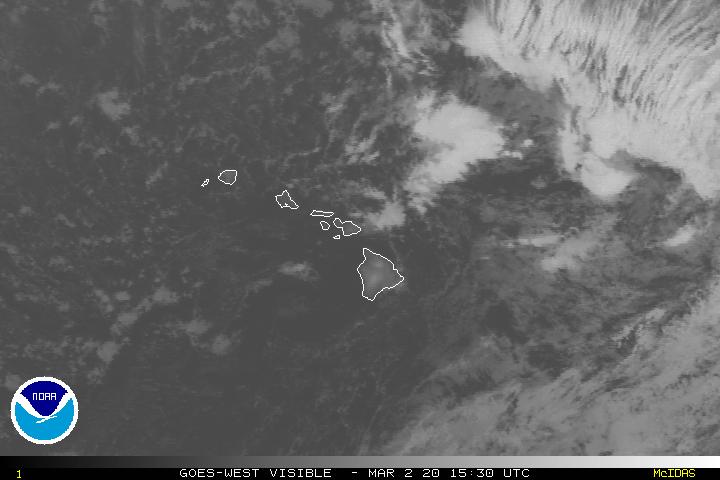












 Email Glenn James: