Air Temperatures ranged between these warmest and coolest spots near sea level around the state – and on the highest mountains…at 5pm Thursday evening:
Kailua-kona – 79F
Hilo, Hawaii – 72
Haleakala Crater – 54 (near 10,000 feet on Maui)
Mauna Kea summit – 45 (near 14,000 feet on the Big Island)
Precipitation Totals–The following numbers represent the largest precipitation totals (inches) during the last 24 hours on each of the major islands, as of Thursday afternoon:
0.47 Mount Waialaele, Kauai 2.13 Oahu Forest NWR, Oahu
0.30 Molokai
0.00 Lanai
0.00 Kahoolawe 2.81 West Wailuaiki, Maui 1.55 Kawainui Stream, Big Island
Marine Winds – Here’s the latest (automatically updated)weather mapshowing a high pressure system to the north of the islands…moving southeastward. Our winds will be lighter from the southeast and and south, then southwest ahead of a cold front.
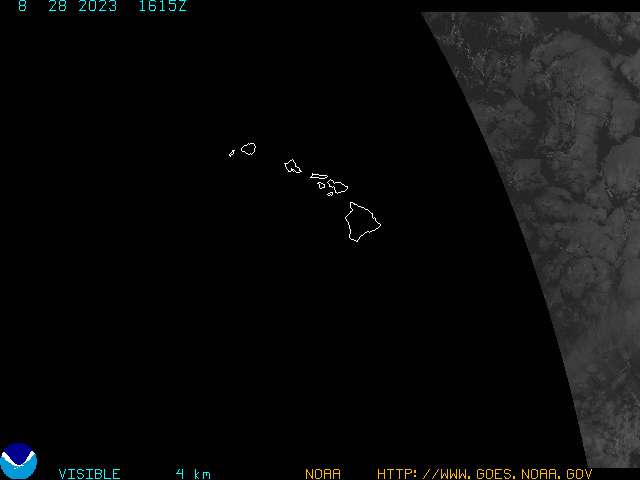
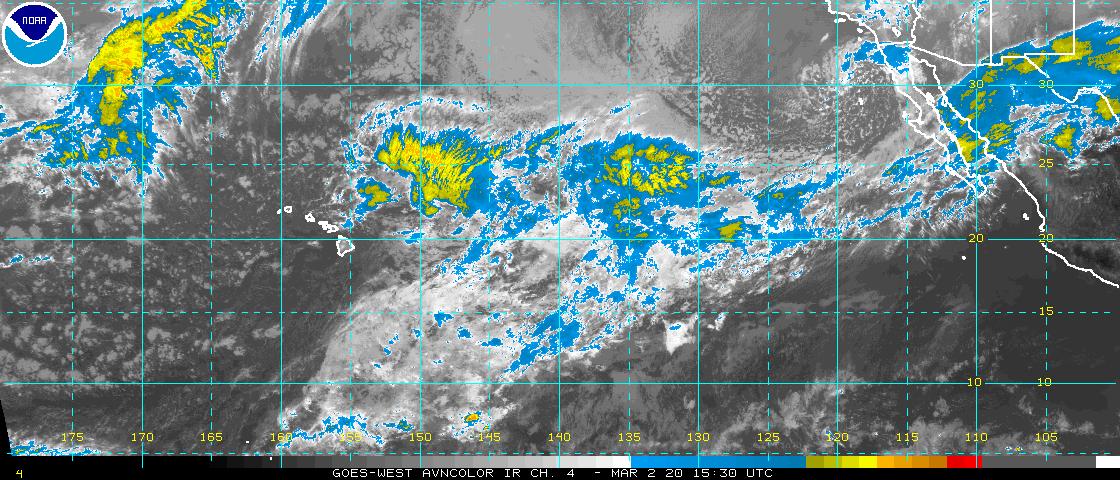
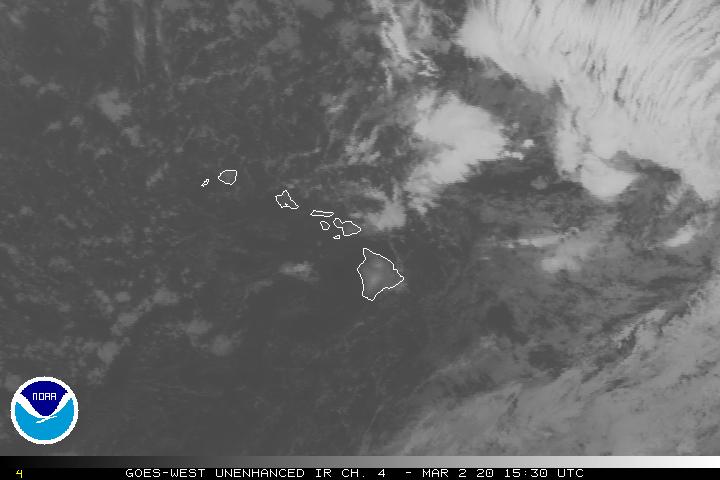
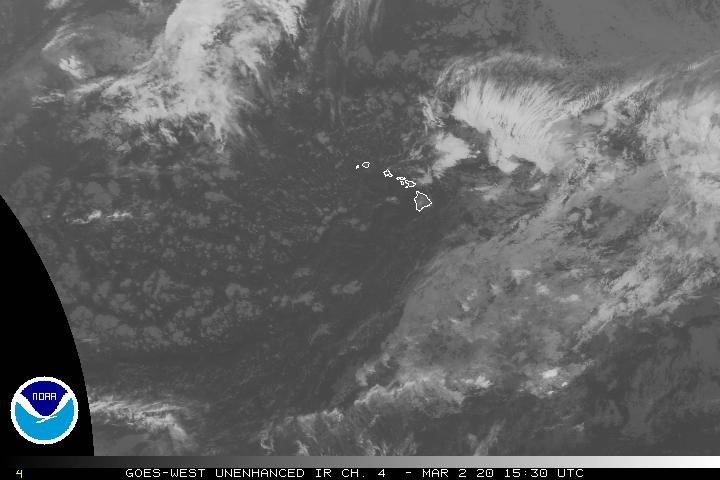
Satellite and Radar Images:To view the cloud conditions we have here in Hawaii, please use the following satellite links, starting off with thisInfrared Satellite Imageof the islands to see all the clouds around the state during the day and night. This next image is one that gives close images of the islands only during the daytime hours, and is referred to as aClose-up visible image. This next image showsa larger view of the Pacific…giving perspective to the wider ranging cloud patterns in the Pacific Ocean. Finally, here’s aLooping IR satellite image, making viewable the clouds around the islands 24 hours a day. To help you keep track of where any showers may be around the islands, here’s the latest animatedradar image.
Hawaii’s Mountains – Here’s a link to the live webcam on the summit of near 14,000 foot Mauna Kea on the Big Island of Hawaii. The tallest peak on the island of Maui is the Haleakala Crater, which is near 10,000 feet in elevation. These two webcams are available during the daylight hours here in the islands…and when there’s a big moon rising just after sunset for an hour or two! Plus, during the nights and early mornings you will be able to see stars, and the sunrise too…depending upon weather conditions. Tropical Cyclone activity in the eastern and central Pacific– Here’s the latest weather information coming out of theNational Hurricane Center, covering the eastern north Pacific. You can find the latest tropical cyclone information for the central north Pacific (where Hawaii is located) by clicking on this link to the Central Pacific Hurricane Center. Here’s atracking mapcovering both the eastern and central Pacific Ocean. A satellite image, which shows the entire ocean area between Hawaii and the Mexican coast…can be found here.
Aloha Paragraphs
Nice Weather Friday…although becoming hazy
The current blustery conditions will be winding down quickly…veering around to the southeast through south direction Friday.A high pressure system is located to the north of the islands Thursday evening…being pushed southeast by an approaching cold front. Our local winds will become much lighter, as the high pressure system moves away. Small craft wind advisory flags remain active across all of our coastal waters now, but will very likely be discontinued Friday. As we get into Friday, our more southerly winds will carry volcanic haze up from the Big Island vents, into some of the smaller islands. These lighter breezes will swing to the southwest, the Kona direction, ahead of a cold front that will arrive over the state this weekend. Then, we’ll find light winds hanging around in the wake of the cold front. It won’t be long before the winds pick up again, from the Kona direction, ahead of another cold front arriving around the middle of the new week ahead.
Showers will be few and far between, to say the least on Friday, with almost 100% of the state remaining completely dry. Looking at this IRsatellite image, we see a very large area of clouds to the east through north of the state. These stratocumulus clouds are usually dry, and often evaporate during the daytime hours…leaving mostly sunny skies. Looking a bit further ahead, as mentioned above, our winds will veer around to the Kona direction later on Friday, due to the approach of the next cold front. This cold front should be able to bring more showers, although its still a little premature to try and guess how many will fall, or exactly where the front may stall along its travels through the island chain.The next chance for additional showers would be around the middle of next week, when another cold front arrives. We keep hoping that one of these showers will give us a good old fashioned soaking rain, although not yet.
It’s Thursday evening, as I begin writing the last section of today’s narrative.The weather today, on Thursday, was about as good as it gets. The only draw back to that statement was the nature of the locally gusty winds. They had much more of an easterly aspect though, compared to the chilly northeast winds of yesterday. I expect more fine weather on Friday, which will be mostly clear and dry, although the volcanic haze may very well be back in some areas…especially here in Maui County. ~~~ Looking out the window before I leave Kihei, it is essentially clear as a bell, with hardly a cloud in the sky. The western slope of the Haleakala Crater is absolutely cloud free! The winds are still whipping around along the windward sides though…with the strongest gust at 5pm, a potent 37 mph at South Point, on the Big Island. Maui County had gusts over 30 mph, with even an impressive 30 mph gust in the big city of Honolulu, on Oahu. I just took my evening walk, upon arriving home. I noticed, besides the good feeling it has given me, that it’s already turning hazy down in the Central Valley just as it’s getting dark out.~~~ I’ll be back early Friday morning with your next new weather narrative, and will let you know if the vog has thickened up, as expected then. I hope you have a great Thursday night wherever you happen to be spending it! Aloha for now…Glenn.
Interesting: Wind energy could generate 20 percent of the electricity needed by households and businesses in the eastern half of the United States by 2024, but it would require up to $90 billion in investment, according to a government report released on Wednesday. For the 20 percent wind scenario to work, billions must be spent on installing wind towers on land and sea and about 22,000 miles of new high-tech power lines to carry the electricity to cities, according to the study from the Energy Department’s National Renewable Energy Laboratory.
"Twenty percent wind is an ambitious goal," said David Corbus, the project manager for the study. "We can bring more wind power online, but if we don’t have the proper infrastructure to move that power around, it’s like buying a hybrid car and leaving it in the garage," The private sector cannot fund all the needed spending, so a big chunk would have to come from the federal government through programs such as loan guarantees, Corbus said.
The Obama administration is already dedicating billions of dollars to double the amount of electricity produced by wind and other renewables energy sources by January 2012. The amount of U.S. electricity generated by wind was up 29 percent during January-October of last year compared to the same period is 2008, according to the Energy Department.
Interesting2:Scientists are reporting the first evidence from human research that blueberries — one of the richest sources of healthful antioxidants and other so-called phytochemicals — improve memory. They said the study establishes a basis for comprehensive human clinical trials to determine whether blueberries really deserve their growing reputation as a memory enhancer. A report on the study appears in ACS’ Journal of Agricultural and Food Chemistry.
Robert Krikorian and colleagues point out that previous studies in laboratory animals suggest that eating blueberries may help boost memory in the aged. Until now, however, there had been little scientific work aimed at testing the effect of blueberry supplementation on memory in people. In the study, one group of volunteers in their 70s with early memory decline drank the equivalent of 2-2 l/2 cups of a commercially available blueberry juice every day for two months.
A control group drank a beverage without blueberry juice. The blueberry juice group showed significant improvement on learning and memory tests, the scientists say. "These preliminary memory findings are encouraging and suggest that consistent supplementation with blueberries may offer an approach to forestall or mitigate neurodegeneration," said the report. The research involved scientists from the University of Cincinnati, the U.S. Department of Agriculture, and the Canadian department of agriculture.
Interesting3:Another 300,000 people are to be moved from their homes near China’s Three Gorges dam, according to state media. It is unclear if the relocations are directly because of the dam and its reservoir but almost 1.3 million people have already been moved from the area. The Three Gorges project is expected to produce 100bn kilowatt-hours of electricity a year at full capacity.
The dam is the biggest in the world, and opponents have long criticised its huge human and environmental costs. Initial reports quoted the China Daily as saying that people were being moved to prevent pollution in the reservoir, and to protect people against hazards like landslides.
A Three Gorges spokesman has since denied this. Hu Jiahai, a deputy of the local people’s congress, told the newspaper: "An eco-screen, or buffer belt, is waiting for approval to be built alongside the reservoir to improve the water quality of the Yangtze River streams and reduce the contamination from residents living nearby.
"Additionally, more people will have to move out of the area to avoid geographic hazards, like landslides," he added. He said the exact number who would need to move depended on an assessment of the geology of the area. But Peng Yehua from China Three Gorges Corporation told the BBC: "These people’s relocation is not a part of the Three Gorges Dam relocation project."
"This relocation of 300,000 is a decision of the Chongqing government, to move residents from high mountain areas with harsh living conditions into better lands." The Three Gorges dam has been controversial from its inception. It was championed by former Chinese leader Mao Zedong.
Officially, the infrastructure project has cost $27.2bn (£16.7m), but others believe the real price could be much higher. Critics claim it will cause massive environmental destruction, and others say the forced resettlement of nearby villagers has left many without compensation. Scientists also caused concern when they said the massive weight of the swelling reservoir was causing an increase in seismic activity and landslides in the area.
Interesting4:A tiny asteroid that buzzed Earth last week highlighted our planet’s vulnerability to objects whose peculiar orbits put them in a game of hide-and-seek with us. An Earth-based telescope spotted the 10-metre space rock hurtling our way just three days before a near miss on 13 January, when it flew by at just one-third of the distance to the moon.
The asteroid is never expected to hit Earth and would burn up before hitting the ground in any case. But its unusual orbit (see diagram) seems ingeniously designed to evade our surveys. It is likely that a handful of objects large enough to cause harm are hiding under similar circumstances.
Large asteroids are relatively easy to spot because they reflect the most sunlight. But smaller asteroids – which can still damage Earth if they span at least 30 to 50 meters – are usually too dim for telescopes to detect except during brief close approaches to Earth. For a typical near-Earth asteroid, these occurrences are a few years or decades apart.
However, last week’s unexpected visitor, called 2010 AL30, kept far enough from Earth to be invisible for more than a century. The prolonged avoidance occurred because the period of its solar orbit was 366 days – very close to Earth’s year (though the close pass shifted the space rock into a 390-day orbit).
Like a slightly slower race car that is periodically lapped by its competitor on a circular track, it stays far from Earth for long stretches. "2010 AL30 may become a sort of ‘poster child’ for hiding asteroids," says Alan Harris of the Space Science Institute in Boulder, Colorado. Similar "synchronized" asteroids may be hiding with periods of very close to two, three, four years and so on, Harris says.
Those with periods of about four years pose the greatest risk to Earth, because they would be in sync with both Earth and Jupiter, says Timothy Spahr of the Minor Planet Center in Cambridge, Massachusetts. Such asteroids would be particularly influenced by Jupiter’s gravity, which could nudge them onto a collision course with Earth.
Asteroids with non-synchronous orbits can also hide. Those with orbits mostly interior to Earth’s – called Aten asteroids – spend most of their time in the glare of the sun as seen from Earth, so telescopes have trouble spotting them.
Interesting5:The recent devastation caused by the earthquake in Haiti is not the only environmental disaster the islands of the world face. A more long term one is the pending sea level rise that could obliterate the world’s small island states, triggering fears of mass migration. However, a mass migration is not immediately likely and some of these small island nations are fighting back.
For Example the Indian Ocean island of Maldives says it has no plans to relocate its 300,000 inhabitants or purchase land in neighboring countries before the seas rise. "Maldives does not have a relocation plan and had at no time ever considered relocation to another country, either in the neighborhood or any other area," Ambassador Abdul Ghafoor Mohamed, the permanent representative of Maldives to the United Nations.
Still, the Pacific Small Island Developing States, which includes countries such as Fiji, Palau, Marshall Islands, Nauru and Tuvalu, have not ruled out the possibility of relocating before disaster strikes. Ambassador Stuart Beck of Palau says that displacement to a neighboring or third country "might be the only option if climate change continues at the current or increased rate without significant and urgent mitigation by the international community."
Mass migrations can and will occur after a natural disaster. The current Haiti problem is an example where over 200,000 people have been trying to find shelter in the neighboring Dominican Republic. During the American "Dust Bowl" of the 1930’s many fled when their farms dried up. The International Organization for Migration has predicted that in the worst case scenario, as many as 50 million to 350 million people may have to migrate from their island nations.
In most Pacific islands, the people, agricultural land, tourist resorts and infrastructure (including roads and airports) are concentrated in the coastal zones, and are thus especially vulnerable to any rise in sea level. Determining how severe this problem is, or might be, is complicated by natural shifts in sea level associated with the recurring ice ages and tectonic action.
The current sea level rise has occurred at a mean rate of 0.7 inches per year for the past century and more recently it has been estimated near 1.2 inches per year (1993-2003). What the future will bring as a sea rise is variable depending on the melting of the ice caps and average global temperatures. Some have predicted as much as 7 feet in the next century for example.
Fleeing is not the only option. Micronesia, a Pacific island nation, has just filed a plea to challenge plans by the Czech Republic to expand a coal fired power station some 10,000 miles away from Micronesia. At issue is Prunerov plant is one of the largest coal fired stations in the European Union and the largest single source of carbon dioxide emissions in the Czech Republic.
Carbon dioxide is a potential cause of global warming and hence sea level rise. "The Federated States of Micronesia is seriously endangered by the impacts of climate change, including the flooding of its entire territory and the eventual disappearance of a portion of its state," Andrew Yatilman, director of the country’s Office of Environment and Emergency Management, submitted in the plea filed with the Environment Ministry of the Czech Republic.
Air Temperatures ranged between these warmest and coolest spots near sea level around the state – and on the highest mountains…at 5pm Wednesday evening:
Kailua-kona – 80F
Lihue, Kauai – 70
Haleakala Crater – 55 (near 10,000 feet on Maui)
Mauna Kea summit – 39 (near 14,000 feet on the Big Island)
Precipitation Totals–The following numbers represent the largest precipitation totals (inches) during the last 24 hours on each of the major islands, as of Wednesday afternoon:
0.08 Mount Waialaele, Kauai 0.19 Punaluu Stream, Oahu
0.00 Molokai
0.00 Lanai
0.00 Kahoolawe
0.06 West Wailuaiki, Maui
0.30 Kawainui Stream, Big Island
Marine Winds – Here’s the latest (automatically updated)weather mapshowing a high pressure system to the north-northwest of the islands…moving eastward into the area north and north-northeast of Hawaii. Our winds will be generally northeast, remaining strong into Thursday…then lighter from the east and southeast.
Satellite and Radar Images:To view the cloud conditions we have here in Hawaii, please use the following satellite links, starting off with thisInfrared Satellite Imageof the islands to see all the clouds around the state during the day and night. This next image is one that gives close images of the islands only during the daytime hours, and is referred to as aClose-up visible image. This next image showsa larger view of the Pacific…giving perspective to the wider ranging cloud patterns in the Pacific Ocean. Finally, here’s aLooping IR satellite image, making viewable the clouds around the islands 24 hours a day. To help you keep track of where any showers may be around the islands, here’s the latest animatedradar image.
Hawaii’s Mountains – Here’s a link to the live webcam on the summit of near 14,000 foot Mauna Kea on the Big Island of Hawaii. The tallest peak on the island of Maui is the Haleakala Crater, which is near 10,000 feet in elevation. These two webcams are available during the daylight hours here in the islands…and when there’s a big moon rising just after sunset for an hour or two! Plus, during the nights and early mornings you will be able to see stars, and the sunrise too…depending upon weather conditions. Tropical Cyclone activity in the eastern and central Pacific– Here’s the latest weather information coming out of theNational Hurricane Center, covering the eastern north Pacific. You can find the latest tropical cyclone information for the central north Pacific (where Hawaii is located) by clicking on this link to the Central Pacific Hurricane Center. Here’s atracking mapcovering both the eastern and central Pacific Ocean. A satellite image, which shows the entire ocean area between Hawaii and the Mexican coast…can be found here.
Aloha Paragraphs
Windy weather…easing off Thursday night into Friday
A brief surge in wind speeds is happening now…with winds dropping off quickly Thursday night into Friday.A high pressure system is located to the north-northwest of the islands, and will be shifting eastward…as thisweather mapshows. This high pressure cell will be moving rapidly eastward, on its way into the area further east. Our local winds have shown a definite increase in strength now, as this high pressure system moves by. Small craft wind advisory flags are now active across all of our coastal waters. As we get into Friday, our winds will veer around to the southeast and south, which might carry some volcanic haze up from the Big Island vents, into some of the smaller islands. Winds will swing all the way around to the southwest, the Kona direction, ahead of a cold front that will arrive over the state this weekend. Then, we’ll find another short spell of cooler north to NE breezes arriving in the wake of the cold front. It won’t be long before the winds shift again, to the Kona direction ahead of another cold front around the middle of next week…followed by light northerly to NE winds again for a couple of days.
The locally strong and gusty NE to ENE winds will carry some showers into our area, from a cloud band off the ocean to our north.Looking at this IRsatellite image, we see an area of clouds dropping down over the state now. It had overlapped the area from Kauai down to Maui County at the time of this writing…hopefully swooping down to the Big Island. The winds are actually strong enough to carry some of these rain drops over to the leeward sides. Checking out thislooping radar image, we could actually get a little excited about those showers moving into our dry state! Looking a bit further ahead, as mentioned above, our winds will veer around to the Kona direction by Friday, due to the approach of the next cold front. This cold front should be able to bring more showers, especially to the areas from Kauai down to Oahu, or perhaps Maui County…although we’re not looking at any gully washers it doesn’t appear. As has been the case this winter so far, the Big Island may see a few showers, but might again end up on the dry side generally. The next chance for additional showers would be around the middle of next week, when another cold front arrives.
It’s Wednesday evening, as I begin writing the last section of today’s narrative.The winds came on as expected today, strong and gusty, and chilly too! They’ve been able to drive a new cloud band, with its associated showers…down into the state. These winds are coming in generally from the northeast, after having passed the northern direction. These typically bring chilly air our way, and are about the only thing that reminds Hawaii’s residents that in fact…we do have winter weather here in the tropics! ~~~ It was even lightly raining here in Kihei, Maui, with rainbows in many directions. I’m about ready to hop in my car, and I know it’s going to be really cool when I get back upcountry, having gained nearly 3,000 feet in elevation in that 40 minute drive. It showered or drizzled most of the way home, although stopped when I got to Kula. Skies were totally clear over the western slopes of the mountain, with just the lowlands receiving that much need rainfall. The temperature when I left Kihei, a little before 6pm, was 74F degrees, and had dropped to 62 degrees by the time I got home. I immediately went out for my evening constitutional, which felt great. Wednesday evening the winds have really become blustery, with all islands finding gusts well over 30 mph, with the small island of Lanai reporting gusts over 50 mph! The NWS has issued a wind advisory over the Kohala area on the Big Island. I’ll be back early Thursday morning, with your next new weather narrative from our windy paradise, I hope you have a great Wednesday night! Aloha fro now…Glenn.
Interesting: Just over a week after the devastating earthquake struck, another earthquake rattled Haiti this morning. Fortunately, the weather will cooperate with recovery efforts. The earthquake this morning occurred at 6:03 a.m. EST. The epicenter of the 6.1-magnitude earthquake struck 35 miles west-southwest of Port-au-Prince. Estimates from the USGS indicate that the shaking felt in Port-au-Prince was light.
The city of Petit Goave likely endured severe shaking, potentially resulting in heavy damage to vulnerable structures. The weather will likely assist those providing aid to Haiti, as both the air and sea will be tranquil through the end of the week. The greater Caribbean Sea and nearby western Atlantic Ocean will be settled and mostly calm.
At sea, winds will tend to be light to moderate with seas no rougher than usual. In the corridor between Haiti and Florida, seas will vary mostly from 1-3 feet. Seas will be rougher north of the Bahamas and through the open Caribbean Sea. Dry weather will dominate the region; however, areas including Hispaniola could get some brief scattered showers and the possibility of a thunderstorm.
Rain was reported at the Port-au-Prince airport yesterday. Aid efforts continue in Haiti as supplies continue to be airlifted and shipped to the capital of Port-au-Prince. Medical teams struggle to treat the thousands of injured, and rescue operations continue to extract survivors from the rubble.
Interesting2:Long-term efforts to help Haiti recover from the earthquake will have to reverse environmental damage such as near-total deforestation that threatens food and water supplies for the Caribbean nation, experts say. The focus is now on emergency aid — Haitian officials estimate that between 100,000 and 200,000 people died in the January 12 quake.
But President Rene Preval urged donors on Monday also to remember the country’s long-term needs. Experts say deforestation in Haiti stretching back to the Duvalier dictatorships — leaving the nation with less than 2 percent forest cover — contributes to erosion that undermines food output by the poorest nation in the Western Hemisphere.
"We need to work…to create mechanisms that reinforce better use of natural resources," said Asif Zaidi, Operations Manager of the post-conflict and disaster management branch of the U.N. Environment Program (UNEP). Before the quake, UNEP had decided on a two-year project from 2010 to bolster Haiti’s environment, from forests to coral reefs, spokesman Nick Nuttall said.
Among quick measures for donors could be to provide propane to encourage a shift from charcoal-burning stoves. That could be backed in the llonger-term by reforestation and investments in renewable energies such as solar or wind power, Zaidi said.
Interesting3:Plasma jets capable of obliterating tooth decay-causing bacteria could be an effective and less painful alternative to the dentist’s drill, according to a new study published in the February issue of the Journal of Medical Microbiology. Firing low temperature plasma beams at dentin — the fibrous tooth structure underneath the enamel coating — was found to reduce the amount of dental bacteria by up to 10,000-fold.
The findings could mean plasma technology is used to remove infected tissue in tooth cavities — a practice that conventionally involves drilling into the tooth. Scientists at the Leibniz-Institute of Surface Modifications, Leipzig and dentists from the Saarland University, Homburg, Germany, tested the effectiveness of plasma against common oral pathogens including Streptococcus mutans and Lactobacillus casei.
These bacteria form films on the surface of teeth and are capable of eroding tooth enamel and the dentin below it to cause cavities. If left untreated it can lead to pain, tooth loss and sometimes severe gum infections. In this study, the researchers infected dentin from extracted human molars with four strains of bacteria and then exposed it to plasma jets for 6, 12 or 18 seconds.
The longer the dentin was exposed to the plasma the greater the amount of bacteria that were eliminated. Plasmas are known as the fourth state of matter after solids, liquids and gases and have an increasing number of technical and medical applications. Plasmas are common everywhere in the cosmos, and are produced when high-energy processes strip atoms of one or more of their electrons.
This forms high-temperature reactive oxygen species that are capable of destroying microbes. These hot plasmas are already used to disinfect surgical instruments. Dr Stefan Rupf from Saarland University who led the research said that the recent development of cold plasmas that have temperatures of around 40 degrees Celsius showed great promise for use in dentistry.
"The low temperature means they can kill the microbes while preserving the tooth. The dental pulp at the centre of the tooth, underneath the dentin, is linked to the blood supply and nerves and heat damage to it must be avoided at all costs." Dr Rupf said using plasma technology to disinfect tooth cavities would be welcomed by patients as well as dentists.
"Drilling is a very uncomfortable and sometimes painful experience. Cold plasma, in contrast, is a completely contact-free method that is highly effective. Presently, there is huge progress being made in the field of plasma medicine and a clinical treatment for dental cavities can be expected within 3 to 5 years."
Interesting4:The Metropolitan Manila Development Authority has started dismounting tarpaulins, mostly campaign posters and advertisements, along major thoroughfares as part of its program to make the metropolis “clean and green.” MMDA Chairman Oscar Inocentes has ordered the Roadway/Sidewalk Clearing Operations Group to remove the visual clutter strewn all over the major thoroughfares.
Some 200 MMDA workers have already been dispatched all over Metro Manila to enforce the directive. “Besides spoiling the visual landscape of Metro Manila, these posters put the public at risk, as most of them are placed on inappropriate areas,” Inocentes said in a statement.
Inocentes noted that the posting of advertising materials on trees also poses a hazard to the environment in general. He said according to Manuel Sayson, agency horticulturist, the nails used in tacking the posters damage the bark of the trees and serve as an additional entry point for insects, fungi and other pests, which cause diseases.
These factors, Inocentes said, lead to the reduction of carbon sequestration or a lesser capability of trees to filter air pollutants. “Our foremost priority is the health and safety of the public. The people who put those posters apparently don’t know that they are instigating grave damage to the environment,” Inocentes said.
A monitoring unit is continuously going around Metro Manila to check public installations such as electric posts, power cables, traffic signs, and sidewalk railings that have been covered with posters and advertisements.
Interesting5:One of the world’s largest tiger populations could be wiped out this century as rising seas threaten to engulf their dwindling habitat in the coastal mangrove forests of Bangladesh, researchers said Wednesday. A projected sea-level rise of 11 inches above 2000 levels along coastal Bangladesh by 2070 may cause the remaining tiger habitat in the Sundarbans to decline by 96 percent, pushing the total population to as few as five tigers, according to the new World Wildlife Fund-led study published this month in the peer-reviewed journal, Climatic Change.
Studies in the past have shown that tiger populations below 25 have difficulty surviving. Colby Loucks, WWF’s deputy director of conservation science, said in a statement that tigers were capable of thriving in a wide range of habitats from the snowy forests of Russia to the tropical forests of Indonesia, but the projected sea-level rise in Bangladesh would likely outpace the tiger’s ability to adapt.
"If we don’t take steps to address the impacts of climate change on the Sundarbans, the only way its tigers will survive this century is with scuba gear," said Loucks, the lead author of the study. Tigers are among the world’s most threatened species, with just 3,200 estimated left in the wild following widespread poaching and deforestation.
There are believed to be close to 250 tigers on the Indian side of the Sundarbans, and another 250 on the Bangladesh side. The study is the first to assess the impact of a sea-level rise on the tigers, and its conclusions were made possible by advances in the data collected on the Sundarbans, although it does not assess the impact on the Indian side of the forest. The Bangladesh government said it was working with several international groups to address the threats to the tigers highlighted in the study.
Interesting6:Ozone blowing over from Asia is raising background levels of a major ingredient of smog in the skies over California, Oregon, Washington and other Western states, according to a new study appearing in Thursday’s edition of the journal Nature. The amounts are small and, so far, only found in a region of the atmosphere known as the free troposphere, at an altitude of two to five miles, but the development could complicate U.S. efforts to control air pollution.
Though the levels are small, they have been steadily rising since 1995, and probably longer, said lead author Owen R. Cooper, a research scientist at the University of Colorado attached to the National Oceanic and Atmospheric Administration’s Earth System Research Laboratory in Boulder, Colo. "The important aspect of this study for North America is that we have a strong indication that baseline ozone is increasing," said Cooper.
"We still don’t know how much is coming down to the surface. If the surface ozone is increasing along with the free tropospheric ozone, that could make it more difficult for the U.S. to meet its ozone air quality standard." The study is the first link between atmospheric ozone over the U.S. and Asian pollution, said Dan Jaffe, a University of Washington-Bothell professor of atmospheric and environmental chemistry.
He contributed data from his observatory on top of Mount Bachelor in Oregon to the study. The U.S. Environmental Protection Agency is considering lowering the current limit on ozone in the atmosphere by as much as 20%, and has been working with China to lower its emissions of the chemicals that turn into ozone. Ozone is harmful to people’s respiratory systems and plants.
It is created when compounds produced by burning fossil fuels are hit by sunlight and break down. Ozone also contributes to the greenhouse effect, ranking behind carbon dioxide and methane in importance. Ozone is only one of many pollutants from Asia that reach the USA. Instruments regularly detect mercury, soot, and cancer-causing PCBs. Jaffe said it was logical to conclude that the increasing ozone was the result of burning more coal and oil as part of the Asia’s booming economic growth.
The next step is to track the amounts of Asian ozone reaching ground levels on the West Coast, said Cooper. Work will start in May and end in June, when air currents produce the greatest amounts of Asian ozone detected in the USA. Weather balloons and research aircraft will be launched daily to measure ozone closer to ground, where it affects the air people breathe, Cooper said.
The study to be published in Nature looked at thousands of air samples collected between 1995 and 2008 and found a 14% increase in the amount of background ozone at middle altitudes in springtime. When data from 1984 were factored in, the rate of increase was similar, and the overall increase was 29%. When ozone from local sources was removed from the data, the trend became stronger, Cooper said.
Using a computer model based on weather patterns, the ozone was traced back to southeastern Asia, including the countries of India, China, Vietnam, Laos and Cambodia. The ozone increases were strongest when winds prevailed from southeastern Asian, Cooper said.
In a commentary also published in Nature, atmospheric chemist Kathy Law of Universite de Paris in France said the study was "the most conclusive evidence so far" of increasing ozone over the western United States. Law noted that natural sources of ozone could contribute to the increases, and there were limitations to the computer model used to trace the sources of the increases, but the study remained a "vital benchmark" that could be used to test climate change models, which have been unable to reproduce increases in ozone.
Air Temperatures ranged between these warmest and coolest spots near sea level around the state – and on the highest mountains…at 4pm Tuesday afternoon:
Poipu, Kauai – 81F
Lihue, Kauai – 75
Haleakala Crater – 61 (near 10,000 feet on Maui)
Mauna Kea summit – 43 (near 14,000 feet on the Big Island)
Precipitation Totals–The following numbers represent the largest precipitation totals (inches) during the last 24 hours on each of the major islands, as of Tuesday afternoon:
0.00 Kauai 0.01 Waimanalo, Oahu
0.00 Molokai
0.00 Lanai
0.00 Kahoolawe
0.00 Kahakuloa, Maui
0.21 Kawainui Stream, Big Island
Marine Winds – Here’s the latest (automatically updated)weather mapshowing a high pressure system to the west of the islands, with a strengthening ridge of high pressure extending east into the area north of Kauai. Our winds will be trade winds, becoming considerably stronger Wednesday.
Satellite and Radar Images:To view the cloud conditions we have here in Hawaii, please use the following satellite links, starting off with thisInfrared Satellite Imageof the islands to see all the clouds around the state during the day and night. This next image is one that gives close images of the islands only during the daytime hours, and is referred to as aClose-up visible image. This next image showsa larger view of the Pacific…giving perspective to the wider ranging cloud patterns in the Pacific Ocean. Finally, here’s aLooping IR satellite image, making viewable the clouds around the islands 24 hours a day. To help you keep track of where any showers may be around the islands, here’s the latest animatedradar image.
Hawaii’s Mountains – Here’s a link to the live webcam on the summit of near 14,000 foot Mauna Kea on the Big Island of Hawaii. The tallest peak on the island of Maui is the Haleakala Crater, which is near 10,000 feet in elevation. These two webcams are available during the daylight hours here in the islands…and when there’s a big moon rising just after sunset for an hour or two! Plus, during the nights and early mornings you will be able to see stars, and the sunrise too…depending upon weather conditions. Tropical Cyclone activity in the eastern and central Pacific– Here’s the latest weather information coming out of theNational Hurricane Center, covering the eastern north Pacific. You can find the latest tropical cyclone information for the central north Pacific (where Hawaii is located) by clicking on this link to the Central Pacific Hurricane Center. Here’s atracking mapcovering both the eastern and central Pacific Ocean. A satellite image, which shows the entire ocean area between Hawaii and the Mexican coast…can be found here.
Aloha Paragraphs
Kula, Maui, Anthurium flower…from my backyard
The weather here in Hawaii has been especially nice, that is if you don’t mind the lack of rainfall.The visitors from afar have appreciated this of course, as has the Chamber of Commerce officials. The emergency management, fire and water departments haven’t though. The threat of wild fires increases co-incidentally, with the drought conditions. There have been some isolated showers, even a few heavier ones during the last month or so, but those haven’t fallen in those areas that need it the most. The NWS office in Honolulu has been exclaiming the low precipitation numbers around the state, with each of the islands qualifying for either dry or very dry status lately. All of this naturally goes in the direction of increased threat of burning of the vast amount of tender brush around, especially in the leeward areas.
The thing that makes the current situation particularly risky, is the forecast of strong and gusty winds starting up over the next couple of days.A high pressure ridge is a little distance to the north of Kauai Tuesday, as thisweather mapshows…keeping winds light today. This map shows a 1026 millibar high pressure system now straddling the International Dateline, to the northwest of our islands. This high pressure cell will be moving rapidly eastward, and end up to the north-northwest and north of Kauai, over the next couple of days…as shown on thisforecast weather map. As this high pressure cell gets a little closer, our local winds will show a marked increase in strength. We’re very likely, if not totally assured to see small craft wind advisory flags going up over most of, if not all our coastal waters. There has even been murmurings from the NWS that we could see gale warnings going up in a few places, likely the Alenuihaha Channel…with even the chance the islands themselves requiring wind advisories locally too. The good thing about all of this, is that these stronger winds will be short lived.
Back to the rainfall issues, the overlying atmosphere remains dry and stable, so that showers are few and far between Tuesday.The next best chance for some showers will come along, carried in our direction by the strengthening trade winds. Looking at thisIR satellite image, we see considerable clouds to the east of the state. However, they aren’t the type that brings many showers, unfortunately. The blustery trade winds will help to push clouds upslope though, which will help to wring some showers out along the windward slopes. There was some hope earlier that the gusty trade winds would carry a few showers to the leeward sides, which would have limited the fire threat…but that seems less likely now. Looking a bit further ahead, our winds will veer around to the Kona direction later Thursday into Friday, due to the approach of a cold front. This cold front should be able to bring more showers, especially to the areas from Kauai down to Oahu, or perhaps MauiCounty…time will tell about that. The next chance for when additional showers might be in the cards, is as another cold front arrives around next Tuesday.
It’s Tuesday evening, as I begin writing the last section of today’s narrative.Everything seems to be conforming to schedule, in terms of the next weather change that just up ahead. The first sign will be the noticeably stronger winds, which hadn’t started as of this evening. Nonetheless, the NWS office has initiated small craft wind advisories across the entire state…in the marine zones that is. The prospect of any significant rainfall associated with this windy weather, doesn’t look good at this point. The better chance looks like with the upcoming cold front, slated for the weekend. Then, as mentioned above, we have another chance for increasing showers around next Tuesday. ~~~ Tuesday, today was pretty nice, although there were still quite a few lower level, but dry clouds hanging around. There has essentially been near totally dry conditions statewide, with just a few light showers, that have been few and very far between. I just took my early evening walk, and it’s so nice out, very mellow up here in Kula, Maui. It’s 65.7F degrees here at a little after 6pm. In contrast, downcountry in Kahului, at the same time, it was a warmer 74 degrees. Looking the other way, up this time, it was 57 up at the top of the Haleakala Crater, and a much cooler 37 degrees atop Mauna Kea, over on the Big Island. ~~~ I’m going out on the deck now, and just sit and be quiet as I watch the light fade on this nice 2nd day of the work week. I’ll be back early Wednesday morning with your next new weather narrative, I hope you have a great Tuesday night until then! Aloha for now…Glenn.
Interesting:Planet Earth has warmed much less than expected during the industrial era based on current best estimates of Earth’s "climate sensitivity" — the amount of global temperature increase expected in response to a given rise in atmospheric concentrations of carbon dioxide (CO2).In a study to be published in the Journal of Climate, a publication of the American Meteorological Society, Stephen Schwartz, of Brookhaven National Laboratory, and colleagues examine the reasons for this discrepancy.
According to current best estimates of climate sensitivity, the amount of CO2 and other heat-trapping gases added to Earth’s atmosphere since humanity began burning fossil fuels on a significant scale during the industrial period would be expected to result in a mean global temperature rise of 3.8°F — well more than the 1.4°F increase that has been observed for this time span.
Schwartz’s analysis attributes the reasons for this discrepancy to a possible mix of two major factors: 1) Earth’s climate may be less sensitive to rising greenhouse gases than currently assumed and/or 2) reflection of sunlight by haze particles in the atmosphere may be offsetting some of the expected warming. "Because of present uncertainties in climate sensitivity and the enhanced reflectivity of haze particles," said Schwartz, "it is impossible to accurately assign weights to the relative contributions of these two factors.
This has major implications for understanding of Earth’s climate and how the world will meet its future energy needs." A third possible reason for the lower-than-expected increase of Earth’s temperature over the industrial period is the slow response of temperature to the warming influence of heat-trapping gases. "This is much like the lag time you experience when heating a pot of water on a stove," said Schwartz.
Based on calculations using measurements of the increase in ocean heat content over the past fifty years, however, this present study found the role of so-called thermal lag to be minor. A key question facing policymakers is how much additional CO2 and other heat-trapping gases can be introduced into the atmosphere, beyond what is already present, without committing the planet to a dangerous level of human interference with the climate system.
Many scientists and policymakers consider the threshold for such dangerous interference to be an increase in global temperature of 3.6°F above the preindustrial level, although no single threshold would encompass all effects. The paper describes three scenarios: If Earth’s climate sensitivity is at the low end of current estimates as given by the Intergovernmental Panel on Climate Change, then the total maximum future emissions of heat-trapping gases so as not to exceed the 3.6° threshold would correspond to about 35 years of present annual emissions of CO2 from fossil-fuel combustion.
A climate sensitivity at the present best estimate would mean that no more heat-trapping gases can be added to the atmosphere without committing the planet to exceeding the threshold. And if the sensitivity is at the high end of current estimates, present atmospheric concentrations of heat-trapping gases are such that the planet is already committed to warming that substantially exceeds the 3.6° threshold.
The authors emphasize the need to quantify the influences of haze particles to narrow the uncertainty in Earth’s climate sensitivity. This is much more difficult than quantifying the influences of the heat-trapping gases. Coauthor Robert Charlson of the University of Washington likens the focus on the heat trapping gases to "looking for the lost key under the lamppost."
Schwartz observes that formulating energy policy with the present uncertainty in climate sensitivity is like navigating a large ship in perilous waters without charts. "We know we have to change the course of this ship, and we know the direction of the change, but we don’t know how much we need to change the course or how soon we have to do it."
Interesting2:Offshore wind power and wave energy foundations can increase local abundances of fish and crabs. The reef-like constructions also favor for example blue mussels and barnacles. What’s more, it is possible to increase or decrease the abundance of various species by altering the structural design of foundation.
This was shown by Dan Wilhelmsson of the Department of Zoology, Stockholm University, in a recently published dissertation. "Hard surfaces are often hard currency in the ocean, and these foundations can function as artificial reefs. Rock boulders are often placed around the structures to prevent erosion (scouring) around these, and this strengthens the reef function," says Dan Wilhelmsson.
A major expansion of offshore wind power is underway along European coasts, and the interest is growing in countries such as the US, China, Japan, and India. Moreover, wave power technologies are being developed very rapidly. Many thousand wind and wave power plants grouped in large arrays that each cover several square kilometers can be expected.
How marine life will react to this is not clear, but several research projects investigating the impacts of noise, shadows, electromagnetic fields, and changes in hydrology etc. are underway. Dan Wilhelmsson studied how offshore wind turbines constitute habitats for fish, crabs, lobsters, fouling animals, and plants. He shows that wind turbines, even without scour protection, function as artificial reefs for bottom dwelling fish.
The seabed in the vicinity of wind turbines had higher densities of fish compared to further away from the turbines and in reference areas. This was despite that the natural bottoms were rich in boulders and algae. Blue mussels dominated on the wind turbines that appeared to offer good growth conditions. Wave power foundations, too, constituting massive concrete blocks, proved to attract fish and large crabs.
Blue mussels fall down from the surface buoys and become food for animals on the foundations and on the adjacent seabed. Lobsters also settle under the foundations. In a large-scale experiment, holes were drilled in the foundations, and this dramatically increased numbers of crabs. The position of the holes also proved to be of importance for the crabs.
Interesting3:The earthquake which rocked Padang, western Sumatra in September last year killing more than 1000 people was not the ‘great earthquake’ which earth scientists are waiting for. In fact, it may have made the next massive earthquake more likely. That is the key conclusion of a paper published January 18 in the journal Nature Geoscience.
Following its publication, Professor John McCloskey of the University of Ulster, who is the lead author of the study and an internationally respected authority on Sumatran earthquakes, has issued the following appeal to the international community. He calls on governments and non-governmental organizations to take preparatory urgent action that will save lives in the next earthquake disaster rather than waiting until after it strikes.
He says: "We can’t continue to refuse to accept the inevitable; earthquakes happen, they kill people, they will kill more and more people if we don’t organize ourselves properly. We must start now." Professor McCloskey and his group rapidly analyzed the M9.2 earthquake that triggered the Indian Ocean 2004 Boxing Day tsunami and alerted the world to the threat of another large quake in the Sumatra region of the Indian Ocean 10 days before it struck. He is head of the Geophysics Research Group at Ulster’s Environmental Sciences Research Institute.
Professor McCloskey says: "At the end of a week which has been dominated by the awful scenes from Haiti, the thought that other big earthquakes are just round the corner is a truly bleak picture. "For some years now scientists have been warning of the build up of stress on one of the earth’s great plate boundaries to the west of Sumatra in Indonesia. For more than 200 years the collision between the Indian Ocean plate and the Asian plate has stored an enormous amount of energy.
"It’s just like slowly drawing a bow. For hundreds of years the energy is stored as the two tectonic plates bend and deform. Then, in just a few seconds all this energy is released generating a massive earthquake and sometimes flexing the seafloor to create a tsunami. "Off western Sumatra the bow is drawn tight. The last shock happened more than 200 years ago and the stresses are probably larger now than they were then; the earthquake must happen soon.
"The science of earthquakes is still on a steep learning curve and earthquake prediction is as far off as ever. "Science and scientists do not have all the answers. We don’t know where or when the next big earthquake will happen. We disagree on a lot of the details about how earthquakes work, how they start and how they stop but there are many things about which there is no disagreement.
"All the indicators are pointing in the same direction for western Sumatra. Another massive earthquake is due there and could happen literally any day." Scientists cannot forecast the exact size of the earthquake but in this case there is complete agreement that it will be very strong, probably bigger than magnitude 8.5, dwarfing the energy release in the Haitian quake.
We also cannot say for sure what size the tsunami will be but it has the potential to be very destructive — maybe even worse than 2004. "But the future need not look like Haiti. We know this earthquake is coming and we might have years or even decades to prepare. "Given the unfolding scenes of carnage following the Haiti earthquake and the completely inadequate speed of the international response, the responsibility on the Indonesian government, the international community and the international NGOs is enormous.
"We must work urgently to prepare for this earthquake if we are not to witness again the awful scenes of children dying for want of a few stitches or a cast for a broken leg. "The September Padang earthquake and the tragedy of Haiti underline the importance of preparation. There are many things that can be done to reduce the impact of earthquakes. Many of these are low-tech methods that have been tried and tested.
"In an earthquake a table can save your life, its legs are extremely strong under compression so when the roof falls down the table provides a small air space, if you’re in there you have a chance. "It’s also clear that we haven’t organized ourselves sufficiently internationally. "It was really disturbing to see children lying on the floor in hospitals with no pain relief, without any medical help at all.
How many lives could have been saved if the international community had prepared properly for this event? "Scientists can’t tell where and when but I can tell you now that other earthquakes like this are absolutely certain. We can’t continue to refuse to accept the inevitable; earthquakes happen, they kill people, they will kill more and more people if we don’t organize ourselves properly.
We must start now. "It is an international disgrace that we appear not to have made the smallest progress in preparation. The ‘international community’ is very good at preparing for war but has failed completely to prepare to help the poor who are always the ones to suffer in these events. "If we want to claim to be civilized we need to ensure that we never see these scenes again. Let’s make our motto: ‘We will do better next time’. "The next time will be sooner than we like to think."
Interesting4:The insight that nature provides services to mankind is not a new one. In 360BC Plato remarked on the helpful role that forests play in preserving fertile soil; in their absence, he noted, the land was turned into desert, like the bones of a wasted body. The idea that the value provided by such "ecosystem services" can be represented by ecologists in a way that economists can get to grips with, though, is rather newer.
A number of the thinkers who have made it a hot topic in the past decade gathered at a meeting on biodiversity and ecosystem services held by the Royal Society, in London, on January 13th and 14th. They looked at the progress and prospects of their attempts to argue for the preservation of nature by better capturing the value of the things – such as pollination, air quality and carbon storage – that it seemingly does for free.
Environmental valuations aim to solve a problem that troubles both economists and ecologists: the misallocation of resources. Take mangrove swamps. Over the past two decades around a third of the world’s mangrove swamps have been converted for human use, with many turned into valuable shrimp farms. In 2007 an economic study of such shrimp farms in Thailand showed that the commercial profits per hectare were $9,632. If that were the only factor, conversion would seem an excellent idea.
Interesting5:The decade of 2000-09 was the Earth’s warmest on record, according to data released last week by the National Climatic Data Center (NCDC) in Asheville, N.C.The climate center reported that the decade’s average global surface temperature was almost 1 degree above the 20th-century average. This shattered the 1990s reading, which was 0.65°F above average.
The global average is based on readings from more than 7,200 ground weather stations around the world and from ships and buoys at sea. Global weather data go back to 1880. The NCDC reports two sustained periods of warming have been recorded in the past 130 years, one that occurred from around 1910-1945, and the most recent worldwide warming trend, which began around 1976.
"Temperatures during the latter period of warming have increased at a rate comparable to the rates of warming projected to occur during the next century, with continued increases of anthropogenic (man-made) greenhouse gases," noted climatologist Ahira Sanchez-Lugo in an online report. 2009 continued a trend of anomalously warm years.
The years 2001 through 2008 each rank among the 10 warmest years of the 130-year (1880-2009) record, and 2009 was no exception. The climate center found that 2009 tied with 2006 as the fifth-warmest since records began in 1880. Almost all of the Earth’s land areas were warmer-than-average in 2009.
Parts of Australia and New Zealand endured record-breaking warmth in January, February and August. The only exceptions to the unusual warmth were in central Asia and interior sections of North America, including the U.S. Midwest, which experienced much cooler-than-normal temperatures. Global precipitation in 2009 was near the long-term average, reported the climate center.
Air Temperatures ranged between these warmest and coolest spots near sea level around the state – and on the highest mountains…at 5pm Monday evening:
Port Allen, Kauai – 81F
Princeville, Kauai – 73
Haleakala Crater – 61 (near 10,000 feet on Maui)
Mauna Kea summit – 46 (near 14,000 feet on the Big Island)
Precipitation Totals–The following numbers represent the largest precipitation totals (inches) during the last 24 hours on each of the major islands, as of Monday afternoon:
0.00 Kauai 0.08 Waimanalo, Oahu
0.00 Molokai
0.00 Lanai
0.00 Kahoolawe
0.15 West Wailuaiki, Maui
0.65 Honokaa, Big Island
Marine Winds – Here’s the latest (automatically updated)weather mapshowing a weak high pressure system to the west of the islands, with a weak ridge of high pressure extending east into the area just north of Kauai. Our winds will be trade winds, but will remain on the light side, becoming stronger later Tuesday into Wednesday.
Satellite and Radar Images:To view the cloud conditions we have here in Hawaii, please use the following satellite links, starting off with thisInfrared Satellite Imageof the islands to see all the clouds around the state during the day and night. This next image is one that gives close images of the islands only during the daytime hours, and is referred to as aClose-up visible image. This next image showsa larger view of the Pacific…giving perspective to the wider ranging cloud patterns in the Pacific Ocean. Finally, here’s aLooping IR satellite image, making viewable the clouds around the islands 24 hours a day. To help you keep track of where any showers may be around the islands, here’s the latest animatedradar image.
Hawaii’s Mountains – Here’s a link to the live webcam on the summit of near 14,000 foot Mauna Kea on the Big Island of Hawaii. The tallest peak on the island of Maui is the Haleakala Crater, which is near 10,000 feet in elevation. These two webcams are available during the daylight hours here in the islands…and when there’s a big moon rising just after sunset for an hour or two! Plus, during the nights and early mornings you will be able to see stars, and the sunrise too…depending upon weather conditions. Tropical Cyclone activity in the eastern and central Pacific– Here’s the latest weather information coming out of theNational Hurricane Center, covering the eastern north Pacific. You can find the latest tropical cyclone information for the central north Pacific (where Hawaii is located) by clicking on this link to the Central Pacific Hurricane Center. Here’s atracking mapcovering both the eastern and central Pacific Ocean. A satellite image, which shows the entire ocean area between Hawaii and the Mexican coast…can be found here.
Aloha Paragraphs
Kula, Maui, Hibiscus flower…from my backyard
A dry and stable air mass remains in place over the Hawaiian Islands Monday evening.There will still be periods when low stratus clouds are carried into our area on the light trade winds, but rainfall will remain generally limited. The two exceptions to this rule include the windward sides of both Maui and the Big Island…where more numerous showers fell. The leeward beaches will be generally nice, with warm sunshine during the days, after the morning clouds burn off. Looking a bit further ahead, the trade winds will pick up gradually over the next two days, becoming strong and gusty by mid-week into Thursday. An increase in windward biased showers will accompany this surge in the trade wind speeds…and may spread over to the leeward sides by mid-week. As we move into later Thursday and Friday, our winds will veer around to the southeast, prompted by the approach of a cold front. This frontal cloud band will bring a period of unsettled weather by the weekend, followed by cooler northerly breezes in its wake.
The surf along our north and west facing beaches will lower in height Tuesday…although with more surf expected through most of the week.The waves aong the north and west shores are still large enough to require high surf advisory flags. The good thing is that the south facing beaches are much smaller, which is giving folks a good place to have fun along the coasts. Since these southern sides of the islands are more user friendly now, that would be the best place to take families Tuesday. If you do go to the north and west sides, please be careful, as the ocean will still be quite rough, requiring close attention while getting near the ocean…especially for the kids.
It’s Monday evening, as I begin writing the last section of today’s narrative.The last several days have been particularly nice here in the Hawaiian Islands, with no major changes on the near term horizon at this point. The days will be quite nice, with just generally dry low clouds around at times. The trade winds are blowing, but they will be mostly light for the time being, then increasing in strength starting later Tuesday into Wednesday. These strong trade winds are expected to blow wetter clouds over way, so it may become showery around mid-week. The air temperatures have risen just enough now, compared the chilly weather we saw a couple of days ago, to qualify as pleasantly warm and comfortable. As noted in the paragraphs above, we will see a winter cold front trigger Kona winds Friday into early Saturday, which could bring showers to the islands by this weekend. ~~~ I went to see the new film Avatar (2009), Sunday evening, and as you probably heard too, it was fantastic! This very popular film was unique, in that 3D glasses got handed out as we walked into the full theatre. I haven’t seen such a packed house in a long time, and as some of you know, I’m no stranger to the film scene. I had high hopes for this film, and wasn’t let down in the slightest. It was a long film, running 2 hours and 40 minutes, and there wasn’t once that I wasn’t carried along in a very engaged way. I give this film a solid A grade without the slightest hestitation. Like I often say here, there may be some folks who wouldn’t like this, but I’d say that they would be few and far between. Here’s a trailer for Avatar, in case you haven’t seen it, or would just like to take a quick look at what all the big news is about. Apparently, this film has made over a billion dollars so far on ticket sales, and has been the most popular film in many years, if not ever. ~~~ Monday was a good day, as the morning clouds burned off in most areas. I expect more clouds to ride in on the light trade winds tonight, which may cause a few more overnight showers along the windward sides. Tuesday will be another good day, although by Wednesday, and likely into Thursday, conditions may turn a bit wetter, and certainly more windy. I’ll be back early Tuesday morning with your next new weather narrative, I hope you have a great Monday night until then! Aloha for now…Glenn.
Air Temperatures ranged between these warmest and coolest spots near sea level around the state – and on the highest mountains…at 3pm Sunday afternoon:
Port Allen, Kauai – 81F
Molokai airport – 75
Haleakala Crater – 63 (near 10,000 feet on Maui)
Mauna Kea summit – 50 (near 14,000 feet on the Big Island)
Precipitation Totals–The following numbers represent the largest precipitation totals (inches) during the last 24 hours on each of the major islands, as of Sunday afternoon:
0.02 Port Allen, Kauai 0.06 Waimanalo, Oahu
0.00 Molokai
0.00 Lanai
0.00 Kahoolawe 0.19 West Wailuaiki, Maui 0.18 Honokaa, Big Island
Marine Winds – Here’s the latest (automatically updated)weather mapshowing a weak high pressure system to the west of the islands, with a weak ridge of high pressure extending east into the area just north of Kauai. Our winds will be trade winds, but will remain on the light side.
Satellite and Radar Images:To view the cloud conditions we have here in Hawaii, please use the following satellite links, starting off with thisInfrared Satellite Imageof the islands to see all the clouds around the state during the day and night. This next image is one that gives close images of the islands only during the daytime hours, and is referred to as aClose-up visible image. This next image showsa larger view of the Pacific…giving perspective to the wider ranging cloud patterns in the Pacific Ocean. Finally, here’s aLooping IR satellite image, making viewable the clouds around the islands 24 hours a day. To help you keep track of where any showers may be around the islands, here’s the latest animatedradar image.
Hawaii’s Mountains – Here’s a link to the live webcam on the summit of near 14,000 foot Mauna Kea on the Big Island of Hawaii. The tallest peak on the island of Maui is the Haleakala Crater, which is near 10,000 feet in elevation. These two webcams are available during the daylight hours here in the islands…and when there’s a big moon rising just after sunset for an hour or two! Plus, during the nights and early mornings you will be able to see stars, and the sunrise too…depending upon weather conditions. Tropical Cyclone activity in the eastern and central Pacific– Here’s the latest weather information coming out of theNational Hurricane Center, covering the eastern north Pacific. You can find the latest tropical cyclone information for the central north Pacific (where Hawaii is located) by clicking on this link to the Central Pacific Hurricane Center. Here’s atracking mapcovering both the eastern and central Pacific Ocean. A satellite image, which shows the entire ocean area between Hawaii and the Mexican coast…can be found here.
Aloha Paragraphs
Extra large surf through Monday…north and west shores
A dry and stable air mass remains in place over the Hawaiian Islands Sunday night.There will be stratus clouds being carried into our area on the generally light trade winds, but rainfall will be limited. The leeward beaches will be generally nice, with warm sunshine during the days. As the winds are blowing from the more classic easterly direction, our air temperatures will be warmer now. Looking a bit further ahead, the trade winds will pick up as we get into the new week, and become moderately strong and gusty by mid-week. A modest increase in windward biased showers may accompany this surge in the trade wind speeds. Even further out into the future, the computer forecast models continue to show a period of unsettled weather arriving next weekend, which may, hopefully…bring some much needed precipitation to our dry Aloha state.
The surf along our north and west facing beaches will remain above normal into Monday.The storm that generated this extra large northwest swell, had hurricane force winds (75 mph) revolving around its center, which is responsible for pushing these unusually high waves our way! Thus, we have another round of extra large to near giant surf breaking now. This swell train of waves began arriving on Kauai’s north and west facing shores Saturday evening. It worked its way down through the island chain Sunday, which will extend into Monday. This very large NW swell has triggered a high surf warning, which demands caution for everyone when getting near these shores. This swell is large enough that there could be localized wrap into other beaches, not used to seeing such large waves breaking.
It’s Sunday evening, as I begin writing the last section of today’s narrative.The last several days have been particularly nice here in the Hawaiian Islands, with no major changes on the near term horizon at this point. The days will be quite sunny, with just generally dry low clouds around at times. The trade winds are blowing, but they will be mostly light. The air temperatures have risen just enough now, compared the chilly weather we saw a couple of days ago, to qualify as pleasantly warm and comfortable. As we move into the new week, after the Martin Luther King Jr. holiday Monday, the trade winds will increase in strength. These stronger winds will peak at some point between Tuesday and Thursday, but not be so strong to be a problem by any means. As these trade winds pick up, there may be a few extra showers falling along the windward coasts and slopes, although they won’t amount to all that much. As noted in the paragraphs above, we will likely see a winter cold front trigger Kona winds by Friday, which could bring showers to the islands by this coming weekend. ~~~ I just back from seeing the new film Avatar (2009), and as you probably have heard, it was fantastic! This very popular film was unique, as 3D glasses got handed out as we walked into the full theatre. I haven’t seen such a packed house in a long time, and as some of you know, I’m no stranger to the film scene. I had high hopes for this film, and wasn’t let down in the slightest way. It was a long film, running 2 hours and 40 minutes, and there wasn’t once that I wasn’t carried along in a very engaged way. I give this film a firm A without the slightest hestitation. Like I often say here, there may be some folks who wouldn’t like this, but I’d say that they would be few and far between. Here’s a trailer for Avatar, in case you haven’t seen it, or would just like to take a quick look at what all the big news is about. Apparently, this film has made over a billion dollars so far on ticket sales, and has been the most popular film in many years, if not ever. I’ll be back Monday morning, with your next new weather narrative from paradise, I hope you have a great Sunday night until then! Aloha for now…Glenn.
Extra:You folks in the western United States, and especially California, should be ready to hunker down at times during the next week and more, as wet and windy weather…to very wet and very windy conditions bring potentially heavy flooding conditions, with tons of snow in the mountains. The latest word includes some of the largest surf along the coasts of California…that has been seen for several years – be prepared!
Interesting:Earthquake experts are warning that the devastating quake that struck Haiti on Tuesday could be the first of several in the region. They say historical records suggest that not all the energy that has built up in the faults running through the Caribbean region was released in this week’s tragedy.
Their fear is that enough energy remains in the fault system to trigger another earthquake of the same scale as Tuesday’s. The last time Haiti was struck by earthquakes of this scale was in 1751 and 1770, when three large earthquakes hit within the space of 20 years.
They ruptured the same fault segment as the one that slipped on Tuesday, as well as segments lying further to the east, in Haiti and the neighboring Dominican Republic. "Last time round there was a sequence of earthquakes," says Uri ten Brink, an expert on earthquakes in the region from the US Geological Survey in Woods Hole, Massachusetts.
"I’m worried, as we might expect the eastern side of the fault to rupture next." Other geologists concur. "Stress transfer along the fault is likely to trigger a chain of quakes," says Bill McGuire from University College London. Another, larger earthquake could affect surrounding nations as well.
The fault that was responsible for Tuesday’s quake extends west through Jamaica. Another runs parallel to it in the north, along the southern edge of Cuba and the northern side of Haiti and the Dominican Republic. Historical records suggest that both these faults produce large and destructive earthquakes every few centuries.
"They are dangerous especially when large population centers like Port-au-Prince, Kingston in Jamaica or Santiago in the Dominican Republic are so close to them," says Paul Mann from the University of Texas at Austin, who published a paper in 2008 that forecast a major quake in the region.
The region harbors a third fault to the east, which is a further cause for concern. Unlike the others it lies underwater, where the Atlantic Ocean plate dives underneath the Caribbean plate, creating the Caribbean island chain: it is a submarine thrust fault, like the one that caused the Indian Ocean earthquake and tsunami on 26 December 2004.
Satellite measurements show that the Caribbean plate is moving east over the Atlantic plate at around 2 centimeters per year. Measurements over several decades show that the sum of all earthquakes that strike on "splinter faults" on the Caribbean plate, like Tuesday’s, have accounted for around half of the energy associated with this movement, leaving the other half stored up in the system.
Some of the remainder may be accommodated by slow creep along the region’s faults, but McGuire and his colleagues are concerned that much of the stress may be accumulating on the undersea thrust fault to the east. If that stress were to be released on the submarine fault, it could trigger a catastrophic tsunami of the scale of the 26 December 2004 Indian Ocean disaster.
McGuire released a report warning of this danger in 2008 (PDF). Along with the entire Caribbean, Central America, the Gulf coast of the US and the north coast of South America would be at risk from such a tsunami. In particular, geological measurements indicate that stress is building in the section of submarine fault between easternmost Dominican Republic and the island of Guadeloupe.
Large earthquakes of magnitude 8.5 to 9.0 could rupture the entire 1000-kilometre length of the fault, McGuire and his colleagues wrote in their report. From the amount of energy being accumulated by subduction, McGuire and his colleagues estimate that undersea thrust earthquakes could recur every 2000 years or so.
Unfortunately, high rates of natural erosion in the region have long since wiped away the geological signs of the last earthquake along this submarine fault. We know from historical records that there has not been a quake along the fault in 500 years, but the next one could be within the century, or within the next millennium.
"We don’t want to scaremonger, but much larger quakes, of magnitude 8 or more, have occurred in this region and will do so again," says McGuire. "Where they are submarine they will present a major tsunami threat, especially as this is such a small area compared with the Indian Ocean."
Interesting2:LiveScience As disaster crews and scientists investigate the havoc wrought in Haiti, questions emerge as to whether such a vastly destructive disaster could happen at home in the United States. In fact, cities are located near dangerous earthquake zones all throughout the country, from the most infamous on the West Coast to potential time bombs in the Midwest and even on the Eastern Seaboard.
The Pacific Northwest
Stretching from northern Vancouver Island in Canada to northern California is the Cascadia subduction zone, where one giant plate of the Earth’s surface is diving deep beneath another one. "The very largest earthquakes all occur on subduction zones," said seismologist Geoffrey Abers at the Lamont-Doherty Earth Observatory of Columbia University in New York.
"These are also the faults that make very large tsunamis that propagate across ocean basins to cause a lot of damage." These "megathrust earthquakes" that threaten Seattle, Portland and Vancouver can be magnitude 9 or greater, geological records reveal.
The area hasn’t really seen any significant seismic activity since instruments began observations roughly a century ago, "but that’s a fairly short period of time, and the system’s accumulating strain," Abers said.
Other faults — cracks in the planet’s surface — might lead to smaller earthquakes, "but if they’re near population centers, they can cause a lot more damage," Abers noted. "The Seattle Fault runs right through downtown Seattle." "Compared to Haiti, probably the most important difference between the U.S. are the building codes and building designs," Abers said.
"The level of strong ground shaking we saw in Port-au-Prince was largely devastating because of the unreinforced masonry there and the shantytowns on unreinforced slopes. In the U.S., we’d always see some damage, but we’d expect to see less loss of life because the building codes are strong in California and somewhat strong in the Pacific Northwest."
California
The most well-known earthquake zone in the United States is the San Andreas Fault, where the Pacific Plate and the North American Plate are sliding past each other, running along heavily populated areas of California.
Still, other fractures in the earth threaten the state as well, such as the Hayward Fault that lies mainly on the east side of San Francisco Bay, and previously unknown fault that caused the 1994 Northridge quake.
"The biggest earthquakes we have any evidence for in California are magnitude 8," Abers said. In California, the faults are very well studied, and the state is very well prepared. That’s not to say the risk is small. Geologists expect the Los Angeles area will eventually be struck by an earthquake larger than any seen in recorded history.
The Midwest
Three of the largest earthquakes in North America recorded in history originated from the New Madrid fault system over the course of two months from 1811 to 1812. These magnitude 7 events shook with enough power to apparently force the Mississippi River to temporarily flow backward.
The quakes — the largest ones ever known in the center of the United States — have raised fears of a "big one" there sometime this century. The closest cities to the New Madrid fault system are Memphis and St. Louis.
"Fundamentally we don’t have a good understanding of exactly how earthquakes in the middle of continents work," Abers said. "We understand a lot about tectonic plates at their boundaries — when it comes to the middle of plates, the thought is that somehow the movement of plates also builds up stresses in the middle of continents.
If we can solve this, we could establish a better idea of what hazards earthquakes pose there." A dense array of seismic instruments is now investigating the zone, and scientists are looking for evidence of ancient earthquakes to get a better sense of how it works. The
Eastern Seaboard
The ancient Ramapo Fault runs near New York City. It last experienced serious movement some 200 million years ago, "with mountains going up and volcanoes erupting in the area," Abers said. "It’s thought it might be where stresses are building up today." A number of other ancient faults go from Canada all the way at least to South Carolina.
The largest earthquake in the northeast was probably the Cape Ann earthquake in 1755 off the coast of Massachusetts, which might have been a magnitude 5.9 quake. "There’s clearly much less activity on the Eastern Seaboard than in California or the Pacific Northwest, but the flip side of that is that the building codes aren’t of the same standard," Abers said.
"So even modest-sized earthquakes close to populated areas could be much more destructive. There are a lot of emergency preparedness groups in California, a lot of work on building codes and designs, but building to earthquake codes is expensive, and in the east there are older buildings built before people thought very hard about earthquakes. Buildings cause 80 percent of deaths in earthquakes from structure collapse."
"The ground in the East also propagates shaking much more efficiently, so earthquakes would affect a much bigger area," he explained. "In the west, the crust is much more busted up, so the seismic waves attenuate — the magnitude 6.7 Northridge earthquake felt in Southern California but not Northern California. In the east the ground has hardened for millions and millions of years, so I felt shaking in Boston from a magnitude 6.0 earthquake in central Quebec that was 500 miles from where I was sitting."
Alaska
Alaska experiences the most earthquakes in the United States, more per year than the combined total of the rest of the country. The nation’s largest recorded earthquakes have all happened there as well. "The last big earthquake in 1964 there was the largest ever recorded in the United States at magnitude 9.2," Abers said.
"It destroyed several towns and it heavily damaged Anchorage. The risk of tsunami is high for coastal areas as well." The Alaskan-Aleutian megathrust is a subduction zone "much bigger than in Cascadia," Abers said.
"The saving grace in Alaska is that the population density is much lower than in California and the Pacific Northwest, but the population of the state has increased dramatically, and there’s infrastructure there such as the Alaska Pipeline that wasn’t there in 1964."
There is seismic monitoring in the state, particularly the urban areas, "but there’s large parts of Alaska that are not that well-studied — magnitude 4 earthquakes go undetected all the time in some of these places," Abers said. "There’s just a lot of real estate to cover."
Air Temperatures ranged between these warmest and coolest spots near sea level around the state – and on the highest mountains…at 5pm Saturday evening:
Kailua-kona – 78F
Lihue, Kauai – 72
Haleakala Crater – 61 (near 10,000 feet on Maui)
Mauna Kea summit – 46 (near 14,000 feet on the Big Island)
Precipitation Totals–The following numbers represent the largest precipitation totals (inches) during the last 24 hours on each of the major islands, as of Saturday afternoon:
0.03 Port Allen, Kauai 0.01 Waimanalo, Oahu
0.00 Molokai
0.00 Lanai
0.00 Kahoolawe
0.01 West Wailuaiki, Maui 0.00 Big Island
Marine Winds – Here’s the latest (automatically updated)weather mapshowing a high pressure system to the northeast of the islands, with a weak ridge of high pressure extending southwest into the area north of Hawaii. Our winds will be trade winds, but will remain on the light side for the most part.
Satellite and Radar Images:To view the cloud conditions we have here in Hawaii, please use the following satellite links, starting off with thisInfrared Satellite Imageof the islands to see all the clouds around the state during the day and night. This next image is one that gives close images of the islands only during the daytime hours, and is referred to as aClose-up visible image. This next image showsa larger view of the Pacific…giving perspective to the wider ranging cloud patterns in the Pacific Ocean. Finally, here’s aLooping IR satellite image, making viewable the clouds around the islands 24 hours a day. To help you keep track of where any showers may be around the islands, here’s the latest animatedradar image.
Hawaii’s Mountains – Here’s a link to the live webcam on the summit of near 14,000 foot Mauna Kea on the Big Island of Hawaii. The tallest peak on the island of Maui is the Haleakala Crater, which is near 10,000 feet in elevation. These two webcams are available during the daylight hours here in the islands…and when there’s a big moon rising just after sunset for an hour or two! Plus, during the nights and early mornings you will be able to see stars, and the sunrise too…depending upon weather conditions. Tropical Cyclone activity in the eastern and central Pacific– Here’s the latest weather information coming out of theNational Hurricane Center, covering the eastern north Pacific. You can find the latest tropical cyclone information for the central north Pacific (where Hawaii is located) by clicking on this link to the Central Pacific Hurricane Center. Here’s atracking mapcovering both the eastern and central Pacific Ocean. A satellite image, which shows the entire ocean area between Hawaii and the Mexican coast…can be found here.
Aloha Paragraphs
Extra large surf Sunday…north and west shores
A dry and stable air mass remains in place over the Hawaiian Islands Saturday night.There will be thinstratified clouds along the windward sides, while the generally light trade winds blow, but rainfall will be minimal at best. The leeward beaches will be exceptionally nice, with lots of warm sunshine during the days. As the winds are blowing from the more classic easterly direction, our air temperatures will become warmer. Looking a bit further ahead, the trade winds will pick up as we get into the new week, and become moderately strong and gusty by mid-week. A modest increase in windward biased showers often accompanies such a surge in the trade wind speeds. Even further out into the future, the computer forecast models continue to show a period of unsettled weather arriving next weekend, which may, hopefully…bring some much needed precipitation to our dry Aloha state then.
The surf along our north and west facing beaches will increase signicantly in size Sunday into Monday.The storm that generated this extra large northwest swell, had hurricane force winds revolving around its center, which is responsible for pushing these unusually high waves our way. Thus, we have another round of extra large to near giant surf forecast. This swell train of waves will begin arriving on Kauai’s north and west facing shores now. It will then work its way down through the island chain Saturday night into Sunday, lasting for several days. This very large NW swell has triggered a high surf warning, which demands caution for everyone when getting near these shores.
It’s Saturday evening, as I begin writing the last section of today’s narrative.Saturday was another great day, with lots of sunshine, and somewhat warmer air temperatures in general. Rainfall has been very limited, with little change expected through the next several days. Weather conditions will be supportive of all outdoor activity through the upcoming holiday on Monday. ~~~ I tried to do some putting (like in golf) at the Sprecklesville Country Club later today, but there were too many people putting away, so I skipped it. Instead I drove down to Baldwin Beach for a long walk and a swim. The sun was warm, although the light trade wind breezes were slightly cool. The light blue color of the ocean was absolutely stunning, and was so inspiring to look at! I sat around for a while, before getting into the ocean, and it felt slightly cool too, but really wasn’t a problem. I ended up talking to a few people before heading into Paia for my shopping. I then drove back upcountry to Kula, and ended up doing some domestic chores. I had planned to go see the new Avatar film this evening, but somehow never got around to drinking coffee today, and am feeling too relaxed to drive down to Kahului, so I’ll just stay home. ~~~ I’ll be back Sunday morning with your next new weather narrative, I hope you have a great Saturday night until then! Aloha for now…Glenn.
Extra:You folks in the western United States, and especially California, should be ready to hunker down at times during the next week and more, as wet and windy weather…to very wet and very windy conditions should bring potentially heavy flooding conditions, with tons of snow in the mountains. The latest word includes some of the largest surf along the coasts of California…that has been seen for several years – be prepared!
Interesting:Earthquake experts are warning that the devastating quake that struck Haiti on Tuesday could be the first of several in the region. They say historical records suggest that not all the energy that has built up in the faults running through the Caribbean region was released in this week’s tragedy.
Their fear is that enough energy remains in the fault system to trigger another earthquake of the same scale as Tuesday’s. The last time Haiti was struck by earthquakes of this scale was in 1751 and 1770, when three large earthquakes hit within the space of 20 years.
They ruptured the same fault segment as the one that slipped on Tuesday, as well as segments lying further to the east, in Haiti and the neighboring Dominican Republic. "Last time round there was a sequence of earthquakes," says Uri ten Brink, an expert on earthquakes in the region from the US Geological Survey in Woods Hole, Massachusetts.
"I’m worried, as we might expect the eastern side of the fault to rupture next." Other geologists concur. "Stress transfer along the fault is likely to trigger a chain of quakes," says Bill McGuire from University College London. Another, larger earthquake could affect surrounding nations as well.
The fault that was responsible for Tuesday’s quake extends west through Jamaica. Another runs parallel to it in the north, along the southern edge of Cuba and the northern side of Haiti and the Dominican Republic. Historical records suggest that both these faults produce large and destructive earthquakes every few centuries.
"They are dangerous especially when large population centers like Port-au-Prince, Kingston in Jamaica or Santiago in the Dominican Republic are so close to them," says Paul Mann from the University of Texas at Austin, who published a paper in 2008 that forecast a major quake in the region.
The region harbors a third fault to the east, which is a further cause for concern. Unlike the others it lies underwater, where the Atlantic Ocean plate dives underneath the Caribbean plate, creating the Caribbean island chain: it is a submarine thrust fault, like the one that caused the Indian Ocean earthquake and tsunami on 26 December 2004.
Satellite measurements show that the Caribbean plate is moving east over the Atlantic plate at around 2 centimeters per year. Measurements over several decades show that the sum of all earthquakes that strike on "splinter faults" on the Caribbean plate, like Tuesday’s, have accounted for around half of the energy associated with this movement, leaving the other half stored up in the system.
Some of the remainder may be accommodated by slow creep along the region’s faults, but McGuire and his colleagues are concerned that much of the stress may be accumulating on the undersea thrust fault to the east. If that stress were to be released on the submarine fault, it could trigger a catastrophic tsunami of the scale of the 26 December 2004 Indian Ocean disaster.
McGuire released a report warning of this danger in 2008 (PDF). Along with the entire Caribbean, Central America, the Gulf coast of the US and the north coast of South America would be at risk from such a tsunami. In particular, geological measurements indicate that stress is building in the section of submarine fault between easternmost Dominican Republic and the island of Guadeloupe.
Large earthquakes of magnitude 8.5 to 9.0 could rupture the entire 1000-kilometre length of the fault, McGuire and his colleagues wrote in their report. From the amount of energy being accumulated by subduction, McGuire and his colleagues estimate that undersea thrust earthquakes could recur every 2000 years or so.
Unfortunately, high rates of natural erosion in the region have long since wiped away the geological signs of the last earthquake along this submarine fault. We know from historical records that there has not been a quake along the fault in 500 years, but the next one could be within the century, or within the next millennium.
"We don’t want to scaremonger, but much larger quakes, of magnitude 8 or more, have occurred in this region and will do so again," says McGuire. "Where they are submarine they will present a major tsunami threat, especially as this is such a small area compared with the Indian Ocean."
Interesting2:LiveScience As disaster crews and scientists investigate the havoc wrought in Haiti, questions emerge as to whether such a vastly destructive disaster could happen at home in the United States. In fact, cities are located near dangerous earthquake zones all throughout the country, from the most infamous on the West Coast to potential time bombs in the Midwest and even on the Eastern Seaboard.
The Pacific Northwest
Stretching from northern Vancouver Island in Canada to northern California is the Cascadia subduction zone, where one giant plate of the Earth’s surface is diving deep beneath another one. "The very largest earthquakes all occur on subduction zones," said seismologist Geoffrey Abers at the Lamont-Doherty Earth Observatory of Columbia University in New York.
"These are also the faults that make very large tsunamis that propagate across ocean basins to cause a lot of damage." These "megathrust earthquakes" that threaten Seattle, Portland and Vancouver can be magnitude 9 or greater, geological records reveal.
The area hasn’t really seen any significant seismic activity since instruments began observations roughly a century ago, "but that’s a fairly short period of time, and the system’s accumulating strain," Abers said.
Other faults — cracks in the planet’s surface — might lead to smaller earthquakes, "but if they’re near population centers, they can cause a lot more damage," Abers noted. "The Seattle Fault runs right through downtown Seattle." "Compared to Haiti, probably the most important difference between the U.S. are the building codes and building designs," Abers said.
"The level of strong ground shaking we saw in Port-au-Prince was largely devastating because of the unreinforced masonry there and the shantytowns on unreinforced slopes. In the U.S., we’d always see some damage, but we’d expect to see less loss of life because the building codes are strong in California and somewhat strong in the Pacific Northwest."
California
The most well-known earthquake zone in the United States is the San Andreas Fault, where the Pacific Plate and the North American Plate are sliding past each other, running along heavily populated areas of California.
Still, other fractures in the earth threaten the state as well, such as the Hayward Fault that lies mainly on the east side of San Francisco Bay, and previously unknown fault that caused the 1994 Northridge quake.
"The biggest earthquakes we have any evidence for in California are magnitude 8," Abers said. In California, the faults are very well studied, and the state is very well prepared. That’s not to say the risk is small. Geologists expect the Los Angeles area will eventually be struck by an earthquake larger than any seen in recorded history.
The Midwest
Three of the largest earthquakes in North America recorded in history originated from the New Madrid fault system over the course of two months from 1811 to 1812. These magnitude 7 events shook with enough power to apparently force the Mississippi River to temporarily flow backward.
The quakes — the largest ones ever known in the center of the United States — have raised fears of a "big one" there sometime this century. The closest cities to the New Madrid fault system are Memphis and St. Louis.
"Fundamentally we don’t have a good understanding of exactly how earthquakes in the middle of continents work," Abers said. "We understand a lot about tectonic plates at their boundaries — when it comes to the middle of plates, the thought is that somehow the movement of plates also builds up stresses in the middle of continents.
If we can solve this, we could establish a better idea of what hazards earthquakes pose there." A dense array of seismic instruments is now investigating the zone, and scientists are looking for evidence of ancient earthquakes to get a better sense of how it works. The
Eastern Seaboard
The ancient Ramapo Fault runs near New York City. It last experienced serious movement some 200 million years ago, "with mountains going up and volcanoes erupting in the area," Abers said. "It’s thought it might be where stresses are building up today." A number of other ancient faults go from Canada all the way at least to South Carolina.
The largest earthquake in the northeast was probably the Cape Ann earthquake in 1755 off the coast of Massachusetts, which might have been a magnitude 5.9 quake. "There’s clearly much less activity on the Eastern Seaboard than in California or the Pacific Northwest, but the flip side of that is that the building codes aren’t of the same standard," Abers said.
"So even modest-sized earthquakes close to populated areas could be much more destructive. There are a lot of emergency preparedness groups in California, a lot of work on building codes and designs, but building to earthquake codes is expensive, and in the east there are older buildings built before people thought very hard about earthquakes. Buildings cause 80 percent of deaths in earthquakes from structure collapse."
"The ground in the East also propagates shaking much more efficiently, so earthquakes would affect a much bigger area," he explained. "In the west, the crust is much more busted up, so the seismic waves attenuate — the magnitude 6.7 Northridge earthquake felt in Southern California but not Northern California. In the east the ground has hardened for millions and millions of years, so I felt shaking in Boston from a magnitude 6.0 earthquake in central Quebec that was 500 miles from where I was sitting."
Alaska
Alaska experiences the most earthquakes in the United States, more per year than the combined total of the rest of the country. The nation’s largest recorded earthquakes have all happened there as well. "The last big earthquake in 1964 there was the largest ever recorded in the United States at magnitude 9.2," Abers said.
"It destroyed several towns and it heavily damaged Anchorage. The risk of tsunami is high for coastal areas as well." The Alaskan-Aleutian megathrust is a subduction zone "much bigger than in Cascadia," Abers said.
"The saving grace in Alaska is that the population density is much lower than in California and the Pacific Northwest, but the population of the state has increased dramatically, and there’s infrastructure there such as the Alaska Pipeline that wasn’t there in 1964."
There is seismic monitoring in the state, particularly the urban areas, "but there’s large parts of Alaska that are not that well-studied — magnitude 4 earthquakes go undetected all the time in some of these places," Abers said. "There’s just a lot of real estate to cover."
Air Temperatures ranged between these warmest and coolest spots near sea level around the state – and on the highest mountains…at 5pm Friday evening:
Honolulu, Oahu – 77F
Kapalua, Maui – 73
Haleakala Crater – 61 (near 10,000 feet on Maui)
Mauna Kea summit – 43 (near 14,000 feet on the Big Island)
Precipitation Totals–The following numbers represent the largest precipitation totals (inches) during the last 24 hours on each of the major islands, as of Friday afternoon:
0.01 Mount Waialaele, Kauai 0.00 Oahu
0.00 Molokai
0.00 Lanai
0.00 Kahoolawe
0.00 Maui
0.01 Honaunau, Big Island
Marine Winds – Here’s the latest (automatically updated)weather mapshowing a high pressure system to the northeast of the islands, with a weak ridge of high pressure extending southwest into the area north of Hawaii. Our winds will be trade winds, but will remain on the light side for the most part.
Satellite and Radar Images:To view the cloud conditions we have here in Hawaii, please use the following satellite links, starting off with thisInfrared Satellite Imageof the islands to see all the clouds around the state during the day and night. This next image is one that gives close images of the islands only during the daytime hours, and is referred to as aClose-up visible image. This next image showsa larger view of the Pacific…giving perspective to the wider ranging cloud patterns in the Pacific Ocean. Finally, here’s aLooping IR satellite image, making viewable the clouds around the islands 24 hours a day. To help you keep track of where any showers may be around the islands, here’s the latest animatedradar image.
Hawaii’s Mountains – Here’s a link to the live webcam on the summit of near 14,000 foot Mauna Kea on the Big Island of Hawaii. The tallest peak on the island of Maui is the Haleakala Crater, which is near 10,000 feet in elevation. These two webcams are available during the daylight hours here in the islands…and when there’s a big moon rising just after sunset for an hour or two! Plus, during the nights and early mornings you will be able to see stars, and the sunrise too…depending upon weather conditions. Tropical Cyclone activity in the eastern and central Pacific– Here’s the latest weather information coming out of theNational Hurricane Center, covering the eastern north Pacific. You can find the latest tropical cyclone information for the central north Pacific (where Hawaii is located) by clicking on this link to the Central Pacific Hurricane Center. Here’s atracking mapcovering both the eastern and central Pacific Ocean. A satellite image, which shows the entire ocean area between Hawaii and the Mexican coast…can be found here.
Aloha Paragraphs
More extra large surf on Sunday…north and west shores
A dry and stable air mass has taken control over the Hawaiian Islands as we move into the long…three day Martin Luther King Jr. weekend.There will be thinstratified clouds along the windward sides, while the trade winds blow, but rainfall will be minimal at best. The leeward beaches will be exceptionally nice. As the winds swing around to a more customary ENE and easterly direction now, our air temperatures will become warmer as we move forward. Looking a bit further ahead, the trade winds will pick up next week, and become light to moderately strong and gusty by mid-week. A modest increase in windward biased showers often accompanies such a surge in the trade wind speeds. Even further out into the future, the computer forecast models are showing a period of unsettled weather arriving next weekend, which may, hopefully…bring some much needed precipitation to our dry Aloha state then.
The surf along our north and west facing beaches has been larger than normal lately…although will be lowering today into Saturday.These large high surf episodes have been tracking our way at least a couple of times per week.There should be a continued reduction in the size of these waves today, lasting through the better part of Saturday. If we consult with this latestweather map, we see a huge and very deep storm far to our northwest. This storm weighed-in at a pretty remarkable 948 millibars yesterday, but has filled slightly to 956 millibars Friday evening. This storm had hurricane force winds revolving around its center Thursday, which generated very large swells. Thus, we have another round of extra large to near giant surf heading our way now. The details of this next big northwest swell, has the forerunners arriving on Kauai’s north and west facing shores later in the day tomorrow. It will work its way down through the island chain Saturday night into Sunday, lasting for several days. This very large NW swell will trigger a high surf warning, which demands caution when getting near these shores…for even the expert water persons among us.
It’s Friday evening, as I begin writing the last section of today’s narrative.It was chilly yesterday, and down right cold, tropically speaking…Thursday night into Friday morning. The winds have shifted just enough now, that the cool snap has eased up some. Friday night into Saturday morning will be a cool one, although overnight temperatures won’t take such a deep nose dive down the thermometer dial. I would recommend leaving that extra blanket on the bed for one more night though, and then tuck it back into the closest again later this weekend. Our weather is going to be choice Saturday and Sunday into Monday, although, as noted above, watch out for that very larger high surf along our north and west shores later this weekend. The days will be warm at sea level, with even the upcountry areas warming several more degrees too. As we move into the holiday on Monday, and even for several more days after that, conditions look favorably inclined from here. The trade winds will pick up strength as we move into the middle of the new week for a couple of days. Then, as we progress towards next weekend, we’ll see some changes in our weather reality, as our winds veer around to the Kona direction…ahead of what looks to be a pretty potent rainfall event next weekend. ~~~ I’m just getting ready to leave Kihei, for a drive over to the windward side…to Kuau near Paia town. Some new friends have invited me to dinner, along with some other of my friends that live nearby. We’ll check out the sunset, if I get there in time, while sipping on a glass of wine. Then, the plan is to throw some fresh fish on the bbq, and have some fun eating dinner together, and rapping about this and that. I’m looking forward to this experience, as these folks live right on the ocean! ~~~ I’ll be back Saturday morning with your next new weather narrative update. I hope you have a great Friday night until then! Aloha for now…Glenn.
Extra:You folks in the western United States, and especially California, should be ready to hunker down at times during the next week and more, as wet and windy weather…to very wet and very windy conditions should bring potentially heavy flooding conditions, with tons of snow in the mountains – be prepared!
Interesting:Earthquake experts are warning that the devastating quake that struck Haiti on Tuesday could be the first of several in the region. They say historical records suggest that not all the energy that has built up in the faults running through the Caribbean region was released in this week’s tragedy.
Their fear is that enough energy remains in the fault system to trigger another earthquake of the same scale as Tuesday’s. The last time Haiti was struck by earthquakes of this scale was in 1751 and 1770, when three large earthquakes hit within the space of 20 years.
They ruptured the same fault segment as the one that slipped on Tuesday, as well as segments lying further to the east, in Haiti and the neighboring Dominican Republic. "Last time round there was a sequence of earthquakes," says Uri ten Brink, an expert on earthquakes in the region from the US Geological Survey in Woods Hole, Massachusetts.
"I’m worried, as we might expect the eastern side of the fault to rupture next." Other geologists concur. "Stress transfer along the fault is likely to trigger a chain of quakes," says Bill McGuire from University College London. Another, larger earthquake could affect surrounding nations as well.
The fault that was responsible for Tuesday’s quake extends west through Jamaica. Another runs parallel to it in the north, along the southern edge of Cuba and the northern side of Haiti and the Dominican Republic. Historical records suggest that both these faults produce large and destructive earthquakes every few centuries.
"They are dangerous especially when large population centers like Port-au-Prince, Kingston in Jamaica or Santiago in the Dominican Republic are so close to them," says Paul Mann from the University of Texas at Austin, who published a paper in 2008 that forecast a major quake in the region.
The region harbors a third fault to the east, which is a further cause for concern. Unlike the others it lies underwater, where the Atlantic Ocean plate dives underneath the Caribbean plate, creating the Caribbean island chain: it is a submarine thrust fault, like the one that caused the Indian Ocean earthquake and tsunami on 26 December 2004.
Satellite measurements show that the Caribbean plate is moving east over the Atlantic plate at around 2 centimeters per year. Measurements over several decades show that the sum of all earthquakes that strike on "splinter faults" on the Caribbean plate, like Tuesday’s, have accounted for around half of the energy associated with this movement, leaving the other half stored up in the system.
Some of the remainder may be accommodated by slow creep along the region’s faults, but McGuire and his colleagues are concerned that much of the stress may be accumulating on the undersea thrust fault to the east. If that stress were to be released on the submarine fault, it could trigger a catastrophic tsunami of the scale of the 26 December 2004 Indian Ocean disaster.
McGuire released a report warning of this danger in 2008 (PDF). Along with the entire Caribbean, Central America, the Gulf coast of the US and the north coast of South America would be at risk from such a tsunami. In particular, geological measurements indicate that stress is building in the section of submarine fault between easternmost Dominican Republic and the island of Guadeloupe.
Large earthquakes of magnitude 8.5 to 9.0 could rupture the entire 1000-kilometre length of the fault, McGuire and his colleagues wrote in their report. From the amount of energy being accumulated by subduction, McGuire and his colleagues estimate that undersea thrust earthquakes could recur every 2000 years or so.
Unfortunately, high rates of natural erosion in the region have long since wiped away the geological signs of the last earthquake along this submarine fault. We know from historical records that there has not been a quake along the fault in 500 years, but the next one could be within the century, or within the next millennium.
"We don’t want to scaremonger, but much larger quakes, of magnitude 8 or more, have occurred in this region and will do so again," says McGuire. "Where they are submarine they will present a major tsunami threat, especially as this is such a small area compared with the Indian Ocean."
Interesting2:LiveScience As disaster crews and scientists investigate the havoc wrought in Haiti, questions emerge as to whether such a vastly destructive disaster could happen at home in the United States. In fact, cities are located near dangerous earthquake zones all throughout the country, from the most infamous on the West Coast to potential time bombs in the Midwest and even on the Eastern Seaboard.
The Pacific Northwest
Stretching from northern Vancouver Island in Canada to northern California is the Cascadia subduction zone, where one giant plate of the Earth’s surface is diving deep beneath another one. "The very largest earthquakes all occur on subduction zones," said seismologist Geoffrey Abers at the Lamont-Doherty Earth Observatory of Columbia University in New York.
"These are also the faults that make very large tsunamis that propagate across ocean basins to cause a lot of damage." These "megathrust earthquakes" that threaten Seattle, Portland and Vancouver can be magnitude 9 or greater, geological records reveal.
The area hasn’t really seen any significant seismic activity since instruments began observations roughly a century ago, "but that’s a fairly short period of time, and the system’s accumulating strain," Abers said.
Other faults — cracks in the planet’s surface — might lead to smaller earthquakes, "but if they’re near population centers, they can cause a lot more damage," Abers noted. "The Seattle Fault runs right through downtown Seattle." "Compared to Haiti, probably the most important difference between the U.S. are the building codes and building designs," Abers said.
"The level of strong ground shaking we saw in Port-au-Prince was largely devastating because of the unreinforced masonry there and the shantytowns on unreinforced slopes. In the U.S., we’d always see some damage, but we’d expect to see less loss of life because the building codes are strong in California and somewhat strong in the Pacific Northwest."
California
The most well-known earthquake zone in the United States is the San Andreas Fault, where the Pacific Plate and the North American Plate are sliding past each other, running along heavily populated areas of California.
Still, other fractures in the earth threaten the state as well, such as the Hayward Fault that lies mainly on the east side of San Francisco Bay, and previously unknown fault that caused the 1994 Northridge quake.
"The biggest earthquakes we have any evidence for in California are magnitude 8," Abers said. In California, the faults are very well studied, and the state is very well prepared. That’s not to say the risk is small. Geologists expect the Los Angeles area will eventually be struck by an earthquake larger than any seen in recorded history.
The Midwest
Three of the largest earthquakes in North America recorded in history originated from the New Madrid fault system over the course of two months from 1811 to 1812. These magnitude 7 events shook with enough power to apparently force the Mississippi River to temporarily flow backward.
The quakes — the largest ones ever known in the center of the United States — have raised fears of a "big one" there sometime this century. The closest cities to the New Madrid fault system are Memphis and St. Louis.
"Fundamentally we don’t have a good understanding of exactly how earthquakes in the middle of continents work," Abers said. "We understand a lot about tectonic plates at their boundaries — when it comes to the middle of plates, the thought is that somehow the movement of plates also builds up stresses in the middle of continents.
If we can solve this, we could establish a better idea of what hazards earthquakes pose there." A dense array of seismic instruments is now investigating the zone, and scientists are looking for evidence of ancient earthquakes to get a better sense of how it works. The
Eastern Seaboard
The ancient Ramapo Fault runs near New York City. It last experienced serious movement some 200 million years ago, "with mountains going up and volcanoes erupting in the area," Abers said. "It’s thought it might be where stresses are building up today." A number of other ancient faults go from Canada all the way at least to South Carolina.
The largest earthquake in the northeast was probably the Cape Ann earthquake in 1755 off the coast of Massachusetts, which might have been a magnitude 5.9 quake. "There’s clearly much less activity on the Eastern Seaboard than in California or the Pacific Northwest, but the flip side of that is that the building codes aren’t of the same standard," Abers said.
"So even modest-sized earthquakes close to populated areas could be much more destructive. There are a lot of emergency preparedness groups in California, a lot of work on building codes and designs, but building to earthquake codes is expensive, and in the east there are older buildings built before people thought very hard about earthquakes. Buildings cause 80 percent of deaths in earthquakes from structure collapse."
"The ground in the East also propagates shaking much more efficiently, so earthquakes would affect a much bigger area," he explained. "In the west, the crust is much more busted up, so the seismic waves attenuate — the magnitude 6.7 Northridge earthquake felt in Southern California but not Northern California. In the east the ground has hardened for millions and millions of years, so I felt shaking in Boston from a magnitude 6.0 earthquake in central Quebec that was 500 miles from where I was sitting."
Alaska
Alaska experiences the most earthquakes in the United States, more per year than the combined total of the rest of the country. The nation’s largest recorded earthquakes have all happened there as well. "The last big earthquake in 1964 there was the largest ever recorded in the United States at magnitude 9.2," Abers said.
"It destroyed several towns and it heavily damaged Anchorage. The risk of tsunami is high for coastal areas as well." The Alaskan-Aleutian megathrust is a subduction zone "much bigger than in Cascadia," Abers said.
"The saving grace in Alaska is that the population density is much lower than in California and the Pacific Northwest, but the population of the state has increased dramatically, and there’s infrastructure there such as the Alaska Pipeline that wasn’t there in 1964."
There is seismic monitoring in the state, particularly the urban areas, "but there’s large parts of Alaska that are not that well-studied — magnitude 4 earthquakes go undetected all the time in some of these places," Abers said. "There’s just a lot of real estate to cover."
Air Temperatures ranged between these warmest and coolest spots near sea level around the state – and on the highest mountains…at 5pm Thursday evening:
Kailua-kona – 76F
Lihue, Kauai – 68
Haleakala Crater – 50 (near 10,000 feet on Maui)
Mauna Kea summit – 37 (near 14,000 feet on the Big Island)
Precipitation Totals–The following numbers represent the largest precipitation totals (inches) during the last 24 hours on each of the major islands, as of Thursday afternoon:
0.03 Kokee, Kauai 0.01 Waipio, Oahu
0.01 Molokai
0.00 Lanai
0.00 Kahoolawe
0.04 Kula, Maui
0.18 Honokaa, Big Island
Marine Winds – Here’s the latest (automatically updated)weather mapshowing a low pressure system to the northeast, moving away to the northeast. Meanwhile, a high pressure system to the northwest will be moving eastward, with our local winds becoming northeast, and ENE trade winds later Friday into Saturday.
Satellite and Radar Images:To view the cloud conditions we have here in Hawaii, please use the following satellite links, starting off with thisInfrared Satellite Imageof the islands to see all the clouds around the state during the day and night. This next image is one that gives close images of the islands only during the daytime hours, and is referred to as aClose-up visible image. This next image showsa larger view of the Pacific…giving perspective to the wider ranging cloud patterns in the Pacific Ocean. Finally, here’s aLooping IR satellite image, making viewable the clouds around the islands 24 hours a day. To help you keep track of where any showers may be around the islands, here’s the latest animatedradar image.
Hawaii’s Mountains – Here’s a link to the live webcam on the summit of near 14,000 foot Mauna Kea on the Big Island of Hawaii. The tallest peak on the island of Maui is the Haleakala Crater, which is near 10,000 feet in elevation. These two webcams are available during the daylight hours here in the islands…and when there’s a big moon rising just after sunset for an hour or two! Plus, during the nights and early mornings you will be able to see stars, and the sunrise too…depending upon weather conditions. Tropical Cyclone activity in the eastern and central Pacific– Here’s the latest weather information coming out of theNational Hurricane Center, covering the eastern north Pacific. You can find the latest tropical cyclone information for the central north Pacific (where Hawaii is located) by clicking on this link to the Central Pacific Hurricane Center. Here’s atracking mapcovering both the eastern and central Pacific Ocean. A satellite image, which shows the entire ocean area between Hawaii and the Mexican coast…can be found here.
Aloha Paragraphs
Pleasant weather on tap!
A cold front, without the typical clear cut cloud band, with its leading edge…passed through the islands during the last 24 hours.This frontal boundary didn’t bring much rainfall, to say the least, but did draw in cooler air…riding in on a locally brisk northwest to north air flow. This is bringing low stable clouds into the north facing coasts and slopes, as shown on this IRsatellite image. The brighter white clouds to the northeast, east and southeast of the Big Island are moving away quickly. These aren’t rain bearing clouds, but are high cirrus clouds, and middle level altocumulus clouds. These clouds are being carried rapidly towards the northeast, on a tropical arm of the jet stream, as shown on this looping IR satellite image. Bringing our attention back to the clouds to the north and northeast of the state, they are low stratocumulus clouds, often referred to more commonly…as broken stratus. They’re generally dry, and won’t produce much, if any showers over our area through the next 4-5 days. With that being said, there may be a few light passing showers taking aim on the windward sides, as the winds swing around to the ENE Friday into the weekend. If we’d like to confirm that there are actually not many showers falling Thursday night, we can check out thislooping radar image.
The surf has been larger than normal this winter, as is often the case during this El Nino phase of the ENSO cycle.These large high surf episodes have been tracking our way at least a couple of times per week, with one of the recent giant northwest swells reaching 55 or 60 feet, on the outer reefs of Oahu’s north shore! The famous surf spot on the north shore of Maui, called Jaws, was huge a couple of times too. This most recent high surf event kept the waves up during the day Thursday. There should be a definite reduction in the size of these waves tonight, through the next couple of days. If we consult with this latestweather map, we see a huge and very deep storm, weighing-in at 948 millibars, exceptionally deep, even for the winter season! This storm has hurricane force winds revolving around its center, which are whipping-up very large swells…that are be heading our way now. The arrival details of this next big northwest swell has it pounding Kauai’s north and west and shores this Saturday night, then working its way down through the island chain Sunday, lasting for several days. This will be one to witness first hand on our local beaches, but everyone, including the best surfers, should be very careful when getting near the shore!
It’s Thursday evening, as I begin writing the last section of today’s narrative.As noted in the two paragraphs above, it’s been a tropically cool day here in the islands. The air flow has been from the north, which has brought chilly air down from more northerly latitudes of the Pacific.
Speaking of chilly temperatures by the way, all the major airport weather stations, near sea level, remained in the 70F’s today. The one exception was the Kona area, which was blocked from the cooler north breezes.
At the same time, we now see flat, rather dry clouds being carried in our direction, on the northeast breezes…which will veer around to the more typical east-northeast trade wind direction soon. Rainfall has been scarce, and with a dry air mass flooding into the state now, we shouldn’t see much of anything in the precipitation department for a while. Looking way ahead, I don’t see any potentially significant rainfall on the horizon, that is until we get to next weekend, that’s not this coming weekend. ~~~ I’m about to head out for the drive back upcountry to Kula. It’s been a good day at work, as they typically are, although I’m looking forward to getting home anyway. I’ll be back early Friday morning with your next new weather narrative. And by the way, our weather will be really very nice through most of the next week, yeah! I hope you have a great Thursday night, and that you can meet me here again soon! Aloha for now…Glenn.
Interesting: The major earthquake that struck Haiti Tuesday may have shocked a region unaccustomed to such temblors, but the devastating quake was not unusual in that it was caused by the same forces that generate earthquakes the world over. In this case, the shaking was triggered by much the same mechanism that shakes cities along California’s San Andreas fault.
The 7.0-magnitude Haiti earthquake would be a strong, potentially destructive earthquake anywhere, but it is an unusually strong event for Haiti, with even more potential destructive impact because of the weak infrastructure of the impoverished nation.
Earthquakes typically occur along the jigsaw-puzzle pieces of Earth’s crust, called plates, which move relative to one another, most of the time at an imperceptibly slow pace. In the case of the Haiti quake, the Caribbean and North American plates slide past one another in an east-west direction.
This is known as a strike-slip boundary. Stress builds up in points along the boundary and along its faults where parts of the crust stick; eventually that stress is released in a sudden, strong movement that causes the two sides of the fault to move and generate an earthquake.
The fault system that ruptured to cause this quake is called the Enriquillo-Plantain Garden fault system. Another factor in the damage that a quake can cause is it intensity. While magnitude is a measurement of how much energy is released by an earthquake, intensity is "simply an estimate or a measure of how strongly that earthquake was felt," said Don Blakeman, an earthquake analyst with the United States Geological Survey.
Interesting2:The weather near the Haitian capital of Port-au-Prince the next several days will not hinder rescue and cleanup efforts in the wake of Tuesday’s devastating earthquake. Through the weekend, high temperatures between 88 and 90 degrees are expected. A stalled front, which recently ushered frigid air into the South, will trigger showers across northern Hispaniola through Friday.
A stray late-day shower cannot be ruled out near Port-au-Prince. There is a slightly better chance of a spotty shower dampening the devastated region this weekend. Any shower, however, should not severely impact rescue operations. This is the dry season in the region, where typically little rainfall occurs through April. The strongest earthquake in more than 200 years shook Haiti Tuesday afternoon.
The magnitude 7.0 quake was centered about 10 miles west of Port-au-Prince and lasted more than a minute. According to the U.S. Geological Survey, dozens of considerably strong aftershocks have rattled the region, with magnitudes varying from 4.5 to 5.9. Search and rescue operations are underway to help those injured and trapped in rubble.
Officials estimate that more than 100,000 people were killed. Officials say the city of Port-au-Prince, a city of several million people, is "destroyed." The Associated Press reports that along with countless homes, the quake has also destroyed major buildings in Port-au-Prince, including a hospital, the National Palace and the headquarters of the U.N. peacekeeping mission in Haiti.
Interesting3:Two-thirds of Antarctica is a high, cold desert. Known as East Antarctica, this section has an average altitude of about 1.2 miles, higher than the American Colorado Plateau. There is a continent about the size of Australia underneath all this ice; the ice sheet sitting on top averages a little over 1.2 miles thick. If all of this ice melted, it would raise global sea level by about 197 feet.
But little, if any, surface warming is occurring over East Antarctica. Radar- and laser-based satellite data show a little mass loss at the edges of East Antarctica, which is being partly offset by accumulation of snow in the interior, although a very recent result from the NASA/German Aerospace Center’s Gravity Recovery and Climate Experiment (Grace) suggests that since 2006 there has been more ice loss from East Antarctica than previously thought.
Overall, not much is going on in East Antarctica — yet. West Antarctica is a series of islands covered by ice. Think of it as a frozen Hawaii, with penguins. West Antarctica is very different. Instead of a single continent, it is a series of islands covered by ice — think of it as a frozen Hawaii, with penguins. Because it’s a group of islands, much of the West Antarctic Ice Sheet (WAIS, in jargon) is actually sitting on the floor of the Southern Ocean, not on dry land. Parts of it are more than 1 mile below sea level.
Pine Island is the largest of these islands and the largest ice stream in West Antarctica is called Pine Island Glacier. The WAIS, if it melted completely, would raise sea level by 16 to 23 feet. And the Pine Island Glacier would contribute about 10 percent of that. Since the early 1990’s, European and Canadian satellites have been collecting radar data from West Antarctica.
These radar data can reveal ice motion and, by the late 1990s, there was enough data for scientists to measure the annual motion of the Pine Island Glacier. Using radar information collected between 1992 and 1996, oceanographer Eric Rignot, based at NASA’s Jet Propulsion Laboratory, found that the Pine Island Glacier’s "grounding line" — the line between the glacier’s floating section and the part of the glacier that rests on the sea floor — had retreated rapidly towards the land.
That meant that the glacier was losing mass. He attributed the retreat to the warming waters around West Antarctica. But with only a few years of data, he couldn’t say whether the retreat was a temporary, natural anomaly or a longer-term trend from global warming. Rignot’s paper surprised many people. JPL scientist Ron Kwok saw it as demonstrating that "the old idea that glaciers move really slowly isn’t true any more."
One result was that a lot more people started to use the radar data to examine much more of Antarctica. A major review published in 2009 found that Rignot’s Pine Island Glacier finding hadn’t been a fluke: a large majority of the marine glaciers of the Antarctic Peninsula were retreating, and their retreat was speeding up. Last summer, a British group revisited the Pine Island Glacier finding and found that its rate of retreat had quadrupled between 1995 and 20068.
The retreat of West Antarctica’s glaciers is being accelerated by ice shelf collapse. Ice shelves are the part of a glacier that extends past the grounding line towards the ocean; they are the most vulnerable to warming seas. A longstanding theory in glaciology is that these ice shelves tend to support the end wall of glaciers, with their mass slowing the ice movement towards the sea.
This was confirmed by the spectacular collapse of the Rhode Island-sized Larsen B shelf along the eastern edge of the Antarctic Peninsula in 2002. The disintegration, which was caught on camera by NASA’s Moderate Resolution Imaging Spectro-radiometer (MODIS) imaging instruments on board its Terra and Aqua satellites, was dramatic: it took just three weeks to crumble a 12,000-year old ice shelf.
Over the next few years, satellite radar data showed that some of the ice streams flowing behind Larsen B had accelerated significantly, while others, still supported by smaller ice shelves, had not. This dynamic process of ice flowing downhill to the sea is what enables Antarctica to continue losing mass even as surface melting declines.
Interesting4:While governments around the world continue to explore strategies for reducing greenhouse gas emissions, a new study suggests policymakers should focus on what needs to be achieved in the next 40 years in order to keep long-term options viable for avoiding dangerous levels of warming. The study is the first of its kind to use a detailed energy system model to analyze the relationship between mid-century targets and the likelihood of achieving long-term outcomes.
"Setting mid-century targets can help preserve long-term policy options while managing the risks and costs that come with long-term goals," says co-lead author Brian O’Neill, a scientist at the National Center for Atmospheric Research (NCAR). The study, conducted with co-authors at the International Institute for Applied Systems Analysis (IIASA) in Austria and the Energy Research Centre of the Netherlands, is being published in the Proceedings of the National Academy of Sciences.
It was funded by IIASA, a European Young Investigator Award to O’Neill, and the National Science Foundation, NCAR’s sponsor. The researchers used a computer simulation known as an integrated assessment model to represent interactions between the energy sector and the climate system. They began with "business as usual" scenarios, developed for the Intergovernmental Panel on Climate Change’s 2000 report, that project future greenhouse gas emissions in the absence of climate policy.
They then analyzed the implications of restricting emissions in 2050, using a range of levels. The team focused on how emissions levels in 2050 would affect the feasibility of meeting end-of-century temperature targets of either about 3.5 degrees or 5.5 degrees Fahrenheit, respectively, above the pre-industrial average. The study identifies critical mid-century thresholds that, if surpassed, would make particular long-term goals unachievable with current energy technologies.
For example, the scientists examined what would need to be done by 2050 in order to preserve the possibility of better-than-even odds of meeting the end-of-century temperature target of 2 degrees Celsius of warming advocated by many governments. One "business as usual" scenario showed that global emissions would need to be reduced by about 20 percent below 2000 levels by mid-century to preserve the option of hitting the target.
In a second case, in which demand for energy and land grow more rapidly, the reductions by 2050 would need to be much steeper: 50 percent. The researchers concluded that achieving such reductions is barely feasible with known energy sources. "Our simulations show that in some cases, even if we do everything possible to reduce emissions between now and 2050, we’d only have even odds of hitting the 2 degree target-and then only if we also did everything possible over the second half of the century too," says co-author and IIASA scientist Keywan Riahi.
Interesting5:Scientists are reporting that "biochar" — a material that the Amazonian Indians used to enhance soil fertility centuries ago — has potential in the modern world to help slow global climate change. Mass production of biochar could capture and sock away carbon that otherwise would wind up in the atmosphere as carbon dioxide, the main greenhouse gas. Their report appears in ACS’ Environmental Science & Technology, a bi-weekly journal. Kelli Roberts and colleagues note that biochar is charcoal produced by heating wood, grass, cornstalks or other organic matter in the absence of oxygen.
The heat drives off gases that can be collected and burned to produce energy. It leaves behind charcoal rich in carbon. Amazonian Indians mixed a combination of charcoal and organic matter into the soil to improve soil fertility, a fact that got the scientists interested in studying biochar’s modern potential.
The study involved a "life-cycle analysis" of biochar production, a comprehensive cradle-to-grave look at its potential in fighting global climate change and all the possible consequences of using the material. It concludes that several biochar production systems have the potential for being an economically viable way of sequestering carbon — permanently storing it — while producing renewable energy and enhancing soil fertility.
Interesting6:During the southern hemisphere winter of 1983, temperatures at Russia’s Vostok research station in Antarctica plunged to a frighteningly cold minus 128.6 degrees Fahrenheit, which is 54 degrees colder than the winter average there and the coldest temperature ever recorded on Earth. Scientists have now figured out why it got so cold. For comparison, the coldest temperature ever recorded in the lower-48 United States was minus 70 degrees F (-57 degrees C) at Rogers Pass, Mont., on Jan. 20, 1954.
An explanation for why the mercury plunged precipitously during a 10-day period in July of 1983 (winter in Earth’s Southern Hemisphere) to that minus 128.6 F (minus 89.2 degrees Celsius) temperature has long eluded scientists. But scientists at the British Antarctic Survey (BAS) and the Arctic and Antarctic Research Institute (AARI) in Russia were able to solve the mystery with a computer model developed to simulate the future evolution of the Antarctic climate, along with weather charts and satellite imagery of the area
They found that relatively warm air that normally flows over the Southern Ocean onto the high Antarctic plateau almost came to a halt during this period. A flow of cold air circling Vostok was preventing the mixing of this warmer air from lower latitudes, isolating the station and causing near optimum cooling conditions.
Adding to this was the absence of a heat-trapping cloud cover and the presence of a layer of tiny particles of ice suspended in the air (known as diamond dust), allowing more heat from the continent’s icy surface to be lost to space.
The findings show just how extreme Mother Nature can be. "Distinguishing between natural variability and human induced changes to the Earth’s atmospheric climate is at the heart of our research, and we wanted to understand why this ‘normal’ weather system was thrown out of balance so severely," said team member John Turner at the BAS. "Our findings indicate that this was a natural event, but this is an important reminder of just how extreme Earth’s natural events can be and that we must always consider the potential for such anomalies to occur."
Turner and his colleagues think that the same combination of circumstances lasting over a longer period of time could make the thermometer at Vostok dip even further, down to minus 141 F (-96 C). The team hopes understanding this cold event will help them better predict how the Antarctic continent will respond to global warming.
"By appreciating that such possibilities can occur and in turn striving to understand the processes that cause them we are better equipped to make predictions for how the planet might react to future changes in polar atmospheric climate" Turner said.
Interesting7: A 7.0-magnitude earthquake has wreaked havoc on Haiti and its capital Port-au-Prince, with estimates of thousands of people killed. Citing a study by nonprofit research group GeoHazards International (GI), U.S. business magazine Forbes on Wednesday published a list of the 20 cities around the world that are most vulnerable to earthquakes. Kathmandu, Nepal, topped the list. GI researchers predicted in the 2001 study around 69,000 of the city’s one million inhabitants would die if a 6.0-magnitude quake struck the city."
Also on the list were Istanbul, Turkey; Delhi, India; Quito, Ecuador; Manila, Philippines; and Islambad/Rawalpindi, Pakistan, all of which could expect tens of thousands of deaths in a large earthquake. Japan has three cities on the list. According to the study, around 9,000 people would die in Tokyo if it were hit by a large earthquake, while Nagoya could expect 900 fatalities and Kobe 300.
The fatality estimates for Japan’s cities are much lower than those of less developed countries because their buildings are constructed to withstand earthquakes. GI ranked the cities based on variables including "building frailty, potential for landslides and fires, and the firefighting and lifesaving medical abilities of local authorities." Meanwhile, Time magazine in October last year named the five most quake-prone regions of the world: Los Angeles, Tokyo, Tehran, Indonesia and the Pacific Northwest coastal areas.
Air Temperatures ranged between these warmest and coolest spots near sea level around the state – and on the highest mountains…at 5pm Wednesday evening:
Poipu, Kauai – 82F
Princeville, Kauai – 72
Haleakala Crater – 46 (near 10,000 feet on Maui)
Mauna Kea summit – 32 (near 14,000 feet on the Big Island)
Precipitation Totals–The following numbers represent the largest precipitation totals (inches) during the last 24 hours on each of the major islands, as of Wednesday afternoon:
0.02 Poipu, Kauai 0.03 Waimanalo, Oahu
0.00 Molokai
0.00 Lanai
0.00 Kahoolawe
0.00 Maui
0.47 Kawainui Stream, Big Island
Marine Winds – Here’s the latest (automatically updated)weather mapshowing a cold front moving through the state. The winds will become locally stronger and gusty from the northwest and north. As a new high pressure follows behind the cold front veering to the northeast to ENE Friday – cooler.
Satellite and Radar Images:To view the cloud conditions we have here in Hawaii, please use the following satellite links, starting off with thisInfrared Satellite Imageof the islands to see all the clouds around the state during the day and night. This next image is one that gives close images of the islands only during the daytime hours, and is referred to as aClose-up visible image. This next image showsa larger view of the Pacific…giving perspective to the wider ranging cloud patterns in the Pacific Ocean. Finally, here’s aLooping IR satellite image, making viewable the clouds around the islands 24 hours a day. To help you keep track of where any showers may be around the islands, here’s the latest animatedradar image.
Hawaii’s Mountains – Here’s a link to the live webcam on the summit of near 14,000 foot Mauna Kea on the Big Island of Hawaii. The tallest peak on the island of Maui is the Haleakala Crater, which is near 10,000 feet in elevation. These two webcams are available during the daylight hours here in the islands…and when there’s a big moon rising just after sunset for an hour or two! Plus, during the nights and early mornings you will be able to see stars, and the sunrise too…depending upon weather conditions. Tropical Cyclone activity in the eastern and central Pacific– Here’s the latest weather information coming out of theNational Hurricane Center, covering the eastern north Pacific. You can find the latest tropical cyclone information for the central north Pacific (where Hawaii is located) by clicking on this link to the Central Pacific Hurricane Center. Here’s atracking mapcovering both the eastern and central Pacific Ocean. A satellite image, which shows the entire ocean area between Hawaii and the Mexican coast…can be found here.
Aloha Paragraphs
Cool and breezy weather
The old cold front has kept some clouds and few showers near the Big Island Wednesday…along with high and middle level clouds over that island too.The other islands in the chain will find low clouds moving in on the blustery northwest winds overnight into Thursday. The new cold front, or what has become just an area of clouds carried along in the gusty northwest winds…will move down through the island chain into Thursday. Thiscold frontisn’t easy to find, and the bright clouds over the Big Island isn’t it. The bulk of the incoming frontal clouds and small drop showers or drizzle, will effect the west and north facing coasts and slopes, and the higher elevations. If we glance at thislooping radar image, it demonstrates that despite the weak cold front, and the old cold front near the Big Island…hardly any precipitation was falling anywhere, at least at the time of this writing.
More impressive than the limited showers, will be the blustery and cool northwest winds that fill in, with and behind the frontal boundary.The air flow will come out of the northwest direction, which isn’t all that common for the islands. The NWS forecast office in Honolulu has issued an unusual gale warning for the offshore waters to the north of the state. Some portion of these blustery winds will extend southward into our area, before veering around to the north and northeast Thursday…and then to the warmer ENE trade wind direction Friday into the weekend. Speaking of brisk winds, they are qualifying as very strong and gusty atop the summits on the Big Island…and the upper reaches of the Haleakala Crater on Maui too. These winds are causing high wind warning conditions atop those higher areas on those two southern islands. The moderately strong trade winds, once they begin blowing on Friday, may become locally stronger and gusty, and will extend into the new work week ahead. This is one of the first examples of a more prolonged trade wind episode, that we’ve seen for quite a while.
The high surf continues here in the islands…and will be building again into Thursday. This large northwest swell will remain active for a couple of days, gradually diminishing Friday into Saturday. Then, starting around Saturday afternoon or evening, yet another even larger NW swell will arrive. In between these large swell days, we’ll have medium sized swells breaking along our north and west facing shores. This is the time of year when we often see these frequent high surf episodes. The recent high surf warning is in effect until 6pm Thursday evening. As we move into next week, the swells will arrive less frequently, and be generally smaller in size. The more westerly direction in these last few swells, coupled with a brief out of season south swell, has brought much larger than normal waves to the south coast of Maui. Many of the sandy beaches between Makena and Kihei, including Wailea, have seen pounding surf breaking.
It’s Wednesday evening, as I begin writing the last section of today’s narrative. As I anticipated, our weather is going through some pretty major changes now. The showers, as noted above, won’t be the main weather story, by any means. The primary focus will concentrate on the high surf conditions, and the cool and blustery winds that are moving into the state now. Early Wednesday evening, winds were gusting to between 30-35 mph from Kauai down through Oahu and Maui, along with air temperatures that are slightly cooler than normal. Speaking of winds, the winds have been gusting up to 60 mph atop the summits on Maui and the Big Island, which will continue. ~~~ Here’s an even closer view of the Hawaiian Islands than the one in the first paragraph above, with this satellite image showing the extremely weak and diffuse looking leading edge of the cold front, or more accurately…described as thin cloud bands moving into the state from the northwest. We can see the leftover clouds, and a few showers too, from the old cold front around the Big Island…along with the cirrus and altocumulus clouds, carried along in a subtropical jet stream, higher in the atmosphere. Here’s this looping radar image so we can track any moisture that gets carried into the state, although I’m not expecting much. ~~~ I’ll be back early Thursday morning with your next new weather narrative. I hope you have a great Wednesday night until then! Aloha for now…Glenn.
Interesting:The earthquake that has hit Haiti, raising fears that thousands have been killed, is the latest in a long line of natural disasters to befall a country ill equipped to deal with such events. Hurricanes and flooding are perennial concerns for the poorest country in the western hemisphere, which has time and again been dependent on foreign aid in emergencies.
In 1963 hurricane Flora, the sixth deadliest Atlantic hurricane in history, devastated the island. The US weather bureau estimated the death toll at 5,000 and the cost of damage to property and crops at between $125m and $180m. The country was struck by two disasters in 2004. In May heavy rains caused flooding that killed more than 2,000 people. Four months later mudslides and flooding caused by hurricane Jeanne, the 12th deadliest Atlantic hurricane, killed more than 3,000 people, mostly in the town of Gonaives.
Tragedy struck again in 2008 when four storms — tropical storm Fay, hurricane Gustav, hurricane Hanna and hurricane Ike — dumped heavy rains on the country. Around 1,000 people died and 800,000 were left homeless. The number of people affected by the storms was put at 800,000 — almost 10% of the population — with the damage estimated at $1bn.
The January 12, 2010, Haiti earthquake occurred in the boundary region separating the Caribbean plate and the North America plate. This plate boundary is dominated by left-lateral strike slip motion and compression, and accommodates about 20 mm/y slip, with the Caribbean plate moving eastward with respect to the North America plate. Haiti occupies the western part of the island of Hispaniola, one of the Greater Antilles islands, situated between Puerto Rico and Cuba.
At the longitude of the January 12 earthquake, motion between the Caribbean and North American plates is partitioned between two major east-west trending, strike-slip fault systems — the Septentrional fault system in northern Haiti and the Enriquillo-Plaintain Garden fault system in southern Haiti.
The location and focal mechanism of the earthquake are consistent with the event having occurred as left-lateral strike slip faulting on the Enriquillo-Plaintain Garden fault system. This fault system accommodates about 7 mm/y, nearly half the overall motion between the Caribbean plate and North America plate.
The Enriquillo-Plaintain Garden fault system has not produced a major earthquake in recent decades. The EPGFZ is the likely source of historical large earthquakes in 1860, 1770, 1761, 1751, 1684, 1673, and 1618, though none of these has been confirmed in the field as associated with this fault.
Interesting2:The severe earthquake that struck Haiti and the Dominican Republic has inflicted large-scale damage, including on hospitals and health facilities, and large numbers of casualties are feared.
Immediate health priorities include:
• search and rescue of survivors trapped underneath rubble;
• treatment of people with major trauma injuries;
• preventing the infection of wounds;
• provision of clean water and sanitation; and
• ensuring breast-feeding is continued.
Control of communicable diseases, such as diarrheal diseases and respiratory infections, will be another major concern in coming days. WHO is working with local authorities, United Nations agencies and humanitarian partners to respond to the emergency. More specifically, WHO is supporting the Haitian government to best coordinate international health assistance to the country.
WHO is also collecting data on the health impact of the earthquake to disseminate to other humanitarian aid providers. In addition, WHO is deploying a 12-member team of health and logistics experts. The WHO experts being sent include specialists in mass casualty management, coordination of emergency health response and the management of dead bodies.
UN buildings, including the WHO premises, have suffered damage in the magnitude 7.0 earthquake, which struck on 12 January. The main force of the earthquake was felt 17 kilometers south-west of the Haitian capital, Port-au-Prince. Haiti is a country that has already suffered from years of humanitarian crisis and natural disasters, including a series of hurricanes that battered the country in 2008.
Interesting3:Coal tar based seal coat, which is the black, shiny substance sprayed or painted on many parking lots, driveways, and playgrounds, has been linked to higher concentrations of the contaminants polycyclic aromatic hydrocarbons (PAHs) in house dust. Apartments with adjacent parking lots treated with the coal-tar based seal coat have house dust with much higher concentrations of PAHs than apartments next to other types of parking lots according to new research released today on-line by Environmental Science and Technology (ES&T).
The main purpose of using a quality sealer is that the sealer coats the asphalt surface protecting it from harmful ultra violet as well as road salts and engine oils which dissolve the asphalt and create soft spots. If untreated areas are ignored, deterioration will occur and you will end up spending much more money trying to patch and repair the asphalt than if you properly maintain it. Coal tar is a byproduct of the coking of coal, and can contain 50 percent or more PAHs by weight.
PAHs are an environmental health issue because several are probable human carcinogens and they are toxic to fish and other aquatic life. Small particles of seal coat, which contains high concentrations of PAHs, likely are tracked indoors by residents after they walk across the parking lot. The study found that apartments adjacent to coal tar seal coated parking lots contained concentrations of PAHs in house dust with that were 25 times higher than in house dust from apartments with concrete, asphalt, or asphalt-based seal coat parking lot surfaces.
The study also found that dust directly on the coal tar seal coated parking lots had PAH concentrations that were 530 times higher than in dust on the parking lots without coal tar seal coat. "These findings represent a breakthrough in our understanding of one of the important sources of these contaminants in house dust and how these contaminants can move from outdoors to indoors.
The study provides evidence that will be potentially useful for policy makers," said Bob Joseph, Director of the USGS Texas Water Science Center. Seal coat products are commonly applied to parking lots of commercial businesses (including strip malls and shopping centers), parking lots and residential driveways. The seal coat wears off of the surface relatively rapidly, especially in areas of high traffic, and manufacturers recommend resealing every three to five years.
There are three types of pavement sealer being produced in the industry today, they are: asphalt based, coal tar and acrylic. Asphalt based sealers are made using asphalt emulsion which is asphalt cement emulsified with water using an emulsifier to homogenize and stabilize the emulsion. Asphalt cement is the binder used in asphalt pavement.
Therefore, when you use asphalt based sealer you are using the same product that was used to hold the driveway aggregate in place to begin with and you are adding back asphalt particles to the pavement which acts like a rejuvenator. Asphalt Based Driveway Sealer have no PAH’s. Acrylic sealers are the least widely used pavement sealers in existence today.
These sealers add nothing back to the asphalt pavement and while they are not carcinogenic, they are known to cause other health discomforts including dizziness, weakness, nausea, headaches, and even gastrointestinal problems. These sealers do however have a few good characteristics including their resistance to gas and oil.
Interesting4:The poster child for sustainable fish farming—the tilapia—is actually a problematic invasive species for the native fish of the islands of Fiji, according to a new study by the Wildlife Conservation Society and other groups. Scientists suspect that tilapia introduced to the waterways of the Fiji Islands may be gobbling up the larvae and juvenile fish of several native species of goby, fish that live in both fresh and salt water and begin their lives in island streams.
The recently published paper appears in Aquatic Conservation: Marine and Freshwater Ecosystems. The authors include: Stacy Jupiter and Ingrid Qauqau of the Wildlife Conservation Society; Aaron P. Jenkins of Wetlands International-Oceania; and James Atherton of Conservation International.
"Many of the unique freshwater fishes of the Fiji Islands are being threatened by introduced tilapia and other forms of development in key water catchment basins," said Dr. Jupiter, a co-author of the study and one of the investigators examining the effects of human activities on the native fauna.
"Conserving the native fishes of the islands will require a multi-faceted collaboration that protects not only the waterways of the islands, but the ecosystems that contain them." The most surprising finding of the study centers on the tilapia, a member of the cichlid family of fishes from Africa that has become one of the most important kinds of fish for aquaculture, due in large part to its rapid rate of growth and palatability. Aside from its value as a source of protein, the tilapia is sometimes problematic to native fish species in tropical locations.
Interesting5:As many as 50 per cent of people bring their work home with them regularly, according to new research out of the University of Toronto that describes the stress associated with work-life balance and the factors that predict it. Researchers measured the extent to which work was interfering with personal time using data from a national survey of 1,800 American workers.
Sociology professor Scott Schieman (UofT) and his coauthors Melissa Milkie (University of Maryland) and PhD student Paul Glavin (UofT) asked participants questions like: "How often does your job interfere with your home or family life?"; "How often does your job interfere with your social or leisure activities?"; and "How often do you think about things going on at work when you are not working?"
Schieman says, "Nearly half of the population reports that these situations occur ‘sometimes’ or ‘frequently,’ which is particularly concerning given that the negative health impacts of an imbalance between work life and private life are well-documented."
Air Temperatures ranged between these warmest and coolest spots near sea level around the state – and on the highest mountains…at 5pm Tuesday evening:
Poipu, Kauai – 79F
Hilo, Hawaii – 70
Haleakala Crater – 50 (near 10,000 feet on Maui)
Mauna Kea summit – 41 (near 14,000 feet on the Big Island)
Precipitation Totals–The following numbers represent the largest precipitation totals (inches) during the last 24 hours on each of the major islands, as of Tuesday afternoon:
0.02 Port Allen, Kauai 0.01 Waimanalo, Oahu
0.00 Molokai
0.00 Lanai
0.00 Kahoolawe
1.24 West Wailuaiki, Maui
1.66 Kawainui Stream, Big Island
Marine Winds – Here’s the latest (automatically updated)weather mapshowing a dissipating cold front near the Big Island. Our recent northeast winds will become light and variable with a tendency to southeast to south and southwest ahead of the next approaching cold front. Then the winds will clock around to the northwest and north later Wednesday…ending up northeast again on Thursday – cooler.
Satellite and Radar Images:To view the cloud conditions we have here in Hawaii, please use the following satellite links, starting off with thisInfrared Satellite Imageof the islands to see all the clouds around the state during the day and night. This next image is one that gives close images of the islands only during the daytime hours, and is referred to as aClose-up visible image. This next image showsa larger view of the Pacific…giving perspective to the wider ranging cloud patterns in the Pacific Ocean. Finally, here’s aLooping IR satellite image, making viewable the clouds around the islands 24 hours a day. To help you keep track of where any showers may be around the islands, here’s the latest animatedradar image.
Hawaii’s Mountains – Here’s a link to the live webcam on the summit of near 14,000 foot Mauna Kea on the Big Island of Hawaii. The tallest peak on the island of Maui is the Haleakala Crater, which is near 10,000 feet in elevation. These two webcams are available during the daylight hours here in the islands…and when there’s a big moon rising just after sunset for an hour or two! Plus, during the nights and early mornings you will be able to see stars, and the sunrise too…depending upon weather conditions. Tropical Cyclone activity in the eastern and central Pacific– Here’s the latest weather information coming out of theNational Hurricane Center, covering the eastern north Pacific. You can find the latest tropical cyclone information for the central north Pacific (where Hawaii is located) by clicking on this link to the Central Pacific Hurricane Center. Here’s atracking mapcovering both the eastern and central Pacific Ocean. A satellite image, which shows the entire ocean area between Hawaii and the Mexican coast…can be found here.
Aloha Paragraphs
A cold front will bring some showers…and cooler weather soon
A retired cold front kept some clouds and localized showers over the Big Island and Maui County Tuesday.The islands of Kauai through Oahu saw generally fair weather. The next cold front, or what may separate into two bands of clouds, will approach the island chain Tuesday night. This next cold front will move over Kauai Wednesday morning, and then progress down through the state of Hawaii, or through most of the state, bringing some much needed showers into Thursday. Although, I should add, just because we need lots of showers…doesn’t mean that we will receive them.
The recent slightly cool northeast breezes, behind the retired cold front, will be giving way to light east, southeast, and finally southerly breezes ahead of Wednesday’s frontal passage. The northeast wind direction has helped to keep some of the front’s remnant moisture around Maui and the Big Island, hugging the windward coasts and slopes. As the next cold front approaches, our winds will take on a more southeast orientation preceding the front. This may once again bring a short period of hazy weather our way, as the volcanic emissions get carried towards the islands of Maui County. The airflow in the wake of the Wednesday cold front will be brisk, and carry cooler air into our area from the northwest and north, before warmer trade winds return Friday into the weekend. Speaking of brisk winds, they may soon qualify as blustery atop the summits on the Big Island…and perhaps even the top of the Haleakala Crater soon as well.
This winter we’ve seen more than the ordinary amount of larger than normal swells arriving! Looking ahead, another very large swell will build Wednesday night into Thursday, remaining large for a couple of days thereafter. Then, during the second half of this coming weekend, yet another very large NW swell arrive. In between these extra large swell days, we’ll have large swells breaking along our north and west facing shores. This is the time of year when we often see these frequent high surf episodes, with the current swell having diminished in size…so that the recent high surf warning level waves have been replaced with smaller high surf advisories.
It’s early Tuesday evening, as I begin writing the last section of today’s narrative. As noted above, our pattern of weak cold fronts pushing in our direction continues. These fronts aren’t bringing the kind of precipitation that we need to push back the drought conditions that exist now. The parent low pressure systems, the gales and storms, of these weak cold fronts, have sure been able to generate large swell trains of waves in our direction though! This has been an interesting winter so far, what with the El Nino influences. We’re about to break out of this long lasting pattern however, shifting into a trade wind weather pattern soon. This isn’t going to be one of those that lasts for one or two days at most. This time around, if the computer forecast models have a good handle on this, they should last Friday through the weekend, and then through most of next week. Generally when we have the trade winds blowing our leeward beaches have good weather. The models are suggesting that despite the trade winds blowing, our overlying atmosphere will be dry and stable, which will limit our rainfall even along the windward sides. ~~ Here’s an even closer view of the Hawaiian Islands, using this IR satellite image. We can see the leftover cumulus clouds, and some showers too, from the old cold front around the Big Island and Maui. We’ll be able to see the first part of the cold front approaching on this satellite picture by Wednesday morning. While we’re keeping an eye out for the cold front, we’d better add this looping radar image, so we can see when the leading edge of the frontal boundary brings its associated moisture. It wouldn’t surpise me to begin seeing some haze coming up over Maui County during the night either. ~~~ I’ll look forward to catching up with you early Wednesday morning, when I’ll be back at the drawing board, preparing your next weather narrative. I hope you have a great Tuesday night until then! Aloha for now…Glenn.
Interesting: Beginning January 18, NASA’s Mars Odyssey orbiter will listen for possible, though improbable, radio transmissions from the Phoenix Mars Lander, which completed five months of studying an arctic Martian site in November 2008. The solar-powered Lander operated two months longer than its three-month prime mission during summer on northern Mars before the seasonal ebb of sunshine ended its work. Since then, Phoenix’s landing site has gone through autumn, winter and part of spring.
The Lander’s hardware was not designed to survive the temperature extremes and ice-coating load of an arctic Martian winter. In the extremely unlikely case that Phoenix survived the winter, it is expected to follow instructions programmed on its computer. If systems still operate, once its solar panels generate enough electricity to establish a positive energy balance, the Lander would periodically try to communicate with any available Mars relay orbiters in an attempt to reestablish contact with Earth.
During each communications attempt, the Lander would alternately use each of its two radios and each of its two antennas. Odyssey will pass over the Phoenix landing site approximately 10 times each day during three consecutive days of listening this month and two longer listening campaigns in February and March. "We do not expect Phoenix to have survived, and therefore do not expect to hear from it.
However, if Phoenix is transmitting, Odyssey will hear it," said Chad Edwards, chief telecommunications engineer for the Mars Exploration Program at NASA’s Jet Propulsion Laboratory, Pasadena, Calif. "We will perform a sufficient number of Odyssey contact attempts that if we don’t detect a transmission from Phoenix, we can have a high degree of confidence that the Lander is not active."
The amount of sunshine at Phoenix’s site is currently about the same as when the Lander last communicated, on Nov. 2, 2008, with the sun above the horizon about 17 hours each day. The listening attempts will continue until after the sun is above the horizon for the full 24.7 hours of the Martian day at the Lander’s high-latitude site.
During the later attempts in February or March, Odyssey will transmit radio signals that could potentially be heard by Phoenix, as well as passively listening. If Odyssey does hear from Phoenix, the orbiter will attempt to lock onto the signal and gain information about the Lander’s status. The initial task would be to determine what capabilities Phoenix retains, information that NASA would consider in decisions about any further steps.
Interesting2:Cities, which already host half the world’s population, are predicted to absorb nearly all of the growth of population over the next three decades. The concentration of humanity in relatively small spaces brings with it enormous environmental challenges, particularly in the low-income and middle-income countries.
Among many factors that influence the quality of the urban environment, biodiversity is arguably the least appreciated. It is welcome, therefore, that the key role played by biodiversity in providing a host of ecosystem services to people is being emphasized during 2010, declared as the International Year of Biodiversity by the United Nations General Assembly.
In the cities, green areas reduce pollution and improve the quality of air; wetlands break down waste and recycle it; and parks and woodlands with their colorful flora and fauna help city-dwellers connect with nature in their backyard. City governments must reflect on the ways in which the negative impact of urbanization on biodiversity can be minimized, and biodiversity enhanced. As conurbations and megacities grow, nature-provided commons such as air, water, and green areas need to be zealously protected.
Cities occupy less than three per cent of the world’s land surface and their activities can be regulated. On the other hand, the number of cities with a population of over a million is increasing rapidly, leaving a disproportionately large ecological footprint on natural resources extracted from elsewhere. It is interesting that several cities, including Curitiba, Nagoya, Brussels, and Paris, are testing a new framework to assess the health of their urban biodiversity.
This tool, the Singapore Index on Cities’ Biodiversity created under the Convention on Biological Diversity of the United Nations Environment Program, should be of great interest to India. The index, which has some core indicators such as birds, butterflies, and plants, and a broader range of optional indicators, including mammals, can lead to a good assessment of the stressors that are depleting cities of biodiversity (such as unregulated building, loss of green areas, and wetlands), and thus affecting ecosystem services.
Many cities in developing countries, particularly those in the tropics, can benefit from an honest appraisal of the biodiversity they retain. Such data are vital, because research shows that compensatory efforts to replace lost ecology are inferior in biodiversity terms. Artificial wetlands, for instance, cannot maintain the same level of ecological function as natural ones as they lack the full range of life forms. Cities stand greatly to benefit from enhanced biodiversity, and mayors and governments must factor that into their development plans.
Interesting3:The pure white snow atop the Andes Mountains may not be so pure after all. Scientists have found traces of toxic pollutants called PCBs in snow samples taken from Aconcagua Mountain, the highest peak in the Americas. While the overall PCB levels were quite low, the results show that these long-lasting contaminants, notorious for causing myriad health problems, can end up at altitudes as high as 20,340 feet, making their way through the atmosphere to these remote areas.
PCBs, or polychlorinated biphenyls, break down slowly, and as a result, can last for many years in the environment. They can be transported through the air long distances, and have been found in mountain ranges in Europe and Canada, as well as the Arctic. The researchers say that mountain ranges may act as "traps" for PCBs. In addition, they figure climate change could lead to the spread of such pollutants.
"The shrinking of the glaciers could lead to the pollutants stored in the glacier snow being carried down with the melt water," said Roberto Quiroz, now at the EULA Chile Environmental Sciences Center. (He completed the work while at IIQAB, the Spanish research institute for environmental chemistry, in Barcelona, Spain.)
Since the melt water is used for agriculture and drinking, contaminants in the water could pose a health risk. PCBs are man-made organic chemicals that contain chlorine atoms, and are part of a larger group of compounds known as chlorinated hydrocarbons. Before being banned in the United States in 1979 (and around the world in 2001), these chemicals were found in a variety of products, including electrical equipment, paints, plastics and carbonless copy paper, according to the U.S. Environmental Protection Agency (EPA).
Research in animals has shown exposure to PCBs can increase the likelihood of various health problems, including cancer, decreased immune responses, neurological problems, and offspring with low birth weights. Studies on humans further support the view that PCBs are dangerous. In the new study, Quiroz and colleagues investigated PCB levels on the Aconcagua Mountain, located near the Chile-Argentina border.
The team gathered samples from several elevations, ranging from 11,482 feet to 20,340 feet, during an expedition in 2003. They found the snow contained low concentrations of PCBs, less than half a nanogram per liter (a nanogram is one billionth of a gram). In comparison, PCB levels in the Italian Alps have been found to be four times higher.
However, it’s interesting to see this contaminant in the Southern Hemisphere at all, said Ricardo Barra of the University of Concepcion in Chile, because most PCB use was in the Northern Hemisphere. The authors note that their work alone does not provide a complete picture of PCBs in the Andes, and more studies with more sampling sites are needed to better understand the movement and accumulation of PCBs in this mountain range.
Interesting4: Which way will it go? On Thursday the Bulletin of the Atomic Scientists will adjust the minute hand on its iconic clock, showing how many minutes we are to midnight. In ominous Cold War symbolism, it illustrates how close the Bulletin thinks humanity is to ultimate catastrophe. Are we closer to midnight? Or have we moved, shaking but relieved, a little further away?
The blogosphere offers a range of bets. My favorite: it should move to five past midnight, reflecting the fact that it is already too late to stave off some degree of global warming. But if I had to bet, I’d go for another few minutes away, perhaps from the current five minutes to midnight back down to seven.
After all, the last time the hand moved, in 2007, it was from seven to five, partly because of then-US President George W. Bush’s faith in nukes and dislike of arms control. It seems only fair that as well as garnering a Nobel Peace Prize, the resuscitation of arms control by Bush’s successor should elicit a reciprocal move. Besides, the farthest the hand has ever been from midnight – 11:43 – was in 1991 when Russia and the US signed the Strategic Arms Control Treaty, START.
That treaty’s successor is about to emerge, we are told, from US-Russian negotiations that will resume later this month. That surely should be worth a few more minutes’ reprieve. On the other hand, climate change has now joined nuclear peril among the Atomic Scientists’ worries, and Copenhagen was hardly reassuring. But moving the hand is a publicity stunt – possibly the only one involving 17 Nobel laureates.
I’m betting that it will be the soapbox for an effort to influence the arms control battle now shaping up in Washington. It is bewildering: the coming global show-down over the Nuclear Non-Proliferation Treaty will fail if the US doesn’t make good on renewing START, say the wonks, but that requires ratification by the US Senate. So does another vital piece in the nuclear arms control puzzle, the Comprehensive Test Ban Treaty.
The battle over the trade-offs some Senators want for one or the other has already begun. The event will be streamed live on the Web at turnbacktheclock.org from the New York Academy of Sciences. Tune in at 10am New York, Eastern Standard Time. That’s 3pm in London, 4pm in Berlin, 7pm in nuclear wannabe Tehran, and midnight in Pyongyang, capital of the last country to stage a nuclear test. Perhaps deliberate?
Interesting5:The increase in temperature in the Arctic has already caused the sea-ice there to melt. According to research conducted by the University of Gothenburg, if the Arctic tundra also melts, vast amounts of organic material will be carried by the rivers straight into the Arctic Ocean, resulting in additional emissions of carbon dioxide.
Several Russian rivers enter the Arctic Ocean particularly in the Laptev Sea north of Siberia. One of the main rivers flowing into the Laptev Sea is the Lena, which in terms of its drainage basin and length is one of the ten largest rivers in the world.
The river water carries organic carbon from the tundra, and research from the University of Gothenburg shows that this adds a considerable amount of carbon dioxide to the atmosphere when it is degraded in the coastal waters.
The increase in temperature in the Arctic, which has already made an impact in the form of reduced sea-ice cover during the summer, may also cause the permafrost to melt. "Large amounts of organic carbon are currently stored within the permafrost and if this is released and gets carried by the rivers out into the coastal waters, then it will result in an increased release of carbon dioxide to the atmosphere," says Sofia Hjalmarsson, native of Falkenberg and postgraduate student at the Department of Chemistry.
In her thesis, Sofia Hjalmarsson has studied the carbon system in two different geographical areas: partly in the Baltic Sea, the Kattegat and the Skagerrak, and partly in the coastal waters north of Siberia (the Laptev Sea, the East Siberian Sea and the Chukchi Sea). The two areas have in common the fact that they receive large volumes of river water containing organic carbon and nutrients, mainly nitrogen.
Interesting6:Sea water under an East Antarctic ice shelf showed no sign of higher temperatures despite fears of a thaw linked to global warming that could bring higher world ocean levels, first tests showed on Monday. Sensors lowered through three holes drilled in the Fimbul Ice Shelf showed the sea water is still around freezing and not at higher temperatures widely blamed for the break-up of 10 shelves on the Antarctic Peninsula, the most northerly part of the frozen continent.
"The water under the ice shelf is very close to the freezing point," Ole Anders Noest of the Norwegian Polar Institute wrote in a statement after drilling through the Fimbul, which is between 820-1,310 feet thick. "This situation seems to be stable, suggesting that the melting under the ice shelf does not increase," he wrote of the first drilling cores.
The findings, a rare bit of good news after worrying signs in recent years of polar warming, adds a small bit to a puzzle about how Antarctica is responding to climate change, blamed largely on human use of fossil fuels. Antarctica holds enough water to raise world sea levels by 187 feet. if it ever all melted, so even tiny changes are a risk for low-lying coasts or cities from Beijing to New York.
The Institute said the water under the Fimbul was about -2.05 Celsius (28.31 Fahrenheit) — salty water freezes at a slightly lower temperature than fresh water. And it was slightly icier than estimates in a regional computer model for Antarctica, said Nalan Koc, head of the Norwegian Polar Institute’s Center for Ice, Climate and Ecosystems. "The important thing is that we are now in a position to monitor the water beneath the ice shelf," she told Reuters. "If there is a warming in future we can tell."














 Email Glenn James: