Air Temperatures ranged between these warmest and coolest spots near sea level around the state – and on the highest mountains…at 4pm Sunday afternoon:
Honolulu, Oahu – 82F
Hilo, Hawaii – 73
Haleakala Crater – 48 (near 10,000 feet on Maui)
Mauna Kea summit – 41 (near 14,000 feet on the Big Island)
Precipitation Totals–The following numbers represent the largest precipitation totals (inches) during the last 24 hours on each of the major islands, as of Sunday afternoon:
Marine Winds – Here’s the latest (automatically updated)weather mapshowing a weak high pressure system to the north-northwest of the islands…moving east-northeast. As this high pressure system gets into the area north and northeast of Hawaii, our winds will be southeast and south to SW later Monday into Tuesday.
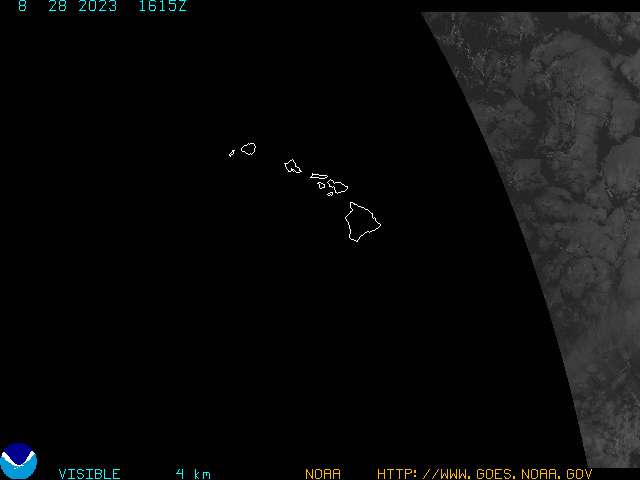
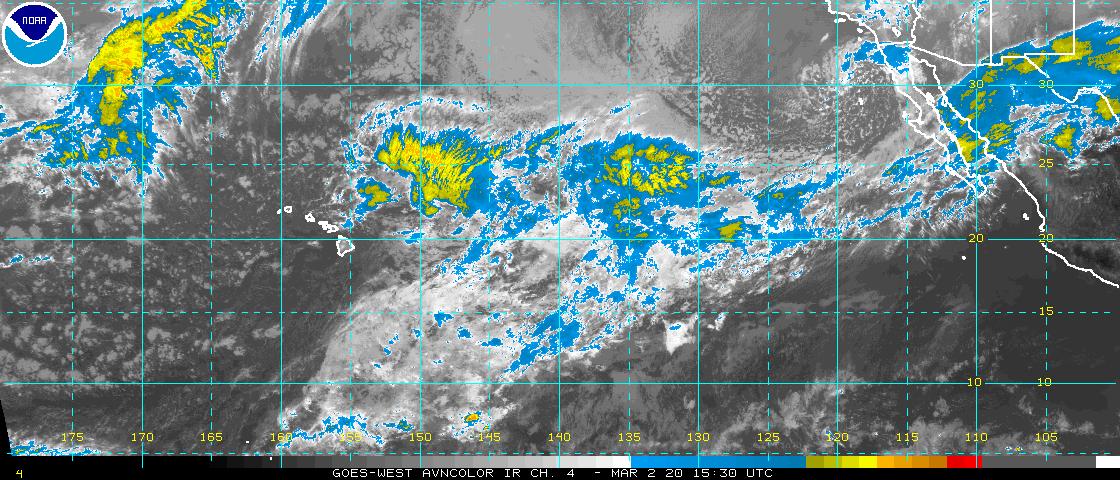
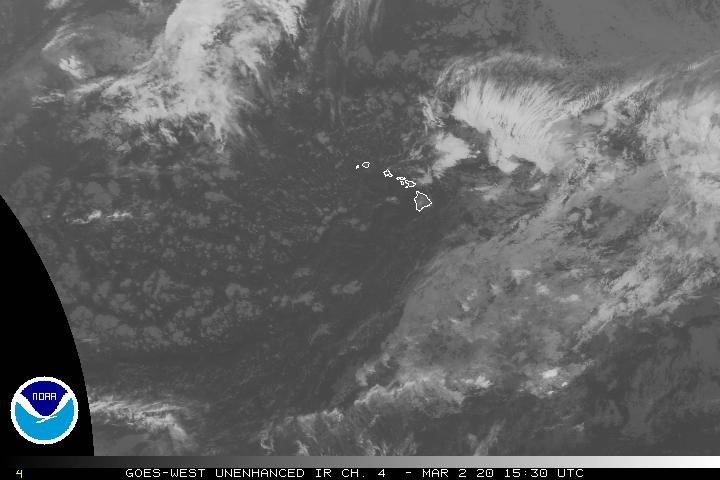
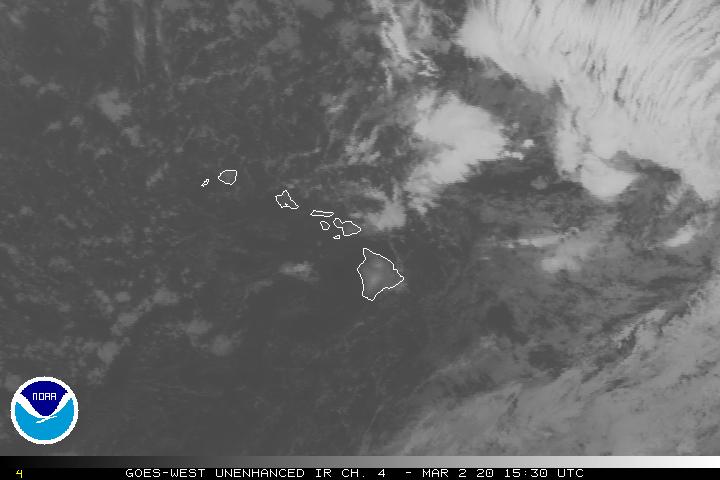
Satellite and Radar Images:To view the cloud conditions we have here in Hawaii, please use the following satellite links, starting off with thisInfrared Satellite Imageof the islands to see all the clouds around the state during the day and night. This next image is one that gives close images of the islands only during the daytime hours, and is referred to as aClose-up visible image. This next image showsa larger view of the Pacific…giving perspective to the wider ranging cloud patterns in the Pacific Ocean. Finally, here’s aLooping IR satellite image, making viewable the clouds around the islands 24 hours a day. To help you keep track of where any showers may be around the islands, here’s the latest animatedradar image.
Hawaii’s Mountains – Here’s a link to the live webcam on the summit of near 14,000 foot Mauna Kea on the Big Island of Hawaii. The tallest peak on the island of Maui is the Haleakala Crater, which is near 10,000 feet in elevation. These two webcams are available during the daylight hours here in the islands…and when there’s a big moon rising just after sunset for an hour or two! Plus, during the nights and early mornings you will be able to see stars, and the sunrise too…depending upon weather conditions. Tropical Cyclone activity in the eastern and central Pacific– Here’s the latest weather information coming out of theNational Hurricane Center, covering the eastern north Pacific. You can find the latest tropical cyclone information for the central north Pacific (where Hawaii is located) by clicking on this link to the Central Pacific Hurricane Center. Here’s atracking mapcovering both the eastern and central Pacific Ocean. A satellite image, which shows the entire ocean area between Hawaii and the Mexican coast…can be found here.
Aloha Paragraphs
Briefly improving weather…ahead of the next front
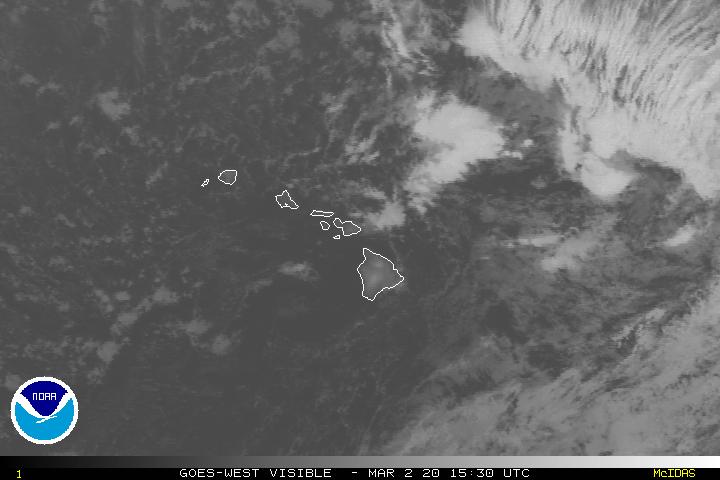
The latest cold front is dissipating over the central islands Sunday afternoon, after bringing plentiful rainfall from Kauai down through Maui.This left most of the Big Island out from under this front’s precipitation shield…which wasn’t good news for that dry island. Thissatellite imageshows the clouds still drapped over the 50th state in places. Here’s a closer view, showing more detail of the islands, using this satellite image. It clearly points out that the old front’s clouds are still around, although will be clearing during the day. There will continue to be the chance that some showers will fall…especially around the Big Island and perhaps the mountains on Maui. Here’s alooping radar imageso we can keep an eye on those showers as they form over the state.
Looking a bit further ahead, the computer models show another cold front approaching the state early in the new week. As this next cold front gets closer, our trade winds will give way to more southeast to southwest Kona breezes. The computer forecast models are giving a good chance of prefrontal showers arriving ahead of the front. This front, which is scheduled to arrive Tuesday, will also bring a short period of showers with it as well. Following the frontal passage, we’ll find cool northerly and northeasterly breezes, which should bring dry weather to the state…followed by light easterly trade winds into next weekend, bringing warmer weather with them.
It’s Sunday evening, as I begin writing the last section of today’s narrative.S
kies around the islands were locally cloudy today, mostly due to the remnant moisture leftover from the recent cold front. This frontal boundary, as described above, is dissipating over the central islands. There is still a thin line of low pressure along this weakening cold front, which could act as a trigger point for a few showers here and there. As we move into the new work week, and as the next cold front gets into range, our winds will swing around to the southeast. This of course means that we could begin to see another surge of volcanic haze coming up from the Big Island vents. Looking out this afternoon, from up here in Kula, Maui, there’s still some vog around from the last batch that arrived. As this next front gets closer on Monday into Tuesday, we may see more of those rainfall producing prefrontal episodes arriving…like ahead of the last cold front. These showers may turn out to be more productive than the cold front itself, which will arrive Tuesday. ~~~ There was a brief light shower over the upcountry area of Kula during the afternoon, and it still looks like we could one or two more, as the cloud bases are still heavy and rather dark. My wind chimes are sounding off lightly, as the trade winds reach over from the windward sides at times today. Despite the fact that moon is now past its prime, it will still be sending lots of reflected sunlight tonight, as it did last night. I was out walking around in the dark Saturday night with a friend, and it was fun to see the moon poking out from behind the clouds at times. I’ll be back very early Monday morning with your next new weather narrative then, I hope you have a great Sunday night until then! Aloha for now…Glenn.
Interesting: Wind power is considered the most promising alternative source of energy. But British experts have now claimed that the noise caused by wind turbines can make some people ill. According to the study by a panel of independent experts the "swishing sound caused by turbines can annoy" some people, causing sleep deprivation and even mental health problems.
"The number of people who suffer these extreme effects are small and if the turbines are designed properly the effects are minimized even further," Dr Leventhall added. "The number of people who suffer these extreme effects are small and if the turbines are designed properly the effects are minimized even further," Dr Leventhall added.
Wind farms, which provide around 2.5 per cent of the country’s electricity, have traditionally been seen by protesters as a blot on the British countryside. Now they have come up with the allegation that their noise may make people ill. But the wind industry said if wind turbines were harmful, it would be impossible to live in a city given the sound levels normally present in urban environments.
"The findings of the study tally with UK research on the subject. In 2007 a Government-backed study carried out by the University of Sal ford found that only one wind farm in the UK was ever found to present a noise nuisance to residents and the issue has since been resolved," said a spokesman for the British Wind Energy Association. There are currently more than 2,500 turbines in Britain and it is planning to build up to 6,000 new wind turbines over the next ten years.
Interesting2:Osama bin Laden, the al-Qaeda leader, has condemned the US and other industrial economies, holding them responsible for the phenomenon of climate change. In an audio tape obtained by Al Jazeera, bin Laden criticized George Bush, the former US president, for rejecting the Kyoto pact and condemned global corporations. "This is a message to the whole world about those responsible for climate change and its repercussions – whether intentionally or unintentionally – and about the action we must take," bin Laden said.
"Speaking about climate change is not a matter of intellectual luxury – the phenomenon is an actual fact." The tape follows one released earlier this week in which the al-Qaeda leader praised a Nigerian man accused of a failed attempt to blow up an airliner heading for Detroit on Christmas Day. In the new recording, bin Laden says "all the industrial states" are to blame for climate change, "yet the majority of those states have signed the Kyoto Protocol and agreed to curb the emission of harmful gases".
He continued: "However, George Bush junior, preceded by [the US] congress, dismissed the agreement to placate giant corporations. And they are themselves standing behind speculation, monopoly and soaring living costs. "They are also behind ‘globalization and its tragic implications’. And whenever the perpetrators are found guilty, the heads of state rush to rescue them using public money." The Kyoto Protocol, a UN treaty aimed at combating global warming, was adopted in December 1997 and has since been ratified by 187 states, but not by the US congress.
Although a signatory to the agreement, the US under Bush refused to ratify the treaty, saying that it should contain binding goals for developing countries to reduce emissions as well as those for industrialized nations. In the new recording, bin Laden said: "Noam Chomsky [the US academic and political commentator] was correct when he compared the US policies to those of the Mafia. They are the true terrorists and therefore we should refrain from dealing in the US dollar and should try to get rid of this currency as early as possible.
"I am certain that such actions will have grave repercussions and huge impact." While continuing to attack America, bin Laden’s comments mark a shift from his earlier, more regionally focused commentary. In his previous tape, bin Laden warned that there would be further attacks on the US unless Barack Obama, the current US president, took steps to resolve the Palestinian conflict. The Obama administration dismissed bin Laden’s comments on the earlier tape and said intelligence analysts had not confirmed that the voice was that of bin Laden.
Interesting3:Half of British Columbia’s land base should be protected to maintain biodiversity in the face of climate change, a coalition of leading environmental groups has recommended to the provincial government. The coalition says in a 99-page report that existing parks and protected areas cover almost 15 per cent of the province’s land base, not nearly enough to protect landscapes and wildlife against the ravages of climate change.
The report, prepared by forest ecologist Jim Pojar, recommends that "at least an additional 35 per cent of the land base [be] managed for biodiversity and carbon," a recognition that natural forests store carbon dioxide better than do industrial forests. New land designations and/or tenures will likely be required to guide management of the expanded conservation network outside of existing parks and protected areas, the report states.
Only activities "compatible with the long-term objectives of biodiversity conservation and adaptation" should be allowed in these new areas, it says. Connectivity of landscapes will become increasingly important as B.C.’s climate continues to warm and species migrate to find new homes. "Species confronting rapid environmental change will either go extinct or survive in one of three ways: by acclimatizing, evolving, or migrating to suitable habitats elsewhere," the report states.
"Those that adapt in their original location will have additional competition from other species or genotypes better suited to the new local environment." B.C. is home to three-quarters of Canada’s mammal and bird species, 70 per cent of its freshwater fish, 60 per cent of its evergreen trees, and thousands of other animals and plants, the report says.
The province’s climate over the next 100 years will become even warmer, with mean annual temperatures warming by 3 to 5 degrees C if current trends continue unabated. There will be more extreme weather events with increasing intensity of storms, floods, wildfires and drought.
Interesting4:U.S. farmers grew record-large corn and soy crops in 2009 but production in 2010 could be even bigger, aided by an El Nino weather pattern that is typically a boon to the Midwest but less so for growers in Australia and southeast Asia, a forecaster said on Thursday. Allen Motew, meteorologist at QT Weather, forecast a dry U.S. spring, which should minimize problems at planting time, followed by a favorably wet summer growing season. "It’s exactly what we need to increase (crop) yields," Motew said at the Top Producer Seminar, a farmers’ conference held in Chicago.
Temperatures in the U.S. Corn Belt are expected to be mostly below normal this summer, while precipitation will be above normal. "We have a double-whammy here — colder and wetter," Motew said. "The odds say we are going to have quite a good year." Motew said corn yields typically increase when an El Nino weather pattern persists for two years in a row. The same is likely true for soybeans, he said. In two of the most recent such years, 1992 and 1998, corn yields increased by 21.1 and 6.1 percent, respectively, Motew said. He said that yields increased during the last 16 of 22 seasons of El Nino weather.
Interesting5:One-third of samples of milk and dairy products analyzed in various restaurants exceed the microbe contamination limits set by the European Union, according to a study carried out by researchers from the University of Valencia (UV). The experts advise against keeping milk in jugs and suggest that these foodstuffs need to be better handled. "Out of all the dairy products we analyzed, 35% of the samples exceeded the maximum contamination levels established by EU law for enterobacteriaceae, and 31% exceeded the limits set for mesophilic aerobic microorganisms (which grow at an optimum temperature of between 30 and 45ºC)," Isabel Sospedra, a researcher at the Department of Preventive Medicine and Public Health of the UV and one of the authors of the study, said.
The scientists examined 265 batches of milk and ready-to-use milk derivatives in a range of bars and restaurants in Valencia, and checked whether their microbial quality fell into line with European Union regulations. The results, which have been published recently in the journal Food borne Pathogens and Disease, show that one-third of the samples had some kind of microorganism contamination and were not fit for human consumption. "Luckily none of the batches we analyzed tested positive for Staphylococcus aureus, Listeria monocytogenes or Salmonella spp., which are pathogenic microorganisms that cause both food poisoning and toxoinfections," the study’s authors says.
The researchers found differences according to the source of the sample (hot milk, products at room temperature or homemade dairy products). According to the study, 2% of the samples of hot milk (kept in jugs or stainless steel thermos flasks) tested positive for the bacteria Escherichia coli. The team detected unsuitable practices, such as reheating milk over and over again, even in a microwave, and then pouring it back into the thermos, which increases the risk of microbial contamination.
The study shows that there is a greater contamination risk from milk kept in jugs, meaning this type of container is not suitable for storing milk. The experts advise that, when using milk in any way, it is important to clean jugs, thermos flasks and the steamers of coffee machines thoroughly and frequently, using the right kind of hygienic sponges or cloths, which is not always the case. "Kitchen cloths are not suitable for disinfecting because of their microstructure, which means they transfer even greater levels of contamination," the scientists explain.
In terms of milk that is cold or at room temperature, this is usually kept in its original container in restaurants and bars — a plastic bottle or tetrabrick. The study shows that containers with a lid are better, since tetrabricks opened with scissors are more exposed to microbial proliferation, and are especially vulnerable to enterobacteriaceae. In terms of dairy products prepared in the restaurants themselves (custards, mousses, puddings and crème caramels), custards (natillas) had the highest levels of contamination with microorganisms.
This may be due to the fact this was the only foodstuff analyzed that is further processed after being heated, say the scientists. Cross contamination could come from the hands of the person preparing the product, particularly when he or she places the biscuit on top of the dish. In line with previous studies, the researchers also showed that adding cinnamon to dairy products led to reduced microorganism contamination, since this substance helps to eliminate microorganisms such as Escherichia coli, Listeria monocytogenes and bacteria from the Salmonella family.
Air Temperatures ranged between these warmest and coolest spots near sea level around the state – and on the highest mountains…at 3pm Saturday afternoon:
Port Allen, Kauai – 81F
Lihue, Kauai – 72
Haleakala Crater – 46 (near 10,000 feet on Maui)
Mauna Kea summit – 39 (near 14,000 feet on the Big Island)
Precipitation Totals–The following numbers represent the largest precipitation totals (inches) during the last 24 hours on each of the major islands, as of Saturday afternoon:
2.35 Wainiha, Kauai 2.78 Olomana Fire Station, Oahu 3.74 Molokai
0.05 Lanai
0.53 Kahoolawe
1.26 Waikapu, Maui 0.42 Pohakuloa Keamuku, Big Island
Marine Winds – Here’s the latest (automatically updated)weather mapshowing a cold front dissipating over the central islands. A high pressure system to the northwest of the islands…is moving east-northeast. As this high pressure system gets into the area north of Hawaii, our winds will become northeast to easterly Sunday.
Satellite and Radar Images:To view the cloud conditions we have here in Hawaii, please use the following satellite links, starting off with thisInfrared Satellite Imageof the islands to see all the clouds around the state during the day and night. This next image is one that gives close images of the islands only during the daytime hours, and is referred to as aClose-up visible image. This next image showsa larger view of the Pacific…giving perspective to the wider ranging cloud patterns in the Pacific Ocean. Finally, here’s aLooping IR satellite image, making viewable the clouds around the islands 24 hours a day. To help you keep track of where any showers may be around the islands, here’s the latest animatedradar image.
Hawaii’s Mountains – Here’s a link to the live webcam on the summit of near 14,000 foot Mauna Kea on the Big Island of Hawaii. The tallest peak on the island of Maui is the Haleakala Crater, which is near 10,000 feet in elevation. These two webcams are available during the daylight hours here in the islands…and when there’s a big moon rising just after sunset for an hour or two! Plus, during the nights and early mornings you will be able to see stars, and the sunrise too…depending upon weather conditions. Tropical Cyclone activity in the eastern and central Pacific– Here’s the latest weather information coming out of theNational Hurricane Center, covering the eastern north Pacific. You can find the latest tropical cyclone information for the central north Pacific (where Hawaii is located) by clicking on this link to the Central Pacific Hurricane Center. Here’s atracking mapcovering both the eastern and central Pacific Ocean. A satellite image, which shows the entire ocean area between Hawaii and the Mexican coast…can be found here.
Aloha Paragraphs
Clouds, some showers…and a few rainbows
The latest cold front is dissipating over the central islands Saturday evening, after bringing plentiful rainfall from Kauai down through Maui.This left most of the Big Island out from under this front’s precipitation shield…which wasn’t good news for that dry island. Thissatellite imageshows the clouds drapped over the 50th state. Here’s a closer view, showing more detail of the islands, using this satellite image. It clearly points out that the front’s clouds are still around, and will be slow to clear. There will continue to be the good chance that some showers will fall overnight…with the outside chance of a couple of locally heavy ones. Here’s alooping radar imageso we can keep an eye on those showers as they form over the state.
Rainfall was generous in many areas, which have a good soaking to most of the state, which has been much appreciated.There was more than the ordinary amount of moisture in the atmosphere, at least in relation to the last several fronts. This fairly deep layer of moisture gave us more widespread showers, some of which were locally heavy. As described in the paragraph above, this front is in the dissipating phase now. There will be lots of clouds left around, which will keep most of the islands overcast Saturday night into Sunday morning. A high pressure system moving in behind the front will cause northeast, to easterly trade winds winds. This will push the front’s remnant moisture into the windward sides, keeping showers falling along those north and east facing coasts and slopes Sunday. This will finally give the Big Island a fighting chance to get some showers.
Looking a bit further ahead, after the localized showery trade winds this weekend, the computer models show another cold front approaching the state early in the new week. As this next cold front gets closer, our trade winds will ease up, giving way to more southeast breezes later Monday into Tuesday. The computer forecast models, at least at this time, are giving a good chance of more abundant showers being brought into the state later Tuesday into Wednesday. We’ll have to wait and see what actually pans out, for the precipitation that arrives then. The major change after that would be the return of the trade winds, a fairly prolonged period of trades actually…which we haven’t seen for quite a while. This would keep passing showers coming our way along the windward sides well into the week. The south and west facing leeward beaches will be in good shape though, with generally dry weather prevailing.
It’s Saturday evening, as I begin writing the last section of today’s narrative.
We really scored with this latest cold front, as many areas received the rainfall that they needed so much. As the satellite imagery above points out, there are lots of clouds still around as we push deeper into this weekend. The radar image up this page shows that indeed, there are showers, generally falling from Oahu down through Maui County…which happens to be under this faltering cold front. ~~~ Friday evening after work I went for a quick Thai dinner in Kahului, and then to see the new film called The Book of Eli (2009)…starring Denzel Washington, and Gary Oldman, which looked pretty good according to the trailers. I know that many of you will be thinking, "there he goes again with his action films." In this film, Denzel Washington fights his way across a post-apocalyptic wasteland to protect a book that holds the key to humanity’s future…which happened to be the Holy Bible.I’m not sure many of you will have the slightest desire to check out this trailer, but here it is, just in case. My friend and I both ended up enjoying this film, which wasn’t too surprising in my case, given my liking for these kinds of down and dirty flicks. ~~~I went down to Costco and bought two new tires for my car this morning, and fortunately, they were’t too busy. I then drove down to Baldwin beach, and despite the cloudy skies, was actually quite nice. There weren’t that many people around, and hardly anyone in the ocean. I enjoyed the experience. Then, it was over to the health food store in Paia, where I ran into several folks who read this webpage…it was nice to meet these new friends! ~~~ I have a friend coming over soon for dinner, and a glass of wine, which will be pleasant. Looking out the window of my weather tower, it appears that the volcanic haze wasn’t washed completely out of the atmosphere, by the locally heavy rains. As a matter of fact, it’s still quite hazy, as the winds remained light with this cold front, keeping the vog in place. ~~~ I’ll be back Sunday morning at some point, but probably not at the crack of dawn as I often do Monday through Saturday. I hope you have a great Saturday night wherever you happen to be spending it! Aloha for now…Glenn
Interesting: Wind power is considered the most promising alternative source of energy. But British experts have now claimed that the noise caused by wind turbines can make some people ill. According to the study by a panel of independent experts the "swishing sound caused by turbines can annoy" some people, causing sleep deprivation and even mental health problems.
"The number of people who suffer these extreme effects are small and if the turbines are designed properly the effects are minimized even further," Dr Leventhall added. "The number of people who suffer these extreme effects are small and if the turbines are designed properly the effects are minimized even further," Dr Leventhall added.
Wind farms, which provide around 2.5 per cent of the country’s electricity, have traditionally been seen by protesters as a blot on the British countryside. Now they have come up with the allegation that their noise may make people ill. But the wind industry said if wind turbines were harmful, it would be impossible to live in a city given the sound levels normally present in urban environments.
"The findings of the study tally with UK research on the subject. In 2007 a Government-backed study carried out by the University of Sal ford found that only one wind farm in the UK was ever found to present a noise nuisance to residents and the issue has since been resolved," said a spokesman for the British Wind Energy Association. There are currently more than 2,500 turbines in Britain and it is planning to build up to 6,000 new wind turbines over the next ten years.
Interesting2:Osama bin Laden, the al-Qaeda leader, has condemned the US and other industrial economies, holding them responsible for the phenomenon of climate change. In an audio tape obtained by Al Jazeera, bin Laden criticized George Bush, the former US president, for rejecting the Kyoto pact and condemned global corporations. "This is a message to the whole world about those responsible for climate change and its repercussions – whether intentionally or unintentionally – and about the action we must take," bin Laden said.
"Speaking about climate change is not a matter of intellectual luxury – the phenomenon is an actual fact." The tape follows one released earlier this week in which the al-Qaeda leader praised a Nigerian man accused of a failed attempt to blow up an airliner heading for Detroit on Christmas Day. In the new recording, bin Laden says "all the industrial states" are to blame for climate change, "yet the majority of those states have signed the Kyoto Protocol and agreed to curb the emission of harmful gases".
He continued: "However, George Bush junior, preceded by [the US] congress, dismissed the agreement to placate giant corporations. And they are themselves standing behind speculation, monopoly and soaring living costs. "They are also behind ‘globalization and its tragic implications’. And whenever the perpetrators are found guilty, the heads of state rush to rescue them using public money." The Kyoto Protocol, a UN treaty aimed at combating global warming, was adopted in December 1997 and has since been ratified by 187 states, but not by the US congress.
Although a signatory to the agreement, the US under Bush refused to ratify the treaty, saying that it should contain binding goals for developing countries to reduce emissions as well as those for industrialized nations. In the new recording, bin Laden said: "Noam Chomsky [the US academic and political commentator] was correct when he compared the US policies to those of the Mafia. They are the true terrorists and therefore we should refrain from dealing in the US dollar and should try to get rid of this currency as early as possible.
"I am certain that such actions will have grave repercussions and huge impact." While continuing to attack America, bin Laden’s comments mark a shift from his earlier, more regionally focused commentary. In his previous tape, bin Laden warned that there would be further attacks on the US unless Barack Obama, the current US president, took steps to resolve the Palestinian conflict. The Obama administration dismissed bin Laden’s comments on the earlier tape and said intelligence analysts had not confirmed that the voice was that of bin Laden.
Interesting3:Half of British Columbia’s land base should be protected to maintain biodiversity in the face of climate change, a coalition of leading environmental groups has recommended to the provincial government. The coalition says in a 99-page report that existing parks and protected areas cover almost 15 per cent of the province’s land base, not nearly enough to protect landscapes and wildlife against the ravages of climate change.
The report, prepared by forest ecologist Jim Pojar, recommends that "at least an additional 35 per cent of the land base [be] managed for biodiversity and carbon," a recognition that natural forests store carbon dioxide better than do industrial forests. New land designations and/or tenures will likely be required to guide management of the expanded conservation network outside of existing parks and protected areas, the report states.
Only activities "compatible with the long-term objectives of biodiversity conservation and adaptation" should be allowed in these new areas, it says. Connectivity of landscapes will become increasingly important as B.C.’s climate continues to warm and species migrate to find new homes. "Species confronting rapid environmental change will either go extinct or survive in one of three ways: by acclimatizing, evolving, or migrating to suitable habitats elsewhere," the report states.
"Those that adapt in their original location will have additional competition from other species or genotypes better suited to the new local environment." B.C. is home to three-quarters of Canada’s mammal and bird species, 70 per cent of its freshwater fish, 60 per cent of its evergreen trees, and thousands of other animals and plants, the report says.
The province’s climate over the next 100 years will become even warmer, with mean annual temperatures warming by 3 to 5 degrees C if current trends continue unabated. There will be more extreme weather events with increasing intensity of storms, floods, wildfires and drought.
Interesting4:U.S. farmers grew record-large corn and soy crops in 2009 but production in 2010 could be even bigger, aided by an El Nino weather pattern that is typically a boon to the Midwest but less so for growers in Australia and southeast Asia, a forecaster said on Thursday. Allen Motew, meteorologist at QT Weather, forecast a dry U.S. spring, which should minimize problems at planting time, followed by a favorably wet summer growing season. "It’s exactly what we need to increase (crop) yields," Motew said at the Top Producer Seminar, a farmers’ conference held in Chicago.
Temperatures in the U.S. Corn Belt are expected to be mostly below normal this summer, while precipitation will be above normal. "We have a double-whammy here — colder and wetter," Motew said. "The odds say we are going to have quite a good year." Motew said corn yields typically increase when an El Nino weather pattern persists for two years in a row. The same is likely true for soybeans, he said. In two of the most recent such years, 1992 and 1998, corn yields increased by 21.1 and 6.1 percent, respectively, Motew said. He said that yields increased during the last 16 of 22 seasons of El Nino weather.
Interesting5:One-third of samples of milk and dairy products analyzed in various restaurants exceed the microbe contamination limits set by the European Union, according to a study carried out by researchers from the University of Valencia (UV). The experts advise against keeping milk in jugs and suggest that these foodstuffs need to be better handled. "Out of all the dairy products we analyzed, 35% of the samples exceeded the maximum contamination levels established by EU law for enterobacteriaceae, and 31% exceeded the limits set for mesophilic aerobic microorganisms (which grow at an optimum temperature of between 30 and 45ºC)," Isabel Sospedra, a researcher at the Department of Preventive Medicine and Public Health of the UV and one of the authors of the study, said.
The scientists examined 265 batches of milk and ready-to-use milk derivatives in a range of bars and restaurants in Valencia, and checked whether their microbial quality fell into line with European Union regulations. The results, which have been published recently in the journal Food borne Pathogens and Disease, show that one-third of the samples had some kind of microorganism contamination and were not fit for human consumption. "Luckily none of the batches we analyzed tested positive for Staphylococcus aureus, Listeria monocytogenes or Salmonella spp., which are pathogenic microorganisms that cause both food poisoning and toxoinfections," the study’s authors says.
The researchers found differences according to the source of the sample (hot milk, products at room temperature or homemade dairy products). According to the study, 2% of the samples of hot milk (kept in jugs or stainless steel thermos flasks) tested positive for the bacteria Escherichia coli. The team detected unsuitable practices, such as reheating milk over and over again, even in a microwave, and then pouring it back into the thermos, which increases the risk of microbial contamination.
The study shows that there is a greater contamination risk from milk kept in jugs, meaning this type of container is not suitable for storing milk. The experts advise that, when using milk in any way, it is important to clean jugs, thermos flasks and the steamers of coffee machines thoroughly and frequently, using the right kind of hygienic sponges or cloths, which is not always the case. "Kitchen cloths are not suitable for disinfecting because of their microstructure, which means they transfer even greater levels of contamination," the scientists explain.
In terms of milk that is cold or at room temperature, this is usually kept in its original container in restaurants and bars — a plastic bottle or tetrabrick. The study shows that containers with a lid are better, since tetrabricks opened with scissors are more exposed to microbial proliferation, and are especially vulnerable to enterobacteriaceae. In terms of dairy products prepared in the restaurants themselves (custards, mousses, puddings and crème caramels), custards (natillas) had the highest levels of contamination with microorganisms.
This may be due to the fact this was the only foodstuff analyzed that is further processed after being heated, say the scientists. Cross contamination could come from the hands of the person preparing the product, particularly when he or she places the biscuit on top of the dish. In line with previous studies, the researchers also showed that adding cinnamon to dairy products led to reduced microorganism contamination, since this substance helps to eliminate microorganisms such as Escherichia coli, Listeria monocytogenes and bacteria from the Salmonella family.
Air Temperatures ranged between these warmest and coolest spots near sea level around the state – and on the highest mountains…at 5pm Friday evening:
Kailua-Kona – 78F
Lihue, Kauai – 70
Haleakala Crater – 46 (near 10,000 feet on Maui)
Mauna Kea summit – 37 (near 14,000 feet on the Big Island)
Precipitation Totals–The following numbers represent the largest precipitation totals (inches) during the last 24 hours on each of the major islands, as of Friday afternoon:
0.76 Mount Waialaele, Kauai
2.47 Kaneohe, Oahu
0.20 Molokai
0.03 Lanai
0.01 Kahoolawe
0.13 Puu Kukui, Maui 0.11 Saddle Quarry, Big Island
Marine Winds – Here’s the latest (automatically updated)weather mapshowing a cold front moving through the state. A weak 1021 millibar high pressure system to the northeast of the islands…is moving away to the east-northeast. Our winds will be south to SW later Friday into Saturday.
Satellite and Radar Images:To view the cloud conditions we have here in Hawaii, please use the following satellite links, starting off with thisInfrared Satellite Imageof the islands to see all the clouds around the state during the day and night. This next image is one that gives close images of the islands only during the daytime hours, and is referred to as aClose-up visible image. This next image showsa larger view of the Pacific…giving perspective to the wider ranging cloud patterns in the Pacific Ocean. Finally, here’s aLooping IR satellite image, making viewable the clouds around the islands 24 hours a day. To help you keep track of where any showers may be around the islands, here’s the latest animatedradar image.
Hawaii’s Mountains – Here’s a link to the live webcam on the summit of near 14,000 foot Mauna Kea on the Big Island of Hawaii. The tallest peak on the island of Maui is the Haleakala Crater, which is near 10,000 feet in elevation. These two webcams are available during the daylight hours here in the islands…and when there’s a big moon rising just after sunset for an hour or two! Plus, during the nights and early mornings you will be able to see stars, and the sunrise too…depending upon weather conditions. Tropical Cyclone activity in the eastern and central Pacific– Here’s the latest weather information coming out of theNational Hurricane Center, covering the eastern north Pacific. You can find the latest tropical cyclone information for the central north Pacific (where Hawaii is located) by clicking on this link to the Central Pacific Hurricane Center. Here’s atracking mapcovering both the eastern and central Pacific Ocean. A satellite image, which shows the entire ocean area between Hawaii and the Mexican coast…can be found here.
Aloha Paragraphs
Full moon..and locally heavy showers too!
A new cold front is bearing down on the Hawaiian Islands Friday afternoon, which will bring increasing clouds and showers now into the weekend.Ahead of this frontal cloud band, there are still some leftover clouds from the last cold front, which are contributing to pre-frontal showers over the islands. Thissatellite imageshows those clouds, as well as the next cold front just about to move over Kauai. Here’s a closer view, using this visible satellite image, showing the large area of clouds over Kauai…where showers have been falling this afternoon. There’s a decent chance that some of these showers may be locally quite heavy into the night. As this front gets closer, the southwest Kona winds will prevail, followed by cooler and rather breezy northwest, north, and northeasterly winds in the wake of the frontal passage. This air will have a cooler feel to it, bringing back slightly chilly tropical temperatures in the wake of the cold front’s passage.
The front will arrive over Kauai this Friday evening, passing over Oahu into the night…then on to Maui and the Big Island Saturday.The computer models are showing more than the ordinary amount of moisture in the atmosphere, as this cold front gets into range. This is true at least, in relation to the last several fronts, which have had to push into a relatively dry atmosphere…when they got into the island chain. This fairly deep layer of moisture could give us a better chance of more widespread showers falling across the Aloha state. This would be a very good thing, as each of the islands could use the precipitation. Once the front gets here, it will likely slow way down and stall when it gets down to the BigIsland. A high pressure system moving in behind the front will trigger gusty northeasterly winds. This will push the front’s remnant moisture into the windward sides, keeping showers falling along those north and east facing coasts and slopes into the weekend perhaps.
As noted above all the necessary ingredients seem to be coming together properly, for the Hawaiian Islands to get wet. Here’s alooping radar imageso we can keep an eye on those showers as they slide down into the state. There’s enough cold air aloft over the state today…that there could actually be a few heavy showers falling. It appears that heavy showers could pop up just about anywhere, and which could contain a random thunderstorm, with possible flooding here and there. Looking a bit further ahead, after the localized showery trade winds this weekend, the computer models show another cold front approaching the state early next week. As this following cold front gets closer, our trade winds will ease up, giving way to more Kona breezes. Hopefully, we’ll get more showers from that cold front too. The big change after that would be the return of the trade winds, a fairly prolonged period of trades actually…which we haven’t seen for quite a while. This would keep passing showers coming our way along the windward sides well into the week. The south and west facing leeward beaches will be in good shape then, with generally dry weather prevailing.
It’s Friday evening, as I begin writing the last section of today’s narrative.
As I was mentioning this morning, everything is setting up nicely, for this opportunity for more showers…finally! Here is Kihei, Maui, late this afternoon heavy rains began falling, and have continued for quite a while now. It’s been so dry along the leeward side of Maui, that everyone and everything needed this big water. I’m about ready to drive over to Kahului, for a quick dinner and then a new film, with one of my Pacific Disaster Center co-workers. This film, called The Book of Eli (2009)…starring Denzel Washington, and Gary Oldman, looks pretty good. I know that many of you will be thinking, there he goes again with his action films! In this film, Denzel Washington fights his way across a post-apocalyptic wasteland to protect a book that holds the key to humanity’s future.I’m not sure many of you will have the slightest desire to check out this trailer, but here it is, just in case. ~~~I’d better get on the road now, if I’m going to be able to have dinner and see the film both. So, I’ll catch up with you early Saturday morning, when I’ll have your next new weather narrative ready for you. I hope you have a great Friday night until then! Aloha for now…Glenn.
Extra:12 August 2009 – the remnants oftropical cyclone Felicia passed over Oahu. The cloud movements over the island of Oahu, looking from the University of Hawaii, up towards Manoa Valley, into the Koolau Mountain range, reveal the shift from northeasterlies to westerlies to light and variable to southerlies and then rapidly and finally to southeasterlies.
Interesting: Wind power is considered the most promising alternative source of energy. But British experts have now claimed that the noise caused by wind turbines can make some people ill. According to the study by a panel of independent experts the "swishing sound caused by turbines can annoy" some people, causing sleep deprivation and even mental health problems.
"The number of people who suffer these extreme effects are small and if the turbines are designed properly the effects are minimized even further," Dr Leventhall added. "The number of people who suffer these extreme effects are small and if the turbines are designed properly the effects are minimized even further," Dr Leventhall added.
Wind farms, which provide around 2.5 per cent of the country’s electricity, have traditionally been seen by protesters as a blot on the British countryside. Now they have come up with the allegation that their noise may make people ill. But the wind industry said if wind turbines were harmful, it would be impossible to live in a city given the sound levels normally present in urban environments.
"The findings of the study tally with UK research on the subject. In 2007 a Government-backed study carried out by the University of Sal ford found that only one wind farm in the UK was ever found to present a noise nuisance to residents and the issue has since been resolved," said a spokesman for the British Wind Energy Association. There are currently more than 2,500 turbines in Britain and it is planning to build up to 6,000 new wind turbines over the next ten years.
Interesting2:Osama bin Laden, the al-Qaeda leader, has condemned the US and other industrial economies, holding them responsible for the phenomenon of climate change. In an audio tape obtained by Al Jazeera, bin Laden criticized George Bush, the former US president, for rejecting the Kyoto pact and condemned global corporations. "This is a message to the whole world about those responsible for climate change and its repercussions – whether intentionally or unintentionally – and about the action we must take," bin Laden said.
"Speaking about climate change is not a matter of intellectual luxury – the phenomenon is an actual fact." The tape follows one released earlier this week in which the al-Qaeda leader praised a Nigerian man accused of a failed attempt to blow up an airliner heading for Detroit on Christmas Day. In the new recording, bin Laden says "all the industrial states" are to blame for climate change, "yet the majority of those states have signed the Kyoto Protocol and agreed to curb the emission of harmful gases".
He continued: "However, George Bush junior, preceded by [the US] congress, dismissed the agreement to placate giant corporations. And they are themselves standing behind speculation, monopoly and soaring living costs. "They are also behind ‘globalization and its tragic implications’. And whenever the perpetrators are found guilty, the heads of state rush to rescue them using public money." The Kyoto Protocol, a UN treaty aimed at combating global warming, was adopted in December 1997 and has since been ratified by 187 states, but not by the US congress.
Although a signatory to the agreement, the US under Bush refused to ratify the treaty, saying that it should contain binding goals for developing countries to reduce emissions as well as those for industrialized nations. In the new recording, bin Laden said: "Noam Chomsky [the US academic and political commentator] was correct when he compared the US policies to those of the Mafia. They are the true terrorists and therefore we should refrain from dealing in the US dollar and should try to get rid of this currency as early as possible.
"I am certain that such actions will have grave repercussions and huge impact." While continuing to attack America, bin Laden’s comments mark a shift from his earlier, more regionally focused commentary. In his previous tape, bin Laden warned that there would be further attacks on the US unless Barack Obama, the current US president, took steps to resolve the Palestinian conflict. The Obama administration dismissed bin Laden’s comments on the earlier tape and said intelligence analysts had not confirmed that the voice was that of bin Laden.
Interesting3:Half of British Columbia’s land base should be protected to maintain biodiversity in the face of climate change, a coalition of leading environmental groups has recommended to the provincial government. The coalition says in a 99-page report that existing parks and protected areas cover almost 15 per cent of the province’s land base, not nearly enough to protect landscapes and wildlife against the ravages of climate change.
The report, prepared by forest ecologist Jim Pojar, recommends that "at least an additional 35 per cent of the land base [be] managed for biodiversity and carbon," a recognition that natural forests store carbon dioxide better than do industrial forests. New land designations and/or tenures will likely be required to guide management of the expanded conservation network outside of existing parks and protected areas, the report states.
Only activities "compatible with the long-term objectives of biodiversity conservation and adaptation" should be allowed in these new areas, it says. Connectivity of landscapes will become increasingly important as B.C.’s climate continues to warm and species migrate to find new homes. "Species confronting rapid environmental change will either go extinct or survive in one of three ways: by acclimatizing, evolving, or migrating to suitable habitats elsewhere," the report states.
"Those that adapt in their original location will have additional competition from other species or genotypes better suited to the new local environment." B.C. is home to three-quarters of Canada’s mammal and bird species, 70 per cent of its freshwater fish, 60 per cent of its evergreen trees, and thousands of other animals and plants, the report says.
The province’s climate over the next 100 years will become even warmer, with mean annual temperatures warming by 3 to 5 degrees C if current trends continue unabated. There will be more extreme weather events with increasing intensity of storms, floods, wildfires and drought.
Interesting4:U.S. farmers grew record-large corn and soy crops in 2009 but production in 2010 could be even bigger, aided by an El Nino weather pattern that is typically a boon to the Midwest but less so for growers in Australia and southeast Asia, a forecaster said on Thursday. Allen Motew, meteorologist at QT Weather, forecast a dry U.S. spring, which should minimize problems at planting time, followed by a favorably wet summer growing season. "It’s exactly what we need to increase (crop) yields," Motew said at the Top Producer Seminar, a farmers’ conference held in Chicago.
Temperatures in the U.S. Corn Belt are expected to be mostly below normal this summer, while precipitation will be above normal. "We have a double-whammy here — colder and wetter," Motew said. "The odds say we are going to have quite a good year." Motew said corn yields typically increase when an El Nino weather pattern persists for two years in a row. The same is likely true for soybeans, he said. In two of the most recent such years, 1992 and 1998, corn yields increased by 21.1 and 6.1 percent, respectively, Motew said. He said that yields increased during the last 16 of 22 seasons of El Nino weather.
Interesting5:One-third of samples of milk and dairy products analyzed in various restaurants exceed the microbe contamination limits set by the European Union, according to a study carried out by researchers from the University of Valencia (UV). The experts advise against keeping milk in jugs and suggest that these foodstuffs need to be better handled. "Out of all the dairy products we analyzed, 35% of the samples exceeded the maximum contamination levels established by EU law for enterobacteriaceae, and 31% exceeded the limits set for mesophilic aerobic microorganisms (which grow at an optimum temperature of between 30 and 45ºC)," Isabel Sospedra, a researcher at the Department of Preventive Medicine and Public Health of the UV and one of the authors of the study, said.
The scientists examined 265 batches of milk and ready-to-use milk derivatives in a range of bars and restaurants in Valencia, and checked whether their microbial quality fell into line with European Union regulations. The results, which have been published recently in the journal Food borne Pathogens and Disease, show that one-third of the samples had some kind of microorganism contamination and were not fit for human consumption. "Luckily none of the batches we analyzed tested positive for Staphylococcus aureus, Listeria monocytogenes or Salmonella spp., which are pathogenic microorganisms that cause both food poisoning and toxoinfections," the study’s authors says.
The researchers found differences according to the source of the sample (hot milk, products at room temperature or homemade dairy products). According to the study, 2% of the samples of hot milk (kept in jugs or stainless steel thermos flasks) tested positive for the bacteria Escherichia coli. The team detected unsuitable practices, such as reheating milk over and over again, even in a microwave, and then pouring it back into the thermos, which increases the risk of microbial contamination.
The study shows that there is a greater contamination risk from milk kept in jugs, meaning this type of container is not suitable for storing milk. The experts advise that, when using milk in any way, it is important to clean jugs, thermos flasks and the steamers of coffee machines thoroughly and frequently, using the right kind of hygienic sponges or cloths, which is not always the case. "Kitchen cloths are not suitable for disinfecting because of their microstructure, which means they transfer even greater levels of contamination," the scientists explain.
In terms of milk that is cold or at room temperature, this is usually kept in its original container in restaurants and bars — a plastic bottle or tetrabrick. The study shows that containers with a lid are better, since tetrabricks opened with scissors are more exposed to microbial proliferation, and are especially vulnerable to enterobacteriaceae. In terms of dairy products prepared in the restaurants themselves (custards, mousses, puddings and crème caramels), custards (natillas) had the highest levels of contamination with microorganisms.
This may be due to the fact this was the only foodstuff analyzed that is further processed after being heated, say the scientists. Cross contamination could come from the hands of the person preparing the product, particularly when he or she places the biscuit on top of the dish. In line with previous studies, the researchers also showed that adding cinnamon to dairy products led to reduced microorganism contamination, since this substance helps to eliminate microorganisms such as Escherichia coli, Listeria monocytogenes and bacteria from the Salmonella family.
Air Temperatures ranged between these warmest and coolest spots near sea level around the state – and on the highest mountains…at 5pm Thursday evening:
Honolulu, Oahu – 79F
Kapalua, Kauai – 73
Haleakala Crater – 50 (near 10,000 feet on Maui)
Mauna Kea summit – 43 (near 14,000 feet on the Big Island)
Precipitation Totals–The following numbers represent the largest precipitation totals (inches) during the last 24 hours on each of the major islands, as of Thursday afternoon:
0.33 Wainiha, Kauai 1.05 Wilson Tunnel, Oahu
0.16 Molokai
0.02 Lanai
0.05 Kahoolawe 4.84 West Wailuaiki, Maui 2.64 Honokaa, Big Island
Marine Winds – Here’s the latest (automatically updated)weather mapshowing a cold front dissipating over the Big Island end of the chain. A weak 1018 millibar high pressure system, to the north of the islands…is moving east. Our winds will be southeast…all the way around to the south to SW later Friday into Saturday.
Satellite and Radar Images:To view the cloud conditions we have here in Hawaii, please use the following satellite links, starting off with thisInfrared Satellite Imageof the islands to see all the clouds around the state during the day and night. This next image is one that gives close images of the islands only during the daytime hours, and is referred to as aClose-up visible image. This next image showsa larger view of the Pacific…giving perspective to the wider ranging cloud patterns in the Pacific Ocean. Finally, here’s aLooping IR satellite image, making viewable the clouds around the islands 24 hours a day. To help you keep track of where any showers may be around the islands, here’s the latest animatedradar image.
Hawaii’s Mountains – Here’s a link to the live webcam on the summit of near 14,000 foot Mauna Kea on the Big Island of Hawaii. The tallest peak on the island of Maui is the Haleakala Crater, which is near 10,000 feet in elevation. These two webcams are available during the daylight hours here in the islands…and when there’s a big moon rising just after sunset for an hour or two! Plus, during the nights and early mornings you will be able to see stars, and the sunrise too…depending upon weather conditions. Tropical Cyclone activity in the eastern and central Pacific– Here’s the latest weather information coming out of theNational Hurricane Center, covering the eastern north Pacific. You can find the latest tropical cyclone information for the central north Pacific (where Hawaii is located) by clicking on this link to the Central Pacific Hurricane Center. Here’s atracking mapcovering both the eastern and central Pacific Ocean. A satellite image, which shows the entire ocean area between Hawaii and the Mexican coast…can be found here.
Aloha Paragraphs
The Hawaiian Islands underwater…and above
The latest cold front has stalled over the southern part of the island chain…keeping partly cloudy skies, and a few showers active.Despite the fact that this cold front is still around, it has lost its forward speed, and is just hanging around…ahead of the next cold front. Thissatellite imageshows the dissipating cold front’s clouds still over much of the state Thursday night, as well as the next new cold front approaching from the northwest. Here’s a closer view, using this IR satellite image, showing the bulk of the clouds stretched from Maui up through Kauai at the time of this writing. The few leftover showers will generally end up along the southeast to south sides of the islands overnight. As the next front gets closer, the southwest Kona winds will likely carry some pre-frontal showers onto the south and west leeward sides.
This next cold front will arrive later Friday into Saturday, followed by yet another…as we move into early next week. The usual Kona winds will precede the cold fronts, followed by slightly cooler north to northeast breezes in their wake. This pattern has been happening all winter thus far. The computer models are showing more than the ordinary amount of moisture in the atmosphere as this next cold front gets into range. If this pans out as expected, we could see more widespread showers associated with this upcoming frontal boundary. This would be a very good thing, and each of the islands could use the precipitation. Time will tell, but later Friday and Saturday’s front looks fairly encouraging! Perhaps its time to do a rain dance or two…or at least a crossing of our fingers in this regard.
It’s Thursday evening, as I begin writing the last section of today’s narrative. As set forth in the two paragraphs above, we’re still quite cloudy, due to the remnant cloudiness associated the old cold front over us now. This is good, as it could be used to bring more showers as the new cold front gets closer. Clouds drop showers, and as dry as we are in many parts of the state now, we like clouds! Although, before we get too excited, we should check out this looping radar image. At the time of this writing, most of the showers were located offshore of the islands, although there were a few showers along the Koolau Mountains of Oahu, and around Maui County too. The main thing I notice about this radar image, is that the showers are now being carried along on southeast breezes. This suggests strongly that it won’t be long before we see voggy skies again, as volcanic haze issuing from the Big Island, moves up over the smaller islands. As is often the case under such conditions, leading up to a cold front passing through the state, I get excited, sometimes really excited! I’ve always been this way, especially as a little weather loving kid. For some reason, this charge has never really left, and even now, as an adult Maui weatherman, it still gets me going!~~~ Speaking of getting me going going, I’m just about ready to take the drive back upcountry, to my home in Kula. My neighbors have emailed me and said that it’s good and foggy up there, up there from down here in Kihei. Fog is one of my favorite weather circumstances, especially when I’m out walking. So, I’m outta here, although will join you again very early Friday morning, with your next new weather narrative from paradise. I hope you have a great Thursday night until then! A little bit more: I just finished dinner, and was walking up the stairs to the weather tower, which is my office and where I sleep both…and found it to be foggy as can be, and lightly raining too, glory be! Aloha for now…Glenn.
Interesting: Vancouver is set to register the warmest January on record with average temperatures more than twice as high as normal, according to Environment Canada. "It’s quite possible this will be the warmest January. We’re sitting at 7.1 Celsius (45F) for an average right now and it will take a lot of cooling to knock that down," meteorologist David Jones said.
The highest recorded average temperature for the month is 6.3 C (43F), set in 1983 and matched in 1994, 2003 and 2006. Since record-keeping began in 1937 at Vancouver International Airport, the average temperature in January has been 3.3 C (38F). The forecast for the rest of the month calls for rain with highs of 8 C and lows of 6C (46-43F).
"We’re attributing this to El Nino and we’ve been particularly warm," said Jones, referring to the recurring climate pattern that brings warm air from the south. Vancouver has set four daily high records as temperatures soared into double digits an unprecedented 11 times in the first 21 days of January.
A normal month would have only three to four days above 10 C (50F). There have only been two days this month when the temperature dipped below freezing; normally Vancouver sees 12 January days below zero. The balmy winter has been worrying fans, officials and athletes of the 2010 Winter Games.
The forecast may go from bad to terrible for Cypress Mountain, an Olympic venue that has already seen close to 500 mm (19.70") of rain this month. "We know El Nino has its strongest effect in the month of February," Jones said, adding that the average temperature in February should be about 1.5 degrees above average, according to long-term models.
"We’re just not seeing anything that would lend me, as a skier, to have some hope about the snow situation in the mountains," Jones said. But average temperatures don’t reflect day-to-day weather, he said, and a cold snap is still possible. Jones noted that weather forecasts are not reliable more than about seven days into the future.
He added that this year’s El Nino is only of moderate strength and warm-weather records are being set only because of normal temperature variability. "Even without El Nino, you can have warm stretches of weather," he said.
Interesting2:Earthquakes triggered the deadliest disasters of the past decade and remain a major threat for millions of people worldwide who live in some of the world’s megacities, the United Nations said Thursday. A UN-backed study said nearly 60 percent of about 780,000 people killed by disasters in 2000 to 2009 died during earthquakes. But climate events affected far more people — nearly three quarters of the two billion hit by catastrophes.
Storms accounted for 22 percent of the overall death toll while extreme temperatures claimed 11 percent of lives lost in 3,852 disasters over the period. Officials and researchers also maintained their alarm over climate or weather-related disasters as the overall number of catastrophes more than doubled compared to the previous decade.
The global bill for disasters reached 960 billion dollars according to the study by the Center for Research on Epidemiology of Disasters (CRED) at Belgium’s Catholic University of Louvain. “Earthquakes are the deadliest natural hazard of the past 10 years and remain a serious threat for millions of people worldwide as eight out of the 10 most populous cities in the world are on earthquake fault-lines,” said Margareta Wahlstroem, UN Special Representative for Disaster Risk Reduction.
But just four percent of those hit by catastrophes over the decade suffered in earthquakes, while 44 percent of them were affected by floods and 30 percent by droughts, the study found. The deadliest disasters in the first decade of the 21st century were the Indian Ocean Tsunami in 2004, which killed 226,408 people in several countries, Cyclone Nargis in Myanmar, which claimed 136,366 lives in 2008 and the Sichuan earthquake in China that year, with 87,476 deaths.
Some 73,338 people were also killed in an earthquake in Pakistan (2005) and 72,210 in heat waves in Europe (2003). The current decade has got off to an equally deadly start, with about 170,000 feared dead in the powerful and unprecedented earthquake that struck Haiti’s capital Port-au-Prince and the surrounding area on January 12. Interesting3: The government has aired fears that global food prices would spike this year, as India suffers its worst drought in nearly four decades. “There’s been a big drought in India which affected half of her territory and which may affect global food prices,” Economic Planning Undersecretary Dennis Arroyo told reporters yesterday. Arroyo listed the Indian dry spell as among the potential obstacles to a full Philippine recovery this year from the global financial crisis, which dragged its economic growth last year to an 11-year low 0.9 percent.
He noted that the Philippines, a huge rice consumer like India, was among the worst nations hit in 2008 when the global prices of the grain spiked to 34-year highs. The Philippines, the world’s largest rice importer, is expected to ramp up rice imports this year after two devastating tropical storms that hit Luzon, the northern part of the country, in September and October last year trimmed annual farm output growth to 0.1 percent. Luzon is the prime location of rice and corn farmlands and granaries and is the chief source of such crops domestically.
“In 2008 you had the global food and fuel crisis. In 2009 we had the financial crisis. Now we’re seeing a global climate crisis. The world is vulnerable to this,” Arroyo said. India, the world’s second most populous country, said last year it was suffering its worst drought since 1972. Low rains had ravaged the country’s rice, cane sugar and groundnut crops.
The Bureau of Animal Industry (BAI) has told the public to brace for higher prices of pork and chicken as a consequence of the El Niño phenomenon that is expected to again affect several parts of Asia after hitting the region a few years ago. The BAI said the foreseen heat wave will cause big problems for the agriculture sector of tropical countries, including the Philippines, and will stunt the growth of their swine and poultry industries.
The agency projects that the local hog and poultry industry will lose some P10 billion due to the anticipated dry spell. The BAI moreover said among those that would suffer are the backyard businesses since almost three-quarters of the country’s swine and poultry production come from such small suppliers. The BAI said the country still has five million kilos each of pork and chicken in its inventory.
Market vendors are worried that pork and chicken price increases could affect their profitability as a result of declining demand. The current price of pork in local public markets is around P160-P170 per kilo. The Department of Agriculture (DA) said it is already taking steps to head off the effects of El Niño. “The Agriculture department has laid down a program to help our fishermen and farmers.
We (though) expect only moderate effects from El Niño,” Agriculture Undersecretary Bernado Fondevilla told a television interview. He said the El Niño phenomenon, which can bring global weather chaos such as droughts and floods, is expected to hit 500,000 hectares of the country’s farmlands, affecting the local production of rice, corn and vegetables. The fisheries sector is also seen to be affected.
Fondevilla said the DA will start cloud seeding, a process that stimulates cloud precipitation to form rain, to help irrigate the farmlands. He said the DA is eyeing to get an extra funding of P1.7 billion from the national government to be able to put in place measures to address the foreboding climate problem. Among the provinces experiencing the early effects of the dry spell are Isabela, Cagayan, as well as some parts of Bulacan and Pampanga in Luzon; and Panay, Samar and Leyte in the Visayas, Fondevilla said.
“(The condition in those areas, however) is not that arid. (They are only) experiencing low rainfall,” he, though, clarified, adding that the country’s irrigation systems bear enough water supply to provide for the irrigation of the farmlands. Fondevilla said there should be no need for the country to raise rice imports as long as the effects of El Niño are mitigated. “NFA (National Food Authority) stocks (of rice) are in place.
We are hoping that with our intervention, there will be no need to import (rice),” he said. But should there be a need to import rice, the government could bring in 300,000 metric tons of the staple grain, he added. The government has said crop losses from the intensifying dry spell, which is seen to affect at least 47 provinces in the country until early next year, could reach P56.4 billion. Besides palay, corn and fish products, the country’s coconut and sugarcane plantations are also threatened to be hit by El Niño.
Air Temperatures ranged between these warmest and coolest spots near sea level around the state – and on the highest mountains…at 5pm Wednesday evening:
Hilo, Hawaii – 78F
Molokai airport – 70
Haleakala Crater – 55 (near 10,000 feet on Maui)
Mauna Kea summit – 41 (near 14,000 feet on the Big Island)
Precipitation Totals–The following numbers represent the largest precipitation totals (inches) during the last 24 hours on each of the major islands, as of Wednesday afternoon:
0.96 Puu Opae, Kauai
1.23 Palehua, Oahu
0.50 Molokai
0.38 Lanai
0.07 Kahoolawe
0.71 Ulupalakua, Maui 0.01 Kamuela, Big Island
Marine Winds – Here’s the latest (automatically updated)weather mapshowing a cold front stalled over Maui County. A weak 1016 millibar high pressure system, to the northwest of the islands…is moving east. Our winds will be northerly, turning NE, then east and southeast into Friday.
Satellite and Radar Images:To view the cloud conditions we have here in Hawaii, please use the following satellite links, starting off with thisInfrared Satellite Imageof the islands to see all the clouds around the state during the day and night. This next image is one that gives close images of the islands only during the daytime hours, and is referred to as aClose-up visible image. This next image showsa larger view of the Pacific…giving perspective to the wider ranging cloud patterns in the Pacific Ocean. Finally, here’s aLooping IR satellite image, making viewable the clouds around the islands 24 hours a day. To help you keep track of where any showers may be around the islands, here’s the latest animatedradar image.
Hawaii’s Mountains – Here’s a link to the live webcam on the summit of near 14,000 foot Mauna Kea on the Big Island of Hawaii. The tallest peak on the island of Maui is the Haleakala Crater, which is near 10,000 feet in elevation. These two webcams are available during the daylight hours here in the islands…and when there’s a big moon rising just after sunset for an hour or two! Plus, during the nights and early mornings you will be able to see stars, and the sunrise too…depending upon weather conditions. Tropical Cyclone activity in the eastern and central Pacific– Here’s the latest weather information coming out of theNational Hurricane Center, covering the eastern north Pacific. You can find the latest tropical cyclone information for the central north Pacific (where Hawaii is located) by clicking on this link to the Central Pacific Hurricane Center. Here’s atracking mapcovering both the eastern and central Pacific Ocean. A satellite image, which shows the entire ocean area between Hawaii and the Mexican coast…can be found here.
Aloha Paragraphs
Underwater is nice…a little chilly up above though
A cold front has brought some showers into the state, which stalled over Maui County Wednesday…with clouds and some showers falling there.Once again, as has become a bad habit, the Big Island has missed the moisture from this frontal cloud band. Thissatellite imageshows the cold front’s ragged clouds over the state Wednesday night. Here’s a closer IR satellite image of what’s left of the cold front, which ran out of energy before reaching the Big Island. Although, looking at the looping radar image in the next paragraph, there appears to be a few showers that managed to sneak down towards the Kona side perhaps. The main thing now will be the brief bout of cooler air coming into the state in its wake…from the north and northeast. This will be followed by a quick spell of easterly trade winds, which may be able to carry some of the leftover showery clouds to the windward sides of the islands into Thursday.
Already we’re starting to look to the northwest, where our next cold front will be arriving from later Friday. The computer forecast models continue to show that we’ll see this next cold front arriving this Friday evening into Saturday…with yet another as we move into early next week. The Kona winds will precede the cold fronts, followed by cooler north to northeast breezes in their wake. This all sounds good, and during a more normal winter, would suggest generous rainfall perhaps from each frontal passage. However, during this El Nino winter, these cold fronts bring a dissapointingly small amount of rainfall our way. In order to get an idea about what I’m referring to, here’s alooping radar image, to see the small amount of showery weather that this cold front is providing around Maui County, and the west side of the Big Island Wednesday night.
The big deal now is the large surf that is breaking along our north and west shores.Giving some context to this situation, are the NWS issued high surf warnings along those beaches. This larger than normal swell will peak at some point tonight, and remain on the large side Thursday…gradually dropping into Friday. This larger than normal surf is such a classic example of what an El Nino winter brings to our Hawaiian Islands. Before we move on here, it should be pointed out that Hawaii’s population, both locals and visitors alike, should be careful of the shore break along these effected north and west facing beaches through the next couple of days. There will be more of these larger than normal NW swells arriving as we move into next week. Back to El Nino, several of the other typical responses here in the islands, are of course the dry conditions, the voggy weather, and often lighter than normal winds…without the appearance, on any regular basis…of the famous trade winds. Speaking of which, they may reappear at times briefly, but there aren’t any definite signs of a long lasting trade wind weather pattern at the moment.
It’s Wednesday evening, as I begin writing the last section of today’s narrative.I think you have a pretty good idea about what’s going on with our weather here in the islands, if you had a chance to read down through the three paragraphs above. We continue to see these near back to back cold fronts, with their Kona winds blowing ahead of their arrivals, and the cooler north to northeast winds in their wake. None of these front’s have been able to put a dent in the drought conditions that we’re currently experiencing. Nonetheless, we are getting some rainfall, although most of it is falling over Kauai and Oahu, and nearly missing the Big Island completely…with Maui County definitely on the dry side of things too. ~~~ Looking out the windows here in Kihei, before I take the drive back upcountry to Kula, it’s mostly cloudy. These clouds are part of the stalled cold front parked over us at the moment. Hopefully, some of these clouds will continue to give us at least some light showers. We need every single drop of water we can coax out these gray overhead clouds. There’s a bit of chilly north breeze blowing too, which may prompt some folks to find that extra blanket for the bed tonight. Right now, I’m heading home, as it’s been a long day of work, and I’m ready to take the edge off with a walk, dinner, some reading, and then to bed. I’ll be up very early Thursday morning, ready to whip out yet another new weather narrative for you. I hope you have a great Wednesday night until then! Aloha for now…Glenn.
Interesting: Carbon dioxide is the gas we most associate with global warming, but methane gas also plays an important role. For reasons that are not well understood, methane gas stopped increasing in the atmosphere in the 1990s. But now it appears to be once again on the rise. Scientists are trying to understand why — and what to do about it. Methane gas comes from all sorts of sources including wetlands, rice paddies, cow tummies, coal mines, garbage dumps and even termites.
Drew Shindell, at NASA’s Goddard Institute in New York, says, "It’s gone up by 150 percent since the pre-industrial period. So that’s an enormous increase. CO2, by contrast, has gone up by something like 30 percent." Molecule for molecule, methane is much more effective than carbon dioxide at trapping heat in the atmosphere. And that’s just part of the trouble.
"Methane is much more complicated once it gets into the atmosphere than something like carbon dioxide is," Shindell says, "and that’s because it reacts with a lot of different important chemicals." For example, methane in the atmosphere also creates ground-level ozone. And ozone isn’t only bad for human health; it also contributes to global warming. Shindell recently totaled up all the effects of methane emissions and realized that the heating effect is more than 60 percent that of carbon dioxide’s.
Interesting2:Public concern about global warming has dropped sharply since the fall of 2008, according to the results of a national survey released January 27 by researchers at Yale and George Mason universities.
The survey found:
• Only 50 percent of Americans now say they are "somewhat" or "very worried" about global warming, a 13-point decrease.
• The percentage of Americans who think global warming is happening has declined 14 points, to 57 percent.
• The percentage of Americans who think global warming is caused mostly by human activities dropped 10 points, to 47 percent.
In line with these shifting beliefs, there has been an increase in the number of Americans who think global warming will never harm people in the United States or elsewhere or other species. "Despite growing scientific evidence that global warming will have serious impacts worldwide, public opinion is moving in the opposite direction," said Anthony Leiserowitz, director of the Yale Project on Climate Change.
"Over the past year the United States has experienced rising unemployment, public frustration with Washington and a divisive health care debate, largely pushing climate change out of the news. Meanwhile, a set of emails stolen from climate scientists and used by critics to allege scientific misconduct may have contributed to an erosion of public trust in climate science."
The survey also found lower public trust in a variety of institutions and leaders, including scientists. For example, Americans’ trust in the mainstream news media as a reliable source of information about global warming declined by 11 percentage points, television weather reporters by 10 points and scientists by 8 points. They also distrust leaders on both sides of the political fence.
Sixty-five percent distrust Republicans Arnold Schwarzenegger and Sarah Palin as sources of information, while 53 percent distrust former Democratic Vice President Al Gore and 49 percent distrust President Barack Obama. Finally, Americans who believe that most scientists think global warming is happening decreased 13 points, to 34 percent, while 40 percent of the public now believes there is a lot of disagreement among scientists over whether global warming is happening or not.
"The scientific evidence is clear that climate change is real, human-caused and a serious threat to communities across America," said Edward Maibach, director of the Center for Climate Change Communication at George Mason University. "The erosion in both public concern and public trust about global warming should be a clarion call for people and organizations trying to educate the public about this important issue."
The results come from a nationally representative survey of 1,001 American adults, age 18 and older. The sample was weighted to correspond with U.S. Census Bureau parameters. The margin of sampling error is plus or minus 3 percent, with 95 percent confidence. The survey was designed by researchers at Yale and George Mason Universities and conducted from December 23, 2009, to January 3, 2010 by Knowledge Networks using an online research panel of American adults.
Interesting3:A team funded by the National Science Foundation (NSF) is returning to Haiti this week to investigate the cause of the January 12, magnitude 7 earthquake there. The geologists will collect crucial data to assess whether the quake could trigger another major event to the east or west of Port-au-Prince, Haiti’s capital. Eric Calais, a Purdue University geophysicist leading the team, said that most aftershocks occur within weeks of the initial quake and that the team urgently needs to get to the site to make a detailed assessment before crucial geological information disappears.
"The big question is instead of small aftershocks, could there be a bigger earthquake coming," Calais said. "There are many historical examples of an initial earthquake triggering an even larger one along the same or nearby faults. We are concerned for the Dominican Republic, as our preliminary models show that the continuation of the fault in this area is loaded."
The January 12th quake killed an estimated 200,000 people in Haiti, left 250,000 injured and left 1.5 million homeless. Port-au-Prince experienced a magnitude 6 aftershock on January 20. "The GPS and geological data gathered by this team will provide important insights into the cause of the January 12, 2010, Haitian earthquake," said Tim Killeen, NSF assistant director for geosciences, "and are essential for evaluating the potential for future earthquakes in the Port-au-Prince area."
The Haitian Bureau of Mines and Energy and the Civil Protection Agency invited Calais and his team back to the country to examine the fault and advise officials as they prepare to rebuild. "The government needs scientifically informed advice to decide what to do now and in the future when they start thinking about rebuilding," Calais said.
"We know how to do the calculations that will tell us if the likelihood of other earthquakes along the fault has increased, but we need information that we can only get by going to the field, making direct observations, and taking measurements on the ground." Calais’ research team has been tracking the build-up of energy along the Enriquillo and Septentrional Faults on the island of Hispaniola, which includes Haiti and the Dominican Republic, using Global Positioning System technology.
The team has studied the area for five years using 100 GPS markers. In 2008, the researchers reported the potential for a magnitude 7.2 earthquake in Haiti and a magnitude 7.5 earthquake in the Dominican Republic. The research was funded by NSF. NSF has awarded the team a new grant to find and map the area of the fault that ruptured, resurvey the existing GPS markers, and install 10 new continuous GPS sites to monitor the changes that will occur in the years to come as Earth’s crust readjusts.
The research team includes other geoscientists at Purdue: Andrew Freed and graduate student Sarah Stamps; Paul Mann of the University of Texas at Austin; Glenn Mattioli of the University of Arkansas; Estelle Chaussard of the University of Miami; and Richard Koehler of the Alaska Division of Geological and Geophysical Surveys. Technical support for the operation is provided by UNAVCO, the NSF-supported facility for geodesy in Boulder, Colo. From GPS measurements at the surface, the team can determine what happened along the fault through its full depth 20 kilometers underground.
Precise measurements of this underground movement are critical for validating models of stress changes that can indicate the potential for, and possible magnitude of, future earthquakes, Calais said. "The shifting stresses in the Earth’s crust after a major earthquake can act to effectively clamp or unclamp other faults. If a fault is almost ready to go and the change in stress slightly unclamps it, then it may fail and cause an earthquake," he said.
"We think this is what’s causing the current sequence of aftershocks, which is mostly concentrated at the western end of the epicentral area, including the recent magnitude 6 aftershock." The team also will collaborate with Falk Amelung and Timothy Dixon of the University of Miami to collect satellite radar data to map crustal changes before and after the earthquake. This information, when combined with the GPS data, will provide the most precise estimate of the earthquake source, a critical starting point for future studies.
"This is an unprecedented opportunity to study a large earthquake at a fault where two tectonic plates meet," Freed said. "What we learn here can be translated to other similar faults throughout the world, such as the San Andreas fault system. Luckily major earthquakes do not occur very often, but that makes this a rare opportunity to learn about the Earth’s behavior."
Despite an invitation by the Haitian government and funding from the NSF, getting transportation into Haiti was difficult, Calais said. Members of Purdue’s Department of Aviation Technology made arrangements via Aeroservice in Miami for Calais and his equipment to be transported to Port-au-Prince on a cargo plane that will also bring aid and supplies to the country.
"The assistance of my Purdue colleagues is instrumental in getting me to Port-au-Prince," Calais said. "It is not easy to get into the country right now, and we don’t want to interfere with what is most important at this time–the ongoing aid and relief efforts." In addition to the donation of transportation, GPS manufacturer Trimble gave Haiti six GPS receivers, which have been fitted for field operation by UNAVCO and will be deployed by the research group.
Air Temperatures ranged between these warmest and coolest spots near sea level around the state – and on the highest mountains…at 4pm Tuesday afternoon:
Hilo, Oahu – 83F
Barking Sands, Kauai – 77
Haleakala Crater – 59 (near 10,000 feet on Maui)
Mauna Kea summit – 46 (near 14,000 feet on the Big Island)
Precipitation Totals–The following numbers represent the largest precipitation totals (inches) during the last 24 hours on each of the major islands, as of Tuesday afternoon:
1.24 Puu Opae, Kauai 0.17 Palehua, Oahu
0.30 Molokai
0.04 Lanai
0.00 Kahoolawe
0.03 Puu Kukui, Maui 0.25 Pali 2, Big Island
Marine Winds – Here’s the latest (automatically updated)weather mapshowing a cold front moving towards the state, with locally gusty southwest Kona winds blowing ahead of it. Winds will veer around to the north in the wake of the frontal passage.
Satellite and Radar Images:To view the cloud conditions we have here in Hawaii, please use the following satellite links, starting off with thisInfrared Satellite Imageof the islands to see all the clouds around the state during the day and night. This next image is one that gives close images of the islands only during the daytime hours, and is referred to as aClose-up visible image. This next image showsa larger view of the Pacific…giving perspective to the wider ranging cloud patterns in the Pacific Ocean. Finally, here’s aLooping IR satellite image, making viewable the clouds around the islands 24 hours a day. To help you keep track of where any showers may be around the islands, here’s the latest animatedradar image.
Hawaii’s Mountains – Here’s a link to the live webcam on the summit of near 14,000 foot Mauna Kea on the Big Island of Hawaii. The tallest peak on the island of Maui is the Haleakala Crater, which is near 10,000 feet in elevation. These two webcams are available during the daylight hours here in the islands…and when there’s a big moon rising just after sunset for an hour or two! Plus, during the nights and early mornings you will be able to see stars, and the sunrise too…depending upon weather conditions. Tropical Cyclone activity in the eastern and central Pacific– Here’s the latest weather information coming out of theNational Hurricane Center, covering the eastern north Pacific. You can find the latest tropical cyclone information for the central north Pacific (where Hawaii is located) by clicking on this link to the Central Pacific Hurricane Center. Here’s atracking mapcovering both the eastern and central Pacific Ocean. A satellite image, which shows the entire ocean area between Hawaii and the Mexican coast…can be found here.
Aloha Paragraphs
Showery cold front moving through the state soon
The winds picked up substantially over the islands from the southwest Kona direction, ahead of a cold front which will reach Kauai this evening…and Oahu overnight.The good thing about this is that the volcanic haze has been blown to the north of the state. There have been showers arriving ahead of the cold front, which has brought welcome rainfall to our leeward sides in places.Thissatellite imageshows the cold front bearing down on us from the northwest direction. We can also see an area of pre-frontal moisture, being carried our way on the gusty Kona winds. These are bringing the first showers, followed by the rainfall moving in with the cold front itself. Here’s a closer IR satellite image of the leading edge of this cold front.
This cold front won’t be the last, as we have several more of these weather features heading our way through the next week. The computer forecast models suggest that after this initial frontal passage tonight into Wednesday, that we will find another cold front arriving this Friday evening into Saturday…with yet another as we move into early next week. The Kona winds will precede the cold fronts, followed by cooler north to northeast breezes in their wake. This is all good news, as we can certainly use all the precipitation we can get. Drought conditions are the reason for this welcoming mat, in terms of desiring much needed water. It’s too early to speak much about later next week, in terms of more cold frontal activity…but we can certainly hope that this sort of thing continues!Speaking of water falling from the sky, here’s alooping radar image, so we can follow its progress into the state.
It’s Tuesday evening, as I begin writing the last section of today’s narrative.Everything seems to be coming together according to the script, with the Kona winds blowing, the prefrontal showers falling, the cold front itself just about ready to move over Kauai (as of 530pm Tuesday)…and the large to very large northwest swell train of waves on tap for Wednesday into Thursday. Speaking of the NW swell, the NWS forecast office in Honolulu has now issued a high surf warning for the north and west shores from Kauai down through Maui. The wave faces along the north shores are expected to be 25 to 35 feet! Meanwhile, while the Big Island won’t see the largest waves, they have their ownthing going on, with a wind advisory in effect now for gusty winds of 20-30 mph blowing atop the summits of that southern-most island…with gusts to 45 mph. I can’t help but say that this has me going quite a bit, all these elemental weather features coming together like they are! I just looked out the window here in Kihei, before I leave for the drive back upcountry to Kula, and the entire flank of the Haleakala Crater is absolutely clear, without the slightest bit of volcanic haze…blown away on the stiff Kona winds. ~~~ I’d best be taking that drive now, so that I’ll have time to get out there for my evening walk. I’ll be back well before the crack of dawn, back at my computer at home, preparing your next new weather narrative from paradise. I hope you have a great Tuesday night until then! Aloha for now…Glenn.
Interesting: The aftershock sequence of the magnitude 7 earthquake that struck near Port-au-Prince, Haiti, on January 12, 2010, will continue for months, if not years. The frequency of events will diminish with time, but damaging earthquakes will remain a threat. It is essential that the rebuilding effort in Haiti take into account the potential for, indeed the inevitability of, future strong earthquakes.
Haiti is cut by two major plate boundary fault zones. Over the past three centuries, earthquakes comparable to or stronger than the recent one have struck Haiti at least four times, including those in 1751 and 1770 that destroyed Port-au-Prince. It is also not just Haiti that has this potential.
The geologic fault that caused the Port-au-Prince earthquake is part of a seismically active zone between the North American and Caribbean tectonic plates. The earthquake undoubtedly relieved some stress on the fault segment that ruptured during the event, but the extent of rupture along the fault is unclear at this time.
In historic times, Haiti has experienced multiple large earthquakes, apparently on adjacent faults. Future quakes have to be anticipated. Similar earthquakes have happened in what the United States might be considered low risk areas. The Charleston Earthquake of 1886 was the most damaging quake to hit the Southeastern United States.
It occurred at 9:50 p.m. on August 31, 1886, and lasted just under a minute. The earthquake caused severe damage in Charleston, South Carolina, damaging 2,000 buildings and causing $6 million worth in damages, while in the whole city the buildings were only valued at approximately $24 million. Between 60 and 110 lives were lost. Some of the damage is still seen today.
The 1811 and 1812 New Madrid Earthquakes are the most intense intraplate earthquake series to have occurred in the contiguous United States in historic times, beginning with an initial pair of very large earthquakes on December 16, 1811. These earthquakes, as well as the seismic zone of their occurrence, were named for the Mississippi River town of New Madrid, Louisiana Territory, now Missouri.
Though the seismic rating of the quake was never measured, it has been estimated as high as 8. There are estimates that the earthquakes were felt strongly over roughly 50,000 square miles, and moderately across nearly 1 million square miles. The historic 1906 San Francisco earthquake, by comparison, was felt moderately over roughly 6,000 square miles.
These American areas continue to be of potential concern. What happened in Haiti could happen in St. Louis or Charleston. Seismic hazard assessments provide the basis for the development of appropriate building codes and the identification of regions at greatest risk. A thorough seismic hazard assessment of Haiti, as well as of other countries in the Caribbean, will provide the basis for establishing or improving building codes and strengthening building resilience over the long term.
The development of more resilient structures and infrastructure is a long term goal, particularly in the face of economic limitations. Over the short term, it is critical that the rebuilding effort be undertaken with an awareness of the potential for subsequent damaging events during the next months and years. It is essential that structures such as hospitals, schools, and critical facilities be reconstructed with greater resilience for the preservation of life and functionality.
Interesting2:The United Nations climate science panel faces new controversy for wrongly linking global warming to an increase in the number and severity of natural disasters such as hurricanes and floods. It based the claims on an unpublished report that had not been subjected to routine scientific scrutiny — and ignored warnings from scientific advisers that the evidence supporting the link too weak.
The report’s own authors later withdrew the claim because they felt the evidence was not strong enough. The claim by the Intergovernmental Panel on Climate Change (IPCC), that global warming is already affecting the severity and frequency of global disasters, has since become embedded in political and public debate.
It was central to discussions at last month’s Copenhagen climate summit, including a demand by developing countries for compensation of $100 billion (£62 billion) from the rich nations blamed for creating the most emissions. Ed Miliband, the energy and climate change minister, has suggested British and overseas floods — such as those in Bangladesh in 2007 — could be linked to global warming. Barack Obama, the US president, said last autumn: "More powerful storms and floods threaten every continent."
Interesting3:A major increase in maximum ocean wave heights off the Pacific Northwest in recent decades has forced scientists to re-evaluate how high a "100-year event" might be, and the new findings raise special concerns for flooding, coastal erosion and structural damage. The new assessment concludes that the highest waves may be as much as 46 feet, up from estimates of only 33 feet that were made as recently as 1996, and a 40 percent increase.
December and January are the months such waves are most likely to occur, although summer waves are also significantly higher. In a study just published online in the journal Coastal Engineering, scientists from Oregon State University and the Oregon Department of Geology and Mineral Industries report that the cause of these dramatically higher waves is not completely certain, but "likely due to Earth’s changing climate."
Using more sophisticated techniques that account for the "non-stationarity" in the wave height record, researchers say the 100-year wave height could actually exceed 55 feet, with impacts that would dwarf those expected from sea level rise in coming decades. Increased coastal erosion, flooding, damage to ocean or coastal structures and changing shorelines are all possible, scientists say.
"The rates of erosion and frequency of coastal flooding have increased over the last couple of decades and will almost certainly increase in the future," said Peter Ruggiero, an assistant professor in the OSU Department of Geosciences. "The Pacific Northwest has one of the strongest wave climates in the world, and the data clearly show that it’s getting even bigger.
"Possible causes might be changes in storm tracks, higher winds, more intense winter storms, or other factors," Ruggiero said. "These probably are related to global warming, but could also be involved with periodic climate fluctuations such as the Pacific Decadal Oscillation, and our wave records are sufficiently short that we can’t be certain yet. But what is clear is the waves are getting larger."
In the early 1990s, Ruggiero said, a fairly typical winter might have an offshore wave maximum of a little more than 25 feet. It was believed then — based primarily on data from two offshore buoys — that 10 meters, or 33 feet, would be about as large as waves would ever get, even in a massive "100-year" storm.
But then a major El Nino — which tends to bring larger waves, higher water levels and increased erosion — happened in 1997-98 and led to a string of "100-year" wave events of around and above 33 feet. Researchers went back to the drawing board, continued to study data and storm events, and now believe that the maximum waves the region may face could approach or even exceed 50 feet.
Increasing wave heights, they said, have had double or triple the impact in terms of erosion, flooding and damage as sea level rise over the last few decades. If wave heights continue to increase, they may continue to dominate over the acceleration in sea level that’s anticipated over the next couple of decades. The prior concern about what sea level rise could do, in other words, is already a reality.
If sea levels do increase significantly in future decades and centuries, that will only add to the damage already being done by higher waves. Exactly what impacts this will have in terms of beach erosion and shifting shorelines is difficult to predict, scientists say, because currents and sand move in complex ways, creating both "winners and losers" in terms of beach stability. But some effects are already visible, Ruggiero said.
"Neskowin is already having problems with high water levels and coastal erosion," Ruggiero said. "Some commercial structures there occasionally lose the use of their lower levels. "Going to the future, communities are going to have to plan for heavier wave impacts and erosion, and decide what amounts of risk they are willing to take, how coastal growth should be managed and what criteria to use for structures," he said.
Interesting4:NASA’s Wide-field Infrared Survey Explorer, or WISE, has spotted its first never-before-seen near-Earth asteroid, the first of hundreds it is expected to find during its mission to map the whole sky in infrared light. There is no danger of the newly discovered asteroid hitting Earth. The near-Earth object, designated 2010 AB78, was discovered by WISE Jan. 12.
The mission’s sophisticated software picked out the moving object against a background of stationary stars. As WISE circled Earth, scanning the sky above, it observed the asteroid several times during a period of one-and-a-half days before the object moved beyond its view. Researchers then used the University of Hawaii’s 88-inch visible-light telescope near the summit of Mauna Kea to follow up and confirm the discovery.
The asteroid is currently about 98 million miles from Earth. It is estimated to be roughly 0.6 miles in diameter and circles the sun in an elliptical orbit tilted to the plane of our solar system. The object comes as close to the sun as Earth, but because of its tilted orbit, it will not pass very close to Earth for many centuries.
This asteroid does not pose any foreseeable impact threat to Earth, but scientists will continue to monitor it. Near Earth objects are asteroids and comets with orbits that pass relatively close to Earth’s path around the sun. In extremely rare cases of an impact, the objects may cause damage to Earth’s surface.
An asteroid about 6 miles wide is thought to have plunged into our planet 65 million years ago, triggering a global disaster and killing off the dinosaurs. Additional asteroid and comet detections will continue to come from WISE. The observations will be automatically sent to the clearinghouse for solar system bodies, the Minor Planet Center in Cambridge, Mass., for comparison against the known catalog of solar system objects.
A community of professional and amateur astronomers will provide follow-up observations, establishing firm orbits for the previously unseen objects. "This is just the beginning," said Ned Wright, the mission’s principal investigator from UCLA. "We’ve got a fire hose of data pouring down from space."
Air Temperatures ranged between these warmest and coolest spots near sea level around the state – and on the highest mountains…at 5pm Monday evening:
Kaneohe, Oahu – 81F
Lihue, Kauai – 75
Haleakala Crater – 55 (near 10,000 feet on Maui)
Mauna Kea summit – 46 (near 14,000 feet on the Big Island)
Precipitation Totals–The following numbers represent the largest precipitation totals (inches) during the last 24 hours on each of the major islands, as of Monday afternoon:
0.34 Anahola, Kauai 0.02 Punaluu Stream, Oahu
0.00 Molokai
0.00 Lanai
0.00 Kahoolawe
0.00 Maui 0.01 Kamuela, Big Island
Marine Winds – Here’s the latest (automatically updated)weather mapshowing a weak 1020 millibar high pressure system far to the east-northeast. Our winds will be light-moderately strong, and locally gusty…from the south and southwest ahead of the next cold front late Tuesday into Wednesday.
Satellite and Radar Images:To view the cloud conditions we have here in Hawaii, please use the following satellite links, starting off with thisInfrared Satellite Imageof the islands to see all the clouds around the state during the day and night. This next image is one that gives close images of the islands only during the daytime hours, and is referred to as aClose-up visible image. This next image showsa larger view of the Pacific…giving perspective to the wider ranging cloud patterns in the Pacific Ocean. Finally, here’s aLooping IR satellite image, making viewable the clouds around the islands 24 hours a day. To help you keep track of where any showers may be around the islands, here’s the latest animatedradar image.
Hawaii’s Mountains – Here’s a link to the live webcam on the summit of near 14,000 foot Mauna Kea on the Big Island of Hawaii. The tallest peak on the island of Maui is the Haleakala Crater, which is near 10,000 feet in elevation. These two webcams are available during the daylight hours here in the islands…and when there’s a big moon rising just after sunset for an hour or two! Plus, during the nights and early mornings you will be able to see stars, and the sunrise too…depending upon weather conditions. Tropical Cyclone activity in the eastern and central Pacific– Here’s the latest weather information coming out of theNational Hurricane Center, covering the eastern north Pacific. You can find the latest tropical cyclone information for the central north Pacific (where Hawaii is located) by clicking on this link to the Central Pacific Hurricane Center. Here’s atracking mapcovering both the eastern and central Pacific Ocean. A satellite image, which shows the entire ocean area between Hawaii and the Mexican coast…can be found here.
Aloha Paragraphs
The back side of the Haleakala Crater…Maui
The winds over our islands will remain generally light to moderately strong Monday evening, before they pick up more substantially from the Kona direction Tuesday into Wednesday…ahead of the next cold front.The last several days have seen volcanic haze over some of the smaller islands, and over some areas on the Big Island too. The vog cleared a little over most areas Tuesday, but actually got thicker over Kauai during the day. As we begin to see increasing Kona winds tonight into Tuesday and Wednesday, we will see a new impulse of these volcanic emissions coming up from the Big Island locally. Thissatellite imageshows this next cold front coming in our direction…which is expected to arrive late Tuesday on Kauai, working its way down through the rest of the island chain into Wednesday. We can clearly see, what looks like several pre-frontal cloud bands, branching off from the primary frontal boundary. These would arrive before the front, bringing showers especially on the leeward sides of the islands of Kauai and Oahu.
We’re all counting on this next cold front to bring showers with it…as we sure need every drop of water we can get.It’s too soon to know for certain just how showery this next front will be, although the computer models continue to suggest that it will be a better rainfall producer (than the last one)…pushing all the way down through the island chain. The islands could certainly use the precipitation, especially those areas from Oahu down through Maui County and the Big Island! The one problem, and we’ve seen this consistently through the winter season thus far, is that the frontal boundary will lack…what we call upper level support. This simply means that there won’t be enough cold air aloft to enhance the incoming showers. The cold air associated with the cold front will remain to the north and northeast, limiting our rainfall, over what it would be, if we had a trough of low pressure aloft over the state. This front however, looks like it will have more moisture to work with, so that hopefully we’ll see more showers…and they should even reach all the way down to Maui and the Big Island this time.
Getting back to the voggy weather, our best chance to see some atmospheric clearing would be after the cold front…when our winds veer around to the north and northeast briefly.This short spell of non-Kona winds will be replaced by a north and NE air flow. Besides the good chance of clearing the vog out, it will bring another cool snap to our islands…tropically speaking of course. Again, referring back to thisIR satellite image, those clouds that are following right behind the cold front, or to the northwest and west, are called stratocumulus. They are formed typically when cool, or cold air flows over a warmer ocean surface. They are usually quite dry, and are good indicators of this cool snap. Cool in this case means a few degrees chillier during the days, perhaps keeping high temperatures in the 70F’s, rather than the lower 80’s at sea level…and a good reason to dig out that extra blanket again for Wednesday and Thursday nights coming up. Then, as we’ve been dancing this samba of Kona winds ~ cold front ~ chilly north breezes…we’ll find returning southeast to south winds, carrying more vog up into the state, ahead of the next cold front, scheduled for Friday night into the weekend.
It’s Monday, as I begin writing the last section of today’s narrative.As is so typical during an El Nino winter, we’re having dry to very dry weather. That’s why we are getting more and more excited about the upcoming cold front, which will hopefully bring showers to the entire state. Besides the dry cold front’s that we’ve seen through January, El Nino is also infamous for bringing Kona winds and voggy weather, which we’ve seen plenty of this winter too. Then, as common as the dry cold fronts, and dry weather, and the vog, we often find higher than normal surf conditions along our north and west facing shores. Just such a large to extra large swell is forecast to arrive later Wednesday into Thursday…which may very well cause the NWS forecast office in Honolulu to issue a high surf warning. ~~~ It wasn’t as voggy Monday, as it was this past weekend. Looking at high resolution visible satellite imagery, I could see that the vog has migrated just offshore to our south and southwest. As the south to southwest Kona winds start up tonight into Tuesday, this vog will be pushed over the islands again, bringing the thick haze back over us. ~~~ I’m just about ready to leave Kihei, as I’m done working now, taking the drive back upcountry to Kula. I’ll be home before its dark, and out on the road for a couple of quick paced loops around the neighborhood. I’ll be back well before sunrise Tuesday, with your next new weather narrative then. I hope you have a great Monday night until then! Aloha for now…Glenn.
Interesting: Bill Gates, the world’s richest man and a leading philanthropist, said on Sunday spending by rich countries aimed at combating climate change in developing nations could mean a dangerous cut in aid for health issues. Gates, the Microsoft Corp co-founder whose $34 billion foundation is fighting malaria, AIDS, tuberculosis and other diseases in developing countries, expressed concern about the amount of spending pledged at December’s Copenhagen global climate meeting.
Participants at the meeting agreed to a target of channeling $100 billion per year to developing countries to combat climate change by 2020. Gates said that amount represents more than three quarters of foreign aid currently given by the richest countries per year. "I am concerned that some of this money will come from reducing other categories of foreign aid, especially health," Gates wrote in a letter, released late on Sunday, describing the work of his foundation.
"If just 1 percent of the $100 billion goal came from vaccine funding, then 700,000 more children could die from preventable diseases," Gates added. Taking the focus away from health aid could be bad for the environment in the long run, said Gates, "because improvements in health, including voluntary family planning, lead people to have smaller families, which in turn reduces the strain on the environment."
Interesting2:The world is showing only lukewarm enthusiasm for a "Copenhagen Accord" to curb climate change, with no sign so far of deeper-than-planned 2020 curbs on greenhouse gas emissions before a January 31 deadline. In Brussels, a draft European Union letter on Friday showed plans for the 27-nation bloc to reiterate a minimum offer of a 20 percent cut in emissions by 2020 below 1990 levels, pleasing industry, and a 30 percent cut if other nations act comparably.
Other countries are likely to do the same after last month’s Copenhagen summit ended with a low-ambition accord. No nations have since announced radically tougher plans for action. "I think that countries are going to stick to their ranges," said Nick Mabey, head of the E3G think-tank in London.
He said it was too early for an overhaul of national goals." It’s almost like the beginning of a new negotiation," said Gordon Shepherd, director of international policy at the WWF environmental group. Many countries were still torn between showing "a burst of enthusiasm" to rebuild momentum after Copenhagen and "complete caution," taking time to review next moves, he said.
Few countries have so far sent letters to the U.N. Climate Change Secretariat before a January 31 deadline for outlining goals for 2020 set by the Copenhagen Accord, which was worked out by major emitters led by China and the United States.
Interesting3:Ice Age climate records from an Arizona stalagmite link the Southwest’s winter precipitation to temperatures in the North Atlantic, according to new research. The finding is the first to document that the abrupt changes in Ice Age climate known from Greenland also occurred in the southwestern U.S., said co-author Julia E. Cole of the University of Arizona in Tucson.
"It’s a new picture of the climate in the Southwest during the last Ice Age," said Cole, a UA professor of geosciences. "When it was cold in Greenland, it was wet here, and when it was warm in Greenland, it was dry here." The researchers tapped into the natural climate archives recorded in a stalagmite from a limestone cave in southern Arizona. Stalagmites grow up from cave floors.
The stalagmite yielded an almost continuous, century-by-century climate record spanning 55,000 to 11,000 years ago. During that time ice sheets covered much of North America, and the Southwest was cooler and wetter than it is now. Cole and her colleagues found the Southwest flip-flopped between wet and dry periods during the period studied. Each climate regime lasted from a few hundred years to more than one thousand years, she said.
In many cases, the transition from wet to dry or vice versa took less than 200 years. "These changes are part of a global pattern of abrupt changes that were first documented in Greenland ice cores," she said. "No one had documented those changes in the Southwest before."
Scientists suggest that changes in the northern Atlantic Ocean’s circulation drove the changes in Greenland’s Ice Age climate, Cole said. "Those changes resulted in atmospheric changes that pushed around the Southwest’s climate."
She added that observations from the 20th and 21st centuries link modern-day alterations in the North Atlantic’s temperature with changes in the storm track that controls the Southwest’s winter precipitation. "Also, changes in the storm track are the kinds of changes we expect to see in a warming world," she said. "When you warm the North Atlantic, you move the storm track north."
Interesting4:The simple formula we’ve learned in recent years — forests remove the greenhouse gas CO2 from the atmosphere; therefore forests prevent global warming — may not be quite as simple as we thought. Forests can directly absorb and retain heat, and, in at least one type of forest, these effects may be strong enough to cancel out a good part of the benefit in lowered CO2.
This is a conclusion of a paper that will be published on January 22, in Science by scientists in the Weizmann Institute’s Faculty of Chemistry. For the past 10 years, the Weizmann Institute has been operating a research station in the semi-arid Yatir Forest, a pine forest at the edge of the Negev Desert. This station is part of a world-wide project composed of over 400 stations, called FLUXNET, which investigates the relationship between forests, the atmosphere and climate around the globe.
The contribution of the Yatir station, says Prof. Dan Yakir of the Environmental Sciences and Energy Research Department, is unique as it ‘is one of very few in the semi-arid zone, which covers over 17% of the Earth’s land surface, and it has the longest record of the processes taking place in semi-arid forests.’ Forests counteract the ‘greenhouse effect’ by removing heat-trapping CO2 from the atmosphere and storing it in living trees.
Over the years of measurement, Yakir’s group has found that the semi-arid forest, even though it’s not as luxuriant as temperate forests farther north, is a surprisingly good carbon sink — better than most European pine forests and about on par with the global average.
This was unexpected news for a forest sitting at the edge of a desert, and it indicated that there is real hope for the more temperate forests if things heat up under future global change scenarios. But forests do more than just store CO2, and Yakir, together with Dr. Eyal Rotenberg, decided to look at the larger picture — the ‘total energy budget’ of a semi-arid forest.
The first hint they had that other processes might be counteracting the cooling effect of CO2 uptake came when they compared the forest’s albedo — how much sunlight is reflected from its surface back into space — with that of the nearby open shrub land.
They found that the dark-colored forest canopy had a much lower albedo, absorbing quite a bit more of the sun’s energy than the pale, reflective surface of surrounding areas. In a cloudless environment with high levels of solar radiation, albedo becomes an important factor in surface heating.
Interesting4:Tilapia has quickly risen through the ranks as an important aquaculture fish. It’s third in production behind carp and salmon, with over 1.5 million metric tons produced every year. Tilapia are the ideal fish farm species because they’re omnivorous, fairly big, quick-growing, tolerate high densities quite well and are mighty tasty.
They are also considered far more environmentally friendly than other species because they can be fed a vegetarian diet. A recent study of tilapia in Fiji drew some attention, however. Tilapia species have been in Fiji since at least 1949, and fish farms there produce tons of it.
But there’s a downside to being the perfect fish to farm: tilapia are also a highly damaging invasive species. Because they grow fast and eat whatever is available, they’re very adaptable to living in just about any freshwater environment that’s warm enough. They’ve invaded the waterways of many of the countries that farm them commercially.
The study revealed that these escapees are damaging the natural biodiversity of Fiji’s waterways. Researchers from Wetlands International, the Wildlife Conservation Society, and Conservation International found that two things correlated strongly to the diversity of native fish in an area. First, they found that the more an area had been cleared for housing or other reasons, the fewer species of native fish.
That was not shocking. It was the second variable that decimated native fish diversity that made headlines: the presence of tilapia. Of the 89 different sample locations surveyed, 85.4 percent had been invaded by tilapia. In Fiji, the loss of native fish is as much a cultural issue as it is an environmental one.
Many native species form an important part of the diet of inland communities, and, in particular, are important in small villages where fish are caught not farmed. As the human populations continue to expand, countries such as Fiji will rely more and more heavily on compact, efficient means of producing food, like fish farms. And while this study serves to warn of the downsides of aquaculture, it unfortunately doesn’t provide a solution to the underlying problem of too many mouths to feed on limited resources.
Air Temperatures ranged between these warmest and coolest spots near sea level around the state – and on the highest mountains…at 4pm Sunday afternoon:
Port Allen, Kauai – 81F
Princeville, kauai – 73
Haleakala Crater – 55 (near 10,000 feet on Maui)
Mauna Kea summit – 46 (near 14,000 feet on the Big Island)
Precipitation Totals–The following numbers represent the largest precipitation totals (inches) during the last 24 hours on each of the major islands, as of Sunday afternoon:
0.96 Puu Opae, Kauai 0.14 Schofield South, Oahu
0.00 Molokai
0.04 Lanai
0.00 Kahoolawe
0.00 Maui 0.01 Saddle Quarry, Big Island
Marine Winds – Here’s the latest (automatically updated)weather mapshowing a dissipating cold front over Kauai. At the same time, we have a weak 1014 millibar high pressure system to the west-northwest…with its associated ridge extending east. Our winds will be light Monday, picking up from the south and southwest ahead of the next cold front Tuesday.
Satellite and Radar Images:To view the cloud conditions we have here in Hawaii, please use the following satellite links, starting off with thisInfrared Satellite Imageof the islands to see all the clouds around the state during the day and night. This next image is one that gives close images of the islands only during the daytime hours, and is referred to as aClose-up visible image. This next image showsa larger view of the Pacific…giving perspective to the wider ranging cloud patterns in the Pacific Ocean. Finally, here’s aLooping IR satellite image, making viewable the clouds around the islands 24 hours a day. To help you keep track of where any showers may be around the islands, here’s the latest animatedradar image.
Hawaii’s Mountains – Here’s a link to the live webcam on the summit of near 14,000 foot Mauna Kea on the Big Island of Hawaii. The tallest peak on the island of Maui is the Haleakala Crater, which is near 10,000 feet in elevation. These two webcams are available during the daylight hours here in the islands…and when there’s a big moon rising just after sunset for an hour or two! Plus, during the nights and early mornings you will be able to see stars, and the sunrise too…depending upon weather conditions. Tropical Cyclone activity in the eastern and central Pacific– Here’s the latest weather information coming out of theNational Hurricane Center, covering the eastern north Pacific. You can find the latest tropical cyclone information for the central north Pacific (where Hawaii is located) by clicking on this link to the Central Pacific Hurricane Center. Here’s atracking mapcovering both the eastern and central Pacific Ocean. A satellite image, which shows the entire ocean area between Hawaii and the Mexican coast…can be found here.
Aloha Paragraphs
Hawaiian Artwork…Mark Webster
Slack winds will remain in place, as a dissipating cold front dies over Kauai…then Kona winds will return ahead of the next cold front later Monday into Tuesday.Here’s a picture of this dissipating satellite image, with its associated clouds mostly over Kauai, although a few did slip into the Channel between there and Oahu. The last couple of days have seen south and SW winds, which have carried considerable volcanic haze up from the Big Island vents, over the smaller islands. As we have light winds still around Sunday evening, this vog will remain in place for the time being. As we begin to see increasing Kona winds later Monday through Tuesday, we’ll see a new push of these volcanic emissions coming up from the Big Island. This next cold front, which is expected to arrive later Tuesday on Kauai, will work its way down through the rest of the island chain into the middle of the new week ahead…with yet another front pushing in our direction late in the work week into next weekend.
Now that we’ve seen yet another cold front leave Maui and the Big Island high and dry…we’ll begin looking at the next cold front…which the models are promising somewhat more rainfall. This next chance for more showers will be around the middle of the new week, when that next cold front arrives. It’s too soon to know for certain just how showery this next front will be, although the computer models are suggesting it would be a better rainfall producer (than this most recent one)…pushing all the way through the island chain. The islands could certainly use some precipitation, especially those areas from Oahu down through Maui County and the Big Island! The one problem, and we’ve seen this consistently through this winter season so far, is that the frontal boundary will lack…what we call upper level support. This simply means that there won’t be enough cold air aloft to enhance the incoming showers. This front however, may have more moisture to work with, so that we hopefully will see more showers…and they may even reach Maui and the Big Island this time.
It’s Sunday evening, as I begin writing the last section of today’s narrative.Sunday was a mellow day here in the 50th state, with just that dissipating cold front that kept some clouds hovering over the area from Kauai down through Oahu. These quickly diminishing clouds weren’t the only thing hanging around, especially down around parts of the Big Island, and Maui County. This of course was the very thick volcanic haze, which has dimished air visibilities like crazy! This vog is super dense, and is making our air mass incredibily difficult to see through, and I’m hearing some folks complaining about it influencing their health in a negative way. Looking across the central valley, from here in Kula, Maui, towards the West Maui Mountains…those near 5,800 foot high mountains have disappeared completely! I know that they are there, but they are absolutely invisible from here. I expect to wake up Monday morning with little change in this stale reality, and likely right on into Tuesday. The increasing Kona winds ahead of the upcoming mid-week cold front, may help to clear out some of the vog, but I’m not promising that now. ~~~ I’m heading out for my evening walk as I finish this update, although I’m going to be taking it easy, as I don’t want to be breathing in too deeply. I hope you have a great Sunday night, and that you will have a chance to check back in then! Aloha for now…Glenn.
Interesting: A new scientific paper co-authored by a University of Adelaide researcher reports strong evidence that humans, not climate change, caused the demise of Australia’s mega-fauna — giant marsupials, huge reptiles and flightless birds — at least 40,000 years ago. In a paper published in the journal Science, two Australian scientists claim that improved dating methods show that humans and mega-fauna only co-existed for a relatively short time after people inhabited Australia, adding weight to the argument that hunting led to the extinction of large-bodied species.
According to Professor Richard ‘Bert’ Roberts from the University of Wollongong and Professor Barry Brook from the University of Adelaide, new methods to directly date bones and teeth of extinct species show that mega-fauna fossils and Aboriginal tools do not all date from the same period.
"Debate about the possible cause of these late Pleistocene extinctions has continued for more than 150 years, with scientists divided over whether climate change or the arrival of humans has been responsible for their demise," Professor Brook says. "Australia was colonized during a time when the climate was relatively benign, supporting the view that people, not climate change, caused the extinctions here," he says.
Interesting2:A new analysis of global surface temperatures by NASA scientists finds the past year was tied for the second warmest since 1880. In the Southern Hemisphere, 2009 was the warmest year on record. Although 2008 was the coolest year of the decade because of a strong La Nina that cooled the tropical Pacific Ocean, 2009 saw a return to a near-record global temperatures as the La Nina diminished, according to the new analysis by NASA’s Goddard Institute for Space Studies (GISS) in New York.
The past year was a small fraction of a degree cooler than 2005, the warmest on record, putting 2009 in a virtual tie with a cluster of other years –1998, 2002, 2003, 2006, and 2007 — for the second warmest on record. "There’s always interest in the annual temperature numbers and a given year’s ranking, but the ranking often misses the point," said James Hansen, GISS director. "There’s substantial year-to-year variability of global temperature caused by the tropical El Nino-La Nina cycle.
When we average temperature over five or ten years to minimize that variability, we find global warming is continuing unabated." January 2000 to December 2009 was the warmest decade on record. Looking back to 1880, when modern scientific instrumentation became available to monitor temperatures precisely, a clear warming trend is present, although there was a leveling off between the 1940s and 1970s. In the past three decades, the GISS surface temperature record shows an upward trend of about 0.36 degrees F per decade.
In total, average global temperatures have increased by about 1.5 degrees F since 1880. "That’s the important number to keep in mind," said GISS climatologist Gavin Schmidt. "The difference between the second and sixth warmest years is trivial because the known uncertainty in the temperature measurement is larger than some of the differences between the warmest years." The near-record global temperatures of 2009 occurred despite an unseasonably cool December in much of North America.
High air pressures from the Arctic decreased the east-west flow of the jet stream, while increasing its tendency to blow from north to south. The result was an unusual effect that caused frigid air from the Arctic to rush into North America and warmer mid-latitude air to shift toward the north. This left North America cooler than normal, while the Arctic was warmer than normal.
"The contiguous 48 states cover only 1.5 percent of the world area, so the United States’ temperature does not affect the global temperature much," Hansen said. GISS uses publicly available data from three sources to conduct its temperature analysis. The sources are weather data from more than a thousand meteorological stations around the world, satellite observations of sea surface temperatures, and Antarctic research station measurements.
Other research groups also track global temperature trends but use different analysis techniques. The Met Office Hadley Centre in the United Kingdom uses similar input measurements as GISS, for example, but it omits large areas of the Arctic and Antarctic where monitoring stations are sparse.
Although the two methods produce slightly differing results in the annual rankings, the decadal trends in the two records are essentially identical. "There’s a contradiction between the results shown here and popular perceptions about climate trends," Hansen said. "In the last decade, global warming has not stopped."
Interesting3:The world’s mountainous regions are home to about 800 million people and the source of some of the world’s major rivers. In these regions, runoff is strongly affected by temperature. This suggests that flooding could be quite sensitive to global warming, but there has been some lack of scientific consensus on the effects of temperature variations on floods.
Allamano et al. show that global warming does increase flood risk significantly. The authors analyzed runoff data recorded by 27 stations in the Swiss Alps and used a simple probabilistic model to study how flood risk varies with temperature, precipitation, and elevation in mountainous regions.
The researchers found that large floods have occurred more frequently in recent years than in the past, and they predict that global warming will result in such floods occurring even more often in the future. In particular, they found that if global temperatures increase by 3.6 degrees Fahrenheit, then large floods that occurred about once every 100 years could occur up to 5 times more often. The research appears in the journal Geophysical Research Letters.
Air Temperatures ranged between these warmest and coolest spots near sea level around the state – and on the highest mountains…at 7pm Saturday evening:
Honolulu, Oahu – 77F
Lihue, Kauai – 73
Haleakala Crater – 46 (near 10,000 feet on Maui)
Mauna Kea summit – 37 (near 14,000 feet on the Big Island)
Precipitation Totals–The following numbers represent the largest precipitation totals (inches) during the last 24 hours on each of the major islands, as of Saturday evening:
0.26 Puu Alua, Kauai 0.01 Waimanalo, Oahu
0.00 Molokai
0.00 Lanai
0.00 Kahoolawe
0.00 Maui 0.09 Saddle Quarry, Big Island
Marine Winds – Here’s the latest (automatically updated)weather mapshowing a weakening cold front moving over Kauai to Oahu. Our winds will be light from the south and southwest ahead of front, remaining light as a new high pressure moves in close to the state…behind the front Sunday into Monday.
Satellite and Radar Images:To view the cloud conditions we have here in Hawaii, please use the following satellite links, starting off with thisInfrared Satellite Imageof the islands to see all the clouds around the state during the day and night. This next image is one that gives close images of the islands only during the daytime hours, and is referred to as aClose-up visible image. This next image showsa larger view of the Pacific…giving perspective to the wider ranging cloud patterns in the Pacific Ocean. Finally, here’s aLooping IR satellite image, making viewable the clouds around the islands 24 hours a day. To help you keep track of where any showers may be around the islands, here’s the latest animatedradar image.
Hawaii’s Mountains – Here’s a link to the live webcam on the summit of near 14,000 foot Mauna Kea on the Big Island of Hawaii. The tallest peak on the island of Maui is the Haleakala Crater, which is near 10,000 feet in elevation. These two webcams are available during the daylight hours here in the islands…and when there’s a big moon rising just after sunset for an hour or two! Plus, during the nights and early mornings you will be able to see stars, and the sunrise too…depending upon weather conditions. Tropical Cyclone activity in the eastern and central Pacific– Here’s the latest weather information coming out of theNational Hurricane Center, covering the eastern north Pacific. You can find the latest tropical cyclone information for the central north Pacific (where Hawaii is located) by clicking on this link to the Central Pacific Hurricane Center. Here’s atracking mapcovering both the eastern and central Pacific Ocean. A satellite image, which shows the entire ocean area between Hawaii and the Mexican coast…can be found here.
Aloha Paragraphs
Cold front over Kauai and Oahu…hazy elsewhere
Our winds remain from the southwest Saturday night…ahead of a weak cold front moving over Kauai and Oahu.A high pressure system is located far to the east-northeast of the islands now…having been pushed southeast by this dissipating cold front. These more southerly and SW winds have carried considerable volcanic haze up from the Big Island vents, over the smaller islands. We’ll find light winds hanging around in the wake of the cold front Sunday. There may be some temporary clearing of the vog for Kauai and Oahu, although Maui County, and many parts of the Big Island will remain hazy. This slack wind condition Monday through Tuesday, will keep hazy conditions in place for the entire state. The winds will pick up again from the Kona direction, ahead of the next cold front, arriving around the middle of the new week ahead…with yet another pushing in our direction late in the work week.
This weakening cold front has moved over Kauai, and will arrive and then stall over Oahu…Saturday night into Sunday. The clouds associated with the frontal boundary, are shown well by using this closer IRsatellite image view. The front cloud band, arriving first over Kauai, brought increasing clouds and showers.The showers will reach Oahu, although will likely skid to a stop there. This leaves the parched islands of Maui County, and the Big Island, even further away from the cold front…dry as a bone. The next chance for more showers will be around the middle of the new week, when another cold front arrives. It’s still too early to know how many showers it will bring, or if it will stall moving through the island chain. Then, as mentioned above, yet another cold front will try and move into the state around next Friday.
It’s Saturday evening, as I begin writing the last section of today’s narrative.As noted above, about half of the island chain, from Kauai to Oahu, will be on the receiving end of this cold front’s showers. We can use this looping radar image to see the showers as they slide down over the Gathering Place island of Oahu tonight. The big thing from Maui County down through the Big Island Saturday evening, besides the lack of rain, is the thick volcanic haze, better known as vog. It was thick here on Maui Saturday, with very poor air visibilities! ~~~ Friday evening after work, I went to see the new film called Sherlock Holmes (2009), starring Robert Downey Jr. and Jude Law…among many others. As I had heard from just about everyone, it was a top notch film, that took me on a wild ride. It was fast paced, and a little crazy, as thelegendary London detective investigates a mysterious nemesis who threatens all ofEngland.
I must say that I thoroughly enjoyed this film, and could easily give it a B+ grade. If you haven’t seen this yet, here’s a trailer, so you can see if it might appeal to you. ~~~I had a good day, hanging out at the beach in Paia for a while this morning, and then taking a great swim on the ocean. I went shopping, before heading back up to Kula. I went with a friend for a walk at a place called Thompson Ranch Rd. out in Keokea…near Ulupalakua. We had dinner together, which is the reason this narrative update was put out later than normal. I’ll be back Sunday morning with your next new weather narrative, I hope you have a great Saturday night until then! Aloha for now…Glenn.
Interesting: A new scientific paper co-authored by a University of Adelaide researcher reports strong evidence that humans, not climate change, caused the demise of Australia’s mega-fauna — giant marsupials, huge reptiles and flightless birds — at least 40,000 years ago. In a paper published in the journal Science, two Australian scientists claim that improved dating methods show that humans and mega-fauna only co-existed for a relatively short time after people inhabited Australia, adding weight to the argument that hunting led to the extinction of large-bodied species.
According to Professor Richard ‘Bert’ Roberts from the University of Wollongong and Professor Barry Brook from the University of Adelaide, new methods to directly date bones and teeth of extinct species show that mega-fauna fossils and Aboriginal tools do not all date from the same period.
"Debate about the possible cause of these late Pleistocene extinctions has continued for more than 150 years, with scientists divided over whether climate change or the arrival of humans has been responsible for their demise," Professor Brook says. "Australia was colonized during a time when the climate was relatively benign, supporting the view that people, not climate change, caused the extinctions here," he says.
Interesting2:A new analysis of global surface temperatures by NASA scientists finds the past year was tied for the second warmest since 1880. In the Southern Hemisphere, 2009 was the warmest year on record. Although 2008 was the coolest year of the decade because of a strong La Nina that cooled the tropical Pacific Ocean, 2009 saw a return to a near-record global temperatures as the La Nina diminished, according to the new analysis by NASA’s Goddard Institute for Space Studies (GISS) in New York.
The past year was a small fraction of a degree cooler than 2005, the warmest on record, putting 2009 in a virtual tie with a cluster of other years –1998, 2002, 2003, 2006, and 2007 — for the second warmest on record. "There’s always interest in the annual temperature numbers and a given year’s ranking, but the ranking often misses the point," said James Hansen, GISS director. "There’s substantial year-to-year variability of global temperature caused by the tropical El Nino-La Nina cycle.
When we average temperature over five or ten years to minimize that variability, we find global warming is continuing unabated." January 2000 to December 2009 was the warmest decade on record. Looking back to 1880, when modern scientific instrumentation became available to monitor temperatures precisely, a clear warming trend is present, although there was a leveling off between the 1940s and 1970s. In the past three decades, the GISS surface temperature record shows an upward trend of about 0.36 degrees F per decade.
In total, average global temperatures have increased by about 1.5 degrees F since 1880. "That’s the important number to keep in mind," said GISS climatologist Gavin Schmidt. "The difference between the second and sixth warmest years is trivial because the known uncertainty in the temperature measurement is larger than some of the differences between the warmest years." The near-record global temperatures of 2009 occurred despite an unseasonably cool December in much of North America.
High air pressures from the Arctic decreased the east-west flow of the jet stream, while increasing its tendency to blow from north to south. The result was an unusual effect that caused frigid air from the Arctic to rush into North America and warmer mid-latitude air to shift toward the north. This left North America cooler than normal, while the Arctic was warmer than normal.
"The contiguous 48 states cover only 1.5 percent of the world area, so the United States’ temperature does not affect the global temperature much," Hansen said. GISS uses publicly available data from three sources to conduct its temperature analysis. The sources are weather data from more than a thousand meteorological stations around the world, satellite observations of sea surface temperatures, and Antarctic research station measurements.
Other research groups also track global temperature trends but use different analysis techniques. The Met Office Hadley Centre in the United Kingdom uses similar input measurements as GISS, for example, but it omits large areas of the Arctic and Antarctic where monitoring stations are sparse.
Although the two methods produce slightly differing results in the annual rankings, the decadal trends in the two records are essentially identical. "There’s a contradiction between the results shown here and popular perceptions about climate trends," Hansen said. "In the last decade, global warming has not stopped."
Interesting3:The world’s mountainous regions are home to about 800 million people and the source of some of the world’s major rivers. In these regions, runoff is strongly affected by temperature. This suggests that flooding could be quite sensitive to global warming, but there has been some lack of scientific consensus on the effects of temperature variations on floods.
Allamano et al. show that global warming does increase flood risk significantly. The authors analyzed runoff data recorded by 27 stations in the Swiss Alps and used a simple probabilistic model to study how flood risk varies with temperature, precipitation, and elevation in mountainous regions.
The researchers found that large floods have occurred more frequently in recent years than in the past, and they predict that global warming will result in such floods occurring even more often in the future. In particular, they found that if global temperatures increase by 3.6 degrees Fahrenheit, then large floods that occurred about once every 100 years could occur up to 5 times more often. The research appears in the journal Geophysical Research Letters.
Air Temperatures ranged between these warmest and coolest spots near sea level around the state – and on the highest mountains…at 5pm Friday evening:
Princeville, Kauai – 81F
Hilo, Hawaii – 74
Haleakala Crater – 54 (near 10,000 feet on Maui)
Mauna Kea summit – 45 (near 14,000 feet on the Big Island)
Precipitation Totals–The following numbers represent the largest precipitation totals (inches) during the last 24 hours on each of the major islands, as of Friday afternoon:
0.01 Mount Waialaele, Kauai
0.10 Mililani, Oahu
0.00 Molokai
0.00 Lanai
0.00 Kahoolawe
0.00 Maui 0.03 Mountain View, Big Island
Marine Winds – Here’s the latest (automatically updated)weather mapshowing a weak high pressure system to the east-northeast of the islands…moving east away from the state. Meanwhile, we have a weakening cold front approaching from the northwest. Our winds will be light from the south and southwest ahead of a cold front arriving later Saturday into Sunday.
Satellite and Radar Images:To view the cloud conditions we have here in Hawaii, please use the following satellite links, starting off with thisInfrared Satellite Imageof the islands to see all the clouds around the state during the day and night. This next image is one that gives close images of the islands only during the daytime hours, and is referred to as aClose-up visible image. This next image showsa larger view of the Pacific…giving perspective to the wider ranging cloud patterns in the Pacific Ocean. Finally, here’s aLooping IR satellite image, making viewable the clouds around the islands 24 hours a day. To help you keep track of where any showers may be around the islands, here’s the latest animatedradar image.
Hawaii’s Mountains – Here’s a link to the live webcam on the summit of near 14,000 foot Mauna Kea on the Big Island of Hawaii. The tallest peak on the island of Maui is the Haleakala Crater, which is near 10,000 feet in elevation. These two webcams are available during the daylight hours here in the islands…and when there’s a big moon rising just after sunset for an hour or two! Plus, during the nights and early mornings you will be able to see stars, and the sunrise too…depending upon weather conditions. Tropical Cyclone activity in the eastern and central Pacific– Here’s the latest weather information coming out of theNational Hurricane Center, covering the eastern north Pacific. You can find the latest tropical cyclone information for the central north Pacific (where Hawaii is located) by clicking on this link to the Central Pacific Hurricane Center. Here’s atracking mapcovering both the eastern and central Pacific Ocean. A satellite image, which shows the entire ocean area between Hawaii and the Mexican coast…can be found here.
Aloha Paragraphs
Cold front…with showers later Saturday-Sunday
Our winds became considerably lighter from the south and southwest…prompted by the approach of a cold front.A high pressure system is located to the east-northeast of the islands Friday evening…being pushed southeast by an approaching cold front. These more southerly oriented winds have carried volcanic haze up from the Big Island vents, over some of the smaller islands. The lighter breezes will swing to the southwest, the Kona direction, ahead of a cold front that will arrive over the state later Saturday on Kauai. Then, we’ll find light winds hanging around in the wake of the cold front on Sunday. This slack wind condition Monday through Tuesday, will keep hazy conditions in place. The winds will eventually pick up again from the Kona direction, ahead of another cold front arriving around the middle of the new week ahead.
Despite the clouds that developed during the day, over the islands, rainfall remained very limited. These stratocumulus clouds, as we glance at the following IRsatellite image, are mostly dry. As we get into the weekend we’ll see the approach of the next cold front. This cold front, arriving first over Kauai later in the day Saturday, will bring increasing clouds and showers.
The showers will reach Oahu, although as it gets down towards Maui, it may be just about out of rainfall…leaving the Big Island likely beyond the reach of these much needed precipitation. The next chance for more showers would be around the middle of the new week, when another cold front arrives.
It’s Friday evening, as I begin writing the last section of today’s narrative.As noted above, our weather as favorably inclined Friday, although there were quite a few clouds around, and it got hazy. Just to verify the dry nature of the clouds that surround the Hawaiian Islands now, lets take a quick look at this looping radar image. Most of Saturday will be just fine, although Kauai will get a little action from the aforementioned cold front later in the day. It will take until Saturday evening for the frontal boundary to reach Oahu, and then probably Sunday before the front might reach Maui County? I’m hoping that this shower bearing cold front will proceed right down to the Big Island, although that might be wishful thinking. This isn’t isn’t looking too good in terms of bringing all that much rainfall to our dry state. The cold front arriving around the middle of the new week looks to be somewhat more productive in terms of bringing moisture, but the models have been to talk us into this a lot lately! ~~~
I’m in a little bit of a rush right now, as I’m trying to make a few film, called Sherlock Holmes, I’ll have to let you know what I thought Saturday morning, although I’ve heard nothing but good things so far. I hope you have a great Friday night! Aloha for now…Glenn.
Interesting: A new scientific paper co-authored by a University of Adelaide researcher reports strong evidence that humans, not climate change, caused the demise of Australia’s mega-fauna — giant marsupials, huge reptiles and flightless birds — at least 40,000 years ago. In a paper published in the journal Science, two Australian scientists claim that improved dating methods show that humans and mega-fauna only co-existed for a relatively short time after people inhabited Australia, adding weight to the argument that hunting led to the extinction of large-bodied species.
According to Professor Richard ‘Bert’ Roberts from the University of Wollongong and Professor Barry Brook from the University of Adelaide, new methods to directly date bones and teeth of extinct species show that mega-fauna fossils and Aboriginal tools do not all date from the same period.
"Debate about the possible cause of these late Pleistocene extinctions has continued for more than 150 years, with scientists divided over whether climate change or the arrival of humans has been responsible for their demise," Professor Brook says. "Australia was colonized during a time when the climate was relatively benign, supporting the view that people, not climate change, caused the extinctions here," he says.
Interesting2:A new analysis of global surface temperatures by NASA scientists finds the past year was tied for the second warmest since 1880. In the Southern Hemisphere, 2009 was the warmest year on record. Although 2008 was the coolest year of the decade because of a strong La Nina that cooled the tropical Pacific Ocean, 2009 saw a return to a near-record global temperatures as the La Nina diminished, according to the new analysis by NASA’s Goddard Institute for Space Studies (GISS) in New York.
The past year was a small fraction of a degree cooler than 2005, the warmest on record, putting 2009 in a virtual tie with a cluster of other years –1998, 2002, 2003, 2006, and 2007 — for the second warmest on record. "There’s always interest in the annual temperature numbers and a given year’s ranking, but the ranking often misses the point," said James Hansen, GISS director. "There’s substantial year-to-year variability of global temperature caused by the tropical El Nino-La Nina cycle.
When we average temperature over five or ten years to minimize that variability, we find global warming is continuing unabated." January 2000 to December 2009 was the warmest decade on record. Looking back to 1880, when modern scientific instrumentation became available to monitor temperatures precisely, a clear warming trend is present, although there was a leveling off between the 1940s and 1970s. In the past three decades, the GISS surface temperature record shows an upward trend of about 0.36 degrees F per decade.
In total, average global temperatures have increased by about 1.5 degrees F since 1880. "That’s the important number to keep in mind," said GISS climatologist Gavin Schmidt. "The difference between the second and sixth warmest years is trivial because the known uncertainty in the temperature measurement is larger than some of the differences between the warmest years." The near-record global temperatures of 2009 occurred despite an unseasonably cool December in much of North America.
High air pressures from the Arctic decreased the east-west flow of the jet stream, while increasing its tendency to blow from north to south. The result was an unusual effect that caused frigid air from the Arctic to rush into North America and warmer mid-latitude air to shift toward the north. This left North America cooler than normal, while the Arctic was warmer than normal.
"The contiguous 48 states cover only 1.5 percent of the world area, so the United States’ temperature does not affect the global temperature much," Hansen said. GISS uses publicly available data from three sources to conduct its temperature analysis. The sources are weather data from more than a thousand meteorological stations around the world, satellite observations of sea surface temperatures, and Antarctic research station measurements.
Other research groups also track global temperature trends but use different analysis techniques. The Met Office Hadley Centre in the United Kingdom uses similar input measurements as GISS, for example, but it omits large areas of the Arctic and Antarctic where monitoring stations are sparse.
Although the two methods produce slightly differing results in the annual rankings, the decadal trends in the two records are essentially identical. "There’s a contradiction between the results shown here and popular perceptions about climate trends," Hansen said. "In the last decade, global warming has not stopped."
Interesting3:The world’s mountainous regions are home to about 800 million people and the source of some of the world’s major rivers. In these regions, runoff is strongly affected by temperature. This suggests that flooding could be quite sensitive to global warming, but there has been some lack of scientific consensus on the effects of temperature variations on floods.
Allamano et al. show that global warming does increase flood risk significantly. The authors analyzed runoff data recorded by 27 stations in the Swiss Alps and used a simple probabilistic model to study how flood risk varies with temperature, precipitation, and elevation in mountainous regions.
The researchers found that large floods have occurred more frequently in recent years than in the past, and they predict that global warming will result in such floods occurring even more often in the future. In particular, they found that if global temperatures increase by 3.6 degrees Fahrenheit, then large floods that occurred about once every 100 years could occur up to 5 times more often. The research appears in the journal Geophysical Research Letters.














 Email Glenn James: