Air Temperatures ranged between these warmest and coolest spots near sea level around the state – and on the highest mountains…at 5pm Friday evening:
Barking Sands, Kauai – 81F
Hilo, Hawaii – 75
Haleakala Crater – 52 (near 10,000 feet on Maui)
Mauna Kea summit – 46 (near 14,000 feet on the Big Island)
Precipitation Totals–The following numbers represent the largest precipitation totals (inches) during the last 24 hours on each of the major islands, as of Friday afternoon: 0.02 Mount Waialeale, Kauai
0.03 Waimanalo, Oahu
0.00 Molokai
0.00 Lanai
0.00 Kahoolawe
0.02 West Wailuaiki, Maui
0.01 Kamuela, Big Island
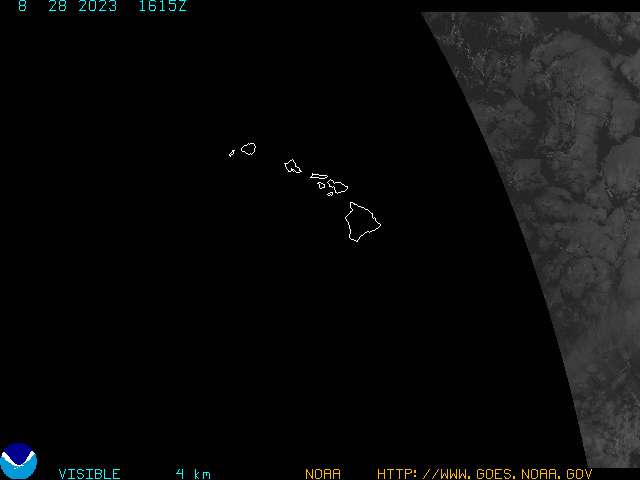
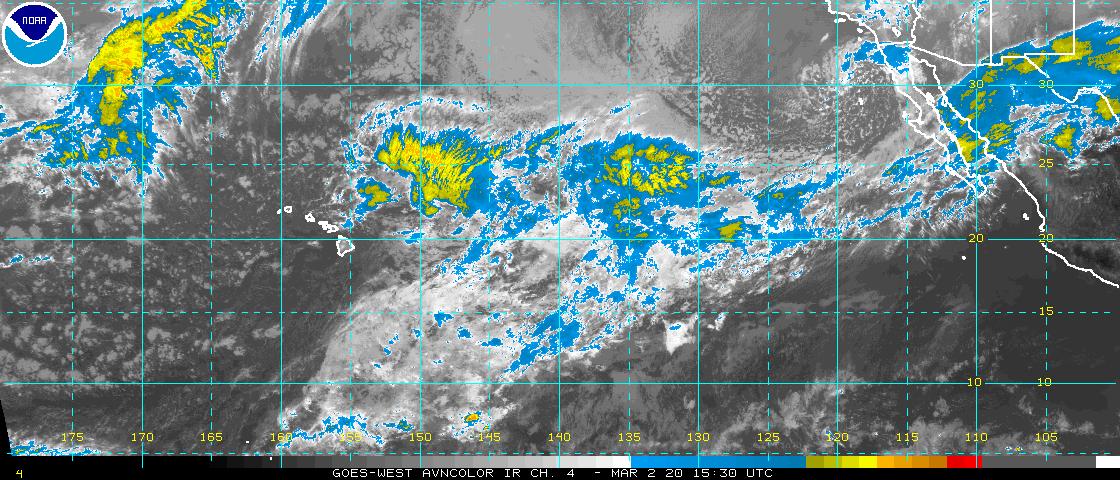
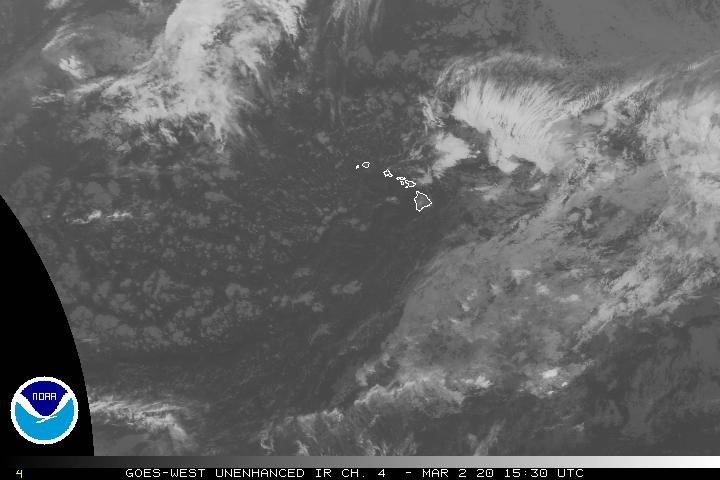
Marine Winds – Here’s the latest (automatically updated)weather mapshowing a weak 1021 millibar high pressure system far to our east, with another weak 1022 millibar cell to the north…moving into the area northeast of us. The combination, with their associated ridges, will keep the light trade winds…gradually becoming lighter southeast breezes as a ridge moves down over the islands this weekend. Satellite and Radar Images:To view the cloud conditions we have here in Hawaii, please use the following satellite links, starting off with thisInfrared Satellite Imageof the islands to see all the clouds around the state during the day and night. This next image is one that gives close images of the islands only during the daytime hours, and is referred to as aClose-up visible image. This next image showsa larger view of the Pacific…giving perspective to the wider ranging cloud patterns in the Pacific Ocean. Finally, here’s aLooping IR satellite image, making viewable the clouds around the islands 24 hours a day. To help you keep track of where any showers may be around the islands, here’s the latest animatedradar image.
Hawaii’s Mountains – Here’s a link to the live webcam on the summit of near 14,000 foot Mauna Kea on the Big Island of Hawaii. The tallest peak on the island of Maui is the Haleakala Crater, which is near 10,000 feet in elevation. These two webcams are available during the daylight hours here in the islands…and when there’s a big moon rising just after sunset for an hour or two! Plus, during the nights and early mornings you will be able to see stars, and the sunrise too…depending upon weather conditions. Tropical Cyclone activity in the eastern and central Pacific– Here’s the latest weather information coming out of theNational Hurricane Center, covering the eastern north Pacific. You can find the latest tropical cyclone information for the central north Pacific (where Hawaii is located) by clicking on this link to the Central Pacific Hurricane Center. Here’s atracking mapcovering both the eastern and central Pacific Ocean. A satellite image, which shows the entire ocean area between Hawaii and the Mexican coast…can be found here.
Aloha Paragraphs
Perfect weather this weekend
More exceptionally nice late autumn weather expected through the weekend…into the first half of the new work week ahead. Our overlying atmosphere remains dry and stable Friday night…which suggests that very pleasant weather conditions will prevail into the future.The trade winds returned briefly Friday, although will be calming down again this weekend. We will likely end up with light and variable breezes, gradually turning to the southeast. We may see a few very minor windward biased showers overnight…with more completely dry weather on tap for Saturday.
The computer models show a weak cold front edging towards Kauai right after this weekend. It may bring a few showers to the Garden Isle on Monday, but it isn’t expected to move down through the island chain. A second stronger cold front is forecast to arrive around the middle of the new week ahead. This one, along with an associated trough of low pressure then, could bring more substantial rainfall for several days. It’s still a little early to know the exact details about this weather change, although more on this will become available soon. We saw a brief spell of trade winds Friday…which attained moderately strong levels locally.The winds will become lighter Saturday afternoon into Sunday and Monday. If they swing far enough around to the southeast direction, we could see hazy conditions, with volcanic haze (vog) moving up into the island chain, from the vents on the Big Island for several days. Looking ahead, the cold front approaching around next Wednesday, will likely trigger stronger and gusty south to southwest Kona winds ahead of its arrival. They may be strong enough to necessitate some sort of advisory flags to go up then.
Our days will begin in a mostly clear way, and after the trade winds falter this weekend, the mornings will turn a bit cooler. The days will be generally warm and sunny though, making for great beaching opportunities. The daytime heating will cause the usual few afternoon cloudy periods, especially around the mountains. There could be a few showers falling, although they will be light, and most areas will remain completely dry through the weekend into Monday and Tuesday. The potential haze may become noticeable later this weekend, into the new week. Things will turn cloudier, windier, and wetter as a cold front ushers in inclement weather beginning next Wednesday-Thursday.
It’s early Friday evening here on Maui, as I begin writing this last section of today’s narrative. What an absolutely beautiful day Friday was, like it has been the last several days! Skies have been near totally cloud free, with warm daytime temperatures. When I was out for lunch here in Kihei during the early afternoon, my car thermometer was reading 87F degrees, now that’s warm for December…even for here Hawaii. I have no doubt that this weekend will be anything but gorgeous. As I’ve been saying lately, it’s time to get out there and enjoy our out of doors now. This outstanding weather, although it might turn hazy with time, will carry forth through the next five days, at least that’s how it looks from here. ~~~ I still don’t know what I’m going to do tonight, now that I’m off work. I’ll probably go see some film, although I’m not sure which one yet. It’s so easy to drive to a theatre, walk in there and sit down, let the lights go dark…and get carried off into another world. I really like that sequence of events. I’d like to go dancing, but I don’t have anyone to go with, and don’t feel like going alone. Oh well, this plan will get me to bed at a reasonable time, which will make me ready to take full advantage of Saturday. I’m quite sure I’ll be hitting the north shore beaches then, as the weather is so perfect now. ~~~ I hope you have a great Friday night wherever you’re reading from! Aloha for now…Glenn.
Interesting: Observers were able to accurately judge some aspects of a stranger’s personality from looking at photographs, according to a study in the current issue of Personality and Social Psychology Bulletin (PSBP), the official monthly journal of the Society for Personality and Social Psychology. Self-esteem, ratings of extraversion and religiosity were correctly judged from physical appearance.
Researchers asked participants to assess the personalities of strangers based first on a photograph posed to the researchers’ specifications and then on a photograph posed the way the subject chose. Those judgments were then compared with how the person and acquaintances rated that individual’s personality.
They found that while both poses provided participants with accurate cues about personality, the spontaneous pose showed more insight, including about the subject’s agreeableness, emotional stability, openness, likability, and loneliness. The study suggested that physical appearance alone can send signals about their true personality.
Interesting2:The gases which formed the Earth’s atmosphere — and probably its oceans — did not come from inside the Earth but from outer space, according to a study by University of Manchester and University of Houston scientists. The report published in the journal Science means that textbook images of ancient Earth with huge volcanoes spewing gas into the atmosphere will have to be rethought.
According to the team, the age-old view that volcanoes were the source of the Earth’s earliest atmosphere must be put to rest. Using world-leading analytical techniques, the team of Dr Greg Holland, Dr Martin Cassidy and Professor Chris Ballentine tested volcanic gases to uncover the new evidence. The research was funded by Natural Environment Research Council (NERC).
"We found a clear meteorite signature in volcanic gases," said Dr Greg Holland the project’s lead scientist. "From that we now know that the volcanic gases could not have contributed in any significant way to the Earth’s atmosphere. "Therefore the atmosphere and oceans must have come from somewhere else, possibly from a late bombardment of gas and water rich materials similar to comets.
"Until now, no one has had instruments capable of looking for these subtle signatures in samples from inside the Earth — but now we can do exactly that." The techniques enabled the team to measure tiny quantities of the un-reactive volcanic trace gases Krypton and Xenon, which revealed an isotopic ‘fingerprint’ matching that of meteorites which is different from that of ‘solar’ gases.
The study is also the first to establish the precise composition of the Krypton present in the Earth’s mantle. Project director Prof Chris Ballentine of The University of Manchester, said: "Many people have seen artist’s impressions of the primordial Earth with huge volcanoes in the background spewing gas to form the atmosphere. "We will now have to redraw this picture."
Interesting3:The massive iceberg that has been headed toward Australia’s southwest coast has prompted authorities to issue a shipping alert. The massive ice chunk, named B17B, is about 1,000 miles from Australia’s southwest coast and is reportedly drifting northward with the wind and current. The iceberg is one of several that broke off of Antarctic ice shelves nearly a decade ago and is estimated to be twice the size of Manhattan.
As the iceberg moves northward, relatively warmer water (50F degrees) will likely cause the iceberg to break up into hundreds of smaller pieces, which could be hazardous to ships. The Australian Bureau of Meteorology issued a shipping alert Friday.
Interesesting4:The picture on many milk cartons shows cows grazing on a pasture next to a country barn and a silo — but the reality is very different. More and more milk comes from confined animal feeding operations (CAFOs), where large herds live in feedlots, awaiting their thrice-daily trip to the milking barn.
A factory farm with 2,000 cows produces as much sewage as a small city, yet there’s no treatment plant. Across the country, big dairies are coming under increased criticism for polluting the air and the water. In New Mexico, they’re in the midst of a manure war. Everyday, an average cow produces six to seven gallons of milk and 18 gallons of manure. New Mexico has 300,000 milk cows.
That totals 5.4 million gallons of manure in the state every day. It’s enough to fill up nine Olympic-size pools. The New Mexico Environment Department reports that two-thirds of the state’s 150 dairies are contaminating groundwater with excess nitrogen from cattle excrement. Either the waste lagoons are leaking, or manure is being applied too heavily on farmland.
Interesting5:People paid by the hour exhibit a stronger relationship between income and happiness, according to a study published in the current issue of Personality and Social Psychology Bulletin (PSPB), the official journal of the Society for Personality and Social Psychology. Researchers explored the relationship between income and happiness by focusing on the organizational arrangements that make the connection between time and money. They found that the way in which an employee is paid is tied to their feeling of happiness.
The researchers theorize that hourly wage-earners focus more attention on their pay than those who earn a salary. That concrete, consistent focus on the worth of the employee’s time in each paycheck influences the level of happiness the employee feels.
"Much of our day-to-day lives are subject to various organizational practices of payment that can prime different ways of thinking, such as the monetary value of one’s time," write authors Sanford E. DeVoe of the University of Toronto and Jeffrey Pfeffer of Stanford University. "It is important to consider the broader context in which people live and work in order to gain a better understanding of the determinants of happiness."
Interesting6:The movement towards zero emission electric cars is gaining a tremendous amount of momentum. As we move into 2010, practical electric vehicles for the vast majority of the public will be available late in the year with the release of the Nissan Leaf. If you plan to purchase an electric car in 2010, you can expect a healthy federal income tax credit to reward you.
For plug-in electric vehicles with a gross vehicle weight of less than 14,000 pounds acquired after December 31, 2009, the maximum tax credit available will be $7,500. The base amount of the credit is $2,500. If the car has a battery capacity of at least 5kWh, then an additional $417 in tax credits will be available.
For every kWh of battery capacity in excess of 5kWh, $417 will be added to the total amount. The additional amount, based on battery capacity, over the base amount is limited to a total of $5,000. If you buy an electric car, charging it will be an obvious concern.
Thanks to the Recovery Act, money has been allocated to build the necessary infrastructure in limited markets to support the growth of the electric vehicle. If you spend money putting in a charger, there is a 30% tax credit on the amount spent. The total credit amount is limited to $30,000 for commercial/retail installations and $1,000 for homeowners, and is set to sunset at the end of 2010.
Interesting7:Long, long ago, some of the first dinosaurs walked the Earth. But scientists have not known with any confidence where those initial dino prints were made. Much more recently, hikers stumbled across a few bits of bone at Ghost Ranch in New Mexico, leading to the discovery of a game-changing dinosaur that reveals where it all began.
The dinosaur, now called Tawa hallae, had a body that was only the size of a medium to large dog, but its remains have helped scientists shore up where dinosaurs came from. The research team used the extremely well-preserved and complete skeletal remains as a means to fitting the newbie and other early dinosaurs onto the evolutionary tree.
"[The results] showed a lot of the South American dinosaurs in the Triassic were the most primitive dinosaurs we have found to date," said lead researcher Sterling Nesbitt of the University of Texas at Austin. "They are closest to the common ancestor of all dinosaurs." (Nesbitt was at the American Museum of Natural History in New York when he made the discovery.)
The upshot: the earliest dinosaurs originated and diverged in what is now South America before trekking across the globe more than 220 million years ago when the continents were assembled into one gargantuan landmass called Pangea. Nesbitt and his colleagues describe the dinosaur in the Dec. 11 issue of the journal Science. Their analyses suggest T. hallae lived some 213 million years ago and was a primitive theropod (mostly carnivorous dinosaur that walked on two legs).
Like Velociraptor, the dinosaur was likely covered with feather-like structures and sported claws and serrated teeth for snagging prey. After the hikers stumbled upon the dinosaur quarry in 2004, scientists excavated the area in northern New Mexico. They uncovered five to seven partial skeletons belonging to T. hallae species buried together in a relatively small pocket among a jumble of tens of thousands of other fossils.
The excavated skeletons suggest this species had a snout-to-tail tip length of about 6 to 13 feet, with a hip height of 3 to 5 feet. The bones suggested that when alive, T. hallae was equipped with air sacs surrounding its neck and braincase — features found in birds today. To find out how T. hallae was related to other early theropods and how the animal came to its North American resting place, the researchers compared T. hallae with other dinosaurs.
"If you have continents splitting apart, you get isolation," Nesbitt said. "So when barriers develop, you would expect that multiple carnivorous dinosaurs in a region should represent a closely related endemic radiation. But that is what we don’t see in early dinosaur evolution." Rather, in the Ghost Ranch sediments they found three carnivorous dinosaur species, including T. hallae, that were only distantly related.
"This implies that each carnivorous dinosaur species descended from a separate lineage before arriving in [the part of Pangea that is now] North America, instead of all evolving from a local ancestor," said study researcher Randall Irmis of the Utah Museum of Natural History and the University of Utah. That wouldn’t be surprising, since the giants were free to roam at the time.
"[Dinosaurs] could essentially walk from pretty far south in the Southern Hemisphere to pretty far north in the Northern Hemisphere," Nesbitt told LiveScience. The team then looked at a variety of reptile groups to see if other animals were wandering across the still-connected continents during the Late Triassic period (about 225 million years ago).
And just like the early theropods, such reptiles were indeed making multiple trips between what are now North and South America, the researchers speculate. This free movement of animals at the time means there were no physical barriers, such as large mountain ranges, hemming dinosaurs and others in to certain parts of Pangea.
But this presents a seeming paradox. "We wondered," Irmis said, "if reptiles, including dinosaurs, were able to freely move around Pangea during the Late Triassic, then why aren’t there any sauropodomorph and ornithischian dinosaurs in North America during the Triassic?" They think the answer is climate. For some reason, only the carnivorous dinosaurs found temperatures in North America to be hospitable, the researchers suggest.
Air Temperatures ranged between these warmest and coolest spots near sea level around the state – and on the highest mountains…at 5pm Thursday evening:
Kailua-kona – 79F
Lihue, Kauai – 74
Haleakala Crater – 50 (near 10,000 feet on Maui)
Mauna Kea summit – 43 (near 14,000 feet on the Big Island)
Precipitation Totals–The following numbers represent the largest precipitation totals (inches) during the last 24 hours on each of the major islands, as of Thursday afternoon: 0.02 Poipu, Kauai 0.01 Kahuku, Oahu
0.00 Molokai
0.00 Lanai
0.00 Kahoolawe
0.00 Maui
0.01 Mountain View, Big Island
Marine Winds – Here’s the latest (automatically updated)weather mapshowing a weak 1018 millibar high pressure system to our east, with another weak 1017 millibar cell to the northwest…moving into the area north of us. The combination, with their associated ridges, will keep the light to moderately strong trade winds around for the time being. Their appearance will be brief at best…as the cold front shifts the ridge down over us, or close by again this weekend. Satellite and Radar Images:To view the cloud conditions we have here in Hawaii, please use the following satellite links, starting off with thisInfrared Satellite Imageof the islands to see all the clouds around the state during the day and night. This next image is one that gives close images of the islands only during the daytime hours, and is referred to as aClose-up visible image. This next image showsa larger view of the Pacific…giving perspective to the wider ranging cloud patterns in the Pacific Ocean. Finally, here’s aLooping IR satellite image, making viewable the clouds around the islands 24 hours a day. To help you keep track of where any showers may be around the islands, here’s the latest animatedradar image.
Hawaii’s Mountains – Here’s a link to the live webcam on the summit of near 14,000 foot Mauna Kea on the Big Island of Hawaii. The tallest peak on the island of Maui is the Haleakala Crater, which is near 10,000 feet in elevation. These two webcams are available during the daylight hours here in the islands…and when there’s a big moon rising just after sunset for an hour or two! Plus, during the nights and early mornings you will be able to see stars, and the sunrise too…depending upon weather conditions. Tropical Cyclone activity in the eastern and central Pacific– Here’s the latest weather information coming out of theNational Hurricane Center, covering the eastern north Pacific. You can find the latest tropical cyclone information for the central north Pacific (where Hawaii is located) by clicking on this link to the Central Pacific Hurricane Center. Here’s atracking mapcovering both the eastern and central Pacific Ocean. A satellite image, which shows the entire ocean area between Hawaii and the Mexican coast…can be found here.
Aloha Paragraphs
Great weather continues in the islands!
Generally dry weather is expected through the rest of this week…with warm sunny to partly cloudy days. Our overlying atmosphere remains dry and stable now…which suggests that very pleasant weather conditions will prevail well into the future.As the trade winds return briefly now through Friday into Saturday morning, we may see a few minor windward biased showers…while the leeward beaches remain totally dry. Daytime temperatures at sea level will be in the upper 70F’s, reaching into the lower 80’s, with overnight lows mostly in the 60’s to lower 70’s.
There are no cold fronts scheduled to arrive here in the islands through Tuesday of next week. The north Pacific Ocean will continue to have gale and storm low pressure systems racing by, although their associated cold fronts will stay north of Hawaii through this period. The computer models are hinting at finally having a cold front bringing some showers around the middle of next week. A couple of cold fronts before that will move by close to the islands, but not reach us. They will however keep our local winds light, and could eventually bring volcanic haze (vog) to the islands. The large northwest swell, breaking on the north and west shores, is lowering in size now…so that the high surf advisory has been dropped Thursday afternoon.The next northwest swell will arrive early this weekend, with another NW swell coming our way later next Monday into Tuesday. The east sides will see some wrap from these waves, so those beaches will be somewhat larger than normal. The south shores will be very small to near flat in contrast…making them good places for a casual swim or snorkeling. Sea water temperatures are running about 77F degrees now, amply warm for a great ocean experience.
The last several days have been exceptionally nice, with nearly cloud free skies the rule for the most part. As the islands are surrounded by a warm ocean, it’s almost impossible to not have a couple of clouds in sight somewhere though. The mornings will be clear, while the afternoon hours will have some clouds forming over the mountains at times. As the trade winds get a brief lift in strength this evening into early Saturday morning, there will be a few clouds riding in along the north and east facing slopes at times. The main thing though, is that showers will be at a minimum. This pleasant weather pattern will persist, staying with us right on through the upcoming weekend. Next week will have cold fronts trying to stretch into our area, perhaps getting close to Kauai at times. As noted above, one of these shower bearing fronts will finally be able to push into the state…around the middle of next week.
It’s early Friday evening here on Maui, as I begin writing this last section of today’s narrative. Near perfect weather continues here in the Hawaiian Islands, and the extra large surf that we saw recently…is fading away. The trade winds are back, having started off quite light today, they should pick up some on Friday. All things considered, we’re having about as good weather as we could hope for this time of year! Looking out the window here in Kihei before I leave for the drive back upcountry to Kula, I see more clear skies than I do clouds. Most of those dry clouds are hovering over and around the West Maui Mountains, and along the slopes of the Haleakala Crater. As the trade winds have returned, our early morning temperatures, at least at sea level locations, will be warming up a few degrees, as will our daytime temperatures too. I’ll be back with your next new weather narrative early Friday morning. I hope you have a great Thursday night until then! Aloha for now…Glenn.
Extra:
There’s a new website,openhazards.com, by a group of earthquake experts that claims to be able to forecast the chance of earthquakes anywhere in the world.
Interesting: It may not sound like "tree-hugging," but cutting down a real tree for Christmas is actually greener than going with the artificial kind. "It is a little counterintuitive to people," said Clint Springer, a biologist at Saint Joseph’s University in Philadelphia. Because of concerns over deforestation around the world, many people naturally worry that buying a real tree might contribute to that problem, Springer says.
But most Christmas trees for sale these days are grown not in the forest but on tree farms, for the express purpose of being cut. Moreover, from a greenhouse gas perspective, real trees are "the obvious choice". Live trees actively photosynthesize as they grow from saplings…which removes carbon dioxide from the atmosphere. The tree farms that grew the trees also replant after the trees are cut.
Artificial trees, on the other hand, don’t come out even in the carbon balance. Petroleum is used to make the plastics in the trees and lots of carbon dioxide-creating energy is required to make and transport them.
Interesting2:As the world grows warmer, some fish may stop acting like themselves. With a small rise in temperature, a new study found, some fish become more daring and more aggressive than they would otherwise be. The finding suggests that climate change could put fish in peril in unexpected ways. "The fact that big effects on behavior were happening over the course of just a couple degrees surprised me," said Peter Biro, a fish ecologist and evolutionary biologist at the University of New South Wales in Sydney, Australia.
"I would have never expected that from the things I had read in the literature." Biro stumbled on the discovery by accident. He was working with damselfish in an indoor lab that naturally got warmer over the course of a day. His original goal was to study personality traits in the fish.
But as the lab heated up every day, he noticed some fish becoming more active, aggressive and bold. To figure out what was behind their personality transformations, Biro and colleagues put 30 young damselfish in individual aquaria. All fish were the same size and the same age, and the researchers gave them as much food as they wanted so that hunger wouldn’t affect their behavior.
Then came the personality tests. To measure boldness, Biro used what he calls "the scary test." First, he shoved a wooden stick into each fish’s tank, sending it into hiding. When he removed the stick, he timed how long it took for the fish to emerge from their shelters.
In a test of aggressiveness, each fish was placed near a jar that contained another fish. Scientists then watched to see how frequently the fish tried to attack or scare their intruders. To gauge activity levels, the researchers simply counted how many times each fish crossed the center of its aquarium over two minutes.
Interesting3:Hillside Farmers Co-op. in Northfield, Minnesota, initiated by Latino immigrants, raises free-range chickens on scattered small, one-quarter acre sites. This makes it a great model for urban farmers as well as rural. By staying small, co-op leader, Regi Haslett-Marroquin told me, Latino farmers will be able to start a farm even though they have very little capital to work with.
In just a few weeks, each farm can sell about a thousand chickens. That quick turnaround will be key to building savings. Over time, it will allow farmers to make more expansive choices in the future, he says – perhaps to buy their own land, or to start supportive businesses in the region.
By keeping each production unit small and family-sized, Marroquin believes, farmers can have a great deal of independence, and the network of small producers can more easily respond to changing market conditions. Start-up costs are relatively small. The Co-op has designed simple chicken barns, framed from wood and covered with plastic sheets that provide shelter for the birds from spring through fall.
Each barn has large doors through which young chicks can stroll at will – and do so, because their feed is outside. Hillside Co-op’s chickens "work out" every day (they are not raised in winter).
Running through fields, pulling sprouted barley grass out of the ground, and searching out organic grains to eat from scattered feeding stations, the chicks build muscle tone. This is a marked contrast to industrial farms in which so-called "free-range" chickens are raised. In those confined operations, there may be a small door for chickens to use to walk outside, but few of the birds even realize they have that choice.
Interesting4:Mild weather that has been dominating Europe during so far this month will yield to a blast of harsh wintry cold early next week. Temperatures during next week as a whole will slide well below normal, 10 degrees and more in some instances, over a wide swathe of Scandinavia to Poland, Germany, France and even the United Kingdom. Cities such as London, Prague and Moscow will likely see their coldest weather all year.
Along with the cold will erupt outbreaks of snow which could be heavy enough to disrupt ground and air transportation. Strong high pressure centered near Iceland will trigger the cold wave as it will drive frigid air southwestward out of arctic Europe and into the heart of the continent.
Interesting5:The National Science Foundation has picked Maui’s Haleakala mountaintop as the site for the world’s largest solar optical telescope. The federal agency picked the dormant volcano last week and announced the choice Tuesday in the Federal Register.
The $300 million project is due to be built on a half-acre among a cluster of observatories near Haleakala’s summit. It will enable scientists to observe sunspots, flares and other phenomena too small to be seen with current equipment.
Backers say the telescope would advance understanding of the sun. Opponents say it would defile a place sacred to Native Hawaiians. The state Board of Land and Natural Resources must approve the project.
Air Temperatures ranged between these warmest and coolest spots near sea level around the state – and on the highest mountains…at 5pm Wednesday evening:
Kailua-kona – 81F
Lihue, Kauai – 73
Haleakala Crater – 50 (near 10,000 feet on Maui)
Mauna Kea summit – 43 (near 14,000 feet on the Big Island)
Precipitation Totals–The following numbers represent the largest precipitation totals (inches) during the last 24 hours on each of the major islands, as of Wednesday afternoon: 0.02 Poipu, Kauai
0.03 Waimanalo, Oahu
0.00 Molokai
0.00 Lanai
0.00 Kahoolawe
0.01 Oheo Gulch, Maui
0.02 Mountain View, Big Island
Marine Winds – Here’s the latest (automatically updated)weather mapshowing weak 1016 millibar high pressure system to the east…with its ridge extending west just to the north of the islands. Our local winds will be light northeast, gradually becoming east-northeast trade winds. Satellite and Radar Images:To view the cloud conditions we have here in Hawaii, please use the following satellite links, starting off with thisInfrared Satellite Imageof the islands to see all the clouds around the state during the day and night. This next image is one that gives close images of the islands only during the daytime hours, and is referred to as aClose-up visible image. This next image showsa larger view of the Pacific…giving perspective to the wider ranging cloud patterns in the Pacific Ocean. Finally, here’s aLooping IR satellite image, making viewable the clouds around the islands 24 hours a day. To help you keep track of where any showers may be around the islands, here’s the latest animatedradar image.
Hawaii’s Mountains – Here’s a link to the live webcam on the summit of near 14,000 foot Mauna Kea on the Big Island of Hawaii. The tallest peak on the island of Maui is the Haleakala Crater, which is near 10,000 feet in elevation. These two webcams are available during the daylight hours here in the islands…and when there’s a big moon rising just after sunset for an hour or two! Plus, during the nights and early mornings you will be able to see stars, and the sunrise too…depending upon weather conditions. Tropical Cyclone activity in the eastern and central Pacific– Here’s the latest weather information coming out of theNational Hurricane Center, covering the eastern north Pacific. You can find the latest tropical cyclone information for the central north Pacific (where Hawaii is located) by clicking on this link to the Central Pacific Hurricane Center. Here’s atracking mapcovering both the eastern and central Pacific Ocean. A satellite image, which shows the entire ocean area between Hawaii and the Mexican coast…can be found here.
Aloha Paragraphs
Island Style!
Warm days and cool nights will continue…bringing pleasant late autumn weather conditions to all the Hawaiian Islands. Our overlying atmosphere is exceptionally dry and stable now…which suggests that very pleasant weather conditions will prevail through most of the rest of this week.The daytime heating, coupled with the light breezes, will prompt some afternoon cloudy periods around the mountains locally…but showers will be few and very far between! Daytime temperatures at sea level will be in the upper 70F’s, reaching into the lower 80’s, with overnight lows in the upper 50’s to 60’s.
The latest computer forecast models are now backing off on any cold fronts arriving through the rest of this week, although we may see one finally making it to the islands at some point…during the first half of the next week. The north Pacific Ocean will continue to have gale and storm low pressure systems racing by, but their cold fronts will stay north of Hawaii until then. As these fronts move by though, they will help keep our local winds on the light side…from variable directions. This could eventually bring some more volcanic haze (vog) to the islands during the upcoming weekend. The large north-northwest swell, breaking on the north and west shores, remains dynamic…although will be gradually losing size Thursday onwards.The next northwest swell will arrive this weekend, with another larger NW swell coming our way next Monday into Tuesday. The east sides will see some wrap from these large waves, so those beaches will be locally larger than normal. The south shores will generally be small to very small in contrast…making them good places for a casual swim or snorkeling. Sea water temperatures are running about 77F degrees now, amply warm for a great ocean experience.
It’s early Thursday evening here on Maui, as I begin writing this last section of today’s narrative. As I’ve mentioned in the paragraphs above, the surf is still locally large, but will be lowering steadily through Friday. What will be most interesting thing to most folks though, will be the outstanding weather conditions that will grace the Hawaiian Islands through most of the rest of this week! As the winds become light to very light at times, we may see some haze around the edges, but hopefully the vog won’t become too much of an issue.~~~The cooler and drier air that came into the islands, behind the most recent cold front…is providing nearly cloud free skies, especially during the night and morning hours. This is making for chilly conditions after dark, but will also make for nice sunny days in turn. I’d recommend keeping that extra blanket on the bed through the next several nights! ~~~ Looking out the window here in Kihei, before I take the drive back upcountry to Kula, it’s a little hazy…and there’s hardly a cloud in the sky, just like last evening. I’ll be back again early Thursday morning, with your next new weather narrative from paradise. I hope you have a great Wednesday night until then! Aloha for now…Glenn.
Interesting: Almost 95% of the world’s population is not protected by laws banning smoking, the World Heath Organization says. In its second major report on the "tobacco epidemic", the UN agency said second-hand or passive smoking killed nearly 600,000 people each year. The WHO said seven new countries passed comprehensive smoke-free laws in 2008, taking the world total to a mere 17. It warned that tobacco is still the leading preventable cause of death, killing five million people every year.
"Unless urgent action is taken to control the tobacco epidemic, the annual death toll could rise to eight million by 2030," the WHO report said. In 2008, an additional 154 million people were newly covered by smoke-free laws enacted in seven countries – Colombia, Djibouti, Guatemala, Mauritius, Panama, Turkey and Zambia. But that still meant only 5.4% of the world’s people were protected, the report said.
The agency urged governments to implement the 2005 WHO framework convention on tobacco control, which 170 nations have signed. The convention urges countries to adopt measures to prevent smoking – by offering people help to quit, enforcing bans on tobacco advertising and raising tobacco taxes – and to protect non-smokers from tobacco smoke.
Interesting2:Pacific island nations are on the front line of climate change, yet despite being seen as the first victims, many are re-positioning themselves to lead the world in renewable energy infrastructure. Chief Bernard Tunim confronts the issue head-on: "We didn’t create global warming but we are its first victims. The industrialized world must take decisive action at the Copenhagen summit before it’s too late for everyone."
Standing in knee-deep water on Piul Island, Chief Bernard points to a decaying coconut stump nearly 200 metres offshore from the beach we are standing on. "That used to be our shoreline only 10 or 15 years ago," he says. "Look how the sea is eating us away. We are only a small island, the king tides have already swamped our gardens and soon we’ll have to leave. The future of my island is now only for fish, not people."
Piul is one of 5 atolls that make up the Carteret Islands group in Papua New Guinea, where the 3,000 islanders who live on these beautiful yet vulnerable atolls are being recognized as the world’s first climate change refugees. Preparations are being made to relocate them to nearby Bougainville, a large mountainous island, over the next year or two.
For them, talk about climate change and rising seas is not an abstract concept but one that’s a hard reality. Chief Bernard has no time for debates over whether the problem is man-made or not, the effect is the same for him and his people — they’ll lose their homeland. Like many islanders, he worries that the debates by scientists and climate skeptics, along with government inaction, are delaying concrete action.
Interesting3:The rift over a leaked draft climate agreement widened Wednesday with an astonishing attack on the West by one of the poor nations’ leading climate negotiators. Lumumba Stanislaus Dia Ping, the Sudanese ambassador to the Group of 77 developing countries, told a news conference that the draft agreement put forward by the Danish government was aimed at "preserving and advancing developed countries’ economic dominance and supremacy."
"The Empire has always relentlessly and ruthlessly grabbed natural resources," he said. "The Danish text and, let me say texts, seek to secure 60 percent of the global atmospheric space for 20 percent of the world’s wealthiest nations. It is a scramble and a rush of extraordinary magnitude." A number of Web sites are linking to the document, which is labeled "The Copenhagen Agreement," but is being widely referred to as the "Danish text."
Interesting4:There are so many issues on the table at the Copenhagen U.N. climate conference that politicians from all the major players have already declared there is no hope of reaching a binding legal agreement. But progress is still possible. Participants speak of reaching a "political agreement." Exactly what that would be remains undefined, but it would represent some form of commitment to address global warming that goes beyond mere rhetoric — yet falls short of a legally binding treaty.
The two-week formal negotiations with representatives from more than 190 nations started Monday, with the ultimate goal of setting up a mechanism to reduce global greenhouse gases. If the nations of the world don’t limit carbon emissions, global temperatures could rise by 5 to 11 degrees Fahrenheit by the end of the century. Sea-level change is highly uncertain, but it could rise from 7 inches to as much as 6 feet.
More than 110 world leaders have said they plan to attend the conference — that’s unprecedented for climate talks. The talks kick into high gear the second week, with President Obama flying in for the closing summit. Potential Scenarios Negotiators hope to agree at least to the shape of a future treaty, setting the stage for talks at a follow-up conference in 2010.
Possibilities include:
Targets And Timetables: In 1997, these same nations met in Kyoto, Japan, to negotiate a climate deal. In it, the rich nations of the world jointly negotiated targets for reducing emissions of carbon dioxide and five other greenhouse gases, under a certain timetable.
The rest of the world had no obligations. The Kyoto protocol is still in force, and contrary to what is often said about it, it does not expire in 2012. However, after that date, nations have no further emissions-reduction commitments. The United States signed the Kyoto pact, but the U.S. Senate never ratified it, so the U.S. is not party to this treaty.
Kyoto Plus: One option in Copenhagen is to extend the Kyoto Protocol and to have a second, parallel agreement that would include the United States. (The United States has made it clear it won’t join Kyoto, because it gives a free ride to China and other economic rivals.)
Pledge and Review: The United States favors an approach that marks a real departure from the Kyoto structure. Instead of jointly negotiating emissions-reduction targets and timetables for achieving them, the U.S. suggests that each nation bring to the table a pledge of what it intends to do to address climate change.
Pledge And Review, DIY: China and other major developing countries have also stepped forward with pledges to control their emissions. These pledges are domestic plans that in some cases have legal force within the nations involved. But so far developing countries have steadfastly refused to make them legally binding in an international climate deal.
Interesting5:A major split between developing countries has emerged at the UN climate talks in Copenhagen, Denmark. Small island states and poor African nations vulnerable to climate impacts laid out demands for a legally-binding deal tougher than the Kyoto Protocol. This was opposed by richer developing states such as China, which fear tougher action would curb their growth.
Tuvalu demanded – and got – a suspension of negotiations until the issue could be resolved. The split within the developing country bloc is highly unusual, as it tends to speak with a united voice. Tuvalu’s negotiator Ian Fry made clear that his country could accept nothing less than full discussion of its proposal for a new legal protocol, which was submitted to the UN climate convention six months ago.
"My prime minister and many other heads of state have the clear intention of coming to Copenhagen to sign on to a legally binding deal," Mr Fry said. "Tuvalu is one of the most vulnerable countries in the world to climate change, and our future rests on the outcome of this meeting."
The call was backed by other members of the Association of Small Island States (AOSIS), including the Cook Islands, Barbados and Fiji, and by some poor African countries including Sierra Leone, Senegal and Cape Verde. Several re-iterated the demand of small island developing states that the rise in the global average temperature be limited to 1.5C, and greenhouse gas concentrations stabilized at 350 parts per million (ppm) rather than the 450ppm favored by developed countries and some major developing nations.
Fast-growing economies such as China, India and South Africa oppose the lower target of 350ppm because they feel that meeting it would retard economic development. Here, they also opposed Tuvalu’s call for a new legally-binding protocol to run alongside the existing Kyoto Protocol, arguing that the existing convention and Kyoto agreement are tough enough.
Air Temperatures ranged between these warmest and coolest spots near sea level around the state – and on the highest mountains…at 5pm Tuesday evening:
Kailua-kona – 82F
Lihue, Kauai – 71
Haleakala Crater – 50 (near 10,000 feet on Maui)
Mauna Kea summit – 41 (near 14,000 feet on the Big Island)
Precipitation Totals–The following numbers represent the largest precipitation totals (inches) during the last 24 hours on each of the major islands, as of Tuesday afternoon: 0.02 Poipu, Kauai 0.01 Kahuku Training Area, Oahu
0.01 Molokai
0.00 Lanai
0.00 Kahoolawe 0.72 West Wailuaiki, Maui
0.36 Honokaa, Big Island
Marine Winds – Here’s the latest (automatically updated)weather mapshowing weak 1017 millibar high pressure system to the north…moving eastward into the area northeast of the islands. Our local winds will be northeast, gradually becoming east-northeast trade winds. Satellite and Radar Images:To view the cloud conditions we have here in Hawaii, please use the following satellite links, starting off with thisInfrared Satellite Imageof the islands to see all the clouds around the state during the day and night. This next image is one that gives close images of the islands only during the daytime hours, and is referred to as aClose-up visible image. This next image showsa larger view of the Pacific…giving perspective to the wider ranging cloud patterns in the Pacific Ocean. Finally, here’s aLooping IR satellite image, making viewable the clouds around the islands 24 hours a day. To help you keep track of where any showers may be around the islands, here’s the latest animatedradar image.
Hawaii’s Mountains – Here’s a link to the live webcam on the summit of near 14,000 foot Mauna Kea on the Big Island of Hawaii. The tallest peak on the island of Maui is the Haleakala Crater, which is near 10,000 feet in elevation. These two webcams are available during the daylight hours here in the islands…and when there’s a big moon rising just after sunset for an hour or two! Plus, during the nights and early mornings you will be able to see stars, and the sunrise too…depending upon weather conditions. Tropical Cyclone activity in the eastern and central Pacific– Here’s the latest weather information coming out of theNational Hurricane Center, covering the eastern north Pacific. You can find the latest tropical cyclone information for the central north Pacific (where Hawaii is located) by clicking on this link to the Central Pacific Hurricane Center. Here’s atracking mapcovering both the eastern and central Pacific Ocean. A satellite image, which shows the entire ocean area between Hawaii and the Mexican coast…can be found here.
Aloha Paragraphs
Our beautiful Hawaiian Islands!
Slightly cool northeast breezes will gradually shift around to the trade wind direction Wednesday…into Thursday. Our overlying atmosphere has dried out considerably now, and become more stable too…which suggests that very pleasant weather conditions will prevail. It appears that our weather will be favorably inclined through much of the rest of this week. The next chance for organized showers will wait until late this coming weekend, when our next rain bearing cold front arrives into next Monday.
This next cold front won’t arrive until later in the day Sunday, but will cause southeast to southerly winds…with possible voggy weather beginning Saturday.This late weekend frontal cloud band will carry moderate showers into the state, but isn’t expected to be all that big a deal. This is the time of year though, when we find storms racing across the north Pacific Ocean, sending cold fronts down to us. Perhaps the main thing here, is that our weather will be really nice between now and the next cold front. It’s a little too soon to know exactly what will follow next week…after the frontal passage.
An unusually large NW swell, breaking on the north and west shores, remains dangerous at the time of this writing…although will be gradually losing some size later Wednesday onwards.The east sides will likely see some wrap from these extra large waves, so those beaches will be locally much larger than normal as well. The south shores too, will generally be small, but some areas may see somewhat larger waves breaking too. These waves will be dangerous, so that staying well away from the ocean where these waves are breaking, seems like it would be a wise thing to do. The next large northwest swell will arrive right after the upcoming weekend…which may be dynamic enough to trigger another high surf warning then.
It’s early Tuesday evening here on Maui, as I begin writing this last section of today’s narrative. As noted above, the weather will be near perfect through the rest of the work week, and likely into the beginning of the weekend. The next cold front, as it approaches the state, will turn our winds to the southeast. This is the infamous wind direction that brings volcanic haze (vog) to the islands…carried up from the volcanic vents on the Big Island. ~~~ Meanwhile, the extra large surf will finally begin to diminish in size later Wednesday, through Friday. This will be a relief to the emergency management community, including the life guards around Hawaii’s beaches. This level of high surf has attracted so many people to the coast for viewing, that traffic jams have been terrible the last couple of days along those north and west facing beaches. I haven’t heard of any deaths in relation to this pounding surf, which is great news! ~~~ I’m getting ready to leave Kihei for the drive back upcountry to Kula. Looking out the window here before I go, I don’t see hardly a cloud in the sky in any direction! Skies have turned amazingly clear today, as thissatellite imageconfirms. There were just a few leftover clouds near the Big Island, but even those should be fading away overnight. It looks like we’re moving into a very dry spell of weather. This is good news for anyone who has been waiting for these conditions…so they can get out there and paint that fence, or take that hike out in nature. Wednesday morning, even at sea level, ought to be another cool one, so perhaps think about where that extra blanket might be for the bed. ~~~I’ll be back early Wednesday morning with your next new weather narrative, I hope you have a restful night until then! Aloha for now…Glenn.
Extra: here’s an amazing slide show of pictures, of the famous surf spot called Jaws here on Maui…from Monday.
Interesting: In theory, New York City Mayor Michael Bloomberg’s landmark plan to reduce greenhouse gas emissions by retrofitting leaky old buildings was a good idea. In the face of a global recession, and with a mandate for building owners to foot much of the bill, the owners didn’t agree. After fierce criticism, the city is dropping a plan that would have required older buildings — those measuring 50,000 square feet or more —to perform energy audits and subsequent efficiency upgrades.
If passed, the mandate would have applied to roughly 22,000 buildings, or nearly half the city’s square footage, requiring owners to upgrade light bulbs, old boilers and leaky windows. The legislation also would have represented a big push in the green building movement, since most cities impose efficiency standards on new construction only.
In the city, buildings contribute 80 percent of the city’s total carbon emissions, and Mayor Bloomberg is trying to lower emissions by 30 percent by 2030. A major sticking point was cost, with owners required to pay for most of the upgrades. Officials estimated private investors would need to kick in $2.5 billion for building improvements since the city only had $16 million in federal stimulus funds to pay for such changes.
Interesting2:South Dakota State University researchers and their colleagues elsewhere in America and in France have found compelling evidence of a previously undocumented large volcanic eruption that occurred exactly 200 years ago, in 1809. The discovery helps explain the record cold decade from 1810-1819. Researchers made the finding by analyzing chemicals in ice samples from snow-capped Antarctica and Greenland in the Arctic.
The year-by-year accumulation of snow in the polar ice sheets records what is going on in the atmosphere. "We found large amounts of volcanic sulfuric acid in the snow layers of 1809 and 1810 in both Greenland and Antarctica," said Professor Jihong Cole-Dai of SDSU’s Department of Chemistry and Biochemistry, the lead author in an article published Oct. 25, in the scientific journal Geophysical Research Letters.
Cole-Dai said climate records show that not only were 1816 — the so-called "year without a summer" — and the following years very cold, the entire decade of 1810-1819 is probably the coldest for at least the past 500 years. Scientists have long been aware that the massive and violent eruption in 1815 of an Indonesian volcano called Tambora, which killed more than 88,000 people in Indonesia, had caused the worldwide cold weather in 1816 and after.
Volcanic eruptions have a cooling effect on the planet because they release sulfur gases into the atmosphere that form sulfuric acid aerosols that block sunlight. But the cold temperatures in the early part of the decade, before that eruption, suggest Tambora alone could not have caused the climatic changes of the decade.
"Our new evidence is that the volcanic sulfuric acid came down at the opposite poles at precisely the same time, and this means that the sulfate is from a single, large eruption of a volcano in 1809," Cole-Dai said.
"The Tambora eruption and the undocumented 1809 eruption are together responsible for the unusually cold decade." Cole-Dai said the Tambora eruption was immense, sending about 100 million tons of sulfur gas into the atmosphere, but the ice core samples suggest the 1809 eruption was also very large — perhaps half the size of Tambora — and would also have cooled the earth for a few years.
The researchers reason that, because the sulfuric acid is found in the ice from both polar regions, the eruption probably occurred in the tropics, as Tambora did, where wind patterns could carry volcanic material to the entire world, including both poles.
Interesting3:Those who are quick to dismiss paper as old-fashioned should hold off on the trash talk. Scientists have made batteries and super-capacitors with little more than ordinary office paper and some carbon and silver nanomaterials. The research, published online December 7 in Proceedings of the National Academy of Sciences, brings scientists closer to lightweight printable batteries that may one day be molded into computers, cell phones or solar panels.
"Power storage is one of the very important aspects of solving the energy issue," comments Robert Linhardt of Rensselaer Polytechnic Institute in Troy, N.Y. The paper-based devices show excellent performance. That performance is largely due to paper’s porous nature: at the nano scale, paper is a tangled matrix of fibers.
This vast surface area helps inks stick, says Yi Cui of Stanford University, coauthor of the new work. This holds true for carbon nanotube ink as well. When carbon-nanotube ink touches paper, the nanotubes "get caught very tightly to the cellulose," says Cui, probably just via good old electrostatic forces.
The paper acts as a scaffold, and the carbon nanotubes act as electrodes that electrolytes in solution react with. This nanotube-paper combination offers a lightweight alternative to traditional energy storage devices that rely on metals.
Interesting4: Iran will reduce heavily subsidized gasoline quota for private motorists in winter, the official IRNA news agency reported. Such a move could help the country lower its consumption as well as vulnerability to any possible Western sanctions targeting its fuel imports.
"The gasoline quota for the private motorists will be reduced to 80 liters from the beginning of winter (starting December 22)," IRNA quoted Mohammad Rouyanian, head of Iran’s Transportation and Fuel Management Office, as saying. The current quota is 100 liters per month. Iran, the world’s fifth-largest oil exporter, lacks sufficient refining capacity and imports 40 percent of its gasoline, a burden for its annual budget.
Interesting5:A new scientific study warns that sea level could rise much faster than previously expected. By the year 2100, global sea level could rise between 75 and 190 centimeters (29-75 inches), according to a paper published in the Proceedings of the National Academy of Sciences.
The authors, Martin Vermeer of Helsinki University of Technology in Finland and Stefan Rahmstorf of the Potsdam Institute for Climate Impact Research in Germany, based their analysis on measurements of sea level and temperature taken over the past 130 years.
In those data they identified a strong link between the rate of sea level rise and global temperature. "Since 1990 sea level has been rising at 3.4 millimeters per year, twice as fast as on average over the 20th Century," says Stefan Rahmstorf. Even if that rate just remained steady, this would already lead to 34 centimeters (13 inch) rise in the 21st century. "But the data show us clearly: the warmer it gets, the faster sea level rises. If we want to prevent a galloping sea level rise, we should stop global warming as soon as possible," adds Rahmstorf.
Air Temperatures ranged between these warmest and coolest spots near sea level around the state – and on the highest mountains…at 5pm Monday evening:
Kailua-kona – 82F
Kapalua, Maui – 73
Haleakala Crater – 46 (near 10,000 feet on Maui)
Mauna Kea summit – 37 (near 14,000 feet on the Big Island)
Precipitation Totals–The following numbers represent the largest precipitation totals (inches) during the last 24 hours on each of the major islands, as of Monday afternoon: 0.93 Kokee, Kauai 0.46 Kamehame, Oahu
0.14 Molokai
0.00 Lanai
0.01 Kahoolawe
0.07 West Wailuaiki, Maui
0.25 Honokaa, Big Island
Marine Winds – Here’s the latest (automatically updated)weather mapshowing weak high pressure systems to the northwest and northeast. Meanwhile, weak cold fronts are moving through, or by to the north. The net result will be northeast breezes…gradually becoming east-northeast trade winds. Satellite and Radar Images:To view the cloud conditions we have here in Hawaii, please use the following satellite links, starting off with thisInfrared Satellite Imageof the islands to see all the clouds around the state during the day and night. This next image is one that gives close images of the islands only during the daytime hours, and is referred to as aClose-up visible image. This next image showsa larger view of the Pacific…giving perspective to the wider ranging cloud patterns in the Pacific Ocean. Finally, here’s aLooping IR satellite image, making viewable the clouds around the islands 24 hours a day. To help you keep track of where any showers may be around the islands, here’s the latest animatedradar image.
Hawaii’s Mountains – Here’s a link to the live webcam on the summit of near 14,000 foot Mauna Kea on the Big Island of Hawaii. The tallest peak on the island of Maui is the Haleakala Crater, which is near 10,000 feet in elevation. These two webcams are available during the daylight hours here in the islands…and when there’s a big moon rising just after sunset for an hour or two! Plus, during the nights and early mornings you will be able to see stars, and the sunrise too…depending upon weather conditions. Tropical Cyclone activity in the eastern and central Pacific– Here’s the latest weather information coming out of theNational Hurricane Center, covering the eastern north Pacific. You can find the latest tropical cyclone information for the central north Pacific (where Hawaii is located) by clicking on this link to the Central Pacific Hurricane Center. Here’s atracking mapcovering both the eastern and central Pacific Ocean. A satellite image, which shows the entire ocean area between Hawaii and the Mexican coast…can be found here.
Aloha Paragraphs
Extra large surf…north and west shores Tuesday!
Cool north to northeast breezes are riding in behind a dissipating cold front…near Maui and Oahu. This band of clouds pushed through most of the state Monday, dropped some generally light showers as it passed overhead. It has slowed down, and more or less stalled in the central part of the state.Thissatellite imageshows what’s left of the cold front, which is most active along the windward sides…at least in terms of clouds and light showers. There are still some clouds around the Big Island too, which will keep a few showers falling around that southernmost island as well. Here’s alooping radar image, so we can keep track of what few showers…which are left in association with the dissipating frontal boundary.
As the front washes out over the central islands into Tuesday, light north to northeast breezes will continue blowing. Weather will be favorably inclined in the wake of the cold front for several days. A second weak cold front will approach during the second half of the work week, with the light trade winds then…giving way to light and variable winds briefly. This second cold front is expected to stall before arriving, so that all we’ll likely notice will be lighter breezes…until the weekend. A third cold front is expected to approach then, turning our winds to the southeast ahead of its arrival. As we know, southeast winds can carry volcanic haze (vog), from the vents on the Big Island, to other parts of the state…which is likely to happen then.
An unusually large swell train of waves will cause dangerously large waves to continue pounding the north and west facing shores…lasting into mid-week.These waves will be breaking along our north and west facing shores, and may be as large and dynamic as any we’ve seen for many years. The east sides will likely see some wrap from these extra large waves, so those beaches will be locally much larger than normal as well. The south shores too, will generally be small, but some areas may see unusually large waves breaking as well. These waves will be very dangerous, although will be very exciting to witness at the same time. I recommend staying well away from the ocean where these waves are breaking, but if you have a chance…they would be very exciting to see! This high surf event is being compared to the wave conditions that occurred all the way back in December of 1969!
It’s early Monday evening here on Maui, as I begin writing this last section of today’s narrative. As noted above, a weak cold front traveled down the island chain today, as shown in the satellite link in the first paragraph above. As the radar images in that paragraph also show, there’s hardly any showers still falling as we move into Monday night. This weather feature will be rather minor, at least compared to the extra large northwest swells that will be breaking along our north and west facing beaches, and outer reefs for the next couple of days. If you plan on checking the waves out, you will have time to do that…although they will be at their largest during these first couple of days of the week. Again, be very careful, and don’t get down near the ocean where these waves are occurring. ~~~ The cold front brought clouds to the central islands today, after clearing Kauai earlier. The showers have been very minor indeed. Looking ahead, it appears that generally dry weather will prevail through most of the rest of this week. Actually, the computer models point out considerably less than the normal amount of precipitation just about everywhere here in the state, into the weekend. The next chance for a cold front’s showers will potentially arrive this coming Sunday evening into early next week. So, I’m expecting really nice weather conditions, that is as soon as we can get rid of the most recent cold front’s residual moisture. ~~~ I’m getting ready to take the drive back upcountry to Kula, and looking out the window here in Kihei before I leave, I see lots of drizzly clouds out there…which I’m sure is even a bit wetter on the north shores, and the upcountry windward sides. I hope you have a great Monday night, and that you will join me here again early Tuesday morning, when I’ll have your next weather narrative from paradise waiting. Aloha for now…Glenn. Interesting: Man-made U.S. greenhouse gas emissions fell last year as record oil prices and a weak economy reduced demand for fossil fuels, the U.S. Energy Information Administration said on Thursday. Output of the gases scientists blame for warming the planet fell 2.2 percent in 2008 from the prior year to 7,053 million tons of carbon dioxide (CO2) equivalent, the EIA said.
Emissions of energy-related carbon dioxide decreased by 2.9 percent in 2008, having risen at an average annual rate of 1.0 percent per year from 1990 to 2007. Since 1990, U.S. greenhouse gas emissions, which include carbon dioxide, methane and nitrous oxide, have increased at an average annual rate of 0.7 percent, the agency said.
Interesting2:Hawaii may be paradise for vacationers, but for geologists it has long been a puzzle. Plate tectonic theory readily explains the existence of volcanoes at boundaries where plates split apart or collide, but mid-plate volcanoes such as those that built the Hawaiian island chain have been harder to fit into the theory.
A classic explanation, proposed nearly 40 years ago, has been that magma is supplied to the volcanoes from upwellings of hot rock, called mantle "plumes," that originate deep in the Earth’s mantle. Evidence for these deep structures has been sketchy, however.
Now, a sophisticated array of seismometers deployed on the sea floor around Hawaii has provided the first high-resolution seismic images of a mantle plume extending to depths of at least 932 miles.
This unprecedented glimpse of the roots of the Hawaiian "hot spot" is the product of an ambitious project known as PLUME, for Plume-Lithosphere Undersea Melt Experiment, which collected and analyzed two years of data from sea floor and land-based seismometers.
"One of the reasons it has taken so long to create these kinds of images is because many of the major hot spots are located in the middle of the oceans, where it has been difficult to put seismic instruments," says study co-author Sean Solomon, director of the Carnegie Institution’s Department of Terrestrial Magnetism.
"The Hawaiian region is also distant from most of the earthquake zones that are the sources of the seismic waves that are used to create the images. Hawaii has been the archetype of a volcanic hotspot, and yet the deep structure of Hawaii has remained poorly resolved. For this study we were able to take advantage of a new generation of long-lived broad band seismic instruments that could be set out on the seafloor for periods of a year at a time."
The PLUME seismic images show a seismic anomaly beneath the island of Hawaii, the chain’s largest and most volcanically active island. Critics of the plume model have argued that the magma in hot spot volcanoes comes from relatively shallow depths in the upper mantle (less than 660 kilometers), not deep plumes, but the anomaly observed by the PLUME researchers extends to at least 1,500 kilometers.
Rock within the anomaly is also calculated to be significantly hotter than its surroundings, as predicted by the plume model. "This has really been an eye-opener," says Solomon. "It shows us that the anomalies do extend well into the lower mantle of the Earth." Erik Hauri, also of Carnegie’s Department of Terrestrial Magnetism, led the geochemical component of the research.
"We had suspected from geochemistry that the center of the plume would be beneath the main island, and that turns out to be about where the hot spot is centered," he says. "We also predicted that its width would be comparable to the size of island of Hawaii and that also turned out to be true.
But those predictions were merely theoretical. Now, for the first time, we can really see the plume conduit." Has the question of hot spots and mantle plumes been settled at last? "We believe that we have very strong evidence that Hawaii is underlain by a plume that extends at least to 1,500 kilometers depth," says Solomon.
"It may well extend deeper, we can’t say on the basis of our data, but that is addressable with global datasets, now that our data have been analyzed. So it’s a very strong vote in favor of the plume model."
Interesting3:In the US, Ford is still behind the 5 major foreign auto makers in fuel efficiency, surpassing only GM and Chrysler. Yet Ford of Europe already achieves dazzling mileage that we Americans can only dream of.
Imagine a gas-fueled car that gets 62 miles to the gallon: "With start-stop, regenerative brakes and an Eco Mode system, the new Focus gets 62 MPG (U.S.) on the European scale and emits just 99 grams of CO2 per kilometer" Available in Europe next Spring.
What is even more startling about this achievement by European Ford is that this mileage is achieved with just good old-fashioned tweaks on the traditional ICE gas car. There is no major technological breakthrough. Why doesn’t Ford make cars like that here?
Interesting4:The rising level of atmospheric carbon dioxide may be fueling more than climate change. It could also be making some trees grow like crazy. That is the finding of a new study of natural stands of quaking aspen, one of North America’s most important and widespread deciduous trees.
The study, by scientists from the University of Wisconsin-Madison and the University of Minnesota at Morris (UMM) and published December 4 in the journal Global Change Biology, shows that elevated levels of atmospheric carbon dioxide during the past 50 years have boosted aspen growth rates by an astonishing 50 percent.
"Trees are already responding to a relatively nominal increase in atmospheric carbon dioxide over the past 50 years," says Rick Lindroth, a UW-Madison professor of ecology and an expert on plant responses to climate change. Lindroth, UW-Madison colleague Don Waller, and professors Christopher Cole and Jon Anderson of UMM conducted the new study.
The study’s findings are important as the world’s forests, which cover about 30 percent of the Earth’s land surface, play an important role in regulating climate and sequestering greenhouses gases. The forests of the Northern Hemisphere, in particular, act as sinks for carbon dioxide, helping to offset the increase in levels of the greenhouse gas, widely viewed as a threat to global climate stability.
What’s more, according to the study’s authors, the accelerated growth rates of aspen could have widespread unknown ecological consequences. Aspen is a dominant tree in mountainous and northern forested regions of North America, including 42 million acres of Canadian forest and up to 6.5 million acres in Wisconsin and Minnesota.
Aspen and their poplar cousins are considered "foundation species," meaning they exert a strong influence on the plant and animal communities and dynamics of the forest ecosystems where they reside. "We can’t forecast ecological change. It’s a complicated business," explains Waller, a UW-Madison professor of botany.
"For all we know, this could have very serious effects on slower growing plants and their ability to persist." Carbon dioxide, scientists know, is food for plants, which extract it from the air and through the process of photosynthesis convert it to sugar, plant food.
Interesting5:A heat wave in Australia, which has given the country the hottest temperatures of the year, has also caused an unusual pest to invade a town in the Outback. Around 6,000 wild camels have entered the small community of Docker River in the Northern Territory.
The extreme drought affecting the area has led the camels to the town of 350 people to seek water, damaging water mains, pipes and even air conditioners attached to houses, according to Earth Week.
The Australian Broadcasting Corp. reports that many of the town’s residents have been forced to stay indoors. The government in Northern Territory plans to draw the camels out of the town using helicopters.
The animals will then be shot and left to decompose in the desert. This decision has sparked controversy with animal-rights groups. The Australian government’s Bureau of Meteorology reported a serious to severe rainfall deficiency across much or Northern Territory from July to November 2009.
AFP also reports that scores of decomposing camels that have died of thirst in the Outback are contaminating water sources. Camels are not native to Australia. They were brought to the country in the late 19th century to assist with transportation across the Outback.
When railroads and roads replaced the need for them, the camels were let free, leading to an explosion in population. An estimated one million camels currently live in Australia, and officials say these non-indigenous animals cause damage to the ecosystem, as reported by Earth Week.
Interesting6:If you think there’s less smog this year, you are probably right. Thanks in large part to cooler temperatures and more rain, the number of dirty-air days for smog nationwide has dropped by almost half in 2009 compared to last year, according to a survey by the non-profit Clean Air Watch. The survey by Clean Air Watch volunteers is the first comprehensive snapshot of smog in the United States in 2009.
It found that the national health standard for smog, technically ozone, was breached more than 2,600 times through August 31 at monitoring stations in 37 states and the District of Columbia. During the same period last year, there were more than 5,000 such events, known in the jargon of the bureaucracy as "exceedences."
There were several key factors in the smog drop, according to Frank O’Donnell, president of Clean Air Watch: cooler, wetter weather, less use of coal-burning electric power plants to run air conditioners, the general decline in the economy, and the continuing turnover of cars and trucks to new models that meet tougher clean-air requirements.
"Despite the improvement, we can’t afford to drop our efforts to reduce smog-forming pollution," O’Donnell said. "We can’t count on rain to wash the pollution away. Scientists warn that global warming could make it harder to achieve clean-air standards in the future. And, obviously, a sick economy is not the right cure for dirty air."
Air Temperatures ranged between these warmest and coolest spots near sea level around the state – and on the highest mountains…at 4pm Sunday afternoon:
Honolulu, Oahu – 82F
Lihue, Kauai – 76
Haleakala Crater – 46 (near 10,000 feet on Maui)
Mauna Kea summit – 43 (near 14,000 feet on the Big Island)
Precipitation Totals–The following numbers represent the largest precipitation totals (inches) during the last 24 hours on each of the major islands, as of Sunday afternoon: 0.07 Makaha Ridge, Kauai 0.03 Waianae Valley, Oahu
0.00 Molokai
0.00 Lanai
0.01 Kahoolawe
0.49 Oheo Gulch, Maui 0.90 Pali 2, Big Island
Marine Winds – Here’s the latest (automatically updated)weather mapshowing a weak high pressure system to the east-northeast. Light and variable breezes becoming light north to northeast behind a cold front Monday…into Tuesday. Satellite and Radar Images:To view the cloud conditions we have here in Hawaii, please use the following satellite links, starting off with thisInfrared Satellite Imageof the islands to see all the clouds around the state during the day and night. This next image is one that gives close images of the islands only during the daytime hours, and is referred to as aClose-up visible image. This next image showsa larger view of the Pacific…giving perspective to the wider ranging cloud patterns in the Pacific Ocean. Finally, here’s aLooping IR satellite image, making viewable the clouds around the islands 24 hours a day. To help you keep track of where any showers may be around the islands, here’s the latest animatedradar image.
Hawaii’s Mountains – Here’s a link to the live webcam on the summit of near 14,000 foot Mauna Kea on the Big Island of Hawaii. The tallest peak on the island of Maui is the Haleakala Crater, which is near 10,000 feet in elevation. These two webcams are available during the daylight hours here in the islands…and when there’s a big moon rising just after sunset for an hour or two! Plus, during the nights and early mornings you will be able to see stars, and the sunrise too…depending upon weather conditions. Tropical Cyclone activity in the eastern and central Pacific– Here’s the latest weather information coming out of theNational Hurricane Center, covering the eastern north Pacific. You can find the latest tropical cyclone information for the central north Pacific (where Hawaii is located) by clicking on this link to the Central Pacific Hurricane Center. Here’s atracking mapcovering both the eastern and central Pacific Ocean. A satellite image, which shows the entire ocean area between Hawaii and the Mexican coast…can be found here.
Aloha Paragraphs
Extra large surf…north and west shores Monday!
The Hawaiian Islands remain in a light and variable wind field…with a trend towards south to southwest breezes ahead of a weak cold front. We’ll see partly cloudy conditions, although there will be cloudy periods, especially around the mountains, stretching down towards the coasts locally. The air mass will remain slightly more shower prone on the Big Island side of the island chain Sunday, with a few more showers there…and around Maui County too.Thissatellite imageshows moisture to the east and northeast of the Big Island. The satellite picture also shows the cold front that is moving our way…just to the northwest of Kauai. This frontal cloud band will arrive over Kauai Sunday night, then pass down through the island chain as far as Maui County on Monday.
Winds will remain quite light from the south, gradually turning southwest later Sunday…with returning light north to northeast breezes starting later Monday. The air flow carried volcanic haze (vog) up the island chain into the islands of Maui County…when the winds wrapped around to the southeast Saturday. The winds will remain light, although may become a little stronger, from the southwest Kona direction, ahead of the approaching cold front. This cold front seems to be holding together a little better than the computer models had previously suggested. This means that perhaps it will be able to push down as far as the islands around Maui Monday. Let’s keep this looping radar image handy, so we can spot the showers as they arrive later tonight into Monday.
It appears that the weak cold front will spread a few showers over the area from Kauai through Maui…maybe even a few residual showers will reach the Big Islands north coast Monday afternoon.As the front dissipates somewhere over the southern Islands later in the day Monday, light north to northeast breezes will return. Weather will be favorably inclined in the wake of the cold front for several days. A second weak cold front may approach during the second half of the work week, with the trade winds giving way to light and variable winds again then. This second cold front is expected to stall before arriving, so that all we’ll likely notice will be lighter breezes…until next weekend, when the trade winds will pick up some.
The very large surf that we saw Saturday continues to decline Sunday…although a second even larger northwest swell will arrive tonight into Monday.The storm that generated this swell, had hurricane force winds revolving around its center. Here’s the latest weather map, showing the setup for this next giant swell train of waves coming in our direction…as well as the blue lined cold front to our northwest. The waves that will be breaking along our north and west facing shores, will be as large and dynamic as any we’ve seen for many years. They will be very dangerous, although will be very exciting to witness at the same time. I recommend staying well away from the ocean where these waves are pounding, but if you have a chance…go take a look at them!
It’s early Sunday evening here on Maui, as I begin writing this last section of this morning’s narrative. Sunday was quite a cloudy day over much of Maui County and the Big Island. The other islands had better luck, with generally sunny skies for the most part. The next weather feature, as noted in the paragraphs above, is a weak cold front bearing down on Kauai. This frontal boundary won’t amount to much, but will bring at least some showers to the islands tonight into Monday. Conditions should improve by Tuesday for several days, with no windy or rainy weather on the horizon likely through the rest of the new week. ~~~ I finally had a chance to stay home and catch up with many domestic chores today. I did have to go out once, for a quick trip down to Paia for some shopping. I didn’t take the time to go to Baldwin Beach, or even to drive by the north shore to take a look at the large surf. Monday will be THE DAY to watch the surf, as it will be enormous along our north shores. ~~~ It feels good to have taken the time to get some business done at home. I’m going to relax through the rest of the day, as a big work week is on tap ahead. The surf will capture our attention in a big way through the first several days of the week, then things should mellow out, with a decent week ahead. I hope you enjoyed your weekend too, and that you’ll meet me here again on Monday, when I’ll have your next new narrative available in the early morning hours. Aloha for now…Glenn. Interesting: Man-made U.S. greenhouse gas emissions fell last year as record oil prices and a weak economy reduced demand for fossil fuels, the U.S. Energy Information Administration said on Thursday. Output of the gases scientists blame for warming the planet fell 2.2 percent in 2008 from the prior year to 7,053 million tons of carbon dioxide (CO2) equivalent, the EIA said.
Emissions of energy-related carbon dioxide decreased by 2.9 percent in 2008, having risen at an average annual rate of 1.0 percent per year from 1990 to 2007. Since 1990, U.S. greenhouse gas emissions, which include carbon dioxide, methane and nitrous oxide, have increased at an average annual rate of 0.7 percent, the agency said.
Interesting2:Hawaii may be paradise for vacationers, but for geologists it has long been a puzzle. Plate tectonic theory readily explains the existence of volcanoes at boundaries where plates split apart or collide, but mid-plate volcanoes such as those that built the Hawaiian island chain have been harder to fit into the theory.
A classic explanation, proposed nearly 40 years ago, has been that magma is supplied to the volcanoes from upwellings of hot rock, called mantle "plumes," that originate deep in the Earth’s mantle. Evidence for these deep structures has been sketchy, however.
Now, a sophisticated array of seismometers deployed on the sea floor around Hawaii has provided the first high-resolution seismic images of a mantle plume extending to depths of at least 932 miles.
This unprecedented glimpse of the roots of the Hawaiian "hot spot" is the product of an ambitious project known as PLUME, for Plume-Lithosphere Undersea Melt Experiment, which collected and analyzed two years of data from sea floor and land-based seismometers.
"One of the reasons it has taken so long to create these kinds of images is because many of the major hot spots are located in the middle of the oceans, where it has been difficult to put seismic instruments," says study co-author Sean Solomon, director of the Carnegie Institution’s Department of Terrestrial Magnetism.
"The Hawaiian region is also distant from most of the earthquake zones that are the sources of the seismic waves that are used to create the images. Hawaii has been the archetype of a volcanic hotspot, and yet the deep structure of Hawaii has remained poorly resolved. For this study we were able to take advantage of a new generation of long-lived broad band seismic instruments that could be set out on the seafloor for periods of a year at a time."
The PLUME seismic images show a seismic anomaly beneath the island of Hawaii, the chain’s largest and most volcanically active island. Critics of the plume model have argued that the magma in hot spot volcanoes comes from relatively shallow depths in the upper mantle (less than 660 kilometers), not deep plumes, but the anomaly observed by the PLUME researchers extends to at least 1,500 kilometers.
Rock within the anomaly is also calculated to be significantly hotter than its surroundings, as predicted by the plume model. "This has really been an eye-opener," says Solomon. "It shows us that the anomalies do extend well into the lower mantle of the Earth." Erik Hauri, also of Carnegie’s Department of Terrestrial Magnetism, led the geochemical component of the research.
"We had suspected from geochemistry that the center of the plume would be beneath the main island, and that turns out to be about where the hot spot is centered," he says. "We also predicted that its width would be comparable to the size of island of Hawaii and that also turned out to be true.
But those predictions were merely theoretical. Now, for the first time, we can really see the plume conduit." Has the question of hot spots and mantle plumes been settled at last? "We believe that we have very strong evidence that Hawaii is underlain by a plume that extends at least to 1,500 kilometers depth," says Solomon.
"It may well extend deeper, we can’t say on the basis of our data, but that is addressable with global datasets, now that our data have been analyzed. So it’s a very strong vote in favor of the plume model."
Interesting3:In the US, Ford is still behind the 5 major foreign auto makers in fuel efficiency, surpassing only GM and Chrysler. Yet Ford of Europe already achieves dazzling mileage that we Americans can only dream of.
Imagine a gas-fueled car that gets 62 miles to the gallon: "With start-stop, regenerative brakes and an Eco Mode system, the new Focus gets 62 MPG (U.S.) on the European scale and emits just 99 grams of CO2 per kilometer" Available in Europe next Spring.
What is even more startling about this achievement by European Ford is that this mileage is achieved with just good old-fashioned tweaks on the traditional ICE gas car. There is no major technological breakthrough. Why doesn’t Ford make cars like that here?
Interesting4:The rising level of atmospheric carbon dioxide may be fueling more than climate change. It could also be making some trees grow like crazy. That is the finding of a new study of natural stands of quaking aspen, one of North America’s most important and widespread deciduous trees.
The study, by scientists from the University of Wisconsin-Madison and the University of Minnesota at Morris (UMM) and published December 4 in the journal Global Change Biology, shows that elevated levels of atmospheric carbon dioxide during the past 50 years have boosted aspen growth rates by an astonishing 50 percent.
"Trees are already responding to a relatively nominal increase in atmospheric carbon dioxide over the past 50 years," says Rick Lindroth, a UW-Madison professor of ecology and an expert on plant responses to climate change. Lindroth, UW-Madison colleague Don Waller, and professors Christopher Cole and Jon Anderson of UMM conducted the new study.
The study’s findings are important as the world’s forests, which cover about 30 percent of the Earth’s land surface, play an important role in regulating climate and sequestering greenhouses gases. The forests of the Northern Hemisphere, in particular, act as sinks for carbon dioxide, helping to offset the increase in levels of the greenhouse gas, widely viewed as a threat to global climate stability.
What’s more, according to the study’s authors, the accelerated growth rates of aspen could have widespread unknown ecological consequences. Aspen is a dominant tree in mountainous and northern forested regions of North America, including 42 million acres of Canadian forest and up to 6.5 million acres in Wisconsin and Minnesota.
Aspen and their poplar cousins are considered "foundation species," meaning they exert a strong influence on the plant and animal communities and dynamics of the forest ecosystems where they reside. "We can’t forecast ecological change. It’s a complicated business," explains Waller, a UW-Madison professor of botany.
"For all we know, this could have very serious effects on slower growing plants and their ability to persist." Carbon dioxide, scientists know, is food for plants, which extract it from the air and through the process of photosynthesis convert it to sugar, plant food.
Interesting5:A heat wave in Australia, which has given the country the hottest temperatures of the year, has also caused an unusual pest to invade a town in the Outback. Around 6,000 wild camels have entered the small community of Docker River in the Northern Territory.
The extreme drought affecting the area has led the camels to the town of 350 people to seek water, damaging water mains, pipes and even air conditioners attached to houses, according to Earth Week.
The Australian Broadcasting Corp. reports that many of the town’s residents have been forced to stay indoors. The government in Northern Territory plans to draw the camels out of the town using helicopters.
The animals will then be shot and left to decompose in the desert. This decision has sparked controversy with animal-rights groups. The Australian government’s Bureau of Meteorology reported a serious to severe rainfall deficiency across much or Northern Territory from July to November 2009.
AFP also reports that scores of decomposing camels that have died of thirst in the Outback are contaminating water sources. Camels are not native to Australia. They were brought to the country in the late 19th century to assist with transportation across the Outback.
When railroads and roads replaced the need for them, the camels were let free, leading to an explosion in population. An estimated one million camels currently live in Australia, and officials say these non-indigenous animals cause damage to the ecosystem, as reported by Earth Week.
Interesting6:If you think there’s less smog this year, you are probably right. Thanks in large part to cooler temperatures and more rain, the number of dirty-air days for smog nationwide has dropped by almost half in 2009 compared to last year, according to a survey by the non-profit Clean Air Watch. The survey by Clean Air Watch volunteers is the first comprehensive snapshot of smog in the United States in 2009.
It found that the national health standard for smog, technically ozone, was breached more than 2,600 times through August 31 at monitoring stations in 37 states and the District of Columbia. During the same period last year, there were more than 5,000 such events, known in the jargon of the bureaucracy as "exceedences."
There were several key factors in the smog drop, according to Frank O’Donnell, president of Clean Air Watch: cooler, wetter weather, less use of coal-burning electric power plants to run air conditioners, the general decline in the economy, and the continuing turnover of cars and trucks to new models that meet tougher clean-air requirements.
"Despite the improvement, we can’t afford to drop our efforts to reduce smog-forming pollution," O’Donnell said. "We can’t count on rain to wash the pollution away. Scientists warn that global warming could make it harder to achieve clean-air standards in the future. And, obviously, a sick economy is not the right cure for dirty air."
Air Temperatures ranged between these warmest and coolest spots near sea level around the state – and on the highest mountains…at 4pm Saturday afternoon:
Kailua-kona – 82F
Hilo, Hawaii – 74
Haleakala Crater – 45 (near 10,000 feet on Maui)
Mauna Kea summit – 39 (near 14,000 feet on the Big Island)
Precipitation Totals–The following numbers represent the largest precipitation totals (inches) during the last 24 hours on each of the major islands, as of Saturday afternoon: 0.06 Kokee, Kauai 0.05 Punaluu Pump, Oahu
0.00 Molokai
0.00 Lanai
0.00 Kahoolawe
0.92 West Wailuaiki, Maui 1.79 Laupahoehoe, Big Island
Marine Winds – Here’s the latest (automatically updated)weather mapshowing a weak high pressure system to the northeast. Light and variable breezes through Sunday….turning south later Sunday into Monday. Satellite and Radar Images:To view the cloud conditions we have here in Hawaii, please use the following satellite links, starting off with thisInfrared Satellite Imageof the islands to see all the clouds around the state during the day and night. This next image is one that gives close images of the islands only during the daytime hours, and is referred to as aClose-up visible image. This next image showsa larger view of the Pacific…giving perspective to the wider ranging cloud patterns in the Pacific Ocean. Finally, here’s aLooping IR satellite image, making viewable the clouds around the islands 24 hours a day. To help you keep track of where any showers may be around the islands, here’s the latest animatedradar image.
Hawaii’s Mountains – Here’s a link to the live webcam on the summit of near 14,000 foot Mauna Kea on the Big Island of Hawaii. The tallest peak on the island of Maui is the Haleakala Crater, which is near 10,000 feet in elevation. These two webcams are available during the daylight hours here in the islands…and when there’s a big moon rising just after sunset for an hour or two! Plus, during the nights and early mornings you will be able to see stars, and the sunrise too…depending upon weather conditions. Tropical Cyclone activity in the eastern and central Pacific– Here’s the latest weather information coming out of theNational Hurricane Center, covering the eastern north Pacific. You can find the latest tropical cyclone information for the central north Pacific (where Hawaii is located) by clicking on this link to the Central Pacific Hurricane Center. Here’s atracking mapcovering both the eastern and central Pacific Ocean. A satellite image, which shows the entire ocean area between Hawaii and the Mexican coast…can be found here.
Aloha Paragraphs
Very large surf…north and west shores!
The Hawaiian Islands remain in a light and variable wind field…with a trend towards southeast to southerly breezes. We’ll see clear to partly cloudy conditions, although there will be cloudy periods, especially around the mountains, stretching down towards the coasts locally. The air mass will remain slightly more shower prone on the Big Island side of the island chain…with a few more showers there, than elsewhere.Thissatellite imageshows moisture south of the Big Island of Hawaii…along with some brighter high cirrus clouds, shifting south over the state as well.
Winds will remain quite light from the southeast, gradually turning south to southwest Sunday…with returning light trade winds starting later Monday. This keeps us in a mild convective weather pattern, with cool mornings, and seasonably warm days. The leeward beaches will have the great weather, with warm daytime sunshine beaming down. The windward sides will find light winds, with generally good weather there too. The air flow will carry some volcanic haze (vog) up the islanc chain to Maui and perhaps Oahu. The main concern along the north and west shores will be dealt with two paragraphs down this page.
Looking further ahead, another cold front comes towards us Sunday night into Monday…bringing a few showers to Kauai and perhaps Oahu.The computer models suggest that we’ll have more light winds moving forward…from the trade wind direction. This should ensure pleasant weather in general, with just a few windward biased showers, especially during the night and early morning hours. The leeward beaches will very likely be quite sunny and mostly dry…with good swimming and snorkeling conditions. A second weak cold front will work its way towards us around mid-week, with trade winds returning by Friday into the weekend.
We will find a very large waves breaking along our north and west shores both Saturday and Sunday.The storm that generated this swell, had hurricane force winds revolving around its center. These swells will be something to photograph, but almost all of us will need to stay out of the ocean on the north and west facing beaches while they’re breaking. Perhaps only those most expert surfers, towed by jet skis, will be able to take full advantage of these rough conditions. A second NW swell is forecast to arrive Monday, which will be even larger than the big today. We could call this Monday surf episode giant!
It’s Saturday evening here on Maui, as I begin writing this last section of today’s narrative. Saturday was a good day, with sunny skies in the morning. The daytime heating, in conjunction with the light and variabile winds, prompted cloud production during the late mornings through the afternoon hours locally. Skies became volcanically haze too, with the light southeast breezes carrying vog up from the Big Island vents. ~~~ Today I went with my neighbors, yes all of them, to the Haleakala Waldorf School crafts faire. We walked around and visited with friends there for a couple of hours. As I got in at 2am Saturday morning, after dancing late Fright night, I had to come home, and after having a nice lunch with my neighbors…layed down for a nap. I’m up again now, obviously, and getting ready for the evening activities. I’m heading down to Paia with my astro-physicist neighbor Jeff, where we’ll have dinner at a pizza place on the Hana highway. Then it’s next door to that, to an art opening, where we’ll mill around and talk with some folks, and take in the art exhibition. I don’t imagine that I’ll be up all that late, but if I can help it, we’ll hit the dance floor across the street at a club where Saturday night has good music playing. ~~~ I’ll catch up with you on Sunday, when I’ll have my next new weather narrative from paradise available for the reading. I hope you have a great Saturday night until then! Aloha for now…Glenn. Interesting: Man-made U.S. greenhouse gas emissions fell last year as record oil prices and a weak economy reduced demand for fossil fuels, the U.S. Energy Information Administration said on Thursday. Output of the gases scientists blame for warming the planet fell 2.2 percent in 2008 from the prior year to 7,053 million tons of carbon dioxide (CO2) equivalent, the EIA said.
Emissions of energy-related carbon dioxide decreased by 2.9 percent in 2008, having risen at an average annual rate of 1.0 percent per year from 1990 to 2007. Since 1990, U.S. greenhouse gas emissions, which include carbon dioxide, methane and nitrous oxide, have increased at an average annual rate of 0.7 percent, the agency said.
Interesting2:Hawaii may be paradise for vacationers, but for geologists it has long been a puzzle. Plate tectonic theory readily explains the existence of volcanoes at boundaries where plates split apart or collide, but mid-plate volcanoes such as those that built the Hawaiian island chain have been harder to fit into the theory.
A classic explanation, proposed nearly 40 years ago, has been that magma is supplied to the volcanoes from upwellings of hot rock, called mantle "plumes," that originate deep in the Earth’s mantle. Evidence for these deep structures has been sketchy, however.
Now, a sophisticated array of seismometers deployed on the sea floor around Hawaii has provided the first high-resolution seismic images of a mantle plume extending to depths of at least 932 miles.
This unprecedented glimpse of the roots of the Hawaiian "hot spot" is the product of an ambitious project known as PLUME, for Plume-Lithosphere Undersea Melt Experiment, which collected and analyzed two years of data from sea floor and land-based seismometers.
"One of the reasons it has taken so long to create these kinds of images is because many of the major hot spots are located in the middle of the oceans, where it has been difficult to put seismic instruments," says study co-author Sean Solomon, director of the Carnegie Institution’s Department of Terrestrial Magnetism.
"The Hawaiian region is also distant from most of the earthquake zones that are the sources of the seismic waves that are used to create the images. Hawaii has been the archetype of a volcanic hotspot, and yet the deep structure of Hawaii has remained poorly resolved. For this study we were able to take advantage of a new generation of long-lived broad band seismic instruments that could be set out on the seafloor for periods of a year at a time."
The PLUME seismic images show a seismic anomaly beneath the island of Hawaii, the chain’s largest and most volcanically active island. Critics of the plume model have argued that the magma in hot spot volcanoes comes from relatively shallow depths in the upper mantle (less than 660 kilometers), not deep plumes, but the anomaly observed by the PLUME researchers extends to at least 1,500 kilometers.
Rock within the anomaly is also calculated to be significantly hotter than its surroundings, as predicted by the plume model. "This has really been an eye-opener," says Solomon. "It shows us that the anomalies do extend well into the lower mantle of the Earth." Erik Hauri, also of Carnegie’s Department of Terrestrial Magnetism, led the geochemical component of the research.
"We had suspected from geochemistry that the center of the plume would be beneath the main island, and that turns out to be about where the hot spot is centered," he says. "We also predicted that its width would be comparable to the size of island of Hawaii and that also turned out to be true.
But those predictions were merely theoretical. Now, for the first time, we can really see the plume conduit." Has the question of hot spots and mantle plumes been settled at last? "We believe that we have very strong evidence that Hawaii is underlain by a plume that extends at least to 1,500 kilometers depth," says Solomon.
"It may well extend deeper, we can’t say on the basis of our data, but that is addressable with global datasets, now that our data have been analyzed. So it’s a very strong vote in favor of the plume model."
Interesting3:In the US, Ford is still behind the 5 major foreign auto makers in fuel efficiency, surpassing only GM and Chrysler. Yet Ford of Europe already achieves dazzling mileage that we Americans can only dream of.
Imagine a gas-fueled car that gets 62 miles to the gallon: "With start-stop, regenerative brakes and an Eco Mode system, the new Focus gets 62 MPG (U.S.) on the European scale and emits just 99 grams of CO2 per kilometer" Available in Europe next Spring.
What is even more startling about this achievement by European Ford is that this mileage is achieved with just good old-fashioned tweaks on the traditional ICE gas car. There is no major technological breakthrough. Why doesn’t Ford make cars like that here?
Interesting4:The rising level of atmospheric carbon dioxide may be fueling more than climate change. It could also be making some trees grow like crazy. That is the finding of a new study of natural stands of quaking aspen, one of North America’s most important and widespread deciduous trees.
The study, by scientists from the University of Wisconsin-Madison and the University of Minnesota at Morris (UMM) and published December 4 in the journal Global Change Biology, shows that elevated levels of atmospheric carbon dioxide during the past 50 years have boosted aspen growth rates by an astonishing 50 percent.
"Trees are already responding to a relatively nominal increase in atmospheric carbon dioxide over the past 50 years," says Rick Lindroth, a UW-Madison professor of ecology and an expert on plant responses to climate change. Lindroth, UW-Madison colleague Don Waller, and professors Christopher Cole and Jon Anderson of UMM conducted the new study.
The study’s findings are important as the world’s forests, which cover about 30 percent of the Earth’s land surface, play an important role in regulating climate and sequestering greenhouses gases. The forests of the Northern Hemisphere, in particular, act as sinks for carbon dioxide, helping to offset the increase in levels of the greenhouse gas, widely viewed as a threat to global climate stability.
What’s more, according to the study’s authors, the accelerated growth rates of aspen could have widespread unknown ecological consequences. Aspen is a dominant tree in mountainous and northern forested regions of North America, including 42 million acres of Canadian forest and up to 6.5 million acres in Wisconsin and Minnesota.
Aspen and their poplar cousins are considered "foundation species," meaning they exert a strong influence on the plant and animal communities and dynamics of the forest ecosystems where they reside. "We can’t forecast ecological change. It’s a complicated business," explains Waller, a UW-Madison professor of botany.
"For all we know, this could have very serious effects on slower growing plants and their ability to persist." Carbon dioxide, scientists know, is food for plants, which extract it from the air and through the process of photosynthesis convert it to sugar, plant food.
Interesting5:A heat wave in Australia, which has given the country the hottest temperatures of the year, has also caused an unusual pest to invade a town in the Outback. Around 6,000 wild camels have entered the small community of Docker River in the Northern Territory.
The extreme drought affecting the area has led the camels to the town of 350 people to seek water, damaging water mains, pipes and even air conditioners attached to houses, according to Earth Week.
The Australian Broadcasting Corp. reports that many of the town’s residents have been forced to stay indoors. The government in Northern Territory plans to draw the camels out of the town using helicopters.
The animals will then be shot and left to decompose in the desert. This decision has sparked controversy with animal-rights groups. The Australian government’s Bureau of Meteorology reported a serious to severe rainfall deficiency across much or Northern Territory from July to November 2009.
AFP also reports that scores of decomposing camels that have died of thirst in the Outback are contaminating water sources. Camels are not native to Australia. They were brought to the country in the late 19th century to assist with transportation across the Outback.
When railroads and roads replaced the need for them, the camels were let free, leading to an explosion in population. An estimated one million camels currently live in Australia, and officials say these non-indigenous animals cause damage to the ecosystem, as reported by Earth Week.
Interesting6:If you think there’s less smog this year, you are probably right. Thanks in large part to cooler temperatures and more rain, the number of dirty-air days for smog nationwide has dropped by almost half in 2009 compared to last year, according to a survey by the non-profit Clean Air Watch. The survey by Clean Air Watch volunteers is the first comprehensive snapshot of smog in the United States in 2009.
It found that the national health standard for smog, technically ozone, was breached more than 2,600 times through August 31 at monitoring stations in 37 states and the District of Columbia. During the same period last year, there were more than 5,000 such events, known in the jargon of the bureaucracy as "exceedences."
There were several key factors in the smog drop, according to Frank O’Donnell, president of Clean Air Watch: cooler, wetter weather, less use of coal-burning electric power plants to run air conditioners, the general decline in the economy, and the continuing turnover of cars and trucks to new models that meet tougher clean-air requirements.
"Despite the improvement, we can’t afford to drop our efforts to reduce smog-forming pollution," O’Donnell said. "We can’t count on rain to wash the pollution away. Scientists warn that global warming could make it harder to achieve clean-air standards in the future. And, obviously, a sick economy is not the right cure for dirty air."
Air Temperatures ranged between these warmest and coolest spots near sea level around the state – and on the highest mountains…at 5pm Friday evening:
Port Allen, Kauai – 81F
Lihue, Kauai – 72
Haleakala Crater – 52 (near 10,000 feet on Maui)
Mauna Kea summit – 36 (near 14,000 feet on the Big Island)
Precipitation Totals–The following numbers represent the largest precipitation totals (inches) during the last 24 hours on each of the major islands, as of Friday afternoon: 1.13 Hanalei River, Kauai 1.55 Bellows, Oahu 3.20 Molokai
1.11 Lanai
1.07 Kahoolawe
3.12 Puu Kukui, Maui
1.32 Kahua Ranch, Big Island
Marine Winds – Here’s the latest (automatically updated)weather mapshowing a weak high pressure system to the west, moving eastward…into the area north of Hawaii this weekend. Light northeast breezes through Sunday….turning light south later Sunday. Satellite and Radar Images:To view the cloud conditions we have here in Hawaii, please use the following satellite links, starting off with thisInfrared Satellite Imageof the islands to see all the clouds around the state during the day and night. This next image is one that gives close images of the islands only during the daytime hours, and is referred to as aClose-up visible image. This next image showsa larger view of the Pacific…giving perspective to the wider ranging cloud patterns in the Pacific Ocean. Finally, here’s aLooping IR satellite image, making viewable the clouds around the islands 24 hours a day. To help you keep track of where any showers may be around the islands, here’s the latest animatedradar image.
Hawaii’s Mountains – Here’s a link to the live webcam on the summit of near 14,000 foot Mauna Kea on the Big Island of Hawaii. The tallest peak on the island of Maui is the Haleakala Crater, which is near 10,000 feet in elevation. These two webcams are available during the daylight hours here in the islands…and when there’s a big moon rising just after sunset for an hour or two! Plus, during the nights and early mornings you will be able to see stars, and the sunrise too…depending upon weather conditions. Tropical Cyclone activity in the eastern and central Pacific– Here’s the latest weather information coming out of theNational Hurricane Center, covering the eastern north Pacific. You can find the latest tropical cyclone information for the central north Pacific (where Hawaii is located) by clicking on this link to the Central Pacific Hurricane Center. Here’s atracking mapcovering both the eastern and central Pacific Ocean. A satellite image, which shows the entire ocean area between Hawaii and the Mexican coast…can be found here.
Aloha Paragraphs
Very large surf…north and west shores!
The rain bearing cold front, and pre-frontal cloud band, are just about through with us…with better weather on tap for the weekend. The fronts will be dissipating, with drier conditions everywhere. We should see clear to partly cloudy conditions, although there’s always that chance for some cloudy periods around the mountains. The air mass will remain a little shower prone on the Big Island side of the island chain…with a few more showers there and around Maui County.
Winds will relax in the wake of the recent cloud bands, becoming quite light this weekend. This will put us back into a mild convective weather pattern, with cool mornings, but more sunshine than we’ve seen the last two days. The leeward beaches will have the best weather, with warm daytime sunshine beaming down. The windward sides may see a few showers, and will have slightly cooler onshore flowing breezes blowing, but neither of these will be problems. The main concern along the north and west shores will be dealt with two paragraphs down this page.
Looking further ahead, another cold front comes towards us early next week…although will likely wash out as it reaches Kauai on Monday.The computer models suggest that we’ll have more light winds next week…probably from the trade wind direction. This should ensure pleasant weather in general, with just a few windward biased showers, especially during the night and early morning hours. The leeward beaches will very likely be quite sunny and mostly dry…with good swimming and snorkeling conditions. Considering the time of year, it wouldn’t be all that surprising to see yet another cold front pushing down into the tropics…in our direction around next weekend.
We will find a very large swell train of waves arriving along our north and west shores early Saturday morning.The storm that generated this swell, had hurricane force winds revolving around its center. These swells will be something to photograph, but almost all of us will need to stay out of the ocean on the north and west facing beaches while they’re breaking. Perhaps only those most expert surfers, towed by jet skis, will be able to take full advantage of these rough conditions. A second NW swell is forecast to arrive right after the weekend, which will be even larger than the big one on Saturday. We could call this Monday surf episode giant!
It’s early Friday evening here on Maui, as I begin writing this last section of today’s narrative. Well, there we have it, all the weather news that’s fit to print, or write about. The main thing, by far, will be the high to super high surf starting Saturday, and continuing off and on through the middle of the new week ahead. Be very careful if you go near the ocean on the north and west facing beaches. If you have a good safe distance between you and the ocean, it will be an amazing sight to behold. ~~~ I’m heading home to a little neighborhood party in Kula now, and then meeting a friend in Makawao later, where we’ll head over to to meet another couple of his friends. Then, the four of us will head over to a dance party in Haiku. Saturday I’ll be going to the Haleakala Waldorf School in Kula in the morning, to a crafts faire…and am sure I’ll see many old and new friends there, which should be lots of fun. I’ll catch up with you in the near future, I hope you have a great Friday night until then! Aloha for now..Glenn. Interesting: Man-made U.S. greenhouse gas emissions fell last year as record oil prices and a weak economy reduced demand for fossil fuels, the U.S. Energy Information Administration said on Thursday. Output of the gases scientists blame for warming the planet fell 2.2 percent in 2008 from the prior year to 7,053 million tons of carbon dioxide (CO2) equivalent, the EIA said.
Emissions of energy-related carbon dioxide decreased by 2.9 percent in 2008, having risen at an average annual rate of 1.0 percent per year from 1990 to 2007. Since 1990, U.S. greenhouse gas emissions, which include carbon dioxide, methane and nitrous oxide, have increased at an average annual rate of 0.7 percent, the agency said.
Interesting2:Hawaii may be paradise for vacationers, but for geologists it has long been a puzzle. Plate tectonic theory readily explains the existence of volcanoes at boundaries where plates split apart or collide, but mid-plate volcanoes such as those that built the Hawaiian island chain have been harder to fit into the theory.
A classic explanation, proposed nearly 40 years ago, has been that magma is supplied to the volcanoes from upwellings of hot rock, called mantle "plumes," that originate deep in the Earth’s mantle. Evidence for these deep structures has been sketchy, however.
Now, a sophisticated array of seismometers deployed on the sea floor around Hawaii has provided the first high-resolution seismic images of a mantle plume extending to depths of at least 932 miles.
This unprecedented glimpse of the roots of the Hawaiian "hot spot" is the product of an ambitious project known as PLUME, for Plume-Lithosphere Undersea Melt Experiment, which collected and analyzed two years of data from sea floor and land-based seismometers.
"One of the reasons it has taken so long to create these kinds of images is because many of the major hot spots are located in the middle of the oceans, where it has been difficult to put seismic instruments," says study co-author Sean Solomon, director of the Carnegie Institution’s Department of Terrestrial Magnetism.
"The Hawaiian region is also distant from most of the earthquake zones that are the sources of the seismic waves that are used to create the images. Hawaii has been the archetype of a volcanic hotspot, and yet the deep structure of Hawaii has remained poorly resolved. For this study we were able to take advantage of a new generation of long-lived broad band seismic instruments that could be set out on the seafloor for periods of a year at a time."
The PLUME seismic images show a seismic anomaly beneath the island of Hawaii, the chain’s largest and most volcanically active island. Critics of the plume model have argued that the magma in hot spot volcanoes comes from relatively shallow depths in the upper mantle (less than 660 kilometers), not deep plumes, but the anomaly observed by the PLUME researchers extends to at least 1,500 kilometers.
Rock within the anomaly is also calculated to be significantly hotter than its surroundings, as predicted by the plume model. "This has really been an eye-opener," says Solomon. "It shows us that the anomalies do extend well into the lower mantle of the Earth." Erik Hauri, also of Carnegie’s Department of Terrestrial Magnetism, led the geochemical component of the research.
"We had suspected from geochemistry that the center of the plume would be beneath the main island, and that turns out to be about where the hot spot is centered," he says. "We also predicted that its width would be comparable to the size of island of Hawaii and that also turned out to be true.
But those predictions were merely theoretical. Now, for the first time, we can really see the plume conduit." Has the question of hot spots and mantle plumes been settled at last? "We believe that we have very strong evidence that Hawaii is underlain by a plume that extends at least to 1,500 kilometers depth," says Solomon.
"It may well extend deeper, we can’t say on the basis of our data, but that is addressable with global datasets, now that our data have been analyzed. So it’s a very strong vote in favor of the plume model."
Interesting3:In the US, Ford is still behind the 5 major foreign auto makers in fuel efficiency, surpassing only GM and Chrysler. Yet Ford of Europe already achieves dazzling mileage that we Americans can only dream of.
Imagine a gas-fueled car that gets 62 miles to the gallon: "With start-stop, regenerative brakes and an Eco Mode system, the new Focus gets 62 MPG (U.S.) on the European scale and emits just 99 grams of CO2 per kilometer" Available in Europe next Spring.
What is even more startling about this achievement by European Ford is that this mileage is achieved with just good old-fashioned tweaks on the traditional ICE gas car. There is no major technological breakthrough. Why doesn’t Ford make cars like that here?
Interesting4:The rising level of atmospheric carbon dioxide may be fueling more than climate change. It could also be making some trees grow like crazy. That is the finding of a new study of natural stands of quaking aspen, one of North America’s most important and widespread deciduous trees.
The study, by scientists from the University of Wisconsin-Madison and the University of Minnesota at Morris (UMM) and published December 4 in the journal Global Change Biology, shows that elevated levels of atmospheric carbon dioxide during the past 50 years have boosted aspen growth rates by an astonishing 50 percent.
"Trees are already responding to a relatively nominal increase in atmospheric carbon dioxide over the past 50 years," says Rick Lindroth, a UW-Madison professor of ecology and an expert on plant responses to climate change. Lindroth, UW-Madison colleague Don Waller, and professors Christopher Cole and Jon Anderson of UMM conducted the new study.
The study’s findings are important as the world’s forests, which cover about 30 percent of the Earth’s land surface, play an important role in regulating climate and sequestering greenhouses gases. The forests of the Northern Hemisphere, in particular, act as sinks for carbon dioxide, helping to offset the increase in levels of the greenhouse gas, widely viewed as a threat to global climate stability.
What’s more, according to the study’s authors, the accelerated growth rates of aspen could have widespread unknown ecological consequences. Aspen is a dominant tree in mountainous and northern forested regions of North America, including 42 million acres of Canadian forest and up to 6.5 million acres in Wisconsin and Minnesota.
Aspen and their poplar cousins are considered "foundation species," meaning they exert a strong influence on the plant and animal communities and dynamics of the forest ecosystems where they reside. "We can’t forecast ecological change. It’s a complicated business," explains Waller, a UW-Madison professor of botany.
"For all we know, this could have very serious effects on slower growing plants and their ability to persist." Carbon dioxide, scientists know, is food for plants, which extract it from the air and through the process of photosynthesis convert it to sugar, plant food.
Interesting5:A heat wave in Australia, which has given the country the hottest temperatures of the year, has also caused an unusual pest to invade a town in the Outback. Around 6,000 wild camels have entered the small community of Docker River in the Northern Territory.
The extreme drought affecting the area has led the camels to the town of 350 people to seek water, damaging water mains, pipes and even air conditioners attached to houses, according to Earth Week.
The Australian Broadcasting Corp. reports that many of the town’s residents have been forced to stay indoors. The government in Northern Territory plans to draw the camels out of the town using helicopters.
The animals will then be shot and left to decompose in the desert. This decision has sparked controversy with animal-rights groups. The Australian government’s Bureau of Meteorology reported a serious to severe rainfall deficiency across much or Northern Territory from July to November 2009.
AFP also reports that scores of decomposing camels that have died of thirst in the Outback are contaminating water sources. Camels are not native to Australia. They were brought to the country in the late 19th century to assist with transportation across the Outback.
When railroads and roads replaced the need for them, the camels were let free, leading to an explosion in population. An estimated one million camels currently live in Australia, and officials say these non-indigenous animals cause damage to the ecosystem, as reported by Earth Week.
Interesting6:If you think there’s less smog this year, you are probably right. Thanks in large part to cooler temperatures and more rain, the number of dirty-air days for smog nationwide has dropped by almost half in 2009 compared to last year, according to a survey by the non-profit Clean Air Watch. The survey by Clean Air Watch volunteers is the first comprehensive snapshot of smog in the United States in 2009.
It found that the national health standard for smog, technically ozone, was breached more than 2,600 times through August 31 at monitoring stations in 37 states and the District of Columbia. During the same period last year, there were more than 5,000 such events, known in the jargon of the bureaucracy as "exceedences."
There were several key factors in the smog drop, according to Frank O’Donnell, president of Clean Air Watch: cooler, wetter weather, less use of coal-burning electric power plants to run air conditioners, the general decline in the economy, and the continuing turnover of cars and trucks to new models that meet tougher clean-air requirements.
"Despite the improvement, we can’t afford to drop our efforts to reduce smog-forming pollution," O’Donnell said. "We can’t count on rain to wash the pollution away. Scientists warn that global warming could make it harder to achieve clean-air standards in the future. And, obviously, a sick economy is not the right cure for dirty air."
Air Temperatures ranged between these warmest and coolest spots near sea level around the state – and on the highest mountains…at 5pm Thursday evening:
Port Allen, Kauai – 82F
Princeville, Kauai – 77
Haleakala Crater – 43 (near 10,000 feet on Maui)
Mauna Kea summit – 39 (near 14,000 feet on the Big Island)
Precipitation Totals–The following numbers represent the largest precipitation totals (inches) during the last 24 hours on each of the major islands, as of Thursday afternoon: 0.02 Hanalei River, Kauai 0.02 Waimanalo, Oahu
0.00 Molokai
0.00 Lanai
0.00 Kahoolawe
0.00 Maui 0.41 Mountain View, Big Island
Marine Winds – Here’s the latest (automatically updated)weather mapshowing a cold front moving down through the islands. Winds will be gusty south to southwest ahead of the front, with lighter north to northeast winds later Friday into Saturday…in its wake. Satellite and Radar Images:To view the cloud conditions we have here in Hawaii, please use the following satellite links, starting off with thisInfrared Satellite Imageof the islands to see all the clouds around the state during the day and night. This next image is one that gives close images of the islands only during the daytime hours, and is referred to as aClose-up visible image. This next image showsa larger view of the Pacific…giving perspective to the wider ranging cloud patterns in the Pacific Ocean. Finally, here’s aLooping IR satellite image, making viewable the clouds around the islands 24 hours a day. To help you keep track of where any showers may be around the islands, here’s the latest animatedradar image.
Hawaii’s Mountains – Here’s a link to the live webcam on the summit of near 14,000 foot Mauna Kea on the Big Island of Hawaii. The tallest peak on the island of Maui is the Haleakala Crater, which is near 10,000 feet in elevation. These two webcams are available during the daylight hours here in the islands…and when there’s a big moon rising just after sunset for an hour or two! Plus, during the nights and early mornings you will be able to see stars, and the sunrise too…depending upon weather conditions. Tropical Cyclone activity in the eastern and central Pacific– Here’s the latest weather information coming out of theNational Hurricane Center, covering the eastern north Pacific. You can find the latest tropical cyclone information for the central north Pacific (where Hawaii is located) by clicking on this link to the Central Pacific Hurricane Center. Here’s atracking mapcovering both the eastern and central Pacific Ocean. A satellite image, which shows the entire ocean area between Hawaii and the Mexican coast…can be found here.
Aloha Paragraphs
Approaching cold front will bring showers…some locally heavy
Showers, some locally heavy are moving into the islands Thursday evening…continuing into the night and Friday. A cold front is bearing down on our Aloha state, arriving tonight into Friday. The pre-frontal showers will arrive earlier, and may turn out to be quite generous from Kauai down through Maui County. This IRsatellite imageshows the approaching cloud band to our northwest…racing along at near 20-30 mph. If we glance at thislooping radar imagewe can already see heavier showers reaching into the state from the southwest. An upper trough of low pressure, with its cold air aloft, will enhance the showers as they work their way down through the island chain. This will likely trigger locally heavy precipitation, with even the chance of a few thunderstorms as well. Flooding is definitely a possibility under these circumstances!
Winds are picking up from the south and southwest directions as the cold front gets closer. These south and SW Kona winds will become locally gusty this evening into the night, ahead of the frontal boundary. Winds will relax in the wake of the frontal passage later Friday, becoming quite light into the weekend. This will put us back into a convective weather pattern, with cool mornings, giving way to cloudy periods during the afternoons…especially around the mountains. The atmosphere will be quite dry and stable by then, so shower activity will be rather limited.
Looking further ahead, another cold front comes towards us early next week…although will fall apart before reaching Kauai.The computer models suggest that we’ll have more light winds next week…probably from the trade wind direction. This means more clear cool mornings, with cloudy periods during the afternoons, with generally upcountry showers…although a few along the windward sides too. The light wind condition suggests that we could begin to see some haze forming over the state too. Considering the time of year, it wouldn’t be all that surprising to see yet another cold front pushing down into the tropics…in our direction later next week.
The parent low pressure systems for these cold front’s, will be deep storms in the north Pacific…which will send us large northwest swells.We’ll see these winter-like swells arriving every couple of days, with high surf advisories, and warnings going up each time. The current northwest swell qualifies as large, although we’ll have to wait until Saturday, and then again next Monday…for extra large swell trains of waves to arrive. The storm that will generate this giant swell, will have hurricane force winds revolving around its center. These swells will be something to photograph, but all of us will need to stay out of the ocean on the north and west facing beaches while they’re breaking. These high surf episodes are common as we move towards our upcoming winter season.
Everything seems to be falling into place now, so that most of the details in the paragraphs above should work out…according to plan.Taking a look at thisbig picture of the Pacific, we can get an idea of all the activity that’s happening now…including our cold front. Earlier this morning, the cold front was racing along at 30-35 mph, but has more recently slowed down its forward progress down a little. At this rate it will arrive on Kauai this evening or tonight, Oahu early Friday morning, then Maui near sunrise…and the Big Island tomorrow afternoon. The expectation is that the frontal boundary will lose some steam after passing Maui County, although will still deliver showers statewide. The mountains will be windy, as the Big Island summits are expecting gusts as high as 50+ mph. This is the season’s first significant weather event, at least in terms of cold fronts go, although it certainly won’t be our last. Despite the El Nino phase of the ENSO cycle, bringing drier than normal rainfall conditions…there will be these punctuating features…such as this strong cold frontal passage.
It’s early Thursday evening here on Maui, as I begin writing this last section of today’s narrative. Ok, here we go, under the waterfall…so to speak. As you see in the looping radar image up the page, heavy rains are upon us now, first on Oahu. I guess we could say "batten down the hatches", as the gusty Kona winds, rain, and possible thunder and lightning qualify easily as inclement weather conditions. The good thing about all this, is that it will be over rather quickly, with the weekend looking good already. I’ll keep a close eye on all of this, and if things get wild tonight, I might have to crawl out from under that warm down comforter, to get back online then? ~~~I’ll be back one way or the other early Friday morning, with your next new weather narrative from paradise. I hope you have a great Thursday night until then! Aloha for now…Glenn.
Interesting: The largest known mass extinction in Earth’s history, about 252 million years ago at the end of the Permian Period, may have been caused by global warming. A new fossil species suggests that some land animals may have survived the end-Permian extinction by living in cooler climates in Antarctica.
Jörg Fröbisch and Kenneth D. Angielczyk of The Field Museum together with Christian A. Sidor from the University of Washington have identified a distant relative of mammals, Kombuisia antarctica, that apparently survived the mass extinction by living in Antarctica.
The new species belongs to a larger group of extinct mammal relatives, called anomodonts, which were widespread and represented the dominant plant eaters of their time. "Members of the group burrowed in the ground, walked the surface and lived in trees," said Fröbisch, the lead author of the study.
"However, Kombuisia antarctica, about the size of a small house cat, was considerably different from today’s mammals — it likely laid eggs, didn’t nurse its young and didn’t have fur, and it is uncertain whether it was warm blooded," said Angielczyk, Assistant Curator of Paleomammology at The Field Museum.
Kombuisia antarctica was not a direct ancestor of living mammals, but it was among the few lineages of animals that survived at a time when a majority of life forms perished. Scientists are still debating what caused the end-Permian extinction, but it was likely associated with massive volcanic activity in Siberia that could have triggered global warming.
When it served as refuge, Antarctica was located some distance north of its present location, was warmer and wasn’t covered with permanent glaciers, said the researchers. The refuge of Kombuisia in Antarctica probably wasn’t the result of a seasonal migration but rather a longer-term change that saw the animal’s habitat shift southward.
Fossil evidence suggests that small and medium sized animals were more successful at surviving the mass extinction than larger animals. They may have engaged in "sleep-or-hide" behaviors like hibernation, torpor and burrowing to survive in a difficult environment.
Interesting2:Leading mental health researchers are warning that some of the most important health consequences of climate change will be on mental health, yet this issue is unlikely to be given much attention at the UN climate change conference in Copenhagen. Dr Lisa Page and Dr Louise Howard from the Institute of Psychiatry (IoP) at King’s College London reviewed a range of recent research by scientists into the potential mental health impacts of climate change.
In an article published in Psychological Medicine online, the two mental health experts conclude that climate change has the potential to have significant negative effects on global mental health. These effects will be felt most by those with pre-existing serious mental illness, but that there is also likely to be an increase in the overall burden of mental disorder worldwide.
The scientists urge for the lack of research into the mechanisms that cause the effects of climate change on mental disorder to be addressed, so that mental health policy makers can plan for the significant impacts of climate change on mental health that are to be expected.
Dr Page, lead author of the article and Clinical Lecturer in Liaison Psychiatry at the IoP, comments: ‘Climate change is assuming centre stage with the upcoming UN conference in Copenhagen. While delegates will discuss the effects of climate change and possible responses by the international governments, we fear that the effects of climate change on mental health will be largely ignored, posing a tremendous risk to the mental health of millions of people in the not-too-distant future.’
Dr Page and Dr Howard identified the following ways in which climate change is likely to impact mental health:
• Natural disasters, such as floods, cyclones and droughts, are predicted to increase as a consequence of climate change. Adverse psychiatric outcomes are well documented in the aftermaths of natural disasters and include post-traumatic stress disorder, major depression and somatoform disorders.
• The needs of people will chronic mental illness have often been overlooked following disaster in favour of trauma-focused psychological interventions and yet the mentally ill occupy multiply vulnerabilities for increased mortality and morbidity at such times.
• As global temperatures increase, people with mental illness are particularly vulnerable to heat-related death. Contributing risk factors such as psychotropic medication, pre-existing respiratory and cardiovascular disease and substance misuse, are all highly prevalent in people with serious mental illness. In addition, maladaptive coping mechanisms and poor quality housing are likely to further increase vulnerability, and death by suicide may also increase above a certain temperature threshold.
• Adverse impacts such as psychological distress, anxiety and traumatic stress resulting from emerging infectious disease outbreaks are also likely to increase if the predicted outbreaks of serious infectious diseases become reality.
• Coastal change and increased flooding is expected to lead to forced mass migration and displacement, which will undoubtedly lead to more mental illness in affected population.
• Urbanization, a phenomenon which will be partially beneficial, for example by increasing opportunities for work and better access to health services, is associated with an increased incidence of schizophrenia in developed countries. In many low- and middle-income countries, mental health provision is already hugely inadequate and is unlikely to be prioritized should further economic collapse occur secondary to climate change.
• The knowledge of man-made climate change could in itself have adverse effects on individual psychological well-being.
Interesting3:The 30-year record low in Antarctic snowmelt that occurred during the 2008-09 austral summer was likely due to concurrent strong positive phases for two main climate drivers, ENSO (El Niño — Southern Oscillation) and SAM (Southern Hemisphere Annular Mode), according to Dr. Marco Tedesco, Assistant Professor of Earth & Atmospheric Sciences at The City College of New York. Professor Tedesco, who is also on the doctoral faculty at the CUNY Graduate Center, added that Antarctic snowmelt levels should revert to higher norms as one of the drivers, the SAM, subsides as the damage to the ozone layer is repaired.
His conclusions, which are based on space-borne microwave observations between 1979 and 2009, were reported in Geophysical Research Letters earlier this fall. "The study’s goal was not only to report on melting but also on the relationship between melting and the climate drivers, El Niño and the SAM," he explained. Low melt years during the 1979-2009 satellite record are related to the strength of the westerly winds that encircle Antarctica, known as the Southern Hemisphere Annular Mode (SAM).
"When the SAM is in a positive phase — meaning that the belt of winds is stronger than average — it has a cooling effect on Antarctic surface temperatures," he explained. "The SAM was especially strong in austral spring and summer 2008-2009, and subsequently the 2008-2009 snowmelt was lower than normal." During the past 30-40 years, the SAM has gradually strengthened during austral summer, due mainly to human-caused stratospheric ozone depletion, he continued.
However, as the hole is repaired as a result of compliance with the Montreal protocol, the winds will weaken and Antarctica will be subject to more warming air. The increasing summer SAM trends are projected to subside, he added. "It is likely that summer temperature increases over Antarctica will become stronger and more widespread because the warming effect from greenhouse gas increases will no longer be kept by the weakened circumpolar winds. The bottom line is as the ozone layer recovers we’ll likely have more melting on Antarctica."
Interesting4:State and Federal agencies have begun poisoning a nearly 6-mile stretch of the Chicago Sanitary Ship Canal to kill off invasive Asian carp while maintenance is performed on an electrical barrier intended to keep the fish out of Lake Michigan. The Lake’s ecosystem is already irreparably damaged by invasive species making the introduction of these new invasive fish a dire threat to the entire Great Lakes system.
The fish can grow to 100 pounds in size and out-compete native species in an ecosystem due to their prolific breeding and ability to filter feed 40% of their body weight on a daily basis. Underscoring the threat, Governor Jennifer Granholm of Michigan today called for the re-opening of a nearly century-old case sitting before the U.S. Supreme Court regarding the Chicago Diversion to force immediate action around the carp issue.
According to Henry Henderson, Director of the Natural Resources Defense Council’s Midwest Program (and a former Commissioner of the Environment for the City of Chicago), "Nobody wants to see 200,000 pounds of dead fish hauled out of the water, but the alternative is far worse. This is a desperate, last ditch attempt to protect Lake Michigan, but more proactive efforts should have been made to stave off this threat."
"The problem does not go away after the poison has floated down the canal. It will require proactive and thoughtful action — two things that have been scarce during this slow motion disaster. In the short-term we need to close the locks and put protections in place on the waterways with no barriers.
But the carp will continue to come up the Illinois River until we re-establish the natural barriers that once protected the Lakes. Until that happens, the Great Lakes will continue to be threatened. No poisoning can fix this issue and the problem will not be solved until we’ve closed the door on these fish."
Air Temperatures ranged between these warmest and coolest spots near sea level around the state – and on the highest mountains…at 5pm Wednesday evening:
Port Allen, Kauai – 82F
Lihue, Kauai – 74
Haleakala Crater – 52 (near 10,000 feet on Maui)
Mauna Kea summit – 41 (near 14,000 feet on the Big Island)
Precipitation Totals–The following numbers represent the largest precipitation totals (inches) during the last 24 hours on each of the major islands, as of Wednesday afternoon: 0.02 Anahola, Kauai 0.02 Waimanalol, Oahu
0.00 Molokai
0.00 Lanai
0.00 Kahoolawe
0.01 Oheo Gulch, Maui 0.76 Mountain View, Big Island
Marine Winds – Here’s the latest (automatically updated)weather mapshowing a cold front moving down through the islands. Winds will be south to southwest Thursday, with lighter north to northeast winds Friday. Satellite and Radar Images:To view the cloud conditions we have here in Hawaii, please use the following satellite links, starting off with thisInfrared Satellite Imageof the islands to see all the clouds around the state during the day and night. This next image is one that gives close images of the islands only during the daytime hours, and is referred to as aClose-up visible image. This next image showsa larger view of the Pacific…giving perspective to the wider ranging cloud patterns in the Pacific Ocean. Finally, here’s aLooping IR satellite image, making viewable the clouds around the islands 24 hours a day. To help you keep track of where any showers may be around the islands, here’s the latest animatedradar image.
Hawaii’s Mountains – Here’s a link to the live webcam on the summit of near 14,000 foot Mauna Kea on the Big Island of Hawaii. The tallest peak on the island of Maui is the Haleakala Crater, which is near 10,000 feet in elevation. These two webcams are available during the daylight hours here in the islands…and when there’s a big moon rising just after sunset for an hour or two! Plus, during the nights and early mornings you will be able to see stars, and the sunrise too…depending upon weather conditions. Tropical Cyclone activity in the eastern and central Pacific– Here’s the latest weather information coming out of theNational Hurricane Center, covering the eastern north Pacific. You can find the latest tropical cyclone information for the central north Pacific (where Hawaii is located) by clicking on this link to the Central Pacific Hurricane Center. Here’s atracking mapcovering both the eastern and central Pacific Ocean. A satellite image, which shows the entire ocean area between Hawaii and the Mexican coast…can be found here.
Aloha Paragraphs
Approaching cold front…with showers
The islands were almost totally clear Wednesday, with just a few clouds stacking up around the mountains on Maui and the Big Island.A fairly fast moving cold front is just on the doorstep of Kauai Wednesday night, and looks destined to bring showers to that island, arriving Wednesday night or early Thursday morning. This IRsatellite imageshows the close proximity of the leading edge of this approaching cloud band. Showers were just about completely absent Wednesday evening, with just a couple of showers to the south of the Big Island…as shown on thislooping radar image. This image will begin to show more precipitation as the front gets closer tonight into Thursday.
Winds are considerably lighter than they have been over the last several days, with a drift up from the southeast Wednesday…with a bit of volcanic haze around Maui.This latestweather mapshows a couple of very weak high pressure systems to the northeast of the islands. A ridge stretches back to the southwest, to over the central part of the chain. As the cold front pushes south and southeast, the ridge will migrate to the south and southeast of the Big Island. As this happens, our wind flow will shift from southeast to south and southwest over the area from Maui to Kauai soon…called of course Kona winds.
The cold front will bring precipitation into the state, Kauai will be first in line for these showers…reaching Maui County Thursday.The computer models continue to suggest that the frontal cloud band will stall, or at least slow way down by the time it gets close to the Big Island. The question is always there, as to how much rainfall that we’ll get? The models, the forecasts, and the forecasters all have their ideas on how wet we’ll get. As is always the case though…time will tell. In the last 24 hours or so, the idea has changed some, with more substantial rainfall now expected. The upper level support, a trough of low pressure, may be strong enough to trigger some thunderstorms along with this frontal passage (fropa) here and there. Our weather will clear up, at least on Kauai and Oahu later Thursday into Friday.The forecast includes a nice weekend for us, with generally light winds. If the winds are light enough, we might slide right back into a convective weather pattern, with afternoon clouds, and a few showers. The next cold front comes towards us later Sunday, arriving into Monday. The way it looks at this point, this following cold front will carry less rainfall, at least compared to this first one. As it passes by, the computer models suggest that we’ll find north to northeast breezes, gradually becoming trade winds for a few days. This would lead us to believe that a few showers would be brought in along the windward coasts and slopes. This is the time of year when we could see another cold front arriving later next week. The parent low pressure systems for these cold fronts, will be deep storms in the north Pacific…which will send us large northwest swells.We’ll see these winter-like swells arriving every 2-3 days, with high surf advisories, or even warnings going up each time. The next couple of these swells will qualify as large, although we will have to wait until next Monday…for an extra large swell train of waves to arrive. The storm that will generate this giant swell, will have hurricane force winds revolving around its center. These swells will be something to photograph, but most of us will need to stay out of the ocean on the north and west facing beaches while they’re breaking. These high surf episodes are common as we move towards our upcoming winter season.
It’s early Wednesday evening here on Maui, as I begin writing this last section of today’s narrative. Wednesday was a great day here in the islands! Skies were generally clear, with just those few clouds surrounding the mountains. Shower activity was at a bare minimum in most areas. As noted in the paragraphs above, Thursday will find the season’s first cold front moving down through the island chain. Gusty Kona winds will blow ahead of the front, with northwest to north, then northeast breezes filling in behind the front. This is all pretty exciting, although I can only speak for myself. I hope that you will enjoy this experience as well. ~~~ I’m just about ready to get out on the road now, for the drive back upcountry to Kula. I’ll be back early Thursday morning to see where the front is then, and to prepare your next new weather narrative from paradise. Don’t forget to keep that extra blanket on your bed, as it will be chilly Thursday morning. The just past full moon will keep island skies well lit too. I hope you have a great Wednesday night until we meet again! Aloha for now…Glenn.
Interesting: For many people "rural" is synonymous with low incomes, limited economic opportunity, and poor schools. However, a recent study found that much of rural America is actually prosperous, particularly in the Midwest and Plains. Researchers just had to look at things differently to see the prosperity.
The study — announced today and based on date from the year 2000 — analyzed unemployment rates, poverty rates, high school drop-out rates, and housing conditions to identify prospering communities. The result: One in five rural counties in the United States is prosperous, doing better than the nation as a whole on all these measures.
The study did not define community success in terms of the traditional measures of growth in population, employment and income, according to Andrew Isserman, an economist at the University of Illinois at Urbana-Champaign and author of the paper.
Instead, it focused on outcomes: Do communities keep their kids in school? Are their unemployment and poverty rates low? Are housing conditions good and the folks healthy? "When we started our research, people wondered whether we would find any prosperous rural communities at all using those criteria.
But more than 300 of the nation’s rural counties did better than the nation," Isserman said. Counties in America’s Heartland — Illinois, Indiana, and Iowa and parts of six adjacent states — came out on top with half the rural counties prospering. In the Southeast and Southwest, fewer than one in twenty rural counties prosper.
Prosperous rural counties have more off-farm jobs, more educated populations, and less income inequality than other rural counties. The prosperous rural counties in 2000 averaged 2 percent population growth over the previous decade.
The worst-off counties, which met no prosperity criteria, averaged five times the growth at 11 percent, yet had much lower incomes. "This finding supports our view that growth and prosperity are different dimensions, and much can be learned from studying rural prosperity," Isserman said.
Interesting2:Two inventions have shaped our modern world more than any other: the engine and the computer. Where the engine captured and extended the human capacity to do physical work, the computer did the same for the capacity of the human brain to think, organize and control. This power has now pervaded not just homes and offices but also tens of thousands of products where it once didn’t seem to fit, thanks to a small and beautiful device called the microprocessor.
Early computers were huge machines constructed from heterogeneous technologies and were very costly and wasteful of energy. Fifty years ago, a computer was an end in itself – it was inconceivable to put a computer inside, say, a toy or an electric toothbrush. Semiconductor technology changed all that.
Semiconductors made it possible to shrink computing components down to previously unimaginable sizes, enabling the invention of the microprocessor. This extended the idea of what a computer could be and provided a conceptual framework for delivering the immense power of computing technology into practical components that could be manufactured in volume, and therefore at low cost.
The microprocessor led naturally to the microcontroller, an entire computer on a single integrated circuit: very small, inexpensive and energy efficient. Today there is no industry and no human endeavor that hasn’t been touched by microprocessors or microcontrollers.
Microprocessors and semiconductor technology are co-evolving, one feeding the other in a cycle of growth limited only by the "food" supply – the ability to make ever smaller transistors. This process is not only delivering ever smaller, faster and cheaper microprocessors, but also adding capabilities such as sensors and motors.
We can now routinely make digital video and still cameras smaller than a grain of rice, optics included, costing less than a dollar. As time goes on, we will be able to mass-produce ever more complex and complete systems.
Interesting3:Eighty-five million barrels. That’s how much oil we consume every day. It’s a staggering amount – enough to fill over 5400 Olympic swimming pools – and demand is expected to keep on rising, despite the impending supply crunch. The International Energy Agency forecasts that by 2030 it will rise to about 105 million barrels per day with a commensurate increase in production, although whistle-blowers recently told The Guardian newspaper in London that insiders at the IEA believe the agency vastly over-estimates our chances of plugging that gap.
The agency officially denies this. Wherever the truth lies, it is widely expected that by 2030 we will have passed the peak of conventional oil production – the moment that output from conventional oil reserves goes into terminal decline. A report from the UK Energy Research Centre (UKERC) published in August said there was a "significant risk" it would happen before 2020.
And that means we will soon be staring down the barrel of the ultimate oil crisis. Some governments and corporations are waking up to the idea and beginning to develop alternatives to keep the world’s transport systems moving when cheap oil runs out. These include biofuels, more energy-efficient – or electric – cars, and hydrogen. But none of these is likely to make up the global shortfall in time.
The pressure is on to keep the black stuff flowing and so the next two decades will see an unprecedented effort to exploit increasingly exotic and unconventional sources of oil. They include tar sands (a mixture of sand or clay and a viscous, black, sticky petroleum deposit called bitumen), oil shale (a sedimentary rock containing kerogen, a precursor to petroleum) and synthetic liquid fuels made from coal or gas.
Purely in terms of geological abundance, these sources look more than sufficient to meet global demand. According to the IEA, taken together, they raise the remaining global oil resource to about 9 trillion barrels – almost nine times the amount of oil humanity has consumed to date. The trouble is that the name "non-conventional oil" hides several dirty little secrets and a whole host of huge challenges.
Conventional oil refers to liquid hydrocarbons trapped in deep, highly pressurized reservoirs, which means that when the wells are drilled, the oil usually gushes to the surface of its own accord. Non-conventional oils are not so forthcoming, and need large amounts of energy, water and money to coax them from the ground and turn them into anything useful, like diesel or jet fuel.
As a result, non-conventional oil production to date has been slow to expand – with current output of just 1.5 million barrels per day. Not only that, because they take so much energy to produce, they are responsible for higher carbon emissions per barrel than conventional oil.
Interesting4:Enjoy serving shrimp, oysters or crabs during your holiday meals? Then you should pay heed to the big climate-change meeting opening next Monday in Copenhagen. What nations decide there could determine if our ocean will continue providing tasty shellfish — or instead become part of a perilous chemistry experiment that could ravage valuable fisheries and coral reefs.
The problem, strange as it may seem, is that the ocean is doing a wonderful job of slowing down global warming. Every day, it removes nearly 30 million metric tons of carbon dioxide — the main warming gas — from the atmosphere. That’s nearly twice what U.S. power plants, cars and factories spew daily into the sky.
So we owe the ocean a big thanks for putting a brake on climate change and giving us time to find solutions. Unfortunately, that help comes at a steep price. When carbon dioxide in the air mixes with seawater, a chemical reaction creates a compound called carbonic acid. In the ocean, however, “acidification” is bad news for shellfish and corals.
That’s because as acidification increases — and it is increasing rapidly — the process locks up the carbonate molecules these creatures need to build their shells and stony skeletons. So far, climate negotiators have paid scant attention to ocean acidification. That needs to change in Copenhagen. Already, scientists say the oceans are 30 percent more acidic than they were just 250 years ago.
That’s a disturbingly rapid shift, perhaps 100 times faster than anything Earth has had during the last 200,000 years. And if we don’t act soon to curb emissions, acidity could double by the end of the century, making our seas more acidic than they’ve been in 20 million years. Scientists are just beginning to fully understand the consequences of this massive chemistry experiment.
Studies, for instance, suggest that adult fish and shellfish might survive more acidic waters but their eggs and larvae may not. So, over time, these organisms would become “dead species walking” — seemingly fine but reproductively doomed. Other research predicts that some ocean waters could become acidic enough to dissolve the shells of the tiny creatures that form the critical base of the marine food chain.
These “pteropods” are a favorite food of pink salmon, and help sustain giant whales. One of the first victims of acidification, however, will be the world’s hard corals. Tiny coral polyps build their monumental, dazzling reefs by manufacturing tons of limestone. But the corals won’t be able to keep up their masonry if acidification continues.
In fact, several studies have concluded that if emissions aren’t curbed, virtually all warm-water reefs could stop growing and start crumbling to rubble by the middle to end of this century. Among the potential U.S. casualties: reefs off Hawaii, Florida and the Gulf Coast that serve as backbones for some of the planet’s richest habitats.
And if the reefs go, so could iconic species that are part of America’s cultural — and culinary — heritage, such as snapper, grouper and spiny lobster. Such losses would have enormous social and economic consequences. Reefs support tourism and global fisheries worth billions of dollars annually, and more than 100 million people rely on them for their food and livelihood.
Interesting5:California officials said on Tuesday that drought and environmental restrictions have forced them to cut planned water deliveries to irrigation districts and cities statewide to just 5 percent of their contracted allotments. Although the state Water Resources Department typically ends up supplying more water than first projected for an upcoming year, its 5 percent initial allocation for 2010 marks the smallest on record since the agency began delivering water in 1967.
Drastic cutbacks in irrigation supplies this year alone from both state and federal water projects have idled some 23,000 farm workers and 300,000 acres of cropland in California, according to researchers at the University of California at Davis. Water shortages also have forced California cities large and small to raise rates they charge and to ration supplies. The state water allocation initially set for this year was 15 percent of the amount users are entitled to receive under their contracts.
That figure was later raised to 40 percent, still well below the 68 percent averaged over the past decade. While a return to wetter weather in the months ahead could quickly ease the crunch, the initial 2010 allotment was greeted with alarm up and down a state already beset with chronic budget problems and jobless levels above the national average.
"On the heels of three years of drought and ongoing regulatory restrictions, we are now bracing for yet another year of painfully limited water supplies," said Laura King Moon, assistant general manager for the State Water Contractors.
Interesting6:Days before the Copenhagen conference on climate change kicks off, a major study by a group of 100 international scientists has said that sea levels are likely to rise by as much as more than 4 feet by the end of this century. That’s twice as much as previously predicted in IPCC’s fourth assessment report of 2007. The report released by the Scientific Committee on Antarctic Research (SCAR) is the first comprehensive review of the impact of global warming on Antarctica.
The IPCC’s 2007 report had projected that sea-levels could rise by 18cm to 59cm by 2099. Subsequent studies of glacial melts in Greenland and Antarctica had raised fears that sea rise could be much higher than that. “We can see the west Antarctic glaciers are shrinking at a rate fast enough to contribute to a sea level rise of 1.4 m by 2100, but it will be no more than that,” SCAR executive director Colin Summerhayes told reporters at a media briefing in London.
If these projections come true, most areas in low-lying island nations like the Maldives would go under the sea. Based on earlier studies, the UN’s environmental panel has already warned that sea levels would be high enough to make the Maldives uninhabitable by 2100. The new study also significantly enhances the threat to the Indian coast — and cities like Mumbai, Chennai and the low-lying Kolkata.
“Anybody who lives in coastal cities needs to be slightly worried by projections of 1 meter or more,” Summerhayes said. Since 1870, global sea level has risen by about 20cm at an average rate of 1.7 mm/year. But in recent decades, the rate has risen sharply to 2.5mm/year, according to the latest figures. The rise in sea level is mainly a result of thermal expansion of the ocean due to global warming as well as increased water inflows from melting glaciers and ice caps.
The reports says that central Antarctica, that has so far been protected from warming due to a hole in the ozone layer, will also see the full effects of greenhouse gas increases as the ozone hole heals. The scientists found that there has been significant thinning of the west Antarctic ice sheet and 90% of glaciers across the Antarctic peninsula had retreated over recent decades.
But the bulk of the Antarctic ice sheet has shown little change over recent decades. However, the report says, historically, small-scale climate variability has caused rapid ice loss, shifts in ocean and atmospheric circulation in the continent. This shows Antarctica is highly sensitive to even minor climate changes. It says studies of sediments under recently lost ice shelves suggest ice shelf loss in some regions is unprecedented during this time scale.




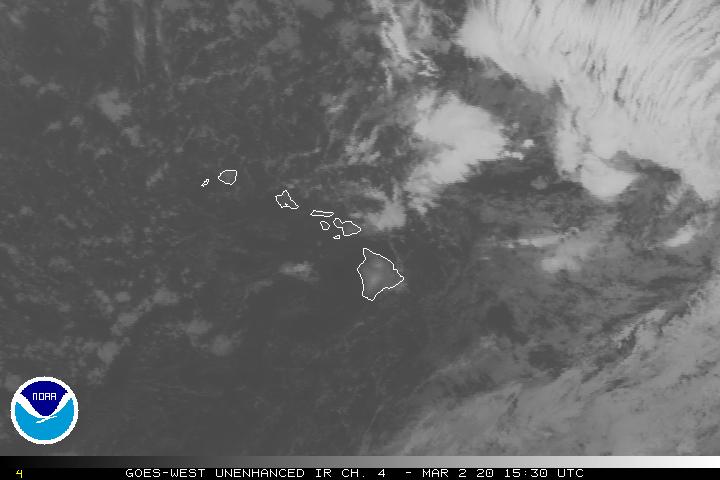












 Email Glenn James: