Air Temperatures ranged between these warmest and coolest spots near sea level around the state – and on the highest mountains…at 5pm Monday evening:
Port Allen, Kauai – 81F
Princeville, Kauai – 73
Haleakala Crater – 46 (near 10,000 feet on Maui)
Mauna Kea summit – 39 (near 14,000 feet on the Big Island)
Precipitation Totals–The following numbers represent the largest precipitation totals (inches) during the last 24 hours on each of the major islands, as of Monday afternoon: 0.07 Mount Waialaele, Kauai 0.33 Oahu Forest NWR, Oahu
0.02 Molokai
0.00 Lanai
0.08 Kahoolawe
0.01 Kepuni, Maui 1.37 Mountain View, Big Island
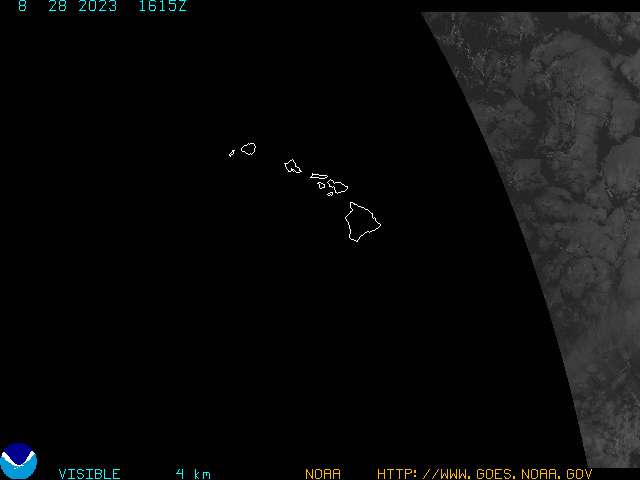
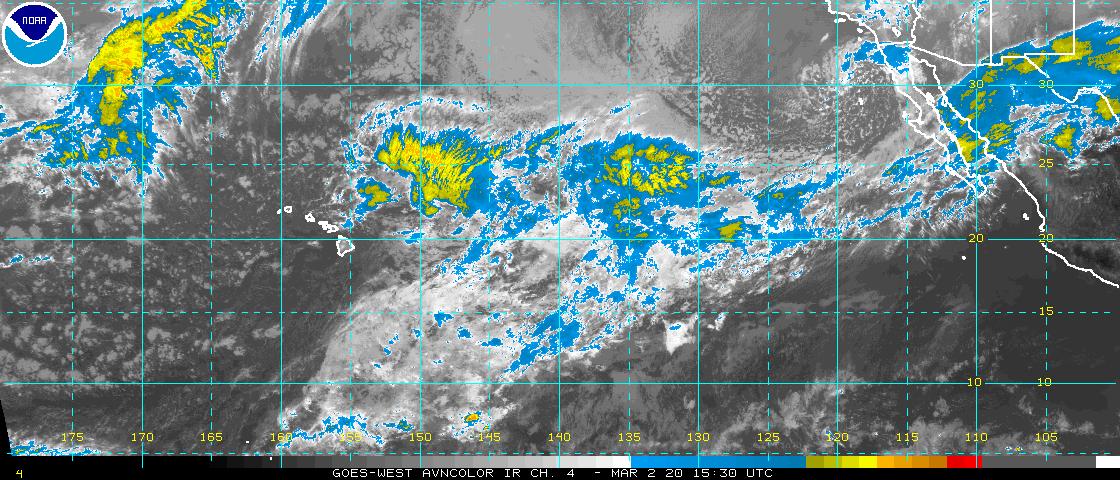
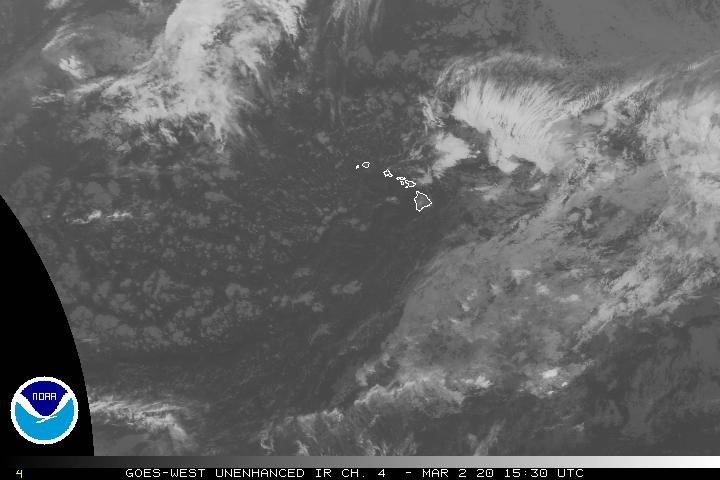
Marine Winds – Here’s the latest (automatically updated)weather mapshowing a 1028 millibar high pressure system northeast of the islands. Our winds will come in from the trade wind direction, gradually picking up a little again Tuesday…then lighter again Wednesday. Satellite and Radar Images:To view the cloud conditions we have here in Hawaii, please use the following satellite links, starting off with thisInfrared Satellite Imageof the islands to see all the clouds around the state during the day and night. This next image is one that gives close images of the islands only during the daytime hours, and is referred to as aClose-up visible image. This next image showsa larger view of the Pacific…giving perspective to the wider ranging cloud patterns in the Pacific Ocean. Finally, here’s aLooping IR satellite image, making viewable the clouds around the islands 24 hours a day. To help you keep track of where any showers may be around the islands, here’s the latest animatedradar image.
Hawaii’s Mountains – Here’s a link to the live webcam on the summit of near 14,000 foot Mauna Kea on the Big Island of Hawaii. The tallest peak on the island of Maui is the Haleakala Crater, which is near 10,000 feet in elevation. These two webcams are available during the daylight hours here in the islands…and when there’s a big moon rising just after sunset for an hour or two! Plus, during the nights and early mornings you will be able to see stars, and the sunrise too…depending upon weather conditions. Tropical Cyclone activity in the eastern and central Pacific– Here’s the latest weather information coming out of theNational Hurricane Center, covering the eastern north Pacific. You can find the latest tropical cyclone information for the central north Pacific (where Hawaii is located) by clicking on this link to the Central Pacific Hurricane Center. Here’s atracking mapcovering both the eastern and central Pacific Ocean. A satellite image, which shows the entire ocean area between Hawaii and the Mexican coast…can be found here.
Aloha Paragraphs
Empty Hawaiian beach…ready for a long walk
The recent unusual weather has ended, as the responsible cold air aloft, mixing with the leftover moisture from last week’s cold fronts, shifts eastward…away from our islands.Stable conditions have returned in the wake of the departing upper level trough of low pressure. We remain in a light trade wind flow of air near the BigIsland and Maui, and light northwesterly breezes around Kauai and Oahu…with just a few incoming showers expected along our windward sides. This generally placid weather pattern will hold firm through mid-week. Daytime air temperatures will remain seasonable, although the nights will be a little chilly, as the daylight hours are so short now. The leeward beaches will be quite nice, with lots of sunshine beaming down, and near flat surf. Speaking of surf, there will be periodic swells coming into our north and west facing beaches this week, with an extra large NW swell making for dangerous conditions around Christmas Day. The computer forecast models show periodic cold fronts approaching the islands this week. Thefirstis expected late tonight into Tuesday, although won’t amount to much, perhaps most on Kauai and Oahu. Here’s asatellite imageof this quick moving cold front to our northwest. The next interruption to these favorably inclined weather circumstances will occur later Christmas Eve…as a second active cold front brings showers into Christmas Day. The generally light winds Wednesday, will give way to fairly mild southwest Kona breezes during the day Thursday. This will occur as the next cold front pushes in our direction from the northwest. It will bring a period of showers, first to Kauai, before it stalls at some point around MauiCounty on Friday. Cooler north to northeast breezes will arrive briefly, before more Kona breezes take over ahead of the next cold front…scheduled to arrive next Monday. Just for the fun of it, here’s a big satellite picture, showing the first cold front to our north and northwest.
It’s early Monday evening here on Maui, as I begin writing this last section of today’s narrative. Monday was a perfectly nice day, at least compared to what we saw Sunday, during the early morning hours. I already described all of that during the morning part of this narrative, so I won’t go into it again. You could always go to the left hand margin of this page, and click on the Archived Narratives link, and go back through the 1000+ past narratives that I’ve written! At any rate, Monday was a great day, as will be Tuesday and Wednesday. As noted above, several cold fronts will dive down towards us, although none of them are expected to be all that serious. There will be one Tuesday, and then around Christmas Day, and a third later this coming Sunday. ~~~ Today is/was the winter solstice, which marks that interface between autumn and winter. This is the time of year when we expect more frequent weather changes…which has been happening lately. ~~~ I’m about ready to take the drive back upcountry to Kula, and to hunker in until early Tuesday morning, when I’ll be up well before dawn to prepare your next new weather narrative. When I got home to Kula, it was foggy and lightly raining, took me by surprise, this seems to be happening more lately. I hope you have a great Monday night, see you in the morning! Aloha for now…Glenn.
Interesting:Chimps remain cool under fire, possessing a near human ability to predict how wildfires spread and react accordingly. This newfound capability of chimpanzees to understand flames might shed light on when and how our distant ancestors first learned to control fire, scientists now suggest. Primatologist Jill Pruetz at Iowa State University in Ames was observing savanna chimpanzees in Senegal in 2006 as people were setting wildfires, an annual tradition that clears land and aids hunting.
Most areas within the chimpanzees’ home range are burned to some degree. "It was the end of the dry season, so the fires burn so hot and burn up trees really fast, and they were so calm about it," Pruetz said of the chimps. "They were a lot better than I was, that’s for sure."
For the most part, wild animals consider fire very distressing, but the chimpanzees showed no sign of stress or fear with the wildfires, other than calmly avoiding the fire as it approached them. "I was surprised at how expert they were at handling the fire," Pruetz told LiveScience.
"The fire was burning really hot, and the flames were at least 10 feet high, up to 20 feet at times." The apes were experts at predicting where the fire would go, Pruetz noted. "I could predict it, sort of, but if it were just me, I would have left," she said. "At one time, I actually had to push through them because I could feel the heat from the fire that was on the side of me and I just wasn’t that comfortable with it."
Interesting2:Airline passengers, who sneak in cell phone calls, play with gaming devices or listen to their mp3 players, during takeoff or landing, probably won’t cause a plane crash, but they may risk a confrontation with flight attendants. Federal agencies and airlines typically err on the side of caution — even though researchers and aircraft companies have found almost no direct evidence of cell phones or other electronic devices interfering with aircraft systems.
Frequent flyers know the familiar drill of only using certain electronic devices at cruising altitudes. The Federal Aviation Administration (FAA) asked the RTCA, an independent industry standards organization, to study the issue of electronic devices on airplanes in 1992. The RTCA found no interference and eventually recommended allowing the use of laptops, gaming devices and music players.
Still, it suggested the precaution of banning the use of any and all devices during the critical takeoff and landing phases. Boeing also investigated several cases in the 1990s where aircraft crews reported that laptop computers or gaming devices caused autopilot disconnects, un-commanded airplane rolls or instrument display malfunctions. The aircraft manufacturer was never able to replicate the reported anomalies in lab tests. Cell phones and wireless devices such as laptops represent a different concern.
They emit active transmissions on the electromagnetic spectrum, which is used by devices that include phones, radios and Wi-Fi networks. But the FCC divided the spectrum into different chunks for different uses, and so a cell phone call should not interfere with the bands reserved for aircraft communications or GPS navigation systems. It turns out that the ban on wireless devices has a lot more to do with possible interference for ground networks, rather than any danger posed to aircraft systems.
The Federal Communications Commission (FCC) banned in-flight use of most cell phones and wireless devices in 1991, citing the reason of ground network interference. FAA regulations uphold the FCC decision. But some airlines allow passengers to use cell phones in "airplane mode," which shuts off phone transmissions.
The FCC briefly considered lifting the in-flight ban on wireless devices, but eventually decided in 2007 to keep the current rules in place because there wasn’t enough evidence to show whether in-flight wireless devices would cause harmful interference with ground networks.
There also wasn’t evidence demonstrating that the devices do cause interference, but the federal agency decided to play it safe. An RTCA report commissioned by the FAA in 2006 also cited a lack of evidence, and recommended keeping the current rules on electronic devices. All the regulations in the world still haven’t prevented airline passengers from casually whipping out the cell phone every now and then.
About one to four cell phone calls were made during every commercial flight, according to a 2006 study from Carnegie Mellon University in Pittsburgh. Funnily enough, the FAA even had to advise aircraft crewmembers to turn off their cell phones during takeoff and landing, after an incident in early 2009. In that case, a first officer’s ringtone proved potentially distracting during takeoff — but as the crew pointed out, their General Operations Manual did not prohibit them from keeping their cell phones on.
Travelers who can’t part with their wireless Internet connections can now at least pay for in-flight access on a growing number of airlines, or take advantage of a free Wi-Fi holiday deal on Virgin American flights. Such services use a dedicated chunk of the electromagnetic spectrum reserved for air-to-ground communication.
Cell phone use remains out of the question during flights, and ditto for Internet voice applications such as Skype. But passengers can at least comfort themselves by knowing that their flight won’t include anyone yammering loudly on a personal call. As the FAA notes, a majority of travelers probably prefer the silence.
Interesting3:A study published by U.S. scientists on Sunday said pollution has caused the world’s oceans to become noisier, causing more harmful effects to whales, dolphins, and other marine life. These effects include death and serious injury caused by brain hemorrhages or other tissue trauma, strandings and beachings, temporary and permanent hearing loss or impairment, displacement from preferred habitat and disruption of feeding, breeding, nursing, communication, sensing and other behaviors vital to the survival of these species.
An increase in motorboats, primarily commercial shipping traffic, exploration and extraction of oil and other minerals, sonar and even coastal jet ski traffic are contributing to the increased level of underwater noise. Man-made sounds are drowning out the calls of mates, calves and other pods that these mammals depend on.
The report, published in the science journal Nature, stated that the sound is absorbed mainly through the viscosity of the water and the presence of certain dissolved chemicals. But the concentration of chemicals that absorb sound in the oceans has declined as a result of ocean acidification, in turn caused by rising concentrations of carbon dioxide. Scientists say with the number of ships doubling over the past 40 years, levels of carbon dioxide have risen dramatically.
This causes pH levels to drop and acidity in the oceans to increase. They found that the increase in acidity could reduce seawater sound absorption by as much as 60 percent by 2100 in high latitude oceans. One of the negative effects of the increased acidity is the reduced rate of calcification, such as that seen in coral reefs.
The authors say, "However, a less anticipated consequence of ocean acidification is its effect on underwater sound absorption." "A decrease in seawater pH lowers sound absorption in the low-frequency range and, as a result, leads to increasing sound transmission," they added.
The study said future global warming may further decrease the ocean’s sound absorption capacity at certain frequencies. "High levels of low-frequency sound have a number of behavioral and biological effects on marine life," it added.
The effects of noise pollution are not as easy to notice as are the other more obvious and visible pollutants like oil spills and marine debris. To what extent these manmade sounds are negatively impacting the oceans is not fully known.
Interesting4:A rumbling volcano in the Philippines was on the verge of a major eruption today – but thousands of villagers living on its slopes are refusing to leave their homes. Already, 40,000 people have fled the no-go zone around Mount Mayon, which oozed crimson lava during eerie scenes captured last night. But around 3,000 residents, mostly farmers, remain – with some even returning after being evacuated up to three times by authorities.
As well as being covered by rivers of lava, those who stay face the additional danger of suffocating ash explosions, experts said. Scientists warned that powerful booms emanating from the country’s most active volcano – 200 miles from capital Manila – indicated that a major eruption was imminent.
After a week of puffing out ash and sending bursts of lava trickling down its steep slopes, the 8,070ft mountain overlooking the Gulf of Albay and Legazpi city in Albay province, in the central Philippines, has caused nearly 2,000 volcanic earthquakes and tremors since yesterday.
The emission of sulphur dioxide – an indication of magma rising inside the volcano – jumped to 6,000 tons per day from the normal 500, said the Philippine Institute of Volcanology and Seismology. It also reported ‘audible booming and rumbling sounds’ in the eastern flank of the volcano, accompanied by intensified crater glow at night.
Lava fountains bursting from the cone-shaped volcano overnight rose 650 feet in the air and red-hot lava flows have reached three miles from the crater, the institute said. Scientists raised the alert level yesterday to one step below a hazardous eruption, saying one was possible within days.
The only higher level is when a major eruption is already in progress. Army troops and police added more patrols to enforce a five-mile exclusion zone around the mountain. More than 40,000 residents were given sleeping mats and food inside school buildings, gyms and other emergency shelters, but some have still been spotted checking on their farms in the prohibited zone.
Albay province governer, Joey Salceda, said about 5,000 more villagers were being transported out of Mayon’s danger zone, but that they were struggling to get everyone to leave. He said: ‘There are people who have been evacuated three times and we sigh: “You again?” We’ve been playing cat and mouse with them.’
A major eruption could trigger pyroclastic flows – superheated gas and volcanic debris that race down the slopes at very high speeds, vaporizing everything in their path. More extensive explosions of ash could drift toward nearby towns and cities. The provincial capital of Legazpi is about nine miles away.
In Mayon’s other eruptions in recent years, pyroclastic flows had reached up to four miles from the crater. ‘The probability of survival in an eruption is zero if you’re in the danger area. The solution is obviously distance,’ Mr Salceda said. Mayon last erupted in 2006, when about 30,000 people were moved. Another eruption in 1993 killed 79 people.
The first recorded eruption was in 1616 but the most destructive came in 1814, killing more than 1,200 people and burying a town in volcanic mud. The ruins of the church in Cagsawa have become an iconic tourist spot. In 1991, Mount Pinatubo exploded in the northern Philippines in one of the biggest volcanic eruptions of the 20th century, killing about 800 people.
Air Temperatures ranged between these warmest and coolest spots near sea level around the state – and on the highest mountains…at 5pm Sunday evening:
Port Allen, Kauai – 79F
Hilo, Hawaii – 71
Haleakala Crater – 39 (near 10,000 feet on Maui)
Mauna Kea summit – 23 (near 14,000 feet on the Big Island)
Precipitation Totals–The following numbers represent the largest precipitation totals (inches) during the last 24 hours on each of the major islands, as of Sunday afternoon: 0.11 Mount Waialaele, Kauai 1.25 Maunawili, Oahu
0.08 Molokai
0.00 Lanai
0.08 Kahoolawe
3.92 Hana airport, Maui 7.40 Piihonua, Big Island!
Marine Winds – Here’s the latest (automatically updated)weather mapshowing a 1026 millibar high pressure system northeast of the islands. Our winds will come in from the northeast, then become lighter Monday…returning trade winds Tuesday. Satellite and Radar Images:To view the cloud conditions we have here in Hawaii, please use the following satellite links, starting off with thisInfrared Satellite Imageof the islands to see all the clouds around the state during the day and night. This next image is one that gives close images of the islands only during the daytime hours, and is referred to as aClose-up visible image. This next image showsa larger view of the Pacific…giving perspective to the wider ranging cloud patterns in the Pacific Ocean. Finally, here’s aLooping IR satellite image, making viewable the clouds around the islands 24 hours a day. To help you keep track of where any showers may be around the islands, here’s the latest animatedradar image.
Hawaii’s Mountains – Here’s a link to the live webcam on the summit of near 14,000 foot Mauna Kea on the Big Island of Hawaii. The tallest peak on the island of Maui is the Haleakala Crater, which is near 10,000 feet in elevation. These two webcams are available during the daylight hours here in the islands…and when there’s a big moon rising just after sunset for an hour or two! Plus, during the nights and early mornings you will be able to see stars, and the sunrise too…depending upon weather conditions. Tropical Cyclone activity in the eastern and central Pacific– Here’s the latest weather information coming out of theNational Hurricane Center, covering the eastern north Pacific. You can find the latest tropical cyclone information for the central north Pacific (where Hawaii is located) by clicking on this link to the Central Pacific Hurricane Center. Here’s atracking mapcovering both the eastern and central Pacific Ocean. A satellite image, which shows the entire ocean area between Hawaii and the Mexican coast…can be found here.
Aloha Paragraphs
Some showers…but the threat of heavy rain is lessening
A pool of unusually cold air near the Big Island and Maui, along with the leftover moisture from an old front…worked together to bring thunderstorms, waterspouts, and localized hail Sunday! The Big Island, and the Maui County side of the Aloha state saw the residual moisture from the recent frontal cloud band, interacting with very cold air aloft…making for this unusual mix of inclement weather. A trough of low pressure, with its unusually cold air aloft, was the triggering mechanism, which set off the locally heavy rainfall. Meanwhile, Kauai has been drier, and lacking the thunderstorms, and will stay that way for the most part…other than some passing showers along the windward sides at times. The thunderstorm activity has shifted eastward for the most part, with clearing skies, and improved weather overall. The looping radar image above shows that some showers apparently are still taking aim on Oahu and Maui, although that threat will be ending soon. Looking ahead, the next cold front will approach Tuesday, although is expected to be rather weak, and unable to push very far into the state then…if any distance at all. The islands of Kauai and Oahu may see a few showers, but they shouldn’t amount to much. The winds will falter again as this cold front pushes a high pressure ridge down over the state Monday…followed by a brief stint of trade winds Tuesday. The computer models go on to show another cold front arriving with precipitation, later in the new work week…which may turn out to be rather significant. This second cold front may turn our winds south to southwest, from the Kona direction, preceding its arrival around Christmas, with another possible bout of cool north to northeast winds in its wake, into next weekend. The latest model runs show yet another early winter cold front approaching late in the new week…more about that soon. There’s been a large disparity between one end of the island chain, to the other, which is somewhat unusual. The Kauai side of the state has been quite dry and stable, with only a few showers falling. In contrast, the air mass over the Big Island and Maui County has been very unstable and wet. This heavy stuff tapered off during the day Sunday, although the surrounding ocean, especially to the east of the Big Island, has had heavy rains falling over the salt water all day. The satellite images suggest that some showers will still be able to reach back towards the islands Sunday evening into the early night hours. There were many reports of localized hail falling from these cumulonimbus clouds over Maui and the Big Island Sunday morning…with even a large waterspout forming just offshore from the Kona coast on the Big Island!
It’s early Sunday evening here on Maui, as I begin writing this last section of today’s narrative.
What a day! This last day of autumn 2009 begin in a spectacular way, at least over the islands of Maui and the Big Island. We saw heavy rains falling from thunderstorm clouds. Those cumulonimbus clouds were firing-off lightning at a very frequent rate, like many flashes
every minute! This of course was followed closely by the associated thunder claps. The skies were virtually lit up almost constantly for a couple of hours, with thunder rumbling almost all the time in turn. A waterspout formed just offshore from the Kona coast today as well, capping off what was a very unusual day of weather here in the islands. At the same time, all that cold air aloft prompted snowfall atop the summits on the Big Island. Things have quieted down a lot since the morning hours. It looks as if we’ll have rather placid weather Monday through Wednesday, after which, the next cold front will arrive later Christmas day into Friday…more on that soon. I hope you have a great Sunday night, and perhaps will join me here again on Monday, which is the winter solstice…the first day of winter 2009. Aloha for now…Glenn.
Interesting: Many animals test their legs and totter forth only hours after they are born, but humans need a year before they take their first, hesitant steps. Is something fundamentally different going on in human babies? Maybe not. A new study shows that the time it takes for humans and all other mammals to start walking fits closely with the size of their brains.
In past studies to develop a new animal model for the brain events that support motor development, neurophysiologist Martin Garwicz of Lund University in Sweden and his colleagues discovered that the schedules by which ferrets and rats acquire various motor skills, such as crawling and walking, are strikingly similar to each other; the progress simply happens faster for rats.
That made them wonder how similar the timing of motor development might be among mammals in general. They compared the time between conception and walking in 24 species and looked at how well this duration correlated with a range of variables, including gestation time, adult body mass, and adult brain mass.
As they report in this week’s issue of PNAS, brain mass accounts for the vast majority (94%) of the variance in walking time between species. Species with larger brains, such as humans, tend to take longer to learn to walk.
Strikingly, a model based on adult brain mass and walking time in the other 23 species almost perfectly predicts when humans begin to walk. "We’ve always considered humans the exception," Garwicz says, "But in fact, we start walking at exactly the time that would be expected from all other walking mammals."
Interesting2:With 1,174 residents per square mile, it is the most densely populated state in the country. The Meadowlands are not known for wildlife diversity, but rather football diversity (the only stadium that’s home to two NFL teams). The longest hike many visitors may take is along Atlantic City’s neon-lit boardwalk.
In short, New Jersey is probably better known for providing habitat to The Sopranos than to species. Yet even this most urban of states provides the latest reminder of how important conservation is to Americans, evident with the approval of the state-wide Green Acres conservation bond on Nov. 3.
In an election in which the incumbent governor who supported the Green Acres bond lost, and the "economy" and "taxes" were the runaway top issues cited by voters in exit polls, this $400 million conservation bond received 53 percent of New Jersey voters’ support.
In doing so, the Green Acres conservation bond actually won more counties than either of the two major gubernatorial candidates. How do you explain this? Well, the first answer may be that people in New Jersey would rather get their clean water from filtering forests and wetlands than expensive water treatment facilities.
Voters may have remembered nearby New York City’s deliberations about future water use in the mid-1990s. At that time, the Big Apple realized it could spend less than $2 billion on preserving existing watershed lands upstate, or spend an estimated $6-8 billion to build new water treatment facilities. That’s an easy decision.
The second reason may be there is actually more to the Garden State than just turnpikes. The state’s Pinelands National Reserve is home to the largest body of open space on the Mid-Atlantic seaboard between Richmond and Boston. The state also has more than 200 miles of ocean and bay shoreline, and its 800,000-acre Highlands Region provides clean drinking water to more than one-half the state’s population.
The urge to protect the value of those assets is completely understandable, as the payoff is "better than gold." The third may be that people in New Jersey are really not that different than the rest of the country — because conservation goes beyond politics in the United States.
Interesting3:If the planet is headed for another mass extinction like the previous five, each of which wiped out more than 75 percent of all species on the planet, then North American mammals are one-fifth to one-half the way there, according to a University of California, Berkeley, and Pennsylvania State University analysis. Many scientists warn that the perfect storm of global warming and environmental degradation — both the result of human activity is leading to a sixth mass extinction equal to the "Big Five" that have occurred over the past 450 million years, the last of which killed off the dinosaurs 68 million years ago.
Yet estimates of how dire the current loss of species is have been hampered by the inability to compare species diversity today with the past. By combining data from three catalogs of mammal diversity in the United States between 30 million years ago and 500 years ago, UC Berkeley and Penn State researchers show that the bulk of mammal extinctions occurred within a few thousand years after the arrival of humans, with losses dropping after that.
Although modern humans emerged from Africa into Europe and Asia by about 40,000 years ago, they didn’t reach North American until about 13,000 years ago, and most mammal extinctions occurred in the subsequent 1-2,000 years. "The optimistic part of the study is that we haven’t come all that far on extinction in the past 10,000 years," said co-author Anthony Barnosky, UC Berkeley professor of integrative biology.
"We have this pulse when humans had their first effect about 13,000 years ago, but diversity has remained pretty steady for about 10,000 years." He expects to see a similar pattern in Europe after the invasion of Homo sapiens some 40,000 years ago. In the last 100 or so years, however, "we are seeing a lot of geographic range reductions that are of a greater magnitude than we would expect, and we are seeing loss of subspecies and even a few species.
So it looks like we are going into another one of these extinction events." "I’m optimistic that, because we haven’t lost those species yet, if we redouble our conservation efforts we can stem the tide of extinctions and have those species around in the future," he added. The study’s 30 million-year timeline allowed the researchers to compare species diversity over a period of dramatic change in the landscape.
The Rocky Mountains and Sierra Nevada ranges formed in the West, while there were dramatic swings in climate that may have been larger than and as fast as the Earth is seeing today, said co-author and UC Berkeley research associate Marc A. Carrasco.
Yet these changes did not have a great effect on mammal diversity, compared to what happened when the last glacial period ended, the ice retreated in North America, and humans crossed from Asia into America. "The only difference is that 13,000 years ago humans appear on the scene," Carrasco said. "The bottom line is, mammals in general were able to deal with these changes in the past. Only when humans arrive do the numbers fall off a cliff."
Interesting4:The consumption of wild cereals among prehistoric hunters and gatherers appears to be far more ancient than previously thought, according to a University of Calgary archaeologist who has found the oldest example of extensive reliance on cereal and root staples in the diet of early Homo sapiens more than 100,000 years ago. Julio Mercader, holder of the Canada Research Chair in Tropical Archaeology in the U of C’s Department of Archaeology, recovered dozens of stone tools from a deep cave in Mozambique showing that wild sorghum, the ancestor of the chief cereal consumed today in sub-Saharan Africa for flours, breads, porridges and alcoholic beverages, was in Homo sapiens’ pantry along with the African wine palm, the false banana, pigeon peas, wild oranges and the African "potato."
This is the earliest direct evidence of humans using pre-domesticated cereals anywhere in the world. Mercader’s findings are published in the December 18 issue of the research journal Science. "This broadens the timeline for the use of grass seeds by our species, and is proof of an expanded and sophisticated diet much earlier than we believed," Mercader said. "This happened during the Middle Stone Age, a time when the collecting of wild grains has conventionally been perceived as an irrelevant activity and not as important as that of roots, fruits and nuts."
In 2007, Mercader and colleagues from Mozambique’s University of Eduardo Mondlane excavated a limestone cave near Lake Niassa that was used intermittently by ancient foragers over the course of more than 60,000 years. Deep in this cave, they uncovered dozens of stone tools, animal bones and plant remains indicative of prehistoric dietary practices. The discovery of several thousand starch grains on the excavated plant grinders and scrapers showed that wild sorghum was being brought to the cave and processed systematically.
"It has been hypothesized that starch use represents a critical step in human evolution by improving the quality of the diet in the African savannas and woodlands where the modern human line first evolved. This could be considered one of the earliest examples of this dietary transformation," Mercader said.
"The inclusion of cereals in our diet is considered an important step in human evolution because of the technical complexity and the culinary manipulation that are required to turn grains into staples." Mercader said the evidence is on par with grass seed use by hunter-gatherers in many parts of the world during the closing stages of the last Ice Age, approximately 12,000 years ago. In this case, the trend dates back to the beginnings of the Ice Age, some 90,000 years earlier.
Interesting5:Which came first, the warmer temperatures or the clearer skies? Answers to that and similar "chicken or egg" type questions could have a significant impact on our understanding of both the climate system and manmade global warming. In an invited talk the week of December 14 at the American Geophysical Union’s fall meeting, Dr. Roy Spencer from The University of Alabama in Huntsville discussed the challenge of answering questions about cause and effect (also known as forcing and feedback) in the climate.
"Feedbacks will determine whether the manmade portion of global warming ends up being catastrophic or barely measurable," Spencer said recently. Spencer’s interest is in using satellite data and a simple climate model to test the simulated feedback processes contained in climate models that are used to forecast global warming. "I am arguing that we can’t measure feedbacks the way people have been trying to do it," he said.
"The climate modelers see from satellite data that warm years have fewer clouds, then assume that the warmth caused the clouds to dissipate. If this is true, it would be positive feedback and could lead to strong global warming. This is the way their models are programmed to behave. "My question to them was, ‘How do you know it wasn’t fewer clouds that caused the warm years, rather than the other way around?’
It turns out they didn’t know. They couldn’t answer that question." One problem is the simplicity of the climate models. Because cloud systems are so complex and so poorly understood, all of the climate models used by the United Nations’ Intergovernmental Panel on Climate Change use greatly simplified cloud parameters to represent clouds. But the calculations that set those parameters are based on assumed cause-and-effect relationships.
Those assumptions might be working in the wrong direction, Spencer said. "What we have found is that cloud cover variations causing temperature changes dominate the satellite record, and give the illusion of positive feedback." Using satellite observations interpreted with a simple model, Spencer’s data support negative feedback (or cooling) better than they support positive feedback.
"This critical component in global warming theory -¬ cloud feedback -¬ is impossible to measure directly in the real climate system," Spencer said. "We haven’t figured out a good way to separate cause and effect, so we can’t measure cloud feedback directly. And if we don’t know what the feedbacks are, we are just guessing at how much impact humans will have on climate change. "I’m trying to spread the word: Let’s go back to basics and look at what we can and cannot do with measurements of the real climate system to validate both climate models and their predictions."
Air Temperatures ranged between these warmest and coolest spots near sea level around the state – and on the highest mountains…at 4pm Saturday afternoon:
Port Allen, Kauai – 81F
Princeville, Kauai – 72
Haleakala Crater – 41 (near 10,000 feet on Maui)
Mauna Kea summit – 32 (near 14,000 feet on the Big Island)
Precipitation Totals–The following numbers represent the largest precipitation totals (inches) during the last 24 hours on each of the major islands, as of Saturday afternoon: 0.05 Wainiha, Kauai 0.07 Punaluu Pump, Oahu
0.00 Molokai
0.00 Lanai
0.00 Kahoolawe
1.68 West Wailuaiki, Maui 8.95 Laupahoehoe, Big Island!
Marine Winds – Here’s the latest (automatically updated)weather mapshowing a 1022 millibar high pressure system moving by to the area north of the islands. Our winds will come in from the northeast this weekend, losing some steam into the new week. Satellite and Radar Images:To view the cloud conditions we have here in Hawaii, please use the following satellite links, starting off with thisInfrared Satellite Imageof the islands to see all the clouds around the state during the day and night. This next image is one that gives close images of the islands only during the daytime hours, and is referred to as aClose-up visible image. This next image showsa larger view of the Pacific…giving perspective to the wider ranging cloud patterns in the Pacific Ocean. Finally, here’s aLooping IR satellite image, making viewable the clouds around the islands 24 hours a day. To help you keep track of where any showers may be around the islands, here’s the latest animatedradar image.
Hawaii’s Mountains – Here’s a link to the live webcam on the summit of near 14,000 foot Mauna Kea on the Big Island of Hawaii. The tallest peak on the island of Maui is the Haleakala Crater, which is near 10,000 feet in elevation. These two webcams are available during the daylight hours here in the islands…and when there’s a big moon rising just after sunset for an hour or two! Plus, during the nights and early mornings you will be able to see stars, and the sunrise too…depending upon weather conditions. Tropical Cyclone activity in the eastern and central Pacific– Here’s the latest weather information coming out of theNational Hurricane Center, covering the eastern north Pacific. You can find the latest tropical cyclone information for the central north Pacific (where Hawaii is located) by clicking on this link to the Central Pacific Hurricane Center. Here’s atracking mapcovering both the eastern and central Pacific Ocean. A satellite image, which shows the entire ocean area between Hawaii and the Mexican coast…can be found here.
Aloha Paragraphs
Celebrating being here in Hawaii!
A relatively dry and stable air mass remains in place…although not statewide. The Big Island and to some extent Maui, continue to see residual moisture from yesterday’s frontal cloud band. The Big Island has had localized heavy rains, and even a few thunderstorms. Maui, along the windward side at least, has seen some of that pooled moisture from the Big Island, spreading back there too. A trough of low pressure, with its unusually cold air aloft, has been the triggering mechanism, which set off the locally heavy rainfall. The generous rainfall backed off some during the day Saturday, but may resume again Saturday evening into Sunday morning. Meanwhile, the rest of the state has been much drier, and will stay that way through the weekend…other than some passing showers along the windward sides here and there.
The winds remain out of the northeast direction, although not very strong…keeping a slightly cool atmosphere over the islands this weekend.Looking ahead, the next cold front will approach Tuesday, although is expected to be rather weak, and unable to push very far into the state then. The islands of Kauai and Oahu may see a few showers, but they shouldn’t amount to much. The winds will falter again as this first cold front of the week, pushes a high pressure ridge down over the state. This in turn may signal the arrival of the next round of volcanically hazy weather for some parts of the state. The computer models go on to show another cold front arriving with precipitation, later in the new work week…which may turn out to be rather significant. This second cold front may turn our winds south to southwest, from the Kona direction, preceding its arrival around Christmas, with another possible bout of cool north to northeast winds in its wake, into next weekend. It’s early Saturday evening here on Maui, as I begin writing this last section of this morning’s narrative.There’s been a large disparity between one end of the island chain, to the other, which is a little unusual. The Kauai side of the state is quite dry and stable, with few showers anywhere. In contrast, the air mass over the Big Island has been unstable and rather wet. Here’s a satellite image, with which you can see the bright white clouds around the Big Island, where the heavy precipitation is falling. In addition, an area of high clouds are streaming overhead, coming in from the north. This heavy stuff tapered off during the day, but may start back up again Saturday night into Sunday morning…as the next area of cold air flows over the state, triggering more locally heavy precipitation. Some of this rainfall may spread back over the windward sides of Maui during this time as well.
~~~ I mostly read, and hung out with my neighbors this morning, before heading down to Paia town, on the north shore early this afternoon. I went to the beach for a short while, and found a few people there, but the chilly weather kept most away. There were large and rough waves breaking, and it was quite cloudy too. Since I was there though, I figured why not jump in that cool ocean for a little swim. I was glad I did, as it wasn’t all that nippy, except just when taking that first dive. I then went shopping, and came pretty much right back home to Kula. My friend Marco has invited me to a dance party tonight, where there will be a live band playing. I often prefer a disc jockey, but he has led me to believe it will be very fun. I’m going down to lower Kula to meet him in a little while, and will let you know how it went Sunday morning, when I’ll be back with your next new weather narrative then. I hope you have a great Saturday night until then! Aloha for now…Glenn.
Interesting: Many animals test their legs and totter forth only hours after they are born, but humans need a year before they take their first, hesitant steps. Is something fundamentally different going on in human babies? Maybe not. A new study shows that the time it takes for humans and all other mammals to start walking fits closely with the size of their brains.
In past studies to develop a new animal model for the brain events that support motor development, neurophysiologist Martin Garwicz of Lund University in Sweden and his colleagues discovered that the schedules by which ferrets and rats acquire various motor skills, such as crawling and walking, are strikingly similar to each other; the progress simply happens faster for rats.
That made them wonder how similar the timing of motor development might be among mammals in general. They compared the time between conception and walking in 24 species and looked at how well this duration correlated with a range of variables, including gestation time, adult body mass, and adult brain mass.
As they report in this week’s issue of PNAS, brain mass accounts for the vast majority (94%) of the variance in walking time between species. Species with larger brains, such as humans, tend to take longer to learn to walk.
Strikingly, a model based on adult brain mass and walking time in the other 23 species almost perfectly predicts when humans begin to walk. "We’ve always considered humans the exception," Garwicz says, "But in fact, we start walking at exactly the time that would be expected from all other walking mammals."
Interesting2:With 1,174 residents per square mile, it is the most densely populated state in the country. The Meadowlands are not known for wildlife diversity, but rather football diversity (the only stadium that’s home to two NFL teams). The longest hike many visitors may take is along Atlantic City’s neon-lit boardwalk.
In short, New Jersey is probably better known for providing habitat to The Sopranos than to species. Yet even this most urban of states provides the latest reminder of how important conservation is to Americans, evident with the approval of the state-wide Green Acres conservation bond on Nov. 3.
In an election in which the incumbent governor who supported the Green Acres bond lost, and the "economy" and "taxes" were the runaway top issues cited by voters in exit polls, this $400 million conservation bond received 53 percent of New Jersey voters’ support.
In doing so, the Green Acres conservation bond actually won more counties than either of the two major gubernatorial candidates. How do you explain this? Well, the first answer may be that people in New Jersey would rather get their clean water from filtering forests and wetlands than expensive water treatment facilities.
Voters may have remembered nearby New York City’s deliberations about future water use in the mid-1990s. At that time, the Big Apple realized it could spend less than $2 billion on preserving existing watershed lands upstate, or spend an estimated $6-8 billion to build new water treatment facilities. That’s an easy decision.
The second reason may be there is actually more to the Garden State than just turnpikes. The state’s Pinelands National Reserve is home to the largest body of open space on the Mid-Atlantic seaboard between Richmond and Boston. The state also has more than 200 miles of ocean and bay shoreline, and its 800,000-acre Highlands Region provides clean drinking water to more than one-half the state’s population.
The urge to protect the value of those assets is completely understandable, as the payoff is "better than gold." The third may be that people in New Jersey are really not that different than the rest of the country — because conservation goes beyond politics in the United States.
Interesting3:If the planet is headed for another mass extinction like the previous five, each of which wiped out more than 75 percent of all species on the planet, then North American mammals are one-fifth to one-half the way there, according to a University of California, Berkeley, and Pennsylvania State University analysis. Many scientists warn that the perfect storm of global warming and environmental degradation — both the result of human activity is leading to a sixth mass extinction equal to the "Big Five" that have occurred over the past 450 million years, the last of which killed off the dinosaurs 68 million years ago.
Yet estimates of how dire the current loss of species is have been hampered by the inability to compare species diversity today with the past. By combining data from three catalogs of mammal diversity in the United States between 30 million years ago and 500 years ago, UC Berkeley and Penn State researchers show that the bulk of mammal extinctions occurred within a few thousand years after the arrival of humans, with losses dropping after that.
Although modern humans emerged from Africa into Europe and Asia by about 40,000 years ago, they didn’t reach North American until about 13,000 years ago, and most mammal extinctions occurred in the subsequent 1-2,000 years. "The optimistic part of the study is that we haven’t come all that far on extinction in the past 10,000 years," said co-author Anthony Barnosky, UC Berkeley professor of integrative biology.
"We have this pulse when humans had their first effect about 13,000 years ago, but diversity has remained pretty steady for about 10,000 years." He expects to see a similar pattern in Europe after the invasion of Homo sapiens some 40,000 years ago. In the last 100 or so years, however, "we are seeing a lot of geographic range reductions that are of a greater magnitude than we would expect, and we are seeing loss of subspecies and even a few species.
So it looks like we are going into another one of these extinction events." "I’m optimistic that, because we haven’t lost those species yet, if we redouble our conservation efforts we can stem the tide of extinctions and have those species around in the future," he added. The study’s 30 million-year timeline allowed the researchers to compare species diversity over a period of dramatic change in the landscape.
The Rocky Mountains and Sierra Nevada ranges formed in the West, while there were dramatic swings in climate that may have been larger than and as fast as the Earth is seeing today, said co-author and UC Berkeley research associate Marc A. Carrasco.
Yet these changes did not have a great effect on mammal diversity, compared to what happened when the last glacial period ended, the ice retreated in North America, and humans crossed from Asia into America. "The only difference is that 13,000 years ago humans appear on the scene," Carrasco said. "The bottom line is, mammals in general were able to deal with these changes in the past. Only when humans arrive do the numbers fall off a cliff."
Interesting4:The consumption of wild cereals among prehistoric hunters and gatherers appears to be far more ancient than previously thought, according to a University of Calgary archaeologist who has found the oldest example of extensive reliance on cereal and root staples in the diet of early Homo sapiens more than 100,000 years ago. Julio Mercader, holder of the Canada Research Chair in Tropical Archaeology in the U of C’s Department of Archaeology, recovered dozens of stone tools from a deep cave in Mozambique showing that wild sorghum, the ancestor of the chief cereal consumed today in sub-Saharan Africa for flours, breads, porridges and alcoholic beverages, was in Homo sapiens’ pantry along with the African wine palm, the false banana, pigeon peas, wild oranges and the African "potato."
This is the earliest direct evidence of humans using pre-domesticated cereals anywhere in the world. Mercader’s findings are published in the December 18 issue of the research journal Science. "This broadens the timeline for the use of grass seeds by our species, and is proof of an expanded and sophisticated diet much earlier than we believed," Mercader said. "This happened during the Middle Stone Age, a time when the collecting of wild grains has conventionally been perceived as an irrelevant activity and not as important as that of roots, fruits and nuts."
In 2007, Mercader and colleagues from Mozambique’s University of Eduardo Mondlane excavated a limestone cave near Lake Niassa that was used intermittently by ancient foragers over the course of more than 60,000 years. Deep in this cave, they uncovered dozens of stone tools, animal bones and plant remains indicative of prehistoric dietary practices. The discovery of several thousand starch grains on the excavated plant grinders and scrapers showed that wild sorghum was being brought to the cave and processed systematically.
"It has been hypothesized that starch use represents a critical step in human evolution by improving the quality of the diet in the African savannas and woodlands where the modern human line first evolved. This could be considered one of the earliest examples of this dietary transformation," Mercader said.
"The inclusion of cereals in our diet is considered an important step in human evolution because of the technical complexity and the culinary manipulation that are required to turn grains into staples." Mercader said the evidence is on par with grass seed use by hunter-gatherers in many parts of the world during the closing stages of the last Ice Age, approximately 12,000 years ago. In this case, the trend dates back to the beginnings of the Ice Age, some 90,000 years earlier.
Interesting5:Which came first, the warmer temperatures or the clearer skies? Answers to that and similar "chicken or egg" type questions could have a significant impact on our understanding of both the climate system and manmade global warming. In an invited talk the week of December 14 at the American Geophysical Union’s fall meeting, Dr. Roy Spencer from The University of Alabama in Huntsville discussed the challenge of answering questions about cause and effect (also known as forcing and feedback) in the climate.
"Feedbacks will determine whether the manmade portion of global warming ends up being catastrophic or barely measurable," Spencer said recently. Spencer’s interest is in using satellite data and a simple climate model to test the simulated feedback processes contained in climate models that are used to forecast global warming. "I am arguing that we can’t measure feedbacks the way people have been trying to do it," he said.
"The climate modelers see from satellite data that warm years have fewer clouds, then assume that the warmth caused the clouds to dissipate. If this is true, it would be positive feedback and could lead to strong global warming. This is the way their models are programmed to behave. "My question to them was, ‘How do you know it wasn’t fewer clouds that caused the warm years, rather than the other way around?’
It turns out they didn’t know. They couldn’t answer that question." One problem is the simplicity of the climate models. Because cloud systems are so complex and so poorly understood, all of the climate models used by the United Nations’ Intergovernmental Panel on Climate Change use greatly simplified cloud parameters to represent clouds. But the calculations that set those parameters are based on assumed cause-and-effect relationships.
Those assumptions might be working in the wrong direction, Spencer said. "What we have found is that cloud cover variations causing temperature changes dominate the satellite record, and give the illusion of positive feedback." Using satellite observations interpreted with a simple model, Spencer’s data support negative feedback (or cooling) better than they support positive feedback.
"This critical component in global warming theory -¬ cloud feedback -¬ is impossible to measure directly in the real climate system," Spencer said. "We haven’t figured out a good way to separate cause and effect, so we can’t measure cloud feedback directly. And if we don’t know what the feedbacks are, we are just guessing at how much impact humans will have on climate change. "I’m trying to spread the word: Let’s go back to basics and look at what we can and cannot do with measurements of the real climate system to validate both climate models and their predictions."
Air Temperatures ranged between these warmest and coolest spots near sea level around the state – and on the highest mountains…at 4pm Friday afternoon:
Port Allen, Kauai – 81F
Lihue, Kauai – 71
Haleakala Crater – 48 (near 10,000 feet on Maui)
Mauna Kea summit – 37 (near 14,000 feet on the Big Island)
Precipitation Totals–The following numbers represent the largest precipitation totals (inches) during the last 24 hours on each of the major islands, as of Friday afternoon: 0.47 Kokee, Kauai 0.16 Kahuku, Oahu
0.00 Molokai
0.00 Lanai
0.00 Kahoolawe 0.88 West Wailuaiki, Maui
0.20 South Point, Big Island
Marine Winds – Here’s the latest (automatically updated)weather mapshowing a high pressure system moving into the area north of the islands. Our winds will come in from the northeast this weekend. Satellite and Radar Images:To view the cloud conditions we have here in Hawaii, please use the following satellite links, starting off with thisInfrared Satellite Imageof the islands to see all the clouds around the state during the day and night. This next image is one that gives close images of the islands only during the daytime hours, and is referred to as aClose-up visible image. This next image showsa larger view of the Pacific…giving perspective to the wider ranging cloud patterns in the Pacific Ocean. Finally, here’s aLooping IR satellite image, making viewable the clouds around the islands 24 hours a day. To help you keep track of where any showers may be around the islands, here’s the latest animatedradar image.
Hawaii’s Mountains – Here’s a link to the live webcam on the summit of near 14,000 foot Mauna Kea on the Big Island of Hawaii. The tallest peak on the island of Maui is the Haleakala Crater, which is near 10,000 feet in elevation. These two webcams are available during the daylight hours here in the islands…and when there’s a big moon rising just after sunset for an hour or two! Plus, during the nights and early mornings you will be able to see stars, and the sunrise too…depending upon weather conditions. Tropical Cyclone activity in the eastern and central Pacific– Here’s the latest weather information coming out of theNational Hurricane Center, covering the eastern north Pacific. You can find the latest tropical cyclone information for the central north Pacific (where Hawaii is located) by clicking on this link to the Central Pacific Hurricane Center. Here’s atracking mapcovering both the eastern and central Pacific Ocean. A satellite image, which shows the entire ocean area between Hawaii and the Mexican coast…can be found here.
Aloha Paragraphs
Friday evening’s sunset…from Kula, Maui
One cold front slowly passed through the state Thursday into Friday morning…with a closely following front zipping through during the day Friday. Neither of these frontal cloud bands brought much moisture to our island chain, although each of the islands picked up some of the limited wet stuff. The location of both of these washed-out cold fronts are near the Big Island this evening…or a little ways east of there. The back edge of these clouds are keeping the windward sides of all the islands cloudy, with a few light showers falling. The atmosphere is drying out nicely however, and becoming less shower prone as we head into the weekend.
Meanwhile, the winds have picked up in strength, from the northeast Friday.This new wind direction is bringing some showers back west, from the merged cold fronts, to the windward sides of the islands, as noted above. The air riding into the state from the northeast is a bit chilly too, as most folks who live here are noticing. Looking ahead, the next cold front will approach this coming Tuesday, although it’s expected to stall before arriving…but will slow down our trade winds again then. They go on to show another cold front arriving with precipitation, later in the new work week…which may turn out to be rather significant, we’ll keep an eye on this prospect. It’s early evening here on Maui, as I begin writing this last section of today’s narrative.Friday has been partly to mostly cloudy, with some light showers, generally located along the windward sides. As noted above, we’ve had two unique cold fronts passing through the island chain during the last 24 hours, or a bit longer. As the satellite image above shows, there’s still quite a few clouds still in our neck of the woods. The main thing will be the gusty winds from a more north to northeasterly direction than we usually see. This will keep a mild chill to our air for the next day or two. ~~~ I’m going after work to some friend’s annual toy drive for kids. It’s in a fancy part of Wailea, and will have valet parking, cocktails and a holiday buffet. This is yet another opportunity for me to practice my socializing skills, wish me luck! I don’t exactly know what I’ll do after that, I’ll see what kind of shape I’m in when I leave. ~~~ At any rate, I’ll be back Saturday morning with your next new weather narrative from paradise. I hope you have a great Friday night until! Aloha for now…Glenn.
Interesting: Many animals test their legs and totter forth only hours after they are born, but humans need a year before they take their first, hesitant steps. Is something fundamentally different going on in human babies? Maybe not. A new study shows that the time it takes for humans and all other mammals to start walking fits closely with the size of their brains.
In past studies to develop a new animal model for the brain events that support motor development, neurophysiologist Martin Garwicz of Lund University in Sweden and his colleagues discovered that the schedules by which ferrets and rats acquire various motor skills, such as crawling and walking, are strikingly similar to each other; the progress simply happens faster for rats.
That made them wonder how similar the timing of motor development might be among mammals in general. They compared the time between conception and walking in 24 species and looked at how well this duration correlated with a range of variables, including gestation time, adult body mass, and adult brain mass.
As they report in this week’s issue of PNAS, brain mass accounts for the vast majority (94%) of the variance in walking time between species. Species with larger brains, such as humans, tend to take longer to learn to walk.
Strikingly, a model based on adult brain mass and walking time in the other 23 species almost perfectly predicts when humans begin to walk. "We’ve always considered humans the exception," Garwicz says, "But in fact, we start walking at exactly the time that would be expected from all other walking mammals."
Interesting2:With 1,174 residents per square mile, it is the most densely populated state in the country. The Meadowlands are not known for wildlife diversity, but rather football diversity (the only stadium that’s home to two NFL teams). The longest hike many visitors may take is along Atlantic City’s neon-lit boardwalk.
In short, New Jersey is probably better known for providing habitat to The Sopranos than to species. Yet even this most urban of states provides the latest reminder of how important conservation is to Americans, evident with the approval of the state-wide Green Acres conservation bond on Nov. 3.
In an election in which the incumbent governor who supported the Green Acres bond lost, and the "economy" and "taxes" were the runaway top issues cited by voters in exit polls, this $400 million conservation bond received 53 percent of New Jersey voters’ support.
In doing so, the Green Acres conservation bond actually won more counties than either of the two major gubernatorial candidates. How do you explain this? Well, the first answer may be that people in New Jersey would rather get their clean water from filtering forests and wetlands than expensive water treatment facilities.
Voters may have remembered nearby New York City’s deliberations about future water use in the mid-1990s. At that time, the Big Apple realized it could spend less than $2 billion on preserving existing watershed lands upstate, or spend an estimated $6-8 billion to build new water treatment facilities. That’s an easy decision.
The second reason may be there is actually more to the Garden State than just turnpikes. The state’s Pinelands National Reserve is home to the largest body of open space on the Mid-Atlantic seaboard between Richmond and Boston. The state also has more than 200 miles of ocean and bay shoreline, and its 800,000-acre Highlands Region provides clean drinking water to more than one-half the state’s population.
The urge to protect the value of those assets is completely understandable, as the payoff is "better than gold." The third may be that people in New Jersey are really not that different than the rest of the country — because conservation goes beyond politics in the United States.
Interesting3:If the planet is headed for another mass extinction like the previous five, each of which wiped out more than 75 percent of all species on the planet, then North American mammals are one-fifth to one-half the way there, according to a University of California, Berkeley, and Pennsylvania State University analysis. Many scientists warn that the perfect storm of global warming and environmental degradation — both the result of human activity is leading to a sixth mass extinction equal to the "Big Five" that have occurred over the past 450 million years, the last of which killed off the dinosaurs 68 million years ago.
Yet estimates of how dire the current loss of species is have been hampered by the inability to compare species diversity today with the past. By combining data from three catalogs of mammal diversity in the United States between 30 million years ago and 500 years ago, UC Berkeley and Penn State researchers show that the bulk of mammal extinctions occurred within a few thousand years after the arrival of humans, with losses dropping after that.
Although modern humans emerged from Africa into Europe and Asia by about 40,000 years ago, they didn’t reach North American until about 13,000 years ago, and most mammal extinctions occurred in the subsequent 1-2,000 years. "The optimistic part of the study is that we haven’t come all that far on extinction in the past 10,000 years," said co-author Anthony Barnosky, UC Berkeley professor of integrative biology.
"We have this pulse when humans had their first effect about 13,000 years ago, but diversity has remained pretty steady for about 10,000 years." He expects to see a similar pattern in Europe after the invasion of Homo sapiens some 40,000 years ago. In the last 100 or so years, however, "we are seeing a lot of geographic range reductions that are of a greater magnitude than we would expect, and we are seeing loss of subspecies and even a few species.
So it looks like we are going into another one of these extinction events." "I’m optimistic that, because we haven’t lost those species yet, if we redouble our conservation efforts we can stem the tide of extinctions and have those species around in the future," he added. The study’s 30 million-year timeline allowed the researchers to compare species diversity over a period of dramatic change in the landscape.
The Rocky Mountains and Sierra Nevada ranges formed in the West, while there were dramatic swings in climate that may have been larger than and as fast as the Earth is seeing today, said co-author and UC Berkeley research associate Marc A. Carrasco.
Yet these changes did not have a great effect on mammal diversity, compared to what happened when the last glacial period ended, the ice retreated in North America, and humans crossed from Asia into America. "The only difference is that 13,000 years ago humans appear on the scene," Carrasco said. "The bottom line is, mammals in general were able to deal with these changes in the past. Only when humans arrive do the numbers fall off a cliff."
Interesting4:The consumption of wild cereals among prehistoric hunters and gatherers appears to be far more ancient than previously thought, according to a University of Calgary archaeologist who has found the oldest example of extensive reliance on cereal and root staples in the diet of early Homo sapiens more than 100,000 years ago. Julio Mercader, holder of the Canada Research Chair in Tropical Archaeology in the U of C’s Department of Archaeology, recovered dozens of stone tools from a deep cave in Mozambique showing that wild sorghum, the ancestor of the chief cereal consumed today in sub-Saharan Africa for flours, breads, porridges and alcoholic beverages, was in Homo sapiens’ pantry along with the African wine palm, the false banana, pigeon peas, wild oranges and the African "potato."
This is the earliest direct evidence of humans using pre-domesticated cereals anywhere in the world. Mercader’s findings are published in the December 18 issue of the research journal Science. "This broadens the timeline for the use of grass seeds by our species, and is proof of an expanded and sophisticated diet much earlier than we believed," Mercader said. "This happened during the Middle Stone Age, a time when the collecting of wild grains has conventionally been perceived as an irrelevant activity and not as important as that of roots, fruits and nuts."
In 2007, Mercader and colleagues from Mozambique’s University of Eduardo Mondlane excavated a limestone cave near Lake Niassa that was used intermittently by ancient foragers over the course of more than 60,000 years. Deep in this cave, they uncovered dozens of stone tools, animal bones and plant remains indicative of prehistoric dietary practices. The discovery of several thousand starch grains on the excavated plant grinders and scrapers showed that wild sorghum was being brought to the cave and processed systematically.
"It has been hypothesized that starch use represents a critical step in human evolution by improving the quality of the diet in the African savannas and woodlands where the modern human line first evolved. This could be considered one of the earliest examples of this dietary transformation," Mercader said.
"The inclusion of cereals in our diet is considered an important step in human evolution because of the technical complexity and the culinary manipulation that are required to turn grains into staples." Mercader said the evidence is on par with grass seed use by hunter-gatherers in many parts of the world during the closing stages of the last Ice Age, approximately 12,000 years ago. In this case, the trend dates back to the beginnings of the Ice Age, some 90,000 years earlier.
Interesting5:Which came first, the warmer temperatures or the clearer skies? Answers to that and similar "chicken or egg" type questions could have a significant impact on our understanding of both the climate system and manmade global warming. In an invited talk the week of December 14 at the American Geophysical Union’s fall meeting, Dr. Roy Spencer from The University of Alabama in Huntsville discussed the challenge of answering questions about cause and effect (also known as forcing and feedback) in the climate.
"Feedbacks will determine whether the manmade portion of global warming ends up being catastrophic or barely measurable," Spencer said recently. Spencer’s interest is in using satellite data and a simple climate model to test the simulated feedback processes contained in climate models that are used to forecast global warming. "I am arguing that we can’t measure feedbacks the way people have been trying to do it," he said.
"The climate modelers see from satellite data that warm years have fewer clouds, then assume that the warmth caused the clouds to dissipate. If this is true, it would be positive feedback and could lead to strong global warming. This is the way their models are programmed to behave. "My question to them was, ‘How do you know it wasn’t fewer clouds that caused the warm years, rather than the other way around?’
It turns out they didn’t know. They couldn’t answer that question." One problem is the simplicity of the climate models. Because cloud systems are so complex and so poorly understood, all of the climate models used by the United Nations’ Intergovernmental Panel on Climate Change use greatly simplified cloud parameters to represent clouds. But the calculations that set those parameters are based on assumed cause-and-effect relationships.
Those assumptions might be working in the wrong direction, Spencer said. "What we have found is that cloud cover variations causing temperature changes dominate the satellite record, and give the illusion of positive feedback." Using satellite observations interpreted with a simple model, Spencer’s data support negative feedback (or cooling) better than they support positive feedback.
"This critical component in global warming theory -¬ cloud feedback -¬ is impossible to measure directly in the real climate system," Spencer said. "We haven’t figured out a good way to separate cause and effect, so we can’t measure cloud feedback directly. And if we don’t know what the feedbacks are, we are just guessing at how much impact humans will have on climate change. "I’m trying to spread the word: Let’s go back to basics and look at what we can and cannot do with measurements of the real climate system to validate both climate models and their predictions."
Air Temperatures ranged between these warmest and coolest spots near sea level around the state – and on the highest mountains…at 4pm Thursday afternoon:
Honolulu, Oahu – 82F
Molokai airport – 75
Haleakala Crater – 50 (near 10,000 feet on Maui)
Mauna Kea summit – 32 (near 14,000 feet on the Big Island)
Precipitation Totals–The following numbers represent the largest precipitation totals (inches) during the last 24 hours on each of the major islands, as of Thursday afternoon: 0.73 Puu Lua, Kauai 0.14 St. Stephens, Oahu
0.00 Molokai
0.00 Lanai
0.00 Kahoolawe
0.01 Puu Kukui, Maui
0.03 Kahua Ranch, Big Island
Marine Winds – Here’s the latest (automatically updated)weather mapshowing a slow moving cold front moving southeast through the state of Hawaii. Our winds will come in from the north to northeast...then trade winds this weekend. Satellite and Radar Images:To view the cloud conditions we have here in Hawaii, please use the following satellite links, starting off with thisInfrared Satellite Imageof the islands to see all the clouds around the state during the day and night. This next image is one that gives close images of the islands only during the daytime hours, and is referred to as aClose-up visible image. This next image showsa larger view of the Pacific…giving perspective to the wider ranging cloud patterns in the Pacific Ocean. Finally, here’s aLooping IR satellite image, making viewable the clouds around the islands 24 hours a day. To help you keep track of where any showers may be around the islands, here’s the latest animatedradar image.
Hawaii’s Mountains – Here’s a link to the live webcam on the summit of near 14,000 foot Mauna Kea on the Big Island of Hawaii. The tallest peak on the island of Maui is the Haleakala Crater, which is near 10,000 feet in elevation. These two webcams are available during the daylight hours here in the islands…and when there’s a big moon rising just after sunset for an hour or two! Plus, during the nights and early mornings you will be able to see stars, and the sunrise too…depending upon weather conditions. Tropical Cyclone activity in the eastern and central Pacific– Here’s the latest weather information coming out of theNational Hurricane Center, covering the eastern north Pacific. You can find the latest tropical cyclone information for the central north Pacific (where Hawaii is located) by clicking on this link to the Central Pacific Hurricane Center. Here’s atracking mapcovering both the eastern and central Pacific Ocean. A satellite image, which shows the entire ocean area between Hawaii and the Mexican coast…can be found here.
Aloha Paragraphs
Cold Front…bringing just a few showers
The well advertised cold front is very slowly moving across Oahu and Maui County…dropping a minimal amount of showers.This cold front had a more impressive presentation to it yesterday, overnight, and even early this morning…at least compared to what it has become since entering the island chain. There were embedded thunderstorms to the southwest of Kauai earlier, with cloud tops reaching up to 40,000 feet. The cold air associated with an upper trough of low pressure, helped to trigger these higher clouds, but it has moved out quickly. Looking at thecold frontearly this evening, it has lost its robust edge, to say the least. At the same time we find lots of bright white clouds just to the southwest through southeast of the Big Island…which are of the cirrus variety.
Referring back to that cold front again, we can see a second cold front…to the northwest of the first. This second cold front looks pretty feeble as well. Nonetheless, as the computer models were suggesting yesterday, the first front, now over Maui County, will wash out…dropping very few showers. It appears that this first front will stall perhaps, and wait for the faster moving cold front to its northwest to move down and join together at some point late tonight into Friday. There’s always that chance that this second cold front will stall before reaching Kauai tooEither the first front, or the first and second front will combine, and settle into the area east of the Big Island.As this cloud band gets hung up somewhere near the Big Island, or just to the east of there Friday into the weekend.
Meanwhile, the winds will be picking up some speed, from the north and then northeast directions.This will likely bring some showers to the windward side of the Big Island…and may stretch back to the windward side of Maui into this weekend. By the way, there looks like a good amount of cool air being carried in behind these weather features…which will cool us down some Friday into the weekend as well. Looking further ahead, the next cold front may arrive next Tuesday into Wednesday, bringing some additional precipitation to the islands then.followed by another stronger cold front around next Friday into the weekend.
As noted in the paragraphs above, and in view of the satellite pictures, and the looping radar image as well…our weather is in the changing mode now.Today and Friday will have more clouds than we’ve seen for the last week, some of which will be of the showery variety at that…after a long dry spell. This will be a good thing, as our islands need the precipitation. This episode of inclement weather will last into Friday, as the responsible cold front(s) work their way down through the island chain. This weekend will see better weather over Kauai and Oahu, although as discussed in the paragraph above, Maui and the Big Island may catch the tail-nd of the showers…as the returning trade winds keep the windward sides off and showery.
It’s early Thursday evening here on Maui, as I begin writing this last section of today’s narrative.The fairly impressive cold front early this morning, pretty much fizzled out during the day Thursday. Kauai saw just under 3/4" of water fall from the skies, while Oahu ended up with just .14"…as the faltering cold front went overhead. The leading edge of the cold front was crawling southeast towards Maui late Thursday. It certainly wasn’t packing many showers with it, as shown on the looping radar image above. It will however bring a little moisture our way, and may be able to hold a couple of drops for parts of the Big Island by early Friday morning. Speaking of the Big Island, you folks down there have some high clouds over you now, which may be able to nudge towards Maui overnight? ~~~ The main thing that I noticed here on Maui today, were the relatively clear skies, at times totally clear…along with the voggy skies too. Clouds will increase a little tonight, and who knows, maybe we’ll wake up to slightly wet side walks Friday…although I doubt whether any of these showers will wake any one up from sleep. Just before dark, as I walked out on my deck here in Kula, I spotted the slimmest little crescent moon on the western horizon. ~~~ I’ll be back early Friday morning, before dawn as a matter of fact, with your next new weather narrative. I’ll have all the newest information about these two cold fronts, and an outlook for the weekend and beyond. I hope you have a great Thursday night until then! Aloha for now…Glenn.
Interesting: Evacuations have moved thousands of people to shelters as the Mt. Mayon continues to spew ash and lava. The Philippine volcano has had several minor eruptions over the past several days, and a full-scale eruption is considered imminent. So far at least 30,000 people have been displaced in anticipation of an eruption, according to BBC News.
A major eruption would not only be another mark on an already lengthy list of natural disasters for the island nation this year, but it would also have impact well beyond the Philippines. Such an eruption would loft a massive cloud of ash high overhead.
Due to the seasonal southward displacement of the jet stream’s high-level westerly winds, any such major ash cloud could be drawn into the busy cross-Pacific flight paths, which would disrupt international air travel.
The Philippines has already suffered a range of natural disasters this year. Tropical cyclones caused widespread flooding and destructive winds. At least 10 tropical cyclones affected, directly or indirectly, the Philippines during 2009. Two of these, Typhoon Ketsana (Ondoy) and Typhoon Parma (Pepeng), had severe and destructive weather impacts.
Interesting2:The US Geologoic Survey released a technical paper detailing new research into oceanic circulation that could help improve projections of future climate conditions. The deep ocean is affected more by surface warming than previously thought, and this understanding allows for more accurate predictions of factors such as sea level rise and ice volume changes.
High ocean surface temperatures have also been found to result in a more vigorous deep ocean circulation system. This increase results in a faster transport of large quantities of warm water, with possible impacts including reduction of sea ice extent and overall warming of the Arctic. "The deep ocean is relatively unexplored, and we need a true understanding of its many complex processes," said U.S. Geological Survey Director Marcia McNutt.
"An understanding of climate change and its impacts based on sound, objective data is a keystone to the type of long-term strategies and solutions that are being discussed now at the United Nations conference in Copenhagen." USGS scientists created the first ever 3-D reconstruction of an ocean during a past warm period, focusing on the mid-Pliocene warm period 3.3 to 3 million years ago.
"Our findings are significant because they improve our previous understanding that the deep ocean stayed at relatively constant, cold temperatures and that the deep ocean circulation system would slow down as surface temperatures increased," said USGS scientist Harry Dowsett. "By looking at conditions in the past, we acquire real data that allow us to see the global climate system as it actually functioned."
"The average temperature of the entire ocean during the mid-Pliocene was approximately one degree warmer than current conditions, showing that warming wasn’t just at the surface but occurred at all depths" said USGS scientist Marci Robinson. "Temperatures were determined by analyzing marine plankton fossils, which are organisms that inhabited the water’s surface, as well as fossils of bottom-dwelling organisms, known as ostracodes."
The USGS led this research through the Pliocene Research, Interpretation and Synoptic Mapping group. The primary collaborators in PRISM are Columbia University, Brown University, University of Leeds, University of Bristol, the British Geological Survey and the British Antarctic Survey.
Interesting3:The climate change that took place in Mesopotamia around 2000 BC did not lead to war, but in fact led to the development of a new shared identity. Although increasing drought often leads to competition and conflict, there seems to be no evidence of this in northern Mesopotamia according to Dutch researcher Arne Wossink.
Wossink studied how the farmers and nomads in northern Mesopotamia — currently the border area between Turkey, Syria and Iraq — responded to the changes in climate that took place between 3000 and 1600 BC. He expected to find considerable evidence of competition: as food and water became scarcer the natural result could well be conflict.
He discovered, however, that the farmers developed much closer bonds with the semi-nomadic cattle farmers. The archaeologist analyzed previous finds from the area as well as ancient texts. His research shows the importance of not seeing climate as the only cause: human responses in particular play a major role.
Wossink studied three regions and only one of these demonstrated traces of competition between settlements. However, the completion in this area was probably due to the strong population growth that was taking place there. The farmers in northern Mesopotamia chose not to compete with one another, but to adapt to the circumstances.
Wossink shows that the arrival of the Amorites, who had until that time been regarded as (semi-)nomadic, was not simply a process of infiltration. The rise in the Amorites should be seen as the spread of an identity that brought crop farmers and cattle farmers together. By adopting the Amoritic identity, the farmers gained access to a large trading network that was necessary to survive the period of drought.
Interesting4:A new analysis of the geological record of the Earth’s sea level, carried out by scientists at Princeton and Harvard universities and published in the Dec. 16 issue of Nature, employs a novel statistical approach that reveals the planet’s polar ice sheets are vulnerable to large-scale melting even under moderate global warming scenarios. Such melting would lead to a large and relatively rapid rise in global sea level. According to the analysis, an additional 2 degrees of global warming could commit the planet to 20 to 30 feet of long-term sea level rise.
This rise would inundate low-lying coastal areas where hundreds of millions of people now reside. It would permanently submerge New Orleans and other parts of southern Louisiana, much of southern Florida and other parts of the U.S. East Coast, much of Bangladesh, and most of the Netherlands, unless unprecedented and expensive coastal protection were undertaken.
And while the researchers’ findings indicate that such a rise would likely take centuries to complete, if emissions of greenhouse gases are not abated, the planet could be committed during this century to a level of warming sufficient to trigger this outcome.
The study was written by Robert Kopp, who conducted the work as a postdoctoral researcher in Princeton’s Department of Geosciences and Woodrow Wilson School of Public and International Affairs; Frederik Simons, an assistant professor of geosciences at Princeton; Jerry Mitrovica, a professor of geophysics at Harvard; Adam Maloof, an assistant professor of geosciences at Princeton; and Michael Oppenheimer, a professor of geosciences and international affairs in Princeton’s Woodrow Wilson School.
As part of the study, the researchers compiled an extensive database of geological sea level indicators for a period known as the last interglacial stage about 125,000 years ago. Polar temperatures during this stage were likely 5 to 9 degrees Fahrenheit warmer than today, as is expected to occur in the future if temperatures reach about about 4 to 6 degrees Fahrenheit above pre-industrial levels.
"The last interglacial stage provides a historical analog for futures with a fairly moderate amount of warming; the high sea levels during the stage suggest that significant chunks of major ice sheets could disappear over a period of centuries in such futures," Kopp said. "Yet if the global economy continues to depend heavily on fossil fuels, we’re on track to have significantly more warming by the end of century than occurred during the last interglacial.
I find this somewhat worrisome." Oppenheimer added, "Despite the uncertainties inherent in such a study, these findings should send a strong message to the governments negotiating in Copenhagen that the time to avoid disastrous outcomes may run out sooner than expected."
Interesting5:A real possibility does exist for developing a new generation of foods that make people feel full by releasing anti-hunger aromas during chewing, scientists in the Netherlands are reporting after a review of research on that topic. Such foods would fight the global epidemic of obesity with aromas that quench hunger and prevent people from overeating.
Their article appears in ACS’ Journal of Agricultural and Food Chemistry. Rianne Ruijschop and colleagues note that scientists long have tried to develop tasty foods that trigger or boost the feeling of fullness. Until recently, that research focused on food’s effects in stomach after people swallow it.
Efforts now have expanded to include foods that release hunger-quenching aromas during chewing. Molecules that make up a food’s aroma apparently do so by activating areas of the brain that signals fullness. Their analysis found that aroma release during chewing does contribute to the feeling of fullness and possibly to consumers’ decisions to stop eating.
The report cites several possible applications, including developing foods that release more aroma during chewing or developing aromas that have a more powerful effect in triggering feelings of fullness.
Interesting6:Like an angry dog, a volcano growls before it bites, shaking the ground and getting "noisy" before erupting. This activity gives scientists an opportunity to study the tumult beneath a volcano and may help them improve the accuracy of eruption forecasts, according to Emily Brodsky, an associate professor of Earth and planetary sciences at the University of California, Santa Cruz.
Brodsky presents recent findings on pre-eruption earthquakes on Wednesday, December 16, at the fall meeting of the American Geophysical Union in San Francisco. Each volcano has its own personality. Some rumble consistently, while others stop and start. Some rumble and erupt the same day, while others take months, and some never do erupt.
Brodsky is trying to find the rules behind these personalities. "Volcanoes almost always make some noise before they erupt, but they don’t erupt every time they make noise," she said. "One of the big challenges of a volcano observatory is how to handle all the false alarms."
Brodsky and Luigi Passarelli, a visiting graduate student from the University of Bologna, compiled data on the length of pre-eruption earthquakes, time between eruptions, and the silica content of lava from 54 volcanic eruptions over a 60-year span. They found that the length of a volcano’s "run-up"–the time between the onset of earthquakes and an eruption–increases the longer a volcano has been dormant or "in repose."
Furthermore, the underlying magma is more viscous or gummy in volcanoes with long run-up and repose times. Scientists can use these relationships to estimate how soon a rumbling volcano might erupt. A volcano with frequent eruptions over time, for instance, provides little warning before it blows.
The findings can also help scientists decide how long they should stay on alert after a volcano starts rumbling. "You can say, ‘My volcano is acting up today, so I’d better issue an alert and keep that alert open for 100 days or 10 days, based on what I think the chemistry of the system is,’ " Brodsky said.
Volcano observers are well-versed in the peculiarities of their systems and often issue alerts to match, according to Brodsky. But this study is the first to take those observations and stretch them across all volcanoes, she said. "The innovation of this study is trying to stitch together those empirical rules with the underlying physics and find some sort of generality," Brodsky said.
Air Temperatures ranged between these warmest and coolest spots near sea level around the state – and on the highest mountains…at 4pm Wednesday afternoon:
Port Allen, Kauai – 82F
Molokai airport – 77
Haleakala Crater – 52 (near 10,000 feet on Maui)
Mauna Kea summit – 39 (near 14,000 feet on the Big Island)
Precipitation Totals–The following numbers represent the largest precipitation totals (inches) during the last 24 hours on each of the major islands, as of Wednesday afternoon: 0.01 Mount Waialeale, Kauai
0.01 Waimanalo, Oahu
0.00 Molokai
0.00 Lanai
0.00 Kahoolawe
0.00 Maui 0.01 Kawainui Stream, Big Island
Marine Winds – Here’s the latest (automatically updated)weather mapshowing an approaching cold front to the northwest, moving southeast into the state of Hawaii. The breezes will be from the southwest ahead of the front…gradually become north to northeast in the wake of the front. Satellite and Radar Images:To view the cloud conditions we have here in Hawaii, please use the following satellite links, starting off with thisInfrared Satellite Imageof the islands to see all the clouds around the state during the day and night. This next image is one that gives close images of the islands only during the daytime hours, and is referred to as aClose-up visible image. This next image showsa larger view of the Pacific…giving perspective to the wider ranging cloud patterns in the Pacific Ocean. Finally, here’s aLooping IR satellite image, making viewable the clouds around the islands 24 hours a day. To help you keep track of where any showers may be around the islands, here’s the latest animatedradar image.
Hawaii’s Mountains – Here’s a link to the live webcam on the summit of near 14,000 foot Mauna Kea on the Big Island of Hawaii. The tallest peak on the island of Maui is the Haleakala Crater, which is near 10,000 feet in elevation. These two webcams are available during the daylight hours here in the islands…and when there’s a big moon rising just after sunset for an hour or two! Plus, during the nights and early mornings you will be able to see stars, and the sunrise too…depending upon weather conditions. Tropical Cyclone activity in the eastern and central Pacific– Here’s the latest weather information coming out of theNational Hurricane Center, covering the eastern north Pacific. You can find the latest tropical cyclone information for the central north Pacific (where Hawaii is located) by clicking on this link to the Central Pacific Hurricane Center. Here’s atracking mapcovering both the eastern and central Pacific Ocean. A satellite image, which shows the entire ocean area between Hawaii and the Mexican coast…can be found here.
Aloha Paragraphs
Cold Front…pushing into the Hawaiian Islands
An active cold front will be pushing into the state soon…moving down through the island chain into Thursday. This cold front, along with an associated upper trough of low pressure, will bring a period of rainfall, as they move together southeast across the Aloha state. The cold air associated with this upper trough may bring the chance of a few thunderstorms to the islands as well. Drier air will push into the state after these showers, first from the north, and then the more common NE trade winds into the weekend. Winds will falter again early next week as yet another cold front approaches, pushing a ridge of high pressure down over us again then.
We saw light southeast winds picking up a notch, as the air flow veered around to the southwest Kona direction…ahead of the cold front. This cold front, after raining on Kauai Wednesday night, will slide down over Oahu towards Maui County Thursday, with the Big Island getting into the action hopefully late Thursday or by Friday. The computer models are trying to stall this cold front, and then have it wait, for a quick moving second band…which would together migrate through the 50th state at some point. Wednesday evening, using this satellite image, we see that there’s only a single band of clouds at the time of this writing however. Perhaps on Thursday, such a weather feature would present itself…time will tell as the old saying goes.
The north to northeast breezes coming into the state in the wake of the cloud band…will have a slight chill to them.Our air temperatures may be a couple of degrees cooler for a while…at least compared to the warmer air ahead of the front. As we move into the weekend, we’ll see improving weather conditions, with nice weather again then, as generally dry conditions take over in most areas. The winds are expected to swing around to the trade wind direction Saturday, which could always keep a few showers falling along the windward sides. The leeward sides, as is often the case, will stay dry and sunny for the most part. Looking further ahead, the next cold front may arrive by the middle of next week, bringing another batch of rain to the islands then.
It’s early Wednesday evening here on Maui, as I begin writing this last section of today’s narrative. Wednesday was a voggy day here in many parts of the Hawaiian Islands, which was quite thick here on Maui. The last several days have been working up to this situation, but today it finally made for poor visibilities…in no uncertain terms. As noted above, we have some inclement weather conditons edging in our direction, although I don’t say that in a negative use of the word. Actually, many areas of the state have been dry to very dry, and will enjoy seeing this incoming moisture off the Pacific Ocean. Satellite imagery makes it look like there may be some locally heavy showers embedded in this cold front, so lets hope so. ~~~ I’m about ready to leave Kihei, to take the drive into Kahului…to the Maui Community College. We’re having our Christmas Party there, so there will be quite a bit of socializing, with a glass of wine in hand. These parties aren’t always that comfortable for me, but I’ll do my best to chit chat. I’m not sure why I feel this way, as these kinds of events can be fun, it’s just that sometimes they aren’t. I’ll let you know how it went, when I come back online with your next new weather narrative, early Thursday morning. At that time, I’ll also have the latest news on this exciting cold front then too. I trust that you will have a great Wednesday night until we meet here again! Aloha for now…Glenn.
Interesting: A new study released by NASA shows that the aquifers for California’s primary agricultural region — the Central Valley — and its major mountain water source — the Sierra Nevada’s — have lost nearly enough water combined to fill Lake Mead, America’s largest reservoir. The findings, based on data from the NASA/German Aerospace Center Gravity Recovery and Climate Experiment (Grace), reflect California’s extended drought and increased rates of groundwater being pumped for human uses, such as irrigation.
In research being presented this week at the American Geophysical Union meeting in San Francisco, scientists from NASA and the University of California, Irvine, detailed California’s groundwater changes and outlined Grace-based research on other global aquifers. The twin Grace satellites monitor tiny month-to-month changes in Earth’s gravity field primarily caused by the movement of water in Earth’s land, ocean, ice and atmosphere reservoirs.
Grace’s ability to directly ‘weigh’ changes in water content provides new insights into how Earth’s water cycle may be changing. Combined, California’s Sacramento and San Joaquin drainage basins have shed more than 30 cubic kilometers of water since late 2003, said professor Jay Famiglietti of the University of California, Irvine.
A cubic kilometer is about 264.2 billion gallons, enough to fill 400,000 Olympic-size pools. The bulk of the loss occurred in California’s agricultural Central Valley. The Central Valley receives its irrigation from a combination of groundwater pumped from wells and surface water diverted from elsewhere.
Interesting2:For most of a decade, scientists have documented unfelt and slow-moving seismic events, called episodic tremor and slip, showing up in regular cycles under the Olympic Peninsula of Washington state and Vancouver Island in British Columbia. They last three weeks on average and release as much energy as a magnitude 6.5 earthquake. Now scientists have discovered more small events, lasting one to 70 hours, which occur in somewhat regular patterns during the 15-month intervals between episodic tremor and slip events.
"There appear to be tremor swarms that repeat, both in terms of their duration and in where they are. We haven’t seen enough yet to say whether they repeat in regular time intervals," said Kenneth Creager, a University of Washington professor of Earth and space sciences. "This continues to paint the picture of the possibility that a megathrust earthquake can occur closer to the Puget Sound region than was thought just a few years ago," he said.
The phenomenon, which Creager discussed during a presentation at the annual meeting of the American Geophysical Union, is the latest piece of evidence as scientists puzzle out exactly what is happening deep below the surface near Washington state’s populous Interstate 5 corridor. He noted that the work shows that tremor swarms follow a size distribution similar to earthquakes, with larger events occurring much less frequently than small events.
The Cascadia subduction zone, where the Juan de Fuca tectonic plate dips beneath the North American plate, runs just off the Pacific coast from northern California to the northern edge of Vancouver Island in British Columbia. It can be the source of massive megathrust earthquakes on the order of magnitude 9 about every 500 years. The last one occurred in 1700.
The fault along the central Washington coast, where the Pacific and Juan de Fuca plates are locked together most of the time but break apart from each other during a powerful megathrust earthquake, was believed to lie 80 miles or more from the Seattle area. But research has shown that the locked zone extends deeper and farther east than previously thought, bringing the edge of the rupture zone beneath the Olympic Mountains, perhaps 40 miles closer to the Seattle area.
It is this locked area that can rupture to produce a megathrust earthquake that causes widespread heavy damage, comparable to the 2004 Indian Ocean earthquake or the great Alaska quake of 1964. Episodic tremor and slip events appear to occur at the interface of the plates as they gradually descend beneath the surface, at depths of about 19 to 28 miles.
The smaller tremors between slip episodes, what Creager refers to as inter-episodic tremor and slip events, appear to occur at the interface of the plates a little farther east and a few miles deeper. "There’s a whole range of events that take place on or near the plate interface. Each improvement in data collection and processing reveals new discoveries," Creager said.
Episodic tremor and slip events often begin in the area of Olympia, Wash., and move northward to southern Vancouver Island over a three-week period, but scientists have yet to pin down such patterns among the smaller tremors that occur between the slip events.
Interesting3:Bacteria inhabited our planet for more than 4 billion years before humans showed up, and they’ll probably outlive us by as many eons more. That suggests they may have something to teach us. New research from Tel Aviv University bacteria expert Prof. Eshel Ben-Jacob of the Raymond and Beverly Sackler School of Physics and Astronomy, grounded in the study of bacteria, presents compelling evidence to suggest there may be good reasons why most people should not automatically opt for the swine flu H1N1 shot.
In research published in the Proceedings of the National Academy of Science (PNAS), Prof. Ben Jacob uses the decision-making of bacteria, an analogue of "game theory," as a model to make his case. "Unlike our health authorities, bacteria would never panic," he says. "Bacteria don’t follow the media or watch cable news.
Instead, they send chemical messages to each other — in a colony 100 times larger than the earth’s human population — to make their decisions. And based on what we’ve seen in bacterial colonies, I know they would be suspicious committing to swine flu shots. They wouldn’t opt for a colony wide vaccination," Prof. Ben Jacob concludes.
Interesting4:What secrets about your risk for diseases are written in your own personal "Book of Life" — the 30,000 or so genes that make you you? Advances in DNA-sequencing technology are bringing closer the day when it will be more economical for consumers to get an answer to that question, and others, by ordering up the deciphering of their entire genetic endowment — their "personal genome."
That’s the possibility that Chemical & Engineering News raises in a compelling new story. With their Book of Life in hand, consumers and their physicians could map out strategies for the prevention, early diagnosis, and more effective treatment of diseases ranging from cancer to rare-genetic disorders.
C&EN Senior Editor Celia Henry Arnaud notes that the first human genome sequence cost more than $2 billion and took about a decade to complete. Technological advances now have cut the time to as little as one week, and some companies are charging individuals $48,000 for the service, a cost that experts expect to drop sharply in the coming years, the article notes.
But the technology also raises important ethical and legal issues, including the possibility of discrimination on the basis of genetic information in the areas of employment and insurance coverage. Many believe that personal genomes are inevitable. "In the future, sequencing will be so cheap and so easy to access that everybody could get sequenced if they want. It’ll be iPod pricing," says the CEO of a company that specializes in direct-to-consumer genome sequencing.
Interesting5:Nearly 20 percent of the U.S. population — or almost 60 million people — went without health insurance at some point since January 2008, according to government estimates released Wednesday. The analysis by the Centers for Disease Control and Prevention comes as Democratic senators wrestle to pass their version of health reform legislation before the end of the year to help make good on President Barack Obama’s top domestic goal of overhauling the nation’s $2.5 trillion healthcare system.
Much of the focus so far has been on how to expand access to health insurance in a nation where coverage is closely tied to employment but 10 percent of the work force in unemployed. More than 45 million people are uninsured. While the CDC’s findings largely backed that figure, they also found 58.4 million lacked coverage at some point in the year prior to the survey, while 31.9 million — or nearly 11 percent — did not have insurance for more than a year.
Two-thirds of those who did not have coverage for at least part of the time were unemployed working-age adults. Those most likely to lack health coverage were Hispanics, men and young adults ages 18 to 24, the CDC found. The CDC’s National Center for Health Statistics analyzed data on 32,694 people who responded from January through June 2009 as part of an ongoing survey.
At a time when much of the debate on the Senate bill has focused on its inclusion of a government-run "public option" insurance plan, the CDC found 20 percent of children and adults age 64 or younger are already covered by government health programs. Democrats plan to strip the public option before the full Senate votes. The Medicaid program helps cover many of the poor, including children. Youth can also get care under the Children Health Insurance Program, which was extended by lawmakers earlier this year.
Younger people with disabilities could also be covered under Medicare, which covers those age 65 or older. One bright spot in the report: more children received health coverage, largely through the government. The number of children enrolled in government health insurance programs also rose from 34.2 percent in 2008 to 37.4 percent in the first half of 2009, according to the study. Overall, 8.2 percent of children still lack health care coverage, it found.
Interesting6:Over the past 16 years, the ski season has been steadily shrinking — despite the fact resorts dramatically have improved their snowmaking, expanding it over a wider area and investing in technology that allows them to make snow at warmer temperatures. But according to the National Ski Areas Association, Western ski resorts have been losing nearly a day of skiing a year since 1990. Whether you call it global warming or climate change, warming temperatures — last week’s cold snap notwithstanding — are having a serious long-range effect on skiing.
The ski industry, experts said, is the canary in the coal mine — the thing that will die first when the weather is too warm to support a snowy Sierra winter. That’s why groups like the Ski Area Citizens Coalition, which handed out its environmental grades for Western resorts, have been so critical of resorts’ efforts to combat global warming. The ski industry officials say they aren’t ignoring the threat of global warming.
In fact, you’d be hard-pressed to find an industry that does more to battle climate change than ski resorts. The industry launched its fight against climate change several years ago with its Keep Winter Cool program, and since then more than 60 resorts have purchased renewable energy credits they said help reduce their carbon footprint. Renewable-energy credits are payments made to alternative-energy producers, such as wind farms or solar-energy producers.
The credits don’t mean the resorts actually are using renewable energy to run their lifts and power their night-skiing lights, although some are. About 30 of the United States’ 326 ski resorts say they are offsetting 100 percent of their energy use through renewable-energy credits. That group includes Vail Resorts, which owns Heavenly on the South Shore, and Sugar Bowl, which was the first California resort to completely offset its energy consumption by purchasing renewable energy credits.
Interesting7:Global warming is giving a boost to Sonoran Desert plants that have an edge during cold weather, according to new research. Although the overall numbers of winter annuals have declined since 1982, species that germinate and grow better at low temperatures are becoming more common. "It’s an unexpected result — that global warming has led to an increase in cold-adapted species," said lead author Sarah Kimball, a research associate at the University of Arizona in Tucson.
"Because the winter rains are arriving later, they are occurring under colder temperatures." Climate change is shifting the winter storm track so the Sonoran Desert’s winter rains now generally begin in late November or early December, rather than during the balmy days of late October. Therefore seeds that require winter rains must sprout during the cooler days of December.
"Southern Arizona has been getting hotter and drier for the last 25 or 30 years, and as a result, the desert annuals we’ve been studying at Tumamoc Hill have been changing," said co-author D. Lawrence Venable, the UA’s director of research at Tumamoc Hill. The researchers focused on the nine most abundant species, which comprise 74 percent of all winter annuals found at the study area.
The species of winter desert annuals studied are ones Venable calls "the bread and butter flowers that you see everywhere." Some are called "belly flowers" because they are best seen close up, in contrast to the less common, showy desert annuals like poppies and lupines. The findings are part of a long-term study of winter annuals that Venable, a UA professor of ecology and evolutionary biology, initiated at Tumamoc Hill in 1982.
Kimball, Venable and their colleagues are publishing their paper, "Contemporary Climate Change in the Sonoran Desert Favors Cold-Adapted Species," in an upcoming issue of the journal Global Change Biology. Amy Angert, now at Colorado State University in Fort Collins, Colo., and Travis Huxman of the UA are also co-authors. The National Science Foundation and the Philecology Foundation of Fort Worth, Texas funded the research.
In 1982, Venable began intensive research into the growth of desert annuals in relation to climate by setting up permanent study plots at Tumamoc Hill. His research team has been continually monitoring the germination, survival and seed production of the winter annuals ever since. The weather station on Tumamoc Hill provides records of local temperatures and precipitation.
Venable now has 72 plots and a team of people to study each plant’s life. Team members start collecting the data 10 days after the first winter rain and after every subsequent rain. Even when there are no subsequent rain events, the team still collects the data monthly. For each plot, a clear sheet of stiff plastic serves as the year’s record of the plants’ location and life history.
On each visit, a researcher places the plastic sheet on a frame 3 inches above the plot and uses a permanent marker to record the location of each germinating plant on the plastic sheet. As the season progresses, each plant’s survival and seed production is marked on the same sheet. To make sure even the littlest plant is not overlooked, the researchers must hunch over the plot and its plastic sheet.
"We use knee pads, for sure," Kimball said. In 2007, Kimball reviewed the data and realized that the temperature at which germination occurred had declined steadily since 1982. However, some species had not done as badly as others and she wondered why. So she turned to Venable’s long-term data set to see which aspect of the plants’ growth was responsible for the change.
She wanted to know whether some species were germinating better or grew better or just made more seeds. In a previous study, Venable and his colleagues had examined the physiology of the nine species and found that some grow better under cold conditions and are more efficient at using water. Those species are now becoming more common as the changing climate shifts the onset of the winter rains. "The physiological component was the ‘Ah Ha!’ thing," Venable said.
"The more water-use-efficient species are more adapted for growing under cold conditions." Some cold-adapted winter annuals that are becoming more common are popcorn flower, or Pectocarya recurvata, and Erodium cicutarium, known more commonly as red filaree or storksbill.
In contrast, species that germinate better when it is warm, such as wooly sunflower, known to scientists as Eriophyllum lanosum, and a species of plantain, Plantago insularis, are becoming less common. "Even though overall the winter growing season is getting warmer, what’s important in this system is that the growing season is initiated at a later date under colder temperatures," Kimball said. "This demonstrates that the response of organisms to climate change can be unexpected."
Air Temperatures ranged between these warmest and coolest spots near sea level around the state – and on the highest mountains…at 5pm Tuesday evening:
Port Allen, Kauai – 81F
Molokai airport – 75
Haleakala Crater – 50 (near 10,000 feet on Maui)
Mauna Kea summit – 39 (near 14,000 feet on the Big Island)
Precipitation Totals–The following numbers represent the largest precipitation totals (inches) during the last 24 hours on each of the major islands, as of Tuesday afternoon: 0.13 Opaekaa Stream, Kauai
0.18 Waihee Pump, Oahu
0.00 Molokai
0.00 Lanai
0.00 Kahoolawe
0.01 Puu Kukui, Maui
0.02 Honaunau, Big Island
Marine Winds – Here’s the latest (automatically updated)weather mapshowing an approaching cold front to the northwest, moving southeast towards Hawaii. The light breezes will gradually become south to southwest Wednesday…ahead of the front. Winds will veer around to the northwest and north in the wake of the frontal passage. Satellite and Radar Images:To view the cloud conditions we have here in Hawaii, please use the following satellite links, starting off with thisInfrared Satellite Imageof the islands to see all the clouds around the state during the day and night. This next image is one that gives close images of the islands only during the daytime hours, and is referred to as aClose-up visible image. This next image showsa larger view of the Pacific…giving perspective to the wider ranging cloud patterns in the Pacific Ocean. Finally, here’s aLooping IR satellite image, making viewable the clouds around the islands 24 hours a day. To help you keep track of where any showers may be around the islands, here’s the latest animatedradar image.
Hawaii’s Mountains – Here’s a link to the live webcam on the summit of near 14,000 foot Mauna Kea on the Big Island of Hawaii. The tallest peak on the island of Maui is the Haleakala Crater, which is near 10,000 feet in elevation. These two webcams are available during the daylight hours here in the islands…and when there’s a big moon rising just after sunset for an hour or two! Plus, during the nights and early mornings you will be able to see stars, and the sunrise too…depending upon weather conditions. Tropical Cyclone activity in the eastern and central Pacific– Here’s the latest weather information coming out of theNational Hurricane Center, covering the eastern north Pacific. You can find the latest tropical cyclone information for the central north Pacific (where Hawaii is located) by clicking on this link to the Central Pacific Hurricane Center. Here’s atracking mapcovering both the eastern and central Pacific Ocean. A satellite image, which shows the entire ocean area between Hawaii and the Mexican coast…can be found here.
Aloha Paragraphs
The Hilo coast…on the Big Island
The winds will remain generally light through Tuesday, with some modest increase from the south and southwest Wednesday…ahead of an active Pacific cold front. This frontal boundary, along with an associated upper trough of low pressure, will bring a short period of rainfall, as it moves down through the state later Wednesday through Thursday night…into Friday morning. The upper trough, associated with the cold front, may bring the slim chance of a few thunderstorms to the islands as well. In the wake of this rain bearing frontal cloud band, drier air will push into the state, which will be a bit on the cool side for a short period…before NE trade winds take over into the weekend. Winds will falter again early next week as yet another cold front approaches, pushing a ridge of high pressure down over us again then.
The light breezes today will keep a convective weather pattern intact over the islands…with Tuesday starting off quite clear, although locally voggy…with afternoon clouds gathering over and around the mountains. There may be a few showers falling, although they will be generally light, with most areas remaining dry through Wednesday. Wednesday will remain locked into a light wind condition, especially over and around the BigIsland and MauiCounty…with a ridge sitting over those areas. Conditions will turn cloudier and wetter, and locally a bit windier as the cold front arrives later Wednesday evening, on the island of Kauai. This weakening cold front will then slide down over Oahu towards MauiCounty…although there’s still that chance that the north shore of the BigIsland might see a few leftover showers Friday. The north to northeast breezes coming into the state in the wake of the cold front…will have a tropical chill to them.Our daytime air temperatures will be a couple of degrees cooler than the air ahead of the front…with a cool night Friday and Saturday. As we move into the weekend, we’ll see improving weather conditions, with nice weather again then, as generally dry conditions take over again. The winds are expected to swing around to the trade wind direction Saturday, which could always bring a few showers to the windward sides. The leeward sides, as is often the case, should stay dry and sunny during the days. Looking ahead further, the next cold front may arrive by the middle of next week, bringing another batch of rain to the islands. Then, looking way into the future, another cold front might reach us by next weekend…along with strong and gusty kona winds. This last prediction by the models is way too far out into the future to be taken with absolute certainty…by any means.
It’s early Tuesday evening here on Maui, as I begin writing this last section of today’s narrative. As noted above, the next cold front will be more robust than the one that flirted with Kauai and Oahu last night. This next front will have what we call upper level support…or an upper trough of low pressure accompanying it. This will prompt enhanced showers, although it will be slowing down once it passes Kauai towards Oahu and Maui County. Nonetheless, it will likely bring some decent showers, with a slim chance of a random thunderstorm or two. Once it passes through, our weather will turn a little cooler briefly, as north breezes blow in its wake. This weekend looks like it will be quite nice, with pleasant trade winds blowing. ~~~ Looking out the window here in Kihei, before I take the drive back upcountry to Kula, I see generally clear skies, with what looks like quickly collapsing clouds, that blanketed the island during the afternoon hours. Tuesday night will be slightly cool, although we’ll have to wait until after this next cold front, for a brief tropical cool snap to occur. ~~~ I’ll catch up with you again early Wednesday, when I’ll be up well before sunrise, preparing your next new weather narrative from paradise. I hope you have a great Tuesday night until then! Aloha for now…Glenn.
Interesting:When it comes to nature, timing is everything. Spring flowers depend on birds and insects for pollination. But if spring-like weather arrives earlier than usual, and flowers bloom and wither before the pollinators appear, the consequences could be devastating for both the plants and the animals that feed on them.
Global warming has made the early arrival of spring commonplace across the planet, say climate scientists. Plants are blooming earlier, birds are nesting sooner and mammals are breaking hibernation earlier than they were a few decades ago.
Understanding how global warming altered the timing of natural cycles in the past can provide important insights about the impact of climate change in the future, said Noah Diffenbaugh, an assistant professor of environmental Earth system science at Stanford University.
"In recent years, there has been quite a bit of work in phenology, which is the study of the timing of lifecycles — when do birds migrate, trees drop their leaves, crops mature, etc.," said Diffenbaugh, a center fellow at Stanford’s Woods Institute for the Environment. "Many of these natural events are tied to the climate."
Using a very high-resolution computer model, Diffenbaugh’s research group has conducted a new experiment that uses phenological observations from the past to project future impacts of global warming at local and regional scales. "Our experiment is unprecedented," he said. "It’s the first time that a climate model has been applied at such spatial and temporal detail over such a long period of time."
Interesting2:New discoveries about the deep ocean’s temperature variability and circulation system could help improve projections of future climate conditions. The deep ocean is affected more by surface warming than previously thought, and this understanding allows for more accurate predictions of factors such as sea level rise and ice volume changes.
High ocean surface temperatures have also been found to result in a more vigorous deep ocean circulation system. This increase results in a faster transport of large quantities of warm water, with possible impacts including reduction of sea ice extent and overall warming of the Arctic. "The deep ocean is relatively unexplored, and we need a true understanding of its many complex processes," said U.S. Geological Survey Director Marcia McNutt.
"An understanding of climate change and its impacts based on sound, objective data is a keystone to the type of long-term strategies and solutions that are being discussed now at the United Nations conference in Copenhagen." USGS scientists created the first ever 3-D reconstruction of an ocean during a past warm period, focusing on the mid-Pliocene warm period 3.3 to 3 million years ago.
"Our findings are significant because they improve our previous understanding that the deep ocean stayed at relatively constant, cold temperatures and that the deep ocean circulation system would slow down as surface temperatures increased," said USGS scientist Harry Dowsett. "By looking at conditions in the past, we acquire real data that allow us to see the global climate system as it actually functioned."
"The average temperature of the entire ocean during the mid-Pliocene was approximately one degree warmer than current conditions, showing that warming wasn’t just at the surface but occurred at all depths" said USGS scientist Marci Robinson. "Temperatures were determined by analyzing marine plankton fossils, which are organisms that inhabited the water’s surface, as well as fossils of bottom-dwelling organisms, known as ostracodes."
Global average surface temperatures during the mid-Pliocene were about 5.5°F greater than today and within the range projected for the 21st century by the Intergovernmental Panel on Climate Change. Therefore it may be one of the closest analogs in helping to understand Earth’s current and future conditions. USGS research on the mid-Pliocene is also the most comprehensive global reconstruction for any warm period.
Interesting3:A visit to your local graveyard can provide not only a history lesson, but a science lesson as well. Historians have long scoured old burial sites to piece together the stories of those who rest there, but scientists are now learning much more from those letters carved in stone. Gravestones are telling the story of changes in Earth’s atmospheric chemistry and rainfall.
Moreover, scientists are asking for your help to read the stones. The iconic white marble headstones found in most graveyards around the world are wonderful diaries of changes in the atmosphere. Chemical interactions occur between the marble and the atmosphere over time. Little by little, atmospheric gases dissolved in rain drops cause the marble to erode.
Changes in atmospheric chemistry also change the rate at which the marble weathers. By accumulating volunteers’ measurements of marble gravestones of different ages around the world, scientists hope to produce a world map of the weathering rates of those gravestones and thereby deduce how the atmosphere has been changing.
Participants are asked to take measurements using simple calipers and GPS, following a set of scientific protocols that are explained online. Data is then logged by participants directly into the scientific database via the project Web site. The project is part of the new global citizen science program called EarthTrek, which is administered by The Geological Society of America in partnership with organizations across America and around the globe.
People interested in participating can register online and follow links to the Gravestone Project or any of several other scientific research projects currently underway through the EarthTrek program. "Being involved in EarthTrek provides people with the opportunity to be involved in real scientific research," says Gary Lewis, EarthTrek Director.
Interesting4:The massive iceberg that has been headed toward Australia’s southwest coast is shedding hundreds of smaller chunks of ice to the ocean. The iceberg is now located in 45 degree F water. While this is considered bitter cold to humans, it is warm for icebergs. This warmer water is causing the iceberg to deteriorate. The massive ice chunk, named B17B, is reportedly drifting in a more easterly direction to coincide with ocean currents, according to the Australian Antarctic Division.
The iceberg is one of several that broke off of Antarctic ice shelves nearly a decade ago and is estimated to be twice the size of Manhattan. As the iceberg continues to break apart, the resulting icebergs likely spread over a large area, which could be extremely hazardous for ships. The Australian Bureau of Meteorology issued a shipping alert last Friday.
Interesting5:Black soot deposited on Tibetan glaciers has contributed significantly to the retreat of the world’s largest non-polar ice masses, according to new research by scientists from NASA and the Chinese Academy of Sciences. Soot absorbs incoming solar radiation and can speed glacial melting when deposited on snow in sufficient quantities. Temperatures on the Tibetan Plateau — sometimes called Earth’s "third pole" — have warmed by 0.3°C (0.5°F) per decade over the past 30 years, about twice the rate of observed global temperature increases.
New field research and ongoing quantitative modeling suggests that soot’s warming influence on Tibetan glaciers could rival that of greenhouse gases. "Tibet’s glaciers are retreating at an alarming rate," said James Hansen, coauthor of the study and director of NASA’s Goddard Institute for Space Studies (GISS) in New York City. "Black soot is probably responsible for as much as half of the glacial melt, and greenhouse gases are responsible for the rest."
"During the last 20 years, the black soot concentration has increased two- to three-fold relative to its concentration in 1975," said Junji Cao, a researcher from the Chinese Academy of Sciences in Beijing and a coauthor of the paper. The study was published December 7th in the Proceedings of the National Academy of Sciences. "Fifty percent of the glaciers were retreating from 1950 to 1980 in the Tibetan region; that rose to 95 percent in the early 21st century," said Tandong Yao, director of the Chinese Academy’s Institute of Tibetan Plateau Research.
Some glaciers are retreating so quickly that they could disappear by mid-century if current trends continue, the researchers suggest. Since melt water from Tibetan glaciers replenishes many of Asia’s major rivers — including the Indus, Ganges, Yellow, and Brahmaputra — such losses could have a profound impact on the billion people who rely on the rivers for fresh water. While rain and snow would still help replenish Asian rivers in the absence of glaciers, the change could hamper efforts to manage seasonal water resources by altering when fresh water supplies are available in areas already prone to water shortages.
Interesting6:The northern coastline of Alaska midway between Point Barrow and Prudhoe Bay is eroding by up to one-third the length of a football field annually because of a "triple whammy" of declining sea ice, warming seawater and increased wave activity, according to new study led by the University of Colorado at Boulder. The conditions have led to the steady retreat of 30 to 45 feet a year of the 12-foot-high bluffs — frozen blocks of silt and peat containing 50 to 80 percent ice — which are toppled into the Beaufort Sea during the summer months by a combination of large waves pounding the shoreline and warm seawater melting the base of the bluffs, said CU-Boulder Associate Professor Robert Anderson, a co-author on the study.
Once the blocks have fallen, the coastal seawater melts them in a matter of days, sweeping the silty material out to sea. The problem is caused by several factors, including increased erosion along the Alaskan coastline due to longer ice-free summer conditions and warmer seawater bathing the coast, Anderson said.
The third potential factor is that the longer the sea ice is detached from the coastline, the further out to sea the sea-ice edge will be. This open-ocean distance between the sea ice and the shore, known as the "fetch," increases both the energy of waves crashing into the coast and the height to which warm seawater can come into contact with the frozen bluffs, said Anderson.
Interesting7:In a perverse way, climate change has inspired people around the world to make competing claims that they are its first victims. From low-lying Pacific islands like Kiribati and Tuvalu, where people face being literally swallowed by rising seas, to Tibetan farmers in Kashmir’s remote Ladakh region, where receding Himalayan glaciers threaten agriculture, people in every corner of the world are coming forward as being on the frontline of global climate change.
Crop failure and drought in Africa, loss of biodiversity in the Amazon and extreme flooding and heat waves in Europe all prove that, if nothing else, climate change is successfully uniting the world in a collective state of imperilment. Now add to the listHawaii. As the only US state located in the tropics, and the only one surrounded entirely by water, scientists expect climate change to affect the Hawaiian Islands in ways unlike anywhere else in the country.
Speaking at a global climate change conference last month on the island of Kauai, scientists from the University of Hawaii (UH) and the US Geological Survey sketched a potential profile of a near-future Hawaii that is expected to be warmer, drier and more susceptible to dramatic rain events and severe coastal erosion.
Dr. Thomas Giambelluca, a climatologist and eco-hydrologist with the UH Geography Department, said that while the overall global surface temperatures have been warming since at least 1860, Hawaii is in an area of slower warming, about half the global rate.
He noted that records since the mid-1970s show that, although Hawaii’s daytime temperatures are remaining constant or climbing slowly, nighttime temperatures are rising at a high rate, especially at higher elevations where the warming rate has been about 0.44 degrees Celsius since the mid-70s. Warmer nights have implications for not only greater energy use, but also biological impacts such as slower growth of crops and natural vegetation.
As overall global rainfall has increased during the last century, Hawaii’s recorded precipitation has experienced a 5 percent to 20 percent decrease between 1901-2005. According to Giambelluca, this downward trend isn’t limited to Hawaii, but can be seen across the same band of latitude (19 degrees N – 28 degrees N) around the world. Giambelluca pointed to a decrease in precipitation during Hawaii’s winter months (November to April) over the last century, with a more dramatic decline (27 percent) since 1970.
Research also shows that Hawaii’s summer rainfall is increasing slightly, with trends pointing to a drier archipelago with a potentially shrinking cloud zone around Hawaii’s high volcanic peaks in the zone where rising moist tropical air creates the rain that makes the islands lush and green. Giambelluca said Hawaii could start to experience more frequent droughts punctuated by periodic extreme heavy downpours. "It is possible we will have less rainfall, but still have more big rain events," Giambelluca said.
Between February 2006 and April 2006, parts of Hawaii had six weeks of nearly continuous heavy rainfall during which time the Kaloko Dam on Kauai was breached, sending hundreds of millions of gallons of water racing toward the sea, killing seven residents who were swept out of their own homes. Last month, an extreme rain event on Kauai flooded the Hanalei Valley, home to the bulk of Hawaii’s taro crop and a wildlife refuge for rare and endangered Hawaiian birds.
Biologists on Kauai have since reported an increase in bird deaths as they move from flooded areas into the flow of automobile traffic. Today, Hawaii relies on about 50 stream gauges to measure stream flow, down from a high of around 200 in the 1960s, said Dr. Gordon Tribble, director of the Pacific Islands Water Science Center for the US Geological Survey. The reduced capacity to measure stream flow, Tribble said, is reflective of reduced state and federal funding.
Hawaii, which has traditionally been made up of communities arranged around watershed systems, still relies on aquifers and groundwater replenished by trade wind-introduced rainfall for the bulk of its fresh water. Reduced rainfall and the decline of dry-weather flow in Hawaii’s streams, Tribble said, has major implications for not only Hawaii’s 1.3 million people, but also its flora and fauna, including about one-quarter of all federally listed threatened and endangered species in the US.
The impact climate change may have on Hawaii’s unique flora and fauna are of particular interest to botanists and biologists. Chipper Wichman, director of the National Tropical Botanical Garden, speaking from the organization’s headquarters on Kauai, said that because 90 percent of Hawaii’s native plants (even higher for invertebrates and birds) are found only in Hawaii, often confined to a single mountain or valley, they are especially vulnerable as climate change alters their ecosystems.
Wichman pointed to shifting rainfall patterns and higher temperatures as having direct and indirect consequences for plants and animals. As wet forests become mesic and mesic forests become dry, it is unlikely all native species will be able to evolve or migrate fast enough to keep up with climate change, Wichman said.
Hawaii’s native bird population, already decimated by avian malaria and avian pox, could suffer final death blows if even a slight rise in ambient temperature increases the territory of mosquitoes, allowing them to move beyond their current range of up to 3,500 feet.
Because native Hawaiian birds serve as pollinators and are essential for seed dispersal, their loss severely affects plants too. "Biodiversity is the fabric of life," Wichman said. "As we lose what some perceive to be insignificant species, we are actually breaking the threads of this fabric. When enough threads are broken, the very integrity of our ecosystem will unravel." Speaking at the climate change conference, Dr. Charles Fletcher, chair of the UH Geology and Geophysics Department said, "scientists are not doing a good job of communicating the facts of global warming to policy makers and the public."
He was referring to what he called "climate change deniers," particularly in the United States. "You don’t see that in other countries," Fletcher said. Citing the example of the Federated States of Micronesia, Fletcher spoke of how low-lying islands in the Pacific are being threatened right now by increasingly high tides and the accompanying salt water, which destroys the soil and aquifers, making food production and obtaining drinking water difficult, if not impossible. Global sea level rise averages about 3.3 millimeters per year.
In Micronesia, the rise is 8 mm to 10 mm per year, the result, in part, of ocean heating and wind patterns. In Hawaii, Fletcher said, sea levels are rising more slowly, around 1.5 mm a year. If and when Hawaii sees accelerated rates of sea level rise as in Micronesia, Hawaii’s current problems will seem small by comparison, Fletcher said. Fletcher noted that the ocean absorbs about 80 percent of the heat in the earth’s climate system and, as such, buffers us from the major impacts of global warming.
Taking 1/100th of one degree from the ocean and releasing it into the atmosphere would raise the atmospheric temperature by 18 degrees Fahrenheit. Fletcher called the ocean the "800-pound gorilla in the climate system that absorbs excess heat." Whether a one meter sea level rise occurs by 2100 or whether it happens later (Fletcher said that carbon released into the atmosphere already ensures this will happen), forecasts indicate a number of dramatic changes for Kauai, and consequently all the Hawaiian Islands in relatively similar ways.
The majority of Hawaii’s population lives in coastal plains where large ocean waves are going to increasingly "punch further into the islands." At just over half a meter sea level rise, Fletcher said flooding will become an annual event. Worsening drainage and high tides means the water will have no place to go. With higher sea levels, it will take less rainfall intensity to cause the same amount of flooding. "Eventually, you will be wondering if it’s fresh water or salt water that is coming into your living room," he said.
Sea level rise, flooding and the greater impact of waves may also effectively transform many coastal communities in Hawaii into a series of barrier islands. "We’re going to be saying ‘aloha’ (farewell) to a lot of our beaches," Fletcher said. On Kauai, Fletcher said, nearly three-quarters (72 percent) of the sandy coastline is eroding at rate of about one foot (0.3 meters) per year.
Fletcher suggested planning for a possible sea level rise of one meter (3.2 feet) over the next 90 years. It’s high time to carefully reconsider what crops will be grown, where and how buildings and infrastructure are built and how people in Hawaii conduct their daily affairs, according to the UH professor. "Climate-proofing our infrastructure and towns now could buy us a few generations of use for many of our communities," Fletcher said.
"We should be building up (from ground level) and back (from the shoreline)." One of the earliest ecosystems to show evidence of climate change are coral reefs. Like other reef systems around the world, Hawaii’s corals are bearing the brunt of rising temperatures, accelerated erosion and greater terrestrial runoff, although to a lesser degree than other regions.
UH research scientist with the Hawaii Institute of Marine Biology Dr. Paul Jokiel has studied coral ecosystems since the early 1970s. He said that climate change would adversely affect Hawaiian corals and all life that depends on them for survival. "Dry areas will get drier, wet areas wetter and greater storm activity will bring more sediment onto the reefs," Jokiel said, adding that increased severe storms, rising sea levels and greater ocean acidification can all lead to mass coral bleaching (the result of stress conditions) and mortality.
Two significant coral bleachings in Hawaii occurred in 1996 and 2002. "If we work real hard, we can probably hold temperature increases to 2 degrees Celsius. If we go much beyond that, the projections get pretty grim," Jokiel said. "At an increase of 5 degrees Celsius, we’re talking about projections of a 90 percent decrease in crop production in Africa." Still, Jokiel said that even a 2 degrees Celsius increase will result in massive loss of coral reefs.
Quoting a colleague, he noted that coral reef biologists may lose their own subject of study, but could at least provide a warning for the rest of the world as to the seriousness of climate change. "Eventually, if we keep doing what we’re doing with the atmosphere and the oceans, we’ll reach a place where nothing will calcify and we may see an entire ecosystem go belly-up," Jokiel said.
Pointing to a PowerPoint projection of a mass of sharply downward sloping lines from 50 research models tracking coral reef viability, Jokiel’s message is stark: "Everything is crashing." A warmer, more acidic ocean not only affects coral reefs, but also fish populations, mammals, zooplankton and algae. In Hawaiian waters, for example, scientists are reporting drops in the production of spiny lobster and monk seal pups that seem to be linked to documented increases in ocean temperature and a decrease in oceanic productivity.
Jokiel said the goal right now should be to limit temperature rise to 2 degrees Celsius through 2100. Rising 6 degrees Celsius would bring changes which, according to Jokiel, "you don’t want to see." Continuing, he said, "the CO2 we put in the atmosphere stays there unless part of it goes in the ocean. It doesn’t go away. The stuff we put in the air remains with us for thousands of years. On a geologic scale it doesn’t mean much, but for humans it means a great deal."
As these and other Hawaii-based scientists continue their research and amass more data, the forecasts are growing increasingly consistent, all pointing to an immediate future in which Kauai and the other Hawaiian Islands are warmer, drier and more vulnerable to extreme weather events like torrential rains and drought.
Coastal inundation, severe disruptions of ecosystems, the loss of biodiversity from the coral reefs to cloud forests, now the last refuge of countless plants and animals found nowhere else on earth, are all indicative of a paradise literally lost. Ask anyone in Hawaii today and they’ll tell you the place remains drop-dead gorgeous.
Travel magazines still gush about Kauai and rank it among the world’s best tropical islands. But as climate change accelerates, it ushers in new conditions that force even the most die-hard skeptics to re-examine the evidence, consider the consequences and starting today, plan for a different tomorrow.
Air Temperatures ranged between these warmest and coolest spots near sea level around the state – and on the highest mountains…at 5pm Monday evening:
Barking Sands, Kauai – 81F
Kapalua, Kauai – 75
Haleakala Crater – 52 (near 10,000 feet on Maui)
Mauna Kea summit – 41 (near 14,000 feet on the Big Island)
Precipitation Totals–The following numbers represent the largest precipitation totals (inches) during the last 24 hours on each of the major islands, as of Monday afternoon: 0.01 Opaekaa Stream, Kauai 0.05 Luluku, Oahu
0.00 Molokai
0.00 Lanai
0.00 Kahoolawe
0.06 Kepuni, Maui 0.07 Saddle Quarry, Big Island
Marine Winds – Here’s the latest (automatically updated)weather mapshowing a weak cold front approaching the islands from the northwest. Meanwhile, there’s high pressure systems to the northwest and northeast. The lighter southeast breezes will gradually become south to southwest later Tuesday into Wednesday. Satellite and Radar Images:To view the cloud conditions we have here in Hawaii, please use the following satellite links, starting off with thisInfrared Satellite Imageof the islands to see all the clouds around the state during the day and night. This next image is one that gives close images of the islands only during the daytime hours, and is referred to as aClose-up visible image. This next image showsa larger view of the Pacific…giving perspective to the wider ranging cloud patterns in the Pacific Ocean. Finally, here’s aLooping IR satellite image, making viewable the clouds around the islands 24 hours a day. To help you keep track of where any showers may be around the islands, here’s the latest animatedradar image.
Hawaii’s Mountains – Here’s a link to the live webcam on the summit of near 14,000 foot Mauna Kea on the Big Island of Hawaii. The tallest peak on the island of Maui is the Haleakala Crater, which is near 10,000 feet in elevation. These two webcams are available during the daylight hours here in the islands…and when there’s a big moon rising just after sunset for an hour or two! Plus, during the nights and early mornings you will be able to see stars, and the sunrise too…depending upon weather conditions. Tropical Cyclone activity in the eastern and central Pacific– Here’s the latest weather information coming out of theNational Hurricane Center, covering the eastern north Pacific. You can find the latest tropical cyclone information for the central north Pacific (where Hawaii is located) by clicking on this link to the Central Pacific Hurricane Center. Here’s atracking mapcovering both the eastern and central Pacific Ocean. A satellite image, which shows the entire ocean area between Hawaii and the Mexican coast…can be found here.
Aloha Paragraphs
View from Wailea…south Maui
Our overlying atmosphere remains quite dry and stable Monday night, which suggests that pleasant weather conditions will prevail through Tuesday.The winds will remain generally light through Tuesday, with some modest increase from the south and southwest later Tuesday into Wednesday. This will occur ahead of a cold front, which will be bearing down on us then. There will be a little haze here and there, especially over the southern Islands. It may become thicker, as the vog collects more fully in places with the southeast wind flow.
Satellite imagery shows a weak cold front moving towards the island of Kauai late in the day Monday. This weakening cold front may bring a few showers to Kauai, although make no further progress into the state than that…probably. A second stronger cold front is forecast to arrive around the middle of the week. This one, along with an associated upper trough of low pressure then, could bring more substantial rainfall, as it moves down through the state later Wednesday through Thursday night…into early Friday morning. In the wake of this rain bearing frontal boundary, drier air will push into the state, bringing back nice weather, although a bit on the cool side into the weekend. The upper trough, in association with the cold front, may bring a few thunderstorms to the lowlands, and a short spell of snow atop the summits on the Big Island.
The light breezes have prompted a convective weather pattern over the islands…with days starting off quite clear, and then afternoon clouds gathering over and around the mountains. There may be a few showers falling, although they will be light, and most areas will remain completely dry through Tuesday into Wednesday. Conditions will turn cloudier and wetter as a cold front arrives late Wednesday into Thursday night. The island of Kauai will receive the showers first, and perhaps most generously when it arrives…with Oahu getting wet Thursday…then Maui getting the last of the weakening cold front’s showers Thursday night. The Big Island’s chance of moisture is slim, but not completely out of the question.
As we get into later Tuesday our winds will swing around to the south and southwest Kona directions…ahead of the approaching cold front. The breezes coming into the state in the wake of the cold front, will have a tropical chill to them. Our daytime air temperatures will be a couple of degrees cooler than the air ahead of the front…with a chilly night Friday and Saturday coming up. Friday into the weekend will bring improving weather conditions, with nice weather on tap again then, with generally dry conditions taking over again.
It’s early Monday evening here on Maui, as I begin writing this last section of today’s narrative. With all the talk about a couple of cold fronts approaching, it’s about time to put a satellite picture of this stuff onboard. Here’s an image, showing the first of two fronts, along with some high cirrus cloudiness just to the south of the Big Island. As long as we’re adding pictures, we’d best put this looping radar image, so we can see whatever few showers that arrive with the cold front near Kauai…if any arrive that is! As we can see by checking out this larger view of the central Pacific, the second cold front isn’t in view just yet. ~~~ Looking out the window here in Kihei, before I head back upcountry to Kula, there’s some very light haze, but it certainly hasn’t gotten out of hand by any means…which is a good thing. ~~~ I’m quite sure that there will be still a few "shooting stars" flying around tonight, in association with the Geminid Meteor Shower…like there were last night! I’m going to be out there again, if I can pry myself out of bed, to check things out. ~~~ I’ll meet you here again early Tuesday morning, at which point I’ll have your next new weather narrative from paradise waiting. I hope you have a great Monday night until then! Aloha for now…Glenn.
Interesting: This is something that would make Lawrence of Arabia turn in his grave: Recent studies are now showing that sand, once Saudi Arabia’s most common commodity (outside of oil) is now becoming almost as scarce as water. For those who are still fascinated with the 1962 Hollywood extravaganza starring Peter O’Toole and Omar Sharif, there seemed to be an endless amount of the yellowish grainy stuff, especially when a frequent sand storm would obliterate virtually all landscapes until it blew over.
It now appears that due to the high quality of Saudi sand for building projects in Bahrain and other Persian Gulf locations sand is now becoming scarce. Scarce enough so that authorities have halted the export of tons of this material — one of the main ingredients in concrete and other building materials used in the construction of all those futuristic-looking cities that are now often seen in TV advertisements promoting tourism and business venues in these locations.
Saudi sand, being usually found in hard to get to desert areas, like Ar Rub al Khali, is expensive to transport to concrete companies, which mix it with gravel and other materials to make the high grade concrete desired for these building projects, like at Masdar City in Abu Dhabi said to be the world’s first "carbon neutral" city, and only projected to be fully completed by the year 2020.
Interesting2:The most detailed seismic images yet published of the plumbing that feeds the Yellowstone supervolcano shows a plume of hot and molten rock rising at an angle from the northwest at a depth of at least 410 miles, contradicting claims that there is no deep plume, only shallow hot rock moving like slowly boiling soup. A related University of Utah study used gravity measurements to indicate the banana-shaped magma chamber of hot and molten rock a few miles beneath Yellowstone is 20 percent larger than previously believed, so a future cataclysmic eruption could be even larger than thought.
The study’s of Yellowstone’s plume also suggests the same "hotspot" that feeds Yellowstone volcanism also triggered the Columbia River "flood basalts" that buried parts of Oregon, Washington state and Idaho with lava starting 17 million years ago. Those are key findings in four National Science Foundation-funded studies in the latest issue of the Journal of Volcanology and Geothermal Research.
The studies were led by Robert B. Smith, research professor and professor emeritus of geophysics at the University of Utah and coordinating scientist for the Yellowstone Volcano Observatory. "We have a clear image, using seismic waves from earthquakes, showing a mantle plume that extends from beneath Yellowstone,” Smith says.
The plume angles downward 150 miles to the west-northwest of Yellowstone and reaches a depth of at least 410 miles, Smith says. The study estimates the plume is mostly hot rock, with 1 percent to 2 percent molten rock in sponge-like voids within the hot rock.
Some researchers have doubted the existence of a mantle plume feeding Yellowstone, arguing instead that the area’s volcanic and hydrothermal features are fed by convection — the boiling-like rising of hot rock and sinking of cooler rock — from relatively shallow depths of only 185 miles to 250 miles.
Interesting3:An international team of scientists led by researchers at the University of Hawaii at Manoa has found no evidence supporting an extraterrestrial impact event at the onset of the Younger Dryas approximately 13,000 years ago. The Younger Dryas is an abrupt cooling event in Earth’s history. It coincided with the extinction of many large mammals including the woolly mammoth, the saber toothed jaguar and many sloths.
This cooling period is generally considered to be the result of the complex global climate system, possibly spurred on by a reduction or slowdown of the thermohaline circulation in North America. This paradigm was challenged two years ago by a group of researchers that reported finding high iridium concentrations in terrestrial sediments dated during this time period, which led them to theorize that an impact event was instead the instigator of this climate shift.
A team led by François Paquay, a Doctoral graduate student in the Department of Geology and Geophysics at the University of Hawaii at Manoa (UHM) decided to also investigate this theory, to add more evidence to what they considered a conceptually appealing theory. However, not only were they unable to replicate the results found by the other researchers, but additional lines of evidence failed to support an impact theory for the onset of the Younger Dryas. Their results will be published in the December 7th early online edition of the Proceedings of the National Academy of Sciences.
Interesting4:Vanderbilt LifeFlight is now using technology once reserved for military operations or secret spy missions. With the ability to enhance light 10,000 times, the air ambulance service’s new night vision goggles essentially turn night into day. "You can see a lit cigarette 10 miles away," said Wilson Matthews, R.N., E.M.T., chief flight nurse for LifeFlight’s base in Lebanon, Tenn., who is part of the night vision transition.
"You go from seeing nothing to seeing the texture of tree leaves." Matthews said night vision will be most useful when making scene landings because pilots and nurses will be able to see the trees, power lines, rising terrain and other hazards on the ground. "Night vision is absolutely amazing. I have been at LifeFlight since 1997, and this is the single best thing we have done to enhance safety," he said.
Because military demand had dropped, this is the first time that the goggles are available to civilian aviation operations. Three of LifeFlight’s four bases are already using night vision, and the final base should be trained by early 2010. A five-hour training program is required for pilots and nurses, and pilots have additional required hours of use in the sky, including take-off, landing, emergency procedures and transitioning between night vision and regular vision.
Night vision works by gathering ambient light from the moon, stars or distant light sources into a special tube. The tube enhances the energy level of the light and hurls the particles at a phosphorus screen that creates the amplified image seen through the eyepiece. Night vision is known for its eerie green hue. That color was chosen because the eye can differentiate more shades of green than any other color.
Interesting5:Ethanol — often promoted as a clean-burning, renewable fuel that could help wean the nation from oil — would likely worsen health problems caused by ozone, compared with gasoline, especially in winter, according to a new study led by Stanford researchers. Ozone production from both gasoline and E85, a blend of gasoline and ethanol that is 85 percent ethanol, is greater in warm sunny weather than during the cold weather and short days of winter, because heat and sunlight contribute to ozone formation.
But E85 produces different byproducts of combustion than gasoline and generates substantially more aldehydes, which are precursors to ozone. "What we found is that at the warmer temperatures, with E85, there is a slight increase in ozone compared to what gasoline would produce," said Diana Ginnebaugh, a doctoral candidate in civil and environmental engineering, who worked on the study. She will present the results of the study on Tuesday, Dec. 15, at the American Geophysical Union meeting in San Francisco.
"But even a slight increase is a concern, especially in a place like Los Angeles, because you already have episodes of high ozone that you have to be concerned about, so you don’t want any increase." But it was at colder temperatures, below freezing, that it appeared the health impacts of E85 would be felt most strongly. "We found a pretty substantial increase in ozone production from E85 at cold temperatures, relative to gasoline when emissions and atmospheric chemistry alone were considered," Ginnebaugh said.
Although ozone is generally lower under cold-temperature winter conditions, "If you switched to E85, suddenly you could have a place like Denver exceeding ozone health-effects limits and then they would have a health concern that they don’t have now." The problem with cold weather emissions arises because the catalytic converters used on vehicles have to warm up before they reach full efficiency.
So until they get warm, a larger proportion of pollutants escapes from the tailpipe into the air. There are other pollutants that would increase in the atmosphere from burning E85 instead of gasoline, some of which are irritants to eyes, throats and lungs, and can also damage crops, but the aldehydes are the biggest contributors to ozone production, as well as being carcinogenic.
Air Temperatures ranged between these warmest and coolest spots near sea level around the state – and on the highest mountains…at 5pm Sunday evening:
Port Allen, Kauai – 82F
Princeville, Kauai – 75
Haleakala Crater – 55 (near 10,000 feet on Maui)
Mauna Kea summit – 43 (near 14,000 feet on the Big Island)
Precipitation Totals–The following numbers represent the largest precipitation totals (inches) during the last 24 hours on each of the major islands, as of Sunday afternoon: 0.01 Anahola, Kauai 0.01 Kahuku, Oahu
0.00 Molokai
0.00 Lanai
0.00 Kahoolawe
0.05 Kepuni, Maui 0.30 Hilo airport, Big Island
Marine Winds – Here’s the latest (automatically updated)weather mapshowing a weak cold front approaching the island from the northwest. Meanwhile, there’s high pressure systems to the northwest and northeast. The lighter southeast breezes will prevail Monday, gradually becoming south to southwest Tuesday. Satellite and Radar Images:To view the cloud conditions we have here in Hawaii, please use the following satellite links, starting off with thisInfrared Satellite Imageof the islands to see all the clouds around the state during the day and night. This next image is one that gives close images of the islands only during the daytime hours, and is referred to as aClose-up visible image. This next image showsa larger view of the Pacific…giving perspective to the wider ranging cloud patterns in the Pacific Ocean. Finally, here’s aLooping IR satellite image, making viewable the clouds around the islands 24 hours a day. To help you keep track of where any showers may be around the islands, here’s the latest animatedradar image.
Hawaii’s Mountains – Here’s a link to the live webcam on the summit of near 14,000 foot Mauna Kea on the Big Island of Hawaii. The tallest peak on the island of Maui is the Haleakala Crater, which is near 10,000 feet in elevation. These two webcams are available during the daylight hours here in the islands…and when there’s a big moon rising just after sunset for an hour or two! Plus, during the nights and early mornings you will be able to see stars, and the sunrise too…depending upon weather conditions. Tropical Cyclone activity in the eastern and central Pacific– Here’s the latest weather information coming out of theNational Hurricane Center, covering the eastern north Pacific. You can find the latest tropical cyclone information for the central north Pacific (where Hawaii is located) by clicking on this link to the Central Pacific Hurricane Center. Here’s atracking mapcovering both the eastern and central Pacific Ocean. A satellite image, which shows the entire ocean area between Hawaii and the Mexican coast…can be found here.
Aloha Paragraphs
The cliffs on the Napali coast…Kauai
More great weather is expected through the first couple of days of the new work week ahead. Our overlying atmosphere remains dry and stable Sunday night…which suggests that very pleasant weather conditions will prevail.The winds will remain generally light through Monday, with some increase from the south and southwest later Tuesday into Wednesday. The atmosphere will gradually become more hazy, as is already beginning to show up in some locations now. It may become thicker over the next couple of days, as the vog collects locally.
Weather maps show a weak cold front edging towards Kauai Monday, although it will stall before arriving…leaving the state in dry weather. A second stronger cold front is forecast to arrive around the middle of the new week ahead. This one, along with an associated upper trough of low pressure then, could bring more substantial rainfall…as it moves down through the state through later later Wednesday through Thursday night. In the wake of this rain bearing frontal boundary, drier air will flood into the state, bringing back nice weather, although a bit on the cool side. The upper trough in assocation with the cold front may bring a short spell of snow atop the summits on the Big Island. The latest model output suggest stronger southwest to west winds arriving behind the cold front…we’ll have to wait until Monday or Tuesday for clarification on the conflicting model forecasts.
Our days will start off quite clear, with afternoon clouds gathering over and around the mountains. There may be a few showers falling, although they will be light, and most areas will remain completely dry through Tuesday. Things will turn cloudier, windier, and wetter as a cold front ushers in inclement weather beginning Wednesday-Thursday. The island of Kauai will receive the showers first, and perhaps most generously on Wednesday, with Oahu during the night, Maui Thursday morning…then the Big Island will get the last of the weakening cold front’s showers Thursday evening or night.
As I mentioned above, our weather will remain favorably inclined for a couple more days. The winds are light enough now, that a convective weather pattern has developed, characterized by cool and clear mornings, leading to cloudy periods over the mountains during the afternoons. Those clouds will have little luck in dropping any showers though, with generally dry weather continuing into Tuesday. As we get into the later Tuesday time period, our winds will swing around to the south and southwest Kona directions…ahead of the approaching cold front. They will be most breezy perhaps atop the mountains, especially on the Big Island and maybe the Haleakala Crater on Maui. Wednesday will begin the wet weather, which will end later Thursday. Friday should begin an improvement, with nice weather on tap again then, heading into next weekend.
It’s Sunday evening here on Maui, as I begin writing this last section of today’s narrative. Sunday turned out just about like expected, with a lovely clear morning giving way to cloudiness during the afternoon hours…along with increased volcanic haze (vog) during the day. It’s still cloudy at sunset, with light to almost moderately thick haze. I’m quite sure that the clouds will collapse soon, giving way to generally clear skies, at least I’m hoping so…so we can witness the Geminid Meteor Shower tonight! It appears that we’ll have a repeat performance of today’s weather, again on Monday. So, if you can, get to the beaches during the morning hours, before the light winds, and daytime heating prompt afternoon clouds. I’ll be back with you again early Monday morning, I hope you have a great Sunday night until then! Aloha for now…Glenn. Extra:Tonight will be the peak of the famous Geminid Meteor Shower…here’s alinkfor information. It’s expected to be a special one this time around!
Interesting: Observers were able to accurately judge some aspects of a stranger’s personality from looking at photographs, according to a study in the current issue of Personality and Social Psychology Bulletin (PSBP), the official monthly journal of the Society for Personality and Social Psychology. Self-esteem, ratings of extraversion and religiosity were correctly judged from physical appearance.
Researchers asked participants to assess the personalities of strangers based first on a photograph posed to the researchers’ specifications and then on a photograph posed the way the subject chose. Those judgments were then compared with how the person and acquaintances rated that individual’s personality.
They found that while both poses provided participants with accurate cues about personality, the spontaneous pose showed more insight, including about the subject’s agreeableness, emotional stability, openness, likability, and loneliness. The study suggested that physical appearance alone can send signals about their true personality.
Interesting2:The gases which formed the Earth’s atmosphere — and probably its oceans — did not come from inside the Earth but from outer space, according to a study by University of Manchester and University of Houston scientists. The report published in the journal Science means that textbook images of ancient Earth with huge volcanoes spewing gas into the atmosphere will have to be rethought.
According to the team, the age-old view that volcanoes were the source of the Earth’s earliest atmosphere must be put to rest. Using world-leading analytical techniques, the team of Dr Greg Holland, Dr Martin Cassidy and Professor Chris Ballentine tested volcanic gases to uncover the new evidence. The research was funded by Natural Environment Research Council (NERC).
"We found a clear meteorite signature in volcanic gases," said Dr Greg Holland the project’s lead scientist. "From that we now know that the volcanic gases could not have contributed in any significant way to the Earth’s atmosphere. "Therefore the atmosphere and oceans must have come from somewhere else, possibly from a late bombardment of gas and water rich materials similar to comets.
"Until now, no one has had instruments capable of looking for these subtle signatures in samples from inside the Earth — but now we can do exactly that." The techniques enabled the team to measure tiny quantities of the un-reactive volcanic trace gases Krypton and Xenon, which revealed an isotopic ‘fingerprint’ matching that of meteorites which is different from that of ‘solar’ gases.
The study is also the first to establish the precise composition of the Krypton present in the Earth’s mantle. Project director Prof Chris Ballentine of The University of Manchester, said: "Many people have seen artist’s impressions of the primordial Earth with huge volcanoes in the background spewing gas to form the atmosphere. "We will now have to redraw this picture."
Interesting3:The massive iceberg that has been headed toward Australia’s southwest coast has prompted authorities to issue a shipping alert. The massive ice chunk, named B17B, is about 1,000 miles from Australia’s southwest coast and is reportedly drifting northward with the wind and current. The iceberg is one of several that broke off of Antarctic ice shelves nearly a decade ago and is estimated to be twice the size of Manhattan.
As the iceberg moves northward, relatively warmer water (50F degrees) will likely cause the iceberg to break up into hundreds of smaller pieces, which could be hazardous to ships. The Australian Bureau of Meteorology issued a shipping alert Friday.
Interesesting4:The picture on many milk cartons shows cows grazing on a pasture next to a country barn and a silo — but the reality is very different. More and more milk comes from confined animal feeding operations (CAFOs), where large herds live in feedlots, awaiting their thrice-daily trip to the milking barn.
A factory farm with 2,000 cows produces as much sewage as a small city, yet there’s no treatment plant. Across the country, big dairies are coming under increased criticism for polluting the air and the water. In New Mexico, they’re in the midst of a manure war. Everyday, an average cow produces six to seven gallons of milk and 18 gallons of manure. New Mexico has 300,000 milk cows.
That totals 5.4 million gallons of manure in the state every day. It’s enough to fill up nine Olympic-size pools. The New Mexico Environment Department reports that two-thirds of the state’s 150 dairies are contaminating groundwater with excess nitrogen from cattle excrement. Either the waste lagoons are leaking, or manure is being applied too heavily on farmland.
Interesting5:People paid by the hour exhibit a stronger relationship between income and happiness, according to a study published in the current issue of Personality and Social Psychology Bulletin (PSPB), the official journal of the Society for Personality and Social Psychology. Researchers explored the relationship between income and happiness by focusing on the organizational arrangements that make the connection between time and money. They found that the way in which an employee is paid is tied to their feeling of happiness.
The researchers theorize that hourly wage-earners focus more attention on their pay than those who earn a salary. That concrete, consistent focus on the worth of the employee’s time in each paycheck influences the level of happiness the employee feels.
"Much of our day-to-day lives are subject to various organizational practices of payment that can prime different ways of thinking, such as the monetary value of one’s time," write authors Sanford E. DeVoe of the University of Toronto and Jeffrey Pfeffer of Stanford University. "It is important to consider the broader context in which people live and work in order to gain a better understanding of the determinants of happiness."
Interesting6:The movement towards zero emission electric cars is gaining a tremendous amount of momentum. As we move into 2010, practical electric vehicles for the vast majority of the public will be available late in the year with the release of the Nissan Leaf. If you plan to purchase an electric car in 2010, you can expect a healthy federal income tax credit to reward you.
For plug-in electric vehicles with a gross vehicle weight of less than 14,000 pounds acquired after December 31, 2009, the maximum tax credit available will be $7,500. The base amount of the credit is $2,500. If the car has a battery capacity of at least 5kWh, then an additional $417 in tax credits will be available.
For every kWh of battery capacity in excess of 5kWh, $417 will be added to the total amount. The additional amount, based on battery capacity, over the base amount is limited to a total of $5,000. If you buy an electric car, charging it will be an obvious concern.
Thanks to the Recovery Act, money has been allocated to build the necessary infrastructure in limited markets to support the growth of the electric vehicle. If you spend money putting in a charger, there is a 30% tax credit on the amount spent. The total credit amount is limited to $30,000 for commercial/retail installations and $1,000 for homeowners, and is set to sunset at the end of 2010.
Interesting7:Long, long ago, some of the first dinosaurs walked the Earth. But scientists have not known with any confidence where those initial dino prints were made. Much more recently, hikers stumbled across a few bits of bone at Ghost Ranch in New Mexico, leading to the discovery of a game-changing dinosaur that reveals where it all began.
The dinosaur, now called Tawa hallae, had a body that was only the size of a medium to large dog, but its remains have helped scientists shore up where dinosaurs came from. The research team used the extremely well-preserved and complete skeletal remains as a means to fitting the newbie and other early dinosaurs onto the evolutionary tree.
"[The results] showed a lot of the South American dinosaurs in the Triassic were the most primitive dinosaurs we have found to date," said lead researcher Sterling Nesbitt of the University of Texas at Austin. "They are closest to the common ancestor of all dinosaurs." (Nesbitt was at the American Museum of Natural History in New York when he made the discovery.)
The upshot: the earliest dinosaurs originated and diverged in what is now South America before trekking across the globe more than 220 million years ago when the continents were assembled into one gargantuan landmass called Pangea. Nesbitt and his colleagues describe the dinosaur in the Dec. 11 issue of the journal Science. Their analyses suggest T. hallae lived some 213 million years ago and was a primitive theropod (mostly carnivorous dinosaur that walked on two legs).
Like Velociraptor, the dinosaur was likely covered with feather-like structures and sported claws and serrated teeth for snagging prey. After the hikers stumbled upon the dinosaur quarry in 2004, scientists excavated the area in northern New Mexico. They uncovered five to seven partial skeletons belonging to T. hallae species buried together in a relatively small pocket among a jumble of tens of thousands of other fossils.
The excavated skeletons suggest this species had a snout-to-tail tip length of about 6 to 13 feet, with a hip height of 3 to 5 feet. The bones suggested that when alive, T. hallae was equipped with air sacs surrounding its neck and braincase — features found in birds today. To find out how T. hallae was related to other early theropods and how the animal came to its North American resting place, the researchers compared T. hallae with other dinosaurs.
"If you have continents splitting apart, you get isolation," Nesbitt said. "So when barriers develop, you would expect that multiple carnivorous dinosaurs in a region should represent a closely related endemic radiation. But that is what we don’t see in early dinosaur evolution." Rather, in the Ghost Ranch sediments they found three carnivorous dinosaur species, including T. hallae, that were only distantly related.
"This implies that each carnivorous dinosaur species descended from a separate lineage before arriving in [the part of Pangea that is now] North America, instead of all evolving from a local ancestor," said study researcher Randall Irmis of the Utah Museum of Natural History and the University of Utah. That wouldn’t be surprising, since the giants were free to roam at the time.
"[Dinosaurs] could essentially walk from pretty far south in the Southern Hemisphere to pretty far north in the Northern Hemisphere," Nesbitt told LiveScience. The team then looked at a variety of reptile groups to see if other animals were wandering across the still-connected continents during the Late Triassic period (about 225 million years ago).
And just like the early theropods, such reptiles were indeed making multiple trips between what are now North and South America, the researchers speculate. This free movement of animals at the time means there were no physical barriers, such as large mountain ranges, hemming dinosaurs and others in to certain parts of Pangea.
But this presents a seeming paradox. "We wondered," Irmis said, "if reptiles, including dinosaurs, were able to freely move around Pangea during the Late Triassic, then why aren’t there any sauropodomorph and ornithischian dinosaurs in North America during the Triassic?" They think the answer is climate. For some reason, only the carnivorous dinosaurs found temperatures in North America to be hospitable, the researchers suggest.
Air Temperatures ranged between these warmest and coolest spots near sea level around the state – and on the highest mountains…at 7pm Saturday evening:
Kailua-kona – 78F
Molokai airport – 68
Haleakala Crater – 50 (near 10,000 feet on Maui)
Mauna Kea summit – 41 (near 14,000 feet on the Big Island)
Precipitation Totals–The following numbers represent the largest precipitation totals (inches) during the last 24 hours on each of the major islands, as of Saturday evening: 0.02 Mount Waialeale, Kauai 0.01 Punaluu Stream, Oahu
0.00 Molokai
0.00 Lanai
0.00 Kahoolawe
0.01 Oheo Gulch, Maui 0.12 Glenwood, Big Island
Marine Winds – Here’s the latest (automatically updated)weather mapshowing weak high pressure systems to our north-northeast, northeast, and far east of us. The recent light trade winds will gradually become lighter southeast breezes as a ridge moves down over the islands Sunday into Monday. Satellite and Radar Images:To view the cloud conditions we have here in Hawaii, please use the following satellite links, starting off with thisInfrared Satellite Imageof the islands to see all the clouds around the state during the day and night. This next image is one that gives close images of the islands only during the daytime hours, and is referred to as aClose-up visible image. This next image showsa larger view of the Pacific…giving perspective to the wider ranging cloud patterns in the Pacific Ocean. Finally, here’s aLooping IR satellite image, making viewable the clouds around the islands 24 hours a day. To help you keep track of where any showers may be around the islands, here’s the latest animatedradar image.
Hawaii’s Mountains – Here’s a link to the live webcam on the summit of near 14,000 foot Mauna Kea on the Big Island of Hawaii. The tallest peak on the island of Maui is the Haleakala Crater, which is near 10,000 feet in elevation. These two webcams are available during the daylight hours here in the islands…and when there’s a big moon rising just after sunset for an hour or two! Plus, during the nights and early mornings you will be able to see stars, and the sunrise too…depending upon weather conditions. Tropical Cyclone activity in the eastern and central Pacific– Here’s the latest weather information coming out of theNational Hurricane Center, covering the eastern north Pacific. You can find the latest tropical cyclone information for the central north Pacific (where Hawaii is located) by clicking on this link to the Central Pacific Hurricane Center. Here’s atracking mapcovering both the eastern and central Pacific Ocean. A satellite image, which shows the entire ocean area between Hawaii and the Mexican coast…can be found here.
Aloha Paragraphs
Perfect weather this weekend
More exceptionally nice late autumn weather expected through the weekend…into the first half of the new work week ahead. Our overlying atmosphere remains dry and stable Saturday…which suggests that very pleasant weather conditions will prevail into the future.The trade winds returned briefly Friday, although will be calming down again this weekend. We will likely end up with light and variable breezes, gradually turning to the east-southeast, and then perhaps southeast by Sunday. The atmosphere will remain clear of haze, until the breezes become southeast, when we could see some haze around the edges.
The computer models show a weak cold front edging towards Kauai on Monday. It is expected to stall before arriving however, leaving the state in dry weather. A second stronger cold front is forecast to arrive around the middle of the new week ahead. This one, along with an associated upper trough of low pressure then, could bring more substantial rainfall…as it moves down through the state. In the wake of this rain bearing frontal boundary, drier air will flood into the state, bringing back nice weather, although a bit on the cool side. The upper trough in assocation with the cold front may bring a short spell of snow atop the summits on the Big Island…along with a possible thunderstorm here and there on Thursday. We saw a brief spell of trade winds Friday…which attained moderately strong levels locally.The winds will become lighter Saturday afternoon into Sunday and Monday. If they swing far enough around to the southeast direction, we could see hazy conditions, with volcanic haze (vog) moving up into the island chain, from the vents on the Big Island for several days. Looking ahead, the cold front approaching around Wednesday, will likely trigger stronger and gusty south to southwest Kona winds ahead of its arrival. They may be strong enough to necessitate some sort of wind advisory flags to go up then.
Our days will continue to be mostly clear and generally warm…that is after relatively cool mornings. The daytime heating may cause a few afternoon clouds, especially around the mountains. There could be a few showers falling, although they will be light, and most areas will remain completely dry through the weekend into Monday and Tuesday. Things will turn cloudier, windier, and wetter as a cold front ushers in inclement weather beginning next Wednesday-Thursday. There still may be some subtle changes in the outlook, as we press in closer to this robust cold front…but it appears most of the details describe in the paragraphs above will hold true.
It’s early Saturday morning here on Maui, as I begin writing this last section of this morning’s narrative. Saturday is beginning just all the other beautiful mornings that we’ve seen most of this week. Skies are totally clear, with just the fewest clouds possible viewed over the ocean to our north. It’s a cool morning, with the Kahului airport sporting the chilliest morning observation at 6am…being 60F degrees. Here in Kula, it was 50 degrees at the same time. The visibilities are outstanding, with the West Maui Mountains, and the Haleakala Crater standing out in crisp attention. This lovely weather will hold firm for many more days, that is until around Wednesday, when we’ll see some fun changes bearing down on the state from the northwest. This new aspect of our weather, as noted above, will be a cold front that charges down through the state into Thursday. The good thing is that better weather, albeit it somewhat cooler, will return Friday, and likely into next weekend.
~~~ After work last evening, I went to one of the theatres in Kahului for a foreign film, called Secret(2007). This unusual film starred Jay Chou, Guey Luninei, among others. The most brief synopsis was that a piano prodigy encounters two mysterious students at a college of arts. The film won several awards, including The 2007 44th Golden Horse Award, Best Visual Effects, The Outstanding Taiwanese Film of the Year, and Best Original Film Song. The fact that this film is called Secret, was no surprise by the end! It was anything but straight forward, and had many twists and turns from the past into the future. The aspect that I found most interesting was the touching love story that developed between the two main characters…shown in the poster link above. It was interesting, when I first went into the big theatre, I was the only person sitting there. This certainly caught my attention, just when one other person came in and sat down a couple of seats away. This fellow and I talked briefly before the film started. At the end, since just the two of us were in there, when typically most of the seats are filled, we talked a little more about our impressions. We were both slightly puzzled over what the Secret was, but both of us enjoyed the film nonetheless. I could recommend it to those that are curious, as I enjoyed it thoroughly. Here’s a trailerif you are interested in taking a quick look.
~~~ I’m ready to get out there for my morning walk now, but will be back later, although not exactly sure when. I have a haircut on the north shore this morning, after which I’ll go down to the beach and enjoy this spectacular weather, take a long walk, and jump in the ocean for a swim. Shopping in Paia will be my next event, before probably going to a friend’s birthday party in Haiku. Therefore, I may not get back here for my usual afternoon updates. At the very latest, I’ll be back Sunday morning, if not before. I hope you have a chance to get outside if you live here in the islands, as it will be yet another special day. If you live on the mainland, or elsewhere, I trust that you will stay warm at least! Aloha for now…Glenn.
Interesting: Observers were able to accurately judge some aspects of a stranger’s personality from looking at photographs, according to a study in the current issue of Personality and Social Psychology Bulletin (PSBP), the official monthly journal of the Society for Personality and Social Psychology. Self-esteem, ratings of extraversion and religiosity were correctly judged from physical appearance.
Researchers asked participants to assess the personalities of strangers based first on a photograph posed to the researchers’ specifications and then on a photograph posed the way the subject chose. Those judgments were then compared with how the person and acquaintances rated that individual’s personality.
They found that while both poses provided participants with accurate cues about personality, the spontaneous pose showed more insight, including about the subject’s agreeableness, emotional stability, openness, likability, and loneliness. The study suggested that physical appearance alone can send signals about their true personality.
Interesting2:The gases which formed the Earth’s atmosphere — and probably its oceans — did not come from inside the Earth but from outer space, according to a study by University of Manchester and University of Houston scientists. The report published in the journal Science means that textbook images of ancient Earth with huge volcanoes spewing gas into the atmosphere will have to be rethought.
According to the team, the age-old view that volcanoes were the source of the Earth’s earliest atmosphere must be put to rest. Using world-leading analytical techniques, the team of Dr Greg Holland, Dr Martin Cassidy and Professor Chris Ballentine tested volcanic gases to uncover the new evidence. The research was funded by Natural Environment Research Council (NERC).
"We found a clear meteorite signature in volcanic gases," said Dr Greg Holland the project’s lead scientist. "From that we now know that the volcanic gases could not have contributed in any significant way to the Earth’s atmosphere. "Therefore the atmosphere and oceans must have come from somewhere else, possibly from a late bombardment of gas and water rich materials similar to comets.
"Until now, no one has had instruments capable of looking for these subtle signatures in samples from inside the Earth — but now we can do exactly that." The techniques enabled the team to measure tiny quantities of the un-reactive volcanic trace gases Krypton and Xenon, which revealed an isotopic ‘fingerprint’ matching that of meteorites which is different from that of ‘solar’ gases.
The study is also the first to establish the precise composition of the Krypton present in the Earth’s mantle. Project director Prof Chris Ballentine of The University of Manchester, said: "Many people have seen artist’s impressions of the primordial Earth with huge volcanoes in the background spewing gas to form the atmosphere. "We will now have to redraw this picture."
Interesting3:The massive iceberg that has been headed toward Australia’s southwest coast has prompted authorities to issue a shipping alert. The massive ice chunk, named B17B, is about 1,000 miles from Australia’s southwest coast and is reportedly drifting northward with the wind and current. The iceberg is one of several that broke off of Antarctic ice shelves nearly a decade ago and is estimated to be twice the size of Manhattan.
As the iceberg moves northward, relatively warmer water (50F degrees) will likely cause the iceberg to break up into hundreds of smaller pieces, which could be hazardous to ships. The Australian Bureau of Meteorology issued a shipping alert Friday.
Interesesting4:The picture on many milk cartons shows cows grazing on a pasture next to a country barn and a silo — but the reality is very different. More and more milk comes from confined animal feeding operations (CAFOs), where large herds live in feedlots, awaiting their thrice-daily trip to the milking barn.
A factory farm with 2,000 cows produces as much sewage as a small city, yet there’s no treatment plant. Across the country, big dairies are coming under increased criticism for polluting the air and the water. In New Mexico, they’re in the midst of a manure war. Everyday, an average cow produces six to seven gallons of milk and 18 gallons of manure. New Mexico has 300,000 milk cows.
That totals 5.4 million gallons of manure in the state every day. It’s enough to fill up nine Olympic-size pools. The New Mexico Environment Department reports that two-thirds of the state’s 150 dairies are contaminating groundwater with excess nitrogen from cattle excrement. Either the waste lagoons are leaking, or manure is being applied too heavily on farmland.
Interesting5:People paid by the hour exhibit a stronger relationship between income and happiness, according to a study published in the current issue of Personality and Social Psychology Bulletin (PSPB), the official journal of the Society for Personality and Social Psychology. Researchers explored the relationship between income and happiness by focusing on the organizational arrangements that make the connection between time and money. They found that the way in which an employee is paid is tied to their feeling of happiness.
The researchers theorize that hourly wage-earners focus more attention on their pay than those who earn a salary. That concrete, consistent focus on the worth of the employee’s time in each paycheck influences the level of happiness the employee feels.
"Much of our day-to-day lives are subject to various organizational practices of payment that can prime different ways of thinking, such as the monetary value of one’s time," write authors Sanford E. DeVoe of the University of Toronto and Jeffrey Pfeffer of Stanford University. "It is important to consider the broader context in which people live and work in order to gain a better understanding of the determinants of happiness."
Interesting6:The movement towards zero emission electric cars is gaining a tremendous amount of momentum. As we move into 2010, practical electric vehicles for the vast majority of the public will be available late in the year with the release of the Nissan Leaf. If you plan to purchase an electric car in 2010, you can expect a healthy federal income tax credit to reward you.
For plug-in electric vehicles with a gross vehicle weight of less than 14,000 pounds acquired after December 31, 2009, the maximum tax credit available will be $7,500. The base amount of the credit is $2,500. If the car has a battery capacity of at least 5kWh, then an additional $417 in tax credits will be available.
For every kWh of battery capacity in excess of 5kWh, $417 will be added to the total amount. The additional amount, based on battery capacity, over the base amount is limited to a total of $5,000. If you buy an electric car, charging it will be an obvious concern.
Thanks to the Recovery Act, money has been allocated to build the necessary infrastructure in limited markets to support the growth of the electric vehicle. If you spend money putting in a charger, there is a 30% tax credit on the amount spent. The total credit amount is limited to $30,000 for commercial/retail installations and $1,000 for homeowners, and is set to sunset at the end of 2010.
Interesting7:Long, long ago, some of the first dinosaurs walked the Earth. But scientists have not known with any confidence where those initial dino prints were made. Much more recently, hikers stumbled across a few bits of bone at Ghost Ranch in New Mexico, leading to the discovery of a game-changing dinosaur that reveals where it all began.
The dinosaur, now called Tawa hallae, had a body that was only the size of a medium to large dog, but its remains have helped scientists shore up where dinosaurs came from. The research team used the extremely well-preserved and complete skeletal remains as a means to fitting the newbie and other early dinosaurs onto the evolutionary tree.
"[The results] showed a lot of the South American dinosaurs in the Triassic were the most primitive dinosaurs we have found to date," said lead researcher Sterling Nesbitt of the University of Texas at Austin. "They are closest to the common ancestor of all dinosaurs." (Nesbitt was at the American Museum of Natural History in New York when he made the discovery.)
The upshot: the earliest dinosaurs originated and diverged in what is now South America before trekking across the globe more than 220 million years ago when the continents were assembled into one gargantuan landmass called Pangea. Nesbitt and his colleagues describe the dinosaur in the Dec. 11 issue of the journal Science. Their analyses suggest T. hallae lived some 213 million years ago and was a primitive theropod (mostly carnivorous dinosaur that walked on two legs).
Like Velociraptor, the dinosaur was likely covered with feather-like structures and sported claws and serrated teeth for snagging prey. After the hikers stumbled upon the dinosaur quarry in 2004, scientists excavated the area in northern New Mexico. They uncovered five to seven partial skeletons belonging to T. hallae species buried together in a relatively small pocket among a jumble of tens of thousands of other fossils.
The excavated skeletons suggest this species had a snout-to-tail tip length of about 6 to 13 feet, with a hip height of 3 to 5 feet. The bones suggested that when alive, T. hallae was equipped with air sacs surrounding its neck and braincase — features found in birds today. To find out how T. hallae was related to other early theropods and how the animal came to its North American resting place, the researchers compared T. hallae with other dinosaurs.
"If you have continents splitting apart, you get isolation," Nesbitt said. "So when barriers develop, you would expect that multiple carnivorous dinosaurs in a region should represent a closely related endemic radiation. But that is what we don’t see in early dinosaur evolution." Rather, in the Ghost Ranch sediments they found three carnivorous dinosaur species, including T. hallae, that were only distantly related.
"This implies that each carnivorous dinosaur species descended from a separate lineage before arriving in [the part of Pangea that is now] North America, instead of all evolving from a local ancestor," said study researcher Randall Irmis of the Utah Museum of Natural History and the University of Utah. That wouldn’t be surprising, since the giants were free to roam at the time.
"[Dinosaurs] could essentially walk from pretty far south in the Southern Hemisphere to pretty far north in the Northern Hemisphere," Nesbitt told LiveScience. The team then looked at a variety of reptile groups to see if other animals were wandering across the still-connected continents during the Late Triassic period (about 225 million years ago).
And just like the early theropods, such reptiles were indeed making multiple trips between what are now North and South America, the researchers speculate. This free movement of animals at the time means there were no physical barriers, such as large mountain ranges, hemming dinosaurs and others in to certain parts of Pangea.
But this presents a seeming paradox. "We wondered," Irmis said, "if reptiles, including dinosaurs, were able to freely move around Pangea during the Late Triassic, then why aren’t there any sauropodomorph and ornithischian dinosaurs in North America during the Triassic?" They think the answer is climate. For some reason, only the carnivorous dinosaurs found temperatures in North America to be hospitable, the researchers suggest.



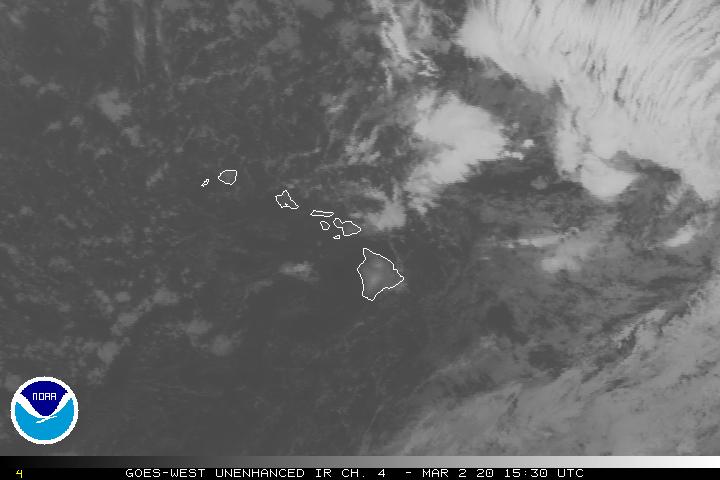














 Email Glenn James: