August 2009
Monthly Archive
Posted by Glenn
No Comments
August 21-22, 2009
Air Temperatures – The following maximum temperatures were recorded across the state of Hawaii Friday afternoon:
Lihue, Kauai – 82
Honolulu, Oahu – 88
Kaneohe, Oahu – 83
Kahului, Maui – 87
Hilo, Hawaii – 82
Kailua-kona – 88
Air Temperatures ranged between these warmest and coolest spots near sea level – and on the highest mountains…at 5 p.m. Friday evening:
Barking Sands, Kauai – 87F
Hilo, Hawaii – 79
Haleakala Crater – 54 (near 10,000 feet on Maui)
Mauna Kea summit – 55 (near 14,000 feet on the Big Island)
Precipitation Totals – The following numbers represent the largest precipitation totals (inches) during the last 24 hours on each of the major islands, as of Friday afternoon:
0.64 Mount Waialaele, Kauai
0.02 Oahu Forest NWR, Oahu
0.00 Molokai
0.00 Lanai
0.00 Kahoolawe
0.19 West Wailuaiki, Maui
0.22 Kealakekua, Big Island
Marine Winds – Here’s the latest (automatically updated) weather map showing high pressure systems to the north of the islands. Trade winds will be active through Saturday into Sunday.
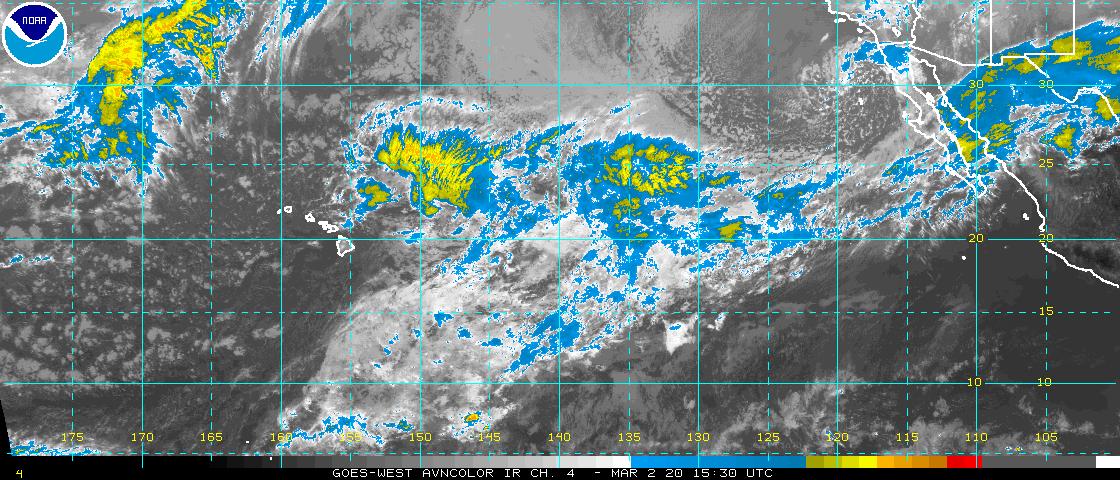
Satellite and Radar Images: To view the cloud conditions we have here in Hawaii, please use the following satellite links, starting off with this Infrared Satellite Image of the islands to see all the clouds around the state during the day and night. This next image is one that gives close images of the islands only during the daytime hours, and is referred to as a Close-up visible image. This next image shows a larger view of the Pacific…giving perspective to the wider ranging cloud patterns in the Pacific Ocean. Finally, here’s a Looping IR satellite image, making viewable the clouds around the islands 24 hours a day. To help you keep track of where any showers may be around the islands, here’s the latest animated radar image.
Hawaii’s Mountains – Here’s a link to the live webcam on the summit of near 14,000 foot Mauna Kea on the Big Island of Hawaii. The tallest peak on the island of Maui is the Haleakala Crater, which is near 10,000 feet in elevation. These two webcams are available during the daylight hours here in the islands…and when there’s a big moon rising just after sunset for an hour or two! Plus, during the nights and early mornings you will be able to see stars, and the sunrise too…depending upon weather conditions.
Tropical Cyclone activity in the eastern and central Pacific – Here’s the latest weather information coming out of the National Hurricane Center, covering the eastern north Pacific. You can find the latest tropical cyclone information for the central north Pacific (where Hawaii is located) by clicking on this link to the Central Pacific Hurricane Center. Here’s a tracking map covering both the eastern and central Pacific Ocean. A satellite image, which shows the entire ocean area between Hawaii and the Mexican coast…can be found here.
Aloha Paragraphs

Skimboarding in Hawaii
The locally strong and gusty trade winds will be the dominant weather feature through the next couple of days, gradually easing up a little Sunday…into the new week ahead. The winds are strong enough now, that we find a small craft wind advisory in place across all the marine zones, stretching from the Big Island up through Kauai and Niihau.
The overlying atmosphere is now very dry and stable, which will provide nice weather through the weekend…into the first part of the new work week. There are no organized shower areas taking aim on the islands now, although whatever showers that do manage to fall, will land along the windward sides. The leeward coasts will find lots of daytime sunshine available for good beaching.
The computer models are still trying to spin up something in the eastern Pacific…which could become the next tropical cyclone over the next couple of days. This area is being referred to as Invest 92 Friday evening, and if it did turn into something, would be referred to as tropical depression 11E. The models mostly show it moving westward, to the south of the Hawaiian Islands late next week…although a couple point it more towards the Big Island. It’s too early to know what, if anything bearing this might have on our islands eventually. There are currently three areas that are trying to spawn in the eastern Pacific as a matter of fact.
I went to the new film called District 9 (2009) Thursday evening after work…starring Sharlto Copley and Jason Cope. The short synopsis of this film reads, "Alien refugees in South Africa hold the key to a mysterious, powerful secret." I believe it was the most watched new film at theatres last weekend. So, because I’m adventuresome, or whatever you might call my desire to see this film, I took a chance and went to see it. Here’s a trailer, just in case you’re feeling like taking a quick look at this action flick. ~~~ I was actually surprised how much I enjoyed this film, although as you might suspect, it was down and dirty. If you’re drawn to these kinds of films, I believe you would find it quite entertaining. If on the other hand, this kind of film is completely disgusting, a total waste of time…don’t go with 500 miles of a theatre playing the film! Smile
It’s Friday evening here in Kula, Maui, as I begin writing this last part of today’s narrative update. Friday was a nice day, as long as you didn’t mind the blustery trade winds that were blowing in those exposed areas. The strongest gust that I saw Friday afternoon was 46 mph, at that windy bay at Maalaea, Maui. I see little change in store for Saturday, with more fair weather, and gusty trade winds on tap.
~~~ I’m trying to decide to drive down to Kahului this evening for another film. I’m pretty settled in here, but could see myself going out. The film that I’m mildly attracted to is called 500 days of Summer (2009)…starring Joseph Gordon-Levitt, and Zooey Deschanel, among others. I like the trailer, and find the leading lady very attractive to tell you the truth. The story is a common one: "Boy-meets-girl story of an unpredictable no-holds-barred love affair." I’m sort of in the mood for a light comedy, and so may make the journey down to Kahului…and if I do, will let you know my take on this new film Saturday morning. I hope you have a great Friday night! Aloha for now…Glenn.
Extra: Amazing youtube video…sand painting!
Interesting: The U.S. Geological Survey released a study that showed mercury contamination in every fish sampled in 291 streams across the country. The work was part of the National Water-Quality Assessment Program (NAWQA) which provides an understanding of water-quality conditions such as whether conditions are getting better or worse over time and how natural features and human activities affect those conditions.
Regional and national assessments are possible because of a consistent study design and uniform methods of data collection and analysis. About a quarter of the fish were found to contain mercury at levels exceeding the criterion for the protection of people who consume average amounts of fish, established by the U.S. Environmental Protection Agency.
More than two-thirds of the fish exceeded the U.S. EPA level of concern for fish-eating mammals. "This study shows just how widespread mercury pollution has become in our air, watersheds, and many of our fish in freshwater streams," said Secretary of the Interior Ken Salazar. "This science sends a clear message that our country must continue to confront pollution, restore our nation’s waterways, and protect the public from potential health dangers."
Some of the highest levels of mercury in fish were found in the tea-colored or "blackwater" streams in North and South Carolina, Georgia, Florida and Louisiana — areas associated with relatively undeveloped forested watersheds containing abundant wetlands compared to the rest of the country. High levels of mercury in fish also were found in relatively undeveloped watersheds in the Northeast and the Upper Midwest.
Elevated levels are noted in areas of the Western United States affected by mining. Mercury, a neurotoxin, is one of the most serious contaminants threatening our nation’s waters. The main source of mercury to natural waters is mercury that is emitted to the atmosphere and deposited onto watersheds by precipitation.
However, atmospheric mercury alone does not explain contamination in fish in our nation’s streams. Naturally occurring watershed features, like wetlands and forests, can enhance the conversion of mercury to the toxic form, methylmercury. Methylmercury is readily taken up by aquatic organisms, resulting in contamination in fish.
An unexpected finding was that the production of methylmercury in channel sediment within the streams themselves appears to be relatively unimportant for controlling methylmercury in stream water. Stream water provides methylmercury to the base of the food chain, and it is the amount of methylmercury in the water that is the primary driver of how much mercury that accumulates in top predator fish.
In general, concentrations in fish increased with increasing concentrations of methylmercury in water. Once in the food web, methylmercury biomagnifies at a fairly consistent rate from algae to invertebrates to fish—even among diverse stream ecosystems. In the ecosystems studied, foodweb characteristics have less impact on the amount of mercury in fish than do methylmercury levels in water.
Interesting2: Kenya has been losing 100 lions a year for the past seven years, leaving the country with just 2000 of its famous big cats, says the Kenya Wildlife Service (KWS) — which concludes the country could have no wild lions at all in 20 years. Conservationists have blamed habitat destruction, disease and conflict with humans for the population collapse.
But Laurence Frank, a wildlife biologist at the University of California, Berkeley, thinks the KWS estimate is optimistic. "Lions are disappearing so fast from Kenya, as well as the rest of Africa, that I think they will disappear [from Kenya] in less than 10 years if action is not taken very quickly," says Frank, who runs several lion conservation projects in the country.
The IUCN suggests that large lion populations of 50 to 100 prides are necessary to conserve genetic diversity and avoid inbreeding. Frank says that the decline of the big cats is due to the inexorable growth in human population and consequent conflict with people over livestock, rather than disease.
Interesting3: Amidst waves and wildlife in the world’s oceans, billions of pounds of polystyrene, water bottles, fishing wire and other plastic products float in endless circles. This bobbing pollution is more than just an eyesore or a choking hazard for birds. According to a new study, plastic in the oceans can decompose in as little as a year, leaching chemical compounds into the water that may harm the health of animals and possibly even people.
"Most people in the world believe that this plastic is indestructible for a very long time," said Katsuhiko Saido, a chemist at Nihon University in Chiba, Japan. He spoke this week at a meeting of the American Chemical Society in Washington, D.C. "We are now concerned that plastic pollution is caused by invisible materials," Saido said through an interpreter. "This will have a great effect on marine life."
Interesting4: Mexico is suffering from its driest year in 68 years, killing crops and cattle in the countryside and forcing the government to slow the flow of water to the crowded capital. Below-average rainfall since last year has left about 80 of Mexico’s 175 largest reservoirs less than half full, said Felipe Arreguin, a senior official at the Conagua commission, which manages the country’s water supply.
"We have zones where the reservoirs are totally full but others that don’t have even a drop of water," he said in an interview late on Tuesday. More than 1,000 cattle have been lost due to lack of rainfall, and up to 20 million tons of crops managed by 3.5 million small farmers are at risk of being lost, agriculture groups say.
Posted by Glenn
No Comments
August 20-21, 2009
Air Temperatures – The following maximum temperatures were recorded across the state of Hawaii Thursday afternoon:
Lihue, Kauai – 81
Honolulu, Oahu – 87
Kaneohe, Oahu – 84
Kahului, Maui – 88
Hilo, Hawaii – 82
Kailua-kona – 85
Air Temperatures ranged between these warmest and coolest spots near sea level – and on the highest mountains…at 5 p.m. Thursday evening:
Kailua-Kona – 86F
Princeville, Kauai – 77
Haleakala Crater – 55 (near 10,000 feet on Maui)
Mauna Kea summit – 55 (near 14,000 feet on the Big Island)
Precipitation Totals – The following numbers represent the largest precipitation totals (inches) during the last 24 hours on each of the major islands, as of Thursday afternoon:
3.92 Mount Waialaele, Kauai
0.74 Poamoho 2, Oahu
0.03 Molokai
0.00 Lanai
0.01 Kahoolawe
0.82 West Wailuaiki, Maui
0.63 Laupahoehoe, Big Island
Marine Winds – Here’s the latest (automatically updated) weather map showing a 1026 millibar high pressure system to the northeast of the islands. Trade winds will be active through Saturday.
Satellite and Radar Images: To view the cloud conditions we have here in Hawaii, please use the following satellite links, starting off with this Infrared Satellite Image of the islands to see all the clouds around the state during the day and night. This next image is one that gives close images of the islands only during the daytime hours, and is referred to as a Close-up visible image. This next image shows a larger view of the Pacific…giving perspective to the wider ranging cloud patterns in the Pacific Ocean. Finally, here’s a Looping IR satellite image, making viewable the clouds around the islands 24 hours a day. To help you keep track of where any showers may be around the islands, here’s the latest animated radar image.
Hawaii’s Mountains – Here’s a link to the live webcam on the summit of near 14,000 foot Mauna Kea on the Big Island of Hawaii. The tallest peak on the island of Maui is the Haleakala Crater, which is near 10,000 feet in elevation. These two webcams are available during the daylight hours here in the islands…and when there’s a big moon rising just after sunset for an hour or two! Plus, during the nights and early mornings you will be able to see stars, and the sunrise too…depending upon weather conditions.
Tropical Cyclone activity in the eastern and central Pacific – Here’s the latest weather information coming out of the National Hurricane Center, covering the eastern north Pacific. You can find the latest tropical cyclone information for the central north Pacific (where Hawaii is located) by clicking on this link to the Central Pacific Hurricane Center. Here’s a tracking map covering both the eastern and central Pacific Ocean. A satellite image, which shows the entire ocean area between Hawaii and the Mexican coast…can be found here.
Aloha Paragraphs

Nice beach on Oahu
The islands will enjoy pleasant weather conditions, under the influence of the well established trade wind weather pattern…right on into the weekend. The trade winds will be the major weather influence through the next several days. The winds are strong enough now, that we find a small craft wind advisory in those typically gusty areas around Maui County…down to the Big Island. These winds will likely ease up a little later this weekend, into the start of next work.
Our local skies will be clear to partly cloudy, with those localized cloudy periods…along with a few showers too. The lower level cumulus and stratocumulus clouds are being carried generally from east to west by the trade winds. The bias for showers will remain anchored on the windward sides generally. This looping radar image will allow you to see just where those rain drops will be falling. The overlying air mass is still unstable, so that we could see a few localized heavier showers around through Friday. Here’s a satellite image showing those brighter white areas…where locally heavy showers are falling over the ocean, to the north and south of the islands Thursday evening.
It’s Thursday evening here in Kihei, Maui, as I begin writing this last part of today’s narrative. That satellite image, in the paragraph just above, is pretty impressive. At the time of this writing, around 6pm Thursday evening, there’s thunderstorms quite close to the Big Island, and to Kauai too. It wouldn’t take much movement of these areas, to bring some heavy showers to our island chain! In addition, we can see lots of lower level clouds being carried in our direction, by the blustery trade winds as well. Those will fall most frequently along the windward coasts and slopes.
~~~ I’m about ready to head over to Kahului, to see a new film this evening. This will be one of those that you will likely dismiss right away, and probably not waste your time clicking on the trailer either. It’s called District 9 (2009), starring Sharlto Copley and Jason Cope…neither of which I’ve heard of quite honestly. The short synopsis of this film reads, "Alien refugees in South Africa hold the key to a mysterious, powerful secret." For some reason, I believe it was the most watched new film at theatres last weekend. So, because I’m adventuresome, or whatever you might call my desire to see this film, I’ll take a chance and go see it. Here’s a trailer, just in case you’re feeling like taking a quick look at what I’ll be seeing. I’ll let you know what I think of this film early Saturday morning, when I’ll be back online with your next new weather narrative from paradise. I hope you have a great Thursday night! Aloha for now…Glenn.
Extra: Hurricane Bill youtube video from the International Space Station…there is sound with this video.
Interesting: The U.S. Geological Survey released a study that showed mercury contamination in every fish sampled in 291 streams across the country. The work was part of the National Water-Quality Assessment Program (NAWQA) which provides an understanding of water-quality conditions such as whether conditions are getting better or worse over time and how natural features and human activities affect those conditions.
Regional and national assessments are possible because of a consistent study design and uniform methods of data collection and analysis. About a quarter of the fish were found to contain mercury at levels exceeding the criterion for the protection of people who consume average amounts of fish, established by the U.S. Environmental Protection Agency.
More than two-thirds of the fish exceeded the U.S. EPA level of concern for fish-eating mammals. "This study shows just how widespread mercury pollution has become in our air, watersheds, and many of our fish in freshwater streams," said Secretary of the Interior Ken Salazar. "This science sends a clear message that our country must continue to confront pollution, restore our nation’s waterways, and protect the public from potential health dangers."
Some of the highest levels of mercury in fish were found in the tea-colored or "blackwater" streams in North and South Carolina, Georgia, Florida and Louisiana — areas associated with relatively undeveloped forested watersheds containing abundant wetlands compared to the rest of the country. High levels of mercury in fish also were found in relatively undeveloped watersheds in the Northeast and the Upper Midwest.
Elevated levels are noted in areas of the Western United States affected by mining. Mercury, a neurotoxin, is one of the most serious contaminants threatening our nation’s waters. The main source of mercury to natural waters is mercury that is emitted to the atmosphere and deposited onto watersheds by precipitation.
However, atmospheric mercury alone does not explain contamination in fish in our nation’s streams. Naturally occurring watershed features, like wetlands and forests, can enhance the conversion of mercury to the toxic form, methylmercury. Methylmercury is readily taken up by aquatic organisms, resulting in contamination in fish.
An unexpected finding was that the production of methylmercury in channel sediment within the streams themselves appears to be relatively unimportant for controlling methylmercury in stream water. Stream water provides methylmercury to the base of the food chain, and it is the amount of methylmercury in the water that is the primary driver of how much mercury that accumulates in top predator fish.
In general, concentrations in fish increased with increasing concentrations of methylmercury in water. Once in the food web, methylmercury biomagnifies at a fairly consistent rate from algae to invertebrates to fish—even among diverse stream ecosystems. In the ecosystems studied, foodweb characteristics have less impact on the amount of mercury in fish than do methylmercury levels in water.
Interesting2: Kenya has been losing 100 lions a year for the past seven years, leaving the country with just 2000 of its famous big cats, says the Kenya Wildlife Service (KWS) — which concludes the country could have no wild lions at all in 20 years. Conservationists have blamed habitat destruction, disease and conflict with humans for the population collapse.
But Laurence Frank, a wildlife biologist at the University of California, Berkeley, thinks the KWS estimate is optimistic. "Lions are disappearing so fast from Kenya, as well as the rest of Africa, that I think they will disappear [from Kenya] in less than 10 years if action is not taken very quickly," says Frank, who runs several lion conservation projects in the country.
The IUCN suggests that large lion populations of 50 to 100 prides are necessary to conserve genetic diversity and avoid inbreeding. Frank says that the decline of the big cats is due to the inexorable growth in human population and consequent conflict with people over livestock, rather than disease.
Interesting3: Amidst waves and wildlife in the world’s oceans, billions of pounds of polystyrene, water bottles, fishing wire and other plastic products float in endless circles. This bobbing pollution is more than just an eyesore or a choking hazard for birds. According to a new study, plastic in the oceans can decompose in as little as a year, leaching chemical compounds into the water that may harm the health of animals and possibly even people.
"Most people in the world believe that this plastic is indestructible for a very long time," said Katsuhiko Saido, a chemist at Nihon University in Chiba, Japan. He spoke this week at a meeting of the American Chemical Society in Washington, D.C. "We are now concerned that plastic pollution is caused by invisible materials," Saido said through an interpreter. "This will have a great effect on marine life."
Interesting4: Mexico is suffering from its driest year in 68 years, killing crops and cattle in the countryside and forcing the government to slow the flow of water to the crowded capital. Below-average rainfall since last year has left about 80 of Mexico’s 175 largest reservoirs less than half full, said Felipe Arreguin, a senior official at the Conagua commission, which manages the country’s water supply.
"We have zones where the reservoirs are totally full but others that don’t have even a drop of water," he said in an interview late on Tuesday. More than 1,000 cattle have been lost due to lack of rainfall, and up to 20 million tons of crops managed by 3.5 million small farmers are at risk of being lost, agriculture groups say.
Posted by Glenn
[2] Comments
August 19-20, 2009
Air Temperatures – The following maximum temperatures were recorded across the state of Hawaii Wednesday afternoon:
Lihue, Kauai – 83
Honolulu, Oahu – 90
Kaneohe, Oahu – 83
Kahului, Maui – 89
Hilo, Hawaii – 84
Kailua-kona – 87
Air Temperatures ranged between these warmest and coolest spots near sea level – and on the highest mountains…at 5 p.m. Wednesday evening:
Honolulu, Oahu – 87F
Lihue, Kauai – 77
Haleakala Crater – 54 (near 10,000 feet on Maui)
Mauna Kea summit – 72 (near 14,000 feet on the Big Island)
Precipitation Totals – The following numbers represent the largest precipitation totals (inches) during the last 24 hours on each of the major islands, as of Wednesday afternoon:
0.30 Mount Waialaele, Kauai
0.64 Oahu Forest NWR, Oahu
0.20 Molokai
0.65 Lanai
0.03 Kahoolawe
1.46 West Wailuaiki, Maui
0.49 Pohakuloa, Big Island
Marine Winds – Here’s the latest (automatically updated) weather map showing a 1026 millibar high pressure system to the northeast of the islands. Our trade winds will pick up in strength Thursday into Friday.
Satellite and Radar Images: To view the cloud conditions we have here in Hawaii, please use the following satellite links, starting off with this Infrared Satellite Image of the islands to see all the clouds around the state during the day and night. This next image is one that gives close images of the islands only during the daytime hours, and is referred to as a Close-up visible image. This next image shows a larger view of the Pacific…giving perspective to the wider ranging cloud patterns in the Pacific Ocean. Finally, here’s a Looping IR satellite image, making viewable the clouds around the islands 24 hours a day. To help you keep track of where any showers may be around the islands, here’s the latest animated radar image.
Hawaii’s Mountains – Here’s a link to the live webcam on the summit of near 14,000 foot Mauna Kea on the Big Island of Hawaii. The tallest peak on the island of Maui is the Haleakala Crater, which is near 10,000 feet in elevation. These two webcams are available during the daylight hours here in the islands…and when there’s a big moon rising just after sunset for an hour or two! Plus, during the nights and early mornings you will be able to see stars, and the sunrise too…depending upon weather conditions.
Tropical Cyclone activity in the eastern and central Pacific – Here’s the latest weather information coming out of the National Hurricane Center, covering the eastern north Pacific. You can find the latest tropical cyclone information for the central north Pacific (where Hawaii is located) by clicking on this link to the Central Pacific Hurricane Center. Here’s a tracking map covering both the eastern and central Pacific Ocean. A satellite image, which shows the entire ocean area between Hawaii and the Mexican coast…can be found here.
Aloha Paragraphs

Typical trade wind weather pattern back very soon
The atmosphere remains at least somewhat unstable, and this of course means that we may still see some heavy showers falling locally. There are clouds rising well into the higher atmosphere early Wednesday evening, especially over the offshore waters around the Hawaiian Islands. This looping satellite image shows those bright white areas…where the heaviest showers are falling. There is a general movement of these clouds from the east towards the west. One particular elongated zone of clouds is located just to the east of the Big Island.
~~~ The clouds in this band have tops, which have been reaching up towards 35,000 feet, so that there may be some embedded thunderstorms forming there. There are other areas of thunderstorms offshore as well. This looping radar image shows, at least early Wednesday evening, that there aren’t very many heavy showers around. This band of clouds however have been taking aim on the Big Island…so that we should begin seeing some locally heavy showers arriving along the east facing coasts and slopes of that island soon. This band may ride the freshening trade winds up to the other islands overnight into Thursday morning.
The interesting thing seems to be the arrival of brisk trade winds across the islands from Molokai down through the Big Island of Hawaii. This would typically have the effect of limiting the showers, and perhaps make the windward sides where the most frequent showers would fall. Looking at that cloud band to the east of the Big Island again, it appears that it could be another surge in our trade wind speeds. It this were so, it would carry that band of clouds into our windward sides, first on the Big Island, and then the other islands.
~~~ The band looks like it could potentially bring some heavy rains with it, with the chance of a thunderstorm as well. When these windward biased showers arrive around the Big Island, there could be some localized flooding there into the overnight hours. The long and short of all this is, that the trade winds are here again, and will be with us through the rest of this week into next week…which is very normal for this time of year here in the islands.
Guillermo has dropped below the tropical depression threshold late Wednesday afternoon, as it ends of its long journey…which started in the eastern Pacific. Guillermo’s latest wind reports, as of 5pm Wednesday evening, showed 35 mph sustained winds…with gusts to 46 mph. The Central Pacific Hurricane Center (CPHC) issued its last advisory on Guillermo Wednesday evening, so that this long lived former tropical cyclone will finally go into the record books…as yet another storm that missed the Hawaiian Islands. Here’s the last CPHC tracking map.
It’s Wednesday evening here in Kihei, Maui, as I begin writing this last part of today’s narrative. The trade winds have rushed back into our Hawaiian Island weather picture today, starting first on the Big Island and Maui…and continuing westward to Oahu and Kauai. As we look at this looping radar image, we see the clouds and showers being carried along from an easterly direction. The atmosphere remains ripe for more showers on a temporary basis, some of which may be yet on the heavy side. Looking at this IR satellite image, we see those bright white spots, those cold cloud tops, which indicate heavy rain showers under them….heading towards the Big Island.
~~~ Looking out the window from my office here in Kihei early Wednesday evening, there are what I would describe as considerable clouds in all directions. I didn’t see any definite showers, although it looked like it was trying to work in that direction. If I experience anything unusual on the drive back upcountry to Kula, I’ll come back online and let you know. Otherwise, I’ll be up early Thursday morning, preparing your next new weather narrative…which will appear around 630am HST as usual on weekdays. Tomorrow is like a Friday, as Friday is a holiday here in the islands, called Admissions Day. I hope you have a great Wednesday night! Aloha for now…Glenn.
Extra: A nice youtube music video of Hawaiian beaches…with a relaxing and meditative focus, like a free trip to the islands…enjoy the warm ocean!
Interesting: They say there’s no place like home. But scientists are reporting some unsettling news about homes in the residential areas of California. The typical house there — and probably elsewhere in the country — is an alarming and probably underestimated source of water pollution, according to a new study reported today at the 238th National Meeting of the American Chemical Society.
In the study, Lorence Oki, Darren Haver and colleagues explain that runoff results from rainfall and watering of lawns and gardens, which winds up in municipal storm drains. The runoff washes fertilizers, pesticides and other contaminants into storm drains, and they eventually appear in rivers, lakes and other bodies of water.
"Results from our sampling and monitoring study revealed high detection frequencies of pollutants such as pesticides and pathogen indicators at all sites," Oki says of their study of eight residential areas in Sacramento and Orange Counties in California.
Graphic shows that polluted runoff originates from several sources, and has been linked to fish kills and a loss of aquatic species diversity. The study suggests current runoff models may underestimate pollution contributed by homes by up to 50 percent.
Interesting2: The population of the coffee-colored Asian clams has soared in the southeast portion of the lake, threatening to hog food sources and excrete nutrients that foster algae growth, according to an annual Lake Tahoe report by UC Davis researchers. Scientists worry that calcium in the clams’ shells could make the lake more hospitable to invasion by quagga or zebra mussels, which cluster onto boats and anything else that rests in the water.
Although the mussels have not been sighted at Tahoe, authorities at other lakes have spent millions of dollars trying to control them. "In a lake like Tahoe where a lot money and a lot of effort is being put into maintaining its pristine nature, the introduction or the threat of invasive species really pulls us away from that pristine condition," said John Reuter, associate director of UC Davis’ Tahoe Environmental Research Center, which released Tuesday’s "Tahoe: State of the Lake Report.
" No one is certain how the Asian clam first arrived at Lake Tahoe, whose famed clear waters lie at the center of a multimillion-dollar tourism economy.
Some authorities say that fishermen used the clams as bait and that surviving clams took root on the lake’s bottom, where they released tiny offspring that were carried by water currents to other parts of the lake. Visitors first noticed the white, partially oxidized shells on the shore seven years ago.
Interesting3: Some dogs are revered or pampered, with fancy clothes and loads of affection…others work for a living. David Blouin, a cultural sociologist at Indiana University South Bend, said relationships between dogs and their owners generally fall into three distinct categories, with some bestowing more canine benefits than others.
And while some dogs may live the high life, serving as surrogate children to their humans, their circumstances can change depending on their owner’s life course and experiences.
"I found it interesting that there are different ways to relate to and think about animals and that people are able to switch and latch onto a different way of thinking about and treating animals when other things happen in their lives, like having children," said Blouin, an assistant professor in the Department of Sociology and Anthropology.
Blouin conducted 28 in-depth interviews with dog owners from a Midwestern county. Dog ownership attitudes fell into three categories: Humanist, where dogs were highly valued and considered close companions, like pseudo people; protectionists might be vegetarians and they greatly valued animals in general, not just as pets; dominionists saw animals as separate, and less important than people, often using the dogs for hunting and pest control and requiring them to live outdoors.
Blouin said the distinct orientations toward animals were informed by multiple, competing cultural logics as well as personal experiences, demographic characteristics and family structure. Rural dog owners were more likely to leave their pets outside, for example.
Empty-nesters seemed to be the most attached to their pets. "People don’t make this stuff up themselves," Blouin said. "They learn how animals should be treated. There are different ideas out there and these ideas exist in little packages, which are promoted by different groups, like the Humane Society or kennel clubs." Blouin is presenting his findings at the annual meeting of the American Sociological Association.
Interesting4: If a lush, protected forest with a winding stream is considered luxury accommodation for a migratory bird, a Purdue University study shows that those birds would be just as happy with the equivalent of a cheap roadside motel. John Dunning, an associate professor of forestry and natural resources, found that migrating birds are just as likely to stop in small woodlots in the middle of an agricultural field for the night as long as there is adequate protection and food.
Dunning said the finding suggests that conservation efforts should extend to smaller forested lands to help stabilize declining migratory bird populations. "There are strategies for conserving forest for migratory birds, but those strategies emphasize the largest patches of forest," Dunning said.
"We found that even very small woodlots were filled with migratory birds at times. It makes us believe we also need to conserve the little patches of forest, not just the big ones."
Dunning and graduate student Diane Packett observed woodlots at three distances from Indiana’s Wabash River and its tributaries — within half a kilometer, between one and five kilometers and at about 20 kilometers. The woodlots were less than 20 acres and had row crops surrounding them on at least three sides.
Dunning and Packett made observations in both spring and fall and reported their findings in the current issue of The Auk, the journal of the American Ornithologists’ Union.
There were 76 different species of migratory birds found in the woodlots, with no statistical differences in the number of species or overall population of birds based on distance from streams. Packett said the birds, which travel thousands of miles between South and Central America and Canada twice each year, sometimes just need a place to stop along their journey.
As forests have been cleared for development, agriculture and other uses, those birds have to make do with whatever patches of forest they can find when they become tired or encounter bad weather. "They don’t make the trip all in one jump. It can be thousands of miles they have to fly," Packett said. "They need safe places to stop, eat and rest. If they don’t have that, they might not survive."
Posted by Glenn
1 Comment
August 18-19, 2009
Air Temperatures – The following maximum temperatures were recorded across the state of Hawaii Tuesday afternoon:
Lihue, Kauai – 82
Honolulu, Oahu – 90
Kaneohe, Oahu – 83
Kahului, Maui – 87
Hilo, Hawaii – 85
Kailua-kona – 87
Air Temperatures ranged between these warmest and coolest spots near sea level – and on the highest mountains…at 5 p.m. Tuesday evening:
Honolulu, Hawaii – 88F
Lihue, Kauai – 80
Haleakala Crater – 50 (near 10,000 feet on Maui)
Mauna Kea summit – 45 (near 14,000 feet on the Big Island)
Precipitation Totals – The following numbers represent the largest precipitation totals (inches) during the last 24 hours on each of the major islands, as of Tuesday afternoon:
1.79 Opaekaa Stream, Kauai
0.35 Oahu Forest NWR, Oahu
0.00 Molokai
0.00 Lanai
0.00 Kahoolawe
0.70 Kaupo Gap, Maui
0.45 Pali 2, Big Island
Marine Winds – Here’s the latest (automatically updated) weather map showing a 1030 millibar high pressure system far to the northeast of the islands. As Guillermo passes between us and our trade wind producing high…our winds will light into Wednesday.
Satellite and Radar Images: To view the cloud conditions we have here in Hawaii, please use the following satellite links, starting off with this Infrared Satellite Image of the islands to see all the clouds around the state during the day and night. This next image is one that gives close images of the islands only during the daytime hours, and is referred to as a Close-up visible image. This next image shows a larger view of the Pacific…giving perspective to the wider ranging cloud patterns in the Pacific Ocean. Finally, here’s a Looping IR satellite image, making viewable the clouds around the islands 24 hours a day. To help you keep track of where any showers may be around the islands, here’s the latest animated radar image.
Hawaii’s Mountains – Here’s a link to the live webcam on the summit of near 14,000 foot Mauna Kea on the Big Island of Hawaii. The tallest peak on the island of Maui is the Haleakala Crater, which is near 10,000 feet in elevation. These two webcams are available during the daylight hours here in the islands…and when there’s a big moon rising just after sunset for an hour or two! Plus, during the nights and early mornings you will be able to see stars, and the sunrise too…depending upon weather conditions.
Tropical Cyclone activity in the eastern and central Pacific – Here’s the latest weather information coming out of the National Hurricane Center, covering the eastern north Pacific. You can find the latest tropical cyclone information for the central north Pacific (where Hawaii is located) by clicking on this link to the Central Pacific Hurricane Center. Here’s a tracking map covering both the eastern and central Pacific Ocean. A satellite image, which shows the entire ocean area between Hawaii and the Mexican coast…can be found here.
Aloha Paragraphs

Weakening tropical storm Guillermo…to the NNE of Hawaii
Weakening Guillermo has essentially stopped our local trade winds, which will remain the case through Wednesday…they will return Thursday through the rest of the week. Guillermo is acting as a blocking force, causing our trade winds to become very light, or disappearing completely, with light sea breezes replacing them during the days…and offshore flowing land breezes at night. This will make our overlying atmosphere feel very warm and muggy temporarily. The trades will return late Wednesday or by Thursday, bringing back refreshing breezes then into the weekend…and beyond.
Guillermo will drop down below a tropical storm, into the tropical depression category…as it moves by to the north of the islands. We have dodged another bullet, with the winds and heavy rains associated with this tropical system…missing our islands to the north. Here’s a tracking map, showing the storm’s track, moving it by to the north of the islands. Here’s a satellite image showing Guillermo in relation to the Hawaiian Islands. Here’s a close-up satellite image of Guillermo. Here’s a satellite presentation…showing the looping of Guillermo.
Guillermo’s latest wind reports, as of Tuesday evening, showed 40 mph sustained winds…with gusts to 52 mph. The current path of this tropical storm keeps it far enough to our north, that there will be no direct influence from the storm itself. Our faltering wind speeds, along with the sultry atmosphere…will be a couple of the indirect effects however. A trough of low pressure aloft, with its destabilizing influence on our air mass, has brought afternoon cloud buildups, especially over the interior sections. These clouds dropped localized generous rain Tuesday, which will have a repeat performance on Wednesday.
It’s Tuesday evening here in Kihei, Maui, as I begin writing this last section of today’s narrative. Tuesday started off in the most spectacular way, with generally clear skies most everywhere…certainly that was the case here on Maui. As expected, the clouds quickly increased over most islands by late morning, with cloudy skies enveloping most of the state during the afternoon hours. Those convective cumulus clouds got darker and darker, and there was only one thing for them to do…and that was of course rain down on us! I understand that there was a thunderstorm off the north shore of east Maui in the afternoon…with thunder heard in Haiku. Here in Kihei, Maui, it rained down hard enough at one point, that there was some very minor flooding of the parking lot outside the Pacific Disaster Center. At around 530pm, the rain had stopped, but it was still very cloudy out, with a few sprinkles falling.
~~~ At 5pm at the Honolulu airport, the air temperature was a very hot 88F degrees! That’s unusual for that time of day, and with hardly a breeze to speak about, I’m sure it must have felt like 90+ in parking lot outside the terminal. I’m about ready to take the drive back upcountry, and am quite sure that I’ll find foggy conditions up in Kula, which is one of my favorite weather conditions. Rain or shine though, I’ll be out there taking my evening walk! I’ll be back here online early Wednesday morning with your next new weather narrative from paradise. I hope you have a great night, and that you will join me here for more fun Wednesday! Aloha for now…Glenn.
Extra: A nice youtube music video of Hawaiian beaches…with a relaxing and meditative focus, like a free trip to the islands…enjoy the warm ocean!
Interesting: The roadrunner might have eluded Wile E. Coyote in cartoons, but now scientists are finally capturing its secrets. Radio tags on roadrunners are revealing the small birds can each have surprisingly large home ranges. Building on knowledge of roadrunners could shed light on the plight of endangered species in those areas, researchers added.
Although the roadrunner is fairly common across the southwestern United States, surprisingly little is known about the bird. "As a predatory bird, they’re pretty wary, and they appear somewhat intelligent in terms of being able to avoid a trap, so they’re not easy to capture for study," explained researcher Dean Ransom, a wildlife ecologist at Texas AgriLife Research.
To study roadrunners, at first Ransom and his colleagues tried luring the birds toward nets with taped playbacks of roadrunner calls, but while the birds did come to look for encroaching rivals, "we couldn’t get them in the nets," he recalled. "We hit upon using a trap for birds of prey, a leg noose baited with a live mouse."
After capturing the roadrunners, they attached radio transmitters onto them and let the birds go, studying their movements of some 50 roadrunners over the past four years. As their name suggests, roadrunners spend most of their time walking and running along the ground, but are capable of flight when pressured.
"It’s not graceful, but it works," Ransom said. Roadrunners are monogamous and likely mate for life, with the male helping in all facets of nesting and feeding the young, including incubating the eggs at night, the researchers helped confirm.
They lay about four eggs on average per nest, but the clutch size can range as high as 10. In the larger clutches, many of the young don’t survive and older nestlings have been seen eating their younger siblings. "We used nest cameras to document what the parents were feeding their young," he added.
"The diet is based solidly on reptiles, especially Texas horned lizards. We have also seen mice, snakes, grasshoppers and a tarantula." Radio tags revealed the home ranges of roadrunners was much larger than before thought. "These are just birds that are 350 grams or so (roughly three-quarters of a lb.), yet they’re able to use an area of 100 hectares or 250 acres. That’s quite a feat," Ransom said.
"I wouldn’t think twice about that for a wild turkey, a 13-lbs. big, long-legged heavy bird, but for a roadrunner that seems extreme and was really surprising to me." Roadrunners occupy landscapes along with many other birds, "and while roadrunners so far are not in trouble, a lot of birds inhabiting the same areas seem to be," Ransom said.
"So because they have such large spatial requirements, they might be able to serve as an indicator species of something going wrong in an environment, like a canary in a coal mine. Learning more about roadrunners could therefore shed light on the human footprint on areas." For instance, the reason these roadrunners have such large ranges could be due to fragmentation of vegetated areas, which can make food or nesting sites more scarce.
"I suspect that if the fragmentation of vegetation gets smaller, you’ll see territory sizes drop dramatically," Ransom said. A number of mysteries persist regarding these birds. "At one camera of a nest, we saw an untagged bird sitting at the edge of a nest, and the only way a mated pair might let that happen — roadrunners are territorial birds — is if the third bird is related," Ransom said. "So there might be a helpers-at-the-nest behavior going on there. We’d like to know more about that."
Interesting2: Hate cockroaches? Best pour yourself a stiff drink. The widely loathed insects can hold their breath to save water, a new study has found – and the trick could help them to thrive in the face of climate change. When cockroaches are resting, they periodically stop breathing for as long as 40 minutes, though why they do so has been unclear.
To investigate the mystery, Natalie Schimpf and her colleagues at the University of Queensland in Brisbane, Australia, examined whether speckled cockroaches (Nauphoeta cinerea) change their breathing pattern in response to changes in carbon dioxide or oxygen concentration, or humidity.
They conclude that cockroaches close the spiracles through which they breathe primarily to save water. In dry environments the insects took shorter breaths than in moist conditions.
"Cockroaches lose water across their respiratory surfaces when they breathe," says Schimpf, "so taking shorter breaths in dry conditions reduces the amount of water they will lose." The study deals a blow to the theory that cockroaches hold their breath to survive underground, where CO2 levels can be poisonous.
"They held their breath no longer in high-CO2 than in low-CO2 conditions," says Schimpf. Nor did the study support the idea that cockroaches hold their breath to avoid damage to their body tissue from chemical reactions with oxygen. The same doesn’t necessarily apply to other insects, warns John Terblanche at Stellenbosch University in South Africa.
"Our research suggests that butterfly pupae hold their breath to prevent oxygen damage, rather than to conserve water," he says. The nifty breath-holding adaptation has allowed cockroaches to colonize drier habitats, says George McGavin of the University of Oxford, and may allow them to thrive in climate change.
"Cockroaches have an awesome array of adaptations to life on dry land," says McGavin. "Living in the humid conditions of a rainforest, where they evolved, might be plain sailing, but cockroaches are adaptable and can cope in a wide range of environmental conditions."
Will the sun ever set on the empire of the cockroach? Not any time soon, says McGavin. "Two hundred and fifty million years of physiological fine tuning has produced a creature that will be around for a long time to come," he says. "Cockroaches, I’m afraid to say, will do well in the face of climate change."
Interesting3: Mention rosemary, thyme, clove, and mint and most people think of a delicious meal. Think bigger…acres bigger. These well-known spices are now becoming organic agriculture’s key weapons against insect pests as the industry tries to satisfy demands for fruits and veggies among the growing portion of consumers who want food produced in more natural ways.
In a study presented at the American Chemical Society’s 238th National Meeting, scientists in Canada are reporting exciting new research on these so-called "essential oil pesticides" or "killer spices."
These substances represent a relatively new class of natural insecticides that show promise as an environmentally-friendly alternative to conventional pesticides while also posing less risk to human and animal health, the researcher says.
"We are exploring the potential use of natural pesticides based on plant essential oils — commonly used in foods and beverages as flavorings," says study presenter Murray Isman, Ph.D., of the University of British Columbia.
These new pesticides are generally a mixture of tiny amounts of two to four different spices diluted in water. Some kill insects outright, while others repel them. Over the past decade, Isman and colleagues tested many plant essential oils and found that they have a broad range of insecticidal activity against agricultural pests.
Some spiced-based commercial products now being used by farmers have already shown success in protecting organic strawberry, spinach, and tomato crops against destructive aphids and mites, the researcher says. "These products expand the limited arsenal of organic growers to combat pests," explains Isman.
"They’re still only a small piece of the insecticide market, but they’re growing and gaining momentum." The natural pesticides have several advantages. Unlike conventional pesticides, these "killer spices" do not require extensive regulatory approval and are readily available.
An additional advantage is that insects are less likely to evolve resistance — the ability to shrug off once-effective toxins — Isman says. They’re also safer for farm workers, who are at high risk for pesticide exposure, he notes. But the new pesticides also have shortcomings.
Since essential oils tend to evaporate quickly and degrade rapidly in sunlight, farmers need to apply the spice-based pesticides to crops more frequently than conventional pesticides. Some last only a few hours, compared to days or even months for conventional pesticides.
As these natural pesticides are generally less potent than conventional pesticides, they also must be applied in higher concentrations to achieve acceptable levels of pest control, Isman says. Researchers are now seeking ways of making the natural pesticides longer-lasting and more potent, he notes.
"They’re not a panacea for pest control," cautions Isman. Conventional pesticides are still the most effective way to control caterpillars, grasshoppers, beetles and other large insects on commercial food crops, he says. "But at the end of the day, it comes down to what’s good for the environment and what’s good for human health."
The "killer spices" aren’t just limited to agricultural use. Some show promise in the home as eco-friendly toxins and repellents against mosquitoes, flies, and roaches. Unlike conventional bug sprays, which have a harsh odor, these natural pesticides tend to have a pleasant, spicy aroma. Many contain the same oils that are used in aromatherapy products, including cinnamon and peppermint, Isman notes.
Interesting4: Scientists have uncovered fresh evidence that life could exist beyond Earth, with research published today showing that comet dust contained traces of a compound vital to human existence. Researchers probing dust and gas collected from the Wild 2 comet by NASA’s Stardust spacecraft in 2004 found traces of the amino acid glycine, lending credence to idea that there is life elsewhere in the universe.
"The discovery of glycine in a comet supports the idea that the fundamental building blocks of life are prevalent in space, and strengthens the argument that life in the universe may be common rather than rare," said Carl Pilcher, one of the space agency’s top astro-biologists. Jamie Elsila, lead author of the report, which was published in the journal Meteoritics and Planetary Science, said the findings also support the idea that the material elements of human life may have come from space.
"Our discovery supports the theory that some of life’s ingredients formed in space and were delivered to Earth long ago by meteorite and comet impacts," she said. The group’s final findings confirm suspicions that the amino acid – which creates the proteins that form the building blocks of life – were not simply earth-sourced contamination.
"We discovered that the Stardust-returned glycine has an extraterrestrial carbon isotope signature, indicating that it originated on the comet," said Ms Elsila. Twenty different amino acids are arranged to build the millions of different proteins that make up everything from hair to enzymes, NASA said.
Posted by Glenn
No Comments
August 17-18, 2009
Air Temperatures – The following maximum temperatures were recorded across the state of Hawaii Monday afternoon:
Lihue, Kauai – 82
Honolulu, Oahu – 86
Kaneohe, Oahu – 83
Kahului, Maui – 86
Hilo, Hawaii – 83
Kailua-kona – 89
Air Temperatures ranged between these warmest and coolest spots near sea level – and on the highest mountains…at 5 p.m. Monday evening:
Kailua-kona – 85F
Honolulu, Oahu – 78
Haleakala Crater – 50 (near 10,000 feet on Maui)
Mauna Kea summit – 48 (near 14,000 feet on the Big Island)
Precipitation Totals – The following numbers represent the largest precipitation totals (inches) during the last 24 hours on each of the major islands, as of Monday afternoon:
0.53 Mount Waialaele, Kauai
0.10 Oahu Forest NWR, Oahu
0.00 Molokai
0.00 Lanai
0.00 Kahoolawe
0.11 Haiku, Maui
0.12 Pahoa, Big Island
Marine Winds – Here’s the latest (automatically updated) weather map showing a 1031 millibar high pressure system far to the northeast of the islands. As Guillermo passes between us and our trade wind producing high…our winds will lose strength into Thursday.
Satellite and Radar Images: To view the cloud conditions we have here in Hawaii, please use the following satellite links, starting off with this Infrared Satellite Image of the islands to see all the clouds around the state during the day and night. This next image is one that gives close images of the islands only during the daytime hours, and is referred to as a Close-up visible image. This next image shows a larger view of the Pacific…giving perspective to the wider ranging cloud patterns in the Pacific Ocean. Finally, here’s a Looping IR satellite image, making viewable the clouds around the islands 24 hours a day. To help you keep track of where any showers may be around the islands, here’s the latest animated radar image.
Hawaii’s Mountains – Here’s a link to the live webcam on the summit of near 14,000 foot Mauna Kea on the Big Island of Hawaii. The tallest peak on the island of Maui is the Haleakala Crater, which is near 10,000 feet in elevation. These two webcams are available during the daylight hours here in the islands…and when there’s a big moon rising just after sunset for an hour or two! Plus, during the nights and early mornings you will be able to see stars, and the sunrise too…depending upon weather conditions.
Tropical Cyclone activity in the eastern and central Pacific – Here’s the latest weather information coming out of the National Hurricane Center, covering the eastern north Pacific. You can find the latest tropical cyclone information for the central north Pacific (where Hawaii is located) by clicking on this link to the Central Pacific Hurricane Center. Here’s a tracking map covering both the eastern and central Pacific Ocean. A satellite image, which shows the entire ocean area between Hawaii and the Mexican coast…can be found here.
Aloha Paragraphs

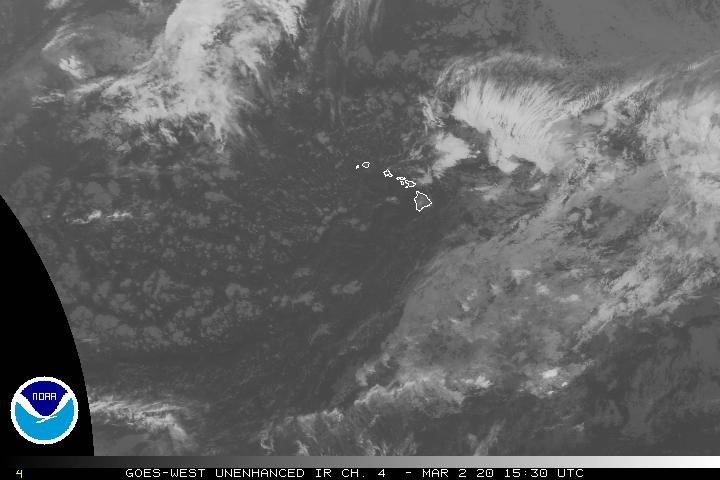
Tropical storm Guillermo…to the ENE of Hawaii
Our local trade winds will continue Monday evening, but then tumble in strength Tuesday and Wednesday, as rapidly weakening Guillermo moves between our islands…and the trade wind producing high pressure system to our northeast. Guillermo will act as a blocking force, causing our trade winds to become very light, with light sea breezes replacing them in certain locales. This will make our overlying atmsphere feel very warm and muggy for a few days. The trades will return at some point Thursday, bringing back refreshing breezes Friday into the weekend…and beyond.
Guillermo remains a rather weak tropical storm Monday evening…and will weaken further into just a remnant low pressure system later Tuesday. This dissipation is a result of cooler sea surf temperatures under the storm, and stronger upper level winds…which have sheared the storm at higher levels. Here’s a tracking map, showing the storm’s track heading up to the northeast and then north of the islands. Here’s a satellite image showing Guillermo in relation to the Hawaiian Islands. Here’s a close-up satellite image of Guillermo. Here’s a satellite presentation…showing the looping of Guillermo.
Guillermo’s latest wind report, early Monday evening, shows much reduced 46 mph sustained winds…with gusts to 58 mph. The current path of this dissipating tropical storm keeps it far enough to our north, that there will be no direct influence from the storm itself. Our faltering wind speeds, with the sultry atmosphere…will be a couple of the indirect effects however. A trough of low pressure aloft, with its destabilizing influence on our air mass, will prompt afternoon cloud buildups, especially over the interior sections. These clouds will likely dump localized generous rain for a couple of hours each afternoon Tuesday through Wednesday. The computer models suggest that Guillermo may drag some leftover cloud elements across the islands Wednesday night into Thursday. This rain should be focused more towards the windward sides…carried in by the returning trade winds. Oh, and let’s not forget the rising large surf along our east facing shores Tuesday into Wednesday…be careful of that!
It’s Monday evening here in Kihei, Maui, as I begin typing this last part of today’s narrative. Monday was yet another great day, in a good series of nice days…from a weather perspective. Even though we have a tropical storm in our general vicinity, there’s nothing to worry about. Nothing to worry about, as long you don’t mind a couple of hot and humid days…like Tuesday and Wednesday. The problem is that our trade winds will be faltering, which during the deep summer month of August, can be somewhat of a problem. Not a major problem, but it’s going to be feeling a little weird out there, without the trade winds blowing. Already by Thursday, those trades will be on the rise, and will reassert themselves through the rest of the week…into next week.
~~~ I’m out of here, as I’m getting ready to jump in my car for the drive home to Kula. I’m so ready to be outside, to be out of the office! I’ll be back with you early Tuesday morning, so here’s wishing you a most marvelous Monday night until then! Aloha for now…Glenn.
Extra: Great youtube video showing the Hubble Ultra Deep Field in 3D!
Interesting: University of Utah mathematicians developed a new cloaking method, and it’s unlikely to lead to invisibility cloaks like those used by Harry Potter or Romulan spaceships in "Star Trek." Instead, the new method someday might shield submarines from sonar, planes from radar, buildings from earthquakes, and oil rigs and coastal structures from tsunamis.
"We have shown that it is numerically possible to cloak objects of any shape that lie outside the cloaking devices, not just from single-frequency waves, but from actual pulses generated by a multi-frequency source," says Graeme Milton, senior author of the research and a distinguished professor of mathematics at the University of Utah.
"It’s a brand new method of cloaking," Milton adds. "It is two-dimensional, but we believe it can be extended easily to three dimensions, meaning real objects could be cloaked. It’s called active cloaking, which means it uses devices that actively generate electromagnetic fields rather than being composed of ‘meta-materials’ [exotic metallic substances] that passively shield objects from passing electromagnetic waves."
Milton says his previous research involved "just cloaking clusters of small particles, but now we are able to cloak larger objects." For example, radar microwaves have wavelengths of about four inches, so Milton says the study shows it is possible to use the method to cloak from radar something 10 times wider, or 40 inches.
That raises hope for cloaking larger objects. So far, the largest object cloaked from microwaves in actual experiments was an inch-wide copper cylinder. A study demonstrating the mathematical feasibility of the new cloaking technique – active, broadband, exterior cloaking – was published online today in the journal Optics Express.
A related paper was published online Aug. 14 in Physical Review Letters. Milton conducted the studies with Fernando Guevara Vasquez and Daniel Onofrei, both of whom are assistant professors-lecturers in mathematics. The research was funded by the National Science Foundation and the University of Utah.
Interesting2: You probably have cocaine in your wallet, purse, or pocket. Sound unlikely or outrageous? Think again! In what researchers describe as the largest, most comprehensive analysis to date of cocaine contamination in banknotes, scientists are reporting that cocaine is present in up to 90 percent of paper money in the United States, particularly in large cities such as Baltimore, Boston, and Detroit.
The scientists found traces of cocaine in 95 percent of the banknotes analyzed from Washington, D.C., alone. Presented at the 238th National Meeting of the American Chemical Society, the new study suggests that cocaine abuse is still widespread and may be on the rise in some areas.
It could help raise public awareness about cocaine use and lead to greater emphasis on curbing its abuse, the researchers say. The scientists tested banknotes from more than 30 cities in five countries, including the U.S., Canada, Brazil, China, and Japan, and found "alarming" evidence of cocaine use in many areas.
The U.S. and Canada had the highest levels, with an average contamination rate of between 85 and 90 percent, while China and Japan had the lowest, between 12 and 20 percent contamination. The study is the first report about cocaine contamination in Chinese and Japanese currencies, they say. "To my surprise, we’re finding more and more cocaine in banknotes," said study leader Yuegang Zuo, Ph.D., of the University of Massachusetts in Dartmouth.
Zuo says that the high percentage of contaminated U.S. currency observed in the current study represents nearly a 20 percent jump in comparison to a similar study he conducted two years ago. That earlier study indicated that 67 percent of bills in the U.S. contained traces of cocaine. "I’m not sure why we’ve seen this apparent increase, but it could be related to the economic downturn, with stressed people turning to cocaine," Zuo says.
Such studies are useful, he noted, because the data can help law enforcement agencies and forensic specialists identify patterns of drug use in a community. Scientists have known for years that paper money can become contaminated with cocaine during drug deals and directly through drug use such as snorting cocaine through rolled bills. Contamination can spread to banknotes not involved in the illicit drug culture because bills are processed in banks’ currency-counting machines.
Interesting3: When it comes to using climate models to assess the causes of the increased amount of moisture in the atmosphere, it doesn’t much matter if one model is better than the other. They all come to the same conclusion: Humans are warming the planet, and this warming is increasing the amount of water vapor in the atmosphere.
In new research appearing in the Aug. 10 online issue of the Proceedings of the U.S. National Academy of Sciences, Lawrence Livermore National Laboratory scientists and a group of international researchers found that model quality does not affect the ability to identify human effects on atmospheric water vapor.
“Climate model quality didn’t make much of a difference,” said Benjamin Santer, lead author from LLNL’s Program for Climate Modeling and Inter-comparison. “Even with the computer models that performed relatively poorly, we could still identify a human effect on climate.
It was a bit surprising. The physics that drive changes in water vapor are very simple and are reasonably well portrayed in all climate models, bad or good.” The atmosphere’s water vapor content has increased by about 0.4 kilograms per cubic meter (kg/m_) per decade since 1988, and natural variability alone can’t explain this moisture change, according to Santer.
“The most plausible explanation is that it’s due to human-caused increases in greenhouse gases,” he said. More water vapor – which is itself a greenhouse gas – amplifies the warming effect of increased atmospheric levels of carbon dioxide.
Interesting4: New research shows that air pollution in eastern China has reduced the amount of light rainfall over the past 50 years and decreased by 23 percent the number of days of light rain in the eastern half of the country. The results suggest that bad air quality might be affecting the country’s ability to raise crops as well as contributing to health and environmental problems.
The study links for the first time high levels of pollutants in the air with conditions that prevent the light kind of rainfall critical for agriculture. Led by atmospheric scientist Yun Qian at the Department of Energy’s Pacific Northwest National Laboratory, the study appears August 15 in the Journal of Geophysical Research-Atmospheres.
"People have long wondered if there was a connection, but this is the first time we’ve observed it from long-term data," said Qian. "Besides the health effects, acid rain and other problems that pollution creates, this work suggests that reducing air pollution might help ease the drought in north China."
China’s dramatic economic growth and pollution problems provide researchers an opportunity to study the connection between air quality and climate. Rain in eastern China — where most of the country’s people and pollution exist — is not like it used to be. Over the last 50 years, the southern part of eastern China has seen increased amounts of total rainfall per year.
The northern half has seen less rain and more droughts. But light rainfall that sustains crops has decreased everywhere. A group of climate researchers from the U.S., China and Sweden wanted to know why light rain patterns haven’t followed the same precipitation patterns as total rainfall.
Posted by Glenn
No Comments
August 16-17, 2009
Air Temperatures – The following maximum temperatures were recorded across the state of Hawaii Sunday afternoon:
Lihue, Kauai – 83
Honolulu, Oahu – 88
Kaneohe, Oahu – 83
Kahului, Maui – 86
Hilo, Hawaii – 82
Kailua-kona – 87
Air Temperatures ranged between these warmest and coolest spots near sea level – and on the highest mountains…at 6 p.m. Sunday evening:
Barking Sands, Kauai – 84F
Hilo, Hawaii – 77
Haleakala Crater – 50 (near 10,000 feet on Maui)
Mauna Kea summit – 59 (near 14,000 feet on the Big Island)
Precipitation Totals – The following numbers represent the largest precipitation totals (inches) during the last 24 hours on each of the major islands, as of Sunday afternoon:
1.31 Mount Waialaele, Kauai
0.217 Oahu Forest NWR, Oahu
0.00 Molokai
0.00 Lanai
0.00 Kahoolawe
0.03 Ulupalakua, Maui
0.09 Waiakea Uka, Big Island
Marine Winds – Here’s the latest (automatically updated) weather map showing a 1031 millibar high pressure system far to the northeast of the islands. This high pressure cell, along with its associated ridges, will keep trade winds blowing across our area Monday…then lighter Tuesday.
Satellite and Radar Images: To view the cloud conditions we have here in Hawaii, please use the following satellite links, starting off with this Infrared Satellite Image of the islands to see all the clouds around the state during the day and night. This next image is one that gives close images of the islands only during the daytime hours, and is referred to as a Close-up visible image. This next image shows a larger view of the Pacific…giving perspective to the wider ranging cloud patterns in the Pacific Ocean. Finally, here’s a Looping IR satellite image, making viewable the clouds around the islands 24 hours a day. To help you keep track of where any showers may be around the islands, here’s the latest animated radar image.
Hawaii’s Mountains – Here’s a link to the live webcam on the summit of near 14,000 foot Mauna Kea on the Big Island of Hawaii. The tallest peak on the island of Maui is the Haleakala Crater, which is near 10,000 feet in elevation. These two webcams are available during the daylight hours here in the islands…and when there’s a big moon rising just after sunset for an hour or two! Plus, during the nights and early mornings you will be able to see stars, and the sunrise too…depending upon weather conditions.
Tropical Cyclone activity in the eastern and central Pacific – Here’s the latest weather information coming out of the National Hurricane Center, covering the eastern north Pacific. You can find the latest tropical cyclone information for the central north Pacific (where Hawaii is located) by clicking on this link to the Central Pacific Hurricane Center. Here’s a tracking map covering both the eastern and central Pacific Ocean. A satellite image, which shows the entire ocean area between Hawaii and the Mexican coast…can be found here.
Aloha Paragraphs
Tropical storm Guillermo…to the east of Hawaii
Fair weather will continue Sunday night in most areas, although the windward sides should see some increase in showers starting early Monday…first on the Big Island. We may see another increase in showers, as a trough of low pressure edges closer around Tuesday. This upper trough would act to enhance shower activity along the leeward upcountry sides of the islands during the afternoon hours for a day or two. Our trade winds will continue blowing, but be tapering off by Tuesday…which will make our atmosphere feel very warm and muggy for several days. The trade winds will return later in the week, into next weekend…becoming rather strong and gusty then.
Hurricane Guillermo will soon be graded to a tropical storm…and has passed over into our central Pacific late Sunday afteroon. Here’s a tracking map, showing its track heading up to the north of the islands. Here’s a satellite image showing Guillermo in relation to the Hawaiian Islands. Here’s a close-up satellite image of Guillermo. Here’s an interesting satellite presentation…showing the looping of Guillermo.
Guillermo is rated as a weakened hurricane Sunday evening…with 75 mph sustained winds…with gusts to 92 mph. Nonetheless, I remain confident, based on the latest forecast track, that Guillermo will weaken well before getting near our islands. As Guillermo moves by to our northeast and north, it will cut off our trade winds, and have us feeling hot and muggy from Tuesday through Thursday. I expect a convective weather pattern to develop then, with clear mornings, giving way to afternoon cloudy periods…with potentially heavy interior showers. Strengthening trade winds will move back into the islands later Thursday into Friday…becoming locally strong and gusty into the weekend.
It’s Sunday evening here in Kula, Maui, as I begin typing this last part of this morning’s narrative. Despite the fact that hurricane Guillermo remains active, I remain encouraged by looking at the latest track map. The storm’s path continues heading in the right direction, and will be going through a major weakening soon. This will be caused by it moving over cooler water…and running underneath stronger winds aloft. We still need to keep an eye on this tropical cyclone, but I must admit, at least at this point, I’m not worried about Guillermo bringing us any kind of strong wind. We may however have some in-direct influence…with locally heavy showers around the middle of the upcoming new week.
~~~ Sunday was a great day here in the islands, with an unusual amount of cloud free skies in many areas…even on the windward sides, and around the mountains. Satellite imagery shows an area of showery clouds coming our way from the east, carried by the moderately strong trade wind flow. I expect the new work week will have some changes in store, caused primarily by the passage of weakening Guillermo passing by to our northeast and then north. The presense of an upper level trough will enhance any showers that form over the islands while it’s around. ~~~ What am I having for dinner tonight, you’re wondering? Oh, well, maybe your not! Anyway, I’m having organic tortilla’s with organic refriend beans, with organic cheese, avocado, and Maui fresh salsa. I’m about ready to have my evening walk now, and then dinner. I hope that you not only have a great dinner of your own, but also a restful Sunday night! ~~~ I’ll be back early Monday morning with your next new weather narrative from these beautiful Hawaiian Islands of ours. Aloha for now…Glenn.
Extra: great whale song youtube video
Extra2: great rainbow on Maui a few days ago…on youtube
Interesting: There are a lot of ups and downs in tropical cyclone formation in the Pacific Ocean this week, and that’s keeping NOAA’s GOES-11 satellite busy. There are remnants of Maka and Tropical Depression 9E, a fizzled Felicia, and a new Tropical Storm named Guillermo.
The graphics folks that create images from the satellite at the GOES Project at NASA Goddard Space Flight Center in Greenbelt, Md. are posting updated images on the GOES Project website often and forecasters are watching them.
In the Central Pacific Ocean, Maka and Felicia are now a memory. Felicia dissipated before it reached Hawaii, and the remnants of Maka are 1,400 miles west-southwest of Kauai. Maka’s remnant clouds and showers are still moving west, and it’s unlikely that it will re-organize.
That means a quiet Central Pacific Ocean for the next two days. In the Eastern Pacific, Tropical Depression 9E (TD9E) appears to be fizzling although it may get a second chance at life, while Tropical Depression 10E powered up into Tropical Storm Guillermo.
The remnants of TD9E are weakly spinning to around 30 mph, while it continues moving west-southwest near 9 mph. The center was located about 1,750 miles west-southwest of the southern tip of Baja California, near 13.9 north and 134.1 west.
The National Hurricane Center noted that shower and thunderstorm activity has increased this morning, and the environment seems to be a little more conducive to strengthening, so TD9E isn’t written off yet. In fact, there’s about a 30-50% chance it may strengthen back into a tropical depression.
Meanwhile, Tropical Depression 10E gained strength took the name Guillermo and it’s sustained winds whipped up to near 50 mph. Guillermo is moving west-northwest near 16 mph and will continue in that direction. Guillermo is closer to mainland Mexico, but poses no threat as its heading away from land.
On Aug. 13 at 5 a.m. EDT the storm was located 805 miles west-southwest of the southern tip of Baja California near 16.9 north and 120.5 west. His minimum central pressure is 999 millibars.
Guillermo is moving into a favorable environment, so he’s expected to continue strengthening. Even though the peak of hurricane season in the eastern and central Pacific Oceans are a month away, it seems like we’re already there.
Interesting2: Regular wobbles in the Earth’s tilt were responsible for the global warming episodes that interspersed prehistoric ice ages, according to new evidence. The finding is the result of research led by Russell Drysdale of the University of Newcastle that has been able to accurately date the end of the penultimate ice age for the first time.
The new dates, which appear in the today’s edition of Science, show the end of the second last ice age occurring 141,000 years ago, thousands of years earlier than previously thought. Using information gathered from a trio of Italian stalagmites, the research has punched a hole in the prevailing theory that interglacial periods are related to changes in the intensity of the northern hemisphere summer.
Drysdale and colleagues suggest that the Earth emerges from ice ages due in large part to changes in the tilt of the planet in relation to the sun, otherwise known as its obliquity. This affects the total amount of sunlight each hemisphere receives in its respective summer, rather than the peak intensity of the solar radiation during the northern summer.
Sediment on the sea floor contains accurate a record of what happened to the Earth’s climate prior to the last ice age. But up until now dating the sediment and the evident climatic changes has not been possible.
Interesting3: Salmon are returning to the Seine after an absence of almost a century as water in the river that runs through Paris has become cleaner in recent years, French scientists said. Once numerous in the river, Atlantic salmon disappeared from the Seine in the early 20th century, partly due to pollution from Paris sewers.
But scientists celebrated an improvement in water quality in the Seine that has tempted the protected species back to Paris. "There has been a turning point. The improvement in water quality has meant that salmon have returned to the Seine," Charles Perrier of the National Institute for Agronomic Research told Reuters. The National Federation for French Fishing estimated that about 1,000 salmon are present in the Seine.
Interesting4: The same things that make Alaska’s marine waters among the most productive in the world may also make them the most vulnerable to ocean acidification. According to new findings by a University of Alaska Fairbanks scientist, Alaska’s oceans are becoming increasingly acidic, which could damage Alaska’s king crab and salmon fisheries.
This spring, chemical oceanographer Jeremy Mathis returned from a cruise armed with seawater samples collected from the depths of the Gulf of Alaska. When he tested the samples’ acidity in his lab, the results were higher than expected.
They show that ocean acidification is likely more severe and is happening more rapidly in Alaska than in tropical waters. The results also matched his recent findings in the Chukchi and Bering Seas.
"It seems like everywhere we look in Alaska’s coastal oceans, we see signs of increased ocean acidification," said Mathis. Often referred to as the "sister problem to climate change," ocean acidification is a term to describe increasing acidity in the world’s oceans.
The ocean absorbs carbon dioxide from the air. As the ocean absorbs more carbon dioxide, seawater becomes more acidic. Scientists estimate that the ocean is 25 percent more acidic today than it was 300 years ago. "The increasing acidification of Alaska waters could have a destructive effect on all of our commercial fisheries.
This is a problem that we have to think about in terms of the next decade instead of the next century," said Mathis. The ocean contains minerals that organisms like oysters and crabs use to build their shells. Ocean acidification makes it more difficult to build shells, and in some cases the water can become acidic enough to break down existing shells.
Mathis’ recent research in the Gulf of Alaska uncovered multiple sites where the concentrations of shell-building minerals were so low that shellfish and other organisms in the region would be unable to build strong shells. "We’re not saying that crab shells are going to start dissolving, but these organisms have adapted their physiology to a certain range of acidity.
Early results have shown that when some species of crabs and fish are exposed to more acidic water, certain stress hormones increase and their metabolism slows down. If they are spending energy responding to acidity changes, then that energy is diverted away from growth, foraging and reproduction," said Mathis.
Another organism that could be affected by ocean acidification is the tiny pteropod, also known as a sea butterfly or swimming sea snail. The pteropod is at the base of the food chain and makes up nearly half of the pink salmon’s diet. A 10 percent decrease in the population of pteropods could mean a 20 percent decrease in an adult salmon’s body weight.
"This is a case where we see ocean acidification having an indirect effect on a commercially viable species by reducing its food supply," said Mathis. The cold waters and broad, shallow continental shelves around Alaska’s coast could be accelerating the process of ocean acidification in the North, Mathis said.
Cold water can hold more gas than warmer water, which means that the frigid waters off Alaska’s coasts can absorb more carbon dioxide. The shallow waters of Alaska’s continental shelves also retain more carbon dioxide because there is less mixing of seawater from deeper ocean waters.
Ask any coastal Alaskan and they will tell you that Alaska’s waters are teeming with biological life, from tiny plankton to humpback whales. All of these animals use oxygen and emit carbon dioxide. Mathis and other scientists call this the "biological pump."
"We are blessed with highly productive coastal areas that support vast commercial fisheries, but this productivity acts like a pump, absorbing more and more carbon dioxide from the atmosphere," said Mathis. "Because of this, the acidity of Alaska’s coastal seas will continue to increase, and likely accelerate, over the next decade."
Mathis said that it is still unclear what the full range of effects of ocean acidification will be, but that it is a clear threat to Alaska’s commercial fisheries and subsistence communities. "We need to give our policy makers and industry managers information and forecasts on ocean acidification in Alaska so they can make decisions that will keep our fisheries viable," said Mathis. "Ecosystems in Alaska are going to take a hit from ocean acidification. Right now, we don’t know how they are going to respond."
Interesting5: A new study reveals that treelines are not responding to climate warming as expected. The research, the first global quantitative assessment of the relationship between climate warming and treeline advance, is published in Ecology Letters and tests the premise that treelines are globally advancing in response to climate warming since 1900.
Treelines are the elevation or latitudinal limits where trees are capable of growth or survival and are considered to be early indicators of climate warming because they are constrained primarily by cold temperatures. Summer temperature is widely considered to be the primary control of treeline formation and maintenance, whereas winter temperatures have previously been considered less critical because of the insulative effects of snow.
This study reveals how winter warming has overturned this prevailing view. "Average temperatures have risen over the last century, with a more pronounced and rapid change at high altitudes and latitudes", said Ms. Melanie Harsch from the Bio-Protection Research Centre in New Zealand. "Within these zones, treelines are thought to be more temperature sensitive and so the rise in summer temperatures should result in an advance of treeline position."
Harsch and her co-authors conducted a multivariate meta-analysis, using a global dataset of 166 treeline sites with temperature data taken from the closest climate station to each site. The team used this data to analyse treeline advance throughout the 20th century and consider the contributing factors to that advance.
The team found that only 87 of the 166 sites (52%) had advanced while simultaneously the mean annual local temperatures had increased at 111 of the 166 sites at an average rate of 0.013?C a year (or 1?C in 77 years). Of the remaining sites, 77 (47%) remained stable and only two (1%) had treelines that receded.
Both of the receding sites showed evidence of disturbance, indicating that regardless of form, location or degree of temperature change experienced over the last century, treeline positions have either advanced or remained static. "Surprisingly these results reveal that treelines are not universally responding to climate warming by advancing, as expected," said Harsch,
"However they demonstrate the importance of temperature on treeline advance over other factors such as disturbance, latitude, scale, elevation and distance to the ocean; none of which demonstrated strong relationships with the probability of treeline advance." Another surprising result of this study was the association with winter, rather than summer, warming.
These results provide no evidence of the prevailing view that high altitude and latitude treelines are controlled only by summer temperatures. Instead they show that treelines are more likely to advance at sites that had warmed during the winter months. It is known, at least in northern latitudes that climate-associated changes in winter conditions are on average more extreme than changes in summer conditions.
"These results show that treelines are responding to warming, but are not consistent in that only half of the sites showed signs of advance despite most sites experiencing warming. Several studies on plant species’ responses to climate warming have shown mixed results and this study provides a possible explanation – both winter and summer conditions control treeline position," concluded Harsch.
"Our expectations of response depend upon which factors are limiting the current treeline distribution. Where summer temperature is the primary limiting factor we can expect to continue seeing advance, but at other sites treeline advance is unlikely to occur until other limiting factors are first lessened."
Posted by Glenn
No Comments
August 15-16, 2009
Air Temperatures – The following maximum temperatures were recorded across the state of Hawaii Saturday afternoon:
Lihue, Kauai – 83
Honolulu, Oahu – 90
Kaneohe, Oahu – 83
Kahului, Maui – 89
Hilo, Hawaii – 84
Kailua-kona – 88
Air Temperatures ranged between these warmest and coolest spots near sea level – and on the highest mountains…at 7 p.m. Saturday evening:
Port Allen, Kauai – 84F
Molokai airport – 77
Haleakala Crater – 48 (near 10,000 feet on Maui)
Mauna Kea summit – 39 (near 14,000 feet on the Big Island)
Precipitation Totals – The following numbers represent the largest precipitation totals (inches) during the last 24 hours on each of the major islands, as of Saturday evening:
0.86 Mount Waialaele, Kauai
0.52 Oahu Forest NWR, Oahu
0.00 Molokai
0.00 Lanai
0.00 Kahoolawe
0.52 Kula, Maui
0.31 Pohakuloa, Big Island
Marine Winds – Here’s the latest (automatically updated) weather map showing a high pressure system to the northeast of the islands. This high pressure cell, along with its associated ridge, will keep our trade winds blowing through the weekend…into the first couple of days of the new week ahead.
Satellite and Radar Images: To view the cloud conditions we have here in Hawaii, please use the following satellite links, starting off with this Infrared Satellite Image of the islands to see all the clouds around the state during the day and night. This next image is one that gives close images of the islands only during the daytime hours, and is referred to as a Close-up visible image. This next image shows a larger view of the Pacific…giving perspective to the wider ranging cloud patterns in the Pacific Ocean. Finally, here’s a Looping IR satellite image, making viewable the clouds around the islands 24 hours a day. To help you keep track of where any showers may be around the islands, here’s the latest animated radar image.
Hawaii’s Mountains – Here’s a link to the live webcam on the summit of near 14,000 foot Mauna Kea on the Big Island of Hawaii. The tallest peak on the island of Maui is the Haleakala Crater, which is near 10,000 feet in elevation. These two webcams are available during the daylight hours here in the islands…and when there’s a big moon rising just after sunset for an hour or two! Plus, during the nights and early mornings you will be able to see stars, and the sunrise too…depending upon weather conditions.
Tropical Cyclone activity in the eastern and central Pacific – Here’s the latest weather information coming out of the National Hurricane Center, covering the eastern north Pacific. You can find the latest tropical cyclone information for the central north Pacific (where Hawaii is located) by clicking on this link to the Central Pacific Hurricane Center. Here’s a tracking map covering both the eastern and central Pacific Ocean. A satellite image, which shows the entire ocean area between Hawaii and the Mexican coast…can be found here.
Aloha Paragraphs

Hurricane Guillermo…to the east of Hawaii
Drier air is arriving over the state of Hawaii, brought in our direction by the trade winds…as we move through Sunday. As normal, we’ll see a few showers falling along the windward coasts and slopes…generally during the night and morning hours. The leeward sides will find pleasant weather conditions, with good beach weather Sunday. As we move into the new week ahead, we may see an increase in windward biased showers, as a trough of low pressure edges closer…enhancing the shower activity starting then.
Powerful hurricane Guillermo is in the eastern Pacific Saturday night, which is expected to cross over into our central Pacific Sunday afternoon or evening. Guillermo is forecast to be a weakening hurricane when it passes into the central Pacific. Here’s a tracking map, showing its track heading up to the north of the islands. Here’s a satellite image showing Guillermo in relation to the Hawaiian Islands. Here’s a close-up satellite image of Guillermo. Here’s an interesting satellite presentation…showing the looping of Guillermo.
Guillermo remains a category 2 hurricane, with 109 mph sustained winds…with gusts to 132 mph! Nonetheless, I remain confident, based on the latest forecast track, that Guillermo will weaken well before getting near our islands. As Guillermo moves by to our northeast and north, it will cut off our trade winds, and have us feeling hot and muggy from Tuesday through Thursday. We would expect a convective weather pattern to develop then, with clear mornings, giving way to afternoon cloudy periods…with potentially heavy interior showers. Strengthening trade winds will move back into the islands Friday into next weekend…becoming locally strong and gusty.
It’s Saturday evening here in Kula, Maui, as I begin typing this last part of today’s narrative. Despite the fact that hurricane Guillermo remains powerful, I remain encouraged by looking at the latest track map. The storm’s path seems to be going in the right direction, and will be going through a major weakening as it comes closer to Hawaii. This will be caused by it moving over cooler water…and running underneath stronger winds aloft. We still need to keep an eye on this tropical cyclone, but I must admit, at least at this point, I’m not too worried about Guillermo bringing us any kind of strong wind. We may however have some in-direct influence…with locally heavy showers around the middle of the upcoming new week.
~~~ I went to see the new film called G.I. Joe: The Rise of Cobra (2009), starring Dennis Quaid, and Channing Tatum, among others…Friday evening after work. This is about a real American hero, based on the 1980’s cartoon/action figures, who comes to life to battle the evil forces of Cobra. This was a true action film, I thoroughly enjoyed it! It really was one of the best films of this type that I’ve seen in a long time. If you’re an action film affectionado, this is definitely one for you! Here’s a trailer if you’re interested in seeing what I’m talking about.
~~~ I spent the better part of Saturday in Haiku, on the windward side of east Maui, participating in an all day zen meditation sitting. This group, who used to be affliated with the Maui Zendo, in the old days some 35+ years ago…has remained together all these years. This is my first time sitting with them in many, many years. It was good to settle into this, what is called zazenkai, which simply means a full day of sitting meditiation. All I really felt like doing quite honestly, after being so deeply involved with working with near back to back tropical cyclones Lana, Felicia, and now Guillermo…was nothing. I just felt like relaxing to da max. Although, as it turned out, paying great attention to my breath, as I sat with this great group of people, was inspiring. ~~~ I’ll be back Sunday morning with more information about Guillermo, and all the other things that I can think to write about, in terms of the weather here in the wonderful Hawaiian Islands. I hope you have a great Saturday night! Aloha for now…Glenn.
Interesting: There are a lot of ups and downs in tropical cyclone formation in the Pacific Ocean this week, and that’s keeping NOAA’s GOES-11 satellite busy. There are remnants of Maka and Tropical Depression 9E, a fizzled Felicia, and a new Tropical Storm named Guillermo.
The graphics folks that create images from the satellite at the GOES Project at NASA Goddard Space Flight Center in Greenbelt, Md. are posting updated images on the GOES Project website often and forecasters are watching them.
In the Central Pacific Ocean, Maka and Felicia are now a memory. Felicia dissipated before it reached Hawaii, and the remnants of Maka are 1,400 miles west-southwest of Kauai. Maka’s remnant clouds and showers are still moving west, and it’s unlikely that it will re-organize.
That means a quiet Central Pacific Ocean for the next two days. In the Eastern Pacific, Tropical Depression 9E (TD9E) appears to be fizzling although it may get a second chance at life, while Tropical Depression 10E powered up into Tropical Storm Guillermo.
The remnants of TD9E are weakly spinning to around 30 mph, while it continues moving west-southwest near 9 mph. The center was located about 1,750 miles west-southwest of the southern tip of Baja California, near 13.9 north and 134.1 west.
The National Hurricane Center noted that shower and thunderstorm activity has increased this morning, and the environment seems to be a little more conducive to strengthening, so TD9E isn’t written off yet. In fact, there’s about a 30-50% chance it may strengthen back into a tropical depression.
Meanwhile, Tropical Depression 10E gained strength took the name Guillermo and it’s sustained winds whipped up to near 50 mph. Guillermo is moving west-northwest near 16 mph and will continue in that direction. Guillermo is closer to mainland Mexico, but poses no threat as its heading away from land.
On Aug. 13 at 5 a.m. EDT the storm was located 805 miles west-southwest of the southern tip of Baja California near 16.9 north and 120.5 west. His minimum central pressure is 999 millibars.
Guillermo is moving into a favorable environment, so he’s expected to continue strengthening. Even though the peak of hurricane season in the eastern and central Pacific Oceans are a month away, it seems like we’re already there.
Interesting2: Regular wobbles in the Earth’s tilt were responsible for the global warming episodes that interspersed prehistoric ice ages, according to new evidence. The finding is the result of research led by Russell Drysdale of the University of Newcastle that has been able to accurately date the end of the penultimate ice age for the first time.
The new dates, which appear in the today’s edition of Science, show the end of the second last ice age occurring 141,000 years ago, thousands of years earlier than previously thought. Using information gathered from a trio of Italian stalagmites, the research has punched a hole in the prevailing theory that interglacial periods are related to changes in the intensity of the northern hemisphere summer.
Drysdale and colleagues suggest that the Earth emerges from ice ages due in large part to changes in the tilt of the planet in relation to the sun, otherwise known as its obliquity. This affects the total amount of sunlight each hemisphere receives in its respective summer, rather than the peak intensity of the solar radiation during the northern summer.
Sediment on the sea floor contains accurate a record of what happened to the Earth’s climate prior to the last ice age. But up until now dating the sediment and the evident climatic changes has not been possible.
Interesting3: Salmon are returning to the Seine after an absence of almost a century as water in the river that runs through Paris has become cleaner in recent years, French scientists said. Once numerous in the river, Atlantic salmon disappeared from the Seine in the early 20th century, partly due to pollution from Paris sewers.
But scientists celebrated an improvement in water quality in the Seine that has tempted the protected species back to Paris. "There has been a turning point. The improvement in water quality has meant that salmon have returned to the Seine," Charles Perrier of the National Institute for Agronomic Research told Reuters. The National Federation for French Fishing estimated that about 1,000 salmon are present in the Seine.
Interesting4: The same things that make Alaska’s marine waters among the most productive in the world may also make them the most vulnerable to ocean acidification. According to new findings by a University of Alaska Fairbanks scientist, Alaska’s oceans are becoming increasingly acidic, which could damage Alaska’s king crab and salmon fisheries.
This spring, chemical oceanographer Jeremy Mathis returned from a cruise armed with seawater samples collected from the depths of the Gulf of Alaska. When he tested the samples’ acidity in his lab, the results were higher than expected.
They show that ocean acidification is likely more severe and is happening more rapidly in Alaska than in tropical waters. The results also matched his recent findings in the Chukchi and Bering Seas.
"It seems like everywhere we look in Alaska’s coastal oceans, we see signs of increased ocean acidification," said Mathis. Often referred to as the "sister problem to climate change," ocean acidification is a term to describe increasing acidity in the world’s oceans.
The ocean absorbs carbon dioxide from the air. As the ocean absorbs more carbon dioxide, seawater becomes more acidic. Scientists estimate that the ocean is 25 percent more acidic today than it was 300 years ago. "The increasing acidification of Alaska waters could have a destructive effect on all of our commercial fisheries.
This is a problem that we have to think about in terms of the next decade instead of the next century," said Mathis. The ocean contains minerals that organisms like oysters and crabs use to build their shells. Ocean acidification makes it more difficult to build shells, and in some cases the water can become acidic enough to break down existing shells.
Mathis’ recent research in the Gulf of Alaska uncovered multiple sites where the concentrations of shell-building minerals were so low that shellfish and other organisms in the region would be unable to build strong shells. "We’re not saying that crab shells are going to start dissolving, but these organisms have adapted their physiology to a certain range of acidity.
Early results have shown that when some species of crabs and fish are exposed to more acidic water, certain stress hormones increase and their metabolism slows down. If they are spending energy responding to acidity changes, then that energy is diverted away from growth, foraging and reproduction," said Mathis.
Another organism that could be affected by ocean acidification is the tiny pteropod, also known as a sea butterfly or swimming sea snail. The pteropod is at the base of the food chain and makes up nearly half of the pink salmon’s diet. A 10 percent decrease in the population of pteropods could mean a 20 percent decrease in an adult salmon’s body weight.
"This is a case where we see ocean acidification having an indirect effect on a commercially viable species by reducing its food supply," said Mathis. The cold waters and broad, shallow continental shelves around Alaska’s coast could be accelerating the process of ocean acidification in the North, Mathis said.
Cold water can hold more gas than warmer water, which means that the frigid waters off Alaska’s coasts can absorb more carbon dioxide. The shallow waters of Alaska’s continental shelves also retain more carbon dioxide because there is less mixing of seawater from deeper ocean waters.
Ask any coastal Alaskan and they will tell you that Alaska’s waters are teeming with biological life, from tiny plankton to humpback whales. All of these animals use oxygen and emit carbon dioxide. Mathis and other scientists call this the "biological pump."
"We are blessed with highly productive coastal areas that support vast commercial fisheries, but this productivity acts like a pump, absorbing more and more carbon dioxide from the atmosphere," said Mathis. "Because of this, the acidity of Alaska’s coastal seas will continue to increase, and likely accelerate, over the next decade."
Mathis said that it is still unclear what the full range of effects of ocean acidification will be, but that it is a clear threat to Alaska’s commercial fisheries and subsistence communities. "We need to give our policy makers and industry managers information and forecasts on ocean acidification in Alaska so they can make decisions that will keep our fisheries viable," said Mathis. "Ecosystems in Alaska are going to take a hit from ocean acidification. Right now, we don’t know how they are going to respond."
Interesting5: A new study reveals that treelines are not responding to climate warming as expected. The research, the first global quantitative assessment of the relationship between climate warming and treeline advance, is published in Ecology Letters and tests the premise that treelines are globally advancing in response to climate warming since 1900.
Treelines are the elevation or latitudinal limits where trees are capable of growth or survival and are considered to be early indicators of climate warming because they are constrained primarily by cold temperatures. Summer temperature is widely considered to be the primary control of treeline formation and maintenance, whereas winter temperatures have previously been considered less critical because of the insulative effects of snow.
This study reveals how winter warming has overturned this prevailing view. "Average temperatures have risen over the last century, with a more pronounced and rapid change at high altitudes and latitudes", said Ms. Melanie Harsch from the Bio-Protection Research Centre in New Zealand. "Within these zones, treelines are thought to be more temperature sensitive and so the rise in summer temperatures should result in an advance of treeline position."
Harsch and her co-authors conducted a multivariate meta-analysis, using a global dataset of 166 treeline sites with temperature data taken from the closest climate station to each site. The team used this data to analyse treeline advance throughout the 20th century and consider the contributing factors to that advance.
The team found that only 87 of the 166 sites (52%) had advanced while simultaneously the mean annual local temperatures had increased at 111 of the 166 sites at an average rate of 0.013?C a year (or 1?C in 77 years). Of the remaining sites, 77 (47%) remained stable and only two (1%) had treelines that receded.
Both of the receding sites showed evidence of disturbance, indicating that regardless of form, location or degree of temperature change experienced over the last century, treeline positions have either advanced or remained static. "Surprisingly these results reveal that treelines are not universally responding to climate warming by advancing, as expected," said Harsch,
"However they demonstrate the importance of temperature on treeline advance over other factors such as disturbance, latitude, scale, elevation and distance to the ocean; none of which demonstrated strong relationships with the probability of treeline advance." Another surprising result of this study was the association with winter, rather than summer, warming.
These results provide no evidence of the prevailing view that high altitude and latitude treelines are controlled only by summer temperatures. Instead they show that treelines are more likely to advance at sites that had warmed during the winter months. It is known, at least in northern latitudes that climate-associated changes in winter conditions are on average more extreme than changes in summer conditions.
"These results show that treelines are responding to warming, but are not consistent in that only half of the sites showed signs of advance despite most sites experiencing warming. Several studies on plant species’ responses to climate warming have shown mixed results and this study provides a possible explanation – both winter and summer conditions control treeline position," concluded Harsch.
"Our expectations of response depend upon which factors are limiting the current treeline distribution. Where summer temperature is the primary limiting factor we can expect to continue seeing advance, but at other sites treeline advance is unlikely to occur until other limiting factors are first lessened."
Posted by Glenn
No Comments
August 14-15, 2009
Air Temperatures – The following maximum temperatures were recorded across the state of Hawaii Friday afternoon:
Lihue, Kauai – 82
Honolulu, Oahu – 88
Kaneohe, Oahu – 83
Kahului, Maui – 88
Hilo, Hawaii – 84
Kailua-kona – 87
Air Temperatures ranged between these warmest and coolest spots near sea level – and on the highest mountains…at 5 p.m. Friday evening:
Honolulu, Oahu – 87F
Barking Sands, Kauai – 78
Haleakala Crater – 55 (near 10,000 feet on Maui)
Mauna Kea summit – 43 (near 14,000 feet on the Big Island)
Precipitation Totals – The following numbers represent the largest precipitation totals (inches) during the last 24 hours on each of the major islands, as of Friday afternoon:
5.87 Mount Waialaele, Kauai
0.96 Ahuimanu Loop, Oahu
0.00 Molokai
0.00 Lanai
0.13 Kahoolawe
0.77 West Wailuaiki, Maui
0.91 Laupahoehoe, Big Island
Marine Winds – Here’s the latest (automatically updated) weather map showing a high pressure system to the northeast of the islands. This high pressure cell, along with its associated ridge, will keep our trade winds blowing through the weekend…into the new week ahead.
Satellite and Radar Images: To view the cloud conditions we have here in Hawaii, please use the following satellite links, starting off with this Infrared Satellite Image of the islands to see all the clouds around the state during the day and night. This next image is one that gives close images of the islands only during the daytime hours, and is referred to as a Close-up visible image. This next image shows a larger view of the Pacific…giving perspective to the wider ranging cloud patterns in the Pacific Ocean. Finally, here’s a Looping IR satellite image, making viewable the clouds around the islands 24 hours a day. To help you keep track of where any showers may be around the islands, here’s the latest animated radar image.
Hawaii’s Mountains – Here’s a link to the live webcam on the summit of near 14,000 foot Mauna Kea on the Big Island of Hawaii. The tallest peak on the island of Maui is the Haleakala Crater, which is near 10,000 feet in elevation. These two webcams are available during the daylight hours here in the islands…and when there’s a big moon rising just after sunset for an hour or two! Plus, during the nights and early mornings you will be able to see stars, and the sunrise too…depending upon weather conditions.
Tropical Cyclone activity in the eastern and central Pacific – Here’s the latest weather information coming out of the National Hurricane Center, covering the eastern north Pacific. You can find the latest tropical cyclone information for the central north Pacific (where Hawaii is located) by clicking on this link to the Central Pacific Hurricane Center. Here’s a tracking map covering both the eastern and central Pacific Ocean. A satellite image, which shows the entire ocean area between Hawaii and the Mexican coast…can be found here.
Aloha Paragraphs
Tropical cyclone Guillermo…moving by to our north
Drier air is arriving over the state of Hawaii, brought in our direction by the returning trade winds…as we head into the weekend. As normal, we’ll see a few showers falling along the windward coasts and slopes…generally during the night and morning hours. The leeward sides will find pleasant weather conditions, with good sunshine prospects in most areas both Saturday and Sunday. As we move into the new week ahead, we may see an increase in windward biased showers, as a trough of low pressure edges closer…enhancing the shower activity then.
Hurricane Guillermo is still in the eastern Pacific, which is expected to cross over into our central Pacific Sunday afternoon or evening. Guillermo is forecast to have weakened back into a tropical storm when it passes into the central Pacific. Here’s a tracking map, showing its track heading up to the north of the islands. Here’s a satellite image showing Guillermo in relation to the Hawaiian Islands. Here’s a close-up satellite image of Guillermo.
Guillermo went through a rapid intensification Friday evening, and zoomed up into a major hurricane, with 115 mph sustained winds…with gusts to 138 mph! Nonetheless, I feel confident, based on the forecast track, that Guillermo will pass well to the north of Hawaii as a dissipating tropical depression. If this happens as expected, it would cut off our trade winds, and make us hot and steamy later next week. We could expect a convective weather pattern to develop then, with clear mornings, giving way to afternoon cloudy periods…with potentially heavy interior showers. Here’s an interesting satellite presentation…showing the looping of Guillermo.
It’s early Friday evening here in Kihei, Maui, as I begin typing this last part of today’s narrative. Despite the fact that hurricane Guillermo is sporting near 115 mph sustained winds I remained encouraged by looking at the latest track map. It seems to be going in the right direction, and will be going through a major weakening as it comes closer to Hawaii. This will be caused by it moving over cooler water…and running underneath stronger winds aloft. We still need to keep an eye on this tropical cyclone, but I must admit, that I’m feeling a good sense of relief.
~~~ I’m just about ready to leave Kihei, and take the drive over to Kahului, to take in the new film called G.I. Joe: The Rise of Cobra (2009), starring Dennis Quaid, and Channing Tatum…among others. This is about a real American hero, based on the 1980’s cartoon/action figures, who comes to life to battle the evil forces of Cobra. This is a true action film, and oh boy…am I in the mood for just this sort of escape from reality. I’ll let you know what I thought of this film Saturday morning…I’m hearing some really good reports. Here’s a trailer if you’re interested in seeing what all the hype is about.
~~~ I’ll be back early Saturday morning with your next new weather narrative, I hope you have a great Friday night until then! Aloha for now…Glenn.
Extra: A recent high resolution picture of the surface of Mars.
Interesting: There are a lot of ups and downs in tropical cyclone formation in the Pacific Ocean this week, and that’s keeping NOAA’s GOES-11 satellite busy. There are remnants of Maka and Tropical Depression 9E, a fizzled Felicia, and a new Tropical Storm named Guillermo.
The graphics folks that create images from the satellite at the GOES Project at NASA Goddard Space Flight Center in Greenbelt, Md. are posting updated images on the GOES Project website often and forecasters are watching them.
In the Central Pacific Ocean, Maka and Felicia are now a memory. Felicia dissipated before it reached Hawaii, and the remnants of Maka are 1,400 miles west-southwest of Kauai. Maka’s remnant clouds and showers are still moving west, and it’s unlikely that it will re-organize.
That means a quiet Central Pacific Ocean for the next two days. In the Eastern Pacific, Tropical Depression 9E (TD9E) appears to be fizzling although it may get a second chance at life, while Tropical Depression 10E powered up into Tropical Storm Guillermo.
The remnants of TD9E are weakly spinning to around 30 mph, while it continues moving west-southwest near 9 mph. The center was located about 1,750 miles west-southwest of the southern tip of Baja California, near 13.9 north and 134.1 west.
The National Hurricane Center noted that shower and thunderstorm activity has increased this morning, and the environment seems to be a little more conducive to strengthening, so TD9E isn’t written off yet. In fact, there’s about a 30-50% chance it may strengthen back into a tropical depression.
Meanwhile, Tropical Depression 10E gained strength took the name Guillermo and it’s sustained winds whipped up to near 50 mph. Guillermo is moving west-northwest near 16 mph and will continue in that direction. Guillermo is closer to mainland Mexico, but poses no threat as its heading away from land.
On Aug. 13 at 5 a.m. EDT the storm was located 805 miles west-southwest of the southern tip of Baja California near 16.9 north and 120.5 west. His minimum central pressure is 999 millibars.
Guillermo is moving into a favorable environment, so he’s expected to continue strengthening. Even though the peak of hurricane season in the eastern and central Pacific Oceans are a month away, it seems like we’re already there.
Interesting2: Regular wobbles in the Earth’s tilt were responsible for the global warming episodes that interspersed prehistoric ice ages, according to new evidence. The finding is the result of research led by Russell Drysdale of the University of Newcastle that has been able to accurately date the end of the penultimate ice age for the first time.
The new dates, which appear in the today’s edition of Science, show the end of the second last ice age occurring 141,000 years ago, thousands of years earlier than previously thought. Using information gathered from a trio of Italian stalagmites, the research has punched a hole in the prevailing theory that interglacial periods are related to changes in the intensity of the northern hemisphere summer.
Drysdale and colleagues suggest that the Earth emerges from ice ages due in large part to changes in the tilt of the planet in relation to the sun, otherwise known as its obliquity. This affects the total amount of sunlight each hemisphere receives in its respective summer, rather than the peak intensity of the solar radiation during the northern summer.
Sediment on the sea floor contains accurate a record of what happened to the Earth’s climate prior to the last ice age. But up until now dating the sediment and the evident climatic changes has not been possible.
Interesting3: Salmon are returning to the Seine after an absence of almost a century as water in the river that runs through Paris has become cleaner in recent years, French scientists said. Once numerous in the river, Atlantic salmon disappeared from the Seine in the early 20th century, partly due to pollution from Paris sewers.
But scientists celebrated an improvement in water quality in the Seine that has tempted the protected species back to Paris. "There has been a turning point. The improvement in water quality has meant that salmon have returned to the Seine," Charles Perrier of the National Institute for Agronomic Research told Reuters. The National Federation for French Fishing estimated that about 1,000 salmon are present in the Seine.
Interesting4: The same things that make Alaska’s marine waters among the most productive in the world may also make them the most vulnerable to ocean acidification. According to new findings by a University of Alaska Fairbanks scientist, Alaska’s oceans are becoming increasingly acidic, which could damage Alaska’s king crab and salmon fisheries.
This spring, chemical oceanographer Jeremy Mathis returned from a cruise armed with seawater samples collected from the depths of the Gulf of Alaska. When he tested the samples’ acidity in his lab, the results were higher than expected.
They show that ocean acidification is likely more severe and is happening more rapidly in Alaska than in tropical waters. The results also matched his recent findings in the Chukchi and Bering Seas.
"It seems like everywhere we look in Alaska’s coastal oceans, we see signs of increased ocean acidification," said Mathis. Often referred to as the "sister problem to climate change," ocean acidification is a term to describe increasing acidity in the world’s oceans.
The ocean absorbs carbon dioxide from the air. As the ocean absorbs more carbon dioxide, seawater becomes more acidic. Scientists estimate that the ocean is 25 percent more acidic today than it was 300 years ago. "The increasing acidification of Alaska waters could have a destructive effect on all of our commercial fisheries.
This is a problem that we have to think about in terms of the next decade instead of the next century," said Mathis. The ocean contains minerals that organisms like oysters and crabs use to build their shells. Ocean acidification makes it more difficult to build shells, and in some cases the water can become acidic enough to break down existing shells.
Mathis’ recent research in the Gulf of Alaska uncovered multiple sites where the concentrations of shell-building minerals were so low that shellfish and other organisms in the region would be unable to build strong shells. "We’re not saying that crab shells are going to start dissolving, but these organisms have adapted their physiology to a certain range of acidity.
Early results have shown that when some species of crabs and fish are exposed to more acidic water, certain stress hormones increase and their metabolism slows down. If they are spending energy responding to acidity changes, then that energy is diverted away from growth, foraging and reproduction," said Mathis.
Another organism that could be affected by ocean acidification is the tiny pteropod, also known as a sea butterfly or swimming sea snail. The pteropod is at the base of the food chain and makes up nearly half of the pink salmon’s diet. A 10 percent decrease in the population of pteropods could mean a 20 percent decrease in an adult salmon’s body weight.
"This is a case where we see ocean acidification having an indirect effect on a commercially viable species by reducing its food supply," said Mathis. The cold waters and broad, shallow continental shelves around Alaska’s coast could be accelerating the process of ocean acidification in the North, Mathis said.
Cold water can hold more gas than warmer water, which means that the frigid waters off Alaska’s coasts can absorb more carbon dioxide. The shallow waters of Alaska’s continental shelves also retain more carbon dioxide because there is less mixing of seawater from deeper ocean waters.
Ask any coastal Alaskan and they will tell you that Alaska’s waters are teeming with biological life, from tiny plankton to humpback whales. All of these animals use oxygen and emit carbon dioxide. Mathis and other scientists call this the "biological pump."
"We are blessed with highly productive coastal areas that support vast commercial fisheries, but this productivity acts like a pump, absorbing more and more carbon dioxide from the atmosphere," said Mathis. "Because of this, the acidity of Alaska’s coastal seas will continue to increase, and likely accelerate, over the next decade."
Mathis said that it is still unclear what the full range of effects of ocean acidification will be, but that it is a clear threat to Alaska’s commercial fisheries and subsistence communities. "We need to give our policy makers and industry managers information and forecasts on ocean acidification in Alaska so they can make decisions that will keep our fisheries viable," said Mathis. "Ecosystems in Alaska are going to take a hit from ocean acidification. Right now, we don’t know how they are going to respond."
Interesting5: A new study reveals that treelines are not responding to climate warming as expected. The research, the first global quantitative assessment of the relationship between climate warming and treeline advance, is published in Ecology Letters and tests the premise that treelines are globally advancing in response to climate warming since 1900.
Treelines are the elevation or latitudinal limits where trees are capable of growth or survival and are considered to be early indicators of climate warming because they are constrained primarily by cold temperatures. Summer temperature is widely considered to be the primary control of treeline formation and maintenance, whereas winter temperatures have previously been considered less critical because of the insulative effects of snow.
This study reveals how winter warming has overturned this prevailing view. "Average temperatures have risen over the last century, with a more pronounced and rapid change at high altitudes and latitudes", said Ms. Melanie Harsch from the Bio-Protection Research Centre in New Zealand. "Within these zones, treelines are thought to be more temperature sensitive and so the rise in summer temperatures should result in an advance of treeline position."
Harsch and her co-authors conducted a multivariate meta-analysis, using a global dataset of 166 treeline sites with temperature data taken from the closest climate station to each site. The team used this data to analyse treeline advance throughout the 20th century and consider the contributing factors to that advance.
The team found that only 87 of the 166 sites (52%) had advanced while simultaneously the mean annual local temperatures had increased at 111 of the 166 sites at an average rate of 0.013?C a year (or 1?C in 77 years). Of the remaining sites, 77 (47%) remained stable and only two (1%) had treelines that receded.
Both of the receding sites showed evidence of disturbance, indicating that regardless of form, location or degree of temperature change experienced over the last century, treeline positions have either advanced or remained static. "Surprisingly these results reveal that treelines are not universally responding to climate warming by advancing, as expected," said Harsch,
"However they demonstrate the importance of temperature on treeline advance over other factors such as disturbance, latitude, scale, elevation and distance to the ocean; none of which demonstrated strong relationships with the probability of treeline advance." Another surprising result of this study was the association with winter, rather than summer, warming.
These results provide no evidence of the prevailing view that high altitude and latitude treelines are controlled only by summer temperatures. Instead they show that treelines are more likely to advance at sites that had warmed during the winter months. It is known, at least in northern latitudes that climate-associated changes in winter conditions are on average more extreme than changes in summer conditions.
"These results show that treelines are responding to warming, but are not consistent in that only half of the sites showed signs of advance despite most sites experiencing warming. Several studies on plant species’ responses to climate warming have shown mixed results and this study provides a possible explanation – both winter and summer conditions control treeline position," concluded Harsch.
"Our expectations of response depend upon which factors are limiting the current treeline distribution. Where summer temperature is the primary limiting factor we can expect to continue seeing advance, but at other sites treeline advance is unlikely to occur until other limiting factors are first lessened."
Posted by Glenn
No Comments
August 13-14, 2009
Air Temperatures – The following maximum temperatures were recorded across the state of Hawaii Thursday afternoon:
Lihue, Kauai – 83
Honolulu, Oahu – 84
Kaneohe, Oahu – 84
Kahului, Maui – 90
Hilo, Hawaii – 84
Kailua-kona – 87
Air Temperatures ranged between these warmest and coolest spots near sea level – and on the highest mountains…at 5 p.m. Thursday evening:
Kailua-kona – 85F
Kaneohe, Oahu – 76
Haleakala Crater – 52 (near 10,000 feet on Maui)
Mauna Kea summit – 55 (near 14,000 feet on the Big Island)
Precipitation Totals – The following numbers represent the largest precipitation totals (inches) during the last 24 hours on each of the major islands, as of Thursday afternoon:
6.96 Mount Waialaele, Kauai
5.53 Oahu Forest NWR, Oahu
0.01 Molokai
0.00 Lanai
0.06 Kahoolawe
1.88 Kaupo Gap, Maui
0.31 Mountain View, Big Island
Marine Winds – Here’s the latest (automatically updated) weather map showing a 1024 millibar high pressure system to the northeast of the islands. The trough of low pressure, which was former tropical cyclone Felicia, is moving away towards the west. We’ll see returning trade winds into Saturday.
Satellite and Radar Images: To view the cloud conditions we have here in Hawaii, please use the following satellite links, starting off with this Infrared Satellite Image of the islands to see all the clouds around the state during the day and night. This next image is one that gives close images of the islands only during the daytime hours, and is referred to as a Close-up visible image. This next image shows a larger view of the Pacific…giving perspective to the wider ranging cloud patterns in the Pacific Ocean. Finally, here’s a Looping IR satellite image, making viewable the clouds around the islands 24 hours a day. To help you keep track of where any showers may be around the islands, here’s the latest animated radar image.
Hawaii’s Mountains – Here’s a link to the live webcam on the summit of near 14,000 foot Mauna Kea on the Big Island of Hawaii. The tallest peak on the island of Maui is the Haleakala Crater, which is near 10,000 feet in elevation. These two webcams are available during the daylight hours here in the islands…and when there’s a big moon rising just after sunset for an hour or two! Plus, during the nights and early mornings you will be able to see stars, and the sunrise too…depending upon weather conditions.
Tropical Cyclone activity in the eastern and central Pacific – Here’s the latest weather information coming out of the National Hurricane Center, covering the eastern north Pacific. You can find the latest tropical cyclone information for the central north Pacific (where Hawaii is located) by clicking on this link to the Central Pacific Hurricane Center. Here’s a tracking map covering both the eastern and central Pacific Ocean. A satellite image, which shows the entire ocean area between Hawaii and the Mexican coast…can be found here.
Aloha Paragraphs
Tropical storm Guillermo…approaching from the east
The remnant moisture from Felicia concentrated its efforts on Kauai and Oahu Thursday…with drier weather arriving Friday into the weekend. There was still lots of tropical moisture hanging over the islands of Kauai and Oahu Thursday. This kept localized on and off showers falling on those two western islands…a couple of which were heavy. As the moisture pulls away from the islands, we’ll see much less showery clouds around, with considerably less showers falling everywhere Friday into the weekend and beyond.
Tropical storm Guillermo may just be able to reach hurricane strength, before slipping back down into a tropical storm soon thereafter…as he moves generally towards our Hawaiian Islands. This storm will be traveling westward, or WNW into our central Pacific Ocean. Here’s a tracking map for Guillermo, with the Hawaiian Islands along the left hand border of the picture. Here’s a satellite image showing Guillermo, that big bright red and orange area of clouds in the eastern Pacific. Here’s a close-up satellite image of Guillermo. By the way, Guillermo is also referred to as 10E, the 10th tropical cyclone in the eastern Pacific this season. We saw 9E dissipate about a day or so ago, but that system is starting to show signs of regenerating, and would be given the name Hilda if it reached tropical storm strength. Here’s a picture of 9E…as it tries to regroup…close to the dividing line between the central and eastern Pacific.
At this point, it looks like Guillermo will pass from the eastern Pacific into our central Pacific this coming Sunday afternoon. If we project out from there, the track continues to point towards Hawaii. It’s too early to know exactly how Guillermo will influence the Hawaiian Islands. Although, it now approaches our islands as a tropical depression around the middle of next week, rather than a tropical storm…which makes it look less threatening to me. As a matter of fact, there’s a decent chance that it will pass us by to the north. If this were to happen, it would cut off our trade winds, and make us hot and steamy next Thursday and Friday. Here’s one more picture, a good one…showing the looping of Guillermo.
It’s around 530pm Thursday evening here in Kihei, Maui, as I begin typing this last paragraph of today’s narrative. It’s the end of another long day of weather work, and I must admit I’m tired. I feel like driving home to Kula, taking a nice early evening walk, have some dinner, and then just crash out. I’ll hit the bed, read my latest book by F. Scott Fitzgerald, and likely fall asleep shortly thereafter. I hope you have a great Thursday night! I’d like to invite you back on Friday, when I’ll have your next new weather narrative available for your inspection in the morning, at around 630am Hawaii Standard Time. Aloha for now…Glenn.
Extra – I found this youtube video very interesting…as Felicia moved over the island of Oahu recently!
Interesting: When word came in April that an entirely new, highly infectious disease–swine flu–was spreading beyond Mexico, this was the most paranoid city in the world. Land at the airport with a fever and runny nose, and you’d risk being quarantined for a week, just in case you’d brought the new disease with you.
People in this city, scarred by the SARS epidemic, still shudder when they hear someone cough. For Hong Kongers, the sound brings back memories of the scary time when the city nearly shut down and residents feared death from a new mystery disease.
Schools were closed. When people left their homes–which wasn’t often–many wore medical masks to reduce their exposure to anyone who might be sick. Fast-forward. If you catch the flu in Hong Kong today–or in most places–you won’t be rushed to the isolation ward just in case it proves to be the new swine flu.
You’ll be told to go home and rest and not cough on anyone. "Everyone has finally realized that this is going to spread," said Dr. Anthony Mounts, a flu specialist at the World Health Organization. What a change. That’s because SARS and swine flu are proving such opposites.
Both are new diseases, which means that none of the 6 billion people on the planet had immunity to them when they came on the scene. The World Health Organization feared that if they developed into full-blown pandemics and raced around the world, millions would die, defenseless against new strains.
Interesting2: When we burn fossil fuels, we are not just putting carbon dioxide into the atmosphere. A lot of it goes into the sea. There, carbon dioxide turns into carbonic acid. And that turns ocean water corrosive, particularly to shellfish and corals.
Biologists are now coming to realize that rising acid levels in the ocean can affect many other forms of sea life as well. Over the past half-dozen years, marine biologists studying ocean acidification have focused mostly on the animals they assume will be the most vulnerable, such as coral reefs and shellfish.
If acid levels in the ocean get too high, their shells can literally dissolve. Marine biologist Eric Pane is part of a second wave of research on ocean acidification as biologists try to understand the consequences for all the life in the sea.
Interesting3: For all its similarities to Earth—clouds that pour rain (albeit liquid methane not liquid water) onto the surface producing lakes and rivers, vast dune fields in desert-like regions, plus a smoggy orange atmosphere that looks like Los Angeles’s during fire season—Saturn’s largest moon, Titan, is generally "a very bland place, weatherwise," says Mike Brown of the California Institute of Technology (Caltech).
"We can watch for years and see almost nothing happen. This is bad news for people trying to understand Titan’s meteorological cycle, as not only do things happen infrequently, but we tend to miss them when they DO happen, because nobody wants to waste time on big telescopes—which you need to study where the clouds are and what is happening to them—looking at things that don’t happen," explains Brown, the Richard and Barbara Rosenberg Professor of Planetary Astronomy.
However, just because weather occurs "infrequently" doesn’t mean it never occurs, nor does it mean that astronomers, in the right place at the right time, can’t catch it in the act. That’s just what Emily Schaller—then a graduate student of Brown’s—and colleagues accomplished when they observed, in April 2008, a large system of storm clouds appear in the apparently dry mid-latitudes and then spread in a southeastward direction across the moon.
Eventually, the storm generated a number of bright but transient clouds over Titan’s tropical latitudes, a region where clouds had never been seen—and, indeed, where it was thought they were extremely unlikely to form.
Interesting4: Reconstructions of past hurricane activity in the Atlantic Ocean indicate that the most active hurricane period in the past was during the "Medieval Climate Anomaly" about a thousand years ago when climate conditions created a "perfect storm" of La Niña-like conditions combined with warm tropical Atlantic waters.
"La Niña conditions are favorable for hurricanes because they lead to less wind shear in the tropical Atlantic," said Michael E. Mann, professor of meteorology, Penn State. When combined with warm tropical Atlantic ocean temperatures, a requirement for hurricanes to form, conditions become ideal for high levels of activity."
During an El Niño, the more familiar half of the El Niño Southern Oscillation (ENSO), there is more wind shear in the Caribbean and fewer hurricanes. The low Atlantic hurricane activity so far during this current season is likely related to the mitigating effects of an emerging El Niño event.
"Hurricane activity since the mid-1990s is the highest in the historical record, but that only goes back a little more than a century and is most accurate since the advent of air travel and satellites in recent decades," said Mann.
"It is therefore difficult to assess if the recent increase in hurricane activity is in fact unusual." Mann, working with Jonathan D. Woodruff, assistant professor of geosciences, University of Massachusetts; Jeffrey P. Donnelly, associate scientist, Woods Hole Oceanographic Institution, and Zhihua Zhang, postdoctoral assistant, Penn State, reconstructed the past 1,500 years of hurricanes using two independent methods.
They report their results in the Aug. 13 issue of Nature. One estimate of hurricane numbers is based on sediment deposited during landfall hurricanes. The researchers looked for coastal areas where water breached the normal boundaries of the beaches and over-washed into protected basins.
Samples from Puerto Rico, the U.S. Gulf coast, the Southern U.S. coast, the mid-Atlantic coast and the southeastern New England coast were radiocarbon dated and combined to form a history of landfall hurricanes.
The other method used a previously developed statistical model for predicting hurricane activity based on climate variables. They applied the model to paleo-climate reconstructions of tropical Atlantic sea surface temperature, the history of ENSO and another climate pattern called the North Atlantic Oscillation (NAO), which is related to the year-to-year fluctuations of the jet stream.
Warm waters are necessary for hurricane development, ENSO influences the wind shear and the NAO controls the path of storms, determining whether or not they encounter favorable conditions for development.
The researchers compared the results of both hurricane estimates, taking into account that the sediment measurements only record landfall hurricanes, but that the relationship between landfall hurricanes and storms that form and dissipate without ever hitting land can be estimated. Both hurricane reconstructions indicate similar overall patterns and both indicate a high period of hurricane activity during the Medieval Climate Anomaly around AD 900 to 1100.
"We are at levels now that are about as high as anything we have seen in the past 1,000 years," said Mann. The two estimates of hurricane numbers do not match identically. The researchers note that they do not know the exact force of a storm that will breach the beach area and deposit sediments.
They are also aware that the relationship between land-falling hurricanes and those that remain at sea is not uniform through all time periods. However, they believe that key features like the medieval peak and subsequent lull are real and help to validate our current understanding of the factors governing long-term changes in Atlantic hurricane activity.
One thing the estimates show is that long periods of warm Atlantic ocean conditions produce greater Atlantic hurricane activity. "It seems that the paleo-data support the contention that greenhouse warming may increase the frequency of Atlantic tropical storms," said Mann. "It may not be just that the storms are stronger, but that there are there may be more of them as well." The National Science Foundation and the Bermuda Institute for Ocean Sciences supported this work.
Posted by Glenn
[4] Comments
August 12-13, 2009
Air Temperatures – The following maximum temperatures were recorded across the state of Hawaii Wednesday afternoon:
Lihue, Kauai – 82
Honolulu, Oahu – 84
Kaneohe, Oahu – 81
Kahului, Maui – 88
Hilo, Hawaii – 85
Kailua-kona – 86
Air Temperatures ranged between these warmest and coolest spots near sea level – and on the highest mountains…at 5 p.m. Wednesday evening:
Kahului, Maui – 84F
Princeville, Kauai – 75
Haleakala Crater – 54 (near 10,000 feet on Maui)
Mauna Kea summit – 61 (near 14,000 feet on the Big Island)
Precipitation Totals – The following numbers represent the largest precipitation totals (inches) during the last 24 hours on each of the major islands, as of Wednesday afternoon:
4.41 Mount Waialaele, Kauai
8.78 Oahu Forest NWR, Oahu
1.20 Molokai
0.69 Lanai
1.41 Kahoolawe
4.06 Kaupo Gap, Maui
3.32 Kealakekua, Big Island
Marine Winds – Here’s the latest (automatically updated) weather map showing two high pressure systems to the north and northeast of the islands. At the same time, we have the trough from retired Felicia over Kauai…and moving away to the west-northwest. Winds will be generally from the southeast Thursday, gradually turning towards the more typical easterly trade wind direction...first on the Big Island and Maui.
Satellite and Radar Images: To view the cloud conditions we have here in Hawaii, please use the following satellite links, starting off with this Infrared Satellite Image of the islands to see all the clouds around the state during the day and night. This next image is one that gives close images of the islands only during the daytime hours, and is referred to as a Close-up visible image. This next image shows a larger view of the Pacific…giving perspective to the wider ranging cloud patterns in the Pacific Ocean. Finally, here’s a Looping IR satellite image, making viewable the clouds around the islands 24 hours a day. To help you keep track of where any showers may be around the islands, here’s the latest animated radar image.
Hawaii’s Mountains – Here’s a link to the live webcam on the summit of near 14,000 foot Mauna Kea on the Big Island of Hawaii. The tallest peak on the island of Maui is the Haleakala Crater, which is near 10,000 feet in elevation. These two webcams are available during the daylight hours here in the islands…and when there’s a big moon rising just after sunset for an hour or two! Plus, during the nights and early mornings you will be able to see stars, and the sunrise too…depending upon weather conditions.
Tropical Cyclone activity in the eastern and central Pacific – Here’s the latest weather information coming out of the National Hurricane Center, covering the eastern north Pacific. You can find the latest tropical cyclone information for the central north Pacific (where Hawaii is located) by clicking on this link to the Central Pacific Hurricane Center. Here’s a tracking map covering both the eastern and central Pacific Ocean. A satellite image, which shows the entire ocean area between Hawaii and the Mexican coast…can be found here.
Aloha Paragraphs

Flash Flood Watch Thursday…Kauai to Oahu
A new tropical cyclone coming our way – Guillermo
The remnant moisture from Felicia has kept the threat of heavy rains over the islands Wednesday…which will continue into the night. As the two pictures above show, there’s still lots of tropical moisture hanging over the Aloha state at Wednsday night. This will keep localized on and off showers around for a while yet, a couple of which will be heavy…perhaps leading to some flash flooding. As former Felicia pulls away from the islands, we will see southeast breezes develop in its wake…potentially carrying volcanic haze up over the islands on Thursday. Putting a positive spin on all of this, we’ll be heading back into a normal summer weather pattern as we get into Friday and the weekend!
The atmosphere, especially from Maui County down to the Big Island, remained charged with tropical moisture…thanks to the unusual south to southwest Kona winds. The original moisture of course was carried over us by former tropical cyclone Felicia. Looking around the state Wednesday evening, we find relative humidities still at higher levels than we usually see, some as high as 100%. As we move into Thursday, the hot summer sunshine, will set the stage for more muggy and sultry weather for the Hawaiian Islands. It will be partly to mostly cloudy, and with daytime temperatures rising into the 80F’s…so that it’s going to be feeling very equatorial.
The western Islands of Kauai and Oahu, were finding localized gusty winds…while most of Maui and the Big Island found lighter Kona winds in general Wednesday. None of these winds are all that strong though, as we slip into what looks like a fairly slack wind condition for about another day or so. As what’s left of Felicia glides further to the west, we’ll gradually see the return of a normal trade wind weather pattern. It was interesting to see the jets taking off into the Kona winds Wednesday, which is something we rarely find during the summer months! When I was at lunch in Kihei, Maui this afternoon, the ocean surface there was all chalked-up with white caps…generated by these Kona winds.
Rainfall became generous as dissipated Felicia slipped over the islands Tuesday night into Wednesday. There were many reports of 3.00" – 4.00"+ amounts of tropical rainfall. The atmosphere remains ripe for more showers, a few of which could continue to be on the very generous side from Kauai down through Maui County. The largest precipitation report showed an impressive 8.78" in the mountains on Oahu! Looking at that satellite image above, and the radar loop too, we can see that there will be possibly more locally heavy rains during the night Wednesday. Thursday, with the light winds, and muggy air, along with the hot sunshine…could produce more of these showers.
Looking a bit further ahead, we’ll gradually find improving weather conditions Friday…into the weekend. The clouds and showers that surround us Wednesday evening, will finally nudge westward, and in the process we’ll dry out. As the trade winds come back, our atmosphere will become less humid, and we’ll begin to feel more comfortable. Speaking of the trade winds, they will become stronger and more gusty as we move into next week. They will carry some showers to the windward sides, although that is completely normal.
A new tropical depression formed in the eastern Pacific, which was called 10E...and quickly strengthed into tropical storm Guillermo. This will be the next storm that will be traveling westward into our central Pacific Ocean. Here’s a tracking map for Guillermo, with the Big Island along the left hand border of the picture. Here’s a satellite image showing Guillermo, that big bright red and orange glob of clouds in the eastern Pacific…which will be a hurricane soon. At this point, it looks like Guillermo will pass from the eastern Pacific into our central Pacific this coming Sunday afternoon. If we project out from there, the track continues to point towards Hawaii.
It’s around 6pm Wednesday evening here in Kihei, Maui, as I begin typing this last paragraph of today’s narrative. What an interesting time! To have a category 4 hurricane, which started out way over towards Mexico about two weeks ago, travel well over 2,000 miles across the ocean, and end up hitting us at just less than tropical depression strength – is amazing in my eyes! Felicia brought just what we needed, which was rainfall, and didn’t bring just what we didn’t want…which was strong winds. The remnant moisture from this retired tropical cyclone is what has kept us locally wet during the last 24 hours. The influence of this moisture, and the unusual wind directions, will still be around Thursday, although it should fade by Friday. This will make way for what looks like a great weekend coming up.
~~~ I’ll be back early Wednesday morning with more weather information, including what’s new with tropical storm Guillermo…again, our next approaching storm to watch. The NWS still has a flash flood watch in effect Wednesday evening, so we still aren’t quite out of the woods, so to speak. I’m heading up to Kula now, and will report back in here if I see anything too unusual along the way back upcountry. I hope you have a good night until we meet again, perhaps on Thursday, depending upon your particular interest level. Aloha for now…Glenn.
Interesting: Over 350 new species including the world’s smallest deer, a "flying frog" and a 100 million-year old gecko have been discovered in the Eastern Himalayas, a biological treasure trove now threatened by climate change. A decade of research carried out by scientists in remote mountain areas endangered by rising global temperatures brought exciting discoveries such as a bright green frog that uses its red and long webbed feet to glide in the air.
One of the most significant findings was not exactly "new" in the classic sense. A 100-million year-old gecko, the oldest fossil gecko species known to science, was discovered in an amber mine in the Hukawng Valley in the northern Myanmar.
"The good news of this explosion in species discoveries is tempered by the increasing threats to the Himalayas’ cultural and biological diversity," said Jon Miceler, Director of WWF’s Eastern Himalayas Program. "This rugged and remarkable landscape is already seeing direct, measurable impacts from climate change and risks being lost forever."
Interesting2: A new study, presented at the meeting of the Ecological Society of America in Albuquerque, found far more mosquitoes in sewage-contaminated streams than in clean ones. Sewage-bred mosquitoes were also bigger and faster than those in purer waters. Mosquitoes carry West Nile virus and other dangerous diseases. The new study suggests that sewage is a public health hazard in more ways than one.
"What it means for people is that we need to push to have cleaner streams in cities," said lead author Luis Fernando Chaves, an ecologist at Emory University in Atlanta. "One way to reduce these artificial problems is to ensure the water quality of these streams by not dumping sewage in them."
Interesting3: General Motors announced Tuesday that its forthcoming electric vehicle, the Chevrolet Volt, will get fuel economy of 230 miles per gallon in city driving, an achievement that both accelerates and befogs the industry’s race to produce more efficient cars. The Volt will become the first mass-produced vehicle to obtain a triple-digit mpg rating, the company said, and some industry analysts agreed that the car may put the company a step ahead of competitors building plug-in hybrids.
"The GM vehicle is the best one in the country based on what we’ve seen," said Don Hillebrand, director of transportation research at the Energy Department’s Argonne National Laboratory, the nation’s leading lab for plug-in vehicles. "But it’s hard to tell — other companies could be keeping theirs secret."
Interesting4: When Kay Helt moved into his superefficient home on the outskirts of Copenhagen two years ago, he felt as if he had just stepped into the lifestyle of the future. His high-tech house uses five times less energy for heating than his old one, and it recycles rainwater for the toilets and shower. Yet in only a few years, Helt’s house will already be obsolete.
With various degrees of urgency, E.U. countries are moving toward requiring new homes to only use clean energy and have zero net carbon emissions, despite some real estate developers’ complaints that such homes cost more to build and will be harder to sell.
The United Kingdom mandates all new homes be zero-carbon by 2016. France and Germany are debating stronger building requirements of their own. And Denmark will require all new houses to meet the "passive house" standard by 2020, meaning using 85 percent less energy and producing 95 percent less carbon dioxide than regular houses.
Interesting5: Annual U.S. emissions of the main greenhouse gas from the burning of coal, natural gas and petroleum should fall 5 percent in 2009 as the recession crimps demand, the government’s top energy forecaster said on Tuesday. "The economic downturn, combined with natural gas displacing some coal as a source of electricity generation, is projected to lead to a 5 percent decline in fossil-fuel based (carbon dioxide) emissions in 2009," the Energy Information Administration said in its monthly forecast.
Carbon dioxide emissions from energy sources represented about 81 percent of total U.S. greenhouse gas output in 2007, according to federal data. The EIA said "an improving economy" should raise annual carbon dioxide emissions from fossil fuels by 0.7 percent next year.
Interesting6: Is it just a coincidence that all the world’s tallest mountain ranges lie at low latitudes? Apparently not, as it seems warmer climates enhance mountain growth. Three things control how high a mountain range is likely to grow: the strength of the underlying crust, the magnitude of tectonic forces pushing upwards, and the amount of erosion wearing the mountains down.
All of the world’s highest ranges have strong underlying crust, but until now it wasn’t clear whether the world’s tallest peaks were dominated by strong uplift or minimal erosion. Using satellite images, David Egholm of Aarhus University in Denmark and colleagues mapped all the major mountain ranges between 60° north and 60° south, plotting their land surface area against elevation.
They compared this with the average altitude of the snowline and the latitude of each range. They also modeled the effects of glacial erosion. At low latitudes, the warmer climate tended to push the snowline higher, and the mountains grew taller, they found.
"Erosion processes are more effective above the snowline where glacial erosion dominates," says Vivi Pedersen of Aarhus University. Peaks are rarely more than 1500 meters above the snowline, meaning that low-latitude ranges like the Himalayas have a head start over high-latitude ranges because their snowline is much higher.
« Previous Page — Next Page »












 Email Glenn James: