July 2009
Monthly Archive
Posted by Glenn
1 Comment
July 11-12, 2009
Air Temperatures – The following maximum temperatures were recorded across the state of Hawaii Saturday afternoon:
Lihue, Kauai – 83
Honolulu, Oahu – 88
Kaneohe, Oahu – 82
Kahului, Maui – 85
Hilo, Hawaii – 81
Kailua-kona – 85
Air Temperatures ranged between these warmest and coolest spots near sea level – and on the highest mountains…at 5 p.m. Saturday evening:
Port Allen, Kauai – 84F
Hilo, Hawaii – 76
Haleakala Crater – 45 (near 10,000 feet on Maui)
Mauna Kea summit – 37 (near 14,000 feet on the Big Island)
Precipitation Totals – The following numbers represent the largest precipitation totals (inches) during the last 24 hours on each of the major islands, as of Saturday afternoon:
2.97 Mount Waialaele, Kauai
1.65 Oahu Forest NWR, Oahu
0.33 Molokai
0.00 Lanai
0.10 Kahoolawe
1.50 West Wailuaiki, Maui
1.54 Waiakea Uka, Big Island
Marine Winds – Here’s the latest (automatically updated) weather map showing a 1027 millibar high pressure system to the northeast of the islands. This high pressure cell, with its associated high pressure ridge, will keep the trade winds blowing through Sunday.
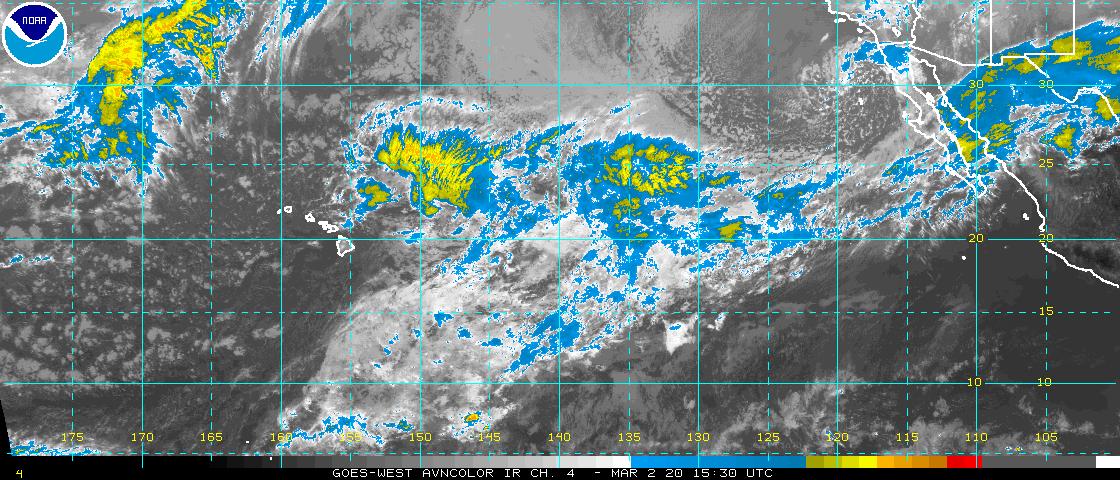
Satellite and Radar Images: To view the cloud conditions we have here in Hawaii, please use the following satellite links, starting off with this Infrared Satellite Image of the islands to see all the clouds around the state during the day and night. This next image is one that gives close images of the islands only during the daytime hours, and is referred to as a Close-up visible image. This next image shows a larger view of the Pacific…giving perspective to the wider ranging cloud patterns in the Pacific Ocean. Finally, here’s a looping IR satellite image, making viewable the clouds around the islands 24 hours a day. To help you keep track of where any showers may be around the islands, here’s the latest animated radar image.
Hawaii’s Mountains – Here’s a link to the live webcam on the summit of near 14,000 foot Mauna Kea on the Big Island of Hawaii. The tallest peak on the island of Maui is the Haleakala Crater, which is near 10,000 feet in elevation. These two webcams are available during the daylight hours here in the islands…and when there’s a big moon rising just after sunset for an hour or two! Plus, during the nights and early mornings you will be able to see stars, and the sunrise too…depending upon weather conditions.
Tropical Cyclone activity in the eastern and central Pacific – Here’s the latest weather information coming out of the National Hurricane Center, covering the eastern north Pacific. You can find the latest tropical cyclone information for the central north Pacific (where Hawaii is located) by clicking on this link to the Central Pacific Hurricane Center. Here’s a tracking map covering both the eastern and central Pacific Ocean. A satellite image, which shows the entire ocean area between Hawaii and the Mexican coast…can be found here.
Aloha Paragraphs

The upper west side beaches…Maui
The trade winds were somewhat lighter Saturday, although should pick up again going into the new week ahead. These common summertime trades will blow generally in the light to moderately strong levels, although those typically windier areas will be a bit more breezy. Here’s a weather map showing the very familiar 1027 millibar high pressure system positioned to the northeast of Hawaii Saturday evening…the source of our breezy winds.
An upper level trough of low pressure is over the Aloha state now, which will keep showers in the forecast…some locally heavy. The leeward sides will remain drier than the windward sides, although a few showers will fall there at times too. There will likely be more than the ordinary clouds around, thanks to the instability of our atmosphere, under the influence of the upper trough. This trough will remain around for several more days, with those enhanced showers sticking around too.
Hurricane Carlos continues to strengthen in the eastern Pacific. It started off as a tropical depression called 04E, and quickly strengthened into tropical storm Carlos Friday. Here’s a track map showing Carlos, in relation to the Hawaiian Islands. Granted, it’s early to be talking about a tropical cyclone so far away, but if you have a chance to click on this track map, you’ll see that it will still be a hurricane as it moves into our central Pacific…around the middle of the new week ahead. Here’s a satellite image of Carlos, in relation to the Hawaiian Islands. It’s that orangish/reddish swirl far to the east-southeast, towards Mexico. It’s too early to know just what, if any, influence that this tropical cyclone may have on our Hawaiian Islands late next week. The good thing is that there may be enough shearing, those strong upper level winds in the area of the islands…that the storm could weaken when it approaches our islands more closely.
I went to see a new film Friday evening after work in Kihei. I’ve been looking forward to seeing Public Enemies (2009), this new film starring Johnny Depp and Christian Bale, among others, for quite a while. Johnny Depp plays a notorious depression-era gangster named John Dillinger…whose charismatic crime spree made him a folk hero to the masses. The critics are giving this film a B grade, while viewers are rising that to a B+…which was definitely good enough to draw me in! I found the film to be thoroughly entertaining, although it did have quite a bit of killing going on. I would give this film a high grade of at least a strong B, and could recommend it those folks who have the stomach for this kind of film. Here’s a trailer…take it for a spin if you’re interested.
It’s Saturday evening here in Kula, Maui, as I begin writing this last paragraph of this morning’s narrative. Looking out the windows of my weather tower now, at around 530pm, I see lots of clouds in all directions. If we glance at this looping radar image, we see that there are more than the usual amount of showers in the area. The bulk of these will take aim on the windward sides during the nights, but there will be some falling elsewhere as well. The leeward beaches will have the best chance of seeing sunshine, especially during the morning hours. It rained lightly here in Kula Saturday afternoon, but as I drove over to Paia to do some shopping, I ran through sections of the road where heavy rains were falling. I’ll come back online again Sunday morning, when I’ll have your next new weather narrative ready for the reading. I hope you have a great Saturday night until then! Aloha for now…Glenn.
Interesting: The Indian government has dramatically reduced water supplies in Mumbai. Water supplies have been reduced by 30% in Mumbai, as the region faces the worst drought in History. Homes, hotels and hospitals are surviving on extremely short water supplies due to the late arrival of the Monsoon rain.
Monsoon rain arrived later than normal to the region, and many of the major lakes rely solely on the Monsoon rain. This year so far the amount of rainfall is around 25% of what would normally have fallen by this time of year.
Mumbai is India’s most populated city with around 20 million people, and it’s a commercial film-making hub. Many of the inhabitants have never seen these measures being implemented.
Meteorologist Matt Keife explained that although the monsoonal moisture has moved into the region the rains are intermittent. There have been only a few days with significant rainfall. The lakes will suffer if they recede more due to the lack of heavy rain.
In many areas of the state of Maharashtra, there has been only 25% of the rainfall received compared to 2008. The residents are Mumbai are concerned that they will have to turn to private water companies as the wells feeding the city are below average levels.
Mumbai residents have been urged to use water sparingly as there may only be enough water for three more weeks in one lake. There are another two lakes which hold enough for a sparingly two-month use. Water is being given to each household for only two hours per day, so many people are waking up at the crack of dawn to shower.
Interesting2: International climate talks held in Italy this week ended with little progress. The rich industrial nations wouldn’t promise to cut back their emissions in the near term. And China, India and the rest of the developing world wouldn’t commit to cutting their emissions, ever.
All nations of the world need to act to reduce the risk of a climate catastrophe. But so far, there’s much more posturing than action. China argues that the United States and other rich nations put most of the carbon dioxide into the atmosphere, so they need to act first and most aggressively.
They demand that those nations slash their carbon dioxide emissions by a staggering 40 percent — in just 10 years. "Well, it’s obviously a totally unrealistic position, and it is not just the Chinese, it is the developing countries in general," says Eileen Claussen, president of the Pew Center on Global Climate Change, who was once a diplomat.
She regards this demand as little more than an over-the-top bargaining tactic. "I think, honestly, that doesn’t work, and it does create a backlash, because people think that they’re just not serious." But, Claussen says, China actually is serious about climate change.
The government believes it’s a real risk. But the country also feels it can’t wean itself from cheap fossil fuels just yet. Ken Lieberthal of the Brookings Institution says China is still struggling to pull hundreds of millions of people out of poverty.
Interesting3: Like most thoroughfares in booming cities of the developing world, Bogotá’s Seventh Avenue resembles a noisy, exhaust-coated parking lot — a gluey tangle of cars and the rickety, smoke-puffing private minibuses that have long provided transportation for the masses. But a few blocks away, sleek red vehicles full of commuters speed down the four center lanes of Avenida de las Américas. The long, segmented, low-emission buses are part of a novel public transportation system called bus rapid transit, or B.R.T.
It is more like an above-ground subway than a collection of bus routes, with seven intersecting lines, enclosed stations that are entered through turnstiles with the swipe of a fare card and coaches that feel like trams inside. Versions of these systems are being planned or built in dozens of developing cities around the world — Mexico City, Cape Town, Jakarta, Indonesia, and Ahmedabad, India, to name a few — providing public transportation that improves traffic flow and reduces smog at a fraction of the cost of building a subway.
Interesting4: Some cold medicines will shave a day off your suffering from the common cold, but they often produce unpleasant side effects. A new study shows, for the first time, that the doctor’s empathy may be an even better way to speed recovery.
People recover from the common cold faster if they believe their doctor shows greater compassion toward their illness, according to a University of Wisconsin School of Medicine and Public Health study, published in the July issue of Family Medicine.
The study, conducted in primary care clinics in southern Wisconsin, involved 350 participants who had one of three types of encounters with doctors: no interaction at all, a standard encounter with discussion of medical history and present illness, or an advanced interaction where the doctor asked more questions and seemed to show more concern for the patient.
Patients then rated doctors on a questionnaire which asked if the doctor made them feel at ease, allowed them to tell their story, listened to what they had to say, understood their concerns, acted positive, explained things clearly, helped them take control, and helped them create a plan of action.
Interesting5: Children and adults who build castles and dig in the sand at the beach are at greater risk of developing gastrointestinal diseases and diarrhea than people who only walk on the shore or swim in the surf, according to researchers from the University of North Carolina at Chapel Hill and the Environmental Protection Agency. People who playfully bury their bodies in the sand are at even greater risk, according to the study published online recently in the American Journal of Epidemiology.
It also shows children, who are more likely than adults to play with and possibly get sand in their mouths, stand the greatest chance of becoming ill after a day at the beach.
“Beach sand can contain indicators of fecal contamination, but we haven’t understood what that means for people playing in the sand,” said Chris Heaney, Ph.D., a postdoctoral epidemiology student at UNC’s Gillings School of Global Public Health and lead author of the study.
“This is one of the first studies to show an association between specific sand contact activities and illnesses.” The study is based on interviews with more than 27,000 people who visited seven freshwater and marine beaches in the agency’s National Epidemiological and Environmental Assessment of Recreational Water Study (NEEAR) between 2003 and 2005 as well as in 2007.
All beaches in the study had sewage treatment plant discharges within seven miles, although the source of sand pollution was unknown and could have included urban runoff as well as wild and domestic animal contamination. Water quality at the beaches was within acceptable limits, Heaney said.
“We have known for some time that swimming in waters polluted by fecal contamination can result in illness, but few previous studies have focused on sand,” said Tim Wade, Ph.D., an EPA epidemiologist and the study’s senior author.
“People should not be discouraged from enjoying sand at the beach, but should take care to use a hand sanitizer or wash their hands after playing in the sand.” People were asked about their contact with sand on the day they visited the beach (digging in the sand or whether they were buried in it).
Then, 10 to 12 days later, participants were telephoned and asked questions about any health symptoms they had experienced since the visit. Researchers found evidence of gastrointestinal illnesses, upper respiratory illnesses, rash, eye ailments, earache and infected cuts.
Diarrhea and other gastrointestinal illnesses were more common in about 13 percent of people who reported digging in sand, and in about 23 percent of those who reported being buried in sand. “A lot of people spend time at the beach, especially in the summer,” Heaney said.
“And while we found that only a small percentage of people who played at the beach became ill later – less than 10 percent in any age group, for any amount of exposure – it’s important to look at the situation more closely.
If we find evidence that shows exposure to sand really does lead to illness, then we can look for the sources of contamination and minimize it. That will make a day at the beach a little less risky.”
Posted by Glenn
No Comments
July 10-11, 2009
Air Temperatures – The following maximum temperatures were recorded across the state of Hawaii Friday afternoon:
Lihue, Kauai – 84
Honolulu, Oahu – 88
Kaneohe, Oahu – 82
Kahului, Maui – 85
Hilo, Hawaii – 83
Kailua-kona – 85
Air Temperatures ranged between these warmest and coolest spots near sea level – and on the highest mountains…at 5 p.m. Friday evening:
Port Allen, Kauai – 86F
Hilo, Hawaii – 73
Haleakala Crater – 48 (near 10,000 feet on Maui)
Mauna Kea summit – 43 (near 14,000 feet on the Big Island)
Precipitation Totals – The following numbers represent the largest precipitation totals (inches) during the last 24 hours on each of the major islands, as of Friday afternoon:
0.66 Mount Waialaele, Kauai
0.23 Wheeler Field, Oahu
0.06 Molokai
0.00 Lanai
0.00 Kahoolawe
1.57 Hana airport, Maui
0.76 Pahoa, Big Island
Marine Winds – Here’s the latest (automatically updated) weather map showing a 1028 millibar high pressure system to the northeast of the islands. This high pressure cell, with its associated high pressure ridge, will keep the trade winds blowing through Sunday.
Satellite and Radar Images: To view the cloud conditions we have here in Hawaii, please use the following satellite links, starting off with this Infrared Satellite Image of the islands to see all the clouds around the state during the day and night. This next image is one that gives close images of the islands only during the daytime hours, and is referred to as a Close-up visible image. This next image shows a larger view of the Pacific…giving perspective to the wider ranging cloud patterns in the Pacific Ocean. Finally, here’s a looping IR satellite image, making viewable the clouds around the islands 24 hours a day. To help you keep track of where any showers may be around the islands, here’s the latest animated radar image.
Hawaii’s Mountains – Here’s a link to the live webcam on the summit of near 14,000 foot Mauna Kea on the Big Island of Hawaii. The tallest peak on the island of Maui is the Haleakala Crater, which is near 10,000 feet in elevation. These two webcams are available during the daylight hours here in the islands…and when there’s a big moon rising just after sunset for an hour or two! Plus, during the nights and early mornings you will be able to see stars, and the sunrise too…depending upon weather conditions.
Tropical Cyclone activity in the eastern and central Pacific – Here’s the latest weather information coming out of the National Hurricane Center, covering the eastern north Pacific. You can find the latest tropical cyclone information for the central north Pacific (where Hawaii is located) by clicking on this link to the Central Pacific Hurricane Center. Here’s a tracking map covering both the eastern and central Pacific Ocean. A satellite image, which shows the entire ocean area between Hawaii and the Mexican coast…can be found here.
Aloha Paragraphs

The end of another good work week
Persistent trade winds remaining active through the weekend…into the beginning of the new week ahead. These common summertime trades will blow generally in the moderately strong levels, although those typically windier areas from the Big Island on up to Oahu…will be a bit more blustery. Here’s a weather map showing the very familiar 1028 millibar high pressure system positioned to the northeast of Hawaii Friday evening…the source of our breezy winds.
Showers carried in by these gusty trade winds will spill along the windward sides…becoming a bit more frequent and heavier this weekend. The leeward sides will remain mostly dry, although a few showers may be carried over into those areas by the trade winds at times too. We find what looks to be the tail-end of the latest high cirrus clouds coming up from the deeper tropics….especially over the south part of the state. As these high clouds move away, we should see lots of sunshine available along our leeward beaches this weekend.
We have a new tropical cyclone that’s swirling in the eastern Pacific Friday. It started off as a tropical depression called 04E, and quickly strengthened into tropical storm Carlos. Here’s a track map showing Carlos, in relation to the Hawaiian Islands. Granted, it’s early to be talking about a tropical cyclone so far away, but if you have a chance to click on this track map, you’ll see that it will be a hurricane as it approaches the border (140W longitude) between the eastern, and our central Pacific later next week. Here’s a satellite image of Carlos, in relation to the Hawaiian Islands. It’s that orangish/reddish swirl far over to the east-southeast…straddling the 10N line of latitude, at about 115W longitude. The best thing that could happen here would be for this tropical system to move by to the south of the islands. Maybe the northern fringe of the system would bring some much needed rainfall to our islands.
Since the work week is over now, I’ll be going to see a new film this evening. I’ve been looking forward to seeing Public Enemies (2009), the new film starring Johnny Depp and Christian Bale, for quite a while. Johnny Depp plays a notorious depression-era gangster named John Dillinger…whose charismatic crime spree made him a folk hero to the masses. The critics are giving this film a strong B grade, while the viewers are rising that to a B+…which is definitely good enough to draw me in! Here’s a trailer for this film, take a look if you have an interest…it’s pretty cool I must admit!
Rather than going to see this film in Kahului, I’m going to go again, like I did last week, to the theater in Kihei. Speaking of which, looking out the window before I leave, it’s still windy out there, as it was pretty much all day. The ocean offshore from Kihei was all frothed-up with white caps this afternoon when I was down that way for my lunch. I’ll be back Saturday morning with your next new weather narrative from paradise. I hope you have a simply lovely Friday night wherever you happen to be spending it! Aloha for now…Glenn.
Interesting: The Indian government has dramatically reduced water supplies in Mumbai. Water supplies have been reduced by 30% in Mumbai, as the region faces the worst drought in History. Homes, hotels and hospitals are surviving on extremely short water supplies due to the late arrival of the Monsoon rain.
Monsoon rain arrived later than normal to the region, and many of the major lakes rely solely on the Monsoon rain. This year so far the amount of rainfall is around 25% of what would normally have fallen by this time of year.
Mumbai is India’s most populated city with around 20 million people, and it’s a commercial film-making hub. Many of the inhabitants have never seen these measures being implemented.
Meteorologist Matt Keife explained that although the monsoonal moisture has moved into the region the rains are intermittent. There have been only a few days with significant rainfall. The lakes will suffer if they recede more due to the lack of heavy rain.
In many areas of the state of Maharashtra, there has been only 25% of the rainfall received compared to 2008. The residents are Mumbai are concerned that they will have to turn to private water companies as the wells feeding the city are below average levels.
Mumbai residents have been urged to use water sparingly as there may only be enough water for three more weeks in one lake. There are another two lakes which hold enough for a sparingly two-month use. Water is being given to each household for only two hours per day, so many people are waking up at the crack of dawn to shower.
Interesting2: International climate talks held in Italy this week ended with little progress. The rich industrial nations wouldn’t promise to cut back their emissions in the near term. And China, India and the rest of the developing world wouldn’t commit to cutting their emissions, ever.
All nations of the world need to act to reduce the risk of a climate catastrophe. But so far, there’s much more posturing than action. China argues that the United States and other rich nations put most of the carbon dioxide into the atmosphere, so they need to act first and most aggressively.
They demand that those nations slash their carbon dioxide emissions by a staggering 40 percent — in just 10 years. "Well, it’s obviously a totally unrealistic position, and it is not just the Chinese, it is the developing countries in general," says Eileen Claussen, president of the Pew Center on Global Climate Change, who was once a diplomat.
She regards this demand as little more than an over-the-top bargaining tactic. "I think, honestly, that doesn’t work, and it does create a backlash, because people think that they’re just not serious." But, Claussen says, China actually is serious about climate change.
The government believes it’s a real risk. But the country also feels it can’t wean itself from cheap fossil fuels just yet. Ken Lieberthal of the Brookings Institution says China is still struggling to pull hundreds of millions of people out of poverty.
Interesting3: Like most thoroughfares in booming cities of the developing world, Bogotá’s Seventh Avenue resembles a noisy, exhaust-coated parking lot — a gluey tangle of cars and the rickety, smoke-puffing private minibuses that have long provided transportation for the masses. But a few blocks away, sleek red vehicles full of commuters speed down the four center lanes of Avenida de las Américas. The long, segmented, low-emission buses are part of a novel public transportation system called bus rapid transit, or B.R.T.
It is more like an above-ground subway than a collection of bus routes, with seven intersecting lines, enclosed stations that are entered through turnstiles with the swipe of a fare card and coaches that feel like trams inside. Versions of these systems are being planned or built in dozens of developing cities around the world — Mexico City, Cape Town, Jakarta, Indonesia, and Ahmedabad, India, to name a few — providing public transportation that improves traffic flow and reduces smog at a fraction of the cost of building a subway.
Interesting4: Some cold medicines will shave a day off your suffering from the common cold, but they often produce unpleasant side effects. A new study shows, for the first time, that the doctor’s empathy may be an even better way to speed recovery.
People recover from the common cold faster if they believe their doctor shows greater compassion toward their illness, according to a University of Wisconsin School of Medicine and Public Health study, published in the July issue of Family Medicine.
The study, conducted in primary care clinics in southern Wisconsin, involved 350 participants who had one of three types of encounters with doctors: no interaction at all, a standard encounter with discussion of medical history and present illness, or an advanced interaction where the doctor asked more questions and seemed to show more concern for the patient.
Patients then rated doctors on a questionnaire which asked if the doctor made them feel at ease, allowed them to tell their story, listened to what they had to say, understood their concerns, acted positive, explained things clearly, helped them take control, and helped them create a plan of action.
Interesting5: Children and adults who build castles and dig in the sand at the beach are at greater risk of developing gastrointestinal diseases and diarrhea than people who only walk on the shore or swim in the surf, according to researchers from the University of North Carolina at Chapel Hill and the Environmental Protection Agency. People who playfully bury their bodies in the sand are at even greater risk, according to the study published online recently in the American Journal of Epidemiology.
It also shows children, who are more likely than adults to play with and possibly get sand in their mouths, stand the greatest chance of becoming ill after a day at the beach.
“Beach sand can contain indicators of fecal contamination, but we haven’t understood what that means for people playing in the sand,” said Chris Heaney, Ph.D., a postdoctoral epidemiology student at UNC’s Gillings School of Global Public Health and lead author of the study.
“This is one of the first studies to show an association between specific sand contact activities and illnesses.” The study is based on interviews with more than 27,000 people who visited seven freshwater and marine beaches in the agency’s National Epidemiological and Environmental Assessment of Recreational Water Study (NEEAR) between 2003 and 2005 as well as in 2007.
All beaches in the study had sewage treatment plant discharges within seven miles, although the source of sand pollution was unknown and could have included urban runoff as well as wild and domestic animal contamination. Water quality at the beaches was within acceptable limits, Heaney said.
“We have known for some time that swimming in waters polluted by fecal contamination can result in illness, but few previous studies have focused on sand,” said Tim Wade, Ph.D., an EPA epidemiologist and the study’s senior author.
“People should not be discouraged from enjoying sand at the beach, but should take care to use a hand sanitizer or wash their hands after playing in the sand.” People were asked about their contact with sand on the day they visited the beach (digging in the sand or whether they were buried in it).
Then, 10 to 12 days later, participants were telephoned and asked questions about any health symptoms they had experienced since the visit. Researchers found evidence of gastrointestinal illnesses, upper respiratory illnesses, rash, eye ailments, earache and infected cuts.
Diarrhea and other gastrointestinal illnesses were more common in about 13 percent of people who reported digging in sand, and in about 23 percent of those who reported being buried in sand. “A lot of people spend time at the beach, especially in the summer,” Heaney said.
“And while we found that only a small percentage of people who played at the beach became ill later – less than 10 percent in any age group, for any amount of exposure – it’s important to look at the situation more closely.
If we find evidence that shows exposure to sand really does lead to illness, then we can look for the sources of contamination and minimize it. That will make a day at the beach a little less risky.”
Posted by Glenn
No Comments
July 9-10, 2009
Air Temperatures – The following maximum temperatures were recorded across the state of Hawaii Thursday afternoon:
Lihue, Kauai – 83
Honolulu, Oahu – 87
Kaneohe, Oahu – 82
Kahului, Maui – 87
Hilo, Hawaii – 84
Kailua-kona – 86
Air Temperatures ranged between these warmest and coolest spots near sea level – and on the highest mountains…at 5 p.m. Thursday evening:
Barking Sands, Kauai – 86F
Molokai airport – 77
Haleakala Crater – 54 (near 10,000 feet on Maui)
Mauna Kea summit – 41 (near 14,000 feet on the Big Island)
Precipitation Totals – The following numbers represent the largest precipitation totals (inches) during the last 24 hours on each of the major islands, as of Thursday afternoon:
0.53 Mount Waialaele, Kauai
0.25 South Fork Kaukonahua, Oahu
0.03 Molokai
0.00 Lanai
0.00 Kahoolawe
0.49 Puu Kukui, Maui
1.03 Mountain View, Big Island
Marine Winds – Here’s the latest (automatically updated) weather map showing a 1027 millibar high pressure system to the northeast of the islands. This high pressure cell, with its associated high pressure ridge, will keep the trade winds blowing through Saturday.
Satellite and Radar Images: To view the cloud conditions we have here in Hawaii, please use the following satellite links, starting off with this Infrared Satellite Image of the islands to see all the clouds around the state during the day and night. This next image is one that gives close images of the islands only during the daytime hours, and is referred to as a Close-up visible image. This next image shows a larger view of the Pacific…giving perspective to the wider ranging cloud patterns in the Pacific Ocean. Finally, here’s a looping IR satellite image, making viewable the clouds around the islands 24 hours a day. To help you keep track of where any showers may be around the islands, here’s the latest animated radar image.
Hawaii’s Mountains – Here’s a link to the live webcam on the summit of near 14,000 foot Mauna Kea on the Big Island of Hawaii. The tallest peak on the island of Maui is the Haleakala Crater, which is near 10,000 feet in elevation. These two webcams are available during the daylight hours here in the islands…and when there’s a big moon rising just after sunset for an hour or two! Plus, during the nights and early mornings you will be able to see stars, and the sunrise too…depending upon weather conditions.
Tropical Cyclone activity in the eastern and central Pacific – Here’s the latest weather information coming out of the National Hurricane Center, covering the eastern north Pacific. You can find the latest tropical cyclone information for the central north Pacific (where Hawaii is located) by clicking on this link to the Central Pacific Hurricane Center. Here’s a tracking map covering both the eastern and central Pacific Ocean. A satellite image, which shows the entire ocean area between Hawaii and the Mexican coast…can be found here.
Aloha Paragraphs

Hanalei Beach…on Kauai
There’s still no end in sight for our blustery trade winds, we could almost say…never ending. These common trades will blow generally in the moderately strong levels, although those typically windier areas from the Big Island on up towards Oahu…will be a bit more blustery. Here’s a weather map showing the very familiar 1028 millibar high pressure system positioned to the northeast of Hawaii Thursday evening…the source of our breezy winds.
There’s nothing unusual about this common July rainfall pattern, with most of the showers falling along the windward sides. Some of those windward biased showers will be briefly heavy, but shortlived. The leeward sides in contrast will remain mostly dry, with warm to very warm daytime temperatures prevailing. We may see an increase in showers towards the upcoming weekend, when they may gain some intensity…especially on the windward sides.
It’s Thursday evening here in Kihei, Maui, as I begin writing this last part of this afternoon’s narrative. What else is there to say about this long lasting trade wind pattern…other than that it’s near perfect I suppose! Some of the windward beaches are pretty gusty, with the ocean surface just offshore…literally filled with countless white caps. Most of the leeward beaches in contrast, typically somewhat more protected from the wind flow, are very nice these days. The surf is down, actually near flat, in many of those south and west facing leeward beaches, which is making for really nice swimming conditions now. I see no reason to believe that Friday will be any different than what we’ve seen Thursday, or Wednesday and Tuesday for that matter. ~~~ It’s that time of day when I take the drive back upcountry to Kula. Looking out the window here in Kihei before I go, I see clear to partly cloudy conditions, although it looks a bit more cloudy up on the slopes of the Halaeakala Crater, where I’m heading. That’s fine with me, as I know that pretty much as soon as the sun goes down, those afternoon clouds will collapse. I’ll catch up with you again early Friday morning, and wish you a great Thursday night until then! Aloha for now…Glenn.
Interesting: Earth’s landmasses in the late Precambrian probably weren’t pleasant, but at least they were green. A new analysis of limestone rocks lain down between 1 billion and 500 million years ago suggests that there was extensive plant life on land much earlier than previously thought. The plants were only tiny mosses and liverworts, but they would have had a profound effect on the planet.
They turned the hitherto barren Earth green, created the first soils and pumped oxygen into the atmosphere, laying the foundations for animals to evolve in the Cambrian explosion that started 542 million years ago. It was already known from genetic evidence that mosses and liverworts probably evolved around 700 million years ago, but up till now there was little sign that they had colonized land to any great extent.
The assumption was that terrestrial life consisted of patchy bacterial mats and "algal scum" until the mid-Ordovician, 475 million years ago, when land was first invaded by modern-looking vascular plants. Paul Knauth of Arizona State University and Martin Kennedy of the University of California, Riverside, examined the chemical composition of all known lime stones dating from the Neoproterozoic era, which stretched from 1 billion years ago up to the start of the Cambrian. Knauth says the balance of carbon-12 to oxygen-18 in the lime stones is "screaming" that they were laid down in shallow seas that received extensive rainwater run-off from a land surface thick with vegetation.
Interesting2: Tire manufacturer Yokohama is now selling a model made with 80 percent non-petroleum material, substituting orange oil as the primary ingredient to make vulcanized rubber. The new tire is called the Super E-spec™ and has already received the Popular Mechanics Editor’s Choice Award in 2008. Yokohama will initially market the tire for hybrid car models such as the Toyota Prius.
"The eco-focused dB Super E-spec mixes sustainable orange oil and natural rubber to drastically cut the use of petroleum, without compromising performance," Yokohama vice president of sales Dan King said. "It also helps consumers save money at the gas pump by improving fuel efficiency via a 20-percent reduction in rolling resistance."
Orange oil is considered sustainable because it is produced from a renewable resource. The same philosophy of reducing petroleum use is utilized in producing plastics from corn starch or vegetable oil. Yokohama has yet to release the environmental impact of disposing these tires, which typically provides an environmental concern.
The petroleum in traditional tires can burn for months in a landfill and is difficult to extinguish. These fires also release black smoke and toxins into the air. Yokohama has not specified whether the orange oil will biodegrade over time.
The process for recycling tires involves devulcanizing the rubber, which would essentially remove the oil and extract natural rubber. Because this is an expensive process, used tires are often shredded and turned into playground surfacing or additives for the soil in sports turf. It can also be reused as artwork.
Interesting3: The giant monoliths of Easter Island are worn, but they have endured for centuries. New research suggests that a compound first discovered in the soil of the South Pacific island might help us stand the test of time, too. On July 8, in the journal Nature, The University of Texas Health Science Center at San Antonio and two collaborating centers reported that the Easter Island compound – called "rapamycin" after the island’s Polynesian name, Rapa Nui – extended the expected lifespan of middle-aged mice by 28 percent to 38 percent.
In human terms, this would be greater than the predicted increase in extra years of life if cancer and heart disease were both cured and prevented. The rapamycin was given to the mice at an age equivalent to 60 years old in humans. The studies are part of the National Institute on Aging (NIA) Interventions Testing Program, which seeks compounds that might help people remain active and disease-free throughout their lives.
The other two centers involved are the University of Michigan at Ann Arbor and Jackson Laboratory in Bar Harbor, Maine. The Texas study was led by scientists at two institutes at the UT Health Science Center: the Institute of Biotechnology (IBT) and the Barshop Institute for Longevity and Aging Studies.
"I’ve been in aging research for 35 years and there have been many so-called ‘anti-aging’ interventions over those years that were never successful," said Arlan G. Richardson, Ph.D., director of the Barshop Institute. "I never thought we would find an anti-aging pill for people in my lifetime; however, rapamycin shows a great deal of promise to do just that.
Interesting4: US scientists say that the El Nino warming trend of the Pacific Ocean waters has returned, bringing with it almost certain changes in weather patterns around the world. The El Nino climatological effect – the periodic warming of central and eastern tropical Pacific waters – occurs on average every two to five years and typically lasts about 12 months.
The US National Oceanic and Atmospheric Administration said the current El Nino was likely to develop further during the next several months, with additional strengthening possible and is expected to last through early 2010. In past years, El Nino has been known to suppress Atlantic hurricane activity and typically brings beneficial winter rain to the arid US southwest.
But the weather system also often brings damaging winter storms in California and turbulent weather across the southern United States. El Nino also has been associated with severe flooding and mudslides in Central and South America, and drought in Indonesia.
Jane Lubchenco, US undersecretary of commerce for oceans and atmosphere and NOAA administrator, said the agency plans to provide frequent updates to "industries, governments and emergency managers about weather conditions El Nino may bring, so these can be factored into decision-making and ultimately protect life, property and the economy".
Posted by Glenn
No Comments
July 8-9, 2009
Air Temperatures – The following maximum temperatures were recorded across the state of Hawaii Wednesday afternoon:
Lihue, Kauai – 84
Honolulu, Oahu – 87
Kaneohe, Oahu – 83
Kahului, Maui – 85
Hilo, Hawaii – 79
Kailua-kona – 86
Air Temperatures ranged between these warmest and coolest spots near sea level – and on the highest mountains…at 5 p.m. Wednesday evening:
Barking Sands, Kauai – 88F
Princeville, Kauai – 81
Haleakala Crater – 59 (near 10,000 feet on Maui)
Mauna Kea summit – 41 (near 14,000 feet on the Big Island)
Precipitation Totals – The following numbers represent the largest precipitation totals (inches) during the last 24 hours on each of the major islands, as of Wednesday afternoon:
0.28 Mount Waialaele, Kauai
0.33 Manoa Valley, Oahu
0.03 Molokai
0.00 Lanai
0.00 Kahoolawe
0.44 West Wailuaiki, Maui
0.48 Piihonua, Big Island
Marine Winds – Here’s the latest (automatically updated) weather map showing a 1028 millibar high pressure system to the northeast of the islands. This high pressure cell, with its associated high pressure ridge, will keep the trade winds blowing through Friday.
Satellite and Radar Images: To view the cloud conditions we have here in Hawaii, please use the following satellite links, starting off with this Infrared Satellite Image of the islands to see all the clouds around the state during the day and night. This next image is one that gives close images of the islands only during the daytime hours, and is referred to as a Close-up visible image. This next image shows a larger view of the Pacific…giving perspective to the wider ranging cloud patterns in the Pacific Ocean. Finally, here’s a looping IR satellite image, making viewable the clouds around the islands 24 hours a day. To help you keep track of where any showers may be around the islands, here’s the latest animated radar image.
Hawaii’s Mountains – Here’s a link to the live webcam on the summit of near 14,000 foot Mauna Kea on the Big Island of Hawaii. The tallest peak on the island of Maui is the Haleakala Crater, which is near 10,000 feet in elevation. These two webcams are available during the daylight hours here in the islands…and when there’s a big moon rising just after sunset for an hour or two! Plus, during the nights and early mornings you will be able to see stars, and the sunrise too…depending upon weather conditions.
Tropical Cyclone activity in the eastern and central Pacific – Here’s the latest weather information coming out of the National Hurricane Center, covering the eastern north Pacific. You can find the latest tropical cyclone information for the central north Pacific (where Hawaii is located) by clicking on this link to the Central Pacific Hurricane Center. Here’s a tracking map covering both the eastern and central Pacific Ocean. A satellite image, which shows the entire ocean area between Hawaii and the Mexican coast…can be found here.
Aloha Paragraphs

The upper west side…Maui
High pressure to our north-northeast, will keep the trade winds alive through the rest of this week…into next week. These common trades will blow in the moderately strong category, although those typically windier areas, and especially around Maui and the Big Island…will be a bit more blustery. Here’s a weather map showing the familiar 1029 millibar high pressure system anchored to the north-northeast of Hawaii Wednesday evening…the source of our breezy winds.
The windward sides will find the bulk of whatever showers that fall…leaving the leeward sides generally dry and warm. Some of those windward showers will be briefly heavy, but as they move quickly along in the trade wind flow, will end quickly. The leeward sides in contrast, will remain mostly dry, with warm to very warm daytime temperatures prevailing. We can see a fair amount of low clouds out over the oceans offshore from the islands, by glancing at this IR satellite image. We may see an increase in showers towards the upcoming weekend…especially on the windward sides.
The third tropical cyclone of the year remains active over in the eastern Pacific…called tropical cyclone Blanca. This storm won’t have any influence here in the islands however…just the way we like it. Here’s a tracking map, which shows it heading west…but it will dissipate well before getting anywhere near us. Here’s a satellite image giving a good perspective of how far away Blanca is from our Hawaiian islands Wednesday. Blanca has recently weakened into a tropical depression, losing strength from the recent tropical storm designation.
It’s Wednesday evening here in Kihei, Maui, as I begin writing this last part of today’s narrative. Wednesday was yet another great day, which is very common during our summer season…here in the tropics. As a result, with all that sunshine beaming down, Honolulu zoomed up to 87 degrees this afternoon. The trade winds blew rather strongly once again today, with a gust at around 5pm still topping out at 40 mph at Maalaea Bay, on Maui. Just behind that top gust, South Point, that southern most place in the islands, on the Big Island…had a gust of 39 mph. Looking out the window here in Kihei, before I take the drive back home upcountry, I see mostly sunny skies in all directions. Even the windward sides are uncharacteristically cloud free. ~~~ I’ll be back early Thursday morning with your next new weather narrative from paradise. I hope you have a great Wednesday night until then! Aloha for now…Glenn.
Interesting: Synthetic fertilizers have dramatically increased food production worldwide. But the unintended costs to the environment and human health have been substantial. Nitrogen runoff from farms has contaminated surface and groundwater and helped create massive "dead zones" in coastal areas, such as the Gulf of Mexico. And ammonia from fertilized cropland has become a major source of air pollution, while emissions of nitrous oxide form a potent greenhouse gas.
These and other negative environmental impacts have led some researchers and policymakers to call for reductions in the use of synthetic fertilizers. But in a report published in the June 19 issue of the journal Science, an international team of ecologists and agricultural experts warns against a "one-size-fits-all" approach to managing global food production.
"Most agricultural systems follow a trajectory from too little in the way of added nutrients to too much, and both extremes have substantial human and environmental costs," said lead author Peter Vitousek, a professor of biology at Stanford University and senior fellow at Stanford’s Woods Institute for the Environment.
"Some parts of the world, including much of China, use far too much fertilizer," Vitousek said. "But in sub-Saharan Africa, where 250 million people remain chronically malnourished, nitrogen, phosphorus and other nutrient inputs are inadequate to maintain soil fertility."
Interesting2: One fine day about 74,000 years ago, a giant volcano on Sumatra blew its top. The volcano named Toba, may have ejected 1000 times more rock and other material than Mount St. Helens in Washington state did in 1980. In the process, it cooled the climate by at least 10°C, causing a global famine. But could the aftermath have been even worse?
A new study puts to rest questions about whether Toba plunged Earth into a 1000-year deep freeze and whether an equivalent event today could jump-start a new, millennium-long ice age. Giant volcanic eruptions such as Toba briefly cause the opposite of global warming.
Although eruptions do emit greenhouse gases such as carbon dioxide, volcanoes also spew sulfur dioxide. Combined with water vapor, sulfur dioxide forms sulfate aerosols, which can spread around the globe, blocking solar radiation and chilling the air before becoming acid rain and snow.
Paleoclimate evidence suggests that the Toba eruption, which occurred during the last ice age, emitted lots of sulfur dioxide–vastly more than Mount St. Helens did. The eruption also seems to have coincided with the start of a 1000-year period of even colder temperatures.
Some scientists have suggested that Toba caused the deep freeze and that perhaps such an event happening today could bring on a new ice age. But models developed by NASA and the National Center for Atmospheric Research in Boulder, Colorado, argue otherwise.
Interesting3: The United States-Mexico border fence may block more wildlife border crossings than people crossings. The already limited populations of pygmy owls and bighorn sheep will likely be among those further threatened by the fence, says a new study.
"In some respects, it’s as obvious as the nose on your face: If you put up a 20-foot chunk of steel, things probably aren’t going to move across it, but we have to show it," said Paul Beier of Northern Arizona University in Flagstaff, who was not a part of the study.
"It’s kind of a shame that we need to prove the obvious, but we do. So this is an important paper in that regard." Since the U.S. government authorized construction of a fence along 700 miles of the border between the U.S. and Mexico in 2006, scientists have raised concerns that a person-tight fence would also exclude many species that rely on habitat on either side of the border. The new research suggests such concerns are valid.
Interesting4: The Amazon River and its current lengthy and transcontinental bed is about 11 million years old, according to a new study. Previously, the river’s exact age was unknown, researchers say. The Amazon, which starts in the Andes and flows easterly into the Atlantic Ocean, originated as a transcontinental river back in the Miocene Epoch between 11.8 million and 11.3 million years ago, and took its present shape about 2.4 million years ago, according to the study by Carina Hoorn of the University of Amsterdam, Jorge Figueiredo of the University of Liverpool, England, and colleagues. The new estimate won’t set any age records for rivers.
Earth’s oldest rivers are hundreds of millions of years old. In fact, while the Amazon is said by some to be Earth’s longest river, it is "quite a youngster among rivers," Hoorn told LiveScience. "For comparison, the New River in North America and the Nile in Africa are thought to be several hundred million years old. The reason for this is that rivers are controlled by their source area. Rivers are as old as the mountains in the hinterlands, one could say.
The Andes uplifted mostly in the past 12 million years and hence the formation and shifting of drainage patterns." The research, published in the July issue of the journal Geology, was undertaken by Petrobras, the national oil company of Brazil, in cooperation with the University of Amsterdam. The whole history of the fluvial drainage system that eventually became the transcontinental Amazon River that we know today is older than 11 million years, Figueiredo said.
The new estimate dates only the onset of the Amazon as a transcontinental river. A "proto-river" flowed much earlier in geologic time, but only on the eastern part of the Amazon Region, Figueiredo said. A more ancient predecessor to the Amazon actually flowed backward at times, from east to west, according to one unpublished study. The current study focused on samples taken from two boreholes drilled by Petrobras near the mouth of the Amazon.
One of the boreholes was 2.6 miles below sea level. Until recently, the Amazon Fan, a sediment column of around 6 miles thick, was difficult to age based on the jumble of local rocks, and scientific drilling expeditions could only reach a fraction of it, Hoorn said. The new analysis of the borehole samples allowed the researchers to reconstruct the history of the Amazon River, and provides insights into the history of the river and the fan.
This research also has implications for understandings of South American paleogeography and the evolution of aquatic organisms in Amazonia and the Atlantic coast, Hoorn said. Sediment aprons in the proximity of major rivers often hold continuous records of terrestrial material accumulated by the river over time, she said. These records can provide insights into the historic climate and geography of the land.
Posted by Glenn
[2] Comments
July 7-8, 2009
Air Temperatures – The following maximum temperatures were recorded across the state of Hawaii Tuesday afternoon:
Lihue, Kauai – 84
Honolulu, Oahu – 87
Kaneohe, Oahu – 83
Kahului, Maui – 85
Hilo, Hawaii – 80
Kailua-kona – 84
Air Temperatures ranged between these warmest and coolest spots near sea level – and on the highest mountains…at 4 p.m. Tuesday afternoon:
Port Allen, Kauai – 86F
Hilo, Hawaii – 80
Haleakala Crater – 63 (near 10,000 feet on Maui)
Mauna Kea summit – 43 (near 14,000 feet on the Big Island)
Precipitation Totals – The following numbers represent the largest precipitation totals (inches) during the last 24 hours on each of the major islands, as of Tuesday afternoon:
0.45 Mount Waialaele, Kauai
0.16 Manoa Valley, Oahu
0.10 Molokai
0.00 Lanai
0.02 Kahoolawe
0.54 West Wailuaiki, Maui
0.38 Mountain View, Big Island
Marine Winds – Here’s the latest (automatically updated) weather map showing a 1031 millibar high pressure system far to the north-northeast of the islands. This high pressure cell, with its associated high pressure ridge, will keep the trade winds blowing through Thursday.
Satellite and Radar Images: To view the cloud conditions we have here in Hawaii, please use the following satellite links, starting off with this Infrared Satellite Image of the islands to see all the clouds around the state during the day and night. This next image is one that gives close images of the islands only during the daytime hours, and is referred to as a Close-up visible image. This next image shows a larger view of the Pacific…giving perspective to the wider ranging cloud patterns in the Pacific Ocean. Finally, here’s a looping IR satellite image, making viewable the clouds around the islands 24 hours a day. To help you keep track of where any showers may be around the islands, here’s the latest animated radar image.
Hawaii’s Mountains – Here’s a link to the live webcam on the summit of near 14,000 foot Mauna Kea on the Big Island of Hawaii. The tallest peak on the island of Maui is the Haleakala Crater, which is near 10,000 feet in elevation. These two webcams are available during the daylight hours here in the islands…and when there’s a big moon rising just after sunset for an hour or two! Plus, during the nights and early mornings you will be able to see stars, and the sunrise too…depending upon weather conditions.
Tropical Cyclone activity in the eastern and central Pacific – Here’s the latest weather information coming out of the National Hurricane Center, covering the eastern north Pacific. You can find the latest tropical cyclone information for the central north Pacific (where Hawaii is located) by clicking on this link to the Central Pacific Hurricane Center. Here’s a tracking map covering both the eastern and central Pacific Ocean. A satellite image, which shows the entire ocean area between Hawaii and the Mexican coast…can be found here.
Aloha Paragraphs

Full moon tonight
Trade winds, and more trade winds…a very common occurrence here in the islands during the summer season. These normal winds of summer are strong enough now, that we see small craft wind advisories in our coastal waters around Maui and the Big Island. Here’s a weather map showing the near 1030 millibar high pressure system to our north-northeast Tuesday evening…the source of our trades. As usual, they will blow strongest during the days, calming down at night in most areas.
Other than a few showers, mostly along the windward sides during the night and early morning hours…our local clouds will remain generally dry. Fairly dry conditions prevail, which isn’t unusual for this time of year. The high clouds, which have been around the last several days, providing great sunrise and sunset colors…have now drifted away. This will make for more sunny weather along our beaches through the next couple of days. Days will be warm to very warm, while nights at sea level will be warm.
The third tropical cyclone of the year remains active over in the eastern Pacific…called tropical storm Blanca. This storm won’t have any influence here in the islands however…just the way we like it. Here’s a tracking map, which shows it heading towards Hawaii…but it will dissipate well before getting anywhere near us. Here’s a satellite image giving a good perspective of how far away Blanca is from our Hawaiian islands Tuesday night.
As noted above, we’re well into the highly regular summer weather season now. This means that day after day, we will have little change in the weather conditions here in the tropics. It will come down to just a few degrees of difference in temperature, and just how strong the trade winds will be blowing. These two parameters will also include the amount of windward biased showers that may fall too. The one more dynamic element, would be any tropical cyclones that happen to bring change to us here in the Hawaiian Islands.
It’s Tuesday evening here in Kihei, Maui, as I begin writing this last part of this afternoon’s narrative. As noted above, the high cirrus clouds are gone now, at least temporarily. The trade winds remain the most pronounced weather feature, with gusty winds, especially during the afternoon hours. I noticed that once again the windy Maalaea Bay, on Maui, had a gust to 43 mph Tuesday afternoon…which is fast! At 5pm, the strongest gust was still at Maalaea, which was checking in at 37 mph. The warmest air temperature anywhere around the state, at the same time, was being being reported at Honolulu, which was still 85F degrees early in the evening. In contrast, the top of Mauna Kea, that near 14,000 summit on the Big Island…the temperature was a chilly 41 degrees at the same time.
~~~ I’m about ready to jump in the car for the drive back upcountry to Kula. I’ll take my walk, watch the sunset, eat dinner, go upstairs for some reading, and then fall asleep. Then it will be early Wednesday, when I’ll get up at around 430am, meditate, get back online to prepare the next weather narrative, and head back down to Kihei for the work day. This is my life during the week, which fortunately I enjoy very much. By the way, I just became aware of the fact that July 7th, today, is the full moon of the month…so that it will be a bright night out there! I hope you have a great Tuesday night, and that perhaps you’ll meet me back here on Wednesday for the next go around. Aloha for now…Glenn.
Interesting: Many offices, businesses and education establishments in Iran have closed for two days because of high pollution levels caused by desert storms. State television said air pollution in the capital, Tehran, had reached levels not seen for 30 years.
Visibility has been reduced to several hundred meters, while some domestic flights have been cancelled. The elderly, children and people with heart and respiratory problems have been told to stay indoors in west Iran.
"All administrative offices are closed because of the atmospheric pollution which has soared several times higher than the normal threshold," said Tehran governor Morteza Tamadon on state television.
In neighboring Iraq, officials described the last week of sandstorms as the worst in history. Hundreds of people were taken to hospital with respiratory problems. Reports say a reduction in the flow of the once-mighty Tigris and Euphrates rivers – from drought and upriver damming – has aggravated the situation.
Interesting2: Particulate air pollution during the 2008 Olympic Games in Beijing constantly exceeded levels considered excessive by the World Health Organization, was far worse than other recent Olympic Games, and was about 30 percent higher than has been reported by Chinese environmental experts – even though some favorable weather conditions helped reduce the problem. The weather, in fact, turned out to be more valuable in addressing this concern than major programs by the Chinese government to heavily restrict automobile use, close factories and slow construction during and before the Olympic games.
These findings are among the final results just published in Environmental Science and Technology, a professional journal, in the first comprehensive study of particulate air pollutants in Beijing and how they compared to past Olympics. The research was done before, during and after the 2008 Olympics by scientists from Oregon State University and Peking University, in work funded by the National Science Foundation in the United States and the National Science Foundation of China.
"Considering the massive efforts by China to reduce air pollution in and around Beijing during the Olympics, this was the largest scale atmospheric pollution experiment ever conducted," said Staci Simonich, an OSU associate professor of environmental and molecular toxicology. "Despite all that, it was some evening rains and favorable shifts in the winds that provided the most relief from the pollution.
"This demonstrates how difficult it is to solve environmental problems on a short-term, local basis," she added. And despite some favorable weather and the pollution control efforts, researchers said, the end result was some of the most severe particulate pollution that Olympic athletes have dealt with in recent games. The levels were about two to four times higher than that of Los Angeles on an average day.
Interesting3: According to the most recent report on the status of the world’s fisheries by the United Nations Food and Agriculture Organization, fisheries supply at least 15% of the animal protein consumed by humans, provide direct and indirect employment for nearly 200 million people worldwide and generate $US85 billion annually. This same report indicates that 28% of the world’s fisheries stocks are currently being overexploited or have collapsed and 52% are fully exploited.
A new study published in PLoS Biology provides the first global evaluation of how management practices influence fisheries’ sustainability. The study assessed the effectiveness of the world’s fisheries management regimes using evaluations from nearly 1,200 fisheries experts, analyzing these in combination with data on the sustainability of fisheries catches.
The results indicate that most fisheries management regimes are lagging far behind standards set by international organizations, and that the conversion of scientific advice into policy, through a participatory and transparent process, plays the most critical role in determining the sustainability of fisheries.
"The world’s fisheries are one of the most important natural assets to humankind," says lead author Camilo Mora, a Colombian researcher at Dalhousie University and the University of California San Diego. "Unfortunately, our use of the world’s fisheries has been excessive and has led to the decline or collapse of many stocks."
"The consequences of overexploiting the world’s fisheries are a concern not only for food security and socio-economic development but for ocean ecosystems," says Boris Worm, a professor at Dalhousie University and co-author of the paper. "We now recognize that overfishing can also lead to the erosion of biodiversity and ecosystem productivity."
Interesting4: A new way of processing rice husks for use in concrete could lead to a boom in green construction. Rice husks form small cases around edible kernels of rice and are rich in silicon dioxide (SiO2), an essential ingredient in concrete. Scientists have recognized the potential value of rice husks as a building material for decades, but past attempts to burn it produced an ash too contaminated with carbon to be useful as a cement substitute.
The world’s penchant for consuming concrete is a huge problem for climate change. Every ton of cement manufactured for use in concrete emits a ton of the greenhouse gas carbon dioxide (CO2) into the atmosphere. Worldwide, cement production accounts for about 5 percent of all CO2 emissions related to human activity.
Interesting5: Charlie Veron, former chief scientist of the Australian Institute of Marine Science, told The Times: "there is no way out, no loopholes. The Great Barrier Reef will be over within 20 years or so." Once carbon dioxide had hit the levels predicted for between 2030 and 2060, all coral reefs were doomed to extinction, he said.
"They would be the world’s first global ecosystem to collapse. I have the backing of every coral reef scientist, every research organization. I’ve spoken to them all. This is critical. This is reality."
Dr Veron’s comments came as the Zoological Society of London, the Royal Society and the International Program on the State of the Ocean (IPSO) held a crucial meeting on the future of coral reefs in London yesterday. In a joint statement they warned that by mid-century extinctions of coral reefs around the world would be inevitable.
Interesting6: The Sri Lankan government is threatening to jail people who do not clean up water puddles in an effort to combat a rise in cases of dengue fever. The disease is spread by mosquitoes, which breed on stagnant water. The authorities are also importing bacteria from Cuba to kill the larvae of the mosquitoes, and are spraying their breeding grounds.
The government says more than 160 people have died from dengue in 2009 – more than double last year’s figure. Dengue fever is a flu-like illness spread by the bite of an infected Aedes mosquito. The disease is most prevalent during the annual monsoons, when heavy rainfall leave puddles of stagnant water where the insects breed.
Government medical official Dr Sankalpa Marasinghe told the BBC Sinhala service that there is a sense of alarm about the disease. "This is because the mortality rate in relation to the infection rate is very high. There have been 163 deaths and 14,750 people infected this year. The spread of the disease is around Sri Lanka, not localised.
There are doubts of the strain of the virus and there could be mutations," he said. "That is why the government is taking various measures, imposing laws and regulations, to keep the environment clean and reduce mosquito breeding. There are direct interventions by the ministries of environment, health and education."
Health officials blame the spread of the disease on people’s carelessness in not properly cleaning their properties and eliminating mosquito breeding grounds. In recent weeks government inspectors have warned people in Colombo and outside the capital that they must get rid of mosquito breeding grounds within two weeks or face fines of up to 25,000 rupees ($220) or a six month jail term.
Dr Marasinghe said that the Cuban bacterium would be useful for large marshy areas. "But there is the problem of feasibility," he said, "since the majority of mosquito breeding occurs in as little as 5mm of water – such as in plant pots." Dengue fever usually begins suddenly with a high temperature, rash, severe headache, pain behind the eyes and in the muscles and joints.
The severity of the joint pain has given the disease the nickname "breakbone fever". Nausea, vomiting and loss of appetite are common. In January Austrian scientists said that people could be protected from dengue by infecting mosquitoes carrying the disease with a parasite which halves their lifespan.
They said that only older mosquitoes pass on dengue – so killing them could cut disease. Many thousands of cases of dengue fever occur worldwide each year, mainly in tropical countries.
The virus is passed to humans when mosquitoes carrying it feed on their blood, and while there have been efforts to eradicate them using insecticides, these have been fraught with problems, including the ability of the mosquito to become resistant to the chemicals used.
Interesting7: After one of the longest sunspot droughts in modern times, solar activity picked up quickly over the weekend. A new group of sunspots developed, and while not dramatic by historic standards, the spots were the most significant in many months. "This is the best sunspot I’ve seen in two years," observer Michael Buxton of Ocean Beach, Calif., said on Spaceweather.com. Solar activity goes in a roughly 11-year cycle.
Sunspots are the visible signs of that activity, and they are the sites from which massive solar storms lift off. The past two years have marked the lowest low in the cycle since 1913, and for a while scientists were wondering if activity would ever pick back up. During 2009 so far, the sun has been completely free of spots about 77 percent of the time.
NASA researchers last month said quiet jet streams inside the sun were responsible, and that activity would soon return to normal. The new set of spots, named 1024, is kicking up modest solar flares. Sunspots are cool regions on the sun where magnetic energy builds up. They serve as a cap on material welling up from below.
Often, that material is released in spectacular light shows called solar flares and discharges of charged particles known as coronal mass ejections. The ejections can travel as space storms to Earth within a day or so, and major storms can knock out satellites and trip power grids on the surface.
Prior to the low-activity period, astronomers had been predicting that the next peak in solar activity, expected in 2013, might be one of the most active in many decades. That forecast was recently revised, however, and scientists now expect the next peak to be modest.
All this matters because, as laid out in a report earlier this year by the National Academy of Sciences, a major solar storm nowadays could cause up to $2 trillion in initial damages by crippling communications on Earth and fueling chaos among residents and even governments in a scenario that would require four to 10 years for recovery.
Such a storm struck in 1859, knocking out telegraph communications and causing those lines to erupt in flames. The world then was not so dependent on electronic communication systems, however.
Posted by Glenn
No Comments
July 6-7, 2009
Air Temperatures – The following maximum temperatures were recorded across the state of Hawaii Monday afternoon:
Lihue, Kauai – 84
Honolulu, Oahu – 85
Kaneohe, Oahu – 82
Kahului, Maui – 87
Hilo, Hawaii – 82
Kailua-kona – 84
Air Temperatures ranged between these warmest and coolest spots near sea level – and on the highest mountains…at 4 p.m. Monday afternoon:
Port Allen, Kauai – 88F
Hilo, Hawaii – 80
Haleakala Crater – 63 (near 10,000 feet on Maui)
Mauna Kea summit – 46 (near 14,000 feet on the Big Island)
Precipitation Totals – The following numbers represent the largest precipitation totals (inches) during the last 24 hours on each of the major islands, as of Monday afternoon:
0.14 Mount Waialaele, Kauai
0.25 Munawili Oahu
0.06 Molokai
0.00 Lanai
0.00 Kahoolawe
0.19 West Wailuaiki, Maui
0.04 Kealakekua, Big Island
Marine Winds – Here’s the latest (automatically updated) weather map showing a 1030 millibar high pressure system far to the north-northeast of the islands. This high pressure cell, with its associated high pressure ridge, will keep the trade winds blowing through Wednesday.
Satellite and Radar Images: To view the cloud conditions we have here in Hawaii, please use the following satellite links, starting off with this Infrared Satellite Image of the islands to see all the clouds around the state during the day and night. This next image is one that gives close images of the islands only during the daytime hours, and is referred to as a Close-up visible image. This next image shows a larger view of the Pacific…giving perspective to the wider ranging cloud patterns in the Pacific Ocean. Finally, here’s a looping IR satellite image, making viewable the clouds around the islands 24 hours a day. To help you keep track of where any showers may be around the islands, here’s the latest animated radar image.
Hawaii’s Mountains – Here’s a link to the live webcam on the summit of near 14,000 foot Mauna Kea on the Big Island of Hawaii. The tallest peak on the island of Maui is the Haleakala Crater, which is near 10,000 feet in elevation. These two webcams are available during the daylight hours here in the islands…and when there’s a big moon rising just after sunset for an hour or two! Plus, during the nights and early mornings you will be able to see stars, and the sunrise too…depending upon weather conditions.
Tropical Cyclone activity in the eastern and central Pacific – Here’s the latest weather information coming out of the National Hurricane Center, covering the eastern north Pacific. You can find the latest tropical cyclone information for the central north Pacific (where Hawaii is located) by clicking on this link to the Central Pacific Hurricane Center. Here’s a tracking map covering both the eastern and central Pacific Ocean. A satellite image, which shows the entire ocean area between Hawaii and the Mexican coast…can be found here.
Aloha Paragraphs
The end of another great day
Typical summertime trade winds will prevail this week here in the islands. These normal winds of summer are strong enough now, that we see small craft wind advisories in our coastal waters around Maui and the Big Island. As the trade winds blow about 95% of the time during the month of July, according to climatology…we’ll see likely no end to their presence into next week at least. Here’s a weather map showing the high pressure system to our north…the source of our trades as we begin this new week.
The usual few windward showers will be carried our way on the trade winds. The leeward beaches will continue to see lots of sunshine, with just an occasional stray shower at times locally. We will continue to see high cirrus moving into the state from the west and southwest, according to this looping satellite image. A trough of low pressure arriving towards the weekend…may increase our windward biased showers a little then.
As noted in the two paragraphs above, there’s nothing unusual about what we expect weatherwise through this new week. Looking a bit further afield, we notice that tropical storm Blanca is active in the eastern Pacific. This storm won’t have any influence here in the islands. Here’s a tracking map, which shows it heading towards Hawaii…but it will dissipate well before getting anywhere near us. Here’s a satellite image giving a good perspective of how far away Blanca is from our Hawaiian islands.
There are still plenty of those same high clouds around Monday evening. These high cirrus clouds will likely provide yet another colorful sunset tonight…keep an eye out this evening. I have the link to the looping satellite image two paragraphs up this page, which show these high clouds moving over the islands. This will cause some filtering of the sunshine today, although we still had quite a warm day…with air temperatures all going up well into the 80F’s at sea level locations. The highest official temperature for the day was 87 degrees at the Kahului, Maui airport.
It’s Monday evening here in Kihei, Maui, as I begin writing this last part of this afternoon’s narrative. Looking out the window here on the south coast, the two main things that I notice are, the gusty trade wind speeds, and the rather thick high cirrus clouds. I would call it partly cloudy, although the sunshine has been able to shine through…although muted. As far as the trade winds go, at around 530pm, the strongest gust that was being recorded, was 39 mph at Maalaea Bay, which was howling at 43 mph earlier in the day. I expect more of those gusty trade winds to be around Tuesday.
~~~ I’m about ready to take the drive back upcountry, back home to Kula. I’d like to get home in time to take a walk, and then settle in on my weather deck for the great sunset that I anticipate to be happening. I’m quite sure that Tuesday’s sunrise will have some good colors as well. I’ll look forward to having your next new weather narrative available for your reading, early Tuesday morning. I hope you have a great Monday night from wherever you happen to be reading from! Aloha for now…Glenn.
Interesting: Coral reef survival is balancing on a knife edge as the combined effects of ocean acidification and ocean warming events threaten to push reefs to the brink of extinction this century, warned a meeting of leading scientists. Organized by ZSL, the International Program on the State of the Ocean (IPSO) and the Royal Society, the meeting identified the level of atmospheric CO2 predicted to result in the demise of coral reefs.
At anticipated rates of emission increase, it is expected that 450 ppm CO2 will be reached before 2050. At that point, corals may be on a path to extinction within a matter of decades. By 2050, the remaining coral reefs could fall victim to ocean acidification. Such a catastrophe would not be confined to reefs, but could start of a domino-like sequence of the fall of other marine ecosystems.
Sir David Attenborough who co-chaired the meeting said “We must do all that is necessary to protect the key components of the life of our planet as the consequences of decisions made now will likely be forever as far as humanity is concerned”.
Scientific evidence shows that we have long passed the point at which the marine environment offers reefs a guaranteed future. “The kitchen is on fire and it’s spreading round the house. If we act quickly and decisively we may be able to put it out before the damage becomes irreversible. That is where corals are now.” said Dr Alex Rogers of ZSL and IPSO.
Interesting2: Previous studies have suggested that Indonesia’s Toba supervolcano, when it erupted about 74,000 years ago, triggered a 1,000-year episode of ice sheet advance, and also may have produced a short-lived "volcanic winter," which drastically reduced the human population at the time. Previous climate model simulations of the eruption have been unable to produce the glaciation, and there are no climate observations to support the volcanic winter.
To investigate additional mechanisms that may have enhanced and extended the effects of the Toba eruption, as well as the volcanic winter, Robock et al. conduct six climate model simulations using state-of-the-art models that include vegetation death effects on radiation budgets, and stratospheric chemistry feedbacks that might affect the lifetime of the volcanic cloud.
The authors use a wide variety of aerosol injection volumes, ranging from 33 to 900 times that of the 1991 Mount Pinatubo injection. They find that none of the models initiate glaciation. Nonetheless, they produce a decade of severe volcanic winter, which would likely have had devastating consequences for humanity and global ecosystems, supporting the idea that the Toba eruption produced a genetic bottleneck in human evolution.
Interesting3: A group of researchers from the British Antarctic Survey have collected individuals from a wide range of species commonly found in Antarctic waters and subjected them to increasing levels of water temperature to learn how each species is prepared to cope with the conditions that they are likely to experience in the future. The study showed that several of these species are already living really close to their upper temperature range, and that further increases caused by global warming could easily provoke serious ecological imbalances in this region.
These results will be presented by Dr. Lloyd S. Peck at the Society of Experimental Biology Annual Meeting in Glasgow on the 30th of June 2009. The researchers found that, for a given species, smaller individuals were able to tolerate higher temperatures compared to larger ones.
Since larger individuals are the ones more likely to have reached sexual maturity, their vulnerability to temperature change could seriously damage population levels within a few generations.
In addition, since active species such as predators fared better than sessile ones when dealing with temperature increase, a disruption in the food chain could add up to the direct effect of global warming to cause disruptions earlier and to greater extents in the Antarctic marine ecosystem.
Interesting4: Like astronomers counting stars in the familiar universe of outer space, chemists in Switzerland are reporting the latest results of a survey of chemical space — the so-called chemical universe where tomorrow’s miracle drugs may reside. The scientists conclude, based on this phase of the ongoing count, that there are 970 million chemicals suitable for study as new drugs.
The study represents the largest publicly available database of virtual molecules ever reported, the researchers say. Jean-Louis Reymond and Lorenz Blum point out that the rules of chemical bonding allow simple elements such as carbon, hydrogen, oxygen, nitrogen and fluorine to potentially form millions of different molecules.
This so-called "chemical universe" or "chemical space" has an enormous potential for drug discovery, particularly for identifying so-called "small molecules" — made of 10 to 50 atoms. Most of today’s medicines consist of these small molecules. Until now, however, scientists had not attempted a comprehensive analysis of the molecules that populate chemical space.
In the report, Reymond and Blum describe development of a new searchable database, GDB-13, that scientists can use in the quest for new drugs. It consists of all molecules containing up to 13 atoms of carbon, nitrogen, oxygen, sulfur, and chlorine under rules that define chemical stability and synthetic feasibility.
The researchers identified more than 970 million possible structures, the vast majority of which have never been produced in the lab. Some of these molecules could lead to the design and production of new drugs for fighting disease, they say.
Interesting5: Some of the world’s highest-profile companies today called on G8 leaders meeting in Italy to agree on a global climate deal by the end of 2009 and to set ambitious targets to cut carbon emissions. Nineteen leading companies — including Johnson & Johnson, Nike, Lafarge, Tetra Pak, Nokia, HP, and The Coca-Cola Company — have partnered with leading global environment organization WWF in a campaign encouraging governments and policy-makers to "Let The Clean Economy Begin."
"Traditionally, governments give businesses environmental targets," said Oliver Rapf, Head, WWF Climate Business engagement. "This time, many of the world’s leading companies are already ahead on the issue, and are urging governments to deliver a strong framework to reduce CO2 emissions globally."
The campaign, which will run across a variety of media, aims to persuade decision-makers at the UN Climate Summit in Copenhagen in December to deliver an ambitious, fair and effective agreement to cut global greenhouse gas emissions. This week’s G8 Summit is a vital step along that path.
Interesting6: The vast amount of carbon stored in the arctic and boreal regions of the world is more than double that previously estimated, according to a study published this week. The amount of carbon in frozen soils, sediments and river deltas (permafrost) raises new concerns over the role of the northern regions as future sources of greenhouse gases.
"We now estimate the deposits contain over 1.5 trillion tons of frozen carbon, about twice as much carbon as contained in the atmosphere", said Dr. Charles Tarnocai, Agriculture and Agri-Food Canada, Ottawa, and lead author.
Dr. Pep Canadell, Executive Director of the Global Carbon Project at CSIRO, Australia, and co-author of the study says that the existence of these super-sized deposits of frozen carbon means that any thawing of permafrost due to global warming may lead to significant emissions of the greenhouse gases carbon dioxide and methane.
Carbon deposits frozen thousands of years ago can easily break down when permafrost thaws releasing greenhouse gases to the atmosphere, according to another recent study by some of the same authors. "Radioactive carbon dating shows that most of the carbon dioxide currently emitted by thawing soils in Alaska was formed and frozen thousands of years ago.
The carbon dating demonstrates how easily carbon decomposes when soils thaw under warmer conditions," said Professor Ted Schuur, University of Florida and co-author of the paper. The authors point out the large uncertainties surrounding the extent to which permafrost carbon thawing could further accelerate climate change.
Interesting7: Climate change is rapidly expanding the size of the world’s tropical zone, threatening to bring disease and drought to heavily populated areas, an Australian study has found. Researchers at James Cook University concluded the tropics had widened by up to 500 kilometers in the past 25 years after examining 70 peer-reviewed scientific articles.
They looked at findings from long-term satellite measurements, weather balloon data, climate models and sea temperature studies to determine how global warming was impacting on the tropical zone. The findings showed it now extended well beyond the traditional definition of the tropics, the equatorial band circling the Earth between the Tropic of Cancer and the Tropic of Capricorn.
Interesting8: A decade ago, swarms of large jellyfish unexpectedly filled the cold waters of the Bering Sea. They clogged nets, attached themselves to fishing lines, and stung the fishermen who hauled in the unintended catch. The area became notorious as "The Slime Bank."
"Area fishermen didn’t want to go there because they caught almost entirely jellyfish," said Richard Brodeur, a fisheries biologist with U.S. National Oceanic and Atmospheric Administration (NOAA) who observed the jellyfish bloom that peaked in 2000.
Although jellyfish populations have since declined off Alaska’s coasts, swarms of hundreds or thousands of the gelatinous creatures are frequently occurring elsewhere, such as in the Gulf of Mexico and in the Black and Mediterranean.
Marine scientists attribute the blooms to a variety of possible factors, including climate change, worsening ocean pollution, and the spread of invasive species. A surge in research is seeking to understand how these swarms may affect seafood industries, coastal power plants, and tourist-lined beaches.
Yet jellyfish still do not receive the attention they deserve, some researchers say. Most fisheries analysts exclude the creatures from models of marine ecosystems, one of the latest trends in sustainable fisheries management. This exclusion may make it more difficult to predict the effects of jellyfish blooms on fisheries.
"The reality is that the jellies are not even in [most] existing ecosystem models," said Monty Graham, a senior marine scientist at the Alabama-based Dauphin Island Sea Lab. "They completely ignore jellies." Ecosystem models typically incorporate a broad range of variables in an effort to generate more detailed population predictions.
These include data on the diets, reproduction rates, and death rates of all interacting species. The United Nations Food and Agriculture Organization suggests that fisheries authorities and the fishing industry implement "ecosystem-based approaches" as part of wider climate change adaptation plans, according to the recent State of World Fisheries and Aquaculture report.
A global study published in January, led by Graham and Daniel Pauly, a marine scientist at the University of British Columbia, found that only about a quarter of the most popular marine ecosystem models explicitly include gelatinous zooplankton such as jellyfish.
And when jellyfish are included, the models often "collapse all things considered gelatinous into a single functional "jellyfish’ group," the study said. By doing so, the models often do not adequately factor the role of jellyfish and related species in the interconnected web of undersea life.
Posted by Glenn
No Comments
July 5-6, 2009
Air Temperatures – The following maximum temperatures were recorded across the state of Hawaii Sunday afternoon:
Lihue, Kauai – 84
Honolulu, Oahu – 87
Kaneohe, Oahu – 83
Kahului, Maui – 86
Hilo, Hawaii – 81
Kailua-kona – 85
Air Temperatures ranged between these warmest and coolest spots near sea level – and on the highest mountains…at 5 p.m. Sunday evening:
Barking Sands, Kauai – 86F
Hilo, Hawaii – 80
Haleakala Crater – 50 (near 10,000 feet on Maui)
Mauna Kea summit – 54 (near 14,000 feet on the Big Island)
Precipitation Totals – The following numbers represent the largest precipitation totals (inches) during the last 24 hours on each of the major islands, as of Sunday afternoon:
1.02 Mount Waialaele, Kauai
0.64 Oahu Forest NWR, Oahu
0.04 Molokai
0.00 Lanai
0.00 Kahoolawe
0.45 Puu Kukui, Maui
0.31 Piihonua, Big Island
Marine Winds – Here’s the latest (automatically updated) weather map showing two 1028 millibar high pressure systems far to the north of the islands. These high pressure cells, with their associated high pressure ridges, will keep the trade winds blowing through Tuesday.
Satellite and Radar Images: To view the cloud conditions we have here in Hawaii, please use the following satellite links, starting off with this Infrared Satellite Image of the islands to see all the clouds around the state during the day and night. This next image is one that gives close images of the islands only during the daytime hours, and is referred to as a Close-up visible image. This next image shows a larger view of the Pacific…giving perspective to the wider ranging cloud patterns in the Pacific Ocean. Finally, here’s a looping IR satellite image, making viewable the clouds around the islands 24 hours a day. To help you keep track of where any showers may be around the islands, here’s the latest animated radar image.
Hawaii’s Mountains – Here’s a link to the live webcam on the summit of near 14,000 foot Mauna Kea on the Big Island of Hawaii. The tallest peak on the island of Maui is the Haleakala Crater, which is near 10,000 feet in elevation. These two webcams are available during the daylight hours here in the islands…and when there’s a big moon rising just after sunset for an hour or two! Plus, during the nights and early mornings you will be able to see stars, and the sunrise too…depending upon weather conditions.
Tropical Cyclone activity in the eastern and central Pacific – Here’s the latest weather information coming out of the National Hurricane Center, covering the eastern north Pacific. You can find the latest tropical cyclone information for the central north Pacific (where Hawaii is located) by clicking on this link to the Central Pacific Hurricane Center. Here’s a tracking map covering both the eastern and central Pacific Ocean.
Aloha Paragraphs

Hanauma Bay…on Oahu
These early summer trade winds will prevail, increasing some as we move into the new work week. As the trade winds have increased in speed Sunday, we see the return of small craft wind advisories in our coastal waters around Maui and the Big Island. As the trade winds blow about 95% of the time during the month of July, according to climatology…we’ll see likely no end to their presence far into the future.
Rainfall will generally be quite light, and restricted for the most part to the windward coasts and slopes…and especially during the night and early morning hours. The leeward beaches will continue to see lots of sunshine right on through the remainder of this holiday weekend and beyond. We will however see a bit of high cirrus moving into the state from the west, according to this looping satellite image. As we move into the mid-week time frame, coming up…there may be some increase in windward biased showers for several days.
It’s Sunday evening here in Kula, Maui, as I begin writing this last part of today’s narrative. Not only didn’t I go to the Haleakala Crater with my neighbors, as I thought we might, I never even made it out for a walk, which is unusual. I just lounged around for the most part, waiting until late in the afternoon to even do my chores, which gets me ready to launch off into the new work week. I made a nice pasta sauce, starting off with a red onion, then included baby broccoli, two zucchini’s, and some mushrooms. I added a bit of anchovies for flavor, then threw in a large can of organic crushed tomatoes to give it body. I finally went out to the garden and picked some fresh basil leaves…and oh yeah, I added two small green peppers from the garden also, which fortunately weren’t too hot.
~~~ I’ll eat this pasta sauce with pasta through the next several nights, through Thursday to be exact. I’ll eat a few crackers each evening while I’m cooking the pasta, and spread on a little of this cheese that I bought, which is called Cypress Grove Chevre – Humboldt Fog…an aged goat milk cheese. As is often my habit, I’ll have one bottle of Pale Ale (which I start drinking while watching the sunset from my weather deck), called Mirror Pond, from the Deschutes Brewery, from Bend, Oregon.
~~~ Ok, that’s it for this Sunday evening, and for this first week of July. I’m going to finally get around to taking a walk, then coming back and watching the sunset, which I anticipate will be a colorful one, what with all the high cirrus clouds around now. I’ll be back early Monday morning with your next new weather narrative from paradise. I hope you have a great Sunday night from wherever you happen to be reading from! Aloha for now…Glenn.
Interesting: Is it possible that something as insubstantial and transitory as snow could be responsible for large scale vertical movements of Earth’s surface and the excavation of deeply incised gorges? Extensive regions of the southern Rocky Mountains of the Southwestern United States have experienced more than 1.5 km of erosion over the past 10 million years, including the development of deeply incised canyons almost a kilometer deep.
And while climate change has been suspected of having a role in the removal of vast volumes of Earth’s crust, determining the specific processes responsible for the large scale erosion has proved problematic. In this month’s GSA Today article, John Pelletier of the University of Arizona has identified the likely culprit — snow.
Pelletier demonstrates that as the global climate system cooled, the fraction of total river discharge derived from snowmelt increased significantly. The result was a huge increase in the magnitude and frequency of highly erosive floods.
Snowmelt descending down from heights of 1.5 to 3.0 km swept across the Inter-montane basins, removing kilometers of rock and cutting deep gorges into the large, flat-lying basins, while the surrounding mountain peaks were left largely intact.
Pelletier’s research, demonstrating that something as fragile as snowflakes could be responsible for the chasms that slice through the Bighorn and adjacent basins, highlights the challenges involved in understanding our finely balanced Earth system.
Interesting2: Two Australian researchers have defined a newly recognized kind of explosive eruption, termed "neptunian," that is restricted to seafloor volcanoes. Sharon R. Allen and Jocelyn McPhie, of the School of Earth Sciences and Centre of Excellence in Ore Deposits, at the University of Tasmania in Hobart, Tasmania, describe their work in a new article published in the journal Geology.
These eruptions are sustained and driven by gas exsolved from magma. The explosions inject large volumes of hot pumice clasts into the seawater above the vent. The hot pumice clasts rapidly absorb water and sink, forming density currents that flow across the seafloor.
Vast areas of the modern seafloor are covered by these pumice-rich neptunian deposits. Neptunian eruptions differ dramatically from magmatic-gas-driven explosive eruptions on land, reflecting the important influence of confining pressure and the higher heat capacity, density, and viscosity of water compared to air.
Interesting3: Swine flu is running wild in the Southern Hemisphere and is spreading rapidly through Europe, with Britain projected to reach 100,000 daily cases by the end of August. The virus is even showing signs of rebounding in Mexico. World Health Organization Director-General Dr. Margaret Chan and health ministers from around the globe huddled Thursday in Cancun for a two-day summit to design strategies for battling the pandemic.
Nations attending include the United States, Canada, China, Britain and Brazil. "As we see today, with well over 100 countries reporting cases, once a fully fit pandemic virus emerges, its further international spread is unstoppable," Chan said during opening remarks.
Mexican officials wanted the meeting held in the Caribbean resort city of Cancun — where tourism has plunged — to highlight the country’s success in controlling its epidemic with a five-day national shutdown of schools and businesses in May.
The measures were applauded by the U.S. Centers for Disease Control and international health officials. "Our presence here is an expression of confidence," Chan said. "Mexico is a safe, as well as a beautiful and warmly gracious, place to visit."
But Mexico is starting to see an increase in swine flu cases in isolated areas. In southern Chiapas state and the state of Yucatan — adjacent to Quintana Roo state, where Cancun is located — cases have jumped more than 50 percent in a worrying sign that the country may see a resurgence, especially when its winter flu season begins in November.
In the space of a week ending Tuesday, the number of cases in Yucatan state jumped from 683 to 1,362, and in Chiapas from 492 to 1,079, Mexico’s Health Department said. During the same week, Quintana Roo reported 102 new cases. Yucatan and Chiapas officials blamed the spike on outbreaks in schools, which they closed a few weeks early for summer break.
Interesting4: "June is busting out all over," as the song says, and with it, U.S. residents along the Atlantic and Gulf coasts begin to gaze warily toward the ocean, aware that the hurricane season is revving up. In the decade since NASA’s QuikScat satellite and its SeaWinds scatterometer launched in June 1999, the satellite has measured the wind speed and wind direction of these powerful storms, providing data that are increasingly used by the National Oceanic and Atmospheric Administration’s (NOAA) National Hurricane Center and other world forecasting agencies. The data help scientists detect these storms, understand their wind fields, estimate their intensity and track their movement.
But tropical cyclones aren’t the only storms that generate hurricane-force winds. Among others that do is a type of storm that dominates the weather in parts of the United States and other non-tropical regions every fall, winter and into spring: extratropical cyclones. Scientists have long known that extratropical cyclones (also known as mid-latitude or baroclinic storms) sometimes produce hurricane-force winds.
But before QuikScat, hurricane-force extratropical cyclones were thought to be relatively rare. Thanks to QuikScat, we now know that such storms occur much more frequently than previously believed, and the satellite has given forecasters an effective tool for routinely and consistently detecting and forecasting them.
These storms, which occur near busy trans-oceanic shipping lanes, pose a significant threat to life and property for those on the high seas, generating high winds and waves up to 30 meters (100 feet) high. When they make landfall, in areas like Alaska, the Pacific Northwest, New England and the U.S. mid-Atlantic coast, they produce strong winds, high surf, coastal flooding, heavy rains, river flooding and even blizzard conditions.
Take the "Hanukkah Eve" extratropical cyclone of Dec. 14-15, 2006, for example. That storm viciously raked the U.S. Pacific Northwest and British Columbia with torrential rainfall and hurricane-force winds exceeding 87 knots (100 miles per hour) in spots. Dozens of people were injured and 18 people lost their lives, while thousands of trees were downed, power was knocked out for more than 1.5 million residents and structural damage topped $350 million.
NOAA defines an extratropical cyclone as "a storm system that primarily gets its energy from the horizontal temperature contrasts that exist in the atmosphere." These low pressure systems have associated cold fronts, warm fronts and occluded fronts. Tropical cyclones, in contrast, don’t usually vary much in temperature at Earth’s surface, and their winds are generated by the energy released as clouds and rain form in warm, moist, tropical air.
While a tropical cyclone’s strongest winds are near Earth’s surface, the strongest winds in extratropical cyclones are about 12 kilometers (8 miles) up, in the tropopause. Tropical cyclones can become extratropical, and vice versa. Extratropical cyclones occur in both the North Atlantic and North Pacific year-round. Those with hurricane-force winds have been observed from September through May.
Their frequency typically begins to increase in October, peaks in December and January, and tapers off sharply after March. They can range from less than 100 kilometers (62 miles) in diameter to more than 4,000 kilometers (nearly 2,500 miles) across. They typically last about five days, but their hurricane-force winds are usually short-lived–just 24 hours or less. Because they can intensify rapidly, they’re often referred to as meteorological "bombs."
Wind speeds in extratropical cyclones can vary from just 10 or 20 knots (12 to 23 miles per hour) to hurricane-force (greater than 63 knots, or 74 miles per hour). During their development, they can trek along at more than 30 knots (35 miles per hour), but they slow down as they mature. At their seasonal peak, up to eight such storms of varying intensity have been observed at once in both the North Atlantic and North Pacific.
Early work by scientists at NASA, NOAA and other organizations demonstrated the effectiveness of using scatterometers for detecting these powerful and destructive winds. Scatterometers work by sending radar signals to the ocean surface and measuring the strength of the radar signals that bounce back. The higher the wind speed, the more the ocean surface is disturbed, and the stronger the reflection that is bounced back to the satellite.
Interesting5: Besides the obvious benefits they bring, it looks like we owe our very existence to plants, which helped prevent the Earth from freezing over during the past 25 million years. About 50 million years ago, Earth was a hothouse —: the poles were ice free, and crocodiles lived in the Arctic. Then, the concentration of carbon dioxide in the atmosphere started dropping from around 1000-1500 parts per million (ppm), and the Earth began to cool.
By about 24 million years ago, the uplift of the Himalayan and Andes mountain ranges led to large-scale weathering of rocks, a process that removes massive amounts of CO2 from the atmosphere. This reduced the greenhouse effect and cooled the planet. But something kept the CO2 levels from dropping beyond a certain point, preventing Earth from turning into an icehouse.
Now, Mark Pagani of Yale University in New Haven, Connecticut, and colleagues have identified our saviours: plants. Trees play an important role in the sequestration of atmospheric CO2 in magnesium and calcium carbonate rocks. As mountains grow, rocks break down and become transported to the foothills, where trees hold them in place in the soil and break them down into minerals.
These then combine with CO2 to form, for example, limestone. The team used computer models to simulate the sensitivity of vegetation to atmospheric CO2 and climate, and found that as the CO2 concentration dropped to about 200 parts per million, the plants started starving and suffocating.
This caused a negative feedback, preventing weathered rocks from turning into carbonates, thus putting a natural brake on the sequestration process and letting CO2 levels rise again. "The carbon dioxide level came down and banged up against this lower limit, and has more or less been banging up against this lower limit for the last 20 odd million years," says team member Ken Caldeira, of the Carnegie Institution of Washington in Stanford, California. "Plants [played] a critical role in preventing the Earth from going into a deep freeze."
Interesting6: Research funded by the National Science Foundation, National Oceanic and Atmospheric Administration and the University of Washington indicates that the rain band near the equator that determines the supply of freshwater to nearly a billion people throughout the tropics and subtropics has been creeping north for more than 300 years, probably because of a warmer world, according to research published in the July issue of Nature Geoscience. If the band continues to migrate at just less than a mile a year, which is the average for all the years it has been moving north, then some Pacific islands near the equator — even those that currently enjoy abundant rainfall — may be drier within decades and starved of freshwater by midcentury or sooner.
The prospect of additional warming because of greenhouse gases means that situation could happen even sooner. The new article presents surprising evidence that the inter-tropical convergence zone hugged the equator some 3 ½ centuries ago during Earth’s little ice age, which lasted from 1400 to 1850. The authors analyzed the record of rainfall in lake and lagoon sediments from four Pacific islands at or near the equator.
One of the islands they studied, Washington Island, is about 5 degrees north of the equator. Today it is at the southern edge of the inter-tropical convergence zone and receives nearly 10 feet of rain a year. But cores reveal a very different Washington Island in the past: It was arid, especially during the little ice age. Among other things, the scientists looked for evidence in sediment cores of salt-tolerant microbes.
On Washington Island they found that evidence in 400- to 1,000-year-old sediment underlying what is now a freshwater lake. Such organisms could only have thrived if rainfall was much reduced from today’s high levels on the island. Additional evidence for changes in rainfall, were provided by ratios of hydrogen isotopes of material in the sediments that can only be explained by large changes in precipitation.
"If the inter-tropical convergence zone was 550 kilometers, or 5 degrees, south of its present position as recently as 1630, it must have migrated north at an average rate of 1.4 kilometers — just less than a mile — a year," Sachs says. "Were that rate to continue, the inter-tropical convergence zone will be 126 kilometers — or more than 75 miles — north of its current position by the latter part of this century."
Posted by Glenn
1 Comment
July 4-5, 2009
Air Temperatures – The following maximum temperatures were recorded across the state of Hawaii Saturday afternoon:
Lihue, Kauai – 84
Honolulu, Oahu – 89
Kaneohe, Oahu – 84
Kahului, Maui – 89
Hilo, Hawaii – 84
Kailua-kona – 86
Air Temperatures ranged between these warmest and coolest spots near sea level – and on the highest mountains…at 4 p.m. Saturday afternoon:
Kailua-kona – 86F
Kaneohe, Oahu – 81
Haleakala Crater – 55 (near 10,000 feet on Maui)
Mauna Kea summit – 46 (near 14,000 feet on the Big Island)
Precipitation Totals – The following numbers represent the largest precipitation totals (inches) during the last 24 hours on each of the major islands, as of Saturday afternoon:
0.24 Mount Waialaele, Kauai
0.38 Oahu Forest NWR, Oahu
0.00 Molokai
0.00 Lanai
0.00 Kahoolawe
0.13 Oheo Gulch, Maui
0.21 Glenwood, Big Island
Marine Winds – Here’s the latest (automatically updated) weather map showing a 1031 millibar high pressure system to the north of the islands. This high pressure cell, with its associated high pressure ridge, will keep the trade winds blowing through this holiday weekend…into the new week ahead.
Satellite and Radar Images: To view the cloud conditions we have here in Hawaii, please use the following satellite links, starting off with this Infrared Satellite Image of the islands to see all the clouds around the state during the day and night. This next image is one that gives close images of the islands only during the daytime hours, and is referred to as a Close-up visible image. This next image shows a larger view of the Pacific…giving perspective to the wider ranging cloud patterns in the Pacific Ocean. Finally, here’s a looping IR satellite image, making viewable the clouds around the islands 24 hours a day. To help you keep track of where any showers may be around the islands, here’s the latest animated radar image.
Hawaii’s Mountains – Here’s a link to the live webcam on the summit of near 14,000 foot Mauna Kea on the Big Island of Hawaii. The tallest peak on the island of Maui is the Haleakala Crater, which is near 10,000 feet in elevation. These two webcams are available during the daylight hours here in the islands…and when there’s a big moon rising just after sunset for an hour or two! Plus, during the nights and early mornings you will be able to see stars, and the sunrise too…depending upon weather conditions.
Aloha Paragraphs

Happy 4th of July!
The trade winds took over nicely today, becoming quite gusty in some places…as is normal for the month of July in the islands. As we move through the remainder of this 4th of July holiday weekend, these trade winds will continue to prevail. As the trade winds increase further during the new work week ahead, we’ll see the return of small craft wind advisories in our coastal waters around Maui and the Big Island at least.
Despite the returning trade winds, our overlying atmosphere remains fairly dry and stable, so that whatever showers that manage to fall…will remain on the light side generally. The leeward beaches will continue to see lots of sunshine beaming down right on through this holiday weekend and beyond. In general, this weekend shouldn’t have all that many showers…with at least the first half of the new work week remaining quite dry as well.
It’s Saturday evening here in Kula, Maui, as I begin writing this last part of today’s narrative. The 4th of July weather today was near perfect. This kept most all of our outdoor activities available. The trade winds were blowing, actually quite strong along most windward areas, lighter in general over on the leeward sides. The trades should be able to ventilate, quite quickly, whatever smoke that we have around…associated with the holiday fireworks this evening.
~~~ I went over to Baldwin Beach today, actually early this afternoon, for a long walk, and at the end…a nice swim. I noticed that the ocean is warming up nicely now, and felt so good! The trade winds were strong enough that there were lots of white caps chalking-up the sea surface. I had planned on doing some putting while I was over there in Spreckelsville, but since I’ve been putting lately on my rug downstairs, into a cup…I forgot my putter at home.
~~~ It’s a bit after 6pm as I write these last words, with the air temperature here in Kula, a warm 71.6F degrees. I noticed that it had went way up to 77.7 degrees when I got home from the beach. It’s cloudy, or at least partly cloudy up here on the slopes of the Haleakala Crater. I don’t have anything going on tonight, so I’ll just stay home and wait for the fireworks to start popping! I hope you have a great Saturday night, on this 4th of July, celebrating the freedom that we American’s have created for ourselves! I’ll be back Sunday morning with your next new weather narrative from paradise. Aloha for now…Glenn.
Interesting: Is it possible that something as insubstantial and transitory as snow could be responsible for large scale vertical movements of Earth’s surface and the excavation of deeply incised gorges? Extensive regions of the southern Rocky Mountains of the Southwestern United States have experienced more than 1.5 km of erosion over the past 10 million years, including the development of deeply incised canyons almost a kilometer deep.
And while climate change has been suspected of having a role in the removal of vast volumes of Earth’s crust, determining the specific processes responsible for the large scale erosion has proved problematic. In this month’s GSA Today article, John Pelletier of the University of Arizona has identified the likely culprit — snow.
Pelletier demonstrates that as the global climate system cooled, the fraction of total river discharge derived from snowmelt increased significantly. The result was a huge increase in the magnitude and frequency of highly erosive floods.
Snowmelt descending down from heights of 1.5 to 3.0 km swept across the Inter-montane basins, removing kilometers of rock and cutting deep gorges into the large, flat-lying basins, while the surrounding mountain peaks were left largely intact.
Pelletier’s research, demonstrating that something as fragile as snowflakes could be responsible for the chasms that slice through the Bighorn and adjacent basins, highlights the challenges involved in understanding our finely balanced Earth system.
Interesting2: Two Australian researchers have defined a newly recognized kind of explosive eruption, termed "neptunian," that is restricted to seafloor volcanoes. Sharon R. Allen and Jocelyn McPhie, of the School of Earth Sciences and Centre of Excellence in Ore Deposits, at the University of Tasmania in Hobart, Tasmania, describe their work in a new article published in the journal Geology.
These eruptions are sustained and driven by gas exsolved from magma. The explosions inject large volumes of hot pumice clasts into the seawater above the vent. The hot pumice clasts rapidly absorb water and sink, forming density currents that flow across the seafloor.
Vast areas of the modern seafloor are covered by these pumice-rich neptunian deposits. Neptunian eruptions differ dramatically from magmatic-gas-driven explosive eruptions on land, reflecting the important influence of confining pressure and the higher heat capacity, density, and viscosity of water compared to air.
Interesting3: Swine flu is running wild in the Southern Hemisphere and is spreading rapidly through Europe, with Britain projected to reach 100,000 daily cases by the end of August. The virus is even showing signs of rebounding in Mexico. World Health Organization Director-General Dr. Margaret Chan and health ministers from around the globe huddled Thursday in Cancun for a two-day summit to design strategies for battling the pandemic.
Nations attending include the United States, Canada, China, Britain and Brazil. "As we see today, with well over 100 countries reporting cases, once a fully fit pandemic virus emerges, its further international spread is unstoppable," Chan said during opening remarks.
Mexican officials wanted the meeting held in the Caribbean resort city of Cancun — where tourism has plunged — to highlight the country’s success in controlling its epidemic with a five-day national shutdown of schools and businesses in May.
The measures were applauded by the U.S. Centers for Disease Control and international health officials. "Our presence here is an expression of confidence," Chan said. "Mexico is a safe, as well as a beautiful and warmly gracious, place to visit."
But Mexico is starting to see an increase in swine flu cases in isolated areas. In southern Chiapas state and the state of Yucatan — adjacent to Quintana Roo state, where Cancun is located — cases have jumped more than 50 percent in a worrying sign that the country may see a resurgence, especially when its winter flu season begins in November.
In the space of a week ending Tuesday, the number of cases in Yucatan state jumped from 683 to 1,362, and in Chiapas from 492 to 1,079, Mexico’s Health Department said. During the same week, Quintana Roo reported 102 new cases. Yucatan and Chiapas officials blamed the spike on outbreaks in schools, which they closed a few weeks early for summer break.
Interesting4: "June is busting out all over," as the song says, and with it, U.S. residents along the Atlantic and Gulf coasts begin to gaze warily toward the ocean, aware that the hurricane season is revving up. In the decade since NASA’s QuikScat satellite and its SeaWinds scatterometer launched in June 1999, the satellite has measured the wind speed and wind direction of these powerful storms, providing data that are increasingly used by the National Oceanic and Atmospheric Administration’s (NOAA) National Hurricane Center and other world forecasting agencies. The data help scientists detect these storms, understand their wind fields, estimate their intensity and track their movement.
But tropical cyclones aren’t the only storms that generate hurricane-force winds. Among others that do is a type of storm that dominates the weather in parts of the United States and other non-tropical regions every fall, winter and into spring: extratropical cyclones. Scientists have long known that extratropical cyclones (also known as mid-latitude or baroclinic storms) sometimes produce hurricane-force winds.
But before QuikScat, hurricane-force extratropical cyclones were thought to be relatively rare. Thanks to QuikScat, we now know that such storms occur much more frequently than previously believed, and the satellite has given forecasters an effective tool for routinely and consistently detecting and forecasting them.
These storms, which occur near busy trans-oceanic shipping lanes, pose a significant threat to life and property for those on the high seas, generating high winds and waves up to 30 meters (100 feet) high. When they make landfall, in areas like Alaska, the Pacific Northwest, New England and the U.S. mid-Atlantic coast, they produce strong winds, high surf, coastal flooding, heavy rains, river flooding and even blizzard conditions.
Take the "Hanukkah Eve" extratropical cyclone of Dec. 14-15, 2006, for example. That storm viciously raked the U.S. Pacific Northwest and British Columbia with torrential rainfall and hurricane-force winds exceeding 87 knots (100 miles per hour) in spots. Dozens of people were injured and 18 people lost their lives, while thousands of trees were downed, power was knocked out for more than 1.5 million residents and structural damage topped $350 million.
NOAA defines an extratropical cyclone as "a storm system that primarily gets its energy from the horizontal temperature contrasts that exist in the atmosphere." These low pressure systems have associated cold fronts, warm fronts and occluded fronts. Tropical cyclones, in contrast, don’t usually vary much in temperature at Earth’s surface, and their winds are generated by the energy released as clouds and rain form in warm, moist, tropical air.
While a tropical cyclone’s strongest winds are near Earth’s surface, the strongest winds in extratropical cyclones are about 12 kilometers (8 miles) up, in the tropopause. Tropical cyclones can become extratropical, and vice versa. Extratropical cyclones occur in both the North Atlantic and North Pacific year-round. Those with hurricane-force winds have been observed from September through May.
Their frequency typically begins to increase in October, peaks in December and January, and tapers off sharply after March. They can range from less than 100 kilometers (62 miles) in diameter to more than 4,000 kilometers (nearly 2,500 miles) across. They typically last about five days, but their hurricane-force winds are usually short-lived–just 24 hours or less. Because they can intensify rapidly, they’re often referred to as meteorological "bombs."
Wind speeds in extratropical cyclones can vary from just 10 or 20 knots (12 to 23 miles per hour) to hurricane-force (greater than 63 knots, or 74 miles per hour). During their development, they can trek along at more than 30 knots (35 miles per hour), but they slow down as they mature. At their seasonal peak, up to eight such storms of varying intensity have been observed at once in both the North Atlantic and North Pacific.
Early work by scientists at NASA, NOAA and other organizations demonstrated the effectiveness of using scatterometers for detecting these powerful and destructive winds. Scatterometers work by sending radar signals to the ocean surface and measuring the strength of the radar signals that bounce back. The higher the wind speed, the more the ocean surface is disturbed, and the stronger the reflection that is bounced back to the satellite.
Interesting5: Besides the obvious benefits they bring, it looks like we owe our very existence to plants, which helped prevent the Earth from freezing over during the past 25 million years. About 50 million years ago, Earth was a hothouse —: the poles were ice free, and crocodiles lived in the Arctic. Then, the concentration of carbon dioxide in the atmosphere started dropping from around 1000-1500 parts per million (ppm), and the Earth began to cool.
By about 24 million years ago, the uplift of the Himalayan and Andes mountain ranges led to large-scale weathering of rocks, a process that removes massive amounts of CO2 from the atmosphere. This reduced the greenhouse effect and cooled the planet. But something kept the CO2 levels from dropping beyond a certain point, preventing Earth from turning into an icehouse.
Now, Mark Pagani of Yale University in New Haven, Connecticut, and colleagues have identified our saviours: plants. Trees play an important role in the sequestration of atmospheric CO2 in magnesium and calcium carbonate rocks. As mountains grow, rocks break down and become transported to the foothills, where trees hold them in place in the soil and break them down into minerals.
These then combine with CO2 to form, for example, limestone. The team used computer models to simulate the sensitivity of vegetation to atmospheric CO2 and climate, and found that as the CO2 concentration dropped to about 200 parts per million, the plants started starving and suffocating.
This caused a negative feedback, preventing weathered rocks from turning into carbonates, thus putting a natural brake on the sequestration process and letting CO2 levels rise again. "The carbon dioxide level came down and banged up against this lower limit, and has more or less been banging up against this lower limit for the last 20 odd million years," says team member Ken Caldeira, of the Carnegie Institution of Washington in Stanford, California. "Plants [played] a critical role in preventing the Earth from going into a deep freeze."
Interesting6: Research funded by the National Science Foundation, National Oceanic and Atmospheric Administration and the University of Washington indicates that the rain band near the equator that determines the supply of freshwater to nearly a billion people throughout the tropics and subtropics has been creeping north for more than 300 years, probably because of a warmer world, according to research published in the July issue of Nature Geoscience. If the band continues to migrate at just less than a mile a year, which is the average for all the years it has been moving north, then some Pacific islands near the equator — even those that currently enjoy abundant rainfall — may be drier within decades and starved of freshwater by midcentury or sooner.
The prospect of additional warming because of greenhouse gases means that situation could happen even sooner. The new article presents surprising evidence that the inter-tropical convergence zone hugged the equator some 3 ½ centuries ago during Earth’s little ice age, which lasted from 1400 to 1850. The authors analyzed the record of rainfall in lake and lagoon sediments from four Pacific islands at or near the equator.
One of the islands they studied, Washington Island, is about 5 degrees north of the equator. Today it is at the southern edge of the inter-tropical convergence zone and receives nearly 10 feet of rain a year. But cores reveal a very different Washington Island in the past: It was arid, especially during the little ice age. Among other things, the scientists looked for evidence in sediment cores of salt-tolerant microbes.
On Washington Island they found that evidence in 400- to 1,000-year-old sediment underlying what is now a freshwater lake. Such organisms could only have thrived if rainfall was much reduced from today’s high levels on the island. Additional evidence for changes in rainfall, were provided by ratios of hydrogen isotopes of material in the sediments that can only be explained by large changes in precipitation.
"If the inter-tropical convergence zone was 550 kilometers, or 5 degrees, south of its present position as recently as 1630, it must have migrated north at an average rate of 1.4 kilometers — just less than a mile — a year," Sachs says. "Were that rate to continue, the inter-tropical convergence zone will be 126 kilometers — or more than 75 miles — north of its current position by the latter part of this century."
Posted by Glenn
No Comments
July 3-4, 2009
Air Temperatures – The following maximum temperatures were recorded across the state of Hawaii Friday afternoon:
Lihue, Kauai – 84
Honolulu, Oahu – 89
Kaneohe, Oahu – 83
Kahului, Maui – 86
Hilo, Hawaii – 79
Kailua-kona – 86
Air Temperatures ranged between these warmest and coolest spots near sea level – and on the highest mountains…at 4 p.m. Friday afternoon:
Honolulu, Oahu – 87F
Hilo, Hawaii – 79
Haleakala Crater – missing (near 10,000 feet on Maui)
Mauna Kea summit – missing (near 14,000 feet on the Big Island)
Precipitation Totals – The following numbers represent the largest precipitation totals (inches) during the last 24 hours on each of the major islands, as of Friday afternoon:
1.13 Mount Waialaele, Kauai
0.56 Wilson Tunnel, Oahu
0.20 Molokai
0.00 Lanai
0.00 Kahoolawe
3.37 Puu Kukui, Maui
1.32 Mountain View, Big Island
Marine Winds – Here’s the latest (automatically updated) weather map showing a 1030 millibar high pressure system to the north of the islands. This high pressure cell, with its associated high pressure ridge, will keep the trade winds blowing through this holiday weekend.
Satellite and Radar Images: To view the cloud conditions we have here in Hawaii, please use the following satellite links, starting off with this Infrared Satellite Image of the islands to see all the clouds around the state during the day and night. This next image is one that gives close images of the islands only during the daytime hours, and is referred to as a Close-up visible image. This next image shows a larger view of the Pacific…giving perspective to the wider ranging cloud patterns in the Pacific Ocean. Finally, here’s a looping IR satellite image, making viewable the clouds around the islands 24 hours a day. To help you keep track of where any showers may be around the islands, here’s the latest animated radar image.
Hawaii’s Mountains – Here’s a link to the live webcam on the summit of near 14,000 foot Mauna Kea on the Big Island of Hawaii. The tallest peak on the island of Maui is the Haleakala Crater, which is near 10,000 feet in elevation. These two webcams are available during the daylight hours here in the islands…and when there’s a big moon rising just after sunset for an hour or two! Plus, during the nights and early mornings you will be able to see stars, and the sunrise too…depending upon weather conditions.
Aloha Paragraphs

The trade winds have returned statewide
As expected, our local trade winds are on the rise in strength now, affording pleasant island weather conditions…and keeping fireworks smoke ventilated Saturday night. As we move into the 4th of July holiday weekend, these trade winds will be noticeably stronger. As the trade winds increase further next week, we will likely see the return of small craft wind advisories in our coastal waters around Maui and the Big Island by around Tuesday or Wednesday.
Despite the returning trade winds, our overlying atmosphere remains fairly dry and stable, so that whatever showers that manage to fall…will remain on the light side generally. The leeward beaches will continue to find lots of sunshine beaming down right on through this weekend and beyond. In general, this weekend shouldn’t have all that many showers…with at least the first half of the new work remaining mostly dry as well.
I went to see a film Friday evening in Kihei after work. This film, called Departures, starred Tsutomu Yamazaki and Kimiko Yo. The short description of this film is: a newly unemployed cellist takes a job preparing the dead for funerals. I know that this doesn’t sound very uplifting, to say the least, although that was only half the story. It has won many awards…including the Best Foreign Language Film. Film critic Roger Ebert says this about Departures: "Director Yojiro Takita and his casting director, Takefumi Yoshikawa, have surpassed themselves. In a film with four principal roles, they’ve found actors whose faces, so very human, embody what Departures wants to say about them… The music is lush and sentimental in a subdued way, the cinematography is perfectly framed and evocative, and the movie is uncommonly absorbing. There is a scene of discovery toward the end with tremendous emotional impact. You can’t say it wasn’t prepared for, but it comes as a devastating surprise, a poetic resolution."
~~~ As many of you know, I end up seeing lots of action films, perhaps more because of their availiability here on Maui, than that they would be my first choice. Departures as one of those rare films that moved me to tears, transported me deep inside myself for a change. I have some things going on in my personal life, which made this film particularly meaningful. If you don’t mind feeling things, or getting in touch with something that we will all face, that we will need to relate to along the way there in others…I could highly recommend this film. Here’s a trailer, in case you’re interested.
I’m going down to see another new film this evening, this time one of a completely different type. It’s called Transporters: Revenge of the Fallen (2009). This film, in contrast to last evening’s highly rated one, got low scores. One short review read like this: "Transformers: Revenge of the Fallen is a noisy, underplotted, and overlong special effects extravaganza that lacks a human touch." Oh well, I’ll go see this film anyway, although doubt whether I’ll have glowing feedback for you on Saturday morning. I’m going dancing in Paia afterwards, with a friend. My hope is that there will be lots of Michael Jackson music being played. Since his funeral will be coming up this Tuesday, I’m viewing this dance night as my way of saying goodbye to this very talented musical super star…the King of Pop.
It’s Friday evening here in Kula, Maui, as I begin writing this last part of today’s narrative. Friday was a good day, in which I stayed home for the most part, maintaining my energy for the big night out tonight. The weather was fine, especially along our beaches, where sunshine was in abundant supply. I have every reason to believe that Saturday, and Saturday night will remain favorably inclined as well, making way for a great holiday across the Aloha state. I’ll be back Saturday morning, although I can’t promise how early, depending up what time I get to bed tonight, which will be late at the earliest! I hope you enjoy your Saturday night, from wherever you happen to be reading from. Aloha for now…Glenn.
Interesting: Is it possible that something as insubstantial and transitory as snow could be responsible for large scale vertical movements of Earth’s surface and the excavation of deeply incised gorges? Extensive regions of the southern Rocky Mountains of the Southwestern United States have experienced more than 1.5 km of erosion over the past 10 million years, including the development of deeply incised canyons almost a kilometer deep.
And while climate change has been suspected of having a role in the removal of vast volumes of Earth’s crust, determining the specific processes responsible for the large scale erosion has proved problematic. In this month’s GSA Today article, John Pelletier of the University of Arizona has identified the likely culprit — snow.
Pelletier demonstrates that as the global climate system cooled, the fraction of total river discharge derived from snowmelt increased significantly. The result was a huge increase in the magnitude and frequency of highly erosive floods.
Snowmelt descending down from heights of 1.5 to 3.0 km swept across the Inter-montane basins, removing kilometers of rock and cutting deep gorges into the large, flat-lying basins, while the surrounding mountain peaks were left largely intact.
Pelletier’s research, demonstrating that something as fragile as snowflakes could be responsible for the chasms that slice through the Bighorn and adjacent basins, highlights the challenges involved in understanding our finely balanced Earth system.
Interesting2: Two Australian researchers have defined a newly recognized kind of explosive eruption, termed "neptunian," that is restricted to seafloor volcanoes. Sharon R. Allen and Jocelyn McPhie, of the School of Earth Sciences and Centre of Excellence in Ore Deposits, at the University of Tasmania in Hobart, Tasmania, describe their work in a new article published in the journal Geology.
These eruptions are sustained and driven by gas exsolved from magma. The explosions inject large volumes of hot pumice clasts into the seawater above the vent. The hot pumice clasts rapidly absorb water and sink, forming density currents that flow across the seafloor.
Vast areas of the modern seafloor are covered by these pumice-rich neptunian deposits. Neptunian eruptions differ dramatically from magmatic-gas-driven explosive eruptions on land, reflecting the important influence of confining pressure and the higher heat capacity, density, and viscosity of water compared to air.
Interesting3: Swine flu is running wild in the Southern Hemisphere and is spreading rapidly through Europe, with Britain projected to reach 100,000 daily cases by the end of August. The virus is even showing signs of rebounding in Mexico. World Health Organization Director-General Dr. Margaret Chan and health ministers from around the globe huddled Thursday in Cancun for a two-day summit to design strategies for battling the pandemic.
Nations attending include the United States, Canada, China, Britain and Brazil. "As we see today, with well over 100 countries reporting cases, once a fully fit pandemic virus emerges, its further international spread is unstoppable," Chan said during opening remarks.
Mexican officials wanted the meeting held in the Caribbean resort city of Cancun — where tourism has plunged — to highlight the country’s success in controlling its epidemic with a five-day national shutdown of schools and businesses in May.
The measures were applauded by the U.S. Centers for Disease Control and international health officials. "Our presence here is an expression of confidence," Chan said. "Mexico is a safe, as well as a beautiful and warmly gracious, place to visit."
But Mexico is starting to see an increase in swine flu cases in isolated areas. In southern Chiapas state and the state of Yucatan — adjacent to Quintana Roo state, where Cancun is located — cases have jumped more than 50 percent in a worrying sign that the country may see a resurgence, especially when its winter flu season begins in November.
In the space of a week ending Tuesday, the number of cases in Yucatan state jumped from 683 to 1,362, and in Chiapas from 492 to 1,079, Mexico’s Health Department said. During the same week, Quintana Roo reported 102 new cases. Yucatan and Chiapas officials blamed the spike on outbreaks in schools, which they closed a few weeks early for summer break.
Interesting4: "June is busting out all over," as the song says, and with it, U.S. residents along the Atlantic and Gulf coasts begin to gaze warily toward the ocean, aware that the hurricane season is revving up. In the decade since NASA’s QuikScat satellite and its SeaWinds scatterometer launched in June 1999, the satellite has measured the wind speed and wind direction of these powerful storms, providing data that are increasingly used by the National Oceanic and Atmospheric Administration’s (NOAA) National Hurricane Center and other world forecasting agencies. The data help scientists detect these storms, understand their wind fields, estimate their intensity and track their movement.
But tropical cyclones aren’t the only storms that generate hurricane-force winds. Among others that do is a type of storm that dominates the weather in parts of the United States and other non-tropical regions every fall, winter and into spring: extratropical cyclones. Scientists have long known that extratropical cyclones (also known as mid-latitude or baroclinic storms) sometimes produce hurricane-force winds.
But before QuikScat, hurricane-force extratropical cyclones were thought to be relatively rare. Thanks to QuikScat, we now know that such storms occur much more frequently than previously believed, and the satellite has given forecasters an effective tool for routinely and consistently detecting and forecasting them.
These storms, which occur near busy trans-oceanic shipping lanes, pose a significant threat to life and property for those on the high seas, generating high winds and waves up to 30 meters (100 feet) high. When they make landfall, in areas like Alaska, the Pacific Northwest, New England and the U.S. mid-Atlantic coast, they produce strong winds, high surf, coastal flooding, heavy rains, river flooding and even blizzard conditions.
Take the "Hanukkah Eve" extratropical cyclone of Dec. 14-15, 2006, for example. That storm viciously raked the U.S. Pacific Northwest and British Columbia with torrential rainfall and hurricane-force winds exceeding 87 knots (100 miles per hour) in spots. Dozens of people were injured and 18 people lost their lives, while thousands of trees were downed, power was knocked out for more than 1.5 million residents and structural damage topped $350 million.
NOAA defines an extratropical cyclone as "a storm system that primarily gets its energy from the horizontal temperature contrasts that exist in the atmosphere." These low pressure systems have associated cold fronts, warm fronts and occluded fronts. Tropical cyclones, in contrast, don’t usually vary much in temperature at Earth’s surface, and their winds are generated by the energy released as clouds and rain form in warm, moist, tropical air.
While a tropical cyclone’s strongest winds are near Earth’s surface, the strongest winds in extratropical cyclones are about 12 kilometers (8 miles) up, in the tropopause. Tropical cyclones can become extratropical, and vice versa. Extratropical cyclones occur in both the North Atlantic and North Pacific year-round. Those with hurricane-force winds have been observed from September through May.
Their frequency typically begins to increase in October, peaks in December and January, and tapers off sharply after March. They can range from less than 100 kilometers (62 miles) in diameter to more than 4,000 kilometers (nearly 2,500 miles) across. They typically last about five days, but their hurricane-force winds are usually short-lived–just 24 hours or less. Because they can intensify rapidly, they’re often referred to as meteorological "bombs."
Wind speeds in extratropical cyclones can vary from just 10 or 20 knots (12 to 23 miles per hour) to hurricane-force (greater than 63 knots, or 74 miles per hour). During their development, they can trek along at more than 30 knots (35 miles per hour), but they slow down as they mature. At their seasonal peak, up to eight such storms of varying intensity have been observed at once in both the North Atlantic and North Pacific.
Early work by scientists at NASA, NOAA and other organizations demonstrated the effectiveness of using scatterometers for detecting these powerful and destructive winds. Scatterometers work by sending radar signals to the ocean surface and measuring the strength of the radar signals that bounce back. The higher the wind speed, the more the ocean surface is disturbed, and the stronger the reflection that is bounced back to the satellite.
Interesting5: Besides the obvious benefits they bring, it looks like we owe our very existence to plants, which helped prevent the Earth from freezing over during the past 25 million years. About 50 million years ago, Earth was a hothouse —: the poles were ice free, and crocodiles lived in the Arctic. Then, the concentration of carbon dioxide in the atmosphere started dropping from around 1000-1500 parts per million (ppm), and the Earth began to cool.
By about 24 million years ago, the uplift of the Himalayan and Andes mountain ranges led to large-scale weathering of rocks, a process that removes massive amounts of CO2 from the atmosphere. This reduced the greenhouse effect and cooled the planet. But something kept the CO2 levels from dropping beyond a certain point, preventing Earth from turning into an icehouse.
Now, Mark Pagani of Yale University in New Haven, Connecticut, and colleagues have identified our saviours: plants. Trees play an important role in the sequestration of atmospheric CO2 in magnesium and calcium carbonate rocks. As mountains grow, rocks break down and become transported to the foothills, where trees hold them in place in the soil and break them down into minerals.
These then combine with CO2 to form, for example, limestone. The team used computer models to simulate the sensitivity of vegetation to atmospheric CO2 and climate, and found that as the CO2 concentration dropped to about 200 parts per million, the plants started starving and suffocating.
This caused a negative feedback, preventing weathered rocks from turning into carbonates, thus putting a natural brake on the sequestration process and letting CO2 levels rise again. "The carbon dioxide level came down and banged up against this lower limit, and has more or less been banging up against this lower limit for the last 20 odd million years," says team member Ken Caldeira, of the Carnegie Institution of Washington in Stanford, California. "Plants [played] a critical role in preventing the Earth from going into a deep freeze."
Interesting6: Research funded by the National Science Foundation, National Oceanic and Atmospheric Administration and the University of Washington indicates that the rain band near the equator that determines the supply of freshwater to nearly a billion people throughout the tropics and subtropics has been creeping north for more than 300 years, probably because of a warmer world, according to research published in the July issue of Nature Geoscience. If the band continues to migrate at just less than a mile a year, which is the average for all the years it has been moving north, then some Pacific islands near the equator — even those that currently enjoy abundant rainfall — may be drier within decades and starved of freshwater by midcentury or sooner.
The prospect of additional warming because of greenhouse gases means that situation could happen even sooner. The new article presents surprising evidence that the inter-tropical convergence zone hugged the equator some 3 ½ centuries ago during Earth’s little ice age, which lasted from 1400 to 1850. The authors analyzed the record of rainfall in lake and lagoon sediments from four Pacific islands at or near the equator.
One of the islands they studied, Washington Island, is about 5 degrees north of the equator. Today it is at the southern edge of the inter-tropical convergence zone and receives nearly 10 feet of rain a year. But cores reveal a very different Washington Island in the past: It was arid, especially during the little ice age. Among other things, the scientists looked for evidence in sediment cores of salt-tolerant microbes.
On Washington Island they found that evidence in 400- to 1,000-year-old sediment underlying what is now a freshwater lake. Such organisms could only have thrived if rainfall was much reduced from today’s high levels on the island. Additional evidence for changes in rainfall, were provided by ratios of hydrogen isotopes of material in the sediments that can only be explained by large changes in precipitation.
"If the inter-tropical convergence zone was 550 kilometers, or 5 degrees, south of its present position as recently as 1630, it must have migrated north at an average rate of 1.4 kilometers — just less than a mile — a year," Sachs says. "Were that rate to continue, the inter-tropical convergence zone will be 126 kilometers — or more than 75 miles — north of its current position by the latter part of this century."
Posted by Glenn
No Comments
July 2-3, 2009
Air Temperatures – The following maximum temperatures were recorded across the state of Hawaii Thursday afternoon:
Lihue, Kauai – 83
Honolulu, Oahu – 89
Kaneohe, Oahu – 83
Kahului, Maui – 88
Hilo, Hawaii – 83
Kailua-kona – 86
Air Temperatures ranged between these warmest and coolest spots near sea level – and on the highest mountains…at 5 p.m. Thursday evening:
Poipu, Kauai – 86F
Molokai airport – 73
Haleakala Crater – 48 (near 10,000 feet on Maui)
Mauna Kea summit – 39 (near 14,000 feet on the Big Island)
Precipitation Totals – The following numbers represent the largest precipitation totals (inches) during the last 24 hours on each of the major islands, as of Thursday afternoon:
0.22 Mount Waialaele, Kauai
0.22 Wilson Tunnel, Oahu
0.01 Molokai
0.30 Lanai
0.00 Kahoolawe
0.12 Puu Kukui, Maui
0.69 Glenwood, Big Island
Marine Winds – Here’s the latest (automatically updated) weather map showing a 1028 millibar high pressure system far to the north of the islands, with a dissipating frontal boundary between it and our islands. The high to the north, and another high far to the northeast, will bring back trade winds Friday into Saturday..as the frontal boundary dissipates.
Satellite and Radar Images: To view the cloud conditions we have here in Hawaii, please use the following satellite links, starting off with this Infrared Satellite Image of the islands to see all the clouds around the state during the day and night. This next image is one that gives close images of the islands only during the daytime hours, and is referred to as a Close-up visible image. This next image shows a larger view of the Pacific…giving perspective to the wider ranging cloud patterns in the Pacific Ocean. Finally, here’s a looping IR satellite image, making viewable the clouds around the islands 24 hours a day. To help you keep track of where any showers may be around the islands, here’s the latest animated radar image.
Hawaii’s Mountains – Here’s a link to the live webcam on the summit of near 14,000 foot Mauna Kea on the Big Island of Hawaii. The tallest peak on the island of Maui is the Haleakala Crater, which is near 10,000 feet in elevation. These two webcams are available during the daylight hours here in the islands…and when there’s a big moon rising just after sunset for an hour or two! Plus, during the nights and early mornings you will be able to see stars, and the sunrise too…depending upon weather conditions.
Aloha Paragraphs

The beautiful Hawaiian Islands
The trade winds, which have been abnormally light the last several days…will be strengthening Friday into the upcoming weekend. An out of season cold front has kept the trade winds at bay for the last couple of days, or at least slowed them down a lot. As we move into Friday, then on into the 4th of July holiday weekend, these weak trade winds will pick up…helping to ventilate whatever fireworks smoke that may be around Saturday night. As the trade winds increase early next week, we will likely see the return of small craft wind advisories in some of our coastal waters.
As the trade winds return, most of the showers will migrate back over to the windward sides Friday into the weekend…and beyond. The overlying atmosphere remains fairly dry and stable, so that whatever showers that do manage to fall, will generally remain on the light side. The leeward beaches in particular, will continue to find lots of sunshine beaming down right into the weekend. In general, Friday into the weekend shouldn’t have all that many showers…although as we move into the new work week ahead, we may see some possible increase in showers along the windward sides then.
It’s Thursday evening here in Kihei, Maui, as I begin writing this last part of today’s narrative. Thursday, with its still lighter than normal trade wind speeds, allowed quite a bit of afternoon cloudiness to form. Each of the islands as a matter of fact, wore a cap of cumulus clouds during the day. The beaches remained quite sunny in general, although even there, in a few places, there were some light showers. As noted above, most of the showers will start taking aim on the windward sides starting Friday into the weekend.
~~~ The NWS forecast office in Honolulu is keeping the high surf advisory alive into the day Friday, covering the south facing beaches of all the islands. This larger than normal surf episode was generated over a week ago, down in the southern hemisphere near New Zealand. Our surfing community is really enjoying this summer surf fest, although those folks who aren’t used to these breakers, should use caution when entering the ocean, where larger than normal waves are breaking…through the next couple of days.
~~~ I’m going to go see a film this evening, here in Kihei for a change of pace. This film is called Departures, starring Tsutomu Yamazaki and Kimiko Yo. The short description of this film is: a newly unemployed cellist takes a job preparing the dead for funerals. I know that this doesn’t sound very uplifting, to say the least, but apparently it is far from depressing. It has won many awards…including the Best Foreign Language Film. Film critic Roger Ebert says this about it: "Director Yojiro Takita and his casting director, Takefumi Yoshikawa, have surpassed themselves. In a film with four principal roles, they’ve found actors whose faces, so very human, embody what Departures wants to say about them… The music is lush and sentimental in a subdued way, the cinematography is perfectly framed and evocative, and the movie is uncommonly absorbing. There is a scene of discovery toward the end with tremendous emotional impact. You can’t say it wasn’t prepared for, but it comes as a devastating surprise, a poetic resolution." Here’s a trailer of the film, in case you’re interested.
~~~ I’ll be back Saturday morning with your next new weather narrative, including a review of what I felt about this film then too. I hope you have a great Thursday night until then! Aloha for now…Glenn.
Interesting: Is it possible that something as insubstantial and transitory as snow could be responsible for large scale vertical movements of Earth’s surface and the excavation of deeply incised gorges? Extensive regions of the southern Rocky Mountains of the Southwestern United States have experienced more than 1.5 km of erosion over the past 10 million years, including the development of deeply incised canyons almost a kilometer deep.
And while climate change has been suspected of having a role in the removal of vast volumes of Earth’s crust, determining the specific processes responsible for the large scale erosion has proved problematic. In this month’s GSA Today article, John Pelletier of the University of Arizona has identified the likely culprit — snow.
Pelletier demonstrates that as the global climate system cooled, the fraction of total river discharge derived from snowmelt increased significantly. The result was a huge increase in the magnitude and frequency of highly erosive floods.
Snowmelt descending down from heights of 1.5 to 3.0 km swept across the Inter-montane basins, removing kilometers of rock and cutting deep gorges into the large, flat-lying basins, while the surrounding mountain peaks were left largely intact.
Pelletier’s research, demonstrating that something as fragile as snowflakes could be responsible for the chasms that slice through the Bighorn and adjacent basins, highlights the challenges involved in understanding our finely balanced Earth system.
Interesting2: Two Australian researchers have defined a newly recognized kind of explosive eruption, termed "neptunian," that is restricted to seafloor volcanoes. Sharon R. Allen and Jocelyn McPhie, of the School of Earth Sciences and Centre of Excellence in Ore Deposits, at the University of Tasmania in Hobart, Tasmania, describe their work in a new article published in the journal Geology.
These eruptions are sustained and driven by gas exsolved from magma. The explosions inject large volumes of hot pumice clasts into the seawater above the vent. The hot pumice clasts rapidly absorb water and sink, forming density currents that flow across the seafloor.
Vast areas of the modern seafloor are covered by these pumice-rich neptunian deposits. Neptunian eruptions differ dramatically from magmatic-gas-driven explosive eruptions on land, reflecting the important influence of confining pressure and the higher heat capacity, density, and viscosity of water compared to air.
Interesting3: Swine flu is running wild in the Southern Hemisphere and is spreading rapidly through Europe, with Britain projected to reach 100,000 daily cases by the end of August. The virus is even showing signs of rebounding in Mexico. World Health Organization Director-General Dr. Margaret Chan and health ministers from around the globe huddled Thursday in Cancun for a two-day summit to design strategies for battling the pandemic.
Nations attending include the United States, Canada, China, Britain and Brazil. "As we see today, with well over 100 countries reporting cases, once a fully fit pandemic virus emerges, its further international spread is unstoppable," Chan said during opening remarks.
Mexican officials wanted the meeting held in the Caribbean resort city of Cancun — where tourism has plunged — to highlight the country’s success in controlling its epidemic with a five-day national shutdown of schools and businesses in May.
The measures were applauded by the U.S. Centers for Disease Control and international health officials. "Our presence here is an expression of confidence," Chan said. "Mexico is a safe, as well as a beautiful and warmly gracious, place to visit."
But Mexico is starting to see an increase in swine flu cases in isolated areas. In southern Chiapas state and the state of Yucatan — adjacent to Quintana Roo state, where Cancun is located — cases have jumped more than 50 percent in a worrying sign that the country may see a resurgence, especially when its winter flu season begins in November.
In the space of a week ending Tuesday, the number of cases in Yucatan state jumped from 683 to 1,362, and in Chiapas from 492 to 1,079, Mexico’s Health Department said. During the same week, Quintana Roo reported 102 new cases. Yucatan and Chiapas officials blamed the spike on outbreaks in schools, which they closed a few weeks early for summer break.
Interesting4: "June is busting out all over," as the song says, and with it, U.S. residents along the Atlantic and Gulf coasts begin to gaze warily toward the ocean, aware that the hurricane season is revving up. In the decade since NASA’s QuikScat satellite and its SeaWinds scatterometer launched in June 1999, the satellite has measured the wind speed and wind direction of these powerful storms, providing data that are increasingly used by the National Oceanic and Atmospheric Administration’s (NOAA) National Hurricane Center and other world forecasting agencies. The data help scientists detect these storms, understand their wind fields, estimate their intensity and track their movement.
But tropical cyclones aren’t the only storms that generate hurricane-force winds. Among others that do is a type of storm that dominates the weather in parts of the United States and other non-tropical regions every fall, winter and into spring: extratropical cyclones. Scientists have long known that extratropical cyclones (also known as mid-latitude or baroclinic storms) sometimes produce hurricane-force winds.
But before QuikScat, hurricane-force extratropical cyclones were thought to be relatively rare. Thanks to QuikScat, we now know that such storms occur much more frequently than previously believed, and the satellite has given forecasters an effective tool for routinely and consistently detecting and forecasting them.
These storms, which occur near busy trans-oceanic shipping lanes, pose a significant threat to life and property for those on the high seas, generating high winds and waves up to 30 meters (100 feet) high. When they make landfall, in areas like Alaska, the Pacific Northwest, New England and the U.S. mid-Atlantic coast, they produce strong winds, high surf, coastal flooding, heavy rains, river flooding and even blizzard conditions.
Take the "Hanukkah Eve" extratropical cyclone of Dec. 14-15, 2006, for example. That storm viciously raked the U.S. Pacific Northwest and British Columbia with torrential rainfall and hurricane-force winds exceeding 87 knots (100 miles per hour) in spots. Dozens of people were injured and 18 people lost their lives, while thousands of trees were downed, power was knocked out for more than 1.5 million residents and structural damage topped $350 million.
NOAA defines an extratropical cyclone as "a storm system that primarily gets its energy from the horizontal temperature contrasts that exist in the atmosphere." These low pressure systems have associated cold fronts, warm fronts and occluded fronts. Tropical cyclones, in contrast, don’t usually vary much in temperature at Earth’s surface, and their winds are generated by the energy released as clouds and rain form in warm, moist, tropical air.
While a tropical cyclone’s strongest winds are near Earth’s surface, the strongest winds in extratropical cyclones are about 12 kilometers (8 miles) up, in the tropopause. Tropical cyclones can become extratropical, and vice versa. Extratropical cyclones occur in both the North Atlantic and North Pacific year-round. Those with hurricane-force winds have been observed from September through May.
Their frequency typically begins to increase in October, peaks in December and January, and tapers off sharply after March. They can range from less than 100 kilometers (62 miles) in diameter to more than 4,000 kilometers (nearly 2,500 miles) across. They typically last about five days, but their hurricane-force winds are usually short-lived–just 24 hours or less. Because they can intensify rapidly, they’re often referred to as meteorological "bombs."
Wind speeds in extratropical cyclones can vary from just 10 or 20 knots (12 to 23 miles per hour) to hurricane-force (greater than 63 knots, or 74 miles per hour). During their development, they can trek along at more than 30 knots (35 miles per hour), but they slow down as they mature. At their seasonal peak, up to eight such storms of varying intensity have been observed at once in both the North Atlantic and North Pacific.
Early work by scientists at NASA, NOAA and other organizations demonstrated the effectiveness of using scatterometers for detecting these powerful and destructive winds. Scatterometers work by sending radar signals to the ocean surface and measuring the strength of the radar signals that bounce back. The higher the wind speed, the more the ocean surface is disturbed, and the stronger the reflection that is bounced back to the satellite.
Interesting5: Besides the obvious benefits they bring, it looks like we owe our very existence to plants, which helped prevent the Earth from freezing over during the past 25 million years. About 50 million years ago, Earth was a hothouse —: the poles were ice free, and crocodiles lived in the Arctic. Then, the concentration of carbon dioxide in the atmosphere started dropping from around 1000-1500 parts per million (ppm), and the Earth began to cool.
By about 24 million years ago, the uplift of the Himalayan and Andes mountain ranges led to large-scale weathering of rocks, a process that removes massive amounts of CO2 from the atmosphere. This reduced the greenhouse effect and cooled the planet. But something kept the CO2 levels from dropping beyond a certain point, preventing Earth from turning into an icehouse.
Now, Mark Pagani of Yale University in New Haven, Connecticut, and colleagues have identified our saviours: plants. Trees play an important role in the sequestration of atmospheric CO2 in magnesium and calcium carbonate rocks. As mountains grow, rocks break down and become transported to the foothills, where trees hold them in place in the soil and break them down into minerals.
These then combine with CO2 to form, for example, limestone. The team used computer models to simulate the sensitivity of vegetation to atmospheric CO2 and climate, and found that as the CO2 concentration dropped to about 200 parts per million, the plants started starving and suffocating.
This caused a negative feedback, preventing weathered rocks from turning into carbonates, thus putting a natural brake on the sequestration process and letting CO2 levels rise again. "The carbon dioxide level came down and banged up against this lower limit, and has more or less been banging up against this lower limit for the last 20 odd million years," says team member Ken Caldeira, of the Carnegie Institution of Washington in Stanford, California. "Plants [played] a critical role in preventing the Earth from going into a deep freeze."
Interesting6: Research funded by the National Science Foundation, National Oceanic and Atmospheric Administration and the University of Washington indicates that the rain band near the equator that determines the supply of freshwater to nearly a billion people throughout the tropics and subtropics has been creeping north for more than 300 years, probably because of a warmer world, according to research published in the July issue of Nature Geoscience. If the band continues to migrate at just less than a mile a year, which is the average for all the years it has been moving north, then some Pacific islands near the equator — even those that currently enjoy abundant rainfall — may be drier within decades and starved of freshwater by midcentury or sooner.
The prospect of additional warming because of greenhouse gases means that situation could happen even sooner. The new article presents surprising evidence that the inter-tropical convergence zone hugged the equator some 3 ½ centuries ago during Earth’s little ice age, which lasted from 1400 to 1850. The authors analyzed the record of rainfall in lake and lagoon sediments from four Pacific islands at or near the equator.
One of the islands they studied, Washington Island, is about 5 degrees north of the equator. Today it is at the southern edge of the inter-tropical convergence zone and receives nearly 10 feet of rain a year. But cores reveal a very different Washington Island in the past: It was arid, especially during the little ice age. Among other things, the scientists looked for evidence in sediment cores of salt-tolerant microbes.
On Washington Island they found that evidence in 400- to 1,000-year-old sediment underlying what is now a freshwater lake. Such organisms could only have thrived if rainfall was much reduced from today’s high levels on the island. Additional evidence for changes in rainfall, were provided by ratios of hydrogen isotopes of material in the sediments that can only be explained by large changes in precipitation.
"If the inter-tropical convergence zone was 550 kilometers, or 5 degrees, south of its present position as recently as 1630, it must have migrated north at an average rate of 1.4 kilometers — just less than a mile — a year," Sachs says. "Were that rate to continue, the inter-tropical convergence zone will be 126 kilometers — or more than 75 miles — north of its current position by the latter part of this century."
« Previous Page — Next Page »












 Email Glenn James: