June 2009
Monthly Archive
Posted by Glenn
No Comments
June 30-July 1, 2009
Air Temperatures – The following maximum temperatures were recorded across the state of Hawaii Tuesday afternoon:
Lihue, Kauai – 82
Honolulu, Oahu – 85
Kaneohe, Oahu – 82
Kahului, Maui – 84
Hilo, Hawaii – 84
Kailua-kona – 85
Air Temperatures ranged between these warmest and coolest spots near sea level – and on the highest mountains…at 5 p.m. Tuesday evening:
Kailua-kona – 74F
Kahului, Maui – 63
Haleakala Crater – 43 (near 10,000 feet on Maui)
Mauna Kea summit – 43 (near 14,000 feet on the Big Island)
Precipitation Totals – The following numbers represent the largest precipitation totals (inches) during the last 24 hours on each of the major islands, as of Tuesday afternoon:
0.07 Kapahi, Kauai
0.39 Oahu Forest NWR, Oahu
0.00 Molokai
0.00 Lanai
0.00 Kahoolawe
0.17 Kula Branch Station, Maui
0.07 Honokaa, Big Island
Marine Winds – Here’s the latest (automatically updated) weather map showing a 1031 millibar high pressure system far to the northeast of the islands. This high pressure cell, and another very weak high far to the east, won’t be near enough to provide much more than light trade winds. These lighter than normal trade winds will remain active Wednesday and Thursday…although will be overridden by sea breezes during the days locally.
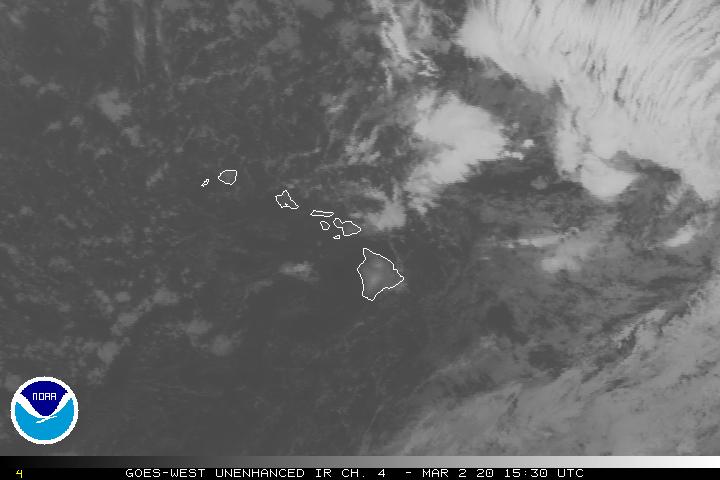
Satellite and Radar Images: To view the cloud conditions we have here in Hawaii, please use the following satellite links, starting off with this Infrared Satellite Image of the islands to see all the clouds around the state during the day and night. This next image is one that gives close images of the islands only during the daytime hours, and is referred to as a Close-up visible image. This next image shows a larger view of the Pacific…giving perspective to the wider ranging cloud patterns in the Pacific Ocean. Finally, here’s a looping IR satellite image, making viewable the clouds around the islands 24 hours a day. To help you keep track of where any showers may be around the islands, here’s the latest animated radar image.
Hawaii’s Mountains – Here’s a link to the live webcam on the summit of near 14,000 foot Mauna Kea on the Big Island of Hawaii. The tallest peak on the island of Maui is the Haleakala Crater, which is near 10,000 feet in elevation. These two webcams are available during the daylight hours here in the islands…and when there’s a big moon rising just after sunset for an hour or two! Plus, during the nights and early mornings you will be able to see stars, and the sunrise too…depending upon weather conditions.
Aloha Paragraphs

Fun in the summer surf…Hawaii
The forecast for lighter trade winds remains in place through Thursday…with some strengthening later Friday into the upcoming holiday weekend. The lightest point in this relaxed trade wind pattern, will likely be Wednesday into Thursday…when it will feel rather hot and humid during the days. As we move into Friday, and the 4th of July holiday weekend, these slack trade winds will pick up again gradually, helping to ventilate whatever fireworks smoke that may be around Saturday night.
Rainfall around the Hawaiian Islands will remain on the light side…gradually moving inland over the leeward slopes during the afternoon hours for a couple of days. As we move into Wednesday and Thursday, some of those afternoon showers may become a bit more generous…especially over Maui and the Big Island. The gradually strengthening trade winds Friday into this coming holiday weekend, should bring the shower activity back around to the windward sections then.
It’s Tuesday evening here in Kihei, Maui, as I begin writing this last paragraph of this morning’s narrative. Tuesday was another great day in terms of weather, with most of the showers falling over and around the mountains during the afternoon hours. Here on Maui, the slopes of the Haleakala Crater, on the leeward side, saw dark clouds gathering force during the late morning hours. As we moved into the afternoon, showers fell quite generously from about Pukalani…down through Kula to Keokea and Ulupalakua.
~~~ I’m just about ready to head out, for the drive back upcountry to Kula. As I glance out the window of my office here in Kihei, I see partly cloudy conditions, with just a little bit of blue sky showing up. Looking up slope, it’s still rather dark up there, with the afternoon clouds still hanging on. As is often the case, after sunset we typically see those cumulus clouds collapsing, making way for clear skies to begin the day on Wednesday. It wouldn’t surprise me to see a near exact repeat tomorrow, from what we saw today.
~~~ As is always the case, I’m looking forward to getting home, and on the way will enjoy listening to the evening news on National Public Radio. I’ll also enjoy viewing the different weather circumstances along the way too. When I leave Kihei, the temperature should be right around 83F or 84 degrees, dropping into the low 70’s or even high 60’s by the time I get home about 40 minutes later. I’ll be sure to come back online early Wednesday morning, when I’ll have your next weather narrative from paradise ready for viewing. I hope you have a great Tuesday night until then! Aloha for now…Glenn.
Interesting: The federal government on Monday agreed to put gray wolves in the western Great Lakes region back on the endangered species list — at least temporarily. The decision came less than two months after the U.S. Fish and Wildlife Service discontinued federal protection for about 4,000 wolves in Michigan, Minnesota and Wisconsin.
The agency acknowledged Monday that it erred by not holding a legally required public comment period before taking action. Under a settlement with five environmental and animal protection groups that had sued the agency earlier this month, the Fish and Wildlife Service said it would return Great Lakes wolves to the list while considering its next move.
They had been classified as endangered from 1974 until their removal May 4. About 1,300 wolves in Montana and Idaho also were dropped from the list then. Because a public comment period was held in their case, they are not covered by the deal announced Monday and their status will not change. A separate lawsuit on that case will move forward.
About 300 wolves in Wyoming remain listed. U.S. District Judge Paul Friedman in Washington, D.C., must approve the settlement for it to take effect. If the Fish and Wildlife Service tries again to remove the wolves from the endangered list, it will hold a 60-day comment period, the settlement says.
The agency still believes "wolves in the western Great Lakes have met the recovery criteria and don’t need to be listed," Georgia Parham, spokeswoman for the Fish and Wildlife Service, said. Parham said federal officials had thought a comment period was not required because one had been held for a previous effort to reclassify the wolves. But they now agree another was needed, she said.
Interesting2: Interior Secretary Ken Salazar announced measures on Monday to hasten the development of solar energy on Western public lands. Mr. Salazar, appearing in Las Vegas with Harry Reid, the Senate Majority Leader, said that 670,000 acres of lands managed by the Bureau of Land Management (an agency within the Department of the Interior) would be studied to determine whether they could support large solar power arrays.
Twenty-four tracts of land in six states — Nevada, Arizona, California, Colorado, New Mexico and Utah — are under review. Maps of the land will be published shortly in the Federal Register. The solar study zones, Mr. Salazar said, are part of the Obama administration’s push to do “everything we can to put the bulls-eye on the development of solar energy on our public lands.”
Mr. Salazar said the assessments would be done in a “thoughtful way,” to ensure not only that the sites can supply plenty of solar power, but also that they “don’t contravene the other important public values we’re trying to protect, including other environmental values.”
Solar power has run into opposition in places like California’s Mojave Desert, where environmentalists and some of their political allies fear that large solar plants could hurt fragile desert ecosystems. By the end of 2010, Mr. Salazar said, he expected there to be 13 commercial-scale solar projects under construction on public lands. “There are millions of acres set aside for oil and gas. It’s about time we did something for renewable energy,” said Mr. Reid.
Interesting3: A new line of household cleaners by Bumgartens will be sold in tablet form, requiring 75 percent less packaging and reducing the impact of shipping because the products have 85 percent less "water weight." The cleaners are part of the Conserve line, which also includes cutlery and dishware. Consumers purchase one bottle and a four-pack of tablets, and the tablets dissolve in water when ready to use.
The available products include a glass cleaner, multi-surface, bathroom and odor eliminator. By shipping cleaners without water, Conserve is able to save 7.5 pounds per bottle. By only including one bottle in a package that provides four uses, Conserve can also ship more cleaners in a single load.
Interesting4: Scientists in China are recommending that the Chinese government consider phasing out the direct burning of traditional chunks of coal in millions of households. It suggests that the government substitute coal briquettes and improved stoves for cooking and heating to help reduce the country’s high air pollution levels.
The recommendation stems from one of the first scientific studies showing that this approach is effective in improving air quality, including a 98 percent reduction in air pollution from tiny, inhalable particles of coal soot. In the new study, Yingjun Chen and colleagues note that government officials have said for years that coal briquettes and improved stoves with better ventilation may cut emissions, but few scientific studies have tested this claim.
Millions of homes in rural China and other parts of the world burn raw coal chunks in small, low-efficiency stoves for cooking and heating. Studies indicate that emissions from incomplete coal combustion in these stoves contribute significantly to China’s serious air pollution levels — among the highest in the world.
Interesting5: The H1N1 flu, also known as the swine flu, is proving more virulent than had previously been thought, French Health Minister Roselyne Bachelot was quoted as saying Monday. "Summer is usually less favorable for the contamination by the virus but, contrary to what we had hoped, we are not registering a summer pause" in the spread of the disease, Bachelot told the daily Le Parisien.
Bachelot said it was possible that summer actually aided the spread of the virus because people traveled more and were more sociable. She said that France would triple the number of hospitals, to more than 300, equipped to take charge of H1N1 flu cases.
France currently counted 276 confirmed cases of the illness, and another 258 people showing symptoms of the disease were being investigated. At the weekend, eight schools were shut in France after pupils fell ill because of the H1N1 flu.
Interesting6: Dust in the wind is rewriting the cycle of life in the mountains. Throughout memory the warmth of spring has begun the mountain snowmelt, bringing life-giving water to greening plants so they can blossom and renew their species. But now, scientists say, the timing is being thrown off by desert dust stirred as global warming dries larger areas and human activity increases in those regions.
This dust darkens the surface of winter snows, warming it by absorbing sunlight that the white surface would have reflected. That causes the snow to melt earlier than in the past, running off before the air has warmed enough to spur plant growth, researchers report in Tuesday’s edition of Proceedings of the National Academy of Sciences.
"It is striking how different the landscape looks as result of this desert-mountain interaction," Chris Landry, director of the Center for Snow and Avalanche Studies in Silverton, Colo. and a co-author of the report, said in a statement. The researchers established test plots in the San Juan Mountains in Colorado. Some plots were left alone to collect snow and dust naturally, others had extra dust added and a third group had naturally arriving dust removed.
Interesting7: Particulate pollution thought to be holding climate change in check by reflecting sunlight instead enhances warming when combined with airborne soot, a new study has found. Like a black car on a bright summer day, soot absorbs solar energy. Recent atmospheric models have ranked soot, also called black carbon, second only to carbon dioxide in potential for atmospheric warming.
But particles, or aerosols, such as soot mix with other chemicals in the atmosphere, complicating estimates of their role in changing climate. "Until now, scientists have had to assume how soot is mixed with other chemical species in individual particles and estimate how that ultimately impacts their warming potential," said Kimberly Prather, professor in the Department of Chemistry and Biochemistry and the Scripps Institution of Oceanography at the University of California, San Diego.
"Our measurements show that soot is most commonly mixed with other chemicals such as sulfate and this mixing happens very quickly in the atmosphere. These are the first direct measurements of the optical properties of atmospheric soot and allow us to better understand the role of soot in climate change."
Interesting8: The first month of the Atlantic hurricane season ended with a whimper Tuesday: No named tropical storms or hurricanes formed in June. However, that’s not unusual, as the average date of the first named storm doesn’t occur until July 10, according to Dennis Feltgen, a meteorologist at the National Hurricane Center in Miami.
Feltgen also reports that the average date of the first Atlantic hurricane is Aug. 14. Since the naming of storms began in 1953, the latest an Atlantic storm has formed was Anita on Aug. 29, 1977. On average, based on records that go back to 1851, a tropical storm forms every other June in the Atlantic basin, which also encompasses the Gulf of Mexico and the Caribbean Sea.
The National Oceanographic and Atmospheric Administration predicted in May that there would be nine to 14 named storms in the Atlantic this year, of which four to seven could become hurricanes, including one to three major hurricanes (Category 3, 4 or 5).
A quiet June doesn’t necessarily presage a quiet remainder to the season, reminds Feltgen. In 2004, a year that had 15 named storms — including Charley, Frances, Ivan and Jeanne — the first storm didn’t form until July 31. In the eastern Pacific basin, Hurricane Andres was the only named storm to form in June. It grazed the west coast of Mexico on June 22, killing one person. No storms or hurricanes are forecast to form in either the Atlantic or Pacific basins for at least the next two days, reports the center.
Interesting9: Threats to sharks are nothing new. For years, scientists have been saying that these ancient fish are in danger of going extinct as many are caught by accident, or on purpose just for their fins, and populations are decimated. Now a new warning from the International Union for Conservation of Nature states that nearly a third of sharks and rays are threatened with extinction.
The analysis of 64 species of ocean sharks and rays found 32 percent are at risk, including the great white shark. An estimated 38 million sharks are killed for their fins each year. Sharks, meanwhile, kill very few people (despite the myth that they’re very deadly). If sharks go, the ocean food chain could crumble, experts have warned.
Top predators are key to keeping populations of key species from growing too large. If sharks die off, you could have a food chain Whac-a-Mole, scientists say. At least one exception to the dire situation: The biggest sharks of all, whale sharks, are thriving off the coast of western Australia.
Posted by Glenn
1 Comment
June 29-30, 2009
Air Temperatures – The following maximum temperatures were recorded across the state of Hawaii Monday afternoon:
Lihue, Kauai – 82
Honolulu, Oahu – 88
Kaneohe, Oahu – 82
Kahului, Maui – 84
Hilo, Hawaii – 82
Kailua-kona – 85
Air Temperatures ranged between these warmest and coolest spots near sea level – and on the highest mountains…at 4 p.m. Monday afternoon:
Port Allen, Kauai – 88F
Hilo, Hawaii – 80
Haleakala Crater – 59 (near 10,000 feet on Maui)
Mauna Kea summit – 52 (near 14,000 feet on the Big Island)
Precipitation Totals – The following numbers represent the largest precipitation totals (inches) during the last 24 hours on each of the major islands, as of Monday afternoon:
0.43 Kapahi, Kauai
0.69 Oahu Forest NWR, Oahu
0.03 Molokai
0.00 Lanai
0.00 Kahoolawe
0.31 Puu Kukui, Maui
0.05 Kealakekua, Big Island
Marine Winds – Here’s the latest (automatically updated) weather map showing a 1030 millibar high pressure system far to the northeast of the islands. This high pressure cell, and another very weak high far to the east, won’t be near enough to provide much more than light trade winds. The trade winds will remain active Tuesday and Wednesday…although may be overridden by sea breezes during the days locally.
Satellite and Radar Images: To view the cloud conditions we have here in Hawaii, please use the following satellite links, starting off with this Infrared Satellite Image of the islands to see all the clouds around the state during the day and night. This next image is one that gives close images of the islands only during the daytime hours, and is referred to as a Close-up visible image. This next image shows a larger view of the Pacific…giving perspective to the wider ranging cloud patterns in the Pacific Ocean. Finally, here’s a looping IR satellite image, making viewable the clouds around the islands 24 hours a day. To help you keep track of where any showers may be around the islands, here’s the latest animated radar image.
Hawaii’s Mountains – Here’s a link to the live webcam on the summit of near 14,000 foot Mauna Kea on the Big Island of Hawaii. The tallest peak on the island of Maui is the Haleakala Crater, which is near 10,000 feet in elevation. These two webcams are available during the daylight hours here in the islands…and when there’s a big moon rising just after sunset for an hour or two! Plus, during the nights and early mornings you will be able to see stars, and the sunrise too…depending upon weather conditions.
Aloha Paragraphs

The perfect beach…Hawaii
An unusual light trade wind regime will take over during this new week, with stronger trade winds not expected until Friday into the weekend. The latest forecast charts continue to show that trade wind speeds will relax in strength this week, remaining lighter than normal…especially by Wednesday. As we move into the 4th of July holiday weekend, the slack trade winds will pick up again gradually, helping to ventilate whatever fireworks smoke that is around then.
The windward sides will find a few showers, although as the trade winds calm down…showers will shift over to the leeward upcountry areas during the afteroon hours. As we move into the second half of this new week, some of those afternoon showers may become locally heavy…especially over Maui and the Big Island. The gradually strengthening trade winds Friday into this coming weekend, should bring the shower activity back around to the windward sections.
It’s Monday evening here in Kihei, Maui, as I begin writing this last paragraph of this evening’s narrative. The trade winds did become lighter already today, although here in Kihei, it was actually quite gusty during the afternoon hours. While I was down near the beach during lunch, there were wind caps on the ocean surface just offshore. The waves had gotten smaller, but already starting later Tuesday…should come up again along our leeward beaches.
~~~ Looking out the window here in Kihei, I see more clouds over the Haleakala Crater, and overhead here on the leeward side…than I do towards the often cloudy windward sides. This is often the case when the trade winds begin to die back in strength. Here’s a satellite image which shows the next batch of high cirrus clouds approaching from the west. As the trade winds weaken even more over the next several days, we’re going to be feeling the heat…hopefully the daytime sea breezes will provide some relief from the hot daytime temperatures.
~~~ I’m about ready to take the drive back upcountry, back up to Kula. It takes some time to get back up to the 3,000+ foot level on the slopes of the Crater, but it’s definitely worth the drive, at least for me. I love the cooler air temperatures up there, which provide great sleeping weather in my humble opinion. I’ll take a walk when I get home, maybe play a little ping pong, and even hit a few golf balls into a cup on my rug! At any rate, I hope you have a great Monday night, and that you might join me here again on Tuesday! Aloha for now…Glenn.
Interesting: Controlling road traffic in congested areas is difficult to say the least, a point to which any drive-time urban commuter might testify. An organic approach to traffic lights might help solve the problem and avoid traffic jams and gridlock, according to research published this month in the International Journal of Autonomous and Adaptive Communications Systems.
According to Holger Prothmann of the Karlsruhe Institute of Technology, and colleagues there and at Leibniz Universität Hannover, Germany, so-called "organic" computing can model even very complex systems. In recent years, they explain organic computing has emerged as a possible solution to a wide range of problems involving complex, autonomous systems that have sensors and controllers.
In the case of an urban traffic system, the sensors would be closed-circuit TV cameras mounted on road gantries and other places while the controllers, or actuators, would be traffic lights, which can effectively start and stop the flow of traffic.
Interesting2: A good partner relationship can act as a buffer for those exposed to work-related stress. "The relationship reduces the negative effects of this kind of stress on our health. But poor relationships will amplify the negative effects," say Ann-Christine Andersson Arntén in a new doctoral dissertation from the University of Gothenburg, Sweden.
"A positive approach and successful stress-management techniques also help to reduce the negative effects of work-related stress," explains Ann-Christine Andersson Arntén, who will be presenting her dissertation in psychology. But when there are stressful experiences both at work and in the relationship, the risk of burn-out and poor health increases dramatically.
About 900 persons took part in her survey. Those who felt they had a good relationship experienced that they enjoyed better health than those who had a more problematic relationship. Women with a poorly-functioning relationship experienced more anxiety, mental stress reactions and sleeping difficulties than women who had a good relationship.
Men who had a mediocre relationship had a higher incidence of depression, anxiety, psychological and somatic stress reactions than men with worse or better relationships. One explanation can be that people living with a mediocre relationship take more responsibility to improve the relationship, while those with poor relationships just admit it, and don’t feel they can do anything about it.
Interesting3: Swine flu has infected as many as 1 million Americans, U.S. health officials said, adding that 6 percent or more of some urban populations are infected. The estimate voiced by a government flu scientist was no surprise to the experts who have been closely watching the virus.
"We knew diagnosed cases were just the tip of the iceberg," said Dr. William Schaffner, a Vanderbilt University infectious diseases expert who was in Atlanta for the meeting of a vaccine advisory panel.
Lyn Finelli, a flu surveillance official with the Centers for Disease Control and Prevention, made the 1 million estimate in a presentation to the vaccine panel. The number is from mathematical modeling, based on surveys by health officials.
Interesting4: The Sahara Desert is crossing the Mediterranean, according to Italian environmental protection group Legambiente which warns that the livelihoods of 6.5 million people living along its shores could be at risk. "Desertification isn’t limited to Africa," said Legambiente Vice President Sebastiano Venneri.
"Without a serious change of direction in economic and environmental policies, the risk will become concrete and irreversible." A recent report by Legambiente estimated that 74 million acres of fertile land along the Mediterranean were turning to desert as the result of overexploited land and water resources.
Legambiente said that southern Italy was at severe risk in addition to the islands of Sicily and Sardinia where 11% of all arable land showed signs of drying up. ”Semi-arid coastal regions like southern Italy are prone to the effects of desertification due to farmers’ dependence on water from underground aquifers instead of rainfall,” said Legambiente spokesman Giorgio Zampetti.
According to Zampetti, pumping too much fresh water out of these underground deposits can result in seawater leaking in to replace it, effectively poisoning the groundwater. As an example of the long-term consequences, Legambiente pointed to Egypt where it said brackish groundwater had compromised half the country’s farmland.
"The south of Italy isn’t the only part of the country at risk," added Zampetti. "Aquifers around the Po Delta in northern Italy have also begun showing signs of saltwater contamination." Experts said that the Po River, which is Italy’s longest waterway and nearly dries up in parts when industrial consumption peaks, is one of the most visible examples of desertifying climate change in Italy.
Italy is not the only country in Europe losing fertile land. Legambiente estimated that desertification affects more than a fifth of the Iberian Peninsula with early indicators also present along the French Riviera.
Interesting5: Desperate to halt the erosion of Louisiana’s coast, officials there are talking about breaking Mississippi River levees south of New Orleans to restore the nourishing flow of muddy water into the state’s marshes. But in a new analysis, scientists at Louisiana State University say inland dams trap so much sediment that the river no longer carries enough to halt marsh loss, especially now that global warming is speeding a rise in sea levels.
As a result, the loss of thousands of additional square miles of marshland is "inevitable," the scientists report in Monday’s issue of Nature Geoscience. The finding does not suggest it would be pointless to divert the muddy water into the marshes, one of the researchers, Harry H. Roberts, said in an interview.
"Any meaningful restoration of our coast has to involve river sediment," said Dr. Roberts, a coastal scientist. But he said officials would have to choose which parts of the landscape could be saved and which must be abandoned, and to acknowledge that lives and businesses would be disrupted.
Instead of breaking levees far south of New Orleans, where relatively few people live, Dr. Roberts said, officials should consider diversions much closer to New Orleans, possibly into the LaFourche, Terrebonne or St. Bernard basins.
"It’s going to be an excruciating process to decide where that occurs," Dr. Roberts said of the levee-breaking. Sediment carried by the Mississippi built up the marshes of Louisiana over thousands of years, but today inland dams trap at least half of it, Dr. Roberts said. He pointed out that there were 8,000 dams in the drainage basin of the Mississippi.
Interesting6: For the first time since territorial days, rain will be free for the catching here, as more and more thirsty states part ways with one of the most entrenched codes of the West. Precipitation, every last drop or flake, was assigned ownership from the moment it fell in many Western states, making scofflaws of people who scooped rainfall from their own gutters. In some instances, the rights to that water were assigned a century or more ago.
Now two new laws in Colorado will allow many people to collect rainwater legally. The laws are the latest crack in the rainwater edifice, as other states, driven by population growth, drought, or declining groundwater in their aquifers, have already opened the skies or begun actively encouraging people to collect.
Posted by Glenn
[2] Comments
June 28-29, 2009
Air Temperatures – The following maximum temperatures were recorded across the state of Hawaii Sunday afternoon:
Lihue, Kauai – 83
Honolulu, Oahu – 88
Kaneohe, Oahu – 82
Kahului, Maui – 85
Hilo, Hawaii – 83
Kailua-kona – 86
Air Temperatures ranged between these warmest and coolest spots near sea level – and on the highest mountains…at 5 p.m. Sunday evening:
Port Allen, Kauai – 86F
Princeville, Kauai – 77
Haleakala Crater – 54 (near 10,000 feet on Maui)
Mauna Kea summit – 54 (near 14,000 feet on the Big Island)
Precipitation Totals – The following numbers represent the largest precipitation totals (inches) during the last 24 hours on each of the major islands, as of Sunday afternoon:
0.23 Kapahi, Kauai
0.27 Manoa Valley, Oahu
0.07 Molokai
0.00 Lanai
0.00 Kahoolawe
0.25 Puu Kukui, Maui
0.22 Kealakekua, Big Island
Marine Winds – Here’s the latest (automatically updated) weather map showing a 1031 millibar high pressure system far to the northeast of the islands, with a ridge extending from the southwest flank of this high…into the area north of the Hawaiian Islands. The trade winds will remain active Monday and Tuesday…although become lighter.
Satellite and Radar Images: To view the cloud conditions we have here in Hawaii, please use the following satellite links, starting off with the Infrared Satellite Image of the islands to see all the clouds around the state during the day and night. This next image is one that gives close images of the islands only during the daytime hours, and is referred to as a Close-up visible image. This next image shows a larger view of the Pacific…giving perspective to the wider ranging cloud patterns in the Pacific Ocean. Finally, here’s a looping IR satellite image, making viewable the clouds around the islands 24 hours a day. To help you keep track of where any showers may be around the islands, here’s the latest animated radar image.
Hawaii’s Mountains – Here’s a link to the live webcam on the summit of near 14,000 foot Mauna Kea on the Big Island of Hawaii. The tallest peak on the island of Maui is the Haleakala Crater, which is near 10,000 feet in elevation. These two webcams are available during the daylight hours here in the islands…and when there’s a big moon rising just after sunset for an hour or two! Plus, during the nights and early mornings you will be able to see stars, and the sunrise too…depending upon weather conditions.
Aloha Paragraphs

Kaneohe Bay…windward Oahu
Trade winds dropping off in strength, remaining quite light through the work week…then gradually rebounding next weekend. A high pressure system far to the northeast of the state will be the source of our trade wind flow. The latest computer forecast models continue to suggest that trade wind speeds will relax in strength going forward, remaining lighter than normal through the next week. As we move into the 4th of July holiday weekend, those trade winds should pick up again gradually…helping to ventilate whatever fireworks smoke that will be around then.
The overlying atmosphere is rather dry and stable at the moment, with just a few windward biased showers falling at times. As the trade winds become lighter during the new week ahead, we’ll see a shift in showers, to over and around the interior sections during the afternoon hours. As we move into the second half of the week ahead, some of those afternoon showers may become locally heavy…especially over Maui and the Big Island. The gradually strengthening trade winds later next weekend, should bring the shower activity back around to the windward sections.
Early winter storms in the southern hemisphere continue to send us summer south swells…impacting the south and west facing leeward beaches of Hawaii. The NWS forecast office in Honolulu, has dropped the high surf advisory active along most of our south facing shores…along with the small craft advisory as well. The wave forecast models suggest that these waves will be around through the next week, at least. Folks who aren’t familiar with these larger than normal waves, should exercise caution when entering the ocean. The next influx of larger south swell waves will arrive later Tuesday.
It’s Sunday evening here in Kula, Maui, as I begin writing this last paragraph. Looking out through my weather tower windows this evening, I see mostly clear skies over along the windward sides. At the same time, looking overhead, it is cloudy, and we just had a very light smattering of sprinkles. It was pretty hot earlier this afternoon, although it quickly thereafter got cloudy, cooling the upcountry area down. I anticipate clearing once the sun goes down, leading to mostly clear skies here in Kula overnight…into Monday morning. ~~~ Speaking of Monday morning, that will be my first day back to work, after being gone to the mainland for nearly two weeks. I’m looking forward to getting back into my schedule, although I must admit it has been nice to pull back from the work scene too. ~~~ I stayed home all day, hanging out closely with my neighbors. I started the day off with a nice walk, and will likely take another one once I finish here. I’ll be back early Monday morning with your next new weather narrative from paradise. I hope you have a great Sunday night from wherever you happen to be reading from! Aloha for now…Glenn.
Posted by Glenn
1 Comment
June 27-28, 2009
Air Temperatures – The following maximum temperatures were recorded across the state of Hawaii Saturday afternoon:
Lihue, Kauai – 83
Honolulu, Oahu – 87
Kaneohe, Oahu – 82
Kahului, Maui – 86
Hilo, Hawaii – 82
Kailua-kona – 87
Air Temperatures ranged between these warmest and coolest spots near sea level – and on the highest mountains…at 5 p.m. Saturday evening:
Port Allen, Kauai – 86F
Hilo, Hawaii – 77
Haleakala Crater – 55 (near 10,000 feet on Maui)
Mauna Kea summit – 48 (near 14,000 feet on the Big Island)
Precipitation Totals – The following numbers represent the largest precipitation totals (inches) during the last 24 hours on each of the major islands, as of Saturday afternoon:
0.87 Mount Waialeale, Kauai
0.48 Oahu Forest NWR, Oahu
0.00 Molokai
0.00 Lanai
0.00 Kahoolawe
0.06 West Wailuaiki, Maui
0.93 Glenwood, Big Island
Marine Winds – Here’s the latest (automatically updated) weather map showing a 1031 millibar high pressure system system to the northeast of the islands, with a ridge extending from the western flank of this high…into the area north and northwest of Kauai. The trade winds will remain active Sunday and Monday.
Satellite and Radar Images: To view the cloud conditions we have here in Hawaii, please use the following satellite links, starting off with the Infrared Satellite Image of the islands to see all the clouds around the state during the day and night. This next image is one that gives close images of the islands only during the daytime hours, and is referred to as a Close-up visible image. This next image shows a larger view of the Pacific…giving perspective to the wider ranging cloud patterns in the Pacific Ocean. Finally, here’s a looping IR satellite image, making viewable the clouds around the islands 24 hours a day. To help you keep track of where any showers may be around the islands, here’s the latest animated radar image.
Hawaii’s Mountains – Here’s a link to the live webcam on the summit of near 14,000 foot Mauna Kea on the Big Island of Hawaii. The tallest peak on the island of Maui is the Haleakala Crater, which is near 10,000 feet in elevation. These two webcams are available during the daylight hours here in the islands…and when there’s a big moon rising just after sunset for an hour or two! Plus, during the nights and early mornings you will be able to see stars, and the sunrise too…depending upon weather conditions.
Aloha Paragraphs

Sunset Hula
The trade winds will remain rather gusty through the weekend into early in the new work week ahead…then calming down Tuesday through Thursday. A high pressure system far to the northeast of the state will be the source of our trade wind flow now. The latest computer forecast models continue to suggest that trade wind speeds will calm down starting Tuesday, remaining lighter than normal through about Thursday. As we move into Friday, and the 4th of July holiday weekend, those trade winds should pick up again…helping to ventilate whatever fireworks smoke that’s around then.
Rainfall will generally be light and most active along our windward sides, with just a few stray light showers being carried over into the leeward sides locally. As the trade winds become lighter during the new week ahead, we will likely see some increase in afternoon showers…especially over and around the interior sections. There are no organized shower areas on our horizon however, so nothing too unusual is expected in terms of precipitation. The strengthening trade winds Friday into next weekend, will bring the shower activity back around to the windward sections.
Early winter storms in the southern hemisphere continue to send us summer south swells…impacting the south and west facing leeward beaches of Hawaii. The NWS forecast office in Honolulu, has high surf advisories active along most of our south facing shores. The wave forecast models suggest that these waves will be around through the next week, at least. Folks who aren’t familiar with these larger than normal waves, should exercise caution when entering the ocean. There may be some waves breaking in channel entrances as well, so small boaters should be careful as well.
Saturday was a pretty typical early summer day, at least in terms of our weather conditions around the state of Hawaii. The trade winds blew just about everywhere, with the ocean surface around the islands full of wind driven white caps. The coconut palm trees were swaying to and fro as well, with a bit of dust blowing around the edges too. At the same time, there were some high cirrus clouds streaking across island skies overhead, especially around Kauai and Oahu, as seen on this looping satellite imagery. We can see that there are a minimum amount of incoming showers heading for the windward sides at the same time.
It’s Saturday evening here in Kula, Maui, as I begin writing this last paragraph of today’s narrative. I drove over to the Paia side this morning for my once every eight week haircut. I did a little shopping there, before driving over to Wailuku to conduct some business that I had to attend to. I had to skip Baldwin Beach, but enjoyed having lunch with my neighbors, once I got back to Kula, before relaxing a bit during the afternoon hours. It was really sunny and warm upcountry, a bit too warm for my liking, I must admit. The high clouds are shifting towards Oahu and Kauai this evening, which should put the sunset colors over those two islands. I’ll be back Sunday morning with your next new narrative, wishing you a great Saturday night until then! This Saturday night, here on Maui, I’ve been watching old Michael Jackson video’s, which continue to be some of my favorite of all times! Aloha for now…Glenn.
Posted by Glenn
[9] Comments
Air Temperatures – The following maximum temperatures were recorded across the state of Hawaii Friday afternoon:
Lihue, Kauai – 83
Honolulu, Oahu – 86
Kaneohe, Oahu – 80
Kahului, Maui – 89
Hilo, Hawaii – 83
Kailua-kona – 86
Air Temperatures ranged between these warmest and coolest spots near sea level – and on the highest mountains…at 6 p.m. Friday evening:
Barking Sands, Kauai – 84F
Hilo, Hawaii – 75
Haleakala Crater – 48 (near 10,000 feet on Maui)
Mauna Kea summit – 37 (near 14,000 feet on the Big Island)
Precipitation Totals – The following numbers represent the largest precipitation totals (inches) during the last 24 hours on each of the major islands, as of Friday afternoon:
2.37 Mount Waialeale, Kauai
1.69 Poamoho 2, Oahu
0.07 Molokai
0.02 Lanai
0.00 Kahoolawe
0.64 West Wailuaiki, Maui
1.42 Glenwood, Big Island
Marine Winds – Here’s the latest (automatically updated) weather map shows a 1031 millibar high pressure system to the northeast of the islands, with a ridge extending from the western flank of this high…into the area north and northwest of Kauai. The trade winds will remain active Saturday and Sunday.
Satellite and Radar Images: To view the cloud conditions we have here in Hawaii, please use the following satellite links, starting off with the Infrared Satellite Image of the islands to see all the clouds around the state during the day and night. This next image is one that gives close images of the islands only during the daytime hours, and is referred to as a Close-up visible image. This next image shows a larger view of the Pacific…giving perspective to the wider ranging cloud patterns in the Pacific Ocean. Finally, here’s a looping IR satellite image, making viewable the clouds around the islands 24 hours a day. To help you keep track of where any showers may be around the islands, here’s the latest animated radar image.
Hawaii’s Mountains – Here’s a link to the live webcam on the summit of near 14,000 foot Mauna Kea on the Big Island of Hawaii. The tallest peak on the island of Maui is the Haleakala Crater, which is near 10,000 feet in elevation. These two webcams are available during the daylight hours here in the islands…and when there’s a big moon rising just after sunset for an hour or two! Plus, during the nights and early mornings you will be able to see stars, and the sunrise too…depending upon weather conditions.
Aloha Paragraphs

South swell waves…on our leeward beaches
As I noted at the top this page, and on the other forecast pages as well, I’ll be in California for the next two weeks. I have some business to take care of, in terms of a very close friend’s health issue, and then will visit my parents after that. This trip came on short notice, and won’t be a vacation, in the traditional sense of the word.
Since it’s the month of June, the driest month of the year here in the islands, I anticipate generally fine weather conditions to prevail in my absence…with the trade winds dominating for the most part.
You will be able to find current weather forecasts on a daily basis, by going to the upper left hand margin on any page of this website…and clicking on the island you want to see about.
I wish everyone well, and look forward to being back with you here in Hawaii. I may find the time to check back in during my time away, and if so…will write a few words on this page then. Aloha for now…Glenn.
Friday, June 19th – Hello everyone, after a very stressful, yet intimate visit with my sick friend in northern California…I’ve flown down to my parents house in southern California now. I just watered all my Mom’s roses, and other flowers in the backyard, and will soon go with my Dad to his various doctor’s appointments. I’ll likely check back in with you later in the day. I hope all of you are doing well! ~~~ It’s been a good day, warm weather, just hanging around with my Mom and Dad. We did a little weeding, and are now about to have a nice dinner together. I’m sipping on a Boonville Brewing Company, Anderson Valley, India Pale Ale (IPA). My Dad is watching Tiger Woods playing golf on the television. ~~~ I see that the Hawaiian Islands are having gusty trade winds, with the top gust Friday afternoon, being registered at Maalaea Bay, Maui…at almost 50 mph! I’ll check back in with you again on Saturday. Have a good one until then, Aloha…Glenn.
Saturday, June 20th – Hi from Long Beach, with just one more day until Father’s Day. I took a nice long walk this morning, then came back and had breakfast with my Mom. A wonderful thing happened after that, as it began to drizzle, wetting the area to the point of dripping off the eaves and leaves. My Mom and I sat outside in the patio with the two cats, drinking coffee, and enjoyed some quiet conversation in the cool morning air. My Dad just got up, so I’ll go in and sit with him now. We plan on having a nice fish dinner this evening, and will come back online at some point today, to say hello again. I see that Maalaea Bay, Maui, is already gusting up over 30 mph fairly early this morning. ~~~ Small craft wind advisories have been pared back a little during the afternoon hours in the marine environment…in the islands. The breezy trade winds are still on the gusty side late Saturday afternoon, with the top gust 45 mph at Maalaea Bay. ~~~ My parents and I sat out in the patio this evening and sipped on a glass or two of red wine, celebrating Father’s Day a little early. Here’s wishing all you Father’s a great day coming up. I’ll be back on Sunday, have a great Saturday night until then! Aloha for now…Glenn.
Father’s Day – Southern California, or at least here in Long Beach, dawned mostly clear and relatively warm Sunday. This was one of the first days that I’ve been able to spend with my Dad on his special day in a long time. My Mom and I prepared a nice breakfast for him, followed by a pastry and a cup of coffee. We’ve been watching lots of golf on the TV, which is unique for me…as I don’t even own a set at home. ~~~ Looking at the information for the Hawaiian Islands Sunday morning, it looks to be still rather windy. The strongest gust that was happening Sunday morning, was 45 mph at South Point, on the Big Island…while Maalaea Bay on Maui wasn’t far behind at 43 mph. Happy Father’s Day, and welcome to the first first offical day of summer too! Aloha, Glenn
Monday, June 22 – Good morning, woke up a bit earlier than the last few days, after a good nights sleep. My parent’s and I watched a good film last night, one from many, many years ago. It’s a bit cloudy this morning along the coast, with cooler temperatures in general, across all of southern California. My parents are still sleeping, so I’m typing very quickly, before going out for an early morning walk. I’ve already let the cats out of the garage, brought the newspaper in the house, and drank two full glasses of water. ~~~ Checking in with the islands, I see that the name of the game is still the strong and gusty trade winds, on this first full day of summer 2009. The small craft advisories, in the marine environment, are now extended across the entire state again, with the strongest gust at 345am (HST) Monday morning, being reported on the small island of Kahoolawe…with a 38 mph gust.
Tuesday, June 23 – Up early here in southern California, woke up after a good night’s sleep, and finally crawled out of bed at a little before 6am. The first thing I did was let the cats out of the garage, and then took a brisk walk around the neighborhood. It’s cloudy this morning in Long Beach, with the typical low clouds coming inland from off the ocean. I’ll wait for my Mom to get up at around 7am, and then hang out with her, while she makes coffee and breakfast. I head back to Maui tomorrow, and already she’s telling me how much they will miss my being home on this visit. I’ll miss them too of course! ~~~ Turning our attention towards Hawaii’s weather Tuesday, we find those gusty trade winds continuing, along with windward showers. The showers will increase some later this week, while the trade winds decrease a touch…with a rising south swell along our leeward beaches. ~~~ Tuesday was yet another lovely day here in Long Beach, as they have been each day of my visit. I had a good day working with my Mom out in the backyard, trimming, pruning, and cutting. We did various shopping chores during the afternoon, and then all three of us sat out and had a small glass of wine before dinner. Tomorrow, on Wednesday, finds me flying back to Maui. I hope you have a great Tuesday night wherever you happen to be reading from! Aloha…Glenn.
Wednesday, June 24 – Hi everyone, up before 6am again this morning, getting the two lap, brisk walk around the school done first thing. Brought the newspaper in, let the cats out, and found cloudy skies above as usual during the month of June. I’ll be with my Mom and Dad this morning, having breakfast, coffee, and packing for my flight to San Francisco, and then on to Kahului, Maui. My Mom and I just walked to a post box to mail a card, and her cats (Mr. & Missy) walked with us down the street (10 houses), and waited in the bushes until we came walking back by…so cute! It will be tough leaving Long Beach, and my parents, just like it was rough leaving my good friend, who is sick in northern California, for the trip down here. At any rate, this is a travel day, and by tonight around 730pm, I’ll be back home in the islands after a two week trip to the mainland. ~~~ By the way, there’s no end in sight for the trade winds in Hawaii, and there should be somewhat heavier showers over the next 2-3 days. I’ll catch up with you again soon, on Thursday from Kula, Maui. Be well everyone, Aloha…Glenn.
Thursday, June 25 – I’m back on Maui, got in last night. I’m happy to have returned, after a mainland trip that accomplished many things that I needed to do. I woke up so early this morning, as my body clock is still three hours ahead. I layed in bed in the dark, and went over what I had just done, finally getting up to meditate. I went for a good early walk, and then got back into bed, as it was still early, and a bit cool up here in Kula. I’ll resume my daily updates soon, and looking out the window this morning, the day is starting off in a really nice way. I had a friend call a few minutes ago, who told me that it rained hard last night in Haiku, over on the windward side. Again, I’ll come online again today, in order to get this website going again. ~~~ I finally had a chance to assimilate my recent trip to the mainland today, and quite honestly, it left me feeling a bit depressed. I feel reasonably good about my parents, but my friend in northern California is fighting stage 4 lung cancer, and I feel very concerned. I felt like I gave so much of myself while away, that the next couple of days I will have to pull it together in my life, and get ready for work starting Monday. It rained today here in Kula, which was the first rain since I left for California. I enjoyed just staying quiet, and letting the big picture sink in for the day. Just when it seemed that I was feeling about all that I could, I got news of the death of Michael Jackson, whose music I’ve loved for so many years, geez! I’ll be back again on Friday with a bit more about the weather here in Hawaii, as I acclimatize myself to the tropics again slowly. I hope you have a great Thursday night! Aloha…Glenn.
Friday, June 26 – This will be the last day that I use the format on this page, returning to my regular updates and narratives, centered more specifically on the weather conditions here in the islands…starting Saturday. I’m starting to get used to being back in the islands now, normalizing so to speak. I plan on going down to the beach this morning, taking a long walk, and jumping in the ocean, and maybe do a little putting at the Spreckelsville Country Club too. ~~~ The trade winds continue to dominate in this early summer weather pattern. There appears to be little change on the horizon in this regard, at least through the first half of the upcoming work week. The usual windward biased showers will continue, while the leeward sides will generally have lots of sunshine…along with those larger than normal south swell waves breaking. ~~~ What a great day Friday it has been, hanging out with my neighbors, going putting at the putting green in Spreckesville, and finally to Baldwin Beach near Paia. The sun was warm, and the trade winds were blowing steadily. The ocean was slightly cool, but felt warm already after just a minutes or so of being in the water. I’m about ready to go have dinner with my friends next door, sitting out on the deck, followed by a good film. They have a rather large TV screen, so it will be good to watch. I believe the film is called Across the Universe, featuring lots of Beatles music. ~~~ I’ll catch up with you again Saturday morning, when this page will be reverted back to its regular form. I hope you have a great Friday night until then! Aloha…Glenn.
Posted by Glenn
[4] Comments
June 10-11, 2009
Air Temperatures – The following maximum temperatures were recorded across the state of Hawaii Wednesday afternoon:
Lihue, Kauai – 83
Honolulu, Oahu – 91
Kaneohe, Oahu – 82
Kahului, Maui – 84
Hilo, Hawaii – 83
Kailua-kona – 85
Air Temperatures ranged between these warmest and coolest spots near sea level – and on the highest mountains…at 4 p.m. Wednesday afternoon:
Honolulu, Oahu – 90F
Hilo, Hawaii – 79
Haleakala Crater – 46 (near 10,000 feet on Maui)
Mauna Kea summit – 39 (near 14,000 feet on the Big Island)
Precipitation Totals – The following numbers represent the largest precipitation totals (inches) during the last 24 hours on each of the major islands, as of Wednesday afternoon:
0.19 Mount Waialeale, Kauai
0.28 Oahu Forest NWR, Oahu
0.00 Molokai
0.00 Lanai
0.00 Kahoolawe
0.25 West Wailuaiki, Maui
0.49 Kealakekua, Big Island
Marine Winds – Here’s the latest (automatically updated) weather map shows a 1024 millibar high pressure system to the northeast of the islands, with a ridge extending from the southwest flank of this high…into the area north and northwest of Kauai. The trade winds will remain active, although will be lighter Wednesday into Thursday, as a surface trough, now just to the east of the Big Island…helps to tamp down the trade wind speeds a little.
Satellite and Radar Images: To view the cloud conditions we have here in Hawaii, please use the following satellite links, starting off with the Infrared Satellite Image of the islands to see all the clouds around the state during the day and night. This next image is one that gives close images of the islands only during the daytime hours, and is referred to as a Close-up visible image. This next image shows a larger view of the Pacific…giving perspective to the wider ranging cloud patterns in the Pacific Ocean. Finally, here’s a looping IR satellite image, making viewable the clouds around the islands 24 hours a day. To help you keep track of where any showers may be around the islands, here’s the latest animated radar image.
Hawaii’s Mountains – Here’s a link to the live webcam on the summit of near 14,000 foot Mauna Kea on the Big Island of Hawaii. The tallest peak on the island of Maui is the Haleakala Crater, which is near 10,000 feet in elevation. These two webcams are available during the daylight hours here in the islands…and when there’s a big moon rising just after sunset for an hour or two! Plus, during the nights and early mornings you will be able to see stars, and the sunrise too…depending upon weather conditions.
Aloha Paragraphs

Larger than normal waves…south shores
The trade winds will continue to blow, remaining light to moderately strong through Thursday…then strengthen again Friday into the upcoming weekend. Looking at this weather map Wednesday evening, we see a 1024 millibar high pressure system to our northeast. That same weather map shows a surface trough of low pressure just to our east…which is helping to keep our trade winds slightly lighter than normal now. The computer models continue to show the trade winds picking up again in strength around Friday, into the weekend and beyond. These breezy trade winds are very normal for this time of year, here in the tropics.
Whatever showers that fall from the clouds being carried our way on the trade winds…will end up along the windward sides. The leeward beaches will remain mostly dry, with generally favorable weather conditions through the rest of this week. The one exception may be a few generous showers along the Kona coast of the Big Island during the afternoon hours. As the trade winds increase Friday, there will continue to be a few passing showers along the windward sides. The overlying atmosphere remains fairly stable however, so that most areas will continue to be quite nice…especially those warm leeward beaches. Speaking of which, watch out for those larger than normal waves breaking there now.
It’s Wednesday evening here in Kihei, Maui, as I begin writing this last section of today’s narrative. Looking out the window here in Kihei, before I take the drive back upcountry to Kula, it looks very typical out there. The skies are partly cloudy around the beaches, and cloudy over both the West Maui Mountains, and the Haleakala Crater. The trade winds blew today, and actually got a bit stronger than expected, although not too much. The main influence here in the islands now, continues to be the rather large surf breaking along our south and west facing leeward beaches…which is expected to continue through the rest of the week, into next week.
~~~ As I’ve been mentioning the last several days, I will be flying to the mainland Thursday. I’ll be there saying goodbye to a very good friend in northern California, and then flying south to Long Beach…to spend some time with my Mom and Dad. I’ll be back to the islands June 24th, and will try and stay in touch as I can while away.
~~~ I’ll be back early Thursday morning to prepare this website for the two week period while I’m over on the mainland. The forecasts, on the left hand margins of each page, will be kept current, so you can always depend on them for your daily weather forecast needs. As I mentioned above, I should be able to check in at times, and will make reports here on this page occasionally from California. Right now, as usual, I’m heading home for my evening walk, then dinner with my neighbors, and then some reading before hitting the hay. I hope you have a great Wednesday night. Aloha for now…Glenn.
Interesting: We all know the political winds surrounding what to do about global warming are fickle. But nobody planned for the newfound apparent fickleness in Mother Nature. Wind across the United States seems to be weakening, a new study suggests. The idea is contrary to what computer models predict should happen as the planet warms, and more research is needed to determine what’s cooking.
But "it’s a very large effect," said study co-author Eugene Takle, a professor of atmospheric science at Iowa State University, according to AP. We don’t need to point this out, but let’s do it anyway: What irony if the wind indeed dies down just as billions of dollars are being invested to harvest it in the effort to reduce the carbon emissions that contribute to global warming! Global investment in green energy quadrupled over the past four years and in 2008, wind got the most new money ($51.8 billion).
Interesting2: While most, but not all, models forecast the development of an El Niño this summer, forecasting these events is still a work in progress. The more compelling evidence comes from the observed data, such as this time diagram showing upper ocean temperatures in the central and eastern Pacific becoming anomalously warm this spring. El Niño conditions have a variety of impacts around the globe, although every event is different.
Typically, upper-level westerly winds intensify a circumstance that could suppress the development of some Atlantic hurricanes this summer. During winter, the North Pacific jet stream flattens its trajectory and moves farther south, which usually brings more warm winter storms across Southern California and Southeastern US. The Pacific Northwest often experiences warmer and drier winters.
Interesting3: The multiple frosts that have blanketed Western Canada in the last week are the most widespread in the top canola-growing province of Saskatchewan in at least five years, the Canola Council of Canada said on Tuesday. Two overnight frosts last week have already resulted in some Saskatchewan farmers reseeding their canola, a Canadian variant of rapeseed, said Jim Bessel, senior agronomy specialist in the province for the industry group Canola Council.
Other farmers are waiting to see growth signs that would suggest their canola plants have survived the frost, which lasted for up to five hours at a stretch. That new growth is slow to appear with generally cool temperatures holding crop development behind schedule.
Ocean temperatures in the equatorial Pacific are showing signs that an old acquaintance is about to pay a new visit. He will rearrange the meteorological furniture across the planet and probably outstay his welcome. According to the Climate Prediction Center, it looks like El Niño is coming back.
Sea surface temperatures have warmed across the Pacific’s midsection during the Spring, and more importantly, a large pulse of subsurface warmth has propagated from west to east. "These surface and subsurface oceanic anomalies typically precede the development of El Niño," the climate center observed in its monthly discussion of conditions in the region.
Interesting4: In the famed Sharktooth Hill Bone Bed near Bakersfield, California, shark teeth as big as a hand and weighing a pound each, intermixed with copious bones from extinct seals and whales, seem to tell of a 15-million-year-old killing ground. Yet, new research by a team of paleontologists from the University of California, Berkeley, the University of British Columbia in Vancouver, Canada, and the University of Utah paints a less catastrophic picture.
Instead of a sudden die-off, the researchers say that the bone bed is a 700,000-year record of normal life and death, kept free of sediment by unusual climatic conditions between 15 million and 16 million years ago. The team’s interpretation of the fossils and the geology to establish the origins of the bone bed, the richest and most extensive marine deposit of bones in the world, are presented in the June 2009 issue of the journal Geology.
The mix of shark bones and teeth, turtle shells three times the size of today’s leatherbacks, and ancient whale, seal, dolphin and fish skeletons, comprise a unique six-to-20-inch-thick layer of fossil bones, 10 miles of it exposed, that covers nearly 50 square miles just outside and northeast of Bakersfield.
Since the bed’s discovery in the 1850s, paleontologists have battled over an obvious question: How did the bones get there? Was this a killing ground for megalodon, a 40-foot version of today’s great white shark? Was it a long-term breeding area for seals and other marine mammals, like Mexico’s Scammon’s lagoon is for the California gray whale? Did a widespread catastrophe, like a red tide or volcanic eruption, lead to a massive die-off?
Interesting5: Fuel-efficient and environmentally-friendly, hybrid buses starred at a public transportation congress in Vienna this week, but they still face a long road before becoming cost-effective on a mass scale. With fuel consumption cut by 20 to 30 percent and CO2 emissions down by about as much — thanks to power generated during braking — the hybrid diesel-electric bus is the way of the future, manufacturers say.
"Eventually, there won’t be any reason to drive with a traditional diesel anymore," Per-Martin Johansson, spokesman for Swedish carmaker Volvo, the world number-two after selling 10,000 buses last year, told AFP. "Besides the immediate environmental benefit, the 40-percent premium is redeemed within five to seven years," said Johansson, who spoke at the International Association of Public Transport (UITP) world congress ending Thursday.
Interesting6: Typhoons can trigger slow earthquakes—and that could be a good thing, according to new research. Slow earthquakes are seismic events during which pressure is released along fault lines over the course of minutes or even days. The slow quakes are so subtle that regular seismometers can’t detect them, and people on land can’t feel them.
But the events interest scientists, because the slow quakes could be breaking up larger regions of seismic stress that would otherwise create more powerful temblors. Alan Linde of the Carnegie Institution for Science in Washington, D.C., and colleagues placed highly sensitive equipment along the eastern coast of Taiwan to record the otherwise imperceptible slow quakes.
To their surprise, the scientists noticed a strong link between slow quakes and typhoons, the name used for hurricanes in the western Pacific. Over a five-year study period, slow earthquakes happened only during the annual typhoon season, and 11 of the recorded quakes happened at the same time as typhoons.
"We had no idea that we’d see [these] events triggered by typhoons. That never crossed our minds," Linde said. Despite the surprise, the connection makes sense, the researchers say. Typhoons are low-pressure systems. When the storms stir up the ocean, local sea levels change to maintain a balance in pressure on the ocean floor.
"On the land side, however, there’s nothing to move [to create such a balance], so the pressure on the land is slightly decreased during the typhoon," Linde said. This means the storm becomes the proverbial last straw, pushing faults that were on the verge of movement into action. "The typhoons act as a trigger, but they can only do this if the fault is almost ready to fail," Linde said.
The new findings help shed light on how and why different kinds of earthquakes happen, which could eventually lead to better earthquake predictions. Slow earthquakes, for example, are already suspected of relieving seismic pressure in certain parts of the world. The relatively quiet events could explain why Taiwan has so much seismic motion but so few major quakes. "The Earth is so wretchedly complicated," Linde said. "Every time you get some new information that tells you something about the way a fault fails, it helps."
Posted by Glenn
No Comments
June 9-10, 2009
Air Temperatures – The following maximum temperatures were recorded across the state of Hawaii Tuesday afternoon:
Lihue, Kauai – 83
Honolulu, Oahu – 91
Kaneohe, Oahu – 82
Kahului, Maui – 83
Hilo, Hawaii – 82
Kailua-kona – 84
Air Temperatures ranged between these warmest and coolest spots near sea level – and on the highest mountains…at 5 p.m. Tuesday evening:
Honolulu, Oahu – 89F
Kapalua, Maui – 79
Haleakala Crater – 59 (near 10,000 feet on Maui)
Mauna Kea summit – 45 (near 14,000 feet on the Big Island)
Precipitation Totals – The following numbers represent the largest precipitation totals (inches) during the last 24 hours on each of the major islands, as of Tuesday afternoon:
0.05 Wailua, Kauai
0.39 Oahu Forest NWR, Oahu
0.00 Molokai
0.00 Lanai
0.00 Kahoolawe
0.14 West Wailuaiki, Maui
0.15 Kahua Ranch, Big Island
Marine Winds – Here’s the latest (automatically updated) weather map shows a 1023 millibar high pressure system to the northeast of the islands, with a ridge extending from the southwest flank of this high…into the area north and northwest of Kauai. The trade winds will remain active, although will be lighter Wednesday into Thursday, as a surface trough, now just to the east of the Big Island…helps to tamp down the trade wind speeds.
Satellite and Radar Images: To view the cloud conditions we have here in Hawaii, please use the following satellite links, starting off with the Infrared Satellite Image of the islands to see all the clouds around the state during the day and night. This next image is one that gives close images of the islands only during the daytime hours, and is referred to as a Close-up visible image. This next image shows a larger view of the Pacific…giving perspective to the wider ranging cloud patterns in the Pacific Ocean. Finally, here’s a looping IR satellite image, making viewable the clouds around the islands 24 hours a day. To help you keep track of where any showers may be around the islands, here’s the latest animated radar image.
Hawaii’s Mountains – Here’s a link to the live webcam on the summit of near 14,000 foot Mauna Kea on the Big Island of Hawaii. The tallest peak on the island of Maui is the Haleakala Crater, which is near 10,000 feet in elevation. These two webcams are available during the daylight hours here in the islands…and when there’s a big moon rising just after sunset for an hour or two! Plus, during the nights and early mornings you will be able to see stars, and the sunrise too…depending upon weather conditions.
Aloha Paragraphs

Nice waves breaking now…Hawaiian Style!
The trade winds will continue to blow, although lighter through Wednesday into Thursday…then strengthen again Friday into the upcoming weekend. Looking at this weather map Tuesday evening, we see a 1022 millibar high pressure system to our northeast. That same weather map shows a surface trough of low pressure to our east…which is helping to keep our trade wind softer than normal now. As the trade winds remain on the light side, there will be onshore flowing sea breezes blowing along our leeward sides. The computer models continue to show the trade winds picking up again in strength around Friday, into the weekend and beyond.
There will be a few minor showers around through Wednesday…with a slight increase in showers Wednesday night into Thursday. The leeward beaches will remain mostly dry, with generally favorable weather conditions during this entire week. The computer forecast models continue to bring in an area of showers Wednesday night through most of Thursday. These showers will fall along the windward sides, and around the mountains. As the trade winds will be on the increase by Friday, there will continue to be some passing showers along the windward sides.
Looking at satellite imagery, and especially the clouds upstream of the islands, we see rather distinct cloud bands, with what looks like relatively dry areas between them. Depending up on the timing of arrival of these bands, we should continue to see slight increases in windward biased showers during the nights, with drying out during the days. The main area of expected showers is located pretty much directly to the northeast of the islands. It might be easiest to see this feature using a looping IR satellite image. This minor disturbance is expected to move along in a more or less WSW direction. The southern edge of this shower area is what will bring the increased chance of showers Wednesday night into Thursday.
It’s Tuesday evening here in Kula, Maui, as I begin writing this last section of today’s narrative. What a lovely day Tuesday was here in the islands, one of the best days we’ve seen in quite some time! There was a general lack of cloudiness, and whatever haze that was around, was confined to the Kona coast on the Big Island for the most part. Air temperatures jetted up well into the 80F’s…with the big city of Honolulu, topping out at 91 hot degrees.
~~~ As I’ve been mentioning recently, I will be flying to the mainland Thursday. I’ll be there saying goodbye to a very good friend in northern California, and then flying south to Long Beach…to spend some time with my Mom and Dad. I’ll be back to the islands June 24th, and will try and stay in touch as I can while away.
~~~ Looking outside now in Kula, I see hardly anything but absolutely clear blue skies. Even up here on the slopes of the Haleakala Crater, there are hardly any clouds at all. The air temperature down at the Kahului airport at around 6pm was a warm 78 degrees, while here at 3,000+ feet in Kula, it was only 5 degrees cooler than that at the same time! I’ll be back here early Wednesday morning with your next new weather narrative. I hope you have a great Tuesday night wherever you happen to be reading from! Aloha for now…Glenn.
Interesting: The World Health Organization said Tuesday a spike in swine flu cases in Australia may push it to finally announce the first flu pandemic in 41 years. It also expressed concern about an unusual rise in severe illness from the disease in Canada. WHO’s flu chief Keiji Fukuda said the agency wanted to avoid "adverse effects" if it announces a global outbreak of swine flu.
Fukuda said people might panic or that governments might take inappropriate actions if WHO declares a pandemic. Some flu experts think the world already is in a pandemic and that WHO has caved in to country requests that a declaration be postponed. "On the surface of it, I think we are in phase 6," or a pandemic, said Margaret Chan, WHO’s director-general.
Chan said it was important to verify the reports that the virus is becoming established outside North America before declaring a pandemic. "The decision to make a phase 6 announcement is a heavy responsibility, a responsibility that I will take very seriously, and I need to be convinced that I have indisputable evidence," she said. Chan said she will hold a conference call with governments Wednesday in order to verify some of the reports she has received before making a formal announcement.
"Once I get indisputable evidence, I will make the announcement," she told reporters in Geneva. WHO said the virus has infected 26,563 people in 73 countries and caused 140 deaths. Most of the cases have been in North America, but Australia also has seen a sharp increase in recent days.
In most of the 73 countries, the new H1N1 virus has triggered only mild illness. But the fact that some of the deaths have occurred in otherwise healthy adults has prompted WHO to classify the outbreak as "moderate" for the time being. "Approximately half the people who have died from this H1N1 infection have been previously healthy people," Fukuda said, adding that this was "one of the observations which has given us the most concern."
Interesting2: First, in late March the bodies of about 1,200 penguins were found on a remote beach in southern Chile. Next came the sardines — millions of them — washed up dead on a nearby stretch of coastline in April, causing a stench so noxious that nearby schools were closed and the army was called in to shovel piles of rotting fish off the sand.
Then it was the turn of the rare Andean flamingos. Over the course of approximately three months, thousands of them abandoned their nests on a salt lake in the Atacama Desert in the far north of Chile. Their eggs failed to hatch, and all 2,000 chicks died in their shells.
Finally, in late May came the pelicans — nearly 60 of them, found dead on the central Chilean coast. No one knows exactly what has caused these four apparently unrelated environmental disasters in as many months. Global warming has been blamed, as has overfishing, pollution and disease.
In northern Chile, ecologists have accused mining companies of fatally altering the flamingos’ habitat by draining the area’s subterranean water. There was speculation that the penguins might have starved to death as a result of the depletion of fish stocks, although a preliminary report by a local university now suggests they were killed by a bacterial infection.
Whatever the explanations, the events have caused unease among Chileans — a sense of guilt over not doing enough to protect their country’s spectacularly rich wildlife. "Chile has very primitive legislation governing the management of its fisheries," says Alex Muñoz, executive director of Oceana, an international marine-conservation group with offices in Santiago, Chile’s capital.
"We have a big problem with overfishing. Our industrial trawlers are having a huge impact on the seabed. We should consider these problems if we want to work out what caused the death of the penguins and the sardines."
Interesting3: Giant jellyfish are taking over parts of the world’s oceans as overfishing and other human activities open windows of opportunity for them to prosper, say researchers. Jellyfish are normally kept in check by fish, which eat small jellyfish and compete for jellyfish food such as zooplankton, researchers said.
But, with overfishing, jellyfish numbers are increasing. These huge creatures can burst through fishing nets, as well as destroy local fisheries with their taste for fish eggs and larvae. Anthony Richardson of CSIRO Marine & Atmospheric Research and colleagues reported their findings in the journal Trends in Ecology and Evolution to coincide with World Oceans Day.
They say climate change could also cause jellyfish populations to grow. The team believes that for the first time, water conditions could lead to what they call a "jellyfish stable state," in which jellyfish rule the oceans. The combination of overfishing and high levels of nutrients in the water has been linked to jellyfish blooms.
Nitrogen and phosphorous in run-off cause red phytoplankton blooms, which create low-oxygen dead zones where jellyfish survive, but fish can’t, researchers said. In the photo, a diver is attaching a sensor to track a monster Echizen jellyfish, which has a body almost 5 feet across, off the coast of northern Japan.
Interesting4: Junk food is stunting the growth of young suburban crows, new research suggests. To make matters worse, and like some humans, crow parents opt to feed their young less nutritious food if it is easier to get. The findings show how evolved behaviors can become detrimental as previously natural environments turn into suburbs. For crows and other birds, suburban and urban environments provide rich, relatively predictable sources of food.
Dumpsters, trashcans, or the unattended grocery bag all make for easier scavenging than the comparatively bare countryside. But while the leftover French fries and donuts a crow would find at these sources may be fine for adults, they can have a detrimental effect on growing young crows.
Rebecca Heiss and colleagues at Binghamton University, New York, found that not only were suburban nestlings smaller than their rural brethren, their levels of blood protein were also lower. The results suggest that their diets, while adequate in terms of calories, lack nutrients that nestlings need to grow to their full potential size.
"They didn’t look like they were malnourished, just smaller," says Heiss, who along with her team spent months watching a population of nearly 40 nests. "This is a really well-watched population; we know these crows from egg to death," Heiss explains.
When the nestlings were between 23 and 31 days old, Heiss and her team climbed up to the nests, dodging the dive-bombs of protective parents, to collect the baby birds. They took a quick blood sample from each, weighed and measured them, and then returned the nestlings.
Back at the lab, tests revealed lower protein and plasma calcium levels in the suburban young compared with rural chicks. Heiss also offered a few of the nests a home-baked nutrient supplement: baby food, powdered eggs, and soaked cat food.
The concoction had more calcium and protein than typical suburban fare; a fact that was reflected in increased growth in the suburban nestlings that ate it. Surprisingly, however, the rural nestlings whose parents fed them supplement were smaller than those who ate natural diets, usually a combination of insects, seeds, and the occasional small animal.
This suggests that crow parents will choose less nutritious food if it is more readily available. "If someone throws out trash, then the crows eat the trash instead of, say, a baby rabbit," says co-author Kevin McGowan. "Urban sources of food tend to be highly predictable," says Reed Bowman of the Archbold Biological Station in Lake Placid, Florida.
According to Bowman, it makes sense that adult birds would opt for easily available, less nutritious, food for themselves, but he finds it puzzling that they would offer the junk food to their offspring. "If bad food makes nestlings worse off, why do parents do it?" he asks.
Bowman thinks that it’s an "evolutionary mistake," that crows evolved to be opportunistic feeders, which helps them in natural environments, but may be detrimental as humans continue to urbanize the rural landscape. It’s not known if the size differences observed in young crows will persist into adulthood.
It is also possible that smaller young crows may not be able to compete with more robust challengers for territory, preventing them from surviving to adulthood. More research is needed to find out how the nutrient inequalities play out over the entire life-span of the crows, say the researchers.
Posted by Glenn
No Comments
June 8-9, 2009
Air Temperatures – The following maximum temperatures were recorded across the state of Hawaii Monday afternoon:
Lihue, Kauai – 83
Honolulu, Oahu – 92
Kaneohe, Oahu – 82
Kahului, Maui – 85
Hilo, Hawaii – 83
Kailua-kona – 87
Air Temperatures ranged between these warmest and coolest spots near sea level – and on the highest mountains…at 4 p.m. Monday afternoon:
Honolulu, Oahu – 89F
Kaneohe, Oahu – 80
Haleakala Crater – 57 (near 10,000 feet on Maui)
Mauna Kea summit – 43 (near 14,000 feet on the Big Island)
Precipitation Totals – The following numbers represent the largest precipitation totals (inches) during the last 24 hours on each of the major islands, as of Monday afternoon:
0.58 Mount Waialaele, Kauai
0.18 Poamoho 2, Oahu
0.00 Molokai
0.00 Lanai
0.00 Kahoolawe
0.33 West Wailuaiki, Maui
0.16 Honokaa, Big Island
Marine Winds – Here’s the latest (automatically updated) weather map shows a 1023 millibar high pressure system to the northeast of the islands, with a ridge extending from the southwest flank of this high…into the area north and northwest of Kauai. The trade winds will remain active, although be lighter Tuesday and Wednesday.
Satellite and Radar Images: To view the cloud conditions we have here in Hawaii, please use the following satellite links, starting off with the Infrared Satellite Image of the islands to see all the clouds around the state during the day and night. This next image is one that gives close images of the islands only during the daytime hours, and is referred to as a Close-up visible image. This next image shows a larger view of the Pacific…giving perspective to the wider ranging cloud patterns in the Pacific Ocean. Finally, here’s a looping IR satellite image, making viewable the clouds around the islands 24 hours a day. To help you keep track of where any showers may be around the islands, here’s the latest animated radar image.
Hawaii’s Mountains – Here’s a link to the live webcam on the summit of near 14,000 foot Mauna Kea on the Big Island of Hawaii. The tallest peak on the island of Maui is the Haleakala Crater, which is near 10,000 feet in elevation. These two webcams are available during the daylight hours here in the islands…and when there’s a big moon rising just after sunset for an hour or two! Plus, during the nights and early mornings you will be able to see stars, and the sunrise too…depending upon weather conditions.
Aloha Paragraphs

Larger surf along our leeward sides now
Our local trade winds will ease up a little in strength through mid-week…then increase again Thursday and Friday into the weekend. Looking at this weather map Monday evening , we see the same long lasting 1023 millibar high pressure system to our northeast. This high pressure cell has a ridge extending southwest from its center…which extends into the area north and northwest of Kauai. This high pressure system will be migrating a distance eastward, away from the islands…which will drop our trade winds down a notch through the middle of this new week. If the trade winds becoming light enough, there will be onshore flowing sea breezes blowing along our leeward sides…while the trade winds should hold up along the north and east facing windward sides. The computer models continue to show the trade winds picking up in strength Thursday through the rest of the week.
There will be a few minor showers around through mid-week…with a more noticeable increase in showers Wednesday night into Thursday. The leeward beaches will remain mostly dry, with generally favorable weather conditions during this first half of the week. The computer forecast models continue to bring in an area of showers late in the day Wednesday through most of Thursday. The bulk of these showers will fall along the windward sides, and around the mountains. As the trade winds will be on the increase Thursday, there will continue to be some passing showers along the windward sides…a few of which may spread over locally into the leeward sides. We should see drier weather moving back in most places Friday into the weekend.
Looking at satellite imagery, and especially the clouds upstream of the islands, we see rather distinct cloud bands, with what looks like relatively dry areas between them. Depending up on the timing of arrival of these bands, we could continue to see slight increases in windward biased showers during the nights, with drying out during the days. The main area, that has a center to it, is located pretty much directly to the northeast of the islands. It might be easiest to start off looking at this area using this non-moving, daytime viewable visible satellite image. Shifting to this looping IR satellite image, we see a slight counterclockwise rotation to this center. This center is expected to move along in a more or less WSW direction, opening up into a more or less north to south oriented trough. The southern edge of this trough is what will bring the increased chance of showers Wednesday night into Thursday. We could certainly use the moisture, so we’re hoping that these showers actually arrive! We can see lots of high level cirrus going by to our north…which seems to be dissipating as it dips southward into our area.
It’s Monday evening here in Kihei, Maui, as I begin writing this last section of today’s narrative. Looking out the window here in Kihei, before I high-tail it back upcountry, it’s generally sunny out there. The trade winds are still quite stiff, with the tropical vegetation swaying to and fro under the influence. While I was down near the beach at lunch, I could see white caps on the ocean surface, along with a sizable south swell, bringing larger than normal waves to the leeward beaches. I saw that the life guards had put up red flags on the sand, warning people to be careful of these breakers. ~~~ By the way, I’m making a very spontaneous trip to California this Thursday. I have to address some health issues there, not my own, but others. I’ll speak more about that in the next couple of days. ~~~ I’ll be back early Tuesday morning with your next new weather narrative. I hope you have a good Monday night until then! Aloha for now…Glenn.
Interesting: The skeleton of a whale that died around 10,000 years ago has been found in connection with the extension of the E6 motorway in Strömstad. The whale bones are now being examined by researchers at the University of Gothenburg who, among other things, want to ascertain whether the find is the mystical "Swedenborg whale".
There are currently four species of right whale. What is particularly interesting is that the size and shape of the whale bones resemble those of a fifth species: the mystical "Swedenborg whale", first described by the scientist Emmanuel Swedenborg in the 18th century.
"Bones from what is believed to be Swedenborg’s right whale have previously been found in western Sweden. However, determining the species of whale bones found in earth is complicated and there is no definitive conclusion on whether the whale actually existed, it could equally well be a myth," says zoologist Thomas Dahlgren and his colleague Leif Jonsson.
To determine the species of whale that has been found Thomas Dahlgren has conducted DNA tests that are to be analyzed in conjunction with researchers at the Natural History Museum in London. The whale bones are interesting in several respects. The fragments of bone were collected in a clay deposit and remains of marine organisms that today are also endangered species were found around them.
"The hunt for the large whale species, which led to the extinction of the Atlantic grey whale and perhaps the Swedenborg whale, may also have caused the extinction of a large number of species that are dependent on whale carcasses for their survival," says Thomas Dahlgren.
The whale bones are thought to be around 10,000 years old and were found 75 meters above sea level, but in a site that at that time was located out on the coast. It is conjectured that the bones have been preserved for such a long time as they were surrounded by fine, oxygen-free clay.
The largest whale bone, approximately 2.5 meters long, is part of a jawbone. Among the smaller bones is a vertebra. Discussions are underway on whether the bones can be put in order and potentially put on public display.
Interesting2: Not a plant to be seen, the desert ground is too dry. But the air contains water, and research scientists have found a way of obtaining drinking water from air humidity. The system is based completely on renewable energy and is therefore autonomous. Cracks permeate the dried-out desert ground, the landscape bears testimony to the lack of water.
But even here, where there are no lakes, rivers or groundwater, considerable quantities of water are stored in the air. In the Negev desert in Israel, for example, annual average relative air humidity is 64 percent – in every cubic meter of air there are 11.5 milliliters of water.
Research scientists at the Fraunhofer Institute for Interfacial Engineering and Biotechnology IGB in Stuttgart working in conjunction with their colleagues from the company Logos Innovationen have found a way of converting this air humidity autonomously and decentrally into drinkable water.
“The process we have developed is based exclusively on renewable energy sources such as thermal solar collectors and photovoltaic cells, which makes this method completely energy-autonomous. It will therefore function in regions where there is no electrical infrastructure,” says Siegfried Egner, head of department at the IGB.
The principle of the process is as follows: hygroscopic brine – saline solution which absorbs moisture – runs down a tower-shaped unit and absorbs water from the air. It is then sucked into a tank a few meters off the ground in which a vacuum prevails.
Energy from solar collectors heats up the brine, which is diluted by the water it has absorbed. Because of the vacuum, the boiling point of the liquid is lower than it would be under normal atmospheric pressure. This effect is known from the mountains: as the atmospheric pressure there is lower than in the valley, water boils at temperatures distinctly below 100 degrees Celsius.
The evaporated, non-saline water is condensed and runs down through a completely filled tube in a controlled manner. The gravity of this water column continuously produces the vacuum and so a vacuum pump is not needed. The re-concentrated brine runs down the tower surface again to absorb moisture from the air.
Interesting3: Chopping down fewer trees and caring for the soil may be cheaper and more effective in fighting climate change than curbing emissions from coal plants, the United Nations Environment Program (UNEP). Many energy companies and analysts say the world should invest in technology which traps carbon emissions from the flue gas of coal plants and then buries it underground.
But the technology is untested. And according to a UNEP report, there are better natural ways to store carbon. Trees store the greenhouse gas carbon dioxide (CO2) as they grow, while soil traps carbon in the organic matter of roots and tiny organisms underground.
"Tens of billions of dollars are being earmarked for carbon capture and storage at power stations, with the CO2 to be buried underground or under the sea," said Achim Steiner, UNEP Executive Director, in the report "The Natural Fix? The Role of Ecosystems in Climate Mitigation". "The Earth’s living systems might be capable of sequestering more than 50 gigatons (billion tons) of carbon over the coming decades with the right market signals," he added.
Interesting4: True or false: taking the commuter train across Boston results in lower greenhouse gas emissions than travelling the same distance in a jumbo jet. Perhaps surprisingly, the answer is false. A new study compares the "full life-cycle" emissions generated by 11 different modes of transportation in the US.
Unlike previous studies on transport emissions, Mikhail Chester and Arpad Horvath of the University of California, Berkeley, looked beyond what is emitted by different types of car, train, bus or plane while their engines are running and includes emissions from building and maintaining the vehicles and their infrastructure, as well as generating the fuel to run them.
Transport studies expert Abigail Bristow of Loughborough University, UK, who was not involved in the study, says it is valuable because it attempts to compare transport on equal terms. To do this, Chester and Horvath calculated how many passengers each train, plane, bus or car would carry in its lifetime and how many kilometers it would cover. The pair took into account how much each infrastructure component — such as tracks, roads and airports — is used in its lifetime.
Interesting5: A transparent thin film barrier used to protect flat panel TVs from moisture could become the basis for flexible solar panels that would be installed on roofs like shingles. The flexible rooftop solar panels – called building-integrated photovoltaics, or BIPVs – could replace today’s boxy solar panels that are made with rigid glass or silicon and mounted on thick metal frames. The flexible solar shingles would be less expensive to install than current panels and made to last 25 years.
"There’s a lot of wasted space on rooftops that could actually be used to generate power," said Mark Gross, a senior scientist at the Department of Energy’s Pacific Northwest National Laboratory. "Flexible solar panels could easily become integrated into the architecture of commercial buildings and homes. Solar panels have had limited success because they’ve been difficult and expensive to install."
Interesting6: The Maldives, one of the nations most threatened by global warming, is appealing to the United Nations space agency to help the island country plan its defenses against rising sea levels. "Beach erosion is the No. 1 problem for our country right now," Environment Minister Abdulla Shahid said over the weekend in an interview in Vienna. The Indian Ocean nation of 385,000 people has had to relocate the populations of two of its 200 islands because of eroding beaches, he said.
The UN Office for Outer Space Affairs is meeting this week in the Austrian capital to help poorer nations get access to satellite imagery that can help them plan for environmental disasters and climate change. Commercial photos from space, which normally cost $4,000 each, can be obtained through the UN for free, Shahid said. The Maldives wants the images to plan sea walls and future population centers.
"The storm surges have become extreme, much worse than anything our people have seen in their lifetimes," Shahid said. One island lost a 1,200-foot (366-meter) long, 160-foot deep stretch of beach in the last two weeks, he said. The team came up with a "phase-shift index" to determine the state of each reef.
Pristine reefs where coral was still abundant had an index number of -2 to -3, while areas where macroalgae have overwhelmed reefs’ surfaces were given an index ranking of between 3 and 5. They found that while there were moderate local increases in seaweed cover over the study period, only four percent of reefs worldwide were dominated by macroalgae — that is, more than 50 percent of a reef’s surface was covered in seaweed.
Researchers also found overall "phase shift severity" decreased in the Caribbean, did not change in the Florida Keys and the Indo-Pacific, and increased slightly on the Great Barrier Reef due to moderate coral loss>
Interesting7: To aesthetes, high-voltage power lines are a blight on the rural landscape. But zoologists at the University of Duisburg–Essen in Germany welcome them as a tool for testing the power of large ruminants to perceive Earth’s magnetic field. Last year, a team led by Hynek Burda and Sabine Begall discovered that free-ranging cattle and deer tend to align their bodies in a north–south direction.
The animals sure seemed to be responding to the geomagnetic field. If so, the zoologists reasoned, they should lose their orientation when they graze or rest near power lines, because the current passing in the lines distorts Earth’s magnetic field. If not, and the animals are reacting instead to the sun or some other cue, power lines should have no effect.
By observing wild roe deer and studying aerial images from Google Earth of cattle in European fields, Burda, Begall and three colleagues confirmed their hypothesis. In general, the animals faced every which way near the lines. (East–west power lines were an intriguing exception; cattle tended to align with them, for reasons still unclear.)
What’s more, cattle gradually regained their north–south body orientation the farther they moved away from the lines. The study is the first strong demonstration of magnetic alignment in mammals other than rodents or bats. An internal compass could well be handy equipment in the roaming lifestyle of grazing animals. The findings were published in the Proceedings of the National Academy of Sciences.
Interesting8: Hong Kong’s worst rainstorm on record, which saw 145 millimeters of rain (5.71") fall in a single hour, cost the wealthy city 75 million US dollars, according to a report issued Monday. The environmental group Greenpeace conducted a detailed survey into the cost of the June 7, 2008 storm, and said it showed Hong Kong needed a comprehensive policy to tackle global warming.
The damages included 15.4 million US dollars related to landslides in 25 locations, nearly 300,000 US dollars for 22 injuries and accidents and 12.4 million US dollars for flight cancellations. "The extreme rainfall Hong Kong suffered last June and the associated high costs will become a horrific normality if no action is taken to stop the climate crisis," Koo Wai Muk, climate campaigner for the group, said.
"Greenpeace calls on the chief executive Donald Tsang to tackle the problem by urgently drawing up a climate-change policy and to keep his promise to transform Hong Kong into a low-carbon economy." There was no immediate response to the report from Hong Kong’s Beijing-appointed administration, which has been accused in the past of being weak on environmental issues.
Hong Kong, a high-rise city of 7 million, has one of the world’s greatest carbon footprints. Campaigns by green groups to use less lights, and turn down air conditioners, have received only lukewarm public response.
Posted by Glenn
1 Comment
June 7-8, 2009
Air Temperatures – The following maximum temperatures were recorded across the state of Hawaii Sunday afternoon:
Lihue, Kauai – 81
Honolulu, Oahu – 88
Kaneohe, Oahu – 81
Kahului, Maui – 83
Hilo, Hawaii – 82
Kailua-kona – 86
Air Temperatures ranged between these warmest and coolest spots near sea level – and on the highest mountains…at 5 p.m. Sunday evening:
Honolulu, Oahu – 86F
Princeville, Kauai – 77
Haleakala Crater – 46 (near 10,000 feet on Maui)
Mauna Kea summit – 30 (near 14,000 feet on the Big Island)
Precipitation Totals – The following numbers represent the largest precipitation totals (inches) during the last 24 hours on each of the major islands, as of Sunday afternoon:
0.67 Mount Waialaele, Kauai
0.45 Poamoho 2, Oahu
0.06 Molokai
0.00 Lanai
0.00 Kahoolawe
0.47 West Wailuaiki, Maui
0.44 Waiakea Uka, Big Island
Marine Winds – Here’s the latest (automatically updated) weather map shows a 1025 millibar high pressure system to the northeast of the islands, with a ridge extending from the southwest flank of this high…into the area north and northwest of Kauai. The trade winds will remain active active, although become somewhat lighter Monday and Tuesday.
Satellite and Radar Images: To view the cloud conditions we have here in Hawaii, please use the following satellite links, starting off with the Infrared Satellite Image of the islands to see all the clouds around the state during the day and night. This next image is one that gives close images of the islands only during the daytime hours, and is referred to as a Close-up visible image. This next image shows a larger view of the Pacific…giving perspective to the wider ranging cloud patterns in the Pacific Ocean. Finally, here’s a looping IR satellite image, making viewable the clouds around the islands 24 hours a day. To help you keep track of where any showers may be around the islands, here’s the latest animated radar image.
Hawaii’s Mountains – Here’s a link to the live webcam on the summit of near 14,000 foot Mauna Kea on the Big Island of Hawaii. The tallest peak on the island of Maui is the Haleakala Crater, which is near 10,000 feet in elevation. These two webcams are available during the daylight hours here in the islands…and when there’s a big moon rising just after sunset for an hour or two! Plus, during the nights and early mornings you will be able to see stars, and the sunrise too…depending upon weather conditions.
Aloha Paragraphs

The Iao Valley…in the west Maui Mountains
Photo Credit: Mike Garrison
Breezy trade winds will continue Sunday…although will ease for several days starting Monday. Looking at this weather map Sunday evening, we see the same familiar 1026 millibar high pressure system to our northeast. This high pressure cell has a ridge extending southwest from its center…which extends into the area north and northwest of Kauai. This high pressure system will be migrating a distance northeast, away from the islands, which will drop our trade winds down a notch through the middle of the new week.
We’ll find dry conditions for the most part, with an occasional windward shower Monday through Wednesday…then perhaps an increase later Thursday into Friday. The leeward beaches will remain mostly dry, with generally good weather during most of the upcoming week. The forecast models want to bring in a few showers to the windward sides starting later Monday…lasting through mid-week. Those same models bring in an area of showers late in the day Thursday into Friday, with dry weather on tap for next weekend. Many areas around the state will continue to see nice weather despite these occasional showery episodes.
It’s Sunday evening here in Kula, Maui, as I begin writing this last section of today’s narrative. As noted in the paragraphs above, the trade winds will drop a notch in strength over the next day or two, although remain active through the upcoming week. There will be a few showers around Monday through Wednesday, with a possible windward biased increase later Thursday and Friday. None of this will be all that impressive, with plenty of sunshine remaining available at most of our beach areas. ~~~ It’s 515pm as I write these last few weather words. Kula is mostly cloudy early this evening, and there have been a few sprinkles during the afternoon hours. The windward sides had better luck collecting more substantial showers this morning, but glancing over that way this evening…it looks much drier. ~~~ I made a nice red sauce pasta sauce this afternoon, with an onion, some red peppers, some shiitaki mushrooms, and a zucchini. I’m looking forward to having that for dinner not only tonight, but through the next several work nights as well. ~~~ I hope you have a great Sunday night, when that big just after full moon, will still be beaming down over the islands, and elsewhere of course. I’ll be back early Monday morning with your next new weather narrative from paradise, be well until then! Aloha for now…Glenn.
Interesting: The El Nino weather pattern, which can bring global weather chaos such as droughts and floods, could develop within weeks, the Climate Prediction Centre in the United States said. El Nino is driven by an abnormal warming of the eastern Pacific and the forecaster said conditions were favorable for a switch to El Nino conditions during June to August 2009.
The forecast is the latest warning of the increased chances of El Nino developing after months of rising ocean temperatures in the tropical Pacific. Australia’s Bureau of Meteorology said if recent trends in Pacific climate patterns held up, there was an above-50 per cent chance an El Nino event would be established by July.
El Nino occurs when the eastern Pacific Ocean heats up, with warmer, moist air moving east, leaving drier weather in the western Pacific and Australia and putting crops at risk of failure. The most devastating El Nino was in 1997/98, when it caused drought in Australia and Indonesia and floods in Peru and Ecuador.
El Nino can also bring wetter weather to parts of the United States and can affect the monsoon in India. The prediction centre, part of the National Oceanic and Atmospheric Administration, said sea surface temperatures had risen for the fifth consecutive month in the equatorial Pacific. Sub-surface temperatures also continued to rise.
"These surface and subsurface oceanic anomalies typically precede the development of El Nino," the centre said. "Current observations, recent trends, and the dynamical model forecasts indicate that conditions are favorable for a transition … to El Nino conditions during June-August 2009."
Interesting2: Flowering plants and hippo-like creatures once thrived in the Arctic, where the tundra and polar bears now prevail. New research, detailed in the June issue of the journal Geology, is shedding light on the lives of prehistoric mammals on Canada’s Ellesmere Island 53 million years ago, including how they survived the six months of darkness during the Arctic winter. Today, Ellesmere Island, located in the high Arctic (about 80 degrees north latitude), is a polar desert that features permafrost, ice sheets, sparse vegetation and a few mammals.
Temperatures there range from minus 37 degrees Fahrenheit in winter to plus 48F degrees in summer. It is one of the coldest and driest places on Earth. But 53 million years ago, the Arctic had a completely different look. The findings have implications for understanding how ancient animals dispersed across North America and what might lie in store for modern mammals that are moving northward because of climate change.
In 1975, researchers discovered that a surprising menagerie of Arctic creatures lived on Ellesmere during the early Eocene epoch (55 million to 50 million years ago). A team led by Mary Dawson of the Carnegie Museum of Natural History in Pittsburgh discovered fossil alligator jaw bones.
Since then, fossils of aquatic turtles, giant tortoises, snakes and even flying lemurs — one of the earliest forms of primates — have also turned up. The new research team analyzed the signatures of carbon and oxygen in the fossil teeth of three types of mammals that once dwelled in the Arctic — a hippo-like, semi-aquatic creature known as Coryphodon; a second, smaller ancestor of today’s tapirs (pig-like animals found in South America and Southeast Asia); and a third rhino-like mammal known as brontothere — to find out what the Arctic environment was like in the past.
The results point to warm, humid summers and mild winters with temperatures probably ranging from just above freezing to near 70 degrees F, said study team member Jaelyn Eberle of the University of Colorado at Boulder. The region was probably similar to swampy cypress forests in the Southeast United States today, Eberle said. Fossils of tree stumps as large as washing machines, can still be found there.
Interesting3: A major source of air pollution in port areas comes from the giant vessels that tie up at their docks to load and unload cargo. That’s because the powerful diesel engines have to run continuously to keep the ships’ equipment and support systems operating. That also means continuous spewing of GHG and diesel particulate emissions into the local air.
A solution to this massive emissions problem has long existed but is not widely implemented because it involves expensive modifications both on-ship and to offshore facilities. It’s called shore power, which allows ships to shut down their diesel engines at berth and literally plug into the landside electricity grid, thus improving air quality.
But slow change is better than no change: BP America and the Port of Long Beach Wednesday opened the world’s first oil tanker terminal equipped with shore power plugs. The BP terminal on Pier T is actually Long Beach’s second dock equipped with shore power, but it’s the first such facility in the world for “liquid bulk” ships — vessels that transport large amounts of petroleum and related fuels. Reducing air pollution is a major component of the port’s Green Port Policy, adopted in 2005.
Also this week Long Beach issued a call for ideas to implement a zero-emission container movement system. The ports of Long Beach and Los Angeles, along with the Alameda Corridor Transportation Authority are seeking new technology to move cargo containers between docks and the Intermodal Container Transfer Facility near West Long Beach, potentially eliminating thousands of short-haul diesel truck trips each day and reducing air pollution.
Proposed technologies might include electric guide ways, zero-emission trucks, or electrified rail, all of which use electricity to power the movement of cargo, rather than diesel-fueled trucks. BP’s shore power installation delivers enough electricity to power about 5,500 homes — up to 8 megawatts at 6,660 volts.
The Alaska Tanker Company has equipped two vessels that regularly visit the port to be able to plug into the BP Terminal on Pier T, which supplies local refineries with crude oil. The joint project was completed at a cost of $23.7 million: $17.5 million from the port and $6.2 million from BP.
Posted by Glenn
[2] Comments
June 6-7, 2009
Air Temperatures – The following maximum temperatures were recorded across the state of Hawaii Saturday afternoon:
Lihue, Kauai – 83
Honolulu, Oahu – 89
Kaneohe, Oahu – 82
Kahului, Maui – 84
Hilo, Hawaii – 84
Kailua-kona – 86
Air Temperatures ranged between these warmest and coolest spots near sea level – and on the highest mountains…at 4 p.m. Saturday afternoon:
Honolulu, Kauai – 86F
Kapalua, Maui – 77
Haleakala Crater – 55 (near 10,000 feet on Maui)
Mauna Kea summit – 37 (near 14,000 feet on the Big Island)
Precipitation Totals – The following numbers represent the largest precipitation totals (inches) during the last 24 hours on each of the major islands, as of Saturday afternoon:
0.13 Mount Waialaele, Kauai
0.06 Manoa Valley, Oahu
0.01 Molokai
0.00 Lanai
0.00 Kahoolawe
0.57 West Wailuaiki, Maui
0.48 Glenwood, Big Island
Marine Winds – Here’s the latest (automatically updated) weather map shows a 1025 millibar high pressure system to the northeast of the islands, with a ridge extending from the southwest flank of this high…into the area about 400 hundred of miles north and northwest of Kauai. The trade winds will remain active both Sunday and Monday.
Satellite and Radar Images: To view the cloud conditions we have here in Hawaii, please use the following satellite links, starting off with the Infrared Satellite Image of the islands to see all the clouds around the state during the day and night. This next image is one that gives close images of the islands only during the daytime hours, and is referred to as a Close-up visible image. This next image shows a larger view of the Pacific…giving perspective to the wider ranging cloud patterns in the Pacific Ocean. Finally, here’s a looping IR satellite image, making viewable the clouds around the islands 24 hours a day. To help you keep track of where any showers may be around the islands, here’s the latest animated radar image.
Hawaii’s Mountains – Here’s a link to the live webcam on the summit of near 14,000 foot Mauna Kea on the Big Island of Hawaii. The tallest peak on the island of Maui is the Haleakala Crater, which is near 10,000 feet in elevation. These two webcams are available during the daylight hours here in the islands…and when there’s a big moon rising just after sunset for an hour or two! Plus, during the nights and early mornings you will be able to see stars, and the sunrise too…depending upon weather conditions.
Aloha Paragraphs

June’s full moon…through a palm tree
Breezy trade winds will continue blowing through Monday…easing up a little thereafter for a few days. Looking at this weather map Saturday evening, we see the same familiar 1026 millibar high pressure system to our northeast. This high pressure cell has a ridge extending southwest from its center…which extends into the area about 400 miles north and northwest of Kauai. These trades remain strong enough to keep the small craft wind advisories active in those windier locations around Maui and the Big Island.
We’ll find dry conditions prevailing through the next several days, which will make the beaches a nice place to be…although there will be a few windward showers. The leeward beaches will remain pretty much completely dry, with lots of sunshine for those spending time there. The forecast models continue to show a dry pattern holding firm through the weekend, into Monday. These same models want to back off on the trade winds a little after the weekend, as well as bring in an increase in windward biased showers starting Monday night…lasting through mid-week.
The June full moon arrives Sunday morning, which makes Saturday night a bright night, although Sunday night will have a gorgeously large round moon shining down as well. The official time of the full moon occurs at 8:12am Sunday morning. I know that I’ll be keeping an eye out for it tonight, and no doubt it will wake me up during the night, providing some good sleepy viewing of it…as it usually does. So, if you’re out and about tonight, keep an eye out for it, or perhaps you’ll spot it while you’re turning over in bed tonight, catching your eye for a second in the dark.
It’s Saturday evening here in Kula, Maui, as I begin writing this last section of today’s narrative. I had a lot of fun today, which started off by my having my breakfast on my neighbors deck. I went back to my house and made myself a nice cup of espresso, along with two small pastries. I sat around reading a bit after that, until my neighbor came over, and we talked. We decided to go putting together, which was really fun. I had what I call a hole in one, but actually it was just that I hit the ball into the hole I was aiming for on the putting green! We headed over to Baldwin Beach after that, and sat around enjoying the views, and took a nice walk…before jumping into the cool Pacific Ocean. I had some shopping to do in Paia, and then it was home. I plan on sitting out on my deck for sunset, and doing some reading that I’ve been looking forward to after that. I hope you have a great Saturday night too! I’ll be back Sunday morning with your next new weather narrative. Aloha for now…Glenn.
Interesting: The El Nino weather pattern, which can bring global weather chaos such as droughts and floods, could develop within weeks, the Climate Prediction Centre in the United States said. El Nino is driven by an abnormal warming of the eastern Pacific and the forecaster said conditions were favorable for a switch to El Nino conditions during June to August 2009.
The forecast is the latest warning of the increased chances of El Nino developing after months of rising ocean temperatures in the tropical Pacific. Australia’s Bureau of Meteorology said if recent trends in Pacific climate patterns held up, there was an above-50 per cent chance an El Nino event would be established by July.
El Nino occurs when the eastern Pacific Ocean heats up, with warmer, moist air moving east, leaving drier weather in the western Pacific and Australia and putting crops at risk of failure. The most devastating El Nino was in 1997/98, when it caused drought in Australia and Indonesia and floods in Peru and Ecuador.
El Nino can also bring wetter weather to parts of the United States and can affect the monsoon in India. The prediction centre, part of the National Oceanic and Atmospheric Administration, said sea surface temperatures had risen for the fifth consecutive month in the equatorial Pacific. Sub-surface temperatures also continued to rise.
"These surface and subsurface oceanic anomalies typically precede the development of El Nino," the centre said. "Current observations, recent trends, and the dynamical model forecasts indicate that conditions are favorable for a transition … to El Nino conditions during June-August 2009."
Interesting2: Flowering plants and hippo-like creatures once thrived in the Arctic, where the tundra and polar bears now prevail. New research, detailed in the June issue of the journal Geology, is shedding light on the lives of prehistoric mammals on Canada’s Ellesmere Island 53 million years ago, including how they survived the six months of darkness during the Arctic winter. Today, Ellesmere Island, located in the high Arctic (about 80 degrees north latitude), is a polar desert that features permafrost, ice sheets, sparse vegetation and a few mammals.
Temperatures there range from minus 37 degrees Fahrenheit in winter to plus 48F degrees in summer. It is one of the coldest and driest places on Earth. But 53 million years ago, the Arctic had a completely different look. The findings have implications for understanding how ancient animals dispersed across North America and what might lie in store for modern mammals that are moving northward because of climate change.
In 1975, researchers discovered that a surprising menagerie of Arctic creatures lived on Ellesmere during the early Eocene epoch (55 million to 50 million years ago). A team led by Mary Dawson of the Carnegie Museum of Natural History in Pittsburgh discovered fossil alligator jaw bones.
Since then, fossils of aquatic turtles, giant tortoises, snakes and even flying lemurs — one of the earliest forms of primates — have also turned up. The new research team analyzed the signatures of carbon and oxygen in the fossil teeth of three types of mammals that once dwelled in the Arctic — a hippo-like, semi-aquatic creature known as Coryphodon; a second, smaller ancestor of today’s tapirs (pig-like animals found in South America and Southeast Asia); and a third rhino-like mammal known as brontothere — to find out what the Arctic environment was like in the past.
The results point to warm, humid summers and mild winters with temperatures probably ranging from just above freezing to near 70 degrees F, said study team member Jaelyn Eberle of the University of Colorado at Boulder. The region was probably similar to swampy cypress forests in the Southeast United States today, Eberle said. Fossils of tree stumps as large as washing machines, can still be found there.
Interesting3: A major source of air pollution in port areas comes from the giant vessels that tie up at their docks to load and unload cargo. That’s because the powerful diesel engines have to run continuously to keep the ships’ equipment and support systems operating. That also means continuous spewing of GHG and diesel particulate emissions into the local air.
A solution to this massive emissions problem has long existed but is not widely implemented because it involves expensive modifications both on-ship and to offshore facilities. It’s called shore power, which allows ships to shut down their diesel engines at berth and literally plug into the landside electricity grid, thus improving air quality.
But slow change is better than no change: BP America and the Port of Long Beach Wednesday opened the world’s first oil tanker terminal equipped with shore power plugs. The BP terminal on Pier T is actually Long Beach’s second dock equipped with shore power, but it’s the first such facility in the world for “liquid bulk” ships — vessels that transport large amounts of petroleum and related fuels. Reducing air pollution is a major component of the port’s Green Port Policy, adopted in 2005.
Also this week Long Beach issued a call for ideas to implement a zero-emission container movement system. The ports of Long Beach and Los Angeles, along with the Alameda Corridor Transportation Authority are seeking new technology to move cargo containers between docks and the Intermodal Container Transfer Facility near West Long Beach, potentially eliminating thousands of short-haul diesel truck trips each day and reducing air pollution.
Proposed technologies might include electric guide ways, zero-emission trucks, or electrified rail, all of which use electricity to power the movement of cargo, rather than diesel-fueled trucks. BP’s shore power installation delivers enough electricity to power about 5,500 homes — up to 8 megawatts at 6,660 volts.
The Alaska Tanker Company has equipped two vessels that regularly visit the port to be able to plug into the BP Terminal on Pier T, which supplies local refineries with crude oil. The joint project was completed at a cost of $23.7 million: $17.5 million from the port and $6.2 million from BP.
Next Page »












 Email Glenn James: