April 2009
Monthly Archive
Posted by Glenn
No Comments
April 10-11, 2009
Air Temperatures – The following maximum temperatures were recorded across the state of Hawaii Friday afternoon:
Lihue, Kauai – 71
Honolulu, Oahu – 77
Kaneohe, Oahu – 74
Kahului, Maui – 75
Hilo, Hawaii – 68
Kailua-kona – 74
Air Temperatures ranged between these warmest and coolest spots near sea level – and on the highest mountains…at 5 p.m. Friday evening:
Barking Sands, Kauai – 78F
Hilo, Hawaii – 66
Haleakala Crater – 41 (near 10,000 feet on Maui)
Mauna Kea summit – 28 (near 14,000 feet on the Big Island)
Precipitation Totals – The following numbers represent the largest precipitation totals (inches) during the last 24 hours on each of the major islands, as of Friday afternoon:
3.24 Mount Waialaele, Kauai
2.60 Oahu Forest NWR, Oahu
0.04 Molokai
0.12 Lanai
0.24 Kahoolawe
0.48 Oheo Gulch, Maui
0.73 Glenwood, Big Island
Weather Chart – Here’s the latest (automatically updated) weather map showing a 1028 millibar high pressure system more or less to the north the islands. This high pressure cell will keep our trade winds light Friday night, strengthening slowly through Saturday.
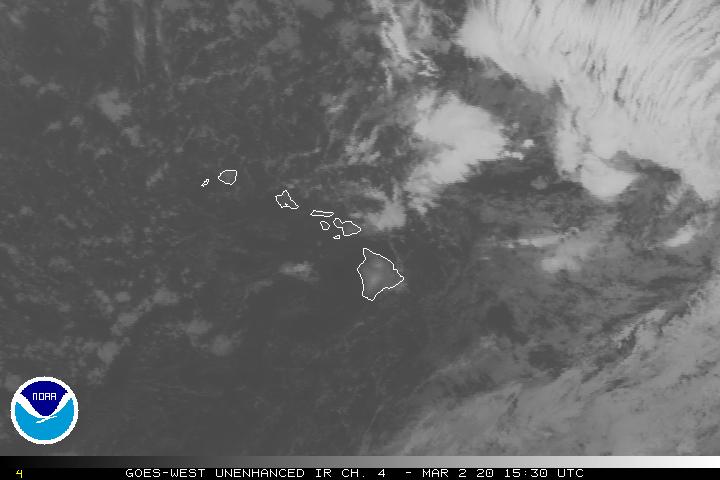
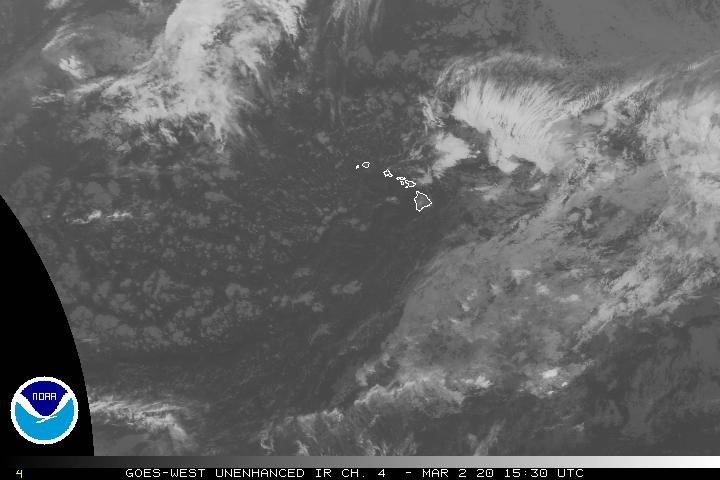
Satellite and Radar Images: To view the cloud conditions we have here in Hawaii, please use the following satellite links, starting off with the Infrared Satellite Image of the islands to see all the clouds around the state during the day and night. This next image is one that gives close images of the islands only during the daytime hours, and is referred to as a Close-up visible image. This next image shows a larger view of the Pacific…giving perspective to the wider ranging cloud patterns in the Pacific Ocean. Finally, here’s a looping IR satellite image, making viewable the clouds around the islands 24 hours a day. To help you keep track of where any showers may be around the islands, here’s the latest animated radar image.
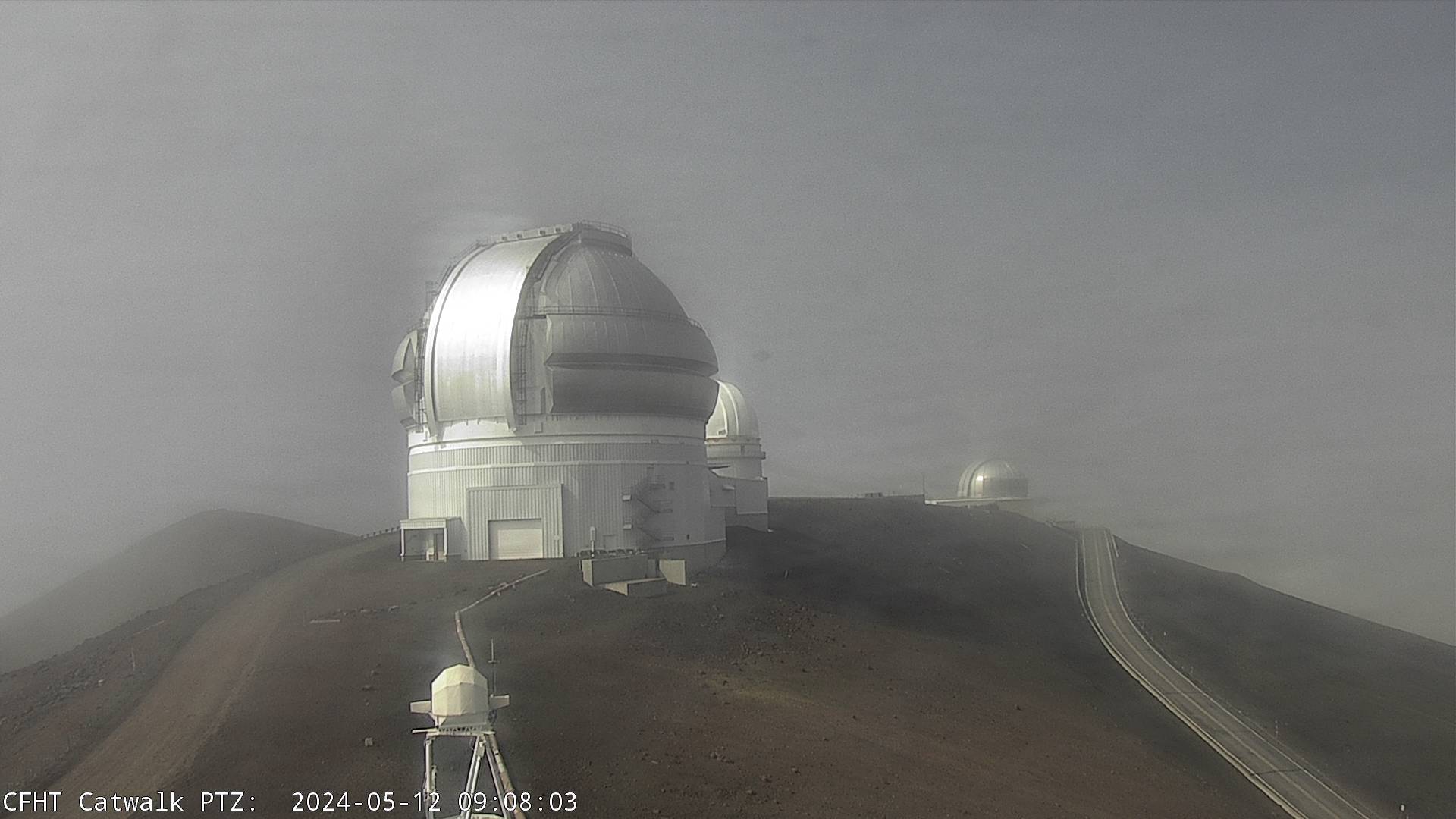
Hawaii’s Mountains – Here’s a link to the live webcam on the summit of near 14,000 foot Mauna Kea on the Big Island of Hawaii. The tallest peak on the island of Maui is the Haleakala Crater, which is near 10,000 feet in elevation. These two webcams are available during the daylight hours here in the islands…and when there’s a big moon rising just after sunset for an hour or two! Plus, during the nights and early mornings you will be able to see stars, and the sunrise too…depending upon weather conditions.
Aloha Paragraphs

Cloudy weather will be clearing Saturday
Winds were unexpectedly light Friday, with a gradually strengthening of the trade winds expected later Saturday into Sunday. The winds became light enough Friday, that the NWS forecast office in Honolulu discontinued all advisories in the coastal and channel waters. Stronger winds are occurring over the tall mountains on the Big Island…with an advisory for 25-40 mph winds up there. Our trade winds will come back into their own Sunday into the new week ahead.
A gradual clearing of the high and middle clouds will occur as we move into weekend. Looking at this satellite image, we continue to see a large, and thick area of high clouds positioned over the central islands down over the Big Island Friday night. The high clouds won’t bring precipitation, although the middle level clouds were dropping light rain here and there during the day Friday. We’ll also see a few windward biased showers at times…along with cooler than normal weather with all these clouds.
We have an end in sight for all the high and middle level clouds…finally! Here’s a looping satellite image which shows the back edge of this high level moisture, moving westward. The middle level clouds, called altocumulus are dropping some light snow at times atop the summits on the Big Island…here’s a link to snow covered Mauna Kea. The NWS is keeping a winter weather advisory, as well as a wind advisory active atop those highest elevations for the time being.
After work Thursday I went to see a new film called Fast & Furious (2009), starring Vin Diesel and Paul Walker, among others. I’m back to my old ways again this evening, opting for a classic supercharged action flick! "When a crime brings them back to L.A., fugitive ex-con Dom Toretto reignites his feud with agent Brian O’Conner. But as they are forced to confront a shared enemy, Dom and Brian must give in to an uncertain new trust if they hope to out manuever him. And from convoy heists to precision tunnel crawls across international lines, two men will find the best way to get revenge: push the limits of what’s possible behind the wheel." – In checking out the trailer, I see that there is the usual adventure, and thrilling content geared around fast cars, violence…and the attractive ladies of course. ~~~ I liked this film, it was entertaining, and there wasn’t anything that I felt let down about. It was advertised as a strictly action flick, and it delivered very adequately in that regard! Here’s the trailer for you to check out yourself, if you have any interest in plugging into this kind of film for a few seconds.
It’s Friday evening as I begin writing this last section of today’s weather narrative. There were off and on showers across the Aloha state Friday, focused most intently around the Big Island…which then shifted over Oahu later in the day. As a matter of fact, there was a flood advisory over most of the island of Oahu, where medium to locally rains broke out during the afteroon. As this looping radar image shows, most of the showers around the state were falling around Oahu Thursday evening. Most of the showers that fell over the Big Island had moved off to the east. Kauai had a few showers during the day as well, although Maui County had a respite from the showers. ~~~ It’s still cloudy here in Maui County as we head towards sunset, almost all of it of the higher and medium level variety. I stayed home all day, never left the property, didn’t even take my customary walks for a change. I just really wanted to lay low, reading, having nice meals, and talking on my cell phone to friends in California. I see no reason to change this now, so will opt to hang out on my weather deck and take in the sunset this evening. By the way, for those of you celebrating Good Friday, best wishes to you. I’ll be back Saturday morning with your next weather narrative, I hope you have a great Friday night whatever you happen to be doing! Aloha for now…Glenn.
Interesting: Though greenhouse gases are invariably at the center of discussions about global climate change, new NASA research suggests that much of the atmospheric warming observed in the Arctic since 1976 may be due to changes in tiny airborne particles called aerosols. Emitted by natural and human sources, aerosols can directly influence climate by reflecting or absorbing the sun’s radiation. The small particles also affect climate indirectly by seeding clouds and changing cloud properties, such as reflectivity.
A new study, led by climate scientist Drew Shindell of the NASA Goddard Institute for Space Studies, New York, used a coupled ocean-atmosphere model to investigate how sensitive different regional climates are to changes in levels of carbon dioxide, ozone, and aerosols.
The researchers found that the mid and high latitudes are especially responsive to changes in the level of aerosols. Indeed, the model suggests aerosols likely account for 45 percent or more of the warming that has occurred in the Arctic during the last three decades. The results were published in the April issue of Nature Geoscience.
Though there are several varieties of aerosols, previous research has shown that two types — sulfates and black carbon — play an especially critical role in regulating climate change. Both are products of human activity. Sulfates, which come primarily from the burning of coal and oil, scatter incoming solar radiation and have a net cooling effect on climate. Over the past three decades, the United States and European countries have passed a series of laws that have reduced sulfate emissions by 50 percent.
While improving air quality and aiding public health, the result has been less atmospheric cooling from sulfates. At the same time, black carbon emissions have steadily risen, largely because of increasing emissions from Asia. Black carbon — small, soot-like particles produced by industrial processes and the combustion of diesel and biofuels — absorb incoming solar radiation and have a strong warming influence on the atmosphere.
Interesting2: Thirty-four-million years ago, Earth changed profoundly. What happened, and how were Earth’s animals, plants, oceans, and climate affected? Focusing on the end of the Eocene epoch and the Eocene-Oligocene transition, a critical but very brief interval in Earth’s history, GSA’s latest Special Paper provides new answers to these questions.
According to the book’s editors, Christian Koeberl of the University of Vienna and Alessandro Montanari of the Observatorio Geologico di Coldigioco in Italy, the end of the Eocene and the Eocene-Oligocene (E-O) transition mark the most profound oceanographic and climatic changes of the past 50 million years of Earth’s history.
Earth experienced global cooling beginning in the middle Eocene, with a sharp temperature drop of about two degrees Celsius in the Late Eocene. This drop was characterized by an increase in marine oxygen isotope values and significant floral and faunal turnovers.
The global climate changes are commonly attributed to the expansion of the Antarctic ice cap following its gradual isolation from other continental masses. However, as examined in this volume, multiple extraterrestrial bolide impacts, possibly related to a comet shower that lasted more than two million years, may have played an important role in deteriorating the global climate.
Interesting3: An unsettled weather pattern will persist across central Italy the next couple of days. Heavier rain this weekend could bring new problems to the area devastated by the recent earthquake. A dying storm system will be responsible for showers and thunderstorms today into Friday. These days will not be entirely wet. The spotty nature of the showers will promote dry and even sunny parts to each day.
The lightning produced by any thunderstorm poses a danger to those left homeless by the earthquake or those continuing to comb through the wreckage in search of survivors. There is an isolated threat of the thunderstorms dropping hail. Drenching downpours from the showers and thunderstorms could cause the region’s damaged buildings to become even more unstable.
Gusty winds from the thunderstorms pose the same concern. Daytime temperatures today into Friday will be generally comfortable, averaging around 60°F. The 17,700 people living in tents across the region will have to endure chilly overnight lows. Temperatures will drop into the low to mid-40s F.
The weather will worsen this weekend with the arrival of a storm from the United Kingdom. More widespread rain will fall late Saturday into Sunday. One to two inches of rain is expected over the weekend. Cooler air will also accompany the wet weather. The rain and cool air will further create miserable conditions for those living in tents. There is also concern that enough rain could fall to make the region more susceptible to landslides in the event of even a minor earthquake.
Interesting4: You’ve probably been there. In a doctor’s office, being advised to do what you dread – exercise. You get that feeling in your gut, acknowledging that, indeed, you should exercise but probably won’t. Now imagine that the doctor is your optometrist. Don’t clean your glasses. You read that right. Eye exercises are used to treat a variety of vision disorders, according to Dr. Janice Wensveen, clinical associate professor at the University of Houston’s College of Optometry.
Patient reactions to this quite common prescription range between surprise and relief, she said, but doing the therapy can improve their performance at school and work. "They’re curious, especially when we tell them, instead of putting a Band-Aid on it like we do with glasses or contact lenses, we’re actually going to solve your problem. You’re going to be cured, and that’s something we don’t very often do," she said.
The standard at-home prescription is known as "pencil push-up therapy," said Wensveen, who practices at the University Eye Institute’s Vision Therapy Clinic in the Family Practice Service. "Patients visually follow a small letter on a pencil as they moved the pencil closer to the nose. The goal is to be able to keep the letter clear and single until it touches your nose."
Not surprisingly, she said, many patients don’t follow through once they’re out the door. "You can imagine that, in the doctor’s office, it sounds great, and you can do it. You think, ‘Wow, this can help me?’ But you get home, and you do it. You think, ‘This is really dumb.’ You do it once, and you never do it again," she said.
Interesting5: New research on infrasound from volcanic eruptions shows an unexpected connection with jet engines. Researchers at Scripps Institution of Oceanography at UC San Diego speeded up the recorded sounds from two volcanoes and uncovered a noise very similar to typical jet engines. These new research findings provide scientists with a more useful probe of the inner workings of volcanic eruptions. Infrasound is sound that is lower in frequency than 20 cycles per second, below the limit of human hearing.
The study led by Robin Matoza, a graduate student at Scripps Oceanography, will be published in an upcoming issue of the journal Geophysical Research Letters, a publication of the American Geophysical Union (AGU). Matoza measured infrasonic sound from Mount St. Helens in Washington State and Tungurahua volcano in Ecuador, both of which are highly active volcanoes close to large population centers.
"We hypothesized that these very large natural volcanic jets were making very low frequency jet noise," said Matoza, who conducts research in the Scripps Laboratory for Atmospheric Acoustics. Using 100-meter aperture arrays of microbarometers, similar to weather barometers but sensitive to smaller changes in atmospheric pressure and low-frequency infrasonic microphones, the research team tested the hypothesis, revealing the physics of how the large-amplitude signals from eruptions are produced.
Jet noise is generated by the turbulent flow of air out of a jet engine. Matoza and colleagues recorded these very large-amplitude infrasonic signals during the times when ash-laden gas was being ejected from the volcano. The study concluded that these large-scale volcanic jets are producing sound in a similar way to smaller-scale man-made jets.
Interesting6: Adding to the growing evidence that a person’s waist size is an important indicator of heart health, a study led by investigators at Beth Israel Deaconess Medical Center (BIDMC) has found that larger waist circumference is associated with increased risk of heart failure in middle-aged and older populations of men and women.
The findings, published online in the April 7 Rapid Access Report of the journal Circulation: Heart Failure, showed that increased waist size was a predictor of heart failure even when measurements of body mass index (BMI) fell within the normal range.
"Currently, 66 percent of adults in the United States are overweight or obese," explains Emily Levitan, ScD, the study’s first author and a Research Fellow in the Cardiovascular Epidemiology Research Unit at BIDMC. "Knowing that the prevalence of heart failure increased between 1989 and 1999, we wanted to better understand if and how this increase in obesity was contributing to these rising figures."
A life-threatening condition that develops when the heart can no longer pump enough blood to meet the body’s needs, heart failure (also known as congestive heart failure) is usually caused by existing cardiac conditions, including high blood pressure and coronary artery disease.
Heart failure is the leading cause of hospitalization among patients 65 and older, and is characterized by such symptoms as fatigue and weakness, difficulty walking, rapid or irregular heartbeat, and persistent cough or wheezing.
Interesting7: The Environmental Protection Agency is reconsidering whether to compel dry cleaners to phase out a cancer-causing chemical used in tens of thousands of operations nationwide, according to court documents filed late last week. The issue of whether to ban perchloroethylene, a hazardous air pollutant linked to cancer and neurological damage, has been the source of a long-running fight between environmental groups and the federal government.
In July 2006, the Bush administration ordered dry cleaners located in residential buildings to phase out the toxic solvent by 2020 but did not impose the same rules on the 28,000 other cleaners that do not operate in such mixed-use buildings. Instead, the EPA required these operators to use devices to detect leaks and to reduce emissions by conducting the wash and dry cycles in the same machine.
The Sierra Club challenged the rules in court, and on Friday the EPA asked the U.S. Court of Appeals for the D.C. Circuit to postpone arguments on the case so it could reconsider the regulations on policy and legal grounds. EPA spokesman Dale Kemery said in an e-mail that the agency and the Justice Department made the request "so that the agency’s new leadership may review the rule."
He added that they asked the court to leave the 2006 rule in place while the review is under way. Between 1996 and 2006, dry cleaners reduced emissions of perchloroethylene, also known as perc, from 25,000 tons to 10,000 tons a year by replacing older dry cleaning machines and improving their efficiency, according to EPA data.
Interesting8: The Kyoto Box is made from cardboard and can be used for sterilizing water or boiling or baking food. The Kenyan-based inventor hopes it can make solar cooking widespread in the developing world, supplanting the use of wood which is driving deforestation.
Other finalists in the $75,000 competition included a device for streamlining lorries, and a ceiling tile that cools hot rooms. Organized by Forum for the Future, the sustainable development charity founded by Jonathan Porritt, the competition aims to support concepts that have "moved off the drawing board and demonstrated their feasibility" for reducing greenhouse gas emissions, but have not gained corporate backing.
"The Kyoto Box has the potential to transform millions of lives and is a model of scalable, sustainable innovation," said Peter Madden, the forum’s chief executive. It is made from two cardboard boxes, which use reflective foil and black paint to maximize absorption of solar energy.
Interesting9: Leatherback turtles are ancient creatures with a modern problem: Plastic. A new study looked at necropsy reports of more than 400 leatherbacks that have died since 1885 and found plastic in the digestive systems of more than a third of the animals. Besides plastic bags, the turtles had swallowed fishing lines, balloon fragments, spoons, candy wrappers and more. Plastic was probably not the cause of death in most cases. Nevertheless, the study is an important wake-up call for a growing garbage problem.
"Eating something that is plastic can’t be good for you, whether it leads to death or not," said Mike James, a marine biologist at Dalhousie University in Halifax, Nova Scotia. "It’s not what they should be eating. And it’s kind of scary that it is showing up in their diet to the extent that it is."
Leatherback turtles are critically endangered and highly charismatic creatures. They are big, weighing 1,000 pounds or more, with shells that can measure more than 6 feet across. These peaceful creatures have had the same basic body plan for 150 million years.
Leatherbacks are also popular for what they eat: namely, large quantities of jellyfish. The problem is that plastic bags look a lot like jellyfish, and plastic often ends up in the oceans, piling up in areas where currents — and turtles — converge. That led James to wonder how much often the turtles were swallowing plastic in their hunt for yummy jellyfish.
Collecting the data was a painstaking process. James and colleagues spent two years searching far and wide for turtle necropsy reports. They scanned the literature, and they asked people to dig up old field-notebooks. For every report found, they had to make sure that a complete necropsy had been performed and that the entire GI tract had been opened.
The researchers ended up with a sample size of 408 turtles, stranded at some point during the last 125 years. Of those, 138 — or 34 percent — contained plastic. Alongside the rise in plastic production, there has been a sharp rise in plastic-containing turtles since the 1950s. That finding isn’t surprising, given the leatherback’s jellyfish-based diet, said Christopher Sasso, a research fisheries biologist with the National Marine Fisheries Service in Miami.
But the numbers are alarming. Plastic can block a turtle’s gut, causing bloating, interfering with digestion, and leading to a slow, painful death. "I can’t imagine it’s very comfortable," he said. "Their guts weren’t designed to digest plastic."
There are vast fields of trash floating in the world’s oceans, Sasso added. And leatherback turtles travel thousands of miles each year, giving them even more opportunities to come in contact with it. "This is an animal that has survived many extinction events," James said, "And now it’s got all these anthropogenic hazards to face."
That’s where people come in. Simple choices — like putting balloons and picnic supplies in the trash and using canvas instead of plastic grocery bags — can help leatherbacks and other marine creatures survive long into the future. "Of all the problems the environment faces, this one is not impossible to address," James said. "We don’t need to have everything packaged in plastic. There are alternatives."
Posted by Glenn
No Comments
April 9-10, 2009
Air Temperatures – The following maximum temperatures were recorded across the state of Hawaii Thursday afternoon:
Lihue, Kauai – 72
Honolulu, Oahu – 77
Kaneohe, Oahu – 73
Kahului, Maui – 74
Hilo, Hawaii – 71
Kailua-kona – 78
Air Temperatures ranged between these warmest and coolest spots near sea level – and on the highest mountains…at 5 p.m. Thursday evening:
Barking Sands, Kauai – 77F
Kahului, Maui – 68
Haleakala Crater – 39 (near 10,000 feet on Maui)
Mauna Kea summit – 28 (near 14,000 feet on the Big Island)
Precipitation Totals – The following numbers represent the largest precipitation totals (inches) during the last 24 hours on each of the major islands, as of Thursday afternoon:
1.72 Mount Waialaele, Kauai
0.15 Nuuanu Upper, Oahu
0.01 Molokai
0.01 Lanai
0.03 Kahoolawe
0.50 West Wailuaiki, Maui
0.31 Glenwood, Big Island
Weather Chart – Here’s the latest (automatically updated) weather map showing a 1033 millibar high pressure system more or less to the north the islands. This high pressure cell will keep our trade winds light to moderately strong Friday and Saturday…lighter in those more protected places.
Satellite and Radar Images: To view the cloud conditions we have here in Hawaii, please use the following satellite links, starting off with the Infrared Satellite Image of the islands to see all the clouds around the state during the day and night. This next image is one that gives close images of the islands only during the daytime hours, and is referred to as a Close-up visible image. This next image shows a larger view of the Pacific…giving perspective to the wider ranging cloud patterns in the Pacific Ocean. Finally, here’s a looping IR satellite image, making viewable the clouds around the islands 24 hours a day. To help you keep track of where any showers may be around the islands, here’s the latest animated radar image.
Hawaii’s Mountains – Here’s a link to the live webcam on the summit of near 14,000 foot Mauna Kea on the Big Island of Hawaii. The tallest peak on the island of Maui is the Haleakala Crater, which is near 10,000 feet in elevation. These two webcams are available during the daylight hours here in the islands…and when there’s a big moon rising just after sunset for an hour or two! Plus, during the nights and early mornings you will be able to see stars, and the sunrise too…depending upon weather conditions.
Aloha Paragraphs

The incredibly beautiful windward side of Oahu
Slightly lighter trade winds will blow Friday through the weekend…and then strengthen some again as we push into early next week. The source of our trade wind weather pattern Thursday night is a 1033 millibar high pressure system to the north of the Hawaiian Islands…as shown on this weather map. The winds have become light enough Thursday night, that the NWS forecast office in Honolulu is keeping the small craft wind advisory active through the major channels from Oahu southward…and those windiest coastal zones around Maui and the Big Island.
A mix of high, middle, and lower level clouds will keep the island chain cloudier than usual for the next couple of days. Looking at this satellite image, we continue to see a large, and thick area of high clouds moving right over us from the southwest. These high clouds will dim and filter our Hawaiian sunshine greatly during the days. These high clouds won’t bring precipitation, although the middle level clouds are dropping light rain at times. We’ll also see a few windward biased showers at times too, cooler than normal with all these clouds.
The name of the game now will be cloudy skies…which of course means a distinct lack of our famous Hawaiian sunshine. We’re going to be seeing lots more of this tropical moisture riding northward over our islands into the weekend. Here’s a looping satellite image which shows the extent of this high level cloudiness moving by overhead. The middle level clouds, called altocumulus are dropping some light snow at times atop the summits on the Big Island…here’s a link to Mauna Kea. The NWS is keeping a winter weather advisory active atop those highest elevations.
It’s early Thursday evening as I begin writing this last section of today’s weather narrative. It was cloudy all day Thursday, with not even a second’s worth of sunshine breaking through here on Maui. As a matter of fact, light rain fell most of the day over Maui County in general. As this looping radar image shows, the central islands seem to be acting like a magnet for these showers falling from the middle level cloudiness Thursday evening/night. I would expect more of the same as we move into Good Friday, with perhaps some relief from the cloudy and locally showery conditions later this coming weekend. ~~~ I’m going to drive over to Kahului from Kihei, where I’m writing these words. I’ve decided to see a new film called Fast & Furious (2009), starring Vin Diesel and Paul Walker, among others. I’m back to my old ways again this evening, opting for a classic supercharged action flick! "When a crime brings them back to L.A., fugitive ex-con Dom Toretto reignites his feud with agent Brian O’Conner. But as they are forced to confront a shared enemy, Dom and Brian must give in to an uncertain new trust if they hope to out manuever him. And from convoy heists to precision tunnel crawls across international lines, two men will find the best way to get revenge: push the limits of what’s possible behind the wheel." – In checking out the trailer, I see that there is the usual adventure, and thrilling content geared around fast cars, violence…and cute girls of course. Here’s the trailer for you to check out yourself, if you have any interest in plugging into this kind of film for a few seconds. ~~~ I’ll be back Friday morning with my opinion about this film, along with your next new weather narrative. I hope you have a great Thursday night! Aloha for now…Glenn.
Interesting: Though greenhouse gases are invariably at the center of discussions about global climate change, new NASA research suggests that much of the atmospheric warming observed in the Arctic since 1976 may be due to changes in tiny airborne particles called aerosols. Emitted by natural and human sources, aerosols can directly influence climate by reflecting or absorbing the sun’s radiation. The small particles also affect climate indirectly by seeding clouds and changing cloud properties, such as reflectivity.
A new study, led by climate scientist Drew Shindell of the NASA Goddard Institute for Space Studies, New York, used a coupled ocean-atmosphere model to investigate how sensitive different regional climates are to changes in levels of carbon dioxide, ozone, and aerosols.
The researchers found that the mid and high latitudes are especially responsive to changes in the level of aerosols. Indeed, the model suggests aerosols likely account for 45 percent or more of the warming that has occurred in the Arctic during the last three decades. The results were published in the April issue of Nature Geoscience.
Though there are several varieties of aerosols, previous research has shown that two types — sulfates and black carbon — play an especially critical role in regulating climate change. Both are products of human activity. Sulfates, which come primarily from the burning of coal and oil, scatter incoming solar radiation and have a net cooling effect on climate. Over the past three decades, the United States and European countries have passed a series of laws that have reduced sulfate emissions by 50 percent.
While improving air quality and aiding public health, the result has been less atmospheric cooling from sulfates. At the same time, black carbon emissions have steadily risen, largely because of increasing emissions from Asia. Black carbon — small, soot-like particles produced by industrial processes and the combustion of diesel and biofuels — absorb incoming solar radiation and have a strong warming influence on the atmosphere.
Interesting2: Thirty-four-million years ago, Earth changed profoundly. What happened, and how were Earth’s animals, plants, oceans, and climate affected? Focusing on the end of the Eocene epoch and the Eocene-Oligocene transition, a critical but very brief interval in Earth’s history, GSA’s latest Special Paper provides new answers to these questions.
According to the book’s editors, Christian Koeberl of the University of Vienna and Alessandro Montanari of the Observatorio Geologico di Coldigioco in Italy, the end of the Eocene and the Eocene-Oligocene (E-O) transition mark the most profound oceanographic and climatic changes of the past 50 million years of Earth’s history.
Earth experienced global cooling beginning in the middle Eocene, with a sharp temperature drop of about two degrees Celsius in the Late Eocene. This drop was characterized by an increase in marine oxygen isotope values and significant floral and faunal turnovers.
The global climate changes are commonly attributed to the expansion of the Antarctic ice cap following its gradual isolation from other continental masses. However, as examined in this volume, multiple extraterrestrial bolide impacts, possibly related to a comet shower that lasted more than two million years, may have played an important role in deteriorating the global climate.
Interesting3: An unsettled weather pattern will persist across central Italy the next couple of days. Heavier rain this weekend could bring new problems to the area devastated by the recent earthquake. A dying storm system will be responsible for showers and thunderstorms today into Friday. These days will not be entirely wet. The spotty nature of the showers will promote dry and even sunny parts to each day.
The lightning produced by any thunderstorm poses a danger to those left homeless by the earthquake or those continuing to comb through the wreckage in search of survivors. There is an isolated threat of the thunderstorms dropping hail. Drenching downpours from the showers and thunderstorms could cause the region’s damaged buildings to become even more unstable.
Gusty winds from the thunderstorms pose the same concern. Daytime temperatures today into Friday will be generally comfortable, averaging around 60°F. The 17,700 people living in tents across the region will have to endure chilly overnight lows. Temperatures will drop into the low to mid-40s F.
The weather will worsen this weekend with the arrival of a storm from the United Kingdom. More widespread rain will fall late Saturday into Sunday. One to two inches of rain is expected over the weekend. Cooler air will also accompany the wet weather. The rain and cool air will further create miserable conditions for those living in tents. There is also concern that enough rain could fall to make the region more susceptible to landslides in the event of even a minor earthquake.
Interesting4: You’ve probably been there. In a doctor’s office, being advised to do what you dread – exercise. You get that feeling in your gut, acknowledging that, indeed, you should exercise but probably won’t. Now imagine that the doctor is your optometrist. Don’t clean your glasses. You read that right. Eye exercises are used to treat a variety of vision disorders, according to Dr. Janice Wensveen, clinical associate professor at the University of Houston’s College of Optometry.
Patient reactions to this quite common prescription range between surprise and relief, she said, but doing the therapy can improve their performance at school and work. "They’re curious, especially when we tell them, instead of putting a Band-Aid on it like we do with glasses or contact lenses, we’re actually going to solve your problem. You’re going to be cured, and that’s something we don’t very often do," she said.
The standard at-home prescription is known as "pencil push-up therapy," said Wensveen, who practices at the University Eye Institute’s Vision Therapy Clinic in the Family Practice Service. "Patients visually follow a small letter on a pencil as they moved the pencil closer to the nose. The goal is to be able to keep the letter clear and single until it touches your nose."
Not surprisingly, she said, many patients don’t follow through once they’re out the door. "You can imagine that, in the doctor’s office, it sounds great, and you can do it. You think, ‘Wow, this can help me?’ But you get home, and you do it. You think, ‘This is really dumb.’ You do it once, and you never do it again," she said.
Interesting5: New research on infrasound from volcanic eruptions shows an unexpected connection with jet engines. Researchers at Scripps Institution of Oceanography at UC San Diego speeded up the recorded sounds from two volcanoes and uncovered a noise very similar to typical jet engines. These new research findings provide scientists with a more useful probe of the inner workings of volcanic eruptions. Infrasound is sound that is lower in frequency than 20 cycles per second, below the limit of human hearing.
The study led by Robin Matoza, a graduate student at Scripps Oceanography, will be published in an upcoming issue of the journal Geophysical Research Letters, a publication of the American Geophysical Union (AGU). Matoza measured infrasonic sound from Mount St. Helens in Washington State and Tungurahua volcano in Ecuador, both of which are highly active volcanoes close to large population centers.
"We hypothesized that these very large natural volcanic jets were making very low frequency jet noise," said Matoza, who conducts research in the Scripps Laboratory for Atmospheric Acoustics. Using 100-meter aperture arrays of microbarometers, similar to weather barometers but sensitive to smaller changes in atmospheric pressure and low-frequency infrasonic microphones, the research team tested the hypothesis, revealing the physics of how the large-amplitude signals from eruptions are produced.
Jet noise is generated by the turbulent flow of air out of a jet engine. Matoza and colleagues recorded these very large-amplitude infrasonic signals during the times when ash-laden gas was being ejected from the volcano. The study concluded that these large-scale volcanic jets are producing sound in a similar way to smaller-scale man-made jets.
Interesting6: Adding to the growing evidence that a person’s waist size is an important indicator of heart health, a study led by investigators at Beth Israel Deaconess Medical Center (BIDMC) has found that larger waist circumference is associated with increased risk of heart failure in middle-aged and older populations of men and women.
The findings, published online in the April 7 Rapid Access Report of the journal Circulation: Heart Failure, showed that increased waist size was a predictor of heart failure even when measurements of body mass index (BMI) fell within the normal range.
"Currently, 66 percent of adults in the United States are overweight or obese," explains Emily Levitan, ScD, the study’s first author and a Research Fellow in the Cardiovascular Epidemiology Research Unit at BIDMC. "Knowing that the prevalence of heart failure increased between 1989 and 1999, we wanted to better understand if and how this increase in obesity was contributing to these rising figures."
A life-threatening condition that develops when the heart can no longer pump enough blood to meet the body’s needs, heart failure (also known as congestive heart failure) is usually caused by existing cardiac conditions, including high blood pressure and coronary artery disease.
Heart failure is the leading cause of hospitalization among patients 65 and older, and is characterized by such symptoms as fatigue and weakness, difficulty walking, rapid or irregular heartbeat, and persistent cough or wheezing.
Interesting7: The Environmental Protection Agency is reconsidering whether to compel dry cleaners to phase out a cancer-causing chemical used in tens of thousands of operations nationwide, according to court documents filed late last week. The issue of whether to ban perchloroethylene, a hazardous air pollutant linked to cancer and neurological damage, has been the source of a long-running fight between environmental groups and the federal government.
In July 2006, the Bush administration ordered dry cleaners located in residential buildings to phase out the toxic solvent by 2020 but did not impose the same rules on the 28,000 other cleaners that do not operate in such mixed-use buildings. Instead, the EPA required these operators to use devices to detect leaks and to reduce emissions by conducting the wash and dry cycles in the same machine.
The Sierra Club challenged the rules in court, and on Friday the EPA asked the U.S. Court of Appeals for the D.C. Circuit to postpone arguments on the case so it could reconsider the regulations on policy and legal grounds. EPA spokesman Dale Kemery said in an e-mail that the agency and the Justice Department made the request "so that the agency’s new leadership may review the rule."
He added that they asked the court to leave the 2006 rule in place while the review is under way. Between 1996 and 2006, dry cleaners reduced emissions of perchloroethylene, also known as perc, from 25,000 tons to 10,000 tons a year by replacing older dry cleaning machines and improving their efficiency, according to EPA data.
Interesting8: The Kyoto Box is made from cardboard and can be used for sterilizing water or boiling or baking food. The Kenyan-based inventor hopes it can make solar cooking widespread in the developing world, supplanting the use of wood which is driving deforestation.
Other finalists in the $75,000 competition included a device for streamlining lorries, and a ceiling tile that cools hot rooms. Organized by Forum for the Future, the sustainable development charity founded by Jonathan Porritt, the competition aims to support concepts that have "moved off the drawing board and demonstrated their feasibility" for reducing greenhouse gas emissions, but have not gained corporate backing.
"The Kyoto Box has the potential to transform millions of lives and is a model of scalable, sustainable innovation," said Peter Madden, the forum’s chief executive. It is made from two cardboard boxes, which use reflective foil and black paint to maximize absorption of solar energy.
Interesting9: Leatherback turtles are ancient creatures with a modern problem: Plastic. A new study looked at necropsy reports of more than 400 leatherbacks that have died since 1885 and found plastic in the digestive systems of more than a third of the animals. Besides plastic bags, the turtles had swallowed fishing lines, balloon fragments, spoons, candy wrappers and more. Plastic was probably not the cause of death in most cases. Nevertheless, the study is an important wake-up call for a growing garbage problem.
"Eating something that is plastic can’t be good for you, whether it leads to death or not," said Mike James, a marine biologist at Dalhousie University in Halifax, Nova Scotia. "It’s not what they should be eating. And it’s kind of scary that it is showing up in their diet to the extent that it is."
Leatherback turtles are critically endangered and highly charismatic creatures. They are big, weighing 1,000 pounds or more, with shells that can measure more than 6 feet across. These peaceful creatures have had the same basic body plan for 150 million years.
Leatherbacks are also popular for what they eat: namely, large quantities of jellyfish. The problem is that plastic bags look a lot like jellyfish, and plastic often ends up in the oceans, piling up in areas where currents — and turtles — converge. That led James to wonder how much often the turtles were swallowing plastic in their hunt for yummy jellyfish.
Collecting the data was a painstaking process. James and colleagues spent two years searching far and wide for turtle necropsy reports. They scanned the literature, and they asked people to dig up old field-notebooks. For every report found, they had to make sure that a complete necropsy had been performed and that the entire GI tract had been opened.
The researchers ended up with a sample size of 408 turtles, stranded at some point during the last 125 years. Of those, 138 — or 34 percent — contained plastic. Alongside the rise in plastic production, there has been a sharp rise in plastic-containing turtles since the 1950s. That finding isn’t surprising, given the leatherback’s jellyfish-based diet, said Christopher Sasso, a research fisheries biologist with the National Marine Fisheries Service in Miami.
But the numbers are alarming. Plastic can block a turtle’s gut, causing bloating, interfering with digestion, and leading to a slow, painful death. "I can’t imagine it’s very comfortable," he said. "Their guts weren’t designed to digest plastic."
There are vast fields of trash floating in the world’s oceans, Sasso added. And leatherback turtles travel thousands of miles each year, giving them even more opportunities to come in contact with it. "This is an animal that has survived many extinction events," James said, "And now it’s got all these anthropogenic hazards to face."
That’s where people come in. Simple choices — like putting balloons and picnic supplies in the trash and using canvas instead of plastic grocery bags — can help leatherbacks and other marine creatures survive long into the future. "Of all the problems the environment faces, this one is not impossible to address," James said. "We don’t need to have everything packaged in plastic. There are alternatives."
Posted by Glenn
[3] Comments
April 8-9, 2009
Air Temperatures – The following maximum temperatures were recorded across the state of Hawaii Wednesday afternoon:
Lihue, Kauai – 74
Honolulu, Oahu – 78
Kaneohe, Oahu – 75
Kahului, Maui – 76
Hilo, Hawaii – 75
Kailua-kona – 80
Air Temperatures ranged between these warmest and coolest spots near sea level – and on the highest mountains…at 4 p.m. Wednesday afternoon:
Barking Sands, Kauai – 77F
Lihue, Kauai – 71
Haleakala Crater – 48 (near 10,000 feet on Maui)
Mauna Kea summit – 34 (near 14,000 feet on the Big Island)
Precipitation Totals – The following numbers represent the largest precipitation totals (inches) during the last 24 hours on each of the major islands, as of Wednesday afternoon:
1.10 Mount Waialaele, Kauai
0.40 Oahu Forest NWR, Oahu
0.01 Molokai
0.00 Lanai
0.09 Kahoolawe
1.25 West Wailuaiki, Maui
0.58 Mountain View, Big Island
Weather Chart – Here’s the latest (automatically updated) weather map showing a 1033 millibar high pressure system more or less to the north the islands. This high pressure cell will keep our trade winds moderately strong Thursday and Friday…lighter in those more protected places.
Satellite and Radar Images: To view the cloud conditions we have here in Hawaii, please use the following satellite links, starting off with the Infrared Satellite Image of the islands to see all the clouds around the state during the day and night. This next image is one that gives close images of the islands only during the daytime hours, and is referred to as a Close-up visible image. This next image shows a larger view of the Pacific…giving perspective to the wider ranging cloud patterns in the Pacific Ocean. Finally, here’s a looping IR satellite image, making viewable the clouds around the islands 24 hours a day. To help you keep track of where any showers may be around the islands, here’s the latest animated radar image.
Hawaii’s Mountains – Here’s a link to the live webcam on the summit of near 14,000 foot Mauna Kea on the Big Island of Hawaii. The tallest peak on the island of Maui is the Haleakala Crater, which is near 10,000 feet in elevation. These two webcams are available during the daylight hours here in the islands…and when there’s a big moon rising just after sunset for an hour or two! Plus, during the nights and early mornings you will be able to see stars, and the sunrise too…depending upon weather conditions.
Aloha Paragraphs

Cloudy skies in the islands
Little change in the expectations of continued trade winds through this week, blowing more or less in the moderately strong realms…right on into next week. The source of our breezy trade winds Wednesday night is a 1033 millibar high pressure system to the north of the Hawaiian Islands…as shown on this weather map. The NWS forecast office in Honolulu is keeping the small craft wind advisory flags up across all of our marine coastal and channel waters. There continues to be no end to the trade wind flow across our tropical latitudes, which is quite common during the spring season here in the islands.
We have moved into what will be rather cloudy skies through the rest of the week, lots of it being the high cirrus variety…with still some showers along our windward sides at times. Looking at this satellite image, we now see a large, and rather thick area of high clouds having moved right over us from the southwest. These high clouds will dim and filter our Hawaiian sunshine greatly through Friday or Saturday…thinning some by Sunday. These high clouds won’t bring precipitation, although the trade winds will carry some shower bearing clouds to our north and east facing windward coasts and slopes.
As noted in the two paragraphs above, our trade winds will continue, and were pretty much completely cloudy now. We’re going to be seeing lots more of this tropical moisture riding northward over our islands into the weekend. Here’s a looping satellite image which shows the extent of this high level cloudiness moving by overhead. We’ve seen the last of our sunny weather for the time being, but before anyone gets too upset, we should see our sunshine returning, at least partially, as we move into the upcoming weekend time frame.
It’s early Wednesday evening as I begin writing this last section of today’s weather narrative. It’s the end of another good day of weather reporting. The main topic now is, and will continue to be…the dense canopy of high cirrus clouds. Becoming a second string player now, will be the moderately strong trade winds. Slightly below this fairly normal wind flow, will be the occasional passing showers along our windward sides. These three weather features will remain our headline weather news through the rest of this week. ~~~ Looking out the window here in Kihei, Maui, before I cruize back upcountry, I see absolutely cloudy skies out there, with not even the slightest sign of sunshine. I know that not everyone is all that happy with this situation, although we should all practice taking a deep breath, and relax into it, that…or just bite the bullet so to speak. The cloudy skies, and the locally breezy trade winds, still have folks talking about the coolness of our weather here in the islands…which is true. ~~~ As we have all this high cloudiness around now, the fact that our April full moon will occur at 458am Thursday morning, won’t do us much good…as it will be muted, as will our sunshine for the time being as well. I will be back early Thursday morning, to present you with your next new weather narrative from this cloudy paradise of Hawaii. I hope you have a great Wednesday night wherever you happen to be hanging out! Aloha for now…Glenn.
Interesting: Bananas are a staple crop of Rwanda. The fruit is eaten raw, fried and baked — it even produces banana beer and wine. Around 2 million tons are grown each year but the fruit is only a small percentage of what the plant produces. The rest — skins, leaves and stems — is left to rot as waste. Now scientists at The University of Nottingham are looking at ways to use that waste to produce fuel, developing simple methods of producing banana briquettes that could be burnt for cooking and heating. PhD student Joel Chaney in the Faculty of Engineering has developed a method of producing the briquettes using minimal tools and technology, which could be used in communities all over Africa.
First, the banana skins and leaves are mashed to a pulp in a hand-operated domestic meat mincer. This pulp is mixed with sawdust to create a mouldable material — in Rwanda it would be mixed with sun dried banana stems, ensuring the whole plant is used. Then, the pulp mix is compressed into briquette shapes and baked in an oven at 105 degrees. Again, in Africa the fuel would be left for a few days to dry in the sun. Once dried, the briquettes form an ideal fuel, burning with a consistent steady heat suitable for cooking. Joel has tested this himself by cooking fried banana fritters, which is similar to “red-red” a popular Ghanaian dish.
“A big problem in the developing world is firewood,” said Joel. “Huge areas of land are deforested every year, which leads to the land being eroded. People need fuel to cook and stay warm but they can’t afford the more expensive types, like gas. “As well as the environmental damage this causes, it also takes a lot of time. Women can spend four or five hours a day just collecting firewood. If an alternative fuel could be found they could spend this time doing other things — even generating an income. “Using waste to create fuel is key to sustainable development, and this method could be easily transferred across Africa.”
Interesting2: Whale sharks — giants of the fish world that strike terror only among tiny creatures like the plankton and krill they eat — are imperiled by over-fishing of the species in parts of its ocean range. That threat is underscored in a new study from geneticists led by Jennifer Schmidt, University of Illinois at Chicago associate professor of biological sciences, reported online April 7 in the journal PLoS One.
Schmidt and her colleagues studied the DNA of 68 whale sharks from 11 locations across the Indian and Pacific Oceans and the Caribbean Sea — an area that covers most of the shark’s known range. Results showed little genetic variation between the populations, which indicates migration and interbreeding among far-flung populations of the big fish.
"Our data show that whale sharks found in different oceans are genetically quite similar, which means that animals move and interbreed between populations," said Schmidt. "From a conservation standpoint, it means that whale sharks in protected waters cannot be assumed to stay in those waters, but may move into areas where they may be in danger."
A tropical fish that can grow 50 feet or longer and weigh over 20 tons, a whale shark’s range can span oceans. They do not breed until they are about 25 to 30 years old, so it will take a long time for the species to recover from recent population declines. Whale sharks are listed as threatened, but not every country protects them. The large animals are especially prized by fishermen for meat and fins used in soup.
Interesting3: A new study by researchers from UC Santa Barbara’s National Center for Ecological Analysis and Synthesis (NCEAS) sheds light on how threats to the world’s endangered coral reef ecosystems can be more effectively managed. In a recent issue of the journal Coral Reefs, lead authors Kimberly A. Selkoe and Benjamin S. Halpern, both of NCEAS, explain how their maps of the Northwestern Hawaiian Islands (NWHI) –– a vast area stretching over 1,200 miles –– can be used to make informed decisions about protecting the world’s fragile reefs. Coral reef ecosystems are at risk due to the direct and indirect effects of human activities.
This study was designed to help natural resource managers make decisions on issues such as surveillance priorities, granting of permits for use, and discernment of which areas to monitor for climate change effects. "Our maps of cumulative human impact are a powerful tool for synthesizing and visualizing the state of the oceans," said first author Selkoe, who is also affiliated with Hawaii Institute of Marine Biology at the University of Hawaii. "The maps can aid in strategically zoning uses of oceans in an informed way that maximizes commercial and societal benefits while minimizing further cumulative impact."
"President (George W.) Bush declared the Northwestern Hawaiian Islands a National Monument in 2006, in part because it is one of the last places in the oceans that have not been heavily altered by human activities," said Halpern. "Our maps of cumulative human impact on these islands show that, despite their extreme isolation, humans are already significantly impacting this special place, and that many of the key threats, such as those associated with climate change, are not mitigated with Monument designation. We must continue to act to protect these islands and coral atolls if we hope to preserve them for future generations."
The authors studied 14 threats specific to NWHI. The threats, all generated by humans, included alien species, bottom fishing, lobster trap fishing, ship-based pollution, ship strike risks, marine debris, research diving, research equipment installation, and wildlife sacrifice for research. Human-induced climate change threats were also studied, including increased ultraviolet radiation, seawater acidification, the number of warm ocean temperature anomalies relevant to disease outbreaks and coral bleaching, and sea level rise.
Risk of increased rates of coral disease due to warming ocean temperature was found to have the highest impact, along with other climate-related threats. However, the authors noted that climate issues cannot be resolved by managers at the regional level. It was noted that threats related to ship traffic are most easily managed by regional management.
Interesting4: The race is on to develop smaller, more powerful and more solid batteries for devices like laptop computers, cell phones, GPS receivers and other portable devices. Scientists at MIT are taking the opposite approach, developing large, eco-friendly stationary batteries made entirely from liquid metal that would store large amounts of power from wind farms or solar cells or serve as backup power sources for hospitals.
"Since these batteries won’t be in someone’s hand or in a car, we don’t have to make them crash-worthy, idiot-proof, and it doesn’t have to operate at around body temperature," said Don Sadoway, a scientist at the Massachusetts Institute of Technology who, along with graduate student David Bradwell and fellow professor Gerbrand Ceder, is developing the molten metal battery.
Interesting5: Plastic bags account for 50 percent of the plastic trash in Washington, D.C.’s Anacostia River. In order to decrease the amount of plastic bags in the Anacostia, the D.C. Council proposed legislation that would put a five cents tax on disposable shopping bags. Eleven council members co-introduced it, and according to a Washington Post article, that almost guarantees it will become law.
Social service groups and plastic bag manufacturers have joined forces in opposing the legislation, arguing that the tax will be a hardship for poor people. "I have no qualms about cleaning up the Anacostia River," said former Ward 8 council member Sandy Allen.
"That little five cents may sound small, but on a continued basis” it eats into the income." Restaurant owner Andy Shallal accused the plastic bag manufacturers of "race-baiting and class-baiting." The legislation’s author, Council member Tommy Wells, said, "The approach I’m taking is really to get into your head, not into your pocket."
A provision in the legislation creates a fund from the tax revenue to clean up the Anacostia and provide reusable bags to "district residents, with priority to assisting seniors and low-income residents." D.C. stores would be allowed to keep a penny for each bag, and the other four cents would go to the fund.
In 2002, Ireland instituted a plastic bag tax of 20 cents per bag, called the PlasTax. Last year the tax increased to 33 cents. The PlasTax was a response to 1.2 million shopping bags, 316 per person, consumed yearly in Ireland. The taxes raised from the PlasTax go into the Green Fund, which finances environmental projects.
During the first three months the amount of shopping bags used by consumers decreased 90 percent and raised $3.45 million. After one year the plastic bag use decreased by 94 percent, and raised $9.6 million. The PlasTax also got rid of one of Ireland’s largest imports as only 21 percent of plastic bags were manufactured in Ireland.
Interesting6: It seemed like a symbolic tipping point for the nation in August when, in the midst of record high gasoline prices and a presidential campaign, the Santa Barbara County Board of Supervisors abandoned its longtime opposition to offshore oil drilling. With offshore oil drilling platforms in the distance, children played in the surf early this year in Santa Barbara County, California.
But six months later, with oil prices less than half what they were last summer, the board met on the issue again on Tuesday and reverted to its traditional stance, approving a resolution against offshore drilling in federal waters by a 3-to-2 vote. "I just feel this is not our future," said Supervisor Doreen Farr, who voted for the resolution. Santa Barbara’s longstanding antipathy to drilling traces back to a huge 1969 oil spill off the city’s coast that helped galvanize the environmental movement.
Ms. Farr, who won election to the board in November, replaced Brooks Firestone, who in August cast the decisive vote in favor of drilling. At the time, Mr. Firestone, who did not seek re-election, cited the importance of drilling to the economy and to reducing the nation’s dependence on foreign energy sources. Tuesday’s resolution was proposed by two supervisors from the city of Santa Barbara, Janet Wolf and Salud Carbajal.
Ms. Farr’s district encompasses part of the city but stretches north and east into the county’s agricultural areas. Two other supervisors from inland areas, Joseph Centeno and Joni Gray, have consistently favored an end to federal moratoriums on drilling. President George W. Bush lifted one moratorium last year. Also in 2008, Congress let a separate moratorium lapse.
Interesting7: Scientists have discovered a link between increased lightning and the strongest winds in hurricanes, a study reports online this week in the British journal Nature Geoscience. Lead author Colin Price of Tel Aviv University in Israel and colleagues found a significant increase in lightning about a day before the most intense winds in the hurricanes they studied. The authors say this bit of advance warning could lead to better intensity forecasts.
Price and his team tracked the wind speeds of all Category 4 and 5 hurricanes, typhoons and cyclones around the world from 2005 to 2007 and compared them with global lightning data. (Category 4 storms have sustained wind speeds of 131 mph and above.) "Of the 58 hurricanes analyzed, only two showed no significant correlation between lightning and wind speed," the authors report.
Though hurricane track predictions have become significantly more accurate in recent decades, the accuracy of hurricane intensity forecasts have remained about the same. "One of our biggest challenges is in providing skillful intensity prediction in our one- to five-day forecasts," Chris Landsea, science and operations officer at the National Hurricane Center in Miami, said in an e-mail. "So any method for assisting NHC in these predictions is welcome."
Price says real-time lightning data have become far more accessible in recent years and can now be monitored continuously at any location around the globe. Other scientists agree that the study has merits but say additional research is needed to determine whether a link exists. "Can the authors’ observations be translated into improved forecasts of hurricane intensity?
Perhaps, but not without much more work," meteorologist John Brown of the National Oceanic and Atmospheric Administration in Boulder, Colo., said in an e-mail. Joe Golden, also an NOAA meteorologist, agrees: "This study is heavy on statistics and weak on the physical linkages between lightning and hurricanes."
Posted by Glenn
No Comments
April 7-8, 2009
Air Temperatures – The following maximum temperatures were recorded across the state of Hawaii Tuesday afternoon:
Lihue, Kauai – 74
Honolulu, Oahu – 81
Kaneohe, Oahu – 75
Kahului, Maui – 75
Hilo, Hawaii – 72
Kailua-kona – 80
Air Temperatures ranged between these warmest and coolest spots near sea level – and on the highest mountains…at 4 p.m. Tuesday afternoon:
Kailua-kona – 79F
Hilo, Hawaii – 66
Haleakala Crater – 50 (near 10,000 feet on Maui)
Mauna Kea summit – 30 (near 14,000 feet on the Big Island)
Precipitation Totals – The following numbers represent the largest precipitation totals (inches) during the last 24 hours on each of the major islands, as of Tuesday afternoon:
1.96 Mount Waialaele, Kauai
1.01 Oahu Forest NWR, Oahu
0.00 Molokai
0.00 Lanai
0.08 Kahoolawe
2.39 Puu Kukui, Maui
0.91 Honokaa, Big Island
Weather Chart – Here’s the latest (automatically updated) weather map showing a 1031 millibar high pressure system more or less to the north the islands. This high pressure cell will keep our trade winds moderately strong, to locally strong and gusty Wednesday and Thursday…lighter in those more protected places.
Satellite and Radar Images: To view the cloud conditions we have here in Hawaii, please use the following satellite links, starting off with the Infrared Satellite Image of the islands to see all the clouds around the state during the day and night. This next image is one that gives close images of the islands only during the daytime hours, and is referred to as a Close-up visible image. This next image shows a larger view of the Pacific…giving perspective to the wider ranging cloud patterns in the Pacific Ocean. Finally, here’s a looping IR satellite image, making viewable the clouds around the islands 24 hours a day. To help you keep track of where any showers may be around the islands, here’s the latest animated radar image.
Hawaii’s Mountains – Here’s a link to the live webcam on the summit of near 14,000 foot Mauna Kea on the Big Island of Hawaii. The tallest peak on the island of Maui is the Haleakala Crater, which is near 10,000 feet in elevation. These two webcams are available during the daylight hours here in the islands…and when there’s a big moon rising just after sunset for an hour or two! Plus, during the nights and early mornings you will be able to see stars, and the sunrise too…depending upon weather conditions.
Aloha Paragraphs

Baby…with Hawaiian Green Sea Turtle
The trade winds will remain over us through the work week, relaxing some during the weekend…then rebuild again next week. The source of our breezy trade winds Tuesday is a 1033 millibar high pressure system to the north of the Hawaiian Islands Tuesday night…as shown on this weather map. These winds will fluctuate some, in terms of strength and direction, although the NWS forecast office in Honolulu is keeping the small craft wind advisory flags up across all of our marine coastal and channel waters at this time. All the wind, both locally and further away has generated swells, which are bringing breaking waves to all our beaches now. A high surf advisory is in force across the north and west facing shores on Kauai down through Maui.
We’ll find generally windward biased showers for the time being…with a possible increase in tropical showers later Thursday or Friday into the weekend. Clear to partly cloudy skies will persist Tuesday night, with cloudy periods at times. Looking at this satellite image, we’re beginning to see those high clouds approaching from the southwest again. They are still too far away to bring us a colorful sunset Tuesday, but should have moved into range, to provide a nice sunrise on Wednesday. It’s a good bet that our skies will turn more cloudy starting later Wednesday, with at least partly to mostly cloudy skies for several days thereafter. There’s still some chance of an increase in showers Friday into the weekend, but at the same time…there remains some question about that too.
It’s early Tuesday evening as I begin writing this last paragraph of today’s weather narrative. As noted in the two paragraphs above, our trade winds will continue, and we’ll be getting cloudier over the next few days. The computer models definitely show lots of tropical moisture riding northward over our islands over the next few days. Here’s a looping satellite image which will show us that high level cirrus cloudiness streaming towards our islands. ~~~ The chance of some increase in rainfall still seems reasonable, especially over the mountains during the afternoon hours by Friday, that is if the trade winds become light enough. Otherwise, if the trade winds remain active, and strong enough, most of the showers, if they do increase, would end up falling along the windward sides of the islands. If you hear some uncertainty around this prospect, you are exactly correct. I’d like to take another day, say by Wednesday morning’s new narrative, before I make any claims on knowing what will happen in this regard. ~~~ I’m just about ready to leave Kihei, at about 530pm, so let me look out the window and see what’s going on out there. There’s a lot of blue skies, and a lot of gray clouds too…along with some breezy trade winds blowing. Speaking of which, the strongest gust at this time, was being observed on the small island of Lanai, where a gust of 37 mph was blowing. Ok, that’s it on this Maui weatherman for the moment, but you can count on my being back with your next new narrative from paradise early Wednesday morning. I hope you have a good night, and that you will come back and visit again then! ~~~ One more thing, I just got back from my walk, and then sat out on the weather deck to watch the sunset, and could just see, far off in the distance to the south, those approaching cirrus clouds. It’s such a great experience to see them on the satellite, and then see them way down on the horizon coming this way! ~~~ Gosh, and now one more final thing, just as I was walking up the stairs to my weather tower, where I not only do my website updates, but also sleep, I noticed an almost full moon beaming down…which will be at its fullest extent very soon. Aloha for now…Glenn.
Interesting: Scientists are finding evidence of widespread malnutrition in commercial and recreational fish, marine mammals, and seabirds because of the global depletion of the small fish they need to survive, according to Oceana’s new report, "Hungry Oceans: What Happens When the Prey is Gone?" These "prey fish" underpin marine food webs and are being steadily exhausted by heavy fishing, increasing demand for aquaculture feed, and climate change.
"We have caught all the big fish and now we are going after their food," said Margot Stiles, marine scientist at Oceana. "Until recently it has been widely believed that prey fish are impossible to overexploit because their populations grow so quickly. We are now proving that untrue as the demands of commercial fisheries and aquaculture out pace the ocean’s ability to provide food for us and itself."
Hungry Oceans finds that 7 of the top 10 fisheries in the world target prey fish. These fisheries have emerged as populations of bigger fish have become overexploited and depleted. The report concludes that the impacts of fishing activity over the past decades has been so great that the nearly all prey fisheries now cannot withstand increased fishing pressure.
Hungry Oceans also finds that aquaculture is increasingly the driver behind overfishing of prey fish, as salmon, tuna and other carnivorous farmed fish become the fastest growing seafood products in the world. Changing ocean temperatures and currents caused by climate change also make prey fish populations more vulnerable.
Hungry Oceans coincides with the release today of the biennial State of the World Fisheries and Aquaculture report by the U.N. Food and Agriculture Organization (FAO). The FAO concludes that 80% of all marine fish stocks are currently fully exploited, overexploited, depleted, or recovering from depletion; including stocks of the 7 largest prey fisheries.
Very few marine fish populations remain with the potential to sustain production increases, and more have now reached their limit than ever before. The future of valuable commercial and recreational fisheries is threatened by the loss of prey fish, especially those that are currently rebuilding from historic depletion. Hungry Oceans identifies bluefin tuna, striped bass, Pacific salmon, and Pacific halibut as key species dependent on prey fish.
"We’re constantly making life difficult for endangered species from seabirds to whales, and going hungry is not going to help. Valuable fish like bluefin tuna are struggling, and we can’t expect the fishery to recover when we are stealing their food supply.
By taking food from the tuna we could end up hungry ourselves" said Stiles. Marine mammals and seabirds also depend on access to prey fish for their daily survival and for their young, including blue whales, humpback whales, penguins, and terns. Even species protected under national and international laws are experiencing food shortages.
Interesting2: Until recently, the federal government wasn’t what we would consider a friend of the environment. Fortunately, some cities have spent the last few years (or decades!) looking forward, and have worked hard to implement sustainable practices and policies. All of the cities discussed below have wide-reaching programs for improving their impact on the environment, including transportation, energy use, and water conservation. Here’s what a few of the forward-thinking cities in this great country of ours have been up to.
Long known as a mecca for green — both the leafy kind and the environmental kind — Portland, Oregon reins supreme over many a list of America’s greenest cities Why? Because they do it all. As the first city in the country to adopt a plan to reduce local greenhouse gas emissions, Portland managed to reduce their emissions to 17% below 1990 levels by 2007 (when adjusted for population growth). With results like that, it’s hard to argue the City’s green cred.
But that achievement only fueled Portland’s fire to make further reductions. The City has set a goal for receiving 100% of the power used in municipal operations and facilities from renewable sources, and has retrofitted traffic signals with energy-sipping LEDs, saving 3% of emissions and $265,000 per year.
Portland also uses unique methods for implementing sustainable practices, including getting their citizens involved. For example, to eliminate the use of pesticides in parks, the City enlists volunteers to help staff with weeding. They have also implemented integrated pest management methods.
After a successful three-year trial program at three parks, two additional parks have been added to the program. These simple changes, partnered with a little hard work, provide Portland’s citizens with tons of pesticide-free green space.
Interesting3: Researchers at North Carolina State University have found that a tiny aquatic plant can be used to clean up animal waste at industrial hog farms and potentially be part of the answer for the global energy crisis. Their research shows that growing duckweed on hog wastewater can produce five to six times more starch per acre than corn, according to researcher Dr. Jay Cheng.
This means that ethanol production using duckweed could be "faster and cheaper than from corn," says fellow researcher Dr. Anne-Marie Stomp. "We can kill two birds — biofuel production and wastewater treatment — with one stone — duckweed," Cheng says. Starch from duckweed can be readily converted into ethanol using the same facilities currently used for corn, Cheng adds.
Corn is currently the primary crop used for ethanol production in the United States. However, its use has come under fire in recent years because of concerns about the amount of energy used to grow corn and commodity price disruptions resulting from competition for corn between ethanol manufacturers and the food and feed industries.
Duckweed presents an attractive, non-food alternative that has the potential to produce significantly more ethanol feedstock per acre than corn; exploit existing corn-based ethanol production processes for faster scale-up; and turn pollutants into a fuel production system.
The duckweed system consists of shallow ponds that can be built on land unsuitable for conventional crops, and is so efficient it generates water clean enough for re-use. The technology can utilize any nutrient-rich wastewater, from livestock production to municipal wastewater.
Interesting4: Despite the alarming conclusions of the UN’s latest State of the World’s Forests, the mainstream media has devoted surprisingly little attention to the report. Snowed under by other news developments as it may have been, global deforestation is by no means insignificant. It’s taking place at shocking rates, the UN’s Food and Agriculture Organization (FAO)’s bi-annual report reveals.
Despite people’s awareness that forests are key to the survival of the planet and the human race, deforestation rates are ever increasing. The expansion of large palm oil and soy plantations has been the main reason why forests are disappearing and the world’s biodiversity resources are shrinking. "The potential for large-scale commercial production of cellulosic biofuel will have unprecedented impacts on the forest sector," the report indicates.
Illegal logging is also a real headache. Around 20% of the world’s forests are being illegally chopped down, a trend at its worst in Africa. The continent has lost around four million hectares of forests annually between 2000 and 2005, representing one-third of all global deforestation. Given the fact that Africa only hosts 16% of the world’s forests, this is a devastating rate. And growth in Europe’s need for wood (for use as biomass, among others) will likely stimulate the practice.
The numbers for Asia and the Pacific, although seemingly positive, also tell stories of reduced biodiversity resources. The continent’s 2005 total forest size of 734 million hectares was bigger than its 2000 level but the increase was mainly due to China’s reforestation plantations. Natural forests are still being logged, only the practice is invisible! All Latin American countries showed deterioration during 2000-2005 except Uruguay and Chile, because of plantation programs similar to those in China.
The global financial crisis won’t make matters any better either in the short term. The FAO says that forests run the risk to be negatively impacted by the global economic crisis because of reduced demand for wood and wood products which in turn leads to investment in forest-based industries and, by dint of investor rationale, forest management.
"A general concern is that some governments may dilute previously ambitious green goals or defer key policy decisions related to climate change mitigation and adaptation as they focus on reversing the economic downturn," the report reveals.
Interesting5: Which is a better strategy, specializing in one crop or diversified cropping? Is conventional cropping more profitable than organic farming? Is it less risky? To answer these questions, the University of Wisconsin’s College of Agriculture and Life Sciences and Michael Fields Agricultural Institute agronomists established the Wisconsin Integrated Cropping Systems Trial (WICST) in 1990. This research is funded by USDA-ARS.
Systems ranging from species-diverse pasture and organic systems to more specialized conventional alfalfa-based forage and corn-based grain systems were compared at two sites in southern Wisconsin from 1993 to 2006. Crop production analysis was published in the 2008 March—April issue of Agronomy Journal while this companion article focuses on the net returns and associated risk exposure of these systems. Full research results from this current study are presented by Chavas et al. in the 2009 March—April issue of Agronomy Journal.
Interesting6: A review of previously published articles indicates there is little evidence supporting an effective treatment of bites from bed bugs, that these insects do not appear to transmit disease, and control and eradication of bed bugs is challenging, according to a new article. Bed bugs (Cimex lectularius) have been known as a human parasite for thousands of years, but scientific studies of this insect are recent and limited. International travel, immigration, changes in pest control practices and insecticide resistance may have contributed to a recent resurgence of this blood-sucking insect in developed countries.
Bed bug infestations have been reported increasingly in homes, apartments, hotel rooms, hospitals, and dormitories in the United States since 1980, according to background information in the article.Hiding places are usually within about 3 to 6 feet of suitable hosts and include seams in mattresses, crevices in box springs, backsides of headboards, spaces under baseboards or loose wallpaper. Health consequences include biting and skin and systemic reactions. The potential for bed bugs to serve as transmitters of disease and optimal methods for bed bug pest control and eradication are unclear.
Interesting7: Researchers from the University of Melbourne and Princeton University have shown for the first time that the difference in reflection of light from the Earth’s land masses and oceans can be seen on the dark side of the moon, a phenomenon known as earthshine. The paper is published in this week’s edition of the international journal Astrobiology. Sally Langford from the University of Melbourne’s School of Physics who conducted the study as part of her PhD, says that the brightness of the reflected earthshine varied as the Earth rotated, revealing the difference between the intense mirror-like reflections of the ocean compared to the dimmer land.
“In the future, astronomers hope to find planets like the Earth around other stars. However these planets will be too small to allow an image to be made of their surface,” she said. “We can use earthshine, together with our knowledge of the Earth’s surface to help interpret the physical make up of new planets.”
This is the first study in the world to use the reflection of the Earth to measure the effect of continents and oceans on the apparent brightness of a planet. Other studies have used a color spectrum and infrared sensors to identify vegetation, or for climate monitoring.
The three year study involved taking images of the Moon to measure the earth’s brightness as it rotated, allowing Ms Langford to detect the difference in signal from land and water. Observations of the Moon were made from Mount Macedon in Victoria, for around three days each month when the Moon was rising or setting.
The study was conducted so that in the evening, when the Moon was a waxing crescent, the reflected earthshine originated from Indian Ocean and Africa’s east coast. In the morning, when the Moon was a waning crescent – it originated only from the Pacific Ocean.
“When we observe earthshine from the Moon in the early evening we see the bright reflection from the Indian Ocean, then as the Earth rotates the continent of Africa blocks this reflection, and the Moon becomes darker,” Ms Langford said. “If we find Earth sized planets and watch their brightness as they rotate, we will be able to assess properties like the existence of land and oceans.”
Posted by Glenn
No Comments
April 6-7, 2009
Air Temperatures – The following maximum temperatures were recorded across the state of Hawaii Monday afternoon:
Lihue, Kauai – 74
Honolulu, Oahu – 82
Kaneohe, Oahu – 77
Kahului, Maui – 79
Hilo, Hawaii – 76
Kailua-kona – 81
Air Temperatures ranged between these warmest and coolest spots near sea level – and on the highest mountains…at 4 p.m. Monday afternoon:
Kailua-kona – 79F
Lihue, Kauai – 70
Haleakala Crater – 45 (near 10,000 feet on Maui)
Mauna Kea summit – 32 (near 14,000 feet on the Big Island)
Precipitation Totals – The following numbers represent the largest precipitation totals (inches) during the last 24 hours on each of the major islands, as of Monday afternoon:
2.15 Hanalei River, Kauai
1.28 Manoa Lyon Arboretum, Oahu
0.04 Molokai
0.00 Lanai
0.00 Kahoolawe
0.76 Puu Kukui, Maui
0.14 Mountain View, Big Island
Weather Chart – Here’s the latest (automatically updated) weather map showing a 1031 millibar high pressure system more or less to the north the islands. This high pressure cell will keep our trade winds moderately strong, to locally strong and gusty Tuesday and Wednesday…lighter in those more protected places.
Satellite and Radar Images: To view the cloud conditions we have here in Hawaii, please use the following satellite links, starting off with the Infrared Satellite Image of the islands to see all the clouds around the state during the day and night. This next image is one that gives close images of the islands only during the daytime hours, and is referred to as a Close-up visible image. This next image shows a larger view of the Pacific…giving perspective to the wider ranging cloud patterns in the Pacific Ocean. Finally, here’s a looping IR satellite image, making viewable the clouds around the islands 24 hours a day. To help you keep track of where any showers may be around the islands, here’s the latest animated radar image.
Hawaii’s Mountains – Here’s a link to the live webcam on the summit of near 14,000 foot Mauna Kea on the Big Island of Hawaii. The tallest peak on the island of Maui is the Haleakala Crater, which is near 10,000 feet in elevation. These two webcams are available during the daylight hours here in the islands…and when there’s a big moon rising just after sunset for an hour or two! Plus, during the nights and early mornings you will be able to see stars, and the sunrise too…depending upon weather conditions.
Aloha Paragraphs

Hawaiian beach campfire
Art credit: Cruiser Art Gallery
Gusty trade winds will remain in force through Thursday or Friday…then ease up and become much lighter from the southeast this weekend. The source of blustery trade winds Monday night is a 1033 millibar high pressure system that is located to the north of the Hawaiian Islands…as shown on this weather map. These winds will fluctuate some, in terms of strength and direction, although the NWS forecast office in Honolulu is keeping the small craft wind advisory flags up across all of our marine coastal and channel waters. Speaking of the ocean, we’ll have lots of waves breaking along all shores of our Hawaiian Islands through the next several days.
The windward sides will see most of whatever showers that fall through the work week, a few could be locally heavy…then more widespread showers this weekend. Clear to partly cloudy skies will persist Monday night, with cloudy periods at times. Looking at this satellite image, we continue to see somewhat cloudier skies than normal. We’ll hold off from seeing those sunshine filtering high clouds, at least through the day Tuesday, after which they will come sliding back our way by mid-week…and stick around for several days at least. It would be a good idea to get out there and do your suntanning now, before we lose our sunny weather thereafter.
As I did this morning, I want to go over again what we can expect as we move through the rest of this week. As noted above we will have the trade winds blowing throughout, at least through Friday. As we move into the second half of the week, we will see some changes occurring. The computer models are now in good agreement…that we will see some increase in clouds and showers starting Friday into the weekend. This may become somewhat widespread, perhaps most frequently and most generously during the afternoon hours…in the upcountry areas. If the winds turn southeast, we would also see an increase in volcanic haze too.
It’s early Monday evening as I begin writing this last paragraph of today’s weather narrative. Most of this week will be just fine, that is if you don’t mind the gusty trade winds, and the addition of our sun dimming cirrus clouds by Wednesday or so. There will be lots of waves breaking, on all our beaches through the next several days, which will be a treat for our local wave riders! As we get into the Friday, Saturday and Sunday time frame, we could see lighter winds, hazy skies, and those more frequent upcountry showers. We will still need to fine tune this prospect, as often during the transition month of April, things can sometimes be less predictable than at other times. I will monitor this situation closely, and have more to say about it early Tuesday morning. ~~~ Looking out the window here in Kihei, just before I take the drive back upcountry, it’s what I would call partly cloudy. The trade winds are blowing, as they did all day. The strongest gust early in the afternoon that I saw, was a muscular 53 mph gust down at the Upolu airport on the Big Island of Hawaii. At around 530pm there was still a 47 mph gust down at that airport, which is pretty late in the day for such a robust observation! ~~~ When I get home, I’ll go see if my neighbors want to take a walk, or I’ll just hit the road alone, either way is ok. I hope you have a great Monday night, and trust that you will check back in on Tuesday, if you have some interest in getting the latest scoop on what’s coming our way here in Hawaii! Aloha for now…Glenn.
Interesting: In the summer of 2007, a large portion of Arctic Sea ice – about 40 per cent – simply vanished. That wasn’t supposed to happen, at least not yet. As recent as 2004, scientists had predicted it would take another 50 to 100 years for that much ice to melt. Yet here it was happening today. It raised the question: Had global warming suddenly pressed the gas pedal to the floor? If so, the world was in for quite a climate ride – dramatic, jarring changes in climate much sooner than expected. Climate scientists were deeply worried.
"It really caught the scientific community by surprise," Professor James Ford, a McGill University geographer and Arctic expert recalled. "The Arctic system is close to crossing the threshold beyond which we will get dramatic changes in climate." The sudden mass melting brought an earlier ice event into new perspective.
In 2005, scientists at the Canadian Ice Service, the nation’s leading ice specialists, were examining satellite images when they noticed that the Ayles Ice Shelf, which is about as big as the island of Montreal, had suddenly broken free from the top of Ellesmere Island and floated away. Vincent Warwick, an Arctic expert at Université Laval, said at the time: "This is a dramatic and disturbing event.
It shows that we are losing remarkable features of the Canadian North that have been in place for many thousands of years. We are crossing climate thresholds, and these may signal the onset of accelerated change ahead." The ice melt of 2007 seemed to confirm Warwick’s fears. Reports since then claim the Arctic ice could be gone by 2013.
Interesting2: An ice bridge which had apparently held a vast Antarctic ice shelf in place during recorded history shattered on Saturday and could herald a wider collapse linked to global warming, a leading scientist said. "It’s amazing how the ice has ruptured. Two days ago it was intact," David Vaughan, a glaciologist with the British Antarctic Survey, told Reuters of a satellite image of the Wilkins Ice Shelf on the Antarctic Peninsula. The satellite picture, from the European Space Agency (ESA), showed that a 40 km (25 mile) long strip of ice believed to pin the Wilkins Ice Shelf in place had splintered at its narrowest point, about 500 meters wide.
"We’ve waited a long time to see this," he said. The Wilkins, now the size of Jamaica or the U.S. state of Connecticut, is one of 10 shelves to have shrunk or collapsed in recent years on the Antarctic Peninsula, where temperatures have risen in recent decades apparently because of global warming. The ESA picture showed a jumble of huge flat-topped icebergs in the sea where the ice bridge had been on Friday, pinning the Wilkins to the coast and running northwest to Charcot Island.
"Charcot Island will be a real island for the first time in history," Vaughan said. Vaughan, who landed on the flat-topped ice bridge on the Wilkins in January in a ski-equipped plane with other scientists and two Reuters reporters, said change in Antarctica was rarely so dramatic. It was the first — and last — visit to the area.
The loss of the ice bridge, jutting about 20 meters out of the water and which was almost 100 km wide in 1950, may now allow ocean currents to wash away far more of the Wilkins shelf. "My feeling is that we will lose more of the ice, but there will be a remnant to the south," said Vaughan.
Ice shelves float on the water, formed by ice spilling off Antarctica, and can be hundreds of meters thick. Nine other shelves have receded or collapsed around the Antarctic Peninsula in the past 50 years, often abruptly like the Larsen A in 1995 or the Larsen B in 2002 further north.
Interesting3: Saturn’s largest moon, Titan, may have a subterranean ocean of hydrocarbons and some topsy-turvy topography in which the summits of its mountains lie lower than its average surface elevation, according to new research. Titan is also more squashed in its overall shape—like a rubber ball pressed down by a foot—than researchers had expected, said Howard Zebker, a Stanford geophysicist and electrical engineer involved in the work.
The new findings may help explain the presence of large lakes of hydrocarbons at both of Titan’s poles, which have been puzzling researchers since being discovered in 2007. "Since the poles are squished in with respect to the equator, if there is a hydrocarbon ‘water table’ that is more or less spherical in shape, then the poles would be closer down to that water table and depressions at the poles would fill up with liquid," Zebker said. The shape of the water table would be controlled by the gravitational field of Titan, which is still not fully understood.
Interesting4: The Empire State Building, New York’s 1931 signature skyscraper, is undergoing a $20 million environmental efficiency makeover to compete in the 21st century. The project, which includes building an on-site facility to remake all 6,500 windows in the 102-story tower, aims to cut energy use almost 40 percent, said Ray Quartararo, director of development and project management for renovation supervisor Jones Lang LaSalle Inc.
"We’re trying to do something that is very new," said Anthony Malkin, whose family owns the building. "By proving that this works, we empower people to argue that this is what should be done, and possibly not by option. Maybe this is something that should be required to be done."
Buildings account for 72 percent of the nation’s electricity consumption and emit 38 percent of its manmade carbon dioxide, according to the U.S. Green Building Council, a Washington-based organization that rates properties for their effect on the environment.
Empire State Building tenants will save on heating and air conditioning bills after the renovation, Quartararo said. His team is pushing for an "Energy Star" rating of 90 from the U.S. Environmental Protection Agency, meaning a building is more energy efficient than 90 percent of offices. Wien & Malkin LLC, the company that indirectly owns the tower, also plans to seek a "gold" rating for Leadership in Energy and Environmental Design (LEED) from the Green Building Council.
Interesting5: All farming depends on the weather, but few foods are more dependent on a specific climate than maple syrup. After all, for the sugar maple’s sap to run at all requires cooperative weather — freezing nights followed by warmer days. But thanks to the build-up of invisible greenhouse gases in the atmosphere, those temperature swings don’t happen as reliably.
At risk is an American tradition that stretches back even before Europeans discovered the "New World." "Weather controls it all," says Marty Fitzgerald, a fifth-generation sugar maker in upstate New York. And, in recent years, the weather has been weird.
Extracting sap from maple trees — the business of maple sugaring — employs everything from little tin funnels and hanging pails to plastic spigots and light blue tubing that turn the forest into a spider’s web of tripwires, often at chest height. Sugar makers collect the sap any number of ways: hustling a pail down the mountainside to the sugar shack, using gravity to deposit it in the holding tanks, even vacuum pumping the sap downhill.
At the Carney sugarbush — the term of art for a stand of maple trees — in upstate New York, Rick Bartlett splits the difference. While 700 hundred trees bear 1,000 or so metal taps and buckets, centralized collecting bins — plastic garbage cans — connected by tubing dot the mountainside and feed into a 300 gallon collector near the sugar shack where the sap is boiled into syrup by Fitzgerald. It takes a mature tree — 40 to 50 years old — to produce maple syrup safely.
By that age, the sugar maple has reached a diameter of roughly 10 inches and, according to the standard Ontario tapping rule, can handle one tap. For every five inches in diameter the tree grows after that, the rule says, it can handle one more tap. Even with tubing, only a high price or a deep love can justify all the labor involved.
Given that an average maple will produce sap with a sugar content of just two percent — sap right out of the bucket often tastes more metallic than sweet — Bartlett must collect more than 40 gallons of sap to create just one gallon of syrup.
Interesting6: A growing number of states are moving to require home builders to offer solar electricity and hot-water systems in new homes, right alongside more traditional options such as fancy kitchen countertops and special window treatments. "It’s just like the granite countertop upgrade or the two-car garage or the larger closet — these are options the homeowner can choose to purchase," said Jeff Lyng, the renewable energy program manager for Colorado Gov. Bill Ritter’s Energy Office.
In Colorado, lawmakers are considering a bill that would require builders to offer a range of options, from pre-wiring the home for solar power to full installation of a solar system. The legislation would also require builders to tell buyers they can roll the cost of the system into their mortgage, reducing up-front costs, Lyng said. The Colorado proposal has passed in the state House and awaits Senate consideration. Ritter, a Democrat who had solar panels installed at the Governor’s Mansion in Denver several years ago, said he plans to sign the bill.
Interesting7: Trees and plants are growing bigger and faster in response to the billions of tons of carbon dioxide released into the atmosphere by humans, scientists have found. The increased growth has been discovered in a variety of flora, ranging from tropical rainforests to British sugar beet crops. It means they are soaking up at least some of the CO2 that would otherwise be accelerating the rate of climate change. It also suggests the potential for higher crop yields.
Some researchers believe the phenomenon is strong enough to buy humanity some extra years in which to try to reverse the growth of greenhouse gas emissions. However, few dispute that this will provide anything more than a temporary reprieve. "There is no doubt that the enrichment of the air with CO2 is increasing plant growth rates in many areas," said Professor Martin Parry, head of plant science at Rothamsted Research, Britain’s leading crop institute.
“The problem is that humans are releasing so much that plants can remove only a fraction of it.” CO2 Plants survive by extracting CO2 from the air and using sunlight to convert it into proteins and sugars. Since 1750 the concentration in the air has risen from of CO2 278 parts per million (ppm) to more than 380ppm, making it easier for plants to acquire the CO2 needed for rapid growth. One of the most convincing confirmations of this trend, recently published in the science journal Nature, came from a team at Leeds University.
Simon Lewis, a fellow of the Royal Society, led the study that measured the girth of 70,000 trees across 10 African countries and compared them with similar records made four decades ago. "On average, the trees were getting bigger faster," Lewis said. He found that each hectare of African forest was trapping an extra 0.6 tons of CO2 a year compared with the 1960s. If this is replicated across the world’s tropical rainforests they would be removing nearly 5 billion tons of CO2 a year from the atmosphere. Humans, however, generate about 50 billion tons of the gas each year.
Scientists have been looking for a similar impact on crop yields and have carried out experiments where plants growing in the open are exposed to extra CO2 released upwind of the site. The experiments generally suggest that raised CO2 levels, similar to those predicted for the middle of this century, would boost the yields of main-stream crops, such as maize, rice and soy, by about 13%. Some niche crops, such as lavender, would similarly benefit.
Interesting8: Dennis Jobin used to cringe when he flushed the toilet in his Phoenix home. To Jobin, it sounded like dollars going down the drain when the old toilet flushed three times with a single pull of the handle. "I run maintenance at a school, so I’m very aware of the cost of water," Jobin says. "Around the house, I’m constantly checking for leaks. But the one thing that has baffled me has been that toilet."
The Environmental Protection Agency estimates that more than 1.25 trillion gallons of water — equivalent to the annual water use of Los Angeles, Chicago and Miami combined — leak from U.S. homes each year. According to the EPA, toilets account for nearly 30% of indoor water consumption in American homes.
Old, inefficient toilets are responsible for the majority of the water wasted — 200 gallons a day each in some cases. Often such leaks can be stopped by simply replacing the flapper, the piece of rubber that seals water into the tank and allows it to leave when you flush.
The flapper can deteriorate with age or develop mineral buildup, failing to provide a tight seal in the toilet tank. Outside the home, it is important to check spigots and irrigation systems for leaks as well, and repairs can sometimes be as small as replacing a washer. Making simple fixes can save 10% on a residential water bill. According to the U.S. Government Accountability Office, 36 states anticipate water shortages over the next five years.
Posted by Glenn
1 Comment
April 5-6, 2009
Air Temperatures – The following maximum temperatures were recorded across the state of Hawaii Sunday afternoon:
Lihue, Kauai – 75
Honolulu, Oahu – 81
Kaneohe, Oahu – 76
Kahului, Maui – 77
Hilo, Hawaii – 76
Kailua-kona – 79
Air Temperatures ranged between these warmest and coolest spots near sea level – and on the highest mountains…at 4 p.m. Sunday afternoon:
Barking Sands, Kauai – 80F
Molokai airport – 70
Haleakala Crater – 43 (near 10,000 feet on Maui)
Mauna Kea summit – 32 (near 14,000 feet on the Big Island)
Precipitation Totals – The following numbers represent the largest precipitation totals (inches) during the last 24 hours on each of the major islands, as of Sunday afternoon:
0.64 Mount Waialaele, Kauai
0.15 South Fork Kaukonahua, Oahu
0.00 Molokai
0.00 Lanai
0.00 Kahoolawe
0.54 Puu Kukui, Maui
0.38 Glenwood, Big Island
Weather Chart – Here’s the latest (automatically updated) weather map showing a 1034 millibar high pressure system to the north the islands. This high pressure cell is well place to keep our trade winds moderately strong, to locally strong and gusty Sunday and Monday…lighter in those more protected places.
Satellite and Radar Images: To view the cloud conditions we have here in Hawaii, please use the following satellite links, starting off with the Infrared Satellite Image of the islands to see all the clouds around the state during the day and night. This next image is one that gives close images of the islands only during the daytime hours, and is referred to as a Close-up visible image. This next image shows a larger view of the Pacific…giving perspective to the wider ranging cloud patterns in the Pacific Ocean. Finally, here’s a looping IR satellite image, making viewable the clouds around the islands 24 hours a day. To help you keep track of where any showers may be around the islands, here’s the latest animated radar image.
Hawaii’s Mountains – Here’s a link to the live webcam on the summit of near 14,000 foot Mauna Kea on the Big Island of Hawaii. The tallest peak on the island of Maui is the Haleakala Crater, which is near 10,000 feet in elevation. These two webcams are available during the daylight hours here in the islands…and when there’s a big moon rising just after sunset for an hour or two! Plus, during the nights and early mornings you will be able to see stars, and the sunrise too…depending upon weather conditions.
Aloha Paragraphs

Lava flowing into the sea…Big Island
Photo Credit: Google.com
The trade winds will continue to blow across our tropical latitudes through the upcoming work week…although my final subside by next weekend. The source of these blustery trade winds is a 1033 millibar high pressure system that is located to the north of the Hawaiian Islands Sunday evening…as shown on this weather map. These winds will fluctuate some, in terms of strength, but continue to blow generally in a manner that will keep small craft wind advisory flags up in those windiest areas around the state.
There’s just a few showers expected along the windward sides Sunday night…although they may increase some Monday and Tuesday. Partly cloudy skies will persist Sunday night, with cloudy periods at times. Looking at this satellite image, we finally see the back edge of the high cirrus clouds approaching from the west. We should see, at least the leeward sides will see…more sunshine Monday. At lower levels, there will be the usual passing showers, as noted above, along our windward sides generally.
Sunday continued to be quite a cloudy day, with a fairly major canopy of high clouds overhead. If we look at this looping satellite image, we can see them sweeping up over us from the deeper tropics. These high clouds kept the sunshine muted to varying degrees, with some sun slipping through over Kauai and Oahu during the late afternoon hours. We should see some relief from the high cloudiness over the next couple of days, although the models suggest that we will see another rather extensive intrusion of high cirrus starting around mid-week.
It’s late Sunday afternoon as I writing this last long paragraph of today’s weather narrative for. The air temperature here in Kula was 63.7F degrees at around 430pm. We may see a nice sunset this evening, as there are still lots of high clouds streaming by. There are some lower level clouds too, but actually not many showers fell during the day. As I noted above, we should see more sunshine Monday and Tuesday, during the days, especially along those south and west facing leeward beaches. ~~~ I had good luck this morning at the Orchid sale in Haiku, where I picked up four nice small plants, which not only had some pretty flowers, but several new sprays, which will give me lovely flowers well into the future. I also had some good luck in being more friendly while I was Paia shopping afterwards. I ran into several friends in the health food store, and then out on Baldwin Ave. while I was getting ready to drive back up to Kula. As I’ve mentioned here before, I have a bit of a shy streak in me, so it was good that I spoke with many folks today. I enjoy communicating, but sometimes just don’t have what it takes to strike up a conversation. I was sort of hoping to run into a lady to talk to, but in all the various cases, it was men that I conversed with. It always turns out to be fine whoever I talk to, as it always feels good somehow! ~~~ I made a nice meal this afternoon, a nice red sauce pasta, and bbq’d some nice organic chicken breasts as well. I’ll plate those together each evening during the upcoming week, which makes it pretty easy after a long work day. ~~~ I’ll be back online again early Monday morning, as I’m already looking forward to launching off into a new week. I hope you have a great Sunday night wherever you happen to be resting your head, and that comes with a friendly invititation to join me here again on Monday! Aloha for now…Glenn.
Interesting: Norma Wooley checked into Loyola University Hospital on a recent Monday morning for brain surgery to repair a life-threatening aneurysm. She went home on Tuesday, cured of the slurred speech, drooping face and worst headache of her life. Dr. John Whapham used a less-invasive technique that’s becoming increasingly common in brain surgery. The Loyola University Health System neurologist inserted a catheter (thin tube) in an artery in Wooley’s leg and guided it up to her brain. The catheter released tiny platinum coils into the bulging aneurysm, effectively sealing it off.
"She went home the next morning with a Band Aid on her leg," Whapham said. Whapham, 36, is part of a new generation of neurologists who are using catheters to repair aneurysms, open clogged arteries, extract blood clots and repair blood vessel malformations in the brain. He also opens blocked carotid arteries in the neck. The catheter technique is much less invasive and risky than traditional brain surgery, which involves cutting a large opening in the skull.
Catheter technology, originally developed for heart surgery, has been modified for narrower and more challenging blood vessels in the brain. "There has been a huge evolution in devices over the last five years," Whapham said. Whapham is an assistant professor in the Departments of Neurology and Neurological Surgery, Loyola University Chicago Stritch School of Medicine.
Interesting2: Scientists have pinned down the constituent of olive oil that gives greatest protection from heart attack and stroke. In a study of the major antioxidants in olive oil, Portuguese researchers showed that one, DHPEA-EDA, protects red blood cells from damage more than any other part of olive oil. "These findings provide the scientific basis for the clear health benefits that have been seen in people who have olive oil in their diet," says lead researcher Fatima Paiva-Martins, who works at the University of Porto.
Heart disease is caused partly by reactive oxygen, including free radicals, acting on LDL or "bad" cholesterol and resulting in hardening of the arteries. Red blood cells are particularly susceptible to oxidative damage because they are the body’s oxygen carriers.
In the study, published in Molecular Nutrition & Food Research, Paiva-Martins and colleagues compared the effects of four related polyphenolic compounds on red blood cells subjected to oxidative stress by a known free radical generating chemical.
DHPEA-EDA was the most effective and protected red blood cells even at low concentrations. The researchers say the study provides the first evidence that this compound is the major source of the health benefit associated with virgin olive oils, which contain increased levels of DHPEA-EDA compared to other oils.
In virgin olive oils, DHPEA-EDA may make up as much as half the total antioxidant component of the oil. Paiva-Martins says the findings could lead to the production of "functional" olive oils specifically designed to reduce the risk of heart disease.
Interesting3: Six out of every 10 university students, regardless their field of study, present symptoms of anxiety when it comes to dealing with mathematics, according to a research work carried out at the University of Granada in Spain. In addition, there are significant differences between men and women, with men suffering less anxiety when it comes to dealing with mathematical tasks (47% of men versus 62% of women).
The research has been carried out by professors Patricia Pérez-Tyteca, Enrique Castro, Isidoro Segovia, Encarnación Castro and Francisco Fernández, of the department of Didactics of Mathematics of the UGR, and Francisco Cano, of the department of Evolutionary and Education Psychology.
This study was carried out in a sample consisting of 885 first-year students from 23 different degrees given at the UGR which include the subject of mathematics, both compulsory and core. The sample included four of the five university fields of study: Health Sciences, Experimental Sciences, Technical Education and Social Sciences.
Interesting4: Is today’s academic and corporate culture stifling science’s risk-takers and stopping disruptive, revolutionary science from coming to the fore? In April’s Physics World the science writer Mark Buchanan looks at those who have shifted scientific paradigms and asks what we can do to make sure that those who have the potential to change our outlook on the world also have the opportunity to do so.
When Max Planck accidentally discovered quantum theory, he kick-started the most significant scientific revolution of the 20th century; his colleague, Wilhelm Röntgen’s experiments with cathode rays led inadvertently to the discovery of X-rays, which ultimately revolutionised modern medical practice; and US physicists at Bell Labs, Arno Penzias and Robert Wilson, detected cosmic wave background radiation — the echo of the Big Bang — when trying to get rid of the annoying noise being picked up by their microwave receiver.
Would today’s physicists, plagued by the publish-or-perish ethic, have the same freedom to explore their findings? Buchanan offers a selection of different perspectives in the article. He looks, for example, at suggestions that scientists themselves could take a financial risk in speculative research depending on whether they do or do not think it will pay off, as well as proposals – through, say, 10-year fellowships – that allow scientists to pursue really "hard", long-standing problems without the pressure for rapid results.
Interesting5: Dust trapped deep in Antarctic ice sheets is helping scientists unravel details of past climate change. Researchers have found that dust blown south to Antarctica from the windy plains of Patagonia – and deposited in the ice periodically over 80,000 years – provides vital information about glacier activity. Scientists hope the findings will help them to better understand how the global climate has changed during the past ice age, and so help predict environmental changes in the future.
The study indicates that the ebb and flow of glaciers in the Chilean and Argentinian region is a rich source of information about past climates – which had not until now been fully appreciated by scientists. The study, carried out by the Universities of Edinburgh, Stirling and Lille, shows that the very coldest periods of the last ice age correspond with the dustiest periods in Antarctica’s past. During these times, glaciers in Patagonia were at their biggest and released their melt water, containing dust particles, on to barren windy plains, from where dust was blown to Antarctica.
When the glaciers retreated even slightly, their melt water ran into lakes at the edge of the ice, which trapped the dust, so that fewer particles were blown across the ocean to Antarctica. Dust from the ice cores was analysed and found to be a close match with mud of the same age in the Magellan Straits, showing that most of the dust originated in this region. The study was supported by the Natural Environment Research Council. The findings were published in Nature Geoscience.
Interesting6: Cell phone users don’t have it easy – many enter far more letters than numbers into their gadgets, but most phones still make you do so using a number pad. Meanwhile, the designers of smart phones seem determined to make touch screen keyboards the norm before they have been fully perfected.
Although touch screens are growing in popularity with designers, tapping at images of buttons on a small, slippery surface does not provide a good user experience. Figuring out better ways to input text on touch screens is important for more than just phones too, as they become common in other places like desktop computers, gaming devices and coffee tables.
Recently some more innovative ideas have shown where the future of mobile touch-screen text input may lie. One that launched recently is Shapewriter – already available for the iPhone and soon on other devices. It does away with the backwards-looking concept of pecking at images of keys on a glossy surface.
A qwerty layout is still shown, but the user draws over it to link up the letters of a word they wish to write. The company behind Shapewriter says it has evidence this can be significantly faster than even a conventional touch keyboard – although at first glance, the shapes you draw even for relatively simple words seem elaborate.
Another approach is to use a phone’s vibrate function to give an uncannily real illusion of using physical buttons. Stephen Brewster’s team at the University of Glasgow, UK, achieve the illusion with split-second pulses of vibrations chosen to provide sensations that feel like pressing a button, or shifting from key to key. Next week at the Computer Human Interaction 2009 conference in Boston, Massachusetts, the team will present results of user tests on a Nokia N800 Internet Tablet equipped with the technology.
The system uses the feedback to allow you to press harder on the screen for uppercase letters. Ultimately, though entering text may stop being a physical task. We reported last year on the first "voiceless phone call", placed using a neckband that makes it possible for someone to think words and have a computer read or type them out. The device detects and translates nerve signals sent by the brain to the vocal cords when we merely think about speaking a sound.
Posted by Glenn
No Comments
April 4-5, 2009
Air Temperatures – The following maximum temperatures were recorded across the state of Hawaii Saturday afternoon:
Lihue, Kauai – 74
Honolulu, Oahu – 80
Kaneohe, Oahu – 76
Kahului, Maui – 79
Hilo, Hawaii – 76
Kailua-kona – 79
Air Temperatures ranged between these warmest and coolest spots near sea level – and on the highest mountains…at 6 p.m. Saturday evening:
Barking Sands, Kauai – 77F
Hilo, Hawaii – 66
Haleakala Crater – 41 (near 10,000 feet on Maui)
Mauna Kea summit – 30 (near 14,000 feet on the Big Island)
Precipitation Totals – The following numbers represent the largest precipitation totals (inches) during the last 24 hours on each of the major islands, as of Saturday evening:
0.67 Mount Waialaele, Kauai
0.11 Maunawili, Oahu
0.08 Molokai
0.00 Lanai
0.00 Kahoolawe
0.25 West Wailuaiki, Maui
0.55 Piihonua, Big Island
Weather Chart – Here’s the latest (automatically updated) weather map showing two high pressure systems, one to the north, and the other far to the northeast of the islands. Our trade winds will be moderate, to locally strong and gusty Saturday night and Sunday…lighter in those more protected places.
Satellite and Radar Images: To view the cloud conditions we have here in Hawaii, please use the following satellite links, starting off with the Infrared Satellite Image of the islands to see all the clouds around the state during the day and night. This next image is one that gives close images of the islands only during the daytime hours, and is referred to as a Close-up visible image. This next image shows a larger view of the Pacific…giving perspective to the wider ranging cloud patterns in the Pacific Ocean. Finally, here’s a looping IR satellite image, making viewable the clouds around the islands 24 hours a day. To help you keep track of where any showers may be around the islands, here’s the latest animated radar image.
Hawaii’s Mountains – Here’s a link to the live webcam on the summit of near 14,000 foot Mauna Kea on the Big Island of Hawaii. The tallest peak on the island of Maui is the Haleakala Crater, which is near 10,000 feet in elevation. These two webcams are available during the daylight hours here in the islands…and when there’s a big moon rising just after sunset for an hour or two! Plus, during the nights and early mornings you will be able to see stars, and the sunrise too…depending upon weather conditions.
Aloha Paragraphs

The beauty of Hula
Photo Credit: Google.com
Our trade winds will accompany us through the rest of this weekend, locally strong and gusty…continuing through all of the new week ahead. There are two high pressure systems that are responsible for this breezy weather, one to the northeast, and the other to the north of the Hawaiian Islands Saturday night…as shown on this weather map. The winds have picked up enough now, that the NWS has extended the small craft wind advisories across all major channels, and those windiest coastal zones.
There are lots of clouds upstream of the islands, that will be carried onto the windward sides…falling in an off and on manner well into the future. Partly cloudy skies will persist through the weekend, with cloudy periods at times. Looking at this satellite image, we see that there continues to be lots of high clouds spreading across our islands Saturday night. They will act to dim and filter our Hawaiian sunshine quite a bit of the time Sunday. At lower levels, there will be the usual passing showers, as noted above, along our windward sides generally.
Saturday was quite a cloudy day, with a fairly major canopy of high clouds overhead. If we look at this looping satellite image, we can see them sweeping up over us from the deeper tropics. The high clouds will keep the sunshine muted again Sunday, but to varying degrees, with some sun slipping through when we have thin spots in the overcast.
I went down to the Maui Community College Saturday afternoon, where the Surfrider Foundation was having a big function, with a movie premier called More Fish in the Sea. There were lots booths, billed as an event to mix environment, exhibits, and entertainment. The film will be shown outside on the lawn, and they’re asking folks to bring low back chairs and blankets. I greatly enjoyed watching the hula dancers, which prompted me to put the hula dancer as the picture above. We moved inside a large room during most of the afternoon, where we listened to many inspirational speakers. I was moved by many of them, and greatly enjoyed how they spoke of saving our oceans for not only ourselves, but for future generations!
It’s not going on 8pm Saturday evening, and as soon as I finish this last paragraph, I’ll go downstairs and do some reading. The air temperature here in Kula is 59.4F degrees. I must admit it was chilly down in Kahului, where I spent the afternoon. The air temperature when I got in my car, before leaving the college, was 72 degrees. This isn’t all that cold, but the cloudy skies, and occasional light mist, along with the gusty trade winds…had me feeling cool. ~~~ Since it’s Sunday in the morning, I’ll likely be a little lazy, and try and lay in longer than I do Monday through Saturday mornings. I’ll be back then with your next new weather narrative. Now that I think about it, I won’t be laying in too long, as I want to be in Haiku, over on the windward side at 8am, for an Orchid sale that I will be going to. So, I hope you have a great Saturday night wherever you happen to be spending it! Aloha for now…Glenn.
Interesting: Norma Wooley checked into Loyola University Hospital on a recent Monday morning for brain surgery to repair a life-threatening aneurysm. She went home on Tuesday, cured of the slurred speech, drooping face and worst headache of her life. Dr. John Whapham used a less-invasive technique that’s becoming increasingly common in brain surgery. The Loyola University Health System neurologist inserted a catheter (thin tube) in an artery in Wooley’s leg and guided it up to her brain. The catheter released tiny platinum coils into the bulging aneurysm, effectively sealing it off.
"She went home the next morning with a Band Aid on her leg," Whapham said. Whapham, 36, is part of a new generation of neurologists who are using catheters to repair aneurysms, open clogged arteries, extract blood clots and repair blood vessel malformations in the brain. He also opens blocked carotid arteries in the neck. The catheter technique is much less invasive and risky than traditional brain surgery, which involves cutting a large opening in the skull.
Catheter technology, originally developed for heart surgery, has been modified for narrower and more challenging blood vessels in the brain. "There has been a huge evolution in devices over the last five years," Whapham said. Whapham is an assistant professor in the Departments of Neurology and Neurological Surgery, Loyola University Chicago Stritch School of Medicine.
Interesting2: Scientists have pinned down the constituent of olive oil that gives greatest protection from heart attack and stroke. In a study of the major antioxidants in olive oil, Portuguese researchers showed that one, DHPEA-EDA, protects red blood cells from damage more than any other part of olive oil. "These findings provide the scientific basis for the clear health benefits that have been seen in people who have olive oil in their diet," says lead researcher Fatima Paiva-Martins, who works at the University of Porto.
Heart disease is caused partly by reactive oxygen, including free radicals, acting on LDL or "bad" cholesterol and resulting in hardening of the arteries. Red blood cells are particularly susceptible to oxidative damage because they are the body’s oxygen carriers.
In the study, published in Molecular Nutrition & Food Research, Paiva-Martins and colleagues compared the effects of four related polyphenolic compounds on red blood cells subjected to oxidative stress by a known free radical generating chemical.
DHPEA-EDA was the most effective and protected red blood cells even at low concentrations. The researchers say the study provides the first evidence that this compound is the major source of the health benefit associated with virgin olive oils, which contain increased levels of DHPEA-EDA compared to other oils.
In virgin olive oils, DHPEA-EDA may make up as much as half the total antioxidant component of the oil. Paiva-Martins says the findings could lead to the production of "functional" olive oils specifically designed to reduce the risk of heart disease.
Interesting3: Six out of every 10 university students, regardless their field of study, present symptoms of anxiety when it comes to dealing with mathematics, according to a research work carried out at the University of Granada in Spain. In addition, there are significant differences between men and women, with men suffering less anxiety when it comes to dealing with mathematical tasks (47% of men versus 62% of women).
The research has been carried out by professors Patricia Pérez-Tyteca, Enrique Castro, Isidoro Segovia, Encarnación Castro and Francisco Fernández, of the department of Didactics of Mathematics of the UGR, and Francisco Cano, of the department of Evolutionary and Education Psychology.
This study was carried out in a sample consisting of 885 first-year students from 23 different degrees given at the UGR which include the subject of mathematics, both compulsory and core. The sample included four of the five university fields of study: Health Sciences, Experimental Sciences, Technical Education and Social Sciences.
Interesting4: Is today’s academic and corporate culture stifling science’s risk-takers and stopping disruptive, revolutionary science from coming to the fore? In April’s Physics World the science writer Mark Buchanan looks at those who have shifted scientific paradigms and asks what we can do to make sure that those who have the potential to change our outlook on the world also have the opportunity to do so.
When Max Planck accidentally discovered quantum theory, he kick-started the most significant scientific revolution of the 20th century; his colleague, Wilhelm Röntgen’s experiments with cathode rays led inadvertently to the discovery of X-rays, which ultimately revolutionised modern medical practice; and US physicists at Bell Labs, Arno Penzias and Robert Wilson, detected cosmic wave background radiation — the echo of the Big Bang — when trying to get rid of the annoying noise being picked up by their microwave receiver.
Would today’s physicists, plagued by the publish-or-perish ethic, have the same freedom to explore their findings? Buchanan offers a selection of different perspectives in the article. He looks, for example, at suggestions that scientists themselves could take a financial risk in speculative research depending on whether they do or do not think it will pay off, as well as proposals – through, say, 10-year fellowships – that allow scientists to pursue really "hard", long-standing problems without the pressure for rapid results.
Interesting5: Dust trapped deep in Antarctic ice sheets is helping scientists unravel details of past climate change. Researchers have found that dust blown south to Antarctica from the windy plains of Patagonia – and deposited in the ice periodically over 80,000 years – provides vital information about glacier activity. Scientists hope the findings will help them to better understand how the global climate has changed during the past ice age, and so help predict environmental changes in the future.
The study indicates that the ebb and flow of glaciers in the Chilean and Argentinian region is a rich source of information about past climates – which had not until now been fully appreciated by scientists. The study, carried out by the Universities of Edinburgh, Stirling and Lille, shows that the very coldest periods of the last ice age correspond with the dustiest periods in Antarctica’s past. During these times, glaciers in Patagonia were at their biggest and released their melt water, containing dust particles, on to barren windy plains, from where dust was blown to Antarctica.
When the glaciers retreated even slightly, their melt water ran into lakes at the edge of the ice, which trapped the dust, so that fewer particles were blown across the ocean to Antarctica. Dust from the ice cores was analysed and found to be a close match with mud of the same age in the Magellan Straits, showing that most of the dust originated in this region. The study was supported by the Natural Environment Research Council. The findings were published in Nature Geoscience.
Interesting6: Cell phone users don’t have it easy – many enter far more letters than numbers into their gadgets, but most phones still make you do so using a number pad. Meanwhile, the designers of smart phones seem determined to make touch screen keyboards the norm before they have been fully perfected.
Although touch screens are growing in popularity with designers, tapping at images of buttons on a small, slippery surface does not provide a good user experience. Figuring out better ways to input text on touch screens is important for more than just phones too, as they become common in other places like desktop computers, gaming devices and coffee tables.
Recently some more innovative ideas have shown where the future of mobile touch-screen text input may lie. One that launched recently is Shapewriter – already available for the iPhone and soon on other devices. It does away with the backwards-looking concept of pecking at images of keys on a glossy surface.
A qwerty layout is still shown, but the user draws over it to link up the letters of a word they wish to write. The company behind Shapewriter says it has evidence this can be significantly faster than even a conventional touch keyboard – although at first glance, the shapes you draw even for relatively simple words seem elaborate.
Another approach is to use a phone’s vibrate function to give an uncannily real illusion of using physical buttons. Stephen Brewster’s team at the University of Glasgow, UK, achieve the illusion with split-second pulses of vibrations chosen to provide sensations that feel like pressing a button, or shifting from key to key. Next week at the Computer Human Interaction 2009 conference in Boston, Massachusetts, the team will present results of user tests on a Nokia N800 Internet Tablet equipped with the technology.
The system uses the feedback to allow you to press harder on the screen for uppercase letters. Ultimately, though entering text may stop being a physical task. We reported last year on the first "voiceless phone call", placed using a neckband that makes it possible for someone to think words and have a computer read or type them out. The device detects and translates nerve signals sent by the brain to the vocal cords when we merely think about speaking a sound.
Posted by Glenn
No Comments
April 3-4, 2009
Air Temperatures – The following maximum temperatures were recorded across the state of Hawaii Friday afternoon:
Lihue, Kauai – 76
Honolulu, Oahu – 82
Kaneohe, Oahu – 77
Kahului, Maui – 80
Hilo, Hawaii – 74
Kailua-kona – 80
Air Temperatures ranged between these warmest and coolest spots near sea level – and on the highest mountains…at 4 p.m. Friday afternoon:
Honolulu, Oahu – 80F
Hilo, Hawaii – 72
Haleakala Crater – 45 (near 10,000 feet on Maui)
Mauna Kea summit – 32 (near 14,000 feet on the Big Island)
Precipitation Totals – The following numbers represent the largest precipitation totals (inches) during the last 24 hours on each of the major islands, as of Friday afternoon:
0.70 Mount Waialaele, Kauai
0.58 South Fork Kaukonahua, Oahu
0.08 Molokai
0.00 Lanai
0.00 Kahoolawe
3.90 Puu Kukui, Maui
2.16 Mountain View, Big Island
Weather Chart – Here’s the latest (automatically updated) weather map showing two high pressure systems, one to the north, and the other far to the northeast of the islands. Our trade winds will be moderate, to locally strong and gusty Saturday and Sunday…lighter in those more protected places.
Satellite and Radar Images: To view the cloud conditions we have here in Hawaii, please use the following satellite links, starting off with the Infrared Satellite Image of the islands to see all the clouds around the state during the day and night. This next image is one that gives close images of the islands only during the daytime hours, and is referred to as a Close-up visible image. This next image shows a larger view of the Pacific…giving perspective to the wider ranging cloud patterns in the Pacific Ocean. Finally, here’s a looping IR satellite image, making viewable the clouds around the islands 24 hours a day. To help you keep track of where any showers may be around the islands, here’s the latest animated radar image.
Hawaii’s Mountains – Here’s a link to the live webcam on the summit of near 14,000 foot Mauna Kea on the Big Island of Hawaii. The tallest peak on the island of Maui is the Haleakala Crater, which is near 10,000 feet in elevation. These two webcams are available during the daylight hours here in the islands…and when there’s a big moon rising just after sunset for an hour or two! Plus, during the nights and early mornings you will be able to see stars, and the sunrise too…depending upon weather conditions.
Aloha Paragraphs

Paradise…Hawaiian Island style
Photo Credit: Google.com
The trade winds slipped slightly in strength Friday, and may remain a little off their strongest mark Saturday…only to crank-up a notch again Sunday into the new week ahead. There’s two high pressure systems that are responsible for all this air in a hurry, one to the northeast, and the other to the north of the Hawaiian Islands Friday night…as shown on this weather map. The winds have eased back enough now, that the NWS office in Honolulu has active small craft wind advisories…only around Maui County and the Big Island. We will likely see a full set of small craft advisory flags springing up again later Saturday, covering Sunday onwards.
These locally gusty trade winds will continue to deposit off and on showers along our windward coasts and slopes…and over the lower mountains on the smaller islands Looking at this satellite image, we see that there is still a fair amount of high clouds down to to the south of our islands. They are slowly migrating northward over us, which will act to dim and filter our Hawaiian sunshine this weekend. At lower levels, there will be the usual passing showers, as noted above, along our windward sides generally. The leeward sides will be nice for the most part, although again with those high clouds back over us again now.
It’s early Friday evening here in Kihei, Maui, as I begin writing this last paragraph of today’s weather narrative from paradise. As discussed in the paragraph above, we have those high clouds around again now. If we look at this looping satellite image, we can see that they are destined to sweep over our islands again this weekend. At the time of this writing, they aren’t all that thick, but by Saturday, I’m quite sure they will be dimming and filtering our famous Hawaiian sunshine more extensively. ~~~ Meanwhile, the other weather condition that will be in our face, so to speak, will be the gusty trade winds. They have come off their peak strength today, and may remain slightly lighter again on Saturday…but will ramp up again Sunday onwards. All of next week will be filled with locally strong and gusty trade winds, so I suppose we had best be getting used to them being around for a while. ~~~ I’m ready to leave Kihei, at a little before 6pm, although not sure where the car will take me yet. I know that there’s are no new films that I’m interested in seeing tonight. So, I may turn the wheel left, or I might turn it right, who knows where I’ll end up! ~~~ The one thing that I am absolutely certain about however, is that I’ll be back Saturday morning with your next new weather narrative from paradise. I hope you have a great Friday night whatever you do, or wherever you’re spending it! Aloha for now…Glenn.
Interesting: Norma Wooley checked into Loyola University Hospital on a recent Monday morning for brain surgery to repair a life-threatening aneurysm. She went home on Tuesday, cured of the slurred speech, drooping face and worst headache of her life. Dr. John Whapham used a less-invasive technique that’s becoming increasingly common in brain surgery. The Loyola University Health System neurologist inserted a catheter (thin tube) in an artery in Wooley’s leg and guided it up to her brain. The catheter released tiny platinum coils into the bulging aneurysm, effectively sealing it off.
"She went home the next morning with a Band Aid on her leg," Whapham said. Whapham, 36, is part of a new generation of neurologists who are using catheters to repair aneurysms, open clogged arteries, extract blood clots and repair blood vessel malformations in the brain. He also opens blocked carotid arteries in the neck. The catheter technique is much less invasive and risky than traditional brain surgery, which involves cutting a large opening in the skull.
Catheter technology, originally developed for heart surgery, has been modified for narrower and more challenging blood vessels in the brain. "There has been a huge evolution in devices over the last five years," Whapham said. Whapham is an assistant professor in the Departments of Neurology and Neurological Surgery, Loyola University Chicago Stritch School of Medicine.
Interesting2: Scientists have pinned down the constituent of olive oil that gives greatest protection from heart attack and stroke. In a study of the major antioxidants in olive oil, Portuguese researchers showed that one, DHPEA-EDA, protects red blood cells from damage more than any other part of olive oil. "These findings provide the scientific basis for the clear health benefits that have been seen in people who have olive oil in their diet," says lead researcher Fatima Paiva-Martins, who works at the University of Porto.
Heart disease is caused partly by reactive oxygen, including free radicals, acting on LDL or "bad" cholesterol and resulting in hardening of the arteries. Red blood cells are particularly susceptible to oxidative damage because they are the body’s oxygen carriers.
In the study, published in Molecular Nutrition & Food Research, Paiva-Martins and colleagues compared the effects of four related polyphenolic compounds on red blood cells subjected to oxidative stress by a known free radical generating chemical.
DHPEA-EDA was the most effective and protected red blood cells even at low concentrations. The researchers say the study provides the first evidence that this compound is the major source of the health benefit associated with virgin olive oils, which contain increased levels of DHPEA-EDA compared to other oils.
In virgin olive oils, DHPEA-EDA may make up as much as half the total antioxidant component of the oil. Paiva-Martins says the findings could lead to the production of "functional" olive oils specifically designed to reduce the risk of heart disease.
Interesting3: Six out of every 10 university students, regardless their field of study, present symptoms of anxiety when it comes to dealing with mathematics, according to a research work carried out at the University of Granada in Spain. In addition, there are significant differences between men and women, with men suffering less anxiety when it comes to dealing with mathematical tasks (47% of men versus 62% of women).
The research has been carried out by professors Patricia Pérez-Tyteca, Enrique Castro, Isidoro Segovia, Encarnación Castro and Francisco Fernández, of the department of Didactics of Mathematics of the UGR, and Francisco Cano, of the department of Evolutionary and Education Psychology.
This study was carried out in a sample consisting of 885 first-year students from 23 different degrees given at the UGR which include the subject of mathematics, both compulsory and core. The sample included four of the five university fields of study: Health Sciences, Experimental Sciences, Technical Education and Social Sciences.
Interesting4: Is today’s academic and corporate culture stifling science’s risk-takers and stopping disruptive, revolutionary science from coming to the fore? In April’s Physics World the science writer Mark Buchanan looks at those who have shifted scientific paradigms and asks what we can do to make sure that those who have the potential to change our outlook on the world also have the opportunity to do so.
When Max Planck accidentally discovered quantum theory, he kick-started the most significant scientific revolution of the 20th century; his colleague, Wilhelm Röntgen’s experiments with cathode rays led inadvertently to the discovery of X-rays, which ultimately revolutionised modern medical practice; and US physicists at Bell Labs, Arno Penzias and Robert Wilson, detected cosmic wave background radiation — the echo of the Big Bang — when trying to get rid of the annoying noise being picked up by their microwave receiver.
Would today’s physicists, plagued by the publish-or-perish ethic, have the same freedom to explore their findings? Buchanan offers a selection of different perspectives in the article. He looks, for example, at suggestions that scientists themselves could take a financial risk in speculative research depending on whether they do or do not think it will pay off, as well as proposals – through, say, 10-year fellowships – that allow scientists to pursue really "hard", long-standing problems without the pressure for rapid results.
Interesting5: Dust trapped deep in Antarctic ice sheets is helping scientists unravel details of past climate change. Researchers have found that dust blown south to Antarctica from the windy plains of Patagonia – and deposited in the ice periodically over 80,000 years – provides vital information about glacier activity. Scientists hope the findings will help them to better understand how the global climate has changed during the past ice age, and so help predict environmental changes in the future.
The study indicates that the ebb and flow of glaciers in the Chilean and Argentinian region is a rich source of information about past climates – which had not until now been fully appreciated by scientists. The study, carried out by the Universities of Edinburgh, Stirling and Lille, shows that the very coldest periods of the last ice age correspond with the dustiest periods in Antarctica’s past. During these times, glaciers in Patagonia were at their biggest and released their melt water, containing dust particles, on to barren windy plains, from where dust was blown to Antarctica.
When the glaciers retreated even slightly, their melt water ran into lakes at the edge of the ice, which trapped the dust, so that fewer particles were blown across the ocean to Antarctica. Dust from the ice cores was analysed and found to be a close match with mud of the same age in the Magellan Straits, showing that most of the dust originated in this region. The study was supported by the Natural Environment Research Council. The findings were published in Nature Geoscience.
Interesting6: Cell phone users don’t have it easy – many enter far more letters than numbers into their gadgets, but most phones still make you do so using a number pad. Meanwhile, the designers of smart phones seem determined to make touch screen keyboards the norm before they have been fully perfected.
Although touch screens are growing in popularity with designers, tapping at images of buttons on a small, slippery surface does not provide a good user experience. Figuring out better ways to input text on touch screens is important for more than just phones too, as they become common in other places like desktop computers, gaming devices and coffee tables.
Recently some more innovative ideas have shown where the future of mobile touch-screen text input may lie. One that launched recently is Shapewriter – already available for the iPhone and soon on other devices. It does away with the backwards-looking concept of pecking at images of keys on a glossy surface.
A qwerty layout is still shown, but the user draws over it to link up the letters of a word they wish to write. The company behind Shapewriter says it has evidence this can be significantly faster than even a conventional touch keyboard – although at first glance, the shapes you draw even for relatively simple words seem elaborate.
Another approach is to use a phone’s vibrate function to give an uncannily real illusion of using physical buttons. Stephen Brewster’s team at the University of Glasgow, UK, achieve the illusion with split-second pulses of vibrations chosen to provide sensations that feel like pressing a button, or shifting from key to key. Next week at the Computer Human Interaction 2009 conference in Boston, Massachusetts, the team will present results of user tests on a Nokia N800 Internet Tablet equipped with the technology.
The system uses the feedback to allow you to press harder on the screen for uppercase letters. Ultimately, though entering text may stop being a physical task. We reported last year on the first "voiceless phone call", placed using a neckband that makes it possible for someone to think words and have a computer read or type them out. The device detects and translates nerve signals sent by the brain to the vocal cords when we merely think about speaking a sound.
Posted by Glenn
No Comments
April 2-3, 2009
Air Temperatures – The following maximum temperatures were recorded across the state of Hawaii Thursday afternoon:
Lihue, Kauai – 76
Honolulu, Oahu – 81
Kaneohe, Oahu – 76
Kahului, Maui – 79
Hilo, Hawaii – 74
Kailua-kona – 81
Air Temperatures ranged between these warmest and coolest spots near sea level – and on the highest mountains…at 4 p.m. Thursday afternoon:
Barking Sands, Kauai – 81F
Hilo, Hawaii – 67
Haleakala Crater – 45 (near 10,000 feet on Maui)
Mauna Kea summit – 32 (near 14,000 feet on the Big Island)
Precipitation Totals – The following numbers represent the largest precipitation totals (inches) during the last 24 hours on each of the major islands, as of Thursday afternoon:
1.51 Mount Waialaele, Kauai
0.22 Wilson Tunnel, Oahu
0.00 Molokai
0.00 Lanai
0.00 Kahoolawe
2.02 Puu Kukui, Maui
1.72 Glenwood, Big Island
Weather Chart – Here’s the latest (automatically updated) weather map showing two high pressure systems, one 1033 millibars, and the other 1034…far to the northeast of the islands. Our trade winds will be moderate, to locally strong and gusty Friday and Saturday…lighter in those more protected places.
Satellite and Radar Images: To view the cloud conditions we have here in Hawaii, please use the following satellite links, starting off with the Infrared Satellite Image of the islands to see all the clouds around the state during the day and night. This next image is one that gives close images of the islands only during the daytime hours, and is referred to as a Close-up visible image. This next image shows a larger view of the Pacific…giving perspective to the wider ranging cloud patterns in the Pacific Ocean. Finally, here’s a looping IR satellite image, making viewable the clouds around the islands 24 hours a day. To help you keep track of where any showers may be around the islands, here’s the latest animated radar image.
Hawaii’s Mountains – Here’s a link to the live webcam on the summit of near 14,000 foot Mauna Kea on the Big Island of Hawaii. The tallest peak on the island of Maui is the Haleakala Crater, which is near 10,000 feet in elevation. These two webcams are available during the daylight hours here in the islands…and when there’s a big moon rising just after sunset for an hour or two! Plus, during the nights and early mornings you will be able to see stars, and the sunrise too…depending upon weather conditions.
Aloha Paragraphs

A great place to snorkel…Honolua Bay, Maui
Photo Credit: Google.com
The trade winds will remain locally strong and gusty Thursday night, relaxing a touch Friday…and then picking up slightly as we move into the weekend. A large 1036 millibar high pressure system, remains the source of our breezy winds Thursday night. The winds continue to be strong enough to keep small craft wind advisories active over all of Hawaii’s channel and coastal waters. There appears to be no end point, in terms of when our trade winds will slack off…much less stop altogether.
There will continue to be windward biased showers, falling most generously over the lower mountains, and along the coastal slopes…during the nights and early mornings. Looking at this satellite image, we still see what’s left of the high and middle level clouds, to the southeast of the Big Island of Hawaii. I don’t expect these clouds to migrate northward over us, although by this weekend, we could see our next high cloud intrusion occur. Friday should be another generally sunny day, particularly along those warm leeward beaches.
We kept track of the strongest gusts during the day Thursday, as the trade winds remained on the strong and gusty side. They are expected to moderate a little on Friday…although should increase again over the weekend. Those trades reached their top speeds around 3pm Thursday afternoon, and so at 4pm they were starting to moderate just a touch. The following numbers (mph) were the strongest on each of the individual islands:
Kauai: 38
Oahu: 33
Molokai: 37
Lanai: 37
Kahoolawe: 39
Maui: 39
Big Island: 46
The winds around 4pm Thursday were dropping alittle, as is often the cause. We found the Upolu airport though, on the Big Island…still showing a top gust of an impressive 46 mph! The winds won’t get much stronger through the rest of Thursday, and as mentioned above, we’ll likely discontinue this list, at least temporarily on Friday.
It’s early Thursday evening here in Kihei, Maui, as I begin writing this last paragraph of today’s weather narrative from paradise. Thursday was another nice day here in the islands…really nice in most places! Yes, it was a bit windy, or quite windy in those typically blustery areas. The ocean was all frothed up with white caps along those exposed coasts, and across the major channels (between the islands) too. If we could overlook those things, and perhaps too, the passing showers along the windward coasts and slopes, it was pretty darn nice out there. The leeward beaches were the most attractive areas, where without the high clouds of late, they basked in warm sunshine across the board. ~~~ If that sounds nice, well, you will have more of that on Friday, more of all the above actually. The trade winds may wind down a touch, although truth be told…most of us won’t notice that much. I wish I could say that the windward showers might dry up, but looking at satellite imagery, there are more clouds upstream of the islands (in relation to the incoming trade winds), that should deep some moisture falling at times. ~~~ As we move into the weekend time frame, all of the above will apply, with the addition of more of those high clouds. So, you sun worshippers, get out there on Friday and take full advantage of the sunny weather that will prevail! ~~~ I’m about ready to take the drive back upcountry to Kula. I’ll very likely hit the road up there, for my early evening walk, ending up on my weather deck for the sunset, taking in the end of the day, sipping on one Sierra Nevada Pale Ale before dinner. I hope that you have a great Thursday night, and that you will meet me here once again on Friday. Aloha for now…Glenn.
Interesting: Norma Wooley checked into Loyola University Hospital on a recent Monday morning for brain surgery to repair a life-threatening aneurysm. She went home on Tuesday, cured of the slurred speech, drooping face and worst headache of her life. Dr. John Whapham used a less-invasive technique that’s becoming increasingly common in brain surgery. The Loyola University Health System neurologist inserted a catheter (thin tube) in an artery in Wooley’s leg and guided it up to her brain. The catheter released tiny platinum coils into the bulging aneurysm, effectively sealing it off.
"She went home the next morning with a Band Aid on her leg," Whapham said. Whapham, 36, is part of a new generation of neurologists who are using catheters to repair aneurysms, open clogged arteries, extract blood clots and repair blood vessel malformations in the brain. He also opens blocked carotid arteries in the neck. The catheter technique is much less invasive and risky than traditional brain surgery, which involves cutting a large opening in the skull.
Catheter technology, originally developed for heart surgery, has been modified for narrower and more challenging blood vessels in the brain. "There has been a huge evolution in devices over the last five years," Whapham said. Whapham is an assistant professor in the Departments of Neurology and Neurological Surgery, Loyola University Chicago Stritch School of Medicine.
Interesting2: Scientists have pinned down the constituent of olive oil that gives greatest protection from heart attack and stroke. In a study of the major antioxidants in olive oil, Portuguese researchers showed that one, DHPEA-EDA, protects red blood cells from damage more than any other part of olive oil. "These findings provide the scientific basis for the clear health benefits that have been seen in people who have olive oil in their diet," says lead researcher Fatima Paiva-Martins, who works at the University of Porto.
Heart disease is caused partly by reactive oxygen, including free radicals, acting on LDL or "bad" cholesterol and resulting in hardening of the arteries. Red blood cells are particularly susceptible to oxidative damage because they are the body’s oxygen carriers.
In the study, published in Molecular Nutrition & Food Research, Paiva-Martins and colleagues compared the effects of four related polyphenolic compounds on red blood cells subjected to oxidative stress by a known free radical generating chemical.
DHPEA-EDA was the most effective and protected red blood cells even at low concentrations. The researchers say the study provides the first evidence that this compound is the major source of the health benefit associated with virgin olive oils, which contain increased levels of DHPEA-EDA compared to other oils.
In virgin olive oils, DHPEA-EDA may make up as much as half the total antioxidant component of the oil. Paiva-Martins says the findings could lead to the production of "functional" olive oils specifically designed to reduce the risk of heart disease.
Interesting3: Six out of every 10 university students, regardless their field of study, present symptoms of anxiety when it comes to dealing with mathematics, according to a research work carried out at the University of Granada in Spain. In addition, there are significant differences between men and women, with men suffering less anxiety when it comes to dealing with mathematical tasks (47% of men versus 62% of women).
The research has been carried out by professors Patricia Pérez-Tyteca, Enrique Castro, Isidoro Segovia, Encarnación Castro and Francisco Fernández, of the department of Didactics of Mathematics of the UGR, and Francisco Cano, of the department of Evolutionary and Education Psychology.
This study was carried out in a sample consisting of 885 first-year students from 23 different degrees given at the UGR which include the subject of mathematics, both compulsory and core. The sample included four of the five university fields of study: Health Sciences, Experimental Sciences, Technical Education and Social Sciences.
Interesting4: Is today’s academic and corporate culture stifling science’s risk-takers and stopping disruptive, revolutionary science from coming to the fore? In April’s Physics World the science writer Mark Buchanan looks at those who have shifted scientific paradigms and asks what we can do to make sure that those who have the potential to change our outlook on the world also have the opportunity to do so.
When Max Planck accidentally discovered quantum theory, he kick-started the most significant scientific revolution of the 20th century; his colleague, Wilhelm Röntgen’s experiments with cathode rays led inadvertently to the discovery of X-rays, which ultimately revolutionised modern medical practice; and US physicists at Bell Labs, Arno Penzias and Robert Wilson, detected cosmic wave background radiation — the echo of the Big Bang — when trying to get rid of the annoying noise being picked up by their microwave receiver.
Would today’s physicists, plagued by the publish-or-perish ethic, have the same freedom to explore their findings? Buchanan offers a selection of different perspectives in the article. He looks, for example, at suggestions that scientists themselves could take a financial risk in speculative research depending on whether they do or do not think it will pay off, as well as proposals – through, say, 10-year fellowships – that allow scientists to pursue really "hard", long-standing problems without the pressure for rapid results.
Interesting5: Dust trapped deep in Antarctic ice sheets is helping scientists unravel details of past climate change. Researchers have found that dust blown south to Antarctica from the windy plains of Patagonia – and deposited in the ice periodically over 80,000 years – provides vital information about glacier activity. Scientists hope the findings will help them to better understand how the global climate has changed during the past ice age, and so help predict environmental changes in the future.
The study indicates that the ebb and flow of glaciers in the Chilean and Argentinian region is a rich source of information about past climates – which had not until now been fully appreciated by scientists. The study, carried out by the Universities of Edinburgh, Stirling and Lille, shows that the very coldest periods of the last ice age correspond with the dustiest periods in Antarctica’s past. During these times, glaciers in Patagonia were at their biggest and released their melt water, containing dust particles, on to barren windy plains, from where dust was blown to Antarctica.
When the glaciers retreated even slightly, their melt water ran into lakes at the edge of the ice, which trapped the dust, so that fewer particles were blown across the ocean to Antarctica. Dust from the ice cores was analysed and found to be a close match with mud of the same age in the Magellan Straits, showing that most of the dust originated in this region. The study was supported by the Natural Environment Research Council. The findings were published in Nature Geoscience.
Interesting6: Cell phone users don’t have it easy – many enter far more letters than numbers into their gadgets, but most phones still make you do so using a number pad. Meanwhile, the designers of smart phones seem determined to make touch screen keyboards the norm before they have been fully perfected.
Although touch screens are growing in popularity with designers, tapping at images of buttons on a small, slippery surface does not provide a good user experience. Figuring out better ways to input text on touch screens is important for more than just phones too, as they become common in other places like desktop computers, gaming devices and coffee tables.
Recently some more innovative ideas have shown where the future of mobile touch-screen text input may lie. One that launched recently is Shapewriter – already available for the iPhone and soon on other devices. It does away with the backwards-looking concept of pecking at images of keys on a glossy surface.
A qwerty layout is still shown, but the user draws over it to link up the letters of a word they wish to write. The company behind Shapewriter says it has evidence this can be significantly faster than even a conventional touch keyboard – although at first glance, the shapes you draw even for relatively simple words seem elaborate.
Another approach is to use a phone’s vibrate function to give an uncannily real illusion of using physical buttons. Stephen Brewster’s team at the University of Glasgow, UK, achieve the illusion with split-second pulses of vibrations chosen to provide sensations that feel like pressing a button, or shifting from key to key. Next week at the Computer Human Interaction 2009 conference in Boston, Massachusetts, the team will present results of user tests on a Nokia N800 Internet Tablet equipped with the technology.
The system uses the feedback to allow you to press harder on the screen for uppercase letters. Ultimately, though entering text may stop being a physical task. We reported last year on the first "voiceless phone call", placed using a neckband that makes it possible for someone to think words and have a computer read or type them out. The device detects and translates nerve signals sent by the brain to the vocal cords when we merely think about speaking a sound.
Posted by Glenn
No Comments
April 1-2, 2009
Air Temperatures – The following maximum temperatures were recorded across the state of Hawaii Wednesday afternoon:
Lihue, Kauai – 75
Honolulu, Oahu – 79
Kaneohe, Oahu – 75
Kahului, Maui – 77
Hilo, Hawaii – 74
Kailua-kona – 82
Air Temperatures ranged between these warmest and coolest spots near sea level – and on the highest mountains…at 4 p.m. Wednesday afternoon:
Kailua-kona – 80F
Princeville, Kauai – 70
Haleakala Crater – 43 (near 10,000 feet on Maui)
Mauna Kea summit – 32 (near 14,000 feet on the Big Island)
Precipitation Totals – The following numbers represent the largest precipitation totals (inches) during the last 24 hours on each of the major islands, as of Wednesday afternoon:
1.64 Mount Waialaele, Kauai
1.12 Poamoho 2, Oahu
0.01 Molokai
0.00 Lanai
0.00 Kahoolawe
2.92 Puu Kukui, Maui
3.40 Glenwood, Big Island
Weather Chart – Here’s the latest (automatically updated) weather map showing a expansive 1037 millibar high pressure system far to the northeast of the islands. Our trade winds will be locally strong and gusty Thursday and Friday…lighter in those more protected places.
Satellite and Radar Images: To view the cloud conditions we have here in Hawaii, please use the following satellite links, starting off with the Infrared Satellite Image of the islands to see all the clouds around the state during the day and night. This next image is one that gives close images of the islands only during the daytime hours, and is referred to as a Close-up visible image. This next image shows a larger view of the Pacific…giving perspective to the wider ranging cloud patterns in the Pacific Ocean. Finally, here’s a looping IR satellite image, making viewable the clouds around the islands 24 hours a day. To help you keep track of where any showers may be around the islands, here’s the latest animated radar image.
Hawaii’s Mountains – Here’s a link to the live webcam on the summit of near 14,000 foot Mauna Kea on the Big Island of Hawaii. The tallest peak on the island of Maui is the Haleakala Crater, which is near 10,000 feet in elevation. These two webcams are available during the daylight hours here in the islands…and when there’s a big moon rising just after sunset for an hour or two! Plus, during the nights and early mornings you will be able to see stars, and the sunrise too…depending upon weather conditions.
Aloha Paragraphs

A perfect double rainbow…Maui
Photo Credit: Google.com
Despite day to day changes in our trade wind speeds…they will continue to be on the stiff side through the rest of this week, into next week. An expansive 1038 millibar high pressure system, remains the source of our locally strong and gusty winds Wednesday night. These winds are definitely strong enough to keep small craft wind advisories active over all of Hawaii’s channel and coastal waters. A high surf advisory for the east facing shores is active as well, due to the rough surf breaking along those beaches.
The trade winds continue to bring passing showers to the windward sides…and along the leeward sides locally at times too. These showers will be moving along rapidly, under the influence of the strong and gusty winds. Meanwhile, the high cirrus clouds, and the middle level altocumulus clouds, are just about gone for the time being. Looking at this satellite image, we can see that they have thinned greatly, at least compared to Wednesday morning. We may see yet another batch of high cirrus coming our way later this weekend.
It was fun to keep track of the trade wind gusts again Wednesday, as they continued to dominate our Hawaiian Island weather picture. These trade winds were still quite gusty at around 5pm Wednesday evening, with these numbers (mph) the strongest on each of the individual islands:
Kauai: 32
Oahu: 46
Molokai: 35
Lanai: 43
Kahoolawe: 44
Maui: 42
Big Island: 37
The winds early Wednesday evening were still way up there, especially on the islands of Kahoolawe, Maui and Oahu. The impressive 46 mph gust on the north shore of Oahu, is pretty gnarly for the evening hours! These winds will be lighter again early Thursday morning…when I am back around to give the next update.
The high clouds are almost totally gone early Wednesday evening, although the trade winds are still ramped up but good. These are the classic weather conditions when we have such a well established trade wind weather pattern on our hands. If you have a second, take a quick look at this weather map, where you will see that very large 1038 millibar high pressure system to the north-northeast of our islands. This high’s nature makes it spin out strong trade winds over our tropical region…it just has to do it!
It’s early Wednesday evening here in Kihei, Maui, as I begin composing this last paragraph of today’s weather narrative from paradise. Looking out the window here on the south coast, before getting in my car for the drive home upcountry to Kula…it’s partly cloudy. Those pesky high and middle level clouds kept our Hawaiian sunshine in check most of the day, but began clearing during the afternoon hours. As this larger view satellite image shows, we will be in the clear, at least terms of the high clouds for a day or two…probably. I don’t see any high clouds that will be zooming in to take the place of these departing ones right away. The computer models do show a trough of low pressure arriving to our west later this coming weekend…which may pump more of those high clouds in our direction then. ~~~ We finally saw some nice sunshine beaming down today, at least this afternoon. The winds are still strong enough though, that we’re not seeing air temperatures climbing back into the lower 80F’s just yet. Although, the Kona coast did rise to a warm 82 degrees Wednesday afternoon, which was the one exception around the state. ~~~ I’m out of here as the saying goes, but I’ll be back again early Thursday morning. I trust that you will have a great Wednesday night wherever you happen to be spending it! Aloha for now…Glenn.
Interesting: New research shows that for millions of years carbon dioxide has been stored safely and naturally in underground water in gas fields saturated with the greenhouse gas. The findings – published in Nature April 1 – bring carbon capture and storage a step closer. Politicians are committed to cutting levels of atmospheric carbon dioxide to slow climate change. Carbon capture and storage is one approach to cut levels of the gas until cleaner energy sources are developed.
But the risks around the long-term storage of millions of cubic meters of carbon dioxide in depleted gas and oil fields has met with some concern, not least because of the possibility of some of the gas escaping and being released back to the atmosphere. Until now, researchers couldn’t be sure how the gas would be securely trapped underground.
Naturally-occurring carbon dioxide can be trapped in two ways. The gas can dissolve in underground water – like bottled sparkling water. It can also react with minerals in rock to form new carbonate minerals, essentially locking away the carbon dioxide underground. Previous research in this area used computer models to simulate the injection of carbon dioxide into underground reservoirs in gas or oil fields to work out where the gas is likely to be stored. Some models predict that the carbon dioxide would react with rock minerals to form new carbonate minerals, while others suggest that the gas dissolves into the water. Real studies to support either of these predictions have, until now, been missing.
To find out exactly how the carbon dioxide is stored in natural gas fields, an international team of researchers – led by the University of Manchester – uniquely combined two specialized techniques. They measured the ratios of the stable isotopes of carbon dioxide and noble gases like helium and neon in nine gas fields in North America, China and Europe. These gas fields were naturally filled with carbon dioxide thousands or millions of years ago.
They found that underground water is the major carbon dioxide sink in these gas fields and has been for millions of years. Dr Stuart Gilfillan, the lead researcher who completed the project at the University of Edinburgh said: "We’ve turned the old technique of using computer models on its head and looked at natural carbon dioxide gas fields which have trapped carbon dioxide for a very long time."
Interesting2: Disaster experts including meteorologists and seismologists have identified the types of catastrophic events the United States is most likely to face, quantifying the risk of earthquakes, urban hurricanes, wildfires and major floods. Tsunamis, hurricanes, tornadoes, earthquakes … Nature’s fickle, and devastating forces are sometimes a surprise. But scientists are not waiting for the next big one. Another hurricane season is here, and while we hold our breath hoping for a less-destructive season than last year, scientists are stepping up to the challenge of looking at how the United States will stand up to all types of natural disasters.
A monster wave strikes the resort beaches of Thailand … Amid the chaos, a vacationing couple from Tiny Town, Colorado, survives by climbing a tree, while brad was able to catch the destruction on his video camera. "It looked like the white water was stacked up about 30 feet when Bradley said ‘Run,’" Stephanie Hanks says. Her husband, Brad, adds, "All I could think of was that wave coming down on us." On December 26, 2004, the Indian Ocean’s tsunami shocked everyone. But scientists say there is no reason for surprise. No place on earth is without risk.
"In terms of the potential top five disasters that could affect the U.S., a lot depends on what sort of probability we want to talk about," disaster expert Ilan Kelman, of the National Center for Atmospheric Research in Boulder, Colo., tells DBIS. At NCAR, disaster experts identified the types of events the United States is most likely to face. For example, earthquakes on the west coast; urban hurricanes in the east could hit Miami, New York, or Washington, D.C., and cities along the Gulf of Mexico like Houston and New Orleans; wildfires near large cities; and major floods.
But none of these are predictions, only educated guesses based on what experts already know. Only one thing is for certain, according to Kelman. "One thing that we’ve learned about nature is that it always has surprises," he says Stephanie and Brad’s surprise was the caring and closeness of people in the aftermath of a tsunami. According to the United Nations International Strategy for Disaster Reduction in Geneva, last year there was an 18-percent increase or 360 natural disasters compared to only 305 the year before. They attribute the rise to the growing number of floods and droughts.
Interesting3: Recent research has predicted that climate change may expand the scope of human infectious diseases. A new review, however, argues that climate change may have a negligible effect on pathogens or even reduce their ranges. The paper has sparked debate in the ecological community. In a forum in the April issue of Ecology, Kevin Lafferty of the U.S. Geological Survey’s Western Ecological Research Center suggests that instead of a net expansion in the global range of diseases, climate change may cause poleward range shifts in the areas suitable for diseases as higher latitudes become warmer and regions near the equator become too hot.
The newly suitable areas for diseases will tend to be in more affluent regions where medicines are in widespread use and can more readily combat the diseases, Lafferty says. He cites model estimations that the most dangerous kind of malaria will gain 23 million human hosts outside of its current range by the year 2050, but will lose 25 million in its current range. "The dramatic contraction of malaria during a century of warming suggests that economic forces might be just as important as climate in determining pathogen ranges," Lafferty says.
Mercedes Pascual of the University of Michigan sees the situation very differently. Pascual is the lead author of one of five Forum papers published in response to Lafferty. Although she agrees that disease expansion in some areas could be accompanied by retraction in others, she emphasizes that disease range does not always correlate with the number of humans infected. In regions of Africa and South America, for example, humans have historically settled in high latitudes and altitudes.
If climate change makes these areas more fit for mosquito breeding and for pathogen development, she writes, then a number of infections could expand. She notes that scientists are already seeing evidence of this pattern. "It would be very unfortunate if the conclusions in Lafferty’s paper were taken as evidence that climate change does not matter to infectious diseases," Pascual says. "Range shifts will matter and should be better understood."
Interesting4: Cleaning fluids used in hospitals may pose a health risk to both staff and patients. A pilot study has found that potentially hazardous chemicals are contained in a selection of agents used in several different hospitals. The study was conducted at the University of Massachusetts Lowell Sustainable Hospitals Program and led by Anila Bello. Other team members were Margaret Quinn and Don Milton, also from the University of Massachusetts Lowell, and Melissa Perry, from the Harvard School of Public Health. They investigated the cleaning materials and techniques used in six Massachusetts hospitals. Bello said,
"Cleaning products may impact worker, and possibly patient, health through air and skin exposures. Because the severity of cleaning exposures is affected by both product formulation and cleaning technique, a combination of product evaluation and workplace exposure data is needed to develop strategies that protect people from cleaning hazards."
Cleaning products are complex mixtures of many chemicals including disinfectants, surfactants, solvents, and fragrances. These ingredients are representative of different chemical classes and have a very wide range of volatilities and other chemical properties. According to Bello, "The ingredients of concern identified in our study included quaternary ammonium chlorides or "quats" that can cause skin and respiratory irritation. Some products contained irritant glycol ethers that can be absorbed through the skin, as well as ethanolamine – another respiratory and dermatological irritant.
We also found several alcohols such as benzyl alcohol, ammonia and several phenols, all of which can exert harmful effects on the body". As well as the composition of cleaning agents, the authors found that the way the products were used affected exposure levels. Some tasks were associated with higher exposures than others; the most hazardous exposure scenarios occur when several cleaning tasks are performed in small and poorly ventilated spaces, such as bathrooms. The authors conclude, "Hazardous exposures related to cleaning products are an important public health concern because these exposures may impact not only cleaning workers, but also other occupants in the building".
Interesting5: During a power outage in California in the 1990s, alarmed residents reportedly called in to report a strange, cloudy shape in the nighttime sky. It turned out to be the Milky Way- seen for the first time. For those of us who live in urban or suburban areas, an overabundance of artificial nighttime light, or light pollution, is nothing new. But light pollution isn’t just a bane to astronomers and an annoyance to the rest of us: studies show that it also poses real health risks, including some increased rates of cancer.
A recent study done in Israel headed by Richard Stevens, a professor and cancer epidemiologist at the University of Connecticut Health Center, and published in Chrono-biology International, has shown some disturbing trends between women exposed to large amounts of artificial night light and breast cancer.
Stevens’ team overlaid satellite photos to measure nighttime artificial light levels with a map detailing the distribution of breast cancer cases. Those women living in the brightest areas (as defined by being able to read at outdoors at midnight) had a 73% higher risk of developing breast cancer than those living in areas with the least outdoor lighting.
These results correlate with an earlier study done in 2005 that showed women who worked night shifts in hospitals also had higher incidences of breast cancer. The report, published in Cancer Research, suggests that melatonin-or rather the lack of it-may be the cause. Melatonin is an essential hormone that our bodies make at night while we sleep. It requires darkness and plays a critical role in regulating our internal clocks.
For women, the light-sensitive hormone is particularly important since scientists suspect that melatonin helps to reduce estrogen levels-higher estrogen levels being a factor in developing breast cancer. And melatonin levels drop precipitously in the presence of artificial light.
This research helps to explain two stark facts that epidemiologists have long known: breast cancer rates are three to five times higher in industrialized countries and, that breast cancer rates are 20 to 50 percent less in blind women. Furthermore, a study released in February by University of Haifa researchers, found elevated risks of prostate cancer in countries with the highest levels of artificial light.
« Previous Page












 Email Glenn James: