April 20-21, 2009 Air Temperatures – The following maximum temperatures were recorded across the state of Hawaii Monday afternoon: Lihue, Kauai – 74
Honolulu, Oahu – 80 Kaneohe, Oahu – 78 Kahului, Maui – 80 Hilo, Hawaii – 80
Kailua-kona – 81 Air Temperaturesranged between these warmest and coolest spots near sea level – and on the highest mountains…at 4 p.m. Monday afternoon:
Kailua-kona – 80F
Lihue, Kauai – 66
Haleakala Crater – 45 (near 10,000 feet on Maui)
Mauna Kea summit – 32 (near 14,000 feet on the Big Island) Precipitation Totals – The following numbers represent the largest precipitation totals (inches) during the last 24 hours on each of the major islands, as ofMonday afternoon: 1.91 Hanalei River, Kauai
1.02 Poamoho 2, Oahu
0.47 Molokai
0.00 Lanai
0.00 Kahoolawe 0.10 Kaupo Gap, Maui
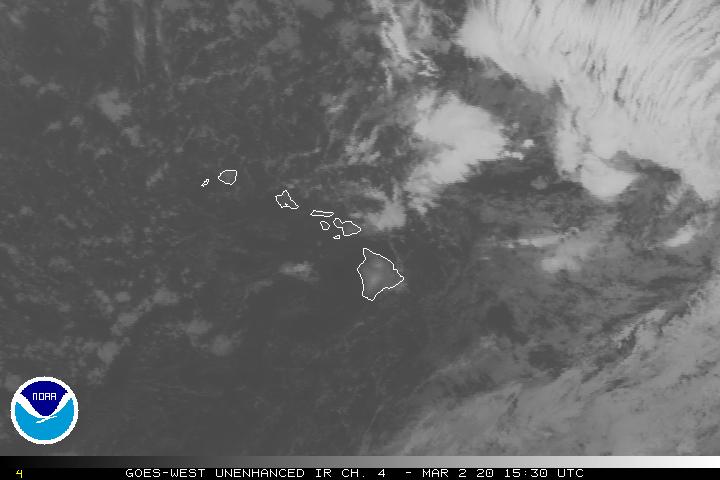
0.12 Kapapala Ranch, Big Island Weather Chart – Here’s the latest (automatically updated) weather mapshowing a weakening cold front over the islands Tuesday, with light winds giving way to strengthening NE breezes into Wednesday. Satellite and Radar Images: To view the cloud conditions we have here in Hawaii, please use the following satellite links, starting off with theInfrared Satellite Image of the islands to see all the clouds around the state during the day and night. This next image is one that gives close images of the islands only during the daytime hours, and is referred to as a Close-up visible image. This next image shows a larger view of the Pacific…giving perspective to the wider ranging cloud patterns in the Pacific Ocean. Finally, here’s a looping IR satellite image, making viewable the clouds around the islands 24 hours a day. To help you keep track of where any showers may be around the islands, here’s the latest animatedradar image.
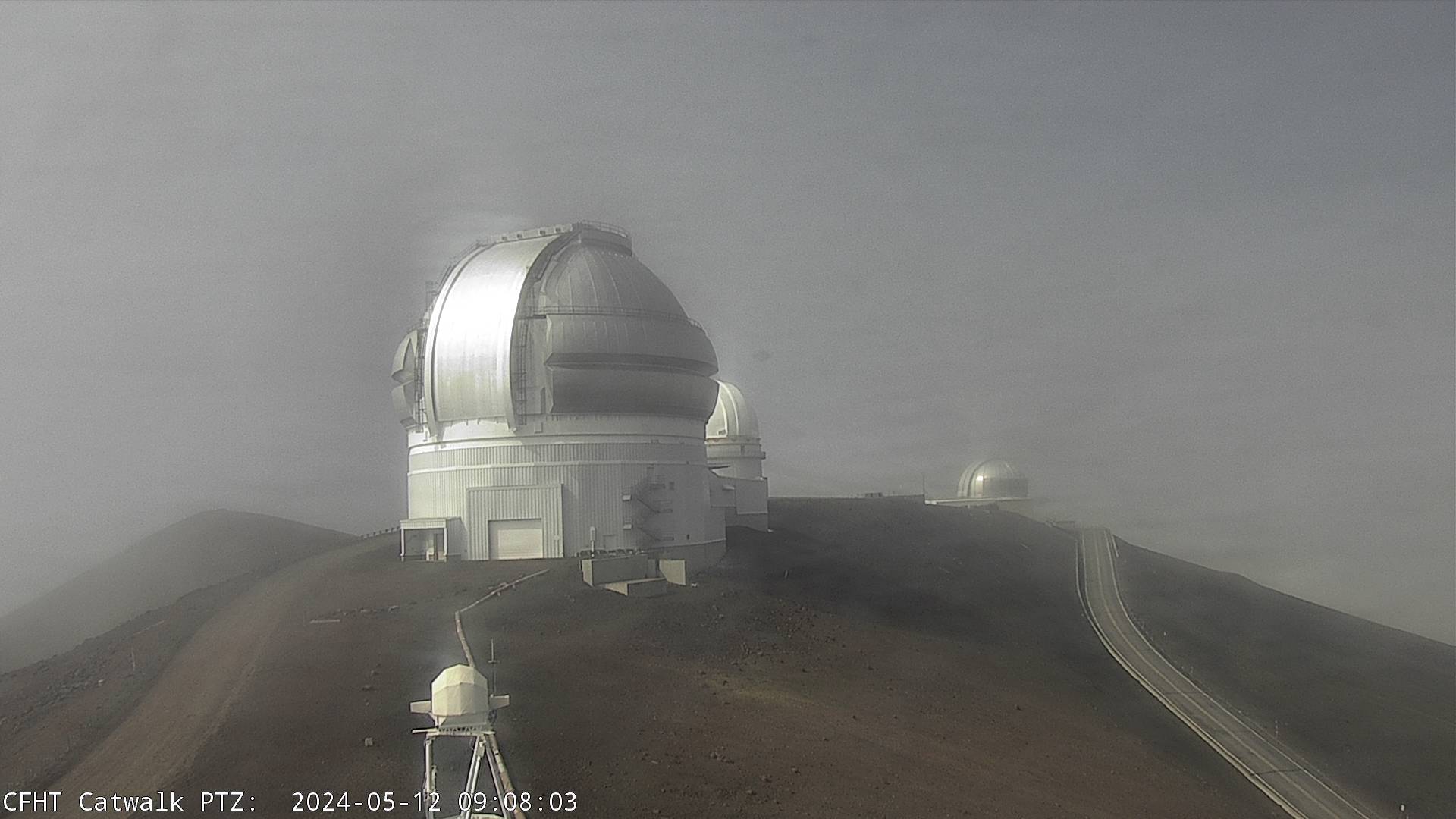
Hawaii’s Mountains – Here’s a link to the live webcam on the summit of near 14,000 footMauna Kea on the Big Island of Hawaii. The tallest peak on the island of Maui is theHaleakala Crater, which is near 10,000 feet in elevation. These two webcams are available during the daylight hours here in the islands…and when there’s a big moon rising just after sunset for an hour or two! Plus, during the nights and early mornings you will be able to see stars, and the sunrise too…depending upon weather conditions.
Aloha Paragraphs
Hawaii…the perfect place
Originally there was one cold front approaching from the northwest direction, which on Sunday became three.
Actually, two were prefrontal cloud bands, although at least one of them caused localized heavy showers on Kauai and Oahu Monday afternoon. The NWS forecast office in Honolulu issued short term forecasts to cover this potentially flooding precipitation event, which was then cancelled once the showers moved offshore. Thislooping radar imageis the best way to show this wet weather outbreak. As these bands work their way through our area, we will likely see periods of showers on most of the islands, although the Big Island has the least likely prospect it appears at the moment.
If we back our view out a bit, using this looping satellite image we can see what looks more like one large frontal boundary now.At the same time, edging in from the left hand side of this satellite loop, we see another large area of incoming cirrus clouds, traveling quickly towards the right side of the picture…west to east. It becomes clearer, at least in terms of what’s happening, if we back out even further, in our look down over the central Pacific using this satellite view. It is very obvious that there are more clouds in our area, than clear blue skies! The bright white ones are the higher variety as usual, and the dull gray clouds reside in the lower realms of the atmosphere.
If we think of the several bands of clouds as just a weakening cold front, it will be easier to discern what to expected as we move forward into the first part of this new work week.This frontal boundary will continue its journey down into the state, bringing showers into the night Monday, and then on into the day Tuesday. The continued threat of some of these showers grading into heavy rainfall will remain with us for the time being. We’ve seen Kona winds ahead of these bands, which has brought localized thick volcanic haze to some parts of the island chain. These Kona winds will give way to north to NE winds with, and in the wake of the front…clearing our skies of this sun filtering haziness with time. While we’re talking about winds, here’s aweather mapshowing a gale low pressure system to the NNE of Hawaii…which will be the source of our brief north to northeast wind, locally gusty. As the winds come from a more northerly aspect, they will feel cooler than the sultry weather that the Kona winds have brought up from the moisture laden deeper tropics.These north to NE winds won’t last very long, as light ENE to easterly trade winds will fill back into our weather picture by mid-week. The interesting part of this weather story comes into shape as we move into Friday and the weekend. I use the word interesting, in a positive way, as if we receive more rainfall then, it would be a good thing, heading into the dry season. If a low pressure system were to become established to the west or NW of Kauai later this week, as the computer models have been suggesting for the last several days, we could see a second period of showers…some of which could be locally quite generous.
It’s early Monday evening as I begin writing this last section of today’s weather narrative. As a summary statement of the information above: there are several bands of clouds that are in our vicinity, one of which may bring some heavier showers tonight into Tuesday. The low pressure system to our NNE, with its associated cold front, is the major influence at the moment. Our winds are light from the SW and west ahead of the front, which will turn around to the north and NE after the cold front drops down into the state. ~~~ Looking out the windows here in Kihei, before I leave for the drive back upcountry to Kula, I see the same hazy reality that I saw from Kula early this morning. There are lots of clouds out there too, but as the radar image above noted, most of the showers are falling over Oahu down through Molokai at the time of this writing. I’m quite sure that Maui will find an increase in showers tonight into Tuesday…while the Big Island may miss most of them. I’ll be back early Tuesday morning with your next new weather narrative, I hope you have a great Monday night until then! Aloha for now…Glenn.
Interesting: Here’s yet another reason to stay in shape: Thinner people contribute less to global warming, according to a new study. Researchers at the London School of Hygiene and Tropical Medicine published a study showing that, because of food production and transportation factors, a population of heavier people contributes more harmful gases to the planet than a population of thin people.
Given that it takes more energy to move heavier people, transportation of heavier people requires more fuel, which creates more greenhouse gas emissions, the authors write. "The main message is staying thin. It’s good for you, and it’s good for the planet," said Phil Edwards, senior lecturer at the London School of Hygiene and Tropical Medicine.
The study offers this novel approach to the global warming problem as U.S. lawmakers discuss the future of climate change legislation. This week, the the House Energy and Commerce Committee is scheduled to begin on a comprehensive energy and climate bill. On Friday, the Environmental Protection Agency announced that six greenhouse gases pose potential health hazards, an announcement that could prompt the regulation of the gases.
More than 1 billion adults worldwide are overweight, and about 300 million are obese, the study said. Generally, the body mass index, a measure of obesity, is increasing in most countries worldwide, from China to European countries to the United States. BMI is going up because of the availability of food and motorized transportation, Edwards said. People are less active now than they were 30 years ago, and the prevalence of fast food has given people less healthy, more energy-dense options.
Interesting2: Every week, Jackie Kaminer of Roswell, Georgia, buys fish for dinner at the local market. Although she knows it’s full of nutrients — including good-for-your-heart omega-3 fatty acids — she’s careful of the types of fish she brings home. Her concern? Mercury and the dangers it poses to her children. So, she sticks to certain varieties: salmon, cod, tilapia and haddock are "safe fish," but she stays away from swordfish, sea bass and tuna.
As a mother of three, Kaminer should be concerned. Released into the atmosphere by industrial pollution, mercury contaminates water systems (and soil) when it rains. As fish feed on one another, the mercury stores up in their bodies. The toxic metal affects the nervous system. And although studies have shown large amounts of mercury can also affect fertility and blood pressure, and possibly cause memory loss in adults, it’s particularly dangerous to young children and fetuses.
According to the American Academy of Pediatrics, during the first several years of life, a child’s brain is still developing and absorbing nutrients. Prenatal and infant mercury exposure can cause poor mental development, cerebral palsy, deafness and blindness. Even in low doses, mercury may affect a child’s development, delaying walking and talking, shortening attention span and causing learning disabilities. Having mercury levels that are too high isn’t someone else’s problem.
In a recent study from the Centers for Disease Control and Prevention, one out of 17 women of childbearing age in the United States has mercury in her blood above the level that could pose a risk to a developing fetus (5.8 micrograms per liter). So the federal government advises pregnant women and those thinking of becoming pregnant to avoid certain fish, such as shark, swordfish and fresh tuna, usually found in fish markets and sushi. Canned tuna seems to be less of a threat, but the U.S. Department of Agriculture says consumption should be limited.
Why avoid these kinds of fish? According to Andrew Heyes, a scientist with the Smithsonian Environmental Research Center, Edgewater, Maryland, the older and larger the fish, the more mercury it has stored. "As it grows older, it can’t eliminate mercury as fast as it takes it in," he says. "So there’s an accumulation in the fish." Because mercury is a growing threat to us and our environment, companies have started to take mercury out of thermometers, switches and even batteries to prevent it from entering our soil.
Now, many regions, like the Chesapeake Bay states of Maryland, Virginia and Delaware, have instituted new rules to limit mercury emissions from coal-fired power plants, one of the largest sources of mercury pollution in the region. Researcher Cindy Gilmour, also with the SERC, says that is a positive development because mercury contamination is getting out of hand. "We’ve opened Pandora’s Box and we’ve let that mercury out from where it was buried underground, into the atmosphere and into our soils and waterways," she says. "All that excess mercury causes problems, not just in people."
Interesting3:The high-end specialty coffee industry isn’t immune to the effects of a recession, but many companies are still doing well. Portland Roasting had a slow holiday season, but business is picking up, said owner Mark Stell. "February was a great month for us," he said. Stell traveled from Oregon to Atlanta, Georgia, for the Specialty Coffee Association of America expo, where the show floor was filled with nearly 800 booths featuring everything from exotic coffee beans to the latest Italian espresso machines.
Stell’s company sells about a million pounds of coffee a year. He said sales to offices and hotels are down but are being replaced by orders from grocers and universities. "People don’t leave coffee," he said. "They just get it differently." Tony Riffel owns Octane Coffee in Atlanta and was watching the 10th annual World Barista Championship, held in conjunction with the expo at the Georgia World Congress Center. Pushcart owner Gwilym Davies of London, England, won the 2009 barista crown.
Riffel said business at his coffee shop was flat last summer, but sales are up 10 percent for the first quarter of 2009. "The first part of this year has been our best ever," he said. "People are being careful with what they’re spending money on, but they’re spending it on quality products." Business is good enough that Riffel plans to open a second location this year. "Now is a really good time to do that," he said.
"Developers and landlords are more flexible and negotiable," even though banks are "pickier than normal." Joseph Taguman also knows about picky banks. The general manager of the Zambia Growers Association said the lack of financing is holding back the association’s 80 farmers. "The U.S. market is continuing at a steady pace," he said. But it’s a slower pace than the past few years. "Coffee is something that has been with humanity for 1,500 years," Hetzel said. "It’s not going anywhere any time soon."
Interesting4:U.S. manufacturers, including major drug makers, have legally released at least 271 million pounds of pharmaceuticals into waterways that often provide drinking water – contamination the federal government has consistently overlooked, according to an Associated Press investigation. Hundreds of active pharmaceutical ingredients are used in a variety of manufacturing, including drug making: For example, lithium is used to make ceramics and treat bipolar disorder; nitroglycerin is a heart drug and also used in explosives; copper shows up in everything from pipes to contraceptives.
Federal and industry officials say they don’t know the extent to which pharmaceuticals are released by U.S. manufacturers because no one tracks them – as drugs. But a close analysis of 20 years of federal records found that, in fact, the government unintentionally keeps data on a few, allowing a glimpse of the pharmaceuticals coming from factories.
As part of its ongoing PharmaWater investigation about trace concentrations of pharmaceuticals in drinking water, AP identified 22 compounds that show up on two lists: the EPA monitors them as industrial chemicals that are released into rivers, lakes and other bodies of water under federal pollution laws, while the Food and Drug Administration classifies them as active pharmaceutical ingredients.
The data don’t show precisely how much of the 271 million pounds comes from drugmakers versus other manufacturers; also, the figure is a massive undercount because of the limited federal government tracking. To date, drug makers have dismissed the suggestion that their manufacturing contributes significantly to what’s being found in water. Federal drug and water regulators agree.
But some researchers say the lack of required testing amounts to a ‘don’t ask, don’t tell’ policy about whether drug makers are contributing to water pollution. "It doesn’t pass the straight-face test to say pharmaceutical manufacturers are not emitting any of the compounds they’re creating," said Kyla Bennett, who spent 10 years as an EPA enforcement officer before becoming an ecologist and environmental attorney.
Pilot studies in the U.S. and abroad are now confirming those doubts. Last year, the AP reported that trace amounts of a wide range of pharmaceuticals – including antibiotics, anti-convulsants, mood stabilizers and sex hormones – have been found in American drinking water supplies. Including recent findings in Dallas, Cleveland and Maryland’s Prince George’s and Montgomery counties, pharmaceuticals have been detected in the drinking water of at least 51 million Americans.
Most cities and water providers still do not test. Some scientists say that wherever researchers look, they will find pharma-tainted water. Consumers are considered the biggest contributors to the contamination. We consume drugs, then excrete what our bodies don’t absorb. Other times, we flush unused drugs down toilets. The AP also found that an estimated 250 million pounds of pharmaceuticals and contaminated packaging are thrown away each year by hospitals and long-term care facilities.
Researchers have found that even extremely diluted concentrations of drugs harm fish, frogs and other aquatic species. Also, researchers report that human cells fail to grow normally in the laboratory when exposed to trace concentrations of certain drugs. Some scientists say they are increasingly concerned that the consumption of combinations of many drugs, even in small amounts, could harm humans over decades. Utilities say the water is safe. Scientists, doctors and the EPA say there are no confirmed human risks associated with consuming minute concentrations of drugs. But those experts also agree that dangers cannot be ruled out, especially given the emerging research.
Interesting5: The Great Wall of China is even greater than previously thought, according to the first detailed survey to establish the length of the ancient barricade. A two-year government mapping study found that the wall spans 8,850km (5,500 miles) – until now, the length was commonly put at about 5,000km. Previous estimates of its length were mainly based on historical records. Infra-red and GPS technologies helped locate some areas concealed over time by sandstorms, state media said.
The project found that there were wall sections of 6,259km, 359km of trenches, and 2,232km of natural defensive barriers such as hills and rivers. The study was carried out by the State Administration of Cultural Heritage and the State Bureau of Surveying and Mapping. Experts said the newly-discovered sections of the wall were built during the Ming Dynasty (1368-1644), and stretch from Hu Mountain in northern Liaoning province to Jiayu Pass in western Gansu province.
The project will continue for another 18 months in order to map sections of the wall built during the Qin (221-206BC) and Han (206BC-9AD) Dynasties, the report said. The wall, the world’s largest man-made structure, was built to protect the northern border of the Chinese Empire.
Archaeologists had lobbied for the survey to be done to provide scholars with an accurate understanding of the construction. Known to the Chinese as the "long Wall of 10,000 Li", the Great Wall is in fact a series of walls and earthen works begun in the 5th Century BC and first linked up under Qin Shi Huang in about 220BC. It was listed as a Unesco world heritage site in 1987.
Interesting6:Overpopulation is the world’s top environmental issue, followed closely by climate change and the need to develop renewable energy resources to replace fossil fuels, according to a survey of the faculty at the SUNY College of Environmental Science and Forestry (ESF). Just in time for Earth Day (April 22) the faculty at the college, at which environmental issues are the sole focus, was asked to help prioritize the planet’s most pressing environmental problems.
Overpopulation came out on top, with several professors pointing out its ties to other problems that rank high on the list. “Overpopulation is the only problem,” said Dr. Charles A. Hall, a systems ecologist. “If we had 100 million people on Earth — or better, 10 million — no others would be a problem.” (Current estimates put the planet’s population at more than six billion.)
Dr. Allan P. Drew, a forest ecologist, put it this way: “Overpopulation means that we are putting more carbon dioxide into the atmosphere than we should, just because more people are doing it and this is related to overconsumption by people in general, especially in the ‘developed’ world.”
“But, whether developed or developing,” said Dr. Susan Senecah, who teaches the history of the American environmental movement, “everyone is encouraged to ‘want’ and perceive that they ‘need’ to consume beyond the planet’s ability to provide.” The ESF faculty pointed to climate change as the second most-pressing issue, with the need to develop renewable energy resources to replace fossil fuels coming in third.
“Experimenting with the earth’s climate and chemistry has great risks,” said Dr. Thomas E. Amidon, who invented a process for removing energy-rich sugars from wood and fermenting those sugars into ethanol. “This is a driver in climate change and loss of biodiversity and is a fundamental problem underlying our need to strive for sustainability.”
Rounding out the top 10 issues on the ESF list are overconsumption, the need for more sustainable practices worldwide, the growing need for energy conservation, the need for humans to see themselves as part of the global ecosystem, overall carbon dioxide emissions, the need to develop ways to produce consumer products from renewable resources, and dwindling fresh water resources.
April 19-20, 2009 Air Temperatures – The following maximum temperatures were recorded across the state of Hawaii Sunday afternoon: Lihue, Kauai – 76
Honolulu, Oahu – 81 Kaneohe, Oahu – 85 Kahului, Maui – 83 Hilo, Hawaii – 79 Kailua-kona – 82 Air Temperaturesranged between these warmest and coolest spots near sea level – and on the highest mountains…at 4 p.m. Sunday afternoon:
Kaneohe, Oahu – 81F
Lihue, Kauai – 69
Haleakala Crater – 48 (near 10,000 feet on Maui)
Mauna Kea summit – 34 (near 14,000 feet on the Big Island) Precipitation Totals – The following numbers represent the largest precipitation totals (inches) during the last 24 hours on each of the major islands, as ofSunday afteroon: 0.56 Kokee, Kauai
0.02 Waimanalo, Oahu
0.00 Molokai
0.13 Lanai
0.00 Kahoolawe 0.08 Oheo Gulch, Maui
0.21 Honaunau, Big Island Weather Chart – Here’s the latest (automatically updated) weather mapshowing a 1028 millibar high pressure system located far to the northeast of the islands. The tail-end of a high pressure ridge, extending southwest from that high pressure cell, is sitting just to the east of Hawaii. At the same time, we have a developing low pressure system to the north-northeast…with its associated cold front about to move down into the state. Winds will be southwest to west flow ahead of the cold front, and then north to NE in its wake. Satellite and Radar Images: To view the cloud conditions we have here in Hawaii, please use the following satellite links, starting off with theInfrared Satellite Image of the islands to see all the clouds around the state during the day and night. This next image is one that gives close images of the islands only during the daytime hours, and is referred to as a Close-up visible image. This next image shows a larger view of the Pacific…giving perspective to the wider ranging cloud patterns in the Pacific Ocean. Finally, here’s a looping IR satellite image, making viewable the clouds around the islands 24 hours a day. To help you keep track of where any showers may be around the islands, here’s the latest animatedradar image.
Hawaii’s Mountains – Here’s a link to the live webcam on the summit of near 14,000 footMauna Kea on the Big Island of Hawaii. The tallest peak on the island of Maui is theHaleakala Crater, which is near 10,000 feet in elevation. These two webcams are available during the daylight hours here in the islands…and when there’s a big moon rising just after sunset for an hour or two! Plus, during the nights and early mornings you will be able to see stars, and the sunrise too…depending upon weather conditions.
Aloha Paragraphs
Rocky coast, south of Makena Beach…Maui
Winds will blow from the west to southwest ahead of an approaching cold front Sunday evening into Monday.These strengthening kona winds will keep our overlying atmosphere muggy, as moisture rides in on these breezes from the deeper tropics. A couple of frontal boundaries move over the state Sunday night into Monday night, our winds will turn north to northeast with, and behind the final front…ushering in slightly cooler weather for several days thereafter.
As this looping satellite image shows, we see the first of three shower bands reaching the island of Kauai and Oahu early Sunday evening. Expanding our view, with this looping satellite image showing the greater central Pacific a bit more, we can see all of the bands of clouds approaching from the northwest. The first showery cloud band reached Kauai Sunday, and is now stretching down to Oahu. The second will reach Kauai Sunday night, merging with the first one. The final band, will drop down into the state later in the day Monday or Monday evening, and stall.
Just considering the fact that the trade winds have been missing in action the last couple of days, is a good indicator of the slightly unusual weather circumstances that are developing.
Adding to this irregularity, we have these late season cloud bands, which are, and will continue to bring showers with then.The final front, which will quickly weaken into a a simple showery cloud band, is expected to hang around over the windward sides of the island for several days at least. The winds will take on a north or northeasterly orientation, which will keep our weather slightly cooler than normal too.
It’s early Sunday evening as I begin writing this last section of today’s weather narrative. If you had a chance to read down through the paragraphs above, you’ll know that we have some interesting weather to move through during the next week!There’s still some uncertainty involved, so stay tuned for adjustments, as we may need to go back to the drawing boards at times…to bring everything into phase with the moment during the new work week ahead. ~~~ Speaking of the weather ahead, the computer models continue to show a rather deep low pressure system forming to the west or northwest of the state towards the even of the upcoming work week. This low may bring another round of unsettled weather, with more rain falling again then. Speaking of showers, and bringing our attention back to the present, here’s a looping radar image so we can keep an eye on the showers falling now.~~~ Here in Kula, Maui Sunday, the winds have had a southeast orientation, enough so that lots of volcanic haze, carried up from the vents on the Big Island…made for poor air visibilities! At around 530pm, I can’t see the West Maui Mountains, and even here upcountry, looking just a short distance, the visibilities are very restricted. ~~~ I’ll be back with your next new weather narrative early Monday morning, I hope you have a great Sunday night wherever you happen to be reading from! Aloha for now…Glenn.
Interesting: More consumer products are claiming to be environmentally responsible, but nearly all of them make at least one claim that is unverifiable, according to a recent study. TerraChoice, an environmental marketing agency with offices in Ottawa and Philadelphia, says more than 98 per cent of the products it surveyed committed at least one of the "seven sins of greenwashing."
"The good news is that the growing availability of green products shows that consumers are demanding more environmentally responsible choices, and that marketers and manufacturers are listening," TerraChoice president Scott McDougall said in a release. "The bad news is that some marketers are exploiting consumers’ demand for third-party certification by creating fake labels or false suggestions of third-party endorsement."
Interesting2: The long-awaited, often-advertised Peapod will be available for order on Earth Day, April 22. Coincidentally, the 22nd also is Administrative Assistant’s Day. We expect to see a lot of greenies and maybe some secretaries tooling around in their $12,500 Peapods at no more than 25 miles an hour.
While the Peapod prototype had clear driver and passenger doors that looked like a Dyson vacuum cleaner, the production version (shown above) of the neighborhood electric vehicle resembles George Jetson’s Deux Chevaux.
Company director and brand guru Peter E. Arnell, whose initials inspired the company’s name, told Treehugger.com the car’s appearance was inspired by "Japanese bullet trains, storm troopers from the film Star Wars, space helmets and turtles."
There’s also a very prominent "smile" to the car’s grill, but what else would you expect from a man whose firm devised Pepsi’s new logo with the Cheshire grin and laughably pretentious backstory? The feel-good vibe continues with a glance at the in-dash iPod (sold seperately).
Edmunds says every trip concludes with a carbon-footprint analysis, while another app tells you exactly how much money you’ve saved by leaving the family truckster at home. Arnell says the Peapod isn’t a neighborhood electric vehicle, even if the National Highway Transportation Safety Board and his company’s own website do.
Arnell callls it a Mobi, a new category he’s "branded" in much the same way automakers branded 4x4s "SUVS." Regardless of what you call it, the Peapod tops out as 25 mph as required by law for NEVs.
Interesting3:A coalition of associations and entities affected by the impact of introduction of gray wolves into Wyoming filed a 60-day notice of intent to sue the federal government about its refusal to delist wolves in Wyoming. The intent to sue was filed April 3 after the U.S. Fish & Wildlife Service published the delisting rules in the Federal Register.
The coalition is comprised of the Wyoming Wool Growers Association, Wyoming Stock Growers Association, Wyoming Farm Bureau Federation, Wyoming Association of Conservation Districts, Rocky Mountain Farmers Union, Wyoming Association of County Predatory Animal Boards, Niobrara County Predatory Animal Board, Wyoming Outfitters & Guides Association, Cody Country Outfitters and Guides Association and Sportsmen for Fish & Wildlife Wyoming.
The Wolf Coalition served notice of intent to sue Interior Secretary Ken Salazar, USFWS Acting Director Rowan Gould and Stephen Guertin, USFWS Acting Regional Director for the Mountain Region. The coalition intends to seek injunctive relief for violation of the Endangered Species Act and its related regulations and policies.
The Wolf Coalition attorney Harriet Hageman said claims arise from the USFWS rejection of the Wyoming Wolf Management Plan, its failure to delist the gray wolf population in Wyoming and its decision to proceed with delisting in Montana, Idaho and parts of Oregon and Washington
Interesting4:The Tecnalia Health and Quality of Life Unit is taking part in the Companionable project, the aim of which is to contribute to the enhancement of the quality of life of elderly and disabled persons using robotized solutions designed to operate in intelligent homes. The initiative, part of the European Union 7th Framework Program, combines for the first time the use of robot in intelligent domestic environments, with the goal of creating a companion that assists people in their own home and helps them to be independent in their everyday lives. Amongst other aspects, this tool provides a control for recognizing emotional states, social and health services support and for videoconferencing with family members or professional careers.
The main lines of research of Companionable involve the development of technologies to create a system that is conscious of its surroundings, with networks of sensors and communications, and the development and design of a mobile robot for therapeutic treatment and care support. The project has set itself the goal of developing a system which is aware of the presence of persons within an intelligent and domotic household, and which interacts with them in a natural and intuitive form.
Interesting5:Heading into a period of the Martian year prone to major dust storms, the team operating NASA’s twin Mars rovers is taking advantage of eye-in-the-sky weather reports. On April 21, Mars will be at the closest point to the sun in the planet’s 23-month, elliptical orbit. One month later, the planet’s equinox will mark the start of summer in Mars’ southern hemisphere. This atmospheric-warming combination makes the coming weeks the most likely time of the Martian year for dust storms severe enough to minimize activities of the rovers.
"Since the rovers are solar powered, the dust in the atmosphere is extremely important to us," said Bill Nelson of NASA’s Jet Propulsion Laboratory, Pasadena, Calif., chief of the engineering team for Spirit and Opportunity. Unexplained computer reboots by Spirit in the past week are not related to dust’s effects on the rover’s power supply, but the dust-storm season remains a concern. Spirit received commands Tuesday to transmit more engineering data in coming days to aid in diagnosis of the reboots.
After months of relatively clear air, increased haze in March reduced Spirit’s daily energy supply by about 20 percent and Opportunity’s by about 30 percent. Widespread haze resulted from a regional storm that made skies far south of the rovers very dusty. Conditions at the rovers’ sites remained much milder than the worst they have endured.
In July 2007, nearly one Martian year ago, airborne dust blocked more than 99 percent of the direct sunlight at each rover’s site. The rovers point cameras toward the sun to check the clarity of the atmosphere virtually every day. These measurements let the planning team estimate how much energy the rovers will have available on the following day.
Observations of changes in the Martian atmosphere by NASA’s Mars Reconnaissance Orbiter, which reached Mars in 2006, and NASA’s Mars Odyssey, which reached Mars in 2001, are available to supplement the rover’s own skywatch. The Mars Color Imager camera on Mars Reconnaissance Orbiter sees the entire planet every day at resolution comparable to weather satellites around Earth.
Interesting6:Sea levels could rise by a "catastrophic" 10 feet by the end of the century – putting millions of people at risk of flooding with coastal cities such as London, New York, Tokyo and Calcutta submerged, according to a new study. The melting of the vast ice sheets in Antarctica and Greenland caused water to pour into the world’s oceans at an alarming rate at the end of the last period of global warming, the study shows.
Analysis of fossilized coral reefs off the Gulf of Mexico found many died during this time – known to climatologists as an "interglacial" – and were replaced by new reefs on higher ground. This happened over a long-term ecological timescale and was caused by a rapid jump in sea level of between 6.5ft and 9.8ft (two to three meters) that occurred around 121,000 years ago, say the researchers.
The findings published in Nature raise concerns that current climate change could yield similar quick ice loss and disastrous sea-level rise in the near future. Dr Paul Blanchon, a marine scientist of the National University of Mexico in Cancun, said his study shows there was a spell of swift melting during the warmest part of the last interglacial.
With growing evidence for contributions from the Antarctic and Greenland ice sheets to sea-level rise, the findings confirm the potential that continuing rapid ice loss could cause disastrous sea-level rise by 2100. Dr Blanchon said this is also bad news for modern coral reefs which are already suffering because of human activity.
He said: "Knowing the rate at which sea level reached its high-stand during the last interglacial period is fundamental in assessing if such rapid ice-loss processes could lead to future catastrophic sea-level rise. "The best direct record of sea level during this high-stand comes from well-dated fossil reefs in stable areas. "Here we present a complete reef-crest sequence for the last interglacial high-stand from the stable north-east Yucatan peninsula in Mexico.
"The abrupt demise of the lower-reef crest allows us to infer that this occurred on an ecological timescale and was triggered by a two-to-three meter jump in sea level. "We constrain this jump to have occurred 121,000 years ago and conclude it supports an episode of ice-sheet instability during the terminal phase of the last interglacial period."
The prediction is not as high as those from some scientists who have warned sea levels may rise as much as 16 feet (five meters) by the end of the century. But a rise of even a meter could have major implications for low-lying countries whose economies are not geared up to build sophisticated sea defense systems, such as Bangladesh.
Interesting7: A new kind of tree could cool the planet by removing a major greenhouse gas from the planet’s atmosphere. What researchers are calling artificial trees, actually towers filled with various materials that adsorb carbon dioxide from the air, could play a major role in reducing climate change — if they prove profitable. "This is an industry still in its infancy," said Billy Gridley of Global Research Technologies, LLC, the company creating the C02-scrubbing towers. "This will eventually rival the size of today’s energy markets.
Interesting8: An asteroid is hurtling toward the planet and threatens to destroy life as we know it. What can humankind do, other than cower? Tie the thing down, suggests aerospace engineer David French of North Carolina State University. He has proposed a way to divert asteroids and other threatening objects by attaching a long tether and ballast.
Done right, "you change the object’s center of mass, effectively changing the object’s orbit and allowing it to pass by the Earth, rather than impacting it," French said in a statement. In March an asteroid passed by Earth at a distance of just about 49,000 miles.
NASA’s Near Earth Object Program has identified more than 1,000 "potentially hazardous asteroids." None is on a collision course with Earth but asteroids have struck before and almost certainly will again, scientists agree.
"For example, about 65 million years ago, a very large asteroid is thought to have hit the Earth in the southern Gulf of Mexico, wiping out the dinosaurs, and, in 1907, a very small airburst of a comet over Siberia flattened a forest over an area equal in size to New York City," French said.
"The scale of our solution is similarly hard to imagine." His idea, to be presented in September at an American Institute of Aeronautics and Astronautics conference, calls for using a tether somewhere between 600 miles and 60,000 miles long to change the trajectory of any object headed toward Earth.
"Nuclear weapons are an intriguing possibility, but have considerable political and technical obstacles. Would the rest of the world trust us to nuke an asteroid? Would we trust anyone else?" Frenach asked.
"And would the asteroid break into multiple asteroids, giving us more problems to solve?" Other solutions that have been proposed include crashing a spacecraft into the asteroid, focusing the Sun’s energy to deflect it, or using a laser to break it up. Interesting9: For Arctic peoples, global warming is not just transforming their land, it is also poisoning their food. Mercury levels in seals and beluga whales eaten by Inuit in northern Canada have reached levels that would be considered unsafe in fish. Now, Gary Stern of Canada’s Department of Fisheries and Oceans in Winnipeg, Manitoba, and colleagues have found that seal meat contains more mercury in low-ice years, suggesting the problem will only get worse.
The team sampled ringed seals caught by traditional hunters in the western Canadian Arctic between 1973 and 2007. Mercury levels were higher after summers with less sea ice. They think this is because Arctic cod flourishes in low-ice years. Because Arctic cod is higher up the food chain than the seals’ other food, their tissues accumulate more mercury (Environmental Science and Technology.
Arctic residents may well be exposed to other pollutants, too. Melting ice releases chemicals such as DDT and PCBs that leached from the atmosphere decades ago and became entombed in ice and permafrost, warns Philippe Grandjean of Harvard University.
As the ice melts, its contaminants flow into streams, rivers and the Arctic Ocean. It may already be too late to prevent a surge of pollutants from polar ice, says Grandjean. However, he notes, policy-makers can try to prevent the same thing happening again by reducing pollutants still in use, such as flame retardants.
April 18-19, 2009 Air Temperatures – The following maximum temperatures were recorded across the state of Hawaii Saturday afternoon: Lihue, Kauai – 77 Honolulu, Oahu – 81 Kaneohe, Oahu – 78 Kahului, Maui – 81 Hilo, Hawaii – 79 Kailua-kona – 79 Air Temperaturesranged between these warmest and coolest spots near sea level – and on the highest mountains…at 5 p.m. Saturday evening:
Haleakala Crater – 55 (near 10,000 feet on Maui)
Mauna Kea summit – 36 (near 14,000 feet on the Big Island) Precipitation Totals – The following numbers represent the largest precipitation totals (inches) during the last 24 hours on each of the major islands, as ofSaturday afternoon: 0.43 Wailua, Kauai
0.03 Waimanalo, Oahu
0.00 Molokai
0.00 Lanai
0.00 Kahoolawe 0.01 Hana airport, Maui
0.13 Mountain View, Big Island Weather Chart – Here’s the latest (automatically updated) weather mapshowing a 1029 millibar high pressure system located far to the east-northeast of the islands. A high pressure is sitting right over the islands this weekend. Winds will be light and variable, gradually taking on a more southerly flow ahead of a weakening cold front. Satellite and Radar Images: To view the cloud conditions we have here in Hawaii, please use the following satellite links, starting off with theInfrared Satellite Image of the islands to see all the clouds around the state during the day and night. This next image is one that gives close images of the islands only during the daytime hours, and is referred to as a Close-up visible image. This next image shows a larger view of the Pacific…giving perspective to the wider ranging cloud patterns in the Pacific Ocean. Finally, here’s a looping IR satellite image, making viewable the clouds around the islands 24 hours a day. To help you keep track of where any showers may be around the islands, here’s the latest animatedradar image.
Hawaii’s Mountains – Here’s a link to the live webcam on the summit of near 14,000 footMauna Kea on the Big Island of Hawaii. The tallest peak on the island of Maui is theHaleakala Crater, which is near 10,000 feet in elevation. These two webcams are available during the daylight hours here in the islands…and when there’s a big moon rising just after sunset for an hour or two! Plus, during the nights and early mornings you will be able to see stars, and the sunrise too…depending upon weather conditions.
Aloha Paragraphs
Swimming with the Dolphins…Oahu
A high pressure ridge has been pushed southward over the Hawaiian Islands this weekend…which will keep our winds light.The lack of our usual breezy trade winds will keep our overlying atmosphere on the muggy side. The latest computer forecast guidance suggests that we have some changes in store during the next week. As a cold front pushes southward towards the islands, our winds will turn south to southwest. As the frontal boundary moves over the state Sunday night through Tuesday, our winds will turn north to northeast…ushering in somewhat cooler weather through most of the new week ahead.
Sunday will be a transition day, from the light and variable wind regime…switching to Kona breezes ahead of a cold front…ending up with showers Monday onwards. The blue sentence above describes what would be quite common during the winter months. If it all manifests as expected, this will turn out to be a little unusual for the spring season. There is still some question to all the particulars, but the theme above seems fairly reasonable for the time being…stay tuned.
Besides the lower level clouds, which will form over and around the islands, we’ve also have quite a bit of the higher cirrus variety around lately too. As this looping satellite image shows, we’ll continue to see rather thin high cirrus clouds continuing to move in our direction from the west Saturday night into Sunday. Expanding our view, with this looping satellite image of the greater central Pacific a bit more, we can see more of this cirrus taking aim on our islands now. At the same time, we’re able to spot the late season cold front approaching from the north.
When I got off work Friday evening I went to see the new filmed called State of Play (2009), starring Russell Crowe and Rachel McAdams, among others. The long and short of this film is that a reporter uncovers a deadly conspiracy when a star congressman’s mistress is brutually murdered. It’s being billed as a dramatic film, with of course the usual violence, sexual references, and drug content. So, this doesn’t sound like a film for everyone! As it turns out, I really enjoyed this film very much, it was complex and engaging, and pulled me right in! Here’s a trailer in case you are interested. ~~~ When I got out of the movie, I drove down to Paia, and met a friend there. We went dancing at one of the restaurants, and had fun. The dancing didn’t start until around 1045pm, which makes for a late night. I got home at around 130am Saturday morning…which was an usually late bedtime for me!
It’s Saturday evening as I begin writing this last section of today’s weather narrative.
Saturday was a good day, a little slow due to my late night activity Friday…which was good for me. Looking out the window of my weather tower this evening, it’s hazy here on Maui. It’s clear to partly cloudy in general, with light winds blowing. I went down to Paia to shop during the afternoon, and found nice sunny skies over on that windward side. Looking over that way, it still is near cloud free, and I’m sure very nice on the beaches there. Actually, I’m quite sure almost all the beaches around the Aloha state are very pleasant, ready for a good sunset. ~~~ I’m staying home tonight, will sit out on my deck and enjoy the sunset. I’ll be back Sunday morning with your next weather narrative, I hope you have a great Saturday night until then! Aloha for now…Glenn.
Interesting: More consumer products are claiming to be environmentally responsible, but nearly all of them make at least one claim that is unverifiable, according to a recent study. TerraChoice, an environmental marketing agency with offices in Ottawa and Philadelphia, says more than 98 per cent of the products it surveyed committed at least one of the "seven sins of greenwashing."
"The good news is that the growing availability of green products shows that consumers are demanding more environmentally responsible choices, and that marketers and manufacturers are listening," TerraChoice president Scott McDougall said in a release. "The bad news is that some marketers are exploiting consumers’ demand for third-party certification by creating fake labels or false suggestions of third-party endorsement."
Interesting2: The long-awaited, often-advertised Peapod will be available for order on Earth Day, April 22. Coincidentally, the 22nd also is Administrative Assistant’s Day. We expect to see a lot of greenies and maybe some secretaries tooling around in their $12,500 Peapods at no more than 25 miles an hour.
While the Peapod prototype had clear driver and passenger doors that looked like a Dyson vacuum cleaner, the production version (shown above) of the neighborhood electric vehicle resembles George Jetson’s Deux Chevaux.
Company director and brand guru Peter E. Arnell, whose initials inspired the company’s name, told Treehugger.com the car’s appearance was inspired by "Japanese bullet trains, storm troopers from the film Star Wars, space helmets and turtles."
There’s also a very prominent "smile" to the car’s grill, but what else would you expect from a man whose firm devised Pepsi’s new logo with the Cheshire grin and laughably pretentious backstory? The feel-good vibe continues with a glance at the in-dash iPod (sold seperately).
Edmunds says every trip concludes with a carbon-footprint analysis, while another app tells you exactly how much money you’ve saved by leaving the family truckster at home. Arnell says the Peapod isn’t a neighborhood electric vehicle, even if the National Highway Transportation Safety Board and his company’s own website do.
Arnell callls it a Mobi, a new category he’s "branded" in much the same way automakers branded 4x4s "SUVS." Regardless of what you call it, the Peapod tops out as 25 mph as required by law for NEVs.
Interesting3:A coalition of associations and entities affected by the impact of introduction of gray wolves into Wyoming filed a 60-day notice of intent to sue the federal government about its refusal to delist wolves in Wyoming. The intent to sue was filed April 3 after the U.S. Fish & Wildlife Service published the delisting rules in the Federal Register.
The coalition is comprised of the Wyoming Wool Growers Association, Wyoming Stock Growers Association, Wyoming Farm Bureau Federation, Wyoming Association of Conservation Districts, Rocky Mountain Farmers Union, Wyoming Association of County Predatory Animal Boards, Niobrara County Predatory Animal Board, Wyoming Outfitters & Guides Association, Cody Country Outfitters and Guides Association and Sportsmen for Fish & Wildlife Wyoming.
The Wolf Coalition served notice of intent to sue Interior Secretary Ken Salazar, USFWS Acting Director Rowan Gould and Stephen Guertin, USFWS Acting Regional Director for the Mountain Region. The coalition intends to seek injunctive relief for violation of the Endangered Species Act and its related regulations and policies.
The Wolf Coalition attorney Harriet Hageman said claims arise from the USFWS rejection of the Wyoming Wolf Management Plan, its failure to delist the gray wolf population in Wyoming and its decision to proceed with delisting in Montana, Idaho and parts of Oregon and Washington
Interesting4:The Tecnalia Health and Quality of Life Unit is taking part in the Companionable project, the aim of which is to contribute to the enhancement of the quality of life of elderly and disabled persons using robotized solutions designed to operate in intelligent homes. The initiative, part of the European Union 7th Framework Program, combines for the first time the use of robot in intelligent domestic environments, with the goal of creating a companion that assists people in their own home and helps them to be independent in their everyday lives. Amongst other aspects, this tool provides a control for recognizing emotional states, social and health services support and for videoconferencing with family members or professional careers.
The main lines of research of Companionable involve the development of technologies to create a system that is conscious of its surroundings, with networks of sensors and communications, and the development and design of a mobile robot for therapeutic treatment and care support. The project has set itself the goal of developing a system which is aware of the presence of persons within an intelligent and domotic household, and which interacts with them in a natural and intuitive form.
Interesting5:Heading into a period of the Martian year prone to major dust storms, the team operating NASA’s twin Mars rovers is taking advantage of eye-in-the-sky weather reports. On April 21, Mars will be at the closest point to the sun in the planet’s 23-month, elliptical orbit. One month later, the planet’s equinox will mark the start of summer in Mars’ southern hemisphere. This atmospheric-warming combination makes the coming weeks the most likely time of the Martian year for dust storms severe enough to minimize activities of the rovers.
"Since the rovers are solar powered, the dust in the atmosphere is extremely important to us," said Bill Nelson of NASA’s Jet Propulsion Laboratory, Pasadena, Calif., chief of the engineering team for Spirit and Opportunity. Unexplained computer reboots by Spirit in the past week are not related to dust’s effects on the rover’s power supply, but the dust-storm season remains a concern. Spirit received commands Tuesday to transmit more engineering data in coming days to aid in diagnosis of the reboots.
After months of relatively clear air, increased haze in March reduced Spirit’s daily energy supply by about 20 percent and Opportunity’s by about 30 percent. Widespread haze resulted from a regional storm that made skies far south of the rovers very dusty. Conditions at the rovers’ sites remained much milder than the worst they have endured.
In July 2007, nearly one Martian year ago, airborne dust blocked more than 99 percent of the direct sunlight at each rover’s site. The rovers point cameras toward the sun to check the clarity of the atmosphere virtually every day. These measurements let the planning team estimate how much energy the rovers will have available on the following day.
Observations of changes in the Martian atmosphere by NASA’s Mars Reconnaissance Orbiter, which reached Mars in 2006, and NASA’s Mars Odyssey, which reached Mars in 2001, are available to supplement the rover’s own skywatch. The Mars Color Imager camera on Mars Reconnaissance Orbiter sees the entire planet every day at resolution comparable to weather satellites around Earth.
Interesting6:Sea levels could rise by a "catastrophic" 10 feet by the end of the century – putting millions of people at risk of flooding with coastal cities such as London, New York, Tokyo and Calcutta submerged, according to a new study. The melting of the vast ice sheets in Antarctica and Greenland caused water to pour into the world’s oceans at an alarming rate at the end of the last period of global warming, the study shows.
Analysis of fossilized coral reefs off the Gulf of Mexico found many died during this time – known to climatologists as an "interglacial" – and were replaced by new reefs on higher ground. This happened over a long-term ecological timescale and was caused by a rapid jump in sea level of between 6.5ft and 9.8ft (two to three meters) that occurred around 121,000 years ago, say the researchers.
The findings published in Nature raise concerns that current climate change could yield similar quick ice loss and disastrous sea-level rise in the near future. Dr Paul Blanchon, a marine scientist of the National University of Mexico in Cancun, said his study shows there was a spell of swift melting during the warmest part of the last interglacial.
With growing evidence for contributions from the Antarctic and Greenland ice sheets to sea-level rise, the findings confirm the potential that continuing rapid ice loss could cause disastrous sea-level rise by 2100. Dr Blanchon said this is also bad news for modern coral reefs which are already suffering because of human activity.
He said: "Knowing the rate at which sea level reached its high-stand during the last interglacial period is fundamental in assessing if such rapid ice-loss processes could lead to future catastrophic sea-level rise. "The best direct record of sea level during this high-stand comes from well-dated fossil reefs in stable areas. "Here we present a complete reef-crest sequence for the last interglacial high-stand from the stable north-east Yucatan peninsula in Mexico.
"The abrupt demise of the lower-reef crest allows us to infer that this occurred on an ecological timescale and was triggered by a two-to-three meter jump in sea level. "We constrain this jump to have occurred 121,000 years ago and conclude it supports an episode of ice-sheet instability during the terminal phase of the last interglacial period."
The prediction is not as high as those from some scientists who have warned sea levels may rise as much as 16 feet (five meters) by the end of the century. But a rise of even a meter could have major implications for low-lying countries whose economies are not geared up to build sophisticated sea defense systems, such as Bangladesh.
Interesting7: A new kind of tree could cool the planet by removing a major greenhouse gas from the planet’s atmosphere. What researchers are calling artificial trees, actually towers filled with various materials that adsorb carbon dioxide from the air, could play a major role in reducing climate change — if they prove profitable. "This is an industry still in its infancy," said Billy Gridley of Global Research Technologies, LLC, the company creating the C02-scrubbing towers. "This will eventually rival the size of today’s energy markets.
Interesting8: An asteroid is hurtling toward the planet and threatens to destroy life as we know it. What can humankind do, other than cower? Tie the thing down, suggests aerospace engineer David French of North Carolina State University. He has proposed a way to divert asteroids and other threatening objects by attaching a long tether and ballast.
Done right, "you change the object’s center of mass, effectively changing the object’s orbit and allowing it to pass by the Earth, rather than impacting it," French said in a statement. In March an asteroid passed by Earth at a distance of just about 49,000 miles.
NASA’s Near Earth Object Program has identified more than 1,000 "potentially hazardous asteroids." None is on a collision course with Earth but asteroids have struck before and almost certainly will again, scientists agree.
"For example, about 65 million years ago, a very large asteroid is thought to have hit the Earth in the southern Gulf of Mexico, wiping out the dinosaurs, and, in 1907, a very small airburst of a comet over Siberia flattened a forest over an area equal in size to New York City," French said.
"The scale of our solution is similarly hard to imagine." His idea, to be presented in September at an American Institute of Aeronautics and Astronautics conference, calls for using a tether somewhere between 600 miles and 60,000 miles long to change the trajectory of any object headed toward Earth.
"Nuclear weapons are an intriguing possibility, but have considerable political and technical obstacles. Would the rest of the world trust us to nuke an asteroid? Would we trust anyone else?" Frenach asked.
"And would the asteroid break into multiple asteroids, giving us more problems to solve?" Other solutions that have been proposed include crashing a spacecraft into the asteroid, focusing the Sun’s energy to deflect it, or using a laser to break it up. Interesting9: For Arctic peoples, global warming is not just transforming their land, it is also poisoning their food. Mercury levels in seals and beluga whales eaten by Inuit in northern Canada have reached levels that would be considered unsafe in fish. Now, Gary Stern of Canada’s Department of Fisheries and Oceans in Winnipeg, Manitoba, and colleagues have found that seal meat contains more mercury in low-ice years, suggesting the problem will only get worse.
The team sampled ringed seals caught by traditional hunters in the western Canadian Arctic between 1973 and 2007. Mercury levels were higher after summers with less sea ice. They think this is because Arctic cod flourishes in low-ice years. Because Arctic cod is higher up the food chain than the seals’ other food, their tissues accumulate more mercury (Environmental Science and Technology.
Arctic residents may well be exposed to other pollutants, too. Melting ice releases chemicals such as DDT and PCBs that leached from the atmosphere decades ago and became entombed in ice and permafrost, warns Philippe Grandjean of Harvard University.
As the ice melts, its contaminants flow into streams, rivers and the Arctic Ocean. It may already be too late to prevent a surge of pollutants from polar ice, says Grandjean. However, he notes, policy-makers can try to prevent the same thing happening again by reducing pollutants still in use, such as flame retardants.
April 17-18, 2009 Air Temperatures – The following maximum temperatures were recorded across the state of Hawaii Friday afternoon: Lihue, Kauai – 75
Honolulu, Oahu – 81 Kaneohe, Oahu – 78 Kahului, Maui – 83 Hilo, Hawaii – 77 Kailua-kona – 80 Air Temperaturesranged between these warmest and coolest spots near sea level – and on the highest mountains…at 5 p.m. Friday evening:
Kapalua, Maui – 79F
Lihue, Kauai – 71
Haleakala Crater – 54 (near 10,000 feet on Maui)
Mauna Kea summit – 36 (near 14,000 feet on the Big Island) Precipitation Totals – The following numbers represent the largest precipitation totals (inches) during the last 24 hours on each of the major islands, as ofFriday afternoon:
0.04 Kapahi, Kauai
0.06 Kaneohe MCB, Oahu
0.04 Molokai
0.08 Lanai
0.02 Kahoolawe 0.06 Kahakuloa, Maui 0.28 Waiakea Uka, Big Island Weather Chart – Here’s the latest (automatically updated) weather mapshowing a 1031 millibar high pressure system located far to the east-northeast of the islands, and another 1018 millibar high to the west-northwest. These high pressure cells will spin out light winds from the SE through Sunday. Winds coming in from this direction first hit the Big Island, which then spreads, putting the smaller islands in a wind shadow. Satellite and Radar Images: To view the cloud conditions we have here in Hawaii, please use the following satellite links, starting off with theInfrared Satellite Image of the islands to see all the clouds around the state during the day and night. This next image is one that gives close images of the islands only during the daytime hours, and is referred to as a Close-up visible image. This next image shows a larger view of the Pacific…giving perspective to the wider ranging cloud patterns in the Pacific Ocean. Finally, here’s a looping IR satellite image, making viewable the clouds around the islands 24 hours a day. To help you keep track of where any showers may be around the islands, here’s the latest animatedradar image.
Hawaii’s Mountains – Here’s a link to the live webcam on the summit of near 14,000 footMauna Kea on the Big Island of Hawaii. The tallest peak on the island of Maui is theHaleakala Crater, which is near 10,000 feet in elevation. These two webcams are available during the daylight hours here in the islands…and when there’s a big moon rising just after sunset for an hour or two! Plus, during the nights and early mornings you will be able to see stars, and the sunrise too…depending upon weather conditions.
Aloha Paragraphs
Nice sunset here in the islands
Low pressure troughs to the north of the islands are the culprit in tamping down our winds at the moment, leaving us in a light wind weather pattern.The lack of our usual breezy trade winds will keep our overlying atmosphere on the muggy side during the days, especially in the lower elevations. Along with the slack winds, we will see hazy conditions become a part of our Hawaiian Island weather picture into the upcoming weekend as well. The latest computer forecast guidance suggests that our trade winds will return pretty much right after the weekend…gradually becoming quite strong and gusty again as we move through next week. Taking a quick glance at this weather map, we see that two gale low pressure systems have pushed a high pressure ridge down close to the islands, which is the reason our winds are so light, and coming in from the southeast or even southerly direction at the moment. It won’t take too long on both Saturday and Sunday mornings, for thickening clouds to begin forming in the upcountry areas…which will spread coastward locally later during the afternoons.We’ll begin to see those afternoon cumulus clouds dropping a few generally light showers in the interior upcountry areas today, although nothing spectacular by any means. A trough of low pressure, with its cold air aloft, will turn some of those afternoon showers heavier as we move into the weekend. The returning trade winds next week, will allow showers to return again to the windward coasts and slopes.
This well established convective weather pattern will last through the upcoming weekend…but turn back over control to our more normal trade winds, as we move into the new work week ahead.The convection, in this convective weather pattern, means that air rises, rather than moving by in a horizontal manner…like when we have the trade winds blowing. The daytime heating, along with the onshore flowing sea breezes, will transport moisture up the volcanic slopes. This moisture will condense out into clouds over the upcountry interior areas. These clouds won’t be all that showery Friday, but as noted above, by the weekend should become more generous.
The nights and early morning hours will find the least amount of clouds, then quickly filling back in over the islands during the days. Besides the lower level clouds, which will form over and around the islands, we’ve also have quite a bit of the higher cirrus variety around lately too. As this looping satellite image shows these high icy clouds streaking our way from the deeper tropics to the southwest. It looks very likely that we’ll be seeing more of this stuff moving over us into the weekend. Expanding our view, with this satellite image of the greater central Pacific a bit more, we can see considerably more of this cirrus taking aim on our islands now. As we look at this looping radar image, we see that hardly anything is happening in terms of precipitation Friday night
.
It’s early Friday evening as I begin writing this last section of today’s weather narrati
ve. I’ve decided to do two activities after work tonight, rather than my usual one…which is going to see a new film. Yes, I’m going to branch out and hit the dance floor after seeing my film! First the film, it’s called State of Play (2009), starring Russell Crowe and Rachel McAdams, among others. This is the opening night, so I hope it’s not sold out! At any rate, a reporter uncovers a deadly conspiracy when a star congressman’s mistress is brutually murdered. It’s being billed as a dramatic film, with of course the usual violence, sexual references, and drug content. So, this doesn’t sound like a film for everyone! Here’s a trailer in case you are interested. ~~~ Then I’m going to do something I haven’t done in a long while, and that’s to go dancing. There’s a dance place in Paia, over on the windward side, although the music doesn’t actually get started until 10 or 1030pm…which is late for me. Anyway, I may be getting up a little later Saturday morning than normal, depends on when I get home, and what shape I’m in then! See you in the morning, have a great Friday night whatever you happen to be doing. Aloha for now…Glenn.
Interesting: More consumer products are claiming to be environmentally responsible, but nearly all of them make at least one claim that is unverifiable, according to a recent study. TerraChoice, an environmental marketing agency with offices in Ottawa and Philadelphia, says more than 98 per cent of the products it surveyed committed at least one of the "seven sins of greenwashing."
"The good news is that the growing availability of green products shows that consumers are demanding more environmentally responsible choices, and that marketers and manufacturers are listening," TerraChoice president Scott McDougall said in a release. "The bad news is that some marketers are exploiting consumers’ demand for third-party certification by creating fake labels or false suggestions of third-party endorsement."
Interesting2: The long-awaited, often-advertised Peapod will be available for order on Earth Day, April 22. Coincidentally, the 22nd also is Administrative Assistant’s Day. We expect to see a lot of greenies and maybe some secretaries tooling around in their $12,500 Peapods at no more than 25 miles an hour.
While the Peapod prototype had clear driver and passenger doors that looked like a Dyson vacuum cleaner, the production version (shown above) of the neighborhood electric vehicle resembles George Jetson’s Deux Chevaux.
Company director and brand guru Peter E. Arnell, whose initials inspired the company’s name, told Treehugger.com the car’s appearance was inspired by "Japanese bullet trains, storm troopers from the film Star Wars, space helmets and turtles."
There’s also a very prominent "smile" to the car’s grill, but what else would you expect from a man whose firm devised Pepsi’s new logo with the Cheshire grin and laughably pretentious backstory? The feel-good vibe continues with a glance at the in-dash iPod (sold seperately).
Edmunds says every trip concludes with a carbon-footprint analysis, while another app tells you exactly how much money you’ve saved by leaving the family truckster at home. Arnell says the Peapod isn’t a neighborhood electric vehicle, even if the National Highway Transportation Safety Board and his company’s own website do.
Arnell callls it a Mobi, a new category he’s "branded" in much the same way automakers branded 4x4s "SUVS." Regardless of what you call it, the Peapod tops out as 25 mph as required by law for NEVs.
Interesting3:A coalition of associations and entities affected by the impact of introduction of gray wolves into Wyoming filed a 60-day notice of intent to sue the federal government about its refusal to delist wolves in Wyoming. The intent to sue was filed April 3 after the U.S. Fish & Wildlife Service published the delisting rules in the Federal Register.
The coalition is comprised of the Wyoming Wool Growers Association, Wyoming Stock Growers Association, Wyoming Farm Bureau Federation, Wyoming Association of Conservation Districts, Rocky Mountain Farmers Union, Wyoming Association of County Predatory Animal Boards, Niobrara County Predatory Animal Board, Wyoming Outfitters & Guides Association, Cody Country Outfitters and Guides Association and Sportsmen for Fish & Wildlife Wyoming.
The Wolf Coalition served notice of intent to sue Interior Secretary Ken Salazar, USFWS Acting Director Rowan Gould and Stephen Guertin, USFWS Acting Regional Director for the Mountain Region. The coalition intends to seek injunctive relief for violation of the Endangered Species Act and its related regulations and policies.
The Wolf Coalition attorney Harriet Hageman said claims arise from the USFWS rejection of the Wyoming Wolf Management Plan, its failure to delist the gray wolf population in Wyoming and its decision to proceed with delisting in Montana, Idaho and parts of Oregon and Washington
Interesting4:The Tecnalia Health and Quality of Life Unit is taking part in the Companionable project, the aim of which is to contribute to the enhancement of the quality of life of elderly and disabled persons using robotized solutions designed to operate in intelligent homes. The initiative, part of the European Union 7th Framework Program, combines for the first time the use of robot in intelligent domestic environments, with the goal of creating a companion that assists people in their own home and helps them to be independent in their everyday lives. Amongst other aspects, this tool provides a control for recognizing emotional states, social and health services support and for videoconferencing with family members or professional careers.
The main lines of research of Companionable involve the development of technologies to create a system that is conscious of its surroundings, with networks of sensors and communications, and the development and design of a mobile robot for therapeutic treatment and care support. The project has set itself the goal of developing a system which is aware of the presence of persons within an intelligent and domotic household, and which interacts with them in a natural and intuitive form.
Interesting5:Heading into a period of the Martian year prone to major dust storms, the team operating NASA’s twin Mars rovers is taking advantage of eye-in-the-sky weather reports. On April 21, Mars will be at the closest point to the sun in the planet’s 23-month, elliptical orbit. One month later, the planet’s equinox will mark the start of summer in Mars’ southern hemisphere. This atmospheric-warming combination makes the coming weeks the most likely time of the Martian year for dust storms severe enough to minimize activities of the rovers.
"Since the rovers are solar powered, the dust in the atmosphere is extremely important to us," said Bill Nelson of NASA’s Jet Propulsion Laboratory, Pasadena, Calif., chief of the engineering team for Spirit and Opportunity. Unexplained computer reboots by Spirit in the past week are not related to dust’s effects on the rover’s power supply, but the dust-storm season remains a concern. Spirit received commands Tuesday to transmit more engineering data in coming days to aid in diagnosis of the reboots.
After months of relatively clear air, increased haze in March reduced Spirit’s daily energy supply by about 20 percent and Opportunity’s by about 30 percent. Widespread haze resulted from a regional storm that made skies far south of the rovers very dusty. Conditions at the rovers’ sites remained much milder than the worst they have endured.
In July 2007, nearly one Martian year ago, airborne dust blocked more than 99 percent of the direct sunlight at each rover’s site. The rovers point cameras toward the sun to check the clarity of the atmosphere virtually every day. These measurements let the planning team estimate how much energy the rovers will have available on the following day.
Observations of changes in the Martian atmosphere by NASA’s Mars Reconnaissance Orbiter, which reached Mars in 2006, and NASA’s Mars Odyssey, which reached Mars in 2001, are available to supplement the rover’s own skywatch. The Mars Color Imager camera on Mars Reconnaissance Orbiter sees the entire planet every day at resolution comparable to weather satellites around Earth.
Interesting6:Sea levels could rise by a "catastrophic" 10 feet by the end of the century – putting millions of people at risk of flooding with coastal cities such as London, New York, Tokyo and Calcutta submerged, according to a new study. The melting of the vast ice sheets in Antarctica and Greenland caused water to pour into the world’s oceans at an alarming rate at the end of the last period of global warming, the study shows.
Analysis of fossilized coral reefs off the Gulf of Mexico found many died during this time – known to climatologists as an "interglacial" – and were replaced by new reefs on higher ground. This happened over a long-term ecological timescale and was caused by a rapid jump in sea level of between 6.5ft and 9.8ft (two to three meters) that occurred around 121,000 years ago, say the researchers.
The findings published in Nature raise concerns that current climate change could yield similar quick ice loss and disastrous sea-level rise in the near future. Dr Paul Blanchon, a marine scientist of the National University of Mexico in Cancun, said his study shows there was a spell of swift melting during the warmest part of the last interglacial.
With growing evidence for contributions from the Antarctic and Greenland ice sheets to sea-level rise, the findings confirm the potential that continuing rapid ice loss could cause disastrous sea-level rise by 2100. Dr Blanchon said this is also bad news for modern coral reefs which are already suffering because of human activity.
He said: "Knowing the rate at which sea level reached its high-stand during the last interglacial period is fundamental in assessing if such rapid ice-loss processes could lead to future catastrophic sea-level rise. "The best direct record of sea level during this high-stand comes from well-dated fossil reefs in stable areas. "Here we present a complete reef-crest sequence for the last interglacial high-stand from the stable north-east Yucatan peninsula in Mexico.
"The abrupt demise of the lower-reef crest allows us to infer that this occurred on an ecological timescale and was triggered by a two-to-three meter jump in sea level. "We constrain this jump to have occurred 121,000 years ago and conclude it supports an episode of ice-sheet instability during the terminal phase of the last interglacial period."
The prediction is not as high as those from some scientists who have warned sea levels may rise as much as 16 feet (five meters) by the end of the century. But a rise of even a meter could have major implications for low-lying countries whose economies are not geared up to build sophisticated sea defense systems, such as Bangladesh.
Interesting7: A new kind of tree could cool the planet by removing a major greenhouse gas from the planet’s atmosphere. What researchers are calling artificial trees, actually towers filled with various materials that adsorb carbon dioxide from the air, could play a major role in reducing climate change — if they prove profitable. "This is an industry still in its infancy," said Billy Gridley of Global Research Technologies, LLC, the company creating the C02-scrubbing towers. "This will eventually rival the size of today’s energy markets.
Interesting8: An asteroid is hurtling toward the planet and threatens to destroy life as we know it. What can humankind do, other than cower? Tie the thing down, suggests aerospace engineer David French of North Carolina State University. He has proposed a way to divert asteroids and other threatening objects by attaching a long tether and ballast.
Done right, "you change the object’s center of mass, effectively changing the object’s orbit and allowing it to pass by the Earth, rather than impacting it," French said in a statement. In March an asteroid passed by Earth at a distance of just about 49,000 miles.
NASA’s Near Earth Object Program has identified more than 1,000 "potentially hazardous asteroids." None is on a collision course with Earth but asteroids have struck before and almost certainly will again, scientists agree.
"For example, about 65 million years ago, a very large asteroid is thought to have hit the Earth in the southern Gulf of Mexico, wiping out the dinosaurs, and, in 1907, a very small airburst of a comet over Siberia flattened a forest over an area equal in size to New York City," French said.
"The scale of our solution is similarly hard to imagine." His idea, to be presented in September at an American Institute of Aeronautics and Astronautics conference, calls for using a tether somewhere between 600 miles and 60,000 miles long to change the trajectory of any object headed toward Earth.
"Nuclear weapons are an intriguing possibility, but have considerable political and technical obstacles. Would the rest of the world trust us to nuke an asteroid? Would we trust anyone else?" Frenach asked.
"And would the asteroid break into multiple asteroids, giving us more problems to solve?" Other solutions that have been proposed include crashing a spacecraft into the asteroid, focusing the Sun’s energy to deflect it, or using a laser to break it up. Interesting9: For Arctic peoples, global warming is not just transforming their land, it is also poisoning their food. Mercury levels in seals and beluga whales eaten by Inuit in northern Canada have reached levels that would be considered unsafe in fish. Now, Gary Stern of Canada’s Department of Fisheries and Oceans in Winnipeg, Manitoba, and colleagues have found that seal meat contains more mercury in low-ice years, suggesting the problem will only get worse.
The team sampled ringed seals caught by traditional hunters in the western Canadian Arctic between 1973 and 2007. Mercury levels were higher after summers with less sea ice. They think this is because Arctic cod flourishes in low-ice years. Because Arctic cod is higher up the food chain than the seals’ other food, their tissues accumulate more mercury (Environmental Science and Technology.
Arctic residents may well be exposed to other pollutants, too. Melting ice releases chemicals such as DDT and PCBs that leached from the atmosphere decades ago and became entombed in ice and permafrost, warns Philippe Grandjean of Harvard University.
As the ice melts, its contaminants flow into streams, rivers and the Arctic Ocean. It may already be too late to prevent a surge of pollutants from polar ice, says Grandjean. However, he notes, policy-makers can try to prevent the same thing happening again by reducing pollutants still in use, such as flame retardants.
April 16-17, 2009 Air Temperatures – The following maximum temperatures were recorded across the state of Hawaii Thursday afternoon: Lihue, Kauai – 75
Honolulu, Oahu – 81 Kaneohe, Oahu – 77 Kahului, Maui – 83 Hilo, Hawaii – 76 Kailua-kona – 82 Air Temperaturesranged between these warmest and coolest spots near sea level – and on the highest mountains…at 4 p.m. Thursday afternoon:
Kahului, Maui – 83F
Lihue, Kauai – 74
Haleakala Crater – 59 (near 10,000 feet on Maui)
Mauna Kea summit – 41 (near 14,000 feet on the Big Island) Precipitation Totals – The following numbers represent the largest precipitation totals (inches) during the last 24 hours on each of the major islands, as ofFriday afternoon:
0.04 Kapahi, Kauai
0.06 Waihee Pump, Oahu
0.04 Molokai
0.08 Lanai
0.02 Kahoolawe 0.06 Kahakuloa, Maui 0.28 Waiakea Uka, Big Island Weather Chart – Here’s the latest (automatically updated) weather mapshowing a 1031 millibar high pressure system located far to the east-northeast of the islands. This far away high pressure cell will send us winds from the SE through Saturday. Winds coming in from this direction first hit the Big Island, which then spread…putting the smaller islands in a wind shadow. Satellite and Radar Images: To view the cloud conditions we have here in Hawaii, please use the following satellite links, starting off with theInfrared Satellite Image of the islands to see all the clouds around the state during the day and night. This next image is one that gives close images of the islands only during the daytime hours, and is referred to as a Close-up visible image. This next image shows a larger view of the Pacific…giving perspective to the wider ranging cloud patterns in the Pacific Ocean. Finally, here’s a looping IR satellite image, making viewable the clouds around the islands 24 hours a day. To help you keep track of where any showers may be around the islands, here’s the latest animatedradar image.
Hawaii’s Mountains – Here’s a link to the live webcam on the summit of near 14,000 footMauna Kea on the Big Island of Hawaii. The tallest peak on the island of Maui is theHaleakala Crater, which is near 10,000 feet in elevation. These two webcams are available during the daylight hours here in the islands…and when there’s a big moon rising just after sunset for an hour or two! Plus, during the nights and early mornings you will be able to see stars, and the sunrise too…depending upon weather conditions.
Aloha Paragraphs
Hawaiian Paradise
Wind speeds dropped Thursday, with wind directions coming all the way around to the southeast. As the trade winds have ended their long lasting regime, we’ll find rather muggy conditions showing up now into the weekend…and perhaps beyond. Along with the slack winds, we will see haze become a part of our Hawaiian Island weather picture too. The latest computer forecast guidance suggests that our trade winds won’t return until around Tuesday or Wednesday of next week. This means that we’ll have muggy weather through this extended period. Clear to partly cloudy mornings will give way to partly to mostly cloudy afternoons…especially in the upcountry areas.
We’ll begin to see those afternoon clouds dropping a few showers in the interior upcountry areas Friday into the weekend, and perhaps right on into early next week. A trough of low pressure, with its cold air aloft, will turn some of those afternoon showers heavy during the weekend. The returning trade winds next week, will allow showers to return again to the windward coasts and slopes. The leeward sides will continue to have generally dry weather, with at least some sunshine during the mornings.
We’ve turned the corner into a convective weather pattern, which will be with us for likely the next five days or so. Convection means that air rises, rather than moving by in a horizontal manner…like when we have the trade winds blowing. The daytime heating, along with the onshore flowing sea breezes, will transport moisture up the volcanic slopes. This moisture will condense out into clouds over the upcountry areas, which simply means the higher elevations. These clouds won’t be overly showery Thursday and Friday, but by the weekend could become more generous.
It’s early Thursday evening as I begin writing this last section of today’s weather narrative.
The words muggy and sultry typically come into play when our winds calm down like this. Days usually start off in a more or less clear way, with air temperatures a few degrees cooler than when the trade winds are blowing. The clouds will increase in coverage, especially around the moutains during the late mornings through the late afternoon hours. Those clouds collapse after sunset, making way for clear nights. We’ll see this pattern going on through the weekend into the first couple of days next week. ~~~ By the way, just as we thought we were done with those pesky high cirrus clouds, here they come again…as shown with this satellite image. All the clouds now will definitely keep us from our classic sunny weather conditions. The combination of the high middle and lower level clouds, which we call multi-layered, will limit our sunshine quite a bit, too much for all those sun worshippers for sure! ~~~ Our local winds are sure lighter now, even compared to this same time yesterday, around 530pm. Let’s do something different here, as these are were lightest winds on each of the islands:
I’m ready to leave Kihei, Maui, for the drive home upcountry to Kula.Looking out the window here before I leave, it’s partly to mostly cloudy outside. It will be interesting to see if I run into any light showers once I get up past Pukalani, up into the pastureland around Kula. I’ll likely sit out to watch the sunset this evening, although unless the high clouds light up, it might not be too spectacular. At any rate, I’ll be back early Friday morning with your next new weather narrative from paradise. I hope you have a great Thursday night until then! Aloha for now…Glenn.
Interesting: More consumer products are claiming to be environmentally responsible, but nearly all of them make at least one claim that is unverifiable, according to a study released Wednesday. TerraChoice, an environmental marketing agency with offices in Ottawa and Philadelphia, says more than 98 per cent of the products it surveyed committed at least one of the "seven sins of greenwashing."
"The good news is that the growing availability of green products shows that consumers are demanding more environmentally responsible choices, and that marketers and manufacturers are listening," TerraChoice president Scott McDougall said in a release. "The bad news is that some marketers are exploiting consumers’ demand for third-party certification by creating fake labels or false suggestions of third-party endorsement."
Interesting2: The long-awaited, often-advertised Peapod will be available for order on Earth Day, April 22. Coincidentally, the 22nd also is Administrative Assistant’s Day. We expect to see a lot of greenies and maybe some secretaries tooling around in their $12,500 Peapods at no more than 25 miles an hour.
While the Peapod prototype had clear driver and passenger doors that looked like a Dyson vacuum cleaner, the production version (shown above) of the neighborhood electric vehicle resembles George Jetson’s Deux Chevaux.
Company director and brand guru Peter E. Arnell, whose initials inspired the company’s name, told Treehugger.com the car’s appearance was inspired by "Japanese bullet trains, storm troopers from the film Star Wars, space helmets and turtles."
There’s also a very prominent "smile" to the car’s grill, but what else would you expect from a man whose firm devised Pepsi’s new logo with the Cheshire grin and laughably pretentious backstory? The feel-good vibe continues with a glance at the in-dash iPod (sold seperately).
Edmunds says every trip concludes with a carbon-footprint analysis, while another app tells you exactly how much money you’ve saved by leaving the family truckster at home. Arnell says the Peapod isn’t a neighborhood electric vehicle, even if the National Highway Transportation Safety Board and his company’s own website do.
Arnell callls it a Mobi, a new category he’s "branded" in much the same way automakers branded 4x4s "SUVS." Regardless of what you call it, the Peapod tops out as 25 mph as required by law for NEVs.
Interesting3:A coalition of associations and entities affected by the impact of introduction of gray wolves into Wyoming filed a 60-day notice of intent to sue the federal government about its refusal to delist wolves in Wyoming. The intent to sue was filed April 3 after the U.S. Fish & Wildlife Service published the delisting rules in the Federal Register.
The coalition is comprised of the Wyoming Wool Growers Association, Wyoming Stock Growers Association, Wyoming Farm Bureau Federation, Wyoming Association of Conservation Districts, Rocky Mountain Farmers Union, Wyoming Association of County Predatory Animal Boards, Niobrara County Predatory Animal Board, Wyoming Outfitters & Guides Association, Cody Country Outfitters and Guides Association and Sportsmen for Fish & Wildlife Wyoming.
The Wolf Coalition served notice of intent to sue Interior Secretary Ken Salazar, USFWS Acting Director Rowan Gould and Stephen Guertin, USFWS Acting Regional Director for the Mountain Region. The coalition intends to seek injunctive relief for violation of the Endangered Species Act and its related regulations and policies.
The Wolf Coalition attorney Harriet Hageman said claims arise from the USFWS rejection of the Wyoming Wolf Management Plan, its failure to delist the gray wolf population in Wyoming and its decision to proceed with delisting in Montana, Idaho and parts of Oregon and Washington
Interesting4:The Tecnalia Health and Quality of Life Unit is taking part in the Companionable project, the aim of which is to contribute to the enhancement of the quality of life of elderly and disabled persons using robotized solutions designed to operate in intelligent homes. The initiative, part of the European Union 7th Framework Program, combines for the first time the use of robot in intelligent domestic environments, with the goal of creating a companion that assists people in their own home and helps them to be independent in their everyday lives. Amongst other aspects, this tool provides a control for recognizing emotional states, social and health services support and for videoconferencing with family members or professional careers.
The main lines of research of Companionable involve the development of technologies to create a system that is conscious of its surroundings, with networks of sensors and communications, and the development and design of a mobile robot for therapeutic treatment and care support. The project has set itself the goal of developing a system which is aware of the presence of persons within an intelligent and domotic household, and which interacts with them in a natural and intuitive form.
Interesting5:Heading into a period of the Martian year prone to major dust storms, the team operating NASA’s twin Mars rovers is taking advantage of eye-in-the-sky weather reports. On April 21, Mars will be at the closest point to the sun in the planet’s 23-month, elliptical orbit. One month later, the planet’s equinox will mark the start of summer in Mars’ southern hemisphere. This atmospheric-warming combination makes the coming weeks the most likely time of the Martian year for dust storms severe enough to minimize activities of the rovers.
"Since the rovers are solar powered, the dust in the atmosphere is extremely important to us," said Bill Nelson of NASA’s Jet Propulsion Laboratory, Pasadena, Calif., chief of the engineering team for Spirit and Opportunity. Unexplained computer reboots by Spirit in the past week are not related to dust’s effects on the rover’s power supply, but the dust-storm season remains a concern. Spirit received commands Tuesday to transmit more engineering data in coming days to aid in diagnosis of the reboots.
After months of relatively clear air, increased haze in March reduced Spirit’s daily energy supply by about 20 percent and Opportunity’s by about 30 percent. Widespread haze resulted from a regional storm that made skies far south of the rovers very dusty. Conditions at the rovers’ sites remained much milder than the worst they have endured.
In July 2007, nearly one Martian year ago, airborne dust blocked more than 99 percent of the direct sunlight at each rover’s site. The rovers point cameras toward the sun to check the clarity of the atmosphere virtually every day. These measurements let the planning team estimate how much energy the rovers will have available on the following day.
Observations of changes in the Martian atmosphere by NASA’s Mars Reconnaissance Orbiter, which reached Mars in 2006, and NASA’s Mars Odyssey, which reached Mars in 2001, are available to supplement the rover’s own skywatch. The Mars Color Imager camera on Mars Reconnaissance Orbiter sees the entire planet every day at resolution comparable to weather satellites around Earth.
Interesting6:Sea levels could rise by a "catastrophic" 10 feet by the end of the century – putting millions of people at risk of flooding with coastal cities such as London, New York, Tokyo and Calcutta submerged, according to a new study. The melting of the vast ice sheets in Antarctica and Greenland caused water to pour into the world’s oceans at an alarming rate at the end of the last period of global warming, the study shows.
Analysis of fossilized coral reefs off the Gulf of Mexico found many died during this time – known to climatologists as an "interglacial" – and were replaced by new reefs on higher ground. This happened over a long-term ecological timescale and was caused by a rapid jump in sea level of between 6.5ft and 9.8ft (two to three meters) that occurred around 121,000 years ago, say the researchers.
The findings published in Nature raise concerns that current climate change could yield similar quick ice loss and disastrous sea-level rise in the near future. Dr Paul Blanchon, a marine scientist of the National University of Mexico in Cancun, said his study shows there was a spell of swift melting during the warmest part of the last interglacial.
With growing evidence for contributions from the Antarctic and Greenland ice sheets to sea-level rise, the findings confirm the potential that continuing rapid ice loss could cause disastrous sea-level rise by 2100. Dr Blanchon said this is also bad news for modern coral reefs which are already suffering because of human activity.
He said: "Knowing the rate at which sea level reached its high-stand during the last interglacial period is fundamental in assessing if such rapid ice-loss processes could lead to future catastrophic sea-level rise. "The best direct record of sea level during this high-stand comes from well-dated fossil reefs in stable areas. "Here we present a complete reef-crest sequence for the last interglacial high-stand from the stable north-east Yucatan peninsula in Mexico.
"The abrupt demise of the lower-reef crest allows us to infer that this occurred on an ecological timescale and was triggered by a two-to-three meter jump in sea level. "We constrain this jump to have occurred 121,000 years ago and conclude it supports an episode of ice-sheet instability during the terminal phase of the last interglacial period."
The prediction is not as high as those from some scientists who have warned sea levels may rise as much as 16 feet (five meters) by the end of the century. But a rise of even a meter could have major implications for low-lying countries whose economies are not geared up to build sophisticated sea defense systems, such as Bangladesh.
Interesting7: A new kind of tree could cool the planet by removing a major greenhouse gas from the planet’s atmosphere. What researchers are calling artificial trees, actually towers filled with various materials that adsorb carbon dioxide from the air, could play a major role in reducing climate change — if they prove profitable. "This is an industry still in its infancy," said Billy Gridley of Global Research Technologies, LLC, the company creating the C02-scrubbing towers. "This will eventually rival the size of today’s energy markets.
Interesting8: An asteroid is hurtling toward the planet and threatens to destroy life as we know it. What can humankind do, other than cower? Tie the thing down, suggests aerospace engineer David French of North Carolina State University. He has proposed a way to divert asteroids and other threatening objects by attaching a long tether and ballast.
Done right, "you change the object’s center of mass, effectively changing the object’s orbit and allowing it to pass by the Earth, rather than impacting it," French said in a statement. In March an asteroid passed by Earth at a distance of just about 49,000 miles.
NASA’s Near Earth Object Program has identified more than 1,000 "potentially hazardous asteroids." None is on a collision course with Earth but asteroids have struck before and almost certainly will again, scientists agree.
"For example, about 65 million years ago, a very large asteroid is thought to have hit the Earth in the southern Gulf of Mexico, wiping out the dinosaurs, and, in 1907, a very small airburst of a comet over Siberia flattened a forest over an area equal in size to New York City," French said.
"The scale of our solution is similarly hard to imagine." His idea, to be presented in September at an American Institute of Aeronautics and Astronautics conference, calls for using a tether somewhere between 600 miles and 60,000 miles long to change the trajectory of any object headed toward Earth.
"Nuclear weapons are an intriguing possibility, but have considerable political and technical obstacles. Would the rest of the world trust us to nuke an asteroid? Would we trust anyone else?" Frenach asked.
"And would the asteroid break into multiple asteroids, giving us more problems to solve?" Other solutions that have been proposed include crashing a spacecraft into the asteroid, focusing the Sun’s energy to deflect it, or using a laser to break it up.
April 15-16, 2009 Air Temperatures – The following maximum temperatures were recorded across the state of Hawaii Wednesday afternoon: Lihue, Kauai – 75 Honolulu, Oahu – 81 Kaneohe, Oahu – 76 Kahului, Maui – 79 Hilo, Hawaii – 71 Kailua-kona – 80 Air Temperaturesranged between these warmest and coolest spots near sea level – and on the highest mountains…at 4 p.m. Wednesday afternoon:
Barking Sands, Kauai – 81F
Hilo, Hawaii – 70
Haleakala Crater – 59 (near 10,000 feet on Maui)
Mauna Kea summit – 41 (near 14,000 feet on the Big Island) Precipitation Totals – The following numbers represent the largest precipitation totals (inches) during the last 24 hours on each of the major islands, as ofWednesday afternoon:
0.44 Mount Waialaele, Kauai
0.16 Oahu Forest NWR, Oahu
0.00 Molokai
0.00 Lanai
0.00 Kahoolawe 0.21 West Wailuaiki, Maui 0.71 Glenwood, Big Island Weather Chart – Here’s the latest (automatically updated) weather mapshowing a 1031 millibar high pressure system located far to the east-northeast of the islands. This far away high pressure cell will send us winds from the ESE or even SE through Friday. Winds coming in from this direction first hit the Big Island, which then spreads, putting the smaller islands is a semi-wind shadow…which will be lighter now. Satellite and Radar Images: To view the cloud conditions we have here in Hawaii, please use the following satellite links, starting off with theInfrared Satellite Image of the islands to see all the clouds around the state during the day and night. This next image is one that gives close images of the islands only during the daytime hours, and is referred to as a Close-up visible image. This next image shows a larger view of the Pacific…giving perspective to the wider ranging cloud patterns in the Pacific Ocean. Finally, here’s a looping IR satellite image, making viewable the clouds around the islands 24 hours a day. To help you keep track of where any showers may be around the islands, here’s the latest animatedradar image.
Hawaii’s Mountains – Here’s a link to the live webcam on the summit of near 14,000 footMauna Kea on the Big Island of Hawaii. The tallest peak on the island of Maui is theHaleakala Crater, which is near 10,000 feet in elevation. These two webcams are available during the daylight hours here in the islands…and when there’s a big moon rising just after sunset for an hour or two! Plus, during the nights and early mornings you will be able to see stars, and the sunrise too…depending upon weather conditions.
Aloha Paragraphs
Hula dancer on the beach
The trade winds will give way to lighter winds starting Thursday…favoring a southeast direction Friday into the weekend. The winds Wednesday afternoon started dropping in strength already, which allowed the NWS to drop the small craft wind advisories everywhere in the state. As the trade winds falter even more noticeably Thursday…we’ll find rather muggy conditions showing up for several days. The latest computer forecast guidance suggests that our trade winds won’t return, until later Sunday or Monday…becoming moderately strong by Tuesday into next Wednesday. The winds early next week may blow from a northeasterly direction…bringing a slight cooling trend then. The high and middle level clouds, that we saw earlier in the day, are now gone…leaving clear to partly cloudy skies in their wake.
Meanwhile, as the trade winds are blowing still, we’ll see the usual few windward showers. As the winds get lighter Thursday through Saturday, we’ll begin to see some afternoon showers in the interior upcountry areas. The returning trade winds by Monday, will allow showers to return again to the windward coasts and slopes then. We may see an old cold front, or what would be more accurately called a shear line, bring a day or three of showers to the windward sides then.
This will be the last full day of trade winds for several days, as low pressure areas going by to our north erode and weaken our trade wind generating ridge of high pressure. The weakest aspect of this looming lighter wind regime will occur Friday and Saturday. As the winds may veer around to the southeast, we could see hazy conditions develop then. As the trade winds return early next week, they will be able to ventilate our local atmosphere, and of course bring back windward showers.
It’s early Wednesday evening as I begin writing this last section of today’s weather narrative. Ok, here we go, into what will be several days of lighter than normal winds…at least compared to what we’ve seen in quite some time. The trade winds will be replaced with what we call sea breezes, or breezes that blow in from the ocean. These will keep the immediate coastline cool, but further inland, it will feel rather muggy. During the nights, we’ll find land breezes, which blow in the opposite direction…from the islands out to sea. None of these will be particularly strong, likely ranging between 5-20 mph for the most part. We will see the very tail-end of the trade winds tonight, and perhaps even into Thursday. As we move into Friday and Saturday, the trade winds will be completely gone. ~~~ Looking out the window here in Kihei, before I drive back upcountry to Kula, it’s partly cloudy. One more thing I want to point out, before leaving, is this looping radar image, which shows the distinct lack of showers just about everywhere in the state at this time. I anticipate that Thursday will dawn mostly clear, with partly cloudy areas along the windward sides. Now I’m really leaving, I hope you have a great Wednesday night, and that you will meet me here again on Thursday. Aloha for now…Glenn. Interesting: The crust of neutron stars is 10 billion times stronger than steel, according to new simulations. That makes the surface of these ultra-dense stars tough enough to support long-lived bulges that could produce gravitational waves detectable by experiments on Earth. Neutron stars are the cores left behind when relatively massive stars explode in supernovae.
They are incredibly dense, packing about as much mass as the sun into a sphere just 20 kilometres or so across, and some rotate hundreds of times per second.
Because of their extreme gravity and rotational speed, neutron stars could potentially make large ripples in the fabric of space – but only if their surfaces contain bumps or other imperfections that would make them asymmetrical. A number of mechanisms have been proposed to create these bumps.
The stars could, for example, gobble up material from a companion star. Bulges could also bubble up over hotter areas of the stars. In theory, these bulges could be stable on the outer surface of the star. Neutron stars are thought to be made up of a soup of neutrons covered with a solid crust.
The crust is composed of crystals of neutron-rich atoms. "But one of the big unknowns for all that work is the strength of the crust. Can you really support a mountain, or will the crust just collapse under the weight?" says Charles Horowitz of Indiana University in Bloomington.
Interesting2: The 62 trillion spam emails sent in 2008 created carbon emissions equivalent to that of 2 billion gallons of petrol burnt in a car engine, according to a report by computer security firm McAfee. The report looked at the energy expended to create, store, view and filter spam on personal computers and servers across 11 countries, including Australia, China, France, the US and the UK.
It found that the level of spam-related emissions generated in these countries is proportionate to its number of email users and the percentage of email that is spam, making it possible to estimate the total energy used by spam worldwide. Nearly 80 per cent of the energy used by spam comes from end-users deleting it from their inboxes and hunting for legitimate email.
While spam filtering software takes up a further 16 per cent, it also reduces the overall energy impact of unsolicited email. The annual energy used to transmit, process and filter spam totals 33 billion kilowatt-hours, the report concludes, which is equivalent to driving around the Earth 1.6 million times or the energy usage of more than 2 million typical homes.
"Stopping spam at its source, as well investing in filtering technology, will save time and money, and will pay dividends to the planet by reducing carbon emissions as well," said Jeff Green, senior vice president of product development at McAfee.
As computer use continues to grow, scrutiny on the energy use of the servers that power everything from the internet to banking services is increasing. Last year, researchers at the University of California, Berkeley, and chipmaker Intel showed that delaying the flow of network data by just a few milliseconds can cut power consumption of some hardware by 50 per cent.
Interesting3: Many Americans fail to check their homes for recalled food products. Only about 60 percent of the studied sample reported ever having looked for recalled food in their homes, and only 10 percent said they had ever found a recalled food product, according to a new study by Rutgers’ Food Policy Institute. The study was based on a survey of 1,101 Americans interviewed by telephone from Aug. 4 to Sept. 24, 2008.
Most respondents said they pay a great deal of attention to food recalls and, when they learn about them, tell many other people. But 40 percent of these consumers think that the foods they purchase are less likely to be recalled than those purchased by others, appearing to believe that food recalls just don’t apply to them.
Despite widespread awareness of recent food borne illness outbreaks and a sense that the number of food recalls is increasing, about half of Americans say that food recalls have had no impact on their lives, said psychologist William K. Hallman, a professor of human ecology at Rutgers, The State University of New Jersey, School of Environmental and Biological Sciences.
"Getting consumers to pay attention to news about recalls isn’t the hard part," he said. "It’s getting them to take the step of actually looking for recalled food products in their homes." Hallman is also the director of FPI and lead author of the study report. Interesting4: Unusual atmospheric phenomena were recorded worldwide in 1761, unexplained at the time. Now independent astronomer Kevin D. Pang of La Cañada Flintridge, California, says he’s figured out the cause — and he credits Benjamin Franklin with a conceptual assist.
While serving as American ambassador in Paris, Franklin first made the connection between a "dry fog" that had obscured the Sun for months in 1784, the extremely cold weather in Europe and North America that same year, and the 1783 eruption of Iceland’s Laki volcano.
The fog was, we now know, droplets of sulfuric acid, called vog (volcanic fog). Pang learned that on May 18, 1761, astronomers could not see the fully eclipsed Moon, which usually glows faintly with refracted Earthlight.
Suspecting vog, he checked other sources, which corroborated his hunch. Chinese history books and weather logs documented bitter cold over subtropical parts of the country the following winter.
In the Sierra Nevada of the United States, tree-ring studies of bristlecone pines revealed frost damage and stunted growth in 1761. Ice cores from Greenland and Antarctica showed abnormally high concentrations of sulfuric acid that year and the next.
A massive volcanic eruption at low latitude in late 1760 or early 1761 must have caused the worldwide cooling, Pang asserts. A likely culprit is Indonesia’s Makian volcano, which blew its top in 1761, he says, but some other, unidentified eruption could be to blame.
April 14-15, 2009 Air Temperatures – The following maximum temperatures were recorded across the state of Hawaii Tuesday afternoon: Lihue, Kauai – 75 Honolulu, Oahu – 81 Kaneohe, Oahu – 76 Kahului, Maui – 78 Hilo, Hawaii – 75 Kailua-kona – 80 Air Temperaturesranged between these warmest and coolest spots near sea level – and on the highest mountains…at 4 p.m. Tuesday afternoon:
Haleakala Crater – 52 (near 10,000 feet on Maui)
Mauna Kea summit – 39 (near 14,000 feet on the Big Island) Precipitation Totals – The following numbers represent the largest precipitation totals (inches) during the last 24 hours on each of the major islands, as ofTuesday afternoon:
1.95 Mount Waialaele, Kauai
0.33 Poamoho 2, Oahu
0.00 Molokai
0.00 Lanai
0.00 Kahoolawe 4.12 Puu Kukui, Maui
2.21 Piihonua, Big Island Weather Chart – Here’s the latest (automatically updated) weather mapshowing a 1031 millibar high pressure system located far to the northeast of the islands. This far away high pressure cell will have our trade winds blowing in the moderately strong Wednesday…becoming lighter Thursday. Satellite and Radar Images: To view the cloud conditions we have here in Hawaii, please use the following satellite links, starting off with theInfrared Satellite Image of the islands to see all the clouds around the state during the day and night. This next image is one that gives close images of the islands only during the daytime hours, and is referred to as a Close-up visible image. This next image shows a larger view of the Pacific…giving perspective to the wider ranging cloud patterns in the Pacific Ocean. Finally, here’s a looping IR satellite image, making viewable the clouds around the islands 24 hours a day. To help you keep track of where any showers may be around the islands, here’s the latest animatedradar image.
Hawaii’s Mountains – Here’s a link to the live webcam on the summit of near 14,000 footMauna Kea on the Big Island of Hawaii. The tallest peak on the island of Maui is theHaleakala Crater, which is near 10,000 feet in elevation. These two webcams are available during the daylight hours here in the islands…and when there’s a big moon rising just after sunset for an hour or two! Plus, during the nights and early mornings you will be able to see stars, and the sunrise too…depending upon weather conditions.
Aloha Paragraphs
The island of Kauai Art Credit: Pierre Bouret
Our trade winds will be gradually becoming lighter through the week…and will become very light Thursday into the weekend. The winds remain strong enough Tuesday evening however, that the NWS is keeping small craft wind advisories in those windiest areas around Maui and the Big Island. As the trade winds falter more noticeably after Wednesday into Thursday…we’ll find rather muggy conditions going into the weekend. The latest computer forecast guidance now suggests that our trade winds won’t return until later Sunday, or early next week. Clear to partly cloudy skies will prevail, with windward biased showers into Wednesday…and then afternoon clouds and few showers beginning Thursday. One area of high clouds is moving eastward, and has cleared the state to the east of the Big Island. As this looping satellite image
shows, it looks like we have another smaller batch of high clouds spreading into our area from the west…likely showing tonight, and may give us a nice sunrise Wednesday. Meanwhile, as the trade winds are blowing now, we’ll see the usual windward showers. As the winds get lighter Thursday through Saturday, we’ll begin to see some afternoon showers in the upcountry areas. The returning trade winds by Sunday, will allow showers to focus their efforts again along the windward coasts and slopes.
Recent computer model runs have changed their tune, adding a different twist to our local weather during the next week. Basically, they now extend the period of light winds, which may become southeast Friday into the weekend locally. Then hold off on bringing back the trade winds until some point late this weekend or early next week. We will see a gradual diminishing trade wind flow after mid-week. An approaching cold front, digging southward from the mid-latitudes, will weaken and erode our trade wind generating ridge of high pressure, to our north. We may begin to see some volcanic haze extending from the vents on the Big Island…over other parts of the state Thursday into Saturday.
It’s early Tuesday evening as I begin writing this last section of today’s weather narrative.Tuesday was another nice day, with lots of warm sunshine beaming down. When I went to lunch here in Kihei, my car thermometer, while driving down the street, read a very summery 88F degrees!
That hot temperature was over black asphalt, so wasn’t a true reading, but it gives you an idea of the kind of day it was. The beaches, especially along the south and west facing leeward beaches were quite exceptional…except where the gusty trade winds were blowing. ~~~ Looking out the window here in Kihei before I take the drive back upcountry, I see lots of blue skies out there. There are some clouds around too, but looking at this looping radar image, we don’t see many showers falling from them at the time of this writing. ~~~ As I was writing about in the paragraphs above, we have some changes on the horizon, with lighter winds making for sultry conditions starting around Thursday. Even as we move into this light wind regime, our weather will remain quite nice, with most of the showers, which aren’t expected to be widespread or heavy, occurring over and around the mountains during the afternoon hours. ~~~ Ok, time to get out on the road, no not for my walk, I have to wait until I get up to Kula for that, but on the highway for my more or less 40 minute drive home. I just sat out and watched the sunset, and I could see that next area of high cirrus clouds light up low on the horizon to the west. I’ll be back early Wednesday morning, and I hope to see you here again then! Aloha for now…Glenn.
Interesting: It’s not easy to kill a full-grown tree — especially one like the piñon pine. The hardy evergreen is adapted to life in the hot, parched American Southwest, so it takes more than a little dry spell to affect it. In fact, it requires a once-in-a-century event like the extended drought of the 1950s, which scientists now believe led to widespread tree mortality in the Four Corners area of Utah, Colorado, New Mexico and Arizona. So, when another drought hit the area around 2002, researchers were surprised to see up to 10% of the piñon pines die off, even though that dry spell was much milder than the one before.
The difference in 2002 was the five decades of global warming that had transpired since the drought in the 1950s. That led terrestrial ecologists at the University of Arizona (UA) to pose the question: With temperatures set to rise sharply over the coming century if climate change goes unchecked, what impact will it have on the piñon pine? Unsurprisingly, the outcome doesn’t look good. In a new study published April 13 in the Proceedings of the National Academy of Sciences (PNAS), scientists at UA found that water-deprived piñon pines raised in temperatures about 7F above current averages, died 28% faster than pines raised in today’s climate.
It’s the first study to isolate the specific impact of temperature on tree mortality during drought — and it indicates that in a warmer world, trees are likely to be significantly more vulnerable to the threat of drought than they are today. "This raises some fundamental questions about how climate change is going to affect forests," says David Breshears, a professor at UA’s School of Natural Resources and a co-author of the PNAS paper. "The potential for lots of forest die-off is really there."
Interesting2: Ploughing up pasture to plant energy crops could produce more CO2 by 2030 than burning fossil fuels, if not done in a sustainable way, it said. Its study found waste wood and MDF produced the lowest emissions, unlike willow, poplar and oil seed rape. The EA wants biomass companies to report all greenhouse gas emissions. The agency is calling on the government to introduce mandatory reporting of greenhouse gas emissions from publicly-subsidized biomass facilities, to help work out if minimum standards need to be introduced.
Wood-burning stoves, boilers and even power stations are seen by many as critical to Britain’s renewable energy targets. Biomass is considered low carbon as long as what is burnt is replaced by new growth, and harvesting and transport do not use too much fuel.
Interesting3: At a time when water supplies are scarce in many areas of the United States, scientists in Minnesota are reporting that production of bioethanol — often regarded as the clean-burning energy source of the future — may consume up to three times more water than previously thought. Sangwon Suh and colleagues point out in the new study that annual bioethanol production in the U.S. is currently about 9 billion gallons and note that experts expect it to increase in the near future. The growing demand for bioethanol, particularly corn-based ethanol, has sparked significant concerns among researchers about its impact on water availability. Previous studies estimated that a gallon of corn-based bioethanol requires the use of 263 to 784 gallons of water from the farm to the fuel pump.
But these estimates failed to account for widely varied regional irrigation practices, the scientists say. The scientists made a new estimate of bioethanol’s impact on the water supply using detailed irrigation data from 41 states.
They found that bioethanol’s water requirements can be as high as 861 billion gallons of water from the corn field to the fuel pump in 2007. And a gallon of ethanol may require up to over 2,100 gallons of water from farm to fuel pump, depending on the regional irrigation practice in growing corn.
However, a dozen states in the Corn Belt consume less than 100 gallons of water per gallon of ethanol, making them better suited for ethanol production. "The results highlight the need to take regional specifics into account when implementing biofuel mandates," the article notes. Interesting4: Rainforest reserves – even those disturbed by roads – provide an important buffer against fires that are devastating parts of the Brazilian Amazon, according to a new study by a trio of researchers at Duke University. "Our findings show that reserves are making a difference even when they are crossed by roads," said lead author, Marion Adeney, a PhD candidate at Duke University’s Nicholas School of the Environment. "We already knew, from previous studies, that there were generally fewer fires inside reserves than outside – what we didn’t know was whether this holds true when you put a road across the reserve."
Fire is one of the chief causes of deforestation in tropical rainforests. Fires in humid tropical forests are always caused by people, Adeney says – they typically start on farms or ranches and spread to the nearby forest. Since tropical forest trees have no natural protection against fire, even a small fire can kill most of the trees. Nearly 90 percent of fires occur within 10 kilometers of a road, a key factor, Adeney says, in explaining why fires are much more common and concentrated in the southern Amazon, where roads are more numerous.
Interesting5: Fast food and soft drinks may be making children fatter but they also make them happy. Programs aimed at tackling childhood obesity, by reducing children’s consumption of unhealthy food and drink, are likely to be more effective if they also actively seek to keep children happy in other ways, according to Professor Hung-Hao Chang from National Taiwan University and Professor Rodolfo Nayga from the University of Arkansas in the US. Determining whether reserves with roads provide protection against deforestation caused by fires was critical, she explains, because the pace of road-building has accelerated in recent years in many parts of the Brazilian Amazon rainforest, including in many reserves.
Especially important are the region’s indigenous reserves, which cover five times the area of fully protected parks. Despite having roads and settlements, many of these indigenous reserves contain ecologically important areas of rainforest still largely unaffected by the human development in surrounding areas.
"There is a lot of discussion about how to curb deforestation and fire as new roads are built or paved into these forests," says Adeney’s co-author and faculty co-advisor, Stuart Pimm, Doris Duke Professor of Conservation Ecology at Duke’s Nicholas School.
Childhood obesity is a major public health issue worldwide. It is well accepted that unhealthy eating patterns are partly responsible for the increase in childhood obesity. However, very little is known about the relationship between fast food and soft drink consumption and children’s happiness.
For the first time, Chang and Nayga looked at the relationship between unhealthy dietary habits and children’s psychological health. In particular, they studied the effects of fast food and soft drink consumption on children’s body weight and unhappiness. Using data from the National Health Interview Survey in Taiwan – a nationwide survey carried out in 2001 – the authors looked at the fast food and soft drink consumption, body weight and level of happiness of 2,366 children aged between 2 and 12 years old. Fast food included French fries, pizza and hamburgers; soft drinks included soda and other sugar-sweetened beverages.
A quarter of the children in the survey sample were overweight or obese and approximately 19 percent sometimes or often felt unhappy, sad or depressed. The study’s key finding was that children who ate fast food and drank soft drinks were more likely to be overweight, but they were also less likely to be unhappy.
The authors’ analysis also highlighted a number of factors influencing children’s body weight, eating patterns and happiness. For example, mothers’ consumption of fast food and soft drinks predicted her child’s eating habits. Those children who ate fast food were more likely to also consume soft drinks.
Children from lower income households were more likely to have unhealthy dietary habits and be overweight or obese. The authors conclude: "Our findings suggest that consumption of fast food and soft drinks can result in a trade-off between children’s objective (i.e. obesity) and subjective (i.e. unhappiness) well-being.
Interesting6: The threat of global warming can still be greatly diminished if nations cut emissions of heat-trapping greenhouse gases by 70 percent this century, according to a new analysis. While global temperatures would rise, the most dangerous potential aspects of climate change, including massive losses of Arctic sea ice and permafrost and significant sea level rise, could be partially avoided.
The study was led by scientists at the National Center for Atmospheric Research (NCAR). "This research indicates that we can no longer avoid significant warming during this century," says NCAR scientist Warren Washington, the lead author.
"But if the world were to implement this level of emission cuts, we could stabilize the threat of climate change and avoid catastrophe." Average global temperatures have warmed by close to almost 1.8 degrees Fahrenheit since the pre-industrial era. Much of the warming is due to human-produced emissions of greenhouse gases, predominantly carbon dioxide.
This heat-trapping gas has increased from a pre-industrial level of about 284 parts per million (ppm) in the atmosphere to more than 380 ppm today. With research showing that additional warming of about 1.8 degrees F may be the threshold for dangerous climate change, the European Union has called for dramatic cuts in emissions of carbon dioxide and other greenhouse gases. The U.S. Congress is also debating the issue.
Interesting7: Almost nine out of 10 climate scientists do not believe political efforts to restrict global warming to 2C will succeed, a Guardian poll reveals today. An average rise of 4-5C by the end of this century is more likely, they say, given soaring carbon emissions and political constraints. Such a change would disrupt food and water supplies, exterminate thousands of species of plants and animals and trigger massive sea level rises that would swamp the homes of hundreds of millions of people.
The poll of those who follow global warming most closely exposes a widening gulf between political rhetoric and scientific opinions on climate change. While policymakers and campaigners focus on the 2C target, 86% of the experts told the survey they did not think it would be achieved. A continued focus on an unrealistic 2C rise, which the EU defines as dangerous, could even undermine essential efforts to adapt to inevitable higher temperature rises in the coming decades, they warned.
Interesting8: Solar power beamed down from space will generate electricity for California homes as soon as 2016, under a new plan by a utility company to ramp up renewable energy technology far beyond solar panels on roofs. PG&E would buy 200 megawatts of space solar power from Solaren Corp. over 15 years under a power purchase agreement, enough to power tens of thousands of homes. The utility company has begun seeking approval for the deal from California state regulators.
Solaren would use solar panels on satellites in orbit to capture the sun’s power, and then convert it into radio frequency energy that could beam down to a receiving station. The energy would then undergo a conversion to electricity and feed into PG&E’s power grid. Having solar panels in orbit could provide a clean, reliable source of solar power that avoids the interruptions of cloudy days and bad weather on Earth.
That tempting prospect has led NASA and the U.S. Defense Department to investigate possibilities for space solar power, despite the hefty cost of launching solar panels into orbit. A former NASA scientist went so far as to demonstrate the radio wave transmission technology that would carry energy from space to Earth. He and his team transmitted solar power over a distance of 92 miles between two Hawaiian islands, during a four-month experiment in 2008.
Interesting9: We tend to think of Neanderthals as one species of cavemen-like creatures, but now scientists say there were actually at least three different subgroups of Neanderthals. Using computer simulations to analyze DNA sequence fragments from 12 Neanderthal fossils, researchers found that the species can be separated into three, or maybe four, distinct genetic groups.
The evidence points to a subgroup of Neanderthals in Western Europe, another in Southern Europe near the Mediterranean, a third in Eastern Europe and the Middle East, and possibly a fourth in Western Asia. These groups have been postulated before, but this is the first study analyzing DNA data to look for genetic variations differentiating the subgroups.
Neanderthals are a hominid species that lived between about 130,000 and 30,000 years ago. They coexisted with humans for a while, and may even have interbred with us. "Because the Neanderthals lived in a very vast territory, and their evolution took place over a very long time, we wonder if there were sub-populations, or if it was a unique population," said researcher Silvana Condemi, a paleoanthropologist at the Universite de la Mediterranee-CNRS-EFS in France.
"Other studies show differences between Neanderthals and modern humans. For the first time we are working just within Neanderthals and taking into account the diversity within that group." Condemi and Virginie Fabre and Anna Degioanni, also of the Universite de la Mediterranee, describe their findings in the April 13 issue of the journal PLoS ONE. The researchers tested various hypotheses, including that all Neanderthals belonged to a single homogeneous population, or that Neanderthals could be divided into two, three, or more subgroups.
They found that the three- and four-group model best fit the data by accounting for the genetic discrepancies seen in the samples. The authors admit that their categorization is based on limited data, since they only have fragments of mitochondrial DNA sequences from a small sample of individuals. Princeton University paleoanthropologist Alan Mann agreed, and said it’s too early to draw bounds around sub-populations because we don’t have any data from individuals outside of the bounds, such as from Neanderthals in Africa or Southeast Asia.
"My view is this is very interesting research but it’s very premature in our study to be able to draw any but the most generalized and preliminary conclusions," he said in a phone interview. "I like the data they present. But at the moment we have to be extremely careful about exactly what we make of this."
In the future, the researchers would like to compare their genetic data to what is known about physical distinctions among Neanderthals from different regions, as well as cultural differences, such as unique tool use among various populations. "What is nice is that there are some variations in the genetics, and we see also from the bones and teeth that there is some variation," Condemi told LiveScience. "We give a confirmation that the Neanderthals are not one homogeneous group.
Interesting10:Huge volumes of captured fish go to waste either because they’re non-target species or because fishing fleets make no effort to record and manage non-target species sustainably. That’s the conclusion of an international study by WWF, which estimates how much of the fish harvest goes to waste as bycatch, the species thrown back dead into the sea or used for other purposes, such as feed for aquaculture.
WWF says the study reinforces the need for a complete paradigm shift in how fisheries are managed, so that everything taken from the sea is accounted for. What’s also needed is a clear and consistent new definition of bycatch to avoid existing disparities in how "waste" fish is recorded and accounted for.
"We want to see everything taken out to be managed in some way to make sure we are fishing within the limits of what’s sustainable," says study author, Robin Davies of WWF International. Davies suggests that from now on, bycatches should include fish that are either unused and or thrown back, or fish that are caught but are not currently monitored to check for any species in danger.
Two earlier landmark studies cited by Davies estimated that between 7 and 27 million tons of fish go to waste as bycatch. Davies new study estimates that 38 million tons go to waste, some 40 per cent of the total tonnage landed. "If 40 per cent of the global catch is unused or unmanaged, how can we make sure it’s fished sustainably?" says Davies, whose study will appear in Marine Policy later this month.
Davies arrived at the estimates by analyzing public fisheries data from 2000 to 2003, covering 44 countries, two oceanic regions (the northeast Atlantic, and the Mediterannean and Black Seas) and global tuna and sharkfin fisheries. The waste was greatest in sharkfin fisheries, which typically discarded 92 per cent of non-target species.
April 13-14, 2009 Air Temperatures – The following maximum temperatures were recorded across the state of Hawaii Monday afternoon: Lihue, Kauai – 75 Honolulu, Oahu – 82 Kaneohe, Oahu – 76 Kahului, Maui – 78 Hilo, Hawaii – 74 Kailua-kona – 80 Air Temperaturesranged between these warmest and coolest spots near sea level – and on the highest mountains…at 5 p.m. Monday evening:
Port Allen, Kauai – 81F
Hilo, Hawaii – 72
Haleakala Crater – 48 (near 10,000 feet on Maui)
Mauna Kea summit – 41 (near 14,000 feet on the Big Island) Precipitation Totals – The following numbers represent the largest precipitation totals (inches) during the last 24 hours on each of the major islands, as ofMonday afternoon:
0.65 Mount Waialaele, Kauai
0.23 South Fork Kaukonahua, Oahu
0.04 Molokai
0.00 Lanai
0.03 Kahoolawe 1.99 Puu Kukui, Maui
1.14 Glenwood, Big Island Weather Chart – Here’s the latest (automatically updated) weather mapshowing a 1034 millibar high pressure system located far to the northeast of the islands. This far away high pressure cell will have our trade winds blowing in the moderately strong category into Wednesday. Satellite and Radar Images: To view the cloud conditions we have here in Hawaii, please use the following satellite links, starting off with theInfrared Satellite Image of the islands to see all the clouds around the state during the day and night. This next image is one that gives close images of the islands only during the daytime hours, and is referred to as a Close-up visible image. This next image shows a larger view of the Pacific…giving perspective to the wider ranging cloud patterns in the Pacific Ocean. Finally, here’s a looping IR satellite image, making viewable the clouds around the islands 24 hours a day. To help you keep track of where any showers may be around the islands, here’s the latest animatedradar image.
Hawaii’s Mountains – Here’s a link to the live webcam on the summit of near 14,000 footMauna Kea on the Big Island of Hawaii. The tallest peak on the island of Maui is theHaleakala Crater, which is near 10,000 feet in elevation. These two webcams are available during the daylight hours here in the islands…and when there’s a big moon rising just after sunset for an hour or two! Plus, during the nights and early mornings you will be able to see stars, and the sunrise too…depending upon weather conditions.
Aloha Paragraphs
Hawaii has some of the best golf…and surfing
Trade winds will remain breezy Monday night through Wednesday, then considerably lighter Thursday and Friday…with returning light trade winds by Saturday or Sunday. The winds are strong enough Monday evening, that the NWS is keeping small craft wind advisories in those windiest areas around Maui and the BigIsland. There’s a chance that by Tuesday, this advisory will be extended across somewhat more of Hawaii‘s coastal and channel waters through mid-week. As the trade winds falter after Wednesday…we’ll find rather muggy conditions for a couple of days. Clear to partly cloudy skies will prevail, with only the Big Island seeing high cirrus clouds by Tuesday. This area of high clouds is moving eastward, and should clear most of the islands soon. As the trade winds are blowing now, we’ll see the usual windward showers. As the winds get lighter after mid-week, we may see some afternoon showers in the upcountry areas for a couple of days. The returning trade winds later this coming weekend, will allow some showers to return to the windward coasts and slopes.
It’s early Monday evening, as I begin writing this last section of today’s weather narrative. Monday was a nice day here in the islands, with the trade winds blowing, just a few light showers…and lots of sunshine. The high clouds were around, but mostly just over Maui and the Big Island of Hawaii. Looking at this looping satellite image, we see that these icy clouds are edging eastward, and should clear the Big island at some point Tuesday. As this looping radar image shows however, there is a very limited amount of shower activity. ~~~ As noted in the paragraphs above, our weather will be filled with breezy trade winds through mid-week, which will then slack off Thursday through early Saturday. They should pick up at some point later Saturday or by Sunday. It appears that our local showers, whether over the windward sides, or the mountains during the afternoons on Thursday and Friday…will all be generally on the light side. ~~~ Looking out the window here in Kihei, before I take the drive back upcountry to Kula, our skies are still filled with those pesky high cirrus clouds. They may be thin enough however, that we could see a nice sunset…which I’ll be watching for myself from home. I’ll be back online again early Tuesday morning, I hope to meet you here again then! Aloha for now…Glenn.
Interesting: Japan’s whaling catch in its latest Antarctic hunt fell far short of its target after disruptions by anti-whaling activists, the Fisheries Agency said on Monday. Japan, which considers whaling to be a cherished cultural tradition, killed 679 Minke whales despite plans to catch around 850. It caught just one fin whale compared with a target of 50 in the hunt that began in November. Some ships in its six-ship fleet have returned home after clashes with the hard line group Sea Shepherd Conservation Society, including a collision that crushed a railing on one of the Japanese ships.
A Fisheries Agency official said ships could not carry out whaling for a total of 16 days because of bad weather and skirmishes with the activists. Japan officially stopped commercial whaling after agreeing to a global moratorium in 1986, but began what it calls a scientific research whaling program the following year. Whale meat can be found in some supermarkets and restaurants. The agency has declined to comment on a recent report that Japan is considering reducing the number of whales it catches each year. Japan has a moratorium on catching humpback whales, a favorite with whale watchers, after international criticism.
Interesting2: In our increasingly urbanized world, it turns out that a little green can go a long way toward improving our health, not just that of the planet. That could mean something as simple as a walk in the park or just a tree viewed through a window. It’s not necessarily the exercise that is the key. It’s the refreshing contact with nature and its uncomplicated demands on us.
Here is how it works: Modern life — commuting, computing, paying taxes — can place a burden on our brains and bodies. In recent years, scientists at the University of Illinois at Urbana-Champaign’s Landscape and Human Health Laboratory and elsewhere have compiled evidence that suggests that a connection to nature is vital to our psychological and physical health because it helps recharge our brains so that we’re better able to cope with the stresses in life.
This ingrained dependence on our environment is like that of any other animal it seems, because like other organisms, we evolved to thrive in our natural surroundings, said Frances (Ming) Kuo, director of the laboratory. Kuo’s colleague William Sullivan discussed this topic earlier this month at a symposium, "Exploring the Dynamic Relationship Between Health and the Environment," at the American Museum of Natural History here.
Interesting3: Researchers at North Carolina State University have found that a tiny aquatic plant can be used to clean up animal waste at industrial hog farms and potentially be part of the answer for the global energy crisis. Their research shows that growing duckweed on hog wastewater can produce five to six times more starch per acre than corn, according to researcher Dr. Jay Cheng.
This means that ethanol production using duckweed could be "faster and cheaper than from corn," says fellow researcher Dr. Anne-Marie Stomp. "We can kill two birds – biofuel production and wastewater treatment – with one stone – duckweed," Cheng says. Starch from duckweed can be readily converted into ethanol using the same facilities currently used for corn, Cheng adds.
Corn is currently the primary crop used for ethanol production in the United States. However, its use has come under fire in recent years because of concerns about the amount of energy used to grow corn and commodity price disruptions resulting from competition for corn between ethanol manufacturers and the food and feed industries.
Duckweed presents an attractive, non-food alternative that has the potential to produce significantly more ethanol feedstock per acre than corn; exploit existing corn-based ethanol production processes for faster scale-up; and turn pollutants into a fuel production system.
The duckweed system consists of shallow ponds that can be built on land unsuitable for conventional crops, and is so efficient it generates water clean enough for re-use. The technology can utilize any nutrient-rich wastewater, from livestock production to municipal wastewater.
Large-scale hog farms manage their animal waste by storing it in large "lagoons" for biological treatment. Duckweed utilizes the nutrients in the wastewater for growth, thus capturing these nutrients and preventing their release into the environment. In other words, Cheng says, "Duckweed could be an environmentally friendly, economically viable feedstock for ethanol."
Interesting4: Since Congress lifted a moratorium on offshore drilling last year, federal lawmakers have grappled with the issue of how best to regulate U.S. ocean waters to allow oil, wave and wind energy development, while sustainably managing critical fisheries and marine animal habitats. A new policy paper, published April 10 in Science by a team of Duke University experts, argues that establishing a public trust doctrine for federal waters could be an effective and ethical solution to this and similar conflicts.
"The public trust doctrine could provide a practical legal framework for restructuring the way we regulate and manage our oceans. It would support ocean-based commerce while protecting marine species and habitats," says lead author Mary Turnipseed, a PhD student at Duke’s Nicholas School of the Environment. The public trust doctrine is "a simple but powerful legal concept," Turnipseed says, that obliges governments to manage certain natural resources in the best interests of their citizens, without sacrificing the needs of future generations.
Interesting5: German companies said they are to order four new high-technology ships which will be able to lower stilts 50 meters to the seabed and jack themselves up. Cranes on the vessels may need only about a week to assemble an offshore wind turbine, according to details from civil-engineering company Hochtief in Bremen. The windmills will be built on concrete artificial islands.
The new fleet, operated jointly with the Beluga shipping company of Bremen, would be able to erect 160 wind turbines a year. Hochtief already operates such a ship, the 4-year-old Odin, which has been contracted to put in place a 45-metre high foundation for a transformer in the middle of the Alpha Ventus wind farm in German coastal waters of the North Sea.
A Beluga spokeswoman said a contract would be signed next week to spend 800 million euros (1.07 billion dollars) on the new-technology ships, with all four to be in operation by 2012. Each will have four stilts and will take all the components out to the watery building sites and accommodate all the workers. Beluga chief executive Niels Stolberg told the newspaper Weser Kurier that no competitor in the world would offer as much. A Hochtief executive, Martin Rahtge, said there were currently fewer than 10 ships in the world with this capability.
Interesting6: Four Austrian glaciers have increased in size in 2008, but the Austrian Alpine Club warned that this was no sign of a new trend, as the majority of glaciers continued to melt in 2008. "The last time we had a larger number of growing glaciers was in 1997," the Alpine Club’s lead researcher Gernot Patzelt said. However, the group’s latest study found that 83 of 94 monitored glaciers continued to melt by up to 49 meters, as temperatures lay above long-term averages by 0.4 degrees in winter and 0.9 degrees in summer.
On average, Austria’s glaciers shrank by 12.8 meters in length, more than one meter below the 10-year average. The below-average decrease was due to the fact that large ends of several glaciers- called glacier tongues – had disintegrated in previous years, and that there were no such developments last year. In recent years, some glaciers in Austria and Germany have been covered with protective textiles in summer to prevent them from shrinking even further.
Interesting7: NASA satellite data and a new modeling approach could improve weather forecasting and save more lives when future cyclones develop. About 15 percent of the world’s tropical cyclones occur in the northern Indian Ocean, but because of high population densities along low-lying coastlines, the storms have caused nearly 80 percent of cyclone-related deaths around the world. Incomplete atmospheric data for the Bay of Bengal and Arabian Sea make it difficult for regional forecasters to provide enough warning for mass evacuations.
In the wake of last year’s Cyclone Nargis — one of the most catastrophic cyclones on record — a team of NASA researchers re-examined the storm as a test case for a new data integration and mathematical modeling approach. They compiled satellite data from the days leading up to the May 2 landfall of the storm and successfully "hindcasted" Nargis’ path and landfall in Burma.
"Hindcasting" means that the modelers plotted the precise course of the storm. In addition, the retrospective results showed how forecasters might now be able to produce multi-day advance warnings in the Indian Ocean and improve advance forecasts in other parts of the world. Results from their study were published March 26 in Geophysical Research Letters.
"There is no event in nature that causes a greater loss of life than Northern Indian Ocean cyclones, so we have a strong motivation to improve advance warnings," said the study’s lead author, Oreste Reale, an atmospheric modeler with the Goddard Earth Sciences and Technology Center, a partnership between NASA and the University of Maryland-Baltimore County.
In late April 2008, weather forecasters tracking cyclone Nargis initially predicted the storm would make landfall in Bangladesh. But the storm veered unexpectedly to the east and intensified from a category 1 storm to a category 4 in just 24 hours. When it made landfall in Burma (Myanmar) on May 2, the storm and its surge killed more than 135,000 people, displaced tens of thousands, and destroyed about $12 billion in property.
In the months that followed, Reale and his U.S.-based team tested the NASA-created Data Assimilation and Forecasting System known as GEOS-5 and its NASA/NOAA-created analysis technique using data from the days leading up to Nargis because the storm was particularly fatal and highly characteristic of cyclones in the northern Indian Ocean.
April 12-13, 2009 Air Temperatures – The following maximum temperatures were recorded across the state of Hawaii Sunday afternoon: Lihue, Kauai – 76 Honolulu, Oahu – 83 Kaneohe, Oahu – 75 Kahului, Maui – 80 Hilo, Hawaii – 75 Kailua-kona – 80 Air Temperaturesranged between these warmest and coolest spots near sea level – and on the highest mountains…at 4 p.m. Sunday afternoon:
Honolulu, Oahu – 82F
Hilo, Hawaii – 68
Haleakala Crater – 45 (near 10,000 feet on Maui)
Mauna Kea summit – 36 (near 14,000 feet on the Big Island) Precipitation Totals – The following numbers represent the largest precipitation totals (inches) during the last 24 hours on each of the major islands, as ofSunday afternoon:
0.16 Mount Waialaele, Kauai
0.33 Oahu Forest NWR, Oahu
0.00 Molokai
0.00 Lanai
0.03 Kahoolawe 0.69 West Wailuaiki, Maui
0.45 Glenwood, Big Island Weather Chart – Here’s the latest (automatically updated) weather mapshowing a 1031 millibar high pressure system located far to the northeast the islands. This high pressure cell will have our trade winds strengthening Monday into Tuesday. Satellite and Radar Images: To view the cloud conditions we have here in Hawaii, please use the following satellite links, starting off with theInfrared Satellite Image of the islands to see all the clouds around the state during the day and night. This next image is one that gives close images of the islands only during the daytime hours, and is referred to as a Close-up visible image. This next image shows a larger view of the Pacific…giving perspective to the wider ranging cloud patterns in the Pacific Ocean. Finally, here’s a looping IR satellite image, making viewable the clouds around the islands 24 hours a day. To help you keep track of where any showers may be around the islands, here’s the latest animatedradar image.
Hawaii’s Mountains – Here’s a link to the live webcam on the summit of near 14,000 footMauna Kea on the Big Island of Hawaii. The tallest peak on the island of Maui is theHaleakala Crater, which is near 10,000 feet in elevation. These two webcams are available during the daylight hours here in the islands…and when there’s a big moon rising just after sunset for an hour or two! Plus, during the nights and early mornings you will be able to see stars, and the sunrise too…depending upon weather conditions.
Aloha Paragraphs
Happy Easter!
The trade winds will become stronger now through Tuesday, then ease up Wednesday through Friday… becoming much lighter next weekend. The winds are strong enough Sunday, that the NWS has issued small craft wind advisories in those windiest areas around Maui and the Big Island. There’s a good chance that during the next 24 hours, this advisory will be activated across even more of Hawaii’s coastal and channel waters
Sunny to partly cloudy skies will prevail Sunday along most leeward areas, with a few showers falling along the windward sides…especially on the Big Island and Maui. The next area of high clouds is sneaking up from the deeper tropics to our south. A trough of low pressure to our west, along with the upper winds aloft, coming up from the southwest, will carry periods of high cirrus clouds streaking across our island skies at times.
It’s almost Easter Sunday evening, as I begin writing this last section of today’s weather narrative. As described above, we’ll find increasingly strong trade winds now through the first half of the upcoming work week. That will be the primary weather influence, along with a few windward biased showers…and a few high clouds at times too. The main thing today, was that our weather was generally really nice, which is important on a major holiday such as Easter! ~~~ Looking at this looping satellite image, we see the next area of high cirrus clouds ranging northward towards the islands. Looking at this webcam view of Mauna Kea on the Big Island, we can spot that high cloudiness riding the high level winds in our direction. There are more areas of high clouds out to the west and northwest, which may eventually work its way towards the islands too. As this looping radar image shows however, there is a very limited amount of shower activity going on at this time. ~~~ So, the rest of Easter, special Christian holiday that it is, will be just fine, with no big changes expected into Monday. We’ll see somewhat stronger trade winds blowing, some additional high clouds arriving, and a few windward biased showers falling here and there. I‘ll be back early Monday morning with your next new weather narrative. Again, Happy Easter to you! I hope you enjoy the rest of your day, into Sunday night/Monday morning. Aloha for now…Glenn.
Interesting: Though greenhouse gases are invariably at the center of discussions about global climate change, new NASA research suggests that much of the atmospheric warming observed in the Arctic since 1976 may be due to changes in tiny airborne particles called aerosols. Emitted by natural and human sources, aerosols can directly influence climate by reflecting or absorbing the sun’s radiation. The small particles also affect climate indirectly by seeding clouds and changing cloud properties, such as reflectivity.
A new study, led by climate scientist Drew Shindell of the NASA Goddard Institute for Space Studies, New York, used a coupled ocean-atmosphere model to investigate how sensitive different regional climates are to changes in levels of carbon dioxide, ozone, and aerosols.
The researchers found that the mid and high latitudes are especially responsive to changes in the level of aerosols. Indeed, the model suggests aerosols likely account for 45 percent or more of the warming that has occurred in the Arctic during the last three decades. The results were published in the April issue of Nature Geoscience.
Though there are several varieties of aerosols, previous research has shown that two types — sulfates and black carbon — play an especially critical role in regulating climate change. Both are products of human activity. Sulfates, which come primarily from the burning of coal and oil, scatter incoming solar radiation and have a net cooling effect on climate. Over the past three decades, the United States and European countries have passed a series of laws that have reduced sulfate emissions by 50 percent.
While improving air quality and aiding public health, the result has been less atmospheric cooling from sulfates. At the same time, black carbon emissions have steadily risen, largely because of increasing emissions from Asia. Black carbon — small, soot-like particles produced by industrial processes and the combustion of diesel and biofuels — absorb incoming solar radiation and have a strong warming influence on the atmosphere. Interesting2: Thirty-four-million years ago, Earth changed profoundly. What happened, and how were Earth’s animals, plants, oceans, and climate affected? Focusing on the end of the Eocene epoch and the Eocene-Oligocene transition, a critical but very brief interval in Earth’s history, GSA’s latest Special Paper provides new answers to these questions.
According to the book’s editors, Christian Koeberl of the University of Vienna and Alessandro Montanari of the Observatorio Geologico di Coldigioco in Italy, the end of the Eocene and the Eocene-Oligocene (E-O) transition mark the most profound oceanographic and climatic changes of the past 50 million years of Earth’s history.
Earth experienced global cooling beginning in the middle Eocene, with a sharp temperature drop of about two degrees Celsius in the Late Eocene. This drop was characterized by an increase in marine oxygen isotope values and significant floral and faunal turnovers.
The global climate changes are commonly attributed to the expansion of the Antarctic ice cap following its gradual isolation from other continental masses. However, as examined in this volume, multiple extraterrestrial bolide impacts, possibly related to a comet shower that lasted more than two million years, may have played an important role in deteriorating the global climate.
Interesting3: An unsettled weather pattern will persist across central Italy the next couple of days. Heavier rain this weekend could bring new problems to the area devastated by the recent earthquake. A dying storm system will be responsible for showers and thunderstorms today into Friday. These days will not be entirely wet. The spotty nature of the showers will promote dry and even sunny parts to each day.
The lightning produced by any thunderstorm poses a danger to those left homeless by the earthquake or those continuing to comb through the wreckage in search of survivors. There is an isolated threat of the thunderstorms dropping hail. Drenching downpours from the showers and thunderstorms could cause the region’s damaged buildings to become even more unstable.
Gusty winds from the thunderstorms pose the same concern. Daytime temperatures today into Friday will be generally comfortable, averaging around 60°F. The 17,700 people living in tents across the region will have to endure chilly overnight lows. Temperatures will drop into the low to mid-40s F.
The weather will worsen this weekend with the arrival of a storm from the United Kingdom. More widespread rain will fall late Saturday into Sunday. One to two inches of rain is expected over the weekend. Cooler air will also accompany the wet weather. The rain and cool air will further create miserable conditions for those living in tents. There is also concern that enough rain could fall to make the region more susceptible to landslides in the event of even a minor earthquake. Interesting4: You’ve probably been there. In a doctor’s office, being advised to do what you dread – exercise. You get that feeling in your gut, acknowledging that, indeed, you should exercise but probably won’t. Now imagine that the doctor is your optometrist. Don’t clean your glasses. You read that right. Eye exercises are used to treat a variety of vision disorders, according to Dr. Janice Wensveen, clinical associate professor at the University of Houston’s College of Optometry.
Patient reactions to this quite common prescription range between surprise and relief, she said, but doing the therapy can improve their performance at school and work. "They’re curious, especially when we tell them, instead of putting a Band-Aid on it like we do with glasses or contact lenses, we’re actually going to solve your problem. You’re going to be cured, and that’s something we don’t very often do," she said.
The standard at-home prescription is known as "pencil push-up therapy," said Wensveen, who practices at the University Eye Institute’s Vision Therapy Clinic in the Family Practice Service. "Patients visually follow a small letter on a pencil as they moved the pencil closer to the nose. The goal is to be able to keep the letter clear and single until it touches your nose."
Not surprisingly, she said, many patients don’t follow through once they’re out the door. "You can imagine that, in the doctor’s office, it sounds great, and you can do it. You think, ‘Wow, this can help me?’ But you get home, and you do it. You think, ‘This is really dumb.’ You do it once, and you never do it again," she said.
Interesting5: New research on infrasound from volcanic eruptions shows an unexpected connection with jet engines. Researchers at Scripps Institution of Oceanography at UC San Diego speeded up the recorded sounds from two volcanoes and uncovered a noise very similar to typical jet engines. These new research findings provide scientists with a more useful probe of the inner workings of volcanic eruptions. Infrasound is sound that is lower in frequency than 20 cycles per second, below the limit of human hearing.
The study led by Robin Matoza, a graduate student at Scripps Oceanography, will be published in an upcoming issue of the journal Geophysical Research Letters, a publication of the American Geophysical Union (AGU). Matoza measured infrasonic sound from Mount St. Helens in Washington State and Tungurahua volcano in Ecuador, both of which are highly active volcanoes close to large population centers.
"We hypothesized that these very large natural volcanic jets were making very low frequency jet noise," said Matoza, who conducts research in the Scripps Laboratory for Atmospheric Acoustics. Using 100-meter aperture arrays of microbarometers, similar to weather barometers but sensitive to smaller changes in atmospheric pressure and low-frequency infrasonic microphones, the research team tested the hypothesis, revealing the physics of how the large-amplitude signals from eruptions are produced.
Jet noise is generated by the turbulent flow of air out of a jet engine. Matoza and colleagues recorded these very large-amplitude infrasonic signals during the times when ash-laden gas was being ejected from the volcano. The study concluded that these large-scale volcanic jets are producing sound in a similar way to smaller-scale man-made jets.
Interesting6: Adding to the growing evidence that a person’s waist size is an important indicator of heart health, a study led by investigators at Beth Israel Deaconess Medical Center (BIDMC) has found that larger waist circumference is associated with increased risk of heart failure in middle-aged and older populations of men and women.
The findings, published online in the April 7 Rapid Access Report of the journal Circulation: Heart Failure, showed that increased waist size was a predictor of heart failure even when measurements of body mass index (BMI) fell within the normal range.
"Currently, 66 percent of adults in the United States are overweight or obese," explains Emily Levitan, ScD, the study’s first author and a Research Fellow in the Cardiovascular Epidemiology Research Unit at BIDMC. "Knowing that the prevalence of heart failure increased between 1989 and 1999, we wanted to better understand if and how this increase in obesity was contributing to these rising figures."
A life-threatening condition that develops when the heart can no longer pump enough blood to meet the body’s needs, heart failure (also known as congestive heart failure) is usually caused by existing cardiac conditions, including high blood pressure and coronary artery disease.
Heart failure is the leading cause of hospitalization among patients 65 and older, and is characterized by such symptoms as fatigue and weakness, difficulty walking, rapid or irregular heartbeat, and persistent cough or wheezing.
Interesting7: The Environmental Protection Agency is reconsidering whether to compel dry cleaners to phase out a cancer-causing chemical used in tens of thousands of operations nationwide, according to court documents filed late last week. The issue of whether to ban perchloroethylene, a hazardous air pollutant linked to cancer and neurological damage, has been the source of a long-running fight between environmental groups and the federal government.
In July 2006, the Bush administration ordered dry cleaners located in residential buildings to phase out the toxic solvent by 2020 but did not impose the same rules on the 28,000 other cleaners that do not operate in such mixed-use buildings. Instead, the EPA required these operators to use devices to detect leaks and to reduce emissions by conducting the wash and dry cycles in the same machine.
The Sierra Club challenged the rules in court, and on Friday the EPA asked the U.S. Court of Appeals for the D.C. Circuit to postpone arguments on the case so it could reconsider the regulations on policy and legal grounds. EPA spokesman Dale Kemery said in an e-mail that the agency and the Justice Department made the request "so that the agency’s new leadership may review the rule."
He added that they asked the court to leave the 2006 rule in place while the review is under way. Between 1996 and 2006, dry cleaners reduced emissions of perchloroethylene, also known as perc, from 25,000 tons to 10,000 tons a year by replacing older dry cleaning machines and improving their efficiency, according to EPA data.
Interesting8: The Kyoto Box is made from cardboard and can be used for sterilizing water or boiling or baking food. The Kenyan-based inventor hopes it can make solar cooking widespread in the developing world, supplanting the use of wood which is driving deforestation.
Other finalists in the $75,000 competition included a device for streamlining lorries, and a ceiling tile that cools hot rooms. Organized by Forum for the Future, the sustainable development charity founded by Jonathan Porritt, the competition aims to support concepts that have "moved off the drawing board and demonstrated their feasibility" for reducing greenhouse gas emissions, but have not gained corporate backing.
"The Kyoto Box has the potential to transform millions of lives and is a model of scalable, sustainable innovation," said Peter Madden, the forum’s chief executive. It is made from two cardboard boxes, which use reflective foil and black paint to maximize absorption of solar energy.
Interesting9: Leatherback turtles are ancient creatures with a modern problem: Plastic. A new study looked at necropsy reports of more than 400 leatherbacks that have died since 1885 and found plastic in the digestive systems of more than a third of the animals. Besides plastic bags, the turtles had swallowed fishing lines, balloon fragments, spoons, candy wrappers and more. Plastic was probably not the cause of death in most cases. Nevertheless, the study is an important wake-up call for a growing garbage problem.
"Eating something that is plastic can’t be good for you, whether it leads to death or not," said Mike James, a marine biologist at Dalhousie University in Halifax, Nova Scotia. "It’s not what they should be eating. And it’s kind of scary that it is showing up in their diet to the extent that it is."
Leatherback turtles are critically endangered and highly charismatic creatures. They are big, weighing 1,000 pounds or more, with shells that can measure more than 6 feet across. These peaceful creatures have had the same basic body plan for 150 million years.
Leatherbacks are also popular for what they eat: namely, large quantities of jellyfish. The problem is that plastic bags look a lot like jellyfish, and plastic often ends up in the oceans, piling up in areas where currents — and turtles — converge. That led James to wonder how much often the turtles were swallowing plastic in their hunt for yummy jellyfish.
Collecting the data was a painstaking process. James and colleagues spent two years searching far and wide for turtle necropsy reports. They scanned the literature, and they asked people to dig up old field-notebooks. For every report found, they had to make sure that a complete necropsy had been performed and that the entire GI tract had been opened.
The researchers ended up with a sample size of 408 turtles, stranded at some point during the last 125 years. Of those, 138 — or 34 percent — contained plastic. Alongside the rise in plastic production, there has been a sharp rise in plastic-containing turtles since the 1950s. That finding isn’t surprising, given the leatherback’s jellyfish-based diet, said Christopher Sasso, a research fisheries biologist with the National Marine Fisheries Service in Miami.
But the numbers are alarming. Plastic can block a turtle’s gut, causing bloating, interfering with digestion, and leading to a slow, painful death. "I can’t imagine it’s very comfortable," he said. "Their guts weren’t designed to digest plastic."
There are vast fields of trash floating in the world’s oceans, Sasso added. And leatherback turtles travel thousands of miles each year, giving them even more opportunities to come in contact with it. "This is an animal that has survived many extinction events," James said, "And now it’s got all these anthropogenic hazards to face."
That’s where people come in. Simple choices — like putting balloons and picnic supplies in the trash and using canvas instead of plastic grocery bags — can help leatherbacks and other marine creatures survive long into the future. "Of all the problems the environment faces, this one is not impossible to address," James said. "We don’t need to have everything packaged in plastic. There are alternatives."
April 11-12, 2009 Air Temperatures – The following maximum temperatures were recorded across the state of Hawaii Saturday afternoon: Lihue, Kauai – 76 Honolulu, Oahu – 82 Kaneohe, Oahu – 77 Kahului, Maui – 81 Hilo, Hawaii – 75 Kailua-kona – 80 Air Temperaturesranged between these warmest and coolest spots near sea level – and on the highest mountains…at 6 p.m. Saturday evening:
Barking Sands, Kauai – 78F
Hilo, Hawaii – 68
Haleakala Crater – 45 (near 10,000 feet on Maui)
Mauna Kea summit – 28 (near 14,000 feet on the Big Island) Precipitation Totals – The following numbers represent the largest precipitation totals (inches) during the last 24 hours on each of the major islands, as ofSaturday afternoon:
2.06 Mount Waialaele, Kauai 3.70 Oahu Forest NWR, Oahu
0.06 Molokai
0.00 Lanai
0.01 Kahoolawe 1.83 Oheo Gulch, Maui
0.16 Waiakea Uka, Big Island Weather Chart – Here’s the latest (automatically updated) weather mapshowing a 1028 millibar high pressure system located far to the northeast the islands. This high pressure cell will have our trade winds strengthening Sunday…then up another notch Monday. Satellite and Radar Images: To view the cloud conditions we have here in Hawaii, please use the following satellite links, starting off with theInfrared Satellite Image of the islands to see all the clouds around the state during the day and night. This next image is one that gives close images of the islands only during the daytime hours, and is referred to as a Close-up visible image. This next image shows a larger view of the Pacific…giving perspective to the wider ranging cloud patterns in the Pacific Ocean. Finally, here’s a looping IR satellite image, making viewable the clouds around the islands 24 hours a day. To help you keep track of where any showers may be around the islands, here’s the latest animatedradar image.
Hawaii’s Mountains – Here’s a link to the live webcam on the summit of near 14,000 footMauna Kea on the Big Island of Hawaii. The tallest peak on the island of Maui is theHaleakala Crater, which is near 10,000 feet in elevation. These two webcams are available during the daylight hours here in the islands…and when there’s a big moon rising just after sunset for an hour or two! Plus, during the nights and early mornings you will be able to see stars, and the sunrise too…depending upon weather conditions.
Aloha Paragraphs
Easter Sunday will have fine weather
We’re quickly moving into a fairly normal trade wind weather pattern…with strengthening trade winds Sunday into Monday. The winds remain light enough Saturday night, that there are no advisories active in any of Hawaii’s coastal or channel waters. As the winds pick up in strength Sunday, we may see a small craft wind advisory going up in those windiest areas then. The trade winds will remain active through most of the upcoming work week…although mellowing-out some starting Wednesday onward.
The high clouds are gone now, which allowed lots of sunshine to return by Saturday afternoon in most areas. Looking at thissatellite image, we see that the departure of the high clouds has returned mostly clear to partly cloudy weather to most areas in the state going into Saturday night. Easter Sunday should be a nice day, although with still a few windward showers around…which will increase some as the trade winds pick up going forward.
It’s Saturday evening as I begin writing this last section of today’s weather narrative. It took a while for island skies to clear, but by the end of the day Saturday…it had happened nicely in most areas. As I pointed out above, the Easter holiday should have great weather for the most part, with favorable conditions for most outdoor activities…including Easter egg hunts! The windward sides will have a few passing showers, although the leeward sides will bask in warm sunshine most of the day. We may see some more of that high cirrus cloudiness stretching overhead by Monday, but it won’t last as long…or be as thick as we’ve seen lately. ~~~ I had a great day, with a nice mix of taking it fairly easy at home, and walking around Paia town over on the windward side. I went to Baldwin Beach and hung out, did some stretching, sat on the beach, and generally enjoyed the sunshine, and breezy trade winds there. Then I drove into Paia, found a good parking place, which isn’t always easy, and just walked around town. It’s been a while since I just looked in all the windows of the shops and restaurants, which seemed to be quite busy with folks strolling around in the fine weather. I did my shopping, stopped by a store in Pukalani on the way home, and then just hunkered in at home in Kula the rest of the day. ~~~ It’s just about time to get out on my weather deck to watch the sunset. I hope you have a great Saturday night from wherever you happen to be reading from! I trust you will drop back by again on Easter for a little while, that is after you find those Easter eggs, and eat a little candy, and perhaps go to church if that is in your personal program. I’ll meet you here on Sunday, Aloha for now…Glenn.
Interesting: Though greenhouse gases are invariably at the center of discussions about global climate change, new NASA research suggests that much of the atmospheric warming observed in the Arctic since 1976 may be due to changes in tiny airborne particles called aerosols. Emitted by natural and human sources, aerosols can directly influence climate by reflecting or absorbing the sun’s radiation. The small particles also affect climate indirectly by seeding clouds and changing cloud properties, such as reflectivity.
A new study, led by climate scientist Drew Shindell of the NASA Goddard Institute for Space Studies, New York, used a coupled ocean-atmosphere model to investigate how sensitive different regional climates are to changes in levels of carbon dioxide, ozone, and aerosols.
The researchers found that the mid and high latitudes are especially responsive to changes in the level of aerosols. Indeed, the model suggests aerosols likely account for 45 percent or more of the warming that has occurred in the Arctic during the last three decades. The results were published in the April issue of Nature Geoscience.
Though there are several varieties of aerosols, previous research has shown that two types — sulfates and black carbon — play an especially critical role in regulating climate change. Both are products of human activity. Sulfates, which come primarily from the burning of coal and oil, scatter incoming solar radiation and have a net cooling effect on climate. Over the past three decades, the United States and European countries have passed a series of laws that have reduced sulfate emissions by 50 percent.
While improving air quality and aiding public health, the result has been less atmospheric cooling from sulfates. At the same time, black carbon emissions have steadily risen, largely because of increasing emissions from Asia. Black carbon — small, soot-like particles produced by industrial processes and the combustion of diesel and biofuels — absorb incoming solar radiation and have a strong warming influence on the atmosphere. Interesting2: Thirty-four-million years ago, Earth changed profoundly. What happened, and how were Earth’s animals, plants, oceans, and climate affected? Focusing on the end of the Eocene epoch and the Eocene-Oligocene transition, a critical but very brief interval in Earth’s history, GSA’s latest Special Paper provides new answers to these questions.
According to the book’s editors, Christian Koeberl of the University of Vienna and Alessandro Montanari of the Observatorio Geologico di Coldigioco in Italy, the end of the Eocene and the Eocene-Oligocene (E-O) transition mark the most profound oceanographic and climatic changes of the past 50 million years of Earth’s history.
Earth experienced global cooling beginning in the middle Eocene, with a sharp temperature drop of about two degrees Celsius in the Late Eocene. This drop was characterized by an increase in marine oxygen isotope values and significant floral and faunal turnovers.
The global climate changes are commonly attributed to the expansion of the Antarctic ice cap following its gradual isolation from other continental masses. However, as examined in this volume, multiple extraterrestrial bolide impacts, possibly related to a comet shower that lasted more than two million years, may have played an important role in deteriorating the global climate.
Interesting3: An unsettled weather pattern will persist across central Italy the next couple of days. Heavier rain this weekend could bring new problems to the area devastated by the recent earthquake. A dying storm system will be responsible for showers and thunderstorms today into Friday. These days will not be entirely wet. The spotty nature of the showers will promote dry and even sunny parts to each day.
The lightning produced by any thunderstorm poses a danger to those left homeless by the earthquake or those continuing to comb through the wreckage in search of survivors. There is an isolated threat of the thunderstorms dropping hail. Drenching downpours from the showers and thunderstorms could cause the region’s damaged buildings to become even more unstable.
Gusty winds from the thunderstorms pose the same concern. Daytime temperatures today into Friday will be generally comfortable, averaging around 60°F. The 17,700 people living in tents across the region will have to endure chilly overnight lows. Temperatures will drop into the low to mid-40s F.
The weather will worsen this weekend with the arrival of a storm from the United Kingdom. More widespread rain will fall late Saturday into Sunday. One to two inches of rain is expected over the weekend. Cooler air will also accompany the wet weather. The rain and cool air will further create miserable conditions for those living in tents. There is also concern that enough rain could fall to make the region more susceptible to landslides in the event of even a minor earthquake. Interesting4: You’ve probably been there. In a doctor’s office, being advised to do what you dread – exercise. You get that feeling in your gut, acknowledging that, indeed, you should exercise but probably won’t. Now imagine that the doctor is your optometrist. Don’t clean your glasses. You read that right. Eye exercises are used to treat a variety of vision disorders, according to Dr. Janice Wensveen, clinical associate professor at the University of Houston’s College of Optometry.
Patient reactions to this quite common prescription range between surprise and relief, she said, but doing the therapy can improve their performance at school and work. "They’re curious, especially when we tell them, instead of putting a Band-Aid on it like we do with glasses or contact lenses, we’re actually going to solve your problem. You’re going to be cured, and that’s something we don’t very often do," she said.
The standard at-home prescription is known as "pencil push-up therapy," said Wensveen, who practices at the University Eye Institute’s Vision Therapy Clinic in the Family Practice Service. "Patients visually follow a small letter on a pencil as they moved the pencil closer to the nose. The goal is to be able to keep the letter clear and single until it touches your nose."
Not surprisingly, she said, many patients don’t follow through once they’re out the door. "You can imagine that, in the doctor’s office, it sounds great, and you can do it. You think, ‘Wow, this can help me?’ But you get home, and you do it. You think, ‘This is really dumb.’ You do it once, and you never do it again," she said.
Interesting5: New research on infrasound from volcanic eruptions shows an unexpected connection with jet engines. Researchers at Scripps Institution of Oceanography at UC San Diego speeded up the recorded sounds from two volcanoes and uncovered a noise very similar to typical jet engines. These new research findings provide scientists with a more useful probe of the inner workings of volcanic eruptions. Infrasound is sound that is lower in frequency than 20 cycles per second, below the limit of human hearing.
The study led by Robin Matoza, a graduate student at Scripps Oceanography, will be published in an upcoming issue of the journal Geophysical Research Letters, a publication of the American Geophysical Union (AGU). Matoza measured infrasonic sound from Mount St. Helens in Washington State and Tungurahua volcano in Ecuador, both of which are highly active volcanoes close to large population centers.
"We hypothesized that these very large natural volcanic jets were making very low frequency jet noise," said Matoza, who conducts research in the Scripps Laboratory for Atmospheric Acoustics. Using 100-meter aperture arrays of microbarometers, similar to weather barometers but sensitive to smaller changes in atmospheric pressure and low-frequency infrasonic microphones, the research team tested the hypothesis, revealing the physics of how the large-amplitude signals from eruptions are produced.
Jet noise is generated by the turbulent flow of air out of a jet engine. Matoza and colleagues recorded these very large-amplitude infrasonic signals during the times when ash-laden gas was being ejected from the volcano. The study concluded that these large-scale volcanic jets are producing sound in a similar way to smaller-scale man-made jets.
Interesting6: Adding to the growing evidence that a person’s waist size is an important indicator of heart health, a study led by investigators at Beth Israel Deaconess Medical Center (BIDMC) has found that larger waist circumference is associated with increased risk of heart failure in middle-aged and older populations of men and women.
The findings, published online in the April 7 Rapid Access Report of the journal Circulation: Heart Failure, showed that increased waist size was a predictor of heart failure even when measurements of body mass index (BMI) fell within the normal range.
"Currently, 66 percent of adults in the United States are overweight or obese," explains Emily Levitan, ScD, the study’s first author and a Research Fellow in the Cardiovascular Epidemiology Research Unit at BIDMC. "Knowing that the prevalence of heart failure increased between 1989 and 1999, we wanted to better understand if and how this increase in obesity was contributing to these rising figures."
A life-threatening condition that develops when the heart can no longer pump enough blood to meet the body’s needs, heart failure (also known as congestive heart failure) is usually caused by existing cardiac conditions, including high blood pressure and coronary artery disease.
Heart failure is the leading cause of hospitalization among patients 65 and older, and is characterized by such symptoms as fatigue and weakness, difficulty walking, rapid or irregular heartbeat, and persistent cough or wheezing.
Interesting7: The Environmental Protection Agency is reconsidering whether to compel dry cleaners to phase out a cancer-causing chemical used in tens of thousands of operations nationwide, according to court documents filed late last week. The issue of whether to ban perchloroethylene, a hazardous air pollutant linked to cancer and neurological damage, has been the source of a long-running fight between environmental groups and the federal government.
In July 2006, the Bush administration ordered dry cleaners located in residential buildings to phase out the toxic solvent by 2020 but did not impose the same rules on the 28,000 other cleaners that do not operate in such mixed-use buildings. Instead, the EPA required these operators to use devices to detect leaks and to reduce emissions by conducting the wash and dry cycles in the same machine.
The Sierra Club challenged the rules in court, and on Friday the EPA asked the U.S. Court of Appeals for the D.C. Circuit to postpone arguments on the case so it could reconsider the regulations on policy and legal grounds. EPA spokesman Dale Kemery said in an e-mail that the agency and the Justice Department made the request "so that the agency’s new leadership may review the rule."
He added that they asked the court to leave the 2006 rule in place while the review is under way. Between 1996 and 2006, dry cleaners reduced emissions of perchloroethylene, also known as perc, from 25,000 tons to 10,000 tons a year by replacing older dry cleaning machines and improving their efficiency, according to EPA data.
Interesting8: The Kyoto Box is made from cardboard and can be used for sterilizing water or boiling or baking food. The Kenyan-based inventor hopes it can make solar cooking widespread in the developing world, supplanting the use of wood which is driving deforestation.
Other finalists in the $75,000 competition included a device for streamlining lorries, and a ceiling tile that cools hot rooms. Organized by Forum for the Future, the sustainable development charity founded by Jonathan Porritt, the competition aims to support concepts that have "moved off the drawing board and demonstrated their feasibility" for reducing greenhouse gas emissions, but have not gained corporate backing.
"The Kyoto Box has the potential to transform millions of lives and is a model of scalable, sustainable innovation," said Peter Madden, the forum’s chief executive. It is made from two cardboard boxes, which use reflective foil and black paint to maximize absorption of solar energy.
Interesting9: Leatherback turtles are ancient creatures with a modern problem: Plastic. A new study looked at necropsy reports of more than 400 leatherbacks that have died since 1885 and found plastic in the digestive systems of more than a third of the animals. Besides plastic bags, the turtles had swallowed fishing lines, balloon fragments, spoons, candy wrappers and more. Plastic was probably not the cause of death in most cases. Nevertheless, the study is an important wake-up call for a growing garbage problem.
"Eating something that is plastic can’t be good for you, whether it leads to death or not," said Mike James, a marine biologist at Dalhousie University in Halifax, Nova Scotia. "It’s not what they should be eating. And it’s kind of scary that it is showing up in their diet to the extent that it is."
Leatherback turtles are critically endangered and highly charismatic creatures. They are big, weighing 1,000 pounds or more, with shells that can measure more than 6 feet across. These peaceful creatures have had the same basic body plan for 150 million years.
Leatherbacks are also popular for what they eat: namely, large quantities of jellyfish. The problem is that plastic bags look a lot like jellyfish, and plastic often ends up in the oceans, piling up in areas where currents — and turtles — converge. That led James to wonder how much often the turtles were swallowing plastic in their hunt for yummy jellyfish.
Collecting the data was a painstaking process. James and colleagues spent two years searching far and wide for turtle necropsy reports. They scanned the literature, and they asked people to dig up old field-notebooks. For every report found, they had to make sure that a complete necropsy had been performed and that the entire GI tract had been opened.
The researchers ended up with a sample size of 408 turtles, stranded at some point during the last 125 years. Of those, 138 — or 34 percent — contained plastic. Alongside the rise in plastic production, there has been a sharp rise in plastic-containing turtles since the 1950s. That finding isn’t surprising, given the leatherback’s jellyfish-based diet, said Christopher Sasso, a research fisheries biologist with the National Marine Fisheries Service in Miami.
But the numbers are alarming. Plastic can block a turtle’s gut, causing bloating, interfering with digestion, and leading to a slow, painful death. "I can’t imagine it’s very comfortable," he said. "Their guts weren’t designed to digest plastic."
There are vast fields of trash floating in the world’s oceans, Sasso added. And leatherback turtles travel thousands of miles each year, giving them even more opportunities to come in contact with it. "This is an animal that has survived many extinction events," James said, "And now it’s got all these anthropogenic hazards to face."
That’s where people come in. Simple choices — like putting balloons and picnic supplies in the trash and using canvas instead of plastic grocery bags — can help leatherbacks and other marine creatures survive long into the future. "Of all the problems the environment faces, this one is not impossible to address," James said. "We don’t need to have everything packaged in plastic. There are alternatives."




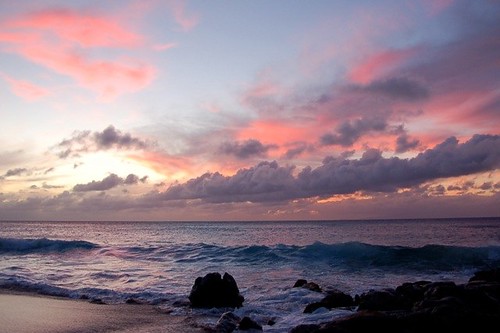














 Email Glenn James: