February 2009
Monthly Archive
Posted by Glenn
No Comments
February 18-19, 2009
Air Temperatures – The following maximum temperatures were recorded across the state of Hawaii Wednesday afternoon:
Lihue, Kauai – 74
Honolulu, Oahu – 81
Kaneohe, Oahu – 77
Kahului, Maui – 80
Hilo, Hawaii – 77
Kailua-kona – 80
Air Temperatures ranged between these warmest and coolest spots near sea level, and on the highest mountains…at 4 p.m. Wednesday afternoon:
Kailua-kona – 78F
Lihue, Kauai – 70
Haleakala Crater – 48 (near 10,000 feet on Maui)
Mauna Kea summit – 36 (near 14,000 feet on the Big Island)
Precipitation Totals – The following numbers represent the largest precipitation totals (inches) during the last 24 hours on each of the major islands, as of Wednesday afternoon:
0.64 Mount Waialaele, Kauai
0.21 Oahu Forest NWR, Oahu
0.08 Molokai
0.00 Lanai
0.00 Kahoolawe
0.29 West Wailuaiki, Maui
0.32 Pahoa, Big Island
Weather Chart – Here’s the latest (automatically updated) weather map showing a 1031 millibar high pressure system located to the north-northwest of the islands, with low pressure cells positioned to the NE…which will cause breezy and cool northeast winds both Thursday and Friday.
Satellite and Radar Images: To view the cloud conditions we have here in Hawaii, please use the following satellite links, starting off with the Infrared Satellite Image of the islands to see all the clouds around the state during the day and night. This next image is one that gives close images of the islands only during the daytime hours, and is referred to as a Close-up visible image. This next image shows a larger view of the Pacific…giving perspective to the wider ranging cloud patterns in the Pacific Ocean. Finally, here’s a looping IR satellite image, making viewable the clouds around the islands 24 hours a day. To help you keep track of where any showers may be around the islands, here’s the latest animated radar image.
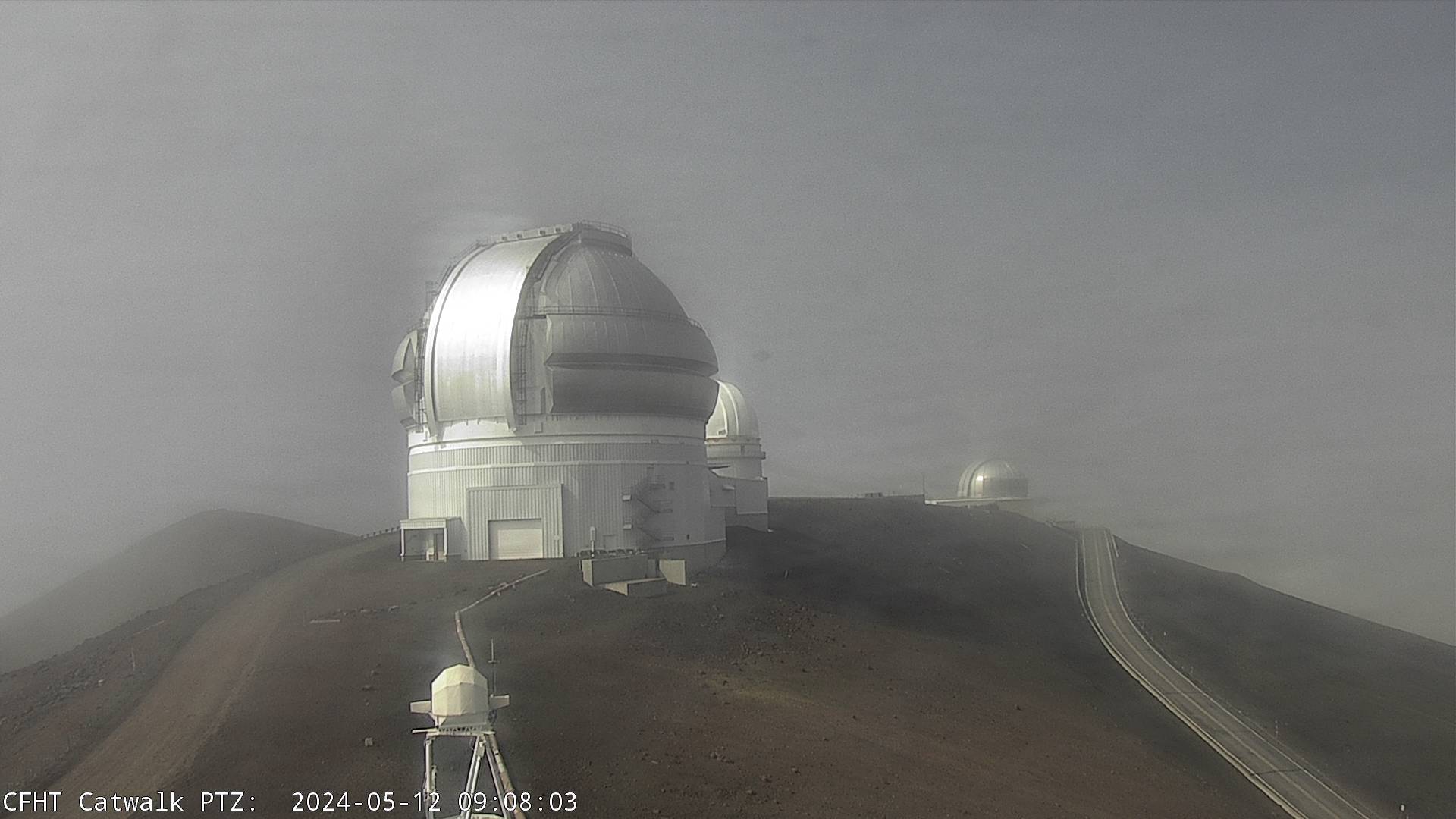
Hawaii’s Mountains – Here’s a link to the live webcam on the summit of near 14,000 foot Mauna Kea on the Big Island of Hawaii. The tallest peak on the island of Maui is the Haleakala Crater, which is near 10,000 feet in elevation. These two webcams are available during the daylight hours here in the islands…and when there’s a big moon rising just after sunset for an hour or two! Plus, during the nights and early mornings you will be able to see stars, and the sunrise too…depending upon weather conditions.
Aloha Paragraphs

Hamoa Beach…near Hana, Maui
Photo Credit: flickr.com
Cooler northeast winds have begun blowing Wednesday…which will likely remain around into Friday. We still have small craft wind advisory flags up over part of the state Wednesday evening, although now only in those windiest areas…generally in the southern part of the state. As we move further into the week, towards the second half of the upcoming weekend, these NE breezes will shift back to the regular easterly trade wind direction…bringing warmer weather our way.
Cooler weather, with more clouds and windward biased showers into Thursday…along with some high cirrus clouds too. The leeward sides in contrast, will remain dry, although will be locally quite breezy. The high clouds will likely move away by Friday, giving us back our sunshine. There will be sunny periods along the leeward beaches, especially during those breaks in the high cloud periods.
It’s Wednesday evening as I begin writing this last narrative paragraph from here in Kihei, Maui. The cooler northeast winds arrived this afternoon, which kept our high temperatures a bit lower as expected. Looking out the window before I make the drive up to Kula, I see lots of high cirrus clouds. Here’s a satellite image showing those icy clouds streaming their way up from the deeper tropics to our southwest. Meanwhile, coming in from the opposite direction, at lower levels of the atmosphere, we have a fairly minor cloud band, an old cold front, bringing a few showers to the windward sides. The combination of northeast winds, the high clouds, and the lower level cloud band moving through the state…will give us a tropical cool snap for a couple of days. The showers moving into the state won’t amount to much, but there will be more clouds blocking the sunshine along the windward coasts and slopes.
~~~ All this wind coming in from the northeast now, will be blowing on the ocean surface…making rough and choppy surf break along our windward sides soon. We may see a high surf advisory flag go up along those areas over the next day or two. The winds coming in from the northeast direction have a tendency to accelerate through valleys. This will make the central valley on Maui a windy place, which sends strong and gusty winds shooting out through Maalaea Bay. These winds often blow down through the Kihei and Wailea areas too, which give the ocean surf lots of white caps, taking the glassy water away, especially during the afternoon hours.
~~~ I’ll be back early Thursday morning with your next new weather narrative. I trust that you’re enjoying the interesting news stories that I place below each weekday morning. I hope you have a great Wednesday night, and hopefully will be inclined to return on Thursday for another perusal of this website. By the way, thanks for showing interest in the advertising links on the left hand margins of all the pages, and also for those google ads on the top and the bottom of the pages as well. Aloha for now…Glenn.
Interesting: The economy isn’t just squeezing the middle class on land, it’s also affecting fish. Wealthy areas and least developed regions have healthiest fish populations, while those in the middle are suffering. According to a study by the Wildlife Conservation Society (WCS) and other organizations, researchers discovered a surprising correlation between "middle class" communities in Eastern Africa and low fish levels. Curiously, areas with both low and high socio-economic levels had comparatively higher fish levels.
Appearing in the latest edition of Current Biology, the study examined reef systems, human population densities, and socio-economics among villages in 30 fished and unfished study sites in five countries along Africa’s Indian Ocean coast. The study is by Josh Cinner of James Cook University (JCU), Tim McClanahan of the Wildlife Conservation Society (WCS), Tim Daw of the University of East Anglia, Nick Graham of JCU, Joseph Maina of WCS, and Shaun Wilson and Terry Hughes of JCU. In a comparison between villages, researchers found that communities with intermediate levels of infrastructure had the lowest fish levels in their adjacent reef systems—up to four times lower than sites of low and high levels of development.
"This is a significant finding on how socio-economics can influence reef fisheries in surprising ways," said Dr. Tim McClanahan, a WCS coral researcher and co-author of the study. "It also shows the importance of combining ecology with social science for conservation planning on a regional scale." The explanation, said researchers, lies in the interplay between traditional customs and how growth influences the social fabric of communities. In poor communities, many of which rely heavily on marine resources, fishing levels are kept in check by local cultural institutions and taboos and a reliance on traditional, low-tech fishing methods. Increases in wealth often reduce a community’s dependence on fishing, but it can also increase the number of motorized fishing vessels and fishing gear such as hand lines.
Interesting2: Powered only by natural sunlight, an array of nano-tubes is able to convert a mixture of carbon dioxide and water vapor into natural gas at unprecedented rates. Such devices offer a new way to take carbon dioxide from the atmosphere and convert it into fuel or other chemicals to cut the effect of fossil fuel emissions on global climate, says Craig Grimes, from Pennsylvania State University, whose team came up with the device.
Although other research groups have developed methods for converting carbon dioxide into organic compounds like methane, often using titanium-dioxide nano-particles as catalysts, they have needed ultraviolet light to power the reactions. The researchers’ breakthrough has been to develop a method that works with the wider range of visible frequencies within sunlight.
Interesting3: The cruise ship Ocean Nova, with 106 people on board, was to attempt again Wednesday to free itself after running aground a day earlier near an Argentine military base in Antarctica. Amid strong winds, the ship awaited the arrival of another cruise ship to which its passengers might be evacuated. Passengers were in good condition and out of danger, Patrick Shaw, chairman of the company Quark Expeditions which operates the Ocean Nova, told Deutsche Presse-Agentur dpa. Shaw noted that the ship’s hull suffered no damage in the accident. The Ocean Nova, sailing under the Bahamas flag, ran aground early Tuesday just three miles off the Argentine military base San Martin, in the area known as Bahia Margarita.
Former Danish Navy seaman Per Gravesen, the ship’s captain, decided to wait for high tide to try and get the ship out of trouble by its own means. An attempt was made in the early hours of Wednesday, but failed. "The maneuvers turned out to be insufficient, so the ship remains aground in the same place," the Argentine Navy said in a statement. The captain was to try again later, at the next high tide. "If he makes it and the hull suffered no damage, passengers can continue their 15-day journey," Shaw said. In case the renewed attempt also fails, passengers were to be evacuated to the cruise ship Clipper Adventure, also operated by Quark Expeditions and which is already in the area, to take them to Argentina’s southernmost town, Ushuaia.
Interesting4: The bird-flu virus is nearly entrenched in China’s poultry population and represents a threat to world health, UN experts said Wednesday. "It has the potential for a pandemic," said Hans Troedsson, the World Health Organization’s (WHO’s) representative in China, which has the world’s largest poultry population. He told journalists in Beijing after China reported five human bird-flu deaths so far this year that health experts were concerned about the breadth and intensity in China of poultry infections of H5N1, the strain of bird flu that can be deadly in humans.
Most human H5N1 infections have occurred after patients have had close contact with infected birds, but health experts fear the virus could mutate into a form that could easily be passed between humans and cause a worldwide pandemic. "It is posing a pandemic risk," Troedsson said of the bird-flu outbreak in China’s poultry. "No one can escape it," he added.
"It will strike the whole world." A warning to China of a pandemic also came from another UN agency, the Food and Agricultural Organization. "We should not be complacent," said Vincent Martin, an animal health adviser from the organization. "If it happens, it will be very scary for everyone."He called for bird-flu prevention and investigations into how the virus spreads, warning that it was evolving.
The experts said they were also concerned that the most recent human infections in China were widely distributed across the country and could not be linked to nearby outbreaks of bird flu among poultry. WHO has confirmed 407 human bird-flu cases since 2003 in 15 Asian and African countries, 254 of which were fatal. China has seen 26 deaths from 39 cases, eight of which occurred this year.
Interesting5: Most of California isn’t falling into the sea yet, but big parts of Alaska are. In a possible sign of things to come, erosion of a stretch of Alaska’s coast surged in recent years to more than double the average historical rate, threatening some towns, a new study finds. The loss of land is documented in photos that show newly collapsed sections of permafrost coastline as well as decades-old artifacts that have slipped into the sea.
Scientists caution that the study does not include the entire coastline, but they said the shift might be due to declining Arctic sea ice extent, increasing summertime sea-surface temperatures, the rising sea level, and increases in storm power and corresponding wave action. "These factors may be leading to a new era in ocean-land interactions that seem to be repositioning and reshaping the Arctic coastline," the scientists write in the Feb. 14 issue of the journal Geophysical Research Letters.
Interesting6: Dreams might mean nothing, but many people take them seriously nonetheless, as Sigmund Freud did, new research finds. People in at least three countries, including the United States, believe dreams contain important hidden truths, said researcher Carey Morewedge, an assistant professor at Carnegie Mellon University in Pittsburgh.
In six different studies, Morewedge and his colleagues surveyed nearly 1,100 people about their dreams. The results are detailed in the February issue of the Journal of Personality and Social Psychology. "Psychologists’ interpretations of the meaning of dreams vary widely," Morewedge said.
"But our research shows that people believe their dreams provide meaningful insight into themselves and their world." In one study that surveyed general beliefs about dreams, Morewedge and co-author Michael Norton, an assistant professor at Harvard Business School, surveyed 149 university students in the United States, India and South Korea.
The researchers asked the students to rate different theories about dreams. Across all three cultures, an overwhelming majority of the students endorsed the theory that dreams reveal hidden truths about themselves and the world, a belief also endorsed by a nationally representative sample of Americans, Morewedge said.
Interesting7: Taiwan President Ma Ying-jeou on Wednesday pledged to help the Pacific island of Tuvalu, which is threatened by rising water levels caused by global warming. Ma made the pledge while receiving Tuvalu’s Prime Minister Apisai Ielemia whose country of 26 square kilometers and 12,000 people is slowly sinking due to rising sea levels. "Tuvalu has opened diplomatic ties with our country for 30 years and has spoken out in support of our country on many international occasions. It is a firm ally of the Republic of China (Taiwan’s formal title)," the Presidential Office quoted Ma as saying. Ma said rising sea levels have already had a serious impact on the life of Tuvalu people. "Our country and Tuvalu have had friendly ties for a long time.
I hope our two countries can strengthen our bond, cooperate and promote our friendship," he said. The news release did not mention what kind of aid Taiwan will give Tuvalu to help the island state cope with rising sea levels. Tuvalu is among the 23 mostly-small nations that recognize Taiwan. More than 170 countries recognize China which sees Taiwan as its breakaway province. Tuvalu consists of six atolls and three islands which are about 4.5 meters above the sea, and some of its beaches have already disappeared under the sea.
Interesting8: The price of staple grains like wheat, rice and maize have been climbing since January, after falling from record levels at the same time in 2008, according to the latest Crop Prospects and Food Situation report by the UN Food and Agriculture Organization. Wheat prices are being pushed up because a smaller wheat harvest is expected from Argentina, a major producer, where government has suspended export permits. Rice prices have begun to climb since Thailand, the largest world’s exporter, diverted some 4 million tons from the market and into public inventories at a price reported to be 20 percent higher than market levels. Maize prices are volatile because of dry conditions in Argentina and Brazil and a lower demand for US maize.
Posted by Glenn
[2] Comments
February 17-18, 2009
Air Temperatures – The following maximum temperatures were recorded across the state of Hawaii Tuesday afternoon:
Lihue, Kauai – 74
Honolulu, Oahu – 80
Kaneohe, Oahu – 76
Kahului, Maui – 79
Hilo, Hawaii – 76
Kailua-kona – 80
Air Temperatures ranged between these warmest and coolest spots near sea level, and on the highest mountains…at 4 p.m. Tuesday afternoon:
Barking Sands, Kauai – 78F
Hilo, Hawaii – 70
Haleakala Crater – missing (near 10,000 feet on Maui)
Mauna Kea summit – 32 (near 14,000 feet on the Big Island)
Precipitation Totals – The following numbers represent the largest precipitation totals (inches) during the last 24 hours on each of the major islands, as of Tuesday afternoon:
1.72 Mount Waialaele, Kauai
0.60 Oahu Forest NWR, Oahu
0.00 Molokai
0.00 Lanai
0.00 Kahoolawe
0.07 Puu Kukui, Maui
0.09 Hilo airport, Big Island
Weather Chart – Here’s the latest (automatically updated) weather map showing a 1032 millibar high pressure system located to the north-northwest of the islands…we’ll see breezy trade winds both Wednesday and Thursday. The trade winds should turn more towards the northeast direction starting Thursday.
Satellite and Radar Images: To view the cloud conditions we have here in Hawaii, please use the following satellite links, starting off with the Infrared Satellite Image of the islands to see all the clouds around the state during the day and night. This next image is one that gives close images of the islands only during the daytime hours, and is referred to as a Close-up visible image. This next image shows a larger view of the Pacific…giving perspective to the wider ranging cloud patterns in the Pacific Ocean. Finally, here’s a looping IR satellite image, making viewable the clouds around the islands 24 hours a day. To help you keep track of where any showers may be around the islands, here’s the latest animated radar image.
Hawaii’s Mountains – Here’s a link to the live webcam on the summit of near 14,000 foot Mauna Kea on the Big Island of Hawaii. The tallest peak on the island of Maui is the Haleakala Crater, which is near 10,000 feet in elevation. These two webcams are available during the daylight hours here in the islands…and when there’s a big moon rising just after sunset for an hour or two! Plus, during the nights and early mornings you will be able to see stars, and the sunrise too…depending upon weather conditions.
Aloha Paragraphs

Soaking rays on the beach…Hawaii
Photo Credit: flickr.com
The trade winds will continue, although will turn to the north and northeast over the next several days…then back to the east and ENE Friday into the upcoming weekend. We still have small craft wind advisory flags up over only part of the state Tuesday afternoon, as the NWS scaled them back recently. As we move further into the week, those generally east to ENE trade winds, will shift more to the north and NE direction. This new, more northerly flow, will bring somewhat cooler weather into our Hawaiian Islands weather picture during the second half of the work week.
Windward showers will be rather limited for the time being, although will increase modestly Wednesday into Thursday…before drier weather will arrive Friday into the weekend. The leeward sides in contrast, will remain dry, with good sunshine along those south and west facing beaches. Thus, this week looks pretty good overall. The models continue to try and make our weather wetter early next week, when we may see another increase in showers then. It’s still too early to nail down this potential wetter weather however, so for now…lets call it a 50/50 chance.
Monday evening I unexpectedly went to see a new film with my neighbors, along with a visiting brother and sister here from Switzerland. We saw The International (2009), starring Clive Owen, Naomi Watts, among many others. This film had great photography from Milan, Berlin, Luxembourg, and New York. There is plenty of mayhem, along with globetrotting shootouts, with no lack of action throughout. As many of you know, this kind of stuff is right down my alley. The folks I went with thought the film was interesting enough, but weren’t thrilled by any means. I give this film a good B grade, but my opinion was tainted a bit by the C grade my friends gave it. At any rate, here’s a trailer if you’re interested in getting a sneak preview.
It’s Tuesday evening as I start writing this last narrative paragraph from here in Kihei, Maui. Tuesday was a nice day here in the islands, especially if you were able to lay around down by the ocean…along our fairly warm sandy beaches. The trade winds were still our most influential weather feature, which remained on the strong and gusty side here and there. At 5pm, the strongest gust that I saw was the 38 mph at Kawaihae, on the Big Island. As far as temperatures go, it was quite warm, although only Honolulu and Kona were able to stretch up to 80F degrees for high temperatures today. At 5pm, the warmest place around the Aloha state was 78 at both Barking Sands, Kauai, and down at the Kona airport. As mentioned above, we should see a fairly minor cloud band, arriving tomorrow (Wednesday) along our windward sides, which will bring in some showery low clouds…lasting into Thursday. The leeward sides shouldn’t see much of this stuff, although there may be a few sprinkles being carried over into those south and west facing areas on the trade winds. Those winds, having a more northerly aspect, will cause somewhat cooler air temperatures, tropically speaking that is. ~~~ I’ll be back early Wednesday morning with your next new weather narrative from paradise, I hope you can meet me back here then! Aloha for now…Glenn.
Interesting: Global number two mobile phone maker Samsung launched five new phones on Monday including a model made from recycled plastic with a solar panel on the back for charging. Samsung said in a statement its "Blue Earth" solar-powered model had a touch screen and was made from plastic taken from used water bottles. It did not give pricing information or say when the phone would go on sale.
Interesting2: “Antarctica is a cradle of life for polar species,” said Rob Nicoll, WWF-Australia, Antarctica and Southern Ocean Initiative Manager. “In particular, the research shows it is an evolutionary garden for octopus, sea spiders and other bizarre deep sea creatures. “The fact that scientists found a number of species common to both Antarctica and the Arctic indicates that the polar oceans are effective safe havens for species that arrive by chance.” The study also found that the warming of the oceans due to climate change was forcing cold-ocean species to move towards the poles. The remarkable range of species has remained hidden for so long because many assumed the polar seas were like marine deserts. However it now appears that the harsh environment of the polar sea has been an engine of evolution offering the right ingredients of isolation and a wide range of habitats.
WWF believes these isolated habitats are threatened by climate change, which is driving ocean acidification and increasing temperatures around the poles. “It’s yet another reason why the world’s governments need to commit to deep emissions cuts at the United Nations Climate Change Conference in Copenhagen this December,” said Nicoll, “otherwise, scientific expeditions like this will simply create a list of species in our oceans that will perish due to climate change.” The threat of climate change comes on top of other threats to the Antarctic’s marine biodiversity from invasive species, oil spills and pollution through shipping activities and the actions of illegal, unregulated and unreported fishing vessels that flaunt international rules.
Interesting3: Water resources in three of South Asia’s largest river basins are highly vulnerable, with millions of people at risk of increasing water scarcity, a new report has found. The report – jointly released by the UN Environment Program and the Asian Institute of Technology- studied the Ganges-Brahmaputra-Meghna (GBM), Indus and Helmand river basins, all of which span multiple countries within the region. It lists overexploitation, climate change, and inadequate distribution and use of water resources among the key threats to the three basins, calling for "a unique mix of policy interventions and preferred routes for future water resources development" to tackle these challenges. Jinhua Zhang, regional coordinator at the UNEP Division of Early Warning & Assessment told SciDev.Net that countries should cooperate more to improve how water resources are managed — particularly to control pollution and improve efficiency — to help stop further damage to these rivers. The report assigned each river basin a vulnerability index, based on resources stress, development pressure, ecological health and management challenges. The GBM basin is most vulnerable, but water resource systems in the Helmand and Indus basins are also highly vulnerable.
Extreme population growth in the basins over the last century has put pressure on the region’s water resources, while around two-thirds of the Himalayan glaciers that feed the basins are receding. Additionally, groundwater levels in the GBM and Indus basins are declining at a rate of two to four metres per year due to intense pumping. In India alone the amount of water per head has decreased from 4,000 to 1,869 cubic meters in the last twenty years. Zhang told SciDev.Net that further research is needed to identify the supply of glacial melt for a given area, the amount of wastewater generated by industry, and strategies for water treatment. "The per capita availability of freshwater is declining, and contaminated water remains the greatest single environmental cause of human illness and death," he says. Improving our knowledge of the vulnerability of freshwater resources "is therefore essential so that policymakers can manage this vital resource for the benefit of their people, their economies and the environment,” says Zhang.
Interesting4: Federal, state and local governments are about to pour tens of billions of dollars into the nation’s infrastructure. The big question: Will we simply spend the money the way we’ve been doing for decades — on more concrete and steel? Or will we use it to make our roads, bridges and other assets much more intelligent? Imagine highways that alert motorists of a traffic jam before it forms, or bridges that report when they’re at risk of collapse. Or an electric grid that fixes itself when blackouts hit. This vision — known as "smart" infrastructure — promises to make the nation more productive and competitive, while helping the environment and saving lives. Not to mention saving money by making what we’ve got work better and break down less often. But fail to upgrade, advocates warn, and the country may be locked into the old way of building for decades to come. "The goal is not just funding projects for short-term job gains," says Paul Feenstra, vice president of government affairs at the Intelligent Transportation Society of America, a group that promotes smart-road technologies. "It should be to create systems that are intelligent and improve productivity in the long run."
Interesting5: Scientists say that Australia can expect more of the scorching conditions that fanned the firestorms that killed at least 181 people this month, prompting a nationwide debate about how to prepare for a hotter, more fire-prone future. As investigators pick through the tangled wreckage left by Australia’s deadliest wildfires, which flattened townships and destroyed more than 1,000 homes starting Feb. 7, a wide-ranging discussion has begun about the way the country handles wildfires – from greenhouse-gas emissions standards to planning codes to an emergency protocol that encourages people to stay and defend their properties. Wildfires have been a feature of the Australian landscape for centuries; thousands of fires burn across the continent each year.
But scientists warn that the "Black Saturday" disaster is a sign of things to come as climate change brings hotter weather and less rain. The governmental Commonwealth Scientific and Industrial Research Organization concluded in 2007 that average temperatures in Australia would increase by as much as 2 degrees Celsius by 2030 and 6 degrees Celsius by 2070 unless greenhouse emissions are drastically cut. That would be a difference of 3.6 degrees and 10.8 degrees Fahrenheit. Days of high or extreme fire danger are forecast to increase by 5 percent to 25 percent if the effects of climate change are low and by 15 percent to 65 percent if they are high, the report said.
Interesting6: If ever there was a superpower of the oceans, the North Atlantic, with its ability to control global weather systems, is it. The bad news is that this region also happens to be especially sensitive to the effects of climate change, so what is happening there could affect the world. The planet’s climate goes through periodic convulsions that affect every region simultaneously. The most recent were in the early 1940s and mid-1970s. The latter coincided with the start of more frequent El Niño events in the Pacific and a strong global warming trend. In past studies, Anastasios Tsonis and colleagues at the University of Wisconsin-Milwaukee have shown statistically that climate features like El Niño and the North Atlantic Oscillation (NAO), which drives weather across Europe, become synchronized for a few decades, before the links abruptly break down and a new pattern emerges. They call it "synchronized chaos".
Now their modeling studies have shown the action is always driven from the North Atlantic. Tsonis says the NAO is "without exception the common ingredient… the pacemaker of major climate shifts." The findings may be seized on by deniers of man-made climate change as evidence of the scale of natural climate variability. Tsonis argued two years ago that accelerated global warming since the 1970s could be due partly to a natural climate shift. But the findings will leave most climate scientists more worried. Today’s climate is changing most dramatically in the far North Atlantic, with record warming and ice loss in recent years. If the climate’s "tipping point" resides in these waters, then nature’s synchronized chaos could unleash unexpectedly sudden and severe consequences.
Interesting7: A powerful snow storm has lashed eastern Russia over the last few days, bringing heavy snow and strong winds to the Sakhalin Islands. Visibility across much of the island dropped to less than 50m, with heavy snow adding to the disruption on the roads. The storm formed in the Sea of Japan before heading north, dumping heavy snow on the Russian island of Sakhalin. This type of storm formation and track is not unusual for the region, which frequently gets hit by such storms at this time of year. In western Russia, many places have been experiencing milder than average conditions over the past week. Daytime temperatures, which are normally around -7C (19F) in Moscow, have been between 1 and -2 over the past seven days. Winters are generally harsh in this region, with temperature rarely above freezing in the day. Forecasters at the Russian Hydrometeorological Centre expect a brief respite from the heavy snow in the east over the next couple of days. Further storms are expected on Friday and Sunday, bringing yet more heavy snow.
Interesting8: In a new research, scientists have determined that seven huge irregular boulders in an island in Tonga were deposited by a prehistoric mega tsunami thousands of years ago. The research was done by Cliff Frohlich and her colleagues from the Institute for Geophysics, John A. and Katherine G. Jackson School of Geosciences, University of Texas at Austin, in the US. The hugely puzzling coral limestone boulders sit 100200 meters from the shoreline on the island of Tongatapu in the southwest Pacific. In 2007, Frohlich studied these boulders, which have dimensions as large as 9 meters and weigh up to 1600 tons, and concluded that the boulders originated at the shoreline about 120,000 years ago and have since been displaced by a prehistoric tsunami. Frohlich and her team analyzed undersea volcanic calderas in the Tofua arc west of Tongatapu and local slump features just offshore from the boulders and concluded that a caldera collapse was the likely cause of a tsunami large enough to move the boulders. A systematic census and analysis of erratic boulders and other tsunamigenic features along shorelines elsewhere in the world may provide a means for extending the historic record and thus more accurately assessing tsunami hazard.
Interesting9: Can money make us happy if we spend it on the right purchases? A new psychology study suggests that buying life experiences rather than material possessions leads to greater happiness for both the consumer and those around them. The study demonstrates that experiential purchases, such as a meal out or theater tickets, result in increased well-being because they satisfy higher order needs, specifically the need for social connectedness and vitality — a feeling of being alive. "These findings support an extension of basic need theory, where purchases that increase psychological need satisfaction will produce the greatest well-being," said Ryan Howell, assistant professor of psychology at San Francisco State University.
Participants in the study were asked to write reflections and answer questions about their recent purchases. Participants indicated that experiential purchases represented money better spent and greater happiness for both themselves and others. The results also indicate that experiences produce more happiness regardless of the amount spent or the income of the consumer. Experiences also lead to longer-term satisfaction. "Purchased experiences provide memory capital," Howell said. "We don’t tend to get bored of happy memories like we do with a material object. "People still believe that more money will make them happy, even though 35 years of research has suggested the opposite," Howell said. "Maybe this belief has held because money is making some people happy some of the time, at least when they spend it on life experiences.
Interesting10: Scientists in Arizona and New Jersey are reporting that aerogels, a super-lightweight solid sometimes called “frozen smoke,” may serve as the ultimate sponge for capturing oil from wastewater and effectively soaking up environmental oil spills. In the new study, Robert Pfeffer and colleagues point out that the environmental challenges of oil contamination go beyond widely publicized maritime oil spills like the Exxon Valdez incident. Experts estimate that each year people dump more than 200 million gallons of used oil into sewers, streams, and backyards, resulting in polluted wastewater that is difficult to treat.
Although there are many different sorbent materials for removing used oil, such as activated carbon, they are often costly and inefficient. Hydrophobic silica aerogels are highly porous and absorbent material, and seemed like an excellent oil sponge. The scientists packed a batch of tiny aerogel beads into a vertical column and exposed them to flowing water containing soybean oil to simulate the filtration process at a wastewater treatment plant. They showed that the aerogel beads absorbed up to 7 times their weight and removed oil from the wastewater at high efficiency, better than many conventional sorbent materials.
Posted by Glenn
[2] Comments
February 16-17, 2009
Air Temperatures – The following maximum temperatures were recorded across the state of Hawaii Monday afternoon:
Lihue, Kauai – 78
Honolulu, Oahu – 81
Kaneohe, Oahu – 76
Kahului, Maui – 80
Hilo, Hawaii – 75
Kailua-kona – 81
Air Temperatures ranged between these warmest and coolest spots near sea level, and on the highest mountains…at 4 p.m. Monday afternoon:
Honolulu, Oahu – 79F
Lihue, Kauai– 70
Haleakala Crater – 48 (near 10,000 feet on Maui)
Mauna Kea summit – 34 (near 14,000 feet on the Big Island)
Precipitation Totals – The following numbers represent the largest precipitation totals (inches) during the last 24 hours on each of the major islands, as of Monday afternoon:
0.29 Mount Waialaele, Kauai
0.05 Manoa Valley, Oahu
0.03 Molokai
0.00 Lanai
0.00 Kahoolawe
0.03 Hana airport, Maui
0.10 Piihonua, Big Island
Weather Chart – Here’s the latest (automatically updated) weather map showing a 1033 millibar high pressure system located to the north-northwest of the islands…we’ll see breezy trade winds both Tuesday and Wednesday.
Satellite and Radar Images: To view the cloud conditions we have here in Hawaii, please use the following satellite links, starting off with the Infrared Satellite Image of the islands to see all the clouds around the state during the day and night. This next image is one that gives close images of the islands only during the daytime hours, and is referred to as a Close-up visible image. This next image shows a larger view of the Pacific…giving perspective to the wider ranging cloud patterns in the Pacific Ocean. Finally, here’s a looping IR satellite image, making viewable the clouds around the islands 24 hours a day. To help you keep track of where any showers may be around the islands, here’s the latest animated radar image.
Hawaii’s Mountains – Here’s a link to the live webcam on the summit of near 14,000 foot Mauna Kea on the Big Island of Hawaii. The tallest peak on the island of Maui is the Haleakala Crater, which is near 10,000 feet in elevation. These two webcams are available during the daylight hours here in the islands…and when there’s a big moon rising just after sunset for an hour or two! Plus, during the nights and early mornings you will be able to see stars, and the sunrise too…depending upon weather conditions.
Aloha Paragraphs

Presidents Day…good time to relax
Photo Credit: flickr.com
The trade winds have moderated a touch, although will continue to be on the breezy side through most of this new week. The winds will be lighter than they were during the second half of this last week, which were very strong and gusty at times. We still have small craft wind advisory flags up over many of our windiest areas today, which will remain in place into Tuesday.
Monday and Tuesday will be generally dry, with just a few showers along the windward sides…increasing a bit Wednesday. The leeward sides will remain dry through the beginning of this week, with lots of sunshine beaming down during the days. Those windward biased showers will be limited, that is until the tail-end of a cold front swings through…bringing us an increase in showers around Wednesday. We may see another increase in showers during the second half of the upcoming weekend.
The high surf advisory for the east facing beaches remains in effect Monday, with our ocean still on the choppy side locally. As the trade winds are still on the breezy side, our ocean will be filled with white caps in many areas. These trade winds will stay with us through most of the upcoming week…if not through all of the next seven days going forward. At least they won’t be as strong as we saw this past weekend.
It’s Monday afternoon here in Kula, Maui, as I begin writing this last section of today’s narrative. The winds, as noted by the numbers below, at least in terms of top gusts, are still showing some good strong gusts from the trade wind direction…as of around 4pm Monday afternoon:
27 mph on Kauai
27 mph on Oahu
25 mph on Molokai
38 mph on Lanai
32 mph on Kahoolawe
35 mph on Maui
38 mph on the Big Island
~~~ This morning I lounged, rested, and read, after a nice breakfast. A friend at the birthday party I went to Sunday, gave me some fresh eggs from her loose running chickens. Wow, the yolks on those things were deep orange, which I plated along with toast. I ate some cherimoya, banana, and vanilla yogurt before I cooked up those special eggs. I then brewed up a nice cup of espresso, and drank that with a couple of warmed-up small pastries that I bought at the health food store in Paia on Saturday.
~~~ During the afternoon I got socialable again, and ended up getting together with all my neighbors. We had lunch, and then tea with chocolate cake and truffles a little while ago. There was a time that we did a little work before that as well, which felt good. One set of neighbors invited me to go see a new film this evening, but I’ll likely pass on that, considering on how late they will be back, and how early I will be getting up in the morning. Speaking of which, I’ll be back with you then, when I’ll have a new weather narrative waiting for you. I hope you have a great Monday night until then! Aloha for now…Glenn.
Posted by Glenn
1 Comment
February 15-16, 2009
Air Temperatures – The following maximum temperatures were recorded across the state of Hawaii Saturday afternoon:
Lihue, Kauai – 75
Honolulu, Oahu – 80
Kaneohe, Oahu – 75
Kahului, Maui – 79
Hilo, Hawaii – 75
Kailua-kona – 82
Air Temperatures ranged between these warmest and coolest spots near sea level, and on the highest mountains…at 1 p.m. Sunday afternoon:
Honolulu, Oahu – 81F
Lihue, Kauai – 75
Haleakala Crater – 54 (near 10,000 feet on Maui)
Mauna Kea summit – 37 (near 14,000 feet on the Big Island)
Precipitation Totals – The following numbers represent the largest precipitation totals (inches) during the last 24 hours on each of the major islands, as of Sunday morning:
0.58 Mount Waialaele, Kauai
0.79 South Fork Kaukonahua, Oahu
0.03 Molokai
0.00 Lanai
0.00 Kahoolawe
0.64 West Wailuaiki, Maui
0.70 Piihonua, Big Island
Weather Chart – Here’s the latest (automatically updated) weather map showing a 1029 millibar high pressure system located to the northwest of the islands…we’ll see breezy trade winds both Monday and Tuesday.
Satellite and Radar Images: To view the cloud conditions we have here in Hawaii, please use the following satellite links, starting off with the Infrared Satellite Image of the islands to see all the clouds around the state during the day and night. This next image is one that gives close images of the islands only during the daytime hours, and is referred to as a Close-up visible image. This next image shows a larger view of the Pacific…giving perspective to the wider ranging cloud patterns in the Pacific Ocean. Finally, here’s a looping IR satellite image, making viewable the clouds around the islands 24 hours a day. To help you keep track of where any showers may be around the islands, here’s the latest animated radar image.
Hawaii’s Mountains – Here’s a link to the live webcam on the summit of near 14,000 foot Mauna Kea on the Big Island of Hawaii. The tallest peak on the island of Maui is the Haleakala Crater, which is near 10,000 feet in elevation. These two webcams are available during the daylight hours here in the islands…and when there’s a big moon rising just after sunset for an hour or two! Plus, during the nights and early mornings you will be able to see stars, and the sunrise too…depending upon weather conditions.
Aloha Paragraphs

Still windy in Hawaii
Photo Credit: flickr.com
We’re through the strongest portion of the recent windy trade wind episode…although the trades will continue to blow well into the future. These gusty trade winds will be dropping a notch today, and along with this gradual slow down in the winds…the gale warning, and the wind advisories have been cancelled as well. This leaves us with just a small craft wind advisory, which covers all of Hawaii’s coastal and channel waters Sunday. As the trade winds ease back a tad more on Monday, the small craft advisory will be scaled back a bit more then.
A dry atmosphere overlies the islands now, with just a few windward biased showers expected…leaving the leeward sides dry and generally sunny during the days. Any showery clouds, being carried along by the trade winds, will remain rather limited, although may pick up briefly at times through the next several days. Since the trade winds will be around through the next week, we’ll likely see periods of showers around through the extended forecast time frame. The atmosphere has taken on a drier aspect now however, so that showers won’t be a problem.
The high surf advisory for the east facing beaches remains in effect Sunday, with our ocean still on the choppy side locally. As the strong and gusty trade winds remain active, we’ll see our local ocean still rather rough under their influence. Since the winds are generally coming in from the east, some of the leeward beaches will be sheltered from the gusty conditions. These beaches, on those south and and west facing exposures, will be where folks will want to go to lay out in the sunshine.
It’s early Sunday morning here in Kula, Maui, as I begin writing this last section of today’s narrative. The winds, despite their relaxing trend starting today, will still be well more strong and gusty than usual. The numbers below show the strongest gusts around the state, on each of the islands, as of 1pm Sunday afternoon:
28 mph on Kauai
38 mph on Oahu
36 mph on Molokai
42 mph on Lanai
42 mph on Kahoolawe
43 mph on Maui
44 mph on the Big Island
~~~ It’s a nice sunny day here on Maui early Sunday afternoon. There’s some low clouds being carried along the windward sides, where I’ll be headed soon. Looking over towards Wailea, Kihei, and Lahaina, from up here in Kula…it looks completely sunny. As noted from the wind speed numbers above, we still have gusty winds blowing, especially from Maui County down through the Big Island. Despite the general call for less windy weather, it won’t be a swift motion into lighter winds anytime soon. As a matter of fact, our trade winds will remain quite blustery as we move through the holiday tomorrow…through most of the next week.
~~~ As noted, I’m heading over to a friend’s house on the windward side, in Haiku, to attend a birthday party. It will be fun to go over there, into the windy weather, and socialize some with old friends. I’ve given this friend a very nice bottle of special red wine, and besides bringing a card…have picked up three packages of organic chicken breasts for the bbq, some really nice cheese from the northern California county of Marin, and some fire roasted crackers that I’ve come to enjoy lately. I’ll more than likely be back later this evening at some point to check in, but I’m not sure exactly when. I therefore want to wish you well, and hope that you enjoy the rest of your Sunday! Aloha for now…Glenn.
Posted by Glenn
No Comments
February 14-15, 2009
Air Temperatures – The following maximum temperatures were recorded across the state of Hawaii Saturday afternoon:
Lihue, Kauai – 75
Honolulu, Oahu – 80
Kaneohe, Oahu – 75
Kahului, Maui – 79
Hilo, Hawaii – 75
Kailua-kona – 82
Air Temperatures ranged between these warmest and coolest spots near sea level, and on the highest mountains…at 4 p.m. Saturday afternoon:
Kailua-kona – 80F
Hilo, Hawaii – 68
Haleakala Crater – 43 (near 10,000 feet on Maui)
Mauna Kea summit – 27 (near 14,000 feet on the Big Island)
Precipitation Totals – The following numbers represent the largest precipitation totals (inches) during the last 24 hours on each of the major islands, as of Saturday afternoon:
0.35 Mount Waialaele, Kauai
0.90 South Fork Kaukonahua, Oahu
0.03 Molokai
0.00 Lanai
0.00 Kahoolawe
0.43 West Wailuaiki, Maui
0.63 Glenwood, Big Island
Weather Chart – Here’s the latest (automatically updated) weather map showing a 1033 millibar high pressure system located to the north of the islands…we’ll see strong and gusty trade winds both Saturday evening into Sunday.
Satellite and Radar Images: To view the cloud conditions we have here in Hawaii, please use the following satellite links, starting off with the Infrared Satellite Image of the islands to see all the clouds around the state during the day and night. This next image is one that gives close images of the islands only during the daytime hours, and is referred to as a Close-up visible image. This next image shows a larger view of the Pacific…giving perspective to the wider ranging cloud patterns in the Pacific Ocean. Finally, here’s a looping IR satellite image, making viewable the clouds around the islands 24 hours a day. To help you keep track of where any showers may be around the islands, here’s the latest animated radar image.
Hawaii’s Mountains – Here’s a link to the live webcam on the summit of near 14,000 foot Mauna Kea on the Big Island of Hawaii. The tallest peak on the island of Maui is the Haleakala Crater, which is near 10,000 feet in elevation. These two webcams are available during the daylight hours here in the islands…and when there’s a big moon rising just after sunset for an hour or two! Plus, during the nights and early mornings you will be able to see stars, and the sunrise too…depending upon weather conditions.
Aloha Paragraphs


Happy Valentines Day!
Photo Credit: flickr.com
The trade winds may have peaked in strength earlier Saturday, although will remain stronger than normal Sunday…moderating a tad further Monday. The trade winds remain stronger and more gusty than usual Saturday evening, keeping small craft wind advisories active over all coastal and channel waters…with a gale warning posted in the channels between Maui and the Big Island. The NWS forecast office has pulled back the wind advisory, which is now ative over only parts of the Big Island, and the summit of the Haleakala Crater on Maui. The latest forecast keeps these gusty trade winds blowing, although somewhat lighter through the next week…at least.
Showers will fall at times along the windward sides, although they will be rather modest…with dry conditions expected across the leeward sides. Showery clouds carried along by these strong trade winds, will remain rather limited, although may pick up briefly at times. Since the trade winds will be around through the next week, we will likely see more of these showers around through the extended forecast time frame. The atmosphere has taken on a drier aspect now, so that showers shouldn’t be a problem.
The winds blowing on the ocean will keep it very rough and choppy, with rather large surf breaking along our east facing beaches. As these strong and gusty trade winds remain blustery through Sunday, we’ll see our local ocean rough and pretty gnarly under their influence. The NWS office in Honolulu is keeping the high surf advisory active, along our east shores, for this incoming larger than normal surf. I recommend being careful going out into the ocean on small boats, and especially kayaks for the time being.
It’s early Saturday evening here in Kula, Maui, as I begin writing this last section of today’s narrative. The winds, although having perhaps peaked in strength earlier in the day Saturday, were still on the strong and gusty side, no doubt about it! Saturday evening’s top gusts, at 5pm included still an impressive array of numbers:
30 mph on Kauai
42 mph on Oahu
35 mph on Molokai
47 mph on Lanai
42 mph on Kahoolawe
46 mph on Maui
46 mph on the Big Island
These numbers represent way stronger winds than we would see blowing on a more typical trade wind day! There will still be gusts above 40 mph Saturday night into Sunday, but the overall tendency will be for slightly lighter winds going forward.
~~~ Friday night after work I went to see the new film Taken (2009) starring Liam Neeson, Maggie Grace, among others. Taken is described as an action, adventure, art, foreign, drama thriller…I like all these words! The critics have been rather spare with their praise for this film, giving it a luke warm C as an average grade. The Yahoo! Users are giving it a more upbeat A-. I was certainly willing to be taken into this film, swept radically away from my mild mannered Maui weatherman existence. The main thrust of this film is about a father who goes to Paris to find his daughter, who was kidnapped by criminals. As he hunts her down, there’s lots of violence along the way. As usual, with these action flicks, I liked it. I don’t usually think of Liam Neeson as being in movies with this much violence, but he more than adequately held his own in this department! Here’s a trailer of this film, although its a pretty rough and tumble piece of work.
~~~ It’s a bit before sunset here in Kula, as the strong trade winds continue to rage locally. There are those places too, that are out of the gusty trade wind flow, which are seeing considerably less windy weather. Here in Kula for instance, there are only light breezes, although just strong enough at the moment (6pm) for my wind chimes to be sounding off slightly. Then, as noted above, there are those windier areas that have well over 40 mph gusts, which have the ocean chalked-up with white caps galore! It’s Valentine’s Day, and in that regard, I send my intimate wishes out to all you lovely ladies out there, who may be reading these words…especially to my Mother Dorothy James, if she happens to be reading from Southern California! I’ll be back Sunday morning with your next new weather narrative, I hope you find everything that you’re looking for on this romantic Saturday night! Aloha for now…Glenn.
Valentines Day… Her eyes are wide as they stare into yours. You wrap your arm around her waist and pull her in close. She touches your face and you lean in, tilt your head—to the right, of course—and your lips connect. The rushing sensation leaves you little room to wonder, “Why the hell am I doing this anyway?” Of course, the simplest answer is that humans kiss because it just feels good. But there are people for whom this explanation isn’t quite sufficient. They formally study the anatomy and evolutionary history of kissing and call themselves philematologists. So far, these kiss scientists haven’t conclusively explained how human smooching originated, but they’ve come up with a few theories, and they’ve mapped out how our biology is affected by a passionate lip-lock. A big question is whether kissing is learned or instinctual. Some say it is a learned behavior, dating back to the days of our early human ancestors. Back then, mothers may have chewed food and passed it from their mouths into those of their toothless infants. Even after babies cut their teeth, mothers would continue to press their lips against their toddlers’ cheeks to comfort them. Supporting the idea that kissing is learned rather than instinctual is the fact that not all humans kiss. Certain tribes around the world just don’t make out, anthropologists say.
While 90 percent of humans actually do kiss, 10 percent have no idea what they’re missing. Others believe kissing is indeed an instinctive behavior, and cite animals’ kissing-like behaviors as proof. While most animals rub noses with each other as a gesture of affection, others like to pucker up just like humans. Bonobos, for example, make up tons of excuses to swap some spit. They do it to make up after fights, to comfort each other, to develop social bonds, and sometimes for no clear reason at all—just like us. Today, the most widely accepted theory of kissing is that humans do it because it helps us sniff out a quality mate. When our faces are close together, our pheromones “talk”—exchanging biological information about whether or not two people will make strong offspring. Women, for example, subconsciously prefer the scent of men whose genes for certain immune system proteins are different from their own. This kind of match could yield offspring with stronger immune systems, and better chances for survival. Still, most people are satisfied with the explanation that humans kiss because it feels good. Our lips and tongues are packed with nerve endings, which help intensify all those dizzying sensations of being in love when we press our mouths to someone else’s. Experiencing such feelings doesn’t usually make us think too hard about why we kiss—instead, it drives us to find ways to do it more often.
Posted by Glenn
No Comments
February 13-14, 2009
Air Temperatures – The following maximum temperatures were recorded across the state of Hawaii Friday afternoon:
Lihue, Kauai – 76
Honolulu, Oahu – 81
Kaneohe, Oahu – 77
Kahului, Maui – 80
Hilo, Hawaii – 78
Kailua-kona – 81
Air Temperatures ranged between these warmest and coolest spots near sea level, and on the highest mountains…at 5 p.m. Friday afternoon:
Barking Sands, Kauai – 82F
Lihue, Kauai – 73
Haleakala Crater – 41 (near 10,000 feet on Maui)
Mauna Kea summit – 25 (near 14,000 feet on the Big Island)
Precipitation Totals – The following numbers represent the largest precipitation totals (inches) during the last 24 hours on each of the major islands, as of Friday afternoon:
2.66 Mount Waialaele, Kauai
1.36 Poamoho 2, Oahu
0.04 Molokai
0.00 Lanai
0.00 Kahoolawe
1.16 West Wailuaiki, Maui
1.26 Piihonua, Big Island
Weather Chart – Here’s the latest (automatically updated) weather map showing a 1037 millibar high pressure system located to the northeast of the islands…we’ll see strong and gusty trade winds both Saturday and Sunday.
Satellite and Radar Images: To view the cloud conditions we have here in Hawaii, please use the following satellite links, starting off with the Infrared Satellite Image of the islands to see all the clouds around the state during the day and night. This next image is one that gives close images of the islands only during the daytime hours, and is referred to as a Close-up visible image. This next image shows a larger view of the Pacific…giving perspective to the wider ranging cloud patterns in the Pacific Ocean. Finally, here’s a looping IR satellite image, making viewable the clouds around the islands 24 hours a day. To help you keep track of where any showers may be around the islands, here’s the latest animated radar image.
Hawaii’s Mountains – Here’s a link to the live webcam on the summit of near 14,000 foot Mauna Kea on the Big Island of Hawaii. The tallest peak on the island of Maui is the Haleakala Crater, which is near 10,000 feet in elevation. These two webcams are available during the daylight hours here in the islands…and when there’s a big moon rising just after sunset for an hour or two! Plus, during the nights and early mornings you will be able to see stars, and the sunrise too…depending upon weather conditions.
Aloha Paragraphs

Strong and gusty trade winds
Photo Credit: flickr.com
Our trade winds finally became blustery, very strong and gusty locally Friday. The trade winds cranked-up in strength during the day Friday, keeping small craft wind advisories active over all coastal and channel waters…with a gale warning posted in the channels between Maui and the Big Island, and between Maui and Molokai. The NWS forecast office is keeping the wind advisory active over the entire state as well, which lasts at this point until 6pm Saturday evening…although may last longer depending on how strong the winds are going into Sunday. The latest forecast keeps these gusty trade winds blowing, although somewhat lighter through the next week…at least.
What is a wind advisory? The official NWS definition of a wind advisory is this:
"A WIND ADVISORY MEANS THAT SUSTAINED WIND SPEEDS OF 30 MPH WITH GUSTS TO 50 MPH ARE EXPECTED. THESE STRONG WINDS CAN MAKE DRIVING DIFFICULT…ESPECIALLY FOR HIGH PROFILE VEHICLES. THEREFORE…USE EXTRA CAUTION WHILE DRIVING. ALSO…SECURE ANY LOOSE OBJECTS THAT MAY BECOME WIND BLOWN DEBRIS DURING THIS WIND EVENT."
Showers won’t be a big part of this windy episode, although there will be some at times, primarily along the windward coasts and slopes. The speed at which any showery clouds will be carried along, by the strong trade winds, will keep them from being problematic in terms of flooding problems. Since the trade winds will be around through the next week, we will likely see quite a few of these showers around through the extended forecast time frame. These showers may carry over into the leeward sides on the smaller islands at times too. The atmosphere has taken a drier aspect now however, so that showers shouldn’t be much of a problem.
The surrounding ocean surface will be full of white caps, and ruffled to the max with chop and rough surf conditions…most remarkably along those north and east facing waters. As these strong and gusty trade winds remain blustery into the weekend, we’ll see our local ocean become very rough. All the incoming strong and gusty trade winds will cause choppy surf conditions, which will be pounding our east facing shores, and wrap around into other areas as well. The NWS office in Honolulu has issued a high surf advisory for this incoming larger than normal surf. I recommend being very careful going out on the ocean on small boats, and especially kayaks for the time being…maybe not going at all as a matter of fact!
It’s early Friday evening here in Kihei, Maui, as I begin writing this last section of today’s narrative. Friday was a very windy day, with winds whipping around to near 60 mph at times down at South Point on the Big Island! At 5pm Friday, the second strongest winds that I saw blowing were the 46 mph gusts at both Upolu airport, and South Point on the Big Island…with the top honors going to the small island of Kahoolawe, where a pile driver gust of 48 mph was occurring. Here on Maui, the top gust at the same time was happening at Maalaea Bay, where a gust of 43 mph was shooting out to sea there. I’ll have more weather news about all this windy weather Saturday morning when I return.
~~~ I’m about to leave Kihei for Kahului now, where I’ll head over to the Kaahumanu Center theatre, for a new film. This time around I’m going to see Taken (2009) starring Liam Neeson, Maggie Grace, among others. Taken is described as an action, adventure, art, foreign, drama and thriller…I like all these words! The critics have been rather spare with their praise for this film, giving it a luke warm C as an average grade. The Yahoo! Users are giving it a more upbeat A-. I’m willing to be taken into this film, carried away into another world, swept from my rather mild mannered, Maui weatherman existence. The main thrust of this film is about a father who goes to Paris to find his daughter, who has been kidnapped by some criminals. As he hunts her down, there’s lots of violence along the way. I’ll be sure to let you know my impression of this film, when I come back online Saturday morning with your next new weather narrative. Here’s a trailer of this film, although its a pretty rough and tumble piece of work. I hope you have a great Friday night until then! Aloha for now…Glenn
Interesting: A new national survey conducted by the Harvard Opinion Research Program at the Harvard School of Public Health finds that the vast majority (93%) of Americans have heard or read about the recent ongoing recall of peanut products. Among those who are aware of the recall, about six in ten (61%) say they have taken one or more precautions to reduce their risk of getting sick from contaminated peanut products. Specifically, about one in four say they have checked ingredient lists on foods in the grocery store to make sure they know which products contain peanuts (27%), thrown away foods in their home that they think might be on the recall list (25%), stopped ordering foods containing peanuts in restaurants (22%), and stopped eating those foods they heard were in the recall (28%), while 15% say they have stopped eating all foods containing peanuts. The poll also finds that among those who are aware of the recall, one in four (25%) mistakenly believe that major national brands of peanut butter are involved in the recall. Seventy percent correctly identify peanut butter crackers as being involved. However, less than half are aware that several other products containing peanuts have been recalled, including some in each of the following food categories: snack bars (49%), cakes, brownies, and cookies (45%), pet treats (43%), candy (39%), pre-packaged meals (36%), ice cream (27%), and jars or cans of dry-roasted peanuts (23%).
Interesting2: Raw fruits and vegetables are good for you but may also send you to the doctor, according to research published today by Cambridge University Press in the journal Epidemiology and Infection. A review article in the journal, written by several experts in their field, has highlighted the fact that fresh fruits and vegetables are increasingly recognized as a source of food poisoning outbreaks in many parts of the world. In Europe, recent outbreaks have revealed new and unexplained links between some bacteria and viruses that cause food poisoning and imported baby corn, lettuces, and even raspberries. In the USA, recent outbreaks of E Coli infections have been linked to bagged baby spinach, and Salmonella to peppers, imported cantaloupe melons and tomatoes as well. Professor Norman Noah, Editor-in-Chief of the journal says:
"This research confirms that raw fruit and vegetables can cause food poisoning.
To obtain raw fruit and vegetables out of season, as many countries now do, they are transported many thousands of miles from growing areas, and outbreaks can affect many widely dispersed countries simultaneously. Some outbreaks undoubtedly go unrecognized, and the scale of the problem is as yet unknown. "Identifying the source of contamination in any outbreak requires a careful assessment of potential exposures. Further work needs to be done to fully understand fully where the organisms that causes the poisoning comes from, and at which point in the journey from field to fork." In the journal, the links between raw produce and food poisoning have been compared with other foods that are now well-recognized sources of infection with particular bacteria, such as eggs with salmonella and beef mince with E Coli.
Interesting3: A team of MIT undergraduate students has invented a shock absorber that harnesses energy from small bumps in the road, generating electricity while it smoothes the ride more effectively than conventional shocks. The students hope to initially find customers among companies that operate large fleets of heavy vehicles. They have already drawn interest from the U.S. military and several truck manufacturers. Senior Shakeel Avadhany and his teammates say they can produce up to a 10 percent improvement in overall vehicle fuel efficiency by using the regenerative shock absorbers. The company that produces Humvees for the army, and is currently working on development of the next-generation version of the all-purpose vehicle, is interested enough to have loaned them a vehicle for testing purposes. The project came about because "we wanted to figure out where energy is being wasted in a vehicle," senior Zack Anderson explains. Some hybrid cars already do a good job of recovering the energy from braking, so the team looked elsewhere, and quickly homed in on the suspension.
They began by renting a variety of different car models, outfitting the suspension with sensors to determine the energy potential, and driving around with a laptop computer recording the sensor data. Their tests showed "a significant amount of energy" was being wasted in conventional suspension systems, Anderson says, "especially for heavy vehicles." Once they realized the possibilities, the students set about building a prototype system to harness the wasted power. Their prototype shock absorbers use a hydraulic system that forces fluid through a turbine attached to a generator. The system is controlled by an active electronic system that optimizes the damping, providing a smoother ride than conventional shocks while generating electricity to recharge the batteries or operate electrical equipment. In their testing so far, the students found that in a 6-shock heavy truck, each shock absorber could generate up to an average of 1 kW on a standard road — enough power to completely displace the large alternator load in heavy trucks and military vehicles, and in some cases even run accessory devices such as hybrid trailer refrigeration units.
Interesting4: There may be a reason teenagers eat more burgers and fries than fruits and vegetables: their parents. In a new policy brief released today by the UCLA Center for Health Policy Research, researchers found that adolescents are more likely to eat at least five servings of fruits and vegetables a day if their parents do. Contrarily, teens whose parents eat fast food or drink soda are more likely to do the same. Every day, more than 2 million California adolescents (62 percent) drink soda and 1.4 million (43 percent) eat fast food, but only 38 percent eat five or more servings of fruits and vegetables, according to the policy brief, "Teen Dietary Habits Related to Those of Parents." The cause of the deficit of healthy foods in teen diets has been attributed in part to the high concentration of fast food restaurants in certain cities and neighborhoods and other environmental factors. The new research is a reminder, however, that "good dietary habits start at home," according to center research scientist Susan H. Babey, a co-author of the policy brief. "If parents are eating poorly, chances are their kids are too." Nearly one-third (30 percent) of California’s teenagers are overweight or obese. Poor dietary habits, along with environmental and other factors, are strongly linked to obesity.
Interesting5: Imagine you live in the suburbs of Chicago and you must commute hundreds of miles to a job in Iowa just to put food on the table. Magellanic penguins living on the Atlantic coast of Argentina face a similar scenario, and it is taking a toll. The penguins’ survival is being challenged by wide variability in conditions and food availability, said Dee Boersma, a University of Washington biology professor and a leading authority on Magellanic penguins. For example, while one parent incubates eggs on the nest the other must go off to find food. But these days, Boersma said, penguins often must swim 25 miles farther to find food than they did just a decade ago. "That distance might not sound like much, but they also have to swim another 25 miles back, and they are swimming that extra 50 miles while their mates are back at the breeding grounds, sitting on a nest and starving," she said.
Boersma has recently published research documenting some of the serious challenges faced by Magellanic penguins in a colony at Punta Tombo, Argentina, which she has studied for more than 25 years. She discusses her research Thursday (Feb. 12) during a news briefing and Friday during a symposium at the American Association for the Advancement of Science meeting in Chicago. The Punta Tombo colony has declined more than 20 percent in the last 22 years, leaving just 200,000 breeding pairs, Boersma said. There are several reasons for the decline, including oil pollution and overharvesting of fish by humans. Climate variation also is a major problem, she found. Longer trips for food during a given breeding season lessen the chances that a given penguin pair will successfully reproduce. Some younger penguins move to colonies that are closer to food one year but might be farther away from food the following year. Increased ocean variability means penguins often return to their breeding grounds later and are in poorer condition to breed.
Interesting6: Out in the deep waters of Monterey Bay, gray whales will be swimming home later this month after a brief winter vacation in Baja California. Whale watchers and marine scientists say these whales have been delaying their southern sojourns and point to climate change as the culprit. Rising sea temperatures have disrupted the animals’ home habitat in the waters between Alaska and Russia, said Wayne Perryman, a researcher at the Southwest Fisheries Science Center in La Jolla. Because of these changes, the whales are spending more time in the north before they start their yearly swim south. The scientists at the center have observed the whales for more than 20 years as they pass through Monterey Bay.
Compared to two decades ago, Perryman said, the animals are reaching the bay a week later. "This isn’t trivial," Perryman said. "It’s a significant change." Richard Ternullo, a boat captain for Monterey Bay Whale Watch in Monterey, said the whales’ yearly arrival in the bay fluctuates, but he has noticed on average it has drifted about 10 days later into the year. "Last year, they were considerably late," Ternullo said. "But this year they seem to be on time." Every year, gray whales undertake a 12,000-mile round-trip swim from the frigid Bering Sea to the warm waters off Baja California. Scientists don’t fully understand what motivates this epic migration — the longest for any mammal — but believe the animals may leave their homes to avoid predators such as killer whales, which feed on gray whale calves.
Interesting7: Fourteen gharials fitted with radio tags have been released into the Rapti River in Nepal in an attempt to identify the reasons for the alarming decline in population of this critically endangered member of the crocodile family. The tagging, carried out by Nepal’s Department of National Parks and Wildlife Conservation in collaboration with WWF-Nepal, is also intended to study the movement pattern of the gharials, to assess its survival rate and find out about its preferred habitat in Nepal. The gharial, which mostly inhabits deep, fast-flowing rivers, is characterized by its long and slender snout whose fragile jaws render it incapable of devouring any large animal including human beings. Its name derives from the pro-truberance at the end of the adult male’s snout that resembles a Ghara, an earthen pot common to India and Nepal. The gharial is the first crocodilian species to be re-categorized as Critically Endangered on the 2007 IUCN Red List. With an inferred population of 5,000 to 10,000 in the 1940s, its numbers plummeted due to organized hunting for skin in the 1950s and 1960s, which led to a scattered and isolated population in India, Nepal, Pakistan and Bangladesh. Although hunting is no longer a threat, the construction of dams, barrages, irrigation canals, sand-mining and riverside agriculture have all resulted in the irreversible loss of habitat for the gharial.
Between 1981-2008, 691 gharials were released in the Narayani, Rapti, Karnali, Babai, Koshi and Kali Gandaki rivers but numbers continue to dwindle. A 2008 survey found just 81 individuals in the various rivers of Nepal, the number probably boosted by the release of captive-bred gharials. The gharial is now considered to be confined to the river systems of the Brahmaputra (India and Bhutan), the Indus (Pakistan), the Ganges (India and Nepal), and the Mahanadi (India), with small populations in the Kaladan and the Irrawady in Myanmar. The 14 gharials released into the River Rapti this week had transmitters attached to the scutes on their tails and each gharial has been given a different number and radio frequency. They will be monitored by Radio Frequency Identification (RFID) technology by a team from Chitwan National Park. WWF’s Country Representative to Nepal, Anil Manandhar, said: “The study will help diagnose the causes of decline in the gharial population. It will also help us better understand the gharial’s habitat use, knowledge that is crucial for saving the most threatened crocodile in the world.”
Interesting8: Her eyes are wide as they stare into yours. You wrap your arm around her waist and pull her in close. She touches your face and you lean in, tilt your head—to the right, of course—and your lips connect. The rushing sensation leaves you little room to wonder, “Why the hell am I doing this anyway?” Of course, the simplest answer is that humans kiss because it just feels good. But there are people for whom this explanation isn’t quite sufficient. They formally study the anatomy and evolutionary history of kissing and call themselves philematologists. So far, these kiss scientists haven’t conclusively explained how human smooching originated, but they’ve come up with a few theories, and they’ve mapped out how our biology is affected by a passionate lip-lock. A big question is whether kissing is learned or instinctual. Some say it is a learned behavior, dating back to the days of our early human ancestors. Back then, mothers may have chewed food and passed it from their mouths into those of their toothless infants. Even after babies cut their teeth, mothers would continue to press their lips against their toddlers’ cheeks to comfort them. Supporting the idea that kissing is learned rather than instinctual is the fact that not all humans kiss. Certain tribes around the world just don’t make out, anthropologists say.
While 90 percent of humans actually do kiss, 10 percent have no idea what they’re missing. Others believe kissing is indeed an instinctive behavior, and cite animals’ kissing-like behaviors as proof. While most animals rub noses with each other as a gesture of affection, others like to pucker up just like humans. Bonobos, for example, make up tons of excuses to swap some spit. They do it to make up after fights, to comfort each other, to develop social bonds, and sometimes for no clear reason at all—just like us. Today, the most widely accepted theory of kissing is that humans do it because it helps us sniff out a quality mate. When our faces are close together, our pheromones “talk”—exchanging biological information about whether or not two people will make strong offspring. Women, for example, subconsciously prefer the scent of men whose genes for certain immune system proteins are different from their own. This kind of match could yield offspring with stronger immune systems, and better chances for survival. Still, most people are satisfied with the explanation that humans kiss because it feels good. Our lips and tongues are packed with nerve endings, which help intensify all those dizzying sensations of being in love when we press our mouths to someone else’s. Experiencing such feelings doesn’t usually make us think too hard about why we kiss—instead, it drives us to find ways to do it more often.
Posted by Glenn
No Comments
February 12-13, 2009
Air Temperatures – The following maximum temperatures were recorded across the state of Hawaii Thursday afternoon:
Lihue, Kauai – 76
Honolulu, Oahu – 79
Kaneohe, Oahu – 77
Kahului, Maui – 83
Hilo, Hawaii – 79
Kailua-kona – 80
Air Temperatures ranged between these warmest and coolest spots near sea level, and on the highest mountains…at 4 p.m. Thursday afternoon:
Kahului, Maui – 80F
Lihue, Kauai – 74
Haleakala Crater – 43 (near 10,000 feet on Maui)
Mauna Kea summit – 25 (near 14,000 feet on the Big Island)
Precipitation Totals – The following numbers represent the largest precipitation totals (inches) during the last 24 hours on each of the major islands, as of Thursday afternoon:
3.20 Kapahi, Kauai
4.90 Poamoho 2, Oahu
0.01 Molokai
0.01 Lanai
0.00 Kahoolawe
5.09 Kaupo Gap, Maui
1.56 Glenwood, Big Island
Weather Chart – Here’s the latest (automatically updated) weather map shows a 1038 millibar high pressure system located to the northeast of the islands Friday…we’ll see the return of stronger trade winds Friday…then even stronger and more gusty into Saturday.
Satellite and Radar Images: To view the cloud conditions we have here in Hawaii, please use the following satellite links, starting off with the Infrared Satellite Image of the islands to see all the clouds around the state during the day and night. This next image is one that gives close images of the islands only during the daytime hours, and is referred to as a Close-up visible image. This next image shows a larger view of the Pacific…giving perspective to the wider ranging cloud patterns in the Pacific Ocean. Finally, here’s a looping IR satellite image, making viewable the clouds around the islands 24 hours a day. To help you keep track of where any showers may be around the islands, here’s the latest animated radar image.
Hawaii’s Mountains – Here’s a link to the live webcam on the summit of near 14,000 foot Mauna Kea on the Big Island of Hawaii. The tallest peak on the island of Maui is the Haleakala Crater, which is near 10,000 feet in elevation. These two webcams are available during the daylight hours here in the islands…and when there’s a big moon rising just after sunset for an hour or two! Plus, during the nights and early mornings you will be able to see stars, and the sunrise too…depending upon weather conditions.
Aloha Paragraphs

Windy weather on the horizon
Photo Credit: flickr.com
The trade winds filled back into most of the eastern Hawaiian Islands Thursday afternoon…which will overlap all islands into Friday. As the trade winds return during the day Thursday, and become stronger Friday, they will require small craft wind advisories over all coastal and channel waters…with even perhaps a gale warning in those windiest areas Friday into Saturday. The NWS forecast office has issued a high wind watch for the entire state, which will come into effect later Friday, and last through most of the weekend. If the winds get as strong as anticipated, that watch would of course be upgraded to a high wind warning in select areas. The latest forecasts keep these gusty trade winds blowing through the middle of next week…at least.
What exactly is a high wind watch? Well, the official NWS definition of a watch is this:
"A HIGH WIND WATCH MEANS THERE IS THE POTENTIAL FOR A HAZARDOUS HIGH WIND EVENT. SUSTAINED WINDS OF AT LEAST 40 MPH…OR GUSTS OF 58 MPH OR STRONGER…MAY OCCUR."
I consider this a definite threat, and suggest that we begin to think about what loose objects that we may want to secure, before the strongest gusts begin blowing. We can expect these winds to be strongest where they blow downslope along the southwestern leeward sides of the islands. These winds too will become strongest where local acceleration occurs through valleys and around headlands…and over mountain ridges.
The instability associated with the long lasting trough of low pressure, is moving away to the west…taking the threat of heavy showers with it. There have been numerous towering cumulus clouds around, which built into thunderstorms locally this week. These rainy clouds have caused flood advisories to be issued by the NWS forecast in Honolulu, on each of the islands lately as well. As the trade winds return during the day Thursday, and then get considerably stronger Friday into the weekend, showers will focus more exclusively along our windward coasts ands slopes…spreading showers at times, over to the leeward sides in places too.
It remains cold atop the Big Island’s mountains, as shown in this webcam shot of Mauna Kea…with an exceptionally low 21F degrees early Thursday morning…which warmed only to 25 degrees early Thursday evening. This webcam, once the sun goes down Thursday evening, will return with first light Friday morning.
We’re heading into a windy period, which will peak in strength Friday through the weekend…gradually easing up as we move into next week. Once those winds become more blustery Friday into the weekend, we’ll see our local ocean become filled with white caps and becoming very rough. All the incoming strong and gusty trade winds will cause rough surf conditions, which will be pounding our east facing shores, and wrap around into other areas as well. Caution should be exercised when entering the ocean during this particularly blustery period, or just staying away from the ocean altogether…wouldn’t be a bad idea either.
It’s early Thursday evening here in Kihei, Maui, as I begin writing this last section of today’s narrative. Here on Maui today, especially during the middle of the day, we had towering cumulus clouds over the West Maui Mountains…and offshore over the smaller island of Lanai as well. As the trade winds arrived later in the afternoon, these cauliflower-like cumulus clouds all collapsed. Looking out the window before I leave for the drive upcountry to Kula, I see lots of clear blue skies out there. There were still one or two vertically enhanced cumulus clouds, although most of them were more horizontal, and flattened out now. As we move into Friday, the main talking point will focus primarily on the strengthening trade wind flow. These trade winds will carry more showers onto the windward sides than we’ve seen lately. ~~~ I’ll be back early Friday morning with your next new weather narrative, at which point I’ll have more new information about the nature of our soon to be blustery trade winds. I hope you have a great Thursday night, waking up rested and refreshed Friday morning! Aloha for now…Glenn.
Interesting: Imagine a hospital where morale is high, employee turnover is low and patient call buttons rarely go unanswered—and if they do, you can call the hospital’s CEO. That’s exactly the type of culture and service that "delights" patients and makes for the most successful community hospitals in the country, as rated by caregivers and patients, says John Griffith, professor in the University of Michigan School of Public Health. In a newly published report, Griffith examined the attributes of 34 community hospitals in nine states that have earned the Health Care Sector Malcolm Baldrige National Quality Award, a nationally recognized quality benchmark for various industries. Griffith’s findings suggest that the single-biggest factor in patient satisfaction is hospital employee morale, which starts with outside-the-box thinking at the very top management levels.
These community hospitals had the happiest patients and caregivers, but only because these hospitals departed radically from traditional hospital management, Griffith says. For instance, at the Florida hospital where patients receive a welcome letter with the CEO’s signature and home phone number, they’re also paid a visit by their unit’s nurse manager, who also leaves cell and office phone numbers. This personal service doesn’t come cheaply, yet the hospitals kept costs low enough to thrive financially on standard Medicare and insurance payments, despite paying employees "extremely well," Griffith says. "They reward a good job, both with celebration and financially with cash," he said. "One of the interesting things about these places is they don’t have any nursing shortages. They have enough nurses, well-trained nurses and well-motivated nurses."
Interesting2: Alcohol advertising and marketing may lead to underage drinking. A large systematic review of more than 13,000 people suggests that exposure to ads and product placements, even those supposedly not directed at young people, leads to increased alcohol consumption. Lesley Smith and David Foxcroft from Oxford Brookes University collated information from seven rigorously selected studies, featuring information on 13,255 participants. This systematic review, funded by the Alcohol and Education Research Council (AERC), is the first to study the effects of advertising, product placement in films, games, sporting events and music videos, depictions of drinking in various media, and exposure to product stands in shops. According to Smith, "Our work provides strong empirical evidence to inform the policy debate on the impact of alcohol advertising on young people, and policy groups may wish to revise or strengthen their policy recommendations in the light of this stronger evidence".
Interesting3: Approximately five million years ago, the Mediterranean Sea dried up after it was sealed off from the Atlantic Ocean. According to earth scientist Rob Govers of Utrecht University, a reduction in the weight on the Earth’s crust led to the Straits of Gibraltar moving upwards. Govers will publish his conclusions in the February issue of the earth sciences journal Geology. Much like a mattress springs back into shape after you get off it, the Earth’s crust moves upwards when sea levels fall. Known as isostasy, this phenomenon explains how the Mediterranean Sea was sealed off from the Atlantic Ocean five million years ago. This ‘dam’ would remain in place for 170,000 years.
Much like today, the rate of evaporation in the Mediterranean Sea five million years ago greatly exceeded the incoming flow of water. As no more water was introduced via the Straits of Gibraltar, the water evaporated and the Mediterranean Sea dried up completely. After being separated for 170,000 years, the Mediterranean Sea and the Atlantic Ocean were once again connected. Govers believes that the movement of the Earth’s crust played a crucial role. The African Plate subducts under the Eurasian Plate beneath Gibraltar and the weight of the subducting edge of the African Plate may have pulled the entire region downwards. Govers submits CT scans of the inner layers of the Earth’s crust and measurements of gravitational forces as evidence: both the scans and the measurements indicate the presence of a heavy mass up to 400 kilometers beneath the area.
Interesting4: About 53 million people in developing countries will remain poor because of the world economic slowdown, the World Bank has said. The Bank says the downturn will reverse many of the gains made in reducing poverty in developing countries. It estimates that 40% of the world’s 107 developing countries are "highly exposed" to the global crisis. And it calls on the rich countries to devote 0.7% of their bail-out packages to help the poor in developing nations. The global crisis is likely to keep 46 million more people below the absolute poverty line of $1.25 per day, and another seven million under $2 per day, compared with previous World Bank forecasts for 2009. "The global crisis threatens to become a human crisis in many developing countries unless they can take targeted measures to protect vulnerable people," said World Bank president Robert Zoellick.
"While much of the world is focused on bank rescues and stimulus packages, we should not forget that poor people are much more exposed if their economies falter." The World Bank says the crisis will also delay progress towards reducing infant mortality, which could see 200,000-400,000 more children a year die if the crisis persists. These developments will undermine the plans agreed by the UN to reach the world poverty targets agreed in the Millennium Development Goals by 2015. The food and fuel price increases in 2008 pushed another 130-150 million poor people into poverty, the Bank estimates.
Interesting5: Confronted with a sharp change of priorities in Washington, international oil executives are expressing an eagerness to work with President Obama to fashion new policies to tackle global warming. At an industry conference here this week, the executives struck a conciliatory tone on how to limit the emissions that are contributing to climate change, with many of them sounding like budding conservationists as they stressed energy efficiency and the need to develop renewable fuels. At the same time, they declared that the country would still need oil for a long time, and sought to persuade the new administration of the need for more drilling off the nation’s coasts. On tackling global warming, a subject that has long divided the industry, some executives said they supported a tax on carbon, while others favored a trading system like the one adopted by Europe.
Almost all of them seemed reconciled to the United States’ adopting some kind of climate policy, and said they were eager to work with the new administration to devise an effective energy strategy. “President Obama comes to office with a strong commitment to tackle climate change,” said Tony Hayward, the chief executive of BP. “Suddenly the challenges many of us have been wrestling with for a long time — the importance of energy security in providing economic security, and tackling the issue of climate change in a way that is commercially viable — are center stage.”
Interesting6: The raging infernos that have left more than 160 people dead in southern Australia burned with such speed that they resembled less a wildfire than a massive aerial bombing. Many victims caught in the blazes had no time to escape; their houses disintegrated around them, and they burned to death. As firefighters battle the flames and police begin to investigate possible cases of arson around some of the fires, there will surely be debates over the wisdom of Australia’s standard policy of advising residents to either flee a fire early or stay in their homes and wait it out. John Brumby, the premier of the fire-hit Australian state of Victoria, told a local radio station on Monday that "people will want to review that … There is no question that there were people who did everything right, put in place their fire plan, and it [didn’t] matter — their house was just incinerated."
Although the wildfires caught so many victims by surprise last weekend, there has been no shortage of distant early-warning signs. The 11th chapter of the second working group of the 2007 Intergovernmental Panel on Climate Change, for example, warned that fires in Australia were "virtually certain to increase in intensity and frequency" because of steadily warming temperatures over the next several decades. Research published in 2007 by the Australian government’s own Commonwealth Scientific and Industrial Research Organization reported that by 2020, there could be up to 65% more "extreme" fire-danger days compared with 1990, and that by 2050, under the most severe warming scenarios, there could be a 300% increase in such days. "[The fires] are a sobering reminder of the need for this nation and the whole world to act and put at a priority the need to tackle climate change," Australian Green Party leader Bob Brown told the Sky News.
Interesting7: The Hawaiian island of Oahu was hit by a rare tornado that touched down near the town of Kapolei on Wednesday. The tornado caused minor damage to several roofs and buildings. It was spawned from a storm that moved south across the islands, bringing strong winds, heavy rain, hail, and even snow over the mountains. As well as the damage caused by the tornado, localised flooding also occurred due to the intense rainfall. Tornadoes are fairly rare in Hawaii. The islands see an average of just one per year, and these tend to be less frequent and less severe compared to the tornadoes experienced in continental parts of the USA.
A tornado is a high speed vortex or funnel of wind that touches the ground. Tornadoes can develop inside hurricanes and large thunderstorms. In these storms, there are violent upcurrents that can combine with strong winds to form a rotating spiral known as a funnel cloud. The funnel cloud can then descend towards the ground, and it if makes contact with the ground, a tornado has been born. The last tornado reported in Hawaii was in September 2008, and the most abundant year for tornadoes was 1971 when five occurred in just one year.
Interesting8: Songbirds fitted with tiny electronic backpacks have provided their downloadable whereabouts over the course of a migration, revealing the feathery aviators can book three times faster than expected. Bridget Stutchbury, a professor of biology at York University in Toronto, and her colleages tracked 14 wood thrushes and 20 purple martins, a type of swallow also called Progne subis, from their breeding grounds in Pennsylvania to their wintering grounds in Central and South America. The next year, in 2008, the team retrieved the devices from five wood thrushes and two purple martins. Overall, the songbirds flew much quicker than expected — more than 311 miles (500 km) a day compared with previous estimates of 93 miles (150 km) per day. And the birds zipped back to North America in the spring about two to six times faster than the fall trip. For instance, one purple martin took 43 days to reach Brazil in the fall, but returned to its breeding colony in the spring in just 13 days. Stutchbury said the songbirds have more incentive in the spring to chug back to North America where they compete for the best real estate for snagging the highest quality mates. In fact, the birds took lengthier rest stops during their fall journeys to wintering grounds.
The purple martins stopped for three to four weeks in the Yucatan before continuing to Brazil. And four wood thrushes took a one- to two-week break in the southeastern United States in late October before crossing the Gulf of Mexico. Two of the wood thrushes (including one that stopped over in the southeastern United States) stopped on the Yucatan Peninsula for two to four weeks in the fall. The results, which are detailed in the Feb. 13 issue of the journal Science, were possible due to a new and lighter tracking technology. Before now, satellite tracking devices were so large they could only be used on heftier birds such as albatross and penguins. And the only contraption small enough for songbirds had been radio transmitters, which require a human to follow the tagged bird in an airplane. Researchers with the British Antarctic Survey miniaturized so-called geolocators recently. The mini backpacks are each smaller than a dime and detect light, allowing researchers to estimate a bird’s map coordinates by recording sunrise and sunset times. "Never before has anyone been able to track songbirds for their entire migratory trip," Stutchbury said.
Interesting9: The nest egg of the typical American family is smaller now than it was seven years ago, according to Federal Reserve data released Thursday. The inflation-adjusted net worth of the typical family increased 17.7% to $120,300 from 2004 through 2007, the Fed said Thursday in its Survey of Consumer Finances, the most detailed look at family finances available. Net worth is defined as assets minus liabilities. "But a lot has happened" since the end of 2007, a Fed economist said. As of October, median net worth had fallen to $98,900, down 3.2% from the end of 2007 and 2% below the level reported in the 2001 survey that was conducted after the dot.com bubble burst. Since October, stock prices have fallen another 15%, while home prices have fallen at least 2%. The Fed survey is conducted every three years. The median is a midpoint, with half of the households in the nation worth more and half worth less. The report shows median household income growth was relatively flat from 2004 to 2007 after adjusting for inflation.
Median household income stood at $47,300 per year at the end of 2007. However, mean income (or the simple average) rose 8.5% during that time to $84,300, suggesting big income gains at the high end of the income distribution. Indeed, the average income for those in the top tenth of the income scale increased nearly 20% to $398,000, while those in the bottom fifth saw their income rise by an average of 3% ($400) to $12,300. For those in the middle, average incomes decreased $400 to $47,300 after adjusting for inflation. The typical family owed $67,300 in debts in 2007, up from $60,700 in 2004. The big increase came from debt on second homes. The typical family that had a mortgage owed $107,000 on their primary residence. Those with credit card balances owed $3,000. The median installment debt, chiefly auto loans, was $13,000.
Posted by Glenn
No Comments
February 11-12, 2009
Air Temperatures – The following maximum temperatures were recorded across the state of Hawaii Wednesday afternoon:
Lihue, Kauai – 76
Honolulu, Oahu – 80
Kaneohe, Oahu – 79
Kahului, Maui – 81
Hilo, Hawaii – 75
Kailua-kona – 81
Air Temperatures ranged between these warmest and coolest spots near sea level, and on the highest mountains…at 4 p.m. Wednesday afternoon:
Barking Sands, Kauai – 81F
Hilo, Big Island – 72
Haleakala Crater – 41 (near 10,000 feet on Maui)
Mauna Kea summit – 28 (near 14,000 feet on the Big Island)
Precipitation Totals – The following numbers represent the largest precipitation totals (inches) during the last 24 hours on each of the major islands, as of Wednesday afternoon:
0.11 Wailua, Kauai
1.44 Oahu Forest NWR, Oahu
0.05 Molokai
0.00 Lanai
0.00 Kahoolawe
1.05 Kaupo Gap, Maui
1.23 Kealakekua, Big Island
Weather Chart – Here’s the latest (automatically updated) weather map continues showing a trough of low pressure to the north of the state, although with a 1038 millibar high pressure system sitting up to the northeast of the islands…we’ll see the return of trade winds during the day Thursday, becoming stronger Friday.
Satellite and Radar Images: To view the cloud conditions we have here in Hawaii, please use the following satellite links, starting off with the Infrared Satellite Image of the islands to see all the clouds around the state during the day and night. This next image is one that gives close images of the islands only during the daytime hours, and is referred to as a Close-up visible image. This next image shows a larger view of the Pacific…giving perspective to the wider ranging cloud patterns in the Pacific Ocean. Finally, here’s a looping IR satellite image, making viewable the clouds around the islands 24 hours a day. To help you keep track of where any showers may be around the islands, here’s the latest animated radar image.
Hawaii’s Mountains – Here’s a link to the live webcam on the summit of near 14,000 foot Mauna Kea on the Big Island of Hawaii. The tallest peak on the island of Maui is the Haleakala Crater, which is near 10,000 feet in elevation. These two webcams are available during the daylight hours here in the islands…and when there’s a big moon rising just after sunset for an hour or two! Plus, during the nights and early mornings you will be able to see stars, and the sunrise too…depending upon weather conditions.
Aloha Paragraphs

The Hawaiian Islands had thunderstorms Wednesday
Photo Credit: flickr.com
We will finally see the return of trade winds Thursday…which will become strong to very strong Friday into the weekend. Our winds were generally quite light, with no active wind related advisories Wednesday. As the trade winds return Thursday, and then become stronger Friday, they will require small craft wind advisories over all coastal and channel waters…with even perhaps a gale warning in those windiest areas into the weekend. The NWS forecast office has issued a high wind watch for the entire state Wednesday afternoon, which will come into effect later Friday, and last through most of the weekend. If the winds get really wild, that watch would of course transform into a high wind warning with time. The latest forecasts keep these gusty trade winds blowing through the middle of next week…at least.
The light wind regime that remained in place Wednesday, brought locally heavy showers during the afternoon hours…with several reports of thunderstorms and localized flooding. There were towering cumulus clouds around later in the day, which once again built into thunderstorms locally. These rainy clouds were due to the daytime heating of the islands, and the still colder than normal air aloft over the Aloha state…causing instability in our atmosphere. As the trade winds return Thursday, and then get considerably stronger Friday, windward biased showers will increase…spreading a few showers over to the leeward sides in places too.
It remains cold atop the Big Island’s mountains, as shown in this webcam shot of Mauna Kea…with an exceptionally low 21F degrees early Wednesday morning…which had risen to only 28 degrees early Wednesday evening. This webcam, when the clouds didn’t block the view during the afternoon hours, saw cloudy periods, along with some passing snow showers.
The current light wind episode will change once the gusty trade winds fill back into our Hawaiian Island weather picture Thursday. Once those winds become more blustery into Friday and the weekend, we’ll see our local ocean become filled with white caps. The expected increase in showers, in association with another upper air low pressure system, which will edge into our area, and the incoming moisture carried in our direction on the gusty trade winds…will make our windward sides wetter starting later Thursday onward. There’s a good chance that some of those showers, carried by the exceptionally strong trade winds…will drift over into some of the leeward sections.
A persistant trough of low pressure, which has stuck around to the north of the islands this week…continued to keep our trade winds at bay Wednesday. As this weather map shows, the trough is that short dashed red line just to the north of Kauai. Looking up to the upper right of the islands, to the northeast, we see a robust 1036 millibar high pressure system. This high is ready to spin-out stronger trade winds into our area soon. They will begin arriving Thursday, and boost up into the strong levels Friday into the weekend.
Wednesday was a very interesting day, in terms of the weather! At one point there was a tornado funnel cloud sighted on the island of Oahu. Otherwise, each of the islands, with the exception of Lanai, took their turn at being on the receiving end of locally heavy showers, with an occasional thunderstorm. There was a little bit of snow falling atop the summits on the Big Island as well. The only thing that was missing was strong and gusty winds! Speaking of which, they are right the corner here in the Hawaiian Islands. As a matter of fact, the headline weather news here in the islands will soon shift from the heavy afternoon rainfall, back to very strong trade winds. These winds will be strong enough as of Friday, that folks should start to think about securing any loose objects around their homes as we move into the weekend.
~~~ I’m getting ready to leave Kihei, Maui, for the drive back upcountry to Kula now, where it has been raining this afternoon. Kula sure hasn’t been the only place that got wet however, with many areas around the state having water falling from the sky during the past several hours. As we get past sunset, the islands will discontinue being heating pads, sending warm moisture to fuel the towering cumulus and cumulonimbus clouds…which dropped the locally heavy, and at times flooding precipitation during the afternoon.
~~~ I’ll be back early Thursday morning with more news about our interesting weather conditions, including the onset of the windy episode that looms on our horizon. I hope you have a great Wednesday night, and that you will be inclined to come back here Thursday, for your next new weather narrative, waiting here for you then! Aloha for now…Glenn.
Interesting: Melbourne vet Ken Hinchcliff is realistic about the hierarchy of concern following Australia’s worst forest fires. "After ensuring the safety of themselves and their human loved ones, people affected by the bushfires will want to ensure their pets are cared for and receive the veterinary attention they need." Hinchcliff is offering free treatment to any animals that are brought to his clinic. But it’s not just cats and dogs and pet birds that, along with their owners, are affected by the loss of more than 1,000 homes. More than 1 million native animals may have perished in Saturday’s fires north of Melbourne. Those injured are being though about and some of them are being looked after. Gayle Chappell from the Hepburn Wildlife Shelter said death, both instant and lingering, is on a massive scale.
"It will be in the hundreds of thousands, possibly millions," she said. "You can’t reconstruct a forest." Aaron Smith’s sheep were lucky. They had their fleeces still on and the Healesville farmer reckons they fared better in the ember attacks than those that had been shorn. Smith and other farmers have started to receive gifts of animal feed from well-wishers around the nation. National Farmers Federation chief Ben Fargher said 30 truckloads of fodder had arrived. Help is coming from as far away as the continent’s north coast. "Some of it is hay and some of it is Lucerne hay," local farmer Simon Ramsay said. "We are trying to get reasonably good quality hay because the animals on the fire ground obviously require more than just energy – they require some protein." Ramsay has also had calls from farmers across the nation, who are willing to come and help drive tractors and tend sheep and cattle.
Interesting2: It’s not uncommon for students to consume energy drinks to increase their concentration as they study throughout the night. "Energy drinks are the coffee of a new generation," says Stéphanie Côté, nutritionist with Extenso, a Université de Montréal health and nutrition think-tank. "These drinks are made up of sugar and caffeine and can have a negative impact on health." According to a 2008 report by Agriculture and Agri-Food Canada, 1.5 billion cans of Red Bull were sold in the United States in 2004. Consumption in Canada is said to be comparable and it is a growing trend for 18-to 24-year-olds. This market segment is broadening as younger children are beginning to consume these drinks before doing physical activity. But these drinks aren’t recommended to either athletes or children under the age of 12. "Energy drinks don’t hydrate the body efficiently," says Côté.
"Because they have too much sugar. And caffeine doesn’t necessarily improve physical performance. In high quantities it can increase the risks of fatigue and dehydration." Several studies have demonstrated that strong doses of caffeine can increase hypertension, cause heart palpitations, provoke irritability and anxiety as well as cause headaches and insomnia. Health Canada does not recommend consuming more than two cans per day. But many young people do not respect this warning. Furthermore, close to 50 percent of 18 to 24-year-olds claim to consume energy drinks mixed with alcohol. Vodka Red Bulls are in vogue despite warnings against the mix. "Usually when someone consumes too much alcohol, their head spins and they feel tired. Energy drinks cancel out these warning signs," explains Côté. "The person feels good and therefore keeps drinking without realizing they are drunk."
Interesting3: Take a guess — how long are the dashed lines that are painted down the middle of a road? If you’re like most people, you answered, “Two feet.” The real answer is 10 feet. That’s the federal guideline for every street, highway, and rural road in the United States, where dashed lines separate traffic lanes or indicate where passing is allowed. A new study has found that people grossly underestimate the length of these lines — a finding which implies that we’re all misjudging distances as we drive, and are driving too fast as a result. Dennis Shaffer, assistant professor of psychology at Ohio State University’s Mansfield campus, led the study, which appeared in the journal Perception & Psychophysics. Shaffer and his colleagues tested more than 400 college students in three experiments. When asked to guess the length of the lines from memory, most answered two feet.
Even when the students were standing some distance away from actual 10-foot lines or riding by them in a car, they judged the size to be the same: two feet.
“We were surprised, first, that people’s estimates were so far off, and second, that there was so little variability,” Shaffer said. The finding holds implications for traffic safety. Each dashed line measures 10 feet, and the empty spaces in-between measure 30 feet. So every time a car passes a new dashed line, the car has traveled 40 feet. But in this study, people consistently judged the lines and the empty spaces to be the same size, claiming that both were two feet. “This means that to most people, 40 feet looks like a lot less than 40 feet when they’re on the road,” Shaffer said. “People cover more ground than they think in a given period of time, so they are probably underestimating their speed.”
Interesting4: University of Miami Rosenstiel School of Marine and Atmospheric Science Professor Dr. Peter Glynn, and 2008 Pew Fellow for Marine Conservation and Assistant Professor Dr. Andrew Baker, assess more than 25 years of data on reef ecosystems recovery from climate change-related episodes of coral bleaching. Coral bleaching – in which corals expel their symbiotic algal partners and turn pale or white – is one of the most visible impacts of climate change on marine ecosystems. Typically caused by higher-than-normal ocean temperatures, it can lead to widespread death of corals and is a major contributor to the rapid decline of coral reef ecosystems worldwide. The new paper, co-authored by Dr. Bernhard Riegl, associate director of the National Coral Reef Institute, represents the first comprehensive review of long-term global patterns in reef recovery following bleaching events. Bringing together the results of dozens of bleaching studies, the article reports that bleaching episodes set the stage for diverse secondary impacts on reef health, including coral disease, the breakdown of reef framework, and the loss of critical habitat for reef fishes and other important marine animals.
"Bleaching has resulted in catastrophic loss of coral cover in some locations, and has changed the coral community structure in many others," said Glynn.
"These dramatic fluctuations have critical impacts on the maintenance of biodiversity in the marine tropics, which is essential to the survival of many tropical and sub-tropical economies." However, the paper also shows that, while bleaching episodes have resulted in dramatic loss of coral cover in certain locations, reefs vary dramatically in their ability to bounce back from these disturbances. It also evaluates factors explaining why some species of coral recover better than others, as well as why some reef regions are recovering while others are not. The study finds that reefs in the Indian Ocean are recovering relatively well from a single devastating bleaching event in 1998. In contrast, western Atlantic (Caribbean) reefs have generally failed to recover from multiple smaller bleaching events and a diverse set of chronic additional stressors such as diseases, overfishing and nutrient pollution. No clear trends were found in the eastern Pacific, the central-southern-western Pacific or the Arabian Gulf, where some reefs are recovering and others are not.
Interesting5: Alcohol consumption is known to cause liver damage. Yet the specifics of alcohol-induced liver injury can differ depending on the pattern of drinking. New rodent findings show that chronic drinking causes more injury – as measured by gene-expression changes – to the liver than acute or binge drinking. "Different patterns of drinking can] produce a different set or pattern of gene expression by the liver because of adaptation by the liver which occurs when the same level of blood alcohol is repeated over and over again," explained Samuel W. French, Distinguished Professor of pathology at the UCLA School of Medicine, and chief of anatomic pathology at Harbor-UCLA Medical Center. Basically, the liver "learns" or "remembers" its response to alcohol. "Unfortunately, these adaptive changes in gene expression are injurious to the liver and are furthermore persistent in the liver even when alcohol drinking has stopped," French added. "This is why people who develop liver disease after chronic alcohol abuse continue to be sick from liver damage for many months after they have stopped drinking. In fact, they actually get worse when they stop drinking because their liver is programmed epigenetically to work under the influence of alcohol. Think of it as deleterious conditioning and a learning process for the liver."
Interesting6: The jaguar Panthera onca has become an animal in danger of extinction over recent decades, due to the fragmentation and deterioration of its habitat, as well as hunting and illegal animal smuggling. As a result of this vulnerability, no individuals have been seen in the centre of Mexico since the start of the 20th Century. However, Mexican and Spanish scientists have now managed to photograph a male jaguar in this region. The lack of published records about the jaguar Panthera onca in the State of Mexico and concerns about whether this animal may have become extinct in the forests of the 674.10 km2 Sierra Nanchititla Natural Reserve led to researchers from the Autonomous University of the State of Mexico (UAEM) and the University of Alicante (UA) successfully seeking out and monitoring this feline. The Mexican-Spanish research project, which has been published recently in The Southwestern Naturalist, includes the first documented recording of Panthera Onca in the centre of Mexico, in the Río Balsas river basin. "The photographs provide information about new recording sites, and allow us to deduce that the area where the animal was observed may be a corridor connecting jaguar populations," Octavio Monroy-Vilchis, lead author and a researcher at the UAEM, tells SINC.
The researchers carried out 86 interviews with inhabitants of villages near the study area between October 2002 and December 2004, as well as collecting feline dropping samples and installing automatic photographic detection systems. "Even though not one of the interviews mentioned sightings of jaguars, we obtained three photographs of a male, and ten of the 132 excrement samples found have been attributed to the jaguar", says Monroy-Vilchis. According to members of the local Wildlife Conservation Society, the general area of the Río Balsas river basin is a priority area for verifying the presence of jaguars, since this "could act as a corridor for them to move around". The experts say there are 15 areas in which it is unknown whether these animals still exist, whether their populations are stable, and if their habitat is adequate. These areas are important for scientific studies, because they could include crucial zones for the felines’ long-term survival.
Interesting7: Hundreds of German motorists slept in their cars Tuesday night as snow chaos blocked a motorway in the south of the country. Heavy snowfall near the Bavarian town of Wuerzburg caused lorries to skid sideways on the A3 motorway, blocking the westbound carriageway to traffic travelling toward Frankfurt, police reported. Cars ground to a halt, forming a thirty-kilometre traffic jam. Drivers had no choice but to spend the night in their vehicles, supplied by the Red Cross with biscuits and warm tea. Traffic started flowing again Wednesday morning. No injuries were reported.
Interesting8: As wild fires continue to rage across the Australian state of Victoria, further north parts of Queensland have been hit by widespread floods. A series of low pressure systems tracking over northeast Australia over the past week have led to days of heavy rainfall. More than 60% of Queensland has been declared as a disaster area, with numerous flood warnings still in effect. The town of Normanton in northern Queensland has been one of the worst affected areas, remaining submerged under water for nearly a week. So far this is the worst flooding to hit the town in 30 years. There was a brief respite from the rain on Friday, but as the flood waters started to recede, another band of rain is moving in.
Overflowing rivers and heavy rainstorms are normal during northern Australia’s November-to-April tropical cyclone season but the Bureau of Meteorology has predicted above-normal monsoonal activity this season. Forecasters expect another area of low pressure to bring further heavy rain and showers over the coming days. Further south, fires continue to rage across parts of Victoria, despite temperatures dropping over the past few days. More than 180 people are now known to have been killed by the fires, which have been fuelled by the heat and strong winds. Next week should see the return to temperatures in the 86F, with a switch to northerly winds helping to fuel the blazes.
Interesting9: The lopsided nature of the solar system’s biggest volcano, Olympus Mons, strengthens the case that life is hiding in the Martian surface, according to a new study. Rising three times higher than Mount Everest, Olympus Mons was active at least 40 million years ago, and perhaps more recently. Researchers believe magma may still be close enough to the surface to support heat-loving bacteria like those found near hydrothermal vents on Earth. But bacteria also need water. Dr Patrick McGovern of the Universities Space Research Association and Assistant Professor Julia Morgan of Rice University at Houston, believe they may have found a source, locked in thick layers of clay-rich sediments beneath the mountain.
Spreading out over an area larger than the state of Victoria, Olympus Mons’ massive lava flows are bunched up in the southeast, and stretched out in the northwest. In a detailed computer simulation of the volcano, the researchers found the volcano would only assume its oblong shape if the erupted lava piled on top of layers of weak, water-laden sediments. Scientists aren’t certain how old Olympus Mons is, but it’s likely that its first eruptions were billions of years ago. If so, it could’ve formed in a time when Mars was much warmer and wetter, and trapped a large reservoir beneath it. Whether or not that reservoir is still warm – and whether it contains life – remains a uncertainty. No heat signatures have yet been detected from satellites orbiting the planet, because their instruments can’t penetrate into the subsurface.
"If we were to go there and shove a probe a metre below the surface, you’d get a very different picture of heat flow," says Dr Brian Hynek of the University of Colorado at Boulder, suggesting the mountain is probably still warm. The blackest depths of a volcano might not seem like the best place to go alien-hunting. But life on Earth has been found subsisting several kilometers down in the crust, and a kilometer beneath the ocean floor. So finding life a kilometer or so below Olympus Mons’ lava flows is well within the realm of possibility, says Hynek. The flows may even act as a kind of insulating blanket, keeping water and heat in, and Mars’ cold, corrosive surface conditions out. "It’s the natural place I’d go first on an astro-biological expedition to Mars, given that it’s the place where volcanism is strongest and youngest on the planet," says McGovern. "And you want to be looking wherever it’s hot."
Posted by Glenn
No Comments
February 10-11, 2009
Air Temperatures – The following maximum temperatures were recorded across the state of Hawaii Tuesday afternoon:
Lihue, Kauai – 74
Honolulu, Oahu – 78
Kaneohe, Oahu – 77
Kahului, Maui – 82
Hilo, Hawaii – 73
Kailua-kona – 82
Air Temperatures ranged between these warmest and coolest spots near sea level, and on the highest mountains…at 4 p.m. Tuesday afternoon:
Kahului, Maui – 81F
Molokai airport – 72
Haleakala Crater – 50 (near 10,000 feet on Maui)
Mauna Kea summit – 27 (near 14,000 feet on the Big Island)
Precipitation Totals – The following numbers represent the largest precipitation totals (inches) during the last 24 hours on each of the major islands, as of Tuesday afternoon:
0.04 Mount Waialaele, Kauai
2.18 Mililani, Oahu
0.05 Molokai
0.00 Lanai
0.00 Kahoolawe
0.48 Kaupo Gap, Maui
1.14 Piihonua, Big Island
Weather Chart – Here’s the latest (automatically updated) weather map continues showing a trough of low pressure to the north of the state, with generally light ESE to southeast winds blowing, which will gradually become more regular trade winds Thursday.
Satellite and Radar Images: To view the cloud conditions we have here in Hawaii, please use the following satellite links, starting off with the Infrared Satellite Image of the islands to see all the clouds around the state during the day and night. This next image is one that gives close images of the islands only during the daytime hours, and is referred to as a Close-up visible image. This next image shows a larger view of the Pacific…giving perspective to the wider ranging cloud patterns in the Pacific Ocean. Finally, here’s a looping IR satellite image, making viewable the clouds around the islands 24 hours a day. To help you keep track of where any showers may be around the islands, here’s the latest animated radar image.
Hawaii’s Mountains – Here’s a link to the live webcam on the summit of near 14,000 foot Mauna Kea on the Big Island of Hawaii. The tallest peak on the island of Maui is the Haleakala Crater, which is near 10,000 feet in elevation. These two webcams are available during the daylight hours here in the islands…and when there’s a big moon rising just after sunset for an hour or two! Plus, during the nights and early mornings you will be able to see stars, and the sunrise too…depending upon weather conditions.
Aloha Paragraphs

Hanapepe overlook…Kauai
Photo Credit: flickr.com
A trough of low pressure located to the north of the islands turned our winds to the southeast, which will depart Wednesday…allowing our trade winds to return. Southeast winds split around the Big Island, putting the smaller islands in a wind shadow. At the same time, SE winds carry volcanic haze over some areas of the state as well. As the trade winds return Wednesday, and then pick up more substantially Thursday, they will become much stronger, necessitating small craft wind advisories over all coastal and channel waters…with even perhaps a gale warning in those windiest areas Friday into the weekend.
The temporary southeast breezes prompted interior afternoon clouds again Tuesday, which became thunderstorms on Oahu and the Big Island…along with some incoming showers along the southeast exposures. Those cumulonimbus clouds that grew over interior sections on those two islands, were due to the daytime heating of the islands, and the still colder than normal air aloft over the Aloha state. As the trade winds pick up Wednesday, and then get considerably stronger Thursday, the windward biased showers will increase markedly…spreading a few showers over to the leeward sides in places too.
It’s cold atop Hawaii’s mountains now, as shown in this webcam shot of Mauna Kea on the Big Island…reading 27F degrees Tuesday evening! This webcam view, when the clouds don’t block the view, will show cloudy periods, along with some passing snow showers. This camera won’t be available again, after dark, until first light Wednesday morning.
This short period of southeast winds gave us muggy conditions…and locally hazy conditions Tuesday afternoon. If you didn’t mind that, it was generally fine, especially along our warm leeward beaches. Once the winds become more blustery Thursday, we’ll see our local ocean all frothed-up with white caps. The expected increase in showers, in association with an upper air low pressure system that will edge into our area, and the incoming moisture carried in our direction on the gusty trade winds…will make our windward sides wet starting later Wednesday or Thursday.
It’s Tuesday evening here in Kihei, Maui, as I begin writing this last paragraph of today’s narrative. Tuesday was a fine day, other than some spotty thunderstorms over central Oahu, and on the slopes of the Big Island. Those lightning and thunder bearing cumulonimbus clouds, dropped generous rainfall locally Tuesday afternoon. Otherwise, it was quite nice, although some folks may have noted the volcanic haze (vog) that was carried up over some parts of the state, on the generally light southeast breezes. Our trade winds will be returning Wednesday, which will do nothing but get stronger as we move into Thursday…through the rest of the week. These blustery trade winds will pick up quite a bit of moisture as they pass over the surrounding ocean, bringing an increase in showers…especially to our windward coasts and slopes. ~~~ Looking out the window here in Kihei, I see a hazy atmosphere out there, along with quite a large area of clear skies. Glancing up towards the Haleakala Crater, and over towards the West Maui Mountains, there are way more clouds there. I may see some fog up around the elevation of my house in Kula, as I drive home soon. I may even see evidence of some late afternoon showers as well. ~~~ I’ll be back very early Wednesday morning with your next new weather narrative from paradise. I hope you have a great Tuesday night until then, under that still rather large moon, that will be beaming down on us! Aloha for now…Glenn.
Unique – A youtube video starring a dog, a cat…and a white rat!
Interesting: Long-term multivitamin use has no impact on the risk of common cancers, cardiovascular disease or overall mortality in postmenopausal women, a new study finds. The message is simple and echoes the advice of most researchers who have looked into the effects of diet: Eat real food. Several other studies have shown vitamin supplements to be next to worthless and in some cases harmful. "Get nutrients from food," said study leader Marian L. Neuhouser of the Public Health Sciences Division at the Hutchinson Center. "Whole foods are better than dietary supplements. Getting a wide variety of fruits, vegetables and whole grains is particularly important." Multivitamins because they are the most commonly used supplement in the United States, used by more than half of residents, who spend more than $20 billion on these products each year, Neuhouser said. "To our surprise, we found that multivitamins did not lower the risk of the most common cancers and also had no impact on heart disease," she said. The results were published in the Feb. 9 issue of the Archives of Internal Medicine. The study was big.
It assessed multivitamin use among nearly 162,000 women enrolled in the Women’s Health Initiative, one of the largest U.S. prevention studies of its kind designed to address the most common causes of death, disability and impaired quality of life in postmenopausal women. The women were followed for about eight years. Of the participants, 41.5 percent reported using multivitamins on a regular basis. Multivitamin users were more likely to be white, live in the western United States, have a lower body-mass index, be more physically active and have a college degree or higher as compared to non-users. Multivitamin users also were more likely to drink alcohol and less likely to smoke than non-users, and they reported eating more fruits and vegetables and consuming less fat than non-users. During the eight-year study period, 9,619 cases of breast, colorectal, endometrial, renal, bladder, stomach, lung or ovarian cancer were reported, as well as 8,751 cardiovascular events and 9,865 deaths. The data showed no significant differences in risk of cancer, heart disease or death between the multivitamin users and non-users.
Interesting2: Life has not yet been found on Mars, and no one is sure whether it will be. But some researchers say it is not too early to consider the possibility that humans could do irreversible damage to indigenous Martian life. A group of international experts will meet as early as this September to discuss whether it is time to revise policies that protect Mars from contamination. At issue is the ethics of exploring the Red Planet – in particular whether hitchhiking Earth microbes could harm Martian habitats. Past missions, including NASA’s twin rovers, have already ferried hundreds of thousands of bacterial cells to the Red Planet. Most of the microbes on the exterior of these craft were quickly destroyed by intense ultraviolet radiation, which passes easily through Mars’s thin atmosphere. But dormant microbes might survive for tens of thousands of years on the interior of the crafts.
And in the case of the Mars Polar Lander, which crashed into the planet’s south pole in 1999, its interior surfaces may have come in direct contact with soil rich in water ice, which could potentially provide a habitable environment for the hitchhikers. "The option of not contaminating Mars is an option that’s no longer available to humanity," says Christopher McKay, a planetary scientist at NASA’s Ames Research Center, who wrote a commentary about the need to protect any Martian life in the current issue of the journal Science. "Mars already has earthlings. We know that for a fact." He warns that Earth life could be reawakened if weather conditions on the planet change. This could happen as a result of periodic swings in the planet’s tilt, or if humans purposely alter the Martian environment, which, ironically, they might do to make conditions cosier for any Martian life they might discover. Microbes on subsurface drills in search of liquid water could also contaminate potential Martian habitats.
Interesting3: An asteroid that had initially been deemed harmless has turned out to have a slim chance of hitting Earth in 160 years. While that might seem a distant threat, there’s far less time available to deflect it off course. Asteroid 1999 RQ36 was discovered a decade ago, but it was not considered particularly worrisome since it has no chance of striking Earth in the next 100 years – the time frame astronomers routinely use to assess potential threats. Now, new calculations show a 1 in 1400 chance that it will strike Earth between 2169 and 2199, according to Andrea Milani of the University of Pisa in Italy and colleagues. With an estimated diameter of 560 meters, 1999 RQ36 is more than twice the size of the better-known asteroid Apophis, which has a 1 in 45,000 chance of hitting Earth in 2036. Both are large enough to unleash devastating tsunamis if they were to smash into the ocean. Although 1999 RQ36’s potential collision is late in the next century, the window of opportunity to deflect it comes much sooner, prior to a series of close approaches to Earth that the asteroid will make between 2060 and 2080.
Asteroid trajectories are bent by Earth’s gravity during such near misses, and the amount of bending is highly dependent on how close they get to Earth. A small nudge made ahead of a fly-by will get amplified into a large change in trajectory afterward. In the case of 1999 RQ36, a deflection of less than 1 kilometer would be enough to eliminate any chance of collision in the next century. But after 2080, the asteroid does not come as close to Earth before the potential impact, so any mission to deflect it would have to nudge the asteroid off course by several tens of kilometers – a much more difficult and expensive proposition. "That’s worth thinking about," says Clark Chapman of the Southwest Research Institute in Boulder, Colorado. As is often the case, more precise calculations enabled by future observations will most likely rule out a collision. But Milani’s team says that routine monitoring of asteroids should be extended to look for potential impacts beyond the 100-year time frame, to identify any other similar cases.
Interesting4: More than 200 dolphins beached themselves Tuesday in the northern Philippines, but local fishermen and volunteers were able to guide them safely back to sea hours later, officials said. The Bureau of Fisheries and Aquatic Resources said at least four of the mammals were found dead in Pilar and Balanga towns in Bataan province, 75 kilometres north-west of Manila. Most of the dolphins had crowded the sea off Pilar town beginning early Tuesday, said provincial Governor Enrique Garcia, whose office immediately called on public and private agencies for help. "This is a phenomenon," he told a radio station in Manila. "It is only now that this happened in our province."
The Fisheries Bureau said most of the dolphins returned to the sea after fishermen and volunteers under the supervision of experts guided the mammals to deep water. The agency said it plans to conduct a "water quality and water parameter test" as part of an investigation into the incident. Beached dolphins are common in the Philippine archipelago of more than 7,000 islands but rarely occur in such huge numbers. Bureau Director Malcolm Sarmiento said the dolphins could have reacted to a "heat wave or disturbance at sea," such as a possible major underwater earthquake. He said he ordered 72 hours of monitoring of the coastal areas in Bataan to ensure that the dolphins would not return.
Interesting5: San Francisco will become the first city in the country to convert large batches of "brown grease" – the smelly, mucky mess left over from foods cooked in oil – into biodiesel and other fuels under a program set to start by the end of the year. The $1.2 million pilot program, which is being funded by state and federal grants, will go toward building a grease recycling plant near the city’s Oceanside treatment plant. The program will allow the city to collect about 10,000 gallons a week of dirty grease, which can be converted into roughly 500 gallons of fuel. "At home, when you’re making eggs and it burns and you get that brown stuff and you scrape it off, that’s what brown grease in essence is," Mayor Gavin Newsom said at a news conference Wednesday. "But it also becomes commercial-grade biodiesel. This is the good stuff, environmentally speaking." About 10 million gallons of brown grease are produced in San Francisco every year, most of it safely collected and treated in the city’s sewer system like any other waste material.
Grease that isn’t treated usually gets dumped down the drain, where it can cause major clogs to city pipes – at a cost of about $3.5 million a year, say city officials. Not only is that a waste of money, but it’s a waste of a potential natural resource, said Ed Harrington, general manager of the San Francisco Public Utilities Commission. "It’s being treated through the wastewater system like any other solid now. That doesn’t take advantage of the fact that there’s energy in it," Harrington said. San Francisco has been recycling "yellow grease" – oil that’s been used for "clean" cooking like frying potatoes – since 2007. Programs that convert used cooking oil into biodiesel are becoming increasingly common in the United States, but so far no one has created a large-scale system for converting brown grease into fuel, said Karri Ving, the biofuel program coordinator for the Public Utilities Commission.
Interesting6: Scientists have found proof in Bermuda that the planet’s sea level was once more than 70 feet higher about 400,000 years ago than it is now. Storrs Olson, research zoologist at the Smithsonian’s National Museum of Natural History, and geologist Paul Hearty of the Bald Head Island Conservancy discovered sedimentary and fossil evidence in the walls of a limestone quarry in Bermuda that documents a rise in sea level during an interglacial period of the Middle Pleistocene in excess of 21 meters above its current level. Hearty and colleagues had published preliminary evidence of such a sea-level rise nearly a decade ago, which was met with skepticism among geologists. This marine fossil evidence now provides unequivocal evidence of the timing and extent of this event. The nature of the sediments and fossil accumulation found by Olson and Hearty was not compatible with the deposits left by a tsunami but rather with the gradual, yet relatively rapid, increase in the volume of the planet’s ocean caused by melting ice sheets.
A rise in sea level to such a height would have ramifications well beyond geology and climate modeling. For the organisms of coastal areas, and particularly for low islands and archipelagos, such a rise would have been catastrophic. The Florida peninsula, for example, would have been reduced to a relatively small archipelago along the higher parts of its central ridge. “We have only to look at Bermuda to begin to assess the impact for terrestrial organisms or seabirds dependant on dry land for nesting sites,” said Olson. “This group of islands in the Atlantic was so compromised as a nesting site for seabirds that at least one species of shearwater became extinct as well as the short-tailed albatross, marking the end of all resident albatrosses in the North Atlantic.”
Interesting7: The decline of amphibian populations worldwide has been documented primarily in frogs, but salamander populations also appear to have plummeted, according to a new study by University of California, Berkeley, biologists. By comparing tropical salamander populations in Central America today with results of surveys conducted between 1969 and 1978, UC Berkeley researchers have found that populations of many of the commonest salamanders have steeply declined. On the flanks of the Tajumulco volcano on the west coast of Guatemala, for example, two of the three commonest species 40 years ago have disappeared, while the third was nearly impossible to find. "There have been hints before – people went places and couldn’t find salamanders. But this is the first time we’ve really had, with a very solid, large database, this kind of evidence," said study leader David Wake, professor of integrative biology at UC Berkeley and curator of herpetology in the campus’s Museum of Vertebrate Zoology.
Frog declines have been attributed to a variety of causes, ranging from habitat destruction, pesticide use and introduced fish predators to the Chytrid fungus, which causes an often fatal disease, chytridiomycosis. These do not appear to be responsible for the decline of Central American salamanders, Wake said.
Instead, because the missing salamanders tend to be those living in narrow altitude bands, Wake believes that global warming is pushing these salamanders to higher and less hospitable elevations. "We are losing some of these treasures of high-elevation and mid-elevation cloud forests in Central America," he said. "It is very worrying because it implies there are severe environmental problems." Because several of the sampled salamander populations were in protected reserves, one message is that threatened species cannot be protected merely by putting a fence around their habitat. Global warming is affecting species even in protected areas – a phenomenon also documented among small mammals in Yosemite National Park by Museum of Vertebrate Zoology scientists.
Interesting8: Can algae save the world again? The microscopic green plants cleaned up the earth’s atmosphere millions of years ago and scientists hope they can do it now by helping remove greenhouse gases and create new oil reserves. In the distant past, algae helped turn the earth’s then inhospitable atmosphere into one that could support modern life through photosynthesis, which plants use to turn carbon dioxide and sunlight into sugars and oxygen. Some of the algae sank to sea or lake beds and slowly became oil. "All we’re doing is turning the clock back," says Steve Skill, a biochemist at the Plymouth Marine Laboratory. "Nature has done this many millions of years ago in producing the crude oil we’re burning today.
So as far as nature is concerned this is nothing new," he said. The race is now on to find economic ways to turn algae, one of the planet’s oldest life forms, into vegetable oil that can be made into biodiesel, jet fuel, other fuels and plastic products. "So we are harvesting sunshine directly using algae, then we are extracting that stored energy in the form of oil from the alga and then using that to make fuels and other non-petroleum based products," Skill said. He predicted that industry will be cultivating algae in viable quantities for commercial oil production with a decade. Such fuels are considered to be net carbon neutral because the algae absorb greenhouse gases when they grow.
Posted by Glenn
No Comments
February 9-10, 2009
Air Temperatures – The following maximum temperatures were recorded across the state of Hawaii Monday afternoon:
Lihue, Kauai – 76
Honolulu, Oahu – 80
Kaneohe, Oahu – 79
Kahului, Maui – 83
Hilo, Hawaii – 76
Kailua-kona – 82
Air Temperatures ranged between these warmest and coolest spots near sea level, and on the highest mountains…at 4 p.m. Monday afternoon:
Kahului, Maui – 81F
Molokai airport – 75
Haleakala Crater – 50 (near 10,000 feet on Maui)
Mauna Kea summit – 28 (near 14,000 feet on the Big Island)
Precipitation Totals – The following numbers represent the largest precipitation totals (inches) during the last 24 hours on each of the major islands, as of Monday afternoon:
0.15 Mount Waialaele, Kauai
0.64 Oahu Forest NWR, Oahu
0.00 Molokai
0.00 Lanai
0.00 Kahoolawe
0.35 Kaupo Gap, Maui
0.95 Waiakea Uka, Big Island
Weather Chart – Here’s the latest (automatically updated) weather map showing high pressure systems to the north and northeast of the Hawaiian Islands. Our winds will remain in the light to moderately strong range through Tuesday
Satellite and Radar Images: To view the cloud conditions we have here in Hawaii, please use the following satellite links, starting off with the Infrared Satellite Image of the islands to see all the clouds around the state during the day and night. This next image is one that gives close images of the islands only during the daytime hours, and is referred to as a Close-up visible image. This next image shows a larger view of the Pacific…giving perspective to the wider ranging cloud patterns in the Pacific Ocean. Finally, here’s a looping IR satellite image, making viewable the clouds around the islands 24 hours a day. To help you keep track of where any showers may be around the islands, here’s the latest animated radar image.
Hawaii’s Mountains – Here’s a link to the live webcam on the summit of near 14,000 foot Mauna Kea on the Big Island of Hawaii. The tallest peak on the island of Maui is the Haleakala Crater, which is near 10,000 feet in elevation. These two webcams are available during the daylight hours here in the islands…and when there’s a big moon rising just after sunset for an hour or two! Plus, during the nights and early mornings you will be able to see stars, and the sunrise too…depending upon weather conditions.
Aloha Paragraphs

Diamond Head Crater…near Honolulu, Oahu
Photo Credit: flickr.com
The trade winds will remain light to moderately strong through the first half of the week…then become strong and gusty Thursday into the weekend. These trade winds, at least through the first part of this new week, will keep favorably inclined weather conditions over the Hawaiian Islands. As the winds begin to pick up more substantially, starting Thursday, they will become much stronger, necessitating small craft wind advisories over all coastal and channel waters…with even perhaps a gale warning in those windiest areas Friday and Saturday.
Showers won’t be a problem now, with most of them arriving along our windward sides…as well as a few over the upcountry areas during the afternoons. This is pretty normal with a trade wind weather pattern in place. Those few interior showers will occur due to the daytime heating of the islands, and the still colder than normal air aloft. As the trade winds get considerably stronger beginning Thursday, the windward biased showers will increase as well…spreading a few showers over to the leeward sides in places too.
It’s cold atop Hawaii’s mountains now, as shown in this webcam shot of Mauna Kea on the Big Island…below freezing late Monday afternoon! This webcam view will of course go away once it gets dark over the Big Island.
The two most influential weather features that affect the Hawaiian Islands this week, will be the stronger winds after mid-week…and the increase in showers then into the weekend. Our weather until then will remain quite nice, with lots of daytime sunshine beaming down, especially over our warm leeward beaches. Once the winds become more blustery Thursday, we’ll see unusually strong winds, stronger than we’ve seen for a while. The showers, in association with an upper air low pressure system that will edge into our area, should should bring more showers in then too.
It’s a little after 5pm here in Kihei, Maui, as I begin writing this last paragraph of today’s narrative. Our weather Monday was just fine, with relatively light trade winds blowing, and not many showers around either. Several beach areas were able to climb to 80F degrees, with the Kahului airport rising all the way to 83 degrees. Whatever rainfall that fell, was for the most part restricted to the windward coasts and slopes. This generally fine trade wind weather pattern will hold tight through Wednesday. Thereafter, as noted in the paragraphs above, our winds will become blustery, and carry an increased amount of showers in on those much stronger trade winds. As the trade winds are bringing in relatively warm air from over our surrounding tropical ocean, it was quite warm at sea level. Case in point, at 5pm Monday evening, it was still 80F degrees at the Kahului airport…with Kapalua, Maui, and the Kona coast both registering a warm 79 degrees. This would be another great night to take a glance at that full moon! By the way, when I got home to Kula, and after taking my walk, I could see that there was a fair amount of haze, which looks volcanic in origin to me. I’ll be back very early Tuesday morning with your next new weather narrative from paradise, of course written from my upcountry home in Kula! Aloha for now…Glenn.
Interesting: The worst wildfires in history are still raging in the state of Victoria, triggered by an intense heat wave in southeast Australia. Temperatures significantly above normal have been experienced in the region since the start of 2009, coupled with rainfall totals well below average for the time of year. This combination of high temperatures, low rainfall and hot dry winds has led to optimum conditions for the wildfires to start and spread. Although wildfires are a common feature of Australian summers, the current extreme weather situation may be being enhanced by a weather phenomenon known as the Indian Ocean Dipole (IOD). The IOD is a phenomenon that results in an irregular warming and cooling of sea temperatures in the southeastern and southwestern Indian Ocean.
It was first recognized in 1999, and climate scientists from the University of South Wales have now linked the IOD to drought conditions in southern Australia. The IOD has two phases, a positive and a negative phase. During the positive phase, the sea temperature drops in the southeastern Indian Ocean and rises in the southwestern Indian Ocean. During the negative phase, the reverse is true. These differences in sea temperature determine how much water evaporates into the atmosphere, which in turn controls the amount of rainfall received in the adjacent areas. Higher sea temperatures lead to increased rainfall, whereas lower sea temperatures can lead to drought conditions. It seems that Australia is currently stuck in a positive phase of IOD, which may be contributing to the unprecedented wildfire situation.
Interesting2: As President Obama pursues green infrastructure projects and other programs aimed at fighting climate change, he is eventually going to have to confront an unpleasant truth: None of it will matter unless the developing world, particularly China, does the same. With China having passed the U.S. as the country with the highest greenhouse gas emissions in the world, and with its per-capita emissions rising four to six times faster than ours, any carbon reductions here will be more than canceled out by increases there. A smart way of addressing that problem was presented last week in a report by a multi- disciplinary team of experts, who proposed that Obama convene a summit with Chinese President Hu Jintao to outline a plan of action against global warming and create high-level councils in both countries to develop ways to implement it.
What makes this project, a joint effort of the Asia Society and the Pew Center on Global Climate Change, different from the usual think-tank fodder is that it was co-chaired by Steven Chu, who as the new secretary of Energy presumably has Obama’s ear when it comes to climate policy. The idea of cooperating more closely with China on such matters isn’t new. Former Treasury Secretary Henry M. Paulson began a series of high-level talks on economic issues with China in 2006, and last year he convened a session on energy and the environment that established various goals and set up task forces to address them. But climate change wasn’t really Paulson’s priority — the session took place in June, when high oil prices were the top economic and political issue, and it was aimed mainly at putting downward pressure on oil demand and prices.
Interesting3: University of Utah biologists discovered that young "right whales" learn from their mothers where to eat, raising concern about their ability to find new places to feed if Earth’s changing climate disrupts their traditional dining areas. "A primary concern is, what are whales going to do with global warming, which may change the location and abundance of their prey?" asks Vicky Rowntree, research associate professor of biology and a coauthor of the new study. "Can they adapt if they learn from their mother where to feed — or will they die?" Previous research by Rowntree and colleagues showed that when climate oscillations increase sea temperatures, southern right whales give birth to fewer calves because the warm water reduces the abundance of krill, which are small, shrimp-like crustaceans eaten by the whales.
The new study — scheduled for publication in the Feb. 15 issue of the journal Molecular Ecology — used genetic and chemical isotope evidence to show that mothers teach their calves where to go for food. "Southern right whales consume enormous amounts of food and have to travel vast distances to find adequate amounts of small prey," says study coauthor Jon Seger, professor of biology at the University of Utah. "This study shows that mothers teach their babies in the first year of life where to go to feed in the immensity of the ocean."
Interesting4: The answer to what’s killing the world’s coral reefs may be found in a tiny chip that fits in the palm of your hand. Scientists at Lawrence Berkeley National Laboratory and the University of California, Merced are using an innovative DNA array developed at Berkeley Lab to catalog the microbes that live among coral in the tropical waters off the coast of Puerto Rico. They found that as coral becomes diseased, the microbial population it supports grows much more diverse. It’s unclear whether this surge in microbial diversity causes the disease, or is a result of it. What is clear is that coral disease is accompanied by a microbial bloom, and the DNA array, called the PhyloChip, offers a powerful way to both track this change and shed light on the pathogens that plague one of the ocean’s most important denizens. “The PhyloChip can help us distinguish different coral diseases based on the microbial community present,” says Shinichi Sunagawa, a graduate student in UC Merced’s School of Natural Sciences who helped to conduct the research.
“This is important because we need to learn more about what’s killing coral reefs, which support the most diverse ecosystem in the oceans. Losing them is much more than losing a reef, it means losing fish and marine mammals, even tourism.” Worldwide, coral is threatened by rising sea temperatures associated with global warming, pollution from coastal soil runoff and sewage, and a number of diseases. The organism’s acute susceptibility to environmental change has given it a reputation as a canary in the coalmine: if it suffers, other species will soon follow. Fortunately, there are ways to give coral a health checkup. Scientists have recently learned that healthy coral supports certain microbial populations, while coral inflicted with diseases such as White Plague Disease support different populations.
Interesting5: Scientists from the California Institute of Technology (Caltech) and an international team of collaborators have returned from a month-long deep-sea voyage to a marine reserve near Tasmania, Australia, that not only netted coral-reef samples likely to provide insight into the impact of climate change on the world’s oceans, but also brought to light at least three never-before-seen species of sea life. "It was truly one of those transcendent moments," says Caltech’s Jess Adkins of the descents made by the remotely operated submersible Jason. Adkins was the cruise’s lead scientist and is an associate professor of geochemistry and global environmental science at Caltech. "We were flying–literally flying–over these deep-sea structures that look like English gardens, but are actually filled with all of these carnivorous, Seuss-like creatures that no one else has ever seen." The voyage on the research vessel RV Thompson explored the Tasman Fracture Commonwealth Marine Reserve, southwest of Tasmania. The voyage was funded by the National Science Foundation and was the second of two cruises taken by the team, which included researchers from the United States–including scientists from Caltech and the Woods Hole Oceanographic Institution in Massachusetts, which owns and operates the submersible Jason–and Australia’s Commonwealth Scientific and Industrial Research Organization (CSIRO).
The first of those voyages was taken in January 2008, with this most recent one spanning 33 days from mid-December 2008 through mid-January 2009. Up until now, the area of the reef the scientists were exploring–called the Tasman Fracture Zone–had only been explored to a depth of 1,800 meters (more than 5,900 feet). Using Jason, the researchers on this trip were able to reach as far down as 4,000 meters (well over 13,000 feet). "We set out to search for life deeper than any previous voyage in Australian waters," notes scientist Ron Thresher from CSIRO’s Climate Adaptation and Wealth from Oceans Flagships. The cruise had two main goals, says Adkins. One was to try to use deep-sea corals to reconstruct the paleo-climate–with an emphasis on the changes in climate over the last 100,000 years–and to understand the fluctuations in CO2 found in the ice-core records. Investigators also wanted to look at changes in the ocean over a much smaller slice of time–the past few hundred to one thousand or so years. "We want to see what’s happened to the corals over the Industrial Revolution timescale," says Adkins. "And we want to see if we can document those changes." The second goal? "Simply to document what’s down there," says Adkins.
Interesting6: It turns out a lot of what we throw in the garbage is stuff that could be composted. Stuff like food scraps, used Kleenex and greasy pizza cartons. In Duluth, the Sanitary District runs a compost site that turns 50-foot-long piles of anything you can think of into compost. The district’s Susan Darley-Hill calls these piles "windrows" because they look like giant rows of hay, only brown. It takes a couple of days to put together enough material to make these windrows, and each one has a small electric pump at the end to force air through it. "When the windrow is complete, we turn that air on, and that will circulate through the pile," Darley-Hill explains. "That keeps the ‘bugs’ as we call them, the microorganism, well supplied with oxygen, which is a really critical part of digestion process." A thermometer with a long stem reaches deep into the pile. "It looks like it’s reading about 143 degrees Fahrenheit, which is a great temperature," says Darley-Hill. "It’s probably about 10 degrees outside right now but it’s really toasty-warm inside.
Interesting7: Paleontology is a science that is noted for its tedium, typically involving researchers and their crews in weeks of painstaking searches of terrain that is often remote and hostile, looking for a fossilized bone shard that indicates the discovery of an ancient creature. Then there is Steve Sweetman, a paleontologist from England’s University of Portsmouth who in the past four years has discovered 48 new species from the age of dinosaurs. Sweetman discovered the new species in ancient river deposits on the Isle of Wight, which is known to bone hunters as "Dinosaur Island" because it is a rich source of dinosaur bones.
But instead of walking the island looking for telltale bone shards, Sweetman gathered up, bucket-by-bucket, some three and a half tons of mud for analysis. He took the mud to a laboratory he set up in his farm on the island and dried and sieved the mud until it became sand. He examined the sand under a microscope and discovered an assortment of tiny fossil bones and teeth. "In the very first sample I found a tiny jaw of an extinct newt-sized salamander-like amphibian and then new species just kept coming," he said. Sweetman has published papers on two of the mammals he’s discovered in the journal Palaeontology. The bucket-based research is continuing.
Interesting8: While parts of North America have been in the icy grips of an unusually cold and snowy winter recently, the Arctic has been downright balmy compared to past winters. These warmer-than-normal temperatures mean that the sea ice in the Arctic is looking pretty anemic, despite the winter season. Arctic ice goes through a normal cycle of summer thaw and winter re-freeze. In recent decades, however, sea ice has become overall less extensive and thinner, leading to forecasts that in future decades the polar region will be ice-free during summer. The trend looks to be continuing this winter, scientists now say. Climate swings in any single season are part of Nature, of course. That’s why records — warm or cold, wet or dry — get broken. For much of the United States, this winter has been an exceptionally chilly one.
The average temperature for the United States in December, 32.5 F, was almost 1 degree Fahrenheit below the average for the 20th century, according to the National Oceanic and Atmospheric Administration. Much of the West and Midwest had a particularly frigid month, with temperatures plunging several degrees below average. This winter in the Arctic has been a completely different story. "It’s warm everywhere in the Arctic. It’s anomalously warm," said Julienne Stroeve, of the National Snow & Ice Data Center (NSIDC) in Boulder, Colo. Both December and January have been abnormally warm months, which impacts the cyclical re-freezing of sea ice over the years, because these are "two crucial ice-growing months.
Interesting9: A futurist in Britain predicts contact lenses will double as TVs in 10 years time. "You will just pop it into your eye in the morning and take it out at the end of the day," said Ian Pearson in The Daily Mail. While it’s unclear why anyone would want such an annoying device, you’d change the channel with voice commands, the thinking goes, and body heat would run the electronics. The whole experience might then be more immersive, according to a related report commissioned by electrical retailer Comet. "We could even get to the point where we’ll be able to immerse ourselves in a football game, making it feel like you’re running alongside your favorite player or berating the ref," the report states. While the idea may sound farfetched, it’s actually rooted in technologies that are being developed. Already, glasses have been turned into private theaters. More dramatically, last year engineers attached electronic circuit and lights to a regular contact lens as a proof of concept for future digital contact lenses that would zoom in on distant objects or display useful facts. And this weekend, researchers announced a step forward in miniaturizing transistors to the point that they’ll be transparent — a key to creating informational displays on windshields or, one might imagine, contact lenses.
« Previous Page — Next Page »












 Email Glenn James: