July 2008


July 11-12 2008


Air Temperatures
The following maximum temperatures were recorded across the state of Hawaii Friday: 

Lihue, Kauai – 85
Honolulu, Oahu – 90
Kaneohe, Oahu – 84
Kahului, Maui – 86

Hilo, Hawaii – 85
Kailua-kona – 86

Air Temperatures ranged between these warmest and coolest spots near sea level at 4 p.m. Friday afternoon:

Barking Sands – 90F  
Molokai airport 80

Precipitation Totals
The following numbers represent the largest precipitation totals (inches) during the last 24 hours on each of the major islands, as of
Friday afternoon:

0.58  Hanalei River, Kauai
0.21 Poamoho 2, Oahu
0.08 Molokai
0.00 Lanai
0.00 Kahoolawe
0.21 Puu Kukui, Maui

0.61 Kealakekua, Big Island


Weather Chart – Here’s the latest (automatically updated)
weather map showing high pressure systems located far to the north and northeast of the islands. These high pressure cells, along with their associated ridges, will keep light northeast winds, locally somewhat stronger Saturday…lighter Sunday. Here’s a link to the NOAA weather school.

Satellite and Radar Images:
To view the cloud conditions we have here in Hawaii, please use the following satellite links, starting off with the
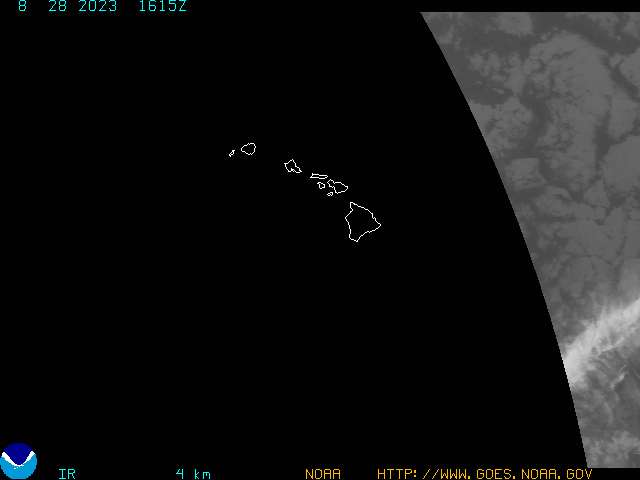
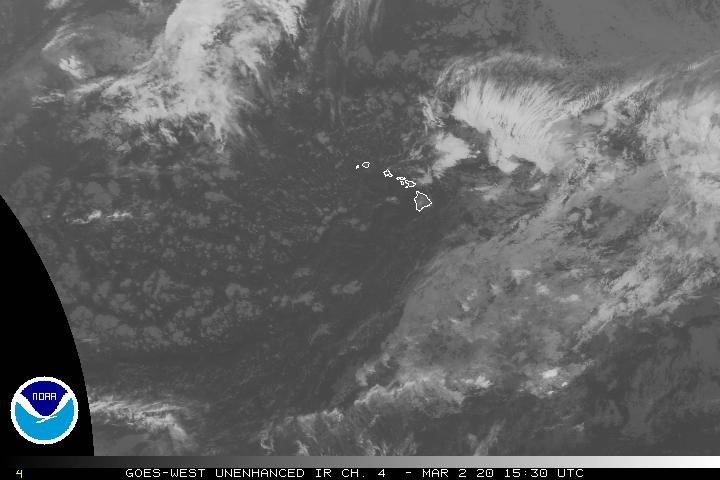
Infrared Satellite Image of the islands to see all the clouds around the state during the day and night. This next image is one that gives close images of the islands only during the daytime hours, and is referred to as a Close-up visible image. This next image shows a larger view of the Pacific…giving perspective to the wider ranging cloud patterns in the Pacific Ocean. To help you keep track of where any showers may be around the islands, here’s the latest animated radar image. 

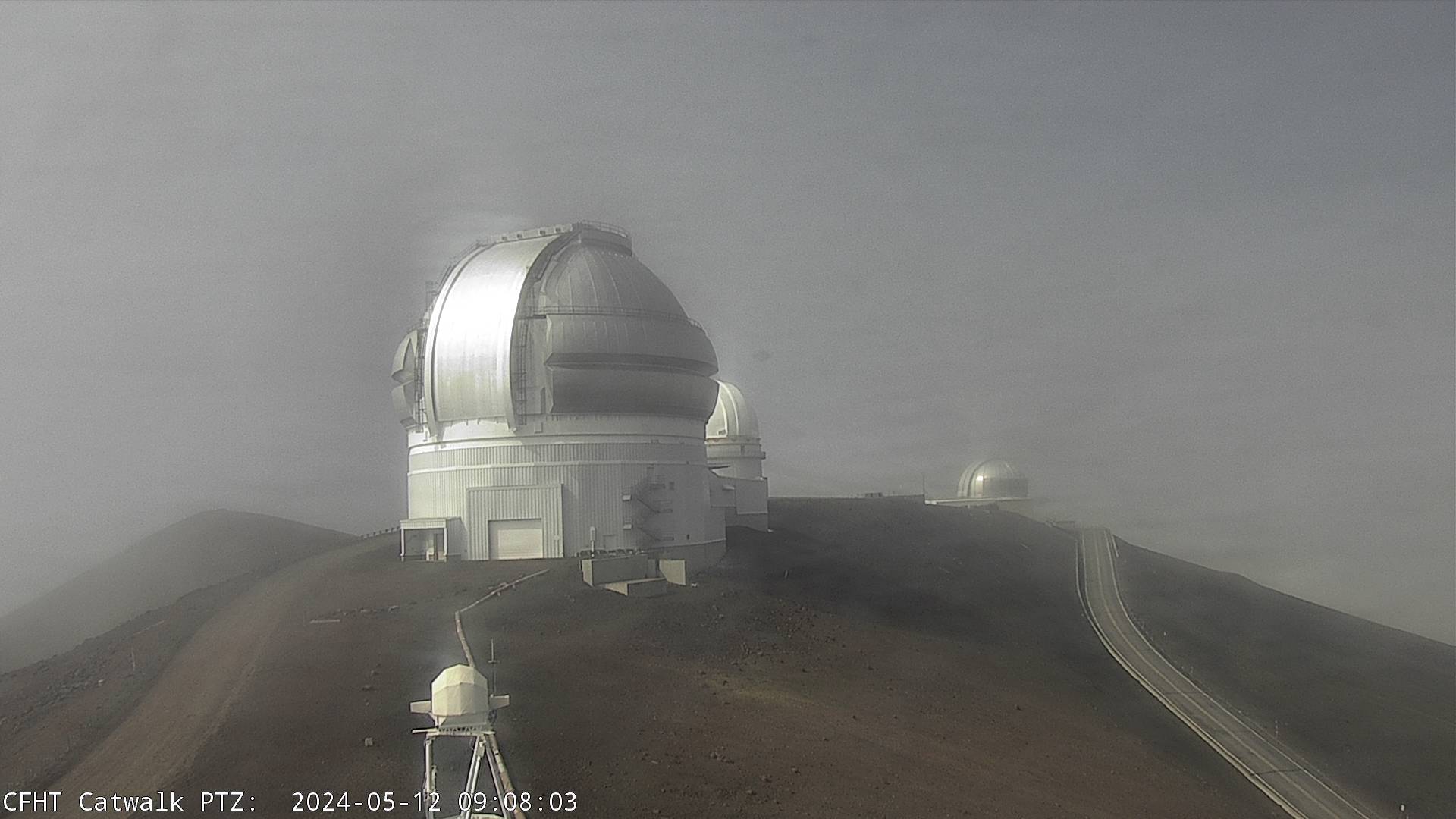
Hawaii’s Mountains – Here’s a link to the live webcam on the summit of near 14,000 foot Mauna Kea on the Big Island of Hawaii. The tallest peak on the island of Maui is the Haleakala Crater, which is near 10,000 feet in elevation. These two webcams are available during the daylight hours here in the islands…and when there’s a big moon rising just after sunset for an hour or two! Plus, during the nights and early mornings you will be able to see stars, and the sunrise too…depending upon weather conditions.

Aloha Paragraphs


http://farm3.static.flickr.com/2030/2313823562_c526d19713.jpg?v=0
A perfect beach on Maui
Photo Credit: Flickr.com


The northeast trade winds will remain generally light Saturday…only to get even lighter again Sunday through Tuesday. Our local winds have been lighter than normal this week. High pressure systems to the north through northeast of the islands, will prompt our winds into the light to almost moderate now…considered more or less normal for this time of year. A trough moving through the islands Sunday through Tuesday, will slow our winds down again. The computer models are suggesting that by the middle of the new week ahead, our trade winds will increase again in strength, into the moderate levels…lasting through the remainder of the week.

Despite the continuing trade winds, our overlying atmosphere will remain rather dry and stable…limiting the showers that will fall along the windward sides of the islands.  After the leeward focus of showers the last several days, the bias for showers has shifted back to the windward sides now. As the trade winds diminish again Sunday through Tuesday, the showers will work their way back over to the leeward sides again during the afternoon hours…only to return again to the windward sides when the trade winds pick up starting next Wednesday.


~~~  As noted above, our trade winds will continue their unusual fluctuations in strength and direction. Generally, when we consider the trade winds during the summer here in the tropical latitudes of the Hawaiian Islands, we think in terms of easterly winds blowing in the more or less moderately strong realms. The later part of our spring season, and now right on into early Summer, hasn’t been normal in that regard. The trades, rather than being in a fairly steady state, have faltered in strength repeatedly…with more of that on tap through the next five days.

~~~ It’s early Friday evening here in Kihei, Maui, as I begin updating this last paragraph of today’s weather narrative from paradise. I just finished work, after a nice day in terms of weather here in Hawaii. I’m about ready to leave for Kahului, where I’ll see the new film called Hellboy II: The Golden Army (2008)…I know that’s a weird name for a film, isn’t it! Hellboy II stars Ron Perlman, Selma Blair, among others. This is a film about the world’s roughest, toughest, reddest superhero, who is back in action to battle an unstoppable army of otherworldly creatures. I saw the original version of this film, and found myself adequately entertained, if not a bit more than that. I’m looking forward to sitting down in the theater, with a nice bag of unbuttered popcorn, and being once again swept away into a strange and different world! Here’s a trailer for this film, just in case you were curious what I’ll be sitting through. I’ll let you know what I thought early Saturday morning, before I leave for a surf session on the Lahaina side. I hope you have a great Friday night wherever you happen to be spending it! Aloha for now…Glenn.

A good song: Baby Come to Me…by James Ingram & Anita Baker – what voices!


Interesting: 


China has ordered dog meat to be taken off the menu at its 112 official Olympic restaurants in order to avoid offending foreign visitors. Restaurant workers are advised to "patiently" suggest other options to diners who order dog. Any restaurant found violating the ban would be black-listed, the state-run Xinhua news agency reported. Dog – known as "fragrant meat" – is eaten by some Chinese for purported medicinal properties. The ban, issued by the Beijing Catering Trade Association, forbids all designated Olympic restaurants from offering dog and urges other food outlets to remove the meat from menus.

"If a customer orders dog meat, restaurant staff should patiently suggest another entree," said Xiong Yumei, deputy director of the Beijing Tourism Bureau told Xinhua. The measure has been implemented to "respect the habits of many countries and nationalities," the Beijing News quoted the municipal food department as saying. The BBC’s James Reynolds says the ban is one of several steps taken by China to avoid foreign visitors being amused or offended by local customs. Authorities have also told people to queue up politely, to smile and not to spit on the streets. During the 1988 Seoul Olympics, South Korea also banned doggie dishes from menus. Officials invoked a law banning the sale of "foods deemed unsightly".


Interesting2: New evidence has emerged that a large plate of floating ice shelf attached to Antarctica is breaking up, in a troubling sign of global warming, the European Space Agency (ESA) said on Thursday. Images taken by its Envisat remote-sensing satellite show that Wilkins Ice Shelf is "hanging by its last thread" to CharcotIsland, one of the plate’s key anchors to the Antarctic peninsula, ESA said in a press release. "Since the connection to the island… helps stabilise the ice shelf, it is likely the breakup of the bridge will put the remainder of the ice shelf at risk," it said. Wilkins Ice Shelf had been stable for most of the last century, covering around 16,000 square kilometres (6,000 square miles), or about the size of Northern Ireland, before it began to retreat in the 1990s. Since then several large areas have broken away, and two big breakoffs this year left only a narrow ice bridge about 2.7 kilometres (1.7 miles) wide to connect the shelf to Charcot and nearby LatadyIsland.


Interesting3: A long list of factors have been blamed for the global food crisis which along with the energy crisis has hit developing countries, and the poor in particular, hardest. Prices of staple foods have risen by up to 100 per cent. A growing population, changes in trade patterns, urbanization, dietary changes, biofuel production, climate change and regional droughts are all responsible, and commentators point to a classic pattern of price increases caused by high demand and low supply. But few mention the declining supply of water that is needed to grow irrigated and rain-fed crops. An often-mooted solution to the food crisis is to breed plants that produce the ultimate high-yielding, low water-consuming crops. While this is important, it will fail unless we also pay attention to where the water for all our food, fibre and energy crops is going to come from. Essentially, every calorie of food requires a litre of water to produce it. So those of us on Western diets use about 2,500-3,000 litres per day. The expected addition of a further 2.5 billion people to the world by 2030 will mean that we have to find over 2,000 more cubic kilometres of fresh water per year to feed them.

This is not any easy task, given that current water usage for food production is 7,500 cubic kilometres per year and supplies are already scarce. A few years ago, my organization, the International Water Management Institute (IWMI), demonstrated that many countries are facing severe water scarcity, either because insufficient fresh water is available or because they lack investment in water infrastructure, such as dams and reservoirs. What makes matters worse is that this scarcity predominantly affects developing countries where the majority of the world’s 840 million under-nourished people live. Serious and extremely worrying evidence indicates that water supplies are steadily being used up. And the causes of water scarcity are much the same as those of the food crisis: demand exceeds a finite supply. The world’s population is projected to grow from 6 billion to 8.5 billion by 2030 and unless we change the way we use water and increase water productivity — ie. produce more ‘crop per drop’ — we will not be able to feed them. That is the conclusion of the IWMI’s recent Comprehensive Assessment of Water Management in Agriculture and its book, Water for Food, Water for Life, which drew on the work of 700 scientists.


Interesting4: Like a tooth dipped in a glass of Coca-Cola, coral reefs, lobsters and other marine creatures that build calcified shells around themselves could soon dissolve as climate change turns the oceans increasingly acidic. The carbon dioxide spewed into the atmosphere by factories, cars and power plants is not just raising temperatures. It is also causing what scientists call "ocean acidification" as around 25 percent of the excess CO2 is absorbed by the seas. The threat to hard-bodied marine organisms, such as coral reefs already struggling with warming waters, is alarming, and possibly quite imminent, marine scientists gathered this week for a coral reef conference in Fort Lauderdale, Florida, said.  "The threshold for (corals) could be approached by the middle of this century … when they’ll reach a point where they may no longer be able to reproduce themselves as fast as they’re being destroyed," said Chris Langdon, am associate professor at the University of Miami’s Rosenstiel School of Marine and Atmospheric Science. "It’s not going to be instant. They’re not going to disappear that year. It may take another 50 or 100 years." It was only recently that scientists woke up to the fact that global warming would reduce the pH value of the oceans due to a chemical reaction of water with CO2. The pH scale is a measure of alkalinity or acidity, with 7 being neutral. The pH value of the oceans has been around 8.2 for hundreds of thousands of years, but since the start of the industrial age in 1800, it has dropped by 0.1.


July 10-11 2008


Air Temperatures
The following maximum temperatures were recorded across the state of Hawaii Thursday: 

Lihue, Kauai – 84
Honolulu, Oahu – 90
Kaneohe, Oahu – 84
Kahului, Maui – 87

Hilo, Hawaii – 87
Kailua-kona – 85

Air Temperatures ranged between these warmest and coolest spots near sea level at 4 p.m. Thursday afternoon:

Honolulu, Oahu – 88F  
Molokai airport 82

Precipitation Totals
The following numbers represent the largest precipitation totals (inches) during the last 24 hours on each of the major islands, as of
Thursday afternoon:

0.72  Mount Waialeale, Kauai
1.25 Makaha Stream, Oahu
0.84 Molokai
1.87 Lanai
0.00 Kahoolawe
0.35 Puu Kukui, Maui

1.83 Waikii, Big Island


Weather Chart – Here’s the latest (automatically updated)
weather map showing high pressure systems located far to the north and northeast of the islands. These high pressure cells, along with their associated ridges, will bump our trade winds up in strength into Saturday. Look for moderately strong northeast trades in most areas. Here’s a link to the NOAA weather school.

Satellite and Radar Images:
To view the cloud conditions we have here in Hawaii, please use the following satellite links, starting off with the
Infrared Satellite Image of the islands to see all the clouds around the state during the day and night. This next image is one that gives close images of the islands only during the daytime hours, and is referred to as a Close-up visible image. This next image shows a larger view of the Pacific…giving perspective to the wider ranging cloud patterns in the Pacific Ocean. To help you keep track of where any showers may be around the islands, here’s the latest animated radar image. 

Hawaii’s Mountains – Here’s a link to the live webcam on the summit of near 14,000 foot Mauna Kea on the Big Island of Hawaii. The tallest peak on the island of Maui is the Haleakala Crater, which is near 10,000 feet in elevation. These two webcams are available during the daylight hours here in the islands…and when there’s a big moon rising just after sunset for an hour or two! Plus, during the nights and early mornings you will be able to see stars, and the sunrise too…depending upon weather conditions.

Aloha Paragraphs


http://farm2.static.flickr.com/1040/1139358879_d8f55a2066.jpg?v=0
A perfect beach on Maui…Kapalua this time
Photo Credit: Flickr.com


The light northeast trade winds will increase in strength a little now, then increase a bit more Friday…only to calm down again some Sunday and Monday. The latest weather map shows a 1028 high pressure system located far to the northeast of Hawaii Thursday evening. The computer models are suggesting that by next week, our trade winds will increase in strength, into the moderate levels starting next Tuesday or Wednesday…lasting through the remainder of the week.

Generally light showers will fall locally along the windward sides at night, while afternoon showers will occur over the leeward areas locally. As the trade winds surge some Friday into Saturday, the chances for those afternoon showers along the leeward sides will diminish, with the bias for showers shifting back to the windward sides then. As the trade winds diminish again Sunday and Monday…the showers will work their way back over to the leeward sides again.


~~~  Low pressure systems in the north Pacific Ocean during the late spring, even into our summer season…have taken unusually southern courses in their tracks. This has kept our local trade winds lighter than normal, and even taken them completely away at times. This constant faltering of our trade wind flow, isn’t what we would expect typically, at least compared to our climatological norm. We would look for a more or less steady trade wind flow from May right through the summer months, during a so called normal year.

~~~ The current weather pattern is another good example of the off kilter conditions of this unusual year. Our trade winds, which usually come in from the east, have taken on a more northeast orientation. Winds from this direction can often be lighter than normal, although in some parts of the state, they can accelerate through valleys, and be quite strong locally. At any rate, our winds are coming in from a different direction than usual for the summer. They will remain light to moderately strong Thursday, but then kick up their heels a bit more Friday into Saturday.

~~~ It’s early Thursday evening here in Kihei, Maui, as I begin updating this last paragraph of today’s narrative. The big question today was whether those leeward showers would pop up later in the day. As it turned out, they didn’t flair up nearly as much as they had the last couple of afternoons. The trade winds become a little stronger than expected, which helped to limit the vertical growth of the afternoon cumulus clouds…and thus the resulting showers. There were however some thick clouds that formed over southwest Maui, down to the south of Wailea and Makena. Radar showed the showers extending out over the ocean towards Kahoolawe. The rest of the state saw less clouds and showers, with many areas having considerable sunshine during the day. The trade winds are expected to increase another notch Friday and Saturday, so that those afternoon clouds and showers that occurred over the leeward sides recently…will migrate back over to the windward sides for the most part. I’ll be back very early Friday morning with your next new weather narrative. I hope you have a great Thursday night until then! Aloha for now…Glenn.


Interesting:   Heavy rain fell on many parts of Mexico during the early and middle stages of this week. Some of the heaviest cloudbursts broke along the nation’s Pacific coast. In southernmost Oaxaca state, for example, 12.4 inches of rain poured down upon the town of Puerto Angel


from Sunday morning to Thursday morning.

Searing heat burned


Algeria‘s Sahara this week. At El Oued-Guemar, for instance, consecutive highs of 118, 119 and 118 degrees F were registered Monday through Wednesday, and the temperature soared to at least 118F again on Thursday. Biskra soared to 115 degrees F Monday, 117F Tuesday, 119 F Wednesday and at least 117 F on Thursday.


Interesting2: A cold snap has affected parts of southern Australia with temperatures plummeting close to zero and snow falling in places. Strong and bitterly cold gale force winds have also swept across Victoria and New South Wales, with snowfalls across Glen Innes in the north of NSW.

Average temperatures across the state of Victoria at this time of year are usually between 6 and 13C (43 to 55F) but recently temperatures have dropped to nearer 2C (36F) in many places, with snowfall across the Australian Alps. The Bureau of Meteorology warned motorists travelling to Barrington Tops to take care in the adverse weather conditions.

A complex low pressure system off Tasmania pulled up much colder air from the south and interacted with a strong high pressure system over Australia. Winds around the low became strong and gusty and sent a series of cold fronts up across southern Australia bringing bands of rain, with snow and blizzard conditions across the mountains.

Farmers were rejoicing as much needed rain fell earlier this week. Vast parts of Australia have been suffering from one of the worst droughts in living memory. The joy, however, may be short-lived as the low pressure system responsible for the recent rain and snow slips away, only to be replaced by high pressure. This high is expected to bring fine, dry and settled conditi


ons.


Interesting3: Ever since the rise of the automobile in the 1950s, the American Dream has featured a home in the suburbs and two cars in the garage. Now the iconic white picket fence comes with a hefty price tag in the form of the cost of the gasoline needed to drive to work and to the supermarket, and the suburban idyll is under review. In different parts of the United States, there are signs of change. While home prices in the suburbs have crashed, apartments in city centers are in demand. Home builders across the country are frantically trying to unload land they had intended for new subdivisions. And planners are rethinking how they can meet demand for housing. One such place is Stapleton, on the site of what used to be Denver's airport. Its developer, real estate company ForestCity, puts homes within walking distance of schools and stores while linking them to the workplace by public transportation. Resident Evelyn Baker says Stapleton appeals to a "cheapskate" side of her nature that favors towing her offspring about in a trailer attached to her bike over paying for gas for her car.

"We're a family of four with two young kids and the obligatory yellow Lab, but we've managed to get by with one car," said Baker, who has lived here since April 2006. And, with gas prices above $4 a gallon, Baker said her move to Stapleton feels like a smart decision both because of lower day-to-day costs and the durability of her home's value. "I do feel like my house is retaining its value, and I'm really excited about that," Baker said. In the suburb of Maricopa, about an hour's drive outside Phoenix, residents have a very different feeling. Built on former corn and cotton fields, the suburb has grown to number 38,000 people from about 1,500 in 2002, accommodating people who were willing to accept longer commutes in order to get homes at cheaper prices.


Interesting4: Scientists have announced the discovery of reef structures they believe doubles the size of the Southern Atlantic Ocean's largest and richest reef system, the Abrolhos Bank, off the southern coast of Brazil's Bahia state. The newly discovered area is also far more abundant in marine life than the previously known Abrolhos reef system, one of the world's most unique and important reefs. Researchers from Conservation International (CI), Federal University of Esprito Santo and Federal University of Bahia announced their discovery in a paper presented today at the International Coral Reef Symposium in Fort Lauderdale. "We had some clues from local fishermen that other reefs existed, but not at the scale of what we discovered," says Rodrigo de Moura, Conservation International Brazil marine specialist and co-author of the paper. "It is very exciting and highly unusual to discover a reef structure this large and harboring such an abundance of fish," he adds.


Interesting5: Water has been found conclusively for the first time inside ancient moon samples brought back by Apollo astronauts. The discovery may force scientists to rethink the lunar past and future, although uncertainty remains about how much water exists and whether future explorers could extract it. The water was found inside volcanic glass beads, which represent solidified magma from the early moon's interior. The news swept through much of the scientific community even before being detailed in the journal Nature this week. "This really appears to have changed the rules of the game," said Robin Canup, astrophysicist and director of the Southwest Research Institute in Boulder, Colo., who was not part of the team that made the discovery. "The assumption has been that the moon is dry."


Interesting6: A new, compact way to collect sunlight from windows and focus it to generate more electricity could make those multiple expensive rooftop solar panels a thing of the past. The solar panels that cover the tops of some buildings today contain photovoltaic cells that convert sunlight into electricity. Unlike burning coal, collecting and converting solar energy releases no greenhouse gases, which warm the atmosphere. Limited efficiency and high construction costs have kept solar from producing more than about 0.07 percent of U.S. energy needs in 2007, according to figures from the U.S. Department of Energy. Solar concentrators can be used to increase the electrical power obtained from the photovoltaic cells. But most concentrators in use today "track the sun to generate high optical intensities, often by using large mobile mirrors that are expensive to deploy and maintain," said MIT's Marc A.

Baldo, who led the team that created the new type of solar concentrator. Instead of covering a large area with solar cells, the new method only requires locating cells around the edges of a flat glass panel. The MIT solar concentrator involves a mixture of two or more dyes painted onto a pane of glass or plastic. The dyes absorb light across a range of wavelengths, reemit it at a different wavelength and transport it across the pane to the solar cells at the edges. "Light is collected over a large area [like a window] and gathered, or concentrated, at the edges," Baldo said. Focusing the light like this increases the electrical power generated by each solar cell "by a factor of 40," he added. The work was funded by the National Science Foundation and the U.S. Department of Energy's Office of Science.


July 9-10 2008


Air Temperatures
The following maximum temperatures were recorded across the state of Hawaii Wednesday: 

Lihue, Kauai – 83
Honolulu, Oahu – 90
Kaneohe, Oahu – 83
Kahului, Maui – 86

Hilo, Hawaii – 87
Kailua-kona – 85

Air Temperatures ranged between these warmest and coolest spots near sea level at 4 p.m. Wednesday afternoon:

Honolulu, Oahu – 84F  
Molokai airport 75

Precipitation Totals
The following numbers represent the largest precipitation totals (inches) during the last 24 hours on each of the major islands, as of
Wednesday afternoon:

0.37  Mount Waialeale, Kauai
0.63 Ahuimanu Loop, Oahu
1.06 Molokai
0.12 Lanai
0.00 Kahoolawe
0.86 Ulupalakua, Maui

1.24 Waikii, Big Island


Weather Chart – Here’s the latest (automatically updated)
weather map showing a 1028 millibar high pressure system located far to the northeast of the islands. This high pressure cell, along with its associated ridge, will keep our trade winds blowing through Friday. Look for light to almost moderately strong northeast trades in most areas. Here’s a link to the NOAA weather school.

Satellite and Radar Images:
To view the cloud conditions we have here in Hawaii, please use the following satellite links, starting off with the
Infrared Satellite Image of the islands to see all the clouds around the state during the day and night. This next image is one that gives close images of the islands only during the daytime hours, and is referred to as a Close-up visible image. This next image shows a larger view of the Pacific…giving perspective to the wider ranging cloud patterns in the Pacific Ocean. To help you keep track of where any showers may be around the islands, here’s the latest animated radar image. 

Hawaii’s Mountains – Here’s a link to the live webcam on the summit of near 14,000 foot Mauna Kea on the Big Island of Hawaii. The tallest peak on the island of Maui is the Haleakala Crater, which is near 10,000 feet in elevation. These two webcams are available during the daylight hours here in the islands…and when there’s a big moon rising just after sunset for an hour or two! Plus, during the nights and early mornings you will be able to see stars, and the sunrise too…depending upon weather conditions.

Aloha Paragraphs


http://farm3.static.flickr.com/2264/2209729634_d2527d1429.jpg?v=0
The end of another perfect day!
Photo Credit: Flickr.com


Trade winds, with a more northeast orientation than usual, will continue to blow across the tropical latitudes of Hawaii. The latest weather map shows a far away 1027 high pressure systems located to the northeast of Hawaii Wednesday night. The trade winds will continue blowing in the light to near moderately strong realms through the rest of this week. The computer models are suggesting that by next week, our trade winds will increase in strength, into the moderate to fresh range. The one thing for sure, or at least pretty sure, is that almost everyday this month will have the trade winds blowing.

Showers will fall locally along the windward sides at night, while afternoon showers will occur over the leeward areas locally. The heaviest showers in this pattern will likely focus their efforts best along the leeward upcountry areas…where locally heavy afternoon downpours will take place. There’s a chance that the remnant moisture from former eastern Pacific tropical cyclone Boris, may bring an increase in clouds and windward showers to the Big Island Thursday, but it won’t amount to much…perhaps justing clipping South Point. 


~~~  We find somewhat lighter than normal trade winds, coming in from a more northerly direction than usual now. These northeast trades continue to bring some fairly minor showers to the windward coasts and slopes. At the same time, where the trade winds are converging along the leeward sides, after splitting around the islands…afternoon cloud build ups are dropping afternoon locally heavy convective showers. This pattern will continue over the next several days, with lots of morning sunshine.

~~~ There was some excitement the last few days, over the prospect of some showers arriving, the source of which would have been from an old hurricane, which formed in the eastern Pacific. This retired system lost all of its wind, or at least all the strong winds a long time ago. The remnant moisture, along with its very weak counterclockwise rotating vortex, is now several hundred miles to the lower right (southeast) of the Big Island. Here’s a looping satellite image of what’s left of former tropical cyclone Boris. The bulk of whatever showers that remain in that area will pass south of the Big Island. The northernmost fringe might clip the windward side of that island at some point Thursday.

~~~ It’s early Wednesday evening here in Kihei, Maui, as I begin updating this last paragraph of today’s narrative. The skies began the day in a mostly clear fashion, although it didn’t take long, aided by the daytime heating of the islands…for thick clouds to form over the interior sections. Each island in the chain took its turn in being on the receiving end of locally heavy showers. Here in Kihei, it was no exception, with an hour or so of generous rainfall. I could see up the slopes of the Haleakala Crater, that in Kula, Keokea, and Ulupalakua it was raining even more heavily. The showers spread down to Wailea and Makena as well. This was two afternoons in a row with lots of afternoon showers falling, which is a good thing, in regards to the exceptionally dry conditions of late. At just past 5pm, the Big Island was still under a flood advisory…where heavy rains were falling in the Kohala area. I see no reason to think that Thursday afternoon might not have another dose of rain along those parched leeward sides. I’m about ready to leave for Kula, for home, tucking into what looks like a cloudy and cool reality. I’m quite sure that the clouds will part just enough by sunset, to see some nice colors. I hope you have a great Wednesday night, and that you will meet me here again on Thursday, for your next new weather narrative from paradise. Aloha for now…Glenn.


Interesting:  Torrential rain during the second half of last week and early this week instigated flooding and mudslides in South Africa‘s province of Western Cape. Around Cape Town, the floodwaters forced hundreds of people to be evacuated as water inundated thousands of buildings. Also, bridges were washed away and mudslides blocked roads.


Downpours continued to plague parts of southeastern China early this week. In Shantou, Guangdong, rainfall was 11 inches within 72 hours as of Wednesday evening, local time. In southern Guangxi, Beihai was soaked by 8.7 inches of rain from Monday morning to Wednesday afternoon.


Very heavy rain swamped parts of Mexico during the first half of this week. In the east, 72-hour rainfall ending Wednesday morning, local time, was 11.5 inches at Matlapa. In the south and on the Pacific coast, 9.8 inches of rain soaked Puerto Angel during the same period.


Interesting2:
Scientists have made an important advance in their efforts to predict earthquakes, the journal Nature says. A team of US researchers has detected stress-induced changes in rocks that occurred hours before two small tremors in California‘s San Andreas Fault. The observations used sensors lowered down holes drilled into the quake zone. The team says we are a long way from routine tremor forecasts but the latest findings hold out hope that such services might be possible one day. "If you had 10 hours’ warning, from a practical point of view, you could evacuate populations, you could certainly get people out of buildings, you could get the fire department ready," said co-author Paul Silver of the Carnegie Institution of Science, Washington. "Hurricane [warnings] give you an idea of what could be done," he told BBC News.


Interesting3: The Seattle City Council will hold a public hearing today on Mayor Greg Nickels’ proposal to ban foam containers and impose a plastic/paper bag fee at local stores, reports the Seattle Times. It is expected the proposal will gain approval. If passed, all restaurants and grocery stores would have to find a non-foam container alternative, and a 20-cent fee would be imposed on each plastic or paper bag used in the checkout line at all grocery, convenience and drugstores. The foam ban would take effect in two stages. Beginning in January, foam products would be banned, but restaurants and grocery stores could switch to plastic products if they had not yet found a biodegradable alternative. By July of 2010, plastics would also be banned and only biodegradables allowed. Some members of the city council question the financial impact of the bans, especially to low-income families. The city plans to supply some homes with reusable bags for free. 


Interesting4: Scientists have announced the discovery of reef structures they believe doubles the size of the Southern Atlantic Ocean’s largest and richest reef system, the Abrolhos Bank, off the southern coast of Brazil’s Bahia state. The newly discovered area is also far more abundant in marine life than the previously known Abrolhos reef system, one of the world’s most unique and important reefs. Researchers from Conservation International (CI), Federal University of Esprito Santo and Federal University of Bahia announced their discovery in a paper presented today at the International Coral Reef Symposium in Fort Lauderdale. "We had some clues from local fishermen that other reefs existed, but not at the scale of what we discovered," says Rodrigo de Moura, Conservation International Brazil marine specialist and co-author of the paper. "It is very exciting and highly unusual to discover a reef structure this large and harboring such an abundance of fish," he adds.


Interesting5: Water has been found conclusively for the first time inside ancient moon samples brought back by Apollo astronauts. The discovery may force scientists to rethink the lunar past and future, although uncertainty remains about how much water exists and whether future explorers could extract it. The water was found inside volcanic glass beads, which represent solidified magma from the early moon’s interior. The news swept through much of the scientific community even before being detailed in the journal Nature this week. "This really appears to have changed the rules of the game," said Robin Canup, astrophysicist and director of the Southwest Research Institute in Boulder, Colo., who was not part of the team that made the discovery. "The assumption has been that the moon is dry."


July 8-9 2008


Air Temperatures
The following maximum temperatures were recorded across the state of Hawaii Tuesday: 

Lihue, Kauai – 82
Honolulu, Oahu – 87
Kaneohe, Oahu – 84
Kahului, Maui – 85

Hilo, Hawaii – 85
Kailua-kona – 86

Air Temperatures ranged between these warmest and coolest spots near sea level at 4 p.m. Tuesday afternoon:

Kapalua – 88F  
Barking Sands, Kauai 79

Precipitation Totals
The following numbers represent the largest precipitation totals (inches) during the last 24 hours on each of the major islands, as of
Tuesday afternoon:

1.27  Hanapepe, Kauai
0.71 Oahu Forest NWR, Oahu
0.00 Molokai
0.00 Lanai
0.00 Kahoolawe
1.12 Ulupalakua, Maui

0.05 Hilo airport, Big Island


Weather Chart – Here’s the latest (automatically updated)
weather map showing a 1028 millibar high pressure system located far to the northeast of the islands. This high pressure cell, along with its associated ridge, will keep our trade winds blowing through Thursday. Look for light to almost moderately strong trades in most areas. Here’s a link to the NOAA weather school.

Satellite and Radar Images:
To view the cloud conditions we have here in Hawaii, please use the following satellite links, starting off with the
Infrared Satellite Image of the islands to see all the clouds around the state during the day and night. This next image is one that gives close images of the islands only during the daytime hours, and is referred to as a Close-up visible image. This next image shows a larger view of the Pacific…giving perspective to the wider ranging cloud patterns in the Pacific Ocean. To help you keep track of where any showers may be around the islands, here’s the latest animated radar image. 

Hawaii’s Mountains – Here’s a link to the live webcam on the summit of near 14,000 foot Mauna Kea on the Big Island of Hawaii. The tallest peak on the island of Maui is the Haleakala Crater, which is near 10,000 feet in elevation. These two webcams are available during the daylight hours here in the islands…and when there’s a big moon rising just after sunset for an hour or two! Plus, during the nights and early mornings you will be able to see stars, and the sunrise too…depending upon weather conditions.

Aloha Paragraphs


http://farm2.static.flickr.com/1068/533009440_a7eb9e54ab.jpg?v=0
The rugged Puna coast on the Big Island
Photo Credit: Flickr.com


The trade winds will continue to grace our islands, although will remain slightly lighter than normal for this time of year. The latest weather map shows far away high pressure systems located to the northeast and northwest of Hawaii Tuesday evening. The trade winds will remain on the light side of the wind spectrum through the rest of this week. The computer models are suggesting that by next week, our trade winds will increase in strength, into the moderate to fresh range. The trade winds on average blow about 95% of the time during the month of July.

There will be periods of showers arriving on the trade winds, although nothing overly generous is in the forecast for the time being. As usual, the windward sides will pick up most of these showers, while the leeward beaches remain generally dry, although a few showers could fall locally there too…perhaps even some heavy downpours. There’s a chance that the remnant moisture from former eastern Pacific tropical cyclone Boris, may bring an increase in clouds and windward showers to the Big Island and possibly Maui. This isn’t a sure thing, as this area of tropical moisture may miss us…moving by to the south. 


~~~  As the two paragraphs above point out, nothing particularly unusual about our weather here in Hawaii at the moment. The trade winds will remain active, just strong enough to temper our summertime heat, but light enough to remain below the small craft wind advisory threshold. The trade winds will gain strength next week, which is normal for this time of year. It would be very unusual for the trade winds to falter too much during July. It generally takes having a retired tropical weather system moving right over the islands, or just to our north…to knock our trade winds down completely during the height of summer.

~~~ Rainfall has been light enough so far this year, that many areas are below, or well below normal. As I’ve mentioned before, our spring rainfall turned out to be less productive than we like to see…which pushes us into a dry summer. If we don’t see some added precipitation coming from some source, which is not on our radar screens at this time, I’ll be writing more and more about that dry weather feature called drought. We actually have drought conditions that exist already, with localized severe drought conditions on Molokai and the Big Island. We remain ever hopeful that some upper level trough of low pressure will move overhead, helping to wring-out extra showers in the not too distant future.

~~~ It’s early Tuesday evening here in Kihei, Maui, as I begin writing this last paragraph of today’s narrative. Tuesday was yet another wonderful summer day here in Hawaii. Clear blue skies prevailed in many areas, with warm to very warm sunshine beaming down. Each of the islands, along the leeward slopes for the most part, developed thick cloud cover, where some localized pretty heavy rains fell. Here on Maui, the rains began upcountry in Ulupalakua, and during the afternoon hours worked their way down towards the coasts into Wailea and even parts of south Kihei I understand. Looking out the window here though, at around 5pm, the clouds are sparse looking towards the north shore, where not a hint of rain is in sight. I’m about ready to leave Kihei for the drive up to Kula, where I’ll find cooler temperatures, and the perfect place awaits me, my deck…to view the sunset. I hope you had a great Tuesday wherever you happened to have spent it! I’ll be back very early Wednesday morning with your next new weather narrative from paradise. Aloha for now…Glenn. 


Interesting:


Global warming will sow destruction across Russia and ex-Soviet states, a report said on Tuesday after the world’s richest countries issued targets on harmful emissions that environmentalists criticized as too soft. The 52-page report — written by green group WWF and British charity Oxfam — described a grim picture of social, ecological and economic collapse in the world’s biggest country and its former empire unless the world took urgent action. "This diagram shows infrastructure collapse. When the temperature raises the infrastructure breaks," WWF climate change expert in Russia Alexei Kokorin said holding up a diagram of the ex-Soviet Union swathed in bands of red, orange and yellow at a presentation of the report in Moscow. Earlier on Tuesday leaders of G8 nations — Japan, the United States, Britain, Russia, Canada, Germany, France and Italy — agreed to halve emissions blamed for climate change by 2050, but environmentalists slammed the targets as too soft.

The WWF/Oxfam report on climate change in Russia and the former Soviet Union had been timed to press home this point. Photos on the report’s cover showed a dog sleigh team panting against an iceless wasteland, a shrinking glacier, cracking mud in a dry river bed and a polar bear stuck on a isolated piece of ice. Russia — which spans from eastern Europe to Asia’s Far East and is 60 percent covered by permafrost — is particularly at risk from temperature rises, the report said. "We must understand that damage caused by climate change is here and now rather than a problem in the distant future, in distant lands," WWF’s director in Russia, Igor Chestin, said in a statement alongside the report.

Interesting2: The United States Senate passed (June 27, 2008), by unanimous consent, legislation that will allow the U.S. to join an international treaty that could dramatically cut ocean ship pollution that causes tens of thousands of global deaths annually. “The Marine Pollution Prevention Act of 2008” (H.R. 802), was passed overwhelmingly by the U.S. House of Representatives last year. “This action could be a sea change that ultimately helps steer us to cleaner, healthier air for the millions of Americans harmed by toxic air pollution from U.S. and foreign-flagged ships,” said Janea Scott, a senior attorney for Environmental Defense Fund based in Los Angeles. “This action will help our country secure protective international standards for large ocean-going ships. We urge our government to immediately complete the critical process of ratifying the MARPOL treaty.”

Annex VI of the International Convention for the Prevention of Pollution from Ships, commonly known as “MARPOL,” is an international treaty that governs air pollution from large ocean-going ships. Large ocean-going ships are a major source of soot, sulfur dioxide and smog-forming pollution that are associated with premature deaths, hospital visits, and asthma attacks that exact a heavy toll on human health for millions of Americans. About ninety percent of the ships that dock at U.S. ports are foreign-flagged international vessels. Shipping-related soot emissions contribute to approximately 60,000 global deaths annually, with impacts concentrated in coastal regions on major trade routes.


Interesting3:
Earth is one special planet. It has liquid water, plate tectonics, and an atmosphere that shelters it from the worst of the sun's rays. But many scientists agree our planet's most special feature might just be us. "It's the only planet we know of that has life," said Alan Boss, a planet formation theorist at the Carnegie Institution of Washington in Washington, D.C. Though other bodies in our solar system, such as Saturn's moon Titan, seem like they could have once been hospitable to some form of life, and scientists still have hope of eventually digging up microbes beneath the surface of Mars, Earth is still the only world known to support life. "So far, we haven't found it anywhere else," said Alex Wolszczan of PennsylvaniaStateUniversity, who co-discovered the first planets beyond our solar system. He agreed that life was Earth's single most impressive characteristic. None of this is a revelation, but understanding what's special about Earth is crucial for finding other planets out there and predicting what they might be like.  The fact that Earth hosts not just life, but intelligent life, makes it doubly unique. And the planet's intelligent life (humanity) has even developed rockets that enable travel beyond the planet, said Gregory Laughlin, astrophysicist and planet hunter at the University of California, Santa Cruz.  "During the last half century, the planet Earth has fashioned together tiny pieces of the metal in its crust, and has flung these delicately constructed objects to all of the other planets in the solar system," Laughlin said, adding that these achievements should be counted as an exemplary trait of our planet.

Interesting4: Artists may now be able to paint dinosaurs and ancient birds and mammals in their true colors, thanks to the discovery of pigment residues in fossilized feathers. In recent years, paleontologists have found fossil feathers in about 50 rock formations pegged to dates ranging from the Jurassic period (from about 200 million to 150 million years ago) to the late Tertiary (from 65 million to about 2 million years ago). These feathers are preserved as residues of carbon that were previously thought to be traces of feather-degrading bacteria.

A new study of some of these residues, detailed in the journal Biology Letters, found that these microscopic organic imprints are actually fossilized melanosomes, tiny organelles found inside pigment cells that produce melanin pigment. Melanin is what determines our hair, eye and skin color and gives birds' feathers their spectacular range of hues. "Feather melanin is responsible for rusty-red to jet-black colors, and a regular ordering of melanin even produces glossy iridescence," said YaleUniversity graduate student Jakob Vinther, lead author of the study.


Interesting5: Almost half the coral reef ecosystems in United States territory are in poor or fair condition, mostly because of rising ocean temperatures, according to a government report released Monday. The reefs discussed in the National Oceanic and Atmospheric Administration report serve as breeding grounds for many of the world's seafood species and act as indicators of overall ocean health. "They are a major indicator of something that could go wrong with the environment," said Timothy Keeney, NOAA's deputy assistant secretary for oceans and atmosphere. Keeney said 25 percent of all marine species need coral reefs to live and grow, while 40 percent of the fish caught commercially use reefs to breed.

"If we lose the reefs, you lose a very significant and important habitat," Keeney said. Since NOAA's last report in 2005, the Caribbean region has lost at least 50 percent of its corals, largely because sea temperatures have risen, Keeney said. Elkhorn and staghorn corals have also been listed as threatened under the Endangered Species Act, the first corals ever to receive such protections based on rapid declines. The 569-page report took 18 months to complete with input from 270 federal, state and university scientists. It documented 15 ecosystems in U.S. states and territories, including the U.S. Virgin Islands, Puerto Rico, Florida, Hawaii, American Samoa and Guam. It was released at the 11th International Coral Reef Symposium in Fort Lauderdale.


Interesting6: Nanopaper made of gently processed natural cellulose nanofibers is found to have remarkable strength; it has a tensile strength almost equaling that of structural steel.  Lars Berglund from the Swedish Royal Institute of Technology in Stockholm, Sweden found that the mechanical processes used to pulp wood damages the natural fibers, weakening them. Berglund developed a process to extract the fibers, keeping their properties intact. The secret to the nanopaper's performance is not only the strength of the undamaged cellulose fibres, but also they way they are arranged into networks. Although strongly bound together, they are still able to slip and slide over each other to dissipate strains and stresses.  The individual cellulose fibres are also much smaller than in conventional paper. "A regular paper network has fibres 30 micrometres in diameter, here we are at a scale three orders of magnitude smaller," says Berglund. "The material [has] very small defects compared with a conventional paper network."


Hawaiian Islands weather details & Aloha paragraphs

Posted by Glenn

No Comments

July 7-8 2008


Air Temperatures
The following maximum temperatures were recorded across the state of Hawaii Monday: 

Lihue, Kauai – 84
Honolulu, Oahu – 90
Kaneohe, Oahu – 84
Kahului, Maui – 86

Hilo, Hawaii – 85
Kailua-kona – 86

Air Temperatures ranged between these warmest and coolest spots near sea level at 4 p.m. Monday afternoon:

Kapalua, Maui – 88F  
Barking Sands 80

Precipitation Totals
The following numbers represent the largest precipitation totals (inches) during the last 24 hours on each of the major islands, as of
Monday afternoon:

0.02  Poipu, Kauai
0.42 Wheeler Field, Oahu
0.00 Molokai
0.00 Lanai
0.00 Kahoolawe
0.04 Kula, Maui

0.44 Waikii, Big Island

Weather Chart – Here’s the latest (automatically updated)
weather map showing high pressure systems located far to the northeast and northwest of the islands. This pressure configuration will keep our trade winds blowing. Look for light to moderately strong trades, with those windier areas finding somewhat stronger gusts through Wednesday. Here’s a link to the NOAA weather school.

Satellite and Radar Images:
To view the cloud conditions we have here in Hawaii, please use the following satellite links, starting off with the
Infrared Satellite Image of the islands to see all the clouds around the state during the day and night. This next image is one that gives close images of the islands only during the daytime hours, and is referred to as a Close-up visible image. This next image shows a larger view of the Pacific…giving perspective to the wider ranging cloud patterns in the Pacific Ocean. To help you keep track of where any showers may be around the islands, here’s the latest animated radar image. 

Hawaii’s Mountains – Here’s a link to the live webcam on the summit of near 14,000 foot Mauna Kea on the Big Island of Hawaii. The tallest peak on the island of Maui is the Haleakala Crater, which is near 10,000 feet in elevation. These two webcams are available during the daylight hours here in the islands…and when there’s a big moon rising just after sunset for an hour or two! Plus, during the nights and early mornings you will be able to see stars, and the sunrise too…depending upon weather conditions.

Aloha Paragraphs


http://farm4.static.flickr.com/3138/2485458818_3559d072fc.jpg?v=0
Kihei, Maui…breezy afternoons
Photo Credit: Flickr.com


The trade winds will remain steady, with minor fluctuations in terms wind speeds through the next week. The latest weather map shows a 1029 millibar high pressure system located far to the northeast of Hawaii Monday evening. These trade winds will remain on the light side Tuesday…then increase again by mid-week through the rest of the week. The trade winds will blow generally in the light to locally moderate levels through Tuesday, then increase more fully into the moderately strong category starting Wednesday.

These light trade winds will blow some showers onto our windward sides at times. The leeward sides in contrast, will generally remain dry, although with possible upcountry afternoon showers. There’s a chance that the remnant moisture from former eastern Pacific tropical cyclone Boris, may bring an increase in clouds and windward showers to the islands around the middle of the week…although mostly on the Big Island and possibly Maui. This isn’t a sure thing, as the slug of tropical moisture may remain to the south of the state.


~~~ Our weather here in the Hawaiian Islands will remain just fine through Tuesday. The leeward sides of the islands in particular, will be great, with great sun tanning potentials along those sandy beaches. Daytime high temperatures will be rising well into the 80F’s, with those hottest areas reaching perhaps 90F degrees…or even a degree or two higher. The lighter trade winds will have us feeling pretty hot during the days…with slightly cooler early mornings.

~~~ The windward sides will find favorably inclined weather too, although, as usual, there will be more wind blowing there. At the same time, that wind will help to carry clouds ashore, brought in from the ocean to our east. These clouds will spill a few showers at times, but nothing remarkable is expected. The windward slopes will find the heaviest rainfall, although again most areas will find light amounts…most leeward beaches remaining totally dry. 

~~~ It’s early Monday evening here in Kihei, Maui. Monday was a lovely day here in the islands, with pretty much maximum sunshine, in contrast to the minimum amount of clouds and showers. As this satellite image shows, we have that area of tropical moisture out to the east-southeast, which may or may not bring some increase in moisture to the southern part of the state in about 48 hours or so. The latest computer model runs are now suggesting that that moisture source may slide by south of the Big Island, which is too bad, as the very dry conditions statewide continue. In a more immediate sense, we should see some increase in windward biased showers overnight into Tuesday morning. All things considered however, weather conditions will generally remain quite nice, which is typical of the early summer season. I’ll be back very early Tuesday, with your next new weather narrative. I hope you have a great Monday night until then! Aloha for now…Glenn.


Interesting: In China’s Olympic co-host city Qingdao, sea breezes that usually bring relief from baking summer temperatures now bring a cloying stench from a massive algae bloom that locals fear will harm the city’s bucolic image during the Games. "If we don’t clean this up, we’re done for," said local businessman Zhang Longfei, pointing at a blanket of green weed stretching far out to sea at Qingdao‘s No. 3 Bathing Beach.  "You think tourists and Games visitors want to see this?" Zhang said, taking a break after lugging a sack full of green weed onto a growing pile offshore. Zhang is one of an army of troops, marine officials and common volunteers battling to clean Qingdao‘s shores as the host city for Olympic sailing events enters peak tourist season and puts the final touches on Games preparations.

Local authorities say 30,000 people and have now been drafted into the cause, and have drawn a line in the sand demanding that the algae, which invaded Qingdao in mid-June, be completely expunged from sailing competition areas by July 15. On beaches usually packed with sun-seeking Chinese tourists, khaki-clad troops and sweaty volunteers strive to shift mounds of green weed washed in by the tide. The epic battle is winnable, officials insist, at least within the confines of the sailing competition area, currently being reinforced with 32 km (20 miles) of marine fencing. "I’m absolutely confident that our government can take effective measures to clean, not only the venue area, but also protect the beautiful beaches, Yuan Zhiping, assistant to the president of the Qingdao Sailing Committee, told Reuters. Sailing events are scheduled to start on August 9.


Interesting2: Like the wavy lines and snowy static that dance across old TV screens, your brain generates noise. Neuroscientists had thought that this brain noise, detectable by researchers using high-tech gear, wasn’t important to the goings-on in your noggin. It was also suspected that this noise would decline with age as children grew up and their mental processes became more efficient. But new research suggests that noise actually increases with age and is a sign of greater complexity in the brain. Researchers at the Baycrest Centre for Geriatric Care in Toronto had a group of 79 people complete a series of face memory tasks, measuring how well they were able to accurately recall faces. The participants represented two age groups, children (ages 8 to 15) and young adults (ages 20 to 33).

While they were performing the task, EEG (electroencephalography) recordings were taken to measure the precise timing of brain activity. The young adults scored better on the tasks than the children, showing that their memory was better and their performance more reliable. But they didn’t have less noise than the children — in fact, they had more. "What we discovered is that brain maturation not only leads to more stable and accurate behavior in the performance of a memory task, but correlates with increased brain signal variability," said study leader Randy McIntosh. "This doesn’t mean the brain is working less efficiently. It’s showing greater functional variability, which is indicative of enhanced neural complexity."


Interesting3: The southern Argentine glacier Perito Moreno was set to fracture Monday, in a rare collapse during the winter in the southern hemisphere. Give the unusual timing for this spectacular natural phenomenon, foreign tourists did not gather by the thousand in the area, as has happened in other years. It was mostly a local crowd who waited to see how the glacier – a natural dike into the lake Lago Argentino, made of millions of tonnes of ice – breaks in a deafening crash. Despite the snow, the rain and very low temperatures, some 1,500 people travelled 80 kilometres on dirt roads from the town of El Calafate to the glacier, inside the Glaciers National Park. The glacier started to let water in on Friday, and a tunnel was created through the ice whose roof was expected to collapse Monday. The Perito Moreno, in the Argentine Patagonian province of Santa Cruz, is one of the few still-growing glaciers in the world.

In the process, it dams up large masses of water. There is a difference of up to 30 metres in altitude between water on the two sides of the ice barrier, which can be up to 60 metres high itself. Large blocks of ice have already collapsed in recent days, and the definitive crash appeared imminent Monday, Argentine media reported. Recent episodes of the phenomenon were to be seen in 2004 and 2006, when the ice barrier collapsed causing a huge avalanche of water. The region, some 2,500 kilometres south-west of Buenos Aires, is very thinly populated, and the phenomenon does not pose risks for people or property.


Hawaiian Islands weather details & Aloha paragraphs

Posted by Glenn

No Comments

July 6-7 2008


Air Temperatures
The following maximum temperatures were recorded across the state of Hawaii Sunday: 

Lihue, Kauai – 84
Honolulu, Oahu – 88
Kaneohe, Oahu – 84
Kahului, Maui – 91

Hilo, Hawaii – 88
Kailua-kona – 86

Air Temperatures ranged between these warmest and coolest spots near sea level at 4 p.m. Sunday afternoon:

Kahului, Maui – 88F  
Hilo, Hawaii 82

Precipitation Totals
The following numbers represent the largest precipitation totals (inches) during the last 24 hours on each of the major islands, as of
Sunday afternoon:

0.48  Mount Waialaele, Kauai
0.14 Poamoho 2, Oahu
0.00 Molokai
0.13 Lanai
0.00 Kahoolawe
0.05 Puu Kukui, Maui

0.16 Waikii, Big Island


Weather Chart – Here’s the latest (automatically updated)
weather map showing a 1028 millibar high pressure system located far to the northeast of the islands. This high pressure cell, along with its associated ridges, will keep our trade winds blowing. Look for light trades, with those windier areas finding somewhat stronger gusts through Tuesday. Here’s a link to the NOAA weather school.

Satellite and Radar Images:
To view the cloud conditions we have here in Hawaii, please use the following satellite links, starting off with the
Infrared Satellite Image of the islands to see all the clouds around the state during the day and night. This next image is one that gives close images of the islands only during the daytime hours, and is referred to as a Close-up visible image. This next image shows a larger view of the Pacific…giving perspective to the wider ranging cloud patterns in the Pacific Ocean. To help you keep track of where any showers may be around the islands, here’s the latest animated radar image. 

Hawaii’s Mountains – Here’s a link to the live webcam on the summit of near 14,000 foot Mauna Kea on the Big Island of Hawaii. The tallest peak on the island of Maui is the Haleakala Crater, which is near 10,000 feet in elevation. These two webcams are available during the daylight hours here in the islands…and when there’s a big moon rising just after sunset for an hour or two! Plus, during the nights and early mornings you will be able to see stars, and the sunrise too…depending upon weather conditions.

Aloha Paragraphs


http://farm1.static.flickr.com/99/303330285_23dfbc0e56.jpg?v=0
The sunset from Waikiki Beach
Photo Credit: Flickr.com


The trade winds will remain steady, with minor fluctuations in terms wind speeds through the next week. The latest weather map shows a 1026 millibar high pressure system located to the northeast of Hawaii Sunday evening. These trade winds will on the light side over the next couple of days…then increase again by mid-week through the rest of the week. The orientation of our local winds has shifted slightly to the south of east, bringing volcanic haze to the Hilo area on the Big Island, on up the chain to Maui County.

These light trade winds will blow some showers onto our windward sides at times. The leeward sides in contrast, will generally remain dry, with just a few possible upcountry afternoon showers. There’s a chance that the remnant moisture from former eastern Pacific tropical cyclone Boris, may bring an increase in clouds and windward showers to the islands around the middle of the new week…although mostly on the Big Island.


~~~ Our weather here in the Hawaiian Islands will remain just fine into Monday. The leeward sides of the islands in particular, will be great, with great sun tanning potentials along those sandy beaches. Daytime high temperatures will be rising well into the 80F’s, with those hottest areas reaching perhaps 90F degrees…or even a degree or two higher. The lighter trade winds will have us feeling pretty hot during the days…with slightly cooler early mornings.

~~~ The windward sides, will find favorably inclinded weather too, although, as usual, there will be a bit more wind blowing there. At the same time, that wind will help to carry clouds ashore, brought in from the ocean to our east. These clouds will spill a few showers at times, but nothing remarkable is expected. The windward slopes will find the heaviest rainfall, although again most areas will find light amounts…most leeward beaches remaining totally dry.

~~~ It’s early Sunday evening here in Kula, Maui.  Looking downcountry, across the central valley towards the West Maui Mountains…I see haze. The winds seem to have carried light volcanic haze up over Maui, from the two vents down on the Big Island. This haze isn’t as bad as it sometimes gets, but is definitely noticeable. I stayed home all day, which was great, just kind of cruising with my neighbors much of the time. I had picked up some chicken thighs and corn on the cob, which we had for lunch. I then brought over some small slices of Key Lime cheese cake for dessert, which topped off the meal nicely. We ended up doing quite a bit of work on the property, which was fun and productive. It’s so wonderful to have a long three day holiday weekend, it really allows one to relax more thoroughly than with just two days off from work. I’ll be back very early Monday morning with your next new weather narrative from paradise. I hope you have a great Sunday night wherever you happen to be spending it! Aloha for now…Glenn.

Honolulu City Lights music video…Keola and Kapono Beamer

Somewhere over the Rainbow
…Israel Kamakawiwo’ole (IZ)


Hula Dancing

Hawaiian Islands weather details & Aloha paragraphs

Posted by Glenn

No Comments

July 5-6 2008


Air Temperatures
The following maximum temperatures were recorded across the state of Hawaii Saturday: 

Lihue, Kauai – 83
Honolulu, Oahu – 89
Kaneohe, Oahu – 83
Kahului, Maui – 91

Hilo, Hawaii – 86
Kailua-kona – 86

Air Temperatures ranged between these warmest and coolest spots near sea level at 4 p.m. Saturday afternoon:

Kahului, Maui – 88F  
Lihue, Kauai 81

Precipitation Totals
The following numbers represent the largest precipitation totals (inches) during the last 24 hours on each of the major islands, as of
Saturday afternoon:

3.98  Mount Waialaele, Kauai
0.70 Poamoho 2, Oahu
0.21 Molokai
0.00 Lanai
0.00 Kahoolawe
0.67 West Wailuaiki, Maui

0.77 Kealakekua, Big Island


Weather Chart – Here’s the latest (automatically updated)
weather map showing a 1025 millibar high pressure system located far to the northwest of the islands. This high pressure cell, along with its associated ridges, will keep our trade winds blowing. Look for lighter winds Sunday into Monday, with those windier areas finding somewhat stronger gusts. Here’s a link to the NOAA weather school.

Satellite and Radar Images:
To view the cloud conditions we have here in Hawaii, please use the following satellite links, starting off with the
Infrared Satellite Image of the islands to see all the clouds around the state during the day and night. This next image is one that gives close images of the islands only during the daytime hours, and is referred to as a Close-up visible image. This next image shows a larger view of the Pacific…giving perspective to the wider ranging cloud patterns in the Pacific Ocean. To help you keep track of where any showers may be around the islands, here’s the latest animated radar image. 

Hawaii’s Mountains – Here’s a link to the live webcam on the summit of near 14,000 foot Mauna Kea on the Big Island of Hawaii. The tallest peak on the island of Maui is the Haleakala Crater, which is near 10,000 feet in elevation. These two webcams are available during the daylight hours here in the islands…and when there’s a big moon rising just after sunset for an hour or two! Plus, during the nights and early mornings you will be able to see stars, and the sunrise too…depending upon weather conditions.

Aloha Paragraphs


http://farm3.static.flickr.com/2071/1979424062_5d55376192.jpg?v=0
Surfboard view of Maui…close to where I surfed today
Photo Credit: Flickr.com


The trade winds will remain steady, with minor fluctuations along the way in terms wind speeds through the next week. The latest weather map shows a 1024 millibar high pressure system located to the north-northwest of Hawaii Saturday evening. These trade winds will weaken some over the next couple of days, becoming generally light through Monday…and increase again thereafter.  

These trade winds will blow some showers onto our windward sides at times…mostly generously during the nights and early mornings.  During the next week or so, those windward sides will find off and on showers…with modest increases at times. The leeward sides in contrast, will generally remain dry, with just a few possible upcountry afternoon showers on Maui and the Big Island. There’s a chance that the remnant moisture from former tropical cyclone Boris, may bring an increase in clouds and windward showers to the islands around the middle of the new week.


~~~ Our weather here in the Hawaiian Islands will remain just fine through the remainder of this 4th of July holiday weekend. The trade winds will continue to bring their cooling relief from the early summer heat. The leeward sides of the islands in particular, will be great, with great sun tanning potentials along those sandy beaches. Daytime high temperatures will be rising well into the 80F’s, with those hottest areas reaching perhaps 90F degrees…or even a degree or two higher.

~~~ The windward sides, will find favorably inclinded weather too, although, as usual, there will be more wind blowing there. At the same time, that wind will help to carry clouds ashore, brought in from the ocean to our east. These clouds will spill a few showers at times, but nothing remarkable is expected. The windward slopes will find the heaviest rainfall, although again most areas will find light amounts…most leeward beaches remaining totally dry.

~~~ It’s early Saturday evening here in Kula, Maui. I got another nice surf session in Saturday morning. I was the first person to paddle out at the spot that I surfed, which was quite a treat. A friend joined me a short while later, and we had a chance to ride lots of waves before more people finally paddled out. Since I had got so much sun Friday, I decided to retreat upcountry right after surfing, and have stayed under the cloud cover. I had planned to drive over to Wailea to a party some friends were putting on, but once I got home, I just couldn’t get myself to take the long drive over there. So, here I am am, hunkered in for the rest of the day, enjoying the relaxing time to read, and have a good dinner of bbq’d organic chicken thighs, and a big fresh salad out of the garden. I have a pint of chocolate hazelnut ice cream, to which I may add some banana and fresh mango for dessert! If I start to listen to some fun music later, I may put a couple of new video’s here, until then, please enjoy the Hawaiian selections I have chosen. I’ll be back Sunday morning, perhaps not at the crack of dawn, or before, like I usually do, since it’s a day for me to sleep in a bit. I hope you have a great Saturday night wherever you happen to be spending it! Aloha for now…Glenn.

Honolulu City Lights music video…Keola and Kapono Beamer

Somewhere over the Rainbow
…Israel Kamakawiwo’ole (IZ)


Hula Dancing

Hawaiian Islands weather details & Aloha paragraphs

Posted by Glenn

No Comments

July 4-5 2008


Air Temperatures
The following maximum temperatures were recorded across the state of Hawaii Friday: 

Lihue, Kauai – 84
Honolulu, Oahu – 89
Kaneohe, Oahu – 83
Kahului, Maui – 86

Hilo, Hawaii – 86
Kailua-kona – 85

Air Temperatures ranged between these warmest and coolest spots near sea level at 4 p.m. Friday afternoon:

Barking Sands, Kauai – 88F  
Princeville, Kauai 77

Precipitation Totals
The following numbers represent the largest precipitation totals (inches) during the last 24 hours on each of the major islands, as of
Friday afternoon:

2.36  Mount Waialaele, Kauai
1.46 Oahu Forest NWR, Oahu
0.00 Molokai
0.02 Lanai
0.00 Kahoolawe
0.50 Puu Kukui, Maui

0.57 Glenwood, Big Island


Weather Chart – Here’s the latest (automatically updated)
weather map showing a 1025 millibar high pressure system located far to the northwest of the islands. This high pressure cell, along with its associated ridges, will keep our trade winds blowing. Look for light to moderately strong winds, with those windier areas finding stronger gusts into Sunday. Here’s a link to the NOAA weather school.

Satellite and Radar Images:
To view the cloud conditions we have here in Hawaii, please use the following satellite links, starting off with the
Infrared Satellite Image of the islands to see all the clouds around the state during the day and night. This next image is one that gives close images of the islands only during the daytime hours, and is referred to as a Close-up visible image. This next image shows a larger view of the Pacific…giving perspective to the wider ranging cloud patterns in the Pacific Ocean. To help you keep track of where any showers may be around the islands, here’s the latest animated radar image. 

Hawaii’s Mountains – Here’s a link to the live webcam on the summit of near 14,000 foot Mauna Kea on the Big Island of Hawaii. The tallest peak on the island of Maui is the Haleakala Crater, which is near 10,000 feet in elevation. These two webcams are available during the daylight hours here in the islands…and when there’s a big moon rising just after sunset for an hour or two! Plus, during the nights and early mornings you will be able to see stars, and the sunrise too…depending upon weather conditions.

Aloha Paragraphs


http://farm1.static.flickr.com/229/458036592_6f0872e32b.jpg?v=0
Happy 4th of July!
Photo Credit: Flickr.com


The trade winds will be our primary weather influence through the 4th of July holiday weekend. The latest weather map shows a 1025 millibar high pressure system located to the north-northwest of Hawaii Friday night. These trade winds will blow generally in the light to moderately strong range, although with those typically windier areas…finding somewhat stronger gusts. These winds will continue through the weekend, right on into the new week ahead.

These trade winds will blow some showers onto our windward sides at times…mostly generously during the nights and early mornings.  During the next week or so, those windward sides will find off and on showers, probably more off than than on…with modest increases at times. The leeward sides in contrast, will generally remain dry, with lots of sunshine beaming down during the days. Some of the leeward upslope areas, like Kona on the Big Island in particular, may find some afternoon or evening showers falling too.


~~~ Our weather here in the Hawaiian Islands will remain just fine during the 4th of July holiday weekend. The trade winds will continue to bring their cooling relief from the early summer heat…along with ventilating whatever smoke from fireworks that tries to accumulate. The leeward sides of the islands in particular, will be fabulous, with great sun tanning potentials along those sandy beaches. There will be small south swell waves breaking too, making for a fun time in the surf. Daytime high temperatures will be rising well into the 80F’s, with those hottest areas reaching perhaps 90F degrees.

~~~ The windward sides, will be pretty good, although, as usual, there will be more wind blowing there. At the same time, that wind will help to carry clouds ashore, brought in from the ocean to our east. These clouds will spill a few showers at times, but nothing remarkable is expected. The windward slopes will find the heaviest rainfall, although again most areas will find light amounts…some most leeward beaches remaining totally dry.

~~~ It’s early Friday evening here in Kula, Maui. This 4th of July holiday weekend will be just fine, with good weather for most outdoor activities. The only showers that you might run into, will be along the windward sides. Last evening after work I went to see the new film called Hancock (2008), starring Will Smith and Jason Bateman, along with beautiful Charlize Theron among others. This film hasn’t gotten top scores by the critics, with one review saying: "Though it begins with promise, Hancock suffers from a flimsy narrative and poor execution." I don’t know if its just me, or what, but I liked the film quite a bit! I guess I don’t look for the weak points, but just enjoy being swept away into some other wild world. I suppose I let go pretty easily, and just become part of the movie, without sitting there waiting critically for what’s wrong. I would give it a solid B grade, at least for what kind of film it tried to be. Here’s a trailer, if you’re interested in seeing a sneak preview of this new adventure film. I went surfing in Lahaina this morning, then slipped right back into my regular Saturday schedule, although it was Friday…which was putting in Sprecklesville, walking and swimming at Baldwin Beach, and then back upcountry to Kula. I’m looking forward to seeing the fireworks down in Wailea once it gets dark, that is if the clouds, and light mist clears a little later this evening. I bbq’d some organic chicken thighs for dinner. I plan to head back over to Lahaina again early tomorrow morning for a second round of surfing, and then have a party to go to in Wailea Saturday afternoon. I hope you have a great Friday night, wherever you are celebrating the holiday! I catch up with you again Saturday morning with your next weather narrative from paradise. Aloha for now…Glenn.

Honolulu City Lights music video…Keola and Kapono Beamer

Somewhere over the Rainbow
…Israel Kamakawiwo’ole (IZ)


Hula Dancing

Hawaiian Islands weather details & Aloha paragraphs

Posted by Glenn

No Comments

July 3-4 2008


Air Temperatures
The following maximum temperatures were recorded across the state of Hawaii Thursday: 

Lihue, Kauai – 84
Honolulu, Oahu – 89
Kaneohe, Oahu – 84
Kahului, Maui – 87

Hilo, Hawaii – 85
Kailua-kona – 86

Air Temperatures ranged between these warmest and coolest spots near sea level at 5 p.m. Thursday evening:

Honolulu, Oahu – 86F  
Hilo, Hawaii 80

Precipitation Totals
The following numbers represent the largest precipitation totals (inches) during the last 24 hours on each of the major islands, as of
Thursday afternoon:

0.23  Mount Waialaele, Kauai
0.14 Olomana Fire Station, Oahu
0.00 Molokai
0.00 Lanai
0.00 Kahoolawe
0.20 Hana airport, Maui

0.40 Mountain View, Big Island

Weather Chart – Here’s the latest (automatically updated)
weather map showing a 1025 millibar high pressure system located far to the north-northwest of the islands. This high pressure cell, along with its associated ridges, will keep our trade winds blowing. Look for light to moderately strong winds, with those windier areas finding stronger gusts into Saturday. Here’s a link to the NOAA weather school.

Satellite and Radar Images:
To view the cloud conditions we have here in Hawaii, please use the following satellite links, starting off with the
Infrared Satellite Image of the islands to see all the clouds around the state during the day and night. This next image is one that gives close images of the islands only during the daytime hours, and is referred to as a Close-up visible image. This next image shows a larger view of the Pacific…giving perspective to the wider ranging cloud patterns in the Pacific Ocean. To help you keep track of where any showers may be around the islands, here’s the latest animated radar image. 

Hawaii’s Mountains – Here’s a link to the live webcam on the summit of near 14,000 foot Mauna Kea on the Big Island of Hawaii. The tallest peak on the island of Maui is the Haleakala Crater, which is near 10,000 feet in elevation. These two webcams are available during the daylight hours here in the islands…and when there’s a big moon rising just after sunset for an hour or two! Plus, during the nights and early mornings you will be able to see stars, and the sunrise too…depending upon weather conditions.

Aloha Paragraphs


http://farm2.static.flickr.com/1173/888088712_d97c272285.jpg?v=0
A Molokai sunset
Photo Credit: Flickr.com


The trade winds will be our primary weather influence through the 4th of July holiday. The latest weather map shows a 1025 millibar high pressure system located to the north-northwest of Hawaii Thursday evening. These trade winds will blow generally in the light to moderately strong range, although with those typically windier areas…finding stronger gusts. These winds will continue through the weekend, right on into the new week ahead.

These trade winds will blow just a few showers onto our windward sides at times.  During the next week or so, those windward sides will find off and on showers, probably more off than than on…with modest increases at times. The leeward sides in contrast, will generally remain dry, with lots of sunshine beaming down during the days. All of this is fairly normal for this time of year.


The eastern Pacific remains active with now weakened tropical depressions Boris and Douglas. Here’s a
storm tracking map, showing the two systems in relation to Hawaii. There remains no threat to the Hawaiian Islands from any of this tropical cyclone activity. Here’s a satellite image showing those two storms in the eastern Pacific. Meanwhile, the Atlantic Ocean finally has its second tropical storm of the season, as Bertha churns the waters there.


~~~ Our weather here in the Hawaiian Islands will remain just fine during the 4th of July holiday weekend. The trade winds will continue to bring their cooling relief from the early summer heat…along with ventilating whatever smoke from fireworks that tries to accumulate Friday night. The leeward sides of the islands in particular, will be fabulous, with great sun tanning potentials along those sandy beaches. There will be small south swell waves breaking too, making for a fun time in the surf. Daytime high temperatures will be rising well into the 80F’s, with those hottest areas reaching perhaps 90F degrees.

~~~ The windward sides, will be pretty good too, although, as usual, there will be more wind blowing there. This is very common of course, thus the name…windward. The trade winds will be picking up some strength now, which will have the palm trees swaying back and forth, and also adding white caps to the ocean surface during the days. At the same time, that wind will help to carry clouds overhead, brought in from the ocean to our east. These clouds will spill a few showers at times, but nothing remarkable is expected. 

~~~ It’s early Thursday evening here in Kihei, Maui. This last work day of the week turned out to be a very nice day. I see no problems going into this long three day holiday weekend. The one problem that could crop up, would be troubles with fires started by the fireworks…especially along the bone dry leeward sides. Folks, particularly with sparklers, should be very careful not to light any brush on fire, and of course, not to burn themselves or others! I’m about to head out to Kahului, to take in a few film, this time called Hancock (2008), starring Will Smith and Jason Bateman, along with beautiful Charlize Theron among others. This film is not getting top scores by the critics, with one review saying: "Though it begins with promise, Hancock suffers from a flimsy narrative and poor execution." I don’t have high hopes for this film, like I did with last weeks Wanted…but I’ll give it a try anyway. I’ll be back early Friday morning with my own reviews. Here’s a trailer, if you’re interested in seeing a sneak preview of this new adventure film. At any rate, I hope you have a great Thursday night wherever you’re hanging your hat! Aloha for now…Glenn.

By the way, as many of you know, I have a ping pong table on my deck here in Kula, just outside my weather tower. If you were wondering what our level of play is, here’s a good example how a typical game would look…yeah right Glenn! This next example would be like one of our shorter rallies

Special: Fly with your mouse


Interesting:


The rocket’s red glare on future July Fourth celebrations may be more eco-friendly as researchers revise the chemistry behind the pyrotechnic displays. Roman candles and roadside flares typically use potassium perchlorate to speed up the fuel-burning process that drives them. As they burn, they should consume most of the perchlorate, but sometimes the reaction snuffs out before all the fuel is consumed, leaving behind some of the chemical. Excess perchlorate is also sometimes added to pyrotechnics.

These leftovers can be a problem because they inhibit the working of the thyroid gland, which produces a key hormone in the human body, according to an article in the June 30 issue of Chemical & Engineering News.

A 2007 U.S. Environmental Protection Agency study mentioned in the article measured perchlorate levels in a small lake in Oklahoma where an annual Fourth of July fireworks show is held. Within 14 hours of the display, perchlorate levels in the water were 1,000 times higher than they were naturally.

One way chemists are trying to revamp these explosive displays is by using compounds with a high nitrogen content to supply the energy that drives the burning reaction. Getting all that energy from breaking nitrogen bonds means that less perchlorate is needed to make those burning shapes in the sky.

Less perchlorate also means less smoke, which in turn means that fewer coloring agents, which are usually heavy metals like strontium, barium and copper, are needed to dazzle patriotic revelers.


Interesting2:


Six months after the first freighter put to sea drawn by a giant kite, a German company said Thursday that the invention could "realistically" reduce a ship’s fuel use by 15 per cent. Enthusiastic proponents say that the computerized SkySails system could usher in a new age of wind power in commercial shipping, although the main power still comes from the ship’s engine. Because of high oil prices, even small savings are valuable to ship-owners. A 90-metre coastal freighter, the Michael A, was retro-fitted with one of the kites at the end of last year and a purpose-built kite vessel, the Beluga SkySails, set off in March on a two-month maiden voyage to Venezuela, the United States and Norway. The Hamburg-based SkySails company said its forecast of at least a 15-per-cent reduction in annual fuel costs applied for European coastal waters including many regions with moderate winds.

The 160-square-metre kite has a pull of eight tons in a stiff breeze, almost as much as a single engine on an Airbus A318 plane and reducing fuel use at such moments by half, Skysails said. Flying higher, the kite had more pull than a sail on a mast. The tests on the Michael A showed the owner could choose between fuel-saving or greater speed, with the sail forecast to raise average speed during the year from 10 to 11.6 knots. Testing is to continue till next year before the system is commercialized. "The emphasis in the second pilot phase will be on extending the flight periods of the kite and optimizing its performance," said Stephan Wrage, 35, inventor of the system and founder of the firm. He hopes to make it pull evenly when the ship pitches in a swell. He said 60,000 of the 100,000 freighters in the world could be retro-fitted with such a kite, though his system was not suitable for very large container vessels.


Interesting3:
Iowans will eventually see more severe flooding every few years because of new flood risks, including rain patterns altered by climate change, the National Wildlife Federation said Tuesday. "Big storms we expected to see every 20 years should be expected every four to six years by end of century," said Amanda Staudt, a climate scientist for the federation who led a news teleconference Tuesday on the issue.  The group said the U.S. Army Corps of Engineers is giving Iowans a false sense of security about the potential for future flooding, even as they have struggled with this year’s record damage. The corps’ latest flood-frequency projections, completed in 2004, did not anticipate more intense rainfall predicted because of climate change and underestimated how high water would rise during floods, the group said. 

A spokesman for the Army Corps said that the group’s assertions were not based on solid research and that the flood projections the corps uses are sound.  During Tuesday’s teleconference, Southern Illinois University geologist Nicholas Pinter said that Iowa‘s Flood of ’93 should have been called a 90-year flood, not a 500-year flood.  He also said the corps’ study underestimated the flood stage at St. Louis by 4.5 feet because it didn’t take into account the heavier future rains predicted by climatologists.  "These aren’t random events," Pinter said, noting there have been four major floods in the last 35 years. "We are getting a systematic series of floods" that are more frequent and severe than predicted by the corps’ models, he said.


Interesting4: During the European heat wave of 2003 that killed tens of thousands, the temperature in parts of France hit 104 degrees. Nearly 15,000 people died in that country alone. During the Chicago heat wave of 1995, the mercury spiked at 106 and about 600 people died.  In a few decades, people will look back at those heat waves "and we will laugh," said Andreas Sterl, author of a new study. "We will find (those temperatures) lovely and cool."  Sterl’s computer model shows that by the end of the century, high temperatures for once-in-a-generation heat waves will rise twice as fast as everyday average temperatures. Chicago, for example, would reach 115 degrees in such an event by 2100. Paris heat waves could near 109 with Lyon coming closer to 114.

Sterl, who is with the Royal Netherlands Meteorological Institute, projects temperatures for rare heat waves around the world in a study soon to be published in the journal Geophysical Research Letters.  His numbers are blistering because of the drying-out effect of a warming world. Most global warming research focuses on average daily temperatures instead of these extremes, which cause greater damage.  His study projects a peak of 117 for Los Angeles and 110 for Atlanta by 2100; that’s 5 degrees higher than the current records for those cities. Kansas City faces the prospect of a 116-degree heat wave, with its current all-time high at 109, according to the National Climactic Data Center.


Hawaiian Island weather details & Aloha paragraphs

Posted by Glenn

No Comments

July 2-3 2008


Air Temperatures
The following maximum temperatures were recorded across the state of Hawaii Wednesday: 

Lihue, Kauai – 84
Honolulu, Oahu – 90
Kaneohe, Oahu – 84
Kahului, Maui – 87

Hilo, Hawaii – 85
Kailua-kona – 84

Air Temperatures ranged between these warmest and coolest spots near sea level at 4 p.m. Wednesday afternoon:

Kapalua, Maui – 88F  
Hilo, Hawaii 82

Precipitation Totals
The following numbers represent the largest precipitation totals (inches) during the last 24 hours on each of the major islands, as of
Wednesday afternoon:

0.25  Waialaele, Kauai
0.12 Kahuku, Oahu
0.02 Molokai
0.04 Lanai
0.04 Kahoolawe
0.55 Hana airport, Maui

0.25 Honokaa, Big Island


Weather Chart – Here’s the latest (automatically updated)
weather map showing a 1024 millibar high pressure system located far to the north-northwest of the islands. This high pressure cell, along with its associated ridges, will keep our trade winds blowing. Look for light to moderately strong winds, with those windier areas finding stronger gusts through Friday. Here’s a link to the NOAA weather school.

Satellite and Radar Images:
To view the cloud conditions we have here in Hawaii, please use the following satellite links, starting off with the
Infrared Satellite Image of the islands to see all the clouds around the state during the day and night. This next image is one that gives close images of the islands only during the daytime hours, and is referred to as a Close-up visible image. This next image shows a larger view of the Pacific…giving perspective to the wider ranging cloud patterns in the Pacific Ocean. To help you keep track of where any showers may be around the islands, here’s the latest animated radar image. 

Hawaii’s Mountains – Here’s a link to the live webcam on the summit of near 14,000 foot Mauna Kea on the Big Island of Hawaii. The tallest peak on the island of Maui is the Haleakala Crater, which is near 10,000 feet in elevation. These two webcams are available during the daylight hours here in the islands…and when there’s a big moon rising just after sunset for an hour or two! Plus, during the nights and early mornings you will be able to see stars, and the sunrise too…depending upon weather conditions.

Aloha Paragraphs


http://farm3.static.flickr.com/2379/2459548643_15b0b3ff00.jpg?v=0
A nice way to end the day
Photo Credit: Flickr.com


After a period of lighter than normal winds here in Hawaii, we’ve seen returning trade winds Wednesday. The latest weather map shows a 1027 millibar high pressure system located to the northwest of Hawaii. The leading edge of these returning winds, will arrive from the northwest Wednesday evening. Trade winds coming in from this direction often have a slightly cooler feel to them, than when they blow in from the east…although with a minimal influence during the summer season. These winds will continue through the rest of this week, right on into next week.

The atmosphere has become dry and stable behind the recent out of season cold front. This satellite image shows that the leftover clouds, from the frontal boundary, have mostly evaporated, leaving the state mostly sunny late Wednesday afternoon. Computer forecast models suggest that we’ll see just a few off and on showers falling on those windward sides. As we move into the upcoming weekend, we may see some increase in showers again along the windward sides. The leeward areas will remain generally dry, as would be expected this time of year. 


The eastern Pacific remains active with tropical storm Boris, and tropical storm Douglas churning the waters. Here’s a
storm tracking map, showing the two systems in relation to the Aloha state. There remains no threat to the Hawaiian Islands. Tropical storm Boris has weakened from a hurricane recently, as it moved over cooler water, while losing more steam…and becoming a tropical depression over the next several days. Here’s a satellite image showing these two counterclockwise spinning storms in the eastern Pacific.


~~~  I’m starting to run out of adjectives to describe the abnormal weather that we’ve seen happening here in the Hawaiian Islands! Yesterday’s very unusual cold front, brought lots of clouds, and many showers to our islands. This was a boon though, as we so needed the rainfall! We saw less than the normal amount of showers during our spring season, which has us going into our typically dry summer months on the verge of a drought…perhaps beyond verge! At any rate, it was wonderful to see such a rare frontal cloud band dip so far south into the tropics.

~~~ The computer forecast models remain on our side, so to speak, as they’re suggesting that we may find more showers arriving this weekend. These showers would be taking aim on the windward sides. The source of these showers would be the close proximity of low pressure systems aloft, along with plenty of available moisture near the surface…to feed the showers. At this point we will take whatever showers we can get, and if see these wet trade winds manifest as pointed out by the models, we will be lucky!

~~~ It’s early Wednesday evening here in Kihei, Maui, as I begin writing this last paragaph of this morning’s narrative. Skies were still quite cloudy early this morning, what with the remnant moisture from yesterday totally unusual cold front. During the day however, those clouds have pretty much completely cleared away, leaving a sunny day in their place. I expect dry and sunny weather to remain in place through Friday. As we move into the weekend, we may see some increase in windward showers, let’s fine tune that prospect over the next couple of days. We have the upcoming 4th of July holiday on Friday, so we want to definitely have good weather for everyone who will be outdoors having fun! I’ll be back very early Thursday morning with your next new weather narrative, I hope you have a great Wednesday night until then! Aloha for now…Glenn.

By the way, as many of you know, I have a ping pong table on my deck up in Kula, just outside my weather tower. If you were wondering what our game playing looks like, here’s a good example how a typical game would look…yeah right Glenn!


Interesting:


The Hong Kong Observatory has declared June 2008 its wettest month ever on record, with records dating back to 1884. Up to midday on Monday June 30th, the total rainfall recorded at the Hong Kong Observatory was 1,346.1mm (53 inches) breaking the previous record set in May 1889. The previous rainfall record was 1,241.1mm (49 inches).  The heavy rain is being attributed to active southwesterlies over the south China coastal areas during the first half of the month. On June 7th in particular, a heavy storm gave as much as 145.5mm (5.73 inches) of rain in one hour.

This set a new record at the Hong Kong Observatory for the highest rainfall ever recorded in an hourly period. The rain triggered floods and landslides prompting the highest level of weather alert. Rainfall during the second half of June is being attributed to Typhoon Fengshen. Fengshen which first lashed the Philippines hit southern China a week ago as a weakened tropical storm. The storm was slow moving and lashed the region with heavy rainfall for several days. Guangzhou and Macau (also in the Pearl River Delta) both set new monthly rainfall records. Although a few showers are forecast for Hong Ko today, high pressure is expected to bring fine weather over the next few days.

Interesting2: China‘s latest Olympics nightmare is a vast algae bloom that covers one-third of the sea where the world’s best sailors are supposed to be competing in just over a month. Athletes call it the blob, the carpet, the fairway. "We almost think of it as land," said Carrie Howe, a member of the U.S. team and her three-person squad’s unofficial algae remover. During practice, she dips her hand into the goo three or four times an hour to remove it from the rudder. When it collects shaggily on the boat’s tow rope, she and her teammates refer to it as "the dog." They’ve named it Hickory. Chinese officials are trying to make the stuff go away.

Hundreds of soldiers cleaned it up by hand in a seaside park Wednesday. About 10,000 ordinary citizens were doing the same along the shore, while more than 1,200 fishing and other boats hauled it in by net, the workers smiling and flashing the two-fingered victory sign to journalists. "We all need to pitch in," said Gao Shaofan, a massage parlor employee who was stuffing the algae into plastic sacks with her co-workers. "This is the worst it’s ever been that we know." Chinese officials promised at a news conference Wednesday that the Olympics competition area, all 19 square miles of it, will be clear of the algae before races begin Aug. 9th. 


Interesting3:
Iowans will eventually see more severe flooding every few years because of new flood risks, including rain patterns altered by climate change, the National Wildlife Federation said Tuesday. "Big storms we expected to see every 20 years should be expected every four to six years by end of century," said Amanda Staudt, a climate scientist for the federation who led a news teleconference Tuesday on the issue.  The group said the U.S. Army Corps of Engineers is giving Iowans a false sense of security about the potential for future flooding, even as they have struggled with this year’s record damage. The corps’ latest flood-frequency projections, completed in 2004, did not anticipate more intense rainfall predicted because of climate change and underestimated how high water would rise during floods, the group said. 

A spokesman for the Army Corps said that the group’s assertions were not based on solid research and that the flood projections the corps uses are sound.  During Tuesday’s teleconference, Southern Illinois University geologist Nicholas Pinter said that Iowa‘s Flood of ’93 should have been called a 90-year flood, not a 500-year flood.  He also said the corps’ study underestimated the flood stage at St. Louis by 4.5 feet because it didn’t take into account the heavier future rains predicted by climatologists.  "These aren’t random events," Pinter said, noting there have been four major floods in the last 35 years. "We are getting a systematic series of floods" that are more frequent and severe than predicted by the corps’ models, he said.


Interesting4: During the European heat wave of 2003 that killed tens of thousands, the temperature in parts of France hit 104 degrees. Nearly 15,000 people died in that country alone. During the Chicago heat wave of 1995, the mercury spiked at 106 and about 600 people died.  In a few decades, people will look back at those heat waves "and we will laugh," said Andreas Sterl, author of a new study. "We will find (those temperatures) lovely and cool."  Sterl’s computer model shows that by the end of the century, high temperatures for once-in-a-generation heat waves will rise twice as fast as everyday average temperatures. Chicago, for example, would reach 115 degrees in such an event by 2100. Paris heat waves could near 109 with Lyon coming closer to 114.

Sterl, who is with the Royal Netherlands Meteorological Institute, projects temperatures for rare heat waves around the world in a study soon to be published in the journal Geophysical Research Letters.  His numbers are blistering because of the drying-out effect of a warming world. Most global warming research focuses on average daily temperatures instead of these extremes, which cause greater damage.  His study projects a peak of 117 for Los Angeles and 110 for Atlanta by 2100; that’s 5 degrees higher than the current records for those cities. Kansas City faces the prospect of a 116-degree heat wave, with its current all-time high at 109, according to the NationalClimacticDataCenter.


« Previous PageNext Page »