June 2008
Monthly Archive
Posted by Glenn
No Comments
June 10-11 2008
Air Temperatures – The following maximum temperatures were recorded across the state of Hawaii Tuesday:
Lihue, Kauai – 83
Honolulu, Oahu – 88
Kaneohe, Oahu – 81
Kahului, Maui – 87
Hilo, Hawaii – 83
Kailua-kona – 85
Air Temperatures ranged between these warmest and coolest spots near sea level at 4 p.m. Tuesday afternoon:
Barking Sands, Kauai – 85F
Kaneohe, Oahu – 78
Precipitation Totals – The following numbers represent the largest precipitation totals (inches) during the last 24 hours on each of the major islands, as of Tuesday afternoon:
1.22 Mount Waialaele, Kauai
1.26 Oahu Forest NWR, Oahu
0.08 Molokai
0.11 Lanai
0.12 Kahoolawe
2.26 Puu Kukui, Maui
0.56 Waiakea Uka, Big Island
Weather Chart – Here’s the latest (automatically updated) weather map showing a 1033 millibar high pressure system to the northeast of the islands. This high pressure cell, along with its associated ridge, will keep moderately strong trade winds blowing across our area…locally stronger and gusty in those windiest areas around Maui and the Big Island.
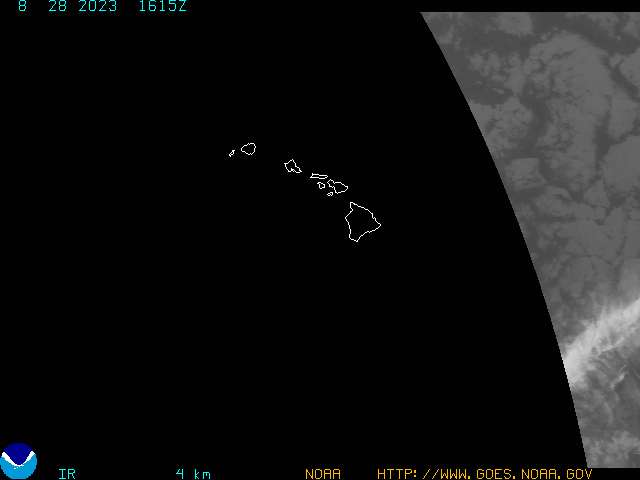
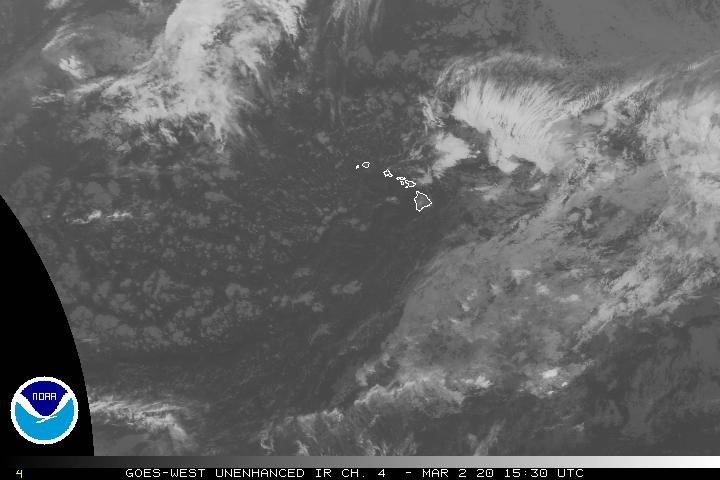
Satellite and Radar Images: To view the cloud conditions we have here in Hawaii, please use the following satellite links, starting off with the Infrared Satellite Image of the islands to see all the clouds around the state during the day and night. This next image is one that gives close images of the islands only during the daytime hours, and is referred to as a Close-up visible image. This next image shows a larger view of the Pacific…giving perspective to the wider ranging cloud patterns in the Pacific Ocean. To help you keep track of where any showers may be around the islands, here’s the latest animated radar image.
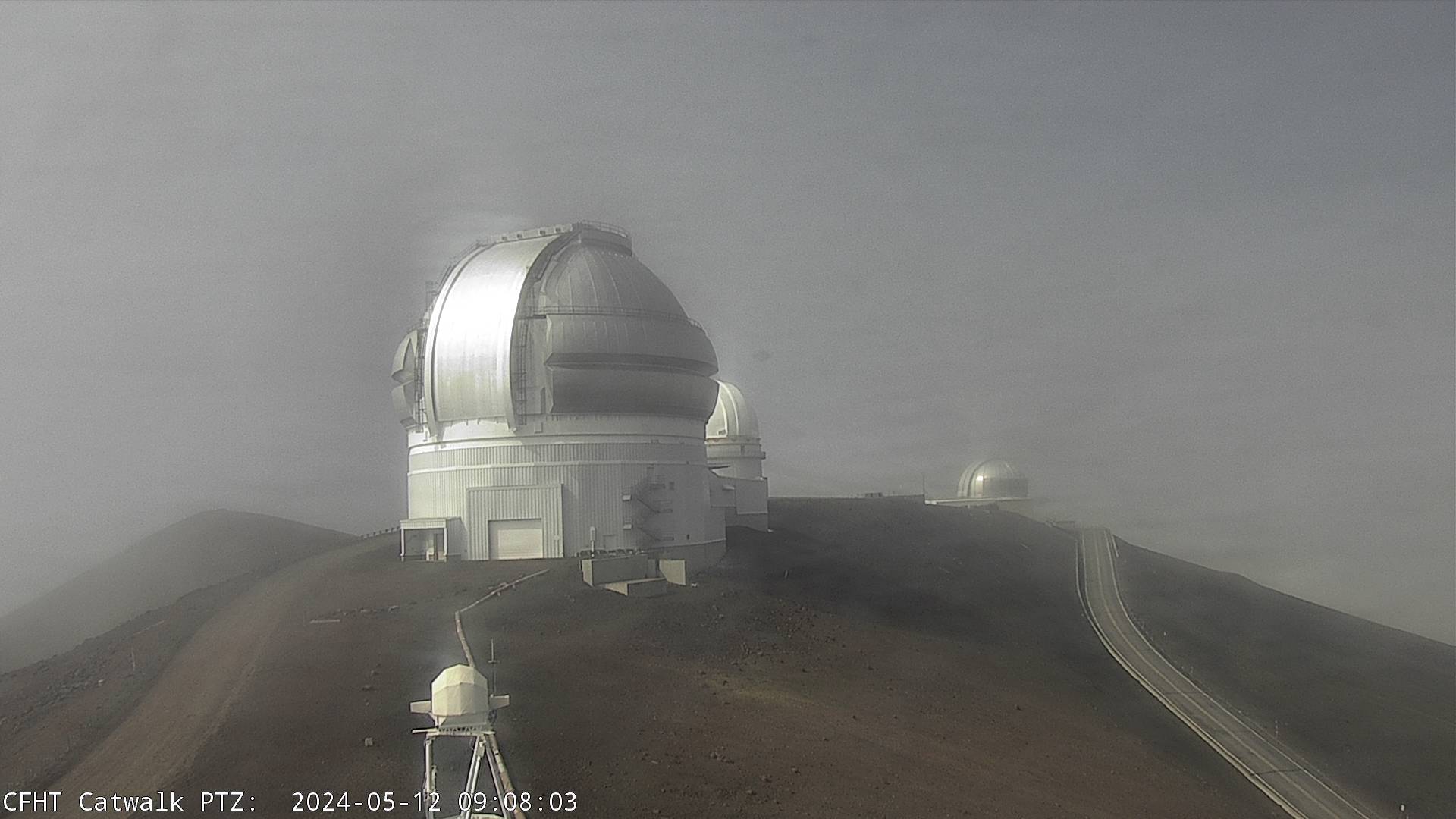
Hawaii’s Mountains – Here’s a link to the live webcam on the summit of near 14,000 foot Mauna Kea on the Big Island of Hawaii. The tallest peak on the island of Maui is the Haleakala Crater, which is near 10,000 feet in elevation. These two webcams are available during the daylight hours here in the islands…and when there’s a big moon rising just after sunset for an hour or two! Plus, during the nights and early mornings you will be able to see stars, and the sunrise too…depending upon weather conditions.
Aloha Paragraphs

Not yet ripe stock of apple bananas
Photo Credit: flickr.com
Trade winds will remain active through Wednesday, then slip a notch during the second half of the week. A moderately strong 1034 millibar high pressure system to the northeast of the islands, and is the source of our trade wind flow Tuesday night. The computer models are suggesting that the trade winds will ease up, as an upper level trough of low pressure moves by to our north…which will cause lighter trade winds Thursda into the weekend.
The windward sides on some of the islands have moistened up, especially on the Big Island. At the same time, some showers have developed along the Kona area on the Big Island as well. Incoming clouds carried by the trade winds will bring a few showers to the other islands, but nothing heavy is indicated for the time being. As an upper level trough gets closer to the islands, later this week, we may see some additional shower enhancement occurring then…although modest in proportion.
~~~ The computer forecast models have changed their tune a little recently, indicating somewhat lighter winds, and a better chance of showers later this week. I’m reluctant to heavily promote this lighter wind, and more showery episode however…as the same thing happened last week, and it was a bust! I’m willing to go along with this outlook for the time being, although will be a little leary until I actually see further evidence. Part of the problem is that climatology tells us that June is the driest month of the year in most areas, although the one exception is around the Big Island.
~~~ It’s early Tuesday evening, as I just finished work here in Kihei, Maui. Looking out the window I can see the trade winds whipping-up some dust in the central valley between Kahului and Kihei. The sky is mostly clear otherwise, with just the usual popcorn kernal cumulus clouds floating along. Tuesday night will be fair, with just some windward biased showers falling here and there. Wednesday is a local Hawaiian holiday, called the Kamehameha Day Celebration…to honor the King in his North Kohala birth place, on the Big Island. If you’re interested in finding out more about this holiday, please click on this link. At any rate, I have the day off from the TV weather show, as the Maui Community College is closed, and off from my regular job in Kihei, at the Pacific Disaster Center too. I haven’t figured out what I’ll do, but I’m sure I can come up with something fun! I’ll meet you back here early Wednesday morning with the next new weather narrative from paradise. I hope you have a great Tuesday night wherever you happen to be spending it! Aloha for now…Glenn.
Interesting: A washing machine using as little as a cup of water for each washing cycle could go on sale to environmentally conscious Britons next year. Xeros Ltd, which has been spun out of the University of Leeds to commercialize the technology, said on Monday the new machines would use less than 2 percent of the water and energy of a conventional washing machine. Plastic chips are used to remove dirt and stains from clothes, leaving them dry and reducing energy consumption as there is no need to use a dryer after the washing cycle, Xeros said in a statement. The firm, which recently secured investment of almost 500,000 pounds ($984,400) from IP Group Plc, told Reuters the price of the new machines was "not expected to be dramatically different from (conventional) washing machines." Washing machine usage has risen by 23 percent in the past 15 years. The average UK household uses almost 21 liters of water daily on clothes washing, 13 percent of daily household water consumption, according to Waterwise, a non-government organization focused on decreasing water wastage in Britain. A typical washing machine uses about 35 kilograms of water for every kilogram of clothes, in addition to the power needed to heat the water and dry the clothes. There are more than two million washing machines sold in Britain annually, with a value of about 1 billion pounds, Xeros said.
Interesting2: The rapid retreat of Arctic sea ice observed in recent summers could triple the rate of warming over northern Alaska, Canada and Russia, a new study suggests. Such intensive warming could endanger sensitive ecosystems and human infrastructure in those regions. It’s the warm version of the snowball effect. "Our study suggests that, if sea-ice continues to contract rapidly over the next several years, Arctic land warming and permafrost thaw are likely to accelerate," said study leader David Lawrence of the NationalCenter for Atmospheric Research in Boulder, Colo. The North Pole is a region of ice floating on the sea, an expanse of ice that in winter connects in some places with continental Arctic ice. The new research was spurred by the record melt of Arctic sea ice last summer, which shrank to more than 30 percent below its average. Around the peak in ice melt, which occurred in September, air temperatures over land in the western Arctic were also unusually warm from August to October, reaching more than 4 degrees Fahrenheit (2 degrees Celsius) above the 1978-2006 average. This raised the question of whether or not these phenomena were related.
Posted by Glenn
No Comments
June 9-10 2008
Air Temperatures – The following maximum temperatures were recorded across the state of Hawaii Monday:
Lihue, Kauai – 83
Honolulu, Oahu – 87
Kaneohe, Oahu – 82
Kahului, Maui – 86
Hilo, Hawaii – 81
Kailua-kona – 85
Air Temperatures ranged between these warmest and coolest spots near sea level at 4 p.m. Monday afternoon:
Honolulu, Oahu – 85F
Molokai airport – 76
Precipitation Totals – The following numbers represent the largest precipitation totals (inches) during the last 24 hours on each of the major islands, as of Monday afternoon:
0.23 Mount Waialaele, Kauai
0.03 Oahu Forest NWR, Oahu
0.00 Molokai
0.00 Lanai
0.00 Kahoolawe
0.04 Puu Kukui, Maui
0.27 Kealakekua, Big Island
Weather Chart – Here’s the latest (automatically updated) weather map showing a 1033 millibar high pressure system to the northeast of the islands. This high pressure cell, along with its associated ridge, will keep moderately strong trade winds blowing across our area…locally stronger and gusty in those windiest areas around Maui and the Big Island.
Satellite and Radar Images: To view the cloud conditions we have here in Hawaii, please use the following satellite links, starting off with the Infrared Satellite Image of the islands to see all the clouds around the state during the day and night. This next image is one that gives close images of the islands only during the daytime hours, and is referred to as a Close-up visible image. This next image shows a larger view of the Pacific…giving perspective to the wider ranging cloud patterns in the Pacific Ocean. To help you keep track of where any showers may be around the islands, here’s the latest animated radar image.
Hawaii’s Mountains – Here’s a link to the live webcam on the summit of near 14,000 foot Mauna Kea on the Big Island of Hawaii. The tallest peak on the island of Maui is the Haleakala Crater, which is near 10,000 feet in elevation. These two webcams are available during the daylight hours here in the islands…and when there’s a big moon rising just after sunset for an hour or two! Plus, during the nights and early mornings you will be able to see stars, and the sunrise too…depending upon weather conditions.
Aloha Paragraphs

The end of another near perfect day in Hawaii
Photo Credit: flickr.com
The trade winds will continue blowing here in the islands…just like they’re suppose to do this time of year. A moderately strong 1032 millibar high pressure system to the northeast of the islands, is the source of our trade wind flow Monday night. Our winds are expected to ease up a little soon, thus the NWS forecast office in Honolulu has dropped the small craft wind advisory over those windier areas around Maui and the Big Island. These cooling and refreshing trade winds will remain active through the rest of the week….blowing in the light to moderately strong range in most areas.
Besides the usual few showers along the windward sides of the islands, our weather will remain quite dry. There may also be a few afternoon and evening showers falling along the Kona slopes as well. Meanwhile, there are still some high cirrus clouds moving up from the southeast, as shown on this looping satellite image. This area of high level moisture seems to be edging eastward, which should help clear these sun dimming clouds from most of the state Monday night…pushing past the Big Island last.
~~~ It’s early Monday evening here in Kihei, Maui, as I begin writing this last paragraph of today’s narrative. The trade winds blew all day, with some of those windier areas finding blustery gusts. As usual, the Maalaea Bay here on Maui had some of the strongest winds, which were still blowing 38 mph at 4pm. Showers were few and far between Monday, with most rain gauges staying completely dry. The last of the high clouds are mostly over the Big Island, although there are a few wisps left over Maui County too. As the sun sets, there may be some nice colors where those departing feathers of icy moisture still exist. I’ll be leaving for the drive upcountry soon, up to Kula, to find my cherished cool air temperatures. Sunshine will be abundant on Tuesday, looking a lot like summer, during these last few days of late spring. I’ll be back very early Tuesday morning with your next new weather narrative. I hope you have a great Monday night wherever you happen to be reading from! Aloha for now…Glenn.
Interesting: The world needs to invest $45 trillion in energy in coming decades, build some 1,400 nuclear power plants and vastly expand wind power in order to halve greenhouse gas emissions by 2050, according to an energy study released recently. The report by the Paris-based International Energy Agency envisions a "energy revolution” that would greatly reduce the world’s dependence on fossil fuels while maintaining steady economic growth. "Meeting this target of 50 percent cut in emissions represents a formidable challenge, and we would require immediate policy action and technological transition on an unprecedented scale,” IEA Executive Director Nobuo Tanaka said. A U.N.-network of scientists concluded last year that emissions have to be cut by at least half by 2050 to avoid an increase in world temperatures of between 3.6 and 4.2 degrees above pre-18th century levels. Scientists say temperature increases beyond that could trigger devastating effects, such as widespread loss of species, famines and droughts, and swamping of heavily populated coastal areas by rising oceans. Environment ministers from the Group of Eight industrialized countries and Russia backed the 50 percent target in a meeting in Japan last month and called for it to be officially endorsed at the G-8 summit in July.
Interesting2: Chemicals produced by humans have been found in deep-sea squid and other creatures, further evidence that contaminants make their way deep into the marine food web, scientists said Monday. Researchers found a variety of chemical contaminants in nine species of cephalopods, which include octopods, squids, cuttlefishes and nautiluses. These species are food for dolphins, narwhals, killer whales and other toothed whales. The researchers collected nine species of cephalopods up to a mile down and deeper in the western North Atlantic Ocean by trawling. "It was surprising to find measurable and sometimes high amounts of toxic pollutants in such a deep and remote environment," said Michael Vecchione, a researcher with the National Oceanic and Atmospheric Administration (NOAA).
Interesting3: Researchers predict a "dead zone" of oxygen-depleted waters off the Louisiana and Texas coasts could grow this summer to 10,084 square miles, making it the largest such expanse in at least 23 years. If the preliminary forecast holds, the researchers say, the size of the so-called "dead zone" would be 17-21% larger than at anytime since the mapping began in 1985 — and about as large as the state of Massachusetts. Another forecast is planned next month. The report Monday from scientists at LouisianaStateUniversity and the Louisiana Universities Marine Consortium is based on May nitrate loads on the Mississippi River at Baton Rouge. Excess nutrients can spur the growth of algae, and when the algae die, their decay consumes oxygen faster than it can be brought down from the surface. As a result, fish, shrimp and crabs can suffocate, threatening the region’s commercial fishing industry. R. Eugene Turner, who led the recent modeling effort, said in a statement that intensive farming — including working land for crops used to make biofuels — has contributed to the high rate of nitrogen loading. Researchers say the largest dead zone measured was 8,894 square miles in 2002. It was about 7,900 square miles last year.
Posted by Glenn
No Comments
June 8-9 2008
Air Temperatures – The following maximum temperatures were recorded across the state of Hawaii Sunday:
Lihue, Kauai – 83
Honolulu, Oahu – 86
Kaneohe, Oahu – 81
Kahului, Maui – 90
Hilo, Hawaii – 86
Kailua-kona – 85
Air Temperatures ranged between these warmest and coolest spots near sea level at 4 p.m. Sunday afternoon:
Kahului, Maui – 85F
Hilo, Hawaii – 78
Precipitation Totals – The following numbers represent the largest precipitation totals (inches) during the last 24 hours on each of the major islands, as of Sunday afternoon:
0.19 Mount Waialaele, Kauai
0.15 Oahu Forest NWR, Oahu
0.00 Molokai
0.00 Lanai
0.00 Kahoolawe
0.16 Oheo Gulch, Maui
0.39 Glenwood, Big Island
Weather Chart – Here’s the latest (automatically updated) weather map showing a 1032 millibar high pressure system to the northeast of the islands. This high pressure cell, along with its associated ridge, will keep moderately strong trade winds blowing across our area Tuesday…locally stronger and gusty in those windiest areas around Maui and the Big Island.
Satellite and Radar Images: To view the cloud conditions we have here in Hawaii, please use the following satellite links, starting off with the Infrared Satellite Image of the islands to see all the clouds around the state during the day and night. This next image is one that gives close images of the islands only during the daytime hours, and is referred to as a Close-up visible image. This next image shows a larger view of the Pacific…giving perspective to the wider ranging cloud patterns in the Pacific Ocean…out from the islands. To help you keep track of where any showers may be around the islands, here’s the latest animated radar image.
Hawaii’s Mountains – Here’s a link to the live webcam on the summit of near 14,000 foot Mauna Kea on the Big Island of Hawaii. The tallest peak on the island of Maui is the Haleakala Crater, which is near 10,000 feet in elevation. These two webcams are available during the daylight hours here in the islands…and when there’s a big moon rising just after sunset for an hour or two! Plus, during the nights and early mornings you will be able to see stars, and the sunrise too…depending upon cloud conditions.
Aloha Paragraphs

Jacaranda trees around Kula, Maui…by the way,
this is the road that I use on a daily basis to go
down the mountain, and then back up again.
Photo Credit: flickr.com
The trade winds will remain locally quite breezy through Monday. A moderately strong 1033 millibar high pressure system to the northeast of the islands, is the source of our trade wind flow Sunday evening. Our winds are strong enough now that small craft wind advisory flags will remain up over those windier areas around Maui and the Big Island. It appears that these cooling and refreshing trade winds will ease off just a little starting Tuesday, although remain active through the rest of the week.
We’re moving into a relatively dry period, which will last through the next several days. There will remain those usual few showers along the windward coasts and slopes…especially during the night and early morning hours. There may also be a few afternoon and evening showers falling along the Kona slopes as well. Meanwhile, we find a considerable amount of high cirrus clouds moving our way from the south, as shown on this looping satellite image. This will help to filter and dim our sunshine into Monday, and perhaps give us another nice sunset tonight.
~~~ It’s early Sunday evening as I sit here in Kula, Maui, writing out this last paragraph. It was yet another very warm day here in the islands, with Kahului, Maui hitting 90F degrees for the third straight afternoon. The trade winds have been blowing steadily as well, with Kapalua, Maui gusting to 35 mph Sunday afternoon, as was Kahoolawe…although the winner in the gust department was the 38 mph at South Point on the Big Island. It has been dry, with little change in that regard expected anytime soon. Looking forward into the new week…besides the slight reduction in our trade wind speeds on Tuesday, these tropical breezes will be with us through the entire week. I had a good day today, staying home, with a little work mixed with quite a lot of relaxation. My neighbor and I decided to cut down a stock of bananas, and from there we worked unexpectedly for over an hour…cleaning up the entire patch, ending up with a huge pile of cut leaves and branches. I’ll be back very early Monday morning with your next new weather narrative from paradise. I hope you have a great Sunday night! Aloha for now…Glenn.
Here’s a great music video, which will bring back fond memories to you older folks: Only You by the The Platters (1955).
Posted by Glenn
No Comments
June 7-8 2008
Air Temperatures – The following maximum temperatures were recorded across the state of Hawaii Saturday:
Lihue, Kauai – 84
Honolulu, Oahu – 88
Kaneohe, Oahu – 82
Kahului, Maui – 90
Hilo, Hawaii – 86
Kailua-kona – 84
Air Temperatures ranged between these warmest and coolest spots near sea level at 5 p.m. Saturday afternoon:
Honolulu, Oahu – 84F
Kaneohe, Oahu – 78
Precipitation Totals – The following numbers represent the largest precipitation totals (inches) during the last 24 hours on each of the major islands, as of Saturday afternoon:
0.43 Moloaa Dairy, Kauai
1.63 Poamoho 2, Oahu
0.00 Molokai
0.24 Lanai
0.00 Kahoolawe
0.01 Puu Kukui, Maui
0.05 Pohakuloa West, Big Island
Weather Chart – Here’s the latest (automatically updated) weather map showing a 1033 millibar high pressure system to the northeast of the islands. This high pressure cell, along with its associated ridge, will keep moderately strong trade winds blowing across our area through Sunday…locally stronger and gusty in those windiest areas around Maui and the Big Island.
Satellite and Radar Images: To view the cloud conditions we have here in Hawaii, please use the following satellite links, starting off with the Infrared Satellite Image of the islands to see all the clouds around the state during the day and night. This next image is one that gives close images of the islands only during the daytime hours, and is referred to as a Close-up visible image. This next image shows a larger view of the Pacific…giving perspective to the wider ranging cloud patterns in the Pacific Ocean…out from the islands. To help you keep track of where any showers may be around the islands, here’s the latest animated radar image.
Hawaii’s Mountains – Here’s a link to the live webcam on the summit of near 14,000 foot Mauna Kea on the Big Island of Hawaii. The tallest peak on the island of Maui is the Haleakala Crater, which is near 10,000 feet in elevation. These two webcams are available during the daylight hours here in the islands…and when there’s a big moon rising just after sunset for an hour or two! Plus, during the nights and early mornings you will be able to see stars, and the sunrise too…depending upon cloud conditions.
Aloha Paragraphs

Like today here in the islands
Photo Credit: flickr.com
The trade winds will boost up a bit now into early in the new week ahead. The computer forecast models suggest that this trade wind flow will prevail through all of next week. A moderately strong 1033 millibar high pressure system, to the northeast of the islands, is the source of our trade wind flow Saturday night. Our winds will increase just enough this weekend, that we’ve seen small craft wind advisory flags going up over the windier areas around Maui and the Big Island. It appears that these cooling and refreshing trade winds will ease off some starting Tuesday, although remain in the light to moderately strong category thereafter.
Now that the atmospheric destabilizing upper level trough of low pressure is to our west…we’ll drop back into a normal trade wind weather pattern. Already we’ve seen dry air moving in from the east, taking away the recent threat of localized heavy showers. Although there will remain those usual showers along the windward coasts and slopes…especially during the night and early morning hours. Meanwhile, we find a considerable amount of high cirrus clouds moving our way from the south, as shown on this looping satellite image. This may give us a nice sunset Saturday evening!
~~~ The main story now, besides the gusty trade winds this weekend, will be the fairly large surf impacting our south and west facing leeward beaches. Late autumn storms in the southern hemisphere, down near New Zealand last week, generated this swell train of waves. This swell began arriving Friday, and will bring relatively large breaking waves to our south and west facing beaches into Sunday. These breakers will be large enough that the general public may need to use caution when entering the ocean, so please be careful out there this weekend. The NWS office in Honolulu issued a high surf advisory, which will remain active into Sunday.
~~~ I got over to the Lahaina side for some surfing this morning, which was a lot of fun! The waves were large enough that there were some juicy rides, although not so large to be intimidating. I saw evidence along the highway between Olowalu and Lahaina town, of some extreme high tides this last week. There was sand and stuff on the side of the road, with puddles of sea water still on the ocean side of the road. At the same time, there were very low tides during the morning hours in contrast.
It’s early Saturday evening as I sit here in Kula, Maui, typing out this last paragraph. It was another hot day here on Maui, with two days in a row now topping out at 90F degrees down in Kahului. It was even very warm up here in Kula, although late this afternoon, the clouds piled-up against the slopes of the Haleakala Crater, cooling things off nicely. As promised this morning, here’s a link to a music group called Radiohead, singing a song called Creep. This song is certainly not for everyone, but for some reason I really like it! While we’re watching music video’s, here’s another that I know many of you will be able to relate to, called I only have eyes for you by the Flamingo’s. At any rate, I hope you have a great Saturday night, partying down, or mellowing out, whichever the case may be. I’ll be back Sunday morning with your next new weather narrative from paradise. Aloha for now…Glenn.
Posted by Glenn
No Comments
June 6-7 2008
Air Temperatures – The following maximum temperatures were recorded across the state of Hawaii Friday:
Lihue, Kauai – 83
Honolulu, Oahu – 87
Kaneohe, Oahu – 81
Kahului, Maui – 90
Hilo, Hawaii – 84
Kailua-kona – 84
Air Temperatures ranged between these warmest and coolest spots near sea level at 4 p.m. Friday afternoon:
Kahului, Maui – 86F
Barking Sands, Kauai – 79
Precipitation Totals – The following numbers represent the largest precipitation totals (inches) during the last 24 hours on each of the major islands, as of Friday afternoon:
0.55 Mount Waialeale, Kauai
0.16 Oahu Forest NWR, Oahu
0.02 Molokai
0.00 Lanai
0.00 Kahoolawe
0.07 West Wailuaiki, Maui
0.06 Puu Waawaa, Big Island
Weather Chart – Here’s the latest (automatically updated) weather map showing a 1032 millibar high pressure system to the northeast of the islands. This high pressure cell, along with its associated ridge, will keep moderately strong trade winds blowing across our area through Saturday…locally stronger and gusty in those windiest areas around Maui and the Big Island.
Satellite and Radar Images: To view the cloud conditions we have here in Hawaii, please use the following satellite links, starting off with the Infrared Satellite Image of the islands to see all the clouds around the state during the day and night. This next image is one that gives close images of the islands only during the daytime hours, and is referred to as a Close-up visible image. This next image shows a larger view of the Pacific…giving perspective to the wider ranging cloud patterns in the Pacific Ocean…out from the islands. To help you keep track of where any showers may be around the islands, here’s the latest animated radar image.
Hawaii’s Mountains – Here’s a link to the live webcam on the summit of near 14,000 foot Mauna Kea on the Big Island of Hawaii. The tallest peak on the island of Maui is the Haleakala Crater, which is near 10,000 feet in elevation. These two webcams are available during the daylight hours here in the islands…and when there’s a big moon rising just after sunset for an hour or two! Plus, during the nights and early mornings you will be able to see stars, and the sunrise too…depending upon cloud conditions.
Aloha Paragraphs

The end of another nice day in the islands
Photo Credit: flickr.com
Late spring trade winds will continue to grace the Hawaiian Islands, moderating our very warm afternoon temperatures at sea level. The computer forecast models suggest that this trade wind flow will prevail through the rest of this week, right on into next week. A moderately strong 1032 millibar high pressure system, to the northeast of the islands is the source of our trade wind flow now. Nothing out of the ordinary is expected, although the winds may increase just enough this weekend, in which case we would see small craft wind advisory flags going up over the windier areas around Maui and the Big Island.
The upper level trough of low pressure is now to the north of Kauai, and will soon lose whatever little bit of influence it has left here in Hawaii. This trough of low pressure has been moving by just to the north of the islands, with its associated cold pool of air aloft, and has been the source of some instability. This water vapor satellite image shows this feature to our north, spinning in a counterclockwise fashion as is moves generally westward. There was hope that it would help to bring us some much needed showers, but most of those didn’t fall in the places that needed the moisture most. We will fall back into a fairly normal trade wind weather pattern now.
~~~ We didn’t have very good luck in terms of attracting much rainfall here in the islands. It’s very clear that we needed the precipitation, to take the edge off the very dry conditions that prevail here in Hawaii now. There have been a couple of heavier showers, although, besides fall over the islands in a few places, ended up being most active over the ocean to the south of the state. There’s still a slim chance that some areas will end up with water on the ground, before this rainfall enhancing upper trough moves away soon.
~~~ Another weather related feature of note, will be the increasing surf along our leeward coasts. Late autumn storms in the southern hemisphere, down near New Zealand last week, generated a swell train of waves in our direction. This swell began arriving Friday, and will bring relatively large breaking waves to our south and west facing beaches this weekend. These breakers will be large enough that the general public may need to use caution when entering the ocean, so please be careful out there this weekend. The NWS office in Honolulu issued a high surf advisory for the south facing shores during the day Friday.
~~~ It’s after work Friday evening, as I’m about ready to leave Kihei. I just got an email from my neighbors, asking if I wanted to meet them at the putting green in Pukalani on the way home to Kula. There weren’t any new films that I was interested in seeing, so I agreed to meet them. It’s nice to putt around sunset, as the Pukalani Country Club has great views down the mountain to the ocean…and also uphill to the summit of the Haleakala Crater. I plan on going surfing early Saturday morning, taking the drive over to the Lahaina side. I have a haircut later in the morning in Haiku, which will put me in close proximity to take a nice beach walk and swim in Paia aftwerwards. This all sounds great to me, as I look forward to having a couple of days off work. I’ll be back online early Saturday, with your next new weather narrative from paradise. I hope you have a great Friday night until then! Aloha for now…Glenn.
Interesting: A team of physicists has claimed that our view of the early Universe may contain the signature of a time before the Big Bang. The discovery comes from studying the cosmic microwave background (CMB), light emitted when the Universe was just 400,000 years old. Their model may help explain why we experience time moving in a straight line from yesterday into tomorrow. Details of the work have been submitted to the journal Physical Review Letters. The CMB is relic radiation that fills the entire Universe and is regarded as the most conclusive evidence for the Big Bang. Although this microwave background is mostly smooth, the Cobe satellite in 1992 discovered small fluctuations that were believed to be the seeds from which the galaxy clusters we see in today’s Universe grew. Dr Adrienne Erickcek, and colleagues from the California Institute for Technology (Caltech), now believes these fluctuations contain hints that our Universe "bubbled off" from a previous one.
Interesting2: The numbers of Northeastern offshore spotted and eastern spinner dolphins in the eastern tropical Pacific Ocean are increasing after being severely depleted because of accidental death in the tuna purse-seine fishery between 1960 and 1990, according to biologists from NOAA’s Fisheries Service. "These estimates are encouraging because they are consistent with what we would expect to see if these stocks are recovering, now that reported fishery mortality has been dramatically reduced," said Dr. Lisa Ballance, director of NOAA’s Southwest Fisheries Science Center protected resources division. "However, we have to be careful not to jump to final conclusions. We need to resolve the uncertainties around these estimates before we can definitively say these stocks are recovering." Between 1960 and 1990, the northeastern offshore spotted and eastern spinner dolphin populations dropped to 20 percent and 30 percent, respectively, of their pre-fishery levels when dolphins were caught and died in tuna purse-seine nets. Since the early 1990s, however, the number of reported dolphin deaths has been very low because of severe restrictions on the fishery.
Posted by Glenn
No Comments
June 5-6 2008
Air Temperatures – The following maximum temperatures were recorded across the state of Hawaii Thursday:
Lihue, Kauai – 83
Honolulu, Oahu – 87
Kaneohe, Oahu – 82
Kahului, Maui – 88
Hilo, Hawaii – 84
Kailua-kona – 84
Air Temperatures ranged between these warmest and coolest spots near sea level at 4 p.m. Thursday afternoon:
Honolulu, Oahu – 85F
Barking Sands, Kauai – 77
Precipitation Totals – The following numbers represent the largest precipitation totals (inches) during the last 24 hours on each of the major islands, as of Thursday afternoon:
2.80 Mount Waialeale, Kauai
0.55 Poamoho 2, Oahu
0.03 Molokai
0.31 Lanai
0.00 Kahoolawe
0.53 Puu Kukui, Maui
0.15 Puu Waawaa, Big Island
Weather Chart – Here’s the latest (automatically updated) weather map showing a 1031 millibar high pressure system to the northeast of the islands. This high pressure cell, along with its associated ridge, will keep moderately strong trade winds blowing across our area through Saturday…locally stronger and gusty in those windiest areas around Maui and the Big Island.
Satellite and Radar Images: To view the cloud conditions we have here in Hawaii, please use the following satellite links, starting off with the Infrared Satellite Image of the islands to see all the clouds around the state during the day and night. This next image is one that gives close images of the islands only during the daytime hours, and is referred to as a Close-up visible image. This next image shows a larger view of the Pacific…giving perspective to the wider ranging cloud patterns in the Pacific Ocean…out from the islands. To help you keep track of where any showers may be around the islands, here’s the latest animated radar image.
Hawaii’s Mountains – Here’s a link to the live webcam on the summit of near 14,000 foot Mauna Kea on the Big Island of Hawaii. The tallest peak on the island of Maui is the Haleakala Crater, which is near 10,000 feet in elevation. These two webcams are available during the daylight hours here in the islands…and when there’s a big moon rising just after sunset for an hour or two! Plus, during the nights and early mornings you will be able to see stars, and the sunrise too…depending upon cloud conditions.
Aloha Paragraphs

The beach at Wailea, Maui
Photo Credit: flickr.com
The trade winds may ease up a touch Friday, as an upper level low pressure trough moves by overhead. The computer forecast models suggest that this trade wind flow will prevail through the rest of this week, right on into next week. This is the time of year the trade winds blow very steadily, really hitting their stride. The month of June, on average, find the trade winds blowing 91% of the time here in Hawaii.
The upper level trough, referred to above, will increase windward showers over the next several days. This trough, with its associated cold pool of air aloft, will destabilize our atmosphere enough…that we could find more generous rainfall arriving along our windward coasts and slopes into the weekend. There may be a few nice showers along the leeward slopes on Maui and the Big Island during the afternoon hours too. This won’t however be a widespread rain event, rather of the hit and miss variety for the most part.
~~~ We have a golden opportunity here, in regards to wringing-out some showers from the clouds that will be passing through our area now. The well advertised trough of low pressure, which will be moving over us now, should trigger some localized heavy windward biased showers. This hasn’t happened yet, but we’ll know soon, whether this will unfold as expected. All the ingredients for this to happen are in place now, and all we need at this point is to hear those raindrops falling on our roofs!
~~~ The cold air associated with the trough is moving over us, which will help to thicken-up our local cumulus clouds. This cold air won’t reach down to the surface of course, so we will find warm temperatures down here where we live. The cold air aloft however will cause what we call instability in our atmosphere. This simply means that those clouds will become more shower prone. How much rain will the windward sides receive, I don’t know, although I’d like to say a lot! As we’re definitely flirting with drought conditions on the islands from Oahu down to the Big Island.
~~~ As I’ve been mentioning the last several days, there’s a second chance for additional precipitation next week, as another trough moves near our islands. It would be so great to have ample rainfall from this first occurrence, and then a follow-up second wet event around the middle of next week! Just about everyone here in the islands should have their fingers crossed, or you wild and crazy folks should be out there doing a rain dance! 
~~~ Conditions are becoming more ripe for localized showers now, with even some fairly generous ones at that in the offing. This looping satellite image shows the high clouds associated with this trough of low pressure, as it spins in a counterclockwise fashion across the state now. This trough will end up to the west of Hawaii by Saturday, although a lobe of the trough will remain back over the islands, keeping localized showers in the forecast into Sunday. Here’s an animated radar image as well, so you can keep an eye on where the showers are falling. Looking out the window here from Kihei, Maui, before I leave on the drive upcountry to Kula, there are lots of high clouds around, and some fairly showery looking cumulus clouds around the edges as well. Those icy cirrus clouds up high, could very easily make for a colorful sunset this evening…keep an eye out. I’ll be back very early Friday morning with your next new weather narrative from paradise. I hope to have news about some nice rains that hopefully fell during the night. The wild card seems to be whether there will be ample moisture being carried our way on the somewhat weaker trade winds that are around now. Aloha for now…Glenn.
Interesting: Chronic pollution in Mexico City, which stains the sky yellow and can trigger government warnings to stay indoors, could be killing off residents’ sense of smell, scientists say. Tests showed people in Mexico City — a sprawling metropolis crammed with around 20 million people and 4 million cars — struggled to sniff out everyday odors like coffee and orange juice compared to residents of a nearby town. Their noses are so badly damaged from a life inhaling toxic particles that they also find it harder to detect the scent of rotten food, said researcher Robyn Hudson who ran the study. "We added a substance (to powdered milk) that is a common contaminant of food, something that smells disgusting basically — like a sour, rotting cabbage," said Hudson. "We were able to see at what point … they would start to reject the contaminated sample, say ‘ew yuck! no! take it away please,’" said Hudson, an Australian and a senior research scientist at Mexico‘s National Autonomous University (UNAM). Mexico City is one of the world’s most polluted capitals, along with Beijing, blighted by its thin high-altitude air and a ring of surrounding mountains that trap exhaust fumes belched from smoky buses and factories on the city outskirts. Contamination levels are better now than two decades ago, but from a high-story window it’s still hard most days to make out the snow-capped peaks that surround the city through the murky shroud of brownish smog. Mexico City‘s ozone levels exceed World Health Organization standards on approximately 300 days of the year.
Interesting2: Mexico City, one of the world’s most polluted capitals, is planting rooftop gardens on public buildings as part of a program launched on Thursday to combat global warming. The smog-choked metropolis plans to replace gas tanks, clothes lines and heat-reflecting asphalt on 100,000 square feet (9,300 square metres) of publicly owned roof space each year with grass and bushes that will absorb carbon dioxide. The city also plans to offer tax breaks for businesses or individuals who put gardens on top of their offices and apartment buildings. Left-wing Mayor Marcelo Ebrard has pledged $5.5 billion over five years to reduce greenhouse gases in Mexico City, home to some 20 million people and 4 million cars. "These are not generic objectives or wishes — we have a clear goal," Ebrard said at an event to inaugurate the environmental plan. The aim is to cut carbon emissions by 4.4 million tonnes a year, still a fraction of the 643 million tonnes of gas Mexico produces nationwide each year, ranking it among the world’s top polluters. The mayor has encouraged cycling by providing bicycle paths and some car-free roads on weekends. His program also aims to capture gas that bubbles up from overflowing landfills and calls for a new subway line and more express bus routes. Putting plants on roofs soaks up some of the carbon dioxide belched out by cars and factories, one of the main causes of climate change, the U.S. Environmental Protection Agency says.
Interesting3: Better insulation at home, less use of the car and even giving up an electric toothbrush can help people in rich nations halve emissions of greenhouse gases, a U.N. report said on Thursday. "Adopting a climate-friendly lifestyle needn’t require drastic changes or major sacrifices," according to the 202-page U.N. Environment Program (UNEP) book entitled "Kick the CO2 Habit: the U.N. Guide to Climate Neutrality". Issued to mark the U.N.’s annual World Environment Day on June 5, it outlines ways for people to combat global warming with measures such as packing lighter suitcases when flying or going jogging in a park rather than on an electric treadmill. World emissions of greenhouse gases, is blamed by the U.N. Climate Panel, for heating the globe total about 4.5 tonnes per person for all of the world’s 6.7 billion population. Most efforts to slow climate change focus on the role of governments — such as in rules for emissions from cars or power plants or building codes to help avert projected impacts such as droughts, heat waves, more powerful storms or rising seas. Fewer look at how individuals can do it themselves. "Multiplied across the world and acted upon by 6.7 billion people, the public have the power to change the future, have the power to personally and collectively influence economies to ‘Kick the CO2 Habit’," said Achim Steiner, head of UNEP.
Posted by Glenn
[2] Comments
June 4-5 2008
Air Temperatures – The following maximum temperatures were recorded across the state of Hawaii Wednesday:
Lihue, Kauai – 83
Honolulu, Oahu – 86
Kaneohe, Oahu – 82
Kahului, Maui – 84
Hilo, Hawaii – 84
Kailua-kona – 82
Air Temperatures ranged between these warmest and coolest spots near sea level at 4 p.m. Wednesday afternoon:
Kahului, Maui – 85F
Hilo, Hawaii – 79
Precipitation Totals – The following numbers represent the largest precipitation totals (inches) during the last 24 hours on each of the major islands, as of Wednesday afternoon:
1.17 Mount Waialeale, Kauai
1.17 Poamoho 2, Oahu
0.03 Molokai
0.29 Lanai
0.00 Kahoolawe
0.72 Puu Kukui, Maui
0.24 Keahole airport, Big Island
Weather Chart – Here’s the latest (automatically updated) weather map showing a 1030 millibar high pressure system to the northeast of the islands. This high pressure cell, along with its associated ridge, will keep light to moderately strong trade winds blowing across our area through Friday…locally stronger and gusty in those windiest areas around Maui and the Big Island. An upper level trough of low pressure, moving by during the next several days, may tamp our surface winds down a bit more than expected, we’ll have to wait and see.
Satellite and Radar Images: To view the cloud conditions we have here in Hawaii, please use the following satellite links, starting off with the Infrared Satellite Image of the islands to see all the clouds around the state during the day and night. This next image is one that gives close images of the islands only during the daytime hours, and is referred to as a Close-up visible image. This next image shows a larger view of the Pacific…giving perspective to the wider ranging cloud patterns in the Pacific Ocean…out from the islands. To help you keep track of where any showers may be around the islands, here’s the latest animated radar image.
Hawaii’s Mountains – Here’s a link to the live webcam on the summit of near 14,000 foot Mauna Kea on the Big Island of Hawaii. The tallest peak on the island of Maui is the Haleakala Crater, which is near 10,000 feet in elevation. These two webcams are available during the daylight hours here in the islands…and when there’s a big moon rising just after sunset for an hour or two! Plus, during the nights and early mornings you will be able to see stars, and the sunrise too…depending upon cloud conditions.
Aloha Paragraphs

Lanikai, Oahu…could this be my
favorite beach in all of the Islands?

The colors of windward Oahu…oh my!
Photo Credit: flickr.com
The trade winds will continue to be the primary weather feature here in the Hawaiian Islands. A moderately strong 1031 millibar high pressure system, located to the northeast of Hawaii Wednesday evening…is the source of our moderately strong trade winds. The computer forecast models suggest that this late spring trade wind flow will prevail through the rest of this week, right on into next week. There will be some minor variations in wind speeds, although 10-25 mph will catch the outer limits in most areas, with those localized 30+ mph gusts here and there.
We will see some increase in windward showers over the next several days. The computer forecast models continue to bring an upper level trough over the state from the east over the next couple of days. This upper trough, with its associated cold pool of air, will destabilize our atmosphere enough…that we would find heavier rainfall arriving along our windward coasts and slopes Thursday into the weekend. There may be a few heavier showers along the leeward slopes on Maui and the Big Island too.
~~~ Despite the fact that this is the driest month of the year, and it would be somewhat unusual, we’re still looking for an increase in showers. The computer models have been very consistent in their forecast of increasing showers associated with an upper low pressure migrating in over the islands. These showers won’t envelop the entire island chain, but be generally restricted to the windward sides. The upcountry areas in Kona, and perhaps the Kula through Ulupalakua slopes on Maui…may see some afternoon showers as well.
~~~ The original thought was that these showers would be around Thursday into Friday, and then move away over the weekend. It now appears that this trough of low pressure will linger in our area right into the weekend. This would give it more of a chance to enhance our local showers into Saturday, and possibly Sunday. This is one of those times when we really need the rain, so we’re hoping that these windward showers manifest as forecast, and perhaps be more generous than expected too.
~~~ The models continue to show a second upper level trough of low pressure coming our way next week. This would be doubly unusual, although given the dry weather conditions we’re dealing with now…twice as nice! The leeward beaches won’t likely see any of this moisture, and may remain quite sunny during the days, so that those folks living on the windward sides, want to escape the showers, they can take their beach towels and plop down on the leeward beaches. Speaking of the leeward beaches, there will be lots of south swell waves breaking there this weekend.
~~~ I just finished work in Kihei, Maui, and will leave soon for the 40 minute drive upcountry to Kula. Glancing out the window, I see some high cirrus clouds streaming overhead from the east this evening. These icy clouds should provide a colorful sunset! During the day, the two most noticeable things that caught my eye, where the locally strong and gusty winds, and the thicker clouds that were around too. Those gusty trade winds reached over 40 mph at Kahoolawe, offshore from the south coast here on Maui. The cumulus clouds today had a different nature than we’ve seen recently, and were more hefty than the fairly wimpy, and rather shallow clouds of late. These more well developed clouds are the first signal of the approaching upper level trough of low pressure. This looping satellite image shows, to the east of the Big Island, the advancing cold air, with its high clouds, moving over the islands. I’ll be back very early Thursday morning with more news about this developing wet trade wind episode, which again, will deposit the bulk of the incoming showers along the windward coasts and slopes. I hope you have a great Wednesday night until then! Aloha for now…Glenn.
Interesting: A team of astronomers has cooked up an out-of-this-world recipe for lunar concrete that could be used to build homes on the moon. The innovative recipe of carbon, glue and moon dust, which produces what looks like a hockey puck, could also be helpful in building other structures on the moon, including giant telescopes and solar power arrays. Lunar living aside, many astrophysicists think that large telescopes on the moon have their advantages: The moon lacks the clouds and blurring atmosphere that can distort images taken from ground-based observatories. In addition, the moon offers a permanent and stable platform — the lunar surface.
One limiting factor for making the concrete could be the amount of material a rocket can reasonably haul up to the moon. But if the bulk of the material was already on the moon, that would lighten the Earth-to-moon payload. And that is the case, Chen says. "We could make huge telescopes on the moon relatively easily, and avoid the large expense of transporting a large mirror from Earth," said Peter Chen of NASA Goddard Spaceflight Center in Greenbelt, Md., and the Catholic University of America in Washington, D.C.
"Since most of the materials are already there in the form of dust, you don’t have to bring very much stuff with you, and that saves a ton of money." Chen also notes that like concrete on Earth, the lunar type could have many uses. "We could build structures on the moon, perhaps habitats for astronauts on the moon, maybe igloos," Chen said during a press briefing here today at a meeting of the American Astronomical Society (AAS).
Interesting2: A little strategically placed makeup quickly turns the wimpiest of male barn swallows into chick magnets, amping up their testosterone and even trimming their weight, new research shows. It’s a "clothes make the man" lesson that — with some caveats — also applies to human males, researchers say. Using a $5.99 marker, scientists darkened the rust-colored breast feathers of male New Jersey barn swallows, turning lighter birds to the level of those naturally darkest. They had already found, in a test three years ago, that the marked-up males were more attractive to females and mated more often. This time they found out that the more attractive appearance, at least in the bird world, triggered changes to the animals’ body chemistry, increasing testosterone. "Other females might be looking at them as being a little more sexy, and the birds might be feeling better about themselves in response to that," said study co-author Kevin McGraw, an evolutionary biology professor at ArizonaStateUniversity. McGraw said the findings are surprising, in part because the hormonal changes occurred after only one week. The study was published in Tuesday’s edition of the journal Current Biology.
Interesting3: New research led by Dr Melanie Massaro and Dr Jim Briskie at the University of Canterbury, which found that the New Zealand bellbird is capable of changing its nesting behaviour to protect itself from predators, could be good news for island birds around the world at risk of extinction. The introduction of predatory mammals such as rats, cats and stoats to oceanic islands has led to the extinction of many endemic island birds, and exotic predators continue to threaten the survival of 25 percent of all endangered bird species worldwide. Dr Massaro says the impact of exotic predators on the native birds of oceanic islands is particularly profound as they evolved over millions of years largely in the absence of these predators and appear naive towards newly introduced mammals. But their study on the bellbird, an endemic New Zealand bird, has identified the ability of a previously naive island bird to change its nesting behaviour in response to the introduction of a large suite of exotic mammalian predators by humans.
Posted by Glenn
No Comments
June 3-4 2008
Air Temperatures – The following maximum temperatures were recorded across the state of Hawaii Tuesday:
Lihue, Kauai – 82
Honolulu, Oahu – 87
Kaneohe, Oahu – 78
Kahului, Maui – 88
Hilo, Hawaii – 83
Kailua-kona – 82
Air Temperatures ranged between these warmest and coolest spots near sea level at 4 p.m. Tuesday afternoon:
Honolulu, Oahu – 86F
Hilo, Hawaii – 76
Precipitation Totals – The following numbers represent the largest precipitation totals (inches) during the last 24 hours on each of the major islands, as of Tuesday afternoon:
0.90 Mount Waialeale, Kauai
0.24 Oahu Forest NWR, Oahu
0.03 Molokai
0.00 Lanai
0.00 Kahoolawe
0.19 West Wailuaiki, Maui
0.10 Mountain View, Big Island
Weather Chart – Here’s the latest (automatically updated) weather map showing a 1029 millibar high pressure system to the northeast of the islands. This high pressure cell, along with its associated ridge, will keep moderately strong trade winds blowing across our area through Thursday…locally stronger and gusty in those windiest areas around Maui and the Big Island.
Satellite and Radar Images: To view the cloud conditions we have here in Hawaii, please use the following satellite links, starting off with the Infrared Satellite Image of the islands to see all the clouds around the state during the day and night. This next image is one that gives close images of the islands only during the daytime hours, and is referred to as a Close-up visible image. This next image shows a larger view of the Pacific…giving perspective to the wider ranging cloud patterns in the Pacific Ocean…out from the islands. To help you keep track of where any showers may be around the islands, here’s the latest animated radar image.
Hawaii’s Mountains – Here’s a link to the live webcam on the summit of near 14,000 foot Mauna Kea on the Big Island of Hawaii. The tallest peak on the island of Maui is the Haleakala Crater, which is near 10,000 feet in elevation. These two webcams are available during the daylight hours here in the islands…and when there’s a big moon rising just after sunset for an hour or two! Plus, during the nights and early mornings you will be able to see stars, and the sunrise too…depending upon cloud conditions.
Aloha Paragraphs

The beautiful island of Kauai
Photo Credit: flickr.com
The trade winds slipped a little in strength Tuesday, although are expected to increase a notch already Wednesday. A moderately strong 1030 millibar high pressure system, located to the northeast of Hawaii…is the source of our moderately strong trade winds now. The recent small craft wind advisory around Maui and the Big Island, has been brought down, although will likely be initiated again Wednesday. The computer forecast models suggest that this late spring trade wind flow will prevail through the rest of this week, right on into next week.
Satellite imagery shows no lack of clouds upwind of the islands, some of which will bring a few showers to the windward sides…although not many. We should have a better shot of moisture later in the week, as an upper level trough moves over, or close to the state then. This upper trough, with its associated cold air aloft, may destabilize our atmosphere enough…that we could find heavier rainfall arriving along our windward coasts and slopes, which would be a very good thing.
~~~ Not all of the forecast models are showing such a good chance of those heavier showers arriving Thursday into Friday. Although, there seems to be enough model agreement, that the chance at least seems quite likely from this vantage point. This is just the kind of weather that we need now, which would help in replenishing our underground aquifers, and our upcountry water reservoirs. This time of year it gets more and more difficult to have generous rainfall, but it’s not out of the question…despite the fact that June is climatologically the driest month of the year.
~~~ The models go on to show the upper level low pressure system, giving way to a rainfall inhibiting upper level high pressure ridge during the weekend. This would bring our dry weather back, although if we can get some good soaking rainfall, again most notably along the windward sides, it will be fine to have a pleasant weekend. The interesting thing now, is that the latest model runs are now showing a second upper level low pressure trough arriving early next week, which could bring the chance of more enhanced shower activity then…that would be a fantastic turn of events!
~~~ Tuesday was another very nice day here in the Hawaiian Islands, with more than enough sunshine beaming down…at least in most places. The next several days should remain favorably inclined as well, with more warm days, and seasonably warm nights continue…at least at sea level locations. The upcountry areas, what with the added elevations, are cooler as would be expected. We could expect a pretty status quo weather reality for the time being, with no major changes expected through at least Wednesday. As noted above, we may see an interesting change of pace Thursday and Friday, before a beautiful weekend unfolds thereafter. I’ll be back very early Wednesday morning with your next new weather narrative. I hope you have a great Tuesday night until then! Aloha, Glenn
Interesting: Lush fields of lettuce and hothouses of tomatoes line the roads. Verdant new developments of plush pastel vacation homes beckon buyers from Britain and Germany. Golf courses – 54 of them, all built in the past decade and most in the past three years – give way to the beach. At last, this hardscrabble corner of southeast Spain is thriving. There is only one problem with this picture of bounty: This province, Murcia, is running out of water. Spurred on by global warming and poorly planned development, swaths of southeast Spain are steadily turning into desert. This year in Murcia farmers are fighting developers over water rights. They are fighting each other over who gets to water their crops. And in a sign of their mounting desperation, they are buying and selling water like gold on a burgeoning black market. "Water will be the environmental issue this year," said Barbara Helferrich, spokeswoman for the European Union’s Environment Directorate. "The problem is urgent and immediate." "If you’re already having water shortages in spring, you know it’s going to be a really bad summer."
Interesting2: Global climate change will not only impact plants and animals but will also affect bacteria, fungi and other microbial populations that perform a myriad of functions important to life on earth. It is not entirely certain what those effects will be, but they could be significant and will probably not be good, say researchers today at a scientific meeting in Boston. “Microbes perform a number of critical functions for ecosystems around the world and we are only starting to understand the impact that global change is having on them,” says Kathleen Treseder of the University of California, Irvine, at the 108th General Meeting of the American Society for Microbiology. Treseder studied the effect of rising temperatures and fungi on carbon stores in Alaskan boreal forests, one area of the globe that is experiencing greater warming than others. “There is a lot of frozen dead material under the snow pack. There is as much carbon trapped in the soil of northern ecosystems as there is carbon in the atmosphere. It is a big unknown what is going to happen if these environments heat up,” says Treseder. She started her research with the hypothesis that an increase in temperatures would lead to increased decomposition by fungi. Since one by-product of decomposition is carbon dioxide, rising temperatures should result in greater carbon dioxide release from the soil. What she found was that nitrogen levels in the soil increased as temperatures rose, and nitrogen tends to suppress fungal decomposition rates.
Interesting3: Speedier family baths could help Japanese cut their burgeoning energy consumption and reduce greenhouse gas emissions, a government report said on Tuesday. Japanese households consume less energy than their U.S. and European counterparts, but consumption has been sharply increasing –jumping 44 percent between 1990 and 2005 — a big reason the environment white paper zeroed in on ways for people to save energy. Families should not only shorten their daily showers by a minute — a common recommendation in the West — but should try to take baths in quick succession, the report said. Japanese usually wash outside the tub and then soak in hot water, which is then reused by the next family member. That means the water must be reheated each time if the next person in line dawdles. Hot water use in bathrooms and kitchens accounted for 39 percent of energy consumed in Japanese homes, a stark contrast to European households, where energy is mainly used for air-conditioning and heating, the report said. Japan is one of the world’s most energy-efficient countries, but greenhouse gas emissions from companies and households have been on the rise in recent years, prompting the government to raise public awareness for global warming. Climate change will be a major agenda on at the G8 summit Japan will be hosting in early July.
Interesting4: Being tiny has its advantages, and a newly discovered microbe in Greenland has exploited this fully. The bacterium survived more than 120,000 years beneath the ice where inhospitable conditions reach new lows. Most organisms constantly deal with trade-offs, such as some hot-desert residents that take advantage of sunshine yet must endure dehydration. The new microbe makes dehydration seem like a walk in the park. Called Chryseobacterium greenlandensis, the tiny bacterium was found 2 miles (3.2 km) beneath a Greenland glacier. There, conditions are extreme, with temperatures below 16 degrees F (-9 degrees C), high pressure, very little oxygen and meager food. The ultra-small size of the new species — about 10 to 100 times smaller than E. coli bacteria — could explain why it was able to gain a foothold in such harsh conditions and survive for so long, scientists say. Tiny microbes like this one likely can more efficiently absorb nutrients due to a larger surface-to-volume ratio. They also may be able to hide more easily from predators and take up residence in microenvironments, such as microscopic veins or cracks in the ice.
Interesting5: Another swimmer was killed by a shark off the Pacific coast of Mexico on May 24, the second tragic shark encounter in two months in that area, thus officially launching another summer of shark hysteria. The Mexican Navy immediately took to seas to search for the sharks, perhaps with the intent to punish them or at least send a stern warning to the shark community. Shark reports are now a regular feature of the news as far away as the New England coast; the sharks are tracked as if they are as deadly as a tornado or summer storm. What would be the reaction to the death of a kid in Iowa killed by a bee sting? Imagine the drama unfold as angry and nervous denizens take to the fields with insect repellent. Never mind pollination: The bees must die. And why not? Worldwide bees are nearly a hundred times deadlier than sharks, killing about 500 people annually, including about 50 in the United States, according to the Centers for Disease Control and Prevention. Yes, sharks are deadly. It has something to do with their gazillion or so razor-sharp teeth. But while it is prudent to avoid waters populated with sharks, shark encounters are rare and fatalities from attacks are even rarer.
Posted by Glenn
No Comments
June 2-3 2008
Air Temperatures – The following maximum temperatures were recorded across the state of Hawaii Monday:
Lihue, Kauai – 83
Honolulu, Oahu – 88
Kaneohe, Oahu – 82
Kahului, Maui – 88
Hilo, Hawaii – 84
Kailua-kona – 85
Air Temperatures ranged between these warmest and coolest spots near sea level at 4 p.m. Monday afternoon:
Honolulu, Oahu – 85F
Lihue, Kauai – 79
Precipitation Totals – The following numbers represent the largest precipitation totals (inches) during the last 24 hours on each of the major islands, as of Monday afternoon:
0.34 Mount Waialeale, Kauai
0.00 Oahu
0.00 Molokai
0.00 Lanai
0.00 Kahoolawe
0.19 Puu Kukui, Maui
0.05 Kealakekua, Big Island
Weather Chart – Here’s the latest (automatically updated) weather map showing a 1028 millibar high pressure system to the northeast of the islands. As the same time, we find a surface trough between that high and Hawaii. The placement of this trough has weakened our local trade winds a touch, but they should strengthen again by mid-week.
Satellite and Radar Images: To view the cloud conditions we have here in Hawaii, please use the following satellite links, starting off with the Infrared Satellite Image of the islands to see all the clouds around the state during the day and night. This next image is one that gives close images of the islands only during the daytime hours, and is referred to as a Close-up visible image. This next image shows a larger view of the Pacific…giving perspective to the wider ranging cloud patterns in the Pacific Ocean…out from the islands. To help you keep track of where any showers may be around the islands, here’s the latest animated radar image.
Hawaii’s Mountains – Here’s a link to the live webcam on the summit of near 14,000 foot Mauna Kea on the Big Island of Hawaii. The tallest peak on the island of Maui is the Haleakala Crater, which is near 10,000 feet in elevation. These two webcams are available during the daylight hours here in the islands…and when there’s a big moon rising just after sunset for an hour or two! Plus, during the nights and early mornings you will be able to see stars, and the sunrise too…depending upon cloud conditions.
Aloha Paragraphs

The Big Island across the channel from Maui
Photo Credit: flickr.com
Trade winds will remain active through the next week here in the Hawaiian Islands. High pressure centers to the north-northeast through northeast, will be the source of our moderately strong trade wind flow. Those windiest areas, especially around Maui and the Big Island, will find somewhat stronger gusts. The recent small craft wind advisory was cancelled Monday for all areas.
There will be some showers arriving this week, focusing their efforts best along the windward sides. The first possible increase in those windward biased showers will arrive Monday night. The source of these showers can be tracked back to an old cold front that pushed into the area north of the state last week. It now appears that only Kauai and perhaps Oahu will see these showers. The second chance we have will occur later in the week, when an upper level trough of low pressure approaches around Thursday.
~~~ We’re looking forward to seeing an increase in clouds and showers along our north and east facing windward coasts and slopes Monday night. The bulk (and that doesn’t mean a lot by the way) of these showers will arrive on Kauai and maybe Oahu, as this first chance of showers arrives. These showers may turn out to be disappointingly light down over Maui and the Big Island. Later in the week, with that upper trough arriving from the east, there’s a better chance of localized heavier showers. Unfortunately, both of these showery events, and calling them events is actually going too far, won’t be nearly enough, on their own, to solve the dry weather problems that we have going on now.
~~~ June 1st marked the first day of our 2008 hurricane season here in the north central Pacific Ocean. There are no tropical cyclones forecast through the next two days…at least. We will have to wait until later in July, at least according to hurricane climatology, before expectations arise in that regard. The eastern Pacific, where the season began May 15th, has already seen two tropical systems, with a third potentially forming over the next couple of days. All the action over there has stuck very close to the coasts in Central America thus far.
~~~ It’s early Monday evening here in Kihei, Maui, as I just finished work. Looking out the window, I see abundantly clear blue skies, with fairly minor small patches of white cotton ball cumulus floating along in the brisk trade wind breezes. I noticed that at lunch, when I was out driving, I could see large areas of dust being picked up in the central valley, between Kahului and Kihei. I looked to see how fast the winds were blowing through the Maalaea Bay, and was impressed with the 44 mph proportions! Looking at the latest satellite image, that old cold front is very difficult to pick out, so I don’t have much hope left in it bringing much in the way of our much needed showers. I’m about ready to take the 40 or so minute drive upcountry, where there are much less than the usual later afternoon clouds stacked-up along the slopes of the Haleakala Crater. I look forward to bringing your next new weather narrative to you, which will be available here in the islands at about 530am, or 830am on the west coast, and 1130am on the east coast Tuesday. I hope you have a great Monday night until then! Aloha for now…Glenn.
Interesting: During the Sichuan earthquake earlier this month, the ground suddenly shifted a gaping five feet, or about shoulder height of an adult. That huge displacement and the rapid ground motions that followed could explain the extensive and tragic damage in China, an engineer said today. "Even though the findings are preliminary, they can be used. It’s better to have this information than no information," said Mario Chavez, professor of seismological engineering at the National Autonomous University of Mexico in Mexico City.
His results also showed the ground motions reached velocities of at least 2.1 feet per second (65 cm per second, or about 1.4 mph – that might seem slow, but consider if a heavy object struck at that speed). In size and speed, the motions are similar to those that were recorded at the epicenter of an 8.1-magnitude earthquake that killed 30,000 people in Mexico City
in 1985, Chavez said.
He added the results provide "an explanation of why we observed so much damage in the region." (Recent reports put the confirmed death toll at 68,858, with another 18,000-plus still missing.)
Chavez used a computer model along with ground-motion data collected during the 7.9-magnitude earthquake at Chinese seismological stations to put together a detailed picture of the ground-shaking that ensued on May 12. He discovered that the ground suddenly jumped, shifted or sank by at least five feet (1.5 meters) in a matter of seconds.
Interesting2: A new super-absorbing material shows promise of sopping up oil leaks and toxic spills in five years, sparing coastlines devastating effects, a published report said on Monday. The paper-like substance made up of a mesh of fine wires, is the work of an international team of scientists including National University of Singapore assistant professor Liu Xiao Gang. The make-up of the strands, known as nanowires, enables them to separate water from oil or other poisonous chemicals containing carbon, The Straits Times said. Joined into fabric-like layers, they could be floated on the surface of the sea in tanks, absorbing oil and leaving clean water behind. "We used the same principle as the lotus leaf," Liu was quoted as saying. "Its texture allows water to roll off like marbles, without ever getting wet." Liu began research two years ago with three experts at the Massachusetts Institute of Technology. The new material is expected to cost slightly more than conventional fabrics. Recyclable and more absorbent, it is expected to save money in the long run. The nanowires absorb up to 20 times the material’s weight purely of oil and no water. On a smaller scale, the material could also be used to absorb oil leaks in car engines and modified to heal wounds, the report said.
Posted by Glenn
[2] Comments
June 1-2 2008
Air Temperatures – The following maximum temperatures were recorded across the state of Hawaii Sunday:
Lihue, Kauai – 85
Honolulu, Oahu – 87
Kaneohe, Oahu – 82
Kahului, Maui – 85
Hilo, Hawaii – 84
Kailua-kona – 85
Air Temperatures ranged between these warmest and coolest spots near sea level at 4 p.m. Sunday afternoon:
Honolulu, Oahu – 85F
Hilo, Hawaii – 77
Precipitation Totals – The following numbers represent the largest precipitation totals (inches) during the last 24 hours on each of the major islands, as of Sunday afternoon:
0.12 Mount Waialeale, Kauai
0.00 Oahu
0.00 Molokai
0.00 Lanai
0.00 Kahoolawe
0.01 West Wailuaiki, Maui
0.07 Pahoa, Big Island
Weather Chart – Here’s the latest (automatically updated) weather map showing high pressure systems strung out to the north-northeast through northeast of the state of Hawaii now. These high pressure cells, along with their associated ridges, will keep moderately strong trade winds blowing across the state Monday and Tuesday…locally strong and gusty in those windiest areas.
Satellite and Radar Images: To view the cloud conditions we have here in Hawaii, please use the following satellite links, starting off with the Infrared Satellite Image of the islands to see all the clouds around the state during the day and night. This next image is one that gives close images of the islands only during the daytime hours, and is referred to as a Close-up visible image. This next image shows a larger view of the Pacific…giving perspective to the wider ranging cloud patterns in the Pacific Ocean…out from the islands. To help you keep track of where any showers may be around the islands, here’s the latest animated radar image.
Hawaii’s Mountains – Here’s a link to the live webcam on the summit of near 14,000 foot Mauna Kea on the Big Island of Hawaii. The tallest peak on the island of Maui is the Haleakala Crater, which is near 10,000 feet in elevation. These two webcams are available during the daylight hours here in the islands…and when there’s a big moon rising just after sunset for an hour or two! Plus, during the nights and early mornings you will be able to see stars, and the sunrise too…depending upon cloud conditions.
Aloha Paragraphs

A good place to hang out…on the island of Kauai
Photo Credit: flickr.com
The trade winds continue to be the dominant weather feature here in Hawaii for the time being. These trades are strong enough, that small craft wind advisory flags remain up in the windiest places around Maui and the Big Island. The latest forecast calls for these stronger than normal trades to drop back down into the more normal moderately strong realms in a couple of days. There continues to be no end in sight to these late spring trade winds.
There will be little change in the dry weather we’ve seen all week. The windward sides will pick up whatever few showers that are around. The leeward sides will find dry weather, with plenty of sunshine…although Kona may see a few afternoon showers. We still expect to see a modest increase in showers later Monday evening into Tuesday, as the moisture associated with an old cold front gets carried onto the windward sides.
~~~ As mentioned in the paragraph above, there’s a retired cold front that’s been hanging out to the north and northeast of the islands most of this week. The computer forecast models continue showing that the remnant moisture will get carried our way on the trade winds starting later Monday. This isn’t going to be a gully washer by any means, but due to the dry weather conditions that prevail here in the islands…we have our hopes up for at least some showers arriving.
~~~ It’s been an unusally warm afternoon up here in Kula, Maui. Skies have been partly cloudy, while down near the beaches, its been mostly sunny. There hasn’t been very many showers, as a matter of fact, almost all rain gauges remained dry during the day. Glancing at my thermometer, the outside air temperature is 71F degrees later Sunday afternoon here at my place. The temperature inside my weather tower, with all the windows open, is an even warmer 79 degrees, which is a little warmer than usual at this elevation. There are many indicators that summer is upon us, or will be in about three weeks at least. This being the first day of June, one would expect summer-like weather conditions to prevail down here in the tropics.
~~~ The weather models are still showing that later in the upcoming week, we will see an area of low pressure approaching from the east. This would act to rise our trade wind inversion layer, with thicker clouds the result. This could provide a second increase in trade wind showers, along the windward sides, for the new week ahead. Counter-balancing this somewhat wetter outlook, is the fact that June is the driest month of the year here in Hawaii. We’ll just have to wait and see how much moisture we can wring-out of the skies starting Monday night, and then again right after mid-week…lets hope at least some! I’ll be back very early Monday morning with your next new edition of the weather narrative from paradise. I hope you have a great Sunday night until. Aloha for now…Glenn.
« Previous Page












 Email Glenn James: