Air Temperaturesranged between these warmest and coolest spots near sea level at 4 p.m. Friday afternoon:
Barking Sands, Kauai – 84F Hilo, Hawaii– 78
Precipitation Totals – The following numbers represent the largest precipitation totals (inches) during the last 24 hours on each of the major islands, as of Friday afternoon: 0.35 Mount Waialeale, Kauai
0.75 South Fork Kaukonahua, Oahu
0.03 Molokai 0.00 Lanai
0.32 Kahoolawe 1.25 Puu Kukui, Maui
0.27 Mountain View, Big Island
Weather Chart – Here’s the latest (automatically updated) weather mapshowing a 1029 millibar high pressure system to the north-northwest of the islands Friday. This high pressure cell, with its associated ridging, will keep moderately strong trade winds blowing, with those usual stronger gusts in the major channels…and those windiest coastal areas.
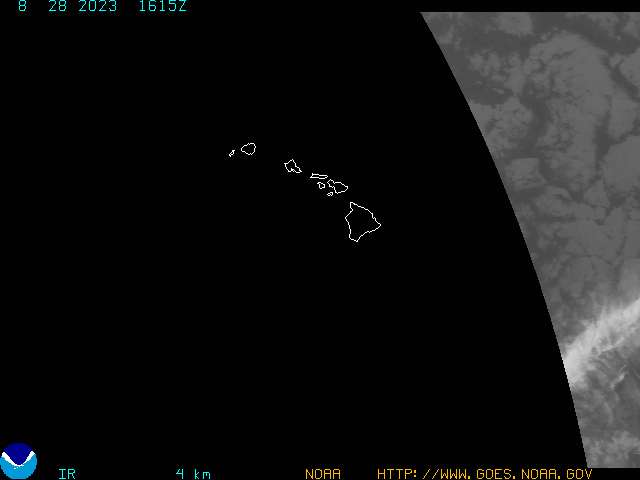
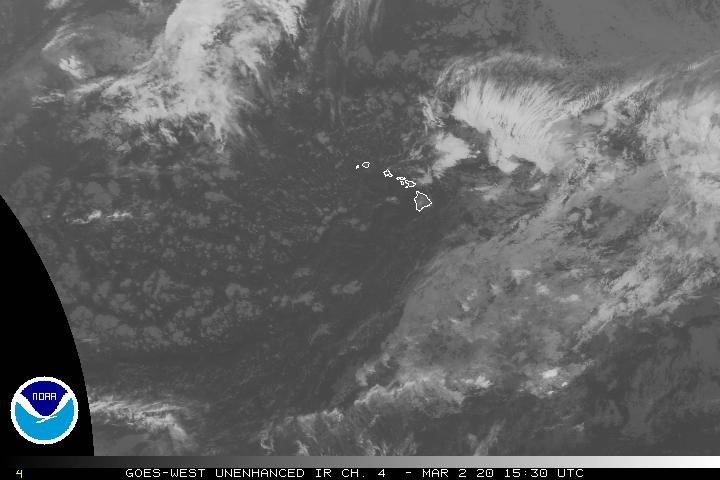
Satellite and Radar Images: To view the cloud conditions we have here in Hawaii, please use the following satellite links, starting off with theInfrared Satellite Image of the islands to see all the clouds around the state during the day and night. This next image is one that gives close images of the islands only during the daytime hours, and is referred to as a Close-up visible image. This next image shows a larger view of the Pacific…giving perspective to the wider ranging cloud patterns in the Pacific Ocean. To help you keep track of where any showers may be around the islands, here’s the latest animatedradar image.
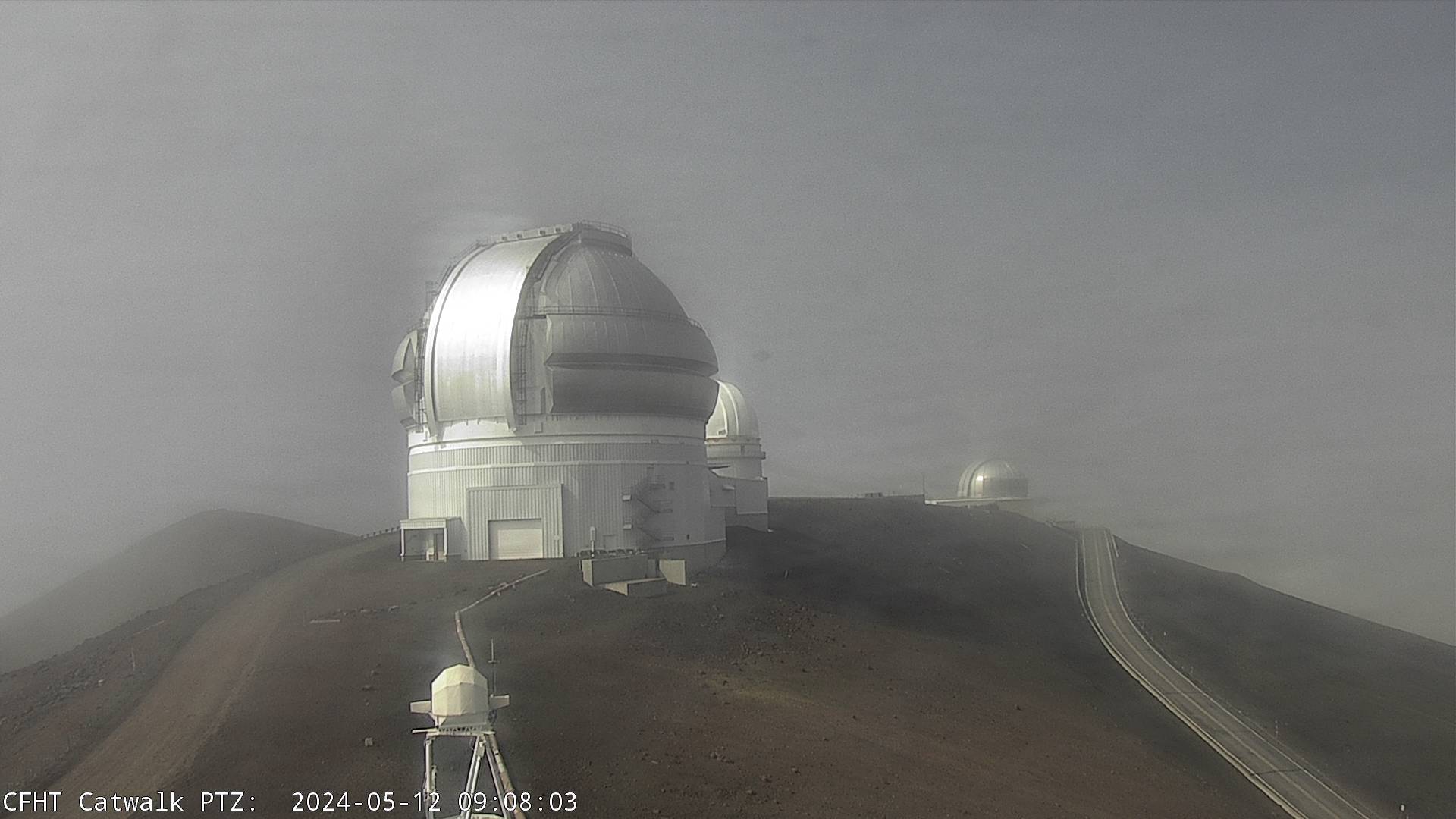
Hawaii’s Mountains – Here’s a link to the live webcam on the summit of near 14,000 footMauna Kea on the Big Island of Hawaii. The tallest peak on the island of Maui is theHaleakala Crater, which is near 10,000 feet in elevation. These two webcams are available during the daylight hours here in the islands…and when there’s a big moon rising just after sunset for an hour or two! Plus, during the nights and early mornings you will be able to see stars, and the sunrise too…depending upon weather conditions.
Aloha Paragraphs
Incredibly colorful plumeria flowers…they smell good too! Photo Credit: Flickr.com
High pressure stretched out to the north of Hawaii, with low pressure to our south…is the reason we’re finding steady trade winds blowing. These trade winds will be moderately strong and gusty through the rest of the week. Small craft wind advisories flags are still flapping in the breeze in those windiest locations in the southern part of the state. There doesn’t appear to be any end in sight for this extended period of trades, which is normal for this time of year. The leeward beaches will see somewhat less wind in general, although even there…it will become breezy, to locally windy during the afternoon hours. Satellite imagery shows clouds, some of which are showery in nature, being carried our way in the trade wind flow. The vast majority of these passing showers will fall along the windward sides. As is often the case, the leeward Kona area could see a few showers as well. Looking into the area upstream, in terms of the trade winds, shows not a very impressive amount of showery clouds…unfortunately. The last 24 hours was quite productive in terms of showers along the windward sides, which was very helpful in pushing back the dry condition of late.
~~~ It’s early Friday evening, here in Kihei, Maui, as I begin writing this last paragraph of today’s narrative. Today was yet another windy day here on the south coast of Maui. The ocean surface, during my lunch break, was completely frothed-up with choppy white caps! Looking at the wind reports at 5pm, showed the windiest place in the entire state was once again Maalaea Bay…where winds were gusting to 40 mph! I’m about ready to jump in my car for the drive to Kahului. I’m going to see the new film The Incredible Hulk (2008)…starring Ed Norton, Liv Tyler, Tim Roth, William Hurt, and Christina Cabot. This is theexplosive, action-packed adventure in one of the all-time most popular superhero sagas unfolds with a cure in reach for the world’s most primal force of fury: THE INCREDIBLE HULK. We find scientist Bruce Banner (Edward Norton) living in shadows, scouring the planet for an antidote. But the warmongers who dream of abusing his powers won’t leave him alone, nor will his need to be with the only woman he has ever loved, Betty Ross (Liv Tyler). Upon returning to civilization, our brilliant doctor is ruthlessly pursued by The Abomination (Tim Roth)–a nightmarish beast of pure adrenaline and aggression whose powers match The Hulk’s own. A fight of comic-book proportions ensues as Banner must call upon the hero within to rescue New York City from total destruction. I’m very much looking forward to seeing this now famous film, and will let you know what I thought early Saturday morning. Although if you can’t wait for that review, you can get a sneak preview by clicking here to see the trailer. I hope you have a great Friday night until then! Aloha for now…Glenn.
An oldie but goodie…Baby Come Back by the Players. Interesting:
The world’s population will reach 7 billion in 2012, even as the global community struggles to satisfy its appetite for natural resources, according to a new government projection. There are 6.7 billion people in the world today. The United States ranks third, with 304 million, behind China and India, according to projections released Thursday by the Census Bureau. The world’s population surpassed 6 billion in 1999, meaning it will take only 13 years to add a billion people. By comparison, the number of people didn’t reach 1 billion until 1800, said Carl Haub, a demographer at the Population Reference Bureau. It didn’t reach 2 billion until 130 years later.
"You can easily see the effect of rapid population growth in developing countries," Haub said. Haub said that medical and nutritional advances in developing countries led to a population explosion following World War II. Cultural changes are slowly catching up, with more women in developing countries going to school and joining the work force. That is slowing the growth rate, though it is still high in many countries. The global population is growing by about 1.2 percent per year. The Census Bureau projects the growth rate will decline to 0.5 percent by 2050.
Interesting2:
A space mission that will be critical to our understanding of climate change has launched from California. The Jason-2 satellite will become the primary means of measuring the shape of the world’s oceans, taking readings with an accuracy of better than 4cm. Its data will track not only sea level rise but reveal how the great mass of waters are moving around the globe. This information will be fundamental in helping weather and climate agencies make better forecasts. The satellite left Earth at 0746 GMT atop a Delta-2 rocket from the Vandenberg Air Force Base. The spacecraft, built by Thales Alenia Space, represents the joint efforts of the US and French space agencies (Nasa and CNES), and the US and European organisations dedicated to studying weather and climate from orbit (Noaa and Eumetsat).
Jason-2 will provide a topographic map of 95% of the Earth’s ice-free oceans every 10 days. Although we think of our seas as being flat, they are actually marked by "hills" and "valleys", where the highs and lows may be as much as two metres apart. Elevation is a key parameter for oceanographers. Just as surface air pressure reveals what the atmosphere is doing above, so ocean height will betray details about the behaviour of water down below. The data gives clues to temperature and salinity. When combined with gravity information, it will also indicate current direction and speed. The oceans store vast amounts of heat from the Sun; and how they move that energy around the globe and interact with the atmosphere are what drive our climate system.
Interesting3:China raised prices for fuel by as much as 18 percent on Friday in a move that could cool the nation’s surging energy consumption. International oil prices dropped sharply Thursday after China said it will raise fuel prices, with light, sweet crude for July delivery falling $4.75 to settle at $131.93 a barrel on the New York Mercantile Exchange. In Asian trading, oil was up slightly at $132.01 a barrel. Growing Chinese demand for oil has underpinned the multiyear rally in oil prices, but higher prices could help crimp that demand. Concerns about spiking Chinese demand for diesel due to cleanup operations in the aftermath of last month’s earthquake contributed to oil’s recent run-up. Lower demand in China "would be a major factor in driving prices down," said Phil Flynn, an analyst at Alaron Trading Corp. in Chicago.
The China Daily newspaper reported Friday that the increase was "because of the soaring price of crude in the international market." It said areas in Sichuan province, hit by a massive earthquake last month, were exempt from the increase. The price increase was announced issued late Thursday after China‘s financial markets were disclosed by the National Development and Reform Commission, the government’s main economic planning agency announced. Prices of gasoline and diesel rose by 1,000 yuan ($145) per ton to 6,980 yuan ($1,015) and 6,520 yuan ($949), respectively. Aviation kerosene rose by 1,500 yuan ($218) per ton to 7,450 yuan ($1,084), the commission said on its Web site.
Air Temperaturesranged between these warmest and coolest spots near sea level at 4 p.m. Thursday afternoon:
Honolulu, Oahu – 85F Hilo, Hawaii– 78
Precipitation Totals – The following numbers represent the largest precipitation totals (inches) during the last 24 hours on each of the major islands, as of Thursday afternoon: 1.08 Mount Waialeale, Kauai
0.27 South Fork Kaukonahua, Oahu
0.03 Molokai 0.00 Lanai
0.00 Kahoolawe
0.59 Puu Kukui, Maui
0.75 Pahoa, Big Island
Weather Chart – Here’s the latest (automatically updated) weather mapshowing a 1029 millibar high pressure system to the north-northwest of the islands Friday. This high pressure cell, with its associated ridging, will keep moderately strong trade winds blowing, with those usual stronger gusts in the major channels…and those windiest coastal areas.
Satellite and Radar Images: To view the cloud conditions we have here in Hawaii, please use the following satellite links, starting off with theInfrared Satellite Image of the islands to see all the clouds around the state during the day and night. This next image is one that gives close images of the islands only during the daytime hours, and is referred to as a Close-up visible image. This next image shows a larger view of the Pacific…giving perspective to the wider ranging cloud patterns in the Pacific Ocean. To help you keep track of where any showers may be around the islands, here’s the latest animatedradar image.
Hawaii’s Mountains – Here’s a link to the live webcam on the summit of near 14,000 footMauna Kea on the Big Island of Hawaii. The tallest peak on the island of Maui is theHaleakala Crater, which is near 10,000 feet in elevation. These two webcams are available during the daylight hours here in the islands…and when there’s a big moon rising just after sunset for an hour or two! Plus, during the nights and early mornings you will be able to see stars, and the sunrise too…depending upon weather conditions.
Aloha Paragraphs
Kauai from the air Artist Credit: James Coleman
The name of the game now, at least in terms of weather in the islands…will be trade winds, trade winds, and more trade winds! These trade winds will be quite strong and gusty through the rest of the week, with small craft wind advisories having gone up in those windiest locations in the southern part of the state in response. There doesn’t appear to be any end in sight for this extended period of trades, which is normal for this time of year. All this "air in a hurry" will carry clouds in our direction off the ocean to our east. Whatever showers that fall, will generally end up along the windward sides. As is often the case, the leeward Kona area could see a few showers as well. There are no rainfall enhancing weather systems on our horizon at the moment…although later this weekend, into early next week, we may see some modest increase in those windward biased showers.
~~~ It’s early Thursday evening, here in Kihei, Maui, as I begin writing this last paragraph of today’s narrative. Looking out the window, I see lots of wind blowing out there, gusty stuff! Looking at the wind reports from around the state early this evening, the strongest gust was, which isn’t usual…that 38 mph reading at that windy bay in Maalaea, here on Maui. Lots of dust is being picked up by the winds, off the dirt covered sugar cane fields in the central valley. Other than these brisk trades, there’s nothing too unusual happening out there. Thursday fair, but windy weather, will track right on into Friday…and then on into the upcoming weekend. I’ll be back very early Friday morning with your next new weather narrative from paradise. I hope you have a lovely Thursday night, which will remain awash with full moon energy, I mean light. Aloha for now…Glenn. Interesting:
New research suggests that ocean temperature and associated sea level increases between 1961 and 2003 were 50 percent larger than estimated in the 2007 Intergovernmental Panel on Climate Change report. The results are reported in the June 19 edition of the journal Nature. An international team of researchers, including Lawrence Livermore National Laboratory climate scientist Peter Gleckler, compared climate models with improved observations that show sea levels rose by 1.5 millimeters per year in the period from 1961-2003. That equates to an approximately 2½-inch increase in ocean levels in a 42-year span. The ocean warming and thermal expansion rates are more than 50 percent larger than previous estimates for the upper 300 meters of oceans.
The research corrected for small but systematic biases recently discovered in the global ocean observing system, and uses statistical techniques that “infill” information in data-sparse regions. The results increase scientists’ confidence in ocean observations and further demonstrate that climate models simulate ocean temperature variability more realistically than previously thought. “This is important for the climate modeling community because it demonstrates that the climate models used for assessing sea-level rise and ocean warming tie in closely with the observed results,” Gleckler said. Climate model data were analyzed from 13 different modeling groups. All model data were obtained from the WCRP CMIP3 multi-model dataset archived at the LLNL’s Program for Climate Model Diagnosis and Intercomparison (PCMDI).
Interesting2:
In the Midwest floods, there’s a broad threat to the crops. Here, in some of the best soil in the world, the stunted stalks of Dave Timmerman’s newly planted corn are wilting in what sometimes look more like rice paddies than the plains, the sunshine glinting off of pools of collected water. Although time is running out, he has yet to plant his soybean crop because the waterlogged soil cannot support his footsteps, much less heavy machinery. Mr. Timmerman’s small farm has been flooded four times in the past month by the Wildcat Creek, a tributary of the Cedar River which overflowed its banks at a record 31 feet last week, causing catastrophic damage in nearby Cedar Rapids and other eastern Iowa towns and farmsteads. "In the lean years, we had beautiful crops but they weren’t worth much," Mr. Timmerman said, surveying his farm, which his family has tended since his great-great-grandfather.
"Now, with commodity prices sky high, mother nature is throwing us all these curve balls. I’m 42 years old and these are by far the poorest crops I’ve ever seen." And he added, "It’s going downhill by the day." As the floodwaters receded in some areas, they rose in others. On Sunday, residents in Iowa City – where the Iowa River was nearing its projected crest and rising downstream – were struggling with the waters, which submerged part of the University of Iowa‘s campus and sent workers scrambling to move books and paintings from the university’s Arts Campus. "Certainly Iowa City has never seen anything like this before," said Linda Kettner, a university spokeswoman. "A lot of people have been displaced. It’s a very poignant time. And at the University of Iowa, we’ve never faced a challenge like this."
Interesting3:
Presidential candidates Barack Obama and John McCain are missing a monumental opportunity to save millions of lives and radically change the course of world history.Global warming, the oil crisis, and HIV/AIDS are finally receiving serious attention, and yet we continue to avoid an issue that perennially threatens the lives of children. The issue could not be more basic, more important, or more ignored: The issue is water. More than 1 billion people, almost 20 percent of the global population, lack access to clean drinking water. Two billion more lack access to basic sanitation. Nearly 2 million children around the world will die this year from water-related illnesses, and with populations in the poorest regions growing faster than in industrialized areas we can expect this number to increase. Meanwhile, the United States has little to say on global or domestic water policy.
Fortune magazine reports that the global water crisis will be as serious in the twenty-first century as oil crises were in the twentieth century, potentially leading to warfare. So it should come as a shock that water is not on the lips of the presidential candidates. Obama denounced the rising oceans associated with climate change in the speech where he claimed his status as the presumptive Democratic nominee, but he did not mention the lack of taps for people in the developing world to access a decent glass of water. Similarly, while McCain has moved away from the Republican Party’s traditional aversion to the issue of global warming, he mostly discusses the environmental component and not the human effects.
Interesting4:
The Gina cloth-covered car is a prototype vehicle from BMW that is covered with fabric rather than metal. Like a living animal, its skin wrinkles a bit when elements are extended (like opening the doors). The shape of the skin can be altered by the car’s owner; it is stretched across flexible metal wires attached to the frame that can be moved with hydraulics. The fabric itself is a silver expansion-resistant textile that is form-fitted to the car’s structure. "The high-precision fit of the material to the metal mesh also allows surface changes without slackening the tension," a spokesman said.
I can’t think of a cloth-covered car in science fiction; readers may have a reference. However, I think that sf writers could suggest some improvements on the fabric skin. For example, I think you’d want to have a car skin that kept itself clean; impregnating the cloth with fabricules from Stephenson’s The Diamond Age would give you a car that never needed to be washed. A Self-Cleaning Fabric With Polymer Film Sprinkled With Silver Nanoparticles demonstrates how scientists are working on this kind of fabric.
Air Temperaturesranged between these warmest and coolest spots near sea level at 4 p.m. Wednesday afternoon:
Honolulu, Oahu – 85F Kailua-kona– 79
Precipitation Totals – The following numbers represent the largest precipitation totals (inches) during the last 24 hours on each of the major islands, as of Wednesday afternoon: 2.59 Mount Waialeale, Kauai
0.91 Oahu Forest NWR, Oahu
0.00 Molokai 0.00 Lanai
0.00 Kahoolawe
0.34 Oheo Gulch, Maui
0.24 Glenwood, Big Island
Weather Chart – Here’s the latest (automatically updated) weather mapshowing high pressure systems to the north-northwest and northeast of the islands. Meanwhile, a trough of low pressure to the west and NW of the state will continue to move away. The net result will be for strengthening trade winds through Thursday.
Satellite and Radar Images: To view the cloud conditions we have here in Hawaii, please use the following satellite links, starting off with theInfrared Satellite Image of the islands to see all the clouds around the state during the day and night. This next image is one that gives close images of the islands only during the daytime hours, and is referred to as a Close-up visible image. This next image shows a larger view of the Pacific…giving perspective to the wider ranging cloud patterns in the Pacific Ocean. To help you keep track of where any showers may be around the islands, here’s the latest animatedradar image.
Hawaii’s Mountains – Here’s a link to the live webcam on the summit of near 14,000 footMauna Kea on the Big Island of Hawaii. The tallest peak on the island of Maui is theHaleakala Crater, which is near 10,000 feet in elevation. These two webcams are available during the daylight hours here in the islands…and when there’s a big moon rising just after sunset for an hour or two! Plus, during the nights and early mornings you will be able to see stars, and the sunrise too…depending upon weather conditions.
Aloha Paragraphs
Big full moon rising! Artist Credit: James Coleman
We’re moving into a solid trade wind weather pattern here in Hawaii now. These trade winds are expected to become stronger through the rest of the week, with small craft wind advisories having gone up in those windiest locations in the southern part of the state Wednesday afternoon. There doesn’t appear to be any end in sight for this extended period of trades, which is normal for this time in the month of June. These gusty trade winds will carry clouds in our direction, although no heavy showers are indicated. Showers will fall generally along the windward sides…although the Kona slopes could see a few afternoon showers too. There are no rainfall enhancing weather systems on our horizon at this time. This isn’t particularly good news however, as we’re a bit dry going into the summer months.
~~~ As can be seen on this looping satellite image, there are still lots of clouds associated with the trough to our west, which is spinning in a counterclockwise fashion near the International Dateline. Meanwhile, to the south, we see a streaky area of high cirrus clouds. They are mostly staying to the south of the Big Island Wednesday evening, but the northern fringe at times pushes up over the Big Island and the islands of Maui County.
~~~ It’s early Wednesday evening, here in Kula, Maui, as I start writing this last paragraph of today’s narrative. It was another nice day here in paradise, with loads of sunshine beaming down, especially along the leeward beaches. The windward sides are finding some increase in clouds and showers, and although they aren’t heavy ones…at this point we need every drop of water that falls from the sky! Speaking of beaming down, June’s full moon will be at the height of its glory tonight! I trust that everyone will have the opportunity, or make it for themselves…to step outside and check it out! I’ll be back very early Thursday morning with your next new weather narrative. I hope you have a bright Wednesday night wherever you happen to be reading from! Aloha for now…Glenn.
Interesting:
With oil prices near $140 a barrel, motorists are starting to look seriously at both alternative fuels and electric vehicles as a way to be able to keep driving their cars. But experts say it will take five to 10 years for these alternatives to take root, given the capacity challenge for an auto industry that is adding 65 million new cars a year to a fleet of 1 billion. In the meantime, car and parts makers, oil companies and even electricity generators are left guessing which way motorists will turn and what technology will win. "We don’t know at the moment whether it’s battery-based electricity technology or sustainable biofuels that will be successful," said James Smith, chairman of Shell UK Ltd, speaking at a climate change seminar hosted by Reuters. "The strategic issues confronting us are very significant." A range of options will emerge as motorists pick between "plug-in" electric cars, longer-range gasoline-electric "hybrids," or simply downsized, more efficient gasoline and diesel models, and as governments, worried by global warming and energy security, give more or less support for biofuels.
Hybrid vehicles, which have both a conventional internal combustion engine and electric motor and battery, are already popular. Toyota Motor Corp has sold 1.5 million Prius hybrids since 1997 and it wants hybrids to reach one tenth of its total sales by 2011. In a hybrid, the electric battery and motor aid stop-start city driving, while the gasoline engine allows longer trips, together cutting energy use and carbon emissions. Hybrids accounted for 3 percent of U.S.car sales in 2007. Makers absorb most of the extra $5,000 engine cost, leaving the street price only $1000 to $2000 higher. Hybrids could be "broadly present" in the auto industry in five years, said Vlatko Vlatkovic, head of electrification research at GE, which has much to gain from widespread electrification of road transport.
Interesting2:The list of countries on the brink of disaster because of the global food crisis is growing by the week. Terrorism and security experts predict widespread social and political unrest and violent conflict in the second and third world. Last week the United Nations’ World Food Program announced it is to provide U.S. $1.2 billion (£600 million) in additional food aid in the 62 countries hit hardest by the food and fuel crisis. And Save the Children Sunday launched an emergency appeal to help children in Ethiopia who are suffering from increasing levels of hunger. The charity said a combination of drought and escalating food prices has left 4.6 million people urgently in need of food. In scenes reminiscent of the famines of the 1980s, about 736,000 of these are children under the age of five, a group which is particularly vulnerable to the effects of malnutrition.
More so than terrorism or global warming, food security will become so critical it will change global governance and result in civil unrest and food wars. “It is clear which countries are going to be at risk,” Graham Hutchings of Oxford Analytica Daily Brief, which provides country-specific daily risk analysis to political leaders, academics, businesses and NGOs, told the Sunday Herald. “Those who are net importers of food and those with weak governments will fall, in all likelihood. The overthrow of the leader in Haiti in April over food prices is the shape of things to come. “Those which have come across our radar are Cambodia, parts of India, the Philippines, central Asian countries such as Uzbekistan and Tajikistan and African countries such as Senegal, Cameroon, Burkina Faso and the Ivory Coast. There have been food riots in Egypt, Yemen and Malaysia.”
Interesting3:
Manya professor dreams of revolution. But Norman T. Uphoff, working in a leafy corner of the CornellUniversity campus, is leading an inconspicuous one centered on solving the global food crisis. The secret, he says, is a new way of growing rice. Rejecting old customs as well as the modern reliance on genetic engineering, Dr. Uphoff, 67, an emeritus professor of government and international agriculture with a trim white beard and a tidy office, advocates a management revolt. Harvests typically double, he says, if farmers plant early, give seedlings more room to grow and stop flooding fields. That cuts water and seed costs while promoting root and leaf growth.
The method, called the System of Rice Intensification, or S.R.I., emphasizes the quality of individual plants over the quantity. It applies a less-is-more ethic to rice cultivation. In a decade, it has gone from obscure theory to global trend – and encountered fierce resistance from established rice scientists. Yet a million rice farmers have adopted the system, Dr. Uphoff says. The rural army, he predicts, will swell to 10 million farmers in the next few years, increasing rice harvests, filling empty bellies and saving untold lives. "The world has lots and lots of problems," Dr. Uphoff said recently while talking of rice intensification and his 38 years at Cornell. "But if we can’t solve the problems of peoples’ food needs, we can’t do anything. This, at least, is within our reach."
Interesting4:
Placing solar panels in space above both night and clouds was first considered 40 years ago. But the estimated cost was, in a word, astronomical. The idea, however, has seen a resurgence, thanks to rising oil prices and advances in solar technology. A report from U.S. Defense Department found that space-based solar is technically feasible and economically viable. To help prove the point, the Air Force Academy recently announced plans for a small demonstration satellite that would beam down a meager, but still significant, 0.1 watts of solar power. "Our vision is to build the world’s first-ever space-based solar power system to light a single bulb on Earth and in so doing light the path for business to follow," said Col. Michael "Coyote" Smith of the Air Force.
The type of transmission beam is still not decided, but the project may benefit from separate research in Japan that has been studying the two most likely technologies: microwaves and lasers. The sun puts out more than 10 trillion times the energy currently being consumed by the whole world. "We would only need to tap into a small fraction of that to get all our energy now and in many years to come," said Mark Hopkins, senior vice president of the National Space Society, which recently formed an alliance with other non-profits to promote space-based solar. The advantage of going to space is that sunlight is constant up there and three to 13 times stronger than the average down here on Earth, Smith said.
Interesting5:
How clouds respond to global warming poses a huge challenge for climate scientists, since clouds are far more changeable in real life than models can predict.However, experts do agree that the level of future global warming greatly depends on clouds. A new study finds that natural variations in how clouds form could actually be causing temperature changes, rather than the other way around, and could also lead to overestimates of how sensitive the Earth’s climate is to greenhouse gas emissions. "Since the cloud changes could conceivably be caused by known long-term modes of climate variability, such as the Pacific Decadal Oscillation, or El Niño and La Niña, some, or even most, of the global warming seen in the last century could simply be due to natural fluctuations in the climate system," says lead author Roy Spencer of the University of Alabama-Huntsville.
Spencer and his co-author William Braswell point out that the paper doesn’t disprove the theory that humans are causing global warming. Instead, they report that "it offers an alternative explanation for what we see in the climate system which has the potential for greatly reducing estimates of mankind’s impact on Earth’s climate." "But we really won’t know until much more work is done," he added. In addition to this article, Spencer has published several others that question the scientific consensus about climate change, which states that human-produced greenhouse gases such as carbon dioxide are causing global warming.
Air Temperaturesranged between these warmest and coolest spots near sea level at 5 p.m. Tuesday evening:
Kahului, Maui – 85F Lihue, Kauai – 78
Precipitation Totals – The following numbers represent the largest precipitation totals (inches) during the last 24 hours on each of the major islands, as of Tuesday afternoon: 1.16 Opaekaa Stream, Kauai
1.02 Manoa Valley, Oahu
0.10 Molokai 0.00 Lanai
0.00 Kahoolawe
0.87 Oheo Gulch, Maui
0.58 Kapapala Ranch, Big Island
Weather Chart – Here’s the latest (automatically updated) weather mapshowing high pressure systems to the north-northwest and northeast of the islands. Meanwhile, a trough of low pressure to the west and NW of the state will continue to move away. The net result will be for strengthening trade winds through Thursday.
Satellite and Radar Images: To view the cloud conditions we have here in Hawaii, please use the following satellite links, starting off with theInfrared Satellite Image of the islands to see all the clouds around the state during the day and night. This next image is one that gives close images of the islands only during the daytime hours, and is referred to as a Close-up visible image. This next image shows a larger view of the Pacific…giving perspective to the wider ranging cloud patterns in the Pacific Ocean. To help you keep track of where any showers may be around the islands, here’s the latest animatedradar image.
Hawaii’s Mountains – Here’s a link to the live webcam on the summit of near 14,000 footMauna Kea on the Big Island of Hawaii. The tallest peak on the island of Maui is theHaleakala Crater, which is near 10,000 feet in elevation. These two webcams are available during the daylight hours here in the islands…and when there’s a big moon rising just after sunset for an hour or two! Plus, during the nights and early mornings you will be able to see stars, and the sunrise too…depending upon weather conditions.
Aloha Paragraphs
Sailing in the islands…great colors! Photo Credit:flickr.com
A trough of low pressure to the west and northwest of Kauai, is easing away towards the west Tuesday night. As the trough moves away, the trade winds are spreading back across the entire island chain again. These trade winds are expected to become stronger through the rest of the week, with small craft wind advisories going up in those windiest locations. As the trough departs, a well established trade wind weather pattern takes over duty through the rest of the week. Showers will be carried towards us on these strengthening winds, falling mostly along the windward sides…although the Kona slopes could see a few afternoon showers too. The rainfall potential however is quite low, with a fairly minimum amount of showers in the forecast.
~~~ As can be seen on this looping satellite image, there are lots of clouds associated with the trough to our west. Those rain bearing clouds will be too far away to influence the main Hawaiian Islands. Meanwhile, to the south, we see a rather large area of high cirrus clouds. If they continue to move northward, we may see them over at least some parts of the state into Wednesday. As usual, they are famous for giving colorful sunset and sunrise colors.
~~~ It’s early Tuesday evening, here in Kula, Maui, as I start writing this last paragraph of today’s narrative. As the trough moves away now, we’ll see a stronger area of trade winds moving in behind it…in its wake. Besides the gusty nature of those trade winds, our weather here in the islands should be just fine, as we move towards the summer solstice this weekend. By the way, the official start of summer will be this Friday, the 20th at 2pm HST. Don’t forget to check out that soon to be full moon, which will be lighting up our night skies brilliantly over the next couple of nights! The point at which the moon will be fullest will occur Wednesday evening at 731pm, at least here in Hawaii. I’ll be back very early Wednesday morning with your next new weather narrative from paradise. I hope you have a great Tuesday night wherever you happen to be spending it! Aloha for now…Glenn.
Interesting:As the full moon rises this Wednesday evening, June 18, many people will be fooled into thinking it’s unusually large. The moon illusion, as it’s known, is a trick in our minds that makes the moon seem bigger when it’s near the horizon. The effect is most pronounced at full moon. Many people swear it’s real, suggesting that perhaps Earth’s atmosphere magnifies the moon. But it really is all in our minds. The moon is not bigger at the horizon than when overhead. The illusion will be particularly noticeable at this "solstice moon," coming just two days before summer starts in the Northern Hemisphere. The reason, according to NASA, lies in lunar mechanics: The sun and full moon are like kids on a see-saw; when one is high, the other is low. This week’s high solstice sun gives us a low, horizon-hugging moon and a strong, long-lasting version of the illusion.
Interesting2:For most folks, a nice hug and some sympathy can help a bit after we get pushed around. Turns out, chimpanzees use hugs and kisses the same way. And it works. Researchers studying people’s closest genetic relatives found that stress was reduced in chimps that were victims of aggression if a third chimp stepped in to offer consolation. "Consolation usually took the form of a kiss or embrace,” said Dr. Orlaith N. Fraser of the Research Center in Evolutionary Anthropology and Paleoecology at Liverpool John Moores University in England.
"This is particularly interesting,” she said, because this behavior is rarely seen other than after a conflict. "If a kiss was used, the consoler would press his or her open mouth against the recipient’s body, usually on the top of the head or their back. An embrace consisted of the consoler wrapping one or both arms around the recipient.” The result was a reduction of stress behavior such as scratching or self-grooming by the victim of aggression, Fraser and colleagues report in Tuesday’s edition of Proceedings of the National Academy of Sciences.
Dr. Frans de Waal of the YerkesPrimateCenter at EmoryUniversity in Atlanta said the study is important because it shows the relationship between consolation and stress reduction. Previous researchers have claimed that consolation had no effect on stress, said de Waal, who was not part of Fraser’s research team. "This study removes doubt that consolation really does what the term suggests: provide relief to distressed parties after conflict. The evidence is compelling and makes it likely that consolation behavior is an expression of empathy,” de Waal said.
Interesting3:Toyota is struggling to keep up with booming demand for its hybrid vehicles because it can’t make enough of the batteries that are key parts in the hit "green” cars, a senior executive said Monday. The crunch is likely to remain the rest of the year, as battery production can’t be boosted until next year, said Toyota Motor Corp. Executive Vice President Takeshi Uchiyamada, who oversees production at Japan‘s top automaker. "Hybrids are selling so well we are doing all we can to increase production,” he told The Associated Press. "We need new lines.” Battery production is critical in determining how many hybrid vehicles Toyota can produce, Uchiyamada said at the company’s Tokyo office. Hybrids, including Toyota‘s top-selling Prius, offer better mileage than comparable gas-only cars by switching to an electric motor whenever possible. Toyota leads the world’s automakers in hybrids sold at about 1.5 million vehicles since the first mass-produced hybrid Prius came out about a decade ago. The company now offers other models in a hybrid version. Prius and other hybrids are soaring in popularity around the world amid surging gasoline prices, and other automakers are also rushing to produce hybrids. Hybrids also boast a green image in reducing emissions linked to global warming.
Air Temperaturesranged between these warmest and coolest spots near sea level at 5 p.m. Monday evening:
Kahului, Maui – 83F Lihue, Kauai – 77
Precipitation Totals – The following numbers represent the largest precipitation totals (inches) during the last 24 hours on each of the major islands, as of Monday afternoon: 1.44 Mount Waialeale, Kauai
1.03 Makaha Stream, Oahu
0.00 Molokai 0.21 Lanai
0.27 Kahoolawe
0.19 Oheo Gulch, Maui
0.43 Kealakekua, Big Island
Weather Chart – Here’s the latest (automatically updated) weather mapshowing high pressure systems to the north-northwest and northeast of the islands. Meanwhile, a trough of low pressure to the west and NW of the state will keep light winds in place over Kauai and Oahu…while Maui and the Big Island will continue to see light to moderately strong trade winds. Winds will increase everywhere Wednesday.
Satellite and Radar Images: To view the cloud conditions we have here in Hawaii, please use the following satellite links, starting off with theInfrared Satellite Image of the islands to see all the clouds around the state during the day and night. This next image is one that gives close images of the islands only during the daytime hours, and is referred to as a Close-up visible image. This next image shows a larger view of the Pacific…giving perspective to the wider ranging cloud patterns in the Pacific Ocean. To help you keep track of where any showers may be around the islands, here’s the latest animatedradar image.
Hawaii’s Mountains – Here’s a link to the live webcam on the summit of near 14,000 footMauna Kea on the Big Island of Hawaii. The tallest peak on the island of Maui is theHaleakala Crater, which is near 10,000 feet in elevation. These two webcams are available during the daylight hours here in the islands…and when there’s a big moon rising just after sunset for an hour or two! Plus, during the nights and early mornings you will be able to see stars, and the sunrise too…depending upon weather conditions.
Our winds have dropped off into the lighter realms Monday…veering around to the east-southeast, or even southeast locally for the next 24-36 hours. This veering motion is being caused by an unusual trough of low pressure that has developed to the west and northwest of Kauai. It will take until later Tuesday or Wednesday before we see the return of our classic trade winds, which will take us into the beginning of our summer season…which occurs this weekend. These lighter winds will have us feeling rather warm and humid during the days, and slightly cooler than normal during the early morning hours. We can consider this to be a modified convective weather pattern, with the usual warm and muggy air that gets brought up on the slightly south of east winds. The next day or two will feel rather muggy, with the chance of a few showers, the most generous of which will be on the island of Kauai.
The relatively close proximity of the trough to the west, will make our atmosphere locally more shower prone. The daytime heating of the islands will get the air rising, and the troughs cold air aloft will allow the cumulus clouds grow more vertically than usual…at least locally. The afternoon hours will likely have the heaviest showers, mostly over the interior sections of the islands. Kauai and Oahu, being closest to the destabilizing influence of the upper trough, with its surface reflection, will see the most generous showers. As the trough moves away later Tuesday into Wednesday, the trade winds will return…with showers shifting back over to the windward sides through the rest of the week.
~~~ This developing light wind episode is yet another perfect example of the unusual nature of this spring season. It makes me wonder what sort of unusual weather occurrences could come our way during the summer months? The first thing that pops into my mind of course would be in regards to tropical cyclone activity. This years hurricane season is forecast to have less than the normal number of storms in the central Pacific. This is a comforting fact, although that doesn’t ensure that we wouldn’t have some close call, or even a direct impact. We don’t usually start to look for spinning storms in our area until later July or August.
~~~ It’s early Monday evening, here in Kula, Maui, as I start writing this last paragraph of today’s narrative. The day turned out to be somewhat windier than expected, which in turn limited the vertical growth of our local clouds. Late in the day the interior sections on Oahu were reporting light rainfall, while most areas basked in warm sunshine. There’s a fair amount of cirrus clouds, which are streaking across island skies up high now. As can be seen on this satellite image, there are lots of clouds associated with the trough to our west…which is the source of the cirrus clouds. Monday evening should be a good sunset, with great colors, which could easily start off Tuesday morning, in a colorful way too. Stronger trade winds aren’t far off, and will bring us back into a typical trade wind weather pattern soon. I’ll be back again very early Tuesday morning with your next new weather narrative. Oh yeah, check out that near full moon tonight, its getting very near its roundest aspect! I hope you have a great Monday night, wherever you happen to be spending it! Aloha for now…Glenn.
Interesting:Japanese car manufacturer Honda has begun the first commercial production of a zero-emission, hydrogen fuel-cell powered vehicle. The four-seater, called FCX Clarity, runs on electricity produced by combining hydrogen with oxygen, and emits water vapour. Honda claims the vehicle offers three times better fuel efficiency than a traditional, petrol-powered car. Honda plans to produce 200 of the cars over the next three years. One of the biggest obstacles standing in the way of wider adoption of fuel-cell vehicles is the lack of hydrogen fuelling stations. Critics also point out that hydrogen is costly to produce and the most common way to produce hydrogen is still from fossil fuels. Analysis of the environmental impact of different fuel technologies has shown that the overall carbon dioxide emissions from hydrogen powered cars can be higher than that from petrol or diesel-powered vehicles. The first five customers are all based in southern California because of the proximity of hydrogen fuelling stations, Honda said. Interesting2:If you are curious about Earth’s periodic mass extinction, events such as the sudden demise of the dinosaurs 65 million years ago, you might consider crashing asteroids and sky-darkening super volcanoes as culprits. But a new study, published online today (June 15, 2008) in the journal Nature, suggests that it is the ocean, and in particular the epic ebbs and flows of sea level and sediment over the course of geologic time, that is the primary cause of the world’s periodic mass extinctions during the past 500 million years. "The expansions and contractions of those environments have pretty profound effects on life on Earth," says Shanan Peters, a University of Wisconsin-Madison assistant professor of geology and geophysics and the author of the new Nature report.
In short, according to Peters, changes in ocean environments related to sea level exert a driving influence on rates of extinction, which animals and plants survive or vanish, and generally determine the composition of life in the oceans. Since the advent of life on Earth 3.5 billion years ago, scientists think there may have been as many as 23 mass extinction events, many involving simple forms of life such as single-celled microorganisms. During the past 540 million years, there have been five well-documented mass extinctions, primarily of marine plants and animals, with as many as 75-95 percent of species lost.
For the most part, scientists have been unable to pin down the causes of such dramatic events. In the case of the demise of the dinosaurs, scientists have a smoking gun, an impact crater that suggests dinosaurs were wiped out as the result of a large asteroid crashing into the planet. But the causes of other mass extinction events have been murky, at best.
"Paleontologists have been chipping away at the causes of mass extinctions for almost 60 years," explains Peters, whose work was supported by the National Science Foundation. "Impacts, for the most part, aren’t associated with most extinctions. There have also been studies of volcanism, and some eruptions correspond to extinction, but many do not."
Interesting3:Germany’s main radiation laboratory has concluded that mobile phones are safe and pose no cancer risk to users, according to a nearly-10-year-long study obtained Monday by Deutsche Presse-Agentur dpa. The survey by the Federal Radiation Protection Bureau found no evidence whatever that cell phones, cordless phones or cordless base stations situated next to beds caused brain cancer, headaches or disturbed sleep in adults. But the scientists said they would like to study the issue longer to make absolutely sure that young children exposed to such electro-magnetic fields did not develop health problems in old age. The bureau, which employs top radiation scientists, advised parents not to let children keep phones permanently in their clothing until such a risk had been ruled out. Large numbers of Germans fear mobile phones may be lethal after alarming reports about them in the media. More than 50 German research projects since 2002 were analysed for the report. In some cases, genetic activity in human cells was observed to change under the influence of radiation, but this did not alter the overall conclusion that the phones were safe. German Environment Minister Sigmar Gabriel was due to unveil the study on Tuesday.
Air Temperaturesranged between these warmest and coolest spots near sea level at 4 p.m. Sunday afternoon:
Kahului, Maui – 86F Hilo, Hawaii – 77
Precipitation Totals – The following numbers represent the largest precipitation totals (inches) during the last 24 hours on each of the major islands, as of Sunday afternoon: 0.13 Mount Waialeale, Kauai
0.29 Koolau Forest NWR, Oahu
0.00 Molokai 0.14 Lanai
0.01 Kahoolawe
0.36 Oheo Gulch, Maui 0.63 Pahala, Big Island
Weather Chart – Here’s the latest (automatically updated) weather mapshowing high pressure systems to the north and northeast of the islands, which would ordinarily provide moderately strong trade winds. A developing trough to the west and NW of the state however, will keep our winds lighter through Tuesday…turning ESE or even SE locally.
Satellite and Radar Images: To view the cloud conditions we have here in Hawaii, please use the following satellite links, starting off with theInfrared Satellite Image of the islands to see all the clouds around the state during the day and night. This next image is one that gives close images of the islands only during the daytime hours, and is referred to as a Close-up visible image. This next image shows a larger view of the Pacific…giving perspective to the wider ranging cloud patterns in the Pacific Ocean. To help you keep track of where any showers may be around the islands, here’s the latest animatedradar image.
Hawaii’s Mountains – Here’s a link to the live webcam on the summit of near 14,000 footMauna Kea on the Big Island of Hawaii. The tallest peak on the island of Maui is theHaleakala Crater, which is near 10,000 feet in elevation. These two webcams are available during the daylight hours here in the islands…and when there’s a big moon rising just after sunset for an hour or two! Plus, during the nights and early mornings you will be able to see stars, and the sunrise too…depending upon weather conditions.
The trade winds will continue Sunday, bringing their cooling relief from the June sunshine. These trades will blow generally in the light to moderately strong range. Monday will see our winds drop back into the lighter realms again…veering around to the east-southeast, or even southeast locally by into Tuesday. This veering motion will be caused by an unusual trough of low pressure to the west or northwest of Kauai. Whenever we have ESE or SE winds, there’s always that chance of volcanic haze being carried up over the chain from the vents on the Big Island. It will take until later in the week before we see the return of our classic trade winds…which will take us into the beginning of our summer season. Meanwhile, what few showers that we see falling, will end up along the windward sides for the time being.The ESE or southeast winds spoken of in the paragraph above, will not only make our winds lighter soon, as they split around the Big Island, putting the rest of the islands somewhat in a wind shadow…but will also contribute to afternoon interior clouds, and some possible showers too. The air will begin to feel rather warm and humid during the days, and slightly cooler than normal during the early morning hours. Once the trade winds return by mid-week, we’ll see the bias for showers moving back over to the windward coasts and slopes.
~~~ It’s late Sunday afternoon here in Kula, Maui. I’ve got my clothes for the new week washed, hung out, dried, and put away already. I’ve given my car a quick wash, I’ve done my composting, recycling…and am pretty much completely ready for the new work week ahead. When you work five days a week, with a schedule as intense and demanding as mine, there’s definitely some staging and preparation involved. It always feels so good to have it all done, so I can relax through the evening hours. I may end up playing ping pong with my neighbors again around sunset, which would be ok with me. I hope you have a great Sunday night wherever you happen to be spending it! I’ll be back very early Monday morning with your next new weather narrative from paradise. Aloha for now…Glenn.
Happy Fathers Day all you Dads!
Air Temperaturesranged between these warmest and coolest spots near sea level at 5 p.m. Saturday evening:
Barking Sands, Kauai – 84F Hilo, Hawaii – 74
Precipitation Totals – The following numbers represent the largest precipitation totals (inches) during the last 24 hours on each of the major islands, as of Saturday afternoon: 0.45 Mount Waialeale, Kauai
0.10 Waihee Pump, Oahu
0.01 Molokai 0.00 Lanai
0.00 Kahoolawe
0.11 Hana airport, Maui
0.14 Pahoa, Big Island
Weather Chart – Here’s the latest (automatically updated) weather mapshowing a 1034 millibar high pressure system far to the northeast of the islands. This high pressure cell, along with its associated ridge, will keep light to locally moderate trade winds blowing across our area Saturday and Sunday.
Satellite and Radar Images: To view the cloud conditions we have here in Hawaii, please use the following satellite links, starting off with theInfrared Satellite Image of the islands to see all the clouds around the state during the day and night. This next image is one that gives close images of the islands only during the daytime hours, and is referred to as a Close-up visible image. This next image shows a larger view of the Pacific…giving perspective to the wider ranging cloud patterns in the Pacific Ocean. To help you keep track of where any showers may be around the islands, here’s the latest animatedradar image.
Hawaii’s Mountains – Here’s a link to the live webcam on the summit of near 14,000 footMauna Kea on the Big Island of Hawaii. The tallest peak on the island of Maui is theHaleakala Crater, which is near 10,000 feet in elevation. These two webcams are available during the daylight hours here in the islands…and when there’s a big moon rising just after sunset for an hour or two! Plus, during the nights and early mornings you will be able to see stars, and the sunrise too…depending upon weather conditions.
Aloha Paragraphs
Surf will be coming up again soon on the south shores Photo Credit:flickr.com
The trade winds will prevail Sunday, although in a slightly lighter form than normal for June. These trades will blow generally in the light to moderately strong range. An upper level low pressure system to the northeast of the Big Island, is interrupting only slightly the trade winds at the moment. As we glance into the new week ahead, our winds may remain lighter than normal, and veer around to the east-southeast, or even southeast locally. This veering motion will be caused by an unusual trough of low pressure to the west or northwest of Kauai. It will take until the middle of the new week before we see the return of our classic trade winds…which will take us into the beginning of our summer season. Meanwhile, what few showers that we see falling, will end up along the windward sides.This satellite image shows that there are clouds upstream of the islands, which will bring some moisture our way. That satellite picture shows that there are more clouds further east and northeast as well. The large streak of clouds to the south of the state are high cirrus clouds, being carried along in the jet stream level winds aloft. It appears that those high clouds will remain far enough to our south, at least for the time being, that our local skies will stay mostly clear to partly cloudy. There’s always that chance that the upper winds aloft will push those sun dimming clouds northward, but not at the moment. ~~~ It’s early Saturday evening, here in Kula, Maui, with my wind chimes making the sweetest song behind me. Glancing around in all directions, there are clouds, although there are, at the same time, big patches of blue too. Looking at that satellite image, in the paragraph above, there’s a weather feature, which in my humble opinion (IMHO), is worth taking a look at. It’s a near west to east oriented line of high cirrus clouds, being carried along in those winds, which at times, give a bumpy ride to the jet aircraft you may be riding on.
~~~ I had a very pleasant day, starting off of course with the early morning webpage updates I did on this Hawaiian weather website. It was to the beach in Paia then, for a long beach walk, followed by a plunge in the warm Pacific Ocean. I had some food shopping to do in town, and then high-tailed back upcountry to home. I finally got a little espresso in me, and settled down to wait for the delivery of my new Kettler ping pong table, which arrived at noon. I still haven’t had a chance to have my first play, but just invited my neighbors to come up around sunset. It’s such a nice looking table, and being on my outside weather deck, looking down on the bi-coastal views, with perhaps a glass of something or other to sip on, well…suffice it to say I’m looking forward to it!
~~~ Given the fact that tomorrow is Sunday, I’ll not jump right out of bed before the crack of dawn. I may lay in a while longer than I do on a Monday through Saturday morning basis, lounging a bit under my warm down comforter. I’m sure you’ll understand, as come very early Monday morning, I’ll be up and at em, well before the light of day appears. So, on that note, I’d like to wish you all a most pleasant Saturday night! Aloha for now…Glenn.
Since it’s Saturday night, here are a couple of tunes which I like:
Air Temperaturesranged between these warmest and coolest spots near sea level at 4 p.m. Friday afternoon:
Honolulu, Oahu – 84F Lihue, Kauai – 77
Precipitation Totals – The following numbers represent the largest precipitation totals (inches) during the last 24 hours on each of the major islands, as of Friday afternoon: 2.13 Mount Waialeale, Kauai
0.56 Oahu Forest NWR, Oahu
0.06 Molokai 0.04 Lanai
0.62 Kahoolawe
0.41 Oheo Gulch, Maui
0.27 Mountain View, Big Island
Weather Chart – Here’s the latest (automatically updated) weather mapshowing a 1034 millibar high pressure system far to the northeast of the islands. This high pressure cell, along with its associated ridge, will keep light to locally moderate trade winds blowing across our area Friday and Saturday.
Satellite and Radar Images: To view the cloud conditions we have here in Hawaii, please use the following satellite links, starting off with theInfrared Satellite Image of the islands to see all the clouds around the state during the day and night. This next image is one that gives close images of the islands only during the daytime hours, and is referred to as a Close-up visible image. This next image shows a larger view of the Pacific…giving perspective to the wider ranging cloud patterns in the Pacific Ocean. To help you keep track of where any showers may be around the islands, here’s the latest animatedradar image.
Hawaii’s Mountains – Here’s a link to the live webcam on the summit of near 14,000 footMauna Kea on the Big Island of Hawaii. The tallest peak on the island of Maui is theHaleakala Crater, which is near 10,000 feet in elevation. These two webcams are available during the daylight hours here in the islands…and when there’s a big moon rising just after sunset for an hour or two! Plus, during the nights and early mornings you will be able to see stars, and the sunrise too…depending upon weather conditions.
Aloha Paragraphs
Nice south swell on the leeward beaches now Photo Credit:flickr.com
Despite the forecast for light trade winds Friday, they decided to increase in strength today, at least locally. The same near 1035 millibar high pressure system, according to this weather map, remains anchored far to the northeast of the islands Friday night. What happened was that the upper level low, which has been up to the north of the islands the last couple of days, is drifting slowly away. This low aloft has been keeping our local winds lighter than they would otherwise be at this time of year. The way it looks from here, it seems reasonable to look for light to now more likely moderately strong trade winds through the weekend into early next week at least. Those windiest areas could easily see more of the 30+ mph gusts in those windiest spots.
Meanwhile, the expected light winds, which didn’t materialized, have kept the expected afternoon convective clouds away.As a matter of fact, the stronger trade winds have swept much of the moisture downstream, allowing mostly clear and sunny skies to prevail. This satellite image shows the situation well. Looking more closely at that satellite image though, shows more clouds not too far upstream of the windward sides of the islands. This larger view shows that there are even more clouds further east and northeast as well. As there are a minimum of clouds around, it stands to reason that there are very few showers. There will likely be some increase in windward biased showers once the next batch of clouds arrives on the trade winds. It appears that we may see an intrusion of high clouds, those down to the SW of the islands at some point this weekend. ~~~ It’s Friday evening, after work here in Kihei, Maui. Looking out the window, there’s hardly a cloud in the sky! The winds are quite breezy through the central valley…between Kahului, and where they shoot out through the Maalaea Bay. At 5pm Friday, the winds were gusting to 33 mph at that windy bay. There’s still a chance that a few heavier showers may pop up overnight near Kauai, and perhaps offshore from Oahu too…as the upper low migrates by from west to east. I didn’t make any plans for after work, it was a busy week, so I guess I’ll just go home to my weather deck, grab a nice cold Sierra Nevada Pale Ale, and enjoy watching the sunset. I’ll be up early Saturday morning, with your next new weather narrative. Saturday is an exciting day, as I get my new Kettler ping pong table, so that I can start playing table tennis again…yeah! I hope you have a great Friday night, Aloha for now…Glenn. Interesting:California scientist Meng Lean has invented a new water filtration method that is cheaper and can recycle about five times faster than today’s system, according to ABC7. The water is not safe for drinking but can be used for activities such as agriculture. The system involves a spiral filtration system. Water is funneled through lightweight disks as they spin, separating dirt and particles from the clean water. Another advantage of the new invention is that much less land space is needed than for a water-treatment plant. Lean continues to refine his system. He and his team plan to experiment on a larger level by the end of June. The goal is to recycle 100 liters of water a minute.
Interesting2:When it comes to greening America’s transportation system, most people focus on cars – producing their fuel differently, using different forms of energy, or shifting commutes away from them entirely. But what of the roads we drive on? Asphalt, which is used to pave over 90 percent of American roads, is processed in Western countries through a process requiring the tar-like substance to be heated to 300 degrees Fahrenheit, an energy-intensive procedure that also produces carbon emissions. In less wealthy parts of the world, though, a "cold mix" approach has long been used; the asphalt isn’t heated, but is sheared into fine particles and mixed with water and surfactants so it can be spread across a road’s surface until it hardens. Now a researcher at the University of Wisconsin-Madison, Dr. Hussain Bahia, intends to adapt these African and Indian techniques – developed by road-builders who couldn’t afford to heat asphalt to make it pliable – for use here. Under the auspices of the Asphalt Research Consortium (a group working with the Federal Highway Administration to improve road-surface performance), he has established a Modified Asphalt Research Center with the goal of improving asphalt in various ways by developing cold mixtures that blend polymers or plastics with crude oil-derived asphalt.
Interesting3:The recovery of Earth’s protective ozone layer, expected to heal gradually over the next half-century or so, may be good news for your skin, but it could also put the brakes on a fast-moving wind current, further exacerbating global warming, a new study suggests. The ozone layer protects Earth’s inhabitants from harmful ultraviolet rays, which can cause skin cancer in humans as well as mutations in other organisms. This layer sits in the lower portion of the stratosphere, the layer of the atmosphere above the troposphere, where Earth’s weather occurs (and we live). Ozone absorbs the sun’s UV light here before it can reach the planet’s surface. The gaping hole in the ozone layer was discovered in 1985, eventually leading to the signing of the Montreal Protocol in 1987, which moved to ban the substances, such as chlorofluorcarbons (CFCs), which destroy stratospheric ozone. (The hole isn’t a total absence of ozone, but a severe reduction in the concentration of ozone that occurs seasonally.) The new study, detailed in the June 13 issue of the journal Science, compares current climate models used by the International Panel on Climate Change to predict the potential long-term consequences of global warming to another set of models that better account for chemical reactions in the stratosphere. Study leader S-W. Son, of ColumbiaUniversity in New York, and an international team of scientists found that the IPCC models fail to adequately model ozone recovery and its possible consequences. The other set of models they used showed that the healing of the ozone layer will warm the stratosphere, disrupting an important westerly wind jet closer to Earth’s surface.
Air Temperaturesranged between these warmest and coolest spots near sea level at 4 p.m. Thursday afternoon:
Kahului, Maui – 84F Lihue, Kauai – 76
Precipitation Totals – The following numbers represent the largest precipitation totals (inches) during the last 24 hours on each of the major islands, as of Thursday afternoon: 3.70 Hanalei River, Kauai 5.75 Ahuimanu Loop, Oahu
0.73 Molokai 0.83 Lanai
0.00 Kahoolawe
0.47 Puu Kukui, Maui
0.45 Kamuela Upper, Big Island
Weather Chart – Here’s the latest (automatically updated) weather mapshowing a 1036 millibar high pressure system far to the northeast of the islands. This high pressure cell, along with its associated ridge, will keep light trade winds blowing across our area Friday and Saturday.
Satellite and Radar Images: To view the cloud conditions we have here in Hawaii, please use the following satellite links, starting off with theInfrared Satellite Image of the islands to see all the clouds around the state during the day and night. This next image is one that gives close images of the islands only during the daytime hours, and is referred to as a Close-up visible image. This next image shows a larger view of the Pacific…giving perspective to the wider ranging cloud patterns in the Pacific Ocean. To help you keep track of where any showers may be around the islands, here’s the latest animatedradar image.
Hawaii’s Mountains – Here’s a link to the live webcam on the summit of near 14,000 footMauna Kea on the Big Island of Hawaii. The tallest peak on the island of Maui is theHaleakala Crater, which is near 10,000 feet in elevation. These two webcams are available during the daylight hours here in the islands…and when there’s a big moon rising just after sunset for an hour or two! Plus, during the nights and early mornings you will be able to see stars, and the sunrise too…depending upon weather conditions.
A lighter version of the trade winds will prevail over the Hawaiian Islands now. A strong, but far away 1035 millibar high pressure system, would ordinarily keep our local trade winds rather strong and gusty. Our most recent forecasts continue to show light trade winds however, as an upper level trough of low pressure moves close…which will cause this lighter wind flow to prevail today into the weekend.
Showers will fall both along the windward sides, and over and around the mountains during the afternoons. We could call this a modified convective weather pattern, as the emphasis for precipitation will be along the windward sides…and the upcountry areas later in the days. There’s a good chance that some of these showers will be locally generous, with even a random thunderstorm. This weather pattern will continue through the upcoming weekend.
~~~ We find a rather complex weather situation here in the islands now. If we looked at this surface weather map, we see a fairly routine trade wind producing high pressure system far to the northeast of the state. This would, under normal circumstances, be spinning-out moderate to fresh trade winds across our tropical latitudes. Although, if we look at actual wind speeds in our area, they are lighter than would e expected…and have even veered to the southeast in places.
~~~ We need to look higher in the atmosphere for the complicating factor, which turns out to be a trough of low pressure aloft. This trough, or what we can think of as a lobe of cold air, has helped to weaken our surface winds. This trough has also made our local clouds more shower prone as well. As of Thursday afternoon, the impressive 5.75" rainfall total during the last 24 hours, was a rain gauge on Oahu, called Ahuimanu Loop.
~~~ This somewhat unusual weather pattern will prevail, with its lighter than normal winds, and occasionally more generous than normal rainfall…through the rest of this week. It will take the departure of the upper level trough to bring us back into a typical late spring trade wind weather pattern. At that point the trade winds will pick up in strength, and the bias for showers will move back over the windward coasts and slopes. This will likely take place by Monday or Tuesday next week.
~~~ It’s early Thursday evening here in Kihei, Maui, as I begin writing this last paragraph of today’s weather narrative. As this satellite image shows, we still have that same spot of towering cumulus clouds just to the south of Maui County…where it was Thursday morning. These rain bearing clouds could bring showers, some heavy over the leeward sides of Maui at any time. The island of Oahu too has had some generous showers, where a flood advisory has been in effect much of the afternoon. The main source of showers during the last 24 hours, which will likely be the case through the next 48 hours, will be the cloud plumes moving between one island to the next…up the chain. Clouds and possible showers will move from the Big Island up over Molokai or Oahu, and from there up over Kauai. Otherwise, this kind of weather pattern will bring nice weather to most of the beach areas, with lots of sunshine beaming down during the day Friday. I’ll be back very early Friday morning with your next new weather narrative. I hope you have a great Thursday night until then! Aloha for now…Glenn.
Interesting:Thenumber of sharks in the Mediterranean has fallen by 97 percent in the last 200 years, putting the sea’s ecological balance at risk, a report released on Wednesday said. The report, by the Washington-based Lenfest Ocean Program, used records such as fishermen’s logs, shark landings, museum specimens and visual sightings to estimate the number and size of the Mediterranean sharks over the last two centuries. There was only enough data on five of the 20 big shark species present in the Mediterranean to be useful to the study — the hammerhead, thresher, blue and two species of mackerel shark, which averaged a decline of 97 percent. "It will have a major impact on the ecosystem because large predatory sharks are at the top of the food chain," said Francesco Ferretti, the report’s lead author. Losing the top of the food chain can mean smaller fish thrive and consume more of their prey, upsetting the ecological balance. "If we lose these sharks we are going to lose this important portion of the ecosystem functioning," said Ferretti. A report last month by the International Union for Conservation of Nature found 11 kinds of shark faced extinction due to overfishing, partly caused by booming demand for shark fin soup in Asia. Fishers from all over the world catch and trade sharks for their lucrative fins, often discarding their carcasses, the report said, noting Indonesia and Spain are among the top culprits.
Interesting2: Africa is suffering deforestation at twice the world rate and the continent’s few glaciers are shrinking fast, according to a U.N. atlas on Tuesday. Satellite pictures, often taken three decades apart, showed expanding cities, pollution, deforestation and climate change were damaging the African environment despite glimmers of improvement in some areas. "Africa is losing more than 4 million hectares (9.9 million acres) of forest every year — twice the world’s average deforestation rate," according to a statement by the U.N. Environment Programme (UNEP) about the 400-page atlas, prepared for a meeting of African environment ministers in Johannesburg. Four million hectares is roughly the size of Switzerland or slightly bigger than the U.S. state of Maryland. Photographs showed recent scars in forests in countries including the Democratic Republic of Congo, Malawi, Nigeria and Rwanda. It said forest loss was a major concern in 35 countries in Africa. And it showed that environmental change extended beyond the well-known shrinking of the snows on Mount Kilimanjaro in Tanzania, Africa’s highest peak at 5,895 meters (19,340 ft), or the drying up of Lake Chad. On the Ugandan border with Democratic Republic of Congo, for instance, glaciers on the RwenzoriMountains where the highest peak is 5,109 meters shrank by half between 1987 and 2003, it said.
Interesting3: Scientists tracking a dramatic shrinkage in Arctic sea ice over the past few years have come to a worrisome conclusion: If the trend continues, it could speed up the melting of Arctic permafrost as well. The environmental consequences of such a development are uncertain, but they could spell trouble for plants, animals, and humans in those regions that depend on solid ground underfoot. As global temperatures climb, the extent of sea ice that persists in the Arctic until the end of summer has hit record lows. Between August and October 2007, for example, the area covered by sea ice shrank more than 30% below its average for that part of the year. At the same time, air temperatures in western Canada and Alaska jumped more than 2°C over the 1978-2006 average for late summer and early autumn. Researchers from the NationalCenter for Atmospheric Research (NCAR) and the National Snow and Ice Data Center (NSIDC), both in Boulder, Colorado, realized that they had seen a similar relationship between Arctic ice melt and land warming in their climate computer model. So atmospheric scientist David Lawrence of NCAR and co-author Andrew Slater of NSIDC plugged the data they had collected–from satellites and ground- and sea-based monitoring stations in the Arctic–into the simulation to see what a continuing pattern would produce.
Interesting4:The sun’s surface has been fairly blank for the last couple of years, and that has some worried that it may be entering another Maunder minimum, the sun’s 50-year abstinence from sunspots, which some scientists have linked to the Little Ice Age of the 17th century.Could a new sunspot drought plunge us into another decades-long cold spell?It’s not very likely, says David Hathaway a solar physicist at NASA’s MarshallSpaceFlightCenter in Huntsville, Ala.The question came up after an international solar conference held last week at MontanaStateUniversity, where scientists discussed the dearth of solar activity in the last couple years."It continues to be dead," said Saku Tsuneta with the National Astronomical Observatory of Japan and program manager for the Hinode solar mission. "That’s a small concern, a very small concern," because the period of inactivity seems to be going on longer than normal. Some scientists think such inactive periods, such as the Maunder minimum, are responsible for cold spells in the past, such as the Little Ice Age.The sun’s energy drives all climate and weather on Earth. And Hathaway does agree there are good indications that fluctuations in solar output related to sunspot cycles influence the Earth’s climate. And the Maunder minimum isn’t the only evidence — scientists have linked two smaller sunspot minimums (periods of time with very few sunspots) in the early 19th century to cold spells, as well as periods before the Maunder minimum deduced from tree ring records, he said.
Air Temperaturesranged between these warmest and coolest spots near sea level at 6 p.m. Wednesday evening:
Honolulu, Oahu – 82F Kaneohe, Oahu – 75
Precipitation Totals – The following numbers represent the largest precipitation totals (inches) during the last 24 hours on each of the major islands, as of Wednesday afternoon: 0.27 Mount Waialaele, Kauai
0.27 Wilson Tunnel, Oahu
0.04 Molokai 0.39 Lanai
0.02 Kahoolawe
0.75 Oheo Gulch, Maui 0.85 Honokaa, Big Island
Weather Chart – Here’s the latest (automatically updated) weather mapshowing a 1036 millibar high pressure system far to the northeast of the islands. This high pressure cell, along with its associated ridge, will keep light trade winds blowing across our area Thursday and Friday…into the weekend.
Satellite and Radar Images: To view the cloud conditions we have here in Hawaii, please use the following satellite links, starting off with theInfrared Satellite Image of the islands to see all the clouds around the state during the day and night. This next image is one that gives close images of the islands only during the daytime hours, and is referred to as a Close-up visible image. This next image shows a larger view of the Pacific…giving perspective to the wider ranging cloud patterns in the Pacific Ocean. To help you keep track of where any showers may be around the islands, here’s the latest animatedradar image.
Hawaii’s Mountains – Here’s a link to the live webcam on the summit of near 14,000 footMauna Kea on the Big Island of Hawaii. The tallest peak on the island of Maui is theHaleakala Crater, which is near 10,000 feet in elevation. These two webcams are available during the daylight hours here in the islands…and when there’s a big moon rising just after sunset for an hour or two! Plus, during the nights and early mornings you will be able to see stars, and the sunrise too…depending upon weather conditions.
The trade winds will become quite a bit lighter during the second half of the week. A strong, but far away 1037 millibar high pressure system, would ordinarily keep our local trade winds rather strong and gusty. The computer models continue to predict a rather definite easing-up of the winds however, as an upper level trough of low pressure moves close…which will cause lighter winds Thursday into the weekend.
There will be somewhat more than the ordinary amount of windward showers now…gradually shifting to over the interior areas over the next several days. As the upper level trough gets closer to the islands, we will see a modified convective weather pattern developing, which is a bit unusual for this time of year. There’s the chance that some of these upcountry showers will be locally generous. This weather pattern will continue into the first day or two of next week.
~~~ The computer forecast models indicatelighter winds, and a good chance of showers now through the rest of the week. The focus for this precipitation, as noted above, will be over the windward sides temporarily. As the trade winds slow down, the emphasis for showers will shift to over and around the mountains during the afternoon hours. It will take the return of the trade winds next week to bring the showers back over to the windward sides.
~~~ It’s early Wednesday evening, as I sit here in my Kula, Maui weather tower, after what turned out to be a cloudy, and misty afternoon. Those mists were occasionally more like light showers, with relatively cool temperatures. I spent some time pressure spraying my deck, although kept the water usage to a bare minimum, considering the dry conditions. One of the reasons I did this was to take the winters dirt and mildew off the deck, so that I could put my new ping pong table on it. Yes, I just purchased, on craigslist, a near new table, which I’ll talk more about this weekend when the seller delivers it from down in Wailuku. Suffice it to say I’m excited, and look forward to getting back into one of my favorite sports, which is ping pong! I’ll be back very early Thursday morning with your next new weather narrative. I hope you have a great Wednesday night wherever you happen to be spending it! Aloha for now…Glenn.














 Email Glenn James: