Air Temperaturesranged between these warmest and coolest spots near sea level at 4 p.m. Monday afternoon:
Port Allen, Kauai – 86F Kawaihae, Hawaii – 67
Precipitation Totals – The following numbers represent the largest precipitation totals (inches) during the last 24 hours on each of the major islands, as of Monday afternoon: 0.03 Moloaa Dairy, Kauai
0.00 Oahu
0.00 Molokai 0.00 Lanai
0.00 Kahoolawe
0.00 Maui 0.03 Kealakekua, Big Island
Weather Chart – Here’s the latest (automatically updated) weather mapshowing high pressure centers located far to the northwest, through northeast of the islands. An out of season cold front has pushed the ridge down over us, with the net result being continued light winds through Tuesday. The ridge will bounce back north of the state Wednesday,with returning light to moderately strong trade winds.Here’s a link to the NOAA weather school.
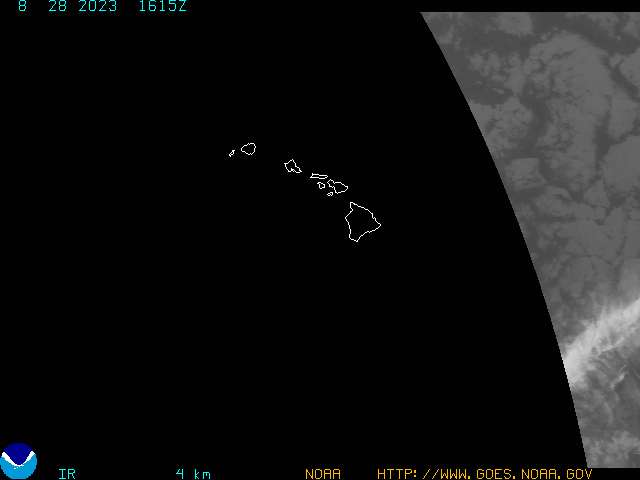
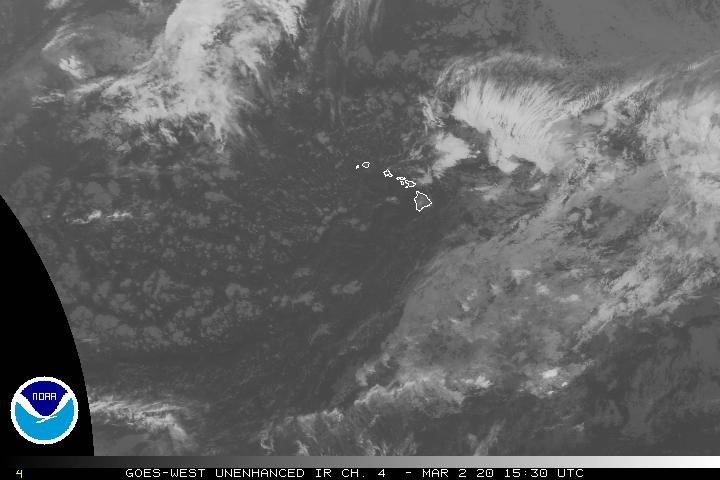
Satellite and Radar Images: To view the cloud conditions we have here in Hawaii, please use the following satellite links, starting off with theInfrared Satellite Image of the islands to see all the clouds around the state during the day and night. This next image is one that gives close images of the islands only during the daytime hours, and is referred to as a Close-up visible image. This next image shows a larger view of the Pacific…giving perspective to the wider ranging cloud patterns in the Pacific Ocean. To help you keep track of where any showers may be around the islands, here’s the latest animatedradar image.
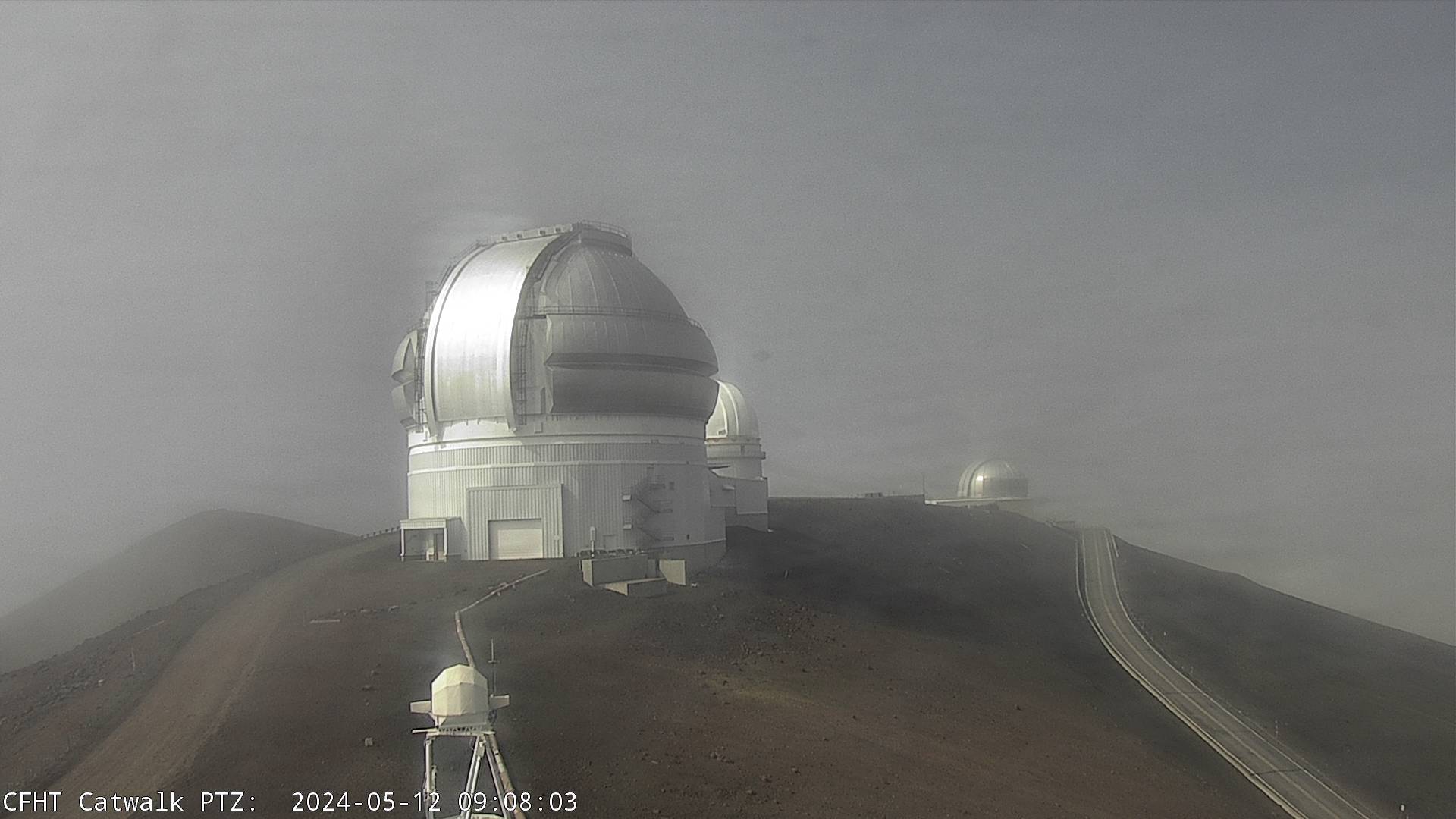
Hawaii’s Mountains – Here’s a link to the live webcam on the summit of near 14,000 footMauna Kea on the Big Island of Hawaii. The tallest peak on the island of Maui is theHaleakala Crater, which is near 10,000 feet in elevation. These two webcams are available during the daylight hours here in the islands…and when there’s a big moon rising just after sunset for an hour or two! Plus, during the nights and early mornings you will be able to see stars, and the sunrise too…depending upon weather conditions.
Aloha Paragraphs
Another shot of paradise here in the islands! Photo Credit: Flickr.com
An early season low pressure system, with its out of season cold front, have pushed our trade wind producing high pressure ridge down over Kauai…where it remains Monday night.This weather map shows two high pressure systems, one to the northwest, and the other to the northeast. The ridge connecting these two cells of high pressure has dipped unusually far south. This is the cause our light early summer winds. We will have to wait until the middle of the work, or even Thursday, before we see the return of strengthening trade winds…which will then continue to blow across our tropical latitudes through the rest of the week, and likely into the following week.
Rainfall has been almost particularly scant, with little change in this dry reality through Tuesday. Temperature inversions over the islands remain low and strong. This means that clouds will be limited in their vertical development, which keeps them from being showery. The winds are light enough that we’re in a convective weather pattern, with clear mornings, giving way to afternoon clouds. Moisture is very limited, which will keep those clouds from doing much for us…in terms of showers. We may see some increase in moisture coming our way during the next 24 hours…which may add some additional cloudiness to island skies during the day Tuesday into Wednesday.
The eastern Pacific continues to be rather active, with one tropical storm named Boris, along with recently dissipated tropical cyclone Cristina.Here’s a storm tracking map, showing these systems in relation to the Hawaiian Islands. Here’s a picture of the storms from space, showing the classic counterclockwise spin with Boris. There is no threat to the Hawaiian Islands. The hurricane models show that the next new tropical system may now be taking form, some 400 or so miles south of Manzanillo, Mexico. This is all fairly normal during this time of year, when the waters in the eastern Pacific are warming quickly under the summer sun.
~~~An usual gale low pressure system, which is spinning to the northeast of Hawaii, along with its associated cold front, are rare occurrences this time of year. Actually, to be more specific, the gale isn’t all that unusual, although it did get much closer to our islands than normal for summer. It’s the cold front, whose cloud band has moved within a couple hundred miles north of Kauai…which is the rarity. This low pressure system, and its cold front, have made for yet another uncommon occurrence, which is having our trade wind producing ridge of high pressure draped right over the islands now too. The net result is that we find ourselves in a light wind episode, when the trade winds ought to be blowing…at least according to climatology. One more thing about this gale, it has generated an out of season north swell, which will bump the surf up along our north shores soon.
~~~ This light wind regime, along with its convective weather pattern will remain in place through Tuesday and perhaps into Wednesday. Days will begin with generally clear skies, although the daytime heating will cause cloudy afternoons. This convective cloudiness may look fairly threatening, as if it might drop some showers, but most of them won’t. The clouds will be too shallow, without enough vertical dimension, to give us showers in most cases. As the trade winds return by mid-week, we may have somewhat better luck, as whatever moisture that may get picked up from the old cold front…could get carried onto the windward sides then, and for a few days thereafter. The second half of this week, otherwise, should exhibit generally fine weather conditions.
~~~ It’s early Monday evening here in Kihei, Maui. Monday was another almost completely dry day, everywhere! It’s about as dry as it gets here in the islands now, with 99% of the rain gauges around the state remaining empty. It’s a dry day when the largest rainfall amount anywhere, tops out at a meager .03"! Clouds remained undercover as well, with mostly sunny skies prevailing. The daytime heating, as expected, caused some minor cloudiness over and around the mountains, but that didn’t spread down towards the coasts very much. I expect another good day Tuesday, with little change in the overall pattern…although we might see some increase in clouds, but not likely in showers. I’ll be back very early Tuesday morning with your next new weather narrative from paradise, I hope you have a great Monday night until then! Aloha for now…Glenn.
Interesting:After last year’s thin ice cover, the North Pole is poised to vanish due to global warming in a short time.DailyTech has previously covered the frantic pace of melt in Greenland, which is accelerating, dumping vast amounts of water into the sea. Meanwhile, the North Pole has been steadily melting away as well. Fortunately, the North Pole ice is floating, and thus will not affect sea levels, but its dissolution is an important indicator of warming. While some remain critical that global warming is occurring at all, the melting of the North Pole represents a sharp indicator against voices of doubt. Now scientists are predicting that a major milestone will be reached this summer or next — the disappearance of the North Pole’s ice cover during the Arctic Summer. To most, imagining the North Pole without ice — only water — is an incredible prospect. But that’s the reality of a warming world. The prediction comes from the U.S.‘s top climate researchers at the National Snow and IceDataCenter in Boulder, Colorado.
They predict that in September, there is a good chance that the ice will be gone on the pole. While this is obviously a rather sobering event, the scientists aren’t afraid to poke a little fun at the climatological milestone. Says the center’s senior research scientist, Mark Serreze, "We kind of have an informal betting pool going around in our center and that betting pool is ‘does the North Pole melt out this summer?” About half the researchers are betting that the geographic pole, currently covered in ice will be ice free this fall. Last year already saw a similarly landmark event — the Northwest Passage was ice free last September for the first time in recorded history. All of these events are merely part of a larger trend according to researchers. Says Serreze, "What we’ve seen through the past few decades is the Arctic sea ice cover is becoming thinner and thinner as the system warms up."
Interesting2:The battle to reduce carbon emissions is at the heart of many eco-friendly efforts, and researchers from the University of Missouri have discovered that nature has been lending a hand. Researchers at the Missouri Tree Ring Laboratory in the Department of Forestry discovered that trees submerged in freshwater aquatic systems store carbon for thousands of years, a significantly longer period of time than trees that fall in a forest, thus keeping carbon out of the atmosphere. “If a tree is submerged in water, its carbon will be stored for an average of 2,000 years,” said Richard Guyette, director of the MU Tree Ring Lab and research associate professor of forestry in the School of Natural Resources in the College of Agriculture, Food and Natural Resources. “If a tree falls in a forest, that number is reduced to an average of 20 years, and in firewood, the carbon is only stored for one year.”
The team studied trees in northern Missouri, a geographically unique area with a high level of riparian forests (forests that have natural water flowing through them). They discovered submerged oak trees that were as old as 14,000 years, potentially some of the oldest discovered in the world. This carbon storage process is not just ancient; it continues even today as additional trees become submerged, according to Guyette. While a tree is alive, it has a high ability to store carbon, thus keeping it out of the atmosphere. However, as it begins to decay, a tree’s carbon is released back into the atmosphere. Discovering that certain conditions slow this process reveals the importance of proper tree disposal as well as the benefits of riparian forests.
Interesting3:Hawaii has become the first state to require solar water heaters in new homes. The bill was signed into law by Governor Linda Lingle, a Republican. It requires the energy-saving systems in homes starting in 2010. It prohibits issuing building permits for single-family homes that do not have solar water heaters. Hawaii relies on imported fossil fuels more than any other state, with about 90 percent of its energy sources coming from foreign countries, according to state data. The new law prohibits issuing building permits for single-family homes that do not have solar water heaters. Some exceptions will be allowed, such as forested areas where there are low amounts of sunshine.
State Sen. Gary Hooser, vice chairman of the Energy and Environment Committee, first introduced the measure five years ago when he said a barrel of oil cost just $40. Since then, the cost of oil has more than tripled. “It’s abundantly clear that we need to take some serious action to protect Hawaii because we’re so dependent on oil,” Hooser said. “I’m very pleased the governor is recognizing the importance of this bill and the huge public benefits that come out of it.”
Air Temperaturesranged between these warmest and coolest spots near sea level at 5 p.m. Sunday evening:
Kailua-kona – 85F Molokai airport – 79
Precipitation Totals – The following numbers represent the largest precipitation totals (inches) during the last 24 hours on each of the major islands, as of Sunday afternoon: 0.03 Poipu, Kauai
0.02 Kahuku, Oahu
0.00 Molokai 0.00 Lanai
0.00 Kahoolawe
0.00 Maui 0.05 Kealakekua, Big Island
Weather Chart – Here’s the latest (automatically updated) weather mapshowing high pressure centers stretched out from the northwest, through northeast of the islands. An out of season cold front has pushed the ridge down over Kauai Monday, with the net result being continued light winds through Tuesday.Here’s a link to the NOAA weather school.
Satellite and Radar Images: To view the cloud conditions we have here in Hawaii, please use the following satellite links, starting off with theInfrared Satellite Image of the islands to see all the clouds around the state during the day and night. This next image is one that gives close images of the islands only during the daytime hours, and is referred to as a Close-up visible image. This next image shows a larger view of the Pacific…giving perspective to the wider ranging cloud patterns in the Pacific Ocean. To help you keep track of where any showers may be around the islands, here’s the latest animatedradar image.
Hawaii’s Mountains – Here’s a link to the live webcam on the summit of near 14,000 footMauna Kea on the Big Island of Hawaii. The tallest peak on the island of Maui is theHaleakala Crater, which is near 10,000 feet in elevation. These two webcams are available during the daylight hours here in the islands…and when there’s a big moon rising just after sunset for an hour or two! Plus, during the nights and early mornings you will be able to see stars, and the sunrise too…depending upon weather conditions.
Aloha Paragraphs
Hawaii truly is paradise! Photo Credit: Flickr.com
Storms in the north central Pacific have weakened our local winds, which will remain light for the time being.Those storms are too far away to do much more than erode our trade wind producing high pressure ridge. This weather map shows two high pressure systems, one to the northwest, and the other to the northeast. There is a break in the connecting ridge between them…where the tail of a cold front exists. This is the cause our unusually light early summer winds now. We will have to wait until the middle of the work, before we see the return of strengthening trade winds.
The overlying atmosphere remains unusually dry and stable, at least from Kauai to Maui. Temperature inversions over the islands remain low and strong. This simply means that clouds will be limited in their vertical development, which keeps them from being showery. The winds are light enough that we’re in a convective weather pattern, with clear mornings, giving way to afternoon clouds. Moisture is very limited, which will keep those clouds from doing much for us…in terms of showers. The Big Island has had better luck, where localized showers were locally quite generous Sunday afternoon.
Meanwhile, the second and third tropical cyclones of the season, in the eastern Pacific remain active in the eastern Pacific…with the tropical storm names Boris and Cristina.They are both heading more or less straight westward, remaining at tropical storm stage, although both will be weakening back into the tropical depression category before too long. Here’s a storm tracking map, showing these storms in relation to the Hawaiian Islands. Here’s a picture of the storms from space, showing the classic counterclockwise swirl to them. There is no threat to the Hawaiian Islands, however the remnant moisture, as they spin in our direction and weaken…may bring an increase in tropical showers to the Aloha state by next weekend.
~~~I’ve been harping on how unusual the current set of weather circumstances are for this time of year. Weather models now show whatever is left of the aforementioned cold front moving down near Kauai in a couple of days. This cold front is very unusual, with the lighter trade winds unusual too…although we can leave off the very word. Light winds, with that June sunshine blazing down, will give a very warm, and somewhat sultry feel to our environment. As mentioned above, days will begin near cloud free, although that daytime heating will start clouds forming over and around the mountains later in the mornings, through the afternoon hours. These clouds will gather most effectively over and around the mountains, spreading down towards the coasts locally. For the time being, most areas will remain dry, although that cold front mentioned above, with its remnant moisture, may bring a few light showers to Kauai, and it wouldn’t be out of the question to see the windward sides on the other islands picking up a few showers during the week from it too.
~~~ It’s early Sunday evening here in Kula, Maui. Skies are mostly clear, although as this satellite image shows, there are some clouds by Kauai, to the south of the cold front that is moving by to our north. If we take a quick look at the looping image, this streak of high clouds appears to be shifting to the west away from our islands. It’s hazy out there too, not quite as thick as it was Saturday evening, but plenty hazy enough anyway. This morning I decided to drive over to Haiku, for the summer orchid sale…and am glad I did, as I found a nice plant. I was so close to Paia, that it seemed ridiculous not to go the beach. I had a great beach walk, and a quick swim in the warm ocean, and after a little shopping, high-tailed it back up here to Kula. I got back home by mid-morning, and have been working and lounging in equal measure through the rest of the day. My neighbors invited me for a nice picnic lunch, which was delicious.
~~~ Speaking of food, I just made a great dinner, which I will eat during the week. I started off with extra virgin olive oil in a pan, throwing in a whole organic onion. Just for the record, all the vegetables were organic. At any rate, in went some nice Yukon potatoes, and a small hot pepper. I sliced up shitaki mushrooms, lots of them, and threw them in too. I had some yellow squash, and a cob of corn, which I added to the mix. Then I cut up some local Kula Asparagus, along with garlic. I let this cook for until the potatoes began softening. I had bought some very fresh Mahi Mahi at the store, and so right at the end I cut that up into small pieces and put that in with those veges. I went out to the garden and picked some cherry tomatoes, and brought in a handful of basil leaves, and tossed those in on top of everything. I’ll plate that, with some tasty hard grating cheese, give a couple of twists of black pepper, a pinch or two of salt, sprinkle on a fork full of capers, and oh boy…
~~~ It’s a little before sunset now, and after first cooking that great meal, and then writing about it for you, I’m getting hungry. I often take my dinner up here to my weather deck, with its bi-coastal views of Maui, and eat it while watching the sunset. I hope you had, or will have a great dinner too, I’ll be back very early Monday morning with your next new weather narrative from paradise. I hope you have a great Sunday night wherever you happen to be spending it! Aloha for now…Glenn.
Air Temperaturesranged between these warmest and coolest spots near sea level at 5 p.m. Saturday afternoon:
Kahului, Maui – 83F South Point, Hawaii – 73
Precipitation Totals – The following numbers represent the largest precipitation totals (inches) during the last 24 hours on each of the major islands, as of Saturday afternoon: 0.08 Mount Waialeale, Kauai
0.01 Poamoho 2, Oahu
0.00 Molokai 0.07 Lanai
0.00 Kahoolawe
0.03 Oheo Gulch, Maui
0.06 Pahala, Big Island
Weather Chart – Here’s the latest (automatically updated) weather mapshowing high pressure centers stretched out from the northwest, north, through northeast of the islands. These high pressure systems will keep only light trade winds blowing through Monday.
Satellite and Radar Images: To view the cloud conditions we have here in Hawaii, please use the following satellite links, starting off with theInfrared Satellite Image of the islands to see all the clouds around the state during the day and night. This next image is one that gives close images of the islands only during the daytime hours, and is referred to as a Close-up visible image. This next image shows a larger view of the Pacific…giving perspective to the wider ranging cloud patterns in the Pacific Ocean. To help you keep track of where any showers may be around the islands, here’s the latest animatedradar image.
Hawaii’s Mountains – Here’s a link to the live webcam on the summit of near 14,000 footMauna Kea on the Big Island of Hawaii. The tallest peak on the island of Maui is theHaleakala Crater, which is near 10,000 feet in elevation. These two webcams are available during the daylight hours here in the islands…and when there’s a big moon rising just after sunset for an hour or two! Plus, during the nights and early mornings you will be able to see stars, and the sunrise too…depending upon weather conditions.
Aloha Paragraphs Sunset shot from Maui Photo Credit: Flickr.com
Fitting right into what has been an unusual spring season here in the islands…our current weather circumstances are quite odd.The month of June is well known for its very regular trade wind flow, blowing like 91% of the time on average. I guess we’re moving into that little 9% window, or will be over the next several days. Glancing at this latestweather map, we see high pressure systems anchored far to the northwest, and about the same distance to the northeast. We see low pressure systems, with their associated frontal boundaries, moving into the area directly north of our islands. This in turn will weaken the trade wind producing high pressure ridge north of here. Thus, the ridge will be not only be eroded from the north, but also pushed southward towards Hawaii.
Returning to the unusual aspects of this weather pattern, it’s just that the trade winds aren’t “suppose” to exhibit this start and stop pattern, like they have most of the spring season…not in June, especially not in late June into early July!So, our trade winds are going to be taking a nose dive in strength, as the ridge uncharacteristically slides down over us. This wouldn’t be so unusual if it were December, or January, or even April…but it’s almost July folks. Light winds equate to very warm and sultry conditions here in Hawaii, down here in the tropics. This uncommon light wind episode will extend into the first several days of the new week ahead, with the models suggesting it will take until around next Wednesday or Thursday, before we feel the return of our cooling and refreshing trade winds.
As the aforementioned sultry conditions develop, we’ll see the bias for showers breaking away from the windward sides…moving over into the upcountry inland areas. We call this shift from a trade wind weather pattern – a convective weather pattern. The most common time for showers under such a regime, would be during the afternoon hours, into the early evenings. If the dynamics were different, we would expect localized heavy showers, but this time around, that won’t be the case. As a matter of fact, only light precipitation is expected, if at all, in most areas…at the atmosphere remains dry and relatively stable at this time.
What you have been reading above, is what I would call unusual for this time of year. Looking at what the computer models are describing as we move further into next week…"grades easily into very unusual, if not down right rare". They show a trough, with a cold front pushing down into the tropics, and moving over the islands. This definitely goes against the grain of climatology, the history of Hawaiian weather. The long and short of all this is that the winds will be getting lighter, and there will be the chance of light showers…especially during the first half of the new week ahead.
Meanwhile, the second and third tropical cyclones of the season, in the eastern Pacific have spun up…taken on the tropical storm names Boris and Cristina. They are both heading more or less straight westward, and aren’t expected to reach hurricane force. Here’s a storm tracking map, showing these storms in relation to the Hawaiian Islands. Here’s a picture of the storms from space, showing the classic counterclockwise swirl to them. There is no threat to the Hawaiian Islands at this time, however the remnant moisture, as they spin in our direction…may bring an increase in tropical showers to the Aloha state by next weekend.
~~~Last night after work I went to see the new film called Wanted (2008), starring James McAvoy, Morgan Freeman, Angelina Jolie, among others. This is a fast paced, crackling thrill ride of a film, full of special effects, and lots of killing. Sorry, I’m sure many of you wonder what I find so fascinating with these kinds of films? What can I say for myself? I have no excuse…am guilty as charged, it’s just that I’m very drawn to seeing these kinds of explosive films for some reason. I have to say in good conscience, that I simply loved the film, it was outstanding, have to give it a B+ grade, and am wondering why I’m not giving it a full on A? It swept me away from the first moment, and had me laughing more than I have laughed in ages. It wasn’t so much that it was funny, although it certainly was, but really it was just so good in parts, that I couldn’t help but laugh! If you are the type of person who can keep this kind of movie in perspective, remembering that it is after all just a motion picture, then I could highly recommend it. If on the other hand, you have a weak stomach for these kinds of films, I would recommend staying at least 10,000 miles away from any theater showing this top notch action film. And then, oh my god, there was Angelina Jolie, her name was Fox in the film, and that name was absolutely well chosen! Here is the trailer for this excellent film.
~~~ It’s early Saturday evening here in Kula, Maui. It’s partly cloudy, although the main thing that I’m seeing is the very hazy skies, which likely consist of some volanic emission from the Big Island. As noted in one of the paragraphs above, the overlying atmosphere is not conducive for showers at this time. These relatively dry conditions are expected to last for another severals days. The unusual part of this whole thing is the light winds that we have going on now. At any rate, I went surfing this morning over on the Lahaina side of the island, and had a great time! I then headed over to the Paia side, stopping by the putting green in Spreckelsville, and was doing quite well, I must say. Then, it was down to Baldwin Beach, for a walk and swim. If you read this page much, you will know that I can get into quite a habit of doing very similar things each weekend, not to mention during the week days…fortunately they are good things! This evening I have no plans, and will just hang around the house, and take it easy. There’s an orchid sale in Haiku tomorrow morning, so I might take the drive over there, and see what I find. Otherwise, nothing much happening, I hope you have a great Saturday night wherever you happen to be! I’ll be back here Sunday morning with your next new update on what’s happening in the world of weather, here in paradise. Aloha for now…Glenn.
Since I have more time during the weekends, I like to share of few of my favorite songs, mostly from the past, since I haven’t been able to stay up on the current music scene. Lets start of with some great voices, and see where it goes as we move into Saturday night.
Air Temperaturesranged between these warmest and coolest spots near sea level at 4 p.m. Friday afternoon:
Barking Sands, Kauai – 86F South Point, Hawaii – 77
Precipitation Totals – The following numbers represent the largest precipitation totals (inches) during the last 24 hours on each of the major islands, as of Friday afternoon: 0.24 Mount Waialeale, Kauai
0.10 Waianae, Oahu
0.01 Molokai 0.07 Lanai
0.06 Kahoolawe
0.10 Oheo Gulch, Maui
0.11 Kamuela Upper, Big Island
Weather Chart – Here’s the latest (automatically updated) weather mapshowing high pressure centers stretched out from the northwest, north, through northeast of the islands. These high pressure systems will keep light trade winds blowing, with those usual stronger gusts locally. The trade winds will remain light through the weekend.
Satellite and Radar Images: To view the cloud conditions we have here in Hawaii, please use the following satellite links, starting off with theInfrared Satellite Image of the islands to see all the clouds around the state during the day and night. This next image is one that gives close images of the islands only during the daytime hours, and is referred to as a Close-up visible image. This next image shows a larger view of the Pacific…giving perspective to the wider ranging cloud patterns in the Pacific Ocean. To help you keep track of where any showers may be around the islands, here’s the latest animatedradar image.
Hawaii’s Mountains – Here’s a link to the live webcam on the summit of near 14,000 footMauna Kea on the Big Island of Hawaii. The tallest peak on the island of Maui is theHaleakala Crater, which is near 10,000 feet in elevation. These two webcams are available during the daylight hours here in the islands…and when there’s a big moon rising just after sunset for an hour or two! Plus, during the nights and early mornings you will be able to see stars, and the sunrise too…depending upon weather conditions.
The trade winds are getting softer now, which will become even lighter this weekend.The winds will get light enough soon, that our overlying atmosphere is going to be feeling rather sultry, if not down right muggy over the next 4-5 days. The computer models are strengthening our local trade winds again by the middle of next week…developing back into the light to moderately strong range then. The trade winds may bring a few light showers to the windward sides, and then a few during the afternoon hours…all on the light side however.The majority of whatever passing showers that arrive, will end up along the windward sides for the time being, although as the winds get lighter…we will see afternoon convective showers over the leeward sides locally too. As this loopingsatellite imageshows, we have an area of high cirrus clouds moving by to the south.At the same time, we see an new area moving southward towards us from the north as well.Those cirrus clouds are showing up as bright and white, carried along in the upper winds aloft. Pressure patterns in the central Pacific are shifting around some now, with the net result being lighter trade winds through the beginning of the new week ahead. We still have a high pressure ridge to our north, which is the source of our local winds now. This ridge will be migrating southward now, which is why our winds will be getting softer, especially later this weekend into Monday. This time of year, when the trade winds falter like this, we find ourselves in an increasingly muggy environment.
As these sultry conditions develop, we’ll see the bias for showers shifting away from the windward sides…moving over to the upcountry inland areas. We call this shift from a trade wind weather pattern – a convective weather pattern. The most common time for showers under such a regime, would be during the afternoon hours, into the early evenings. If the dynamics were different, we would expect localized heavy showers, but this time around, that won’t be the case.
By the way, the second tropical cyclone of the season, in the eastern Pacific has spun up…called tropical storm Boris.It is heading more or less straight westward, which isn’t expected to reach hurricane force. Meanwhile, another system, to the left of the main storm, has developed, called 3E, which is forecast to become tropical storm Cristina soon. Here’s a storm tracking map, showing this newly developed storm in relation to the Hawaiian Islands. Here’s a picture of the storms from satellite. Neither of these early season storms pose any threat to the Hawaiian Islands at this time. ~~~We’ll here we are at the end of yet another work week. These days it seems that we rarely have just a normal period of weather, at least not many lately. There always seems to be something going on that qualifies it for the unusual category. I’m about ready to leave Kihei, Maui, heading over to Kahului, to see a new film. This time its called Wanted (2008), starring James McAvoy, Morgan Freeman, Angelina Jolie, among others. This is a faced paced, crackling thrill ride of a film, full of special effects, and lots of killing. Sorry, I’m sure many of you wonder what I find so fascinating with these kinds of films? What can I say for myself? I have no excuse, am guilty as charged…it’s just that I’m very drawn to seeing these kinds of explosive films for some reason. If you can handle it, here’s a trailer for this film, which is most assuredly not for everyone out there! I’ll be back early Saturday morning with your next new weather narrative, and more than likely, raving about how much I liked this film! I hope you have a great Friday night wherever you happen to be spending it. Aloha for now…Glenn. Interesting: Martian soil appears to contain sufficient nutrients to support life – or, at least, asparagus – Nasa scientists believe. Preliminary analysis by the Phoenix Mars Lander mission on the planet’s soil found it to be much more alkaline than expected. Scientists working on the spacecraft project said they were "flabbergasted" by the discovery. The find has raised hopes conditions on Mars may be favourable for life. "We basically have found what appears to be the requirements, the nutrients, to support life, whether past, present or future," said Sam Kounaves, the project’s lead chemist, from the University of Arizona. Although he said further tests would have to be conducted, Mr Kounaves said the soil seemed "very friendly… there is nothing about it that is toxic," he said.
It is the type of soil you would probably have in your back yard – you know, alkaline. You might be able to grow asparagus in it really well." As well as being far less acidic than anticipated, the soil was also found to contain traces of magnesium, sodium, potassium and other elements. "We were all flabbergasted at the data we got back," said Mr Kounaves. "It is very exciting for us." The analysis is based on a cubic centimetre of soil scooped from 2.5cm (one inch) below Mars’ surface by the lander’s robotic arm.
Interesting2: TheNorth Pole may be briefly ice-free by September as global warming melts away Arctic sea ice, according to scientists from the National Snow and IceDataCenter in Boulder, Colorado. "We kind of have an informal betting pool going around in our center and that betting pool is ‘does the North Pole melt out this summer?’ and it may well," said the center’s senior research scientist, Mark Serreze. It’s a 50-50 bet that the thin Arctic sea ice, which was frozen in autumn, will completely melt away at the geographic North Pole, Serreze said. The ice retreated to a record level in September when the Northwest Passage, the sea route through the Arctic Ocean, opened briefly for the first time in recorded history. "What we’ve seen through the past few decades is the Arctic sea ice cover is becoming thinner and thinner as the system warms up," Serreze said. Specific weather patterns will determine whether the North Pole’s ice cover melts completely this summer, he said. "Last year, we had sort of a perfect weather pattern to get rid of ice to open up that Northwest Passage," Serreze said. "This year, a different pattern can set up. so maybe we’ll preserve some ice there. We’re in a wait-and-see mode right now. We’ll see what happens."
The brief lack of ice at the top of the globe will not bring any immediate consequences, he said. "From the viewpoint of the science, the North Pole is just another point in the globe, but it does have this symbolic meaning," Serreze said. "There’s supposed to be ice at the North Pole. The fact that we may not have any by the end of this summer could be quite a symbolic change." Serreze said it’s "just another indicator of the disappearing Arctic sea ice cover" but that it is happening so soon is "just astounding to me." "Five years ago, to think that we’d even be talking about the possibility of the North Pole melting out in the summer, I would have never thought it," he said. The melting, however, has been long seen as inevitable, he said. "If you talked to me or other scientists just a few years ago, we were saying that we might lose all or most of the summer sea ice cover by anywhere from 2050 to 2100," Serreze said. "Then, recently, we kind of revised those estimates, maybe as early as 2030. Now, there’s people out there saying it might be even before that. So, things are happening pretty quick up there."
Interesting3:Food prices could rise even more unless the mysterious decline in honey bees is solved, farmers and businessmen told lawmakers Thursday. "No bees, no crops," North Carolina grower Robert D. Edwards told a House Agriculture subcommittee. Edwards said he had to cut his cucumber acreage in half because of the lack of bees available to rent. About three-quarters of flowering plants rely on birds, bees and other pollinators to help them reproduce. Bee pollination is responsible for $15 billion annually in crop value. In 2006, beekeepers began reporting losing 30 percent to 90 percent of their hives. This phenomenon has become known as Colony Collapse Disorder. Scientists do not know how many bees have died; beekeepers have lost 36 percent of their managed colonies this year.
It was 31 percent for 2007, said Edward B. Knipling, administrator of the Agriculture Department’s Agricultural Research Service. "If there are no bees, there is no way for our nation’s farmers to continue to grow the high quality, nutritious foods our country relies on," said Democratic Rep. Dennis Cardoza of California, chairman of the horticulture and organic agriculture panel. "This is a crisis we cannot afford to ignore." Food prices have gone up 83 percent in three years, according to the World Bank. Edward R. Flanagan, who raises blueberries in Milbridge, Maine, said he could be forced to increase prices tenfold or go out of business without the beekeeping industry. "Every one of those berries owes its existence to the crazy, neurotic dancing of a honey bee from flower to flower," he said.
Interesting4:Global warming has caused dramatic shifts in some aquatic communities in which fish populations die off and lobsters, crabs and squid move in. The finding comes from a new analysis of 50 years worth of fish-trawling data collected in Narragansett Bay and adjacent Rhode Island Sound but may apply elsewhere, researchers said. Resident fish communities have progressively shifted from vertebrate species (fish) to the invertebrates (lobsters and crabs); from bottom-feeders to species that find their food higher up in the water column; and from larger, cool-water species to smaller, warm-water dwellers. "This is a pretty dramatic change, and it’s a pattern that is being seen in other ecosystems … but we’re in the relatively unique position of being able to document it," said Jeremy Collie of the University of Rhode Island, leader of the new study.
Collie said that while most of the changes observed in the survey occurred slowly, an abrupt change appeared to take place in 1980 and 1981 when benthic species (or bottom-feeders), such as winter flounder and silver hake, declined and pelagic species (or those that feed closer to the surface), such as butterfish and bluefish, increased. "We think there has been a shift in the food web resulting in more of the productivity being consumed in the water column," Collie explained. "Phytoplankton are increasingly being grazed by zooplankton, which are then eaten by planktivorous fish, rather than the phytoplankton sinking to the bottom and being consumed by bottom fish. It’s a rerouting of that production from the bottom to the top."
Air Temperaturesranged between these warmest and coolest spots near sea level at 4 p.m. Thursday afternoon:
Honolulu, Oahu – 86F Hilo, Hawaii – 78
Precipitation Totals – The following numbers represent the largest precipitation totals (inches) during the last 24 hours on each of the major islands, as of Thursday afternoon: 1.00 Mount Waialeale, Kauai
0.05 Manoa Lyon Arboretum, Oahu
0.00 Molokai 0.00 Lanai
0.00 Kahoolawe
0.44 Kaupo Gap, Maui
0.08 Waiakea Uka, Big Island
Weather Chart – Here’s the latest (automatically updated) weather mapshowing high pressure centers stretched out from the northwest, north, through northeast of the islands Friday. These high pressure systems will keep light trade winds blowing, with those usual stronger gusts locally. The trade winds will remain light into the weekend.
Satellite and Radar Images: To view the cloud conditions we have here in Hawaii, please use the following satellite links, starting off with theInfrared Satellite Image of the islands to see all the clouds around the state during the day and night. This next image is one that gives close images of the islands only during the daytime hours, and is referred to as a Close-up visible image. This next image shows a larger view of the Pacific…giving perspective to the wider ranging cloud patterns in the Pacific Ocean. To help you keep track of where any showers may be around the islands, here’s the latest animatedradar image.
Hawaii’s Mountains – Here’s a link to the live webcam on the summit of near 14,000 footMauna Kea on the Big Island of Hawaii. The tallest peak on the island of Maui is theHaleakala Crater, which is near 10,000 feet in elevation. These two webcams are available during the daylight hours here in the islands…and when there’s a big moon rising just after sunset for an hour or two! Plus, during the nights and early mornings you will be able to see stars, and the sunrise too…depending upon weather conditions.
Aloha Paragraphs
Spectacular sunset in Hawaii Photo Credit: Flickr.com
The trade winds will be taking a tumble in strength, becoming lighter as we move into the weekend.Most areas around the state saw light to moderately strong trade winds blowing Thursday…which will become lighter Friday into the weekend. The small craft wind advisory, which was active for the last week or so, has now been dropped across all Hawaiian waters. The computer models are strengthening our local trade winds again by the middle of next week…developing back into the light to moderately strong range then. We will see at least some increase in showers falling at times now, into the weekend.The majority of whatever passing showers that arrive, will end up along the windward sides for the time being, although if the winds get as light as expected…we may see afternoon convective showers over the leeward sides with time too. This increase in showers won’t come in buckets, but there definitely looks like at least more showers than we’ve seen since last weekend. As this loopingsatellite imageshows, we have an area of high cirrus clouds moving over the state.Those cirrus clouds are showing up as bright and white, carried along from west to east in the upper winds aloft. Those high flying clouds arrived during the day Thursday, just in time to provide a nice sunset…which should set the stage for a colorful sunrise again Friday. At the same time, we see lots of clouds marching our way at the lower levels of the atmosphere…carried in on the trade winds.
Pressure patterns in the central Pacific are shifting around some now, with the net result being lighter trade winds for the next several days. We still have a high pressure ridge well established to our north, which is the source of our local winds now. This ridge however will be migrating southward some, which is why our winds will be getting somewhat softer, especially as we get into the weekend time frame. This time of year, when the trade winds falter like this, we find ourselves in an increasingly muggy environment.
As this somewhat more sultry reality settles in over us, we may see the bias for showers breaking away from the windward sides…moving over into the upcountry inland areas. It will depend on just how light the trade winds become. If they get lighter than expected, that would add weight for the interior showers to develop. If on the other hand, the trade winds continue to hold their own, then whatever showers that are around, would occur more so along the windward coasts and slopes.
~~~Thursday was another nice day here in the islands! As mentioned one of the paragraphs above, high cirrus clouds have arrived over island skies…along with a few lower level clouds too. The winds stayed a bit stronger than anticipated, but are expected to begin their more pronounced slow down beginning Friday. This unusual softening of the trade winds will extend into the first couple of days of next week. At the same time, as that satellite image, a couple of paragraphs up the page show, we have some added moisture headed our way from the east, which hopefully will bring at least some measure of increasing shower activity. I’m heading home to Kula now, and hope to arrive in time to witness the nice sunset that should occur this evening. I’ll be back very early again on Friday morning however, with your next new weather narrative from paradise. I hope you have a great Thursday night wherever you happen to be spending it! Aloha for now…Glenn.
Interesting:The true impact of an asteroid or comet crashing near the Chesapeake Bay 35 million years ago has been examined in detail for the first time. The analysis reveals the resilience of life in the aftermath of disaster. The impact crater, which is buried under 400 to 1,200 feet (120 to 365 meters) of sand, silt and clay, spans twice the length of Manhattan. The sprawling depression helped create what would eventually become Chesapeake Bay. About 10,000 years ago, ice sheets began to melt and once-dry river valleys filled with water. The rivers of the Chesapeake region converged directly over the buried crater, according to the U.S. Geological Survey (USGS). Gregory Gohn of the USGS and his colleagues analyzed samples from two deep holes drilled into the crater near its center.
"I think what we wanted to do is drill into the central part of the crater and get as long of a section as we could and understand the processes that put them in the order we found them," Gohn told SPACE.com. Within seconds of the object’s touchdown, rocks were flung high into the air. The force of the impact carved a colossal cavity and caused temperatures to skyrocket, turning brittle rocks into taffy. Then, material along the cavity’s rim surged downhill into the bowl-shaped depression like an avalanche. The extreme heat, the researchers say, killed off most life. However, they found abundant microbes living today in the deepest parts of the crater. Some of the ancient bacteria would have survived the impact, the researchers say, because their little hideouts didn’t feel the brunt of the heat. The rest of the abundant and newly discovered microbial life is thought to have recolonized the zapped area possibly tens of thousands of years following the impact when temperatures dropped to habitable levels.
Interesting2: Some scientists believe that at least one meteorite found in Antarctica preserves evidence of ancient life on Mars. Now, work by a team of English scientists reinforces an earlier suggestion that evidence of life on the early Earth might be found in meteorites on the moon. The original idea was presented in a 2002 paper by University of Washington astronomer John Armstrong, who suggested that material ejected from Earth during the Late Heavy Bombardment (a period about four billion years ago when the Earth was subjected to a rain of asteroids and comets) might be found on the moon. Armstrong’s suggestion was interesting, but whether a meteor ejected from the Earth might arrive intact on the moon remained an open question.
New research by a team under Ian Crawford and Emily Baldwin of the Birkbeck College School of Earth Sciences used more sophisticated means to simulate the pressures any such terrestrial meteorites might have experienced during their arrival on the lunar surface. This confirmed Armstrong’s hypothesis. In many cases, the pressures could be low enough to permit the survival of biological markers, making the lunar surface a good place to look for evidence of early terrestrial life. Any such markers are unlikely to remain on Earth, where they would have been erased long ago by more than three billion years of volcanic activity, later meteor impacts, or simple erosion by wind and rain.
Interesting3:A billion acres of farmland around the world have been abandoned and could now be used to grow biofuel crops, a new study suggests. One of the criticisms of biofuels such as ethanol from corn or rice is that the crops eat into land that could be used to grow food, which is increasingly in short supply globally, causing frustration and hunger that have led to protests and riots. The alternative of clearing forests to grow biofuel crops is unacceptable to many. Yet somewhere between 1 billion and 1.2 billion acres of agricultural land is lying fallow, the study finds. That compares to about 3.8 billion acres that are currently in use. The researchers caution, however, that biofuels will be no magic bullet to resolving possible energy crises in the future.
"Our results showed that if you used all these abandoned agricultural lands, you might obtain up to 8 percent of current energy needs," said Elliott Campbell, a postdoctoral fellow in biology at StanfordUniversity and lead author of the report. "So this result is basically showing us that biofuels could be a meaningful, but a small portion of our total energy future." The study, based on satellite imagery and historical maps, is detailed today in the online edition of the journal Environmental Science &Technology. It was funded by the Carnegie Institution and the Global Climate and Energy Project at Stanford.
Air Temperaturesranged between these warmest and coolest spots near sea level at 4 p.m. Wednesday afternoon:
Honolulu, Oahu – 86F Lihue, Kauai– 73
Precipitation Totals – The following numbers represent the largest precipitation totals (inches) during the last 24 hours on each of the major islands, as of Wednesday afternoon: 0.80 Mount Waialeale, Kauai
0.16 Manoa Lyon Arboretum, Oahu
0.01 Molokai 0.00 Lanai
0.00 Kahoolawe
0.14 West Wailuaiki, Maui
0.29 Glenwood, Big Island
Weather Chart – Here’s the latest (automatically updated) weather mapshowing high pressure centers stretched out from the northwest, north, through northeast of the islands Thursday. These high pressure systems will keep light to moderately strong trade winds blowing, with those usual stronger gusts in the major channels. The trade winds will gradually weaken into Friday as the ridge moves southward towards the islands.
Satellite and Radar Images: To view the cloud conditions we have here in Hawaii, please use the following satellite links, starting off with theInfrared Satellite Image of the islands to see all the clouds around the state during the day and night. This next image is one that gives close images of the islands only during the daytime hours, and is referred to as a Close-up visible image. This next image shows a larger view of the Pacific…giving perspective to the wider ranging cloud patterns in the Pacific Ocean. To help you keep track of where any showers may be around the islands, here’s the latest animatedradar image.
Hawaii’s Mountains – Here’s a link to the live webcam on the summit of near 14,000 footMauna Kea on the Big Island of Hawaii. The tallest peak on the island of Maui is theHaleakala Crater, which is near 10,000 feet in elevation. These two webcams are available during the daylight hours here in the islands…and when there’s a big moon rising just after sunset for an hour or two! Plus, during the nights and early mornings you will be able to see stars, and the sunrise too…depending upon weather conditions.
As is often the case during the month of June, there is no end in sight to the trade winds here in Hawaii. Most areas around the state will find moderately strong trade winds blowing Wednesday and Thursday. The small craft wind advisory, in those windiest areas around Maui and the Big Island, remains active…although may be dropped soon. There may be some weakening of our local winds Thursday into the weekend, although they will continue to blow right into next week…picking up in strength again after the weekend. Those trade winds will carry clouds in our direction, although there’s nothing unusual about that this time of year. The majority of whatever passing showers that arrive, will end up along the windward sides. We’re expecting somewhat less that the normal amount of incoming showers Wednesday. There’s a good chance that Thursday and Friday, and perhaps into the weekend…may be a bit more productive in terms of incoming showers. This increase will be most pronounced along the windward sides, although a few lucky leeard spots might see a few showers too.
~~~ As this looping satellite imageshows, we’re in between periods of high cirrus clouds. The bright white clouds, moving along generally from left to right, are the icy cirrus clouds. Looking further to the west (to the left) of the islands, we see what may be our next batch of high cloudiness approaching. It will likely take another day or two before they arrive. We like these clouds, as they don’t bring rain, they’re too high up in the atmosphere for that…and they provide often vividly colorful sunrise and sunset colors.
~~~ Our local weather is gliding along nicely, providing good weather conditions for us now. Just about all outdoor activities that I can think of, including tennis, golf, beaching, hiking, badminton, among others, will find the weather cooperating. The morning hours as usual will have the least wind, while the afternoons will find windier conditions. Personally, I enjoy the mornings for my beach outings, as the wind makes the ocean choppy later in the days. Air temperatures will be warm to very warm during the days, and seasonably warm at night…cooler of course in the upcountry areas.
~~~ It’s early Wednesday evening here in Kihei, Maui, as I begin writing this last paragraph of today’s narrative. As was the case Tuesday at this same time, glancing out the window, there’s hardly a cloud in the sky in any direction. Craning my neck to see all the way over the windward side, I don’t see even one cloud out in the direction…which is unusual with the trade winds blowing. Those blue skies don’t give up much rain obviously, so that most rain gauges around the state have remained dry as a bone. I’m about ready to take the drive upcountry, to Kula, where it is even nearly cloud free too…which is even more unusual. The winds remain up in strength today, with the strongest gust at just past 5pm, tied at 32 mph at both the Kahului airport, and Maalaea Bay, both of course here on Maui. I expect the favorably inclined weather conditions to remain in place through the night, with that possible increase in showers along the windward sides sliding into place at some point Thurdsay. I’ll be back very early Thursday to discuss that, and everything else about the weather here in the Hawaiian Islands then. I hope you have a great Wednesday night wherever you happen to be spending it! Aloha for now…Glenn. Interesting:
A major review by University of Adelaide researchers shows that the world is losing the battle over tropical habitat loss with potentially disastrous implications for biodiversity and human well-being. Published online today in the Ecological Society of America’s journal Frontiers in Ecology and the Environment, the review concludes we are "on a trajectory towards disaster" and calls for an immediate global, multi-pronged conservation approach to avert the worst outcomes. Lead author Associate Professor Corey Bradshaw, from the University of Adelaide‘s School of Earth and Environmental Sciences, says tropical forests support more than 60% of all known species. But up to 15 million hectares of tropical rainforest are being lost every year and species are being lost at a rate of up to 10,000 times higher than would happen randomly without humans present. "This is not just a tragedy for tropical biodiversity, this is a crisis that will directly affect human livelihoods," says Associate Professor Bradshaw.
"This is not just about losing tiny species found at the base of big trees in a rain forest few people will ever see, this is about a complete change in ecosystem services that directly benefit human life. "The majority of the world’s population live in the tropics and what is at stake is the survival of species that pollinate most of the world’s food crops, purify our water systems, attenuate severe flood risk, sequester carbon (taking carbon dioxide out of the air) and modify climate." Associate Professor Bradshaw says recent technical debate about likely extinction rates in the tropics could be used by governments to justify destructive policies. "We must not accept belief that all is well in the tropics, or that the situation will improve with economic development, nor use this as an excuse for inaction on the vexing conservation challenges of this century," he says. "We need to start valuing forests for all the services they provide, and richer nations should be investing in the maintenance of tropical habitats."
Interesting2:
Major technological progress needed to make renewable energy affordable says a study by the RAND corporation. Dramatic progress in renewable energy technology is needed if the United States desires to produce 25 percent of its electricity and motor vehicle fuel from renewable sources by 2025 without significantly increasing consumer costs, according to a RAND Corporation study issued today. Produced by the RAND Environment, Energy and Economic Development program, the study provides a "snapshot" of the nation’s potential energy expenditures if a requirement was imposed that 25 percent of electricity and motor vehicle fuels used in the United States by 2025 would come from renewable resources (a goal activists have described as "25 x ’25"). The study finds that biomass resources and wind power have the greatest potential to contribute toward reaching the 25 x ’25 goal.
The study replaces a report withdrawn by RAND in 2006 because of errors RAND identified in the computer model and numerical assumptions on which the findings were based. The new report finds that meeting the 25 x ’25 goals would be more challenging than outlined in the earlier version of the report. RAND is a nonprofit research organization. The Energy Future Coalition, a nonprofit environmental organization, asked RAND to assess the economic and other impacts of meeting the 25 x ’25 goal. The RAND study considered technological and economic factors that would affect the costs of renewable energy as well as non-renewable fossil fuels.
Interesting3:
Theworld’s poorest nations are unable to manage the mountains of toxic waste flowing in for disposal from rich countries because of a lack of resources and political will, officials said Wednesday. Katharina Kummer Peiry, the executive secretary of a UN convention on hazardous waste disposal, said the dumping of everything from hazardous chemicals to electronic waste from televisions and computers in poor countries is a growing problem. She blamed it mostly on the inability of poor nations to finance better enforcement and monitoring of waste coming into their ports. "The problem lies in the lack of interest and lack of resources on the issue at all levels," Peiry said.
The warning comes as delegates from as many as 170 countries meet on the Indonesian island of Bali to discuss how they can strengthen the U.N.-administered Basel Convention on the Control of Transboundary Movements of Hazardous Wastes and their Disposal, adopted in 1989. The meeting ends Friday. The extent of the problem was illustrated in 2006, when hundreds of tons of toxic waste were dumped around Ivory Coast‘s main city of Abidjan, killing at least 10 people and sickening tens of thousands more. The waste came from a tanker chartered by the Dutch commodities trading company Trafigura Beheer BV, which turned to Africa after disposal costs in Amsterdam were deemed too expensive.
Interesting4:The argument that increasing whale populations are behind declining fish stocks is completely without scientific foundation, leading researchers and conservation organizations said today as the International Whaling Commission opened its 60th meeting in Santiago, Chile. The Humane Society International, WWF and the Lenfest Ocean Program today presented three new reports debunking the science behind the ”˜whales-eat-fish’ claims emanating from whaling nations Japan, Norway and Iceland. The argument has been used to bolster support for whaling, particularly from developing nations.
“It is not the whales, it is over-fishing and excess fishing capacity that are responsible for diminishing supplies of fish in developing countries,” said fisheries biologist Dr. Daniel Pauly, director of the University of British Columbia Fisheries Centre. “Making whales into scapegoats serves only to benefit wealthy whaling nations while harming developing nations by distracting any debate on the real causes of the declines of their fisheries.” Who’s eating all the fish? The food security rationale for culling cetaceans, the report co-authored by Dr Pauly for the Humane Society International contrasts “the widely different impacts of fisheries and marine mammals” with fisheries targeting larger fish where available and marine mammals consuming mainly smaller fish and organisms.
Interesting5:Coiledup in a tornado is as much energy as an entire power plant. So a Canadian engineer has a plans to spin up his own twister and extract energy from its tethered tail. It all depends on heating the air near the surface so that it is much warmer than the air above. "You can generate energy whenever you have a temperature gradient," said Louis Michaud. "The source of the energy here is the natural movement of warm and cold air currents." These so-called convective air currents are only useful if they can be channeled in some way. That is why Michaud proposes using a tornado as a kind of drinking straw between the warm ground below and the cold sky above. Wind turbines placed at the bottom could generate electricity from the sucked-up air. Tornadoes and hurricanes form when sun-heated air near the surface rises and displaces cooler air above.
As outside air rushes in to replace the rising air, the whole mass begins to rotate. Michaud got the notion of a man-made tornado — what he calls the Atmospheric Vortex Engine (AVE) — while working as an engineer on gas turbines. "When I looked further into it, I didn’t run into anything that was impossible," Michaud told LiveScience. The AVE structure is a 200-meter-wide arena with 100-meter-high walls. Warm humid air enters at the sides, directed to flow in a circular fashion. As the air whirls around at speeds up to 200 mph, a vacuum forms in the center, which holds the vortex together as it extends several miles into the sky. The concept is similar to a solar chimney with the swirling walls of the vortex replacing the brick walls of the tower. But the AVE can reach much higher into the sky where the air is colder.
Air Temperaturesranged between these warmest and coolest spots near sea level at 4 a.m. Tuesday morning:
Kailua-kona – 76F Hilo, Hawaii– 69
Precipitation Totals – The following numbers represent the largest precipitation totals (inches) during the last 24 hours on each of the major islands, as of Tuesday afternoon: 0.68 Mount Waialeale, Kauai 0.68 Oahu Forest NWR, Oahu
0.10 Molokai 0.04 Lanai
0.01 Kahoolawe
0.29 Hana airport, Maui
0.19 Mountain View, Big Island
Weather Chart – Here’s the latest (automatically updated) weather mapshowing high pressure centers stretched out from the northwest, north, through northeast of the islands Wednesday. These high pressure systems will keep moderately strong trade winds blowing, with those usual stronger gusts in the major channels…and those windiest coastal areas into Thursday.
Satellite and Radar Images: To view the cloud conditions we have here in Hawaii, please use the following satellite links, starting off with theInfrared Satellite Image of the islands to see all the clouds around the state during the day and night. This next image is one that gives close images of the islands only during the daytime hours, and is referred to as a Close-up visible image. This next image shows a larger view of the Pacific…giving perspective to the wider ranging cloud patterns in the Pacific Ocean. To help you keep track of where any showers may be around the islands, here’s the latest animatedradar image.
Hawaii’s Mountains – Here’s a link to the live webcam on the summit of near 14,000 footMauna Kea on the Big Island of Hawaii. The tallest peak on the island of Maui is theHaleakala Crater, which is near 10,000 feet in elevation. These two webcams are available during the daylight hours here in the islands…and when there’s a big moon rising just after sunset for an hour or two! Plus, during the nights and early mornings you will be able to see stars, and the sunrise too…depending upon weather conditions.
Aloha Paragraphs
The beautiful Kona coast on the Big Island Photo Credit: Flickr.com
The locally gusty trade winds will remain active, although become a bit lighter as we move towards the weekend. Most areas around the state will find moderately strong trade winds blowing Wednesday and Thursday. The small craft wind advisory, in those windiest areas around Maui and the Big Island, remains active. A storm in the Gulf of Alaska by Friday into the weekend, will cause some weakening of our local winds, although they will continue to blow right into next week. There will be a few showers, although nothing too impressive for the time being. The majority of whatever passing showers that arrive, will end up along the windward sides. We’re expected a more or less normal amount of incoming showers during this work week, or perhaps slightly less than that through Thursday. There’s a chance that later Friday into this weekend might be more productive in terms of incoming showers…caused by a trough of low pressure moving into our area.
~~~ The trade wind weather pattern remains well established here in the islands. High pressure centers are located to our north, with an elongated trough of low pressure well to our south. This sets up a pressure gradient, as air moves from high pressure to low pressure. This is what causes our local trade winds…those winds that ancient sea mariners used to carry their trading goods from one port to another.
~~~ As I pointed out in one of the paragraphs above, we’re involved with a fairly dry set of weather circumstances at the moment. This suggest that only a few passing showers will bring moisture to the tropical vegetation along the windward sides of the islands. We may see some increase in showers Friday into the upcoming weekend. This isn’t a sure thing, although the computer forecast models continue to imply that this will windward biased shower activty will arrive.
~~~ I’ve finished work here in Kihei, Maui, and about to take the drive home to Kula. Glancing out the window before I leave this computer, I see almost totally clear skies, with 90% cloud free conditions. It’s exceptionally clear as a matter of fac, although the usual capping cloud remains atop the West Maui Mountains. The winds are blowing still, and just for continuity sake, lets see where the strongest gusts are happening around 5pm, and how fast they are blowing. We’ll, I’ll bet that you already had a pretty good idea, and yes, you were right if you thought it would be Maalaea Bay! There were still 42 mph gusts this late in the day,. One has to windy weather to live there…at least happily! I hope you have a great Tuesday night, wherever you happen to be spending it! I’ll be here again very early Wednesday morning, with your next new weather narrative from paradise. Aloha for now until then…Glenn.
Interesting:
Exactly20 years have passed since Dr. James E. Hansen of NASA first testified to Congress on June 23, 1988 that global temperatures had risen beyond the range of natural variability. Waiting another 20 years before taking decisive action is not an option. Since 1988, mainstream scientific thinking has caught up with Dr. Hansen’s declaration that our climate is being adversely affected by human activities, primarily the burning of fossil fuels-and the forecasts of climate change in the coming decades are increasingly dire. But political action has fallen well behind the pace of scientific progress, and despite growing public support to limit greenhouse gas emissions, the U.S. Senate failed early this month to approve landmark legislation that would have begun to do so.
Dr. Hansen’s latest research indicates that greenhouse gas concentrations have already reached damaging levels and the climate is nearing a dangerous tipping point that will unleash far-reaching changes in the atmosphere and oceans that could take millennia to reverse. In his latest paper, Dr. Hansen calls for deep reductions in carbon dioxide emissions, beginning almost immediately, with a focus on phasing out the uncontrolled combustion of coal by 2030. As the world moves toward a new climate agreement in 2009, decision makers must understand the tremendous risks we face and the urgency of action in the year ahead. Although many still argue that such a transition to a low-carbon energy system will be enormously expensive and difficult, our research has shown that it would open up vast economic opportunities, spur innovation and job creation, assist efforts to reduce poverty, and increase energy security.
Interesting2:Biofuels can be a sustainable part of the world’s energy future, especially if bio-energy agriculture is developed on currently abandoned or degraded agricultural lands, report scientists from the Carnegie Institution and Stanford University. Using these lands for energy crops, instead of converting existing croplands or clearing new land, avoids competition with food production and preserves carbon-storing forests needed to mitigate climate change. Sustainable bioenergy is likely to satisfy no more than 10% of the demand in the energy-intensive economies of North America, Europe, and Asia. But for some developing countries, notably in Sub-Saharan Africa, the potential exists to supply many times their current energy needs without compromising food supply or destroying forests.
Elliot Campbell, Robert Genova, and Christopher Field of the Carnegie Institution’s Department of Global Ecology, with David Lobell of StanfordUniversity, estimated the global extent of abandoned crop and pastureland and calculated their potential for sustainable bioenergy production from historical land-use data, satellite imaging, and ecosystem models. Agricultural areas that have been converted to urban areas or have reverted to forests were not included in the assessment. The results of the study are published in the June 25 online edition of Environmental Science and Technology.
Interesting3:There are more species of bees buzzing around the globe than there are species of mammals and birds combined, a new census shows. This new count of bee species, conducted by John S. Ascher of the AmericanMuseum of Natural History in New York, comes from a list he compiled of more than 19,200 described bee species. "Most people know of honey bees and a few bumble bees, but we have documented that there are actually more species of bees than of birds and mammals put together," Ascher said. Ascher’s census documents 2,000 more described species than the most recent definitive list published eight years ago.
Cataloguing the world’s species, especially small insects, is an enormous challenge; scientists don’t even know how many total species live on the planet — estimates run from 5 million to 100 million total species, though only 2 million have been identified. Taking a head count of the world’s bees is important though because the busy insects are critical to pollinating crops. Honey bees, such as Apis mellifera, are the most economically important pollinators. But while honey bees are the most well-known bee faces, most bees don’t make honey or live in hives like this social species.
Interesting4: By 2015, 17 percent of the residents of the United States will be getting cosmetic procedures, the body enhancement industry predicts. A new study published by the American Society of Plastic Surgeons (ASPS) predicts there will be more than 55 million cosmetic surgery procedures performed in 2015. That’s nearly one procedure for every five Americans, including children, based on U.S. Census Bureau population projections. Of course, the bulk of procedures are done on adults, and some people might get more than one body part fixed in a year. The industry is well aware of what is driving all this: "Pushing this growth is increasing consumer awareness, direct-to-consumer marketing and advertising, as well as technological advances in non-surgical options," the group said in a statement today.
In 2007, Americans spent more than $13 billion for nearly 11.7 million cosmetic procedures. That’s up from nearly 8.5 million procedures in 2001. Thanks to the bad economy, times are tough in human body shops right now, however. "While today’s economy reflects a slow-down in plastic surgery procedures, the specialty will weather the current decline in economic growth just as it has previous declines, such as the stock market correction after the 2001 Internet bubble," said ASPS President Richard D’Amico, MD. "This prediction for 2015 is exciting." Some caution
Interesting5: Substantially improving the accuracy of hurricane intensity predictions could take years and tens of millions of dollars, the NationalHurricaneCenter‘s director said Tuesday. In an interview with The Associated Press, Bill Read said reducing by half the errors made in tasks such as determining whether a storm would remain a Category 1 or grow stronger would be a costly and long-term effort. Predicting a storm’s intensity is much harder for meteorologists than estimating where it will go. Since 1990, forecasters have reduced by more than half their errors in predicting a storm’s path, but over the same time the accuracy of their intensity forecasts has remained virtually unchanged. "To really get after that you’re talking tens of millions of dollars, if not more, to reach an ambitious goal," Read said. "We’ve made a steady gain in the improvement of the track forecasts, and we haven’t figured out how to do that yet for rapid intensification." That could take between five and 10 years, he said. Read said he’s satisfied for now with the $3 million the government is spending this year for research into improving intensity forecasts.
Long-term improvement, however, would require a sustained investment. Read took the helm of the NationalHurricaneCenter in January. The six-month Atlantic hurricane season which officially began June 1 is his first as director. The center monitors the movement and strength of tropical weather systems and issues storm watches and warnings for the U.S. and surrounding areas. Read said he expects to spend a lot of time talking about preparing for storms, as other directors have. He said it’s denial, not complacency, that keeps many people from being prepared. They just don’t think a storm will hit, and that’s what emergency managers and others have to overcome, he said. Read also talked about the sensitive issue of a suggested link between global warming and hurricanes, acknowledging it carries "so much emotional baggage" it can be "really hard to sift out the science."
Air Temperaturesranged between these warmest and coolest spots near sea level at 6 p.m. Monday evening:
Barking Sands, Kauai – 83F Lihue, Kauai– 77
Precipitation Totals – The following numbers represent the largest precipitation totals (inches) during the last 24 hours on each of the major islands, as of Monday afternoon: 0.40 Mount Waialeale, Kauai
0.12 Manoa Lyon Arboretum, Oahu
0.03 Molokai 0.00 Lanai
0.00 Kahoolawe
0.20 West Wailuaiki, Maui
0.28 Kamuela upper, Big Island
Weather Chart – Here’s the latest (automatically updated) weather mapshowing high pressure centers located to the north-northwest and northeast of the islands. These high pressure systems will keep moderately strong trade winds blowing, with those usual stronger gusts in the major channels…and those windiest coastal areas through Wednesday.
Satellite and Radar Images: To view the cloud conditions we have here in Hawaii, please use the following satellite links, starting off with theInfrared Satellite Image of the islands to see all the clouds around the state during the day and night. This next image is one that gives close images of the islands only during the daytime hours, and is referred to as a Close-up visible image. This next image shows a larger view of the Pacific…giving perspective to the wider ranging cloud patterns in the Pacific Ocean. To help you keep track of where any showers may be around the islands, here’s the latest animatedradar image.
Hawaii’s Mountains – Here’s a link to the live webcam on the summit of near 14,000 footMauna Kea on the Big Island of Hawaii. The tallest peak on the island of Maui is theHaleakala Crater, which is near 10,000 feet in elevation. These two webcams are available during the daylight hours here in the islands…and when there’s a big moon rising just after sunset for an hour or two! Plus, during the nights and early mornings you will be able to see stars, and the sunrise too…depending upon weather conditions.
The trade winds will continue blowing across the tropical latitudes of Hawaii, bringing their cooling and refreshing relief from the early summer heat. Most areas around the state will find moderately strong trade winds blowing. The small craft wind advisory, in those windiest areas around Maui and the Big Island, remains active Monday. There doesn’t appear to be any end in sight for this extended period of trades, which is normal for the summer season. Winds will be locally very gusty, topping the 40 mph mark at times. There have been more than the normal amount of showers here in the Aloha state the last couple of days. The bulk of those passing showers have arrived along the windward sides, where the largest precipitation totals have occurred. We’re expected a more or less normal amount of incoming showers this week, or perhaps slightly less than that. There’s a chance that later in the week, towards Friday into the weekend, we might see another increase…but that’s still too far out into the future for much certainty at this point.
~~~ It’s early Monday evening here in Kihei, Maui, as I begin writing this last section of today’s narrative. As this satellite image shows, we have some high clouds situated to the east and south of the islands. Some of this high cloudiness, which shows up in the satellite picture as whiter and brighter clouds, may move northward into the island chain overnight or Tuesday. Those types of clouds can provide great sunrise and sunset colors! Monday was characterized by windy trade wind weather, with little in the way of showers anywhere. At the height of the days winds, there was one gust that went all the way up the wind scale to 42 mph at Maalaea Bay, Maui. As a matter of fact, late this afternoon, the winds were gusting to 35 mph at Kahului, and still at 42 mph at Maalaea Bay. If you liked the weather here in Hawaii today, you will like it again Tuesday…as I see very little change in store. The one thing though, may be the intrusion of those high clouds to our south, which could end up dimming and filtering our famous Hawaiian sunshine. I’ll be back very early Tuesday morning with your next new weather narrative from paradise, I hope you have a great Monday night until then! Aloha for now…Glenn.
Interesting:Information gleaned from a Greenland ice core by an international science team shows that two huge Northern Hemisphere temperature spikes prior to the close of the last ice age some 11,500 years ago were tied to fundamental shifts in atmospheric circulation. The ice core showed the Northern Hemisphere briefly emerged from the last ice age some 14,700 years ago with a 22-degree-Fahrenheit spike in just 50 years, then plunged back into icy conditions before abruptly warming again about 11,700 years ago. Startlingly, the Greenland ice core evidence showed that a massive "reorganization" of atmospheric circulation in the Northern Hemisphere coincided with each temperature spurt, with each reorganization taking just one or two years, said the study authors.
The new findings are expected to help scientists improve existing computer models for predicting future climate change as increasing anthropogenic greenhouse gases in the atmosphere drive up Earth’s temperatures globally. The team used changes in dust levels and stable water isotopes in the annual ice layers of the two-mile-long Greenland ice core, which was hauled from the massive ice sheet between 1998 to 2004, to chart past temperature and precipitation swings. Their paper was published in the June 19 issue of Science Express, the online version of Science.
Interesting2:It’sa battle that’s been raging in this country for more than 15 years, with skirmishes fought in town council rooms, the House of Commons, the Supreme Court of Canada and on the letters pages of this newspaper. But the use of pesticides for purely esthetic purposes — such as killing dandelions — has likely never been a hotter topic than it is today. The push for a cosmetic pesticide ban in Calgary comes at a time when citizens have started questioning the safety of the food they eat, the toys they buy and the chemicals they’re exposed to. That public awareness has seen the movement for a pesticide ban pick up speed in Calgary, says Robin McLeod, spokeswoman for the Coalition for a Healthy Calgary. A Canadian Cancer Society survey released in May found 87 per cent of Albertans support community bylaws banning the cosmetic use of pesticides.
"Environmental concerns are becoming a bigger issue for Canadians as a whole," McLeod says. If passed, Calgary would be the first major municipality west of Ontario to implement a pesticide ban. In February, three aldermen brought forward a proposal for Calgary to phase out the use of pesticides — including herbicides, insecticides and fungicides — for cosmetic purposes by the end of 2010. The proposal called for city crews to stop using the chemicals by December 2009, with the ban to include private property by December 2010. After two hours of debate, the issue was referred to an environmental advisory board to study and come back with recommendations.
Interesting3:California’s air board, for years an obscure state agency, will take center stage this week when it unveils a blueprint for the nation’s most aggressive fight against global warming, a newspaper report said on Sunday. The plan is expected to affect every resident, industry and government agency in the state in the coming decade, the San Francisco Chronicle said. The far-reaching plan, which comes 18 months after Governor Arnold Schwarzenegger signed landmark legislation to curb greenhouse emissions by one-third by 2020, is likely to encourage consumers to use energy-efficient light bulbs and replace gas-guzzling cars with fuel-sipping hybrids. The plan could require industry to reduce pollution or pay fees based on the amount of carbon they release, according to the report.
Mary Nichols, chairwoman of the California Air Resources Board, said the draft of the "scoping plan," which the agency’s staff will present next Thursday to the 11-member board, will be a work in progress until the final version is adopted by the end of the year. "We’ve been clear up until now that the draft plan will lay out our background information on where the state’s emissions come from, how much they need to be reduced, and lay out a strategy on how to address them sector by sector," Nichols said. About 60 percent of the needed reductions can be obtained by implementing existing regulations or new rules that are in the regulatory pipeline, Nichols said.
Interesting4:The climate of early Earth was no day at the beach, with stinging acid rains and an intensely warm surface, a new study suggests. These harsh conditions could explain why geologists today have found no rocks more than 4 billion years old: They were all weathered away. The fate of all those rocks from the first 500 million years after Earth formed has been a longstanding question in geology. Scientists have floated various explanations for the missing rocks, including destruction by barrages of meteorites and the possibility that the early Earth was a sea of red-hot magma in which no rocks could form. The analysis in the new study suggests a different scenario. Geologists from the University of Wisconsin-Madison examined zircon crystals, the oldest known materials on Earth, to shed light on the fate of rocks from the early Earth. Zircons, which are smaller than a speck of sand, can offer a window back in time to about 4.4 billion years ago, when the Earth was a mere 150 million years old because they are extremely resistant to chemical changes.
The research team analyzed the ratios of different isotopes of lithium (which have different atomic weights and number of neutrons per atom) in zircons from the JackHills in Western Australia. They compared the lithium fingerprints of those zircons to those from continental crust and rocks similar to those found in Earth’s mantle, the molten layer sandwiched between the crust and core. The results of the analysis, detailed in a recent online issue of the journal Earth and Planetary Science Letters, provide evidence that the young Earth already had the beginnings of continents, relatively cool temperatures and liquid water by the time the Australian zircons formed.
Interesting5:Exactly 20 years after warning America about global warming, a top NASA scientist said the situation has gotten so bad that the world’s only hope is drastic action. James Hansen told Congress on Monday that the world has long passed the "dangerous level" for greenhouse gases in the atmosphere and needs to get back to 1988 levels. He said Earth’s atmosphere can only stay this loaded with man-made carbon dioxide for a couple more decades without changes such as mass extinction, ecosystem collapse and dramatic sea level rises. "We’re toast if we don’t get on a very different path," Hansen, director of the Goddard Institute of Space Sciences who is sometimes called the godfather of global warming science, told The Associated Press. "This is the last chance." Hansen brought global warming home to the public in June 1988 during a Washington heat wave, telling a Senate hearing that global warming was already here. To mark the anniversary, he testified before the House Select Committee on Energy Independence and Global Warming where he was called a prophet, and addressed a luncheon at the National Press Club where he was called a hero by former Sen. Tim Wirth, D-Colo., who headed the 1988 hearing.
To cut emissions, Hansen said coal-fired power plants that don’t capture carbon dioxide emissions shouldn’t be used in the United States after 2025, and should be eliminated in the rest of the world by 2030. That carbon capture technology is still being developed and not yet cost efficient for power plants. Burning fossil fuels like coal is the chief cause of man-made greenhouse gases. Hansen said the Earth’s atmosphere has got to get back to a level of 350 parts of carbon dioxide per million. Last month, it was 10 percent higher: 386.7 parts per million. Hansen said he’ll testify on behalf of British protesters against new coal-fired power plants. Protesters have chained themselves to gates and equipment at sites of several proposed coal plants in England. "The thing that I think is most important is to block coal-fired power plants," Hansen told the luncheon. "I’m not yet at the point of chaining myself but we somehow have to draw attention to this.
Air Temperaturesranged between these warmest and coolest spots near sea level at 5 p.m. Sunday evening:
Barking Sands, Kauai – 84F Hilo, Hawaii– 77
Precipitation Totals – The following numbers represent the largest precipitation totals (inches) during the last 24 hours on each of the major islands, as of Sunday afternoon: 0.25 Mount Waialeale, Kauai
0.71 South Fork Kaukonahua, Oahu
0.12 Molokai 0.00 Lanai
0.00 Kahoolawe 1.35 Puu Kukui, Maui
0.46 Glenwood, Big Island
Weather Chart – Here’s the latest (automatically updated) weather mapshowing high pressure centers located to the northwest and northeast of the islands. These high pressure systems will keep moderately strong trade winds blowing, with those usual stronger gusts in the major channels…and those windiest coastal areas through Tuesday.
Satellite and Radar Images: To view the cloud conditions we have here in Hawaii, please use the following satellite links, starting off with theInfrared Satellite Image of the islands to see all the clouds around the state during the day and night. This next image is one that gives close images of the islands only during the daytime hours, and is referred to as a Close-up visible image. This next image shows a larger view of the Pacific…giving perspective to the wider ranging cloud patterns in the Pacific Ocean. To help you keep track of where any showers may be around the islands, here’s the latest animatedradar image.
Hawaii’s Mountains – Here’s a link to the live webcam on the summit of near 14,000 footMauna Kea on the Big Island of Hawaii. The tallest peak on the island of Maui is theHaleakala Crater, which is near 10,000 feet in elevation. These two webcams are available during the daylight hours here in the islands…and when there’s a big moon rising just after sunset for an hour or two! Plus, during the nights and early mornings you will be able to see stars, and the sunrise too…depending upon weather conditions.
The gusty trade winds of the last week, will begin to mellow-out some as we move into the new week. The trade winds were moderately strong and gusty Sunday, becoming generally light to moderately strong Monday onward. The small craft wind advisory has been scaled back some now, and may be gone by Monday. There doesn’t appear to be any end in sight for this extended period of trades however, which is normal for this time of year. The Hawaiian Islands have been happy to see an increase in showers the last day or two. The bulk of these passing showers have arrived along the windward sides, where the largest precipitation totals have occurred. The weather may stay a bit more showery for the time being, at least off and on into the new week. The leeward sides will be immune from these passing showers, although even there, there will be a few showers sneaking over the mountains.
~~~ It’s Sunday evening here in Kula, Maui, as I begin writing this last paragraph of today’s narrative. It’s cloudy up here on the mountain, and glancing over towards the windward side, it looks showery. There’s a virtual wall of gray shower bearing clouds banked up against that side of the mountain…towards Makawao and Haiku. As this satellite image shows, there a fair amount of clouds to the east of the islands, which will keep some wet clouds heading our way on the trade wind flow. This is such good news, as we have been in dire need of rainfall, to offset the dry weather we had through much of the spring months! I think enough folks who live here in Hawaii did some rain dances, that it finally had the desired effect! At any rate, I’ll be back very early Monday morning with you next new narrative, I hope you have a great Sunday night until then! Aloha for now…Glenn.
A billion seconds ago it was 1959.
A billion minutes ago Jesus was alive.
A billion hours ago our ancestors were living in the Stone Age.
A billion days ago no-one walked on the earth on two feet.
A billion dollars ago was only 8 hours and 20 minutes, at the rate our government is spending it.
Air Temperaturesranged between these warmest and coolest spots near sea level at 4 p.m. Saturday afternoon:
Barking Sands, Kauai – 85F Lihue, Kauai– 80
Precipitation Totals – The following numbers represent the largest precipitation totals (inches) during the last 24 hours on each of the major islands, as of Saturday afternoon: 0.92 Mount Waialeale, Kauai
0.30 South Fork Kaukonahua, Oahu
0.06 Molokai 0.00 Lanai
0.00 Kahoolawe
0.87 Puu Kukui, Maui
0.47 Glenwood, Big Island
Weather Chart – Here’s the latest (automatically updated) weather mapshowing high pressure centers stretched to the north through northeast of the islands. This elongated zone of high pressure, with associated ridges, will keep moderately strong trade winds blowing, with those usual stronger gusts in the major channels…and those windiest coastal areas into Monday.
Satellite and Radar Images: To view the cloud conditions we have here in Hawaii, please use the following satellite links, starting off with theInfrared Satellite Image of the islands to see all the clouds around the state during the day and night. This next image is one that gives close images of the islands only during the daytime hours, and is referred to as a Close-up visible image. This next image shows a larger view of the Pacific…giving perspective to the wider ranging cloud patterns in the Pacific Ocean. To help you keep track of where any showers may be around the islands, here’s the latest animatedradar image.
Hawaii’s Mountains – Here’s a link to the live webcam on the summit of near 14,000 footMauna Kea on the Big Island of Hawaii. The tallest peak on the island of Maui is theHaleakala Crater, which is near 10,000 feet in elevation. These two webcams are available during the daylight hours here in the islands…and when there’s a big moon rising just after sunset for an hour or two! Plus, during the nights and early mornings you will be able to see stars, and the sunrise too…depending upon weather conditions.
Aloha Paragraphs
Inside the Haleakala Crater on Maui Photo Credit: Flickr.com
Summer is here, and right on schedule we find the gentle weather conditions that characterize the season. The trade winds will be moderately strong and gusty through the rest of the weekend. Small craft wind advisories flags are still flapping in the breeze in those windiest locations in the southern part of the state. There doesn’t appear to be any end in sight for this extended period of trades, which is normal for this time of year. The leeward beaches will see somewhat less wind in general, although even there…it will become breezy, to locally windy during the afternoon hours. As is very typical, with such an early summer trade wind weather pattern, it will be generally dry. The bulk of whatever few passing showers that do manage to fall, will land along the windward sides. As is often the case, the leeward Kona area could see a few showers as well. Looking into the area upstream, in terms of the trade wind flow, doesn’t show a very impressive array of showery clouds…unfortunately. I use the that somewhat negative word, due to the dry conditions that prevail here in the islands at the moment. Fortunately, the windward sides have had a some small drop precipitation during the day Saturday.
~~~ I went to see The Incredible Hulk (2008)…starring Ed Norton, Liv Tyler, Tim Roth, William Hurt, among others last night after work. This is theexplosive, action-packed adventure in one of the all-time most popular superhero sagas, which unfolds with a cure in reach for the world’s most primal force of fury: THE INCREDIBLE HULK. We find scientist Bruce Banner (Edward Norton) living in shadows, scouring the planet for an antidote. But the warmongers who dream of abusing his powers won’t leave him alone, nor will his need to be with the only woman he has ever loved, Betty Ross (Liv Tyler). Upon returning to civilization, our brilliant doctor is ruthlessly pursued by The Abomination (Tim Roth)–a nightmarish beast of pure adrenaline and aggression whose powers match The Hulk’s own. A fight of comic-book proportions ensues as Banner must call upon the hero within to rescue New York City from total destruction. The film turned out to meet my expectations, bringing to bear excitement and plenty of entertainment value to the big screen. There were lots of small kids in the theater, but that didn’t keep me from being swept along with them, in this solid B film…with the occasional burst up into the B+ category! I know you are anxious to see this film yourself…yeah right Glenn. Although at least you might be interested enough to check out the trailer…then again maybe not!
~~~ It’s Saturday afternoon here in Kula, Maui. I tweaked my lower back earlier this week, which had me in pretty rough shape for several days there, although it is much improved now…thanks to ice applications. At any rate, so rather than surfing in Lahaina today, I went for a more gentle activity, hoping for a long walk down at Baldwin Beach on the north shore, along with a jump in the warm ocean. As it turned out, it was raining in that area, and I had to sit in my car for quite a while talking on my cell phone, before the showers backed off enough to hit the putting green in Spreckelsville. I then went down to the beach, and was all ready to take my nice walk, but in came the showers again. I couldn’t just leave, being that close to the ocean, so I just went swimming in the rain. It actually felt really nice, and no one else was around for the most part. I came home, and ended up just lazing around most of the day for a change. I’m about to head over to Haiku, as I’ve been invited for dinner. This person has a pool and a hot tub, so am hoping to get into the water again! I hope you have a great Saturday night yourself, and will meet me here again early Sunday morning, when I’ll be back with your next new weather narrative. Aloha for now…Glenn.
A billion seconds ago it was 1959.
A billion minutes ago Jesus was alive.
A billion hours ago our ancestors were living in the Stone Age.
A billion days ago no-one walked on the earth on two feet.
A billion dollars ago was only 8 hours and 20 minutes, at the rate our government is spending it.














 Email Glenn James: