May 2008
Monthly Archive
Posted by Glenn
No Comments
May 11-12 2008
Air Temperatures – The following maximum temperatures were recorded across the state of Hawaii Sunday:
Lihue, Kauai – 81
Honolulu, Oahu – 87
Kaneohe, Oahu – 79
Kahului, Maui – 86
Hilo, Hawaii – 80
Kailua-Kona, Hawaii – 82
Air Temperatures ranged between these warmest and coolest spots near sea level at 5 p.m. Sunday evening:
Honolulu, Oahu – 82F
Hilo, Hawaii – 76
Precipitation Totals – The following numbers represent the largest precipitation totals (inches) during the last 24 hours on each of the major islands, as of Sunday afternoon:
0.48 MOUNT WAIALEALE, KAUAI
0.47 POAMOHO 2, OAHU
0.00 MOLOKAI
0.00 LANAI
0.05 KAHOOLAWE
1.34 PUU KUKUI, MAUI
0.79 WAIAKEA UKA, BIG ISLAND
Weather Chart – Here’s the latest (automatically updated) weather map showing high pressure centers far to the NE of the state. This large area of high pressure will keep trade winds blowing across our islands Monday…gradually getting lighter into Tuesday.
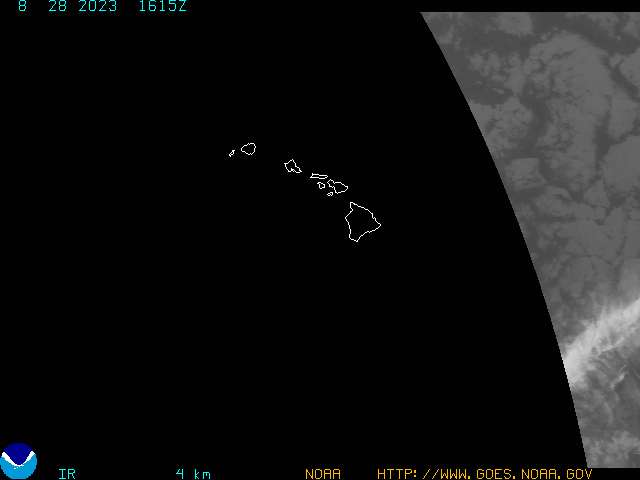
Satellite and Radar Images: To view the cloud conditions we have here in Hawaii, please use the following satellite links, starting off with the Infrared Satellite Image of the islands to see all the clouds around the state during the day and night. This next image is one that gives close images of the islands only during the daytime hours, and is referred to as a Close-up visible image. This next image shows a larger view of the Pacific…giving perspective to the wider ranging cloud patterns in the Pacific Ocean…out from the islands. To help you keep track of where any showers may be around the islands, here’s the latest animated radar image.
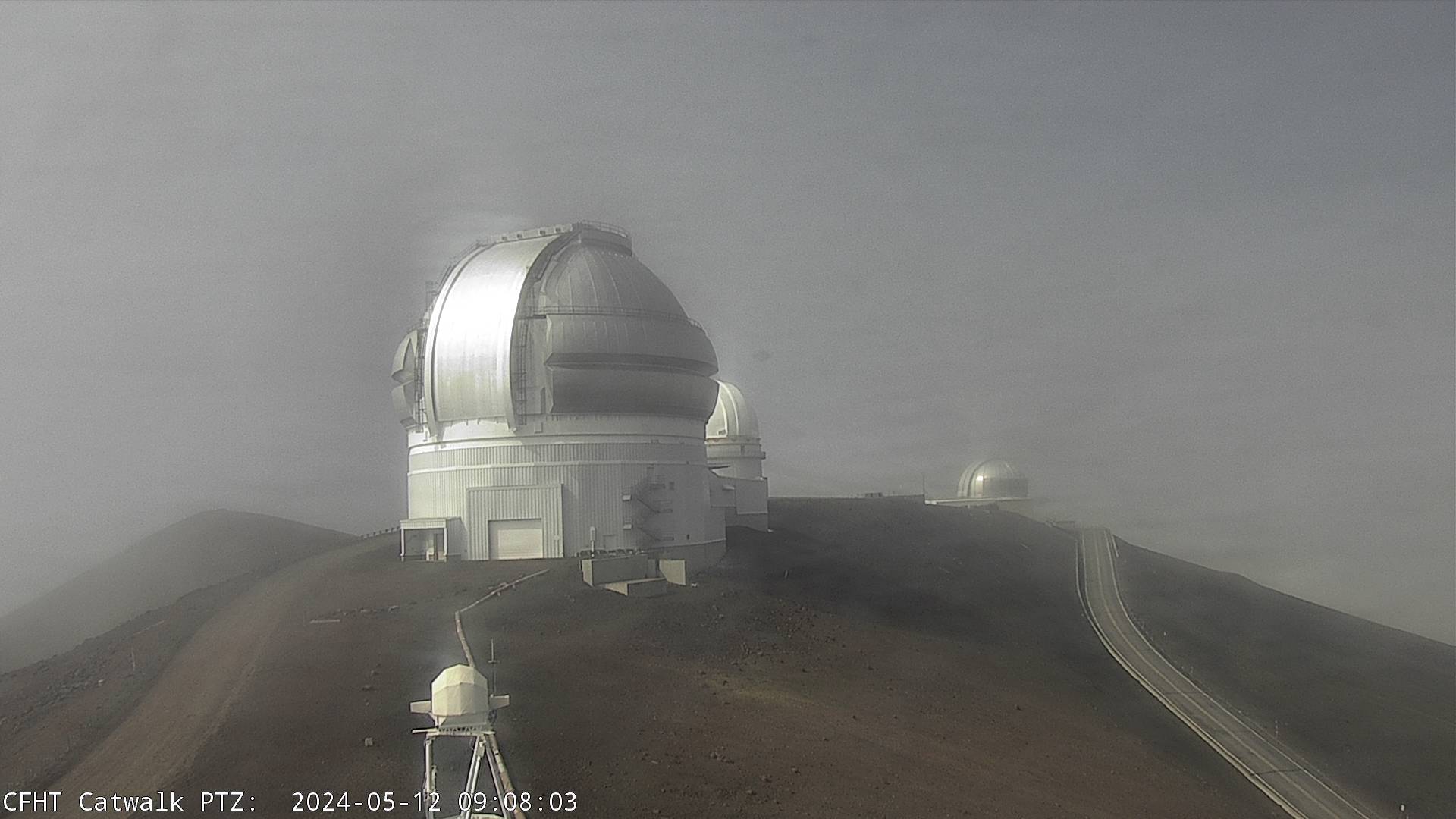
Hawaii’s Mountains – Here’s a link to the live webcam on the summit of near 14,000 foot Mauna Kea on the Big Island of Hawaii. The tallest peak on the island of Maui is the Haleakala Crater, which is near 10,000 feet in elevation. These two webcams are available during the daylight hours here in the islands…and when there’s a big moon rising just after sunset for an hour or two! Plus, during the nights and early mornings you will be able to see stars, and the sunrise too…depending upon cloud conditions.
Aloha Paragraphs

Happy Mothers Day!
Moderately strong trade winds will give way to lighter trade breezes Monday. A small craft wind advisory was trimmed down Saturday, which on Sunday includes only the major channels around Maui and the Big Island, plus Maalaea Bay…which should be canceled altogether Monday. Our local winds will be getting even lighter by Tuesday, and for several days thereafter. During the Tuesday through Friday period, they will in the very light and variable realms. The weather models show them picking up again by the weekend…then continuing into the following week.
As the trade winds are still blowing, the focus for showers will remain anchored along the windward sides through Monday. The leeward beaches will be generally quite dry, although showers could fall along the Kona slopes of the Big Island during the late afternoons. The bias for showers will shift over to the interior areas starting Tuesday afternoon, with afternoon showers occurring each day through Friday. The generosity of these convective showers will be somewhat limited, so that no flooding problems are anticipated at this time.
It’s Sunday evening as I begin writing this last section of today’s narrative. As described above, a fairly routine trade wind weather pattern will prevail here in the islands through Monday. As Tuesday arrives, our trade winds will be pretty much completely gone, with whatever light breezes that will be around then…drifting up from a southeast direction. This means that we’ll see voggy weather in many parts of the state for several days thereafter.
~~~ A cold front approaching the state from the NW will prompt this change in our weather circumstances. As we get into the heart of this convective weather pattern, our days will start off with clear skies, along with slightly cooler than normal early morning air temperatures…giving way to rather sultry conditions as the sun gets higher in the sky during the days. The daytime heating will cause clouds to build up over and around the mountains during the afternoons, with precipitation falling in the upcountry areas. Clouds typically evaporate again after dark, with the process beginning again the next day.
~~~ It’s Mother’s Day…one of the most special holiday’s of the year! My Mom, whose name is Dorothy James, lives in Long Beach, California. It’s pretty much a given, that we all love our Mom’s, no doubt about that fact! I’d like to wish each and every Mom that happens to be reading these words, the very best day. I was just talking to my Mom yesterday, and she reminded me that it only happens once a year…giving us just this one special Sunday to tell our Mothers just how much they mean to us. I sent my Mom two orchid plants, from Haiku, Maui. I know that everyone sends a card, and tries to get together with this special lady in our lives, or at least sends a nice card. You can’t say it too often: Happy Mothers Day!
~~~ I was able to connect with my Mother today through a software program called Skype. My neighbor connected with my Mom and Dad via her portable computer, which had a built in camera. I was able to see my Mom and Dad, and others in my family, while they could see me on their computer…talking live to each other at the same time, via microphones in our computers. We walked around this property, showing my parents our garden, and where I lived, including my weather tower here in Kula, Maui. It was pretty amazing, and especially for my parents! My Mom was able to show me the orchids that I had sent her for a Mothers Day present.
~~~ It’s quite clear here on Maui this evening, with not many clouds around at all, much less rainfall. I understand that the Big Island’s windward sides are where the most showers were falling. I hope everyone had a chance to communicate with their Mom in person, or at least on the telephone on this special day. If not, I trust spirits were touched in such a way that an intimate Mother son and daughter connection was continued through yet another year. I’ll be back again with your next new weather narrative from paradise very early Monday morning. I hope you have a great Sunday night until then! Aloha for now…Glenn.
Posted by Glenn
No Comments
May 10-11 2008
Air Temperatures – The following maximum temperatures were recorded across the state of Hawaii Saturday:
Lihue, Kauai – 81
Honolulu, Oahu – 86
Kaneohe, Oahu – 81
Kahului, Maui – 84
Hilo, Hawaii – 79
Kailua-Kona, Hawaii – 83
Air Temperatures ranged between these warmest and coolest spots near sea level at 3 p.m. Saturday afternoon:
Honolulu, Oahu – 85F
Hilo, Hawaii – 75
Precipitation Totals – The following numbers represent the largest precipitation totals (inches) during the last 24 hours on each of the major islands, as of Saturday afternoon:
0.40 MOUNT WAIALEALE, KAUAI
0.30 SOUTH FORK KAUKONAHUA, OAHU
0.02 MOLOKAI
0.00 LANAI
0.00 KAHOOLAWE
0.54 WEST WAILUAIKI, MAUI
0.88 GLENWOOD, BIG ISLAND
Weather Chart – Here’s the latest (automatically updated) weather map showing high pressure centers far to the NE of the state. This large area of high pressure will keep moderately strong trade winds blowing across our islands Saturday…gradually getting lighter into Sunday into Monday.
Satellite and Radar Images: To view the cloud conditions we have here in Hawaii, please use the following satellite links, starting off with the Infrared Satellite Image of the islands to see all the clouds around the state during the day and night. This next image is one that gives close images of the islands only during the daytime hours, and is referred to as a Close-up visible image. This next image shows a larger view of the Pacific…giving perspective to the wider ranging cloud patterns in the Pacific Ocean…out from the islands. To help you keep track of where any showers may be around the islands, here’s the latest animated radar image.
Hawaii’s Mountains – Here’s a link to the live webcam on the summit of near 14,000 foot Mauna Kea on the Big Island of Hawaii. The tallest peak on the island of Maui is the Haleakala Crater, which is near 10,000 feet in elevation. These two webcams are available during the daylight hours here in the islands…and when there’s a big moon rising just after sunset for an hour or two! Plus, during the nights and early mornings you will be able to see stars, and the sunrise too…depending upon cloud conditions.
Aloha Paragraphs
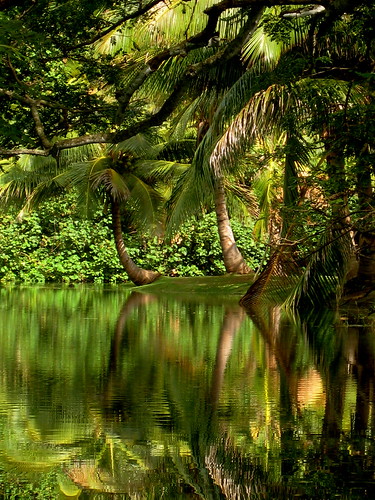
A magical spot on Kauai
The trade winds will still be rather gusty Saturday…stepping down in strength Sunday into the new week ahead. A small craft wind advisory was trimmed down Saturday, now including just the major channels from Oahu southward to the Big Island for the most part. These trades will slow down Sunday, getting even lighter during the new week ahead. During the Tuesday through Thursday period, they will in the very light and variable realms. The latest models show them picking up again around next Friday…then continuing through the rest of the week into the following week.
Showers will concentrate around the mountains and along the windward coasts and slopes for the time being. Those windward areas will find the most generous rainfall as usual, which will be the case through Monday. The leeward beaches will be generally quite dry, although showers could fall along the Kona slopes of the Big Island during the late afternoons. The bias for showers will shift over to the interior areas starting Tuesday afternoon.
It’s Saturday evening as I begin writing this last section of today’s narrative. As described above, a fairly routine trade wind weather pattern prevails here in the islands for the moment. These conditions will hold through the weekend, and start us off into our new week ahead. The current rather strong and gusty trade wind flow will begin to soften later this weekend into Monday…onward.
~~~ As Tuesday rolls around, our trade winds will diminish further in strength, and will likely veer around to a southeast direction. A cold front approaching the state from the NW will prompt this change in our weather circumstances. A light wind convective weather pattern will begin Tuesday, and remain in place through Thursday. This means that we’ll see voggy weather in many parts of the state.
~~~ A convective weather pattern typically manifests with days starting off in a clear way, with slightly cooler than normal temperatures giving way to rather hot and muggy afternoons. At the same time we can see clouds stacking-up over and around the mountains during the afternoons, with precipitation falling in the upcountry areas. Clouds typically evaporate again after dark, with the process beginning again the next day.
~~~ I went down to the beach on the north shore here on Maui early this morning. It was a delight to take that long walk down to Spreckelsville, or what is often referred to as baby beach. Baby beach is a long lagoon, with shallow water, which is perfect for kids, and for people who don’t want to deal with waves. I walked back to Baldwin Beach, and had a nice swim. It was breakfast time when I got back to Paia, so I had a crepe at a little eatery on Baldwin Ave. I did a little shopping at Mana Food, and stopped in at the Pukalani Superette for a couple pieces of fresh Ahi tuna on the way home.
~~~ When I got back home to Kula, my neighbor and I cut down a stock of bananas, which turned out to be quite a job. I had a chance to rest a little, although now I’m on my way to meet a friend for a walk out along Thompson Ranch Rd, down in Keokea. It’s a wonderful place to stretch your legs, and look down the mountain towards Makena, Wailea and Kihei. We will have dinner together, and sip on a nice glass of red wine…in this case a great 1997 Napa Valley, California Cabernet. I’ll catch up with you early Sunday morning again, when I’ll have your next new weather narrative from paradise ready for the reading here. I’m planning on an early trip down to the Pukalani country club for some putting…more about that then. I hope you have a great Saturday night wherever you happen to be spending it. It may mean you are reading from here in Hawaii, or perhaps in Vancouver, Canada, or Duluth, or Tampa, maybe Butte, Montana…whatever. Aloha for now…Glenn.
Bye the way, here’s wishing all you Mom’s…a very Happy Mothers Day!
Posted by Glenn
No Comments
May 9-10 2008
Air Temperatures – The following maximum temperatures were recorded across the state of Hawaii Friday:
Lihue, Kauai – 81
Honolulu, Oahu – 86
Kaneohe, Oahu – 80
Kahului, Maui – 84
Hilo, Hawaii – 80
Kailua-Kona, Hawaii – 82
Air Temperatures ranged between these warmest and coolest spots near sea level at 4 p.m. Friday afternoon:
Barking Sands, Kauai – 84F
Hilo, Hawaii – 77
Precipitation Totals – The following numbers represent the largest precipitation totals (inches) during the last 24 hours on each of the major islands, as of Friday afternoon:
0.34 MOUNT WAIALEALE, KAUAI
1.13 SOUTH FORK KAUKONAHUA, OAHU
0.00 MOLOKAI
0.00 LANAI
0.00 KAHOOLAWE
0.22 KAUPO GAP, MAUI
2.26 KEALAKEKUA, BIG ISLAND
Weather Chart – Here’s the latest (automatically updated) weather map showing high pressure centers far to the NE of the state. This large area of high pressure will keep moderately strong trade winds blowing across our islands Saturday…gradually getting lighter into Sunday.
Satellite and Radar Images: To view the cloud conditions we have here in Hawaii, please use the following satellite links, starting off with the Infrared Satellite Image of the islands to see all the clouds around the state during the day and night. This next image is one that gives close images of the islands only during the daytime hours, and is referred to as a Close-up visible image. This next image shows a larger view of the Pacific…giving perspective to the wider ranging cloud patterns in the Pacific Ocean…out from the islands. To help you keep track of where any showers may be around the islands, here’s the latest animated radar image.
Hawaii’s Mountains – Here’s a link to the live webcam on the summit of near 14,000 foot Mauna Kea on the Big Island of Hawaii. The tallest peak on the island of Maui is the Haleakala Crater, which is near 10,000 feet in elevation. These two webcams are available during the daylight hours here in the islands…and when there’s a big moon rising just after sunset for an hour or two! Plus, during the nights and early mornings you will be able to see stars, and the sunrise too…depending upon cloud conditions.
Aloha Paragraphs

Deep colors of a beautiful flower lei
The gusty trade winds of the last several days will be gradually mellowing out this weekend. A small craft wind advisory remains active in all coastal and channel waters from the north shore of Kauai down through South Point, on the Big Island Friday evening. These trades will slow down this weekend, becoming much lighter by the middle of next week. The latest models show them picking up again around next Friday…then continuing through the rest of the week into the following week.
There will still be the usual showers falling here in the islands. The windward areas as usual will find the most generous rainfall. The leeward beaches will be generally quite dry, although showers could fall along the Kona slopes of the Big Island during the late afternoons. As the winds are so strong now, a few stray showers may make it over into the leeward areas at times on the smaller islands. Weather in general will continue to be pretty normal in most regards otherwise.
It’s Friday evening as I begin writing this last section of today’s narrative. As described above, a fairly routine trade wind weather pattern prevails here in the islands at the moment. These conditions will hold through the weekend, and start us off into our new week ahead. The current rather strong and gusty trade wind flow will however, begin to soften a little this weekend into Monday.
~~~ As next Tuesday rolls around, our trade winds will diminish in strength, and may very well veer around to the southeast direction. A trough, or a cold front approaching the state from the NW will be the culprit in this change in our weather circumstances. A light wind convective weather pattern will kick in Tuesday, and remain in place through Thursday. This means that we’ll see the likelihood of voggy weather in some parts of the state.
~~~ A convective weather pattern usually has the days starting off in a clear way, with slightly cooler than normal temperatures giving way to rather hot and muggy afternoons. At the same time we can see clouds stacking-up over and around the mountains during the afternoons, with precipitation falling in the upcountry areas. Clouds typically evaporate again after dark, with the process beginning again the next day.
~~~ It’s after work on Friday, I’m still in Kihei, Maui, leaving soon for the drive to Kahului. I really want to see the new film called Iron Man, but I’m afraid it’s still going to be too crowded, so I’ll give it one more week. As a second choice, I’ll see the new film called Redbelt (2008)…starring Chjwetel Ejiofor, Tim Allen, Rodrigo Santoro, among others. Redbelt is set in the west-side of Los Angeles fight world, a world inhabited by bouncers, cage- fighters, cops and special forces types, Redbelt, is the story of Mike Terry (Chiwetel Ejiofor), a Jiu-Jitsu teacher who has avoided the prize fighting circuit, choosing instead to pursue an honorable life by operating a self-defense studio with a samurai’s code. The Yahoo critics give it a solid B rating, while the rottentomatoes movie review website gives it 70 out of 100 points. Here’s a trailer if you feel like checking it out. It’s another one of those heavy duty action packed films!
~~~ I’ll be back early Saturday morning, not only with your next new weather narrative, but with my impression of the film. I plan on leaving the house early for a trip to the north shore right after breakfast, more about that in the morning. I hope you have a great Friday night wherever you happen to be spending it, whether in Laramie, Palm Springs, Albany, Austin…or perhaps Portland, Santa Rosa or even Key West, Florida! Aloha for now…Glenn.
Shark Surfer!
Interesting: A new company hopes drivers will kick the oil habit by brewing ethanol at home that won’t spike food prices. E-Fuel Corp unveiled on Thursday the "MicroFueler" touting it as the world’s first machine that allows homeowners to make their own ethanol and pump the brew directly into their cars. The portable unit that sells for $10,000 resembles a gasoline station pump and nozzle — minus the slot for a credit card, or the digital "SALE" numbers that whir ever faster at retail pumps as global demand pushes fuel prices to record levels. Instead of tapping gasoline from an underground tank, the pump’s back end plugs into home power and water supplies to make ethanol for as little as $1 a gallon (3.8 liters), according to E-Fuel. The company says one of the machine’s top selling points is its sweet tooth. It ferments fuel from sugar, the price of which is historically cheap as global supplies are glutted. That means it avoids the Achilles heel of today’s U.S. ethanol system — reliance on corn — which has been blamed for helping to spike global food prices.
Interesting2: It’s a happy Mother’s Day for an Arkansas woman — she’s pregnant with her 18th child. Michelle Duggar, 41, is due on New Year’s Day, and the latest addition will join seven sisters and 10 brothers. There are two sets of twins. "We’ve had three in January, three in December. Those two months are a busy time for us,” she said, laughing. The Duggars’ oldest child, Josh, is 20, and the youngest, Jennifer, is nine months old. The fast-growing family lives in Tontitown in northwest Arkansas in a 7,000-square-foot home. All the children — whose names start with the letter J — are home-schooled. Duggar has been pregnant for more than 11 years of her life, and the family is in the process of filming another series for Discovery Health. The new show looks at life inside the Duggar home, where chores — or "jurisdictions” — are assigned to each child. One episode of the new show involves a "jurisdiction swap,” where the boys do chores traditionally assigned to the girls, and vice versa, Duggar said. "The girls swapped jurisdictions, changing tires, working in the garages, mowing the grass,” she said. "The boys got to cook supper from start to finish, clean the bathrooms,” among other chores.
Interesting3: It’s hard for anyone to say what music looks like, but a new mathematical approach sees classical music as cone-shaped and jazz as pyramid-like. The connections between math and music are many, from the unproven Mozart effect (the idea that playing Mozart’s music to children might improve their mathematical abilities) to the music of the spheres (the ancient belief that proportions in the movements of the planets could be viewed as a form of music). Now scientists have created a mathematical system for understanding music. Clifton Callender of Florida State University, Ian Quinn of YaleUniversity and Dmitri Tymoczko of PrincetonUniversity outlined their "geometrical music theory" in the April 18 issue of the journal Science. The team designed a geometrical technique for mapping out music in coordinate space. For music made of chords containing two notes, all musical possibilities take the shape of a Möbius strip, which basically looks like a twisted rubber band (this was first described by Tymoczko in a 2006 Science paper). The team found that the shape of possibilities using three-note chords is a three-dimensional ice cream cone, where types of chords, such as major chords and minor chords, are unique points on the cone. The space of four-note chords is what mathematicians would call a "cone over the real projective plane," which resembles a pyramid in our 3-D universe. Any piece of music can be mapped in these spaces.
Posted by Glenn
No Comments
May 8-9 2008
Air Temperatures – The following maximum temperatures were recorded across the state of Hawaii Thursday:
Lihue, Kauai – 80
Honolulu, Oahu – 85
Kaneohe, Oahu – 80
Kahului, Maui – 84
Hilo, Hawaii – 79
Kailua-Kona, Hawaii – 83
Air Temperatures ranged between these warmest and coolest spots near sea level at 4 a.m. Thursday afternoon:
Honolulu, Oahu – 83F
Lihue, Kauai – 75
Precipitation Totals – The following numbers represent the largest precipitation totals (inches) during the last 24 hours on each of the major islands, as of Thursday afternoon:
0.51 MOUNT WAIALEALE, KAUAI
0.73 SOUTH FORK KAUKONAHUA, OAHU
0.15 MOLOKAI
0.00 LANAI
0.00 KAHOOLAWE
1.15 PUU KUKUI, MAUI
0.92 GLENWOOD, BIG ISLAND
Weather Chart – Here’s the latest (automatically updated) weather map showing high pressure centers far to the NE of the state. This large area of high pressure will keep moderately strong to fresh trade winds blowing across our islands Friday into Saturday…locally strong and gusty.
Satellite and Radar Images: To view the cloud conditions we have here in Hawaii, please use the following satellite links, starting off with the Infrared Satellite Image of the islands to see all the clouds around the state during the day and night. This next image is one that gives close images of the islands only during the daytime hours, and is referred to as a Close-up visible image. This next image shows a larger view of the Pacific…giving perspective to the wider ranging cloud patterns in the Pacific Ocean…out from the islands. To help you keep track of where any showers may be around the islands, here’s the latest animated radar image.
Hawaii’s Mountains – Here’s a link to the live webcam on the summit of near 14,000 foot Mauna Kea on the Big Island of Hawaii. The tallest peak on the island of Maui is the Haleakala Crater, which is near 10,000 feet in elevation. These two webcams are available during the daylight hours here in the islands…and when there’s a big moon rising just after sunset for an hour or two! Plus, during the nights and early mornings you will be able to see stars, and the sunrise too…depending upon cloud conditions.
Aloha Paragraphs


The art of flower lei making
The trade winds are blowing in the locally strong and gusty realms now. We’ve seen the trade winds increase a notch now, and will remain that way into the first half of the weekend. A small craft wind advisory is now active in all coastal and channel waters from the north shore of Kauai down through South Point, on the Big Island. These trades will slow down starting Sunday, becoming much lighter by the middle of next week. The latest models show them picking up again around next Thursday or Friday…then continuing through the rest of the week.
There will be the usual showers being carried in our direction on the fresh trade winds…slightly more numerous than normal. The windward areas as usual will find the most generous rainfall. The leeward beaches will be generally quite dry, although a few showers could fall along the Kona slopes of the Big Island during the afternoon or early evening hours. As the winds are so strong now, a few stray showers may make it into the leeward areas at times on the smaller islands.
It’s Thursday evening as I begin writing this last section of today’s narrative. Just when we thought we were going to see the trade winds blowing through the remainder of spring, right on into the beginning of summer…we now see a stop sign up ahead! As I’ve been mentioning the last several days, the computer models want to have our winds getting much lighter for a day or two next week. Those models point out a rather deep trough of low pressure, with a cold front, approaching the Hawaiian Islands after the weekend. This storminess would push our trade wind producing high pressure ridge down closer to the state, and perhaps right down over us. This is the reason our winds will take a nose dive in strength…around next Tuesday and Wednesday.
~~~ If this happens as described, we would see our trade wind weather pattern giving way to a light wind convective weather pattern. We would see the haze levels around the state increasing, and if there was a drift of air coming up from the southeast, we could see thick volcanic haze, the infamous vog, settling in over many parts of the state. Often with this kind of weather pattern in force, we see clear, slightly cooler than normal mornings giving way to rather hot and muggy afternoons. At the same time we could see clouds stacking up over and around the mountains during the afternoons, with precipitation falling in the upcountry areas. Clouds typically evaporate again after dark, with the process beginning again the next day.
~~~ Thursday was another nice day here in the islands, although the trade winds were rushing around locally. The strongest winds that I saw during the aftrernoon hours, was the 44 mph gust here on Maui, at Maalaea Bay. They were still gusting to 42 mph at that windy Bay late in the afternoon. Kahoolawe saw gusts at the same time to 37 mph, while even normally light winded Lanai had 35 mph gusts. Other than all this "air in a hurry", skies were generally quite sunny during the day. As this looping satellite image shows, a strong stream of high cirrus clouds are remaining just to the south of Hawaii…riding along in the jet stream level winds. It wouldn’t take much of a nudge northward, to bring that high altitude cloudiness up over the Aloha state.
~~~ Friday will find the trade winds still on the rowdy side of the wind speed spectrum. Sunshine will be abundant, especially along the leeward sides of the islands. The windward sides will see a few showers falling, and there could be a couple of loud showers falling, particularly if you live under a tin roof! I’ll be back very early Friday morning with your next new weather narrative from paradise. I hope you have a great Thursday night until then! Aloha for now…Glenn.
Interesting: High gasoline prices could lead to a dramatic saving in US greenhouse-gas emissions. That’s the conclusion of economists in the US, who suggest high fuel prices are turning consumers off SUVs and onto smaller, more fuel-efficient vehicles. What’s more, car owners are predicted to cut back on driving in order to save money. Together, these changes in consumer behaviour could make an important dent in the US contribution to global warming, reducing annual carbon dioxide emissions by tens of millions of tons per year. The impact will be dramatic, says Chris Knittel, an economist at the University of California, Davis, who was involved in one of the studies. The changes are being driven by record fuel prices in the US, where, at the end of April, the average price of gasoline stood at $3.65 per gallon, 20 per cent more than in January and treble the price of a decade ago. Until recently, these increases did not seem to be having a consistent effect on the car market and fuel use. Though sales of SUVs in the US have been falling over the past few years, this decline has come on the back of years of rapid growth, and overall gasoline consumption has been increasing every year since 1991.
Interesting2: Wyoming Air Pollution Rivals Big Cities. There isn’t anything metropolitan about this tiny unincorporated town in southwest Wyoming, where a few single-family homes and a volunteer fire station stand against a skyline of snowcapped mountains. But Boulder, with a population of just 75 people, has one thing in common with major metropolitan areas: air pollution thick enough to pose health risks. "Used to be you could see horizon to horizon, crystal clear. Now you got this,” said Craig Jensen as he gestured to a pale blue sky that he says is not as deeply colored as it used to be. "Makes you wonder what it’s going to do to the grass, the trees and the birds.” The pollution, largely from the region’s booming natural gas industry, came in the form of ground-level ozone, which has exceeded healthy levels 11 times since January and caused Wyoming to issue its first ozone alerts. Now the ozone threatens to cost the industry and taxpayers millions of dollars to stay within federal clean-air laws. Sublette County is home to one of the largest natural gas reserves in North America, and it is dotted with hundreds of gas wells to supply the growing U.S. demand for cleaner-burning fuel. Thousands more wells are planned for the future.
Interesting3: Turn greenhouse gases to stone? Transform them into a treacle-like liquid deep under the seabed? The ideas may sound like far-fetched schemes from an alchemist’s notebook but scientists are pursuing them as many countries prepare to bury captured greenhouse gases in coming years as part of the fight against global warming. Analysts say the search for a suitable technology could become a $150 billion-plus market. But a big worry is that gases may leak from badly chosen underground sites, perhaps jolted open by an earthquake. Such leaks could be deadly and would stoke climate change. Part of the answer could be to petrify or liquefy gases like carbon dioxide — emitted for example from power plants and factories run on coal, oil or natural gas — if technical hurdles can be overcome and costs are not too high. "If you can convert (the gases) to stone, and it’s environmentally benign and permanent, then that’s better," said Juerg Matter, a German scientist at ColumbiaUniversity in New York who is working on a project in Iceland to turn carbon dioxide, the main greenhouse gas, to rock. In theory, carbon dioxide reacts with porous basalt and turns into a mineral, but no one knows how long that takes. Matter and U.S., French and Icelandic experts plan to inject 50,000 tonnes of the gas into basalt in a test starting in 2009.
Interesting4: Remains of meals that included seaweed are helping confirm the date of a settlement in southern Chile that may offer the earliest evidence of humans in the Americas. Researchers date the seaweed found at Monte Verde to more than 14,000 years ago, 1,000 years earlier than the well-studied Clovis culture. And the report comes just a month after other scientists announced they had found coprolites — fossilized human feces — dating to about 14,000 years ago in a cave in Oregon. Taken together, the finds move back evidence of people in the Americas by a millennium or more, with settlements in northern and southern coastal areas. The prevailing theory has been that people followed herds of migrating animals across an ancient land bridge between Siberia and Alaska, and then moved southward along the West coast. Proof has been hard to come by, however. The sea was about 200 feet lower at the time and as it rose it would have inundated the remains of coastal settlements. A team led by anthropologist Tom Dillehay of Vanderbilt University reports on the new seaweed study from Monte Verde, Chile, in Friday’s edition of the journal Science.
Posted by Glenn
No Comments
May 7-8 2008
Air Temperatures – The following maximum temperatures were recorded across the state of Hawaii Wednesday:
Lihue, Kauai – 81
Honolulu, Oahu – 85
Kaneohe, Oahu – 80
Kahului, Maui – 85
Hilo, Hawaii – 80
Kailua-Kona, Hawaii – 82
Air Temperatures ranged between these warmest and coolest spots near sea level at 4 p.m. Wednesday afternoon:
Honolulu, Oahu – 83F
Hilo, Hawaii – 77
Precipitation Totals – The following numbers represent the largest precipitation totals (inches) during the last 24 hours on each of the major islands, as of Wednesday afternoon:
0.80 MOUNT WAIALEALE, KAUAI
0.35 POAMOHO 2, OAHU
0.06 MOLOKAI
0.01 LANAI
0.00 KAHOOLAWE
0.45 PUU KUKUI, MAUI
0.49 PAHOA, BIG ISLAND
Weather Chart – Here’s the latest (automatically updated) weather map showing a large 1031 milliar high pressure center far to the NE of the state. This high pressure system will keep moderately strong to fresh trade winds blowing across our islands Thursday and Friday…locally strong and gusty.
Satellite and Radar Images: To view the cloud conditions we have here in Hawaii, please use the following satellite links, starting off with the Infrared Satellite Image of the islands to see all the clouds around the state during the day and night. This next image is one that gives close images of the islands only during the daytime hours, and is referred to as a Close-up visible image. This next image shows a larger view of the Pacific…giving perspective to the wider ranging cloud patterns in the Pacific Ocean…out from the islands. To help you keep track of where any showers may be around the islands, here’s the latest animated radar image.
Hawaii’s Mountains – Here’s a link to the live webcam on the summit of near 14,000 foot Mauna Kea on the Big Island of Hawaii. The tallest peak on the island of Maui is the Haleakala Crater, which is near 10,000 feet in elevation. These two webcams are available during the daylight hours here in the islands…and when there’s a big moon rising just after sunset for an hour or two! Plus, during the nights and early mornings you will be able to see stars, and the sunrise too…depending upon cloud conditions.
Aloha Paragraphs
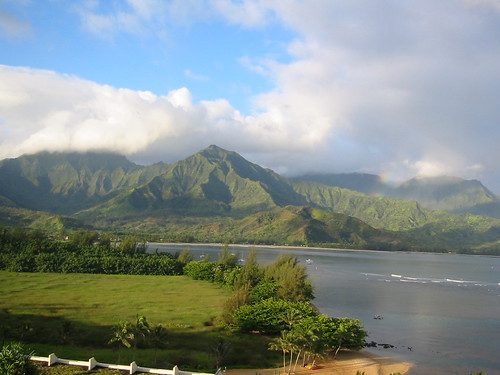 Princeville, Kauai
The trade winds have picked up in strength now, becoming rather blustery in some places. We’ll see the trade winds increase another notch Thursday through the rest of the week. A small craft wind advisory is now active in Hawaii’s coastal and channel waters around Maui and the Big Island, which may be expanded a bit further up the chain into the weekend. These trade will blow through next Tuesday, at which point they will likely slow down, and perhaps become southeast…remaining light for several days thereafter.
Despite the stronger trade winds, we won’t see much of an increase in showers. The windward areas as usual will find the most generous rainfall. The leeward beaches will be generally quite dry, although a few showers could fall along the Kona slopes of the Big Island during the afternoon or early evening hours. It appears that there will be little change in this favorably inclined trade wind weather pattern this week. We may see some changes occurring around the middle of next week.
It’s Wednesday evening as I begin writing this last section of today’s narrative. In the last sentence in the paragraph above, I intimated that there may be some changes starting around next Wednesday. The computer models want to have our winds getting much lighter then, and turn to the southeast. It’s still too early to totally accept this future possibility. If on the other hand, it were to occur as the models are pointing out, we would see the return of potentially thick vog, along with an increase in afternoon convective cloudiness and showers for a few days then.
~~~ It’s always risky to talk about what will be happening a week out into the future. The accuracy of weather forecasts is usually pretty good for that day, or perhaps even a day or two ahead. When you try and project out seven days however, well, that can bring weathermen and women, back to the drawing boards several times…back to their chalk boards, doing some pretty heavy erasing! So, we’ll hold this prospect lightly for the time being, and just keep a wary eye on it through the rest of this week. The models have even gone so far as to suggest an active cold front moving down through the state, which would be unusual this time of year. Stranger things have happened, but if we use climatology as a measuring stick, it would be unlikely to see a frontal cloud band moving down through the island chain during the middle of May.
~~~ Wednesday the weather followed the forecast script pretty well, staying nice for almost all outdoor activities. At the moment, as demonstrated with this looping satellite image, we’re mostly clear of the persistent high cirrus cloudiness of late. There are a few wisps moving by, with a couple of potential new areas moving our way on the upper winds aloft. The trade winds were the most notable weather element today, pushing our tropical vegetation around, and chalking-up our coastal waters with lots of white caps. Speaking of the ocean, without very much surf breaking on our local beaches now, this is an excellent time to be snorkeling, swimming, and just generally being in the ocean…although watch out for the gusty winds if you’re out in kayaks.
~~~ I will be back very early Thursday morning with your next new Hawaiian Island weather narrative. I hope you have a great Wednesday night, whether you’re here in the Islands, or in Seattle, Portland, San Francisco, LA or San Diego…or elsewhere of course! Aloha for now…Glenn
Note: I have not mentioned the devastating cyclone, named Nargis, which slammed into the river delta region in Myanmar (Burma). I was tracking the storm a week before it made landfall, as part of my duties at the Pacific Disaster Center here in Kihei, Maui, where I’m the senior weather analyst. So I have been very aware of the horrendous after-effects of this major storm…up to 100,000 deaths expected! There is certainly no lack of news, from various sources, which is the reason that I’m not including information about it on this website. I send my very best wishes to everyone involved in that area! Glenn
Interesting: China’s Huge Self-Sustaining Soar LED Wall, alled the GreenPix Zero Energy Media Wall, and with 2,292 individual color LEDs, comparable to a 24,000 sq. ft. monitor screen, it’s said to be the largest color LED display in the world. The wall is solar-powered too — photovoltaics are integrated into the wall’s glass curtain, and it harvests power during the day, to illuminate the display at night. Designed by, Simone Giostra & Partners Architects, the GreenPix wall is part of the Xicui Entertainment Complex in Beijing, near the site of the 2008 Olympics. The polycrystalline photovoltaic cells are laminated within the glass of the curtain wall and placed with changing density on the entire building’s skin. The density pattern increases building’s performance, allowing natural light when required by interior program, while reducing heat gain and transforming excessive solar radiation into energy for the media wall. The building will open to the public in June 2008, with a specially commissioned program of video installations and live performances by artists.
Interesting2: Scientists have suggested that due to the adverse effects of Arctic ice melting, the hybrid of a polar bear and grizzly bear – dubbed the ‘grolar bear’, might rise in numbers. According to a report in The Sun , the effects of climate change means that the hybrid bears could become more common as their habitats increasingly overlap due to global warming. "One of the real things that is happening is that grizzlies are moving north, at the same time the polar bears are forced to be on the beach and we have found a number of grizzly bear polar bear hybrids," said biologist Dr George Divoky, who has worked in the Arctic region for over three decades. "Essentially that could mean that it would save the polar bear genes in the grizzly population," he added. Biologists have already spotted the hybrid species.
Interesting3: Polar bears may have it relatively easy. It’s the tropical creatures that could really struggle if the climate warms even a few degrees in places that are already hot, scientists reported on Monday. That doesn’t mean polar bears and other wildlife in the polar regions won’t feel the impact of climate change. They probably will, because that is where the warming is expected to be most extreme, as much as 18 degrees F (10 degrees C) by the end of this century. But there are far fewer species living in the Arctic and Antarctic and in the temperate zones than in the tropics, said Curtis Deutsch of the University of California at Los Angeles. Many of these tropical creatures are living at the edge of their temperature tolerance already. Even the slight tropical warming predicted by 2100 — 5.4 degrees F (3 degrees C) — could push them to the brink, Deutsch said in a telephone interview. In research published in Proceedings of the National Academy of Sciences, Deutsch and his co-authors investigated what could happen to cold-blooded animals in the tropics over the next 100 years if the predictions of greenhouse warming hold true. They chose cold-blooded creatures — mostly insects but also frogs, lizards and turtles — because warm-blooded animals have other ways of regulating their body temperatures, such as growing a thick coat of fur to guard against cold and shedding when it gets warm.
Interesting4: Climate change is harder on women in poor countries, where mothers stay in areas hit by drought, deforestation or crop failure as men move to literally greener pastures, a Nobel Peace laureate said on Tuesday. "Many destructive activities against the environment disproportionately affect women, because most women in the world, and especially in the developing world, are very dependent on primary natural resources: land, forests, waters," said Wangari Maathai of Kenya. "Women are very immediately affected, and usually women and children can’t run away," said Maathai, who won the 2004 Nobel Peace Prize for her work on sustainable development. "Men can trek and go looking for greener pastures in other areas in other countries … but for women, they’re usually left on site to face the consequences," she said. "So when there is deforestation, when there is drought, when there is crop failure, it is the women and children who are the most adversely affected." Maathai was in Washington with 1997 Nobel Peace laureate Jody Williams, who got the award for her work in creating an international treaty to ban landmines, and both spoke to reporters at a briefing. Williams said she saw climate change as a threat to security, and said desertification of former agricultural land fueled the conflict in Darfur.
Posted by Glenn
No Comments
May 6-7 2008
Air Temperatures – The following maximum temperatures were recorded across the state of Hawaii Tuesday:
Lihue, Kauai – 81
Honolulu, Oahu – 85
Kaneohe, Oahu – 81
Kahului, Maui – 85
Hilo, Hawaii – 80
Kailua-Kona, Hawaii – 82
Air Temperatures ranged between these warmest and coolest spots near sea level at 4 p.m. Tuesday afternoon:
Honolulu, Oahu – 84F
Lihue, Kauai – 77
Precipitation Totals – The following numbers represent the largest precipitation totals (inches) during the last 24 hours on each of the major islands, as of Tuesday afternoon:
1.92 MOUNT WAIALEALE, KAUAI
0.21 NUUANU UPPER, OAHU
0.00 MOLOKAI
0.00 LANAI
0.00 KAHOOLAWE
0.27 PUU KUKUI, MAUI
0.62 HONAUNAU, BIG ISLAND
Weather Chart – Here’s the latest (automatically updated) weather map showing a 1030 milliar high pressure center far to the NE of the state. This high pressure system will keep light to moderately strong trade winds blowing across our islands Wednesday, increasing some Thursday.
Satellite and Radar Images: To view the cloud conditions we have here in Hawaii, please use the following satellite links, starting off with the Infrared Satellite Image of the islands to see all the clouds around the state during the day and night. This next image is one that gives close images of the islands only during the daytime hours, and is referred to as a Close-up visible image. This next image shows a larger view of the Pacific…giving perspective to the wider ranging cloud patterns in the Pacific Ocean…out from the islands. To help you keep track of where any showers may be around the islands, here’s the latest animated radar image.
Hawaii’s Mountains – Here’s a link to the live webcam on the summit of near 14,000 foot Mauna Kea on the Big Island of Hawaii. The tallest peak on the island of Maui is the Haleakala Crater, which is near 10,000 feet in elevation. These two webcams are available during the daylight hours here in the islands…and when there’s a big moon rising just after sunset for an hour or two! Plus, during the nights and early mornings you will be able to see stars, and the sunrise too…depending upon cloud conditions.
Aloha Paragraphs
 The Kona coast on the Big Island
The typical springtime trade winds will continue to blow over the Hawaiian Islands. We’ll see light to moderately strong trade winds blowing into Wednesday. The computer forecast models show that the trade winds will increase a notch or two Thursday through the rest of the week. There are no small craft wind advisories active in Hawaii’s coastal or channel waters at the moment, but will likely be needed during the second half of the week. These persistent trade winds will continue on into next week, providing fair weather.
These trade winds will carry a few showers our way, depositing them most generously along the windward sides of the islands. The overlying atmosphere remains just a little shower prone, so that there won’t be any unusual rainfall activity. The leeward beaches will be generally quite dry, although a few showers could fall locally. It appears that there will be little change in this more or less normal trade wind weather pattern this week, although we could use more showers as we head towards our dry summer season.
It’s Tuesday evening as I begin writing this last section of today’s narrative. As noted above, there’s nothing unusual happening here in the Hawaiian Islands at the moment. As this looping satellite image shows, the latest stream of high clouds to the west and southwest of the state, have now dropped south over or near the Big Island. There’s another batch of high clouds associated with a trough of low pressure to the west of Kauai this evening. Some of this seems to be sweeping over the Kauai end of the island chain, which may spread over the central islands during the night.
~~~ Tuesday was a great day, with abundant sunshine beaming down in most areas. There were some cloud buildups over and around the mountains, although that is very common during such a trade wind weather pattern…as we have going on now. As the air cools during the night, we’re apt to see a modest increase in showers along the windward sides, which again is very typical. Skies should be mostly clear to partly cloudy for the most part Wednesday, with little indication of any significant changes taking place through the rest of this week, into the first several days of next week.
~~~ The computer models want to have our winds getting much lighter, and turn to the southeast around next Wednesday. It’s still too early in the game to cement this prospect into place. If on the other hand, it were to occur as the models are hinting, we would see the return of potentially thick vog, along with an increase in afternoon convective cloudiness…in addition to generous shower activity in the interior parts of the islands. I believe we should take a wait and see posture at this point, and just keep an eye on what develops in this regard later this week.
~~~ I hope you have a great Tuesday night wherever you are spending it! I’ll be back very early Wednesday morning with your next new weather narrative from paradise. Aloha for now…Glenn.
Interesting: For eight years, Tony and Sam Bayaoa have grown thousands of bright red, yellow and pink protea flowers on their farm. Then in March, Kilauea volcano opened a new vent and began spewing double the usual amount of toxic gas. Now about 70 percent of their crop is dried, brown and brittle. "The first reaction was — did someone poison the plants?" said Tony Bayaoa, whose two-acre farm is 35 miles from the volcano. "I’ve lost my livelihood." Big Island crops are shriveling, as sulfur dioxide from Kilauea wafts over them and envelops them in "vog," or volcanic smog. People are wheezing, and schoolchildren are being kept indoors during recess. High gas levels led Hawaii Volcanoes National Park to close several days last month, forcing the evacuation of thousands of visitors. Residents of this volcanic island are used to toxic gas. But this haze is so bad that farmers are thinking about growing different crops, and many people are worrying about their health. Kirk Brewer, 33, an electrician who moved to the Big Island in 2006 from Southern California, blames his headaches and wife Tracy‘s itchy skin, sore throat and runny nose on the vog. "It’s a bummer when you go to the other islands and see how clear and blue it is, but we’ll just deal with it," Brewer said. When educator Ann Peterson of Kona went to the bank last week, she and the teller were making the same noises in their throats. They looked at each other and said in unison, "Vog!" Kilauea on the BigIsland has been erupting continuously since 1983. But in mid-March, a new vent formed at the summit, giving Kilauea two large sulfur dioxide outlets instead of one.
Interesting2: Using sophisticated unmanned aircraft, research scientists at Scripps Institution of Oceanography, UC San Diego hope to assess Southern California’s potential for climate change and better understand the sources of air pollution. Funded by the California Energy Commission, the California AUAV Air Pollution Profiling Study (CAPPS) uses autonomous unmanned aerial vehicles (AUAVs) to gather meteorological data as the aircraft fly through clouds and aerosol masses in Southern California skies. The flights will take place at Edwards Air Force Base near Rosamond, Calif. The study began its first sortie of data-gathering flights in April 2008. Scripps Atmospheric and Climate Sciences Professor V. Ramanathan, CAPPS’s lead scientist, said the characteristics of Southern California climate and meteorology – ranging from its dry weather to its tendency to trap rather than export smog – could make it especially prone to climate change consequences of air pollution such as accelerated snowmelt and dimming at ground level.
Interesting3: There’s a downside to nearly all renewable energy technologies available for homeowners. Cost. Though over time a solar power or small wind system may pay for itself in savings from not buying fuels or power from the grid, the initial outlay for renewable energy is staggering for mere mortals. Despite the wisdom of a penny saved is a penny earned, most Americans consider sales price first, long term savings last. However simple, low tech, clever products or affordable high tech plug and play technologies may be the key to bringing renewable energy into the home. For example a water-filled black rubber, plastic or even canvas bag hung from a tree limb is a way for campers to grab a hot shower courtesy of the heat of the Sun. Like the hot water that flows from a garden hose lying on the ground on a sunny day, given a few hours a sack of water hanging in the sunlight will provide a soothing, though brief, shower. These solar water heaters are plentiful through camping and outdoor supply outlets. (The technology has advanced, too, with some models offering battery-powered pumps so the solar heated water can be used for more than showers.)
Interesting4: Scientists at the University of Konstanz in Germany and the National Institute of Standards and Technology (NIST) have demonstrated an ultrafast laser that offers a record combination of high speed, short pulses and high average power. The same NIST group also has shown that this type of laser, when used as a frequency comb—an ultraprecise technique for measuring different colors of light—could boost the sensitivity of astronomical tools searching for other Earthlike planets as much as 100 fold. The dime-sized laser, to be described Thursday, May 8, at the Conference on Lasers and Electro-Optics,* emits 10 billion pulses per second, each lasting about 40 femtoseconds (quadrillionths of a second), with an average power of 650 milliwatts. For comparison, the new laser produces pulses 10 times more often than a standard NIST frequency comb while producing much shorter pulses than other lasers operating at comparable speeds. The new laser is also 100 to 1000 times more powerful than typical high-speed lasers, producing clearer signals in experiments. The laser was built by Albrecht Bartels at the Center for Applied Photonics of the University of Konstanz.
Interesting5: Polar bears may have it relatively easy. It’s the tropical creatures that could really struggle if the climate warms even a few degrees in places that are already hot, scientists reported on Monday. That doesn’t mean polar bears and other wildlife in the polar regions won’t feel the impact of climate change. They probably will, because that is where the warming is expected to be most extreme, as much as 18 degrees F (10 degrees C) by the end of this century. But there are far fewer species living in the Arctic and Antarctic and in the temperate zones than in the tropics, said Curtis Deutsch of the University of California at Los Angeles. Many of these tropical creatures are living at the edge of their temperature tolerance already. Even the slight tropical warming predicted by 2100 — 5.4 degrees F (3 degrees C) — could push them to the brink, Deutsch said in a telephone interview. In research published in Proceedings of the National Academy of Sciences, Deutsch and his co-authors investigated what could happen to cold-blooded animals in the tropics over the next 100 years if the predictions of greenhouse warming hold true. They chose cold-blooded creatures — mostly insects but also frogs, lizards and turtles — because warm-blooded animals have other ways of regulating their body temperatures, such as growing a thick coat of fur to guard against cold and shedding when it gets warm.
Posted by Glenn
No Comments
May 5-6 2008
Air Temperatures – The following maximum temperatures were recorded across the state of Hawaii Monday:
Lihue, Kauai – 81
Honolulu, Oahu – 85
Kaneohe, Oahu – 80
Kahului, Maui – 84
Hilo, Hawaii – 79
Kailua-Kona, Hawaii – 83
Air Temperatures ranged between these warmest and coolest spots near sea level at 4 p.m. Monday afternoon:
Honolulu, Oahu – 83F
Molokai airport – 77
Precipitation Totals – The following numbers represent the largest precipitation totals (inches) during the last 24 hours on each of the major islands, as of Monday afternoon:
2.10 MOUNT WAIALEALE, KAUAI
1.28 MANOA VALLEY, OAHU
0.17 MOLOKAI
0.00 LANAI
0.00 KAHOOLAWE
2.90 PUU KUKUI, MAUI
1.83 GLENWOOD, BIG ISLAND
Weather Chart – Here’s the latest (automatically updated) weather map showing a 1024 milliar high pressure center far to the NE of the state. This high pressure system will keep light to moderately strong trade winds blowing across our islands through Wednesday…although still those gusty conditions in those windiest spots on Maui and the Big Island.
Satellite and Radar Images: To view the cloud conditions we have here in Hawaii, please use the following satellite links, starting off with the Infrared Satellite Image of the islands to see all the clouds around the state during the day and night. This next image is one that gives close images of the islands only during the daytime hours, and is referred to as a Close-up visible image. This next image shows a larger view of the Pacific…giving perspective to the wider ranging cloud patterns in the Pacific Ocean…out from the islands. To help you keep track of where any showers may be around the islands, here’s the latest animated radar image.
Hawaii’s Mountains – Here’s a link to the live webcam on the summit of near 14,000 foot Mauna Kea on the Big Island of Hawaii. The tallest peak on the island of Maui is the Haleakala Crater, which is near 10,000 feet in elevation. These two webcams are available during the daylight hours here in the islands…and when there’s a big moon rising just after sunset for an hour or two! Plus, during the nights and early mornings you will be able to see stars, and the sunrise too…depending upon cloud conditions.
Aloha Paragraphs
 The end of yet another great day in the islands
The trade winds will continue blowing across the tropical latitudes of the Hawaiian Islands. We’ll see light to moderately strong trade winds blowing in general. The computer forecast models show that the trade winds will continue in the light to moderately strong range through Tuesday, then begin to increase a notch or two Wednesday through the rest of the week. There are no small craft wind advisories active in Hawaii’s coastal or channel waters at the moment, but will likely be needed during the second half of the new week.
The windward sides of the islands, and also over and around the mountains, will be a little wetter than they have been recently. The overlying atmosphere has become less stable, and more shower prone. An upper level low will cause our inversion to rise, allowing clouds to attain great heights. The leeward beaches will be generally quite dry however, although a few showers may fall locally. As we get into the middle of the week, there will be a decrease in shower activity through the end of the week.
It’s Monday evening as I begin writing this last section of today’s narrative. As noted above, the trade winds will be a little softer now, while the windward sides, and around the mountains, will become a bit wetter. Neither of these two changes will be all that noticeable. As this looping satellite image shows, there is an area of high clouds to the west of the state, which are spreading over the islands now. These cirrus clouds don’t look too thick however, and will have probably cleared most of the state by Tuesday morning.
~~~ As noted in the paragraphs above, with the exception of a few minor changes, our local weather will continue to be quite nice. As far as clouds go, there will be somewhat more of them around than usual. We have the usual cumulus and stratocumulus at lower levels of the atmosphere, and then there are those wispy cirrus clouds riding along on the jet stream level winds aloft too. There will still be sunshine beaming down during the days however, so beach goers should be able to find sunny spots at many of our local beaches.
~~~ The high cirrus clouds muted our Hawaiian sunshine Monday, although they never got so thick that it became a cloudy day…that is until late in the afternoon hours. If they stay thin, we may find a colorful sunset, atlhough one never knows just spectacular it will be until it actually starts to happen. I’ll be sitting out on my weather deck in Kula, Maui, watching, and enjoying the show…color or not. I’m hoping that when I get home I’ve have computer connectivity, in contrast to this morning, when I didn’t. I’m hoping to have your next new weather narrative available for your viewing around 530am Tuesday morning Hawaii Standar Time. If it doesn’t appear then, you’ll know that I’ll be down at the Maui Community College creating it, and if so, if should be available by 7am HST. I hope you have a great Monday night until then! Aloha for now…Glenn.
Interesting: Australia needs several years of above average rain to end a drought that has devastated crops in three of the last six years, according to the latest report by the Bureau of Meteorology. The bureau said in its monthly drought statement on Monday that despite recent heavy rains over eastern Australia’s main cropping lands, the drought was far from over, and had intensified in the outback. "Several years of above average rainfall are required to remove the very long-term (water) deficits," said the bureau. "The combination of record heat and widespread drought during the past five to 10 years over large parts of southern and eastern Australia is without historical precedent and is, at least partly, a result of climate change." Australia‘s drought began to ease in late 2007 and in the first two months of 2008, leading private and government forecasters to predict a record or near-record wheat crop of 26-27 million tonnes in 2008/09, up from 13 million tonnes the year before. However, dry weather has returned in the past two months. Western Australian wheat growers have received enough rain to begin to plant their next crop, but farmers in eastern growing areas are still waiting for planting rain.
Interesting2: Fungi may have an important role to play in the fate of potentially dangerous depleted uranium left in the environment after recent war campaigns, according to a new report in the May 6th issue of Current Biology, a publication of Cell Press. The researchers found evidence that fungi can “lock” depleted uranium into a mineral form that may be less likely to find its way into plants, animals, or the water supply. “This work provides yet another example of the incredible properties of microorganisms in effecting transformations of metals and minerals in the natural environment,” said Geoffrey Gadd of the University of Dundee in Scotland. “Because fungi are perfectly suited as biogeochemical agents, often dominate the biota in polluted soils, and play a major role in the establishment and survival of plants through their association with roots, fungal-based approaches should not be neglected in remediation attempts for metal-polluted soils.”
Interesting3: Although shoppers have generally accepted that eating organic foods will be more costly, a recent and rapid rise in prices may force some consumers to alter their eating habits. Food prices have been rising for several months now, and at first, organic prices stayed steady. But organic foods are catching up – and then some. A gallon of organic milk, for example, is now nearing $7. College sophomore and president of FarmEcology, Maura Goldstein says she has not changed her buying habits when it comes to organic foods – which are produced without pesticides and chemical fertilizers – but eating out organically has become a concern. "I try to cook at home more since rising food prices are magnified when you eat out," she wrote in an e-mail. High prices are likely to affect many, as 39 percent of the U.S. population consumes some form of organic food, according to the Organic Trade Association. For Penn students, there hasn’t been a large rise in prices at local stores thus far. Fresh Grocer spokesman Jeff Beaky said the grocery store has not yet seen a significant change in prices of organic foods in comparison to inorganic foods. "Prices for everything went up, so if you compare it to some other products, customers don’t necessarily notice too much," Beaky said.
Interesting 4: With U.S. gasoline prices edging toward the recently unimaginable price of $4 a gallon, consumers are beginning to drive less and energy efficiency is again a hot topic. But the pain caused by high oil prices is nothing like what looms as an even more basic and essential natural commodity — water — faces dwindling supplies and growing demand. As essential as it is taken for granted, water is The Next Oil. It’s one thing not to be able to afford gas for the family car. People may be inconvenienced and face budget challenges, but few have to drive to survive. But water is absolutely critical for personal and public health, which is why governments have always subsidized its cost. Consumers directly pay only a fraction of the real cost of the clean drinking water that comes out of their faucets. Indeed, water is so plentiful and its delivery and quality so automatic that most people in the developed world feel as though it is free. The enormous expense of building, maintaining and operating water systems is often as invisible as H2O itself.
Posted by Glenn
No Comments
May 4-5 2008
Air Temperatures – The following maximum temperatures were recorded across the state of Hawaii Sunday:
Lihue, Kauai – 81
Honolulu, Oahu – 85
Kaneohe, Oahu – 80
Kahului, Maui – 85
Hilo, Hawaii – 80
Kailua-Kona, Hawaii – 82
Air Temperatures ranged between these warmest and coolest spots near sea level at 6 p.m. Sunday evening:
Barking Sands, Kauai – 80F
Hilo, Hawaii – 69
Precipitation Totals – The following numbers represent the largest precipitation totals (inches) during the last 24 hours on each of the major islands, as of Sunday afternoon:
1.46 MOUNT WAIALEALE, KAUAI
0.89 MANAO VALLEY, OAHU
0.04 MOLOKAI
0.15 LANAI
0.00 KAHOOLAWE
1.82 PUU KUKUI, MAUI
1.29 GLENWOOD, BIG ISLAND
Weather Chart – Here’s the latest (automatically updated) weather map showing a 1027 milliar high pressure center far to the NE of the state. This high pressure system will keep light to moderately strong trade winds blowing across our islands through Tuesday…although still those gusty conditions in those windiest spots on Maui and the Big Island.
Satellite and Radar Images: To view the cloud conditions we have here in Hawaii, please use the following satellite links, starting off with the Infrared Satellite Image of the islands to see all the clouds around the state during the day and night. This next image is one that gives close images of the islands only during the daytime hours, and is referred to as a Close-up visible image. This next image shows a larger view of the Pacific…giving perspective to the wider ranging cloud patterns in the Pacific Ocean…out from the islands. To help you keep track of where any showers may be around the islands, here’s the latest animated radar image.
Hawaii’s Mountains – Here’s a link to the live webcam on the summit of near 14,000 foot Mauna Kea on the Big Island of Hawaii. The tallest peak on the island of Maui is the Haleakala Crater, which is near 10,000 feet in elevation. These two webcams are available during the daylight hours here in the islands…and when there’s a big moon rising just after sunset for an hour or two! Plus, during the nights and early mornings you will be able to see stars, and the sunrise too…depending upon cloud conditions.
Aloha Paragraphs
 Sunset from the island of Oahu
The trade winds will be somewhat lighter now through the next few days. We’ll see light to moderately strong trade winds blowing in general. The computer forecast models show that the trade winds will continue in the light to moderately strong range through Tuesday, then begin to increase a notch or two Wednesday through the rest of the week. There are no small craft wind advisories active in Hawaii’s coastal or channel waters, but will likely be needed during the second half of the new week.
There will be an increase in windward and mountain showers now through the next several days. The overlying atmosphere has become less stable, and more shower prone. An approaching upper level low will cause our inversion to rise, allowing clouds to become thicker. The leeward beaches will be generally quite dry however, although a few showers may fall locally. As we get into the middle of the new week, there will be a decrease in shower activity through the end of the week.
It’s Sunday evening as I begin writing this last section of today’s narrative. As noted above, the trade winds will be a little softer now, while the windward sides, and around the mountains, will become a bit wetter. Neither of these two changes will be extreme. As this looping satellite image shows, there is an area of high clouds to the west of the state, which will be moving overhead soon, helping to dim and filter our sunshine during the days, but also giving colorful sunset and sunrise colors too.
~~~ Sunday was a good day, although there were somewhat more showers around than the last 3-4 days. Here in Kula, Maui, there was a quick little shower during the afternoon hours, although it was pretty heavy for a short time. Looking over towards the windward sides, I can see showers falling just before sunset. Speaking of the sunset, there may very well be a nice one Sunday evening, what with the high cirrus clouds streaming by aloft.
~~~ I picked up a couple of nice orchids this morning in Haiku, where there was a sale going on. When I left Haiku, over on the windward side of east Maui, I headed to Hookipa Beach Park, and found very small waves breaking, and hardly anyone out riding at Pavil’s…one of the local surf spots there. I then drove down to Baldwin Beach, on the Kahului side of Paia town, and took a nice long walk on that sandy beach. It was a little windy, with white caps on the ocean surface just offshore, but I decided to take a quick swim anyway, and am glad I did. I then drove back upcountry to Kula, and just hung out for the rest of the day.
~~~ I’ll be back very early Monday morning with your next new weather narrative from paradise, I hope you have a great Sunday night until then! Aloha for now…Glenn.
Note: There is a temporary problem with the live streaming tv weather feed, with its link on the left hand margin of this page. I’ve been assured that it will be working properly again for Monday’s show…sorry for the inconvenience! Literally, almost every rain gauge in the state of Hawaii remained dry, with just a few light sprinkles, or an isolated shower, finding a landing spot in a few windward locations. Aloha, Glenn
Note2: Check out this remarkably large wave video!
Posted by Glenn
No Comments
May 3-4 2008
Air Temperatures – The following maximum temperatures were recorded across the state of Hawaii Saturday:
Lihue, Kauai – 80
Honolulu, Oahu – 85
Kaneohe, Oahu – 80
Kahului, Maui – 84
Hilo, Hawaii – 76
Kailua-Kona, Hawaii – 84
Air Temperatures ranged between these warmest and coolest spots near sea level at 4 p.m. Saturday afternoon:
Barking Sands, Kauai – 82F
Kapalua, Maui – 72
Precipitation Totals – The following numbers represent the largest precipitation totals (inches) during the last 24 hours on each of the major islands, as of Saturday afternoon:
0.52 MOUNT WAIALEALE, KAUAI
0.07 PALISADES, OAHU
0.00 MOLOKAI
0.00 LANAI
0.00 KAHOOLAWE
0.31 PUU KUKUI, MAUI
0.27 GLENWOOD, BIG ISLAND
Weather Chart – Here’s the latest (automatically updated) weather map showing high pressure centers far to the NE of the state. These highs will keep light to moderately strong trade winds blowing across our islands Sunday…although still those stronger and gusty conditions in those windiest spots on Maui and the Big Island into Monday.
Satellite and Radar Images: To view the cloud conditions we have here in Hawaii, please use the following satellite links, starting off with the Infrared Satellite Image of the islands to see all the clouds around the state during the day and night. This next image is one that gives close images of the islands only during the daytime hours, and is referred to as a Close-up visible image. This next image shows a larger view of the Pacific…giving perspective to the wider ranging cloud patterns in the Pacific Ocean…out from the islands. To help you keep track of where any showers may be around the islands, here’s the latest animated radar image.
Hawaii’s Mountains – Here’s a link to the live webcam on the summit of near 14,000 foot Mauna Kea on the Big Island of Hawaii. The tallest peak on the island of Maui is the Haleakala Crater, which is near 10,000 feet in elevation. These two webcams are available during the daylight hours here in the islands…and when there’s a big moon rising just after sunset for an hour or two! Plus, during the nights and early mornings you will be able to see stars, and the sunrise too…depending upon cloud conditions.
Aloha Paragraphs
 The end of another perfect day on Maui
The balmy trade winds continue to bring nice weather conditions to all the Hawaiian Islands. We’ll see light to moderately strong trade winds…with the usual stronger gusts in those windiest areas. The computer forecast models show that the trade winds will continue to blow in the light to moderately strong range Sunday through Tuesday, then begin to increase a notch around the middle of the new week ahead.
There will be a few showers falling along the windward sides, and around the mountains. The overlying atmosphere remains relatively dry and stable. This means that the mostly dry weather conditions will continue, with no heavy rainfall expected anytime soon. The leeward beaches should be nice and sunny to partly cloudy, with daytime temperatures rising well into the 80F’s.
It’s Saturday evening as I begin writing this last section of today’s narrative. Saturday was a good day to be outside here in the islands, with little change in that regard expected into Sunday. I left early this morning from here in Kula, Maui, for the drive over to the Lahaina side for a surf session. As I was driving over there, there was a radar policeman picking off speeders. I somehow had the intuition to slow down from driving 55 mph, down to the speed limit of 45, and it was a good thing I did that! The only other car on the road at that time, must have been going about 55, and he got caught…close call. At any rate, I surfed one of my favorite spots, which is very close to Lahaina, called Puamana. The waves were small, and because of the low tide, the surf was closing out…which simply means breaking all at once, rather than peeling. I surfed for about an hour, and got several fun rides. I then drove to Paia for some food shopping, and then back here to Kula. As I was driving up through the pasture lands between Makawao and Kula, I stopped to check out a small group of what looked like Texas Longhorn cattle. I’ve been passing these cows, with their long horns, for several months, always meaning to stop and look at them. So this morning, I pulled over, and watched them as they were all laying down close to the road. They were so mellow, just laying there chewing their cud…is that the right spelling? In a way, I would have liked to have climbed the fence and sat with them, but I’m sure they would have scattered if I left my car.
~~~ I’ll be back here early Sunday morning with your next new weather narrative. When I finish that, and after a quick breakfast, I’ll drive over to Haiku Maui Orchids, as they’re having a sale on their beautiful flowers. Maybe when I’m done there, as I’ll be so close to the beach, I’ll go for a walk and swim at Hookipa Beach Park, or Baldwin Beach…both nice places on the north shore. I hope you have a great Saturday night wherever you happen to be spending it! Aloha for now…Glenn.
Note: There is a temporary problem with the live streaming tv weather feed, with its link on the left hand margin of this page. I’ve been assured that it will be working properly again for Monday’s show…sorry for the inconvenience! Literally, almost every rain gauge in the state of Hawaii remained dry, with just a few light sprinkles, or an isolated shower, finding a landing spot in a few windward locations. Aloha, Glenn
Note2: Check out this remarkably large wave video!
Posted by Glenn
No Comments
May 2-3 2008
Air Temperatures – The following maximum temperatures were recorded across the state of Hawaii Friday:
Lihue, Kauai – 81
Honolulu, Oahu – 86
Kaneohe, Oahu – 81
Kahului, Maui – 85
Hilo, Hawaii – 81
Kailua-Kona, Hawaii – 83
Air Temperatures ranged between these warmest and coolest spots near sea level at 4 p.m. Friday afternoon:
Kahului, Maui – 82F
Hilo, Hawaii – 75
Precipitation Totals – The following numbers represent the largest precipitation totals (inches) during the last 24 hours on each of the major islands, as of Friday afternoon:
0.08 MOUNT WAIALEALE, KAUAI
0.04 MANOA VALLEY, OAHU
0.01 MOLOKAI
0.00 LANAI
0.00 KAHOOLAWE
0.11 WEST WAILUAIKI, MAUI
0.18 LAUPAHOEHOE, BIG ISLAND
Weather Chart – Here’s the latest (automatically updated) weather map showing high pressure centers far to the NE of the state. These highs will keep light to moderately strong trade winds blowing across our islands during the weekend…although still those stronger and gusty conditions in those windiest spots on Maui and the Big Island.
Satellite and Radar Images: To view the cloud conditions we have here in Hawaii, please use the following satellite links, starting off with the Infrared Satellite Image of the islands to see all the clouds around the state during the day and night. This next image is one that gives close images of the islands only during the daytime hours, and is referred to as a Close-up visible image. This next image shows a larger view of the Pacific…giving perspective to the wider ranging cloud patterns in the Pacific Ocean…out from the islands. To help you keep track of where any showers may be around the islands, here’s the latest animated radar image.
Hawaii’s Mountains – Here’s a link to the live webcam on the summit of near 14,000 foot Mauna Kea on the Big Island of Hawaii. The tallest peak on the island of Maui is the Haleakala Crater, which is near 10,000 feet in elevation. These two webcams are available during the daylight hours here in the islands…and when there’s a big moon rising just after sunset for an hour or two! Plus, during the nights and early mornings you will be able to see stars, and the sunrise too…depending upon cloud conditions.
Aloha Paragraphs
 Waimea Bay, north shore of Oahu
The spring time trade winds will continue, becoming a little lighter through the weekend. We’ll see light to moderately strong trade winds, gradually decreasing…keeping cool and refreshing air coming over the islands. A small craft wind advisory is now limited to the areas around the Big Island and Maui…and may be cancelled altogether at some point Saturday. The computer forecast models show that the trade winds will begin to increase again around the middle of the new week ahead.
The islands have a well established dry trade wind weather pattern going on, which shouldn’t change much this weekend. There will be a few light showers, mostly along the wind sides, but nothing much to speak of at the moment. It still seems likely that right after the weekend, a precipitation enhancing trough of low pressure will develop near the state. This trough will lift the inversion layer, allowing thickening clouds, and somewhat more generous showers for several days then.
It’s Friday evening as I begin writing this last section of today’s narrative. Friday was yet another one of those gloriously fine spring days, with hardly any showers falling anywhere…leaving tons of warm Hawaiian sunshine beaming down. There were the usual popcorn cumulus clouds around, much like those in the picture above. The trade winds were breezing along, swaying the coconut palms trees to and fro…tempering the afternoon heat nicely. I expect another beauty on Saturday. ~~~ I’ll be heading out to see one of the new films playing in Kahului, called Forgetting Sarah Marshall (2008)…starring Jason Segel, and Kristen Bell, among others. "After a devastating break-up with his girlfriend, a guy heads to Hawaii to recover…only to run into his ex, and her new boyfriend." This comedy is receiving very good ratings, and as much as I usually avoid comedies, I’m going to give this one a try. Here’s the trailer for this film, so you can check it out. I’ll let you know what I think when I come back online early Saturday morning with your next new weather narrative from paradise. Aloha for now…Glenn.
Note: There is a temporary problem with the live streaming tv weather feed, with its link on the left hand margin of this page. I’ve been assured that it will be working properly again for Monday’s show…sorry for the inconvenience! Literally, almost every rain gauge in the state of Hawaii remained dry, with just a few light sprinkles, or an isolated shower, finding a landing spot in a few windward locations. Aloha, Glenn
Note2: Check out this remarkably large wave video!
Interesting: The greater dwarf cloud rat was thought to live in the canopies of tall trees in the Philippines, but the last sighting of one was 112 years ago. Now it has been found again. One of the rodents was found in Mt. Pulag National Park in the Philippines. The fist-sized mammal has dense, soft, reddish-brown fur, a black mask around large dark eyes, small rounded ears, a broad and blunt snout, and a long tail covered with dark hair. "This beautiful little animal was seen by biologists only once previously — by a British researcher in 1896 who was given several specimens by local people, so he knew almost nothing about the ecology of the species," said Lawrence Heaney, curator of mammals at the Field Museum and leader of a team that rediscovered the rat. "Since then, the species has been a mystery, in part because there is virtually no forest left on Mt. Data, where it was first found." The dwarf cloud rat (Carpomys melanurus) is a smaller relative of giant clouds rats, spectacular animals found only on Luzon Island in the Philippines, but widespread and comparatively well known.
Interesting2: Arctic sea ice, sometimes billed as Earth’s air conditioner for its moderating effects on world climate, will probably shrink to a record low level this year, scientists predicted on Wednesday. In releasing the forecast, climate researcher Sheldon Drobot of the University of Colorado at Boulder called the changes in Arctic sea ice "one of the more compelling and obvious signs of climate change." If that prediction holds true, it would be the third time in the past five years that Arctic sea ice retreated to record lows, the scientists said in a statement. That retreat is caused by warming temperatures and the spread of younger, thinner, less hardy ice in the region. Based on satellite data and temperature records, the researchers forecast a 59 percent chance the annual minimum sea ice record would be broken again in 2008. In the past decade, Arctic sea ice declined by roughly 10 percent, with a record drop in 2007 that left a total minimum ice cover of 1.59 million square miles. That represented a decline of 460,000 square miles from the previous record low in 2005 — an area the size of Texas and California combined. Scientists measure ice cover at its low ebb at the end of summer. "The current Arctic ice cover is thinner and younger than at any previous time in our recorded history, and this sets the stage for rapid melt and a new record low," Drobot said. Overall, 63 percent of the Arctic ice cover is younger than average, and only 2 percent is older than average, he said.
« Previous Page — Next Page »












 Email Glenn James: