May 2008
Monthly Archive
Posted by Glenn
No Comments
May 21-22 2008
Air Temperatures – The following maximum temperatures were recorded across the state of Hawaii Wednesday:
Lihue, Kauai – 80
Honolulu, Oahu – 81
Kaneohe, Oahu – 83
Kahului, Maui – 88
Hilo, Hawaii – 83
Kailua-Kona, Hawaii – 82
Air Temperatures ranged between these warmest and coolest spots near sea level at 4 p.m. Wednesday afternoon:
Kapalua, Maui – 82F
Molokai airport – 70
Precipitation Totals – The following numbers represent the largest precipitation totals (inches) during the last 24 hours on each of the major islands, as of Wednesday afternoon:
0.74 Port Allen, Kauai
0.86 Kalaeloa airport, Oahu
0.01 Molokai
0.09 Lanai
0.00 Kahoolawe
0.25 Ulupalakua, Maui
0.30 Keahole airport, Big Island
Weather Chart – Here’s the latest (automatically updated) weather map showing a 1033 millibar high pressure system far to the NE of the state of Hawaii Thursday. This high has a ridge extending SW, to a position over Kauai. This pressure configuration will south and southeast breezes blowing through Thursday…gradually becoming light easterlies Friday.
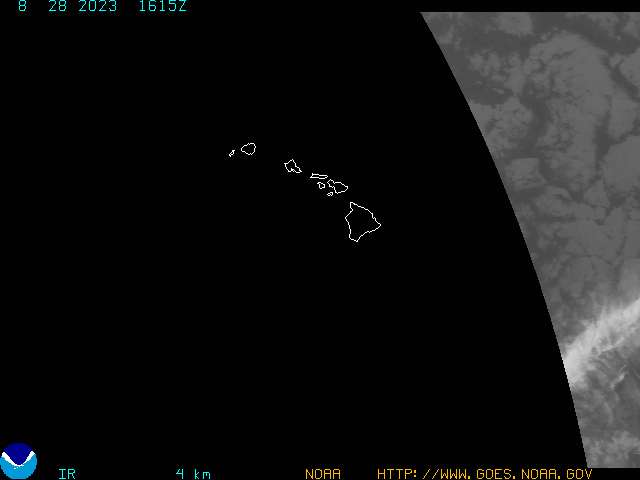
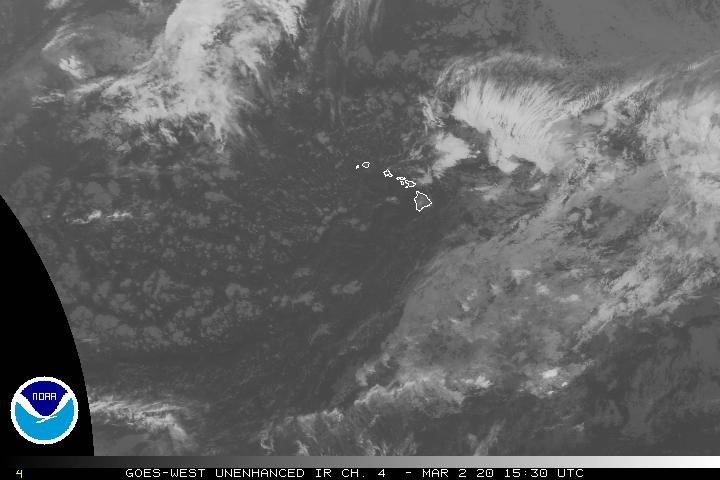
Satellite and Radar Images: To view the cloud conditions we have here in Hawaii, please use the following satellite links, starting off with the Infrared Satellite Image of the islands to see all the clouds around the state during the day and night. This next image is one that gives close images of the islands only during the daytime hours, and is referred to as a Close-up visible image. This next image shows a larger view of the Pacific…giving perspective to the wider ranging cloud patterns in the Pacific Ocean…out from the islands. To help you keep track of where any showers may be around the islands, here’s the latest animated radar image.
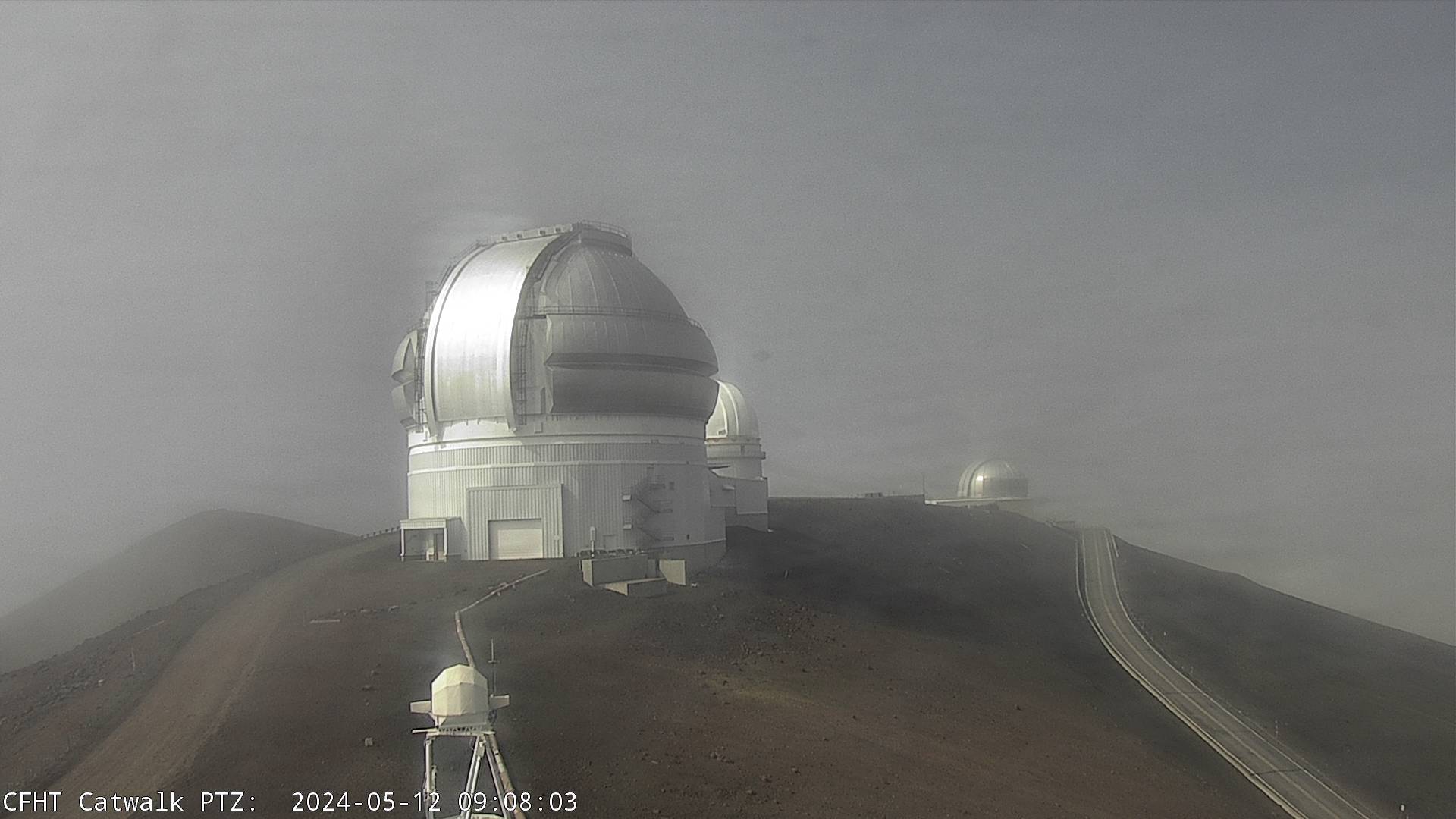
Hawaii’s Mountains – Here’s a link to the live webcam on the summit of near 14,000 foot Mauna Kea on the Big Island of Hawaii. The tallest peak on the island of Maui is the Haleakala Crater, which is near 10,000 feet in elevation. These two webcams are available during the daylight hours here in the islands…and when there’s a big moon rising just after sunset for an hour or two! Plus, during the nights and early mornings you will be able to see stars, and the sunrise too…depending upon cloud conditions.
Aloha Paragraphs
 The Iao Valley on Maui
Photo Credit: flickr.com
South to southeast breezes have replaced our normal trade winds for the time being. A late season cold front has pushed our trade wind producing ridge down over the state now…which is why our trade winds will be on vacation through the next day or two. This wind direction will carry volcanic haze up over the islands, along with muggy air into Friday. Wind speeds will be generally light, with returning trade winds forecast beginning later Friday into the weekend.
This cold front will stall before arriving here in the Hawaiian Islands. Our weather has taken a turn back into a light wind convective weather pattern now, with generally clear to partly cloudy mornings giving way to afternoon cloudy periods. These convective cumulus clouds over the interiors of the islands will drop a few showers, leaving the beaches dry and quite sunny for the most part during the days. The returning trades this weekend, will bring back a few showers to the windward sides then.
I was going on and on in yesterday’s narrative, about how unusual it is to see such a cold front…this late in the spring season. If you’re wondering what all the fuss is about, well, take a look at this looping satellite image, which shows this cold front coming our way…in the upper left hand corner of the picture. As mentioned above, it will stop before reaching Kauai, but not before forcing our trade wind producing high pressure ridge down over the islands…effectively stopping the trade winds.
Volcanic haze has been in the weather news quite a lot this year. The current light south to southeast breezes will carry more of that volcanic emission over the islands now. This vog may not get as thick as it was last week, we’ll have to wait until Thursday to see where it ends up. Fortunately this will be a brief period of hazy weather, as by later Friday the trade winds will begin filtering back into the Hawaiian Island weather picture, carrying the haze away downstream of the Aloha state.
~~~ The NWS forecast office in Honolulu recently issued their outlook for the upcoming 2008 hurricane season here in the central Pacific. It calls for slightly less than the normal amount of tropical cyclones forming, or passing into the central Pacific from the eastern Pacific. The normal number is 4-5 storms per hurricane season, with this year’s expectations being 2-3…which of course is good news! The NWS is fond of saying, it only takes one however!
~~~ I’m in Kihei as I begin writing this last paragraph of today’s afternoon update. I still don’t see a lot of volcanic haze out there, with the West Maui Mountains, along with the Iao Valley, quite clearly visible. I would expect the haze to be carried over the state during the night, with restricted visibilities evident by Thursday morning. As noted above however, this stuff will depend greatly on the different wind directions that the winds are carrying this vog up from the Big Island…to each individual island. I’ll be back very early Thursday morning with your next new weather narrative…including the nature of our haze atmospherics then. I hope you have a great Wednesday night until then! Aloha, Glenn.
Interesting: In an effort to improve electronics recycling in the United States, the U.S. Postal Service is developing a free national collection program for small electronic items. The program, now in a pilot stage, provides courtesy envelopes with pre-paid postage for patrons to deposit their unwanted digital cameras, printer cartridges, MP3 players, cell phones, and PDAs. International recycling company Clover Technologies Group processes the devices in its U.S. and Mexican facilities and then refurbishes and resells them if possible. Now limited to select cities, including Chicago and Los Angeles, the program may expand nationwide in the fall, and it eventually may accept a wider range of devices. "It doesn’t cost us anything because [Clover] is paying for postage on the envelope," said Joanne Veto, a post office spokesperson. "For us, it’s a really smart thing to do." The program would be a de facto national electronic recycling program, the first for the United States. As the only industrialized nation not to ratify the 1989 Basel Convention, which requires its signatories to notify developing nations of incoming hazardous waste shipments, many environmentalists have criticized the country for its lack of action to reduce the international spread of electronic garbage, known as e-waste.
Interesting2: About 45 minutes north of downtown Los Angeles, a machine the size of a small truck flattens tons of food scraps, paper towels and other household trash into the side of a growing 300-foot pile. To Waste Management, which operates the landfill, this is more than just a mountain of garbage. Pipes tunneled deep into the mound extract gas from the rotting waste and send it to a plant that turns it into electricity. Apart from the huge-wheeled compactor driving over garbage on its surface, it looks like an ordinary hillside. And it doesn’t even smell. Yet it produces enough energy to power 2,500 homes in Southern California. About 45 minutes north of downtown Los Angeles, a machine the size of a small truck flattens tons of food scraps, paper towels and other household trash into the side of a growing 300-foot pile. To Waste Management, which operates the landfill, this is more than just a mountain of garbage. Pipes tunneled deep into the mound extract gas from the rotting waste and send it to a plant that turns it into electricity. Apart from the huge-wheeled compactor driving over garbage on its surface, it looks like an ordinary hillside. And it doesn’t even smell. Yet it produces enough energy to power 2,500 homes in Southern California.
Interesting3: Honda Motor Co said on Wednesday it would launch a new, low-cost hybrid car in Japan, North America and Europe in early 2009 as it seeks to cut the lead of Toyota Motor Corp in the green car race. Despite the pressure of record-high oil prices and concerns over climate change, fuel-efficient and low-emission hybrids still occupy a small niche in the global car market, partly due to their higher costs for both consumers and automakers. Japan‘s top two automakers lead the industry in the fuel-saving technology which runs on both electricity and gasoline, but Toyota has dominated sales with its groundbreaking Prius model, which is only available as a hybrid. Koichi Ogawa, chief portfolio manager at Daiwa SB Investments, said it was hard to know whether Honda could challenge Toyota‘s dominance. "When you say ‘hybrid,’ the image that really comes to mind is Prius," he said. "Honda is very dependent on the U.S. market, which is shifting towards things like hybrids, and for survival having a hybrid (model) is essential." By twinning a conventional engine and battery-powered electric motor, hybrids currently add $5,000 or more to comparable gasoline models, a premium Honda Chief Executive Takeo Fukui sees coming down to around $2,000 in the next generation of hybrids. "It is important to move hybrid vehicles from the current image-oriented stage to the new stage toward full-scale penetration," Fukui told a news conference. Executive Vice President Koichi Kondo said Honda hoped to price the hybrid-only car under 2 million yen ($19,290).
Interesting4: The “Big One,” as earthquake scientists imagine it in a detailed, first-of-its-kind script, unzips California’s mighty San Andreas Fault north of the Mexican border. In less than two minutes, Los Angeles and its sprawling suburbs are shaking like a bowl of jelly. The jolt from the 7.8-magnitude temblor lasts for three minutes — 15 times longer than the disastrous 1994 Northridge quake. Water and sewer pipes crack. Power fails. Part of major highways break. Some high-rise steel frame buildings and older concrete and brick structures collapse. Hospitals are swamped with 50,000 injured as all of Southern California reels from a blow on par with the Sept. 11 attacks and Hurricane Katrina: $200 billion in damage to the economy, and 1,800 dead. Only about 700 of those people are victims of building collapses. Many others are lost to the 1,600 fires burning across the region — too many for firefighters to tackle at once. A team of about 300 scientists, governments, first responders and industries worked for more than a year to create a realistic crisis scenario that can be used for preparedness, including a statewide drill planned later this year. Published by the U.S. Geological Survey and California Geological Survey, it is to be released Thursday in Washington, D.C. Researchers caution that it is not a prediction, but the possibility of a major California quake in the next few decades is very real. Last month, the USGS reported that the GoldenState has a 46 percent chance of a 7.5 or larger quake in the next 30 years, and that such a quake probably would hit Southern California. The Northridge quake, which killed 72 people and caused $25 billion in damage, was much smaller at magnitude 6.7. “We cannot keep on planning for Northridge,” said USGS seismologist Lucy Jones. “The science tells that it’s not the worst we’re going to face.”
Posted by Glenn
No Comments
May 20-21 2008
Air Temperatures – The following maximum temperatures were recorded across the state of Hawaii Tuesday:
Lihue, Kauai – 80
Honolulu, Oahu – 89
Kaneohe, Oahu – 83
Kahului, Maui – 88
Hilo, Hawaii – 84
Kailua-Kona, Hawaii – 83
Air Temperatures ranged between these warmest and coolest spots near sea level at 4 p.m. Tuesday afternoon:
Kahului, Maui – 86F
Kaneohe, Oahu – 76
Precipitation Totals – The following numbers represent the largest precipitation totals (inches) during the last 24 hours on each of the major islands, as of Tuesday afternoon:
1.36 Mount Waialeale, Kauai
0.11 Oahu Forest NWR, Oahu
0.04 Molokai
0.05 Lanai
0.00 Kahoolawe
0.20 Oheo Gulch, Maui
0.07 Kapapala Ranch, Big Island
Weather Chart – Here’s the latest (automatically updated) weather map showing a 1030 millibar high pressure system far to the NE of the state of Hawaii Wednesday. This high has a ridge extending SW, to a position near Kauai, moving southward. This pressure configuration will bring lighter breezes now, veering to the south and southeast through Thursday.
Satellite and Radar Images: To view the cloud conditions we have here in Hawaii, please use the following satellite links, starting off with the Infrared Satellite Image of the islands to see all the clouds around the state during the day and night. This next image is one that gives close images of the islands only during the daytime hours, and is referred to as a Close-up visible image. This next image shows a larger view of the Pacific…giving perspective to the wider ranging cloud patterns in the Pacific Ocean…out from the islands. To help you keep track of where any showers may be around the islands, here’s the latest animated radar image.
Hawaii’s Mountains – Here’s a link to the live webcam on the summit of near 14,000 foot Mauna Kea on the Big Island of Hawaii. The tallest peak on the island of Maui is the Haleakala Crater, which is near 10,000 feet in elevation. These two webcams are available during the daylight hours here in the islands…and when there’s a big moon rising just after sunset for an hour or two! Plus, during the nights and early mornings you will be able to see stars, and the sunrise too…depending upon cloud conditions.
Aloha Paragraphs
 It will be a moonlit night in Hawaii
Photo Credit: flickr.com
Tuesday will be the last day of trade winds, until they begin again later Friday afternoon. A trade wind producing ridge of high pressure is still north of Kauai Tuesday night, the source of our recent light to moderately strong trades. As we move into Wednesday, a late season cold front will push our ridge down over the state…with light southeast winds, and more volcanic haze the result into Thursday.
Satellite imagery shows clouds being carried our way on the trade winds. Whatever showers that fall will make their splash down along the windward sides of the islands. The leeward sides will be generally dry, with lots of sunshine during the days. Our weather will take a turn back into a light wind convective weather pattern Wednesday, with interior showers falling locally during the afternoon hours.
An unusually late season cold front is bearing down on the islands from the NW. This cold front will stall before moving into the state however…so no rainfall is expected in association with the cloud band. The close proximity of the front will knock down our trade winds, and turn them southeast…ushering in volcanic haze Wednesday into Friday. It will take the trade winds returning later Friday into the weekend…to ventilate this haze away.
I find myself using the word unusual more and more these days. The latest examples have been last week’s cold front, which dropped down into the islands as far as Oahu. This cold front brought a few showers to Kauai and Oahu, although more importantly, helped to fill our skies with thick volcanic haze. The frontal system didn’t bring the haze with it, but prompted light winds, which carried vog up from the volcanic vents on the Big Island…all the way up the chain of islands to Kauai.
The next example of exercising the word unusual is occurring this week, with yet another uncommon cold front bearing down on the state from the NW. Before I go any further, let me provide you with a looping satellite image of this cold front coming our way from the NW direction…in the upper left hand corner of the picture. A second interesting feature is the counterclockwise rotating upper level low pressure system to the east of the state…with its circular cloud shape! Back to the cold front, it will stop before reaching Kauai, but not before shoving our trade wind producing high pressure ridge down over the islands. This will effectively stop the trade winds.
The trade winds will be pushed to a location just south of the islands Wednesday and Thursday. The unfortunate prospect here is that there will be an air drift from the southeast, which will bring volcanic haze back over the islands…just at a time when we are seeing the end of the last hazy episode! It will stick around into Friday, and then be ventilated away, at least start to be, later in the day Friday into the weekend. Fair weather will return this weekend, and last well into next week.
~~~ The NWS forecast office in Honolulu recently issued their outlook for the upcoming 2008 hurricane season here in the central Pacific. It calls for slightly less than the normal amount of tropical cyclones forming, or passing into the central Pacific from the eastern Pacific. The normal number is 4-5 storms per hurricane season, with this year’s expectations being 2-3…which is of course good news! The NWS is fond of saying, it only takes one!
~~~ The trade winds remained active Tuesday, keeping the volcanic haze at bay down over the Big Island…where the Kona coast was very voggy today. As the trade winds stop, and the southeast breezes begin blowing, look for thickening volcanic haze in other parts of the island chain over the next several days. I’ll be back very early Wednesday morning with your next new weather narrative, I hope you have a great Tuesday night until then! Aloha for now…Glenn.
Interesting: According to the 2000 census, America’s office workers spend an average of 52 hours a week at their desks or work stations. Many recent studies on job satisfaction have shown that workers who spend longer hours in office environments, often under artificial light in windowless offices, report reduced job satisfaction and increased stress levels. How can employers make office environments more conducive to productivity and employee happiness" Try adding some “green” to your office. Not greenbacks—green plants! A research study published in the February 2008 issue of HortScience offers employers and corporations some valuable advice for upping levels of employee satisfaction by introducing simple and inexpensive environmental changes. Dr.Tina Marie (Waliczek) Cade, Associate Professor of Horticulture in the Department of Agriculture at Texas State University, explained that the project was designed to investigate whether employees who worked in offices with windows and views of green spaces and workers who had green plants in their offices perceived greater job satisfaction than employees who did not have access to these environmental components.
Interesting2: Los Angeles officials discussed Thursday a plan to conserve water which includes limiting water use, punishing water wasters and recycling waste water, according to an article in the Los Angeles Times. Officials say the City of Los Angeles will have a 15 percent increase in water demand by 2030. To accommodate the robust need, 32 billion gallons of water will have to be saved or recaptured each year. Los Angeles officials discussed Thursday a plan to conserve water which includes limiting water use, punishing water wasters and recycling waste water, according to an article in the Los Angeles Times. Officials say the City of Los Angeles will have a 15 percent increase in water demand by 2030. To accommodate the robust need, 32 billion gallons of water will have to be saved or recaptured each year.
Interesting3: When major catastrophes strike, like the recent Asian earthquake and tsunami, the mass deaths can lead one to think that natural disasters are the most likely way people can die. Not by a long shot. According to the National Center for Health Statistics, the leading causes of death in the United States are, in this order, heart disease, cancer, stroke, chronic lower respiratory diseases, and "accidental injury," a broad category that includes a lot of stuff that just happens. You are more likely to commit suicide or fall to your death than be killed by a tsunami or any natural disaster, the odds say. In less advanced countries, where residents often live in poverty and huddle near the sea or in poorly constructed houses, tsunamis, floods and earthquakes are a more looming threat. But even in such locales, there are far greater risks over the course of a lifetime. There are no formal estimates on the risk of death by tsunami, because they occur so infrequently. About 2,200 died in a Papua New Guinea tsunami in 1998; roughly 8,000 in the Philippines in 1976, about 120 in Hawaii and California in 1964. You have to go back to 1896 — 27,000 deaths in Japan — to find one that even approached the 150,000-plus scale of the Asian disaster on Dec. 26, 2004.
Interesting4: Damaged aircraft could repair themselves automatically, even during flight, by mimicking healing processes found in nature, a researcher said this week. One method could be as simple as a resin that oozes into cracks on demand. Not only might such a breakthrough lead to safer planes, but it could also lead to lighter craft that would save fuel, drop costs and reduce global warming gas emissions as well. "At oil approaching $130 a barrel, if you can strip weight off, you could save money," said researcher Ian Bond, a materials scientist at the University of Bristol in England. Aircraft routinely suffer damage from day-to-day use. A great deal of aerospace research goes into materials that can resist damage. "You would be surprised how often trucks drive into aircraft when parked at airports, and then you have tools dropped on planes at maintenance hangers, or hailstones when flying through storms. Very subtle damage, little dings and cracks and bangs that, if left undetected…could grow into something serious. At aircraft hangers, a lot of time is spent trying to find these defects." Aircraft designs that nowadays help cope with damage end up adding weight.
Posted by Glenn
No Comments
May 19-20 2008
Air Temperatures – The following maximum temperatures were recorded across the state of Hawaii Monday:
Lihue, Kauai – 83
Honolulu, Oahu – 87
Kaneohe, Oahu – 81
Kahului, Maui – 89
Hilo, Hawaii – 82
Kailua-Kona, Hawaii – 83
Air Temperatures ranged between these warmest and coolest spots near sea level at 4 a.m. Monday afternoon:
Honolulu, Oahu – 76F
Kailua-kona – 68
Precipitation Totals – The following numbers represent the largest precipitation totals (inches) during the last 24 hours on each of the major islands, as of Monday afternoon:
0.47 Wailua, Kauai
0.32 Oahu Forest NWR, Oahu
0.00 Molokai
0.00 Lanai
0.00 Kahoolawe
0.01 Kula, Maui
0.10 Pahoa, Big Island
Weather Chart – Here’s the latest (automatically updated) weather map showing a 1021 millibar high pressure system just to the north of the state of Hawaii Tuesday. This has keep light to locally moderate easterly trade winds active…becoming lighter and veering to the southeast starting Wednesday.
Satellite and Radar Images: To view the cloud conditions we have here in Hawaii, please use the following satellite links, starting off with the Infrared Satellite Image of the islands to see all the clouds around the state during the day and night. This next image is one that gives close images of the islands only during the daytime hours, and is referred to as a Close-up visible image. This next image shows a larger view of the Pacific…giving perspective to the wider ranging cloud patterns in the Pacific Ocean…out from the islands. To help you keep track of where any showers may be around the islands, here’s the latest animated radar image.
Hawaii’s Mountains – Here’s a link to the live webcam on the summit of near 14,000 foot Mauna Kea on the Big Island of Hawaii. The tallest peak on the island of Maui is the Haleakala Crater, which is near 10,000 feet in elevation. These two webcams are available during the daylight hours here in the islands…and when there’s a big moon rising just after sunset for an hour or two! Plus, during the nights and early mornings you will be able to see stars, and the sunrise too…depending upon cloud conditions.
Aloha Paragraphs
 Full moon rising over the Haleakala Crater on Maui
Photo Credit: flickr.com
We’ll see another day of light to almost moderately strong trade winds, before they ease up on Wednesday. A trade wind producing ridge of high pressure is north of Kauai Monday evening. These cooling and refreshing trade breezes will continue the clearing our local skies of the haze now. As Wednesday arrives, another late season cold front will push our ridge down over or near the state…with light winds, and more volcanic haze arriving locally then.
The trade winds will carry some moisture our way over the next couple of days. The atmosphere remains dry and stable however, which will limit the amount of those windward biased showers quite a bit. The leeward sides will be generally dry, with lots of sunshine beaming down during the days. Nice weather will prevail through the next several days. Our weather will take a turn back into a light wind convective weather pattern by mid-week.
A very late season cold front will be approaching the islands soon. This unusual cold front will stall before moving into the state…so little if any rainfall is expected in association with the cloud band. It looks like our winds will turn southeast again locally…ushering in volcanic haze over some parts of the state Wednesday into Friday. It will take the trade winds returning later Friday into the weekend…to ventilate this haze away.
~~~ It’s really kind of hard to believe that we’ll be seeing yet another unseasonably late cold front pushing in our direction again soon! This front will very likely stall before arriving over Kauai, so that rainfall isn’t going to be an issue. The problem will be that the trade winds will give way to more southeast winds. These are the winds that carry volcanic haze up over the state from the Big Island. The light winds will put us into a convective weather pattern with clear mornings becoming locally cloudy during the afternoons, with some showers spilling over the interior sections. The trade winds will return Friday, and begin clearing the haze, with good weather on tap for the weekend.
~~~ The trade winds provided a nice day here in the islands. The one exception was the cloudiness that anchored itself over the island of Oahu. This band of clouds was what was left from last week’s dissipated cold front. The rest of the state remained almost totally dry, even on the windward sides.
~~~ The next couple of nights will be good ones to gaze up. The May full moon is happening, and will fill our after dark hours with lots of reflected sunlight. Speaking of the Moon, this month’s full Moon is the smallest of 2008. Remember that the Moon’s orbit is not perfectly circular but elliptical so there is a closest and farthest point to the Earth every month, called perigee and apogee, respectively. This month’s full Moon coincides with its apogee, therefore making it appear smaller in the sky. The difference visually is less than 10% and most people will probably not notice it, but pictures of the Moon compared at both extremes (perigee and apogee) will definitely show the difference.
~~~ I don’t know about you, but I’ll be looking for that full moon the next couple of nights. I’ll be back here very early Tuesday morning with your next new weather narrative from paradise. I hope you have a great Monday night until then! Aloha for now…Glenn.
Interesting: Marine scientists surveying a large undersea mountain chain were amazed to find millions of tiny starfish swirling their arms to capture food in the undersea current. An expedition by 19 scientists, including five from Australia, studied the geology and biology of eight Macquarie Ridge sea mounts. They are part of a string of underwater volcanoes — dormant for millions of years — that stretches 875 miles from south of New Zealand toward Antarctica. The scientists also investigated the world’s biggest ocean current — the Antarctic Circumpolar Current — amid expectations they would find evidence of climate change in the Southern Ocean. While the expedition’s cameras found a wide range of corals, a high density of cardinal fish and the huge coral, the vast collection of brittle stars was the highlight of the voyage. "I’ve personally never seen anything like this — all these animals, the sheer volume — all waiting for food from the current,” expedition member and marine biologist Dr. Mireille Consalvey said Monday. "It challenged what we as scientists thought we knew.” Expedition leader and marine biologist Ashley Rowden said starfish usually cover only slopes away from the top of the undersea mountains. "It got us excited as soon as we saw it,” Rowden said of the site, dubbed "BrittleStarCity.”
Interesting2: Global warming isn’t to blame for the recent jump in hurricanes in the Atlantic, concludes a study by a prominent federal scientist whose position has shifted on the subject. Not only that, warmer temperatures will actually reduce the number of hurricanes in the Atlantic and those making landfall, research meteorologist Tom Knutson reported in a study released Sunday. In the past, Knutson has raised concerns about the effects of climate change on storms. His new paper has the potential to heat up a simmering debate among meteorologists about current and future effects of global warming in the Atlantic. Ever since Hurricane Katrina in 2005, hurricanes have often been seen as a symbol of global warming’s wrath. Many climate change experts have tied the rise of hurricanes in recent years to global warming and hotter waters that fuel them. Another group of experts, those who study hurricanes and who are more often skeptical about global warming, say there is no link. They attribute the recent increase to a natural multi-decade cycle. What makes this study different is Knutson, a meteorologist with the National Oceanic and Atmospheric Administration’s fluid dynamics lab in Princeton, N.J. He has warned about the harmful effects of climate change and has even complained in the past about being censored by the Bush administration on past studies on the dangers of global warming. He said his new study, based on a computer model, argues "against the notion that we’ve already seen a really dramatic increase in Atlantic hurricane activity resulting from greenhouse warming.”
Interesting3: While carbon dioxide has been getting lots of publicity in climate change, reactive forms of nitrogen are also building up in the environment, scientists warn. "The public does not yet know much about nitrogen, but in many ways it is as big an issue as carbon, and due to the interactions of nitrogen and carbon, makes the challenge of providing food and energy to the world’s peoples without harming the global environment a tremendous challenge," University of Virginia environmental sciences professor James Galloway said in a statement. "We are accumulating reactive nitrogen in the environment at alarming rates, and this may prove to be as serious as putting carbon dioxide in the atmosphere," said Galloway, author of a paper and co-author of a second on the topic in Friday’s issue of the journal Science. While nitrogen alone is inert and harmless, reactive nitrogen compounds — such as ammonia — have been released by its use in nitrogen-based fertilizers and the large-scale burning of fossil fuels. Various forms of nitrogen contribute to greenhouse warming, smog, haze, acid rain dead zones with little or no life along the coasts, and depletion of the ozone layer in the stratosphere, the researchers concluded. The researchers propose ways to reduce nitrogen use, ranging from encouraging its uptake by plants to recovering and reusing nitrogen from manure and sewage and decreasing nitrogen emissions from fossil fuel combustion.
Interesting4: The El Nino phenomenon that has puzzled climate scientists in recent decades may have assisted the first trip around the world nearly 500 years ago. Explorer Ferdinand Magellan encountered fair weather on Nov. 28, 1520, after days of battle through the rough waters south of South America. From there his passage across the Pacific Ocean may have been eased by the calming effects of El Nino, researchers speculate in a new study. When an El Nino occurs, the waters of the Equatorial Pacific become warmer than normal, creating rising air that changes wind and weather patterns. The effects can be worldwide, including drought in the western Pacific and more rain in Peru and the west coast of South America. Tree ring data indicate that an El Nino was occurring in 1519 and 1520 and may even have begun in 1518. After passing through the strait later named for him, Magellan sailed north along the South American coast and then turned northwest, crossing the equator and eventually arriving at the Philippines, where he was killed in a battle with natives. Magellan was seeking the so-called spice islands, now part of Indonesia, and his course took him north of that goal. But the route may have been dictated by mild conditions and favorable winds during an El Nino, anthropologists Scott M. Fitzpatrick of North Carolina State University and Richard Callaghan of the University of Calgary, Canada, propose in a new study of his trip. Their research is summarized in Friday’s edition of the journal Science and is scheduled to be published in full in the August edition of the Journal of Pacific History.
Posted by Glenn
No Comments
May 18-19 2008
Air Temperatures – The following maximum temperatures were recorded across the state of Hawaii Sunday:
Lihue, Kauai – 82
Honolulu, Oahu – 90…tied the record for the date
Kaneohe, Oahu – 82
Kahului, Maui – 85
Hilo, Hawaii – 82
Kailua-Kona, Hawaii – 84
Air Temperatures ranged between these warmest and coolest spots near sea level at 5 p.m. Sunday evening:
Honolulu, Oahu – 86F
Hilo, Hawaii – 79
Precipitation Totals – The following numbers represent the largest precipitation totals (inches) during the last 24 hours on each of the major islands, as of Sunday afternoon:
0.01 Moloaa Dairy, Kauai
0.00 Oahu
0.00 Molokai
0.00 Lanai
0.00 Kahoolawe
0.01 Kahului airport, Maui
0.03 Kahuku Ranch, Big Island
Weather Chart – Here’s the latest (automatically updated) weather map showing a high pressure ridge north of the state of Hawaii Monday. This has keep light to moderately strong easterly trade winds active…continuing through Tuesday.
Satellite and Radar Images: To view the cloud conditions we have here in Hawaii, please use the following satellite links, starting off with the Infrared Satellite Image of the islands to see all the clouds around the state during the day and night. This next image is one that gives close images of the islands only during the daytime hours, and is referred to as a Close-up visible image. This next image shows a larger view of the Pacific…giving perspective to the wider ranging cloud patterns in the Pacific Ocean…out from the islands. To help you keep track of where any showers may be around the islands, here’s the latest animated radar image.
Hawaii’s Mountains – Here’s a link to the live webcam on the summit of near 14,000 foot Mauna Kea on the Big Island of Hawaii. The tallest peak on the island of Maui is the Haleakala Crater, which is near 10,000 feet in elevation. These two webcams are available during the daylight hours here in the islands…and when there’s a big moon rising just after sunset for an hour or two! Plus, during the nights and early mornings you will be able to see stars, and the sunrise too…depending upon cloud conditions.
Aloha Paragraphs
 The trade winds are clearing the haze away
Photo Credit: flickr.com
The trade winds are back, and will stick around through Tuesday. A trade wind producing ridge of high pressure is north of Kauai Sunday night. Light trade winds have slipped into the state on Kauai, blowing light to moderately strong from the Big Island up through the island of Oahu. These cooling and refreshing trade breezes continuing the clearing our local skies of the haze now.
Dry weather will continue, despite the return of the trade winds. The atmosphere remains dry and stable, which will remain the case into the first part of the new week. The leeward sides will be generally dry, with lots of sunshine beaming down during the days. Nice weather will prevail through the next several days. Our weather will take a turn back into a light wind convective weather pattern by mid-week.
The computer forecast models are showing an upper level low pressure system digging down towards the islands around the middle of the new week. A surface reflection, in the form of a very late season cold front, is shown approaching the state from the northwest at the same time. The unfortunate part of this impending weather situation would be the fact that our local trade winds will be pushed south of the state again, as the ridge slides down over Hawaii. It looks like our winds will turn southeast again…ushering in volcanic haze over the state again then.
~~~ Sunday was a nice day here in the islands, especially so, as we’re finally being able to see some detail on our surrounding moutains and valleys. The trade winds have filled back across the entire state now, with a top gust of 27 mph already at Maalaea Bay on Maui, late Sunday afternoon. The refreshing trade winds didn’t keep the air from rising nicely however, with Honolulu reporting a high temperature of 90F degrees…which tied the record maximum temperature for the date. We’ll see these pleasant weather conditions continuing into the new week, although, as described in the paragraph above, the trades will be breaking down again by Wednesday.
~~~ I had a great Sunday, getting up early, like I like to do, polishing off the website updates first thing. I darted out shortly thereafter for the long version of my early morning walk, which I have time for during the weekends. I ate a nice breakfast, followed up with my usual espresso and pastry. I finally got down to the Pukalani golf course with my old putter, and a worn out golf ball, for some putting. I really enjoyed it, and all I can say is, watch out Tiger Woods! I spend the rest of the day at home, much of it working in our garden with the neighbors. I’ll be back very early Monday morning with your next new weather narrative from paradise. Oh yeah, I almost forgot to mention, that the haze is much reduced, and I can see the West Maui Mountains quite well…although there is still some haze around. I hope you have a great Sunday night wherever you happen to be spending it! Aloha for now…Glenn.
Aspire 2 Inspire B4U Expire…
Posted by Glenn
No Comments
May 17-18 2008
Air Temperatures – The following maximum temperatures were recorded across the state of Hawaii Saturday:
Lihue, Kauai – 83
Honolulu, Oahu – 86
Kaneohe, Oahu – 83
Kahului, Maui – 89
Hilo, Hawaii – 83
Kailua-Kona, Hawaii – 80
Air Temperatures ranged between these warmest and coolest spots near sea level at 5 p.m. Saturday evening:
Kapalua, Maui – 84F
Hilo, Hawaii – 78
Precipitation Totals – The following numbers represent the largest precipitation totals (inches) during the last 24 hours on each of the major islands, as of Saturday afternoon:
0.31 Mount Waialeale, Kauai
0.01 Waianae Valley, Oahu
0.00 Molokai
0.01 Lanai
0.00 Kahoolawe
0.10 Oheo Gulch, Maui
0.11 Pahala, Big Island
Weather Chart – Here’s the latest (automatically updated) weather map showing a high pressure ridge just north of the state of Hawaii now. This has brought back light to moderately strong easterly trade winds…which will last through Monday.
Satellite and Radar Images: To view the cloud conditions we have here in Hawaii, please use the following satellite links, starting off with the Infrared Satellite Image of the islands to see all the clouds around the state during the day and night. This next image is one that gives close images of the islands only during the daytime hours, and is referred to as a Close-up visible image. This next image shows a larger view of the Pacific…giving perspective to the wider ranging cloud patterns in the Pacific Ocean…out from the islands. To help you keep track of where any showers may be around the islands, here’s the latest animated radar image.
Hawaii’s Mountains – Here’s a link to the live webcam on the summit of near 14,000 foot Mauna Kea on the Big Island of Hawaii. The tallest peak on the island of Maui is the Haleakala Crater, which is near 10,000 feet in elevation. These two webcams are available during the daylight hours here in the islands…and when there’s a big moon rising just after sunset for an hour or two! Plus, during the nights and early mornings you will be able to see stars, and the sunrise too…depending upon cloud conditions.
Aloha Paragraphs
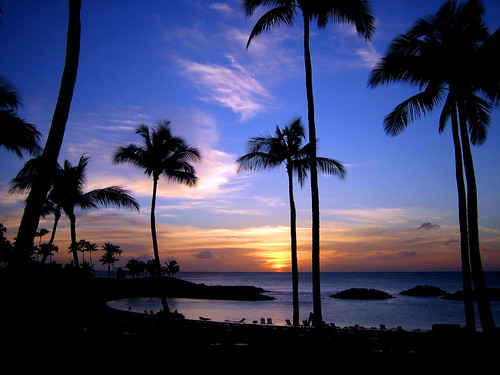 After the volcanic haze is gone
Photo Credit: flickr.com
The trade winds are back! A trade wind producing ridge of high pressure is now north of Kauai Saturday evening. Light trade winds have slipped into the state to its south, blowing light to moderately strong from the Big Island up through the island of Oahu…still light on Kauai. These cooling and refreshing trade breezes are helping to clear out our local skies, which will be much improved Sunday.
The trade winds usually bring back some showers to the windward sides, although not many for the time being. The atmosphere remains dry and stable, which will remain the case through the weekend into early in the upcoming new week. The leeward sides will be generally dry, with lots of sunshine beaming down during the days. Nice weather will prevail through the next several days…at least.
The models were showing a dynamic upper level low pressure system digging down towards the islands around the middle of the upcoming week. A surface reflection, in the form of a very late season cold front, was also shown approaching the state from the northwest at the same time. The unfortunate part of this impending weather situation would have been the fact that our local trade winds would stop again, as the ridge would be pushed down over Hawaii again by Wednesday or Thursday. We would have likely seen our winds turn southeast again…ushering in thick volcanic haze over the state again then! The fortunate thing is that the latest model runs have backed off on this, lets hope that they stick with this through the next couple of days!
~~~ I went to see a new film Friday evening after work. I saw Iron Man (2008), starring Robert Downey, Jeff Bridges, Terrence Howard, Shaun Toub, and Gwyneth Paltrow. Robert Downey Jr. stars as Tony Stark, a billionaire playboy and genius who puts as much effort into chasing skirts as he puts into chasing his next big idea. A trip to Afghanistan to sell weapons quickly devolves into chaos, and Stark finds himself at the mercy of a warlord who wants him to build a missile. Instead, Stark creates a powerful suit of armor, turning him into Iron Man and allowing him to escape. When he returns to America, his assistant Pepper Pots (Gwyneth Paltrow), friend Rhodey (Terrence Howard), and right-hand man Obadiah Stane (Jeff Bridges) all marvel at the change in the man they knew…who is ready to save the world.
Everyone has been raving about this film, and I for one had been looking forward to seeing it for a long time! I was thoroughly entertained, and found the film to be very engaging. It had plenty of special effects, and no lack of high action either. There were aspects of it that reminded me of Batman, or even Superman, it was that kind of big film. If you are a fan of those kinds of tall tales, you would do well to see this highly rated movie. I enjoyed all of the actors, and I must admit got a fairly major crush on Ms. Paltrow…its fun to look at her beauty on the big screen! Here’s a trailer for your enjoyment.
~~~ The trade winds are back, which is a good thing! It’s still before sunset here in Kula, Maui, as I begin this last paragraph…and still quite hazy in the lee of the Haleakala Crater. Stepping out on my weather deck, I still can’t quite see the West Maui Mountains. I was downtown in Kahului today though, and found that the trade winds were clearing the haze from the windward sides already. I’m sure that during the day Sunday, the haze will be ventilated away even more, and by this time on Sunday, there will be substantially better air visibilities. I’ll be back Sunday morning with a new weather narrative, with the latest status on the hazy conditions of late. I hope you have a great Saturday night wherever you happen to be spending it! Aloha for now…Glenn.
Posted by Glenn
No Comments
May 16-17 2008
Air Temperatures – The following maximum temperatures were recorded across the state of Hawaii Friday:
Lihue, Kauai – 83
Honolulu, Oahu – 83
Kaneohe, Oahu – 84
Kahului, Maui – 84
Hilo, Hawaii – 83
Kailua-Kona, Hawaii – 82
Air Temperatures ranged between these warmest and coolest spots near sea level at 4 p.m. Friday afternoon:
Barking Sands, Kauai – 82F
Molokai airport – 78
Precipitation Totals – The following numbers represent the largest precipitation totals (inches) during the last 24 hours on each of the major islands, as of Friday afternoon:
0.22 Hanapepe, Kauai
0.01 Makua Ridge, Oahu
0.00 Molokai
0.00 Lanai
0.00 Kahoolawe
0.05 Pukalani, Maui
0.67 Laupahoehoe, Big Island
Weather Chart – Here’s the latest (automatically updated) weather map showing a dissipating cold front near Kauai. This weather feature is keeping our trade wind producing high pressure ridge near the Islands…although it will be migrating northward slowly. Light easterly trade winds will begin blow across the state through the weekend.
Satellite and Radar Images: To view the cloud conditions we have here in Hawaii, please use the following satellite links, starting off with the Infrared Satellite Image of the islands to see all the clouds around the state during the day and night. This next image is one that gives close images of the islands only during the daytime hours, and is referred to as a Close-up visible image. This next image shows a larger view of the Pacific…giving perspective to the wider ranging cloud patterns in the Pacific Ocean…out from the islands. To help you keep track of where any showers may be around the islands, here’s the latest animated radar image.
Hawaii’s Mountains – Here’s a link to the live webcam on the summit of near 14,000 foot Mauna Kea on the Big Island of Hawaii. The tallest peak on the island of Maui is the Haleakala Crater, which is near 10,000 feet in elevation. These two webcams are available during the daylight hours here in the islands…and when there’s a big moon rising just after sunset for an hour or two! Plus, during the nights and early mornings you will be able to see stars, and the sunrise too…depending upon cloud conditions.
Aloha Paragraphs
 Volcanic haze gives pink sunsets in Hawaii
Photo Credit: flickr.com
A dissipating cold front is located just to the north of Kauai Friday evening, which will keep our winds light into the weekend. As the cold front washes out over the next 24 hours, a trade wind producing ridge of high pressure will migrate to a position just north of the islands again…returning light trades to our islands…gradually. The thick volcanic haze will take some time to clear out our local skies, although slowly improving air visibilities are on the way.
The overlying atmosphere remains dry and stable, limiting showers just about everywhere here in Hawaii. There will be a few possible showers here and there, but our weather will remain quite dry going into the weekend. As the trade winds filter back into the state over the next several days, into early in the new week ahead, we’ll see a few showers falling along the windward sides.
The late season cold front isn’t dissipating quick as fast as expected, keeping the trade winds at bay for a while longer yet. This IR satellite image shows what’s left of the gradually weakening frontal boundary. This cloud band will disappear from our Hawaiian Island weather picture at some point this weekend, paving the way for the return of light trade winds.
The main weather related concern continues to be the volcanic haze hanging over the Hawaiian Islands Friday night. The haze will be most thick and troublesome right around the volcanic vents, plaguing the local population on the Big Island. The rest of the islands will have thick vog as well, with poor visibilites common. We will have to wait until this weekend, when the trade winds start to blow lightly, to see the gradual ventilation of the haze…although it will be slow going at first.
The latest computer forecast models are showing another round of unusual weather beginning later next week. It’s too early in the game to get all worked-up over this prospect, as what the models are pointing out would be very unusual for this time of year! Nonetheless, the models are showing a very dynamic upper level low pressure system digging down over the islands around the middle of next week. A surface reflection, in the form of a very late season cold front, would be approaching the state from the northwest towards the weekend. This is very similar to what we’re involved in now, almost a mirror image in some ways. The negative part of this potential weather situation would be the fact that our local winds would turn southeast again…ushering in thick volcanic haze over the state again late next week! We have plenty of time to make major revisions along the way, so let’s just hang loose about this for the time being.
~~~ It’s Friday evening here in the islands as I begin this last section of today’s narrative. As is my habit, I’ll be taking in a new film tonight. I’ll see Iron Man (2008), starring Robert Downey, Jeff Bridges, Terrence Howard, Shaun Toub, and Gwyneth Paltrow. Robert Downey Jr. stars as Tony Stark, a billionaire playboy and genius who puts as much effort into chasing skirts as he puts into chasing his next big idea. A trip to Afghanistan to sell weapons quickly devolves into chaos, and Stark finds himself at the mercy of a warlord who wants him to build a missile. Instead, Stark creates a powerful suit of armor, turning him into Iron Man and allowing him to escape. When he returns to America, his assistant Pepper Pots (Gwyneth Paltrow), friend Rhodey (Terrence Howard), and right-hand man Obadiah Stane (Jeff Bridges) all marvel at the change in the man they knew…who is ready to save the world. Everyone is raving about this film, and I for one have been looking forward to seeing it for a long time! Here’s a trailer for your enjoyment.
~~~ I’ll be back early Saturday morning with your next new weather narrative. This will include more reports about the persistent voggy weather, and when exactly the trade winds will finally clear our local skies from this thick haze. I’ll have more up-to-date information about the next round of increasing vog on tap for later next week…at least maybe it will come back on us. I’ll have a movie review for you in the morning as well. I hope you have a great Friday night wherever you happen to be spending it! Aloha for now…Glenn.
Interesting: The world’s species are declining at a rate "unprecedented since the extinction of the dinosaurs", a census of the animal kingdom has revealed. The Living Planet Index out today shows the devastating impact of humanity as biodiversity has plummeted by almost a third in the 35 years to 2005. The report, produced by WWF, the Zoological Society of London (ZSL) and the Global Footprint Network, says land species have declined by 25 per cent, marine life by 28 per cent, and freshwater species by 29 per cent. Jonathan Loh, editor of the report, said that such a sharp fall was "completely unprecedented in terms of human history". "You’d have to go back to the extinction of the dinosaurs to see a decline as rapid as this," he added. "In terms of human lifespan we may be seeing things change relatively slowly, but in terms of the world’s history this is very rapid." And "rapid" is putting it mildly. Scientists say the current extinction rate now up to 10,000 times faster than what has historically been recorded as normal.
Interesting2: Greenhouse gases are at higher levels in the atmosphere than at any time in at least 800,000 years, according to a study of Antarctic ice on Wednesday that extends evidence that mankind is disrupting the climate. Carbon dioxide and methane trapped in tiny bubbles of air in ancient ice down to 3,200 meters (10,500 ft) below the surface of Antarctica add 150,000 years of data to climate records stretching back 650,000 years from shallower ice drilling. "We can firmly say that today’s concentrations of carbon dioxide and methane are 28 and 124 percent higher respectively than at any time during the last 800,000 years," said Thomas Stocker, an author of the report at the University of Berne. Before the Industrial Revolution, levels of greenhouse gases were guided mainly by long-term shifts in the earth’s orbit around the sun that have plunged the planet into ice ages and back again eight times in the past 800,000 years. The U.N. Climate Panel last year blamed human activities, led by burning of fossil fuels that release heat-trapping gases, for modern global warming that may disrupt water and food supplies with ever more droughts, floods and heat waves. "The driving forces now are very much different from the driving forces in the past when there was only natural variation," Stocker told Reuters of the study in the journal Nature by scientists in Switzerland, France and Germany.
Interesting3: The universe is twice as bright as it appears, astronomers now suggest. The light bulb went on when they calculated that dust blocks about the half the light emitted from stars and galaxies. Astronomers have known about interstellar dust for a while, but they haven’t been able to quantify just how much light it blocks. Now a team of researchers has studied a catalogue of galaxies and found that dust shields roughly 50 percent of their light. "I was shocked by the sheer scale of the effect," said Simon Driver, an astronomer from the University of St. Andrews in Scotland who led the study. "Most people just kind of said, ‘We suspect dust is a minor problem.’ I spent much of my career working on deep images from Hubble and I’ve always ignored dust almost entirely." The result will likely cause many astronomers to revise their calculations of the intrinsic brightness of many celestial objects, Driver said. Until now, many astronomers thought stars and galaxies were really about 10 percent brighter in optical light than they appeared because of dust. If the new findings are true, it turns out that objects in the sky are about twice as bright than they appear. "This is a strong, clear-cut result," Driver told SPACE.com. "We’ve really got to take dust seriously and we’ve got to make large adjustments to our magnitude calculations." (A magnitude scale is used to define brightness of celestial objects.) The astronomers detailed their findings in the May 10 issue of the Astrophysical Journal Letters.
Interesting4: Peering beneath the ice at the north pole of Mars has now revealed the red planet may be surprisingly colder than was thought. Any liquid water that might exist on Mars therefore might be hidden deeper than once suspected, closer to that world’s warm heart, researchers suggested. An international team of scientists used the Mars Reconnaissance Orbiter to probe the north pole of the red planet with radar. The ice cap there goes about 1.2 miles deep (2 km) and is roughly the size of Pakistan at 310,000 square miles large (800,000 square km). These scans revealed the polar cap has up to four layers of ice rich in sand and dust, each separated by clearer sheets of nearly pure ice. Each dirty and clean layer is some 1,000 feet thick (300 meters). These dirty and clean layers were created by ages of intense dust storms followed by icy eras.
This five-million-year-long cycle was likely driven by wobbles in Mars’ tilt and fluctuations in the shape of its orbit around the sun. The more sunlight the red planet saw because of these changes, the more the polar icecaps retreated and the more dust storms Mars saw. "All this layering is key evidence for theoretical models that predict that changes in Mars’ climate are coupled with orbital changes," said researcher Roger Phillips, a geophysicist at Southwest Research Institute in Boulder. Unexpectedly, the radar scans also revealed the massive weight of the ice cap does not deform any underlying sediment. This implies the crust beneath the cap is strong — more than 180 miles thick (300 km). To have such a thick crust, "Mars might be colder than we thought," Phillips told SPACE.com. As a result, any liquid water that might be underground has to be buried even deeper than once speculated. "If one thought that liquid water was 5 kilometers deep (3 miles), it’s now at least 30 percent deeper than that," he said. Philips and his colleagues detailed their findings online May 15 in the journal Science.
Posted by Glenn
No Comments
May 15-16 2008
Air Temperatures – The following maximum temperatures were recorded across the state of Hawaii Thursday:
Lihue, Kauai – 83
Honolulu, Oahu – 84
Kaneohe, Oahu – 87
Kahului, Maui – 85
Hilo, Hawaii – 84
Kailua-Kona, Hawaii – 82
Air Temperatures ranged between these warmest and coolest spots near sea level at 4 p.m. Thursday afternoon:
Honolulu, Oahu – 82F
Hilo, Hawaii – 78
Precipitation Totals – The following numbers represent the largest precipitation totals (inches) during the last 24 hours on each of the major islands, as of Thursday afternoon:
0.01 Mount Waialeale, Kauai
0.01 Palolo Fire Station, Oahu
0.00 Molokai
0.00 Lanai
0.00 Kahoolawe
0.21 Kaupo Gap, Maui
0.29 Kealakekua, Big Island
Weather Chart – Here’s the latest (automatically updated) weather map showing a dissipating cold front near Kauai and Oahu. This weather feature is keeping our trade wind producing high pressure ridge near the Islands now…and our local winds light and variable in direction. Light easterly trade winds will begin to appear Saturday.
Satellite and Radar Images: To view the cloud conditions we have here in Hawaii, please use the following satellite links, starting off with the Infrared Satellite Image of the islands to see all the clouds around the state during the day and night. This next image is one that gives close images of the islands only during the daytime hours, and is referred to as a Close-up visible image. This next image shows a larger view of the Pacific…giving perspective to the wider ranging cloud patterns in the Pacific Ocean…out from the islands. To help you keep track of where any showers may be around the islands, here’s the latest animated radar image.
Hawaii’s Mountains – Here’s a link to the live webcam on the summit of near 14,000 foot Mauna Kea on the Big Island of Hawaii. The tallest peak on the island of Maui is the Haleakala Crater, which is near 10,000 feet in elevation. These two webcams are available during the daylight hours here in the islands…and when there’s a big moon rising just after sunset for an hour or two! Plus, during the nights and early mornings you will be able to see stars, and the sunrise too…depending upon cloud conditions.
Aloha Paragraphs
 Volcanic haze over Waikiki
Photo Credit: flickr.com
A high pressure ridge has been pushed down near the Big Island, by a weakening cold front near Kauai. The ridges position close to the Big Island will keep light and variable winds over the Big Island. The islands from Maui up through Kauai will remain in a light Kona wind condition Thursday. As the cold front dissipates Friday, the ridge will migrate northward over the islands again, returning light and variable winds to the entire state. The hazy conditions will remain in place until the trade winds return this weekend.
Despite the presence of the late season cold front, there won’t be much precipitation around…although Kauai and Oahu may see a few showers. The atmosphere will remain rather muggy, as the air flow is coming up from the deeper tropics to our south. There will be a few showers, but overall, our weather will remain quite dry and stable. As the ridge comes back up over the state Friday, we will move back into a light wind convective weather pattern, with a few afternoon interior showers falling locally.
An unusually late season cold front was located between Kauai and Oahu Thursday evening. This IR satellite image shows the ragged leading edge of this frontal boundary. If this were happening during the winter months, or even earlier this spring, we might expect wetter conditions. Since we’re just a month or so away from the summer solstice, its too late in the spring…to wring much moisture out of this last cold front of the season.
The main concern remains the volcanic haze that is being carried up over the state of Hawaii, from the two volcanic vents on the Big Island. The haze will be most thick and troublesome right around the vents, plaguing the local population on the Big Island. The rest of the islands will have varying amounts of vog. We will have to wait until this weekend, when the trade winds start to blow, to see the gradual ventilation of the haze, or at least the beginning of that process.
~~~ Thursday was a voggy day there in the Aloha state, no doubt about it. This volcanic haze has enveloped the entire state, from the northernmost island of Kauai, right down the chain, to the Big Island in the south. Looking out the window here in Kihei, Maui, we’re pretty much soaked in with vog, with what I would consider very poor air visibilities! The sunset this evening will be muted at best, probably just a red ball sinking into the Pacific Ocean to our west. Unfortunately, we seem to be having more and more of this hazy weather lately. One of my friends recently asked me, "Is this perma-vog Glenn"…I reassured her, at least the best that I could, that that was not going to be the case. The folks on the Big Island will have to contend with this stuff more than the rest of the state though, especially the Kau District, and then at times wrapping around into the Kona area as well.
~~~ We’ll see yet another day or even two, with rather thick vog hanging around. There is light at the end of the tunnel however, or in this case, clearer skies ahead. As the trade winds pick up this weekend, there will begin to be some increased detail to our local mountains and valleys. It may take most of the upcoming weekend before the trade winds are fully able to bring back our more normal better quality air visibilities. I’ll be back very early Friday morning with your next new weather narrative from paradise, yes, it is still paradise…despite the hazy conditions! I hope you have a great Thursday night wherever you happen to be reading from! Aloha for now…Glenn.
Interesting: Greenhouse gases are at higher levels in the atmosphere than at any time in at least 800,000 years, according to a study of Antarctic ice on Wednesday that extends evidence that mankind is disrupting the climate. Carbon dioxide and methane trapped in tiny bubbles of air in ancient ice down to 3,200 meters (10,500 ft) below the surface of Antarctica add 150,000 years of data to climate records stretching back 650,000 years from shallower ice drilling. "We can firmly say that today’s concentrations of carbon dioxide and methane are 28 and 124 percent higher respectively than at any time during the last 800,000 years," said Thomas Stocker, an author of the report at the University of Berne. Before the Industrial Revolution, levels of greenhouse gases were guided mainly by long-term shifts in the earth’s orbit around the sun that have plunged the planet into ice ages and back again eight times in the past 800,000 years. The U.N. Climate Panel last year blamed human activities, led by burning of fossil fuels that release heat-trapping gases, for modern global warming that may disrupt water and food supplies with ever more droughts, floods and heat waves. "The driving forces now are very much different from the driving forces in the past when there was only natural variation," Stocker told Reuters of the study in the journal Nature by scientists in Switzerland, France and Germany.
Interesting2: A new NASA-led study shows human-caused climate change has made an impact on a wide range of Earth’s natural systems, including permafrost thawing, plants blooming earlier across Europe, and lakes declining in productivity in Africa. Cynthia Rosenzweig of NASA’s Goddard Institute for Space Science in New York and scientists at 10 other institutions have linked physical and biological impacts since 1970 with rises in temperatures during that period. The study, to be published May 15 in the journal Nature, concludes human-caused warming is resulting in a broad range of impacts across the globe. "This is the first study to link global temperature data sets, climate model results, and observed changes in a broad range of physical and biological systems to show the link between humans, climate, and impacts," said Rosenzweig, lead author of the study. Rosenzweig and colleagues also found the link between human-caused climate change and observed impacts on Earth holds true at the scale of individual continents, particularly in North America, Europe, and Asia. To arrive at the link, the authors built and analyzed a database of more than 29,000 data series pertaining to observed impacts on Earth’s natural systems. The data were collected from about 80 studies, each with at least 20 years of records between 1970 and 2004.
Interesting3: The universe is twice as bright as it appears, astronomers now suggest. The light bulb went on when they calculated that dust blocks about the half the light emitted from stars and galaxies. Astronomers have known about interstellar dust for a while, but they haven’t been able to quantify just how much light it blocks. Now a team of researchers has studied a catalogue of galaxies and found that dust shields roughly 50 percent of their light. "I was shocked by the sheer scale of the effect," said Simon Driver, an astronomer from the University of St. Andrews in Scotland who led the study. "Most people just kind of said, ‘We suspect dust is a minor problem.’ I spent much of my career working on deep images from Hubble and I’ve always ignored dust almost entirely." The result will likely cause many astronomers to revise their calculations of the intrinsic brightness of many celestial objects, Driver said. Until now, many astronomers thought stars and galaxies were really about 10 percent brighter in optical light than they appeared because of dust. If the new findings are true, it turns out that objects in the sky are about twice as bright than they appear. "This is a strong, clear-cut result," Driver told SPACE.com. "We’ve really got to take dust seriously and we’ve got to make large adjustments to our magnitude calculations." (A magnitude scale is used to define brightness of celestial objects.) The astronomers detailed their findings in the May 10 issue of the Astrophysical Journal Letters.
Posted by Glenn
No Comments
May 14-15 2008
Air Temperatures – The following maximum temperatures were recorded across the state of Hawaii Wednesday:
Lihue, Kauai – 85
Honolulu, Oahu – 84
Kaneohe, Oahu – 83
Kahului, Maui – 83
Hilo, Hawaii – 83
Kailua-Kona, Hawaii – 81
Air Temperatures ranged between these warmest and coolest spots near sea level at 4 p.m. Wednesday afternoon:
Honolulu, Oahu – 82F
Hilo, Hawaii – 76
Precipitation Totals – The following numbers represent the largest precipitation totals (inches) during the last 24 hours on each of the major islands, as of Wednesday afternoon:
0.09 Mount Waialeale, Kauai
0.85 Punuluu Pump, Oahu
1.35 Molokai
0.15 Lanai
0.54 Kahoolawe
1.07 Oheo Gulch, Maui
0.68 Waikii, Big Island
Weather Chart – Here’s the latest (automatically updated) weather map showing a deep low pressure system in the Gulf of Alaska, with its associated cold front approaching from the NW. These weather features have forced our trade wind producing high pressure ridge southward over the islands now…weakening our local winds in the process. There will be south to SW kona winds blowing to the north of the high pressure ridge.
Satellite and Radar Images: To view the cloud conditions we have here in Hawaii, please use the following satellite links, starting off with the Infrared Satellite Image of the islands to see all the clouds around the state during the day and night. This next image is one that gives close images of the islands only during the daytime hours, and is referred to as a Close-up visible image. This next image shows a larger view of the Pacific…giving perspective to the wider ranging cloud patterns in the Pacific Ocean…out from the islands. To help you keep track of where any showers may be around the islands, here’s the latest animated radar image.
Hawaii’s Mountains – Here’s a link to the live webcam on the summit of near 14,000 foot Mauna Kea on the Big Island of Hawaii. The tallest peak on the island of Maui is the Haleakala Crater, which is near 10,000 feet in elevation. These two webcams are available during the daylight hours here in the islands…and when there’s a big moon rising just after sunset for an hour or two! Plus, during the nights and early mornings you will be able to see stars, and the sunrise too…depending upon cloud conditions.
Aloha Paragraphs
 Volcanic haze
Photo Credit: flickr.com
A high pressure ridge is now located over the Big Island, with light to locally moderate south to southwest kona winds blowing from Maui to Kauai. An active Pacific cold front has pushed our ridge southward over the islands. Areas over the Big Island will have light and variable winds, while the Kona breezes will remain in the 5-20+ mph range through the remainder of the work week over the rest of the state.
These Kona winds will bring tropical showers to some parts of the state. Clouds will begin stacking-up over the leeward sides of islands…where the greatest likelihood of showers exists at this time. These clouds, aided by the daytime heating will thicken during the later mornings through afternoon hours. Showers will fall from these cumulus clouds locally, with a couple of them potentially rather heavy.
It’s Wednesday evening as I begin writing this last section of today’s narrative. A deep low pressure system, now spinning in a counterclockwise fashion in the Gulf of Alaska, with its associated late season cold front, have effectively stopped our trade winds from blowing here in Hawaii. More specifically, this low and front have teamed-up to force a ridge of high pressure down over the southern part of the island chain. The location of this ridge will help determine our local weather conditions through the rest of this work week.
The locally breezy south breezes will bring variable amounts of volcanic haze to the state. These kona breezes will give a rather muggy feel to our air at times too. Meanwhile, the aforementioned cold front, which is still to our northwest, will be moving closer now. The computer forecast models have had varying solutions as to exactly where it will finally stall in its journey into the tropics. The latest iteration shows it skidding to a stop somewhere around Kauai. The close proximity of that northernmost island will make it a candidate for showers as the frontal cloud band gets close. There’s a chance that some of the front’s moisture may sneak down as far as Oahu, with an outside chance of them reaching Maui as well.
Here’s a looping satellite image so you can keep an eye on this cold front’s progress towards the state of Hawaii.
A concern that crops up now too, is just how hazy it will become. The haze will contain, at least in some places, varying amounts of volcanic emission, of course called vog. The Big Island, being closest to the Puu OO and Halemaumau vents, will have the most serious problems. The SE through SW winds, will help to spread it into the populated area of Hilo town. This volcanic haze is working its way up the island chain Wednesday, where it had become thick across most of the state by late afternoon. It will take getting to the weekend, with the return of our fair weather trade winds, to see the haze lifting some, although it will take until early next week to see significant clearing.
~~~ Wednesday was an interesting day here in the islands. The most notable features included the increasing voggy conditions, in addition to the unusual Kona wind flow across the state. This air flow from the deeper tropics carried some showers into our leeward areas, a couple of which were briefly heavy. I spent the day in Kihei, as usual at my day job, where in the late morning hours there was a rather short lived downpour. Looking out the window early this evening, it has become very voggy, with thick haze masking all but the closest physical terrain features. We will have to get used to this murky reality, as they will be upon us through the next several days. Aloha for now…Glenn.
Interesting: If you’ve ever been on a road trip, you’ve probably seen this sight at a rest stop: one, or many big rig trucks, just…idling. Not going anywhere. What is this, like a computer on "sleep," ready to go? No. The answer may surprise you. At least in the US, truck drivers are required to rest 10 hours for every 11 driven. A reasonable thing, but this often necessitates them sleeping in their cabins. And that requires power for the heating or cooling, and other comforts of "home" on the road. Power that comes from a running truck. But that has consequences. On the environment, on the driver, and on the vehicle. Multiply that by the number of truckers on the road at any given time, and the potential impact is enormous. And it doesn’t have to be that way. IdleAire has created a device that alleviates the need for idling, while retaining all that truckers are accustomed to having while at rest. And it doesn’t require retrofitting the vehicle, beyond a $10 window adapter, a price point apparently unique for the industry.
Interesting2: Recipe for energy saving unravelled in migratory birds, pointed wings together with carrying less weight per wing area and avoidance of high winds and atmospheric turbulence save a bird loads of energy during migration. This has been shown for the first time in free-flying wild birds by researchers at Princeton University, the University of Montana, and the German Max Planck Institute for Ornithology. They state in PLoS ONE’s May 14th edition that climate change might have a critical impact on small migrants’ energy budgets if it causes higher winds and atmospheric instability as predicted. The costs of migration are enormous: in small songbirds, flight increases energy expenditure by approximately 50 % during the migratory period.
Biologists Melissa Bowlin and Martin Wikelski examined the energetics of Swainson’s thrushes, which are often used to study migration. Some of these small songbirds of only 30 grams travel an amazing distance of about 4800 km from their winter site in Panama to breed in Canada, and back again. In total, a one-way trip takes 3.2 million wing beats and about 1300 kJ of extra energy.
As they can not take much fuel ”˜on board’ and can only afford short stops, the thrushes have to fly very efficiently. Birds with rounder wingtips and a higher ”˜wingloading’ — a high body mass compared to the wing area — were found to have a higher heart rate, and therefore a higher rate of energy expenditure. Also, heart rates increased with wind speed, but surprisingly it did not matter whether it was a tailwind or a headwind. Heart rates also went up with increasing atmospheric instability. Avoidance of high winds and turbulence may therefore reduce flight costs for small birds during their migration.
Interesting3: Overconfidence ensures failure in business. New research reveals big-headed business people are more likely to jump into new ventures with little regard for competition and market size. The results, detailed in the recent issue of the journal Experimental Psychology, shed light on why many ventures fail in the first few years. In 2006, nearly 650,000 new businesses with employees opened their doors in the United States, while nearly 565,000 firms closed, according to the U.S. Small Business Administration. More than 99 percent of the nearly 27 million businesses in the U.S. in 2006 were small firms with fewer than 500 employees. "Market entry decisions tend to be overoptimistic," said lead researcher Briony Pulford, a psychologist at the University of Leicester in England, "with the inevitable result that new business startups tend to exceed market capacity, and many new businesses fail within a few years."
Interesting3: Potentially toxic computer waste could instead wind up fueling your car one day. A simple and efficient technique can recycle discarded circuit boards into environmentally friendly raw materials for use in fuel, plastic and other useful consumer products. As electronics make their way everywhere around the world, heaps of outdated, unwanted devices are piling up in junkyards. This is creating one of the world’s biggest environmental headaches. Computers and other electronics are more hazardous than normal household trash, loaded as they are with toxic materials such as arsenic, mercury and lead or certain flame retardants. In 2005, the United States generated some 2.63 million tons of such garbage, and this amount is only expected to increase — "electronic waste" is the fastest growing part of our waste stream. Now scientists in Romania and Turkey are seeking ways to remove toxic materials from electronics so these scrap materials can be safely recycled.
Posted by Glenn
No Comments
May 13-14 2008
Air Temperatures – The following maximum temperatures were recorded across the state of Hawaii Tuesday:
Lihue, Kauai – 80
Honolulu, Oahu – 80
Kaneohe, Oahu – 81
Kahului, Maui – 86
Hilo, Hawaii – 81
Kailua-Kona, Hawaii – 81
Air Temperatures ranged between these warmest and coolest spots near sea level at 4 p.m. Tuesday afternoon:
Kapalua, Maui – 82F
Kaneohe, Oahu – 74
Precipitation Totals – The following numbers represent the largest precipitation totals (inches) during the last 24 hours on each of the major islands, as of Tuesday afternoon:
0.17 Moloaa Dairy, Kauai
0.58 Koolau rain gauge, Oahu
0.18 Molokai
0.02 Lanai
0.00 Kahoolawe
0.48 Hana airport, Maui
0.75 Kealakekua, Big Island
Weather Chart – Here’s the latest (automatically updated) weather map showing a rapidly deepening low pressure system to the north, with its associated cold front approaching from the NW. These weather features have forced our trade wind producing high pressure ridge southward over the islands now…weakening our local winds in the process.
Satellite and Radar Images: To view the cloud conditions we have here in Hawaii, please use the following satellite links, starting off with the Infrared Satellite Image of the islands to see all the clouds around the state during the day and night. This next image is one that gives close images of the islands only during the daytime hours, and is referred to as a Close-up visible image. This next image shows a larger view of the Pacific…giving perspective to the wider ranging cloud patterns in the Pacific Ocean…out from the islands. To help you keep track of where any showers may be around the islands, here’s the latest animated radar image.
Hawaii’s Mountains – Here’s a link to the live webcam on the summit of near 14,000 foot Mauna Kea on the Big Island of Hawaii. The tallest peak on the island of Maui is the Haleakala Crater, which is near 10,000 feet in elevation. These two webcams are available during the daylight hours here in the islands…and when there’s a big moon rising just after sunset for an hour or two! Plus, during the nights and early mornings you will be able to see stars, and the sunrise too…depending upon cloud conditions.
Aloha Paragraphs


Nene…Hawaii’s state bird
Photo Credit: flickr.com
Light daytime onshore sea breezes, will give way to light offshore flowing land breezes at night through the remainder of this work week. We can refer to these light wind conditions as part of a convective weather pattern…with light and variable breezes blowing. The weather models show the trade winds returning again by the weekend…continuing into the following week.
The bias for showers will be over and around the mountains during the afternoon and early evening hours now. The beaches will be generally quite dry, as showers concentrate their efforts best in the upcountry areas. There may be times when those showers turn into brief downpours here and there. As the trade winds return by the weekend, showers will move back to the windward sides.
It’s Tuesday evening as I begin writing this last section of today’s narrative. As noted in the two paragraphs above, we’re now into a fairly well established convective weather pattern. A rapidly developing low pressure system, sometimes referred to in the meteorology community as an exploding low, or a bomb, with its associated cold front approaching the state from the NW…are causing this change in our weather conditions. This rather vigorous frontal boundary, at least for this time of year, will stall around the island of Kauai by Thursday.
This cold front will push our trade wind producing high pressure ridge down over the islands Tuesday night. This will prompt clear skies, along with slightly cooler than normal early morning air temperatures…giving way to rather sultry conditions as the sun gets higher in the sky during the days. The daytime heating will cause clouds to build up over and around the mountains during the afternoons, with precipitation falling in the upcountry areas. Clouds typically evaporate again after dark, leading to a clear sky start to the next day.
Here’s a looping satellite image so you can keep an eye on this cold front’s progress towards the state of Hawaii. It appears that there are high cirrus clouds associated with the frontal cloud band.
As the ridge moves southward over us, we’ll end up under a stagnant air mass. Adding to this sultry environment will be the addition of volcanic haze, carried from the two volcanic vents on the Big Island…up over the other islands. The thickest part of this hazy episode will reside down over the Big Island, where there may be some health issues with the local population. There should be a slight drift of air coming up from the SE, south, and even SW direction. This will carry some of the vog up over the other islands as well. The returning trade winds by the weekend, will help to carry most of this haze away.
~~~ Tuesday turned out to be a rather unusual day for this Maui Weatherman! Everything was going well, as I got this website all updated early in the morning, and then went down and did my TV weather show. The interesting part came as I was driving from Kahului, here on Maui, to the Pacific Disaster Center in Kihei, my day job. I happened to look down at the temperature gauge on my car on the way over, and it began to rise. I stopped, and checked the water, and it seemed to be fine. Still though, the needle on the gauge rose, so I pulled off the road, as I didn’t want my car to over heat. I had to call a tow truck, who pulled me back to a mechanic in Wailuku. My neighbor here in Kula came down and picked me up, and brought me home. I fortunately have the ability to log into my office computer from home, and do my regular work. I don’t know about you, but when my car breaks down on the side of the road, I sort of break down too! I was lucky to have a cell phone, and a free towing contract with one of the automobile clubs…otherwise, I would have been up the creek, without a paddle as the saying goes.
~~~ Anyway, everything worked out, despite all those weird feelings that come to play when this kind of thing happens. I still have to wait to find out what is wrong with my car though, wish me luck! I’ll be back here with your next new weather narrative from hazy Hawaii, very early Wednesday morning. I hope you have a great Tuesday night wherever you happen to be spending it! Aloha for now…Glenn.
Interesting: The sun bounces up and down as it roams the Milky Way, and such wavering might have hurled showers of comets Earth’s way that caused mass extinctions, including the one that killed the dinosaurs, a new study claims. Such cosmic impacts might also have spread life to alien worlds, scientists speculate. However, doubts have been raised about these suggestions. To arrive at the comet showers idea, astronomers calculated the path of our solar system across the Milky Way as it circles the galactic core. As we pass through the densest part of the galactic disk, the gravitational pull of the surrounding gas and dust clouds dislodges comets in the Oort Cloud in the outer solar system, causing these icy goliaths to plunge toward the sun, the researchers said. The sun passes through this galactic zone every 35 million to 40 million years, raising the chances of comets hurtling inward tenfold, according to calculations. This cycle seems to coincide with evidence of craters and mass extinctions on Earth, which suggest we suffer more collisions roughly every 36 million years.
"It’s a beautiful match between what we see on the ground and what is expected from the galactic record," said researcher William Napier, an astronomer at the CardiffCenter for Astrobiology in Wales. He and his colleague Janaki Wickramasinghe will detail their findings in a forthcoming issue of the Monthly Notices of the Royal Astronomical Society. Although the solar bounce cycle may have been killer news for non-avian dinosaurs, pterosaurs, plesiosaurs, mosasaurs, and the many plant and invertebrate species that went extinct 65 million years ago, it may also have helped life spread to other planets. The comets may have blasted microbes off Earth that can withstand the interstellar void. "Microorganisms thrown into space from this barrage can pass straight into star- and planet-forming regions within the nebula, without being sterilized en route by cosmic rays," Napier told SPACE.com. "This opens the door to the exciting idea that life may spread not just within the solar system, but may be pan-galactic."
Interesting2: The deadly earthquake in China this week was devastating and felt across a vast area. The epicenter struck central China‘s SichuanProvince, yet it was felt as far away as Taiwan, Thailand and Vietnam. And its origin was shallow. In short, it is exactly what seismologists fear could happen in Southern California some day. Scientists think the Sichuan earthquake was caused by seismic activity associated with the Indian land-mass colliding with the Asian continent (this same force has slowly built up the Himalaya mountain range). Because this week’s temblor was relatively shallow — 11.8 miles (19 km) below the ground — it caused especially violent quaking on the surface, which led to extensive damage. "Some of our worst-case scenarios would involve an earthquake somewhat like this on one of the faults that run through the L.A. region," said Thomas Heaton, a professor of engineering seismology at Caltech. "If we had one like this, it would be a tremendous natural disaster. We would expect to have extensive damage in the several hundred-billion dollar range."
While this event was horrific, it is not the worst experienced in China‘s shaky past. A number of Earth’s deadliest earthquakes have occurred in China, including what is thought to be the deadliest in history, the 1556 quake in Shaanxi, China. Thought to be about a magnitude-8 event, this disaster caused an estimated 830,000 deaths. China‘s last major quake struck the city of Tangshan, near Beijing, in 1976. Though this temblor rated a 7.8 magnitude, less geologically severe than Monday’s earthquake (a 7.9 according to the U.S. Geological Survey), it caused far greater damage. "Tangshan was a horrendous disaster," Heaton said today. "Basically every building in the city was leveled." Official figures put the death toll around 250,000 people, but it was likely closer to 500,000 to 750,000, Heaton said. So far, the Sichuan earthquake has claimed at least 12,000 lives, and this figure is likely to rise.
Interesting3: Enthusiastic response to an international tree- planting plan begun in 2006 prompted the UN Development Programme on Tuesday to set a new target of 7 billion trees planted by 2009. The programme had already exceeded its initial target of 1 billion trees, planting twice that many. The billion-tree campaign was launched by UNEP and the World Agroforestry Centre in Nairobi in November 2006 to counter the threats of global warming and help meet the challenge of water shortages and bio-diversity loss. The campaign went beyond the expectations of UNEP and its supporters, and has spread to 155 countries. "No one could have imagined it could have flowered so fast and so far," UNEP executive director Achim Steiner said at UN headquarters.
"Having exceeded every target that has been set for the campaign, we are now calling on individuals, communities, business and industry, civil society organizations and governments to evolve this initiative onto a new and even higher level" by the time the Climate Change Conference meets in Copenhagen in late 2009, Steiner said. If the new target is be reached by the end of next year, there would be a tree planted for each person on earth. The world population now stands at 6.6 billion. UNEP said the billion-tree campaign has become a "practical expression of private and public concern over global warming," which results from the trapping of carbon dioxide and greenhouse gases in the atmosphere. Over half of all trees planted since 2006 were in Africa, with Ethiopia leading with 700 million trees, UNEP said. Other significant tree planting took place in Turkey (400 million), Mexico (100 million) and Kenya (100 million).
Posted by Glenn
No Comments
May 12-13 2008
Air Temperatures – The following maximum temperatures were recorded across the state of Hawaii Monday:
Lihue, Kauai – 81
Honolulu, Oahu – 86
Kaneohe, Oahu – 80
Kahului, Maui – 87
Hilo, Hawaii – 79
Kailua-Kona, Hawaii – 83
Air Temperatures ranged between these warmest and coolest spots near sea level at 4 p.m. Monday afternoon:
Honolulu, Oahu – 84F
Kahului, Maui – 78
Precipitation Totals – The following numbers represent the largest precipitation totals (inches) during the last 24 hours on each of the major islands, as of Monday afternoon:
0.37 MOUNT WAIALEALE, KAUAI
0.06 KOOLAU RAIN GAUGE, OAHU
0.00 MOLOKAI
0.01 LANAI
0.05 KAHOOLAWE
0.08 OHEO GULCH, MAUI
0.56 GLENWOOD, BIG ISLAND
Weather Chart – Here’s the latest (automatically updated) weather map showing a rapidly deepening low pressure system to the north, with its associated cold front to the NW. These weather features are forcing our trade wind producing high pressure ridge southward closer to the islands…weakening our local winds in the process.
Satellite and Radar Images: To view the cloud conditions we have here in Hawaii, please use the following satellite links, starting off with the Infrared Satellite Image of the islands to see all the clouds around the state during the day and night. This next image is one that gives close images of the islands only during the daytime hours, and is referred to as a Close-up visible image. This next image shows a larger view of the Pacific…giving perspective to the wider ranging cloud patterns in the Pacific Ocean…out from the islands. To help you keep track of where any showers may be around the islands, here’s the latest animated radar image.
Hawaii’s Mountains – Here’s a link to the live webcam on the summit of near 14,000 foot Mauna Kea on the Big Island of Hawaii. The tallest peak on the island of Maui is the Haleakala Crater, which is near 10,000 feet in elevation. These two webcams are available during the daylight hours here in the islands…and when there’s a big moon rising just after sunset for an hour or two! Plus, during the nights and early mornings you will be able to see stars, and the sunrise too…depending upon cloud conditions.
Aloha Paragraphs

Common bird of Hawaii…Japanese white-eye
Photo Credit: flickr.com
The trade winds will be breaking down, with light and variable winds taking over through the remainder of the work week. The long lasting small craft wind advisory, across all or parts of Hawaiian waters, has now been cancelled altogether…due to the diminishing wind speeds. During the Tuesday through Friday period, they will be in the very light and variable realms. The weather models show them picking up again by the weekend…then continuing into the following week.
Whatever showers that are around through the rest of this work week, will be switching over to the interior sections during the afternoons soon. The leeward beaches will be generally quite dry, although showers could fall along the Kona slopes of the Big Island, and perhaps Maui during the late afternoons beginning Tuesday. The atmosphere will remain quite dry and stable, limiting those convective showers quite a bit in most cases. As the trade winds return by the weekend, showers will return to the windward sides then.
It’s Monday evening as I begin writing this last section of today’s narrative. As noted in the two paragraphs above, we will be slipping out of our normal trade wind weather pattern soon. A late season cold front approaching the state from the NW, will prompt this change in our weather conditions. This rather vigorous frontal boundary, at least for this time of year, will stall around the island of Kauai by Thursday. It may get close enough to that northernmost island, that they may receive a few showers.
This cold front will push our trade wind producing high pressure ridge down over the islands Wednesday. The arrival of this ridge will prompt light and variable wind conditions. As we get into the heart of this light wind episode, our days will start off with clear skies, along with slightly cooler than normal early morning air temperatures…giving way to rather warm and sultry conditions as the sun gets higher in the sky during the days. The daytime heating will cause clouds to build up over and around the mountains during the afternoons, with precipitation falling in the upcountry areas. Clouds typically evaporate again after dark, with the process beginning again the next day.
The problem that we’re going to run into during this convective weather episode, will be the rather muggy conditions during the days. Adding to this sultry environment may be the addition of volcanic haze, carried up from the volcanic vents on the Big Island…up over the other islands. It’s still too early to know for sure just how thick this vog will become, although it seems quite likely that there will be some. The wind direction, even though it will be light, will make all the difference on where these volcanic emissions end up. We will have to wait and see exactly which way the wind is drifting, to know where the vog will be most concentrated. The returning trade winds by the weekend, will help to carry most of this haze away, thank goodness!
~~~ The trade winds held on Monday, and have been quite breezy in those windiest areas around the state. We will soon be saying goodbye to those cooling and refreshing breezes however, as they go on vacation until the weekend. Late Monday afternoon, the strongest wind gust around the state was noted at Kahoolawe, where the winds were topping-out at just above 30 mph. Clouds have been rather sparse during the day, even in those usually cloudiest spots around the state. Whatever showers that fell from those generally fair weather clouds, were quite light however…with the largest rainfall figure during the last 24 hours falling along the windward side of the Big Island, where Glenwood registered .56".
~~~ I will be back very early Tuesday morning with your next new weather narrative. I hope you have a great Monday night wherever you happen to be spending it! Aloha for now…Glenn.
Funny cat treadmill video
Interesting: The Korean village Donggwang gets 100% of its power from the sun. The village is located on the semi-tropical island of Jeju-do. Near the village, HallaMountain, a volcano and the tallest mountain in South Korea, rises from the island’s center amidst a patchwork of small farms. The village’s forty houses and the school all have large solar panels covering their roofs. A typical roof will have a two kilowatt solar installation. In 2004, the government subsidized the solar systems in Donggwang, paying 70% of the installation fees. Jeju-du island also has a large wind farm. Last year, the local government announced its plan to raise the island’s wind power generation capacity to 500 megawatts (MW) by 2020, in order to replace 20 percent of conventionally generated electricity. It also had said it will replace 26 percent of existing fuel used in transportation to environmentally friendly fuel.
Interesting2: Arctic ice is melting fast and the area covered by ice sheets in ocean could shrink this summer to the smallest since 1978 when satellite observation first started, Japanese scientists warned in a report. Ice sheets in the Arctic Ocean shrank to the smallest area on record in late summer in 2007, researchers at the Japan Aerospace Exploration Agency said in a report on the website. "The sea ice in the Arctic Ocean has continued to shrink since the beginning of April in such momentum to approach last year’s levels," they said in the report based on an analysis of satellite images. The area covered with perennial ice in the Arctic Ocean has receded "drastically" in recent years, falling to nearly half the area observed in 2005, they said. "The reduction of areas covered with perennial ice means the overall ice in the Arctic Ocean is thinner and thinner year after year," the report added. The researchers made no mention of human-fueled climate change that could be blamed for thinner Arctic ice. The conservation group WWF said last month that Arctic ice may be melting faster than most climate change science has concluded. WWF said that climate change has already affected all aspects of ecology in the Arctic, including the region’s oceans, sea ice, ice sheets, snow and permafrost.
Interesting3: The pesticide DDT, banned decades ago in much of the world, still shows up in penguins in Antarctica, probably due to the chemical’s accumulation in melting glaciers. Adelie penguins, known for their waddling gait and a habit of nesting on stones, have long shown evidence of DDT in their fatty tissues, although not in enough concentration to hurt the birds, according to Heidi Geisz of the Virginia Institute of Marine Science. But researchers were surprised to see that the level of the pesticide in Adelies’ fat had not declined, even after DDT was banned for exterior use in the 1970s in the United States and elsewhere. First noted in 1964, while the chemical was still widely used, the amount of DDT found in Adelie penguins rose in the 1970s and has stayed stable since then, Geisz said in a telephone interview. In findings published in the journal Environmental Science & Technology, Geisz and her colleagues noted that persistent organic pollutants like DDT accumulate and become concentrated in the Antarctic ecosystem. "DDT, along with a lot of other of these organic contaminants, actually travel through the atmosphere … toward the polar regions by a process of evaporation and then condensation in cooler climates," Geisz said, explaining this is how the pesticide got deposited in Antarctic glaciers.
Interesting4: The wealthier a country is and the more greenhouse gases it spews into the atmosphere, the less worried its citizens are about the effects of global warming. Residents of the low-lying Netherlands, ironically, are the least worried of all. The findings are the result of a study that started when Hanno Sandvik, a biology postdoctoral researcher at the NorwegianUniversity of Science and Technology, came across on online survey conducted by ACNielsen that polled people in 46 countries asking about their attitudes toward global warming. Sandvik had been "a little depressed" about what he perceived as the poor state of understanding of climate change and the lack of public concern over its effects in Norway, he said. When he saw the survey results, his suspicions were confirmed: Norway was in the top 10 of the least concerned countries. More surprisingly, The Netherlands, which stands to be one of the first nations to feel the effects of climate change through sea level rise, topped the list. The flood-prone country with a lot of coastline was followed by Russia and the United States (in a tie), with Latvia, Estonia, Denmark, Belgium, New Zealand, and Finland rounding out the top 10.
« Previous Page — Next Page »












 Email Glenn James: