March 2008
Monthly Archive
Posted by Glenn
No Comments
March 11-12 2008
Air Temperatures – The following maximum temperatures were recorded across the state of Hawaii Tuesday:
Lihue, Kauai – 81
Honolulu, Oahu – 85
Kaneohe, Oahu – 80
Kahului, Maui – 81
Hilo, Hawaii – 84
Kailua-Kona, Hawaii – 79
Temperatures ranged between these warmest and coolest spots near sea level at 4 a.m. Tuesday morning:
Honolulu, Oahu – 73F
Molokai airport – 61
Precipitation Totals – The following numbers represent the largest precipitation totals (inches) during the last 24 hours on each of the major islands, as of Tuesday afternoon:
0.01 HANALEI RIVER, KAUAI
0.12 PUNALUU PUMP, OAHU
0.01 MOLOKAI
0.00 LANAI
0.00 KAHOOLAWE
0.11 ULUPALAKUA, MAUI
0.73 KEALAKEKUA, BIG ISLAND
Weather Chart – Here’s the latest (automatically updated) weather map. A high pressure ridge is located to the northeast of the islands…which extends from a high pressure cell far to the NE…in the eastern Pacific. Winds will light to moderately strong trades, although somewhat stronger and gusty in those typically windier locations through Thursday.
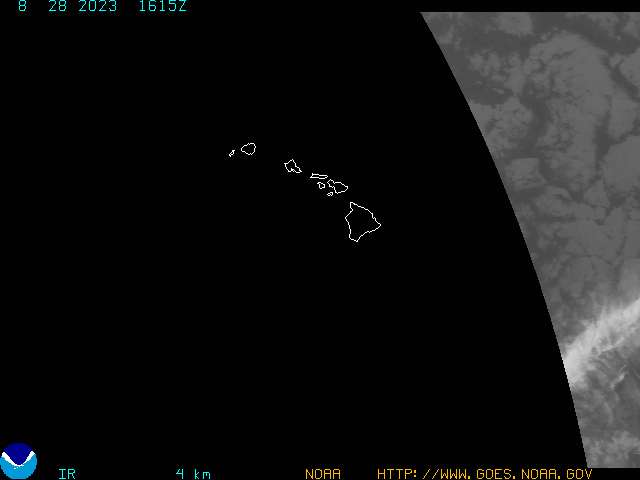
Satellite and Radar Images: To view the cloud conditions we have here in Hawaii, please use the following satellite links, starting off with the Infrared Satellite Image of the islands to see all the clouds around the state during the day and night. This next image is one that gives close images of the islands only during the daytime hours, and is referred to as a Close-up visible image. This next image shows a larger view of the Pacific…giving perspective to the wider ranging cloud patterns in the Pacific Ocean…out from the islands. To help you keep track of where any showers may be around the islands, here’s the latest animated radar image.
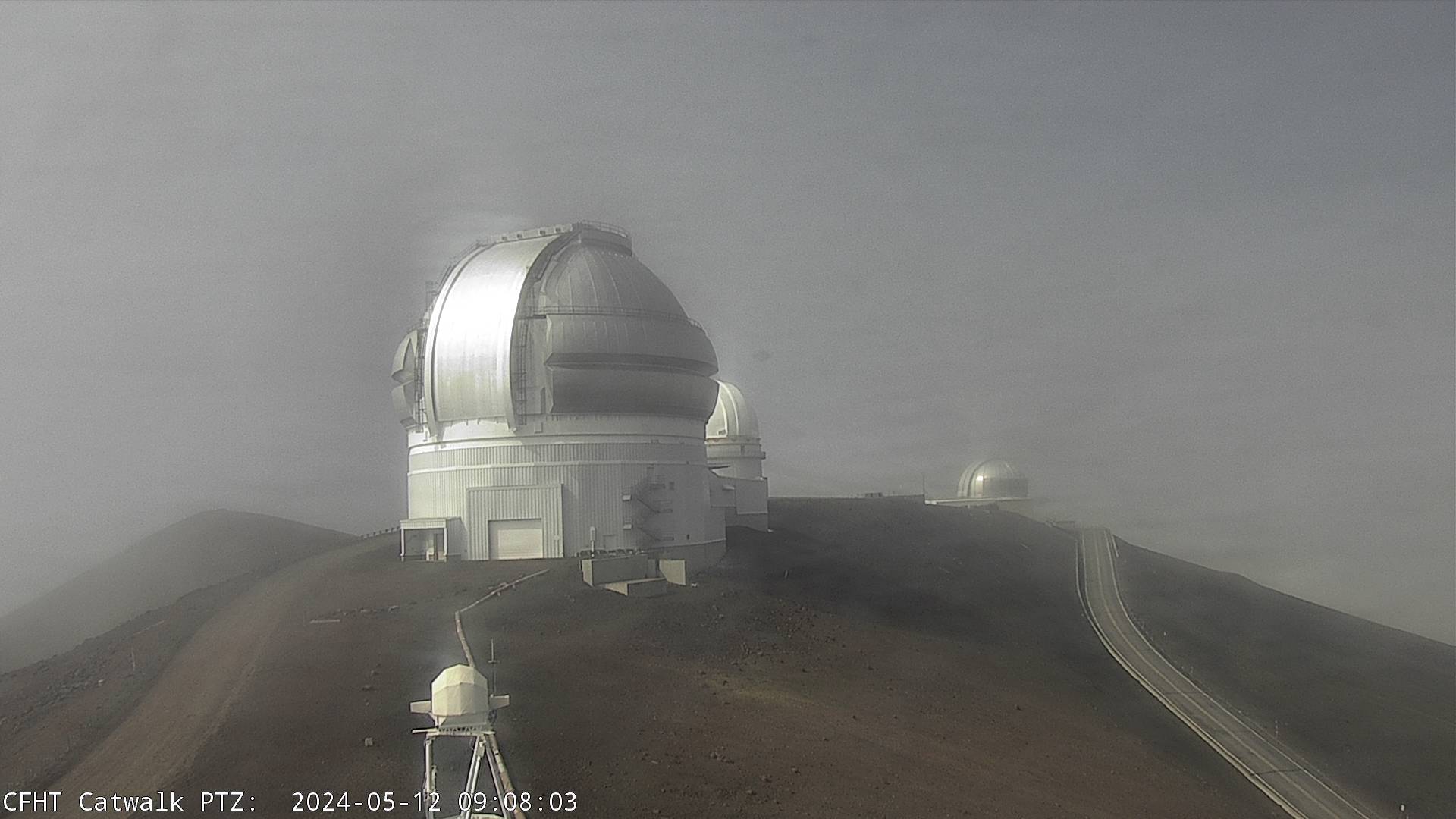
Hawaii’s Mountains – Here’s a link to the live webcam on the summit of near 14,000 foot Mauna Kea on the Big Island of Hawaii. The tallest peak on the island of Maui is the Haleakala Crater, which is near 10,000 feet in elevation. These two webcams are available during the daylight hours here in the islands…and when there’s a big moon rising just after sunset for an hour or two! Plus, during the nights and early mornings you will be able to see stars, and the sunrise too…depending upon cloud conditions.
Aloha Paragraphs

Leeward beaches have south swell waves
Photo Credit: Flickr.com
After a long absence, the trade winds have returned, helping to clear away the haze of late. A ridge is located to the northeast of Hawaii Tuesday evening. Light to locally moderate trade winds arrived today, and will stick around into Wednesday. The latest computer models show steady trade wind breezes remaining active through most of next week as a matter of fact. These winds won’t likely get strong enough to prompt a small craft wind advisory, although will be somewhat stronger next week.
The returning trade winds will take us out of our long lasting convective weather pattern. Tuesday started off with clear to partly cloudy skies, with a few light windward showers locally. The upcountry areas saw cloud cover during the afternoons, with a few showers falling locally there as well. As the trade winds are now blowing steadily, we’ll see an increase in showers along the windward sides. The leeward sides will remain mostly dry, and quite sunny during the days.
It’s Tuesday evening as I begin updating this last paragraph of today’s narrative. As noted above, the long lasting light wind episode has given way to what looks like an extend period of trade winds…continuing into next week. The trade winds will clear our local skies of volcanic haze, which is a good thing. There will finally start to be some increase in windward biased showers, although nothing heavy is indated. ~~~ As my picture of the day suggests, we’ve seen a new south swell breaking along our leeward beaches. This swell was generated about a week ago down near New Zealand, and has taken that long to travel the 3,000 to 4,000 miles to get here. Our local surf community is thrilled to see these nice waves. A reinforcement will arrive Friday into the weekend, with more good south swell waves expected next week. Speaking of surf and such, the north and west shores will find new waves arriving early Wednesday morning, with rising surf along our east shores soon into next week as well. ~~~ Tuesday saw a rather quick change from the light wind conditions of the last few weeks, back into a trade wind weather pattern. This will bring favorably inclined weather conditions, with the addition of some much needed showers spraying their way along the windward coasts and slopes. ~~~ I’ll be back very early Wednesday morning with your next new weather narrative, I hope everyone has a great Tuesday night wherever you happen to be spending it! Aloha for now…Glenn.
Interesting: "This is the first time anyone has looked at the odor-tracking behavior of individual birds in the wild using remote techniques," said Gabrielle Nevitt, professor of neurobiology, physiology and behavior at UC Davis and an author on the study with UC Davis graduate student Marcel Losekoot of the Bodega Marine Laboratory and Henri Weimerskirch of the Centre National de la Recherche Scientifique, France. Wandering albatrosses fly for thousands of miles across the ocean, usually gliding a few feet above sea level. Floating carrion, especially squid, make up a large part of their diet.
Albatrosses nesting on Possession Island in the southwestern Indian Ocean were fitted with GPS receivers that recorded their exact position every 10 seconds and stomach temperature gauges that noted every meal. When the birds returned to land after a foraging trip, the researchers removed the equipment and downloaded the data.
They found that the birds usually flew across the wind, which allows them to cross plumes of scent drifting downwind and is also the best strategy for energy-efficient soaring. Sometimes birds would fly straight to food, but almost half the time an albatross would either turn upwind or zigzag into the wind toward a meal.
Both patterns suggest that the birds were following a plume of scent, rather than visual cues. Birds could turn upwind toward a food source several miles away — well over the visual horizon. Hunting by scent allows the albatross to cover a strip of ocean several miles wide as it flies crosswind, Nevitt said.
Interesting2: The storm which hit the UK Sunday night and through Monday gave rise to some dramatic footage taken around southern coasts of England and Wales. However, while the storm was not exceptional in itself, a combination of things is said to have made the storm more unusual.
According to the Met Office, the strength of the storm, depth of the low pressure and the fact that it hit the UK at a time which coincided with high spring tides, made it more unusual. A storm of this strength and southerly position at this time of year, they say is the kind of storm which would occur once every 5 years.
The storm which originated across Canada and the US was swept across the Atlantic by a very strong jet stream. This is a corridor of strong winds in the upper atmosphere which drives weather systems.
Strongest winds yesterday were reported at the Mumbles, South Wales, recording 82mph (132km/h) and The Needles, Isle of Wight, recording 95mph (153km/h). Similar wind strengths were recorded across Northern France as the storm buffeted the near continent as well. The French Met Service (Meteo France) recorded 96mph (155km/h) at Raz (in the Finistere department).
Another storm is set to hit the UK overnight, but this time the strongest winds are expected to be across Northern Ireland and Northern England with gusts in excess of 80mph possible in exposed places. Gale force winds may return across a large swathe of the country.
Posted by Glenn
1 Comment
March 10-11 2008
Air Temperatures – The following maximum temperatures were recorded across the state of Hawaii Monday:
Lihue, Kauai – 82
Honolulu, Oahu – 82
Kaneohe, Oahu – 80
Kahului, Maui – 81
Hilo, Hawaii – 84
Kailua-Kona, Hawaii – 82
Temperatures ranged between these warmest and coolest spots near sea level at 4 a.m. Monday morning:
Kailua-kona – 71F
Molokai airport – 57
Precipitation Totals – The following numbers represent the largest precipitation totals (inches) during the last 24 hours on each of the major islands, as of Monday afternoon:
0.01 OMAO, KAUAI
0.02 MAKUA RANGE, OAHU
0.00 MOLOKAI
0.01 LANAI
0.00 KAHOOLAWE
0.01 PUU KUKUI, MAUI
0.01 SOUTH POINT, BIG ISLAND
Weather Chart – Here’s the latest (automatically updated) weather map. A high pressure ridge is located just to the northeast of the islands…which extends from a 1030 millibar high pressure cell far to the NE…in the eastern Pacific. Winds will remain light Tuesday, although gradually becoming trade winds later today into Wednesday.
Satellite and Radar Images: To view the cloud conditions we have here in Hawaii, please use the following satellite links, starting off with the Infrared Satellite Image of the islands to see all the clouds around the state during the day and night. This next image is one that gives close images of the islands only during the daytime hours, and is referred to as a Close-up visible image. This next image shows a larger view of the Pacific…giving perspective to the wider ranging cloud patterns in the Pacific Ocean…out from the islands. To help you keep track of where any showers may be around the islands, here’s the latest animated radar image.
Hawaii’s Mountains – Here’s a link to the live webcam on the summit of near 14,000 foot Mauna Kea on the Big Island of Hawaii. The tallest peak on the island of Maui is the Haleakala Crater, which is near 10,000 feet in elevation. These two webcams are available during the daylight hours here in the islands…and when there’s a big moon rising just after sunset for an hour or two! Plus, during the nights and early mornings you will be able to see stars, and the sunrise too…depending upon cloud conditions.
Aloha Paragraphs

Lanikai Beach on Oahu
Photo Credit: Flickr.com
This week will start off with light winds, and end up with light winds…with a brief period of trade winds in between. Storms to the north and northwest of Hawaii, will keep a high pressure system pushed into the eastern Pacific, offshore from San Diego, California. A weak ridge extends from this high to over the northern islands, keeping our winds light and variable through Tuesday evening…with quite a lot of haze around. The latest computer forecast guidance suggests that light trade winds will arrive Wednesday, stick around through Thursday. The ridge will get forced down over the islands again Friday into the weekend, with lighter southeast breezes then.
Dry weather will start the week, with an increase in windward showers arriving along with the trade winds Wednesday into Thursday. Monday and Tuesday will start off with clear skies, then turn locally cloudy during the afternoon hours. The upcountry areas will see rather thick cloud cover during the afternoons, which will collapse after dark. When the trade winds arrive by mid-week, there will be some sort of an increase in showers arriving along the windward sides. As we get to Friday into the weekend, the bias for showers will shift from the windward sides, back over the mountains during the afternoon hours…as we slip back into a convective weather pattern.
It’s Monday evening as I begin writing this last paragraph of today’s narrative. As noted in the paragraphs above, our dry convective weather pattern, the same one we’ve had for the last couple of weeks, will remain in place as we start this new work week. We could point upwards, towards the ridge of high pressure aloft over the islands, as the cause for this prolonged period of dry weather. This upper ridge will hang around for another couple of days, before being replaced by a trough of low pressure, which may be around through much of the rest of the week. This upper trough will make our overlying atmosphere somewhat more shower prone. This is the primary reasoning behind why we should be seeing an increase in the showers brought in by the surging trade winds starting at mid-week. ~~~ A cold front later in the week, perhaps even a couple of them, will push our trade wind producing high pressure surface ridge down over the islands. This should occur starting Friday into the weekend, which will send us back into a light and variable wind condition, with light southeasterly breezes blowing locally. If the upper trough of low pressure is still around then, we could see a few generous showers falling in the upcountry areas during the afternoons then. ~~~ As you may have noticed, if you follow the weather closely, each new day the computer models seem to have had a new take on what will be happening weatherwise this week. We may very well need to continue fine tuning the weather outlook, although what else is new in the world of weather!? ~~~ Monday was a classic example of well developed convective weather conditions. The day started off just fine, although the daytime heating cooked up lots of clouds. These clouds sometimes restrict themselves to over and around the mountains, but not today! As a matter of fact, clouds spread out rather extensively over all the islands…right down to the beaches in most cases. The only saving grace perhaps, was that these clouds didn’t do much more than wring out a sprinkle or two of rain. These clouds will clear out nicely after dark, making way for yet another clear sky start to the day Tuesday. ~~~ I hope everyone has a good and restful Monday night! I’ll be back very early Tuesday morning with your next new weather narrative from paradise. Aloha for now…Glenn.
Interesting: South Australia has been suffering in the scorching heat this last week, in a heat wave which is currently on track to become their longest on record. The heat wave is made even more extraordinary in that it has arrived in what is now the start of autumn across Australia. On Monday temperatures in Adelaide reached 99F in the city and 100F at Adelaide Airport. This makes it the eighth consecutive day that temperatures in Adelaide have exceeded 95F. In doing so it has equaled the record set in 1934, making it Adelaide’s longest hot spell in over 70 years. However, records go back to the 1860’s and if the city reaches 95F on Tuesday, it will set a new all time record for the state. It may be a close call though since the Australian Bureau of Meteorology has forecast a high of 93F on Tuesday. Tomorrow is expected to be the “cooler” of the week, with the sweltering heat expected to carry on into the weekend. Temperatures from Wednesday are expected to be 95-102F. The hot, dry weather is very much in contrast to cool and wet conditions being experienced further north, across Queensland and parts of New South Wales. There, low pressure has brought frequent storms across the region and severe floods.
Interesting2: Corn is a key element of the U.S. food supply. It is what dairy cows eat to make milk and hens consume to lay eggs. It fattens cattle, hogs and chickens before slaughter. It makes soda sweet. As the building block of ethanol, it is now also a major component of auto fuel. And that may signal trouble ahead. Economists are cautioning that the nation’s growing dependence on corn would make for a double jolt in the event of a drought across the Midwest: soaring prices not just for food but also for gasoline. Analysts now warn that a "corn shock" might not be far off — and it could lead to $5 gas and $3.50 eggs as the effects reverberate across the economy. "We are replacing price volatility from the Middle East with Midwestern weather price volatility," said Michael Swanson, a Wells Fargo & Co. vice president and agricultural economist. Such a disaster would occur against a backdrop of soaring prices for basic food items and other commodities that are already stressing the economy. Coffee is up 21% to date, platinum 42% and already high oil an additional 6%. After a torrid 2007, corn prices have risen an additional 20% this year because of global demand for livestock feed, sweeteners and ethanol. The rush by American farmers to forgo other grains to plant cash-producing corn, along with weather problems, has squeezed wheat supplies, pushing the price of that grain up 21%. Soy has risen 25% this year.
Posted by Glenn
No Comments
March 9-10 2008
Air Temperatures – The following maximum temperatures were recorded across the state of Hawaii Sunday:
Lihue, Kauai – 80
Honolulu, Oahu – 81
Kaneohe, Oahu – 80
Kahului, Maui – 79
Hilo, Hawaii – 85
Kailua-Kona, Hawaii – 83
Temperatures ranged between these warmest and coolest spots near sea level at 5 a.m. Sunday morning:
Kailua-kona – 71F
Kahului, Maui – 59
Precipitation Totals – The following numbers represent the largest precipitation totals (inches) during the last 24 hours on each of the major islands, as of Sunday afternoon:
0.04 WAINIHA, KAUAI
0.00 OAHU
0.00 MOLOKAI
0.01 LANAI
0.00 KAHOOLAWE
0.06 KAUPO GAP, MAUI
0.06 KAPAPALA RANCH, BIG ISLAND
Weather Chart – Here’s the latest (automatically updated) weather map. A high pressure ridge over the area between Oahu and Kauai…extends from a 1026 millibar high pressure cell far to the ENE…in the eastern Pacific. Winds will remain light and variable through Tuesday.
Satellite and Radar Images: To view the cloud conditions we have here in Hawaii, please use the following satellite links, starting off with the Infrared Satellite Image of the islands to see all the clouds around the state during the day and night. This next image is one that gives close images of the islands only during the daytime hours, and is referred to as a Close-up visible image. This next image shows a larger view of the Pacific…giving perspective to the wider ranging cloud patterns in the Pacific Ocean…out from the islands. To help you keep track of where any showers may be around the islands, here’s the latest animated radar image.
Hawaii’s Mountains – Here’s a link to the live webcam on the summit of near 14,000 foot Mauna Kea on the Big Island of Hawaii. The tallest peak on the island of Maui is the Haleakala Crater, which is near 10,000 feet in elevation. These two webcams are available during the daylight hours here in the islands…and when there’s a big moon rising just after sunset for an hour or two! Plus, during the nights and early mornings you will be able to see stars, and the sunrise too…depending upon cloud conditions.
Aloha Paragraphs

Laperouse Bay on Maui
Photo Credit: Flickr.com
Light breezes will dominate, varying in direction between east and southeast. Storms to the north and northwest of Hawaii, will keep a high pressure system pushed into the eastern Pacific, offshore from the southern California coast. A weak ridge will extend from this high to over the islands, keeping our winds light and variable. There will be several cold fronts moving by to our north, keeping the ridge near by or over us, and our winds generally light through Tuesday. The latest computer forecast guidance suggests that light to moderately strong trade winds will arrive Wednesday…prevailing through the rest of the week.
The overlying atmosphere remains rather dry and stable, so despite the extensive afternoon cloudiness over and around the mountains…there won’t be much precipitaton falling from them. Days will start off quite clearly, remaining that way for the most part along the beaches. The upcountry areas however will see rather thick cloud cover during the afternoons, which will collapse after dark. Cold fronts will approach the islands at times during the next week, and may bring a few showers, especially on Kauai, but no major rain event will occur. When the trade winds arrive by mid-week, there will be at least some increase in showers arriving along the windward sides.
It’s Sunday evening as I begin writing this last paragraph of today’s narrative. What you see described in the two paragraphs above are the classic elements of a convective weather pattern. If the details look similar to what you have been reading about here for the last two weeks, you’re absolutely right. In a nut shell, cold fronts to our north will keep a light wind producing ridge of high pressure displaced southward over or near the islands. This will keep our local air mass less shower prone than usual. By the way, with the light winds around again, our haze levels will be on the increase again. ~~~ The light winds were expected to last through the greater part of the new week. It should be pointed out that the computer models have been flip flopping over what the weather solution would be for the second half of the new week ahead. The latest iteration now shows the return of trade winds around mid-week, which are now scheduled to last through the remainder of the week. As the trade winds return, if in fact they actually do, we would expect passing shower activity along the windward sides of each of the islands. ~~~ Clouds have increased in the upcountry areas Sunday afternoon, as expected. They seem less shower prone than they did yesterday however. These clouds will evaporate after dark, leaving a star filled skies during the night. I’ll be back very early Monday morning, until then I hope you have a great Sunday night wherever you happen to be reading from! Aloha for now…Glenn.
Posted by Glenn
1 Comment
March 8-9 2008
Air Temperatures – The following maximum temperatures were recorded across the state of Hawaii Saturday:
Lihue, Kauai – 81
Honolulu, Oahu – 81
Kaneohe, Oahu – 80
Kahului, Maui – 81
Hilo, Hawaii – 83
Kailua-Kona, Hawaii – 83
Temperatures ranged between these warmest and coolest spots near sea level at 5 a.m. Saturday morning:
Kailua-kona – 71F
Molokai airport – 58
Precipitation Totals – The following numbers represent the largest precipitation totals (inches) during the last 24 hours on each of the major islands, as of Saturday afternoon:
0.02 MOLOAA DAIRY, KAUAI
0.08 OAHU FOREST NWR, OAHU
0.00 MOLOKAI
0.00 LANAI
0.00 KAHOOLAWE
0.05 WEST WAILUAIKI, MAUI
0.36 HONOKAA, BIG ISLAND
Weather Chart – Here’s the latest (automatically updated) weather map. A high pressure ridge just north of Kauai…extends from a 1029 millibar high pressure cell far to the ENE…in the eastern Pacific. Winds will remain light over Kauai, with trade winds on the other islands through Monday.
Satellite and Radar Images: To view the cloud conditions we have here in Hawaii, please use the following satellite links, starting off with the Infrared Satellite Image of the islands to see all the clouds around the state during the day and night. This next image is one that gives close images of the islands only during the daytime hours, and is referred to as a Close-up visible image. This next image shows a larger view of the Pacific…giving perspective to the wider ranging cloud patterns in the Pacific Ocean…out from the islands. To help you keep track of where any showers may be around the islands, here’s the latest animated radar image.
Hawaii’s Mountains – Here’s a link to the live webcam on the summit of near 14,000 foot Mauna Kea on the Big Island of Hawaii. The tallest peak on the island of Maui is the Haleakala Crater, which is near 10,000 feet in elevation. These two webcams are available during the daylight hours here in the islands…and when there’s a big moon rising just after sunset for an hour or two! Plus, during the nights and early mornings you will be able to see stars, and the sunrise too…depending upon cloud conditions.
Aloha Paragraphs

Cattle at Ulupalakua Ranch, Maui
Photo Credit: Flickr.com
Light trade winds will remain in place here in the islands Sunday into Monday. Our trade wind producing ridge of high pressure is located a short distance north of Kauai now, allowing easterly breezes to remain over the entire state. There will be little change in the direction or strength of these breezes for the time being. There looks to be some changes that will happen around the middle of the new week ahead though, when high pressure strengthens to our north and northeast, potentially ushering in a stronger trade wind flow for a day or two…then getting lighter again for next weekend.
Showers will be few and far between, concentrating their efforts best on the Big Island and east Maui. These showers will get carried into the windward sides generally, although they won’t amount to much. There will be the usual clouds that stack-up over and around the mountains as well. These cumulus buildups won’t be able to drop many showers, although a few will fall here and there. Showers may increase around the middle of the upcoming week, focused primarily over the windward sides. We may see wet trade winds continuing along the windward sides for several days thereafter.
It’s Saturday evening as I begin updating this last paragraph of today’s narrative. Looking into next week, as noted in the two paragraphs above, we finally see some changes occurring…after a long dry spell. The computer models show a cold front approaching the state from the northwest early in the week, although it will likely stall before getting into our area. It may however add enough moisture into our overlying atmosphere, that we see an increase in windward showers then. As we pass mid-week, high pressure systems to the north and northeast are expected to strengthen, boosting the trade winds as they move back into the islands. This surge of trade winds may push more moisture onto the windward sides of the islands. As we move into next weekend, the winds will drop again, with the bias for windward showers, shifting over and around the mountains during the afternoon hours. ~~~ I went to see the new film Penelope (2008) Friday evening. As soon as I saw that it was billed as a comedy, I became reluctant. I often think of these comedy’s as being too silly. At any rate, Penelope stars Christina Ricci, Reese Witherspoon, James McAvoy, Catherine O’Hara, among others. As many of you regular readers know, I’m typically drawn to those heavy, often rather violent action films. This time I thought I’d try something different though, taking a step or three back from the intensity that I often enjoy in the theaters. I can’t say I was sorry that I saw this film, it was cute, rather endearing at times, light hearted in general. If you have any interest in a sneak peek into this film, here’s the trailer, see what you think. ~~~ It’s just before sunset here in Kula, Maui, as I put the last finishing touches on this narrative update. Saturday was a great day, especially down near the beaches. I took an early morning walk along Thompson Road, out near Keokea and Ulupalakua, which was a great way to start the day! Once I got home, I didn’t leave the property, which was nice for a change. I hung out with my neighbors, which is pleasure. Late in the afternoon, the clouds gathered significantly on the slopes of the Haleakala Crater. These clouds began to lightly shower a little while ago, which was a treat. Looking down the mountain, I can see that the beaches over towards Kihei and Wailea were still warm and sunny. Here in Kula, at just before 5pm, it was a bit foggy, with those light showers, and cool. I love this kind of upcountry weather, and I know those folks down near the ocean enjoyed their sunshine too. ~~~ I’m going to remain hunkered in this evening, with no plans to go anywhere. I’ll be back Sunday morning with your next new weather narrative, I hope you have a great Saturday night wherever you happen to be spending it! Aloha for now…Glenn.
Posted by Glenn
No Comments
March 7-8 2008
Air Temperatures – The following maximum temperatures were recorded across the state of Hawaii Friday:
Lihue, Kauai – 80
Honolulu, Oahu – 81
Kaneohe, Oahu – 80
Kahului, Maui – 82
Hilo, Hawaii – 83
Kailua-Kona, Hawaii – 82
Temperatures ranged between these warmest and coolest spots near sea level at 4 a.m. Friday morning:
Kaneohe, Oahu – 73F
Kahului, Maui – 62
Precipitation Totals – The following numbers represent the largest precipitation totals (inches) during the last 24 hours on each of the major islands, as of Friday afternoon:
0.00 KAUAI
0.01 DILLINGHAM, OAHU
0.00 MOLOKAI
0.00 LANAI
0.00 KAHOOLAWE
0.00 MAUI
0.09 KAPAPALA RANCH, BIG ISLAND
Weather Chart – Here’s the latest (automatically updated) weather map. A high pressure ridge north of Kauai Friday…extends out of a 1029 millibar high pressure cell far to the ENE. Winds will remain light over Kauai, with trade winds on the other islands through Saturday.
Satellite and Radar Images: To view the cloud conditions we have here in Hawaii, please use the following satellite links, starting off with the Infrared Satellite Image of the islands to see all the clouds around the state during the day and night. This next image is one that gives close images of the islands only during the daytime hours, and is referred to as a Close-up visible image. This next image shows a larger view of the Pacific…giving perspective to the wider ranging cloud patterns in the Pacific Ocean…out from the islands. To help you keep track of where any showers may be around the islands, here’s the latest animated radar image.
Hawaii’s Mountains – Here’s a link to the live webcam on the summit of near 14,000 foot Mauna Kea on the Big Island of Hawaii. The tallest peak on the island of Maui is the Haleakala Crater, which is near 10,000 feet in elevation. These two webcams are available during the daylight hours here in the islands…and when there’s a big moon rising just after sunset for an hour or two! Plus, during the nights and early mornings you will be able to see stars, and the sunrise too…depending upon cloud conditions.
Aloha Paragraphs

Sea cliffs at South Point , on the Big Island…
the southernmost part of the state of Hawaii
Photo Credit: Flickr.com
Mild trade winds will continue to grace the Hawaiian Islands through the weekend. Our trade wind producing ridge of high pressure is located a distance north of Kauai now, allowing easterly breezes to remain over the entire state. There will be little change in the direction or strength of these breezes for the time being. There looks to be some changes that will happen around the middle of the new week ahead though, when high pressure strengthens to our north and northeast…potentially ushering in a stronger and more well established trade wind regime after mid-week.
Little change is expected in the generally dry and stable conditions over Hawaii through the weekend. A few showers will get carried into the windward sides, although they won’t amount to much. There will be the usual clouds that stack-up over and around the mountains too. These cumulus buildups may look threatening…but won’t be able to drop many showers either. The one exception may be on the Big Island, where an upper trough of low pressure edging in from the east, may trigger some increase in showers. Showers may increase during the second half of the upcoming week, focused primarily over the windward sides.
It’s Friday evening as I begin updating this last paragraph of today’s narrative. The long lasting period of fine late winter weather will continue, providing good conditions for all outdoor activities. As mentioned in the paragraphs above, most areas will have mild mannered trade winds blowing, along with just a few showers falling here and there. The Big Island, and perhaps east Maui would have the best chance of somewhat more showers than the rest of the state. ~~~ Looking into next week, we finally see some changes occurring, the most meaningful of which would happen during the second half of the week. The computer models show a cold front approaching the state from the northwest early in the week, although now show it stalling before getting into our area. It may hang to our north for a few days, pushing our high pressure ridge down over Hawaii again, with lighter winds in general Monday or Tuesday into Wednesday. As we pass mid-week, high pressure systems to the north and northeast are expected to strengthen, boosting the trade winds as they move back into the islands. This surge of trade winds may push the leftover moisture from the expired cold front, which is often called a shearline, into the windward sides of the islands. We sometimes refer to this type of situation as wet trade winds. ~~~ I’m about ready to leave Kihei, taking the drive into Kahului. I had planned on seeing the new film called 10,000 B.C. this evening, although considering its the opening night, I thought I’d wait until next week instead. During the day, one of my fellow workers told me to see Penelope (2008). As soon as I saw that it was a comedy, I said to myself, no way. However, I seem to have changed my mind, and will see something of a different nature than normal. Penelope stars Christina Ricci, Reese Witherspoon, James McAvoy, Catherine O’Hara, among others. I’m going to give this film a try, although I must say, going in, I have some considerations. I’ll let you know what I think Saturday morning when I get back online. Until then, here’s a trailer, so you can begin to form your own impression. See ya tomorrow. Aloha for now…Glenn.
Interesting: Sea levels are set to fall over millions of years, making the current rise blamed on climate change a brief interruption of an ancient geological trend, scientists said on Thursday. They said oceans were getting deeper and sea levels had fallen by about 170 meters (560 ft) since the Cretaceous period 80 million years ago when dinosaurs lived. Previously, the little-understood fall had been estimated at 40 to 250 meters. "The ocean floor has got on average older and gone down and so the sea level has also fallen," said Bernhard Steinberger at the Geological Survey of Norway, one of five authors of a report in the journal Science. "The trend will continue," he told Reuters. A computer model based on improved understanding of shifts of continent-sized tectonic plates in the earth’s crust projects more deepening of the ocean floor and a further sea level decline of 120 meters in 80 million years’ time. If sea levels were to fall that much now, Russia would be connected to Alaska by land over what is now the Bering Strait, Britain would be part of mainland Europe and Australia and Papua island would be the same landmass. The study aids understanding of sea levels by showing that geology has played a big role alongside ice ages, which can suck vast amounts of water from the oceans onto land. "If we humans still exist in 10, 20 or 50 million years, irrespective of how ice caps are waxing and waning, the long term … is that sea level will drop, not rise," said lead author Dietmar Muller of the University of Sydney. Over time, Muller told Science in a podcast interview there would be fewer mid-ocean ridges and a shift to more deep plains in the oceans as continents shifted. The Atlantic would widen and the Pacific shrink.
Interesting2: New Flash: Biological anthropologist endorses presidential candidate. The wait is over. After months of speculation, and controversy, biological anthropologist, Dr. Earnest A. Hooton, of Harvard, has finally weighed in on his choice of presidential candidate. The endorsement goes to … a woman, any woman. "As a professional student of man [surely that’s a misquote and he meant ‘humankind’], I judge that females of our species have certain qualities that ought to render them superior to males in statesmanship," Hooton said, The New York Times reports. Since there is only one woman candidate currently running, we have to assume that Hooton is throwing his weight behind Hillary Clinton, or would be backing her if he weren’t long dead. Earnest Hooton’s call for a female president ran in the newspaper on October 17, 1944, (that would be during the presidential race between Franklin Roosevelt and Thomas Dewey, neither of whom were women). At that time, women were considered high-strung hysterics incapable of logical thought, let alone the guts to run a war room. Hooten probably wanted to be provocative, even outlandish in suggesting those silly little creatures might be able to do more than cook dinner. "If human behavior, even on subjects they really knew nothing about. Readers may have laughed out loud when they read the column, but they probably read it.
Interesting3: The latest flow from Kilauea Volcano reached the ocean overnight, according to scientists with the Hawaii Volcano Observatory. A scientist flew over the flow with Hawaii County officials on Thursday morning. "On a general basis, it is a real strong tube that leads to the ocean and is quite a healthy flow at this time," Big Island Mayor Harry Kim said. Access to Kilauea’s eruption was cut off Wednesday after the current lava flow crossed the last Big Island access road to the site. Kim warned that people should stay out of the area at this time because of the potential for part of the flow to break off and surround them. County officials said they know there are people sneaking into the site at night, but police and state park officials are out advising people the area is restricted. County and state highway personnel are working to cut a road to a new lava-viewing site. The road would cut the 2.5- to 3-mile walk that people would otherwise have to face. Kim said he hopes to have the new road for people to view the flow up by 2 p.m. on Saturday. The area will be accessible from 2 p.m.-10 p.m. each day. That is subject to change, depending on any potential dangers. Hawaii County and Hawaii Volcanoes National Park workers will man the site to inform and educate the people who go to the area, Kim said. Kim said that based on past experience, he expects more than 1,000 sightseers per day. The National Park’s flow has continued to hit the water, but people are kept at least a quarter-mile from the flow because of the direction of the wind and the potential for fumes.
Posted by Glenn
No Comments
March 6-7 2008
Air Temperatures – The following maximum temperatures were recorded across the state of Hawaii Thursday:
Lihue, Kauai – 80
Honolulu, Oahu – 84
Kaneohe, Oahu – 79
Kahului, Maui – 81
Hilo, Hawaii – 83
Kailua-Kona, Hawaii – 81
Temperatures ranged between these warmest and coolest spots near sea level at 4 a.m. Thursday morning:
Kaneohe, Oahu – 72F
Kahului, Maui – 57
Precipitation Totals – The following numbers represent the largest precipitation totals (inches) during the last 24 hours on each of the major islands, as of Thursday afternoon:
0.00 KAUAI
0.01 POAMOHO 2, OAHU
0.00 MOLOKAI
0.00 LANAI
0.00 KAHOOLAWE
0.00 MAUI
0.03 KEALAKEKUA, BIG ISLAND
Weather Chart – Here’s the latest (automatically updated) weather map. A high pressure ridge north of Kauai Friday…extends out of a 1029 millibar high pressure cell far to the ENE. Winds will remain light over Kauai, with trade winds on the other islands through Saturday.
Satellite and Radar Images: To view the cloud conditions we have here in Hawaii, please use the following satellite links, starting off with the Infrared Satellite Image of the islands to see all the clouds around the state during the day and night. This next image is one that gives close images of the islands only during the daytime hours, and is referred to as a Close-up visible image. This next image shows a larger view of the Pacific…giving perspective to the wider ranging cloud patterns in the Pacific Ocean…out from the islands. To help you keep track of where any showers may be around the islands, here’s the latest animated radar image.
Hawaii’s Mountains – Here’s a link to the live webcam on the summit of near 14,000 foot Mauna Kea on the Big Island of Hawaii. The tallest peak on the island of Maui is the Haleakala Crater, which is near 10,000 feet in elevation. These two webcams are available during the daylight hours here in the islands…and when there’s a big moon rising just after sunset for an hour or two! Plus, during the nights and early mornings you will be able to see stars, and the sunrise too…depending upon cloud conditions.
Aloha Paragraphs

The Kona coast on the Big Island of Hawaii
Photo Credit: Flickr.com
Light trade winds filter into the state from the east now. Our trade wind producing ridge of high pressure is located a distance north of Kauai Thursday evening, allowing a drift of air from the east over the state. There will be little change in the direction or strength of these breezes for the time being. There looks to be some changes around the middle of next week, when a fairly meaningful cloud band pushes through the state…opening the flood gates for stronger trade winds then through the rest of the week.
Other than a few showers here and there…conditions will remain very dry well into the future. A few showers will get carried into the windward sides, although they won’t amount to much. The light trade winds won’t inhibit clouds from forming over and around the mountains during the afternoons in most areas. These cumulus buildups may look threatening, becoming pretty dark late in the day…but won’t do much more than that. A frontal passage later next week may bring a change in this dry weather pattern, with wet trade winds thereafter.
It’s Thursday evening as I begin updating this last paragraph of today’s narrative. We’re moving through a late winter weather pattern here in the islands now. The trade winds, albeit on the light side, will grace Hawaii through the remainder of this week. The overlying atmosphere, as it has been for well over a week, remains dry and stable. These ingredients continue to give us favorably inclined weather conditions. I’m sure everyone is happy with this reality, including both the local residents, and our visitors here on vacation. I see little change in this light trade wind pattern going forward, taking us at least through the rest of this week. ~~~ Looking ahead, the trade winds will start next week, and probably end the week as well. The latest computer forecast models are now suggesting that we’ll see some sort of weather action in between though. The winds will likely turn from the trade wind direction later next Tuesday or Wednesday, towards the southeast, and then perhaps all the way around to the south and SW kona directions…ahead of an active Pacific frontal cloud band. This front could bring wet weather to the Aloha state around next Thursday, followed by cool north winds. These northerlies will quickly become trade winds thereafter…with the chance of wet conditions continuing along the windwad sides. The leeward sides will clear out nicely, with sunny weather returning. All of this is really too far into the future to get all worked up over at this point, and may need major revisions between now and then! ~~~ Thursday was a great day here in the islands, with the trade winds keeping the coconut palm fronds swaying to and fro. There was glorious Hawaiian sunshine beaming down, just about everywhere, with just enough puffy cumulus clouds around, to beautify or local skies. It is warm now in the islands, with high temperatures rising into the low 80F’s…with a few of the warmest leeward beaches flirting with 85F degrees! I see no good reason to think that Friday won’t be a more or less carbon copy of today. ~~~ I’ll be back very early Friday morning with your next new weather narrative. I hope you have a great Thursday night until then! Aloha for now…Glenn.
Incredible…try it and see!
Interesting: They may not be gas-guzzlers, but electric cars have a raging thirst for water. A comparison of the volume of coolant water used in the thermoelectric power plants that provide most of our electricity and that used in extracting and refining petroleum suggests that electric vehicles require significantly more water per mile than those powered by gasoline. The findings could bode ill for drought stricken areas in the event of a large scale switch to plug-in vehicles. "I wouldn’t sound the alarm that this is going to ruin the day," says Carey King from the University of Texas, Austin, US, noting that no mass-market electric vehicle is currently available. "But looking into the future, this is something we should take into account." King and colleagues found that cars, light trucks, and SUVs running off the electric grid consume three times more water and withdraw 17 times more water per mile than their equivalent gasoline-powered vehicles.
Interesting2: It finally happened this week. The price of oil passed the all-time inflation-adjusted peak of $103.76 that was set in April 1980—and is now three times what it was just four years ago. What’s going on? This is a record that virtually none of the world’s oil experts predicted, particularly at a time when the world economy is slumping and the demand for gasoline is now dropping in the United States. Some of the blame may go to speculation and the decline of the dollar. But the roots of the problem run deeper. Worlcrude oil production has actually fallen from 73.8 million barrels per day in 2005 to 73.2 million barrels per day in the first ten months of 2007, according to the U.S. Energy Information Administration. This makes 2005 the peak year for world oil production so far, though it is too early to know if this will turn out to be the all-time high. In 2007, crude oil production declined in some of the world’s largest oil-producing countries— including Indonesia, Mexico, Norway, Nigeria, the United Kingdom, Saudi Arabia, and Venezuela—due to a combination of geological and political factors. The fact that the world is having a hard time expanding oil supply fast enough to keep up with even modest demand growth is beginning to be accepted in some corners of the oil industry. The CEO of Royal Dutch Shell and the U.S. industry-dominated National Petroleum Council have both stated that supply constraints are likely to put continued pressure on world oil markets in the years ahead.
Interesting3: Beijing is seeking weather forecasters from home and abroad to provide hourly bulletins in three languages for every event of the Olympics in August, China‘s top meteorological official said on Thursday. More than 70 of the country’s best provincial weather forecasters would come to Beijing to help out, said Zheng Guoguang, head of the China Meteorological Administration. "The whole nation’s strength will be mustered," he told reporters on the sidelines of the Chinese People’s Political Consultative Conference, an advisory body to parliament currently meeting in the capital. Weather experts from previous Olympic hosts such as the United States and Australia would also come in August to share their expertise and technology, Zheng said. "There will be forecasters at every venue to issue detailed weather services in Chinese, English and French, to be updated every hour," said Zheng, who has a PhD from the University of Toronto. He said weather was the most challenging factor in Beijing‘s preparations for the Games. "The pressure is very high," Xinhua news agency quoted Zheng as saying. But the simmering heat and humidity that usually plague Beijing in the summer should have relented during the 16-day Games and history was on Beijing‘s side when it came to guaranteeing a dry opening ceremony on August 8, he said.
Posted by Glenn
No Comments
March 5-6 2008
Air Temperatures – The following maximum temperatures were recorded across the state of Hawaii Wednesday:
Lihue, Kauai – 80
Honolulu, Oahu – 82
Kaneohe, Oahu – 80
Kahului, Maui – 82
Hilo, Hawaii – 83
Kailua-Kona, Hawaii – 82
Temperatures ranged between these warmest and coolest spots near sea level at 4 a.m. Wednesday morning:
Kaneohe, Oahu – 73F
Kahului, Maui – 61
Precipitation Totals – The following numbers represent the largest precipitation totals (inches) during the last 24 hours on each of the major islands, as of Wednesday afternoon:
0.01 KAPAHI, KAUAI
0.02 KAHUKU TRAINING AREA, OAHU
0.00 MOLOKAI
0.00 LANAI
0.00 KAHOOLAWE
0.03 HANA AIRPORT, MAUI
0.28 GLENWOOD, BIG ISLAND
Weather Chart – Here’s the latest (automatically updated) weather map. A high pressure ridge north of Kauai Thursday…extends out of a 1026 millibar high pressure cell far to the ENE. Winds will remain light over Kauai, with trade winds on the other islands through Friday.
Satellite and Radar Images: To view the cloud conditions we have here in Hawaii, please use the following satellite links, starting off with the Infrared Satellite Image of the islands to see all the clouds around the state during the day and night. This next image is one that gives close images of the islands only during the daytime hours, and is referred to as a Close-up visible image. This next image shows a larger view of the Pacific…giving perspective to the wider ranging cloud patterns in the Pacific Ocean…out from the islands. To help you keep track of where any showers may be around the islands, here’s the latest animated radar image.
Hawaii’s Mountains – Here’s a link to the live webcam on the summit of near 14,000 foot Mauna Kea on the Big Island of Hawaii. The tallest peak on the island of Maui is the Haleakala Crater, which is near 10,000 feet in elevation. These two webcams are available during the daylight hours here in the islands…and when there’s a big moon rising just after sunset for an hour or two! Plus, during the nights and early mornings you will be able to see stars, and the sunrise too…depending upon cloud conditions.
Aloha Paragraphs

The Oheo Gulch near Hana, Maui
Photo Credit: Flickr.com
Our trade wind producing high pressure ridge is just north of Kauai Wednesday evening…allowing light trade winds to move up into the state a distance. The Big Island and Maui will see easterly trade winds, while Oahu and Kauai, closer to a high pressure ridge just to our north…will have lighter winds in general. The modestly strong trades have helped to ventilate away some of the haze that has prevailed over the southern part of the Aloha state. The latest computer models show light to moderately strong trade winds during the first part of next week, overriden by light and variable winds shortly thereafter.
A few windward biased showers will fall around the Big Island and Maui, otherwise most areas will remain dry for the time being. A few showers will get carried into the windward sides, now that the trade winds are blowing in places. These showers won’t amount to much, although be more generous than any time during the last week. Those areas closer to Kauai won’t see the trade winds, and find afternoon clouds over the interior sections collecting a few drops, but again hardly worth mentioning. The leeward beaches statewide will continue to find dry weather.
It’s Wednesday evening as I begin writing this last paragraph of today’s narrative. We’re moving into the tail-end of our winter season here in the islands…with spring just up ahead. Here in the tropics, at least here in the Hawaiian Islands, spring usually means that the trade winds would be blowing. When the trade winds are active, we often see at least some form of passing shower activity along the windward sides. Just as commonly, the leeward beaches are graced with abundant daytime sunshine, and warm to very warm air temperatures. One thing we can’t forget though, is that we’re still in a fairly strong La Nina condition here in the Pacific Ocean. This typically means that we see more than the normal amount of rainfall in the islands. ~~~ Wednesday kept to the script quite closely, with no major deviations from the expected forecast. Clouds increased during the day over the mountains, as usual, although didn’t let loose, also expected. Light trade winds returned today, although not much more than that. Clouds will clear overnight in most areas, with Thursday looking to closely resemble Wednesday. ~~~ I’ll be back very early Thursday morning with your next new weather narrative from the tropical Hawaiian Islands. I hope everyone has a great Wednesday night until then! Aloha for now…Glenn.
Interesting: The least biologically productive areas of the oceans are expanding much faster than predicted, according to a new study by researchers at NOAA and the University of Hawaii. This change in ocean biology, linked to the warming of sea surface waters, may negatively affect the populations of many fish species trying to survive in these desert-like environments. Between 1998 and 2007, these expanses of saltwater with low surface plant life in the Pacific and Atlantic Oceans grew by 15 percent or 6.6 million square kilometers, according to the study which appears in Geophysical Research Letters. The expansion is occurring at the same time that sea surface temperatures are warming about one percent or .02 to .04 degrees Celsius a year. The warming increases stratification of the ocean waters, preventing deep ocean nutrients from rising to the surface and creating plantlife.
Interesting2: Research from ancient sediment cores indicates that a warming climate could make the world’s arctic tundra far more susceptible to fires than previously thought. The findings, are important given the potential for tundra fires to release organic carbon — which could add significantly to the amount of greenhouse gases already blamed for global warming. The authors of the study, examined ancient sediments from four lakes in a remote region of Alaska, in and around Gates of the Arctic National Park, to determine what kind of vegetation existed in the area after the last ice age…14,000 to 9,000 years ago. By looking at fossilized pollen grains in the sediment cores, the authors determined that after the last ice age, the arctic tundra was very different from what it is now. Instead of being covered with grasses, herbs, and short shrubs, it was covered with vast expanses of tall birch shrubs. Charcoal preserved in the sediment cores also showed evidence that those shrub expanses burned — frequently.
Interesting3: Imagine a vat of liquid cow manure covering the area of five football fields and 33 feet deep. Meet California’s most alternative new energy. On a dairy farm in the Golden State’s agricultral heartland, utility PG&E Corp began on Tuesday producing natural gas derived from manure, in what it hopes will be a new way to power homes with renewable, if not entirely clean, energy. The Vintage Dairy Biogas Project, the brainchild of life- long dairyman David Albers, aims to provide the natural gas needed to power 1,200 homes a day, Albers said at the facility’s inauguration ceremony. "When most people see a pile of manure, they see a pile of manure. We saw it as an opportunity for farmers, for utilities, and for California," Albers said.
Posted by Glenn
No Comments
March 4-5 2008
Air Temperatures – The following maximum temperatures were recorded across the state of Hawaii Tuesday:
Lihue, Kauai – 80
Honolulu, Oahu – 83
Kaneohe, Oahu – 79
Kahului, Maui – 80
Hilo, Hawaii – 83
Kailua-Kona, Hawaii – 83
Temperatures ranged between these warmest and coolest spots near sea level at 4 a.m. Tuesday morning:
Honolulu, Oahu – 70F
Kahului, Maui – 61
Precipitation Totals – The following numbers represent the largest precipitation totals (inches) during the last 24 hours on each of the major islands, as of Tuesday afternoon:
0.02 MOLOAA DAIRY, KAUAI
0.04 OAHU FOREST NWR, OAHU
0.00 MOLOKAI
0.00 LANAI
0.00 KAHOOLAWE
0.00 MAUI
0.03 HONOKAA, BIG ISLAND
Weather Chart – Here’s the latest (automatically updated) weather map. A high pressure ridge will be remain just north of Kauai Wednesday. Winds will remain light and variable over Kauai, with light trade winds on the Big Island end of the state through Thursday.
Satellite and Radar Images: To view the cloud conditions we have here in Hawaii, please use the following satellite links, starting off with the Infrared Satellite Image of the islands to see all the clouds around the state during the day and night. This next image is one that gives close images of the islands only during the daytime hours, and is referred to as a Close-up visible image. This next image shows a larger view of the Pacific…giving perspective to the wider ranging cloud patterns in the Pacific Ocean…out from the islands. To help you keep track of where any showers may be around the islands, here’s the latest animated radar image.
Hawaii’s Mountains – Here’s a link to the live webcam on the summit of near 14,000 foot Mauna Kea on the Big Island of Hawaii. The tallest peak on the island of Maui is the Haleakala Crater, which is near 10,000 feet in elevation. These two webcams are available during the daylight hours here in the islands…and when there’s a big moon rising just after sunset for an hour or two! Plus, during the nights and early mornings you will be able to see stars, and the sunrise too…depending upon cloud conditions.
Aloha Paragraphs

Kealakekua Bay…on the Big Island
Photo Credit: Flickr.com
The trade winds will grace the southern islands, with lighter winds on the Kauai end of the state. The Big Island and Maui will see a light to almost moderately strong easterly trade winds, while Oahu and Kauai, closer to a high pressure ridge just to our north…will have lighter winds in general. Cold fronts moving by to the north of the state will keep this ridge close to, or just north of the islands through the week. The modestly strong trades will help to ventilate away some of the haze that has plagued the southern part of the Aloha state.
There will be a few light showers along the windward sides of the islands, otherwise remaining dry most areas. Days will start off clear to partly cloudy, with daytime heating of the islands, aided by the onshore sea breezes, starting clouds forming over and around the mountains during the afternoons. These clouds won’t drop many showers though, and will clear up again during the night. Whatever few showers that fall will spread themselves out between those upcountry areas during the afternoons…and a few along the windward sides where the trade winds are active.
It’s Tuesday evening as I begin updating this last paragraph of today’s narrative. Taking a look at this weather map, we find our trade wind producing high pressure ridge just to the north of Kauai now. As can be seen on that map, this ridge extends from a rather robust 1029 millibar high pressure system, located offshore from the San Francisco Bay. The high will stay around in that same area, although the ridge will migrate around some, stretching from near Kauai, to points a little further north at times. The placement of this high pressure ridge will determine how far into the state the trade winds will manage to get. At the moment, they are blowing over the Big Island end of the island chain, reaching up over Maui, and on to Oahu during the days. The good news about this, is that the trade winds are helping to ventilate away some of the volcanic haze. Additionally, it may help to bring back a few showers to the windward sides, which have been extremely dry for well over a week now. ~~~ I’ve received many questions lately about whether the Humpback Whales are still around, and the answer is yes. I’m not a whale expert, but my understanding is that they are around through March and into April. Several kind and informed folks responded in the area down the page from here, and I want to send out a hearty thanks to each! ~~~ Tuesday was a nice day here in the islands. When I went down near the beach at lunch, and sat and watched the blue ocean, my car thermometer in Kihei, Maui, read 90F degrees! That was on the pavement of course, although it sure felt every degree of that summer-like number. As I sat there, I saw at least one big splash offshore, as a whale breached, what a sight! ~~~ I’ll be back very early Wednesday morning with your next new weather narrative, I hope you have a great Tuesday night until then! Aloha for now…Glenn.
Interesting: Even Superman couldn’t stop a hurricane in its tracks. But now, if another Katrina comes along, we may be able to send it back out to sea before it can hurt us, thanks to the work of climate research teams based in the U.S. and Israel. The researchers claim that by dropping a planeload of soot into the frozen cloud at the top of the hurricane, they could slow the hurricane down and change its path, preventing damage to major cities. Their plans aren’t fully formed quite yet, but once they iron out the details, these researchers could have the capacity to send hurricanes back where they came from — so maybe you can hold onto your beach house in Florida, after all.
Interesting2: Studying rice may not sound like the world’s most exciting job. But think again: One plant biologist, Dr. Monty Jones, has made the study of rice his life’s work — and as a result of his amazing innovations in the field, he’s dramatically improved the lives of millions of farmers and the general population throughout West Africa. Dr. Jones, 56, a native of Sierra Leone, spent years traveling with his team from farm to farm, all over Africa and Asia. They painstakingly classified each and every variety of rice plant they discovered. (Not a small task: The rare O. glaberrima species alone has over 1,500 varieties.) Finally, Dr. Jones and his team set to work developing a hardy hybrid that could deal with droughts, weeds, and poor soil — all of which are common plant-killers in Africa. The resulting crop is NERICA (New Rices for Africa), a fast-growing, high-yield grain that can easily survive even the driest African seasons. The new rice will provide nutrition to millions of people in famine-striken Africa, and will save $200 million in importation costs. True, a grain of rice isn’t very big — but when it comes to making a difference in Africa, a little bit of rice can go a very long way.
Interesting3: Most scientists tend to shy away from talk of extraterrestrials — but not astronomer Margaret Turnbull, who’s spent her entire career at NASA studying the galaxy for signs of life on other planets. Last year, she announced a list of 11 "habstars" — habitable stars with environments very similar to Earth’s — narrowed down from a list of more than 17,000. Thanks to her research, astronomers at the Seti Institute will have a great head start when they begin scanning the skies for alien life forms with the Allen Telescope Array, a powerful device that can pick up on radio signals from other planets. And if they happen to come across a real-life version of E.T., the candy-loving creature from outer space, we’ll have Turnbull to thank for the introduction.
Posted by Glenn
No Comments
March 3-4 2008
Air Temperatures – The following maximum temperatures were recorded across the state of Hawaii Monday:
Lihue, Kauai – 80
Honolulu, Oahu – 85
Kaneohe, Oahu – 79
Kahului, Maui – 81
Hilo, Hawaii – 83
Kailua-Kona, Hawaii – 81
Temperatures ranged between these warmest and coolest spots near sea level at 4 a.m. Monday morning:
Kailua-kona – 72F
Kahului, Maui – 62
Precipitation Totals – The following numbers represent the largest precipitation totals (inches) during the last 24 hours on each of the major islands, as of Monday afternoon:
0.05 MOLOAA DAIRY, KAUAI
0.02 MAKUA RANGE, OAHU
0.00 MOLOKAI
0.00 LANAI
0.00 KAHOOLAWE
0.00 MAUI
0.02 MOUNTAIN VIEW, BIG ISLAND
Weather Chart – Here’s the latest (automatically updated) weather map. A high pressure ridge will be remain over or just to the north of Kauai Tuesday, moving a little further north Wednesday. Winds will remain light over Kauai and Oahu, with light to almost lower moderately strong trade winds on the Big Island end of the state through this forecast period.
Satellite and Radar Images: To view the cloud conditions we have here in Hawaii, please use the following satellite links, starting off with the Infrared Satellite Image of the islands to see all the clouds around the state during the day and night. This next image is one that gives close images of the islands only during the daytime hours, and is referred to as a Close-up visible image. This next image shows a larger view of the Pacific…giving perspective to the wider ranging cloud patterns in the Pacific Ocean…out from the islands. To help you keep track of where any showers may be around the islands, here’s the latest animated radar image.
Hawaii’s Mountains – Here’s a link to the live webcam on the summit of near 14,000 foot Mauna Kea on the Big Island of Hawaii. The tallest peak on the island of Maui is the Haleakala Crater, which is near 10,000 feet in elevation. These two webcams are available during the daylight hours here in the islands…and when there’s a big moon rising just after sunset for an hour or two! Plus, during the nights and early mornings you will be able to see stars, and the sunrise too…depending upon cloud conditions.
Aloha Paragraphs

More great beach weather this week!
Light and variable winds, with light trade winds at times…will be the name of the game this week in the islands. The Big Island and Maui will see a light to almost moderately strong easterly trade winds, while Oahu and Kauai, closer to a high pressure ridge just to our north, will have lighter winds in general. Cold fronts moving by to the north of the state will keep a high pressure ridge close to the islands through the week. There will be volcanic haze associated with this weather pattern, although where the trade winds reach, it will help to ventilate it away to varying degrees.
The prolonged period of dry weather will stick around through this week as well. Days will start off clear to partly cloudy, with daytime heating of the islands, aided by the onshore sea breezes, starting clouds forming over and around the mountains during the afternoons. These clouds won’t drop many showers though, and will clear up again during the night. Meanwhile, back down at sea level, days will remain quite sunny and dry, with some cloudy periods during the afternoons locally. Whatever few showers that fall will spread themselves out between the upcountry areas during the afternoons, and a few along the windward sides where the trade winds are active.
It’s Monday evening as I begin writing this last paragraph of today’s narrative. February was a month characterized by gusty trade winds, and lots of showers falling along the windward sides of the islands. Now that we’re involved in such a long lasting light wind episode, with very dry conditions…it’s hard to imagine all that wind and rain of last month! Last week was extremely dry, with nothing much more than light winds blowing here in the Aloha state. There’s certainly nothing wrong with these conditions, and I’m sure vacationers to Hawaii enjoyed it very much. These kinds of weather circumstances make for excellent beach experiences. There’s a bit of high cloudiness around now too, which will more than likely give a nice colorful sunset this evening…and if it’s still around Tuesday morning, the skies may light up pink and orange again then. ~~~ The trade winds were able to reach further into the state today, than they have for a while. This in turn allowed some of the volcanic haze to clear out, although it’s not all gone just yet. Hopefully the trade winds will blow again Tuesday, so that we can see some further improvement of our local air visibilities then. ~~~ On a personal note, I went to see my Dermatologist, Dr. George Martin this afternoon, and got a clean bill of health. As I’ve spent about a trillion too many hours in the sunshine during my life, having lived by the beach the whole time, and being an avid surfer much of those years, this is great news! ~~~ I hope everyone has a wonderful Monday night, wherever you happen to be spending it! I’ll be back with your next new weather narrative from our lovely Hawaiian Islands very early Tuesday morning. Aloha for now…Glenn.
Interesting: South Korea closed schools on Monday and its factories producing memory chips stepped up safeguards, as a choking pall of sand mixed with toxic dust from China covered most of the country and other parts of Asia. The annual "yellow dust" spring storms, which originate in China’s Gobi Desert before sweeping south to envelop the Korean peninsula and parts of Japan, are blamed for scores of deaths and billions of dollars in damage every year in South Korea. It issued a yellow dust warning at the weekend. On Monday, school districts in southeastern regions urged parents to keep kindergarten and elementary school children at home. "We advised the closure because kindergarten, primary school students have weaker immune systems," said Min Eyu-gi, an education official in Busan. An official with the Meteorological Administration said the first major storm of the season, which has also hit parts of Japan, was dissipating. But forecasts from China said cold air and little rainfall would lead to more storms from Wednesday through March 11, Xinhua news agency reported. Taiwan mostly avoids the toxic clouds but skies in Taipei on Monday were overcast, with the government telling people to wear surgical masks and avoid exercising outdoors.
Interesting2: Anti-whaling activists clashed with Japanese whalers in the Southern Ocean on Monday, prompting a diplomatic complaint from Tokyo to Canberra and a rebuke for the activists from the Australian government. Members of the hardline Sea Shepherd group threw bottles and containers of foul-smelling substances at the Japanese factory ship the Nisshin Maru as part of the organization’s campaign to disrupt Japan’s annual whale hunt.
Interesting3: A survey of 1000 people, released Monday by the National Sleep Foundation, found participants average six hours and 40 minutes of sleep a night on weeknights, even though they estimated they’d need roughly another 40 minutes of sleep to be at their best. Roughly one-third of those surveyed said they had fallen asleep or become very sleepy at work in the past month. While sleepy workers know they’re not performing as well as they could during the day, work is what’s keeping them up nights, according to the survey, which found workdays are getting longer and time spent working from home averages close to four-and-a-half hours each week. It seems people are also trying to squeeze in more time for themselves and their families, even if it means less sleep. The average wake up is at 5:35 a.m. and it’s followed by about two hours and 15 minutes at home before heading out to work, according to the survey. Average bedtime is 10:53.
Posted by Glenn
No Comments
March 2-3 2008
Air Temperatures – The following maximum temperatures were recorded across the state of Hawaii Sunday:
Lihue, Kauai – 81
Honolulu, Oahu – 81
Kaneohe, Oahu – 80
Kahului, Maui – 80
Hilo, Hawaii – 80
Kailua-Kona, Hawaii – 83
Temperatures ranged between these warmest and coolest spots near sea level at 5 a.m. Sunday morning:
Kailua-kona – 74F
Molokai airport – 58
Precipitation Totals – The following numbers represent the largest precipitation totals (inches) during the last 24 hours on each of the major islands, as of Sunday afternoon:
0.02 MOLOAA DAIRY, KAUAI
0.02 MAKUA RANGE, OAHU
0.00 MOLOKAI
0.00 LANAI
0.00 KAHOOLAWE
0.01 KAHAKULOA, MAUI
0.09 GLENWOOD, BIG ISLAND
Weather Chart – Here’s the latest (automatically updated) weather map. A high pressure ridge will be remain over Oahu Monday. Winds will remain light and variable over Kauai and Oahu, with light trade winds on the Big Island end of the state through Tuesday.
Satellite and Radar Images: To view the cloud conditions we have here in Hawaii, please use the following satellite links, starting off with the Infrared Satellite Image of the islands to see all the clouds around the state during the day and night. This next image is one that gives close images of the islands only during the daytime hours, and is referred to as a Close-up visible image. This next image shows a larger view of the Pacific…giving perspective to the wider ranging cloud patterns in the Pacific Ocean…out from the islands. To help you keep track of where any showers may be around the islands, here’s the latest animated radar image.
Hawaii’s Mountains – Here’s a link to the live webcam on the summit of near 14,000 foot Mauna Kea on the Big Island of Hawaii. The tallest peak on the island of Maui is the Haleakala Crater, which is near 10,000 feet in elevation. These two webcams are available during the daylight hours here in the islands…and when there’s a big moon rising just after sunset for an hour or two! Plus, during the nights and early mornings you will be able to see stars, and the sunrise too…depending upon cloud conditions.
Aloha Paragraphs

An empty hammock waiting for you!
Our local winds will be light Sunday evening into Monday…light trade winds will return starting Tuesday. The Big Island end of the island chain could see a light easterly wind flow, while the Kauai side will find southeast breezes for the most part. Cold fronts moving by to the north of the state will keep a high pressure ridge over or close to the islands through Monday. As Tuesday arrives, the ridge will move a little north of Kauai, at which point we’ll see light trade winds push further into the state. There will be volcanic haze associated with this light wind weather pattern for the time being. The returning trade winds will gradually help to ventilate the haze away, with better visibilities finally.
High pressure ridging over the islands, will keep a low inversion layer in place…with dry weather the net result. Days will start off clear to partly cloudy, with daytime heating of the islands, aided by the onshore sea breezes, getting clouds forming over and around the mountains during the afternoons. These clouds won’t have much chance to drop showers though, and will clear up again during the night. Meanwhile, back down at sea level, days will remain quite sunny and dry, with some cloudy periods during the afternoons locally. When the trade winds return Tuesday, we will start to see a few limited showers along the windward sides.
It’s Sunday evening as I begin updating this last paragraph of today’s narrative. Sunday started off nicely, as did Saturday, and Friday, and Thursday…so on and so forth. This past week has been very similar from one day to the next, with the general theme being dry weather for the entire state. I see no significant change in this regard through the next week, with light precipitation prospects at best. For the time being, the few raindrops that do find their way to the ground, will land in the upcountry areas during the later afternoon hours. As the trade winds return Tuesday onward, the bias for those light showers will migrate over to the windward coasts and slopes. Thus, the current dry weather pattern, which has been with us for one week…will become two. ~~~ Looking down the mountain, from up here in Kula, Maui, all I see see is thick volcanic haze over the central valley. We got cloudy upcountry this afternoon, and there were a few sprinkles a few minutes ago, just after I washed my car and dried it off. It didn’t amount to much though, perhaps what we could classify as a trace. There are sun rays trying to filter through the clouds and haze, although the air visibilities are anything but perfect, far from it as a matter of fact! At sunset, the vog was so thick that I couldn’t see the West Maui Mountains from this vantage point, with the sun going down as a big red ball into the ocean! ~~~ The weekend went way too fast, much too fast indeed. I definitely could use one more day to recharge my batteries, before starting this new work week ahead. Oh well, that’s how it goes sometimes, although I did get quite a few things done. I’ll be back very early Monday morning with your next new weather narrative from paradise, I hope you have a great Sunday night until then! Aloha for now…Glenn.
« Previous Page — Next Page »












 Email Glenn James: