May 2006
Monthly Archive
Posted by Glenn
No Comments
May 10 – 11 2006
Air Temperatures – The following maximum temperatures were recorded across Hawaii Wednesday:
Lihue, Kauai – 81F
Honolulu, Oahu – 83
Kaneohe, Oahu – 79
Kahului, Maui – 83
Hilo, Hawaii – 74
Kailua-Kona, Hawaii – 84
Temperatures early Thursday morning ranged between these warmest and coolest spots near sea level at the 4 a.m. hour:
Kaneohe, Oahu- 73
Hilo, Hawaii – 61
Precipitation Totals – The following numbers represent the largest precipitation totals (inches) during the last 24 hours (as of Thursday morning) on each of the major islands, including:
0.59 MOUNT WAIALEALE, KAUAI
0.10 KAHUKU TRAINING AREA, OAHU
0.07 MOLOKAI
0.00 LANAI
0.00 KAHOOLAWE
0.24 WEST WAILUAIKI, MAUI
0.78 HONAUNAU, BIG ISLAND
Weather Chart – Here’s the latest (automatically updated) weather map…showing high pressure centers far to north and the NE of the islands. The location and strength of these anticyclones will keep moderately strong trade winds blowing through Friday…strong and gusty at times. Here’s a Weather Map Symbol page for clarification about what all those funny weather symbols mean.
Hawaii’s Mountains – Here’s a link to the live webcam on the summit of near 14,000 foot Mauna Kea on the Big Island of Hawaii. The tallest peak on the island of Maui is the Haleakala Crater, which is near 10,000 feet in elevation. These two webcams are available during the daylight hours here in the islands…and when there’s a big moon rising just after sunset for an hour or two! Plus, during the nights and early mornings you will be able to see stars, and the sunrise too…depending upon cloud conditions.
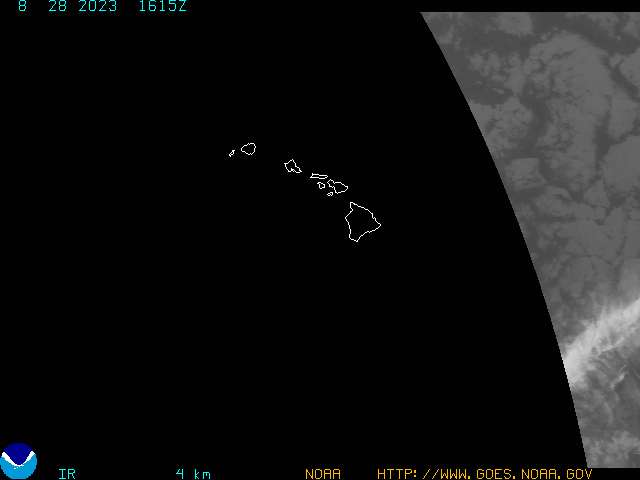
Satellite Images – To view the cloud conditions we have here in Hawaii, please use the following satellite links, starting off with the Infrared Satellite Image of the islands to see all the clouds around the state during the day and night. This next image is one that gives close images of the islands only during the daytime hours, and is referred to as a Close-up visible image. This next image shows a larger view of the Pacific…giving perspective to the wider ranging cloud patterns in the Pacific Ocean…out from the islands. To help you keep track of where any showers may be around the islands, here’s the latest animated radar image.
Aloha Paragraphs
 Kealia Beach, Kauai
The latest computer forecast models show the current brisk trade winds, along with some windward showers…will be interrupted this weekend. In the mean time, high pressure to the NE of the state will keep the breezy trade winds blowing across our area. These cooling and refreshing winds are still strong enough to keep a small craft wind advisory active over some coastal and channel waters around Maui and the Big Island. The trade winds will blow through the end of this work week, and then begin to flag as we move into the weekend time frame.
Our local atmosphere is still a bit unstable, especially over and around the Big Island end of the Hawaiian Island chain. This suggests that the trade wind inversion is still quite high, allowing clouds to develop more vertically than normal. This in turn is a good indicator of somewhat more showers than we previously expected. The bulk of this falling moisture will be focused along the windward coasts and slopes…occurring most generously during the night and early morning hours. The leeward sides of the islands will remain mostly dry, with some possible afternoon showers along the Kona slopes.
Looking at the latest satellite images, there aren’t many sun dimming or filtering clouds around now. There was one rather minor swath of high cirrus clouds moving by, just to the south of the state. However, there’s a good chance it will fly by without moving northward over the Aloha state. This clears the way for what looks like more sunny weather, especially along those leeward coastal areas. All this sunny weather will force the local air temperatures upward, ending up in the 80F’s just about everywhere near sea level. Those warmest areas, like Kona, Kihei and Lahaina, will top out in the upper 80F’s!
As the weekend rolls around, the forecast calls for a temporary fading of our trade wind regime. A deep trough of low pressure, moving by to the north of the islands, will force our trade wind producing high pressure ridge southward near Hawaii. This will cause the faltering action of the trade winds, and may usher in a day or two of rather hot and muggy weather near the beaches. The lighter winds should prompt afternoon cloud buildups, and some possible showers over the interior regions. At the same time, the trough may send a weak cloud band towards us, although it would be very unusual if it brought any showers this time of year. We’ll find the trade winds snapping back into place right after the weekend…with more fine weather on tap for next week.
It’s early Wednesday evening here in Kula, Maui. The two weather items I have on my mind as the sun currently sinks into the western horizon, is how sunny and dry it was today, and the second is how incredibly close to being full the moon is, as it rises over the Haleakala Crater. As I was exclaiming during last evening’s sunset commentary, it was definitely summery today. The report I received from the Kihei area, in terms of the high temperature Tuesday confirms this fact: 90F degrees! I’m listening to the internet radio station, Manao Radio, which broadcasts from here on Maui. The current song is Tupelo Honey by Van Morrison…so sweet indeed! I’m enjoying a small glass of full bodied red wine called Black Chook, which is from Australia…it goes oh so well with the sunset, the music, the moon, and the overall sense of well being that I’m experiencing at the moment. I stopped by the Pukalani Superette on the way home, picked up some precooked Mahimahi, which I’ll plate with steamed organic brocolli. I hope you have a great Wednesday night, and don’t forget to click on a few of the google ads after you read this, there are some interesting deals available, and it helps to support this web sites existence at the same time. I’ll be back early, well before dawn Thursday morning, with your next weather narrative from paradise. Aloha for now…Glenn.
P.S. Here’s a link to one of the advertisers on the left hand margin: Adventures in Hawaii…whose website says: “We specialize in helping you to discover all the fun and exciting vacation activities that are available here in Hawaii. We make it EASY and affordable for you to make reservations in advance, so that you will be able to make the most of your time here in paradise. Our service is FREE … we have no hidden surcharges and it never costs you more to book with us!”
Posted by Glenn
1 Comment
May 9 – 10 2006
Air Temperatures – The following maximum temperatures were recorded across Hawaii Tuesday:
Lihue, Kauai – 81F
Honolulu, Oahu – 83
Kaneohe, Oahu – 81
Kahului, Maui – 85
Hilo, Hawaii – 78
Kailua-Kona, Hawaii – 82
Temperatures early Wednesday morning ranged between these warmest and coolest spots near sea level at the 4 a.m. hour:
Honolulu – 73
Hilo, Hawaii – 67
Precipitation Totals – The following numbers represent the largest precipitation totals (inches) during the last 24 hours (as of Wednesday morning) on each of the major islands, including:
1.02 MOUNT WAIALEALE, KAUAI
0.21 PUNALUU PUMP, OAHU
0.01 MOLOKAI
0.00 LANAI
0.00 KAHOOLAWE
1.74 WEST WAILUAIKI, MAUI
1.36 PIIHONUA, BIG ISLAND
Weather Chart – Here’s the latest (automatically updated) weather map…showing a 1030 millibar high pressure center far to the NE of the islands. The location and strength of this anticyclone will keep moderately strong trade winds blowing through Thursday…strong and gusty at times. Here’s a Weather Map Symbol page for clarification about what all those funny weather symbols mean.
Hawaii’s Mountains – Here’s a link to the live webcam on the summit of near 14,000 foot Mauna Kea on the Big Island of Hawaii. The tallest peak on the island of Maui is the Haleakala Crater, which is near 10,000 feet in elevation. These two webcams are available during the daylight hours here in the islands…and when there’s a big moon rising just after sunset for an hour or two! Plus, during the nights and early mornings you will be able to see stars, and the sunrise too…depending upon cloud conditions.
Satellite Images – To view the cloud conditions we have here in Hawaii, please use the following satellite links, starting off with the Infrared Satellite Image of the islands to see all the clouds around the state during the day and night. This next image is one that gives close images of the islands only during the daytime hours, and is referred to as a Close-up visible image. This next image shows a larger view of the Pacific…giving perspective to the wider ranging cloud patterns in the Pacific Ocean…out from the islands. To help you keep track of where any showers may be around the islands, here’s the latest animated radar image.
Aloha Paragraphs

Can’t you almost smell this fragrant Plumeria flower?
A routine mid-May trade wind weather pattern prevails across the Hawaiian Islands now. These favorably inclined weather conditions will hold through the rest of this week. High pressure centers far to the NW and NE will be the source of our locally breezy trade winds. These trades will carry in moisture patches at times, taking aim on the windward sides of the islands. The leeward sides will see lots of sunshine, particularly during the morning hours. Air temperatures will reach up into the 80F’s at most sea level locations…cooler in the higher elevation upcountry areas.
The shower enhancing upper level low pressure system, which provided rainfall recently, is now being replaced by high pressure aloft. This will help to support a more limited moisture pattern, with whatever showers that are around, falling along the windward coasts and slopes. One of the few exceptions to this rule, may be the showers that spill from the afternoon clouds that form over the Kona slopes of the Big Island. This rather dry reality won’t change much as we move through this week. By the way, those few windward showers will occur most frequently during the night and early morning hours.
Back to the trade winds, they will be quite breezy where they meet the coasts most directly. This happens to occur along the north and east facing shores…which we call the windward sides of the islands. High pressure is forecast to remain in place to the north of the islands, with an elongated zone of low pressure, called the ITCZ (inter-tropical convergence zone) remaining intact to our south. This pressure configuration will keep the pressure gradient sufficiently steep to sustain moderately strong trade winds blowing across our latitudes of the north central Pacific. Think in terms of 10-25 mph in general, with gusts in those windiest areas moving well up into the 30+ mph range during the days.
These trade winds may falter a bit as we get into the upcoming weekend time frame. This will be caused by a mid-latitude trough of low pressure, to our north…weakening the trade wind producing high pressure ridge. The trade winds aren’t expected to stop entirely, but may soften a bit into next week. We need these trade winds to keep blowing at this time of year, otherwise it can get hot and muggy during the days. The trade winds bring to bear their cooling and refreshing relief from the tropical warmth during our spring and summer months. There isn’t expected to be much change as the trade winds ease back, although we may tend to see some added cloudiness over and around the interior sections of the islands then…with some possible spotty showers falling.
It’s early Tuesday evening here in Kula, Maui, as I begin this sunset commentary. I don’t believe that there could have been a more summery day, than what we’ve seen on this spring day in May! It was a mostly sunny in many parts of the state, certainly here on Maui, that’s for sure. The Kihei and Lahaina coastal strips were mostly sunny from the crack of dawn, to now…just as the sun sets into the whip cream like cumulus clouds stacked up over the 5,800 foot West Maui Mountains. Even now, just before 7pm, at this 3,100 foot elevation in Kula, it’s a warm 70F degrees just outside my weather tower, with a reading of 79F degrees inside here, with all the windows fully open. There are no high level cirrus clouds around today, with just the gray lower level cumulus and stratocumulus clouds, with their soft pink fringe on top. The birds are chirping away, just as they were early this morning, with the exception of the totally quiet roosters, up the way. It won’t be long before everything quiets down, as the birds find their comfortable roosts in the nearby trees. Looking ahead, we have more fair weather prospects ahead, with the trade winds dominating our local weather picture through Friday. I hope you have a great Tuesday night, and that you might find some interest in joining me here again on Wednesday, same place, same time. Aloha for now…Glenn.
P.S. Here’s a link to one of the advertisers on the left hand margin: Kanaha Kai Surf Shop, on the north shore of Maui. Windsurfing, Kiteboarding and Surfing on Maui. Kanaha Kai Maui offers the best gear, rentals, lessons and service. Conveniently located on the beach road to Kanaha Beach Park and Kite Beach, Kanaha Kai Maui is the premier oceansport store on Maui.
Posted by Glenn
[4] Comments
May 8 – 9 2006
Air Temperatures – The following maximum temperatures were recorded across Hawaii Monday:
Lihue, Kauai – 81F
Honolulu, Oahu – 83
Kaneohe, Oahu – 80
Kahului, Maui – 83
Hilo, Hawaii – 79
Kailua-Kona, Hawaii – 83
Temperatures early Tuesday morning ranged between these warmest and coolest spots near sea level at the 4 a.m. hour:
Kailua-kona – 74
Hilo, Hawaii – 67
Precipitation Totals – The following numbers represent the largest precipitation totals (inches) during the last 24 hours (as of Tuesday morning) on each of the major islands, including:
0.68 MOUNT WAIALEALE, KAUAI
0.27 WILSON TUNNEL, OAHU
0.00 MOLOKAI
0.00 LANAI
0.00 KAHOOLAWE
1.58 WEST WAILUAIKI, MAUI
3.56 WAIAKEA UKA, BIG ISLAND
Weather Chart – Here’s the latest (automatically updated) weather map…showing high pressure centers far to the NE and NW of the islands. The location and strength of these anticyclones will keep moderately strong trade winds alive through Wednesday…strong and gusty at times. Here’s a Weather Map Symbol page for clarification about what all those funny weather symbols mean.
Hawaii’s Mountains – Here’s a link to the live webcam on the summit of near 14,000 foot Mauna Kea on the Big Island of Hawaii. The tallest peak on the island of Maui is the Haleakala Crater, which is near 10,000 feet in elevation. These two webcams are available during the daylight hours here in the islands…and when there’s a big moon rising just after sunset for an hour or two! Plus, during the nights and early mornings you will be able to see stars, and the sunrise too…depending upon cloud conditions.
Satellite Images – To view the cloud conditions we have here in Hawaii, please use the following satellite links, starting off with the Infrared Satellite Image of the islands to see all the clouds around the state during the day and night. This next image is one that gives close images of the islands only during the daytime hours, and is referred to as a Close-up visible image. This next image shows a larger view of the Pacific…giving perspective to the wider ranging cloud patterns in the Pacific Ocean…out from the islands. To help you keep track of where any showers may be around the islands, here’s the latest animated radar image.
Aloha Paragraphs

Another gorgeous Hawaii sunset
An upper level area of low pressure, which kept the islands shower prone this past weekend, is departing to the east. In the wake of this low and trough, we’ll see the trade winds once again become the dominant weather feature in Hawaii. It will likely take one more day for this to happen fully, so that the Big Island of Hawaii should still have the risk of locally heavy showers. As a matter of fact, the 4am Monday morning report from the windward side of the Big Island, still showed locally heavy rain falling.
A lobe of low pressure, associated with the eastward moving low pressure, will keep the easternmost island of Hawaii showery. The greatest chance of showers will focus on those windward coasts and slopes. Although the Kona slopes may see some locally heavy afternoon showers too, with the chance of a thunderstorm still in the forecast for the time being. The rest of the islands, from Maui through Kauai, will see a return to a fairly normal trade wind weather pattern through the rest of this week…with the Big Island getting in line by Tuesday.
Speaking of the trade winds, they will be moderately strong through the rest of this week. Monday finds a NWS issued small craft advisory in force over those areas that typically find the strongest trade wind speeds. We can generally look for 10-25 mph winds, although those windiest areas, especially between the major islands, in the channels…will have winds in gusts topping the 30 mph mark. As usual, the nights will have the softest winds, with the later morning through late afternoon hours having the strongest.
Other than the locally heavier showers around the Big Island Monday, the rest of the state will find a stabilizing atmosphere, with fewer showers in general. This week will slip back into what we could call a climatological norm. This suggests that most areas will be dry, especially the south and west facing leeward coasts. The north and east oriented windward coasts and slopes will continue to find some passing showers, although not as many as we’ve seen recently…under the influence of the upper low pressure system.
It’s early Monday evening here in Kula, Maui, as I begin today’s sunset commentary. I’m listening to classical music on the internet, with the soft wind chimes vying for my attention in the background. It was a nice spring day here on Maui, with what I’d describe as partly cloudy conditions in general. I could see that there were some showers watering the tropical vegetation along the windward slopes. As I drove into my driveway, there were a few light sprinkles here in Kula too. The cloudy periods kept the afternoon temperatures from attaining their full potential at the beaches, although nonetheless, the high temperatures easily rose into the 80F’s at most sea level locations. It’s just now sunset, and the temperature just outside my weather tower is a warm 68F degrees, with an even warmer 72F inside with all the windows open. At the same time, down at the Kahului airport, it was a warmer 75F…with the Kona airport even warmer at 78F. Life is good here in the islands, feeling almost like summer now. I hope you have a great Monday night, and that you will join me here again early Tuesday morning, with an avid interest in what’s happening in the world of weather in the tropics. Aloha for now…Glenn.
p.s. Here’s a link to one of the advertisers on the left hand margin: Maui Car Rentals…”Maui Car Rentals offers clean, reliable and low priced rental cars. They will pick you up curbside at the Maui Kahului airport. Please call them to rent a car today.” Rental Car Special 2001 Corolla picked up between May 1, to June 5, 2006 – $99 a week + taxes
Posted by Glenn
No Comments
May 7 – 8 2006
Air Temperatures – The following maximum temperatures were recorded across Hawaii Sunday:
Lihue, Kauai – 80F
Honolulu, Oahu – 82
Kaneohe, Oahu – 80
Kahului, Maui – 81
Hilo, Hawaii – 73
Kailua-Kona, Hawaii – 83
Temperatures early Monday morning ranged between these warmest and coolest spots near sea level at the 4 a.m. hour:
Lihue, Kauai – 74
Hilo, Hawaii – 68
Precipitation Totals – The following numbers represent the largest precipitation totals during the last 24 hours (as of Monday morning) on each of the major islands, including:
1.62 MOUNT WAIALEALE, KAUAI
1.96 SOUTH FORK KAUKONAHUA, OAHU
0.08 MOLOKAI
0.00 LANAI
0.00 KAHOOLAWE
1.51 WEST WAILUAIKI, MAUI
3.95 GLENWOOD, BIG ISLAND
Weather Chart – Here’s the latest (automatically updated) weather map…showing a 1033 millibar high pressure system far to the NE of the islands. The location and strength of this anticyclone will keep moderately strong trade winds alive through Tuesday…strong and gusty at times. Here’s a Weather Map Symbol page for clarification about what all those funny weather symbols mean.
Hawaii’s Mountains – Here’s a link to the live webcam on the summit of near 14,000 foot Mauna Kea on the Big Island of Hawaii. The tallest peak on the island of Maui is the Haleakala Crater, which is near 10,000 feet in elevation. These two webcams are available during the daylight hours here in the islands…and when there’s a big moon rising just after sunset for an hour or two! Plus, during the nights and early mornings you will be able to see stars, and the sunrise too…depending upon cloud conditions.
Satellite Images – To view the cloud conditions we have here in Hawaii, please use the following satellite links, starting off with the Infrared Satellite Image of the islands to see all the clouds around the state during the day and night. This next image is one that gives close images of the islands only during the daytime hours, and is referred to as a Close-up visible image. This next image shows a larger view of the Pacific…giving perspective to the wider ranging cloud patterns in the Pacific Ocean…out from the islands. To help you keep track of where any showers may be around the islands, here’s the latest animated radar image.
Aloha Paragraphs

Beautiful Plumeria flowers…have such a wonerful scent!
An upper air low pressure system remains active just to the south of the central Islands Sunday. This is helping to keep passing showers in the forecast, most of which will be concentrating their efforts along the windward coasts and slopes on Maui and the Big Island. The trade winds will be blowing at light to moderately strong levels, which will help to carry showery clouds in our direction from the east. At the higher altitudes of the atmosphere, cold air will enhance those showers, with some becoming locally heavy in places. The trough’s presence may be enough to trigger a few thunderstorm cells over the Aloha state today as well. A flash flood watch is in effect for the islands of Maui, Kahoolawe and the Big Island.
Looking at the latest weather map, we find a moderately strong high pressure system situated to the NE of the state. This trade wind generating high pressure cell will keep the islands in a breezy condition through Monday…actually through the next week at least. This is normal during the month of May, when the trade winds usually are in force most of the time. The nights and early mornings often show the softest breezes, which pick up during the late morning through the late afternoons. These winds aren’t currently strong enough to prompt any warnings or advisories in the coastal marine environment.
As for those incoming showers, there will likely be quite a few of them Sunday from Maui down to the Big Island…tapering off some on Monday. They commonly stick pretty close to the slopes along the north and east facing windward sections. The leeward sides in contrast, often are too far away from these incoming moisture pockets, remaining quite dry. However, as there is cold air aloft, which will help to eliminate any trade wind inversion…we will see towering cloud developments in places, which could drop showers just about anywhere. The forecast calls for less of a threat of heavy showers by Monday, with conditions returning to normal for this time of year Tuesday into the new week ahead.
It’s early Sunday evening here in Kula, Maui, as I start today’s sunset commentary. It was another off and on cloudy day, with the on part most prevalent along the windward sides, and around the mountains. The leeward sides saw more sunshine, with just some occasional cloudy periods. I’m listening to Hawaiian music online, this time KPOA, 93.5FM, which is here on Maui. The late day sunshine is streaming into my weather tower, with an air temperature a warm 67F degrees outside, and 71F inside at the moment…630pm. It’s been varying between partly and mostly cloudy here in Kula, with alternating light showers and bursts of nice sunshine. You know, even when it’s showery, as it’s been over on the windward sides lately, it’s still so mellow and enjoyable here in the islands! Looking out the window, most of the lovely Jacaranda flowers are gone now, which were stripped off by the recent heavy showers several days ago. As I was driving home from work that evening, the road was full of the dropped flowers…which almost looked like snow had fallen! I’ll be back early Monday morning with the next updated weather narrative, I hope to meet you here then. Aloha for now…Glenn.
Posted by Glenn
[3] Comments
May 6 – 7 2006
Air Temperatures – The following maximum temperatures were recorded across Hawaii Saturday:
Lihue, Kauai – 81F
Honolulu, Oahu – 81
Kaneohe, Oahu – 76
Kahului, Maui – 76
Hilo, Hawaii – 72
Kailua-Kona, Hawaii – 82
Temperatures early Sunday morning ranged between these warmest and coolest spots near sea level at the 4 a.m. hour:
Lihue, Kauai – 74
Hilo, Hawaii – 66
Precipitation Totals – The following numbers represent the largest precipitation totals during the last 24 hours (as of Sunday morning) on each of the major islands, including:
1.96 MOUNT WAIALEALE, KAUAI
0.64 SOUTH FORK KAUKONAHUA, OAHU
0.20 MOLOKAI
0.00 LANAI
0.00 KAHOOLAWE
2.04 WEST WAILUAIKI, MAUI
6.77 GLENWOOD, BIG ISLAND
Weather Chart – Here’s the latest (automatically updated) weather map…showing a 1029 millibar high pressure system to the NE of the islands. Despite having low pressure aloft over the state Sunday, our winds will remain light to moderately strong trades, locally gusty at times…especially during the afternoon hours through Monday. Here’s a Weather Map Symbol page for clarification about what all those funny weather symbols mean.
Hawaii’s Mountains – Here’s a link to the live webcam on the summit of near 14,000 foot Mauna Kea on the Big Island of Hawaii. The tallest peak on the island of Maui is the Haleakala Crater, which is near 10,000 feet in elevation. These two webcams are available during the daylight hours here in the islands…and when there’s a big moon rising just after sunset for an hour or two! Plus, during the nights and early mornings you will be able to see stars, and the sunrise too…depending upon cloud conditions.
Satellite Images – To view the cloud conditions we have here in Hawaii, please use the following satellite links, starting off with the Infrared Satellite Image of the islands to see all the clouds around the state during the day and night. This next image is one that gives close images of the islands only during the daytime hours, and is referred to as a Close-up visible image. This next image shows a larger view of the Pacific…giving perspective to the wider ranging cloud patterns in the Pacific Ocean…out from the islands. To help you keep track of where any showers may be around the islands, here’s the latest animated radar image.
Aloha Paragraphs

Sunset in Hawaii
The main ingredients of our weather conditions in the Hawaiian Islands continue to be: the trade winds, incoming showers, and a trough of low pressure aloft. This is a recipe for many passing showers, most of which will be concentrating their efforts along the windward coasts and slopes on Maui and the Big Island. The trade winds will be blowing at light to moderately strong levels, which will help to carry showery clouds in our direction from the east. At the higher altitudes of the atmosphere, cold air will enhance those showers, with some becoming locally heavy in places. The trough’s presence will almost certainly be enough to trigger a few thunderstorm cells over the Aloha state today as well. A flash flood watch is in effect for the islands from Oahu to the Big Island.
Looking at the latest weather map, we find a moderately strong high pressure system situated to the NE of the state. This trade wind generating high pressure cell will keep the islands in a breezy condition through Sunday…actually through the next week at least. This is normal during the month of May, when the trade winds usually are in force most of the time. The nights and early mornings often show the softest breezes, which pick up during the late morning through the late afternoons. These winds aren’t currently strong enough to prompt any warnings or advisories in the coastal marine environment.
As for those incoming showers, there will likely be quite a few of them Saturday and Sunday…tapering off by Monday. They commonly stick pretty close to the slopes along the north and east facing windward sections. The leeward sides in contrast, often are too far away from these incoming moisture pockets, remaining quite dry. However, as there is cold air aloft, which will keep our temperature inversion high, or even eliminate it all together…we will see towering cloud developments, which could drop showers just about anywhere. The forecast calls for less of a threat of heavy showers Sunday, with conditions returning to normal for this time of year Monday into the new week ahead.
It’s early Saturday evening here in Kula, Maui, as I begin this sunset commentary. There was a vast difference in our local weather on Kauai, compared to the rest of the state today. Taking a look at this satellite image, you can see the type of heavy duty clouds that are forming over and around some parts of the islands currently. These clouds will be able to keep some form of showers around, focused most intently along the windward sides of the islands…and around the mountains too. This looping radar image will show you where those showers are falling. Here on Maui, at least on the slopes of Haleakala, where I spent the day, it was anything but sunny. As a matter of fact, it was pretty much totally cloudy all day! There were off and on showers, although none of them were particularly heavy. I stayed indoors all day, which was something I haven’t done for a long time. It’s rather unusual to have weather like this during the month of May, however we may come to appreciate these off and on showery days, once we get into the fall and winter months of this year. I say this because it appears that a new El Nino weather pattern may take over soon…which often brings dry weather to the Aloha state, sometimes even droughts. I hope you have a great Saturday night, I’ll be back early Sunday morning with the next weather updates. Aloha for now…Glenn.
Posted by Glenn
[5] Comments
May 5 – 6 2006
Air Temperatures – The following maximum temperatures were recorded across Hawaii Friday:
Lihue, Kauai – 80F
Honolulu, Oahu – 80
Kaneohe, Oahu – 80
Kahului, Maui – 82
Hilo, Hawaii – 75
Kailua-Kona, Hawaii – 84
Temperatures early Saturday morning ranged between these warmest and coolest spots near sea level at the 4 a.m. hour:
Kailua-kona – 73
Hilo – 68
Precipitation Totals – The following numbers represent the largest precipitation totals during the last 24 hours (as of Saturday morning) on each of the major islands, including:
2.46 MOUNT WAIALEALE, KAUAI
3.53 SOUTH FORK KAUKONAHUA, OAHU
0.16 MOLOKAI
0.35 LANAI
0.13 KAHOOLAWE
5.67 WEST WAILUAIKI, MAUI
5.31 MOUNTAIN VIEW, BIG ISLAND
Weather Chart – Here’s the latest (automatically updated) weather map…showing a 1029 millibar high pressure system to the NE of the islands Friday. Despite having low pressure aloft over the state Saturday, our winds will remain light to moderately strong trades, locally gusty at times…especially during the afternoon hours through Sunday. Here’s a Weather Map Symbol page for clarification about what all those funny weather symbols mean.
Hawaii’s Mountains – Here’s a link to the live webcam on the summit of near 14,000 foot Mauna Kea on the Big Island of Hawaii. The tallest peak on the island of Maui is the Haleakala Crater, which is near 10,000 feet in elevation. These two webcams are available during the daylight hours here in the islands…and when there’s a big moon rising just after sunset for an hour or two! Plus, during the nights and early mornings you will be able to see stars, and the sunrise too…depending upon cloud conditions.
Satellite Images – To view the cloud conditions we have here in Hawaii, please use the following satellite links, starting off with the Infrared Satellite Image of the islands to see all the clouds around the state during the day and night. This next image is one that gives close images of the islands only during the daytime hours, and is referred to as a Close-up visible image. This next image shows a larger view of the Pacific…giving perspective to the wider ranging cloud patterns in the Pacific Ocean…out from the islands. To help you keep track of where any showers may be around the islands, here’s the latest animated radar image.
Aloha Paragraphs

Towering clouds today…some heavy showers
The main ingredients of our weather conditions in the Hawaiian Islands now include: the trade winds, incoming showers, and a trough of low pressure aloft. This is a recipe for many passing showers, most of which will be concentrating their efforts along the windward coasts and slopes. The trade winds will be blowing at moderately strong levels, which will help to carry showery clouds in our direction. At the higher altitudes of the atmosphere, cold air will enhance those showers, with some becoming locally heavy in places. The trough’s presence may be enough to trigger a few thunderstorm cells over the southern islands of Maui and the Big Island.
Looking at the latest weather map, we find a moderately strong high pressure system situated to the NE of the state. This trade wind generating high pressure cell will keep the islands in a breezy condition through Saturday…actually through the next week at least. This is normal during the month of May, when the trade winds usually are in force most of the time. The nights and early mornings often show the softest breezes, which pick up during the late morning through the late afternoons. These winds aren’t currently strong enough to prompt any warnings or advisories in the coastal marine environment. The trade winds help to temper the very warm afternoon heat near sea level.
As for those incoming showers, there will likely be quite a few of them through the next several days. They commonly stick pretty close to the slopes along the north and east facing windward sections. The leeward sides in contrast, often are too far away from these incoming moisture pockets, remaining quite dry. However, as there is cold air aloft, which will help to raise our temperature inversion, or even eliminate it all together, we may see afternoon cloud developments, which could drop a few showers just about anywhere. The leeward slopes of the Big Island, and perhaps Maui too, will see the most frequent showers falling…likely heaviest along the slopes of Mauna Loa, Mauna Kea and Haleakala on Maui.
It’s early Friday morning here in Kula, Maui, as I begin this last paragraph of today’s weather narrative. I should note that the latest computer forecast models are suggesting that much of next week will have fine trade wind weather! As we move deeper into the spring month of May, our weather has a tendency to shift into a rather settled mode. The weather during most of May, right on into June, is the kind that the local Chamber of Commerce folks love to describe! During May and June, at least during most years, often finds sunny and dry weather conditions, along with balmy trade wind breezes most days. On another note, and as I was pointing out in my sunset commentary last evening, I had a great visit with my parents in southern California recently. I’m happy to say that my Dad, who has been experiencing a few “speed bumps†in his health lately, is stabilizing now. Nothing could make me happier than to see him regaining his strength, and able to get out on his cherished golf course again soon! I hope you have a great Friday, I’ll be back later in the day with more weather updates. Aloha for now…Glenn.
p.s. Here’s a link to one of the advertisers on the left hand margin: Pacific Rim Productions…Their mission statement says “Our team of professional Lighting Designers, Audio and Video Engineers, and Staging Technicians, are dedicated to maintaining the standard of excellence required by the unique creative demands of today’s technologically complex multimedia corporate productions – show after show- in order to foster long-term, continuing client relationships.”
Posted by Glenn
[4] Comments
May 4 – 5 2006
Air Temperatures – The following maximum temperatures were recorded across Hawaii Thursday:
Lihue, Kauai – 78F
Honolulu, Oahu – 82
Kaneohe, Oahu – 80
Kahului, Maui – 84
Hilo, Hawaii – 82
Kailua-Kona, Hawaii – 85
Temperatures early Friday morning ranged between these warmest and coolest spots near sea level at the 4 a.m. hour:
Kailua-kona – 73
Hilo – 68
Precipitation Totals – The following numbers represent the largest precipitation totals during the last 24 hours (as of Friday morning) on each of the major islands, including:
0.98 MOUNT WAIALEALE, KAUAI
0.42 MILILANI, OAHU
0.04 MOLOKAI
0.08 LANAI
0.00 KAHOOLAWE
0.66 HAIKU, MAUI
0.24 PALI 2, BIG ISLAND
Weather Chart – Here’s the latest (automatically updated) weather map…showing a 1029 millibar high pressure system to the NE of the islands Friday. Despite having low pressure aloft over the state, our winds will remain light to moderately strong trades, locally gusty at times…especially during the afternoon hours through Saturday. Here’s a Weather Map Symbol page for clarification about what all those funny weather symbols mean.
Hawaii’s Mountains – Here’s a link to the live webcam on the summit of near 14,000 foot Mauna Kea on the Big Island of Hawaii. The tallest peak on the island of Maui is the Haleakala Crater, which is near 10,000 feet in elevation. These two webcams are available during the daylight hours here in the islands…and when there’s a big moon rising just after sunset for an hour or two! Plus, during the nights and early mornings you will be able to see stars, and the sunrise too…depending upon cloud conditions.
Satellite Images – To view the cloud conditions we have here in Hawaii, please use the following satellite links, starting off with the Infrared Satellite Image of the islands to see all the clouds around the state during the day and night. This next image is one that gives close images of the islands only during the daytime hours, and is referred to as a Close-up visible image. This next image shows a larger view of the Pacific…giving perspective to the wider ranging cloud patterns in the Pacific Ocean…out from the islands. To help you keep track of where any showers may be around the islands, here’s the latest animated radar image.
Aloha Paragraphs
 Hawaii Beach Rocks…
The low pressure system to our east has pretty much dissipated and the remnants of it in the form of an inverted trough in the surface easterlies is slowly drifting westward across the state. That will mean that the trade winds will bounce back Thursday and Friday. The temperatures will likely increase a bit especially at night as the winds will prevent the surface based inversion from forming. The humidity will also increase a tad for making it more comfortable when wet at the beach. A few more showers will be around with the return of the trades, and since there is apt to be a weak cyclonic circulation left behind at upper levels, some of these showers could be a little heavier than the run of the mill trade showers. Raymond asks if the weather will be fine when he gets here from the mainland in a couple of weeks. I would guarantee almost 100 percent that fine sunny trade wind weather will prevail by then. This is probably the best possible time climatologically to visit if you want sun and pleasant weather. Besides Maui has such a variety of microclimates that if you don’t like one particular place, you will certainly be able to drive a few miles to find a more suitable location.
Hi, Glenn here, back on Maui, after a short trip to California to visit my family. It was a short, but sweet visitation! My Dad has been going through some health issues, problems with his heart and lungs for the most part. He is a very strong person, especially considering that he has smoked cigarettes for 70 of his 84 years of life! It was very hard to leave, but it was a very meaningful time together nonetheless. I’m hoping that my Dad will regain his strength, will return to a more or less normal life, able to get back to his beloved golf, and feel better in general. It’s tough having a cherished member of the family not feeling well, which brings up all kinds of emotions, and can be challenging to say the least. I hope all of you regular readers have been well, while I was out of the state! I want to thank Hans Rosendal for stepping in to do the weather analysis in my absence, he is a very kind and generous person…not to mention his great bank of knowledge of the worlds weather! It’s just now sunset here on Maui, with a bright orange glow happening behind the West Maui Mountains, from here in Kula. I’m listening to an internet radio station called Mozart Forever, Always. The current piece is the: Piano Concerto N. 10 in E flat KV 365, 1 Allegro. I don’t have much food laid in yet, but will get by with guacamole with chips, steamed broccoli, and perhaps some instant Thai soap. I hope you have a great Thursday night! I’ll be back with a new weather narrative early Friday morning. Aloha for now…Glenn.
Posted by Glenn
[4] Comments
May 4 – 5 2006
Air Temperatures – The following maximum temperatures were recorded across Hawaii Wednesday:
Lihue, Kauai – 79F
Honolulu, Oahu – 78
Kaneohe, Oahu – 79
Kahului, Maui – 82
Hilo, Hawaii – 80
Kailua-Kona, Hawaii – 86
Temperatures early Thursday morning ranged between these warmest and coolest spots near sea level at the 4 a.m. hour:
Kailua-kona – 72
Hilo – 62
Precipitation Totals – The following numbers represent the largest precipitation totals during the last 24 hours (as of Thursday morning) on each of the major islands, including:
0.47 MOUNT WAIALEALE, KAUAI
0.20 KAWAILOA, OAHU
0.08 MOLOKAI
0.00 LANAI
0.00 KAHOOLAWE
0.18 ULUPALAKUA, MAUI
0.12 HAKALAU, BIG ISLAND
Weather Chart – Here’s the latest (automatically updated) weather map…showing a low pressure trough to the NE and east of the islands…moving westward. At the same time, we have high pressure systems far to the north and NE. This pressure configuration will keep our winds light-moderately strong from the NE…gradually coming out of the true trade wind direction by Friday. Here’s a Weather Map Symbol page for clarification about what all those funny weather symbols mean.
Hawaii’s Mountains – Here’s a link to the live webcam on the summit of near 14,000 foot Mauna Kea on the Big Island of Hawaii. The tallest peak on the island of Maui is the Haleakala Crater, which is near 10,000 feet in elevation. These two webcams are available during the daylight hours here in the islands…and when there’s a big moon rising just after sunset for an hour or two! Plus, during the nights and early mornings you will be able to see stars, and the sunrise too…depending upon cloud conditions.
Satellite Images – To view the cloud conditions we have here in Hawaii, please use the following satellite links, starting off with the Infrared Satellite Image of the islands to see all the clouds around the state during the day and night. This next image is one that gives close images of the islands only during the daytime hours, and is referred to as a Close-up visible image. This next image shows a larger view of the Pacific…giving perspective to the wider ranging cloud patterns in the Pacific Ocean…out from the islands. To help you keep track of where any showers may be around the islands, here’s the latest animated radar image.
Aloha Paragraphs
 Sunset on a Kauai Beach
The low pressure system to our east has pretty much dissipated and the remnants of it in the form of an inverted trough in the surface easterlies is slowly drifting westward across the state. That will mean that the trade winds will bounce back on Thursday and Friday and we will likely not even see the SE winds on the back side of this trough. The temperatures will likely increase a bit especially at night as the winds will prevent the surface based inversion from forming. The humidity will also increase a tad for making it more comfortable when wet at the beach. A few more showers will be around with the return of the trades, and since there is apt to be a weak cyclonic circulation left behind at upper levels, some of these showers could be a little heavier than the run of the mill trade showers. Raymond asks if the weather will be fine when he gets here from the mainland in a couple of weeks. I would guarantee almost 100 percent that fine sunny trade wind weather will prevail by then. This is probably the best possible time climatologically to visit if you want sun and pleasant weather. Besides Maui has such a variety of microclimates that if you dont like one particular place, you will certainly be able to drive a few miles to find a more suitable location.
We had a strong earth quake of 7.8 moment magnitude in the Tonga trench 3000 miles away this morning near sunrise. There briefly was a tsunami watch out for the Hawaiian Islands which was cancelled in short order. Mary asks if we were in danger. There is always some danger of a tsunami during an undersea earth quake due to a possible landslide being involved. Thus a watch was the proper action while checking out nearby tide gages and buoy data connected with sea bottom pressure measurements. The tsunami waves travel at roughly 500 mph so if it had been an even more powerful quake, the wave would have arrived around noon Hawaiian time. Waves from that direction have not in the past been as dangerous it seems to me as from the SE and NE and N.
Much Aloha to you all from Hans substituting for Glenn. Glenn should be back for tomorrow’s summary.
Posted by Glenn
No Comments
May 3 – 4 2006
Air Temperatures – The following maximum temperatures were recorded across Hawaii Tuesday:
Lihue, Kauai – 80F
Honolulu, Oahu – 75
Kaneohe, Oahu – 77
Kahului, Maui – 80
Hilo, Hawaii – 81
Kailua-Kona, Hawaii – 83
Temperatures early Wednesday morning ranged between these warmest and coolest spots near sea level at the 2 a.m. hour:
Kailua-kona – 75
Mololokai airport – 61
Precipitation Totals – The following numbers represent the largest precipitation totals during the last 24 hours (as of Wednesday morning) on each of the major islands, including:
0.15 KOKEE, KAUAI
0.21 WAIHEE, OAHU
0.00 MOLOKAI
0.00 LANAI
0.00 KAHOOLAWE
0.25 KAUPO GAP, MAUI
0.50 Laupahoehoe, BIG ISLAND
Weather Chart – Here’s the latest (automatically updated) weather map…showing a low pressure trough to the NE and east of the islands. At the same time, we have a high pressure system to the NW. This pressure configuration will keep our winds light…gradually increasing from the trade wind direction later in the day through Thursday. Here’s a Weather Map Symbol page for clarification about what all those funny weather symbols mean.
Hawaii’s Mountains – Here’s a link to the live webcam on the summit of near 14,000 foot Mauna Kea on the Big Island of Hawaii. The tallest peak on the island of Maui is the Haleakala Crater, which is near 10,000 feet in elevation. These two webcams are available during the daylight hours here in the islands…and when there’s a big moon rising just after sunset for an hour or two! Plus, during the nights and early mornings you will be able to see stars, and the sunrise too…depending upon cloud conditions.
Satellite Images – To view the cloud conditions we have here in Hawaii, please use the following satellite links, starting off with the Infrared Satellite Image of the islands to see all the clouds around the state during the day and night. This next image is one that gives close images of the islands only during the daytime hours, and is referred to as a Close-up visible image. This next image shows a larger view of the Pacific…giving perspective to the wider ranging cloud patterns in the Pacific Ocean…out from the islands. To help you keep track of where any showers may be around the islands, here’s the latest animated radar image.
Aloha Paragraphs
 Hawaii sunset…
The low pressure system to our NE is drifting southeastward and southward to the latitude of the Islands while weakening. The low has weakened to the point that it is now classified as an inverted trough in the surface easterlies. Our present light and variable wind flow, which basically is out of the NW a little above the surface, will then be gradually changing to come out of the NE then E and SE as the trough moves across the island chain and west of us. As long as the winds are from northerly quadrants, they will be cool and dry. Some increase in moisture and temperature is forecasted toward the end of the week.
The light winds presently over our area is causing good diving conditions along most shorelines. The windsurfing, however, is of course not the best under these conditions but should improve late in the week. As for surfing, an increase in surf along the south shores is expected beginning today, Wednesday, courtesy a storm in the southern hemisphere a few days ago. This south swell should last several days. Even though winds are light here at the surface, the flow aloft is fairly fast. The northwesterly winds aloft on the west side of the low and trough to our ENE are extending down to the summit areas of Mauna Kea and Mauna Loa with windy conditions there near 14,000 feet. Slightly breezy conditions can also be expected over Mount Haleakala at 10,000 feet. These upper level winds will be gradually diminishing.
I had a question from Karen as to what meteorologists mean when they talk about short waves. Perhaps the best way to explain it is to tell you what the long waves are and then categorize all the other minor perturbations as short waves. By long waves we mean the planetary Rossby waves named after Carl-Gustav Rossby, the Swedish-American meteorologist who studied them in great detail just prior to WWII. Those long waves are horizontal wave patterns in the upper westerly flow with a sinusoidal pattern of alternately troughs and ridges over the middle latitudes around the northern and southern hemispheres, say between 30N and 60N. So the upper westerlies are not straight out of the west but are out of the NW for a while then out of the W at the bottom of the trough and then out of the SW flowing toward the next downstream ridge. The winter flow pattern have the longest wave lengths and the fastest flow with perhaps 3 or 4 sets of troughs and ridges around the world. In the weaker summertime flow there are as many as 6 to 8 sets of troughs and ridges. These troughs and ridges move very slowly and may actually remain stationary for as much as 6 weeks at a time as was the case during the late February and March rains on Kauai and Oahu and western Maui county a few weeks ago. The wet weather then occurs in the SW flow where the flow is from trough to ridge. Little ripples or SHORT WAVES then travel through this stationary long wave flow pattern activating the thunderstorms and heavy rainfalls. So short waves are sort of a catch all term often used to help explain the sudden activity within a given long wave weather pattern.
Much Aloha to you all from Hans substituting for Glenn.
Posted by Glenn
No Comments
May 2 – 3 2006
Air Temperatures – The following maximum temperatures were recorded across Hawaii Monday:
Lihue, Kauai – 79F
Honolulu, Oahu – 79
Kaneohe, Oahu – 78
Kahului, Maui – 79
Hilo, Hawaii – 78
Kailua-Kona, Hawaii – 84
Temperatures early Tuesday morning ranged between these warmest and coolest spots near sea level at the 3 a.m. hour:
Kailua-kona – 72
Mololokai airport – 62
Precipitation Totals – The following numbers represent the largest precipitation totals during the last 24 hours (as of Tuesday morning) on each of the major islands, including:
0.13 KOKEE, KAUAI
0.01 PUNALUU, OAHU
0.00 MOLOKAI
0.00 LANAI
0.00 KAHOOLAWE
0.11 WEST WAILUAIKI, MAUI
0.28 HAKALAU, BIG ISLAND
Weather Chart – Here’s the latest (automatically updated) weather map…showing a low pressure system to the north of the islands. The placement of this low will keep the trade winds out of our area for the time being…gradually returning later Wedesday or Thursday. Here’s a Weather Map Symbol page for clarification about what all those funny weather symbols mean.
Hawaii’s Mountains – Here’s a link to the live webcam on the summit of near 14,000 foot Mauna Kea on the Big Island of Hawaii. The tallest peak on the island of Maui is the Haleakala Crater, which is near 10,000 feet in elevation. These two webcams are available during the daylight hours here in the islands…and when there’s a big moon rising just after sunset for an hour or two! Plus, during the nights and early mornings you will be able to see stars, and the sunrise too…depending upon cloud conditions.
Satellite Images – To view the cloud conditions we have here in Hawaii, please use the following satellite links, starting off with the Infrared Satellite Image of the islands to see all the clouds around the state during the day and night. This next image is one that gives close images of the islands only during the daytime hours, and is referred to as a Close-up visible image. This next image shows a larger view of the Pacific…giving perspective to the wider ranging cloud patterns in the Pacific Ocean…out from the islands. To help you keep track of where any showers may be around the islands, here’s the latest animated radar image.
Aloha Paragraphs
 A beautiful sunrise in Hawaii
The low pressure system to our NE is drifting southeastward and southward to the latitude of the Islands while weakening. The closed low is gradually opening up and becoming an inverted trough in the trade wind easterlies. This trough will then move westward across the Islands during midweek with the present light northerly winds gradually changing from NE to E to SE over the next few days leading into the weekend. These winds will be mostly light with periods of calm. As long as the winds are from northerly quadrants, they will be cool and dry. Some increase in moisture and temperature is forecasted toward the end of the week.
The light winds presently over our area is causing good diving conditions along most shorelines. The windsurfing, however, is of course not the best under these conditions. As for surfing, an increase in surf along the south shores is expected beginning Wednesday courtesy a storm in the southern hemisphere a few days ago. This south swell should last several days. Even though winds are light here at the surface, the flow aloft is fairly fast. The northwesterly winds aloft on the west side of the low and trough to our ENE are extending down to the summit areas of Mauna Kea and Mauna Loa with windy conditions there near 14,000 feet. Slightly breezy conditions can also be expected over Mount Haleakala at 10,000 feet.
We are now getting into the month of May and the sun is very powerful. Be sure to protect yourself against the harmful rays of the sun. At our latitudes near 20N, the sun is already almost vertical overhead at local noon, which is about 12:30 pm standard time. Let us take a minute to explain standard time versus solar time. By standard time, we mean that we have partitioned the earth into 24 time zones each 15 degrees longitude wide. The zero degree longitude was chosen as the one that runs through the Greenwich Observatory in London. The Hawaiian time zone is based on the 150W longitude line, or 10 hours from the Greenwich time. The International Dateline is close by to our west at 180 degrees W or E. Since each time zone is 15 degrees longitude wide, we theoretically have to add and subtract 7 1/2 degrees to get the width of the standard time zone. This in the case of Hawaii’s zone would be from 142.5W to 157.5W. Hilo is at 155W and Oahu at 157W and Niihau at 160W. Thus anything west of Oahu technically belongs within the next time zone centered on 165W. We would of course not want to split Kauai and Niihau off from the rest of the state, so their day is slightly skewed with respect to solar time with solar noon a few minutes after 12:30. Since the sun moves across 15 degrees longitude in 60 minutes, it will take 20 minutes to move the 5 degrees longitude from Hilo to Niihau. This way you can compute the time of local noon around the Islands. This calculation also works for sunrise and sunset times around the equinoxes. However, since the daylength increases northward in the summertime and decreases in that direction in winter, the calculations become slightly more complicated outside the times of the equinoxes, but as a rough approximation the sun rises and sets 20 minutes earlier in Hilo than on Niihau.
Much Aloha to you all from Hans substituting for Glenn.
« Previous Page












 Email Glenn James: