Air Temperatures ranged between these warmest and coolest spots near sea level around the state – and on the highest mountains…at 4pm Thursday afternoon:
Honolulu, Oahu – 82F
Princeville, Kauai – 72
Haleakala Crater – 50 (near 10,000 feet on Maui)
Mauna Kea summit – 39 (near 14,000 feet on the Big Island)
Precipitation Totals–The following numbers represent the largest precipitation totals (inches) during the last 24 hours on each of the major islands, as of Thursday afternoon: 0.80 Princeville airport, Kauai 0.22 Wilson Tunnel, Oahu
0.00 Molokai
0.00 Lanai
0.00 Kahoolawe
0.01 Puu KukuiMaui 0.01 Kahua Ranch, Big Island
Marine Winds – Here’s the latest (automatically updated)weather maphowing a high pressure system passing by to the north of the islands, then to the northeast Saturday. Our winds will be generally light north to northeast Friday, gradually turning southeast and south later Saturday.
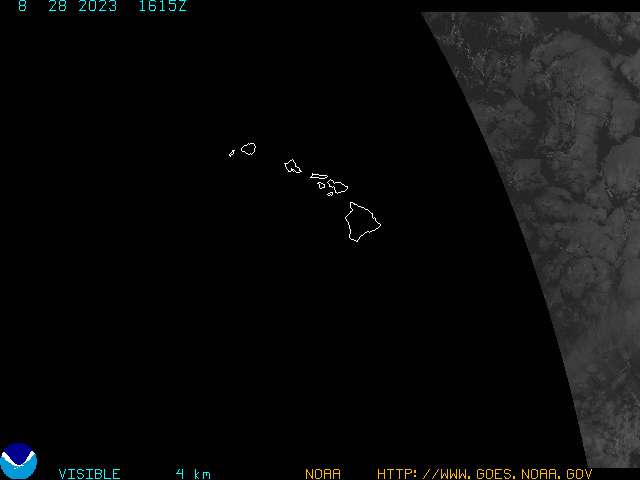
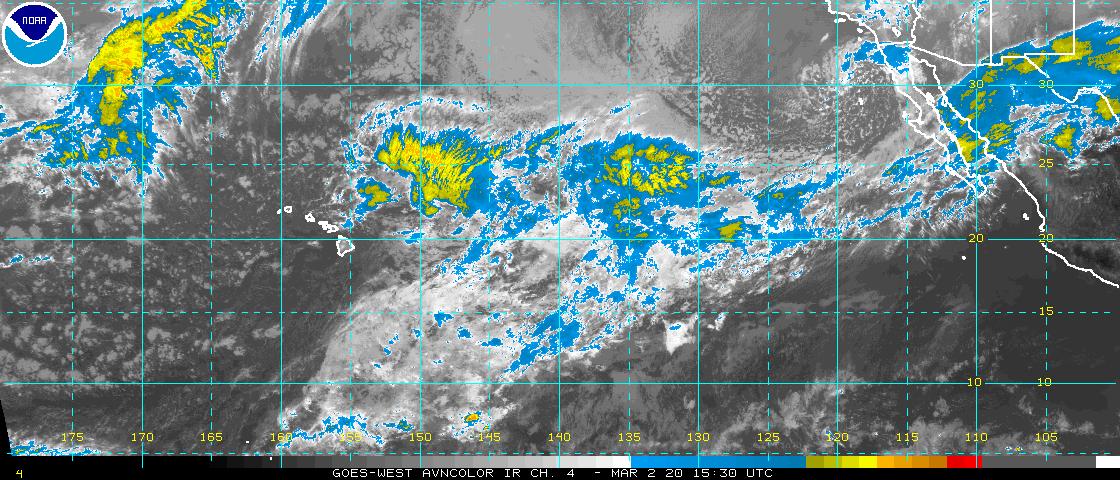
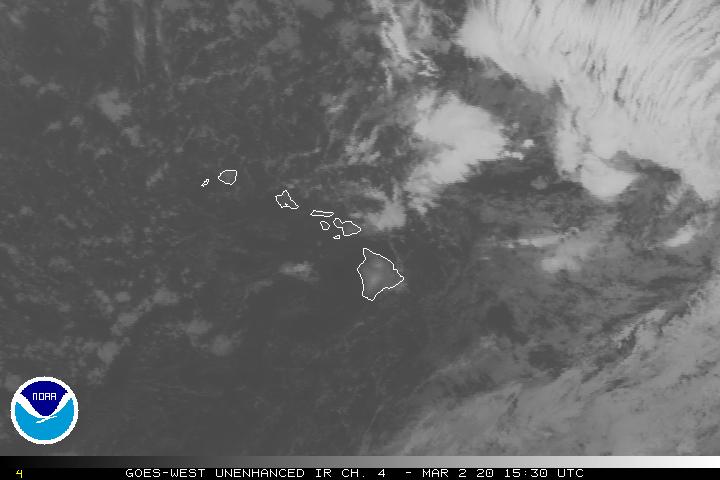
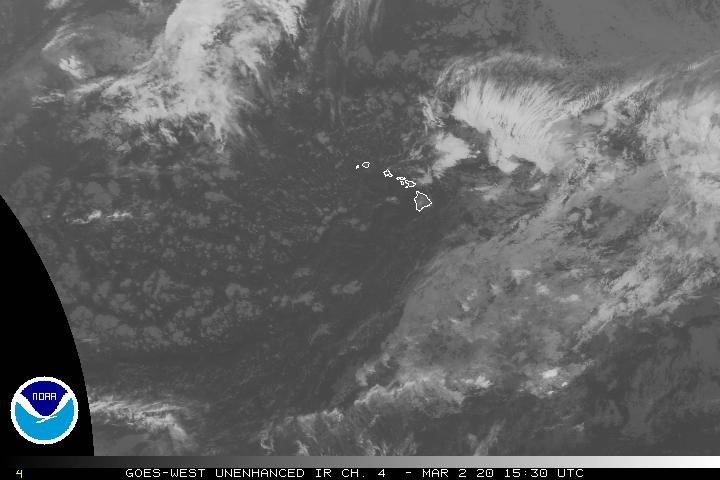
Satellite and Radar Images:To view the cloud conditions we have here in Hawaii, please use the following satellite links, starting off with thisInfrared Satellite Imageof the islands to see all the clouds around the state during the day and night. This next image is one that gives close images of the islands only during the daytime hours, and is referred to as aClose-up visible image. This next image showsa larger view of the Pacific…giving perspective to the wider ranging cloud patterns in the Pacific Ocean. Finally, here’s aLooping IR satellite image, making viewable the clouds around the islands 24 hours a day. To help you keep track of where any showers may be around the islands, here’s the latest animatedradar image.
Hawaii’s Mountains – Here’s a link to the live webcam on the summit of near 14,000 foot Mauna Kea on the Big Island of Hawaii. The tallest peak on the island of Maui is the Haleakala Crater, which is near 10,000 feet in elevation. These two webcams are available during the daylight hours here in the islands…and when there’s a big moon rising just after sunset for an hour or two! Plus, during the nights and early mornings you will be able to see stars, and the sunrise too…depending upon weather conditions. Tropical Cyclone activity in the eastern and central Pacific– Here’s the latest weather information coming out of theNational Hurricane Center, covering the eastern north Pacific. You can find the latest tropical cyclone information for the central north Pacific (where Hawaii is located) by clicking on this link to the Central Pacific Hurricane Center. Here’s atracking mapcovering both the eastern and central Pacific Ocean. A satellite image, which shows the entire ocean area between Hawaii and the Mexican coast…can be found here.
Aloha Paragraphs
Full moon & fireworks…Happy New Year Everyone!
A series of cold fronts will move towards, or into the state, during the next week.The main storm track in the Pacific Ocean, will remain quite far north of the islands however. This will generally limit the energy of these frontal cloud bands from having too much influence on our local weather conditions here in Hawaii. As has been the case during the last week, these cold fronts have tended to stall before reaching Kauai, or just bring a few showers to Kauai, and Oahu….for the most part. The overlying atmosphere remains fairly dry, which will also work against their dropping very much in the way of precipitation. I do notice, that the thin leading edge of this front has small pockets of heavier showers…making a quick pass overhead. You will see what I mean by clicking on the radar link just below.
The first of these cold fronts will push down through the islands soon over Kauai, and then into early Saturday…on the other islands.Here’s a looping radar image, showing this line of showers moving down the island.
The computer forecast models show another one coming in our direction over the weekend, with a third at some point early next week…perhaps early Tuesday. None of these are anything to worry about in terms of too much rainfall, nor anything to get excited about in terms of breaking the drought that we have going on now either. The forecast models suggest that perhaps later next week, we could finally get a wetter cold front.
Light to moderately strong Kona winds will remain in place ahead of this weakening cold front, with perhaps a brief period of slightly cooler north to northest breezes later Friday into early Saturday…before more light Kona winds return.During El Nino episodes, like we have now, we often see lighter than normal winds, as high pressure ridges are pushed southward over the islands. At the same time, these light winds typically bring hazy conditions to the islands…this haze often has the volcanic vents on the Big Island, as their source. Since we’re talking about El Nino, often we see examples where cold fronts lose their impetus before arriving, or stall as they try and enter the island chain. This in turn limits their rainfall potential, putting the state in a drought condition…as is now happening. One more common thread through this El Nino display is larger than normal surf, destined for our north and west facing shores.
As mentioned above, there appears to be more of the same in store, with off and on periods of volcanic haze, more weak cold fronts, and large to extra large surf for next week.It looks likely that our New Year’s Eve celebrations may have just enough breezes to help with ventilation, although there’s lots of volcanic haze around at the same time. We should see a brief spell of north to NE winds later Friday, perhaps helping to clear the hazy weather away a little. This won’t last long though, as more soft winds will return this weekend, with probably just enough of a southerly and southeasterly flow to bring the vog back by Sunday. This will be happening as a ridge drops down over or near us, prompted by the approach of the next weak cold front, which won’t produce much rainfall…and stall someplace between Kauai and Oahu again around early next Tuesday.
I’ve certainly been talking a lot about cold fronts lately, although they haven’t amounted to very much…that’s for sure! This is so typical of a winter influenced by El Nino. All the major storms remain far to the north of the islands, as shown on this weather map. All those storm and gale low pressure systems, are riding the polar jet stream winds, up around 45 and 50 degrees north latitude. The low pressure systems down here closer to the tropics are much weaker, as are their associated cold fronts. At the same time we have high pressure systems pushed down further south than normal too, which keeps our local winds light. At the same time, we have high pressure ridges anchored nearby, which often helps to draw volcanic haze up over parts of the island chain.
It’s almost Thursday evening here on Maui, as I begin writing the last section of today’s narrative.We have a lot going on now, what with the cold front, the gusty Kona winds, the vog, the blue full moon, and New Year’s Eve!
Here’s an IRsatellite imageof this cloud band. Here’s a much larger satellite image of the Pacific, showing the islands outlined in blue.~~~
I’m going out for my early evening walk now, but will be back a little later, likely having a nice celebration drink in hand, to add a few further thoughts then. In case this is your last read of the year, I hope you have a great, great New Year! Thanks so much for being one of the readers of this Hawaii Weather Today website! We’ll, it’s a little later in the evening now, and that totally huge full moon has risen over the flank of the Haleakala Crater…beaming in the window of my weather tower at the moment. I’m having a little to drink, and I must admit it feels good, well…it’s true. In my mind, New Years Eve is the ultimate date night, even if you’re by yourself! I’m gonna go find us another song, somethin’ to follow the Beatles, now that might not be so easy! I found a couple more things in the video realm, as the full moon once again catches my eye….out the window. Time to drink some water, excuse me for a few moments. I just got my hands on the photo from early this morning, showing the near full moon sliding into the West Maui Mountains…from right next door to where I live here in Kula. We’re going to lose the moon in a while, as the frontal clouds migrate down through the islands. I don’t know if I’m going to be staying up until midnight, it’s about 10pm, and I’m getting a little slowed down, a little tired, and thinking fondly about crawling under that warm down comforter. If I check out, no worries, I’ll meet you back here tomorrow, on New Year’s Day. Aloha for now…Glenn.
Extra:“Twenty years from now, you will be more disappointed by the things that you didn’t do, than by the ones you did do. So throw off the bowlines. Sail away from the safe harbor. Catch the trade winds in your sails. Explore. Dream. Discover.” —Mark Twain
We can’t leave out the basic truth here, in a song...don’t be afraid to turn it up now.
This is a fast moving cold front bringing showers through the islands now! The rains were over Oahu at the moment, a little after 9pm, falling where President Obama and his entourage are staying on the windward side.
>>>>>>>Interesting, up the mountain from here, people are firing off guns into the night, that certainly got my attention! I havn’t heard that sound in a long time.<<<<<<<<<
Interesting: In 2005, the journal Injury Prevention reported that New Year’s Day is more deadly for pedestrians than any other day of the year. From 1986 to 2002, 410 pedestrians were killed on New Year’s Day. Fifty-eight percent of those killed had high blood alcohol concentrations. Alcohol also plays a significant role in the deaths of pedestrians throughout the year, according to information from the Insurance Institute for Highway Safety.
In 2007, their research found that "37 percent of fatally injured pedestrians 16 and older had blood alcohol concentrations at or above 0.08 percent." Of those killed at night, 54 percent had high blood alcohol levels. During the period from July 2008 to June 2009, of the 86 patients ages 16 and older who were treated at Loyola after being struck by cars, 18 were found to have some level of alcohol in their system.
Of that number, 14 had blood alcohol concentrations at or above 0.08 percent, the legal definition for impaired driving in Illinois. "If they had been driving and were stopped by police, they would have been arrested for driving under the influence," Esposito said. Esposito added that the number doesn’t include the people who suffer injuries in their homes from unintentional causes and violence after drinking.
"It’s not just walking outside. All the time we see people who have been drinking that have fallen down the stairs or tripped at home and injured themselves. Others have decided to pick a fight using a knife or with someone holding a gun," Esposito said. If you drink and plan to walk on New Year’s Eve or any other day of the year, you have to take special care, Esposito said. Don’t wear dark clothing at night that can make it difficult for drivers to see you. Walk solely on the sidewalks and cross at designated crossings.
Also, it’s a good idea to walk in a group, which is easier for drivers to spot, and try to walk with at least one person who has not been drinking, a designated chaperone or escort. Drivers need to take extra care when in locations where people drink, such as areas with large numbers of bars, since intoxicated pedestrians have slower reflexes and can be unpredictable, Esposito said.
People throwing parties in which alcohol is consumed have an equal obligation to watch over their guests who are walking home as they do with the ones who may be driving. "You have to be able to assess someone’s perceived ability to safely get from one place to the other," Esposito said. "If their mode of transportation is a car, you do things to prevent them from driving.
If that mode of transportation is their legs, then you either drive them or make them stay at home." Even if a guest who is walking and who has been drinking is staying on the premises, you should be aware that they can trip and fall down the stairs, Esposito said. "So you don’t want to send them up to the second-story bedroom," Esposito said.
Interesting2:For many, celebrating the holidays calls for a champagne toast. But for some people popping a bottle of bubbly can be dangerous to your health. "Eye injuries from flying champagne corks, especially around the holidays, are fairly common," said Mark Melson, M.D., assistant professor of Ophthalmology and Visual Sciences at the Vanderbilt Eye Institute.
"Champagne is part of the holidays, but opening the bottles properly might save some folks a trip to the emergency room or a visit to their eye doctor. "It might be cool to have the cork pop and it’s exciting to have champagne gush from the bottle, but it’s not fun to suffer an eye injury that may prove to be devastating."
Melson, who specializes in oculoplastic reconstructive surgery and neuro-ophthalmology, said the pressure from a champagne cork can be up to 3 times more than the pressure in a car’s tire. And champagne or sparkling wine corks can travel at speeds up to 50-60 miles per hour.
"That is a lot of force to the eye," said Melson. "The damage can range from corneal abrasions to retinal detachment. The best advice if someone does suffer an eye injury is to seek medical attention immediately.
Do not manipulate the eye in any way." Those suffering from eye-related cork injuries might experience severe eye pain, discharge of fluid from the eye, loss of vision, flashes of light, floaters or specs in the eye as well as the feeling that a curtain or shadow is covering their vision.
Melson, along with the American Academy of Ophthalmology, suggests the following tips for proper champagne opening:
• Make sure the bottle of bubbly is chilled. If left warm the pressure is more likely to build.
• Don’t shake the bottle. This only increases the speed of the cork upon opening.
• Place a towel over the top of the bottle to provide an additional shield.
• Keep the bottle tilted at a 45-degree angle, pointing away from people.
• Hold the cork while twisting the bottle to break the seal. Keep your hand over the cork.
• Never use a corkscrew to open a bottle of champagne. It will only serve as a larger, more dangerous projectile.
"Often times, people have a delayed response because of impaired judgment," said Melson. "And if treated in an appropriate fashion, we can prevent vision loss and permanent eye damage. "I would recommend that people be as responsible as possible and just think about what you are doing before popping the cork. It’s one thing for the cork to hit the ceiling, but you can’t always control where that cork goes."
Interesting3: Research from the University of Reading suggests that two glasses of champagne a day may be good for your heart and circulation. The researchers have found that drinking champagne wine daily in moderate amounts causes improvements in the way blood vessels function. Champagne does this by increasing the availability of nitric oxide, a vascular active molecule which controls blood pressure. It is able to induce these effects because it contains polyphenols, plant chemicals from the red grapes and white grapes used in champagne production.
When you drink champagne, these polyphenols get absorbed into the circulation where they are able to act on the vascular system. Specifically, they appear to slow down the natural removal of nitric oxide from our blood, meaning that it will have a longer time to act on blood vessels and so improve the flow of blood around the body. High nitric oxide levels in the blood, as a result of drinking champagne, can have beneficial effects, because as well as increasing blood flow, it may help to decrease both blood pressure and the likelihood of blood clots forming.
This could therefore reduce the risks of suffering from cardiovascular disease and stroke, but more research needs to be done to determine the long term effects of daily champagne consumption. Dr Jeremy Spencer, from the Department of Food and Nutritional Sciences said: "Our research has shown that drinking around two glasses of champagne can have beneficial effects on the way blood vessels function, in a similar way to that observed with red wine. We always encourage a responsible approach to alcohol consumption, but the fact that drinking champagne has the potential to reduce the risks of suffering from cardiovascular diseases such as heart disease and stroke, is very exciting news."
Air Temperatures ranged between these warmest and coolest spots near sea level around the state – and on the highest mountains…at 5pm Wednesday evening:
Kapalua, Maui – 81F
Lihue, Kauai – 74
Haleakala Crater – 52 (near 10,000 feet on Maui)
Mauna Kea summit – 43 (near 14,000 feet on the Big Island)
Precipitation Totals–The following numbers represent the largest precipitation totals (inches) during the last 24 hours on each of the major islands, as of Wednesday afternoon: 1.08 Puu Lua, Kauai 1.04 Palehua, Oahu
0.00 Molokai
0.00 Lanai
0.00 Kahoolawe
0.00 Maui 0.00 Big Island
Marine Winds – Here’s the latest (automatically updated)weather mapshowing a 1027 millibar high pressure system to the northeast of the islands…with its associated ridge running southwest over the southern part of the island chain. Our winds will remain light from the south to southwest…gradually becoming light trade winds into Friday. Satellite and Radar Images:To view the cloud conditions we have here in Hawaii, please use the following satellite links, starting off with thisInfrared Satellite Imageof the islands to see all the clouds around the state during the day and night. This next image is one that gives close images of the islands only during the daytime hours, and is referred to as aClose-up visible image. This next image showsa larger view of the Pacific…giving perspective to the wider ranging cloud patterns in the Pacific Ocean. Finally, here’s aLooping IR satellite image, making viewable the clouds around the islands 24 hours a day. To help you keep track of where any showers may be around the islands, here’s the latest animatedradar image.
Hawaii’s Mountains – Here’s a link to the live webcam on the summit of near 14,000 foot Mauna Kea on the Big Island of Hawaii. The tallest peak on the island of Maui is the Haleakala Crater, which is near 10,000 feet in elevation. These two webcams are available during the daylight hours here in the islands…and when there’s a big moon rising just after sunset for an hour or two! Plus, during the nights and early mornings you will be able to see stars, and the sunrise too…depending upon weather conditions. Tropical Cyclone activity in the eastern and central Pacific– Here’s the latest weather information coming out of theNational Hurricane Center, covering the eastern north Pacific. You can find the latest tropical cyclone information for the central north Pacific (where Hawaii is located) by clicking on this link to the Central Pacific Hurricane Center. Here’s atracking mapcovering both the eastern and central Pacific Ocean. A satellite image, which shows the entire ocean area between Hawaii and the Mexican coast…can be found here.
Aloha Paragraphs
Hawaiian beauty…takes the cake!
The cold front stopped its forward motion, creeping to a halt just to the northwest of Kauai Wednesday.There has been a prefrontal area of clouds that reached out ahead of the front itself, bringing some minor showers to Oahu. Elsewhere, the southern islands have remained dry. Here’s a IRsatellite imageof this front, showing the prefrontal cloud band draped over Oahu. This same satellite picture shows the nearly clear skies out ahead of the frontal boundary, from Maui County down through the Big Island. The daytime heating of the islands caused some minor interior clouds to form during the afternoon. As has been the case recently, those clouds will evaporate quickly as the sun sets this evening. Here’s alooping radar imageto see where any showers are falling now.
As far as precipitation from this cold front is concerned, the lions share has fallen over Kauai and Oahu during the last 24 hours.The largest rainfall figure measured in at 1.08” as of late Wednesday afternoon, at a new USGS gauge called Puu Lua (on Kauai)…with the second greatest total from another new USGS gauge called Palehua (on Oahu)…with 1.04”. Continuing down the island chain, there wasn’t one speck of rainfall over the islands of Maui County, and the Big Island. An area of cold air, a low pressure trough, may spark a few heavier showers, pulled down from the leftover frontal moisture near Kauai late tonight…or over the water north of there early tomorrow morning.
In the wind department, there hasn’t been anything strong, certainly not anywhere near small craft advisory levels.As a matter of fact, the islands have remained in a field of light winds over the last several days. The trade winds have been taking a break for quite a while. During El Nino episodes, we often see lighter than normal winds, as high pressure ridges are pushed southward over the islands. At the same time, these light and variable winds typically help to bring hazy conditions to the islands…many times that haze has the volcanic vents on the Big Island as their origin. Since we’re talking about El Nino again, it would be prudent to mention that we often see examples where cold fronts lose steam before they arrive, or stall as they try and push through the island chain. This in turn limits their rainfall potential, putting the state in a drought condition…as is happening now. One more common thread through this El Nino display is larger than normal surf, destined for our north and west facing shores.
Looking into the future, there appears to be more of the same in store, with light winds and volcanic haze, more weak cold fronts, and large to extra large surf for next week.Rewinding for just a second, it looks very likely that our New Year’s Eve celebrations will be couched in haze and smoke, at least in some of those urban areas, where fireworks will be let off. We should see a very brief spell of easterly, or ENE trade winds on Friday, perhaps helping to clear the current bout of hazy weather away. This won’t last long though, as more soft winds will return this weekend, with probably just enough of a southerly and southeasterly flow to bring the vog back. This will be happening as a ridge drops down over or near us, prompted by the approach of the next weak cold front, which will likely not produce much rainfall…and stall someplace between Kauai and Oahu again around next Tuesday.
It’s early Wednesday evening here on Maui, as I begin writing the last section of today’s narrative.The islands of Kauai and Oahu had clouds today, while the rest of the state luxuriated in mostly clear and warm weather conditions! Here on Maui is was simply delicious, the weather couldn’t have been any better, as even the vog backed off some later in the day. Friday looks like another great day, the last full day of the year, of the decade for that matter! ~~~ If you had a chance to look outside last night, perhaps you saw that big, round, bright, near full moon out your window…if you missed it then, check it out tonight for sure. Right now, as I look out the window of my Kula weather tower, that thingis so bright, so large, it’s just out of this world! You may know that we have our second full moon of the month about to happen on New Year’s Eve night…what timing! As I’ve been mentioning lately, it’s referred to as a blue moon, due to its rarity.
~~~ It’s just before sunset now, and as was the case yesterday, I really want to see the sunset. So, I’m going to finish these last few lines very soon. I’ll be back very early Friday morning with your next new weather narrative. I hope you have a great Wednesday night until then! Aloha for now…Glenn.
Interesting: California scientists hope studying 180 black mussels pried from algae-covered rocks in San Francisco Bay will provide clues into how many drugs and chemicals are polluting waters across the nation. Mussels filter water and store contaminants in their tissue, providing a record of pollution in the environment.
The creatures are being culled from 80 sites in California as part of a pilot study by the National Oceanic and Atmospheric Administration to see how pervasive the substances have become. "We haven’t measured mussels for these compounds, so there’s not a lot of data," Dominic Gregorio, a senior environmental scientist with the State Water Resources Control Board, said.
"So this is really a first step to be proactive and get ahead of the curve on this." Regulators are concerned about an array of chemicals and pharmaceuticals — synthetic estrogen used in birth control pills, anti-bacterial agents in hand sanitizers and a flame retardant used on computers, furniture and cars — that can accumulate in the tissue of animals and people.
Recent studies found levels of PBDEs, or polybrominated diphenyl ethers, a flame retardant used in the manufacture of a wide range of consumer products, in waters off of every U.S. coast. The chemicals are being detected more often in surface water, state water quality officials said, but little data exists about how these substances negatively effect the health of humans and animals.
After conducting tests on the mussels, the data will help guide the study of emerging contaminants in other states, said Gunnar Lauenstein, program manager for NOAA’s Mussel Watch, which has tested mussels since 1986. Traces of PBDEs have also been found in human breast milk, aquatic birds and fish in North America, Europe and Asia, according to the U.S. Environmental Protection Agency. Until now NOAA’s Mussel Watch has tested the bivalves for pollutants like the pesticide DDT.
This pilot study could help guide regulators in determining what new pollutants in mussels should be regularly monitored. "What we’re trying to do now is focus on a newer generation of consumer products," Lauenstein said. The California mussels will also be tested for bisphenol A, or BPA, a chemical used to harden plastics and line the cans of baby formula and other foods.
Scientists are concerned that BPA exposure may harm reproductive systems and promote prostate and breast cancers, though the Centers of Disease Control and Prevention says human health effects of BPA exposure are still unknown. Gregorio said the data collected from around the state will include mussels from a wide range of areas including cities, agricultural regions and open spaces.
Interesting2:Coral reef fish can undergo a personality change in warmer water, according to an intriguing new study suggesting that climate change may make some species more aggressive. Experiments with two species of young damselfish on Australia’s Great Barrier Reef have shown for the first time that some reef fish are either consistently timid, or consistently bold, and that these individual differences are even more marked as water temperatures rise.
A slight lift of just one or two degrees may have only a small effect on some fish but the behavior of others can be transformed — leading them to become up to 30 times more active and aggressive.
"The idea that fish have personalities may seem surprising at first, but we now know that personality is common in animal populations, and that this phenomenon may have far-reaching implications for understanding how animals respond to ecological and environmental challenges," says Dr Peter Biro, of the UNSW School of Biological, Earth and Environmental Sciences, who led the study with colleagues Christa Beckmann and Judy A. Stamps. It is published in the journal Proceedings of the Royal Society B.
Interesting3:Here’s an opportunity to wisely spend some of the $100 billion that Secretary of State Hillary Clinton promised at Copenhagen to cut the greenhouse gases of developing nations by aiding in the development of renewable energy infrastructure to by-pass fossil fuel dependence. Apparently one in four Chinese cities and seven out of 10 counties are without sewage-treatment plants, according to the People’s Daily.
While there are many ways to treat sewage or municipal waste; one of the newest is the use of municipal solid waste to make renewable energy. Converting waste to energy is done in several ways. One is making bio-gas from sewage (human or animal) to run gas-turbine driven electric power plants.
Another is to create a biofuel, such as that used by nearly every vehicle in Sweden’s fifth largest city Linkoping. Greenhouse gas emissions there were reduced as much as 90% with the technology. It helped Sweden achieve a 9% below-Kyoto emissions cut with simultaneous 44% economic growth.
This presents an opportunity to kill two birds with one stone; by building the infrastructure in the developing world that uses municipal solid waste to make renewable energy. This would cut the greatest source of the rise expected in greenhouse gas emissions from fossil fuel use in the next decades: from fast-developing nations like India and China.
The developed world evolved water treatment technologies well before our knowledge of climate change drove us to invent uses for municipal solid waste as a source of renewable energy with no greenhouse gas emissions.
Interesting4:The US Geological Survey will use Recovery Act funding to improve its ability to monitor volcanoes and to predict their eruptions. Some of the funds will be used to modernize instrumentation and information systems to state-of-the-art, providing the necessary tools to communicate hazard information quickly to those who need it.
The United States and its territories contain 169 volcanoes considered capable of erupting. One, Kilauea in Hawaii, has been erupting continuously for the past 26 years, at times inundating residential areas with lava and at other times requiring national park closures due to explosions and toxic gas.
Another, Redoubt Volcano in Alaska, shot ash clouds to heights of more than 50,000 feet several times this year. The three-month long eruption appears to have paused and may have ended, but not before severely disrupting aviation operations, repeatedly dusting Alaskan communities with ash, and forcing an oil storage facility to suspend operations. Photo shows Mt Redoubt eruption.
Residents and critical infrastructure in the nation’s six highest-risk volcanic areas—including the Yellowstone region– will benefit from increased monitoring and analysis as a result of Recovery Act funds being channeled into volcano monitoring, Secretary Salazar announced today.
The U.S. Geological Survey is planning to use $15.2 million of its American Recovery and Reinvestment Act funds to upgrade volcano monitoring and the analysis and distribution of eruption information at the five volcano observatories that cover Wyoming, Alaska, Hawaii, the Northwest, California, as well as the network that covers the Commonwealth of the Northern Mariana Islands.
"These stimulus funds will not only create or preserve jobs, but also could very well preserve lives," said Secretary Salazar. "The funds help protect both people on the ground as well as airline passengers flying over the eruption-prone regions. At the same time that the funds are helping public safety, they are also spurring scientific innovation with economic benefits."
The Yellowstone Volcano Observatory in Wyoming, jointly operated by the USGS, Yellowstone National Park, and the University of Utah, will coordinate the expenditure of $950,000 in USGS recovery funds for two primary purposes: (1) upgrade seismic and other monitoring systems within Yellowstone National Park, and (2) create a variety of software tools, alarming capabilities and display systems for use by partners and collaborating state agencies.
Although the last volcanic eruption in Yellowstone was prehistoric, the Yellowstone volcano is the largest and perhaps most persistently restless volcano in the United States. Rock-hurling steam explosions are relatively frequent and the intense seismic activity around New Year’s 2009 highlighted flaws within the existing monitoring network as well as the extent of public concern about the Yellowstone Volcano.
Yellowstone National Park experienced an intense swarm of earthquakes around New Year’s Day that attracted concern nationwide. Work to be conducted with ARRA funds is divided into six projects, coinciding with the six high-risk volcanic areas in the United States.
In addition to $950,000 for Yellowstone, these allocations are $7.56 million for the Alaska Volcano Observatory, $2.4 million for the Cascades Volcano Observatory in Washington state, $3.3 million for the Hawaiian Volcano Observatory, $200,000 for the Long Valley Observatory in California and $800,000 for upgrading networks in the Commonwealth of the Northern Marianas.
Air Temperatures ranged between these warmest and coolest spots near sea level around the state – and on the highest mountains…at 5pm Tuesday evening:
Kapalua, Maui – 81F
Port Allen, Kauai – 75
Haleakala Crater – 50 (near 10,000 feet on Maui)
Mauna Kea summit – 43 (near 14,000 feet on the Big Island)
Precipitation Totals–The following numbers represent the largest precipitation totals (inches) during the last 24 hours on each of the major islands, as of Tuesday afternoon: 0.70 Puu Opae, Kauai 0.01 Waimanalo, Oahu
0.00 Molokai
0.00 Lanai
0.00 Kahoolawe
0.02 Puu Kukui, Maui
0.80 Pali 2, Big Island
Marine Winds – Here’s the latest (automatically updated)weather mapshowing a 1026 millibar high pressure system to the northeast of the islands. Our winds will remain light from the south to southwest…ahead of a stalling cold front, then light again on Thursday. Satellite and Radar Images:To view the cloud conditions we have here in Hawaii, please use the following satellite links, starting off with thisInfrared Satellite Imageof the islands to see all the clouds around the state during the day and night. This next image is one that gives close images of the islands only during the daytime hours, and is referred to as aClose-up visible image. This next image showsa larger view of the Pacific…giving perspective to the wider ranging cloud patterns in the Pacific Ocean. Finally, here’s aLooping IR satellite image, making viewable the clouds around the islands 24 hours a day. To help you keep track of where any showers may be around the islands, here’s the latest animatedradar image.
Hawaii’s Mountains – Here’s a link to the live webcam on the summit of near 14,000 foot Mauna Kea on the Big Island of Hawaii. The tallest peak on the island of Maui is the Haleakala Crater, which is near 10,000 feet in elevation. These two webcams are available during the daylight hours here in the islands…and when there’s a big moon rising just after sunset for an hour or two! Plus, during the nights and early mornings you will be able to see stars, and the sunrise too…depending upon weather conditions. Tropical Cyclone activity in the eastern and central Pacific– Here’s the latest weather information coming out of theNational Hurricane Center, covering the eastern north Pacific. You can find the latest tropical cyclone information for the central north Pacific (where Hawaii is located) by clicking on this link to the Central Pacific Hurricane Center. Here’s atracking mapcovering both the eastern and central Pacific Ocean. A satellite image, which shows the entire ocean area between Hawaii and the Mexican coast…can be found here.
Aloha Paragraphs
Hanauma Bay…where President Obama visited Tuesday
A weakening cold front will bring precipitation to Kauai and Oahu tonight into Wednesday, with the rest of the state remaining generally dry…with a few exceptions.Meanwhile, a ridge of high pressure is located over the central islands, and heading southward towards the Big Island. This ridge of high pressure, as shown on this weather map, will act as a possible shield to the showers, brought in by the cold front, in the southern part of the island chain. This weather map also shows this 60 mile wide approaching cold front, pushing southeast into the tropics…at about 20 mph. The parent storm for this cloud band is located to the north of Hawaii, moving away towards the northeast. The expectation is for this frontal boundary to arrive late Tuesday night over Kauai, and then sag down over Oahu into Wednesday…where it will probably come to a stop. Here’s a IRsatellite image, showing a prefrontal band of clouds over Kauai and Oahu, almost reaching Molokai. This evenlarger view, shows the cold front approaching from the northwest as well. Showers shouldn’t be heavy, but rather fall in the light to moderate heavy range. Further down the island chain, there will be a few showers, carried our way from the deeper tropics, on the south to southwest Kona breezes. Thislooping radar imagewill show us where these prefrontal showers are falling (around Kauai and Oahu, at the time of this writing), as well as the precipitation associated with the cold front…when it arrives too.
As far as winds go, they will remain light or a little stronger, generally from the south to southwest.These winds have remained light thus far, although as the cold front bears down on Kauai and Oahu, they will gain a little more strength. As the high pressure ridge remains anchored over the Big Island end of the state, that island and Maui will likely remain under a generally light wind flow. The one exception will be over the summits on the Big Island…which will be breezy. The southeast to southerly orientation of the breezes has carried volcanic haze up from the Big Island vents, to the smaller islands. Maui County has been hazy for days now, and this vog will prevail over Oahu and perhaps even Kauai as the cold front approaches.
This voggy reality will remain in place through New Year’s Eve, mixing with the smoke generated by fireworks.We should begin to see some relief as we get into New Year’s Day, as a quickly passing high pressure system, moving by to our north, will draw the high pressure ridge northward some. The hope is that it will migrate far enough north to bring back a short spell of light trade winds. This in turn would help to ventilate our hazy atmosphere Friday into at least part of Saturday. Then, the next cold front will be approaching, which will force the ridge back down over us, with more volcanic haze being drawn up over the island chain from the Big Island again. It appears that next week we will have another couple of cold fronts, with off and on bouts of light wind…and hazy weather.
It’s early Tuesday evening here on Maui, as I begin writing the last section of today’s narrative.The weather here in the islands responded to the approaching cold front Tuesday, pretty much as expected. As the looping radar image up the page shows, the prefrontal showers have been taking turns falling over both Kauai and Oahu. At the time of this writing, early Tuesday evening, they were generally in the Kauai channel between these two islands. As the cold front pushes closer, those showers will edge southeast over Oahu, at least likely. When the cold front itself arrives, it will bring both of those islands more showers. The rest of the state may see a few showers, but aren’t expected to see anything significant. As has been the case lately, the voggy weather prevails as we move into the sunset hour. ~~~ Speaking of sunset, I’m anxious to get out on my weather deck to take in the setting sun. There’s more clouds stretching into our area from the south and southwest now, but most of those will collapse as soon as the sun goes down. ~~~ The cold front isn’t the only thing bearing down on us now, that’s for sure! Yes, I’m referring to the New Year’s Eve celebrations…we’re getting close now. One of the things that will make it really even more special, will be the second full moon of the month, called the blue moon…which is already looking pretty full already! Plus, we have the President of the United States of America, and his family of course, spending this most exciting night of the year with us here in Hawaii! ~~~ Ok, that’s it, I’m out of here, or at least out on the deck now. I’ll meet you here dark and early Wednesday morning, with your next new weather narrative from paradise. I hope you have a great Tuesday night until then! Aloha for now…Glenn.
Extra2: Fleetwood Mac…Dreams
——> It’s almost New Year’s Eve! Extra3: The Cranberries…Dreams
Interesting: This month, conservationists in the Czech Republic and Kenya launched an audacious bid to save one of the world’s rarest animals: the northern white rhinoceros. Four of the last eight known northern whites in the world, two male and two female, were packed into wooden crates and sent from a Czech zoo to Kenya, where scientists hope they will get down to the business of breeding.
The rhinos arrived at Nairobi’s main airport at 3:30 a.m. on Dec. 19. Hamish Currie prowled the tarmac directing trucks, tractors and a giant crane as the animals came off the 747. "The trip went very well; they’re all relaxed," said Currie, who directs the Back to Africa program, which helps return zoo animals to the wild.
"But obviously we want to get them on the road as soon as possible and reduce their stress. So the trucks are waiting now and we’re going to load two onto a truck with a crane, fasten them down and get out of here." The rhinos were headed to the Ol Pejeta Conservancy near Mount Kenya to see if the climate and terrain will encourage them to breed.
Interesting2:Over the past decade, researchers have developed a variety of reliable real-time and archival instruments to study sounds made or heard by marine mammals and fish. These new sensors are now being used in research, management, and conservation projects around the world, with some very important practical results. Among them is improved monitoring of endangered North Atlantic right whales in an effort to reduce ship strikes, a leading cause of their deaths.
"The tools available to both acquire and analyze passive acoustic data have undergone a revolutionary change over the last ten years, and have substantially increased our ability to collect acoustic information and use it as a functional management tool," said Sofie Van Parijs, lead author and a bio-acoustician at NOAA’s Northeast Fisheries Science Center laboratory in Woods Hole, Mass.
"These tools have significantly improved monitoring of North Atlantic right whales and enhanced the efficacy of managing ship traffic to reduce ship strikes of whales through much of the western North Atlantic off the U.S. East Coast." Van Parijs is one of many researcher whose work is described this month in the journal Marine Ecology Progress Series. Her paper is one of about a dozen in a special theme issue focused on acoustics in marine ecology.
Van Parijs, who currently heads the NEFSC’s Protected Species Branch, is also a co-author of a related paper on acoustic interference or masking, in which marine animals alter their use of sound as a result of changing background noise. Van Parijs and her colleagues focus on two types of acoustic sensors, real-time and archival.
Real-time sensors are mounted on surface buoys, usually anchored or cabled to the ocean bottom, or deployed as arrays towed from a surface vessel. Archival sensors are affixed on bottom-moored buoys equipped with hydrophones to continuously record ocean sounds for long periods of time, often up to three months, before the sensors are temporarily recovered and their batteries refreshed.
Some archiving sensors can be mounted of individual animals. "Marine animals live their lives and communicate acoustically across different time and space scales and use sound for different reasons," said Van Parijs. "We need to use the right tool in the right place for the right need. There is no ‘one size fits all’ when it comes to using technology in the ocean." Large whales move and communicate over great distances, while smaller whales and dolphins tend to communicate over smaller areas.
Pinnipeds, the group of marine mammals that includes seals, walrus and sea lions, can breed on land, on ice or in the water, and move and communicate from small to medium distances. Human-produced sounds complicate the sensing problem by adding sounds to what can be a very noisy environment.
The use of passive acoustic monitoring is increasing as improved reliability and lower hardware and software costs provide researchers with a set of tools that can answer a broad range of scientific questions. This information can, in turn, be used in conservation management and mitigation efforts. While most of the new technologies have been applied in studies of whales and dolphins, the researchers say the sensors can also be used in studying pinnipeds, sirenians (manatees and dugongs), and fish.
Interesting3:The background lighting provided in a room has an influence on how we taste wine. This is the result of a survey conducted by researchers at the Institute of Psychology at Johannes Gutenberg University Mainz, Germany. Several sub-surveys were conducted in which about 500 participants were asked how they liked a particular wine and how much they would pay for it. It was found that the same wine was rated higher when exposed to red or blue ambient light rather than green or white light.
The test persons were even willing to spend in excess of one Euro more on a specific bottle of Riesling when it was offered in red instead of green light. "It is already known that the color of a drink can influence the way we taste it," says Dr Daniel Oberfeld-Twistel of the General Experimental Psychology division. "We wanted to know whether background lighting, for example in a restaurant, makes a difference as well."
The survey showed, among other things, that the test wine was perceived as being nearly 1.5 times sweeter in red light than in white or green light. Its fruitiness was also most highly rated in red light. Accordingly, one conclusion of the study is that the color of ambient lighting can influence how wine tastes, even when there is no direct effect on the color of the drink. "The extreme lighting conditions found in some bars can undoubtedly influence the way a wine tastes," concludes Oberfeld-Twistel.
He also recommends that serious wine tasting should be conducted in a neutral light color environment. Perhaps a partial explanation of why lighting influences the way we taste wine is that in what we perceive to be pleasant lighting conditions, we also regard the wine as being more pleasant too. Additional research is planned to provide further insight into this fascinating phenomenon.
Interesting4:Using disinfectants could cause bacteria to become resistant to antibiotics as well as the disinfectant itself, according to research published in the January issue of Microbiology. The findings could have important implications for how the spread of infection is managed in hospital settings.
Researchers from the National University of Ireland in Galway found that by adding increasing amounts of disinfectant to laboratory cultures of Pseudomonas aeruginosa, the bacteria could adapt to survive not only the disinfectant but also ciprofloxacin — a commonly-prescribed antibiotic — even without being exposed to it.
The researchers showed that the bacteria had adapted to more efficiently pump out antimicrobial agents (disinfectant and antibiotic) from the bacterial cell. The adapted bacteria also had a mutation in their DNA that allowed them to resist ciprofloxacin-type antibiotics specifically. P. aeruginosa is an opportunistic bacterium that can cause a wide range of infections in people with weak immune systems and those with diseases such as cystic fibrosis (CF) and diabetes. P. aeruginosa is an important cause of hospital-acquired infections.
Disinfectants are used to kill bacteria on surfaces to prevent their spread. If the bacteria manage to survive and go on to infect patients, antibiotics are used to treat them. Bacteria that can resist both these control points may be a serious threat to hospital patients. Importantly, the study showed that when very small non-lethal amounts of disinfectant were added to the bacteria in culture, the adapted bacteria were more likely to survive compared to the non-adapted bacteria.
Dr. Gerard Fleming, who led the study, said, "In principle this means that residue from incorrectly diluted disinfectants left on hospital surfaces could promote the growth of antibiotic-resistant bacteria. What is more worrying is that bacteria seem to be able to adapt to resist antibiotics without even being exposed to them."
Dr. Fleming also stressed the importance of studying the environmental factors that might promote antibiotic resistance. "We need to investigate the effects of using more than one type of disinfectant on promoting antibiotic-resistant strains. This will increase the effectiveness of both our first and second lines of defense against hospital-acquired infections," he said.
Interesting5:There is increased evidence that the Arctic could face seasonally ice-free conditions and much warmer temperatures in the future. This has happened before. Scientists have documented evidence that the Arctic Ocean and Nordic Seas were too warm to support summer sea ice during the mid-Pliocene warm period (3.3 to 3 million years ago). This period is characterized by warm temperatures similar to those projected for the end of this century, and is used to help understand future conditions.
The US Geological Survey (USGS) has found that summer sea surface temperatures in the Arctic were between 50 to 64°F during the mid-Pliocene, while current temperatures are around 32°F. The Pliocene is a time period 2.5 to 5 million years before the present year. The Arctic Ocean is of particular interest because in this region climate models struggle to predict climate sensitivity and the response of sea ice.
In order to provide the first quantitative climate data from this region during this period, sea surface temperatures were estimated from several ocean drilling sites. Evidence of much warmer than modern conditions in the Arctic Ocean during this time frame with temperatures as high as 65F was found. Examining past climate conditions will allow for a true understanding of how Earth’s climate system really functions.
Loss of sea ice could have varied and the consequences will have varied considerably. As examples rain fall patters would have been far different. Some deserts would have bloomed and some grass lands would have become deserts. "In looking back 3 million years, we see a very different pattern of heat distribution than today with much warmer waters in the high latitudes,” said USGS scientist Marci Robinson.
"The lack of summer sea ice during the mid Pliocene suggests that the record setting melting of Arctic sea ice over the past few years could be an early warning of more significant changes to come." Global average surface temperatures during the mid-Pliocene were about 5.5°F greater than today and within the range projected for the 21st century. So our present global temperatures are not as hot as they once were.
The world has been here before. Scientists have also studied conditions during the mid-Pliocene by analyzing fossils dated back to this time period. An acknowledgment of past animal and plant life will help understand and confirm how climate has changed in particular global locations. This plus continued scientific investigation will help a greater understanding of how climate has already changed over millions of years.
Air Temperatures ranged between these warmest and coolest spots near sea level around the state – and on the highest mountains…at 5pm Monday evening:
Barking Sands, Kauai – 81F
Molokai airport – 76
Haleakala Crater – 52 (near 10,000 feet on Maui)
Mauna Kea summit – 43 (near 14,000 feet on the Big Island)
Precipitation Totals–The following numbers represent the largest precipitation totals (inches) during the last 24 hours on each of the major islands, as of Monday afternoon: 0.01 Wainiha, Kauai 0.02 Waimanalo, Oahu
0.00 Molokai
0.00 Lanai
0.00 Kahoolawe 0.05 West Wailuaiki, Maui 0.01 Pahoa, Big Island
Marine Winds – Here’s the latest (automatically updated)weather mapshowing a 1023 millibar high pressure system to the northeast of the islands. Our winds will remain light from the southeast…gradually becoming south to southwest ahead of a stalling cold front. Satellite and Radar Images:To view the cloud conditions we have here in Hawaii, please use the following satellite links, starting off with thisInfrared Satellite Imageof the islands to see all the clouds around the state during the day and night. This next image is one that gives close images of the islands only during the daytime hours, and is referred to as aClose-up visible image. This next image showsa larger view of the Pacific…giving perspective to the wider ranging cloud patterns in the Pacific Ocean. Finally, here’s aLooping IR satellite image, making viewable the clouds around the islands 24 hours a day. To help you keep track of where any showers may be around the islands, here’s the latest animatedradar image.
Hawaii’s Mountains – Here’s a link to the live webcam on the summit of near 14,000 foot Mauna Kea on the Big Island of Hawaii. The tallest peak on the island of Maui is the Haleakala Crater, which is near 10,000 feet in elevation. These two webcams are available during the daylight hours here in the islands…and when there’s a big moon rising just after sunset for an hour or two! Plus, during the nights and early mornings you will be able to see stars, and the sunrise too…depending upon weather conditions. Tropical Cyclone activity in the eastern and central Pacific– Here’s the latest weather information coming out of theNational Hurricane Center, covering the eastern north Pacific. You can find the latest tropical cyclone information for the central north Pacific (where Hawaii is located) by clicking on this link to the Central Pacific Hurricane Center. Here’s atracking mapcovering both the eastern and central Pacific Ocean. A satellite image, which shows the entire ocean area between Hawaii and the Mexican coast…can be found here.
Aloha Paragraphs
Kailua Beach…Oahu
Dry to very dry weather has been the case lately, with little change expected for the moment.An atmospheric stabilizing ridge of high pressure is nearby Monday evening, meaning that whatever few clouds that are around, will be shallow. Thin low level clouds are usually very light precipitation producers…at best. Thus, rainfall totals lately have been extremely low, with most areas remaining totally dry. Getting back to that ridge of high pressure, here’s aweather mapshowing where it sits early Monday evening…over Kauai. This weather map also shows an approaching cold front, draping southward into the tropics. The parent storms for this cloud band are located far north of Hawaii, towards the Gulf of Alaska. The latest computer forecast models don’t show this front getting into the state, although it will get close enough…that the ridge will be pushed down towards the Big Island Tuesday.Here’s an IRsatellite image, showing the cloud band to our north, with a few thunderstorms firing-off along it’s generally east to west oriented length. This evenlarger view, shows this cold front, along with another low, and it’s associated cold front, which is expected to bring some showers to the state later Tuesday into Wednesday. There’s some chance that southerly or even southwesterly Kona breezes may carry some showers to our leeward sides later Tuesday…in other words prefrontal showers.
As far as winds go, they will remain light, generally from the southeast …gradually turning around to the south and southwest.The location of the high pressure ridge will determine which direction these light breezes blow. As the ridge was over Kauai at the time of this writing, our winds were coming up from the southeast generally, lightest near Kauai. To the south of the ridge, as we get down to Maui County and the Big Island, the ridge’s influence will be less. There were gusts to 30 mph on Kahoolawe, and South Point, on the Big Island…which have direct exposure to the incoming SE winds. As the cold front gets closer, the one arriving Wednesday, it will push the ridge down further into the state.
This in turn will allow breezes to strengthen a bit over Kauai and Oahu, taking on a southwest orientation.The models suggest that as the cold front dissipates over the central Islands later Wednesday, there won’t be any new high pressure system moving into place to our northwest. This will keep our winds light, and variable in direction Thursday into early Friday. Light winds aren’t the best of things, in terms of ventilating the fireworks smoke, thus the potentially hazy reality slated for New Year’s Eve. Southerly winds forecast for this coming weekend, may help to clear our air, before more southeast winds kick in, with more possible vog…before the next cold front in line approaches early next week. It’s still too early to know exactly how strong, or how far into the state that cold front will penetrate. El Nino is helping to keep these fronts on the dry side, and limit their southern push.
It’s Monday evening here on Maui, as I begin writing the last section of today’s narrative.The volcanic haze (vog) is the main story Monday evening, as it has become quite thick over some parts of the island chain. Here on Maui, a little before sunset, it’s very obvious to the most casual observer. I can still see the West Maui Mountains, from here in Kula…but not well. The clouds that surrounded the islands during the afternoon hours, at least in some places, are collapsing and disappearing quickly, as we approach sunset. There has been the most minimum amount of showers falling, that our dry period contines. We should begin to see some increasing showers, although likely not all that many, over the next few days. ~~~ It’s just before 6pm Monday evening, as I write these last few sentences. I finished a book called The Crossing, written by Cormac McCarthy, which exhibited the classical dark side of life, as Mr. McCarthy is famous for. You may remember that he was the author of No Country for Old Men, which became the #1 film of 2008, when it was put to film. If any of you had the opportunity to see that great film, you know that it was dark and intense…but oh so well done! ~~~ I’m about to get out there for my early evening walk now, although will return early Tuesday morning with your next new weather narrative from paradise. By the way, the picture up this page, of Kailua, Oahu, happens to be where President Obama and his family are staying now. The weather has been fine for their vacation so far, but may slip half a notch later Tuesday into Wednesday…as the next cold front pushes down into the state then. Aloha for now…Glenn.
Interesting:Earth’s various ecosystems, with all their plants and animals, will need to shift about a quarter-mile per year on average to keep pace with global climate change. How well particular species can survive rising worldwide temperatures attributed to excess levels of heat-trapping "greenhouse" gases emitted by human activity hinges on those species’ ability to migrate or adapt in place.
The farther individual species — from shrubs and trees to insects, birds and mammals — need to move to stay within their preferred climate, the greater their chance of extinction. The study suggests that scientists and governments should update habitat conservation strategies that have long emphasized drawing boundaries around environmentally sensitive areas and restricting development within those borders.
A more "dynamic" focus should be placed on establishing wildlife corridors and pathways linking fragmented habitats, said research co-author Healy Hamilton of the California Academy of Sciences. "Things are on the move, faster than we anticipated," she told Reuters.
"This rate of projected climate change is just about the same as a slow-motion meteorite in terms of the speed at which it’s asking a species to respond." The new research suggests that denizens of mountainous habitats will experience the slowest rates of climate change because they can track relatively large swings in temperature by moving just a short distance up or down slope.
Interesting2:Despite near instantaneous condemnation of his role in the culmination of the COP15 climate negotiations last week, president Obama voiced his frustration over the course those negotiations took and accord that resulted from them. Speaking with Jim Lehrer, president Obama said that "people are justified in being disappointed about the outcome in Copenhagen."
Lehrer asked about comments Obama made that Copenhagen "was a success anyhow," despite the tepid nature of the accord. President Obama responded: What—what did occur was that at a point where there was about to be complete breakdown, and the prime minister of India was heading to the airport and the Chinese representatives were essentially skipping negotiations, and everybody’s screaming, what did happen was cooler heads prevailed.
So that—that was an important principle, that everybody’s got to do something in order to solve this problem. But I make no claims, and didn’t make any claims going in, that somehow that was going to be everything that we needed to do to solve climate change. And—and my main responsibility here is to convince the American people that it is smart economics and it is going to be the engine of our economic growth for us to be a leader in clean energy.
And if we pass a bill in the Senate, reconcile it with the House, that says we are going to invest in wind energy and solar energy and we’re going to be the guys who are producing wind turbines, and we’re going to be the folks who are producing solar panels on rooftops, and we’re going to be the country that is retrofitting all its homes and businesses so that we are 30 percent more energy efficient than we are right now, that produces jobs that can’t be exported; it reduces our dependence on foreign oil; it is good economics; it will increase our exports—oh, and by the way, it also solves the climate problem.
And that is, I think, an argument that I’m going to be making not just next year, but for several years to come. What I said was essentially that rather than see a complete collapse in Copenhagen, in which nothing at all got done and would have been a huge backward step, at least we kind of held ground and there wasn’t too much backsliding from where we were.
Interesting3:Are hybrid cars still considered niche, or even — dare we say — "luxury" purchases? The failure of the lower-cost Honda Insight hybrid to dent the market for the Prius has some in the auto industry answering yes. Business Week reports that the Insight, which was introduced this year with a base MSRP of $19,800, over $2,000 less than the Prius, is still being outsold by Toyota’s car 6 to 1.
The Insight’s sluggish sales is proving a useful cautionary tale to other automakers looking to catch up to Toyota in the hybrid market, and some have already made major strategic shifts as a result. General Motors, which will introduce the Volt late next year through its Chevy brand, has scrapped plans for a "Prius-killer" hybrid sedan that would get 53 miles to the gallon.
Part of the reason, no doubt, is that the beleaguered car company needs to focus its energies on making the Volt successful. But the other big reason is Prius’ merciless crushing of the Insight. Rich Liberal Elitists Driving Fancy Hybrid Cars. The Insight, which is based on the Honda Fit subcompact body, was meant to be a low-budget hybrid, a car for a market segment that may not exist.
Honda hoped to sell 40,000 Insights this year, but now admits it will fall far short of that goal. From the Business Week article. It’s not clear that the Insight will ever seriously challenge the Prius because Honda has overlooked a lesson Toyota learned years ago: Hybrids aren’t a budget purchase.
According to Business Week, many Prius owners make more than $100,000 a year. The 3rd generation Prius, which went on sale this year, features a bigger, more powerful engine, more passenger space, and "Lexus" touches. Not to mention egregiously expensive — yet environmentally snazzy — options like a solar powered roof ($3,600).
Interesting4:The University of Alabama at Birmingham (UAB) has published an important research paper that shows a clear link between calorie intake and the lifespan of human cells. Researchers from the have discovered that restricting consumption of glucose, the most common dietary sugar, can extend the life of healthy human-lung cells and speed the death of precancerous human-lung cells, reducing cancer’s spread and growth rate.
The research has wide-ranging potential in age-related science, including ways in which calorie-intake restriction can benefit longevity and help prevent diseases like cancer that have been linked to aging, said principal investigator Trygve Tollefsbol, Ph.D., D.O., a professor in the Department of Biology. "These results further verify the potential health benefits of controlling calorie intake," Tollefsbol said.
"Our research indicates that calorie reduction extends the lifespan of healthy human cells and aids the body’s natural ability to kill off cancer-forming cells." The UAB team conducted its tests by growing both healthy human-lung cells and precancerous human-lung cells in laboratory flasks. The flasks were provided either normal levels of glucose or significantly reduced amounts of the sugar compound, and the cells then were allowed to grow for a period of weeks.
"In that time, we were able to track the cells’ ability to divide while also monitoring the number of surviving cells. The pattern that was revealed to us showed that restricted glucose levels led the healthy cells to grow longer than is typical and caused the precancerous cells to die off in large numbers," Tollefsbol said. In particular, the researchers found that two key genes were affected in the cellular response to decreased glucose consumption.
The first gene, telomerase, encodes an important enzyme that allows cells to divide indefinitely. The second gene, p16, encodes a well known anti-cancer protein. "Opposite effects were found for these genes in healthy cells versus precancerous cells. The healthy cells saw their telomerase rise and p16 decrease, which would explain the boost in healthy cell growth," Tollefsbol said.
"The gene reactions flipped in the precancerous cells with telomerase decreasing and the anti-cancer protein p16 increasing, which would explain why these cancer-forming cells died off in large numbers." The UAB research into the links between calorie intake, aging and the onset of diseases related to aging is thought to be a first of its kind given that it used the unique approach of testing human cells versus laboratory animals.
Interesting5:Middle Eastern and North African countries, often referred to under the umbrella term MENA countries, have the potential to create more than 3 times the world’s power needs, according to a new study reported in the Dubai-based Khaleej Times. Countries that move fast, the study suggests, could have the competitive advantage. Who could take the lead: MENA countries, especially ones located on the Arabian Peninsula, as well as others like Jordan, Lebanon, and Israel could be.
These countries are no strangers to the notion of solar energy, and Green Prophet has covered countless articles touting solar energy in the Middle East. One of the region’s leading solar energy development countries, Israel, has even been asked by the UN to increase its development of solar energy.
Despite being an instrumental innovator through companies such as BrightSource or Solel, Israel’s own use of solar power at home more closely resembles that of a developing nation. The Khaleej Times article pointed out that countries in the MENA region have the "greatest potential for solar regeneration" supplying 45% of the world’s energy sources possible through renewable energy.
Renewable energy sources of interest in this region include Abu Dhabi’s Masdar City as well as its hosting of the World Renewable Energy Agency headquarters . Known as IRENA, this center could fuel development in the whole region. A big problem, however, is under-funding of renewable energy projects, due to a big abundance of oil and other fossil fuels, says Beirut based Ibrahim El Hussenei, a partner in the London based energy project development company, Booz & Company whose representatives were present at the COP 15 Climate Change Conference in Copenhagen.
Interesting6:Alaska’s Mount Redoubt volcano is rumbling again. The Alaska Volcano Observatory says a series of small earthquakes began occurring around the summit of the volcano Sunday and continued Monday.
As a result, scientists have upgraded the volcano’s alert status. Redoubt, about 105 miles southwest of Anchorage, went through an eruptive period that led to major explosions earlier this year, including one that dusted Anchorage with ash fall.
The erupting volcano forced the Cook Inlet Pipeline Co. to remove millions of gallons of oil stored at the Drift River Terminal 22 miles away. Hundreds of airline flights also had to be canceled because of ash clouds this spring. The last time Mount Redoubt had a similar period of activity was in late 1989 to spring 1990.
Air Temperatures ranged between these warmest and coolest spots near sea level around the state – and on the highest mountains…at 5pm Sunday evening:
Princeville, Kauai – 81F
Lihue, Kauai – 75
Haleakala Crater – 55 (near 10,000 feet on Maui)
Mauna Kea summit – 39 (near 14,000 feet on the Big Island)
Precipitation Totals–The following numbers represent the largest precipitation totals (inches) during the last 24 hours on each of the major islands, as of Sunday morning: 0.03 Omao, Kauai 0.01 Waimanalo, Oahu
0.00 Molokai
0.00 Lanai
0.00 Kahoolawe
0.00 Maui
0.00 Big Island
Marine Winds – Here’s the latest (automatically updated)weather mapshowing a 1024 millibar high pressure system to the northeast of the islands. Our winds will remain light from the east and southeast through Tuesday. Satellite and Radar Images:To view the cloud conditions we have here in Hawaii, please use the following satellite links, starting off with thisInfrared Satellite Imageof the islands to see all the clouds around the state during the day and night. This next image is one that gives close images of the islands only during the daytime hours, and is referred to as aClose-up visible image. This next image showsa larger view of the Pacific…giving perspective to the wider ranging cloud patterns in the Pacific Ocean. Finally, here’s aLooping IR satellite image, making viewable the clouds around the islands 24 hours a day. To help you keep track of where any showers may be around the islands, here’s the latest animatedradar image.
Hawaii’s Mountains – Here’s a link to the live webcam on the summit of near 14,000 foot Mauna Kea on the Big Island of Hawaii. The tallest peak on the island of Maui is the Haleakala Crater, which is near 10,000 feet in elevation. These two webcams are available during the daylight hours here in the islands…and when there’s a big moon rising just after sunset for an hour or two! Plus, during the nights and early mornings you will be able to see stars, and the sunrise too…depending upon weather conditions. Tropical Cyclone activity in the eastern and central Pacific– Here’s the latest weather information coming out of theNational Hurricane Center, covering the eastern north Pacific. You can find the latest tropical cyclone information for the central north Pacific (where Hawaii is located) by clicking on this link to the Central Pacific Hurricane Center. Here’s atracking mapcovering both the eastern and central Pacific Ocean. A satellite image, which shows the entire ocean area between Hawaii and the Mexican coast…can be found here.
Aloha Paragraphs
Perfect Hawaiian weather
Weather here in the islands will be nice…through the first couple of days of the new work week ahead. We’ll find generally clear skies, punctuated by some cloudy periods locally. These few clouds will gather here and there, although with the overlying atmosphere being dry and stable…hardly any showers will fall. The air visibilities will become less clear and hazy over the next few days. The next major change in our local weather will arrive around the middle of the new week, when the next cold front brings showers to some parts of our islands then. The breezes will be light southeast to east…lasting for a few days. As these southeast breezes occur, we’ll see volcanic haze being carried up over some parts of the island chain…from the volcanic vents down on the Big Island. Southeast breezes also put the smaller islands, from Maui to Kauai, in the wind shadow of the Big Island. As this light wind convective pattern continues, we often become, as noted, hazy, along with clear mornings giving way to some localized clouds, with just a few minor showers…if any at all.
It’s Sunday evening here on Maui, as I begin writing this last section of today’s narrative.As noted above, our weather is near perfect, with light winds and clear skies prevailing in most areas. There’s a bit of volcanic haze around locally, but it hasn’t gotten to be thick at this point…not that it might not become that way. Otherwise, there’s been a distinct lack of clouds, with hardly any showers falling anywhere. I expect more of the same as we begin our new work week. ~~~ A friend of mine gave me a single pint bottle of what’s called Hop Trip, which is described as a fresh hop pale ale. It’s from the Deschutes Brewery in Oregon, on the label it reads: "Obsessive longing and flawless execution converge. We wait restlessly all year for the hop harvest celebration. Our one chance to capture the bright citrus and pine essence of fresh hops. Hop driver and brewer synchronize their timepieces. Vine to kettle in less than four hours. Enjoy." I like the taste, and at 5.5% alcohol, it isn’t too strong to drink comfortably. ~~~ Looking out from my deck here in Kula, I see no clouds in any direction. There’s not a breath of air moving either. The sun is so warm and pleasant, making for such a very nice early evening. I’m looking forward to moving through the rest of this year, what with New Year’s Eve coming up, along with a Blue Moon (the second full moon of the month) that same night, it should be special. Today I stayed home and read quite a bit, washed my car, did my laundry, while listening to classical music, generally of Bach and Vivaldi, among others. I needed to pull back a little, as I’ve been go, go, go lately. I’ll meet you here early Monday morning, with your next new weather narrative. I hope you have a great Sunday night! Aloha for now…Glenn.
Air Temperatures ranged between these warmest and coolest spots near sea level around the state – and on the highest mountains…at 5pm Saturday evening:
Port Allen, Kauai – 81F
Lihue, Kauai – 76
Haleakala Crater – 55 (near 10,000 feet on Maui)
Mauna Kea summit – 41 (near 14,000 feet on the Big Island)
Precipitation Totals–The following numbers represent the largest precipitation totals (inches) during the last 24 hours on each of the major islands, as of Saturday afternoon: 0.57 Mount Waialaele, Kauai 0.18 Oahu Forest NWR, Oahu
0.00 Molokai
0.00 Lanai
0.00 Kahoolawe
0.00 Maui
0.00 Big Island
Marine Winds – Here’s the latest (automatically updated)weather mapshowing a weak 1022 millibar high pressure system to the east-northeast of the islands. Our winds will become lighter from the southeast through Monday. Satellite and Radar Images:To view the cloud conditions we have here in Hawaii, please use the following satellite links, starting off with thisInfrared Satellite Imageof the islands to see all the clouds around the state during the day and night. This next image is one that gives close images of the islands only during the daytime hours, and is referred to as aClose-up visible image. This next image showsa larger view of the Pacific…giving perspective to the wider ranging cloud patterns in the Pacific Ocean. Finally, here’s aLooping IR satellite image, making viewable the clouds around the islands 24 hours a day. To help you keep track of where any showers may be around the islands, here’s the latest animatedradar image.
Hawaii’s Mountains – Here’s a link to the live webcam on the summit of near 14,000 foot Mauna Kea on the Big Island of Hawaii. The tallest peak on the island of Maui is the Haleakala Crater, which is near 10,000 feet in elevation. These two webcams are available during the daylight hours here in the islands…and when there’s a big moon rising just after sunset for an hour or two! Plus, during the nights and early mornings you will be able to see stars, and the sunrise too…depending upon weather conditions. Tropical Cyclone activity in the eastern and central Pacific– Here’s the latest weather information coming out of theNational Hurricane Center, covering the eastern north Pacific. You can find the latest tropical cyclone information for the central north Pacific (where Hawaii is located) by clicking on this link to the Central Pacific Hurricane Center. Here’s atracking mapcovering both the eastern and central Pacific Ocean. A satellite image, which shows the entire ocean area between Hawaii and the Mexican coast…can be found here.
Aloha Paragraphs
Lovely weather in Hawaii!
Weather here in the islands will be nice Sunday…through the first couple of days of the new work week ahead. We’ll find generally clear skies, punctuated by some cloudy periods during the afternoons locally. These few clouds will gather over and around the mountains, although with the overlying atmosphere being dry and stable…hardly any showers will fall. The air visibilities will be fine for the moment, although will become less clear and hazy over the next few days. The next major change in our local weather will arrive around the middle of the new week, when the next cold front brings showers to some parts of our islands then. The breezes will be light southeast Sunday onwards…for a few days. As these southeast breezes occur, we’ll see volcanic haze being carried up over some parts of the island chain…from the volcanic vents down on the Big Island. Southeast breezes also put the smaller islands, from Maui to Kauai, in the wind shadow of the Big Island. As this light wind convective pattern develops, we often become, as noted, hazy, along with clear mornings giving way to some afternoon clouds over and around the mountains, with just a few minor showers…if any at all.
It’s Saturday evening here on Maui, as I begin writing this last section of today’s narrative.Saturday was another really nice day, just like Christmas Day was. These favorably inclined weather conditions will hold firm through the next several days. Since we are involved with El Nino conditions, cold fronts will continue to approach, but most of them have, and likely will continue…to stall before arriving. Those that are a little stronger will push into the state, but not often bring that much rainfall. The next one, on Monday, will pass us by, with the next one likely not reaching Kauai either on Wednesday. The southwest Kona breezes might be able to bring up some showers from the deeper tropics preceding that frontal boundary. These showers would likely fall along our south and west facing leeward sides around mid-week, coming up. ~~~ I had a great day, having breakfast with my neighbors, before we all headed down to Baldwin Beach, to soak up a few rays. There was no lack of sunshine, that’s for sure! I jumped in the ocean, and it felt wonderful, as it always does. I’m sipping on a small glass of red wine as I write these words, let me go down and get the bottle, so I can share it with you. I wish I could pour you a glass, if you were old enough that is, smile! It’s a 2006 Goldeneye, a great Pinot Noir, from Anderson Valley, Philo, California…in Mendecino County. Meanwhile, I’m listening to pandora.com on the internet, the current song is Foolish Heart, by Steve Perry. My neighbors have invited me for dinner, so I’ll be heading over there after finishing these last few sentences. I hope you had a wonderful Saturday, either here on the islands, or elsewhere! I’ll be back Sunday morning with your next new weather narrative from paradise. Aloha for now…Glenn.
Air Temperatures ranged between these warmest and coolest spots near sea level around the state – and on the highest mountains…at 6am Friday morning:
Poipu, Kauai – 72F
Kahului, Maui – 61
Haleakala Crater – 46 (near 10,000 feet on Maui)
Mauna Kea summit – 36 (near 14,000 feet on the Big Island)
Precipitation Totals–The following numbers represent the largest precipitation totals (inches) during the last 24 hours on each of the major islands, as of Friday morning: 2.25 Wainiha, Kauai
4.96 Oahu Forest NWR, Oahu
0.20 Molokai
0.00 Lanai
0.00 Kahoolawe
0.01 Kahakuloa, Maui
0.00 Big Island
Marine Winds – Here’s the latest (automatically updated)weather mapshowing a weak 1020 millibar high pressure system to the northeast of the islands Saturday. Our winds will be light trade winds Saturday…becoming lighter from the southeast Sunday. Satellite and Radar Images:To view the cloud conditions we have here in Hawaii, please use the following satellite links, starting off with thisInfrared Satellite Imageof the islands to see all the clouds around the state during the day and night. This next image is one that gives close images of the islands only during the daytime hours, and is referred to as aClose-up visible image. This next image showsa larger view of the Pacific…giving perspective to the wider ranging cloud patterns in the Pacific Ocean. Finally, here’s aLooping IR satellite image, making viewable the clouds around the islands 24 hours a day. To help you keep track of where any showers may be around the islands, here’s the latest animatedradar image.
Hawaii’s Mountains – Here’s a link to the live webcam on the summit of near 14,000 foot Mauna Kea on the Big Island of Hawaii. The tallest peak on the island of Maui is the Haleakala Crater, which is near 10,000 feet in elevation. These two webcams are available during the daylight hours here in the islands…and when there’s a big moon rising just after sunset for an hour or two! Plus, during the nights and early mornings you will be able to see stars, and the sunrise too…depending upon weather conditions. Tropical Cyclone activity in the eastern and central Pacific– Here’s the latest weather information coming out of theNational Hurricane Center, covering the eastern north Pacific. You can find the latest tropical cyclone information for the central north Pacific (where Hawaii is located) by clicking on this link to the Central Pacific Hurricane Center. Here’s atracking mapcovering both the eastern and central Pacific Ocean. A satellite image, which shows the entire ocean area between Hawaii and the Mexican coast…can be found here.
Aloha Paragraphs
Merry Christmas!
An early winter, shower producing cold front…has stalled between Oahu and Maui County Christmas Day.This cold front pushed over Kauai yesterday…bringing some light to moderately heavy isolated precipitation with it. As it traveled over Oahu during the afternoon into the evening, it brought locally generous rainfall in the Koolau Mountains. The only place that saw rainfall early Christmas morning was near Kapalua, here on Maui…although Molokai picked up a few showers too. The Big Island looks like it will remain south of the dissipating cloud band. Whatever showers that have been able to fall, have been generally along the windward sides, and in the mountains. The winds were light ahead of the cold front, which have now turned slightly cooler from the northeast direction Christmas Day.Brief NE trade winds will give way already to light southeast breezes later on Saturday. If these southeast breezes manifest as the models suggest, we would see volcanic haze being carried up over some parts of the island chain…from the volcanic vents on the Big Island. Southeast breezes also put the smaller islands, from Maui to Kauai, in the wind shadow of the Big Island. As this light wind convective pattern develops, we often become, as noted, hazy…along with clear mornings giving way to some afternoon clouds over and around the mountains, with just a few minor showers.
Meanwhile, our big news is occurring in the marine environment, as a very large northwest swell has arrived.This swell has triggered high surf warnings along our north and west facing beaches from Kauai to Maui. These swells were generated by deep storm low pressure systems in the northwest Pacific, which had hurricane force winds blowing at times. Everyone should use caution when getting near the shorelines along our north and west facing beaches during this high surf episode! At the same time, an out of season south swell will be breaking from the southern hemisphere, keeping generally small surf breaking along our south facing beaches…although not comparable to the big stuff on our north and west shores.
As noted in the paragraphs above, we have a dissipated cold front draped across the area across the central Islands.We’ve seen generally light to moderate showers, with a few more generous amounts….with most of that taking aim on our windward sides, and over the mountains on the smaller islands. Speaking of the cold front, here’s a large view of the Pacific, showing the long cloud band, in relation to the Hawaiian Islands…outlined in blue. Here’s acloser lookat this frontal cloud band, which has pushed down into the state, although will be pushed back north and northwest, by the southeast winds this weekend.
It’s Friday morning here on Maui, as I begin writing this last section of this morning’s narrative.I was impressed with the 4.96" of rain that fell in the mountains on Oahu…with 2.25" in the mountains on Kauai! Molokai got just short of a quarter an inch overnight, while at 545am Christmas morning, Maui that picked up only .01" at Kahakuloa. The Big Island had registered no rain at all. As the trade winds pick up later today into Saturday, the remnant moisture from the dissipated cold front, will get pushed onto the windward sides, where some showers will fall. This will likely end on Sunday, as the lighter southeast winds return, perhaps bringing more volcanic haze than showers into early next week. ~~~ It’s Christmas morning, and I want to send everyone the warmest and most spirited wishes possible. Speaking of warm, it isn’t very warm here in upcountry Maui. As a matter of fact, it’s down right chilly up here in Kula, as my outdoor thermometer is reading 48.9F degrees at 715am.
I hope that you are spending the day with family and friends, and will find the comfort of this holiday near at hand. If you are alone, I hope you are feeling connected to this joyous holiday in your own way. My friend Linda is downstairs, and I’m going to see if I can rouse her for a nice walk, before having coffee, breakfast, and visiting with my neighbors. Later today I head over to Haiku, to join some other friends for an afternoon of socializing, and sharing a meal together. I’m not exactly sure when I’ll be home, so that the next time I may be back, would be either this evening, or early Saturday morning. I hope you enjoy the rest of your Christmas until then! Aloha for now…Glenn.
Air Temperatures ranged between these warmest and coolest spots near sea level around the state – and on the highest mountains…at 4pm Thursday afternoon:
Kailua-kona – 79F
Princeville, Kauai – 70
Haleakala Crater – 52 (near 10,000 feet on Maui)
Mauna Kea summit – 45 (near 14,000 feet on the Big Island)
Precipitation Totals–The following numbers represent the largest precipitation totals (inches) during the last 24 hours on each of the major islands, as of Thursday afternoon: 1.23 Wainiha, Kauai 0.01 Waimanalo, Oahu
0.00 Molokai
0.00 Lanai
0.00 Kahoolawe
0.00 Maui
0.00 Big Island
Marine Winds – Here’s the latest (automatically updated)weather mapshowing a weakening cold front moving through the state. Our winds will be slightly cooler from the north to northeast in the wake of the cold front Friday, then trade winds this weekend. Satellite and Radar Images:To view the cloud conditions we have here in Hawaii, please use the following satellite links, starting off with thisInfrared Satellite Imageof the islands to see all the clouds around the state during the day and night. This next image is one that gives close images of the islands only during the daytime hours, and is referred to as aClose-up visible image. This next image showsa larger view of the Pacific…giving perspective to the wider ranging cloud patterns in the Pacific Ocean. Finally, here’s aLooping IR satellite image, making viewable the clouds around the islands 24 hours a day. To help you keep track of where any showers may be around the islands, here’s the latest animatedradar image.
Hawaii’s Mountains – Here’s a link to the live webcam on the summit of near 14,000 foot Mauna Kea on the Big Island of Hawaii. The tallest peak on the island of Maui is the Haleakala Crater, which is near 10,000 feet in elevation. These two webcams are available during the daylight hours here in the islands…and when there’s a big moon rising just after sunset for an hour or two! Plus, during the nights and early mornings you will be able to see stars, and the sunrise too…depending upon weather conditions. Tropical Cyclone activity in the eastern and central Pacific– Here’s the latest weather information coming out of theNational Hurricane Center, covering the eastern north Pacific. You can find the latest tropical cyclone information for the central north Pacific (where Hawaii is located) by clicking on this link to the Central Pacific Hurricane Center. Here’s atracking mapcovering both the eastern and central Pacific Ocean. A satellite image, which shows the entire ocean area between Hawaii and the Mexican coast…can be found here.
Aloha Paragraphs
Merry Christmas!
An early winter, light shower producing cold front…is moving down through the Aloha state Christmas Eve into the night.This cold front pushed over Kauai during the morning hours…bringing some light to moderately heavy isolated precipitation with it. It was traveling down the island chain towards Oahu this afternoon, probably stalling over the islands of Maui County during the night into Christmas Day. The Big Island looks like it will remain south of the dissipating cloud band. Whatever showers that are able to fall, will end up generally along the windward sides, for the most part. The overlying atmosphere is fairly dry, and stable though…which will limit the amount of showers quite a bit everywhere. Here’s alooping radar image, which shows the showers riding through the state. The winds will be light ahead of this cold front, then turning slightly cooler from the north to the northeast in its wake.Trade winds will fill in Friday and Saturday, before light southeast breezes return on Sunday. If these southeast breezes manifest as the models suggest, we would see volcanic haze being carried up over some parts of the island chain…from the volcanic vents on the Big Island. Southeast breezes also put the smaller islands, from Maui to Kauai, in the wind shadow of the Big Island. As this light wind convective pattern develops, we often become, as noted, hazy…along with clear mornings giving way to cloudy afternoons over and around the mountains, with just a few minor afternoon showers.
Meanwhile, our big news will occur in the marine environment, as another very large northwest swell will arrive late today on Kauai, becoming locally very large to giant into Friday and Saturday…through the state.This swell has triggered high surf warnings along our north and west facing beaches from Kauai to Maui Thursday afternoon. These swells were generated by deep storm low pressure systems in the northwest Pacific, which had hurricane force winds blowing at times. This swell is being compared to the near giant surf we had a couple of weeks ago. Everyone should use caution when getting near the shorelines along our north and west facing beaches during this high surf episode! At the same time, an out of season south swell will arrive from the southern hemisphere, keeping larger than normal surf up along our south facing beaches as well.
As noted in the paragraphs above, we have a weakening cold front pushing south and southeast into the tropics.This frontal cloud band has made its entry into the state earlier today, bringing a few insignificant showers to Kauai. The computer forecast models show it getting hung up somewhere near Maui late tonight into Christmas Day. There’s always that chance that it could hobble down towards the Big Island, although it will be pretty much out of gas by then. We can look generally for light to moderate showers, with most of that taking aim on our windward sides. Speaking of the cold front, here’s a large view of the Pacific, showing the long cloud band, in relation to the Hawaiian Islands…outlined in blue. Here’s acloser lookat the leading edge of this frontal cloud band, which was pushing down through the state Christmas Eve.
It’s early Thursday evening here on Maui, as I begin writing this last section of today’s narrative.Oh my, it’s Christmas Eve, it’s a few minutes after 5pm Thursday, and in my book…is officially started now. It’s exciting to be in the fold of this important holiday now, rather than in the long lead up to the present. I have a friend from Marin County, her name is Linda coming over soon. She’s the person I stay with often, when I go to California on vacation. At any rate, we will have dinner together, after watching the sunset, with a nice glass of red wine in hand. We’ll sit around talking, probably have a late walk. In the morning, we’ll have a nice breakfast, coffee, and open a few presents, the ones that my Mom and Dad sent me. Then we’ll join together with my next door neighbors, we’re all good friends, and hang out together. Linda will head back to Haiku, to join her son, and I’ll get ready for my next social occasion around noon Friday. This entails driving over to Haiku, to my friend Sharon’s house, where there’s an afternoon get together, which should be fun. ~~~ I
‘ll catch up with you at some point on Christmas morning, likely early, now that I think about it. I hope you have a great Christmas Eve from wherever you’re reading from! Aloha for now…Glenn.
Air Temperatures ranged between these warmest and coolest spots near sea level around the state – and on the highest mountains…at 5pm Wednesday evening:
Kailua-kona – 79F
Lihue, Kauai – 74
Haleakala Crater – 52 (near 10,000 feet on Maui)
Mauna Kea summit – 43 (near 14,000 feet on the Big Island)
Precipitation Totals–The following numbers represent the largest precipitation totals (inches) during the last 24 hours on each of the major islands, as of Wednesday afternoon: 0.01 Omao River, Kauai 0.05 Ahuimanu Loop, Oahu
0.00 Molokai
0.00 Lanai
0.00 Kahoolawe 0.09 West Wailuaiki, Maui
0.04 Kawainui Stream, Big Island
Marine Winds – Here’s the latest (automatically updated)weather mapshowing a weak 1016 millibar high pressure system to the east-northeast of the islands. Our winds will be light Thursday ahead of the next cold front…becoming cooler from the north to northeast in the wake of the cold front later Friday. Satellite and Radar Images:To view the cloud conditions we have here in Hawaii, please use the following satellite links, starting off with thisInfrared Satellite Imageof the islands to see all the clouds around the state during the day and night. This next image is one that gives close images of the islands only during the daytime hours, and is referred to as aClose-up visible image. This next image showsa larger view of the Pacific…giving perspective to the wider ranging cloud patterns in the Pacific Ocean. Finally, here’s aLooping IR satellite image, making viewable the clouds around the islands 24 hours a day. To help you keep track of where any showers may be around the islands, here’s the latest animatedradar image.
Hawaii’s Mountains – Here’s a link to the live webcam on the summit of near 14,000 foot Mauna Kea on the Big Island of Hawaii. The tallest peak on the island of Maui is the Haleakala Crater, which is near 10,000 feet in elevation. These two webcams are available during the daylight hours here in the islands…and when there’s a big moon rising just after sunset for an hour or two! Plus, during the nights and early mornings you will be able to see stars, and the sunrise too…depending upon weather conditions. Tropical Cyclone activity in the eastern and central Pacific– Here’s the latest weather information coming out of theNational Hurricane Center, covering the eastern north Pacific. You can find the latest tropical cyclone information for the central north Pacific (where Hawaii is located) by clicking on this link to the Central Pacific Hurricane Center. Here’s atracking mapcovering both the eastern and central Pacific Ocean. A satellite image, which shows the entire ocean area between Hawaii and the Mexican coast…can be found here.
Aloha Paragraphs
The windward side of Oahu
Generally fair weather will remain in place Wednesday into Thursday…with a quickly weakening cold front bringing a few showers to some parts of the state into Friday. This cold front will arrive on Kauai later Christmas Eve day…bringing some showers with it. It will then move along to Oahu during the night, although is then expected to stall out somewhere between there and Maui County…perhaps not reaching the Big Island. Whatever showers that are able to fall will land along the windward sides, with the leeward coasts remaining dry for the most part. The winds will be light ahead of the cold front, then turning cooler from the north to the northeast in its wake.Thereafter, our breezes will be light to locally moderate trade winds into the upcoming weekend. Typically when the trade winds are blowing, we would expect nice weather, which looks to be the case this time. There may be a few passing showers along our windward sides, but nothing out of the ordinary. The south and west facing leeward beaches will be generally dry, with lots of sunshine beaming down during the days.
Meanwhile, our big news will occur in the marine environment, as another very large northwest swell will arrive later Thursday…becoming locally giant into Friday.This swell, coming in from the northwest to west-northwest direction, will prompt high surf warning level waves breaking then. These swells were generated by deep storm low pressure systems in the northwest Pacific, that had hurricane force winds. The swell coming our way for Christmas Eve into Christmas Day, is being compared to the near giant surf we had a couple of weeks ago. Everyone should use caution when getting near the shorelines along our north and west facing beaches during this high surf episode! At the same time, an out of season south swell will arrive from the southern hemisphere, bringing the surf up some along our south facing beaches as well. It’s early Wednesday evening here on Maui, as I begin writing this last section of today’s narrative.Our weather was terrific on Wednesday, with copious amounts of warm sunshine beaming down everywhere. There were a couple of the lightest possible showers, although most areas, remained totally dry. It looks like most of Thursday will remain in this favorably inclined state, at least until the next cold front arrives over Kauai late in the day, right around when the official Christmas Eve begins at 5pm. Speaking of the cold front, here’s a large view of the Pacific, showing the approaching cold front, in relation to the Hawaiian Islands…outlined in blue. The clouds, called stratocumulus, that are following closely behind the frontal boundary, usually indicate cooler air coming into the state. So, we can expect a little tropical chill to our atmosphere on Christmas Day, although there will be no white Christmas – smile. ~~~ I’m heading out now for the drive back upcountry to Kula, glancing out the window here in Kihei, before leaving, it’s clear, clear, clear! I’ll catch up with you early Thursday morning, when I’ll have your next new weather narrative from paradise, waiting for you then! Aloha for now…Glenn.
Interesting: The US EPA has finalized a rule setting tough engine and fuel standards for large US flagged ships, a major milestone in the agency’s coordinated strategy to slash harmful marine diesel emissions. The regulation harmonizes with international standards and will lead to significant air quality improvements throughout the country.
“There are enormous health and environmental consequences that come from marine diesel emissions, affecting both port cities and communities hundreds of miles inland. Stronger standards will help make large ships cleaner and more efficient, and protect millions of Americans from harmful diesel emissions,” said EPA Administrator Lisa P. Jackson.
“Port communities have identified diesel emissions as one of the greatest health threats facing their people — especially their children. These new rules mark a step forward in cutting dangerous pollution in the air we breathe and reducing the harm to our health, our environment, and our economy.”
Air pollution from large ships, such as oil tankers and cargo ships, will grow rapidly as port traffic increases. By 2030, the present domestic and international strategy is expected to reduce, from present levels, annual emissions of nitrogen oxides (NOx) from large marine diesel engines by about 1.2 million tons and particulate matter emissions by about 143,000 tons.
When fully implemented, this coordinated effort will reduce NOX emissions from ships by 80 percent, and particulate emissions by 85 percent, compared to current emissions. There are two types of diesel engines used on ocean-going vessels: main propulsion and auxiliary engines.
The main propulsion engines on most ocean-going vessels are very large. Auxiliary engines on ocean-going vessels typically range in size from small portable generators to locomotive-size engines with power of 4,000 kilowatts or more. Auxiliary engines on US flagged ocean-going vessels are subject to EPA’s marine diesel engine standards for engines with per-cylinder displacement up to 30 liters per cylinder.
The emission reductions from the strategy will yield significant health and welfare benefits that go well beyond the US port where the vessel is located. Less air emissions at the port will mean less emissions downwind of the port. EPA estimates that in 2030, this effort will prevent between 12,000 and 31,000 premature deaths and 1.4 million work days lost.
The estimated annual health benefits in 2030 as a result of reduced air pollution are valued between $110 and $270 billion, which is up to nearly 90 times the projected cost of $3.1 billion to achieve those results. This rule, under the Clean Air Act, complements a key piece of EPA’s strategy to designate an emissions control area for thousands of miles of US and Canadian coasts.
The International Maritime Organization (IMO), a United Nations agency, is set to vote in March 2010 on the adoption of the joint U.S.-Canada emissions control area, which would result in stringent standards for all large foreign-flagged as well as domestic ships operating within the designated area. The rule adds new lower NOX standards and strengthens EPA’s diesel fuel program for affected ships.
The intent was to reduced air emissions without compromising safety or the maritime economy. This action represents another milestone in EPA’s decade-long effort to reduce pollution from both new and existing diesel engines. This effort includes similar emissions from other diesel fueled engines including passenger cars, trucks and other internal combustion engines.
Interesting2:The US Department of Agriculture announced an agreement with U.S. dairy producers to accelerate adoption of innovative manure to energy projects on American dairy farms. The agreement represents a dynamic public/private partnership and is another demonstration of the Obama Administration’s commitment to curb the emissions of greenhouse gases.
"This historic agreement, the first of its kind, will help us achieve the ambitious goal of drastically reducing greenhouse gas emissions while benefitting dairy farmers," said Agriculture Secretary Tom Vilsack.
The "Use of manure to electricity technology is a win for everyone because it provides an untapped source of income for famers, provides a source of renewable electricity, reduces our dependence on foreign fossil fuels, and provides a wealth of additional environmental benefits."
With this Memorandum of Understanding, the Innovation Center for U.S. Dairy – part of the Dairy Management Inc. – the USDA and U.S. dairy producers will work together to reach a 25 percent reduction in greenhouse gas emissions by the year 2020. USDA will do so by undertaking research initiatives, allowing implementation flexibility, and enhancing marketing efforts of anaerobic digesters to dairy producers.
Anaerobic digester technology is a proven method of converting waste products, such as manure, into electricity. The technology utilizes generators that are fueled by methane captured from the animal manure. Currently, only about 2 percent of U.S. dairies that are candidates for a profitable digester are utilizing the technology.
Dairy operations with anaerobic digesters routinely generate enough electricity to power 200 homes. Through the agreement, USDA and the Innovation Center for U.S. Dairy will increase the number of anaerobic digesters supported by USDA programs. Beyond promoting the digesters, the agreement will encourage research, and development of new technologies to help dairies reduce greenhouse gas emissions.
Interesting3:The air in some school classrooms may contain higher levels of extremely small particles of pollutants — easily inhaled deep into the lungs — than polluted outdoor air, scientists in Australia and Germany are reporting in an article in Environmental Science & Technology. Lidia Morawska and colleagues note increasing concern in recent years over the health effects of airborne ultrafine particles.
Evidence suggests that they can be toxic when inhaled into the lungs. Much of the scientific research, however, has focused on outdoor sources of these invisible particles, particularly vehicle emissions. Little research has been done, however, on indoor sources, and even less on ultrafine particles in school classrooms.
In an effort to fill those gaps in knowledge, the scientists studied levels of ultrafine particles in 3 elementary school classrooms in Brisbane, Australia. They found that on numerous occasions ultrafine particle levels in the classrooms were significantly higher than outdoors.
The highest levels occurred during art activities such as gluing, painting and drawing when indoor levels were several times higher than outdoor levels. There also were significant increases in ultrafine particle levels when detergents were used for cleaning.
Interesting4:Disability rates among non-institutionalized older Americans increased between 2000 and 2005, a trend that could seriously impact the quality of life of seniors in the coming decades if it continues, according to a study led by researchers at the University of Toronto and the University of California, Berkeley. The findings are troubling, said the authors, because they suggest that the steady decline since the 1980s of disability rates among older adults may have ended.
Adding to the concern is the expected doubling between 2000 and 2030 of the number of Americans over 65 as the Baby Boom generation continues to age. "The combination of increasing disability rates plus a growing population of older adults emphasizes the importance of prevention of the many chronic conditions giving rise to disability in the first place," said the study’s lead author, Esme Fuller-Thomson, professor of social work at the University of Toronto.
"There is evidence, for example, that the doubling of obesity rates over the last three decades may be linked to rising disability in older people, yet the obesity problem is largely preventable." The study, appearing in the December issue of the Journals of Gerontology, reflects a 9 percent increase over five years in non-institutionalized adults 65 and over reporting difficulty in basic activities of daily living.
Those functions include dressing, bathing and in-home mobility due to a physical, mental or emotional condition lasting six months or more. "People are living longer, but many are also living sicker," said study co-author Amani Nuru-Jeter, assistant professor of community health and human development at UC Berkeley’s School of Public Health. "This study is providing an early warning sign that the decline in disability rates we’ve been hearing about might be ending."
Interesting5:The average low-income person loses 8.2 years of perfect health, the average high school dropout loses 5.1 years, and the obese lose 4.2 years, according to researchers at Columbia University’s Mailman School of Public Health. Tobacco control has long been one of the most important public health policies, and rightly so; the average smoker loses 6.6 years of perfect health to their habit.
But the nation’s huge high school dropout rate and poverty rates are typically not seen as health problems. This new study published in the December 2009 issue of the American Journal of Public Health, shows that poverty and dropout rates are at least as important a health problem as smoking in the United States.
These researchers define "low-income" as household earnings below 200% of the Federal Poverty Line, or roughly the bottom third of the U.S. population. On average, poverty showed the greatest impact on health. Smoking was second, followed by being a high school dropout, non-Hispanic Black, obese, a binge drinker, and uninsured.
The findings are based on data from various national datasets that are designed to measure both health and life expectancy. Healthy life lost combines both health and life expectancy into a single number, sometimes known as quality-adjusted life years.
Air Temperatures ranged between these warmest and coolest spots near sea level around the state – and on the highest mountains…at 5pm Tuesday evening:
Kailua-kona – 79F
Princeville, Kauai – 72
Haleakala Crater – 45 (near 10,000 feet on Maui)
Mauna Kea summit – 30 (near 14,000 feet on the Big Island)
Precipitation Totals–The following numbers represent the largest precipitation totals (inches) during the last 24 hours on each of the major islands, as of Tuesday afternoon: 0.40 Hanalei River, Kauai 0.86 Oahu Forest NWR, Oahu
0.50 Molokai
0.00 Lanai
0.00 Kahoolawe 2.20 Kahakuloa, Maui
0.92 Honokaa, Big Island
Marine Winds – Here’s the latest (automatically updated)weather mapshowing a 1019 millibar high pressure system moving by to the north of the islands. Our winds will come in from the trade wind direction, gradually lighter again Thursday ahead of the next cold front. Satellite and Radar Images:To view the cloud conditions we have here in Hawaii, please use the following satellite links, starting off with thisInfrared Satellite Imageof the islands to see all the clouds around the state during the day and night. This next image is one that gives close images of the islands only during the daytime hours, and is referred to as aClose-up visible image. This next image showsa larger view of the Pacific…giving perspective to the wider ranging cloud patterns in the Pacific Ocean. Finally, here’s aLooping IR satellite image, making viewable the clouds around the islands 24 hours a day. To help you keep track of where any showers may be around the islands, here’s the latest animatedradar image.
Hawaii’s Mountains – Here’s a link to the live webcam on the summit of near 14,000 foot Mauna Kea on the Big Island of Hawaii. The tallest peak on the island of Maui is the Haleakala Crater, which is near 10,000 feet in elevation. These two webcams are available during the daylight hours here in the islands…and when there’s a big moon rising just after sunset for an hour or two! Plus, during the nights and early mornings you will be able to see stars, and the sunrise too…depending upon weather conditions. Tropical Cyclone activity in the eastern and central Pacific– Here’s the latest weather information coming out of theNational Hurricane Center, covering the eastern north Pacific. You can find the latest tropical cyclone information for the central north Pacific (where Hawaii is located) by clicking on this link to the Central Pacific Hurricane Center. Here’s atracking mapcovering both the eastern and central Pacific Ocean. A satellite image, which shows the entire ocean area between Hawaii and the Mexican coast…can be found here.
Aloha Paragraphs
Beautiful picture of Kauai
A series of fairly weak cold fronts will bring periodic showers to our islands through the next week…generally falling along the windward sides. The first of these frontal cloud bands will brush by the Aloha state to our northeast Tuesday night. Here’s asatellite imageof this weak cold front, which shows that most of the precipitation falling over the ocean to the east of Hawaii. We may see a few very minor showers as a weak, associated cloud band progresses down through the island chain tonight. The next in this three part series of cold fronts, will arrive on Kauai Christmas Eve day…bringing some showers with it. This second cold front won’t amount to all that much either, although the models suggest it will be somewhat more robust, and bring clouds and showers down the island chain Thursday night into Friday.
The bulk of the showers from this second cold front will fall along the north and northeast…to ENE facing windward sides. Here’s alarger satellite image, showing this next cold front far to the north and northwest of our islands. Winds will be light, perhaps swinging around to the south or SW Kona direction preceding its arrival…depending upon how strong the cold front happens to be then. The winds will veer around to the north and northeast in the wake of that cold front…bringing a brief bout of slightly cooler air with it. The third cold front will arrive by later Sunday into Monday, likely followed by another day or two of northeast breezes, before a fourth possible cold front arrives around the middle of next week – please don’t quote me though, as that’s a bit too far out into the future to conjecture about all that strongly!
More importantly, and certainly more of a threatening nature…will be the large to extra large surf that will be breaking along our north and west facing beaches.These swells, coming in from the northwest direction generally, will keep high surf warning level waves breaking for the time being. These swells are being generated by deep storm low pressure systems in the far northwest Pacific. This latestweather mapshows the very long fetch, that stretch of the ocean where storm force winds are blowing…in the direction of our islands today. The swell coming our way for Christmas Eve into Christmas Day, is being compared to the near giant surf we had a couple of weeks ago.
Folks that are drawn to the beaches of course, to watch these extra large waves, but should exercise caution…and remain well away from the shoreline. We were lucky a couple of weeks ago, as we didn’t lose anyone to the very rough ocean conditions, and we’d like to keep it that way! The El Nino phase of the ENSO cycle is helping to provide this extra large surf now, as it often does here in the islands. El Nino is forecast to bring drier than normal rainfall to the Aloha state, punctuated of course, by wet storms. El Nino periods can also bring up more than the ordinary amount of volcanic haze from the BigIsland…with lighter winds in general. It’s early Tuesday evening here on Maui, as I begin writing this last section of today’s narrative.Tuesday was a good day, with lots of sunshine available in most areas. The winds were a little cool, as they came in from a more northerly direction than usual. Even though, the Kona coast on the Big Island had a high temperature Tuesday afternoon, of a remarkable 87F degrees. This was due to the fact that the north breezes were blocked from arriving in Kona, due to the presence of the large mountains blocking that cool air. The rest of the state was mostly in the upper 70’s to very low 80’s. Air temperatures will be seasonable tonight, and then again on Wednesday. At noted above, later Christmas Eve Day, into Christmas Day, we’ll have a cold front bringing some showers to us, although the bulk of those will fall along the windward sides of the islands. ~~~ Looking out the window here in Kihei, just before I take the drive back upcountry to Kula, its generally clear outside. I expect some showers to come riding in along the windward sides this evening however, although I doubt whether very many of them, if any at all, will make the trip over to the leeward sides. I’ll meet you back here dark and early Wednesday morning, with your next new weather narrative waiting for you as usual. Aloha for now…Glenn.
Interesting: Federal officials are promoting the use of a chalky residue from coal-burning power plants as a fertilizer on U.S. farms, even as regulators simultaneously consider new rules for the waste, which contains small amounts of toxic metals. During the Bush administration, U.S. officials began promoting the agricultural use of a synthetic form of gypsum, a calcium-rich substance produced by the "scrubbers" that remove acid rain-causing sulfur from coal plant emissions.
As a cheaper alternative to mined gypsum in fertilizing crops, use of so-called flue gas desulfurization gypsum, or FGD gypsum, has tripled since 2001. And with the waste piling up at coal-fired power plants around the country, officials saw it as a more "beneficial use" than simply burying it in landfills.
But FGD gypsum also contains mercury, arsenic, and lead, and some environmentalists warn that not enough is known about the environmental and health effects. Federal officials insist the levels are so low that they pose no hazards to health. Meanwhile, the Environmental Protection Agency is crafting the first U.S. regulations for coal waste storage and disposal in response to a major coal ash spill from a Tennessee power plant that flooded 300 acres on Dec, 22, 2008 and caused about $1 billion in damage.
Update: EPA’s pending decision on regulating coal ash waste from power plants, expected this month, will be delayed for a short period due to the complexity of the analysis the agency is currently finishing. As part of her commitment to ensuring the protection of public health and the environment regarding coal ash, EPA Administrator Lisa P. Jackson had set a deadline to complete the regulatory decision before the close of this year. However, the agency is still actively clarifying and refining parts of the proposal.
Interesting2:Twenty-five years on, campaigners say the world’s worst-ever industrial accident is still claiming victims. Sanjay Kumar visits Bhopal in India and speaks to the locals who say their government has failed them badly. Bhopal is a beautiful city. Located about 750 kilometers south of Delhi and surrounded by lakes and lush greenery, Old and New Bhopal are a fascinating and thriving combination of Islamic and Hindu architecture vying for space in a city founded about 1000 years ago.
But perched a little away from the old and new cities is a quite different face of Bhopal. Here in Jayaprakash Nagar, or JP ith potholes and the lanes are dusty and unkempt. For this is a place that many want to forget–the location of the Union Carbide Plant, the scene of the world’s worst-ever industrial disaster.
Twenty-five years ago, in the early hours of December 3, deadly methyl isocyanate and other toxins leaked from the plant, exposing hundreds of thousands to the poisonous gas. Although no official total casualty count has been released, estimates based on hospital and rehabilitation records suggest that more than 25,000 people died either as a direct result of the gas leak or from diseases related to it, while tens of thousands more have reported being sick.
"I think it would have been better if we’d died that night," says Leela Bai. "At least then I wouldn’t have had to see my children in such a miserable condition." Leela’s daughter, Renu, was a year old when the gas leak occurred. She survived the incident, but has suffered the after-effects ever since. Her face became bloated, her hair grew thinner and she developed an abnormal growth near her stomach.
Renu eventually married, but her first husband left her after their first child was born because her poor health prevented her from performing daily chores. Her brother, meanwhile, could not escape the effects of the leak despite being born four years after the disaster. Even at 22 he’s more like a teenager, with both his physical and mental growth having been stunted.
Interesting3:The USEPA released in early December the 2008 Toxics Release Inventory (TRI) report which provides information on toxic chemicals used and released by utilities, refineries, chemical manufacturers, paper companies, and many other facilities across the nation to all media whether it is air, water or solid waste. The TRI is compiled from data submitted to EPA and the States by industry.
For the EPA’s mid-Atlantic region, the 2008 TRI data indicate a 9.1 percent decrease of 35.2 million pounds of on and off site chemical releases as compared with 2007. A total of 350 million pounds of chemicals were released during 2008 to the air, water or landfills by facilities in the mid-Atlantic region which includes Pennsylvania, Delaware, Maryland, Virginia, West Virginia and the District of Columbia.
When compared with the 2000 TRI data of 478.0 million pounds released, the 2008 figures represent a 27.0 percent reduction (128.0 million pounds) in toxic pollutants released by facilities in the mid-Atlantic region. This was accomplished by process changes, raw material substitution and pollution control equipment. From a national perspective all toxic releases were 3.86 billion pounds in 2008 which was down from 4.12 billion pounds in 2007 and 4.32 billion in 2006. This is a decrease of 10 % in just three years.
Interesting4:The British Antarctic Survey has released new photographs of ice fish, octopus, sea pigs, giant sea spiders, rare rays and beautiful basket stars that live in Antarctica’s continental shelf seas are revealed this week by the British Antarctic Survey (BAS). As part of an international study on sea surface to seabed biodiversity a research team from across Europe, USA, Australia and South Africa onboard the BAS Royal Research Ship James Clark Ross sampled a bizarre collection of marine creatures from the Bellingshausen Sea, West Antarctica — one of the fastest warming seas in the world.
Research cruise leader Dr. David Barnes of British Antarctic Survey said, "Few people realize just how rich in biodiversity the Southern Ocean is — even a single trawl can reveal a fascinating array of weird and wonderful creatures as would be seen on a coral reef. These animals are potentially very good indicators of environmental change as many occur in the shallows, which are changing fast, but also in deeper water which will warm much less quickly.
We can now begin to get a better understanding of how the ecosystem will adapt to change." "Our research on species living in the waters surrounding the BAS Rothera Research Station on the Antarctic Peninsula shows that some species are incredibly sensitive to temperature changes.
Our new studies on the diverse range of marine creatures living in the deep waters of the Bellingshausen Sea will help us build a more complete picture of Antarctica’s marine biodiversity and give us an important baseline against which we can compare future impact on marine life."
The teeth of some apes are formed primarily to handle the most stressful times when food is scarce, according to new research performed at the National Institute of Standards and Technology (NIST). The findings imply that if humanity is serious about protecting its close evolutionary cousins, the food apes eat during these tough periods — and where they find it — must be included in conservation efforts.
Interesting5:It’s known that escaped fish from Norwegian salmon farms can interbreed with wild salmon, and thus must have changed the genetic and physical makeup of the country’s famed wild salmon stocks. But how much? Biologists at the Norwegian University of Science and Technology (NTNU) are trying to answer this question by breeding special fish families to determine the exact genetic differences between farmed and wild salmon stocks.
Scientists at the Norwegian University of Science and Technology are trying to determine the genetic differences between farmed and wild salmon — and the effects of those differences — as a way to help protect the country’s unique wild salmon stocks. Beginning in 1971, aquaculture researchers combed 40 of Norway’s best wild salmon rivers to find the soundest genetic stock they could.
These fish, selected for their ability to grow rapidly and use food efficiently, formed the breeding lines for Norway’s wildly successful salmon aquaculture industry. Nearly 40 years and 10 salmon generations later, the industry has grown by a factor of more than 600, and had a turnover of roughly $3 billion US in 2007.
But producing more than 170 million farmed salmon results in at least some escapees — according to Statistics Norway, the official government statistics office, roughly 450,000 farmed salmon and trout escaped from Norwegian fish farms in 2007. In comparison, an estimated 470,000 wild Atlantic salmon approached the Norwegian coast in 2007 to spawn in one of Norway’s salmon rivers.
It’s known that escaped farmed fish can interbreed with wild salmon, and thus must have changed the genetic and physical makeup of today’s wild salmon stocks. But how much? Biologists at the Norwegian University of Science and Technology (NTNU) are trying to answer this question by breeding special fish families to determine the exact genetic differences between farmed and wild salmon stocks.
Led by Ole Kristian Berg and Sigurd Einum, professors at NTNU’s Department of Biology, researchers including have established 130 different salmon "families," where the father’s contribution comes from sperm taken from Norway’s first generation of farmed salmon (stored in a sperm bank), and the mother comes from a selection of Norwegian salmon rivers as well as from farmed stock.
The result is a combination of specially bred fish that can be compared to today’s stocks of wild fish. When the specially bred fish are five centimeters long, they will have grown enough so that their physical characteristics, as well as their genetic makeup, can be compared to wild salmon of today.
Norway is home to the world’s most genetically varied wild salmon stocks on the planet, with genetically distinct groups found in the country’s 452 different wild salmon rivers. But since 1970, wild salmon stocks have been reduced by roughly 80 per cent.
Fully 10 percent of the country’s salmon rivers have lost their populations, with another 32 rivers severely threatened because of the effects of hydropower development, acid rain, sea lice and the invasion of the parasite Gyrodactylus salaris.
In 2008, scientists from the Norwegian Institute for Nature Research, a government research institute, determined that fully 35 per cent of all salmon in the Surna River, one of Norway’s most important wild salmon rivers, were in fact farmed fish "That is very high for such a big salmon river," says Kjetil Hindar, a senior researcher at NINA.
"In rivers that have been affected by diseases or by parasites like Gyrodactylus, wild salmon stocks are weakened and are particularly vulnerable," says NTNU’s Berg. "It is easy for these stocks to be affected by wild salmon whose genes have been diluted by farmed fish."
Interesting6:Dasher and Dancer and Prancer and Vixen were no doubt keeping an eye on the recent climate conference in Copenhagen. Reindeer numbers have dropped nearly 60 percent in the last three decades due to climate change and habitat disturbance caused by humans, a study earlier this year found. The decline of reindeer is a hot topic to more than just Santa and millions of children around the world.
"The caribou is central to the normal function of northern ecosystems," Justina Ray, executive director of Wildlife Conservation Society-Canada, said last year. "With their huge range requirements and need for intact landscapes, these animals are serving as the litmus test for whether we will succeed in taking care of their needs in an area that is under intensifying pressure."
Here are some reindeer facts that might surprise you (especially the last one): They’re actually Caribou. Reindeer and Caribou are two names for the same species (Rangifer tarandus), with reindeer generally referring to the domesticated variety that are herded by humans and pull sleds. Such reindeer live mostly in Scandinavia and Siberia and are typically smaller with shorter legs than their wild caribou relatives.
In Siberia, caribou are called "wild" reindeer. The animal’s size and weight varies by gender and age, with adult caribou reaching 3 to 4 feet tall and weighing on average up to 375 pounds for males and 200 pounds for females. They’re fast. While they may not fly, scientists say caribou can run as fast as 48 mph, though their normal walk is a slow one.
When alarmed by a predator, however, a caribou will trot with its head held high and parallel to the ground, and its normally floppy tail held up in the air. When chased, it will gallop quickly. They get around. Caribou are known to travel up to 3,000 miles in a year, the longest documented movements of any terrestrial mammal, according to the IUCN.
Their counterpart in the water, the humpback whale, holds the record for the longest mammalian voyage, swimming 5,000 miles to their balmy breeding grounds in winter. They can handle the cold. These antlered deer live in Alaska, Canada, Scandinavia and Russia, where they graze on tundra plants.
Rather than a velvety suit, reindeer are covered with hollow hairs that trap in air and keep them well-insulated from the elements. Plus, their circulatory systems keep the cooler blood in the reindeer’s limbs from drawing heat from the warm blood in their core body. They’re quiet. Santa won’t have to worry about his reindeer waking up the kids (at least those without bells around their necks).
Female reindeer tend to communicate mainly in the first months after the birth of offspring in summer, while males vocalize exclusively during the autumn mating season. During other seasons when they do vocalize, here’s how: Scientists found males are equipped with a large air sac in the neck that enables them to emit a hoarse rattling sound, or mating call.
The throaty call could deter rival males while attracting a potential mate. For the females, such air sacs allow moms to individualize their calls when communicating with their young. Santa’s crew is all-female. Male reindeer shed their antlers at the end of the mating season in early December.
Females, however, keep their thinner antlers throughout the winter. If all the sightings are to be believed, then it is the gals tugging pudgy Santa and the goods through the winter sky. And this might be why Santa chose an all-female crew: Male reindeer carry as little as 5 percent body fat when Christmas rolls around, having lost much of their fatty stores during the mating season.
Female reindeer, however, enter winter carrying about 50 percent body fat. This natural insulator, which can be a couple of inches thick on their rumps, keeps the reindeer toasty in temperatures as low as minus 45 degrees Fahrenheit (minus 43 degrees Celsius).














 Email Glenn James: