November 2009
Monthly Archive
Posted by Glenn
No Comments
November 30-December 1, 2009
Air Temperatures – The following maximum temperatures were recorded across the state of Hawaii Monday afternoon:
Lihue, Kauai – 76
Honolulu, Oahu – 79
Kaneohe, Oahu – 76
Kaunakakai, Molokai – 79
Kahului, Maui – 80
Hilo, Hawaii – 79
Kailua-kona – 84
Air Temperatures ranged between these warmest and coolest spots near sea level around the state – and on the highest mountains…at 4pm Monday afternoon:
Kailua-kona – 84F
Hilo, Hawaii – 71
Haleakala Crater – 45 (near 10,000 feet on Maui)
Mauna Kea summit – 32 (near 14,000 feet on the Big Island)
Precipitation Totals – The following numbers represent the largest precipitation totals (inches) during the last 24 hours on each of the major islands, as of Monday afternoon:
0.69 Mount Waialaele, Kauai
0.68 South Fork Kaukonahua, Oahu
0.90 Molokai
0.01 Lanai
0.00 Kahoolawe
3.99 Puu Kukui, Maui
2.01 Honokaa, Big Island
Marine Winds – Here’s the latest (automatically updated) weather map showing a 1025 millibar high pressure system far to the northwest of the islands…moving eastward towards Hawaii. Winds will be locally strong and gusty into Tuesday, then lighter.
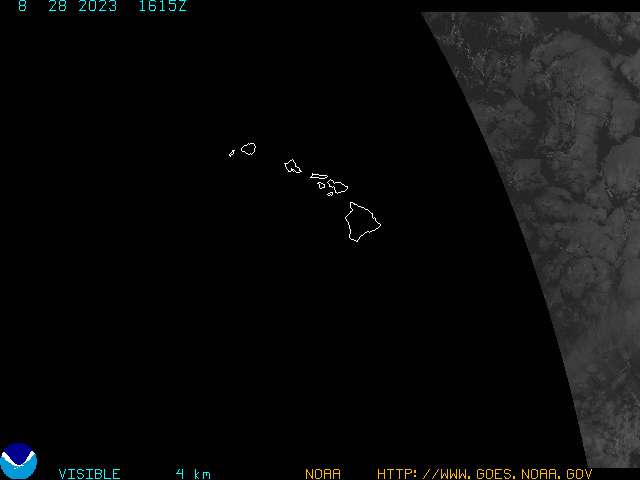
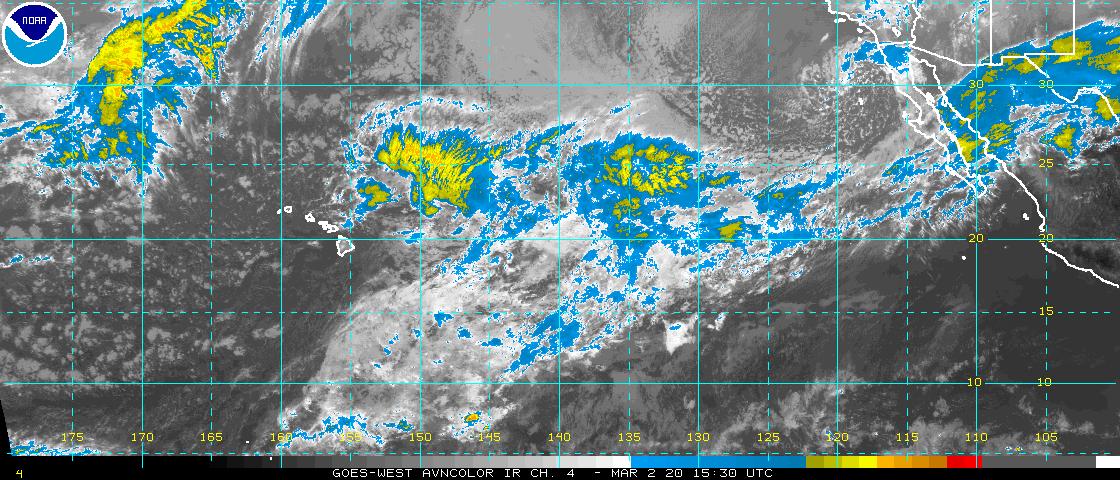
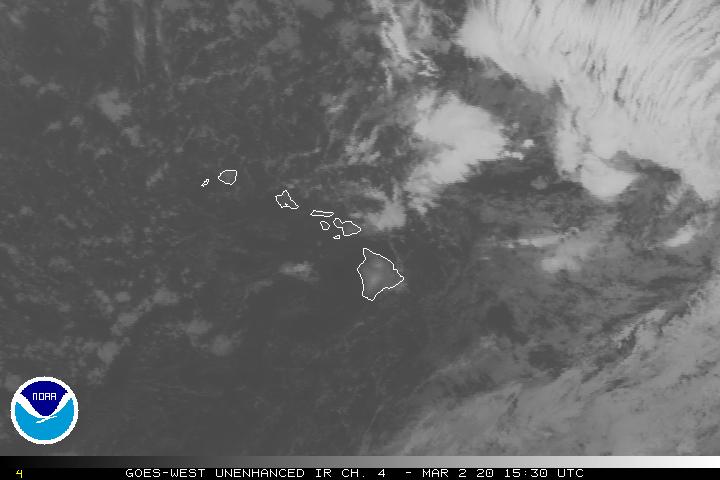
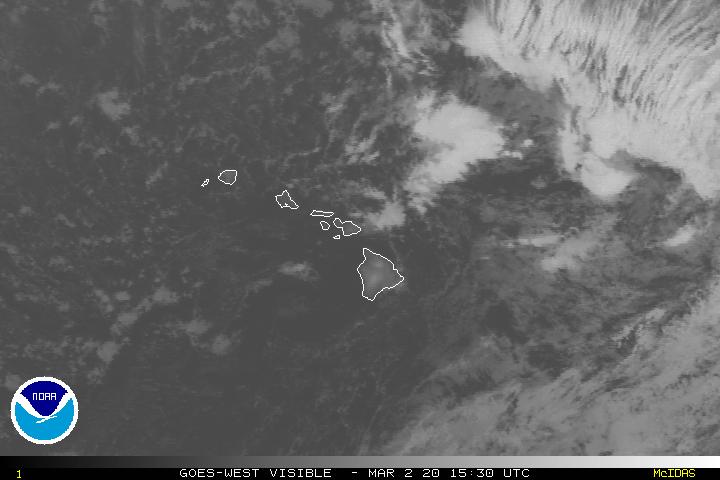
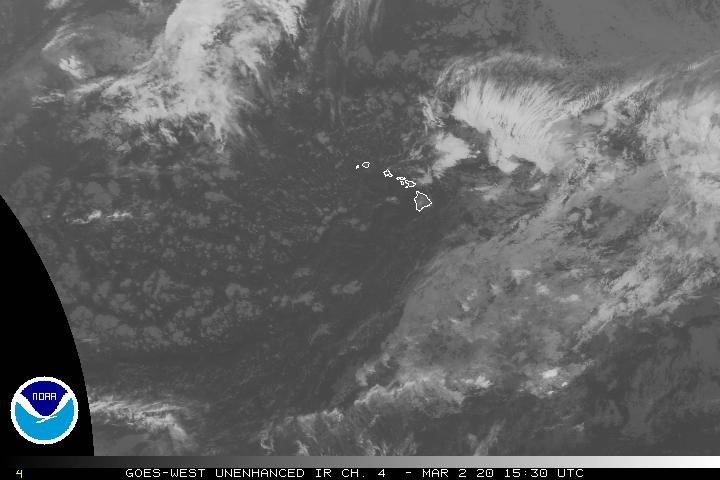
Satellite and Radar Images: To view the cloud conditions we have here in Hawaii, please use the following satellite links, starting off with this Infrared Satellite Image of the islands to see all the clouds around the state during the day and night. This next image is one that gives close images of the islands only during the daytime hours, and is referred to as a Close-up visible image. This next image shows a larger view of the Pacific…giving perspective to the wider ranging cloud patterns in the Pacific Ocean. Finally, here’s a Looping IR satellite image, making viewable the clouds around the islands 24 hours a day. To help you keep track of where any showers may be around the islands, here’s the latest animated radar image.
Hawaii’s Mountains – Here’s a link to the live webcam on the summit of near 14,000 foot Mauna Kea on the Big Island of Hawaii. The tallest peak on the island of Maui is the Haleakala Crater, which is near 10,000 feet in elevation. These two webcams are available during the daylight hours here in the islands…and when there’s a big moon rising just after sunset for an hour or two! Plus, during the nights and early mornings you will be able to see stars, and the sunrise too…depending upon weather conditions.
Tropical Cyclone activity in the eastern and central Pacific – Here’s the latest weather information coming out of the National Hurricane Center, covering the eastern north Pacific. You can find the latest tropical cyclone information for the central north Pacific (where Hawaii is located) by clicking on this link to the Central Pacific Hurricane Center. Here’s a tracking map covering both the eastern and central Pacific Ocean. A satellite image, which shows the entire ocean area between Hawaii and the Mexican coast…can be found here.
Aloha Paragraphs

Gradually lighter trade winds
The trade winds will remain active, at least in most areas, through Tuesday…then big noticeably lighter by mid-week. The small craft advisory will contine over most of Hawaii’s marine zones Monday night. The computer models suggest that the trade winds will diminish on Wednesday…with lighter and variable breezes then. The approach of a cold front will turn our winds southeast, then south and southwest…from the Kona direction, by Thursday. A second cold front will potentially turn our winds again to the south and southwest by Sunday again. If a third cold front doesn’t try to move our way thereafter…we will likely see a surge of cool north winds in the wake of that final frontal boundary next Tuesday.
Cold air associated with an upper level low pressure system…recently made our atmosphere unstable. This upper level disturbance enhanced incoming showers…carried our way on the blustery trade winds. This cold air aloft caused some locally heavy showers…along with a couple of thunderstorms around the Big Island. Drier air is moving into our area from the west now, which has put us back into an unusually dry trade wind weather pattern into Tuesday. Lets use this satellite image to keep an eye on the clouds around now…and use this looping radar image to see where just a few showers might be for the time being.
Looking further ahead, and as described above, we have more excitement up ahead. Drier weather is upon us now, with fairly normal weather conditions on tap through Tuesday. Wednesday’s winds will turn considerably lighter than they are now, with some afternoon interior clouds perhaps dropping a few light showers. Then, as we move into Thursday, our winds will become Kona in direction (south and southwest), as an active Pacific cold front moves in our direction from the northwest. It will bring some rain to our islands this Friday…with another cold front precipitation event later Sunday or next Monday.
It’s early Monday evening here on Maui, as I begin writing this last section of today’s narrative. As you can see, if you had a chance to read down through the paragraphs above, we’re looking at several days of nice weather ahead. The trade winds will remain around through Tuesday, but then soften into what we call light and variable breezes by mid-week. We haven’t seen Kona winds in quite some time, so it will be a pleasure to welcome them back into our area starting Thursday. ~~~ This evening, I’m about ready to take the drive over to Haiku for the viewing of a film. This is at a friend of mine’s house, where he apparently has a large screen. He and another friend of mine, have teamed up to present a film tonight called Wings of Desire. These films are shown after some libations and a little food, followed by discussion of the films. I won’t be able to stay for that, but will take in the film before high-tailing it back upcountry to Kula afterwards. I’ll let you know what I thought of the film early Tuesday morning. I’ll embed that commentary in the next new weather narrative from Paradise. I hope you have a great Monday night until then! Aloha for now…Glenn.
Interesting: Popular thinking about how to improve food systems for the better often misses the point, according to the results of a three-year global study of salmon production systems. Rather than pushing for organic or land-based production, or worrying about simple metrics such as "food miles," the study finds that the world can achieve greater environmental benefits by focusing on improvements to key aspects of production and distribution.
For example, what farmed salmon are fed, how wild salmon are caught and the choice to buy frozen over fresh matters more than organic vs. conventional or wild vs. farmed when considering global scale environmental impacts such as climate change, ozone depletion, loss of critical habitat, and ocean acidification.
The study is the world’s first comprehensive global-scale look at a major food commodity from a full life cycle perspective, and the researchers examined everything — how salmon are caught in the wild, what they’re fed when farmed, how they’re transported, how they’re consumed, and how all of this contributes to both environmental degradation and socioeconomic benefits.
Interesting2: There is one month left in 2009, which leaves you plenty of time to take advantage of the green tax incentives available to consumers. While some of these tax credits or deductions have been available for several years, many were created as part of the American Recovery and Reinvestment Act.
A common theme among green-related Recovery Act programs is the importance of weatherization projects. When homeowners can create a more energy efficient property, they save money on energy bills as well as reduce their greenhouse gas emissions. Energy-saving and weatherization products must be installed on an existing, primary residence.
Although 2009 is coming to a close, these tax credits are valid for projects completed through December 31, 2010. If you’re in the market for a new vehicle, purchasing a hybrid or clean diesel vehicle may help you save thousands on your taxes. Unfortunately, the most popular hybrid, the Toyota Prius, is no longer eligible for a tax credit.
Tax credits for hybrids are phased out after an automaker has sold 60,000 eligible units. However, there are still three automakers that sell tax credit-eligible hybrid vehicles: Ford, General Motors, and Nissan. Due to the popularity of the Ford Escape Hybrid, Ford is already in the tax credit phase out process.
If you purchased an eligible Ford hybrid prior to April 1, 2009, you may be eligible to take the full credit amount. Ford hybrids purchased between April 1, 2009 and September 30, 2009 are eligible for a 50% credit and eligible Ford hybrids purchased prior to March 31, 2010 will be eligible for a 25% credit.
Interesting3: Companies need to move towards using greener chemicals because the principal drivers demanding such change — science, regulation, and business-to-business environmentally preferable purchasing programs — are surging and will intensify. Product toxicity reduction should be a core element of business strategy because it can reduce reputational and litigation liabilities, help companies avoid "toxic lockout" of their products from the marketplace, and drive innovation.
It can drive sales in the marketplace for environmentally preferable products, lower overhead costs when products subject to government hazardous waste laws are eliminated, and contribute to enhanced employee safety and productivity. Toxicity reduction and elimination can also yield other forms of cost savings, generally determined on a case by case basis.
In the course of this three-part series, we aim to help you figure out how to reduce your company’s toxic footprint by reducing and eliminating the "worst of the worst" toxic chemicals and promoting use of "best of the best" green ones.
Interesting4: New analysis of a 13,000-year-old Mars meteorite, retrieved from Antarctica, has rekindled the debate about whether the ancient rock holds signs of past microbial Martian life. The study is reminiscent of initial research, published in 1996, suggesting that very, very tiny — nanometer-sized — iron sulfide and iron oxide grains in the meteorite had biological origins, and that tiny, worm-shaped objects in the rock, known as ALH84001, could be the fossilized remains of Martian microbes.
The research was widely panned, and the NASA team making claims for life on Mars subsequently retreated. Now a team of experts at the NASA Johnson Space Center, including the lead astro-biologist in the 1996 study, David McKay, have looked at the rock again using a new analysis technique, called ion beam milling.
They conclude that there is enough evidence to rule out at least one geological process as the one that formed the nano-crystal iron grains. That leaves something that was once living — biology — as a possible cause.
Interesting5: Intervals of regional warmth and cold in the past are linked to the El Niño phenomenon and the so-called "North Atlantic Oscillation" in the Northern hemisphere’s jet stream, according to a team of climate scientists. These linkages may be important in assessing the regional effects of future climate change. "Studying the past can potentially inform our understanding of what the future may hold," said Michael Mann, Professor of meteorology, Penn State.
Mann stresses that an understanding of how past natural changes have influenced phenomena such as El Niño, can perhaps help to resolve current disparities between state-of the-art climate models regarding how human-caused climate change may impact this key climate pattern.
Mann and his team used a network of diverse climate proxies such as tree ring samples, ice cores, coral and sediments to reconstruct spatial patterns of ocean and land surface temperature over the past 1500 years. They found that the patterns of temperature change show dynamic connections to natural phenomena such as El Niño.
They report their findings in the Nov. 27 issue of Science. Mann and his colleagues reproduced the relatively cool interval from the 1400s to the 1800s known as the "Little Ice Age" and the relatively mild conditions of the 900s to 1300s sometimes termed the "Medieval Warm Period." "However, these terms can be misleading," said Mann.
"Though the medieval period appears modestly warmer globally in comparison with the later centuries of the Little Ice Age, some key regions were in fact colder. For this reason, we prefer to use ‘Medieval Climate Anomaly’ to underscore that, while there were significant climate anomalies at the time, they were highly variable from region to region."
The researchers found that 1,000 years ago, regions such as southern Greenland may have been as warm as today. However, a very large area covering much of the tropical Pacific was unusually cold at the same time, suggesting the cold La Niña phase of the El Niño phenomenon. This regional cooling offset relative warmth in other locations, helping to explain previous observations that the globe and Northern hemisphere on average were not as warm as they are today.
Interesting6: In the film The Day After Tomorrow, the world enters the icy grip of a new glacial period within the space of just a few weeks. Now new research shows that this scenario may not be so far from the truth after all. William Patterson, from the University of Saskatchewan in Canada, and his colleagues have shown that switching off the North Atlantic circulation can force the Northern hemisphere into a mini ‘ice age’ in a matter of months. Previous work has indicated that this process would take tens of years.
Around 12,800 years ago the northern hemisphere was hit by a mini ice-age, known by scientists as the Younger Dryas, and nicknamed the ‘Big Freeze’, which lasted around 1300 years. Geological evidence shows that the Big Freeze was brought about by a sudden influx of freshwater, when the glacial Lake Agassiz in North America burst its banks and poured into the North Atlantic and Arctic Oceans.
This vast pulse, a greater volume than all of North America’s Great Lakes combined, diluted the North Atlantic conveyor belt and brought it to a halt. Without the warming influence of this ocean circulation temperatures across the Northern hemisphere plummeted, ice sheets grew and human civilisation fell apart. Previous evidence from Greenland ice cores has indicated that this sudden change in climate occurred over the space of a decade or so.
Now new data shows that the change was amazingly abrupt, taking place over the course of a few months, or a year or two at most. Patterson and his colleagues have created the highest resolution record of the ‘Big Freeze’ event to date, from a mud core taken from an ancient lake, Lough Monreach, in Ireland. Using a scalpel layers were sliced from the core, just 0.5mm thick, representing a time period of one to three months.
Posted by Glenn
[2] Comments
November 29-30, 2009
Air Temperatures – The following maximum temperatures were recorded across the state of Hawaii Sunday afternoon:
Lihue, Kauai – 77
Honolulu, Oahu – 81
Kaneohe, Oahu – 78
Kaunakakai, Molokai – 80
Kahului, Maui – 80
Hilo, Hawaii – 79
Kailua-kona – 90
Air Temperatures ranged between these warmest and coolest spots near sea level around the state – and on the highest mountains…at 4pm Sunday afternoon:
Barking Sands, Kauai – 82F
Molokai airport – 70
Haleakala Crater – 41 (near 10,000 feet on Maui)
Mauna Kea summit – 36 (near 14,000 feet on the Big Island)
Precipitation Totals – The following numbers represent the largest precipitation totals (inches) during the last 24 hours on each of the major islands, as of Sunday afternoon:
0.36 Mount Waialaele, Kauai
0.59 Oahu Forest NWR, Oahu
0.20 Molokai
0.08 Lanai
0.13 Kahoolawe
3.04 Puu Kukui, Maui
1.65 Pahoa, Big Island
Marine Winds – Here’s the latest (automatically updated) weather map showing a 1030 millibar high pressure system far to the northeast of the islands, with a new 1032 millibar high pressure cell to the north-northwest. Winds will be locally strong and gusty through Monday.
Satellite and Radar Images: To view the cloud conditions we have here in Hawaii, please use the following satellite links, starting off with this Infrared Satellite Image of the islands to see all the clouds around the state during the day and night. This next image is one that gives close images of the islands only during the daytime hours, and is referred to as a Close-up visible image. This next image shows a larger view of the Pacific…giving perspective to the wider ranging cloud patterns in the Pacific Ocean. Finally, here’s a Looping IR satellite image, making viewable the clouds around the islands 24 hours a day. To help you keep track of where any showers may be around the islands, here’s the latest animated radar image.
Hawaii’s Mountains – Here’s a link to the live webcam on the summit of near 14,000 foot Mauna Kea on the Big Island of Hawaii. The tallest peak on the island of Maui is the Haleakala Crater, which is near 10,000 feet in elevation. These two webcams are available during the daylight hours here in the islands…and when there’s a big moon rising just after sunset for an hour or two! Plus, during the nights and early mornings you will be able to see stars, and the sunrise too…depending upon weather conditions.
Tropical Cyclone activity in the eastern and central Pacific – Here’s the latest weather information coming out of the National Hurricane Center, covering the eastern north Pacific. You can find the latest tropical cyclone information for the central north Pacific (where Hawaii is located) by clicking on this link to the Central Pacific Hurricane Center. Here’s a tracking map covering both the eastern and central Pacific Ocean. A satellite image, which shows the entire ocean area between Hawaii and the Mexican coast…can be found here.
Aloha Paragraphs

Chance of heavy showers into Monday morning
The trade winds will be locally strong and gusty through Monday. The small craft advisory covers most of Hawaii’s marine zones Sunday evening. This current weather map shows a 1030 millibar high pressure system far to the northeast of the islands, with a 1032 millibar high pressure cell evident to the north. The computer models suggest that the trade winds will diminish once again by around Tuesday into Wednesday. The approach of a robust cold front will turn our winds southeast, then south and southwest…from the Kona direction, by later Thursday into the weekend. If things go according to plan, cool north winds will fill in behind the passage of the cold front later next Sunday.
Cold air associated with an upper level low pressure system…has made our atmosphere more shower prone today. This upper level disturbance will enhance incoming showers…carried our way on the blustery trade winds. If all the ingredients come together just right today, as they seem to be around Maui and the Big Island, we will see locally heavy rain, with even the chance of a thunderstorm. The vast majority of these showers are falling along the windward sides. Lets use this satellite image to keep an eye on the clouds around now…and use this looping radar image to see where the showers are falling too. As next weekend’s cold fronts gets into our area, we would see increasing showers again then…some of which could be heavy.
It’s late Sunday afternoon here on Maui, as I begin writing this last section of today’s narrative. The weather on Maui and the Big Island has been wet locally Saturday evening into most of the day Sunday. The windward sides received most of the rainfall, but at least some of it flew over into the leeward sections here on Maui. Here in Kula, it has been raining off and on all day! This cold air aloft now, has initiated an unstable atmosphere overhead. This in turn could cause localized flooding, and lots of locally generous rainfall. There’s still a chance of a few thunderstorms before this temporary instability moves on Monday, although I haven’t seen one as of the time of this writing.
~~~ Saturday evening I went over to a friends house in lower Kula, the house that my recently passed away friend, Julie Claire Holmes owned. She and I bought many bottles of 1997 cabernet Sauvignon together…several years ago. I took the last bottle of this 97′ wine that I had over for dinner last night. This choice bottle was a Raymond, Napa Valley Reserve. Julie and I were working our way through these bottles, a couple a year, until she died this past summer. This friend who lives on her property now, went with Julie, and took care of her in California until she passed away. I felt it proper to share this last bottle with him in honor of both Julie, and what he so kindly did for her. This person and I, whose name is Marco Biancardi, had so much to speak about Julie’s life, and our individual relationships with her. As it turned out of course, we both had so much to say about how her death has influenced our lives as well. She was such a dear, dear friend of mine, and Marco’s too.
~~~ The red wine was absolutely wonderful, and I personally tasted every sip, and smelled the nose before of each of those sips. We talked and talked, about so many things revolving around our love for Julie. We played music, looked at a wonderful video that Marco had made covering the end of her life. As some of you know, I had flown to be with her for a week, to say my goodbye to her back in June. Marco had some snips of Julie’s hair in a special cloth envelope, her beautiful blond hair, and I danced around some, carrying it in my hands. Julie loved Tango dancing, and so it seemed fitting to give her one last whirl…although likely that will happen again. I didn’t get home until 130am Sunday morning, which was very late for me. The wind was blowing so hard, swinging my wind chimes around, that I didn’t get all that much sleep anyway.
~~~ One of my neighbors, the astro-physicist named Jeff Kuhn, has invited everyone over to his house this evening for dinner. He has another famous astro-physicist from Russia and Germany visiting, and she will be cooking a traditional Russian meal for all of us. So life goes on, and then there’s work in Kihei tomorrow. I seem to be on a new roll somehow, as each day has something special to offer, and of course we’re heading into our Christmas/New Year’s holidays soon too. I’ll be back early Monday morning with your next new weather narrative, I hope you have a great Sunday night until then! Aloha for now…Glenn.
Extra: Wow!
Interesting: The number of people with diabetes in the United States is expected to double over the next 25 years, a new study predicts. That would bring the total by 2034 to about 44.1 million people with the disease, up from 23.7 million today. At the same time, the cost of treating people with diabetes will triple, the study also warns, rising from an estimated $113 billion in 2009 to $336 billion in 2034.
One factor driving the soaring costs: the number of people living with diabetes for lengthy periods, the researchers said. Over time, the cost of caring for someone with diabetes tends to rise along with their risk for developing complications, such as end-stage renal disease, which requires dialysis.
"We believe our model provides a more precise estimate of what the population size will look like and what it will cost the country and government programs like Medicare," said study author Dr. Elbert Huang, an assistant professor of medicine at the University of Chicago. Prior forecasts, including the ones currently used by the federal government’s budget analysts, have underestimated the burden, the researchers said.
A 1991 study, for example, predicted that 11.6 million people would have diabetes in 2030. In 2009, there were already more than twice that many living with diabetes. "In a similar way, we may be underestimating what’s happening, which is actually very disturbing," Huang said.
Among Medicare beneficiaries, the number with diabetes is expected to rise from 8.2 million to 14.6 million in 2034, with an accompanying rise in spending from $45 billion to $171 billion. "That essentially means that in 2034, half of all direct spending on diabetes care will be coming from the Medicare population," Huang said.
The study is published in the December issue of Diabetes Care. The high cost of chronic disease is one of the most pressing issues facing the United States as legislators grapple with financial strains on Medicare and the larger issue of health-care reform, the researchers say.
Interesting2: The kelp forests off southern California are considered to be some of the most diverse and productive ecosystems on the planet, yet a new study indicates that today’s kelp beds are less extensive and lush than those in the recent past. The kelp forest tripled in size from the peak of glaciation 20,000 years ago to about 7,500 years ago, then shrank by up to 70 percent to present day levels, according to the study by Rick Grosberg, professor in the Department of Evolution and Ecology and the Center for Population Biology at UC Davis, with Michael Graham of the Moss Landing Marine Laboratory and Brian Kinlan at UC Santa Barbara.
Kelp forests around offshore islands peaked around 13,500 years ago as rising sea levels created new habitat and then declined to present day levels. The kelp along the mainland coast peaked around 5,000 years later. This transition from an extensive island-based kelp system to a mainland-dominated system coincided with conspicuous events in the archaeological record of the maritime people in the region, suggesting that climate-driven shifts in kelp ecosystems impacted human populations that used those resources. Understanding the past history of a population is crucial to understanding its genetics in the present, Grosberg said.
Interesting3: Hammerhead sharks are some of the Ocean’s most distinctive residents. "Everyone wants to understand why they have this strange head shape," says Michelle McComb from Florida Atlantic University. One possible reason is the shark’s vision.
"Perhaps their visual field has been enhanced by their weird head shape," says McComb, giving the sharks excellent stereovision and depth perception. However, according to McComb, there were two schools of thought on this theory. In 1942, G.
Walls speculated that the sharks couldn’t possibly have binocular vision because their eyes were stuck out on the sides of their heads. However, in 1984, Leonard Campagno suggested that the sharks would have excellent depth perception because their eyes are so widely separated.
"In fact one of the things they say on TV shows is that hammerheads have better vision than other sharks," says McComb, "but no one had ever tested this." Teaming up with Stephen Kajiura and Timothy Tricas, the trio decided to find out how wide a hammerhead’s field of view is and whether they could have binocular vision and publish their results on November 27 2009 in the Journal of Experimental Biology.
Hammerheads come in all shapes and sizes so McComb and Kajiura, opted to work with species with heads ranging from the narrowest to the widest. Fishing for juvenile scalloped hammerheads off Hawaii and bonnethead sharks in the waters around Florida, the team successfully landed the fish and quickly transported them back to local labs to test the fish’s eyesight.
Interesting4: The world’s oceans are absorbing less carbon dioxide (CO2), a Yale geophysicist has found after pooling data taken over the past 50 years. With the oceans currently absorbing over 40 percent of the CO2 emitted by human activity, this could quicken the pace of climate change, according to the study, which appears in the November 25 issue of Geophysical Research Letters.
Jeffrey Park, professor of geology and geophysics and director of the Yale Institute for Biospheric Studies, used data collected from atmospheric observing stations in Hawaii, Alaska and Antarctica to study the relationship between fluctuations in global temperatures and the global abundance of atmospheric CO2 on interannual (one to 10 years) time scales.
A similar study from 20 years ago found a five-month lag between interannual temperature changes and the resulting changes in CO2 levels. Park has now found that this lag has increased from five to at least 15 months. "No one had updated the analysis from 20 years ago," Park said.
"I expected to find some change in the lag time, but the shift was surprisingly large. This is a big change." With a longer lag time, atmospheric CO2 can no longer adjust fully to cyclical temperature fluctuations before the next cycle begins, suggesting that the oceans have lost some of their ability to absorb CO2 from the atmosphere.
Weaker CO2 absorption could be caused by a change in ocean circulation or just an overall increase in the surface temperature. "Think of the oceans like soda," Park said. "Warm cola holds less fizz," Park said. "The same thing happens as the oceans warm up."
Interesting5: An analysis of quality of cardiac care following the public release of data on measures of care at hospitals in Ontario, Canada, did not result in significant system wide improvement in hospitals’ performance on most quality of care indicators, according to a new study. "Public release of hospital performance data is increasingly being mandated by policy makers with the goal of improving the quality of care.
Advocates of report cards believe that publicly releasing performance data on hospitals will stimulate hospitals and clinicians to engage in quality improvement activities and increase the accountability and transparency of the health care system.
Critics argue that publicly released report cards may contain data that are misleading or inaccurate and may unfairly harm the reputations of hospitals and clinicians," the authors write.
"Although there has been considerable debate, few empirical data exist to determine whether publicly released report cards on hospital performance improve the overall quality of care provided."
Interesting6: A flotilla of icebergs originating in Antarctica has been detected over open seas south of New Zealand. The icebergs, straying well outside the normal range for such Antarctic Ice, were located in remote, little-traveled waters, and thus were not a major shipping hazard. Nor were they a significant threat to New Zealand.
According to the AP, the nearest was said by authorities to lie 160 miles southeast of Stewart Island, southern New Zealand, based on satellite imagery on Tuesday. Its size was roughly 100 yards by 200 yards. A bigger berg standing 50 yards above the waterline and spanning 500 yards in length, lurked near Macquarie Island.
Macquarie is located midway between Antarctica and New Zealand at the southwestern corner of the South Pacific Ocean. The ultimate origin for this icy flotilla may have stemmed from a massive break-up of the Ross Ice Shelf back in 2000.
Another raft of icebergs linked to this break up of shelf ice drifted toward southern New Zealand during 2006. These never reached New Zealand, as they either broke up or were swept away to open seas by ocean currents.
Interesting7: Islands don’t move much, but they can still make waves. In fact they sometimes make dramatic waves … in the clouds. In a new satellite image, the South Sandwich island chain triggers a series of airborne waves. The V-shaped waves fan out to the east, visible as white clouds over the dark ocean water.
The islands disturb the smooth flow of air, creating waves that ripple through the atmosphere downwind of the obstacles, NASA explained in a statement. The moist, cloudy air over the ocean (meteorologists call this the marine layer) is often capped by a layer of dry air.
When the wave ripples through the atmosphere downwind of the islands, clouds form (or persist) at the crests of the waves because air cools as it rises, and water vapor condenses into cloud droplets.
|
In the wave troughs, some of the dry air from above sinks into marine layer, replacing the cloudy air. In addition, as air sinks, it warms, causing clouds to evaporate. The rugged islands, in the southern Atlantic Ocean, are of volcanic origin — Bristol and Montagu have been active during recorded history.
Posted by Glenn
No Comments
November 28-29, 2009
Air Temperatures – The following maximum temperatures were recorded across the state of Hawaii Saturday afternoon:
Lihue, Kauai – 79
Honolulu, Oahu – 84
Kaneohe, Oahu – 80
Kaunakakai, Molokai – 81
Kahului, Maui – 82
Hilo, Hawaii – 80
Kailua-kona – 83
Air Temperatures ranged between these warmest and coolest spots near sea level around the state – and on the highest mountains…at 4pm Saturday afternoon:
Kailua-kona – 83F
Kapalua, Maui – 77
Haleakala Crater – 48 (near 10,000 feet on Maui)
Mauna Kea summit – 41 (near 14,000 feet on the Big Island)
Precipitation Totals – The following numbers represent the largest precipitation totals (inches) during the last 24 hours on each of the major islands, as of Saturday afternoon:
0.51 Mount Waialaele, Kauai
0.06 South Fork Kaukonahua, Oahu
0.06 Molokai
0.00 Lanai
0.00 Kahoolawe
1.10 Puu Kukui, Maui
1.10 Hakalau, Big Island
Marine Winds – Here’s the latest (automatically updated) weather map showing a 1036 millibar high pressure system far to the northeast of the islands. Winds will be moderately strong…locally stronger and gusty.
Satellite and Radar Images: To view the cloud conditions we have here in Hawaii, please use the following satellite links, starting off with this Infrared Satellite Image of the islands to see all the clouds around the state during the day and night. This next image is one that gives close images of the islands only during the daytime hours, and is referred to as a Close-up visible image. This next image shows a larger view of the Pacific…giving perspective to the wider ranging cloud patterns in the Pacific Ocean. Finally, here’s a Looping IR satellite image, making viewable the clouds around the islands 24 hours a day. To help you keep track of where any showers may be around the islands, here’s the latest animated radar image.
Hawaii’s Mountains – Here’s a link to the live webcam on the summit of near 14,000 foot Mauna Kea on the Big Island of Hawaii. The tallest peak on the island of Maui is the Haleakala Crater, which is near 10,000 feet in elevation. These two webcams are available during the daylight hours here in the islands…and when there’s a big moon rising just after sunset for an hour or two! Plus, during the nights and early mornings you will be able to see stars, and the sunrise too…depending upon weather conditions.
Tropical Cyclone activity in the eastern and central Pacific – Here’s the latest weather information coming out of the National Hurricane Center, covering the eastern north Pacific. You can find the latest tropical cyclone information for the central north Pacific (where Hawaii is located) by clicking on this link to the Central Pacific Hurricane Center. Here’s a tracking map covering both the eastern and central Pacific Ocean. A satellite image, which shows the entire ocean area between Hawaii and the Mexican coast…can be found here.
Aloha Paragraphs

Great tropical colors
The temporarily lighter trade winds will be picking up again Sunday into Monday. The small craft advisory has been pared back quite a bit in the marine zones Saturday night. This current weather map shows a strong 1036 millibar high pressure system to the northeast of the islands. The computer models suggest that the trade winds will diminish once again by mid-week. A second, more robust cold front will turn our winds southeast, then south and southwest…from the Kona direction by next Friday into the weekend. If things go according to plan, cool north winds will fill in behind the passage of the cold front early the following week.
The computer models continue to strongly suggest that Sunday looks like it could turn unsettled again…lasting at least into Monday. The approaching cold front may draw deep moisture up into the state from the southeast, lasting for several days. At the same time, an upper level disturbance will be enhance these showers…and even cause some localized thunderstorms for several days. If all the ingredients come together just right Sunday and Monday, we could see some dynamic lightning displays across the state! As next weekend’s cold front gets into our area, we would see increasing showers again then…some of which could be heavy.
It’s Saturday evening here on Maui, as I begin writing this last section of this morning’s narrative. The weather was just fine today, with lots of sunshine beaming down, especially along our warm leeward beaches. As we get into Sunday, and into the new work week ahead, things could get very interesting. There’s still a bit of uncertainty about exactly what will be happening, but I think we should be ready for unsettled conditions. This implies that we’ll have cold air aloft, with a corresponding unstable atmosphere overhead. If there’s lots of available moisture, like some of the computer models are suggesting, we may get a rare display of strong thunderstorms. This in turn could cause localized flooding, and lots of bright lightning…and loud thunder!
~~~ I went to see a new film at the Maui Arts and Cultural Center in Wailuku Friday evening. It was called Up In The Air (2009), starring George Clooney, Vera Farminga, Anna Kendrick, Jason Bateman. The brief synopsis of this film: "A smart and poignant romantic comedy that is one of those rare mainstream Hollywood pictures that addresses contemporary issues gracefully. Anchored by a strong performance from George Clooney, director Jason Reitman’s most mature film balances laughs and pathos with its story of downsized workers and love’s redemptive power." This was a great film, one of the best I’ve seen lately, although it did have a sad note strung through it…about being alone in life. I would recommend your seeing it when it flies into your area. Here’s a trailer of this new film, I think you will enjoy viewing it.
~~~ I went to Baldwin Beach with one of my neighbors today, and was met by another friend down there. The three of us had a nice long walk down to what’s called Baby Beach in Sprecklesville. We sat around talking on the warm sand, and got in the water for a dip. I swam out to the white water near the reef, the breaking waves…as I always enjoy that energy. We hung out a while longer, before heading into Paia for some grocery shopping at the health food store.
~~~ This evening I’m going over to a friends house down in lower Kula, the house that my recently passed away friend, Julie Claire Holmes owned. She and I bought many bottles of 1997 cabernet Sauvignon together…many years ago. This particular bottle is a Raymond, Napa Valley Reserve. We were working our way through these bottles, a couple a year, until she died this past summer. This friend who lives on her property, went with Julie, and took care of her in California until she passed away. I felt it proper to share this bottle with him in honor of both Julie, and what he ever so kindly did for her. I’ll let you know how it tasted Sunday morning. This person and I, whose name is Marco Biancardi, will have lots to speak about Julie’s death this evening, and I anticipate some of it will be sad. Actually, just writing that last sentence brings tears to my eyes. She was such a dear, dear friend of mine, and Marco’s too. This occasion brings another round of emotional good byes to her. ~~~ I hope you have a good Saturday night wherever you’re spending it! See you Sunday morning. Aloha for now…Glenn.
Interesting: The number of people with diabetes in the United States is expected to double over the next 25 years, a new study predicts. That would bring the total by 2034 to about 44.1 million people with the disease, up from 23.7 million today. At the same time, the cost of treating people with diabetes will triple, the study also warns, rising from an estimated $113 billion in 2009 to $336 billion in 2034.
One factor driving the soaring costs: the number of people living with diabetes for lengthy periods, the researchers said. Over time, the cost of caring for someone with diabetes tends to rise along with their risk for developing complications, such as end-stage renal disease, which requires dialysis.
"We believe our model provides a more precise estimate of what the population size will look like and what it will cost the country and government programs like Medicare," said study author Dr. Elbert Huang, an assistant professor of medicine at the University of Chicago. Prior forecasts, including the ones currently used by the federal government’s budget analysts, have underestimated the burden, the researchers said.
A 1991 study, for example, predicted that 11.6 million people would have diabetes in 2030. In 2009, there were already more than twice that many living with diabetes. "In a similar way, we may be underestimating what’s happening, which is actually very disturbing," Huang said.
Among Medicare beneficiaries, the number with diabetes is expected to rise from 8.2 million to 14.6 million in 2034, with an accompanying rise in spending from $45 billion to $171 billion. "That essentially means that in 2034, half of all direct spending on diabetes care will be coming from the Medicare population," Huang said.
The study is published in the December issue of Diabetes Care. The high cost of chronic disease is one of the most pressing issues facing the United States as legislators grapple with financial strains on Medicare and the larger issue of health-care reform, the researchers say.
Interesting2: The kelp forests off southern California are considered to be some of the most diverse and productive ecosystems on the planet, yet a new study indicates that today’s kelp beds are less extensive and lush than those in the recent past. The kelp forest tripled in size from the peak of glaciation 20,000 years ago to about 7,500 years ago, then shrank by up to 70 percent to present day levels, according to the study by Rick Grosberg, professor in the Department of Evolution and Ecology and the Center for Population Biology at UC Davis, with Michael Graham of the Moss Landing Marine Laboratory and Brian Kinlan at UC Santa Barbara.
Kelp forests around offshore islands peaked around 13,500 years ago as rising sea levels created new habitat and then declined to present day levels. The kelp along the mainland coast peaked around 5,000 years later. This transition from an extensive island-based kelp system to a mainland-dominated system coincided with conspicuous events in the archaeological record of the maritime people in the region, suggesting that climate-driven shifts in kelp ecosystems impacted human populations that used those resources. Understanding the past history of a population is crucial to understanding its genetics in the present, Grosberg said.
Interesting3: Hammerhead sharks are some of the Ocean’s most distinctive residents. "Everyone wants to understand why they have this strange head shape," says Michelle McComb from Florida Atlantic University. One possible reason is the shark’s vision.
"Perhaps their visual field has been enhanced by their weird head shape," says McComb, giving the sharks excellent stereovision and depth perception. However, according to McComb, there were two schools of thought on this theory. In 1942, G.
Walls speculated that the sharks couldn’t possibly have binocular vision because their eyes were stuck out on the sides of their heads. However, in 1984, Leonard Campagno suggested that the sharks would have excellent depth perception because their eyes are so widely separated.
"In fact one of the things they say on TV shows is that hammerheads have better vision than other sharks," says McComb, "but no one had ever tested this." Teaming up with Stephen Kajiura and Timothy Tricas, the trio decided to find out how wide a hammerhead’s field of view is and whether they could have binocular vision and publish their results on November 27 2009 in the Journal of Experimental Biology.
Hammerheads come in all shapes and sizes so McComb and Kajiura, opted to work with species with heads ranging from the narrowest to the widest. Fishing for juvenile scalloped hammerheads off Hawaii and bonnethead sharks in the waters around Florida, the team successfully landed the fish and quickly transported them back to local labs to test the fish’s eyesight.
Interesting4: The world’s oceans are absorbing less carbon dioxide (CO2), a Yale geophysicist has found after pooling data taken over the past 50 years. With the oceans currently absorbing over 40 percent of the CO2 emitted by human activity, this could quicken the pace of climate change, according to the study, which appears in the November 25 issue of Geophysical Research Letters.
Jeffrey Park, professor of geology and geophysics and director of the Yale Institute for Biospheric Studies, used data collected from atmospheric observing stations in Hawaii, Alaska and Antarctica to study the relationship between fluctuations in global temperatures and the global abundance of atmospheric CO2 on interannual (one to 10 years) time scales.
A similar study from 20 years ago found a five-month lag between interannual temperature changes and the resulting changes in CO2 levels. Park has now found that this lag has increased from five to at least 15 months. "No one had updated the analysis from 20 years ago," Park said.
"I expected to find some change in the lag time, but the shift was surprisingly large. This is a big change." With a longer lag time, atmospheric CO2 can no longer adjust fully to cyclical temperature fluctuations before the next cycle begins, suggesting that the oceans have lost some of their ability to absorb CO2 from the atmosphere.
Weaker CO2 absorption could be caused by a change in ocean circulation or just an overall increase in the surface temperature. "Think of the oceans like soda," Park said. "Warm cola holds less fizz," Park said. "The same thing happens as the oceans warm up."
Interesting5: An analysis of quality of cardiac care following the public release of data on measures of care at hospitals in Ontario, Canada, did not result in significant system wide improvement in hospitals’ performance on most quality of care indicators, according to a new study. "Public release of hospital performance data is increasingly being mandated by policy makers with the goal of improving the quality of care.
Advocates of report cards believe that publicly releasing performance data on hospitals will stimulate hospitals and clinicians to engage in quality improvement activities and increase the accountability and transparency of the health care system.
Critics argue that publicly released report cards may contain data that are misleading or inaccurate and may unfairly harm the reputations of hospitals and clinicians," the authors write.
"Although there has been considerable debate, few empirical data exist to determine whether publicly released report cards on hospital performance improve the overall quality of care provided."
Interesting6: A flotilla of icebergs originating in Antarctica has been detected over open seas south of New Zealand. The icebergs, straying well outside the normal range for such Antarctic Ice, were located in remote, little-traveled waters, and thus were not a major shipping hazard. Nor were they a significant threat to New Zealand.
According to the AP, the nearest was said by authorities to lie 160 miles southeast of Stewart Island, southern New Zealand, based on satellite imagery on Tuesday. Its size was roughly 100 yards by 200 yards. A bigger berg standing 50 yards above the waterline and spanning 500 yards in length, lurked near Macquarie Island.
Macquarie is located midway between Antarctica and New Zealand at the southwestern corner of the South Pacific Ocean. The ultimate origin for this icy flotilla may have stemmed from a massive break-up of the Ross Ice Shelf back in 2000.
Another raft of icebergs linked to this break up of shelf ice drifted toward southern New Zealand during 2006. These never reached New Zealand, as they either broke up or were swept away to open seas by ocean currents.
Interesting7: Islands don’t move much, but they can still make waves. In fact they sometimes make dramatic waves … in the clouds. In a new satellite image, the South Sandwich island chain triggers a series of airborne waves. The V-shaped waves fan out to the east, visible as white clouds over the dark ocean water.
The islands disturb the smooth flow of air, creating waves that ripple through the atmosphere downwind of the obstacles, NASA explained in a statement. The moist, cloudy air over the ocean (meteorologists call this the marine layer) is often capped by a layer of dry air.
When the wave ripples through the atmosphere downwind of the islands, clouds form (or persist) at the crests of the waves because air cools as it rises, and water vapor condenses into cloud droplets.
|
In the wave troughs, some of the dry air from above sinks into marine layer, replacing the cloudy air. In addition, as air sinks, it warms, causing clouds to evaporate. The rugged islands, in the southern Atlantic Ocean, are of volcanic origin — Bristol and Montagu have been active during recorded history.
Posted by Glenn
1 Comment
November 27-28, 2009
Air Temperatures – The following maximum temperatures were recorded across the state of Hawaii Friday afternoon:
Lihue, Kauai – 79
Honolulu, Oahu – 84
Kaneohe, Oahu – 80
Kaunakakai, Molokai – 81
Kahului, Maui – 81
Hilo, Hawaii – 76
Kailua-kona – 84
Air Temperatures ranged between these warmest and coolest spots near sea level around the state – and on the highest mountains…at 5pm Friday evening:
Barking Sands, Kauai – 82F
Hilo, Hawaii – 71
Haleakala Crater – 43 (near 10,000 feet on Maui)
Mauna Kea summit – 32 (near 14,000 feet on the Big Island)
Precipitation Totals – The following numbers represent the largest precipitation totals (inches) during the last 24 hours on each of the major islands, as of Friday afternoon:
0.65 Mount Waialaele, Kauai
0.98 Wilson Tunnel, Oahu
0.04 Molokai
0.00 Lanai
0.00 Kahoolawe
4.93 West Wailuaiki, Maui
4.65 Pahoa, Big Island
Marine Winds – Here’s the latest (automatically updated) weather map showing a 1037 millibar high pressure system far to the northeast of the islands. Winds will be moderately strong Saturday…locally stronger and gusty. Sunday’s winds should pick up a notch.
Satellite and Radar Images: To view the cloud conditions we have here in Hawaii, please use the following satellite links, starting off with this Infrared Satellite Image of the islands to see all the clouds around the state during the day and night. This next image is one that gives close images of the islands only during the daytime hours, and is referred to as a Close-up visible image. This next image shows a larger view of the Pacific…giving perspective to the wider ranging cloud patterns in the Pacific Ocean. Finally, here’s a Looping IR satellite image, making viewable the clouds around the islands 24 hours a day. To help you keep track of where any showers may be around the islands, here’s the latest animated radar image.
Hawaii’s Mountains – Here’s a link to the live webcam on the summit of near 14,000 foot Mauna Kea on the Big Island of Hawaii. The tallest peak on the island of Maui is the Haleakala Crater, which is near 10,000 feet in elevation. These two webcams are available during the daylight hours here in the islands…and when there’s a big moon rising just after sunset for an hour or two! Plus, during the nights and early mornings you will be able to see stars, and the sunrise too…depending upon weather conditions.
Tropical Cyclone activity in the eastern and central Pacific – Here’s the latest weather information coming out of the National Hurricane Center, covering the eastern north Pacific. You can find the latest tropical cyclone information for the central north Pacific (where Hawaii is located) by clicking on this link to the Central Pacific Hurricane Center. Here’s a tracking map covering both the eastern and central Pacific Ocean. A satellite image, which shows the entire ocean area between Hawaii and the Mexican coast…can be found here.
Aloha Paragraphs

Gorgeous Hawaiian sunset
Still strong and gusty trade winds, although falling off just a touch Sunday…picking up again Sunday. The small craft advisory has been pared back a little in the marine zones Friday evening. This current weather map shows a strong 1037 millibar high pressure system to the northeast of the islands. An approaching cold front this weekend, will cause our winds to slow down just a little Saturday…increasing again Sunday and Monday. The computer models suggest that the trade winds will diminish once again by mid-week. A second, more robust cold front may turn our winds south and southwest, from the Kona direction by next weekend.
As the trade winds continue, there’s always that prospect for more windward showers. The computer models are now strongly suggesting that Sunday looks like it could turn unsettled again. The approaching cold front may draw some moisture up into the state from the southeast later in the weekend, lasting for several days. At the same time, an upper level disturbance will be enhance these showers…and even cause some localized thunderstorms. As next weekend’s cold front gets into our area, we would see increasing showers again then. Here’s the latest satellite image, showing showers being carried in our direction on the trade winds…especially around Maui and the Big Island at the time of this writing.
It’s Friday evening here on Maui, with still quite a few clouds still hanging around. The windward sides have remained on the wet side, with off and on passing showers falling…although that seems to be coming to an end temporarily now. The leeward sides had a pretty good day, which will definitely stretch through Saturday. There’s still a little uncertainty as to what the second half of the weekend will look like. The models are drawing up a wet weather picture, with unstable conditions, and possible localized heavy showers falling here and there by Sunday. This prospect will need to be monitored closely, as flash flooding isn’t totally out of the question. ~~~ I’m going to see a new film at the Maui Arts and Cultural Center in Wailuku. It’s called Up In The Air (2009), starring George Clooney, Vera Farminga, Anna Kendrick, Jason Bateman. The brief synopsis of this film: "A smart and poignant romantic comedy that is one of those rare mainstream Hollywood pictures that addresses contemporary issues gracefully. Anchored by a strong performance from George Clooney, director Jason Reitman’s most mature film balances laughs and pathos with its story of downsized workers and love’s redemptive power." Here’s a trailer of this new film, I think you will enjoy seeing it. I’ll of course give you ~~~ I’ll be back online with a movie review Saturday morning, I hope you have a great Friday night! Aloha for now…Glenn.
Interesting: The number of people with diabetes in the United States is expected to double over the next 25 years, a new study predicts. That would bring the total by 2034 to about 44.1 million people with the disease, up from 23.7 million today. At the same time, the cost of treating people with diabetes will triple, the study also warns, rising from an estimated $113 billion in 2009 to $336 billion in 2034.
One factor driving the soaring costs: the number of people living with diabetes for lengthy periods, the researchers said. Over time, the cost of caring for someone with diabetes tends to rise along with their risk for developing complications, such as end-stage renal disease, which requires dialysis.
"We believe our model provides a more precise estimate of what the population size will look like and what it will cost the country and government programs like Medicare," said study author Dr. Elbert Huang, an assistant professor of medicine at the University of Chicago. Prior forecasts, including the ones currently used by the federal government’s budget analysts, have underestimated the burden, the researchers said.
A 1991 study, for example, predicted that 11.6 million people would have diabetes in 2030. In 2009, there were already more than twice that many living with diabetes. "In a similar way, we may be underestimating what’s happening, which is actually very disturbing," Huang said.
Among Medicare beneficiaries, the number with diabetes is expected to rise from 8.2 million to 14.6 million in 2034, with an accompanying rise in spending from $45 billion to $171 billion. "That essentially means that in 2034, half of all direct spending on diabetes care will be coming from the Medicare population," Huang said.
The study is published in the December issue of Diabetes Care. The high cost of chronic disease is one of the most pressing issues facing the United States as legislators grapple with financial strains on Medicare and the larger issue of health-care reform, the researchers say.
Interesting2: The kelp forests off southern California are considered to be some of the most diverse and productive ecosystems on the planet, yet a new study indicates that today’s kelp beds are less extensive and lush than those in the recent past. The kelp forest tripled in size from the peak of glaciation 20,000 years ago to about 7,500 years ago, then shrank by up to 70 percent to present day levels, according to the study by Rick Grosberg, professor in the Department of Evolution and Ecology and the Center for Population Biology at UC Davis, with Michael Graham of the Moss Landing Marine Laboratory and Brian Kinlan at UC Santa Barbara.
Kelp forests around offshore islands peaked around 13,500 years ago as rising sea levels created new habitat and then declined to present day levels. The kelp along the mainland coast peaked around 5,000 years later. This transition from an extensive island-based kelp system to a mainland-dominated system coincided with conspicuous events in the archaeological record of the maritime people in the region, suggesting that climate-driven shifts in kelp ecosystems impacted human populations that used those resources. Understanding the past history of a population is crucial to understanding its genetics in the present, Grosberg said.
Interesting3: Hammerhead sharks are some of the Ocean’s most distinctive residents. "Everyone wants to understand why they have this strange head shape," says Michelle McComb from Florida Atlantic University. One possible reason is the shark’s vision.
"Perhaps their visual field has been enhanced by their weird head shape," says McComb, giving the sharks excellent stereovision and depth perception. However, according to McComb, there were two schools of thought on this theory. In 1942, G.
Walls speculated that the sharks couldn’t possibly have binocular vision because their eyes were stuck out on the sides of their heads. However, in 1984, Leonard Campagno suggested that the sharks would have excellent depth perception because their eyes are so widely separated.
"In fact one of the things they say on TV shows is that hammerheads have better vision than other sharks," says McComb, "but no one had ever tested this." Teaming up with Stephen Kajiura and Timothy Tricas, the trio decided to find out how wide a hammerhead’s field of view is and whether they could have binocular vision and publish their results on November 27 2009 in the Journal of Experimental Biology.
Hammerheads come in all shapes and sizes so McComb and Kajiura, opted to work with species with heads ranging from the narrowest to the widest. Fishing for juvenile scalloped hammerheads off Hawaii and bonnethead sharks in the waters around Florida, the team successfully landed the fish and quickly transported them back to local labs to test the fish’s eyesight.
Interesting4: The world’s oceans are absorbing less carbon dioxide (CO2), a Yale geophysicist has found after pooling data taken over the past 50 years. With the oceans currently absorbing over 40 percent of the CO2 emitted by human activity, this could quicken the pace of climate change, according to the study, which appears in the November 25 issue of Geophysical Research Letters.
Jeffrey Park, professor of geology and geophysics and director of the Yale Institute for Biospheric Studies, used data collected from atmospheric observing stations in Hawaii, Alaska and Antarctica to study the relationship between fluctuations in global temperatures and the global abundance of atmospheric CO2 on interannual (one to 10 years) time scales.
A similar study from 20 years ago found a five-month lag between interannual temperature changes and the resulting changes in CO2 levels. Park has now found that this lag has increased from five to at least 15 months. "No one had updated the analysis from 20 years ago," Park said.
"I expected to find some change in the lag time, but the shift was surprisingly large. This is a big change." With a longer lag time, atmospheric CO2 can no longer adjust fully to cyclical temperature fluctuations before the next cycle begins, suggesting that the oceans have lost some of their ability to absorb CO2 from the atmosphere.
Weaker CO2 absorption could be caused by a change in ocean circulation or just an overall increase in the surface temperature. "Think of the oceans like soda," Park said. "Warm cola holds less fizz," Park said. "The same thing happens as the oceans warm up."
Interesting5: An analysis of quality of cardiac care following the public release of data on measures of care at hospitals in Ontario, Canada, did not result in significant system wide improvement in hospitals’ performance on most quality of care indicators, according to a new study. "Public release of hospital performance data is increasingly being mandated by policy makers with the goal of improving the quality of care.
Advocates of report cards believe that publicly releasing performance data on hospitals will stimulate hospitals and clinicians to engage in quality improvement activities and increase the accountability and transparency of the health care system.
Critics argue that publicly released report cards may contain data that are misleading or inaccurate and may unfairly harm the reputations of hospitals and clinicians," the authors write.
"Although there has been considerable debate, few empirical data exist to determine whether publicly released report cards on hospital performance improve the overall quality of care provided."
Interesting6: A flotilla of icebergs originating in Antarctica has been detected over open seas south of New Zealand. The icebergs, straying well outside the normal range for such Antarctic Ice, were located in remote, little-traveled waters, and thus were not a major shipping hazard. Nor were they a significant threat to New Zealand.
According to the AP, the nearest was said by authorities to lie 160 miles southeast of Stewart Island, southern New Zealand, based on satellite imagery on Tuesday. Its size was roughly 100 yards by 200 yards. A bigger berg standing 50 yards above the waterline and spanning 500 yards in length, lurked near Macquarie Island.
Macquarie is located midway between Antarctica and New Zealand at the southwestern corner of the South Pacific Ocean. The ultimate origin for this icy flotilla may have stemmed from a massive break-up of the Ross Ice Shelf back in 2000.
Another raft of icebergs linked to this break up of shelf ice drifted toward southern New Zealand during 2006. These never reached New Zealand, as they either broke up or were swept away to open seas by ocean currents.
Interesting7: Islands don’t move much, but they can still make waves. In fact they sometimes make dramatic waves … in the clouds. In a new satellite image, the South Sandwich island chain triggers a series of airborne waves. The V-shaped waves fan out to the east, visible as white clouds over the dark ocean water.
The islands disturb the smooth flow of air, creating waves that ripple through the atmosphere downwind of the obstacles, NASA explained in a statement. The moist, cloudy air over the ocean (meteorologists call this the marine layer) is often capped by a layer of dry air.
When the wave ripples through the atmosphere downwind of the islands, clouds form (or persist) at the crests of the waves because air cools as it rises, and water vapor condenses into cloud droplets.
|
In the wave troughs, some of the dry air from above sinks into marine layer, replacing the cloudy air. In addition, as air sinks, it warms, causing clouds to evaporate. The rugged islands, in the southern Atlantic Ocean, are of volcanic origin — Bristol and Montagu have been active during recorded history.
Posted by Glenn
[3] Comments
November 26-27, 2009
Air Temperatures – The following maximum temperatures were recorded across the state of Hawaii Thursday afternoon:
Lihue, Kauai – 79
Honolulu, Oahu – 83
Kaneohe, Oahu – 80
Kaunakakai, Molokai – 82
Kahului, Maui – 84
Hilo, Hawaii – 79
Kailua-kona – 82
Air Temperatures ranged between these warmest and coolest spots near sea level around the state – and on the highest mountains…at 6pm Thursday evening:
Barking Sands, Kauai – 80F
Kapalua, Maui – 72
Haleakala Crater – missing (near 10,000 feet on Maui)
Mauna Kea summit – missing (near 14,000 feet on the Big Island)
Precipitation Totals – The following numbers represent the largest precipitation totals (inches) during the last 24 hours on each of the major islands, as of Thursday evening:
7.47 Mount Waialaele, Kauai
6.42 Manoa Valley, Oahu
0.10 Molokai
0.00 Lanai
0.24 Kahoolawe
1.00 Puu Kukui, Maui
0.87 Honokaa, Big Island
Marine Winds – Here’s the latest (automatically updated) weather map showing a 1034 millibar high pressure system far to the north-northeast of the islands…moving eastward. Winds will be locally strong and gusty Friday.
Satellite and Radar Images: To view the cloud conditions we have here in Hawaii, please use the following satellite links, starting off with this Infrared Satellite Image of the islands to see all the clouds around the state during the day and night. This next image is one that gives close images of the islands only during the daytime hours, and is referred to as a Close-up visible image. This next image shows a larger view of the Pacific…giving perspective to the wider ranging cloud patterns in the Pacific Ocean. Finally, here’s a Looping IR satellite image, making viewable the clouds around the islands 24 hours a day. To help you keep track of where any showers may be around the islands, here’s the latest animated radar image.
Hawaii’s Mountains – Here’s a link to the live webcam on the summit of near 14,000 foot Mauna Kea on the Big Island of Hawaii. The tallest peak on the island of Maui is the Haleakala Crater, which is near 10,000 feet in elevation. These two webcams are available during the daylight hours here in the islands…and when there’s a big moon rising just after sunset for an hour or two! Plus, during the nights and early mornings you will be able to see stars, and the sunrise too…depending upon weather conditions.
Tropical Cyclone activity in the eastern and central Pacific – Here’s the latest weather information coming out of the National Hurricane Center, covering the eastern north Pacific. You can find the latest tropical cyclone information for the central north Pacific (where Hawaii is located) by clicking on this link to the Central Pacific Hurricane Center. Here’s a tracking map covering both the eastern and central Pacific Ocean. A satellite image, which shows the entire ocean area between Hawaii and the Mexican coast…can be found here.
Aloha Paragraphs

Windy weather here in the islands
The trade winds will remain active through the rest of this week into early next…with fluctuation in speed at times. The small craft advisory is active in all of the marine zones across the entire state Friday morning. This current weather map shows a 1035 millibar high pressure system to the northeast of the islands. At this point, there is no end in sight for this late autumn trade wind episode…although this time of year, changes can happen rather quickly.
The emphasis for showers will remain fixed along the windward showers Friday…with even a few flying over to the leeward sides on the smaller islands. The forecast continues to show off and on showers along our north and east facing windward coasts and slopes…and through the upcoming weekend. As is often the case under such a trade wind weather pattern, the most generous showers would likely fall during the night and early morning hours. The leeward sides should be quite nice, with lots of sunshine beaming down, other than those partly cloudy conditions…and high clouds here and there at times too.
Caution should be used when going near the ocean along our north and west shores…as large waves will continue breaking Friday. This surf is large enough, that the NWS forecast office in Honolulu has continued a high surf advisory along those beaches. The computer wave models show more storms in the north Pacific, which will bring additional large NW swells to us over the next week. Meanwhile, a small craft advisory remains in force for both the large northwest swell, and the strong trade winds now too. The south side beaches will be near flat in contrast, and will offer more user friendly swimming conditions.
The last couple of days have shown some surprises in the amount of showers that fell over the islands of Kauai, and Oahu. Things dried out during the day on this Thanksgiving holiday, although there were areas of convection, which triggered isolated thunderstorms in the southern part of the state. We can see lots of high cirrus clouds near the Big Island too. It looks as if we are returning to a more normal trade wind weather pattern at this point, although there’s the chance we could see a few quick moving heavier showers here and there at times.
It’s Thanksgiving night here on Maui, and I’m very grateful for the good fortune that surrounds me. I honestly feel so much thanks for the way my life has turned out. I feel supported by the Universe, sending my thanks out to all those places it needs to go. I wish each of you my best wishes on this day to remember what we have…rather than what we’re lacking. ~~~ I was invited to enjoy a Thanksgiving feast in lower Kula with friends today, which was a lovely gathering. Then, I was invited to join a large group of other folks for a big dance party, which I’m heading down to right now. This party is an annual affair, with great music, and lots of folks who like to dance on the big floor at this huge house, also in lower Kula. So, I’m set, and hope that all of you had a special day with family and friends by your side too. If not, then I hope you enjoyed your own company, moving through the day lifted by your individual presence. I’ll catch up with you again on Friday morning. ~~~ This evening I began seeing lightning towards the windward northeast and eastern slopes, which lasted quite a while. When I got home after this great dance party, it is windy here in Kula, with the sound of even stronger winds up the mountain. My wind chimes are sounding off, much more than usual. The air has an aura of excitement, bringing an edge to this area as I write these last few words. See you Friday. Aloha for now…Glenn.
Interesting: General Motors has been inundated in recent years with nothing but bad news. After filing for bankruptcy and receiving a controversial government bailout, the ailing car maker is trying to revolutionize the auto industry and breathe life back into its deflated sails with the introduction of the Chevy Volt. Considered to be an "extended-range electric vehicle" or E-REV, the Volt is set to go on sale late next year and is unlike today’s hybrids. A lithium-ion battery powers the Volt for the first 40 miles of a trip and then the gas engine kicks in to create more electricity to keep the car rolling.
If recharged every 40 miles, the Volt’s owner may never need to go to the pump again. The Volt is slated to receive a 230 mpg rating (through a bit of creative math), which is impressive, but we wanted to know how it stacks up against the current hybrid front runner, the Toyota Prius. First off, let’s take a look at Chevy Volt’s stats.
The Volt does 0-60 in 8 seconds and runs on electricity for the first 40 miles, then the gas engine kicks in and recharges the battery. Once the batteries are depleted and the generator kicks in, the car has an additional 260 miles of driving range.
If the Volt is driven farther than 40 miles without recharging, it will get roughly 40 mpg while running on the generator. The wheels, however, are always driven by the electric system. The Volt has to be plugged in and takes 6.5 hours to charge using a standard 100 volt home outlet.
Interesting2: U.S. researchers have demonstrated a technology that uses the sun’s heat to convert carbon dioxide and water into the building blocks of traditional fuels, a reverse combustion process that may emerge as a practical alternative to sequestration of CO2 emissions from power plants. The prototype "Sunshine to Petrol" system, developed by Sandia National Laboratories in New Mexico, uses concentrated solar energy to trigger a thermo-chemical reaction in an iron-rich composite located inside a two-sided cylindrical chamber.
The iron oxide is designed to lose an oxygen molecule when exposed to 1,500 degree C heat, and then retrieve an oxygen molecule when it is cooled down, essentially converting an incoming supply of CO2 into an outgoing stream of carbon monoxide.
Interesting3: It’s that time of year again… no, not when turduckens appear on dinner tables nationwide and it becomes somehow acceptable to call the marshmallow a vegetable. It’s time for the 2009 edition of "Freeing the Grid," an annual report card to states on their net metering and interconnection standards.
Together, these two key policies empower energy customers (that’s you) to go solar and reduce your utility bills. Although there is still plenty of room for improvement, this year’s report shows solid progress across most states—an indicator that these once-obscure policies are becoming accepted best practices.
Oregon was this year’s star pupil. Meanwhile, there were still a number of states that didn’t even show up to class. Want to see if your state made the grade? Download 2009’s Freeing the Grid here from the report’s lead author, Network for New Energy Choices. They may sound wonky, but net metering and interconnection standards are the backbone of a strong rooftop solar market.
Interesting4: Food waste contributes to excess consumption of freshwater and fossil fuels which, along with methane and carbon dioxide emissions from decomposing food, impacts global climate change. In a new paper published in the open-access, peer-reviewed journal PLoS One, Kevin Hall and colleagues at the National Institute of Diabetes and Digestive and Kidney Diseases calculate the energy content of nationwide food waste from the difference between the US food supply and the food eaten by the population.
The latter was estimated using a validated mathematical model of human metabolism relating body weight to the amount of food eaten. The researchers found that US per capita food waste has progressively increased by about 50% since 1974 reaching more than 1400 Calories per person per day or 150 trillion Calories per year.
Previous calculations are likely to have underestimated food waste by as much as 25% in recent years. This calculated progressive increase of food waste suggests that the US obesity epidemic may have been the result of a "push effect" of increased food availability and marketing with Americans being unable to match their food intake with the increased supply of cheap, readily available food.
Hall and colleagues suggest that addressing the oversupply of food energy in the US could help curb to the obesity epidemic as well as reduce food waste, which would have profound consequences for the environment and natural resources. For example, food waste is now estimated to account for more than one quarter of the total freshwater consumption and more than 300 million barrels of oil per year representing about 4% of the total US oil consumption.
Interesting5: President Barack Obama will go to Copenhagen next month to participate in a long-anticipated, high-stakes global climate summit, a White House official said. The president will attend the summit on Dec. 9 before heading to Oslo to accept the Nobel Peace Prize, the official told NBC News. Obama’s attendance had been in question until now.
The conference had originally been intended to produce a new global climate change treaty on limiting emissions of greenhouse gases that would replace the 1997 Kyoto Protocol. However, hopes for a legally binding agreement have dimmed lately, with leaders saying the summit is more likely to produce a template for future action to cut emissions blamed for global warming.
Interesting6: Tackling climate change by reducing carbon dioxide and other greenhouse emissions will have major direct health benefits in addition to reducing the risk of climate change, especially in low-income countries, according to a series of six papers appearing on, Nov. 25 in the British journal The Lancet. The studies, three of them coauthored by Kirk R. Smith, professor of global environmental health and one coauthored by Michael Jerrett, associate professor of environmental health sciences, both at University of California, Berkeley, use case studies to demonstrate the co-benefits of tackling climate change in four sectors: electricity generation, household energy use, transportation, and food and agriculture.
"Policymakers need to know that if they exert their efforts in certain directions, they can obtain important public health benefits as well as climate benefits," said Smith, who was the principal investigator in the United States for the overall research effort. "Climate change threatens us all, but its impact will likely be greatest on the poorest communities in every country. Thus, it has been called the most regressive tax in human history. Carefully choosing how we reduce greenhouse gas emissions will have the added benefit of reducing global health inequities."
Posted by Glenn
No Comments
November 25-26, 2009
Happy Thanksgiving!
Air Temperatures – The following maximum temperatures were recorded across the state of Hawaii Wednesday afternoon:
Lihue, Kauai – 79
Honolulu, Oahu – 83
Kaneohe, Oahu – 79
Kaunakakai, Molokai – 84
Kahului, Maui – 80
Hilo, Hawaii – 79
Kailua-kona – 84
Air Temperatures ranged between these warmest and coolest spots near sea level around the state – and on the highest mountains…at 5pm Wednesday evening:
Barking Sands, Kauai – 81F
Molokai airport – 73
Haleakala Crater – missing (near 10,000 feet on Maui)
Mauna Kea summit – 34 (near 14,000 feet on the Big Island)
Precipitation Totals – The following numbers represent the largest precipitation totals (inches) during the last 24 hours on each of the major islands, as of Wednesday afternoon:
0.23 Mount Waialaele, Kauai
0.36 Wilson Tunnel, Oahu
0.02 Molokai
0.00 Lanai
0.02 Kahoolawe
0.18 Ulupalakua, Maui
0.23 Mountain View, Big Island
Marine Winds – Here’s the latest (automatically updated) weather map showing a 1033 millibar high pressure system far to the north of the islands…moving eastward. Winds will be locally strong and gusty Thursday and Friday.
Satellite and Radar Images: To view the cloud conditions we have here in Hawaii, please use the following satellite links, starting off with this Infrared Satellite Image of the islands to see all the clouds around the state during the day and night. This next image is one that gives close images of the islands only during the daytime hours, and is referred to as a Close-up visible image. This next image shows a larger view of the Pacific…giving perspective to the wider ranging cloud patterns in the Pacific Ocean. Finally, here’s a Looping IR satellite image, making viewable the clouds around the islands 24 hours a day. To help you keep track of where any showers may be around the islands, here’s the latest animated radar image.
Hawaii’s Mountains – Here’s a link to the live webcam on the summit of near 14,000 foot Mauna Kea on the Big Island of Hawaii. The tallest peak on the island of Maui is the Haleakala Crater, which is near 10,000 feet in elevation. These two webcams are available during the daylight hours here in the islands…and when there’s a big moon rising just after sunset for an hour or two! Plus, during the nights and early mornings you will be able to see stars, and the sunrise too…depending upon weather conditions.
Tropical Cyclone activity in the eastern and central Pacific – Here’s the latest weather information coming out of the National Hurricane Center, covering the eastern north Pacific. You can find the latest tropical cyclone information for the central north Pacific (where Hawaii is located) by clicking on this link to the Central Pacific Hurricane Center. Here’s a tracking map covering both the eastern and central Pacific Ocean. A satellite image, which shows the entire ocean area between Hawaii and the Mexican coast…can be found here.
Aloha Paragraphs

Large waves remain active…north and west shores
The trade winds will remain active through the rest of this week into next…some fairly minor fluctuation in speed at times. The small craft advisory is active in all of the marine zones across the entire state Wednesday night. This current weather map shows a 1033 millibar high pressure system to the north of the islands, moving eastward. At this point, there is no end in sight for this late autumn trade wind episode. As usual, the night and early morning hours will see the lightest wind conditions, with winds picking up again during the later morning hours…through the late afternoon time frame.
The emphasis for showers will remain along the windward showers Thursday into Friday…with even a few flying over to the leeward sides on the smaller islands. As noted, the computer models have been suggesting, that we would see some modest increase in showers along our north and east facing windward coasts and slopes today into Friday. As is often the case under such a trade wind weather pattern, the most generous showers would likely fall during the night and early morning hours. This satellite image shows those approaching windward biased showers…along with areas of high cirrus clouds, which will carry across our islands at times.
Caution should be used when going near the ocean along our north and west shores…as large waves will be breaking Thursday…lowering into Friday. This surf is large enough, that the NWS forecast office in Honolulu has a high surf warning along those beaches at the time of this writing. The computer wave models show more storms in the north Pacific, which will bring additional large NW swells to us over the next week. Meanwhile, a small craft advisory remains in force for both the large northwest swell, and the strong trade winds now too. The south side beaches will be near flat in contrast, and will offer more user friendly swimming conditions. I might add that only experienced water persons should be getting out into the ocean on those north facing beaches.
It’s early Wednesday evening here in Kihei, Maui, as I begin writing this last section of today’s narrative. Wednesday saw considerably more clouds than originally expected, with some showers too. As this looping radar image shows, there are some generous showers traveling along in the trade wind flow now. Each of the islands will take their turn in getting somewhat wet, although as noted above, the lion’s share of these showers will end up along the windward coasts and slopes. The smaller islands, and especially Oahu, will see some of these showers being carried over the mountains…into the leeward sides. ~~~ This evening I’m going to see a new film, one which last weekend, when it opened at theatres, broke records. It’s not your typical film by any means, and is called Twilight Saga: The New Moon (2009)…starring Kristen Stewart, Robert Pattinson and Taylor Lautner among others. The briefest synopsis: "Bella Swan delves deeper into the mysteries of the supernatural world she yearns to become part of, only to find herself in greater peril than ever before." I didn’t see the first of this series, so this synopsis doesn’t mean a lot to me, and may not to you either. Just in case you’re interested though, here’s the trailer for this "out there" film. This film obviously isn’t for everyone, although lots and lots folks are seeing it anyway. ~~~ I’ll be back Thanksgiving morning with you next new weather narrative, I hope you have a great Wednesday night until then! Aloha for now…Glenn.
Interesting: General Motors has been inundated in recent years with nothing but bad news. After filing for bankruptcy and receiving a controversial government bailout, the ailing car maker is trying to revolutionize the auto industry and breathe life back into its deflated sails with the introduction of the Chevy Volt. Considered to be an "extended-range electric vehicle" or E-REV, the Volt is set to go on sale late next year and is unlike today’s hybrids. A lithium-ion battery powers the Volt for the first 40 miles of a trip and then the gas engine kicks in to create more electricity to keep the car rolling.
If recharged every 40 miles, the Volt’s owner may never need to go to the pump again. The Volt is slated to receive a 230 mpg rating (through a bit of creative math), which is impressive, but we wanted to know how it stacks up against the current hybrid front runner, the Toyota Prius. First off, let’s take a look at Chevy Volt’s stats.
The Volt does 0-60 in 8 seconds and runs on electricity for the first 40 miles, then the gas engine kicks in and recharges the battery. Once the batteries are depleted and the generator kicks in, the car has an additional 260 miles of driving range.
If the Volt is driven farther than 40 miles without recharging, it will get roughly 40 mpg while running on the generator. The wheels, however, are always driven by the electric system. The Volt has to be plugged in and takes 6.5 hours to charge using a standard 100 volt home outlet.
Interesting2: U.S. researchers have demonstrated a technology that uses the sun’s heat to convert carbon dioxide and water into the building blocks of traditional fuels, a reverse combustion process that may emerge as a practical alternative to sequestration of CO2 emissions from power plants. The prototype "Sunshine to Petrol" system, developed by Sandia National Laboratories in New Mexico, uses concentrated solar energy to trigger a thermo-chemical reaction in an iron-rich composite located inside a two-sided cylindrical chamber.
The iron oxide is designed to lose an oxygen molecule when exposed to 1,500 degree C heat, and then retrieve an oxygen molecule when it is cooled down, essentially converting an incoming supply of CO2 into an outgoing stream of carbon monoxide.
Interesting3: It’s that time of year again… no, not when turduckens appear on dinner tables nationwide and it becomes somehow acceptable to call the marshmallow a vegetable. It’s time for the 2009 edition of "Freeing the Grid," an annual report card to states on their net metering and interconnection standards.
Together, these two key policies empower energy customers (that’s you) to go solar and reduce your utility bills. Although there is still plenty of room for improvement, this year’s report shows solid progress across most states—an indicator that these once-obscure policies are becoming accepted best practices.
Oregon was this year’s star pupil. Meanwhile, there were still a number of states that didn’t even show up to class. Want to see if your state made the grade? Download 2009’s Freeing the Grid here from the report’s lead author, Network for New Energy Choices. They may sound wonky, but net metering and interconnection standards are the backbone of a strong rooftop solar market.
Interesting4: Food waste contributes to excess consumption of freshwater and fossil fuels which, along with methane and carbon dioxide emissions from decomposing food, impacts global climate change. In a new paper published in the open-access, peer-reviewed journal PLoS One, Kevin Hall and colleagues at the National Institute of Diabetes and Digestive and Kidney Diseases calculate the energy content of nationwide food waste from the difference between the US food supply and the food eaten by the population.
The latter was estimated using a validated mathematical model of human metabolism relating body weight to the amount of food eaten. The researchers found that US per capita food waste has progressively increased by about 50% since 1974 reaching more than 1400 Calories per person per day or 150 trillion Calories per year.
Previous calculations are likely to have underestimated food waste by as much as 25% in recent years. This calculated progressive increase of food waste suggests that the US obesity epidemic may have been the result of a "push effect" of increased food availability and marketing with Americans being unable to match their food intake with the increased supply of cheap, readily available food.
Hall and colleagues suggest that addressing the oversupply of food energy in the US could help curb to the obesity epidemic as well as reduce food waste, which would have profound consequences for the environment and natural resources. For example, food waste is now estimated to account for more than one quarter of the total freshwater consumption and more than 300 million barrels of oil per year representing about 4% of the total US oil consumption.
Interesting5: President Barack Obama will go to Copenhagen next month to participate in a long-anticipated, high-stakes global climate summit, a White House official said. The president will attend the summit on Dec. 9 before heading to Oslo to accept the Nobel Peace Prize, the official told NBC News. Obama’s attendance had been in question until now.
The conference had originally been intended to produce a new global climate change treaty on limiting emissions of greenhouse gases that would replace the 1997 Kyoto Protocol. However, hopes for a legally binding agreement have dimmed lately, with leaders saying the summit is more likely to produce a template for future action to cut emissions blamed for global warming.
Interesting6: Tackling climate change by reducing carbon dioxide and other greenhouse emissions will have major direct health benefits in addition to reducing the risk of climate change, especially in low-income countries, according to a series of six papers appearing on, Nov. 25 in the British journal The Lancet. The studies, three of them coauthored by Kirk R. Smith, professor of global environmental health and one coauthored by Michael Jerrett, associate professor of environmental health sciences, both at University of California, Berkeley, use case studies to demonstrate the co-benefits of tackling climate change in four sectors: electricity generation, household energy use, transportation, and food and agriculture.
"Policymakers need to know that if they exert their efforts in certain directions, they can obtain important public health benefits as well as climate benefits," said Smith, who was the principal investigator in the United States for the overall research effort. "Climate change threatens us all, but its impact will likely be greatest on the poorest communities in every country. Thus, it has been called the most regressive tax in human history. Carefully choosing how we reduce greenhouse gas emissions will have the added benefit of reducing global health inequities."
Posted by Glenn
No Comments
November 24-25, 2009
Air Temperatures – The following maximum temperatures were recorded across the state of Hawaii Tuesday afternoon:
Lihue, Kauai – 80
Honolulu, Oahu – 85
Kaneohe, Oahu – 80
Kaunakakai, Molokai – 83
Kahului, Maui – 84
Hilo, Hawaii – 81
Kailua-kona – 84
Air Temperatures ranged between these warmest and coolest spots near sea level around the state – and on the highest mountains…at 4pm Tuesday afternoon:
Honolulu, Oahu – 82F
Lihue, Kauai – 77
Haleakala Crater – 50 (near 10,000 feet on Maui)
Mauna Kea summit – 41 (near 14,000 feet on the Big Island)
Precipitation Totals – The following numbers represent the largest precipitation totals (inches) during the last 24 hours on each of the major islands, as of Tuesday afternoon:
0.18 Mount Waialaele, Kauai
0.02 Waimanalo, Oahu
0.00 Molokai
0.00 Lanai
0.00 Kahoolawe
0.06 West Wailuaiki, Maui
0.40 Mountain View, Big Island
Marine Winds – Here’s the latest (automatically updated) weather map showing a 1025 millibar high pressure system far to the northeast of the islands…along with a 1028 millibar high to the far northwest. A ridge of high pressure will be connecting these high pressure cells soon. Winds will be moderately strong, although locally stronger and gusty from the trade wind direction Wednesday into Friday.
Satellite and Radar Images: To view the cloud conditions we have here in Hawaii, please use the following satellite links, starting off with this Infrared Satellite Image of the islands to see all the clouds around the state during the day and night. This next image is one that gives close images of the islands only during the daytime hours, and is referred to as a Close-up visible image. This next image shows a larger view of the Pacific…giving perspective to the wider ranging cloud patterns in the Pacific Ocean. Finally, here’s a Looping IR satellite image, making viewable the clouds around the islands 24 hours a day. To help you keep track of where any showers may be around the islands, here’s the latest animated radar image.
Hawaii’s Mountains – Here’s a link to the live webcam on the summit of near 14,000 foot Mauna Kea on the Big Island of Hawaii. The tallest peak on the island of Maui is the Haleakala Crater, which is near 10,000 feet in elevation. These two webcams are available during the daylight hours here in the islands…and when there’s a big moon rising just after sunset for an hour or two! Plus, during the nights and early mornings you will be able to see stars, and the sunrise too…depending upon weather conditions.
Tropical Cyclone activity in the eastern and central Pacific – Here’s the latest weather information coming out of the National Hurricane Center, covering the eastern north Pacific. You can find the latest tropical cyclone information for the central north Pacific (where Hawaii is located) by clicking on this link to the Central Pacific Hurricane Center. Here’s a tracking map covering both the eastern and central Pacific Ocean. A satellite image, which shows the entire ocean area between Hawaii and the Mexican coast…can be found here.
Aloha Paragraphs

Extra large waves in Hawaii soon…north and west shores
Slightly lighter trade winds blew Tuesday, which will give way to stronger winds Wednesday through Friday. These trade winds, once they get back up to speed, will be blustery. We’re seeing small craft advisory flags going back up through most of the marine zones across the entire state now. The winds will likely be at their peak Thursday into Friday, in those most windy locations. This current weather map shows two 1026 high pressure systems, one to the far northeast…and other straddling the International Dateline to the northwest. As this weather chart shows, there’s an elongated ridge of high pressure connecting the two, except where a cold front breaks through to the north of our islands. This is why our local trade winds have softened a little yesterday and today.
Rainfall will remain in the normal to somewhat below normal category for the time being. The windward sides are where the most generous precipitation will occur at lower elevations. The computer models have been suggesting, since last week actually, that we could see some modest increase in showers along our north and east facing windward coasts and slopes at Thursday into Friday. As is often the case under such a typical trade wind weather pattern, the most generous showers would likely fall during the night and early morning hours. The gusty trade winds might be strong enough to coax a few showers into the leeward sides at times too.
The big news will soon be the large to very large northwest swell, which will pump the surf up starting tonight…lasting into Thursday. The surf is going to be large enough, that the NWS forecast office in Honolulu has already issued a high surf warning along our north and west facing beaches! This much higher than normal surf, will last into Thursday at least…gradually lowering in height thereafter. The computer wave models show more storms in the north Pacific, which will bring additional large NW to NNW swells to us over the next week. Meanwhile, a small craft advisory has been issued for both the large northwest swell, and the increasingly strong trade winds that will be in play by Wednesday as well. Only the most experienced watermen and women should be out in these kinds of rough ocean conditions.
It’s early Tuesday evening here in Kihei, Maui, as I begin writing this last section of today’s narrative. Tuesday was a great day in terms of weather, with hardly any clouds in our local skies! The trade winds were blowing, but not as strongly as what we’ll see over the next several days. The weather just up ahead will be quite nice in general, with a couple of exceptions. The first item is the very large surf in our marine environment, which will be dangerous along our north and west facing beaches. The second is the increasingly strong trade winds that will be filling into our Hawaiian Island weather picture soon as well. ~~~ After work today I’ll be driving over to Wailuku. I’ve been invited to go on Manao Radio, a local station here on Maui, for an hour long interview. The disc jockey’s name who invited me is JJ Paladino. This interview happens between 630 and 730pm (HST), on the 91.5 FM station. It can be listened to on manaoradio.com if you have any interest. As I understand it, we’ll be talking about weather and stuff, and I’ll have a chance to play some of the music I like. ~~~ Looking out the window here in Kihei, before I leave for the drive to Wailuku, it’s almost totally clear. There’s a few clouds around, but it’s much less cloudy than usual for this time of day. I’ll catch up with you early Wednesday morning, when I’ll be back with your next new weather narrative, yes from paradise! Aloha for now…Glenn.
Interesting: A new study provides "incontrovertible evidence" that the volcanic super-eruption of Toba on the island of Sumatra about 73,000 years ago deforested much of central India, some 3,000 miles from the epicenter, researchers report. The volcano ejected an estimated 800 cubic kilometers of ash into the atmosphere, leaving a crater (now the world’s largest volcanic lake) that is 100 kilometers long and 35 kilometers wide.
Ash from the event has been found in India, the Indian Ocean, the Bay of Bengal and the South China Sea. The bright ash reflected sunlight off the landscape, and volcanic sulfur aerosols impeded solar radiation for six years, initiating an "Instant Ice Age" that — according to evidence in ice cores taken in Greenland — lasted about 1,800 years.
During this instant ice age, temperatures dropped by as much as 16 degrees centigrade (28 degrees Fahrenheit), said University of Illinois anthropology professor Stanley Ambrose, a principal investigator on the new study with professor Martin A.J. Williams, of the University of Adelaide. Williams, who discovered a layer of Toba ash in central India in 1980, led the research.
The climactic effects of Toba have been a source of controversy for years, as is its impact on human populations. In 1998, Ambrose proposed in the Journal of Human Evolution that the effects of the Toba eruption and the Ice Age that followed could explain the apparent bottleneck in human populations that geneticists believe occurred between 50,000 and 100,000 years ago. The lack of genetic diversity among humans alive today suggests that during this time period humans came very close to becoming extinct.
Interesting2: The oceans are by far the largest carbon sink in the world. Some 93 percent of carbon dioxide is stored in algae, vegetation, and coral under the sea. But oceans are not able to absorb all of the carbon dioxide released from the burning of fossil fuels. In fact, a recent study suggests that the oceans have absorbed a smaller proportion of fossil-fuel emissions, nearly 10 percent less, since 2000.
The study, published in the current issue of Nature, is the first to quantify the perceived trend that oceans are becoming less efficient carbon sinks. The study team, led by Columbia University oceanographer Samar Khatiwala, measured the amount of human-caused carbon dioxide emissions pumped into the oceans since 1765.
Industrial carbon dioxide emissions have increased dramatically since the 1950s, and oceans have until recently been able to absorb the greater amounts of emissions. Sometime after 2000, however, the rise in emissions and the oceans’ carbon uptake decoupled. Oceans continue to absorb more carbon, but the pace appears to have slowed. The reason is based in part on simple chemistry.
Increased concentrations of carbon dioxide have turned waters more acidic, especially nearer to the poles. While carbon dioxide dissolves more readily in cold, dense seawater, these waters are less capable of sequestering the gas as the ocean becomes more acidic. The study revealed that the Southern Ocean, near Antarctica, absorbs about 40 percent of the carbon in oceans.
Interesting3: After wind, sun, currents and tides, a company is preparing to make clean electricity by harnessing another natural phenomenon, the energy-unleashing encounter of freshwater and seawater. Taking a step further in the planet’s hunt for clean power, Norway is to unveil today the world’s first prototype of an osmotic power plant on the banks of the Oslo fjord.
The project is small-scale but could prove the great potential of osmotic energy. "It is a form of renewable energy which, unlike solar or wind power, produces a predictable and stable amount of energy regardless of the weather," explained Stein Erik Skilhagen, in charge of the project at state-owned Statkraft, which specializes in renewable energies.
Osmotic energy is based on the principle that nature is constantly seeking balance, and plays on the different concentration levels of liquids. When freshwater and seawater meet on either side of a membrane — a thin layer that retains salt but lets water pass — freshwater is drawn towards the seawater side. The flow puts pressure on the seawater side, and that pressure can be used to drive a turbine, producing electricity.
Interesting4: A report published by Report Buyer entitled "Ethical Food and Beverage, Personal Care and Household Products in the U.S." states that despite the economic downturn of 2008-2009, ethical grocery products are continuing to make headway in the market, especially when contrasted with the relatively flat market for conventional groceries. Indeed, by many accounts, consumer demand is steadily increasing for products that fulfill eco-friendly, natural, organic, local, humane, and fair trade criteria.
Major marketers and retailers are increasingly tapping into this trend by offering more ethical products, upping their corporate responsibility efforts through energy-efficient "green" facilities and sustainable business practices, and increasing their associated cause-related marketing efforts.
Underpinning market advancement is ongoing strong consumer demand for products perceived to be healthier and safer. According to the 348 page report, approximately one-fourth of U.S. adult shoppers frequently buy certified organic food or beverage products, and one-third are usually willing to pay more for organic foods-even in the midst of economic recession.
Interesting5: Today, the U.S. Environmental Protection Agency issued a final rule to help reduce water pollution from construction sites. This rule, which takes effect in February 2010 and will be phased in over four years, should significantly improve the quality of water nationwide. Construction activities like clearing, excavating and grading significantly disturb soil and sediment.
If that soil is not managed properly it can be easily washed off of the construction site during storms and pollute nearby water bodies. The new Effluent Guidelines for Discharges from the Construction and Development Industry require construction site owners and operators that disturb one or more acres of land to use best management practices to ensure that soil disturbed during construction activity does not pollute nearby water bodies.
Additionally, owners and operators of sites that impact 10 or more acres of land at one time will be required to monitor discharges and ensure they comply with specific limits on discharges to minimize the impact on nearby water bodies. This is the first time that EPA has imposed national monitoring requirements and enforceable numeric limitations on construction site storm water discharges.
Soil and sediment runoff is one of the leading causes of water quality problems nationwide. Soil runoff from construction has also reduced the depth of small streams, lakes and reservoirs, leading to the need for dredging. It is anticipated that the regulation will reduce the amount of sediment discharged from construction sites by about 4 billion pounds each year once fully implemented.
Interesting6: Alcohol-based hand sanitizers, found in schools, hospitals, day-care centers, health clubs and grocery stores, can be a great substitute for hand washing if soap and water aren’t available, as long as they contain more than 60 percent ethyl alcohol or isopropanol or a combination of the two. And though they can kill bacteria, they differ from products labeled "antibacterial," which require water. Available in a squeeze bottle or pump, sanitizer gel is alcohol-based and doesn’t need to be rinsed off. Just a dime-sized dollop to dry hands kills micro-organisms by stripping away the outer layer of the oil on the skin.
After you’ve used it, the bacteria don’t regrow as fast, which keeps "residual micro-flora that reside in deeper layers of skin from coming to the surface," according to the Colorado State University Cooperative Extension. But hand sanitizers still don’t remove dirt; you need soap, water and friction for that.
The setting and what’s already on your hands also is important, because soil, food and other substances make the gels less effective. Health-care workers, for example, can use waterless hand sanitizers in place of soap and water because the employees routinely clean their hands several times an hour, and sanitizers encourage compliance, according to the U.S. Centers for Disease Control and Prevention.
Interesting7: Antibacterial soap, which contains the chemicals triclosan or triclocarban, must be used with water and is marketed as having the ability to kill bacteria. But it’s no more effective than non-antibacterial soap and doesn’t prevent colds or flu, which are caused by viruses, not bacteria. Unless you’re in a hospital environment, using products with triclosan, a biocide that can destroy biological structures at random, is overkill, like using a jackhammer to kill an ant.
Moreover, triclosan, which mimics the thyroid hormone and is bioaccumulating in the environment, is present in 60 percent of U.S. waterways investigated. Unfortunately, it’s nearly impossible to find liquid soap without triclosan.
It’s also added to toothpaste, deodorant, dog shampoo, cutting boards, clothing, toys and other antibacterial products. The best way around this is to "just rub your hands with plain water," said Sylvia Garcia-Houchins, manager of infection control at the University of Chicago. The key is the scrubbing action.
Interesting8: Rising water temperatures are kicking up more powerful winds on Lake Superior, with consequences for currents, biological cycles, pollution and more on the world’s largest freshwater lake…and its smaller brethren. Since 1985, surface water temperatures measured by lake buoys have climbed 1.2 degrees per decade, about 15 percent faster than the air above the lake and twice as fast as warming over nearby land.
"The lake’s thermal budget is very sensitive to the amount of ice cover over the winter," says Ankur Desai, atmospheric and oceanic sciences professor at the University of Wisconsin-Madison. "There is less ice on Lake Superior during the winter, and consequently the water absorbs more heat." A wide temperature differential between water and air makes for a more stable atmosphere with calmer winds over the relatively cold water.
However, as warming water closes the gap, as in Lake Superior’s case, the atmosphere gets more turbulent. "You get more powerful winds," Desai says. "We’ve seen a 5 percent increase per decade in average wind speed since 1985." Those findings will be published Nov. 15 in the journal Nature Geoscience.
Interesting9: A new detailed map of Mars shows what was likely a vast ocean in the north and valleys around the equator, suggesting that the planet once had a humid, rainy climate, according to research. The computer-generated map, based on topographic data from NASA satellites, also showed that the network of valleys on the red planet was at least twice as extensive as previously estimated.
"The relatively high values over extended regions indicate the valleys originated by means of precipitation-fed runoff erosion – the same process that is responsible for formation of the bulk of valleys on our planet," geography professor at Northern Illinois University, Wei Luo, said. "A single ocean in the northern hemisphere would explain why there is a southern limit to the presence of valley networks.
"The southernmost regions of Mars, located farthest from the water reservoir, would get little rainfall and would develop no valleys. This would also explain why the valleys become shallower as you go from north to south, which is the case." Prof Luo said rain would be mostly restricted to the area over the ocean and to the land surfaces in nearby, as indicated by the belt-like pattern of valley dissection seen in the new map.
The report appears in the Journal of Geophysical Research. Since NASA’s Mariner 9 space probe discovered the ancient Martian valley networks in 1971, debate has raged over whether the valleys resulted from water erosion – meaning that there was humidity and rainfall – or through groundwater sapping erosion, which can happen in cold and dry conditions.
Posted by Glenn
No Comments
November 23-24, 2009
Air Temperatures – The following maximum temperatures were recorded across the state of Hawaii Monday afternoon:
Lihue, Kauai – 80
Honolulu, Oahu – 85
Kaneohe, Oahu – 81
Kaunakakai, Molokai – 82
Kahului, Maui – 83
Hilo, Hawaii – 80
Kailua-kona – 83
Air Temperatures ranged between these warmest and coolest spots near sea level around the state – and on the highest mountains…at 4pm Monday afternoon:
Honolulu, Oahu – 83F
Lihue, Kauai– 77
Haleakala Crater – 50 (near 10,000 feet on Maui)
Mauna Kea summit – 41 (near 14,000 feet on the Big Island)
Precipitation Totals – The following numbers represent the largest precipitation totals (inches) during the last 24 hours on each of the major islands, as of Monday afternoon:
0.46 Mount Waialaele, Kauai
0.25 South Fork Kaukonahua, Oahu
0.00 Molokai
0.00 Lanai
0.00 Kahoolawe
0.68 West Wailuaiki, Maui
0.78 Waiakea Uka, Big Island
Marine Winds – Here’s the latest (automatically updated) weather map showing a 1028 millibar high pressure system far to the northeast of the islands. Winds will be moderately strong, although locally gusty from the trade wind direction, becoming a little less strong through Tuesday…then picking up again mid-week.
Satellite and Radar Images: To view the cloud conditions we have here in Hawaii, please use the following satellite links, starting off with this Infrared Satellite Image of the islands to see all the clouds around the state during the day and night. This next image is one that gives close images of the islands only during the daytime hours, and is referred to as a Close-up visible image. This next image shows a larger view of the Pacific…giving perspective to the wider ranging cloud patterns in the Pacific Ocean. Finally, here’s a Looping IR satellite image, making viewable the clouds around the islands 24 hours a day. To help you keep track of where any showers may be around the islands, here’s the latest animated radar image.
Hawaii’s Mountains – Here’s a link to the live webcam on the summit of near 14,000 foot Mauna Kea on the Big Island of Hawaii. The tallest peak on the island of Maui is the Haleakala Crater, which is near 10,000 feet in elevation. These two webcams are available during the daylight hours here in the islands…and when there’s a big moon rising just after sunset for an hour or two! Plus, during the nights and early mornings you will be able to see stars, and the sunrise too…depending upon weather conditions.
Tropical Cyclone activity in the eastern and central Pacific – Here’s the latest weather information coming out of the National Hurricane Center, covering the eastern north Pacific. You can find the latest tropical cyclone information for the central north Pacific (where Hawaii is located) by clicking on this link to the Central Pacific Hurricane Center. Here’s a tracking map covering both the eastern and central Pacific Ocean. A satellite image, which shows the entire ocean area between Hawaii and the Mexican coast…can be found here.
Aloha Paragraphs

Koolau Range…windward Oahu
The fine trade wind weather conditions, which we experienced this past weekend, will continue on through the first several days of this new holiday work week. The computer models continue to show a reduction in wind speeds. This being noted, Maui and the Big Island remained quite gusty Monday evening. This current weather map shows a 1026 high pressure system, over in the eastern Pacific…generally offshore from the southern California coast. As this weather chart shows, there is an elongated ridge of high pressure trailing back to the west-southwest, and west…to a point north of Kauai.
This ridge is being eroded to some extent by two deep storm low pressure systems, and their trailing cold fronts. This in turn is the reason our trade winds have lost some strength now. The computer models show another high pressure system, now in the western Pacific, moving quickly eastward. This new high pressure cell will increase the pressure gradient across the Hawaiian Islands, with the winds picking up by mid-week. The models go on to show another slight reduction Friday and Saturday, before surging again Sunday into next week. These fluctuations are fairly normal, as high and low pressure systems race across the north Pacific from west to east this time of year.
Besides a few locally heavy rainfall amounts in some mountain areas, conditions have been somewhat dry recently. The windward sides are where the most generous precipitation has occurred at lower elevations. The computer models have been suggesting, since last week actually, that we could see some modest increase in showers along those north and east facing windward coasts and slopes at mid-week. As is often the case under such a typical trade wind weather pattern, the most generous showers would likely fall during the night and early morning hours.
This satellite image shows the large perspective, with the deep low and cold front to our north…which are tamping down our local trade wind speeds now. The models show this first cold front stalling before arriving, with a better chance of a second one pushing down into the state later this coming weekend. The models show a third cold front, which looks like it could be more of a gully washer, arriving in about 240 hours from today…or around next Wednesday and Thursday. This is way out there into the future, and may or may not manifest?
It’s late Monday afternoon here in Kihei, Maui, as I begin writing this last section of today’s narrative. Monday was one of those especially nice days here in the islands, considering what it can sometimes be like this late in November. Skies were mostly clear, even along most of our windward sides. Rainfall was pretty scarce, although may increase a tad during the night. I expect Tuesday will be another lovely day, a very good chance of that happening as a matter of fact. ~~~ I want to remind you that we have quite a large swell train of waves running along our north shores now, with an associated high surf advisory from Kauai down through Maui. There’s a very good chance that an even larger northwest swell will arrive along these beaches by mid-week. I suggest being careful in those areas where large waves are breaking! ~~~ I’m about ready to take the drive home to Kula. I’ll have a quick dinner, before heading over to Haiku, on the windward side of east Maui. I’ll join some other folks to take part in three periods of zazen, or zen meditation. It will be a later getting to bed night, but I feel it’s worth staying up later than normal under these circumstances. ~~~ I’ll meet up with you again early Tuesday morning, when I’ll have your next new weather narrative from paradise waiting here. I hope you have a great Monday night until then! Aloha for now…Glenn.
Interesting: On the skin’s surface, bacteria are abundant, diverse and constant, but inflammation is undesirable. Research at the University of California, San Diego School of Medicine now shows that the normal bacteria living on the skin surface trigger a pathway that prevents excessive inflammation after injury.
"These germs are actually good for us," said Richard L. Gallo, MD, PhD, professor of medicine and pediatrics, chief of UCSD’s Division of Dermatology and the Dermatology section of the Veterans Affairs San Diego Healthcare System. The study, to be published in the advance on-line edition of Nature Medicine on November 22, was done in mice and in human cell cultures, primarily performed by post-doctoral fellow Yu Ping Lai .
"The exciting implications of Dr. Lai’s work is that it provides a molecular basis to understand the ‘hygiene hypothesis’ and has uncovered elements of the wound repair response that were previously unknown. This may help us devise new therapeutic approaches for inflammatory skin diseases," said Gallo.
The so-called "hygiene hypothesis," first introduced in the late 1980s, suggests that a lack of early childhood exposure to infectious agents and microorganisms increases an individuals susceptibility to disease by changing how the immune system reacts to such "bacterial invaders."
The hypothesis was first developed to explain why allergies like hay fever and eczema were less common in children from large families, who were presumably exposed to more infectious agents than others. It is also used to explain the higher incidence of allergic diseases in industrialized countries.
The skin’s normal microflora — the microscopic and usually harmless bacteria that live on the skin — includes certain staphylococcal bacterial species that will induce an inflammatory response when they are introduced below the skin’s surface, but do not initiate inflammation when present on the epidermis, or outer layer of skin.
Interesting2: Talk about bearing a grudge! Even though wolves were extirpated from Colorado in the 1930s, yellow-bellied marmots there still fear them, a recent study shows. Foxes, coyotes, and mountain lions all think marmots make a nice meal. But each predator represents a different threat: foxes, for example, usually attack pups, whereas coyotes are adept at catching marmots of all ages.
Belying their name, adult yellow-bellies sometimes actually chase foxes, but they turn tail and scamper to their burrows when a coyote shows up. The rodents react appropriately to the danger level. Daniel T. Blumstein, a behavioral ecologist at the University of California, Los Angeles, and two colleagues were curious to see if the Colorado marmots would still respond defensively to wolves — a major menace way back when.
They sprinkled horse feed in a field to attract marmots, and erected life-size photographs of a fox, coyote, mountain lion, wolf, or African antelope (as a control) nearby. When the researchers suddenly unveiled one of the pictures, foraging marmots were most likely to flee in response to the wolf.
Blumstein says the marmots’ reaction supports the “multipredator hypothesis,” the notion that prey maintain their fear of extinct predators so long as similar enemies—probably coyotes, in the marmots’ case — remain in play to keep them on their toes.
Interesting3: New research adds to the growing body of evidence suggesting the Red Planet once had an ocean. In a new study, scientists from Northern Illinois University and the Lunar and Planetary Institute in Houston used an innovative computer program to produce a new and more detailed global map of the valley networks on Mars.
The findings indicate the networks are more than twice as extensive (2.3 times longer in total length) as had been previously depicted in the only other planet-wide map of the valleys. Further, regions that are most densely dissected by the valley networks roughly form a belt around the planet between the equator and mid-southern latitudes, consistent with a past climate scenario that included precipitation and the presence of an ocean covering a large portion of Mars’ northern hemisphere.
Scientists have previously hypothesized that a single ocean existed on ancient Mars, but the issue has been hotly debated. "All the evidence gathered by analyzing the valley network on the new map points to a particular climate scenario on early Mars," NIU Geography Professor Wei Luo said.
"It would have included rainfall and the existence of an ocean covering most of the northern hemisphere, or about one-third of the planet’s surface." Luo and Tomasz Stepinski, a staff scientist at the Lunar and Planetary Institute, publish their findings in the current issue of the Journal of Geophysical Research — Planets.
Interesting4: There are signs Asian carp may have breached barriers designed to keep the prolific fish out of the Great Lakes, which could spell ecological disaster for the vital source of fresh water. Concentrations of DNA discovered by Notre Dame University researchers may indicate the presence of bighead and silver carp upstream from two electrical barriers designed to bottle up the invasive fish.
Environmentalists say that if the fish reach the Great Lakes, about 20 miles from the barriers, they would quickly destroy the lakes’ $4.5 billion fishery by consuming other fish and their food sources. Only Lake Superior among the five lakes may be too cold for the carp, which can reproduce rapidly and reach 100 pounds. The Great Lakes are the world’s largest body of surface fresh water and are relied on by 30 million people in the United States and Canada for drinking water and recreation.
"This is devastating news," Andy Buchsbaum of the National Wildlife Federation said of the discovery of carp DNA in the Cal-Sag channel 8 miles from Lake Michigan. "We have to hope that there aren’t enough population of fish to reproduce and create an epidemic of Asian carp in the lakes," he said.
Interesting5: At a recent solar energy conference in Anaheim, economic development officials from Ohio talked up a state that seemed far removed from the solar panels and high-tech devices that dominated the convention floor. Ohio, long known for its smokestack auto plants and metal-bending factories, would be an ideal place for green technology companies to set up shop, they said.
"People don’t traditionally think of Ohio when they think of solar," said Lisa Patt-McDaniel, director of Ohio’s economic development agency. But in fact, the Rust Belt goes well with the Green Belt, she said. For all of green tech’s futuristic sheen, solar power plants and wind farms are made of much of the same stuff as automobiles: machine-stamped steel, glass and gearboxes.
Interesting6: Understanding mixing in the ocean is of fundamental importance to modeling climate change or predicting the effects of an El Niño on our weather. Modern ocean models primarily incorporate the effects of winds and tides. However, they do not generally take into account the mixing generated by swimming animals. More than 60 years ago, oceanographers predicted that the effect of swimming animals could be profound. Accounting for this effort has proven difficult, though, so it has not entered into today’s models.
Now Kakani Katija and John Dabiri at the California Institute of Technology have developed a way to estimate the extent of "biogenic" mixing. After conducting field measurements on swimming jellyfish, they built models of how animals mix the waters ocean-wide and concluded that the effect may be extensive. "Swimming animals may contribute to ocean mixing on the same level as winds and tides," says Katija. "This necessitates the inclusion of biogenic mixing sources in ocean circulation and global climate models."
Interesting7: Sixty-five world leaders have confirmed they will attend a U.N. conference in Copenhagen in December that will try to clinch a new global climate deal, and many more are considering, Danish officials said on Sunday. Facing splits in the climate talks, Denmark 10 days ago formally invited the heads of state and government of 191 U.N. member states to come for the final two days of the December 7-18 conference to push for a deal at the meeting, originally meant for environment ministers.
Danish officials declined to provide a full list of those who had agreed to come to the Copenhagen conference, but noted some leaders, such as those from Britain, Germany, France, Spain, Australia, Japan, Indonesia and Brazil, had announced their intention to attend. The United Nations said this month about 40 leaders had indicated plans to attend, mostly from developing nations as well as from Germany and Britain, even before the official invitation.
European Commission President Jose Manuel Barroso has said he would come. And U.S. President Barack Obama has said he would attend if it could give impetus to a deal. Marathon talks since 2007 have failed to overcome differences between developed and developing nations on issues such as the depth of greenhouse gas cuts by industrialized countries by 2020 or extra funds to help poor nations.
Interesting8: East Antarctica’s ice started to melt faster from 2006, which could cause sea levels to rise sooner than anticipated, according to a study by scientists at the University of Texas. In the study published in Nature’s Geoscience journal, scientists estimated that East Antarctica has been losing ice mass at an average rate of 5 to 109 gigatons per year from April 2002 to January 2009, but the rate speeded up from 2006. The melt rate after 2006 could be even higher, the scientists said.
"The key result is that we appear to be seeing a large amount of ice loss in East Antarctica, mostly in the long coastal regions (in Wilkes Land and Victoria Land), since 2006," Jianli Chen at the university’s center for space research and one of the study’s authors, told Reuters. "This, if confirmed, could indicate a state change of East Antarctica, which could pose a large impact on global sea levels in the future," Chen said.
Posted by Glenn
1 Comment
November 22-23, 2009
Air Temperatures – The following maximum temperatures were recorded across the state of Hawaii Sunday afternoon:
Lihue, Kauai – 79
Honolulu, Oahu – 86
Kaneohe, Oahu – 80
Kaunakakai, Molokai – 82
Kahului, Maui – 84
Hilo, Hawaii – 79
Kailua-kona – 82
Air Temperatures ranged between these warmest and coolest spots near sea level around the state – and on the highest mountains…at 6pm Sunday evening:
Kailua-kona – 79F
Hilo, Hawaii – 70
Haleakala Crater – 45 (near 10,000 feet on Maui)
Mauna Kea summit – 32 (near 14,000 feet on the Big Island)
Precipitation Totals – The following numbers represent the largest precipitation totals (inches) during the last 24 hours on each of the major islands, as of Sunday evening:
3.28 Mount Waialaele, Kauai
0.81 Oahu Forest NWR, Oahu
0.02 Molokai
0.00 Lanai
0.01 Kahoolawe
1.00 Oheo Gulch, Maui
0.41 Mountain View, Big Island
Marine Winds – Here’s the latest (automatically updated) weather map showing a 1026 millibar high pressure system far to the northeast of the islands. Winds will be locally strong and gusty from the trade wind direction, becoming a little less strong through Tuesday…even lighter in those less exposed areas.
Satellite and Radar Images: To view the cloud conditions we have here in Hawaii, please use the following satellite links, starting off with this Infrared Satellite Image of the islands to see all the clouds around the state during the day and night. This next image is one that gives close images of the islands only during the daytime hours, and is referred to as a Close-up visible image. This next image shows a larger view of the Pacific…giving perspective to the wider ranging cloud patterns in the Pacific Ocean. Finally, here’s a Looping IR satellite image, making viewable the clouds around the islands 24 hours a day. To help you keep track of where any showers may be around the islands, here’s the latest animated radar image.
Hawaii’s Mountains – Here’s a link to the live webcam on the summit of near 14,000 foot Mauna Kea on the Big Island of Hawaii. The tallest peak on the island of Maui is the Haleakala Crater, which is near 10,000 feet in elevation. These two webcams are available during the daylight hours here in the islands…and when there’s a big moon rising just after sunset for an hour or two! Plus, during the nights and early mornings you will be able to see stars, and the sunrise too…depending upon weather conditions.
Tropical Cyclone activity in the eastern and central Pacific – Here’s the latest weather information coming out of the National Hurricane Center, covering the eastern north Pacific. You can find the latest tropical cyclone information for the central north Pacific (where Hawaii is located) by clicking on this link to the Central Pacific Hurricane Center. Here’s a tracking map covering both the eastern and central Pacific Ocean. A satellite image, which shows the entire ocean area between Hawaii and the Mexican coast…can be found here.
Aloha Paragraphs

Large waves on the north shores now
The long lasting trade winds will continue to blow in our Hawaiian Island weather picture Sunday night…relaxing some Monday and Tuesday. The small craft wind advisories have been taken down now, and likely won’t be needed again until the second of the upcoming work week. Computer models suggest that the trade wind speeds will accelerate again by mid-week onwards. Wind speeds in general will be in the moderately strong category, although those windier areas will find stronger and gusty conditions.
Generally fair weather conditions will prevail, with just the usual few windward showers falling…mostly during the nights and early mornings. This IR satellite image shows that a fairly minor area of high cirrus clouds is located to the southeast of the Big Island. This larger satellite picture shows the extent of these high cirrus clouds, which are more extensive far to the southeast. Looking ahead, we find that there will be just those occasional passing showers along our windward sides…with favorably inclined weather for our leeward beaches. The Big Island may see some increase in showers later Tuesday into Wednesday…spreading up along the windward sides of the smaller islands Thursday.
It’s Sunday evening here in Kula, Maui, as I begin writing this last section of today’s narrative. I had a simply wonderful day, right from my first waking moment, through now, before I crawl into bed for some reading, before falling asleep. I ended up hanging out with my next door neighbors pretty much all day. I took my breakfast over there and sat out with them on their sunny deck. None of us had gotten up all that early, due to our little private party last night. Our other neighbor had some things to do, so took a rain check on what the other three of us did around noon. This is when the fun factor really kicked in, as we packed for a walk into the Haleakala Crater. We drove up to the top, and then hiked down into the Crater for a distance. It was something like perhaps 30-45 minutes down what’s called Sliding Sands trail. We had our lunch and water, and lounged around just off the trail for an hour or so. It is so quiet in the Crater, as close to totally quiet as anywhere I’ve ever been, at least as far as I can remember. We took our time walking out, and then drove back down the mountain to our home. I had this stuff to do to get ready for the work week, so I’ve been scrambling alittle for the last hour. ~~~ I’m go to retire soon, so I’ll say good night for now. I’ll be back early Monday morning though, right here with your next new narrative then. I hope you have a great Sunday night! Aloha for now…Glenn.
Interesting: The diversity of life on Earth is undergoing an "immense and hidden" tragedy that requires the scale of global response now being deployed to tackle climate change, according to one of the world’s most eminent biologists. Prof Edward Wilson, an ecologist who has been described as "Darwin’s natural heir" and hailed by novelist Ian McEwan as an "intellectual hero" and "inspirational" writer, told the Guardian that the threat was so grave he is pushing for the creation of an international body of experts modeled on the UN’s Intergovernmental Panel on Climate Change (IPCC).
The IPCC, which is credited with convincing world leaders that the threat from climate change is real, includes about 2,500 scientific expert reviewers from more than 130 countries and was awarded the Nobel peace prize in 2007 along with Al Gore. Wilson’s proposed organization – which he names the Barometer of Life – would report to governments on the threats posed to species around the world.
Wilson said the problem of biodiversity loss had been "eased off centre stage" because of the focus on climate change. "We don’t hear as much public concern, protestation and plans by political leaders to save the living environment. It doesn’t get anything like the attention the physical environment has," he said.
Since the beginning of the last century, 183 species are known to have become extinct, including the Tasmanian tiger, the Caribbean monk seal and the toolache wallaby. But this number is a gross underestimate of the true number of extinctions, according to the International Union for Conservation of Nature species program.
Wilson was speaking ahead of the 150th anniversary of the publication of the Origin of Species on Tuesday. The 80-year-old scientist will deliver a lecture via video link to an audience at London’s Royal Institution on Darwin’s legacy and "the future of biology".
Interesting2: Roughly 15,000 years ago, at the end of the last ice age, North America’s vast assemblage of large animals — including such iconic creatures as mammoths, mastodons, camels, horses, ground sloths and giant beavers — began their precipitous slide to extinction. And when their populations crashed, emptying a land whose diversity of large animals equaled or surpassed Africa’s wildlife-rich Serengeti plains then or now, an entirely novel ecosystem emerged as broadleaved trees once kept in check by huge numbers of big herbivores claimed the landscape.
Soon after, the accumulation of woody debris sparked a dramatic increase in the prevalence of wildfire, another key shaper of landscapes. This new picture of the ecological upheaval of the North American landscape just after the retreat of the ice sheets is detailed in a study published November 19 in the journal Science.
The study, led by researchers from the University of Wisconsin-Madison, uses fossil pollen, charcoal and dung fungus spores to paint a picture of a post-ice age terrain different from anything in the world today.
The work is important because it is "the clearest evidence to date that the extinction of a broad guild of animals had effects on other parts of these ancient ecosystems," says John W. Williams, a UW-Madison professor of geography and an expert on ancient climates and ecosystems who is the study’s senior author.
What’s more, he says, the detailing of changes on the ice age landscape following the crash of keystone animal populations can provide critical insight into the broader effects of animals disappearing from modern landscapes.
Interesting3: A nutritionist in Nigeria says that malnutrition and iron deficiency in schoolchildren could be reduced in her country by baking up snail pie. In a research paper to be published in the International Journal of Food Safety, Nutrition and Public Health, she explains snail is not only cheaper and more readily available than beef but contains more protein.
Ukpong Udofia of the Department of Home Economics, at the University of Uyo, has looked at the moisture levels, protein content, and iron composition of the flesh of the giant West African land snail and compared it to beef steak.
Snail pie is much more nutritious than a beef pie, she says. Udofia and her research team baked pies of both varieties and asked young mothers and their children to try the tasty meal.
Most of them preferred the taste and texture of the pies baked with the snail Archachatina marginata to those made with beef. The kids and their mothers judged the snail pies to have a better appearance, texture, and flavor.
"Snail pie is recommended as a cheap source of protein and iron for school-age children and young mothers and could contribute in the fight against iron deficiency anemia," Udofia says.
"The land snail is a readily available and affordable source of animal protein, inhabits a lot of the green forest and swamps of most developing countries including Nigeria," Udofia adds, "It is also increasingly cultivated, although in the West it is more familiar as an unusual pet than a pie.
Iron deficiency and a lack of protein in the diet affect young mothers and their children in many developing countries including Nigeria, according to the World Health Organization leading to serious health problems.
There is no quick fix for the problem of malnutrition in such countries, but alternative to high-cost meat products could help. Snail meat contains protein, fat (mainly polyunsaturated fatty acid), iron, calcium, magnesium, phosphorus, copper, zinc, vitamins A, B6, B12, K and folate.
It also contains the amino acids arginine and lysine at higher levels than in whole egg. It also contains healthy essential fatty acids such as linoleic and linolenic acids. The high-protein, low-fat content of snail meat makes it a healthy alternative food.
Interesting4: Sustainable farming, initially adopted to preserve soil quality for future generations, may also play a role in maintaining a healthy climate, according to researchers at the Department of Energy’s Oak Ridge and Los Alamos national laboratories. ORNL and LANL scientists are exploring the large potential of the earth’s soils to sequester carbon, with estimates claiming that new land-use practices could greatly reduce U.S. carbon emissions by as much as 25 percent.
But exactly which practices are the most effective is still unclear, and a research paper published in the Soil Science Society of America Journal shines some light on this topic by introducing an easy-to-use field-portable approach to measure the carbon content of soils.
"This is a tool one could use to measure changes in soil carbon over time and try to establish whether soil carbon stocks are increasing or decreasing as a result of land-use practices," said lead author Madhavi Martin of ORNL’s Environmental Sciences Division.
"Although it is possible to measure these properties in the laboratory, the simplicity and portability of the device allow researchers exponentially greater flexibility to conduct their investigations." The paper describes the adaptation of Laser Induced Breakdown Spectroscopy, or LIBS, a technique that once made Martin something of a celebrity when she used it confirm the common origin of two separate pieces of firewood — evidence that eventually led to a confession in a 2006 Texas murder case.
LIBS works by measuring the light emitted when a small portion of the sample is annihilated with a laser pulse, a flash that provides an elemental fingerprint of virtually any substance under examination. The challenge for the authors was configuring the experimental design to ensure accurate measurements of carbon regardless of soil characteristics.
To accomplish this, the authors acquired a varied set of soil samples with different sand, silt and clay compositions from the Natural Resources Conservation Service and tested them against numerous laser wavelength and energies.
Posted by Glenn
No Comments
November 21-22, 2009
Air Temperatures – The following maximum temperatures were recorded across the state of Hawaii Saturday afternoon:
Lihue, Kauai – 80
Honolulu, Oahu – 85
Kaneohe, Oahu – 80
Kaunakakai, Molokai – 81
Kahului, Maui – 84
Hilo, Hawaii – 80
Kailua-kona – 84
Air Temperatures ranged between these warmest and coolest spots near sea level around the state – and on the highest mountains…at 5pm Saturday evening:
Barking Sands, Kauai – 83F
Molokai airport – 76
Haleakala Crater – missing (near 10,000 feet on Maui)
Mauna Kea summit – 32 (near 14,000 feet on the Big Island)
Precipitation Totals – The following numbers represent the largest precipitation totals (inches) during the last 24 hours on each of the major islands, as of Saturday afternoon:
0.34 Mount Waialaele, Kauai
0.09 Oahu Forest NWR, Oahu
0.00 Molokai
0.00 Lanai
0.00 Kahoolawe
0.04 Oheo Gulch, Maui
0.71 Mountain View, Big Island
Marine Winds – Here’s the latest (automatically updated) weather map showing a 1028 millibar high pressure system to the north-northeast of the islands. Winds will be locally strong and gusty from the trade wind direction through Monday…lighter in those less exposed areas.
Satellite and Radar Images: To view the cloud conditions we have here in Hawaii, please use the following satellite links, starting off with this Infrared Satellite Image of the islands to see all the clouds around the state during the day and night. This next image is one that gives close images of the islands only during the daytime hours, and is referred to as a Close-up visible image. This next image shows a larger view of the Pacific…giving perspective to the wider ranging cloud patterns in the Pacific Ocean. Finally, here’s a Looping IR satellite image, making viewable the clouds around the islands 24 hours a day. To help you keep track of where any showers may be around the islands, here’s the latest animated radar image.
Hawaii’s Mountains – Here’s a link to the live webcam on the summit of near 14,000 foot Mauna Kea on the Big Island of Hawaii. The tallest peak on the island of Maui is the Haleakala Crater, which is near 10,000 feet in elevation. These two webcams are available during the daylight hours here in the islands…and when there’s a big moon rising just after sunset for an hour or two! Plus, during the nights and early mornings you will be able to see stars, and the sunrise too…depending upon weather conditions.
Tropical Cyclone activity in the eastern and central Pacific – Here’s the latest weather information coming out of the National Hurricane Center, covering the eastern north Pacific. You can find the latest tropical cyclone information for the central north Pacific (where Hawaii is located) by clicking on this link to the Central Pacific Hurricane Center. Here’s a tracking map covering both the eastern and central Pacific Ocean. A satellite image, which shows the entire ocean area between Hawaii and the Mexican coast…can be found here.
Aloha Paragraphs

Pololu Valley…Hawaii
The long lasting trade winds continue to dominate our Hawaiian Island weather picture this weekend. The small craft wind advisories remain in place over the major channels, Maalaea Bay on Maui, and in some coastal zones on the Big Island Saturday evening. Looking ahead, there is no definite end in sight for the trade wind flow. There will be minor fluctuations in strength, but they are forecast to remain active through most of the new week ahead. Wind speeds in general will continue in the moderately strong category, although those windier areas will find stronger and gusty conditions.
Generally fair weather conditions will prevail, with just the usual few windward showers falling…mostly during the nights and early mornings. This IR satellite image shows that the area of high cirrus clouds has moved away, now located to the southeast of the Big Island. This larger satellite picture shows the extent of these high cirrus clouds here in the central Pacific…being carried along in the subtropical jet stream. The overlying atmosphere remains dry and stable now, which is limiting precipitation nicely. Looking ahead, we find that there will be just those occasional passing showers along our windward sides…with favorably inclined weather for our leeward beaches.
It’s Saturday evening here in Kula, Maui, as I begin writing this last section of today’s narrative. Saturday was another really nice day here in the islands, with loads of warm Hawaiian sunshine beaming down just about everywhere. The beaches in particular were gorgeous…although with gusty trade winds blowing locally. ~~~ I went to see a new film Friday evening, called Bright Star (2009). Bright Star is a drama/romance film that is based on the last three years of the life of poet John Keats. It stars Ben Whishaw as Keats, and Abbie Cornish as his muse Fanny Brawne. As it turned out, I very much liked this film, and could highly recommend it to most folks. It certainly wasn’t a light weight film, and revolved around the great love affair between two sensitive human beings. There were many sad aspects to this story, which brought tears to my eyes at times. Here’s a trailer to this period piece. ~~~ Then, I drove out to the windward side, for some dancing in Paia with friends from the Pacific Disaster Center. The dancing starts late, around 1030pm or so. I had a good time, and look forward to the next time that I get out to shake a leg! I didn’t get home to around 1am, and then went out for a walk to settle down. This sort of outing isn’t something that I’d want to do every Friday night, although once in a while is perfect. ~~~ Today I went down to Paia again, this time to Baldwin beach for a long walk, and a swim in the ocean. These winds were strong along that coast, unless you tucked into some sheltered place, where lots of folks hung out today. I got in the water, which felt a little cool in that first dive, but it didn’t take long to begin feeling warm enough soon thereafter. I went shopping for my weekly supplies, and then drove back upcountry to Kula. It’s about 530pm at the moment, and the temperature is a nice warm 69.4F degrees. I had both of my neighbors invite me over this evening, so that maybe I’ll try and hit both houses for conversation…and perhaps dinner. I’ll be back Sunday morning with your next new weather narrative, although I expect nice conditions to prevail. I’d recommend watching out for the rising large surf along our north shores however, we don’t want any mishaps! Aloha for now…Glenn.
Interesting: The diversity of life on Earth is undergoing an "immense and hidden" tragedy that requires the scale of global response now being deployed to tackle climate change, according to one of the world’s most eminent biologists. Prof Edward Wilson, an ecologist who has been described as "Darwin’s natural heir" and hailed by novelist Ian McEwan as an "intellectual hero" and "inspirational" writer, told the Guardian that the threat was so grave he is pushing for the creation of an international body of experts modeled on the UN’s Intergovernmental Panel on Climate Change (IPCC).
The IPCC, which is credited with convincing world leaders that the threat from climate change is real, includes about 2,500 scientific expert reviewers from more than 130 countries and was awarded the Nobel peace prize in 2007 along with Al Gore. Wilson’s proposed organization – which he names the Barometer of Life – would report to governments on the threats posed to species around the world.
Wilson said the problem of biodiversity loss had been "eased off centre stage" because of the focus on climate change. "We don’t hear as much public concern, protestation and plans by political leaders to save the living environment. It doesn’t get anything like the attention the physical environment has," he said.
Since the beginning of the last century, 183 species are known to have become extinct, including the Tasmanian tiger, the Caribbean monk seal and the toolache wallaby. But this number is a gross underestimate of the true number of extinctions, according to the International Union for Conservation of Nature species program.
Wilson was speaking ahead of the 150th anniversary of the publication of the Origin of Species on Tuesday. The 80-year-old scientist will deliver a lecture via video link to an audience at London’s Royal Institution on Darwin’s legacy and "the future of biology".
Interesting2: Roughly 15,000 years ago, at the end of the last ice age, North America’s vast assemblage of large animals — including such iconic creatures as mammoths, mastodons, camels, horses, ground sloths and giant beavers — began their precipitous slide to extinction. And when their populations crashed, emptying a land whose diversity of large animals equaled or surpassed Africa’s wildlife-rich Serengeti plains then or now, an entirely novel ecosystem emerged as broadleaved trees once kept in check by huge numbers of big herbivores claimed the landscape.
Soon after, the accumulation of woody debris sparked a dramatic increase in the prevalence of wildfire, another key shaper of landscapes. This new picture of the ecological upheaval of the North American landscape just after the retreat of the ice sheets is detailed in a study published November 19 in the journal Science.
The study, led by researchers from the University of Wisconsin-Madison, uses fossil pollen, charcoal and dung fungus spores to paint a picture of a post-ice age terrain different from anything in the world today.
The work is important because it is "the clearest evidence to date that the extinction of a broad guild of animals had effects on other parts of these ancient ecosystems," says John W. Williams, a UW-Madison professor of geography and an expert on ancient climates and ecosystems who is the study’s senior author.
What’s more, he says, the detailing of changes on the ice age landscape following the crash of keystone animal populations can provide critical insight into the broader effects of animals disappearing from modern landscapes.
Interesting3: A nutritionist in Nigeria says that malnutrition and iron deficiency in schoolchildren could be reduced in her country by baking up snail pie. In a research paper to be published in the International Journal of Food Safety, Nutrition and Public Health, she explains snail is not only cheaper and more readily available than beef but contains more protein.
Ukpong Udofia of the Department of Home Economics, at the University of Uyo, has looked at the moisture levels, protein content, and iron composition of the flesh of the giant West African land snail and compared it to beef steak.
Snail pie is much more nutritious than a beef pie, she says. Udofia and her research team baked pies of both varieties and asked young mothers and their children to try the tasty meal.
Most of them preferred the taste and texture of the pies baked with the snail Archachatina marginata to those made with beef. The kids and their mothers judged the snail pies to have a better appearance, texture, and flavor.
"Snail pie is recommended as a cheap source of protein and iron for school-age children and young mothers and could contribute in the fight against iron deficiency anemia," Udofia says.
"The land snail is a readily available and affordable source of animal protein, inhabits a lot of the green forest and swamps of most developing countries including Nigeria," Udofia adds, "It is also increasingly cultivated, although in the West it is more familiar as an unusual pet than a pie.
Iron deficiency and a lack of protein in the diet affect young mothers and their children in many developing countries including Nigeria, according to the World Health Organization leading to serious health problems.
There is no quick fix for the problem of malnutrition in such countries, but alternative to high-cost meat products could help. Snail meat contains protein, fat (mainly polyunsaturated fatty acid), iron, calcium, magnesium, phosphorus, copper, zinc, vitamins A, B6, B12, K and folate.
It also contains the amino acids arginine and lysine at higher levels than in whole egg. It also contains healthy essential fatty acids such as linoleic and linolenic acids. The high-protein, low-fat content of snail meat makes it a healthy alternative food.
Interesting4: Sustainable farming, initially adopted to preserve soil quality for future generations, may also play a role in maintaining a healthy climate, according to researchers at the Department of Energy’s Oak Ridge and Los Alamos national laboratories. ORNL and LANL scientists are exploring the large potential of the earth’s soils to sequester carbon, with estimates claiming that new land-use practices could greatly reduce U.S. carbon emissions by as much as 25 percent.
But exactly which practices are the most effective is still unclear, and a research paper published in the Soil Science Society of America Journal shines some light on this topic by introducing an easy-to-use field-portable approach to measure the carbon content of soils.
"This is a tool one could use to measure changes in soil carbon over time and try to establish whether soil carbon stocks are increasing or decreasing as a result of land-use practices," said lead author Madhavi Martin of ORNL’s Environmental Sciences Division.
"Although it is possible to measure these properties in the laboratory, the simplicity and portability of the device allow researchers exponentially greater flexibility to conduct their investigations." The paper describes the adaptation of Laser Induced Breakdown Spectroscopy, or LIBS, a technique that once made Martin something of a celebrity when she used it confirm the common origin of two separate pieces of firewood — evidence that eventually led to a confession in a 2006 Texas murder case.
LIBS works by measuring the light emitted when a small portion of the sample is annihilated with a laser pulse, a flash that provides an elemental fingerprint of virtually any substance under examination. The challenge for the authors was configuring the experimental design to ensure accurate measurements of carbon regardless of soil characteristics.
To accomplish this, the authors acquired a varied set of soil samples with different sand, silt and clay compositions from the Natural Resources Conservation Service and tested them against numerous laser wavelength and energies.
Next Page »












 Email Glenn James: